A Bride’s Wagon Broke on Her Wedding Morning, So a Ranch Hand Rode Her to the Church—Then She Heard the Groom’s Secret Plan and Whispered, “Keep Riding.”
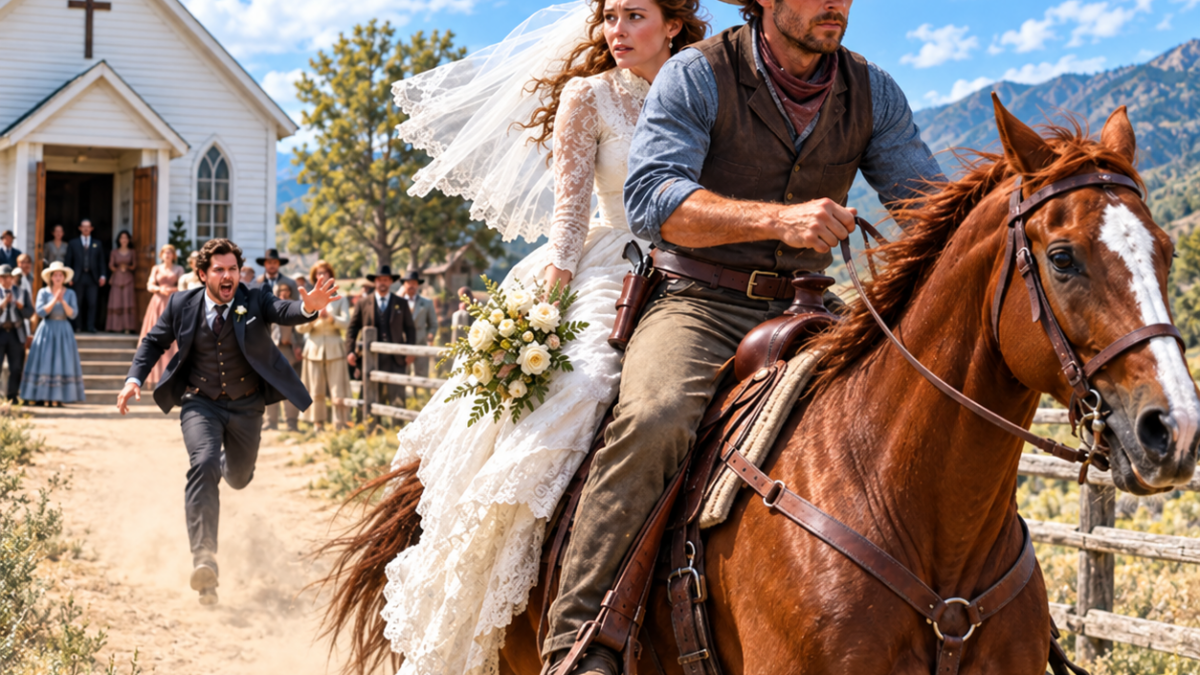
A Bride’s Wagon Broke on Her Wedding Morning, So a Ranch Hand Rode Her to the Church—Then She Heard the Groom’s Secret Plan and Whispered, “Keep Riding.”
Every man in Silver Hollow stepped away when they learned whose daughter Ren Slate was, leaving her alone beside a packed trunk and a ten-dollar debt that would send her back east by sundown.
Only a quiet rancher named Jonah Whitlock put the money on the table, asking for no marriage, no promise, and nothing in return except that the town stop punishing a woman for her father’s name.
Three weeks later, when one of those same families lost a little girl in a blizzard so violent the roads disappeared beneath the snow, the only person who could still read the fading trail was the bride they had all been too afraid to choose.
Wyoming Territory, October 1886.
By the time the afternoon train whistled into Silver Hollow, nearly every unmarried man in town had found a reason to be standing somewhere near the depot.
Some claimed they needed supplies.
Others said they had business with the freight clerk.
One man had apparently spent forty minutes examining a stack of horseshoes outside Harlan’s Mercantile, though everyone in town knew he had purchased horseshoes the week before.
The truth was considerably simpler.
Six women were arriving from Cheyenne under an arrangement organized by the Western Household and Marriage Association, and Silver Hollow contained more lonely ranchers than respectable ways for those ranchers to admit they were lonely.
The agency was not selling women.
The clerk repeated that point twice before the train even finished emptying.
Each woman had voluntarily entered the arrangement.
The agency advanced her rail fare and lodging expenses west.
Any man who wished to formally court one of the women could settle the remaining travel balance directly with the agency.
The woman was still free to refuse him.
The man was free to reconsider.
No marriage was required.
No legal claim changed hands with the money.
It was, as the clerk kept insisting, an introduction arrangement.
Not an auction.
That did not stop half the men present from behaving as though livestock might be inspected.
Ren Slate noticed immediately.
She stepped from the train carrying one small leather case while a porter placed her trunk on the platform.
She was twenty-eight.
Tall enough to look some men directly in the eye.
Dark brown hair pinned simply beneath a travel hat.
Gray-green eyes.
Plain brown dress.
Good boots.
No jewelry except a narrow silver chain at her throat.
She had traveled long enough to recognize the exact moment a room—or in this case a platform—began deciding what kind of woman she was before she spoke.
She had spent most of her life learning how to survive that moment.
So she stood straight.
Hands folded.
Expression calm.
Never defensive.
Never eager.
The agency clerk, Mr. Bell, worked down the list.
“Miss Margaret Lane.”
A blacksmith named Everett Cole stepped forward.
They spoke.
Margaret smiled.
Twenty minutes later, her travel balance was settled.
“Miss Julia Hart.”
Then Clara Finch.
Then Ellen Montgomery.
Then Rose Weaver.
PART2:
Each conversation began awkwardly and ended with at least the promise of another.
Ren watched women who had shared train compartments with her for nearly four days disappear one by one beside men who carried their trunks, offered elbows, asked whether they preferred coffee or tea, and tried very hard to look less terrified than they were.
Rose gave Ren a nervous smile before leaving.
“You’ll be all right.”
Ren nodded.
“I usually am.”
Rose squeezed her hand.
Then she went.
Only Ren remained.
Mr. Bell cleared his throat and checked his ledger.
“Miss Renata Slate.”
The platform changed.
Not dramatically at first.
A conversation stopped.
Someone near the mercantile said, “Slate?”
Another man turned.
Mr. Bell hesitated.
Ren saw recognition spread through the crowd like a match catching dry grass.
“Amos Slate?” someone asked.
She did not answer.
She did not need to.
A rancher in a black hat stepped backward.
Another muttered something to the man beside him.
Ren heard enough.
“Gunfighter’s girl.”
“Thought she’d be older.”
“Wouldn’t bring that trouble onto my property.”
“My brother saw Amos shoot two men outside Laramie.”
“Heard he killed seven.”
“Heard twenty.”
“You believe every saloon story you hear?”
PART3:
“You marry into that name if you want.”
The final sentence came with a laugh.
Nobody laughed with him.
Ren kept her face still.
Amos Slate had been dead for three years.
His reputation remained considerably healthier.
Depending on who told the story, he had been a murderer, hired gun, thief, outlaw, protector, extortionist, cattleman’s enforcer, vigilante, or some combination of all seven.
Ren had stopped correcting people long ago.
Corrections invited questions.
Questions invited stories.
Stories became judgments.
The men on the platform did what men in other towns had done.
They looked at her and saw him.
Not a woman who had crossed three states alone.
Not someone who could mend tack, dress a wound, calculate feed through a winter, shoot accurately enough to put food on a table, or read a storm two days before most people noticed the clouds.
They saw Amos Slate.
One by one, men who had been visibly considering speaking to her turned away.
A widower named Calvin Brooks was pushed jokingly forward by his friends.
He refused.
“No offense, ma’am.”
Ren almost smiled.
Men frequently said “no offense” immediately before offering one.
“I’ve got children.”
“I understand.”
He looked relieved that she had made it easy.
Another man, younger, approached her.
“Your father really Amos?”
“Yes.”
“How many men did he kill?”
Ren stared at him.
“I never counted.”
The young man swallowed and retreated.
By five in the afternoon, every other woman from the train had gone.
Ren’s trunk remained on the platform.
So did Ren.
Across the street, Jonah Whitlock had been watching nearly the entire thing.
He had not come to town for a bride.
That distinction mattered to him.
He had come for flour, lamp oil, coffee, two replacement hinges, a coil of wire, and a new handle for an ax he had broken the previous week.
He had loaded everything except the coffee when the train arrived.
Like everyone else, he had looked.
Then he had stayed longer than necessary.
Jonah was thirty-six years old and owned a small ranch nine miles south of Silver Hollow.
He was not wealthy.
He was not poor enough to inspire concern.
He had forty-three head of cattle, three good horses, one stubborn mule, a house he had built mostly himself, and enough land to keep him busy from before sunrise until well after dark.
He had lived alone for six years.
People had tried to fix that.
Mrs. Callaway once invited him to dinner and accidentally arranged for her widowed cousin to be present.
The reverend’s wife had introduced him to two schoolteachers.
Turley, an old rancher with absolutely no tact, once asked Jonah whether he planned to die unmarried “out of principle or laziness.”
Jonah had not decided.
What he did know was that desperation seemed a poor reason to marry.
So he watched from the mercantile porch as Ren Slate became increasingly alone.
He heard the whispers.
He recognized the name.
Of course he did.
Everyone did.
When Jonah had been fourteen, Amos Slate was already the subject of stories told badly after whiskey.
Some were probably true.
Most had grown considerably since their original telling.
Jonah had no idea which was which.
What he did know was that Amos Slate was dead.
And the woman standing beside the trunk was not.
Mr. Bell approached Ren with an apologetic expression.
“I’m sorry, Miss Slate.”
“For what?”
“The remaining travel fee.”
She already knew.
“How much?”
“Ten dollars.”
Ren looked toward the train tracks.
The return train east would arrive the following morning.
“I don’t have ten dollars.”
Mr. Bell lowered his voice.
“I know.”
She had three dollars and seventeen cents.
He knew that too.
The agency had recorded her funds.
“Can I work the balance?”
“Not through the agency.”
“Then what happens?”
“I’m required to return you to Cheyenne.”
Ren’s face did not change.
Inside, something old and tired settled into place.
Of course.
She had packed the trunk expecting to unpack it.
But she had also packed it the way she always did.
Efficiently.
Everything reachable.
Nothing buried too deeply.
Nothing that would take more than ten minutes to close again.
She had learned young never to assume she would stay.
Mr. Bell looked genuinely uncomfortable.
“I can cover your supper tonight.”
“That isn’t necessary.”
“Miss Slate—”
“I said it isn’t necessary.”
He nodded.
Ren looked across the street.
Several men avoided her eyes.
One or two looked guilty.
Guilt, she had learned, was rarely strong enough to overcome fear.
Then someone stepped off the mercantile porch.
Jonah crossed the road.
He was not imposing.
Average height.
Lean.
Sun-browned face.
Dark hair badly in need of trimming.
A brown work coat patched at one elbow.
Nothing about him suggested wealth, danger, or theatrical courage.
He simply walked to the agency table.
“How much?”
Mr. Bell looked surprised.
“Ten dollars.”
Jonah pulled a small leather purse from his pocket.
Ren’s eyes narrowed.
He counted coins onto the table.
Mr. Bell stared at him.
“Mr. Whitlock?”
“That settles it?”
“Yes.”
Jonah nodded.
“Good.”
Ren stepped closer.
“What exactly do you believe you just purchased?”
Several men nearby suddenly found the conversation interesting again.
Jonah looked at her.
“Nothing.”
“You paid my balance.”
“I did.”
“Why?”
“Because otherwise they send you back.”
“That does not answer why.”
Jonah glanced at the men still lingering.
Some looked away.
He looked back at Ren.
“A man’s sins don’t belong to his daughter.”
Silence.
Ren studied him.
“You know who my father was.”
“I know what people say.”
“And that doesn’t concern you?”
“Some.”
That answer caught her off guard.
“Some?”
“I’d be lying if I said the name meant nothing.”
At least he was honest.
He continued.
“But I don’t know you.”
“No.”
“And apparently neither do they.”
His gaze swept briefly toward the platform.
Several men shifted uncomfortably.
Jonah turned back.
“I’ve never been especially good at watching the wrong thing happen when stopping it only costs ten dollars.”
Mr. Bell cleared his throat.
“There is still the question of lodging.”
Jonah nodded.
“My ranch has a spare room.”
Ren stared.
Jonah held up one hand.
“I’m not asking you to marry me.”
A few men behind them laughed.
Jonah ignored them.
“You can stay a few days. A week if needed. Decide what you want next.”
“And what do you expect?”
“Nothing.”
“Nobody expects nothing.”
“That sounds exhausting.”
“It is.”
Jonah considered her.
“Then maybe you could use a few days somewhere quiet enough to discover whether I’m lying.”
Ren almost smiled.
Almost.
“Suppose I leave.”
“You leave.”
“And the ten dollars?”
“Gone.”
“You would not ask repayment?”
“If you have it someday and it matters to you, fine.”
“And if I don’t?”
“Then I’ll somehow survive the financial catastrophe.”
That did make her smile.
A small one.
He noticed.
She noticed him noticing.
“I need to know where this ranch is.”
“South road. Nine miles.”
“Who else lives there?”
“No one.”
That could have been dangerous.
Ren’s body tensed automatically.
Jonah saw it.
“You can ask anyone in town whether I’m safe.”
“I would rather ask women.”
“Smart.”
He pointed toward the church.
“Reverend’s wife knows me. Mrs. Callaway. Harlan’s wife at the store. Ask all three.”
Ren did.
That delayed them almost an hour.
Jonah did not complain.
Mrs. Callaway described him as “stubborn, dull in company, reliable in bad weather, and incapable of flirting effectively.”
Harlan’s wife said, “He’s decent. Too decent sometimes.”
The reverend’s wife laughed.
“If Jonah Whitlock ever behaves improperly toward you, come tell me and I will personally strike him with a Bible.”
Ren returned to the wagon.
Jonah waited beside her trunk.
“Well?”
“They say you are dull.”
“Cruel town.”
“And apparently safe.”
“I’ll accept that.”
He lifted her trunk into the wagon.
Ren watched how he handled it.
Not opening.
Not asking.
Not making jokes.
Just lifting.
She climbed onto the seat.
Silver Hollow watched them leave.
The road to Jonah’s ranch crossed open country.
For the first two miles, Ren said little.
Jonah seemed comfortable with silence.
That helped.
Eventually he asked, “You hungry?”
“Yes.”
“I should warn you my cooking is mostly designed to discourage starvation.”
“Not enjoyment?”
“That would be ambitious.”
She glanced at him.
“You live alone by choice?”
“I suppose.”
“That sounds uncertain.”
“I’ve had opportunities.”
“And?”
“None seemed fair to either person.”
Ren understood more than she expected.
The ranch came into view near sunset.
Small house.
Barn.
Corral.
Windmill.
A line of cottonwoods near a creek.
Nothing grand.
But cared for.
The house had a porch.
Two chairs.
Ren noticed that immediately.
Inside, it was plainly a bachelor’s house.
Clean enough.
Sparse.
A table with two chairs.
A cast-iron stove.
Hooks near the door.
A rifle above the mantel.
A shelf of books that surprised her.
And two blue-and-white china cups inside the cupboard.
She found them after supper while helping wash dishes.
“Why two?”
Jonah glanced over.
“Two what?”
“Cups.”
“Came as a pair.”
“You live alone.”
“Yes.”
She waited.
“That’s your explanation?”
“It’s accurate.”
Ren dried the cup.
Jonah busied himself with stacking plates.
He was hiding something.
Not sinister.
Embarrassing.
She decided not to press.
The coffee the following morning offered a more immediate mystery.
Ren took one swallow.
Stopped.
Looked at the cup.
Then at Jonah.
“How long has that been on the stove?”
“Since breakfast.”
She looked toward the window.
The sun had barely risen.
“That seems reasonable.”
He drank.
Then Ren noticed the pot had a blackened ring around it.
“Whose breakfast?”
Jonah looked at the coffee.
“Mine.”
“Today?”
A pause.
“Possibly yesterday.”
She stared at him.
“You reheated yesterday’s coffee?”
“Waste seems unnecessary.”
“That isn’t coffee anymore.”
“What is it?”
“I’m not certain.”
He took another drink.
Ren laughed.
The sound surprised them both.
It was the first time she had laughed since before the train reached Wyoming.
Jonah smiled into his cup.
Over the next several days, Ren learned the rhythms of his ranch.
Jonah woke before dawn.
Fed livestock.
Checked fencing.
Worked until hunger forced him inside.
He spoke to horses more easily than people.
He could repair nearly anything if given enough time.
He had a habit of saying “I can manage” immediately before proving he could not.
Ren’s trunk remained closed in the guest room.
Jonah noticed.
On the third morning, he stood in the doorway.
“There are hooks.”
Ren looked up from lacing her boot.
“I see them.”
“For clothes.”
“I understood their function.”
He smiled faintly.
“You could use them.”
“I’m not staying.”
“I didn’t say you were.”
The speed of her answer hung between them.
Jonah nodded toward the trunk.
“That thing will hold up without being ready to flee every morning.”
Ren’s face cooled.
He immediately regretted it.
“Sorry.”
“No.”
She stood.
“You’re not wrong.”
Jonah waited.
Ren looked at the trunk.
“I have lived in sixteen places.”
“In twenty-eight years?”
“In the last seventeen.”
He said nothing.
“My father attracted trouble.”
“That seems to be the popular account.”
“He also believed trouble should be left behind before it reached me.”
“So you moved.”
“Often.”
“Your mother?”
Ren’s jaw tightened.
“Died when I was nine.”
“I’m sorry.”
“My father did what he could.”
People rarely expected her to defend Amos.
Jonah noticed.
Ren continued.
“He was many things.”
“Were the stories true?”
“Some.”
“Which?”
She looked at him.
“You ask questions directly.”
“I prefer answers that way.”
“So did he.”
That did not sound like a compliment.
Jonah leaned against the doorframe.
“You don’t have to tell me.”
Ren’s shoulders relaxed slightly.
“He killed men.”
Jonah stayed silent.
“Sometimes because he had no other choice.”
A pause.
“Sometimes because I think he convinced himself he had no other choice.”
That distinction had cost her years to understand.
“He taught me to shoot before I could cook.”
“Useful combination out here.”
“He taught me how to find water where dry ground lies about having none.”
“More useful.”
“How to ride through the night.”
“How often did you need that?”
“Enough.”
Jonah’s humor disappeared.
Ren looked toward the trunk.
“He taught me not to unpack.”
“Why?”
“Because sometimes people came.”
“For him?”
“Yes.”
“And you left.”
“Usually before morning.”
Jonah looked at the hooks again.
He wished he had never mentioned them.
“You can leave everything in the trunk as long as you want.”
Ren glanced at him.
“Thank you.”
The next afternoon, Jonah tried setting a fence post alone.
Ren watched from twenty yards away.
He dug.
Lifted.
Braced.
The post leaned.
He cursed quietly.
Ren continued watching.
He reset it.
It leaned again.
“I can hold it,” she called.
“I can manage.”
There it was.
Ren folded her arms.
Jonah tried a third time.
The post fell.
She walked over.
“I thought you could manage.”
“I was managing badly.”
She picked up one end.
“Hold it straight.”
“You don’t need to help.”
“I know.”
He looked at her.
She met his eyes.
“I did it anyway.”
Together they set the post in a quarter of the time.
When they finished, Ren brushed dirt from her hands.
“Might do you good to learn that accepting help is not identical to weakness.”
Jonah looked at the perfectly straight post.
“You sound practiced.”
“My father was terrible at accepting help.”
“And how did that work for him?”
“He died with enemies in three territories.”
Jonah nodded.
“Point taken.”
A week later, loose fence wire cut Jonah’s forearm badly enough to expose pale tissue beneath the blood.
He wrapped it in his shirt.
Ren saw him returning toward the house.
“What happened?”
“Nothing.”
“You are bleeding through your sleeve.”
“Minor.”
She grabbed his wrist.
He hissed.
“Sit.”
“Ren—”
“Sit.”
He sat.
She cleaned the wound with boiled water and alcohol.
“You need stitches.”
“I can ride to town.”
“By the time you return, you’ll have bled through another shirt.”
“You stitch?”
She threaded a needle.
“Hold still.”
Jonah watched her hands.
Steady.
Precise.
No hesitation.
“Where did you learn?”
“My father.”
“He taught sewing?”
“Of men, mostly.”
She made the first stitch.
Jonah clenched his jaw.
“Frontier medicine was one of his kinder lessons.”
“What were the less kind ones?”
Ren kept working.
“Running.”
Another stitch.
“Hiding.”
Another.
“Sleeping in places where snakes were preferable to people.”
Jonah said nothing.
“Going hungry quietly.”
She tied the final knot.
“Reading weather because choosing the wrong canyon could kill you.”
She wrapped the arm.
“There.”
Jonah looked at the bandage.
“You’ve done this often.”
“Yes.”
“Was he cruel to you?”
Ren’s eyes rose sharply.
“No.”
Jonah waited.
“He loved me.”
Her voice was firm.
“He simply lived a life where loving someone did not automatically make him safe for them.”
That stayed with Jonah.
So did nearly everything Ren said.
They began spending evenings on the porch.
Sometimes speaking.
Sometimes not.
Ren asked about the second cup again.
Jonah tried avoiding the subject.
She persisted.
“You cannot maintain mystery over crockery indefinitely.”
“I bought the cups when I built the house.”
“Why two?”
He stared toward the sunset.
“I thought I’d have someone.”
Ren’s expression changed.
Jonah shrugged.
“House seemed too big for one.”
“It is small.”
“Felt big.”
“So you expected to marry?”
“Eventually.”
“What happened?”
“Years.”
“That is not an event.”
“It is when enough of them happen.”
She smiled.
“You kept the cup.”
“Throwing it out felt dramatic.”
“So instead you preserved evidence of disappointment for six years.”
“That sounds considerably worse when you say it.”
“It usually does.”
Jonah glanced at her.
“What would you build?”
“What?”
“If you could choose a house.”
Ren laughed.
“I’ve never owned one.”
“That wasn’t the question.”
She thought.
Then, slowly, “Kitchen windows south.”
“Why?”
“Morning light in winter.”
“Practical.”
“A porch.”
“This house has one.”
“Wider.”
“For what?”
“Two chairs without knocking knees.”
Jonah looked down at the porch boards.
“Anything else?”
“A pantry large enough that one bad storm doesn’t make hunger immediate.”
The words slipped out naturally.
Jonah noticed.
Ren looked toward the horizon.
“And a bedroom where I could put a trunk somewhere without keeping it packed.”
He was quiet.
“You have thought about staying.”
“I have thought about houses.”
“Fine distinction.”
“The only kind I have much practice making.”
The third week began with silence.
Not between them.
Outside.
Ren noticed during morning chores.
She stopped carrying a bucket halfway from the well.
Jonah was repairing a gate.
“What?”
She looked toward the cottonwoods.
“Listen.”
He did.
“Nothing.”
“Exactly.”
Jonah frowned.
Ren set down the bucket.
The usual morning birds were absent.
Not entirely.
But fewer.
The air felt wrong.
Wind out of the northwest.
Steady.
Cold without the sharpness that usually accompanied autumn mornings.
Horses restless.
Cattle bunching.
By afternoon, thin ice had formed at the edge of the creek.
Too early.
Ren crouched beside it.
Jonah stood behind her.
“Problem?”
“Yes.”
“What?”
“Storm.”
He looked toward the blue sky.
“No clouds.”
“They’ll come.”
“How bad?”
“I don’t know.”
She touched the ice.
“Bad enough.”
Jonah crouched.
“What are you seeing?”
Ren pointed.
“Birds left yesterday.”
“Happens.”
“Not all at once.”
She nodded toward the pasture.
“Cattle have been pushing toward windbreaks since morning.”
“Cold.”
“Not this cold.”
She stood.
“The wind hasn’t shifted in six hours.”
“So?”
“My father used to say a wind that forgets how to wander is carrying something.”
Jonah smiled faintly.
“Sounds like Amos Slate.”
“He was annoying that way.”
“Did he know weather?”
“He stayed alive outdoors for forty-nine years.”
Fair.
Ren looked at him.
“We should warn town.”
Jonah did not laugh.
That mattered.
Silver Hollow did.
Not everyone.
But enough.
Ren stood inside Harlan’s Mercantile while men gathered.
“Could turn tonight,” she said. “Maybe tomorrow. You need wood indoors. Water drawn. Livestock close. Anyone living far from town should decide now whether they want to stay isolated.”
Mr. Callaway leaned on the counter.
“You’ve been here three weeks.”
“Yes.”
“And you’re warning men who’ve wintered this valley twenty years?”
“Yes.”
A few laughed.
Ren’s face did not change.
The storekeeper spoke more gently.
“Wyoming skies fool experienced men, Miss Slate.”
“They do.”
“So maybe we wait for clouds before declaring disaster.”
Ren nodded.
“That is your choice.”
A voice from the rear interrupted.
“What else?”
Everyone turned.
Old Silas Turley sat beside the stove.
He was seventy if he was a day.
He had lived in the valley before Silver Hollow contained enough buildings to justify a name.
Ren looked at him.
“Ice is forming early along shallow water.”
Turley’s expression sharpened.
“Where?”
“Whitlock Creek.”
“North bank?”
“Both.”
“And horses?”
“Restless.”
“Birds?”
“Mostly gone.”
Turley stood.
“Wind?”
“Northwest. Steady.”
He looked around.
“I’d bring your wood in.”
Callaway scoffed.
“You believe her?”
Turley put on his coat.
“I believe I’m too old to freeze because pride kept me from stacking wood.”
Jonah stepped forward.
“I’ve ranched here six years. Never seen that creek freeze this early.”
“You backing her because she lives with you?” someone asked.
Jonah looked directly at him.
“I’m backing her because I have eyes.”
The laughter died.
“Prepare and nothing happens, you waste half a day.”
He shrugged.
“Don’t prepare and she’s right, you could waste considerably more.”
A handful listened.
Most did not.
Ren and Jonah planned to return to the ranch before dark.
They never made it.
By three, clouds had swallowed the western horizon.
By four, wind screamed down Main Street.
By five, snow flew sideways so thick the end of the street disappeared.
Jonah stood outside the church shielding his eyes.
“We’re not riding nine miles in that.”
“No.”
Ren watched the horses strain against the hitching rail.
“We stable them.”
They moved animals into the livery barn.
The reverend opened the church.
Families living near town began arriving.
Then more.
By nightfall, Silver Hollow was no longer a town.
It was a handful of buildings surrounded by white nothing.
The storm intensified after dark.
Wind found every crack.
Shutters banged.
Roofs groaned.
Snow pressed beneath doors.
The church stove could not safely heat the entire building.
Ren looked around once.
“Close off the sanctuary.”
Reverend Hale blinked.
“What?”
“Too much space.”
She pointed.
“Put families into the back rooms. Children and elderly nearest heat.”
Mrs. Callaway stared.
“We can’t all fit.”
“We fit or we freeze separately.”
Jonah nodded.
“She’s right.”
Within an hour, pew cushions covered floors.
Blankets hung across doorways to trap heat.
Men hauled wood.
Women organized food.
Children slept beneath coats.
Ren showed two teenagers how to pack snow along the windward foundation.
Callaway objected.
“You’re putting snow against the church?”
“It insulates.”
“Snow is cold.”
“So is the air moving through those gaps.”
Turley laughed.
“Do what she says, Callaway.”
He did.
Around midnight, Mrs. Callaway found Ren near the stove.
Her two sons slept nearby.
“I owe you an apology.”
Ren checked a kettle.
“You do not owe me anything.”
“I laughed.”
“So did half the town.”
“My husband too.”
“I noticed.”
Mrs. Callaway lowered her voice.
“You warned us.”
Ren looked at the sleeping children.
“Keep them warm.”
“That’s all?”
“That’s enough.”
By morning, the general store’s rear roof had partially collapsed.
The main food supply sat trapped behind splintered beams and six feet of packed drift.
Jonah organized work teams.
He knew which men owned axes.
Who could lift.
Who panicked.
Who did not.
Ren managed warmth and rationing.
“Four men outside at a time,” she ordered.
Callaway stared.
“We need more digging.”
“You need living diggers.”
“The food—”
“Will still be there after you rest.”
He opened his mouth.
Ren looked at him.
He closed it.
Jonah hid a smile.
“What?”
“Nothing.”
“Say it.”
“You have a way with people.”
“I have a way of frightening men into common sense.”
“Useful skill.”
The storm continued.
Second night.
Then morning.
People began to understand this was not an inconvenience.
It was survival.
Short trips between buildings required ropes tied around waists.
Snow drifted against doors high enough that men dug outward just to exit.
Animals died in exposed corrals.
Chimneys clogged.
Two roofs failed.
Still the church held.
Then, shortly after noon on the second day, the door burst open.
A man stumbled inside nearly blind from snow.
Elias Parker.
His face was white with terror.
“My daughter.”
Everyone turned.
“My girl’s gone.”
His wife screamed from across the room.
Ren moved immediately.
“How old?”
“Seven.”
“When did you see her last?”
“This morning. She was with her brother.”
“What happened?”
“He thought she followed her mother into the back room. We just—God, we just realized.”
“How long?”
Elias shook his head.
“Maybe an hour.”
Ren’s stomach dropped.
One hour in that weather could kill an adult.
A child had far less.
“What was she wearing?”
“Red coat.”
“Boots?”
“Yes.”
“Hat?”
“Blue wool.”
Jonah stepped beside her.
“Where’s the house?”
“East edge.”
“I know it.”
Ren grabbed her coat.
Mrs. Parker caught her arm.
“You can find her?”
Ren looked at the woman.
She did not lie.
“I can try.”
Jonah tied rope around his waist.
“You stay.”
Ren turned.
“No.”
“You can read tracks. I know the ground.”
“I said no.”
“So did I.”
They stared at each other.
This was not the moment to argue.
Turley stepped forward.
“Both of you go or neither. You’ll need each other.”
They went.
Visibility outside was less than twenty feet.
Snow erased their footprints almost as quickly as they made them.
At the Parker house, Ren crouched beside the back step.
Most people saw white.
Ren saw disruption.
A shallow indentation.
A line where loose snow had collapsed differently.
A tiny mark against the side of a drift.
“She came this way.”
Jonah could barely see it.
“You’re sure?”
“No.”
He waited.
Ren looked at him.
“But it’s what I’d follow.”
“That’s enough.”
They moved east.
Ren remembered Amos.
Not the gunfighter people feared.
Her father kneeling beside a trail when she was eleven.
Don’t look for a whole footprint, girl.
Weather steals whole things first.
Look for what the person disturbed.
A broken crust.
A bent stem.
Snow under snow.
She searched.
A depression near a fence.
A small glove snagged on wire.
Ren grabbed it.
Red yarn.
“She was here.”
Jonah shouted into the wind.
No answer.
They continued.
Then the trail disappeared.
Completely.
Ren turned slowly.
Nothing.
Only white.
Jonah leaned close enough to be heard.
“Where would she go?”
Ren closed her eyes.
Seven years old.
Cold.
Frightened.
Wind behind her.
A child would turn away from pain.
Seek walls.
Darkness.
Cover.
“What buildings?”
“Parker barn west.”
“Too far back.”
“Old Jensen place northeast.”
“How far?”
“Quarter mile.”
“Other?”
Jonah thought.
“Abandoned line barn beyond that.”
“Show me.”
They moved.
Ren found no tracks.
She stopped again.
Think.
Her father’s voice returned.
People lost in weather do not think like people sitting warm.
Cold makes choices simple.
Away from wind.
Toward walls.
Toward anything that looks like shelter.
“Line barn.”
Jonah nodded.
They changed direction.
The abandoned barn appeared as a darker shape through blowing snow.
Door half buried.
Jonah dug.
Ren crawled through first.
Darkness.
“Hello?”
Nothing.
Then a sound.
Small.
A whimper.
Ren’s heart stopped.
“Anna?”
A child’s voice.
“Mom?”
Ren nearly collapsed from relief.
The girl had wedged herself behind an old stall partition, wrapped around her knees.
Blue hat gone.
Red coat white with frost.
Awake.
Barely.
Ren dropped beside her.
“Anna, my name is Ren.”
“My feet hurt.”
“I know.”
“I’m cold.”
“I know.”
She touched the girl’s cheek.
Cold, but not waxy.
Still responsive.
Jonah knelt.
“Can we carry her?”
“Yes.”
Ren wrapped Anna inside her own outer coat.
Jonah lifted the girl.
“Stay awake,” Ren said.
Anna’s eyes fluttered.
“My mama mad?”
Ren almost cried.
“No.”
“Sure?”
“She is going to be so happy to see you that you might never be allowed outdoors again.”
The child made something like a laugh.
They returned slowly.
When the church appeared, people poured outside despite the wind.
Mrs. Parker ran.
Jonah handed Anna over.
The mother collapsed around her daughter.
Elias grabbed Jonah.
Then Ren.
He tried speaking.
Nothing came.
Three weeks earlier, Elias Parker had been one of the men who refused even to speak with Amos Slate’s daughter.
Now he was crying into her shoulder.
Ren stood stiffly at first.
Then put one hand on his back.
Anna survived.
Mild frostbite.
Hypothermia.
No permanent injury.
The storm still was not finished.
Neither was Ren.
On the third day, food became the problem.
Church supplies were low.
The store remained inaccessible.
Jonah remembered helping Harlan reinforce the store cellar years earlier.
“There’s an outside coal hatch.”
Harlan shook his head.
“Buried.”
“Where exactly?”
“North wall.”
Jonah drew the building layout from memory.
Ren studied it.
“If we dig here, we approach behind the drift instead of into it.”
Callaway leaned over the table.
“How long?”
“Hours.”
Ren pointed to six men.
“Three working, three warming.”
“We need speed.”
“We need hands that can still hold shovels by sunset.”
Nobody argued anymore.
They dug.
Shift by shift.
Jonah crawled through first when they opened enough space.
Twenty minutes later he shouted from inside.
“Found it!”
Flour.
Beans.
Salt pork.
Coffee.
Molasses.
Enough food to carry everyone through.
Men cheered.
Harlan sat down in the snow and cried.
That evening another emergency arrived.
Young Matthew Crane came in after checking cattle.
His hand was white and stiff.
A neighbor filled a basin with steaming water.
Ren knocked it aside.
“Not hot!”
The man stared.
“He’s frozen.”
“And that will burn tissue he cannot feel.”
She prepared warm water.
Slow warming.
Dry cloth.
No rubbing.
No direct stove heat.
Matthew groaned as circulation returned.
“You sure?”
“No.”
Everyone looked at her.
Ren continued calmly.
“I’m sure this is what I was taught.”
“By your father?” Turley asked.
“Yes.”
Nobody laughed at Amos Slate’s lessons now.
The storm broke on the fourth morning.
Not suddenly.
The wind weakened.
Light appeared.
People stepped outside and stared.
Silver Hollow looked buried.
Snow against roofs.
Fences vanished.
Wagons reduced to white shapes.
But the church still stood.
So did most of the town.
No one had died.
The statement moved quietly from person to person.
No one had died.
Three weeks earlier, they would not spend ten dollars to keep Ren Slate from being put back on a train.
Now children she had kept warm slept beside mothers who had once whispered about her blood.
Men she had instructed dug out chimneys.
A girl she had tracked through a whiteout slept alive in her mother’s arms.
The change was not instant.
Shame rarely transforms people elegantly.
Some avoided her eyes.
Some became excessively kind.
Others offered clumsy apologies.
Ren accepted none dramatically.
She simply helped with cleanup.
Turley found her two days later in the church.
“You got time?”
“For what?”
“Your father.”
Ren’s expression closed slightly.
“You said you knew him.”
“I said I knew of him.”
He sat.
She remained standing.
Turley removed his hat.
“Stories about Amos Slate got easier after he died.”
“Stories usually do.”
“He killed men.”
“Yes.”
“He scared plenty more.”
“Yes.”
“He was not innocent.”
“I know.”
Turley nodded.
“Good.”
Ren almost smiled.
“You think I need convincing?”
“I think children spend half their lives defending fathers and the other half learning they don’t have to.”
That landed harder than she expected.
Turley continued.
“Twenty-five years ago, a land company started buying claims around the northern valleys. Men who refused got threatened.”
Ren listened.
“Amos worked for them at first.”
She knew that.
“Then?”
“He learned what they were doing.”
“What?”
“Burning barns. Cutting fences. Driving cattle off claims. Making small ranchers desperate enough to sell.”
Ren’s jaw tightened.
“My father never told me.”
“Probably because he was ashamed he’d helped them before he understood.”
Turley stared at his hands.
“He turned.”
“Against them?”
“Yes.”
“That is why they hunted him?”
“Partly.”
Ren sat.
Turley looked at her.
“Some men he killed were killers themselves.”
“That doesn’t make every killing right.”
“No.”
She appreciated that answer.
“He also robbed a stage.”
Turley shrugged.
“Probably.”
Ren almost laughed.
“Comforting.”
“I’m not polishing him into a saint.”
“Good.”
“Just telling you one thing.”
“What?”
“A man can do bad things and still have done some good.”
He put his hat back on.
“And people who hated him had reasons to tell only one half.”
Ren sat alone after he left.
For the first time in years, she allowed herself to remember Amos without immediately putting him on trial.
He had sung terribly.
Cooked beans well.
Could braid a rope faster than anyone she knew.
Had once carried her twenty miles when she was sick.
Had killed men.
Had lied.
Had frightened her.
Had protected her.
Had taught her how to survive.
Human.
Complicated.
Dead.
Not hers to repair.
And not hers to become.
The town held a supper after the roads cleared.
Ren tried refusing.
Mrs. Callaway refused her refusal.
“You will attend.”
“That sounds less like an invitation.”
“It is.”
Tables filled the church.
Food everywhere.
Three pies from Mrs. Callaway.
Harlan supplied coffee.
Fresh coffee.
Ren made a point of telling Jonah.
He looked wounded.
“Mine is fresh sometimes.”
“When?”
“Special occasions.”
“This qualifies.”
Anna Parker sat beside Ren for half the meal.
The child had decided Ren belonged to her personally.
Elias Parker stood during dessert.
He held his hat.
“Miss Slate.”
The room quieted.
Ren immediately wanted to leave.
Elias swallowed.
“I owe you more than I can say.”
“You don’t.”
“Yes.”
He looked around.
“I wouldn’t even speak to you the day you arrived.”
Ren said nothing.
“I decided I knew what kind of woman you were because I knew stories about your father.”
His voice cracked.
“Then my girl disappeared.”
Mrs. Parker took his hand.
“And you went into that storm for her.”
Elias looked at Ren.
“I am ashamed.”
Ren stood.
The entire room waited.
She could humiliate him.
A smaller part of her wanted to.
Instead she said, “Then do better next time you meet someone whose story you think you already know.”
Elias nodded.
“I will.”
“That is enough.”
Someone near the back raised a glass.
“Still say Whitlock got the best ten-dollar bargain in Wyoming.”
Laughter broke the tension.
Ren’s face warmed.
Jonah did not laugh.
He stood.
“I didn’t buy a bride.”
The room quieted again.
His voice remained calm.
“I paid ten dollars because sending a woman away for another man’s reputation was wrong.”
He looked toward Ren.
“She owed me nothing then.”
A pause.
“Owes me nothing now.”
Ren stared at him.
Jonah came around the table.
For the first time since she had arrived, he seemed nervous.
Actually nervous.
“I do have a question.”
Turley muttered, “About time.”
People laughed.
Jonah ignored them.
He looked only at Ren.
“Would you stay?”
Her breath caught.
“Here?”
“With me.”
The room disappeared.
Jonah continued before she could answer.
“Not because Silver Hollow needs you.”
She listened.
“Not because you have nowhere else.”
His voice softened.
“Not because of ten dollars.”
Ren thought of the trunk.
Still half packed.
The empty hooks.
The south-facing kitchen she had imagined.
Two cups.
The porch.
Jonah’s terrible coffee.
The fence post.
His stitched arm.
The first man in years who heard Amos Slate’s name and then looked back at Ren.
“Just because you want to,” Jonah finished.
Ren smiled.
“Yes.”
Jonah released a breath.
“Yes?”
“Yes.”
The room erupted.
Ren laughed.
Someone cheered.
Mrs. Callaway cried.
Turley shouted something inappropriate about ten dollars earning excellent interest.
Jonah put his hand over Ren’s on the table.
She turned hers beneath it and laced their fingers together.
That winter, Ren returned to Jonah’s ranch.
This time, the trunk looked different.
It had always stood in the guest room like an animal ready to run.
One evening Jonah added another hook beside the front door.
Ren noticed immediately.
“You added that.”
He kept removing his boots.
“Your shawl keeps ending up on my chair.”
“That bothers you?”
“I sit in the chair.”
“You could move the shawl.”
“I did.”
“So?”
“You put it back.”
Ren smiled.
“And the hook?”
“Practical solution.”
“You are proposing permanent storage space.”
“One hook.”
“A dangerous beginning.”
Jonah looked at her.
“Could remove it.”
“No.”
He left it.
The following week, Ren unpacked the trunk.
Not partly.
Completely.
She folded dresses into drawers.
Hung coats.
Placed her mother’s small photograph on the dresser.
A silver comb beside it.
A book her father had given her.
At the very bottom was Amos Slate’s old neckerchief.
Red.
Faded.
Ren held it for a long time.
Then folded it carefully.
Not hidden.
Not displayed like a shrine.
Simply kept.
When she finished, the trunk was empty.
Jonah passed the room.
Stopped.
Looked.
Said nothing.
Ren glanced at him.
“You may speak.”
“I’m thinking.”
“Dangerous.”
“What do you want to do with the trunk?”
She smiled.
“Barn.”
He nodded.
Together they carried it outside.
Spring came late.
Snow retreated.
Creeks swelled.
Grass returned.
Ren discovered that Silver Hollow looked less hostile in green.
People treated her differently.
Not perfectly.
That mattered.
She did not become a saint because she survived a storm.
The town did not become enlightened because one winter frightened it.
Some people still whispered.
A traveler once recognized the name and asked whether she was “that killer’s girl.”
Before Ren could answer, Mrs. Callaway said, “No. She’s Ren Whit—”
Then stopped.
Ren was not yet Ren Whitlock.
Mrs. Callaway coughed.
“Ren Slate. And if you intend to be stupid about it, buy your supplies elsewhere.”
Harlan stared.
“That is my store.”
Mrs. Callaway shrugged.
“Then you tell him.”
Harlan did.
Jonah proposed in April.
Poorly.
He had apparently planned the moment for a week.
Ren found him behind the barn repairing a harness.
“Ren.”
“Yes?”
“I need to ask something.”
She waited.
He continued working.
“You intend to look at me?”
“I’m considering.”
“This is promising.”
Jonah set down the leather.
He stood.
“I bought the cups before I built the porch.”
Ren blinked.
“That is your opening?”
“I forgot the rest.”
She laughed.
Jonah rubbed the back of his neck.
“The second cup.”
“Yes.”
“I kept it because I thought someday someone might use it.”
“I know.”
“No, I mean really use it.”
He looked embarrassed.
“Every morning.”
Her laughter softened.
Jonah continued.
“I don’t want gratitude.”
“I know.”
“I don’t want you because you saved a town.”
“I know.”
“I don’t care who Amos Slate was except where understanding him helps me understand you.”
Ren’s eyes began to burn.
“And I don’t want you staying because I paid a debt.”
“Jonah.”
“I know.”
He took her hand.
“I just need to say it correctly.”
She let him.
“I love you.”
Simple.
No flourish.
Exactly him.
“I would like you to stay for as long as staying is what you choose.”
Ren squeezed his hand.
“Are you asking me to marry you?”
“Yes.”
“Good.”
“Good?”
“Because otherwise this speech has wandered considerably.”
Jonah laughed.
“Ren.”
“Yes.”
“You haven’t answered.”
She stepped closer.
“I thought I did months ago.”
“Humor me.”
“Yes.”
He kissed her.
No church.
No audience.
No applause.
Just wind through spring grass.
Two horses at the fence.
And an empty trunk in the barn.
They married in May.
The same church that had sheltered Silver Hollow during the blizzard.
Ren wore a cream-colored dress Mrs. Callaway insisted on helping make.
Jonah wore the only suit he owned.
Turley stood near the back.
Elias Parker and his family sat near the front.
Anna threw flower petals with such enthusiasm that the reverend had to step over them.
Before the ceremony, Mr. Bell—the agency clerk who had arrived in town on other business—found Jonah outside.
“Heard you married the Slate woman after all.”
Jonah looked at him.
“In approximately twenty minutes.”
Mr. Bell smiled.
“Ten dollars.”
Jonah groaned.
“You people are never going to stop saying that.”
“Probably not.”
Ren had heard.
She appeared in the doorway behind them.
“Ten dollars was rather cheap.”
Jonah looked at her.
“I knew eventually you’d demand interest.”
“Possibly.”
“What rate?”
“Lifetime.”
Jonah smiled.
“I can manage.”
Ren lifted one eyebrow.
“I have learned to distrust that sentence.”
They married.
No one owed anyone.
That was the point.
The years after were not easy simply because the story deserved a pleasant ending.
Ranch life remained ranch life.
One winter killed cattle.
Another spring washed out fencing.
Jonah broke two ribs when a horse threw him.
Ren sat beside him while Dr. Miller wrapped his chest and told him repeatedly that “I can manage” had now been medically prohibited.
They argued about money.
They argued about land.
Once they argued for three days about whether to build an additional storage shed.
But they never argued about whether Ren belonged.
The kitchen eventually got south-facing windows.
That happened three years into the marriage after Jonah expanded the house.
He claimed the old wall had needed replacement anyway.
Ren knew better.
The porch became wider too.
Two chairs fit without touching.
Later, four.
Silver Hollow began asking Ren for weather advice.
At first, people made jokes.
Then they stopped joking.
If she told ranchers to bring cattle closer, they listened.
If she said the river would rise, sacks appeared near doors.
She was not always right.
That mattered too.
Once she predicted a hard freeze that never came.
Harlan teased her for two weeks.
Ren accepted it.
Knowledge was not magic.
It was observation.
Experience.
Probability.
Her father had taught her that.
“Anyone who claims the wilderness always tells him what comes next is either a fool or selling something.”
That was one of Amos’s better lessons.
Turley continued telling Ren stories.
Not to redeem her father.
To complicate him.
Amos once defended a homesteader.
Amos once robbed a gambler.
Amos once shot a man who was unarmed, though witnesses disagreed over whether the man had been reaching for a hidden weapon.
Ren stopped trying to decide whether the whole of Amos Slate could be placed into one moral box.
He had loved her.
He had frightened others.
He had protected people.
He had harmed people.
All true.
What was not true was that his blood determined hers.
That belonged to her.
Years later, Anna Parker—no longer a seven-year-old lost in snow—came to Ren before leaving Silver Hollow to train as a teacher.
“You know I remember almost nothing from the barn?”
Ren smiled.
“You were nearly frozen.”
“I remember your voice.”
Ren looked at her.
“What did I say?”
“You told me my mother wasn’t angry.”
Ren laughed softly.
“She wasn’t.”
“I thought she would be.”
“She was too busy thanking every saint she knew.”
Anna grew serious.
“My father says you saved me.”
“Your father exaggerates.”
“You found me.”
“Jonah knew the barn existed.”
“You read the trail.”
“We worked together.”
Anna smiled.
“You always do that.”
“What?”
“Make sure everyone gets part of the credit.”
“Usually because everyone deserves part.”
Anna hugged her.
“I’m glad Mr. Whitlock had ten dollars.”
Ren laughed.
“So is Mr. Whitlock.”
Jonah was still teased about it when he was sixty.
One evening, after thirty years of marriage, he and Ren sat on the porch.
The cups were there.
Same pair.
One had a crack repaired with metal staples.
The other had lost a small chip along the rim.
Ren held hers carefully.
“You should replace these.”
Jonah looked offended.
“Absolutely not.”
“They are nearly as old as we are.”
“Unnecessary cruelty.”
“You kept a cup for a woman you had never met.”
“Yes.”
“Why?”
He had answered versions of the question before.
That night he answered differently.
“Hope, I suppose.”
Ren looked at him.
“You were lonely.”
“Yes.”
“Why didn’t you ever say so?”
“Because men are stupid.”
“That explanation covers considerable history.”
Jonah smiled.
“I didn’t know who I was waiting for.”
Ren rested her head against his shoulder.
“And then a notorious gunfighter’s daughter arrived and frightened the whole town.”
“You never frightened me.”
“That is not true.”
He considered.
“The first stitches were alarming.”
She laughed.
Jonah looked toward the fields.
“You know what I remember most about that day?”
“What?”
“Not the name.”
“Not the ten dollars?”
“No.”
“What?”
“Your trunk.”
Ren became quiet.
“You kept one hand on the handle the whole afternoon.”
She had not known he noticed.
“You looked ready to leave before anyone told you to.”
Ren stared into her coffee.
“I was.”
“Then I thought maybe a few days where no one could make you leave might be worth ten dollars.”
Her throat tightened even after all those years.
“You never told me that.”
“Didn’t seem necessary.”
“Jonah Whitlock.”
“What?”
“Thirty years and you are still withholding useful information.”
He kissed the top of her head.
“Some habits survive.”
The trunk remained in their barn.
Eventually it held tools.
Then old blankets.
Later toys belonging to grandchildren.
One summer, their granddaughter Clara found Amos Slate’s old red neckerchief inside a box.
“Who was he?”
Ren sat on the barn floor.
“My father.”
“Was he bad?”
Children ask questions adults spend decades avoiding.
Ren thought carefully.
“He did some bad things.”
Clara frowned.
“Was he good?”
“He did some good things.”
“That doesn’t answer.”
“It may be the truest answer.”
Clara looked confused.
Ren smiled.
“When you’re older, you’ll learn people are often more than one story.”
She touched the red cloth.
“But you are not responsible for the worst thing someone before you did.”
Clara nodded without fully understanding.
Someday she would.
Ren never forgot the platform.
Not the shame.
Not the whispers.
Not men avoiding her eyes.
But those memories lost their power.
Because whenever she remembered standing there beside the trunk while an entire town decided Amos Slate’s daughter must be dangerous, another memory followed.
The same town buried beneath snow.
Mrs. Callaway trusting Ren with her children.
Elias Parker crying when Anna was found.
Men digging where Ren told them.
Families gathered warm inside the church.
Jonah beside her.
Always beside.
That was what changed.
Not merely what people thought of her.
What she thought home could be.
For most of her childhood, home meant wherever Amos said they could safely remain until morning.
A boarding house.
A ranch bunkhouse.
A line shack.
A camp beneath cottonwoods.
Once, a cave.
Twice, freight wagons.
Home had never been a place.
It was temporary permission to sleep.
By the time Ren reached adulthood, leaving had become easier than staying.
Packing easier than unpacking.
Suspicion easier than trust.
The greatest thing Jonah gave her was not ten dollars.
Not a ranch.
Not marriage.
Not even love.
He gave her time without obligation.
A room she could leave.
A hook she did not have to use.
A cup that did not require anything in return.
A place where nobody locked the door behind her and called it protection.
She stayed because she could leave.
That was the difference.
Silver Hollow eventually stopped introducing her as Amos Slate’s daughter.
It took years.
But one day Ren noticed someone say to a traveler:
“That’s Ren Whitlock. Best weather eye in the valley.”
No mention of Amos.
She did not realize until later how much that mattered.
Jonah did.
That evening he poured coffee.
Fresh.
Mostly.
“You’re smiling.”
“No.”
“You are.”
“Harlan called me Ren Whitlock today.”
“That is generally your name.”
“He didn’t mention Father.”
Jonah stopped.
Then understood.
He raised his cup.
“To being considerably less interesting than one’s ancestry.”
Ren tapped hers against it.
“I’ll drink to that.”
She lived long enough to see Silver Hollow grow.
Rail traffic increased.
The mercantile expanded.
A proper schoolhouse replaced the small room where children once studied.
The old church was repaired twice.
People who survived the blizzard told the story differently depending on who was speaking.
Some said Ren Slate saved Silver Hollow.
Ren disliked that version.
Too simple.
She had not carried every child.
Had not dug every drift.
Had not repaired roofs or hauled every piece of wood.
Jonah knew the buildings.
Turley recognized the danger.
The reverend opened the church.
Mrs. Callaway organized children.
Men dug.
Women cooked.
Everyone contributed.
What Ren had done was notice.
Warn.
Organize.
And refuse to panic.
That was enough.
Sometimes the greatest difference between tragedy and survival is not one hero doing everything.
It is one person seeing danger early enough to help everyone else do something.
That was the truth Ren preferred.
Still, at town suppers, someone eventually made the joke.
“Ten dollars!”
Jonah would groan.
Ren would smile.
Then someone would raise a glass.
“To the best ten dollars ever spent.”
Jonah corrected them until the end of his life.
“I didn’t buy her.”
Everyone knew.
That was why the correction mattered.
He had paid a fare.
Not a price.
He had opened a door.
Ren had chosen whether to walk through.
And decades after that afternoon, when strangers occasionally heard the shortened version and said, “So he paid ten dollars for a bride?” Ren always corrected them too.
“No.”
She would smile.
“He paid ten dollars so I would have somewhere to go while I decided what I wanted.”
That difference contained their entire life together.
Because no person becomes yours simply because you helped them.
No kindness creates ownership.
No debt becomes love because it is dressed in romance.
Jonah expected nothing.
So eventually Ren could give him something freely.
Herself.
Her trust.
Her future.
Her decision to stay.
And Silver Hollow learned something similar.
They rejected Ren because of a man who was already dead.
Then depended on skills that same man had taught her.
Not his gun.
Not his violence.
His knowledge.
Weather.
Cold.
Tracking.
Wounds.
Survival.
Amos Slate left his daughter a complicated inheritance.
Fear.
Skill.
Memories.
A name people distrusted.
But he did not decide who Ren became.
Neither did Silver Hollow.
Neither did Jonah.
Ren did.
Years after the great blizzard, another storm crossed the valley.
Nothing as severe.
Heavy snow.
Strong wind.
Enough to keep people indoors.
Ren woke during the night.
Habit.
She walked to the window.
Jonah stirred.
“Storm?”
“Yes.”
“Bad?”
“No.”
“You sure?”
She watched the snow.
“Fairly.”
Jonah pulled the blanket higher.
“You coming back to bed?”
Ren stood another moment.
The wind pressed snow against the glass.
She thought of her father waking her in the dark.
Pack.
Move.
Now.
Always ready.
Always leaving.
Then she looked around the bedroom.
Clothes hanging openly.
Boots beside the wall.
Family photographs.
A dresser too large to move quickly.
The old trunk long gone from this room.
Nothing packed.
Nothing waiting.
Ren returned to bed.
Jonah’s hand found hers beneath the blanket.
She closed her eyes.
Outside, the storm continued.
Inside, Ren Slate did something that had taken nearly half her life to learn.
She stayed asleep.
Because home, she finally understood, was not the place where danger could never reach you.
There was no such place.
Home was the place where you no longer spent every peaceful night preparing to run.
It was a second cup used every morning.
A hook beside the door.
A porch wide enough for two chairs.
A man who paid ten dollars and expected nothing.
A town that once feared your name and eventually learned your own.
And a life that belonged to you because, for the first time, staying had become a choice rather than a sentence.
The people of Silver Hollow spent years saying Jonah Whitlock had made the best ten-dollar trade in Wyoming.
They were wrong.
There had never been a trade.
Jonah had not purchased a bride.
He had purchased a stranger one small piece of freedom.
And Ren Slate, once free to choose, gave him something no amount of money could ever have bought.
She unpacked her trunk.
She filled the second cup.
And she stayed.








