A Boy Was the Only One Who Understood What the Stroke-Stricken Hells Angel Was Trying to Say
PART3:
He drew crude pictures on napkins.
A motorcycle.
A clock.
A house.
A dog.
A wheel.
A road.
A hand.
He let Roland point, tap, draw over them, or make the same broken sound four times until it finally cracked open into something Levi could understand.
It was slow work.
Some days it was humiliating.
Levi could see that.
Roland would squeeze his eyes shut when a simple word refused him. His jaw would tremble. His good hand would curl into a fist on the table, not from anger at Levi, but from rage at the invisible wall inside his own body.
Levi never flinched.
Never looked away.
Never finished a sentence Roland had not finished himself.
That, more than anything, was the thing nobody else in Elko had thought to offer him.
June Kesler worried at first.
“You’re spending a lot of afternoons with that man,” she said one evening while folding laundry at the kitchen table.
Levi kept pairing socks.
“He’s trying to tell somebody something.”
“I know you mean well, baby, but he’s not going to get better just because you sit with him.”
“He’s not trying to get better.”
June paused.
Levi looked up.
“He’s trying to tell somebody something,” he repeated. “Nobody lets him finish.”
June did not have an answer for that.
Her son was ten years old, stubborn, certain, and somehow more patient than half the adults she knew.
So she let him keep going.
Gus Landry pushed harder.
He liked Levi fine. He liked Roland too, though liking someone did not stop a man like Gus from worrying about business. Two separate customers had asked quietly whether the Hells Angel fellow was going to be a permanent fixture, because his broken talking made tourists uncomfortable on their way to the Ruby Mountain trailheads.
“It ain’t personal, Roland,” Gus said one morning while refilling coffee himself and not quite meeting the old man’s eyes. “But you understand how it looks.”
Roland understood exactly how it looked.
That was the trouble.
Everyone thought he did not know what had happened to him from the outside.
He knew.
He saw the way strangers softened their voices as if volume were kindness. He saw men who had once asked his judgment now pat his shoulder and move on because waiting made them uncomfortable. He saw Gus’s pity. He saw the club’s awkwardness. He saw people decide, with good intentions and quick glances, that the man he had been was mostly gone.
But Levi was slowly learning that Roland Duffield had spent his whole working life listening to things other people missed.
He found out almost by accident.
One Thursday, Roland brought a shoebox of photographs into the diner inside one of his old saddlebags. The box looked worn at the corners, held together by a rubber band. He placed it on the table with the care of a man setting down something breakable.
Levi opened it only after Roland nodded.
There were pictures of motorcycles, desert roads, a woman with kind eyes who appeared over and over again in different years, and one black-and-white photo of a much younger Roland in an Air Force uniform.
“That’s you?” Levi asked.
Roland nodded.
Levi picked up another photo: a control tower baking under tropical sun.
Roland tapped the picture.
Then tapped his own ear.
He made a sound that took Levi almost a full minute to untangle.
“Tower?” Levi guessed.
Roland nodded hard.
Perry Lofton, the club’s road captain, happened to be in the booth behind them waiting on his order. He leaned over, not unkindly.
“Man ran a control tower for going on forty years, kid. Air Force first, then civilian out at J.C. Harris Field right here in town until retirement. Best ears in Elko County.”
Roland looked down, jaw tight.
Perry continued, either not noticing or not knowing how to stop.
“Roland Duffield could tell you a plane had a rough engine bearing from the pitch coming in over the Rubies before the pilot even knew something was wrong.”
Perry shook his head.
“Funny how a man spends his whole life listening for what everybody else misses and now can’t get anybody to listen to him for two straight minutes.”
Roland closed the shoebox gently.
The way a person closes a door on a room he is not ready to enter.
Levi did not say anything then.
But the sentence stayed with him.
Best ears in Elko County.
The club, meanwhile, was preparing for the biggest date on its calendar: the ninth annual Wheels for Kids poker run.
Forty riders would leave from the clubhouse on Silver Street, ride down Idaho, loop out along the scenic stretch toward Lamoille Canyon, and return to deliver a check to the pediatric wing at Northeastern Nevada Regional Hospital.
Roland’s favorite day of the year.
Or it had been.
This year, club president Max Sorenson had suggested Roland ride in a support truck instead of on two wheels.
He said it gently.
He said it in front of Roland, as though Roland were not fully present to hear it.
“Man had a stroke, Perry,” Max said later out in the gravel lot. “We keep pretending nothing changed, somebody’s going to get hurt. Him most likely.”
The rider Max had chosen to run advance that year was Jesse Talmage.
Twenty-eight.
Youngest full-patch member in the chapter.
Fastest rider by far.
Jesse had run the Lamoille Highway loop two years in a row without so much as scuffing a peg. He was careful in the way fast men were careful when they trusted themselves more than age allowed. He liked Roland. Everybody did, underneath the awkwardness. But Jesse was busy, young, and a little embarrassed by how hard it was to stand still and watch a grown man struggle to order coffee.
So he kept his visits short.
Kept his eyes on his phone.
Clapped Roland’s shoulder.
Moved on.
It was easier that way.
And Jesse Talmage, like most of Elko that summer, had no idea that Roland had spent three nights walking slow circles around Jesse’s parked Road King in the clubhouse garage with a work light in his good hand, staring at the rear wheel the way he used to stare at a radar screen when the numbers did not add up.
Roland had heard it first.
Not seen it.
He had been in the garage late, wiping down tools because his hands, at least, still remembered what to do. Jesse’s bike had been rolled in hot after a highway run, metal ticking as it cooled. Another man might have heard ordinary settling.
Roland heard wrongness.
A faint rhythm under the rhythm.
A whispery softness in the tire rotation when Jesse pushed the bike back into place.
Not a flat.
Not worn tread.
Something underneath.
Something on the sidewall.
A weakness that hid unless pressure, speed, heat, and curve all decided to meet at once.
Roland tried to tell Max the next morning.
The word would not come.
He tried Jesse.
Jesse smiled, checked his phone, and said, “Later, brother.”
He tried Perry.
Perry guessed three different things, all wrong, then said, “We’ll get you coffee.”
Every day that passed was one day closer to the poker run.
Every day nobody understood him, Roland felt the old panic of a control tower with a warning trapped inside a dead radio.
By the third week of June, Levi had built something close to a real vocabulary with Roland.
Not words exactly.
A system.
Patient and slow.
Gestures, drawings, half sounds, taps, pauses, and the shared agreement that silence was not empty just because adults feared it.
Levi knew Roland had grown up in a farm town in eastern Nevada.
Joined the Air Force at eighteen.
Spent part of his twenties at a base in Panama.
Married Dorothy, the woman in the photographs, and lost her five years earlier.
Levi knew the ache of Dorothy’s absence crossed Roland’s face sometimes with such total force that no translation was needed.
He also knew, with growing certainty, that Roland was trying to tell someone about a motorcycle.
One Saturday morning, Levi spread a fresh napkin between them.
“Show me again.”
He drew six shapes in a row.
A wheel.
A chain.
A mirror.
A headlight.
A seat.
A brake lever.
Roland’s good hand hovered.
Then came down hard on the wheel.
He tapped it four times.
Then he made a shape with his thumb and forefinger, a small gap, and dragged his fingernail slowly along an invisible curved line on the table. His mouth worked. His face reddened. The sound came out broken and wrong.
His hand slapped flat, frustrated beyond trying.
“Cracked,” Levi said slowly. “The wheel’s cracked?”
Roland went very still.
Then he shook his head.
Not quite.
He dragged the invisible line again, this time along the side of his own thumb, showing Levi the curve of it.
Not a crack straight across.
Something along an edge.
It took two more days before Levi understood, and even then only by accident.
June’s boyfriend’s old truck blew a tire on Highway 225. Nobody was hurt, but June spent twenty minutes on the phone describing the exact way the sidewall had bulged and split before it let go.
Levi, sitting at the kitchen table with cereal gone soggy in front of him, went still.
“Sidewall,” he said aloud.
June looked over.
“What?”
But Levi was already reaching for a napkin.
The next afternoon, he brought a fresh drawing to the diner.
A single tire in cross-section.
He pointed to the outer edge.
The bulge.
The weak spot.
Roland’s whole face changed.
His good hand came down on the drawing so hard the pencil jumped.
He nodded over and over, throat working, tears standing unashamed in his eyes because after five months, someone had finally heard the whole sentence.
“Whose bike?” Levi asked. “Which one has the bad tire?”
That was where it broke down completely.
Roland knew the answer.
Levi could see it sitting behind his eyes, whole and certain.
It simply would not come.
He tried a name.
Four different ways.
Each attempt collapsed into the same tangled syllable. By the fifth try, his good hand was shaking with something beyond frustration.
Fear.
Whoever it was, Roland was afraid for them specifically.
Levi’s stomach turned cold with the sense that time was running out.
He tried bringing it to his mother that night.
A biker.
A tire.
A napkin drawing.
A bad sidewall.
A man who could hear things other people missed.
Even Levi could hear how thin it sounded.
June’s patience finally cracked.
“Levi, honey, I love that you care about him. I do. But you’re ten. You can’t go around telling grown men their motorcycles are broken based on a game you made up with a man who can’t finish a sentence.”
Levi looked down.
June softened immediately.
“I’m not saying you’re wrong to care. I’m saying this isn’t something you can fix by yourself.”
For the first time since May, Levi doubted himself.
That night, lying awake in his narrow bed, he ran through every napkin, every sound, every half-formed word. A small, cruel voice in his head asked whether he had imagined the whole thing. Maybe he had filled in blanks like the adults did, just slower and kinder.
Maybe there was no bad tire.
Maybe there was just an old man and a lonely kid and a story they had built together because they both needed one.
He almost did not go back Sunday.
But he did.
Roland was waiting in the same booth.
The shoebox of photographs sat open in front of him. He had placed one new picture on top: himself decades younger, standing beside a young airman in front of a tower, one hand clapped on the younger man’s shoulder, both of them grinning.
Underneath it, in shaking pencil that Levi later learned had taken nearly forty minutes to produce, Roland had written three words.
I still hear.
Levi looked up.
Roland’s eyes were steady.
For once, his hand was not trembling.
“Okay,” Levi said quietly. “Then let’s find out whose bike it is.”
He did not tell his mother that part.
Not yet.
He was not sure he could explain it in a way that would not sound as thin as before. Some stubborn ten-year-old certainty inside him decided that the only way through this was to get the whole answer first and the belief of the grown-ups second.
Saturday, July fifth, dawned clear and already warm.
By 7:30, the gravel lot behind the clubhouse on Silver Street was a churn of engines, coolers, coffee, leather, dust, and forty riders checking mirrors, saddlebags, tire pressure, and route cards for the ninth annual Wheels for Kids poker run.
Levi had begged June to let him watch the sendoff.
She agreed mostly to prove gently, as she told herself, that nothing was wrong.
Roland was there too, seated in a folding chair near the clubhouse door where Max had suggested he wait for the support truck.
From the moment Levi spotted him across the lot, he could see something in Roland had changed overnight.
His good hand gripped the arm of the chair like he meant to leave a print in it.
His eyes were fixed on a red-and-chrome Road King parked nose-out at the front of the staging line.
Engine idling.
Saddlebags strapped.
Ready for the solo advance run down Lamoille Highway.
Roland had been sitting in that same folding chair since six that morning, waiting for someone to walk close enough so he could try again.
Three riders had already stopped to say good morning.
Three times Roland had opened his mouth, felt the word rise behind his teeth, and watched it die while the rider smiled, patted his shoulder, and moved toward coffee.
Behind the clubhouse, an engine revved twice.
Every muscle in Roland’s chest pulled tight as a winch cable.
Jesse Talmage was going to leave in less than ten minutes.
Jesse Talmage’s bike.
Levi’s stomach dropped straight through the gravel.
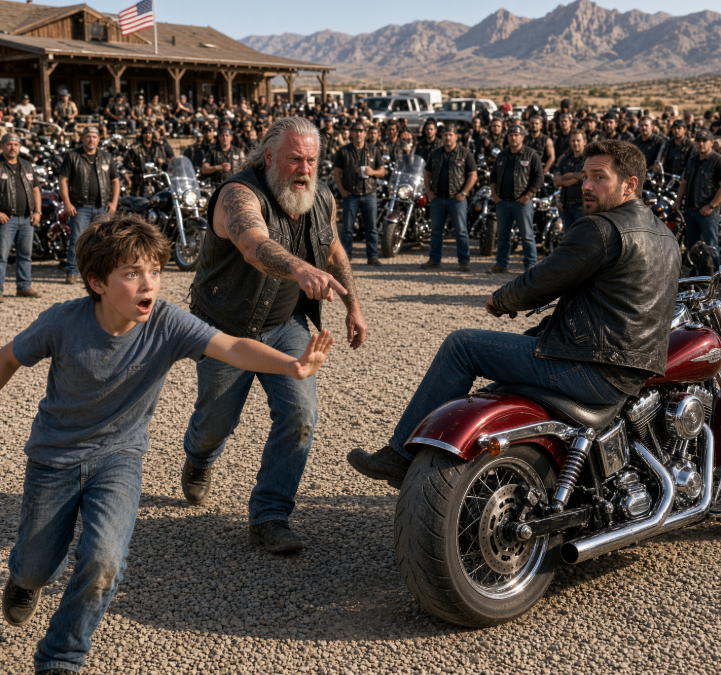
He ran.
“Wait!” he shouted, cutting between two parked Harleys and ignoring his mother calling his name behind him. “Wait, don’t go yet!”
Jesse, already swinging a leg over the seat, looked down with the mildly baffled patience of a grown man being interrupted by a kid he barely knew.
“Whoa. Easy there, little man. What’s up?”
“Your tire,” Levi said.
The words tangled.
Panic did to him something almost like what the stroke did to Roland.
He stopped.
Breathed.
Slowed down.
The exact thing he had spent two months teaching someone else to do.
“Roland’s been trying to tell everybody for weeks,” Levi said. “Your back tire has a bulge in the sidewall. It’s going to blow.”
Jesse looked past Levi toward Roland’s chair.
Roland had gotten to his feet.
He was limping across the gravel as fast as his right leg would allow, his good hand chopping the air in short, urgent strokes toward the Road King’s rear wheel.
“Buh—buh—blo—”
His bad knee buckled.
He caught himself.
His face went red with effort.
“Blow,” Roland said.
The word tore loose whole for the first time in six months.
Raw.
Ragged.
Unmistakable.
“Blow. Highway. Blow.”
For one long second, nobody moved.
Jesse looked at Levi.
Then at Roland, red-faced and straining, closing the distance with a desperate lurching speed that looked, to anyone who had not spent two months learning to see past it, exactly like the confusion everyone had already decided to find in him.
“Come on, man,” Jesse said, not unkindly, glancing at his watch. “I checked it myself Thursday. I gotta roll. We’re already—”
“He’s not confused,” Levi shouted.
Heads turned along the staging line.
“He was an air traffic controller for forty years. He can hear things nobody else can hear, and he’s been trying to tell you this for two weeks, and everybody just keeps walking away before he finishes.”
June had caught up by then, out of breath, one hand already reaching for Levi’s shoulder to pull him back and apologize.
That was her first instinct.
She would admit it later.
Pure reflex.
The same reflex the whole lot was running on.
But something in Levi’s voice stopped her hand halfway.
She had never heard her son sound like that.
Not scared.
Certain.
“Levi,” she said, quieter than she meant to. “Are you sure?”
“I’m sure,” Levi said, not looking away from Jesse. “Just give him five seconds. Please. Just watch him instead of waiting for him to finish so you can talk again.”
Gus Landry, who had driven over from the diner with a tray of coffee for the sendoff, set the tray down hard on a tailgate and strode over.
Deputy Grant Osmond, parked at the corner of Silver and Idaho to hold traffic for departure, climbed out of his cruiser.
A tight knot of riders gathered around the Road King.
Roland reached the bike, breathing hard.
He dropped to one knee beside the rear wheel.
His bad knee.
The one that still buckled without warning.
He dragged his good hand along the sidewall until his fingers found the spot and stopped.
Then he looked up.
He did not try to speak again.
He simply pressed Jesse’s hand gently, insistently, down onto the same place in the rubber.
Jesse went still.
Under his fingers, just above the wear line, the sidewall gave in a way rubber that thick should never give.
A soft, spongy bulge no wider than a thumbprint.
The kind of flaw that hid perfectly beneath a quick glance and full tread.
The kind that could let go completely around mile eleven of Lamoille Highway at speed, on a blind curve above the canyon, with a two-hundred-foot drop beyond the outside shoulder.
“Oh my God,” Jesse said quietly.
He looked at Roland, and something in his face cracked open.
“Oh my God, Roland. I’m sorry. I’m so sorry I didn’t—”
Roland shook his head, cutting him off.
For the first time in six months, the gesture was not frustration.
It was forgiveness.
Plain.
Immediate.
Offered before the apology had even finished.
It was 8:14 in the morning.
Max Sorenson killed the sendoff on the spot.
He pulled the whole staging line back into the lot and ordered two men to walk every bike tire by tire before anyone was allowed onto Idaho Street.
Deputy Osmond crouched by the Road King’s wheel with his flashlight and let out a low whistle.
“I’ve seen blowouts on Highway 80 from exactly this kind of hidden sidewall failure,” he said. “Whoever caught this probably saved somebody’s life.”
Nobody answered.
Everyone already knew who had caught it.
The inspection turned up one more surprise.
A second bike, three back in line, had a rear brake line worn nearly through against a loose bracket bolt.
Nobody had asked Roland about that one.
He simply stood at the edge of the huddle, watching the mechanic’s hands work, and nodded once when the frayed line came free.
The way a man nods when a diagnosis he already knew finally gets confirmed by someone else.
Max found him there a few minutes later, looking at the two disassembled wheels laid out on a tarp like evidence at a trial nobody had wanted to hold.
“I told you to sit in a truck today,” Max said.
Roland’s mouth worked slowly.
This time, nobody rushed him.
“Good thing,” he said, the words thick but clear enough, “he managed. I didn’t.”
It was the first joke anyone had heard him make since January.
The laughter that followed did not come all at once.
It started with Perry.
Then Jesse.
Then Gus, standing at the edge of the crowd with his forgotten coffee tray and his face doing something complicated around the eyes.
“Well,” Gus said to nobody in particular, “would you look at that?”
He went to find Roland a cup of coffee himself.
The Wheels for Kids poker run left two hours late that year.
Nobody complained.
Not once.
Not even the families waiting outside Northeastern Nevada Regional Hospital for the check the club delivered every summer.
Jesse rode the advance leg on a borrowed bike, his own Road King trailered behind the support truck for a proper tire replacement back at the shop. He took the Lamoille Highway curves slower than he ever had before, close enough to the canyon wall to feel the drop on the outside shoulder without looking down.
By the time he pulled into the hospital lot, dusted and pale in a way he would deny later, something in the way he rode had changed.
None of his brothers could quite name it.
Every one of them noticed.
At the hospital, a seven-year-old named Marissa, three weeks out from open-heart surgery, sat in a wheelchair in the shade by the entrance and got to be the one who handed the poker run check to the hospital administrator, the way a child did every year.
She asked Jesse shyly if it was true that someone had really saved his life that morning.
Jesse crouched beside her wheelchair.
“Yes,” he said. “It’s true.”
“Who?”
“An old man everybody almost stopped listening to.”
Marissa considered this with the seriousness only a seven-year-old recovering from heart surgery could summon.
“Grown-ups do that to me all the time too,” she said.
Jesse had no answer for that except the right one.
“You’re right,” he said. “It isn’t fair. I’m going to try to do better.”
By the time the last bike rolled back into the clubhouse lot that evening, dust-caked and triumphant, the story of the morning had already made its way through every rider in the chapter.
It was told and retold until it had the polished shape of something that would be repeated for years at every Wheels for Kids run to come.
Jesse told it the most.
He told it the same way every time, standing the ruined tire against the clubhouse wall like evidence, running his thumb over the bulge for anyone who had not seen it for themselves.
Roland did not correct any of the tellings.
He sat in his usual folding chair near the door, Levi cross-legged on the gravel beside him, and let the club come to him instead.
One by one.
The way they had not for six months.
Max crouched in front of him first.
“I had you ride in a truck today,” Max said. “I’m not going to make that mistake again.”
Roland looked at him steadily.
“Whatever you see,” Max continued, “however long it takes you to say it, we’re going to wait and hear the whole thing from now on. All of us. That’s not a favor, Roland. That’s how it should’ve been from the start.”
Perry made him honorary road captain on the spot, only half joking.
He tried to pin something to Roland’s vest, but Roland waved off the ceremony with an embarrassed flap of his good hand.
The title stuck anyway.
By August, every rider doing a pre-run check swung by Roland’s garage first, held up whatever part worried them, and waited.
Really waited.
No guessing.
No filling silence.
No finishing his sentence before he had fought his way through it.
That evening, Perry sat beside Roland’s folding chair with a beer he was not drinking.
“How’d you even catch it, brother?” he asked. “Tire looked fine to the rest of us. Looked fine to Jesse, and that boy checks his bike closer than most men check their marriages.”
Roland was quiet for a long moment.
Everyone waited.
The porch light hummed.
A dog barked somewhere down the street.
Levi looked up at Roland but said nothing.
Roland worked the words the way Levi had taught him to work them: slowly, without shame, without letting anyone steal the sentence just to make the silence easier.
When he spoke, it came broken in places.
Looping twice before it straightened out.
But every person on that porch leaned in and stayed leaning until he was done.
“Forty years,” Roland said. “Listen for the thing under the thing.”
He tapped his own ear.
“Radio. Engine. Man talking who don’t want you knowing he’s scared.”
He touched his chest.
“Stroke took my mouth. Didn’t take my ears.”
Nobody moved.
Roland looked down at Levi, and something in his weathered face went soft in a way none of them had seen since Dorothy died.
“Everybody hears broken talk,” he said. “Thinks it means broken mind.”
He shook his head slowly.
“Ain’t the same thing. Never was.”
Silence held the porch.
Not awkward this time.
Honest.
Then Gus Landry cleared his throat from the edge of the light.
“Man’s got a permanent booth waiting tomorrow morning,” Gus said. “Both of them do, matter of fact. Corner booth is on the house as long as I own the place.”
He looked sheepish toward Roland.
“Should’ve offered that a long time ago. Sorry it took near getting somebody killed for me to sit still long enough to listen.”
Roland reached out and shook Gus’s hand.
Held it a beat longer than a handshake usually lasts.
Everyone understood what that meant.
Forgiven.
The same way he had forgiven Jesse that morning.
The same way Roland seemed to have decided sometime in the last six months that holding a grudge took more words than he had left to spare.
Nancy Pitt, Roland’s speech therapist, heard about it two days later when Roland showed up for his regular session ten minutes early for the first time since starting therapy.
She had come out from Spring Creek expecting the same plateau she had been documenting for months.
She left rewriting her whole assessment.
A man who could track a hidden flaw in a rubber sidewall by feel and sound had every faculty he had ever had. He simply needed the world to slow down enough to receive it.
“I was wrong to talk about moving you into higher support,” she told him plainly.
Roland sat across from her.
His mouth worked.
Nancy waited.
This time, really waited.
“Most people were,” he said finally. “Not your fault. Habit.”
Nancy blinked hard.
Then wrote that down too.
June Kesler came to collect Levi a little after nine that night and found her son still cross-legged on the gravel, half asleep against the leg of Roland’s folding chair.
The shoebox of photographs sat open between them.
A new picture had been added to the top.
Levi and Roland, taken by Perry on somebody’s phone that afternoon, both squinting into the sun, both grinning the exact same crooked grin.
June crouched and gathered Levi’s jacket.
“I’m sorry I didn’t believe you,” she said quietly. “I should have.”
Levi mumbled, already half into sleep.
“It’s okay. Nobody did at first.”
His eyes closed.
“That’s kind of the whole thing.”
June looked up at Roland over her son’s head.
Roland looked back.
Neither needed words for what passed between them.
Monday morning came ordinary as any other.
The sun climbed slow over the Rubies.
At seven sharp, Gus Landry unlocked the front door of the Silver Spur Diner, flipped the sign to OPEN, and set two clean mugs down in the corner booth before a single customer had asked for coffee.
One for the man who was finally being heard.
One for the boy who had never stopped listening in the first place.
When Roland came in, he paused at the door.
Old habits made half the diner glance up.
Then, one by one, people did something different.
They did not look away.
They did not rush to pity him.
They did not soften their faces into that awful expression that made him feel like a memorial to himself.
Gus lifted the coffee pot.
“Morning, Roland.”
Roland nodded.
Levi arrived ten minutes later with his backpack dragging off one shoulder and a fresh stack of napkins already stolen from the dispenser before June could tell him not to.
He slid into the booth across from Roland.
“You got anything today?”
Roland’s mouth moved.
His good hand tapped once on the table.
Levi waited.
Roland looked toward the window, where a pickup passed with a squealing belt loud enough to make him wince.
He lifted one finger.
“Alternator,” he said slowly.
The word came out rough.
But complete.
Levi grinned.
“Thought so.”
Roland smiled into his coffee.
Outside, traffic moved along Idaho Street.
Motorcycles sat in the gravel lot, no longer ordinary in quite the same way.
The whole town would keep telling the story of the poker run and the hidden sidewall and the boy who stopped a bike from leaving.
They would tell it loudly because loud stories were easier.
But the truer part was quieter.
It was a ten-year-old sliding into a booth and saying, Try it slow.
It was an old man flexing painful fingers because somebody had finally given him a reason to keep trying.
It was a diner learning that silence was not empty.
It was a club learning that respect did not mean patting a man’s shoulder and walking away before he finished.
And it was Roland Duffield, stroke-stricken but not broken, sitting in the corner booth with coffee warming his hands, finally surrounded by people willing to wait long enough to hear the thing under the thing.
Because his mouth had failed him.
His body had betrayed him.
But his mind had never left.
His ears had never stopped working.
And one boy, too young to know what adults considered impossible, had listened long enough to save a man’s life.








