A Boy Suddenly Pulled a Hells Angel From His Motorcycle—Seconds Later, 700 Riders Realized Why, and What They Did Next Left Everyone on the Road in Tears
PART3:
My brothers climbed off their bikes, stretching, laughing, reaching for wallets, complaining about heat, fuel, old hips, road dust, and the kind of subjects men talk about when nothing needs saying.
I was last to dismount.
I rode a matte black Harley with chrome accents, a bike I knew better than some people know their own kitchens. Nine years with that machine. I knew how it sounded cold, how it sounded climbing, how it idled when the air was thin, how the grips felt when the front tire picked up rain grooves.
I swung my leg over and felt that wrongness again.
Sharper now.
I pressed my right hand against my face and walked toward the curb at the far end of the station.
Someone laughed near the pumps.
Someone cursed at a card reader.
Roy Stanton still watched from the doorway.
I bought a bottle of water from the machine and sat down on the curb without opening it.
That was not like me.
On a long ride in August, water is not optional. You drink before thirst makes a point of itself.
But I set the bottle beside me and leaned forward, elbows on knees, head in my hand.
Across the lot, the woman near the minivan tightened her hand around her son’s wrist.
I noticed without looking directly.
A half step back.
A body angled between child and perceived threat.
I had seen that movement for decades.
At twenty, it made me angry.
At thirty, it made me bitter.
At fifty-one, it was just information.
The boy did not share her caution.
His name was Caleb Whitmore.
I did not know that then.
All I saw at first was a small kid in a green dinosaur shirt, curly hair stuck damp against his forehead, sneakers with lights in the soles, and a face lit with the kind of fascination adults spend years training out of children.
He was looking at my motorcycle like it had descended from space.
His mother, Sandra Whitmore, was thirty-eight, red-haired, tired in the eyes, and operating on the nervous alertness of a woman who had done too much alone for too long. I learned later that her husband had been injured in an accident three years earlier. I learned later that Caleb had been raised mostly by a mother who worked two jobs and still found time to memorize the names of dinosaurs he could not pronounce properly.
That day, Sandra was simply a woman trying to buy gas without her five-year-old walking into trouble.
Caleb had other plans.
He pulled free from her grip.
Not in defiance exactly.
More like gravity had changed.
“Caleb,” she said.
Every mother has a voice for danger.
That one was hers.
The boy crossed the asphalt toward me with total seriousness.
Fifteen feet.
Ten.
Five.
I looked up.
He stopped in front of me.
We studied each other.
He was not afraid.
That was the first thing I noticed.
Not because he was brave in the way men brag about bravery.
Children are not brave when they do not understand the performance of fear.
He simply had not accepted the premise that I was something to avoid.
He looked at my arms.
“Your arm has stuff on it.”
I blinked.
“Yeah,” I said. “It does.”
“What’s that one say?”
He pointed to the Gothic letters on my right forearm.
Ride forever.
I looked down at the ink. Old. Faded. Blurred a little at the edges now, like the past softening without disappearing.
“Ride forever,” I said.
He considered this.
“Why?”
That almost got me.
Not what does it mean.
Not did it hurt.
Why.
The only question that matters and the one adults stop asking because the answers get inconvenient.
“Because sometimes you get tired of standing still.”
Caleb thought about that with the solemn attention of a judge reviewing evidence.
Then he nodded.
Acceptable.
He looked toward the Harley.
“Is that yours?”
“Yeah.”
“It’s really big.”
“It is.”
“Can I touch it?”
Behind him, Sandra stood frozen twelve feet away, arms half lifted, trapped between terror and embarrassment.
I looked at her.
Then back at him.
“Not yet,” I said. “Maybe ask your mom first.”
Roy Stanton watched from the doorway.
I know he saw the child approach me.
I do not think he saw what happened.
Not really.
He was too busy waiting for the thing he expected.
The incident.
The confirmation.
The biker snapping at the kid. The mother screaming. The whole story becoming what he had already written in his head.
Instead, a man in a skull patch told a five-year-old to ask his mother before touching a motorcycle.
Reality disappoints prejudice in quiet ways before it embarrasses it in loud ones.
Sandra came forward quickly and put both hands on Caleb’s shoulders.
“I am so sorry,” she said.
“He’s all right,” I told her.
“He just loves motorcycles.”
“I noticed.”
Caleb leaned around her.
“Do you ride forever?”
“Trying to.”
He smiled like that was the best answer anyone had given him all week.
Sandra guided him back toward their car.
I watched them go.
Then looked at my water bottle.
Still unopened.
The wrongness stayed.
Fifteen minutes passed.
The riders fueled up and drifted into loose clusters. No hurry. No schedule. Just heat, road dust, pump handles clicking, and the kind of conversation men have while half their minds remain on machines.
Frank came looking for me.
“Mercer.”
I looked up.
“We’re moving in ten.”
“Yeah.”
He studied me.
Frank did not ask “you good?” casually. He knew better. That question between men like us was not small talk. It was an invitation or an accusation depending on tone.
He chose neither.
“Give me a minute,” I said.
He nodded and walked back.
I stood slowly, worked the stiffness out of my back, and headed toward my bike.
I remember everything about the next few seconds.
The heat off the asphalt.
The oil smell near pump four.
The buzz of the drink machine behind me.
The boy’s dinosaur shirt in my peripheral vision.
The way the key felt between my fingers.
I swung my leg over the seat.
Settled my weight.
Reached for the ignition.
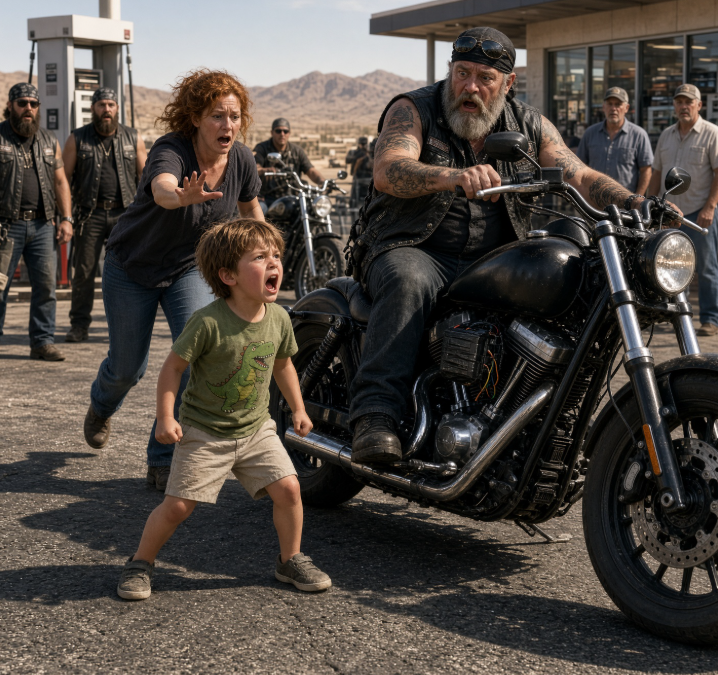
“Don’t.”
The word came from low down, below my eye line.
Sharp.
Absolute.
I looked down.
Caleb stood at the front of my Harley, both small fists clenched at his sides, feet planted like he had decided he could physically prevent the motorcycle from moving if that became necessary.
Sandra was four feet behind him, arms half raised again, face already apologizing for whatever came next.
“Don’t what?” I asked.
“Don’t start it.”
His jaw was set.
“It smells.”
“What smells?”
“The bike.”
I felt something in my body shift.
Not fear.
Attention.
“What kind of smell?”
Caleb pointed toward the underside of the fuel tank.
“Like when Dad’s car had the thing under it before it made the noise.”
Sandra went still.
All the color left her face.
Caleb turned his head.
“Mom. Tell him. Tell him about Dad’s car.”
The station seemed to quiet around that sentence.
I looked at Sandra.
She was staring at the bike now.
Not embarrassed.
Not confused.
Remembering.
“What happened to his dad’s car?” I asked.
Her mouth opened, but nothing came out.
Caleb answered.
“It smelled hot and wrong. He said get back, and then it made a big noise. He got hurt.”
Sandra whispered, “It was an electrical fire. Three years ago. The battery shorted. He smelled the wiring before it ignited.”
Caleb looked at me with a child’s impatience for adults wasting time.
“This smells like that. But meaner.”
Meaner.
That was the word.
I climbed off the seat.
Slowly.
Very slowly.
I crouched by the front wheel and looked beneath the tank.
At first, I saw only shadow against matte black frame.
Then I saw what did not belong.
Small.
About the size of a deck of cards.
Wrapped in black electrical tape.
Placed to disappear against the frame.
Two leads running toward the ignition harness.
My body went cold in the desert heat.
I had seen fire before it started.
I had seen vehicles become coffins.
I had seen enough crude malicious work to know intention even before expertise.
I stood.
Slowly.
“Frank.”
My voice was quiet.
That is the thing people misunderstand about real emergencies.
They take the volume out of you.
The men who shout first are usually still catching up.
Frank heard my tone and crossed the lot in six steps.
Three other riders moved instinctively closer.
I did not explain.
I pointed.
Frank crouched.
Looked.
The color left his face.
He stood.
“Everybody off the bikes.”
A few men glanced over.
Frank’s voice sharpened.
“Everybody off the bikes now.”
The chapter moved.
No debate.
No jokes.
No “why.”
If Frank used that voice, the why could come later.
Riders stepped away from machines. Hands lifted off keys. Men moved fast but controlled, the way people do when authority arrives without needing volume.
Sandra grabbed Caleb and lifted him against her shoulder.
This time he let her.
Because she was trembling.
Because even five-year-olds understand when adults need something from them.
Roy came out from behind the register.
He looked at us moving away from the motorcycles, and I saw his face settle into grim satisfaction.
For half a second, he believed his story had come true.
Bikers.
Trouble.
Of course.
Then reality kept moving past him.
I called 911 from twenty feet away from the bike.
I gave my name.
The address.
Frontier Gas Station, corner of Basto Road and Lenwood Road.
Possible explosive device attached beneath motorcycle fuel tank.
Wiring appears connected to ignition harness.
Eighteen motorcycles on site.
Civilians present.
Need immediate law enforcement and bomb disposal.
The dispatcher asked me to repeat the detail about the wiring.
I did.
No drama.
No embellishment.
No guesswork beyond what I could see.
“Sir,” she said, voice controlled, “I need everyone at least one hundred feet from the vehicle. Units are en route.”
“Copy that.”
That phrase left my mouth from older training.
From fire radio discipline.
From years of learning that panic takes up space clarity needs.
Roy heard it.
He uncrossed his arms.
I began moving people.
Not shouting.
Not running.
That would have cracked the situation open.
I walked person to person.
“You need to move across the road, please.”
Most people moved before I finished the sentence.
There is a way to say please that is not a request. It is a description of the near future delivered politely.
Frank and the others helped. Customers, employees, riders, Sandra, Caleb, Roy. Across Basto Road. Far side. Behind vehicles where possible. No one near the pumps. No one near glass.
The first sheriff’s cruiser arrived in eleven minutes.
The bomb unit from Victorville arrived eighteen minutes after that.
Those were long minutes.
Long enough for every thought you do not want to have to introduce itself.
The device had been there when I sat on the bike.
The device had been there while we rode.
The device had been there when Caleb talked to me.
The device had been there when I almost turned the key.
A quarter turn.
That was the distance between my life and whatever comes after.
A child had smelled what twenty-seven years of riding had taught every adult there not to notice.
Or maybe not twenty-seven years.
Maybe we noticed plenty.
Maybe we had all simply learned to distrust small things that did not fit into the stories we already believed.
Caleb had not learned that yet.
He stood on the far side of the road in Sandra’s arms, watching the bomb technicians approach my Harley with professional patience.
He was not crying.
Not shaking.
If anything, he looked fascinated.
His head tracked every movement.
Every case opened.
Every tool removed.
Every slow approach.
I looked at him and felt something I did not know what to do with.
Gratitude, yes.
But that word was too small.
You thank a man for holding a door.
What do you do when a child keeps you from becoming a crater at a gas station because he still trusts his senses?
Sandra came toward me after the perimeter was established.
She started with, “I’m sorry about—”
Wrong beginning.
She knew it as soon as she said it.
“Your kid did good,” I said, not looking away from the technicians.
Her voice shook.
“He scared me to death.”
“Real good,” I said.
Caleb leaned down from her arms and wrapped his small hand around one of my fingers.
It was a natural movement.
No ceremony.
No permission requested.
A child deciding where his hand belonged.
I looked down at it.
Then at my bike inside the orange cones.
Then at the man in the heavy protective gear kneeling under the fuel tank.
I did not pull away.
Detective Carol Haynes from major crimes arrived after the bomb techs confirmed what they were looking at.
She was methodical.
Mid-forties, hair tied back, eyes sharp in the way detectives get when they have learned people usually tell the truth badly even when they are trying. She showed her badge and asked if I could walk through some things with her.
I said yes.
We stood in the partial shade of the cinderblock wall because that was the only mercy the desert had to offer.
The interview lasted forty minutes.
She asked about the ride.
The morning.
The prior forty-eight hours.
The last thirty days.
Anyone near my bike.
Any stops.
Any disputes.
Any threats.
Any enemies.
That word always sounds dramatic until someone wires a bomb to your ignition.
I answered directly.
Not because I love police interviews.
Because clarity matters.
She listened carefully, writing in a notepad that already had sweat curling the page edges.
Then she asked, “Can you think of anyone who might want to target you specifically?”
I looked at the Harley.
At the cones.
At the heat shimmer.
At Caleb inside the gas station now, sitting near the cold drink aisle while his mother tried to make him sip water.
A door opened in memory.
I had kept it closed for years, not because I was ashamed, but because some stories become heavier when spoken too often.
“There’s a man named Terrence Grady,” I said.
Haynes looked up.
I continued.
“He served six years at California Correctional Institution in Tehachapi. Involuntary manslaughter. Vehicular hit-and-run at Lake Gregory in 2013. Released eight months ago.”
“Your connection?”
“I testified.”
“In what capacity?”
I looked at her.
“Witness. Rescue responder. The woman and her daughter in the burning vehicle lived because I got them out before the fuel tank went. Grady was driving the truck that hit them. He ran.”
Haynes wrote slowly.
“Why would he blame you?”
“Because people who run from burning cars are not usually honest about who caused the fire.”
Roy Stanton was pretending to sweep near the air pump.
Badly.
The wind carried sound.
I knew he heard the word testified because he stopped sweeping.
I did not look at him.
Haynes asked more.
The accident.
The trial.
Whether Grady had threatened me.
He had.
Not dramatically. Not in a movie way.
Just a look across a courtroom and one sentence under his breath during a recess.
You’ll answer for this.
Men say things when their future is collapsing.
Most never act on them.
Most.
By 3:47 p.m., the device had been rendered safe, documented, photographed, and transported for lab examination.
The bomb technician, Marcus Webb, delivered the assessment in a flat technical voice near the perimeter.
IED initiation system wired to ignition circuit.
Detonation on engine start.
Placement window consistent with three to five hours.
Three to five hours.
We had ridden two hundred forty miles.
Stopped twice.
Fueled once before the Frontier.
My machine had carried death under the tank across the desert like a secret.
The FBI was notified because vehicle bombs do not stay local. Two agents arrived from the Los Angeles field office in a gray sedan at 4:12 p.m., ties loosened against the heat. Agent David Torres was thirty-two, maybe, young enough to still look surprised when the world became uglier than paperwork suggested. His partner was older and less readable.
They spoke with Haynes.
With Frank.
With me.
With Sandra.
With Roy.
With the bomb techs.
The evidence began building its quiet structure: crude device, hardware store materials, online components, trace particles, placement window, a motive with a name attached to it.
Terrence Grady.
I did not feel relief when the name came forward.
Only recognition.
Like hearing a song you hate from another room.
Frank found me near the road around 4:30.
He stood slightly to my left.
Close enough to be plainly present.
Far enough to let a man keep his air.
“Webb says three to five hours,” he said.
“Yeah.”
“So it was there before we left Victorville.”
“Yeah.”
Frank was quiet.
“Grady’s been out eight months.”
“I know.”
“He wasn’t going to forgive the testimony.”
“I know that too.”
Frank turned and looked at me.
He understood the topography of that silence. Twenty-two years riding together gives a man the map. He knew what lived there: the burning vehicle at Lake Gregory, the woman screaming for her daughter, Grady’s truck vanishing into dust, the courtroom, the testimony, the looks from men who thought cooperation made you less loyal to the patch and more loyal to a system that had never loved us.
Frank let the silence run its course.
Then he spoke, not just to me.
To the road.
To the agents within hearing.
To Roy pretending not to listen.
“You know what that detective asked me?” he said. “Whether chapter members would cooperate voluntarily. I told her we would waive attorney presence for initial statements, and she looked at me like I’d made a joke.”
Agent Torres paused mid-note.
Frank kept going.
“People look at the patch and stop seeing the person.”
Roy sat down slowly in the folding chair near the station entrance.
Frank nodded toward my cut.
“Dale Mercer has been a Hells Angel for twenty-two years. Before that, seventeen years as a San Bernardino County volunteer firefighter. He pulled two people out of a burning vehicle because he knew how and because nothing else entered his mind except getting them out.”
He looked at the coned Harley.
“The people who put that bomb on his bike know that better than anyone. That’s exactly why they put it there.”
No one spoke.
Agent Torres stopped writing.
Roy took off his cap and held it in his lap.
That was the first time I saw the man reconsider me.
Not forgive himself.
Not yet.
Just reconsider.
News travels through biker networks faster than weather.
No official callout.
No formal order.
No drama.
Just one brother calling another.
Dale’s bike was wired.
Kid caught it.
Grady maybe.
He’s alive.
By sunset, riders started arriving at the Frontier.
Ones and twos at first.
Victorville.
Hesperia.
Fontana.
Rancho Cucamonga.
Men who had been at work and left.
Men who had been asleep and woke.
Men who rode ninety miles without knowing anything except one of ours had nearly been taken.
They fueled up, parked where they could, and asked for nothing.
By dark, forty-three riders stood in the lot.
The desert changes fast at night.
By day it tries to burn everything out of you. After sunset, it becomes a cold vault. The heat leaves the ground and the sky widens and all the hard edges soften just enough to make you think peace is possible.
Roy brought a case of bottled water from the back room and set it on the curb near the air pump.
He said nothing.
A few riders nodded.
He nodded back.
That was apology enough for the moment.
Caleb had not left.
Sandra had tried twice.
Both times, she discovered him migrating back toward me, as if I had become part of the event that required supervision. He sat on the curb beside me with a paper cup of hot chocolate from the convenience machine, watching bikes arrive.
“Why are they all coming?” he asked.
I looked at the lot.
Men in leather standing under gas station lights.
Chrome catching neon.
The orange cones around my Harley.
Frank talking to Agent Torres.
Roy sitting in his lawn chair with his cap still in his hands.
“Because one of them almost didn’t make it today,” I said. “And they want to be where he is.”
Caleb processed this.
“That’s you.”
“That’s me.”
“Are you glad?”
I looked at him.
Then the riders.
Then the dark stretch of I-15.
“Yeah,” I said. “I’m glad.”
He nodded and drank his hot chocolate like the conversation had landed exactly where it needed to.
Later, Sandra apologized again.
Not for Caleb this time.
For how she had pulled him back when we rode in.
“For seeing the vest before the man,” she said.
I shrugged.
“Everybody does.”
“That doesn’t make it right.”
“No.”
She looked toward Caleb. He was explaining to Frank why triceratops were stronger than most people understood.
“My husband used to say Caleb noticed things other people missed,” she said.
“Sounds accurate.”
“After the car fire, he had nightmares about smells. Burnt wire. Gas. Hot plastic. He would say something smelled wrong and cry if we didn’t leave.”
I watched Caleb.
“He saved my life because something once scared him badly enough that he never forgot the smell.”
Sandra’s eyes filled.
“I know.”
“That’s a hard thing for a child to carry.”
“He doesn’t know he’s carrying it.”
“Maybe that’s why he could use it.”
She looked at me, then nodded slowly.
That first night after a near thing is always strange.
People think survival feels like relief.
Sometimes it does.
More often, the world stays too sharp.
Edges brighter.
Sounds closer.
The body keeps waiting for the thing that almost happened to finish happening.
I slept at the Desert Inn on Main Street, three blocks east of the Frontier, in a room that smelled like industrial air conditioning, old carpet, and a cleaning product losing the fight against decades of cigarettes.
I sat on the edge of the bed for a long time without turning on the television.
My phone buzzed every few minutes.
Frank.
Brothers.
Unknown numbers.
My daughter in Phoenix.
I called her because if she heard from someone else, I would never be forgiven.
“Hey, sweetheart.”
“Dad?”
That one syllable told me she already knew enough to be terrified.
“I’m all right.”
“What happened?”
“Somebody put something on my bike. It got found before anything happened.”
There was silence.
Then: “Something?”
“Yeah.”
“Explosive something?”
I closed my eyes.
“Yeah.”
“Dad.”
“I’m all right.”
“You always say that.”
“I’m saying it now because it’s true.”
Another silence.
“Are you alone?”
“No.”
That was true in the larger sense. Forty-three riders were within three blocks of me.
But in the room, yes.
I was alone.
My daughter knew me too well.
“Don’t sit by yourself all night,” she said.
“I won’t.”
Another lie.
She let me have it.
Daughters of men like me learn when to push and when to mark the place for later.
After we hung up, I thought about three hours.
The placement window.
Three to five hours.
The device under my tank while I rode open desert.
While I stopped for fuel.
While I sat on a curb and talked to Caleb about tattoos.
While eighteen bikes surrounded mine, any one of my brothers close enough to die because Grady hated me specifically and did not care who else became shrapnel.
That is the thing about revenge.
The man aiming it always pretends it is precise.
It never is.
Revenge is a shotgun fired into a crowd by a coward who tells himself he has chosen a target.
I did not sleep much.
Terrence Grady was arrested two days later at his sister’s house in Needles.
6:15 in the morning.
Sheriff’s deputies, federal agents, warrant in hand.
They found traces of matching materials. Receipts. Search history. Photographs of my bike taken from behind at an earlier stop. A map with notes. The kind of evidence that looks small separately and damning together.
His attorney entered a not guilty plea.
That was fine.
The process would be long.
Processes usually are.
I gave three more statements.
Signed forms.
Reviewed timelines.
Answered questions from the sheriff’s department, FBI, and ATF liaison out of Los Angeles.
I cooperated because cooperation is not weakness when the truth is already standing beside you.
On the second afternoon, Sandra brought Caleb to the Desert Inn.
I was standing outside near the vending machines, drinking coffee that tasted like melted plastic, when her car pulled up.
Caleb climbed out holding a piece of paper.
He walked straight to me.
No hesitation.
No fear.
He held up the paper without speaking.
I took it.
Crayon on printer paper.
A large man on a very large motorcycle, drawn from a low angle the way children draw things that impress them. The man had a beard, sunglasses, and arms the size of tree trunks. Beside him, approximately the height of one boot, stood a small figure with curly hair and a green dinosaur shirt.
At the top, in uneven letters, he had written:
MR. DALE AND ME
I looked at it too long.
Long enough that Sandra looked away to give me privacy.
“This is good,” I said finally.
Caleb shrugged with the practiced modesty of a person who knows the thing is good and does not need to say so.
“You can keep it if you want.”
“I want.”
He nodded.
“I made your bike black because black is faster.”
“Good call.”
“And I made you big.”
“I noticed.”
“You are big.”
“Also accurate.”
He pointed to the small figure.
“That’s me.”
“I figured.”
“I didn’t draw the bomb because Mom said no.”
Sandra closed her eyes.
“Caleb.”
“What? I didn’t.”
I folded the paper carefully once and placed it inside my cut, in the inner pocket near my chest. That pocket already held a chapter card and a folded receipt from a garage in Flagstaff that had done right by me fourteen years earlier.
Things I carried because they meant something I did not need to explain.
Caleb watched me put it away.
“You have pockets for important things.”
“Yeah.”
“Do I go in there now?”
I looked at Sandra.
She was crying quietly.
“Yeah,” I said. “You go in there now.”
Caleb seemed satisfied.
Then he asked if the bomb truck had a siren.
We talked about that for fifteen minutes.
The ride happened Saturday.
Nobody officially planned it.
That is what people outside our world never understand. They think everything is hierarchy and orders. Sometimes it is. Often, it is simply shared understanding moving through people who know what presence means.
By Friday night, riders were coming from San Diego, Sacramento, the Central Valley, Nevada border towns, mountain roads, coastal cities, and far places that required leaving before sunrise.
Frank kept a count on his phone until it hit 712 confirmed.
Then he put the phone away.
“Enough,” he said.
Saturday morning at eight, they staged on Basto Road.
Two long columns stretching back toward the I-15 ramp.
Engines warming in cool desert air.
The mountains still holding shadow.
The sky that particular early morning blue the Mojave loses by nine.
I rode a borrowed Heritage Softail because my Harley was still with the crime lab in San Bernardino. The borrowed bike was clean, strong, and wrong under me. Not bad. Just not mine.
You can borrow a machine.
You cannot borrow history.
Frank rode near the front.
I rode near the end.
Not because anyone told me to.
Because I needed to see it.
Seven hundred motorcycles rolled down Main Street in formation.
Slow.
Measured.
Not aggressive.
Not triumphant.
Present.
The sound filled Barstow before the bikes did. People stepped out of shops. Men came out of garages. Women stood in doorways. Kids climbed onto low walls. Phones came up, yes, but so did hands over hearts.
We rode past the old station.
Past the outlet shops.
Past the dispatch building.
Past the elementary school.
Through the residential grid.
Seven hundred engines making a sound you felt through the soles of your feet.
Sandra and Caleb stood at the corner of Main Street and Yucca Avenue.
Tracy Aldridge, Frank’s wife, had texted Sandra the time and place with four words:
Be there if you can.
Sandra came early.
Caleb wore the same dinosaur shirt.
In his hand, he held a small American flag someone from the hardware store had given him. He stood at the curb, serious as a soldier, watching the bikes approach.
The first rider passed.
He looked at Caleb and gave one nod.
The second did the same.
Then the third.
Then the fourth.
One by one.
Individually.
Deliberately.
For the length of a seven-hundred-motorcycle procession, riders nodded to a five-year-old boy in a dinosaur shirt.
No speeches.
No plaques.
No staged handshake.
Just one gesture repeated hundreds of times.
Respect, translated into motion.
I came near the end.
When I rounded the corner and saw him standing there, small flag lifted, Sandra behind him with both hands on his shoulders, something inside me tightened hard enough to hurt.
I eased my lane position toward the curb and slowed almost to walking pace.
Caleb raised the flag.
Not dramatically.
Just a small, certain lift.
The correct thing to do in the moment.
I raised two fingers off the handlebars.
A rider’s wave.
Smaller than a salute.
Larger than nothing.
His face lit up.
Then I rode on because if I stopped, I did not know if I would be able to start again.
Roy Stanton had come too.
I saw him near the corner of Yucca and First, standing alone in a clean shirt and his ball cap. He had driven there before his shift and had not told anyone at the station where he was going.
He watched all seven hundred pass.
When the last bike cleared the corner and the sound thinned toward the I-15, Roy took his cap off and held it against his chest.
I learned that later.
From him.
Not that day.
That day, after the ride, people gathered back near the Frontier. Not crowding. Not celebrating. Just lingering, because leaving too quickly after something like that feels disrespectful to the nearly.
Roy walked up to me while I stood near the edge of the lot.
He held two bottles of water.
This time he handed one directly to me.
“I threw away the one you left,” he said.
I looked at him.
“What?”
“Thursday. You left a bottle by the curb when everything happened. It sat there till this morning. I threw it away.”
“Okay.”
“I thought you should know.”
I accepted the water.
He shifted his weight.
Roy Stanton was not a man built for speeches. That was clear. Whatever he had rehearsed in his truck was probably failing him now.
“I been wrong about people before,” he said.
“Most people have.”
He nodded.
“I was wrong about you before you did anything.”
That was more than most men admit in a lifetime.
I unscrewed the bottle.
“Takes some people longer.”
His mouth twitched.
“I suppose.”
He looked toward the pump where my bike had been.
“That boy saved more than you.”
I followed his gaze.
“Yeah.”
“He saved me from being as sure as I was.”
I drank the water because my throat had gone tight and I needed something to do.
Roy put his cap back on.
“If you and your people come through again, coffee’s on me.”
“Careful,” I said. “There are a lot of us.”
He looked around at the lot full of bikes.
“I noticed.”
That was how Roy became ours in a small way.
Not patched.
Not riding.
Just a man at a desert gas station who learned to look twice.
The legal case took months.
Terrence Grady did what men like him do. He denied, delayed, blamed, contradicted, claimed evidence was planted, claimed memory failed, claimed old enemies had set him up, claimed he was being targeted because of past mistakes.
Past mistakes.
That phrase has carried more cowardice than any two words should be allowed to hold.
A mistake is forgetting a birthday.
Turning too sharply into a curb.
Leaving coffee on the roof of your truck.
Driving drunk through a campground, hitting a family vehicle, running while it burned, and later wiring a bomb to the motorcycle of the man who testified against you is not a mistake.
It is a character revealed repeatedly.
The woman from Lake Gregory came to one hearing.
Her name was Maribel Ortiz.
Her daughter, Sofia, was seventeen by then. She had been seven the night of the crash. I had not seen them since the trial years before, except in the occasional update passed through prosecutors. Life had carried them forward, limping but moving.
Maribel walked with a cane.
Sofia had burn scars along her neck and left arm.
They found me in the courthouse hallway.
For a second, none of us spoke.
Then Maribel touched my arm.
“You pulled us out,” she said.
I nodded.
There did not seem to be anything useful to add.
“Sofia remembers your vest,” she said.
I looked at the young woman.
She smiled slightly.
“I remember thinking the angel on the back was scary.”
“It’s not an angel,” I said.
“I know now.”
“She asked for you after,” Maribel said. “At the hospital. She asked if the scary angel man got out too.”
My chest tightened.
“I got out.”
“Because you always do?” Sofia asked.
“No,” I said. “Because somebody kept me moving.”
She understood that more than I wanted her to.
At that hearing, Grady looked back once and saw Maribel, Sofia, me, Frank, Sandra, and Caleb sitting in the same row.
Caleb had brought a coloring book because court bored him instantly.
Sandra had warned him he needed to be quiet.
He was.
Mostly.
When Grady looked back, Caleb stared at him with the open curiosity of a child observing something unpleasant but educational.
Then he leaned toward me and whispered, “He looks like someone who blames chairs when he trips.”
Sandra nearly choked.
Frank looked down.
I kept my face still through force of will.
Caleb was not wrong.
The case ended in a plea because most cases do.
Federal charges.
Explosive device.
Attempted murder allegations resolved through stacked counts and sentencing exposure I do not need to detail here.
Grady went back behind walls.
For longer this time.
At sentencing, I was allowed to speak.
I almost did not.
Not because I had nothing to say.
Because anger, when given a microphone, often embarrasses the truth.
I stood anyway.
I looked at Grady only once.
Then at the judge.
“I am alive because a five-year-old boy smelled something adults ignored,” I said. “My brothers are alive because he spoke. Customers at that gas station are alive because his mother raised him to trust what he knew even when it inconvenienced grown men.”
The courtroom stayed still.
“This man did not only target me. He targeted everyone near me. That is what cowardice does. It makes innocent people pay interest on another man’s grievance.”
I paused.
“My life was saved by a child. I ask the court to remember all the lives that child saved when deciding what this man’s choices are worth.”
That was all.
Caleb asked afterward if judges give grades.
Sandra said no.
Frank said sometimes.
That confused him for three days.
Life after did not return to normal.
Normal is an overrated concept sold to people who have not lost enough to know better.
But life did continue.
My Harley eventually came back from the crime lab.
Not immediately.
Evidence takes its time.
When I saw it again, the bike looked the same.
That bothered me.
I do not know what I expected. A shadow. A mark. Some visible proof that death had been taped beneath the tank. But machines do not carry meaning unless we put it there.
I stood in the garage for a long time before touching it.
Frank stood behind me.
“You don’t have to ride it.”
“I know.”
“You can sell it.”
“I know.”
“You can burn it.”
I looked back.
He shrugged.
“Ceremonially.”
“That your official recommendation as chapter president?”
“My official recommendation is don’t let Grady own your bike.”
That was Frank.
Straight into the center.
I put my hand on the tank.
Cold metal.
Familiar.
Mine.
“I’ll ride it.”
“Today?”
“No.”
“Good. I didn’t want to chase you if you were about to make a point.”
I rode it a week later.
Alone first.
Then with Frank.
Then with the chapter.
The first ignition turn was the hardest.
I sat in the garage with my thumb on the switch, every nerve waiting for heat, sound, pain, absence.
Nothing happened.
Engine caught.
Deep.
Clean.
Alive.
I rode ten miles.
Then fifty.
Then back through the desert.
Trust does not return all at once.
It comes in increments.
A mile.
A turn.
A gas station.
A boy waving from a curb.
Caleb became part of our lives in a way none of us planned.
At first, Sandra worried about boundaries.
I respected that.
I was a fifty-one-year-old Hells Angel, and her five-year-old had decided I was one of his people because trauma and instinct had introduced us under extraordinary circumstances. She had every right to be careful.
So we did it properly.
No surprise visits.
No gifts without asking her.
No rides on motorcycles.
No social media circus.
No turning a child into a mascot.
Frank’s wife Tracy helped because women like Tracy have been managing the emotional intelligence of motorcycle clubs since before any of us learned to admit we had emotions.
She and Sandra became friends before I realized it was happening.
That made things easier.
Caleb came to the clubhouse once for a barbecue.
The men were warned beforehand.
No swearing near the kid.
No revving engines to impress him.
No scary stories.
No teaching him gestures his mother would later blame on us.
They mostly obeyed.
Caleb arrived wearing dinosaur shoes and carrying the drawing he had made me, now laminated because Sandra was that kind of mother. He asked every rider what their bike’s name was. Some had answers. Some invented answers on the spot and regretted them when he remembered months later.
He asked Frank why his beard was “organized.”
Frank said leadership required standards.
Caleb accepted this.
He asked me why my motorcycle was fixed.
“Because it’s mine.”
He nodded.
“If something bad gets on your stuff, you take the bad thing off.”
“Pretty much.”
“Then it’s still yours.”
“Yeah.”
He looked satisfied, as if he had been testing whether I understood a basic principle.
Maybe I had been.
Sandra watched from across the yard, smiling in that tired, careful way of hers.
Later, she told me Caleb had fewer nightmares after the ride.
“Seeing everyone listen to him changed something,” she said.
“How?”
“I think after his dad’s accident, part of him believed adults didn’t believe what he noticed. The car smelled wrong. He said so. Then it still caught fire. With you, he said something smelled wrong, and everyone moved.”
I looked toward Caleb. He was explaining ankylosaurus armor to a man with a neck tattoo who looked genuinely invested.
Sandra continued.
“You gave him proof that speaking mattered.”
I shook my head.
“He gave us proof listening mattered.”
Both were true.
A year after the incident, Roy Stanton called me.
I had given him my number months earlier after stopping at the Frontier on a ride. Not for any dramatic reason. He wanted to know who to call if “something seemed off with riders passing through,” and I told him if his instincts bothered him, he could call me.
That is community sometimes.
An old gas station owner and a biker exchanging numbers because both have learned to respect the other man’s eyes.
Roy called on a Thursday morning.
“You busy?”
“Depends.”
“Can you come by the station?”
“What happened?”
“Nothing bad.”
“That’s not an answer.”
“I got something to show you.”
I rode out.
The Frontier looked the same from the road: sun-faded sign, pump islands, drink machine, cinderblock walls, asphalt remembering too much heat. But near the curb where I had sat that day, Roy had installed a small metal bench.
Plain.
Sturdy.
Bolted down.
On the backrest was a modest plaque.
NO PATCH TELLS THE WHOLE STORY.
IN HONOR OF THE BOY WHO SPOKE UP
AND EVERYONE WHO LISTENED.
I read it twice.
Roy stood beside me, pretending not to watch my face.
“Too much?” he asked.
“No.”
“Not enough?”
“No.”
“Good.”
I touched the top of the bench.
“You put this here?”
“It’s my station.”
“Yeah.”
“I also keep trail mix now.”
That got me.
“What?”
He pointed inside.
“Bottom shelf of the cold aisle. Kid cleaned me out that day. Figured I should restock properly.”
I looked away toward the highway.
The desert shimmered.
“Roy.”
“Don’t make it weird,” he said.
“Wasn’t planning to.”
“You were.”
I smiled despite myself.
The bench became a stopping place.
Riders passing through took photos there. Families did too. Sometimes people asked about the plaque, and Roy told the story better each time, though he never made himself the hero. That mattered.
He always began with the boy.
He always ended with listening.
Two years passed.
Then three.
Caleb grew.
Kids do that no matter how firmly you remember them as five.
He lost teeth. Got taller. Switched from dinosaurs to space for a while, then returned to dinosaurs with more scientific vocabulary. He learned to read chapter patches and highway signs. He built model motorcycles from kits and painted one matte black with chrome accents.
Sandra worked fewer hours after getting a better position managing schedules at a medical office. Her husband, Aaron, remained disabled from the car fire, but over time he joined more gatherings. He was quiet, gentle, and carried his own guilt about the accident even though no one blamed him for an electrical failure.
The first time Aaron met me, he shook my hand longer than necessary.
“My son trusts you,” he said.
“I know.”
“That is not small.”
“No.”
“He told me you listened.”
I looked at Caleb, who was trying to convince Frank that pterosaurs were not dinosaurs and that this distinction mattered morally.
“He made it hard not to.”
Aaron smiled faintly.
“He does that.”
The seven-hundred-rider procession became a story people told.
Stories change in the telling.
Sometimes the number became eight hundred.
Sometimes Caleb “smelled the bomb from across the lot,” which was not exactly true. Sometimes I “barely jumped off before it blew,” which was not true at all. The device never detonated, thank God and Caleb Whitmore.
I corrected people when I could.
Not because I care about looking brave.
Because the truth was better.
The truth was a boy noticed something wrong and spoke.
The truth was adults listened.
The truth was a disaster did not happen.
People like explosions in stories because they understand noise.
Prevention is harder for them.
A bomb not going off leaves no crater for cameras.
Only people still breathing who might not have been.
The older I get, the more I respect the quiet miracles.
Every August, near the anniversary, we gathered at the Frontier.
Not a huge ride like the first year.
Sometimes fifty bikes.
Sometimes a hundred.
Once three hundred when the weather was forgiving and word spread wider than expected.
Roy always stocked extra water.
And trail mix.
Sandra always brought Caleb if he wanted to come.
He always wanted to come.
One year, when Caleb was nine, he asked me why Terrence Grady had tried to kill me.
I had known the question would come eventually.
We sat on the metal bench by the curb, the plaque warm under our backs. His legs were longer now, feet nearly touching the ground.
“Because he blamed me for consequences that came from what he did,” I said.
Caleb thought about that.
“That’s dumb.”
“Yes.”
“But people do dumb things when they’re mad?”
“They do dangerous things when they think anger makes them right.”
He looked toward the pumps.
“Was he sad?”
That question surprised me.
“Maybe.”
“About going to prison?”
“Probably.”
“About the people in the car?”
“I don’t know.”
Caleb frowned.
“You should be sad about people you hurt.”
“Yeah.”
He was quiet.
Then he said, “I’m glad the bomb didn’t go off.”
I looked at him.
“Me too.”
“Would everybody have died?”
“No.”
I refused to put that picture in his head.
“Some people would have been hurt. Maybe badly.”
He nodded.
“I’m glad I said something.”
“That was the bravest part.”
“I wasn’t brave.”
“No?”
“I just smelled it.”
“And spoke.”
He considered this.
“I guess.”
“Most people notice something wrong and talk themselves out of saying it.”
“Why?”
“Because they don’t want to look foolish. Or bother anyone. Or be wrong.”
“That’s dumb too.”
“Yeah.”
He leaned back against the bench.
“Adults are weird.”
“Every day, kid.”
When Caleb was twelve, he gave a presentation at school about emergency awareness.
He called me the night before.
“Do I have to mention you?”
“No.”
“But you’re part of the story.”
“The important part is telling people to trust their senses and speak up.”
“My teacher says personal stories make presentations stronger.”
“Your teacher sounds dangerous.”
“She wears cardigans.”
“Worst kind.”
He laughed.
Then grew quiet.
“Were you scared?”
“When?”
“When I told you not to start it.”
I looked at the phone in my hand.
“Not at first. I was focused.”
“After?”
“Yes.”
“What were you scared of?”
I answered honestly.
“That you could have been hurt because someone hated me.”
He was silent.
Then he said, “But I wasn’t.”
“No.”
“And you weren’t.”
“No.”
“So don’t get stuck on the almost.”
There are moments when children return your own lessons sharpened.
“That’s good advice,” I said.
“I know. I’m using it in my presentation.”
“Of course you are.”
When Caleb was fourteen, he asked for a ride.
Sandra said no before he finished the sentence.
I said no before Sandra did.
He looked betrayed by both of us.
“You said no too fast.”
“You are fourteen.”
“I saved your life.”
“That argument expires at helmet laws.”
“It should at least get me around the block.”
“No.”
Frank, traitor that he was, said, “Maybe at sixteen with permission and gear.”
Sandra glared at him.
Frank looked away.
Leadership requires knowing when to shut up.
At sixteen, Caleb did ride.
Not with me first.
With his mother’s permission, his father watching, full helmet, jacket, gloves, boots, and a safety lecture so long even I became bored with myself.
We rode five miles.
Slow.
Back roads.
No highway.
When we returned, Caleb took off the helmet and looked like the universe had personally opened a door for him.
Sandra was crying.
Aaron had one hand on her shoulder.
I expected Caleb to talk nonstop.
He did not.
He stood beside the bike, one hand on the seat, and said quietly, “I get it now.”
“What?”
“Ride forever.”
I looked at him.
“Yeah?”
“Sometimes you get tired of standing still.”
I had forgotten he remembered that.
Or maybe I had hoped he did.
On Caleb’s eighteenth birthday, he did not join the club.
People always assume that is where this kind of story goes.
Boy saves biker.
Bikers adopt boy.
Boy becomes biker.
Life is not a movie, and good endings are not always circular.
Caleb went to college in Arizona to study mechanical engineering with a focus on vehicle safety systems.
He said, “If I’m good at noticing when machines are wrong, maybe I should learn why.”
Sandra cried for a week before he left and then pretended she hadn’t.
I gave Caleb the original crayon drawing he had made me.
He stared at it.
“You kept this?”
“In my cut. Then in my safe.”
“For thirteen years?”
“Important pocket.”
He smiled, but his eyes shone.
“I can’t take this.”
“It’s yours.”
“I gave it to you.”
“And now I’m giving it back.”
He looked at the drawing: the huge man, the huge motorcycle, the tiny kid in the dinosaur shirt.
“I drew you way too big.”
“No,” Sandra said from the doorway. “That’s exactly how you saw him.”
Caleb looked at me.
Then folded the paper carefully and put it in his backpack.
“Important pocket,” he said.
“Good.”
Before he left, we rode to the Frontier.
Roy was older by then, slower, but still running the station because retirement sounded to him like a thing invented by people who did not know what to do with mornings.
The bench was sun-faded.
The plaque still readable.
NO PATCH TELLS THE WHOLE STORY.
Caleb sat on it one last time before college.
“I don’t remember being scared,” he said.
“You weren’t.”
“Were you?”
“Eventually.”
He nodded.
“I remember your finger.”
“What?”
“I held your finger when the bomb truck came.”
I had not known he remembered that.
“I remember that too.”
“You didn’t pull away.”
“No.”
“Why?”
I looked at the pumps, the curb, the old patch of asphalt where my Harley had sat inside cones.
“Because I needed something to hold on to too.”
Caleb looked at me for a long moment.
Then he said, “You could have said that earlier.”
“I’m saying it now.”
“Fair.”
The last time I saw Roy Stanton, he was sweeping near the air pump again.
Not pretending this time.
Actually sweeping.
He stopped and leaned on the broom as Caleb loaded a case of water into Sandra’s car.
“He turned out good,” Roy said.
“Yeah.”
“You had something to do with that.”
“No.”
Roy looked at me.
“Don’t do that old biker humility thing. It’s annoying.”
I laughed.
Roy pointed the broom toward the bench.
“A boy did something brave here because nobody had taught him not to. Then a bunch of grown men spent years trying not to teach it out of him. That counts.”
I let that sit.
Then nodded.
“Maybe.”
Roy smiled.
“Close enough.”
Roy died the next spring.
Heart attack.
Quick, according to his daughter.
We rode for him.
Not seven hundred.
But enough.
We parked at the Frontier, filled the lot, and stood quietly while his daughter unlocked the door for one final morning shift that would not be his. She placed his cap on the counter beside the register.
Frank took his own cap off.
So did I.
So did every rider in the building.
Roy had learned to look twice.
That was no small thing.
Years have passed now.
More than I like counting.
I am older than Roy was the day we first rode into his station, which seems impossible until I look at my hands. The tattoos are softer. The Gothic letters on my forearm have blurred enough that young people ask what they say. My knees predict weather. My beard is more silver than dark. Frank retired from presidency and became somehow more opinionated with fewer responsibilities.
Caleb is twenty now.
He calls sometimes from Arizona, usually about engines, internships, or some professor who said something mechanically questionable. He still notices everything. He still asks why. He rides now, carefully, on a used bike he bought with money from working part-time and rebuilding old carburetors for people who underestimate him.
Sandra pretends to hate it.
Aaron secretly loves it.
I pretend not to know either thing.
Every August, if schedules allow, Caleb comes back to the Frontier.
The station has changed ownership but kept the bench.
The new owner knows the story. Roy’s daughter made sure the plaque stayed in the sale agreement, which may be the most Roy Stanton thing I ever heard.
Sometimes people stop and read it.
Sometimes they ask.
Sometimes no one does.
That is all right.
Not every sacred place announces itself loudly.
Some look like an old curb beside a gas station off I-15, where a bottle of water once sat forgotten and a boy in a dinosaur shirt told a man not to turn a key.
I still ride.
Not forever.
Nothing is forever, despite what the ink says.
But I ride.
Because sometimes you do get tired of standing still.
Because the road remains one of the few places my thoughts line up behind me instead of crowding my chest.
Because my brothers are still out there.
Because a bike that nearly became my coffin became mine again one ignition turn at a time.
Because Caleb once told me not to get stuck on the almost.
He was right.
The almost can swallow a life if you let it.
Almost died.
Almost exploded.
Almost lost brothers.
Almost became another story told in past tense at bars and funerals.
But almost is not what happened.
What happened is a boy spoke.
A man listened.
A mother held her child.
A chapter moved.
A gas station owner reconsidered.
A detective wrote carefully.
A bomb technician did his work.
Seven hundred riders nodded to a five-year-old on a desert corner.
A bike started again.
A life continued.
Several lives did.
That is the version I keep.
Every time I pass the Frontier, I stop if time allows.
I sit on the bench.
I read the plaque, though I know every word.
NO PATCH TELLS THE WHOLE STORY.
Then I look at the curb where I sat with my head in my hand before anything happened.
I remember feeling wrong and not knowing why.
I remember Caleb’s voice.
Don’t.
I remember the smell of hot asphalt.
Frank’s face when he saw the device.
Sandra trembling.
Caleb’s small hand around my finger.
Roy’s cap in his lap.
The first rider arriving after sunset.
The nods on Main Street.
The drawing in my pocket.
And I think about how close the world came to being different.
Not just for me.
For Frank.
For Sandra.
For Caleb.
For Roy.
For Maribel and Sofia, who would have had to hear that the man who pulled them from fire had been killed by the man who put them there.
For my daughter in Phoenix, who would have gotten a different phone call.
For every rider who would have carried another name like a stone.
A quarter turn of a key.
That is all.
People want life to change in big visible moments, but sometimes everything depends on the smallest interruption.
A child’s nose.
A single word.
Don’t.
If there is anything worth taking from my story, it is not that bikers can be good men.
We already knew that.
It is not that children can be brave.
They prove that every day before adults teach them caution.
It is this:
When someone small says something is wrong, listen.
When someone you have already judged acts differently than your judgment predicted, notice.
When the world gives you a chance to step back from being certain, take it.
And if a five-year-old in a dinosaur shirt plants himself in front of your motorcycle and tells you not to start it, do not laugh.
Do not argue.
Do not let pride turn the key.
Get off the bike.
Crouch down.
Look underneath.
You might find nothing.
You might feel foolish.
Or you might live long enough to watch seven hundred riders nod to the boy who saved your life.
I did.
And I have never forgotten him.








