A Bonded Cat Pair Had Until 9 A.M. to Live—Then a Broke Couple Who Could Barely Pay Rent Turned Their Car Around
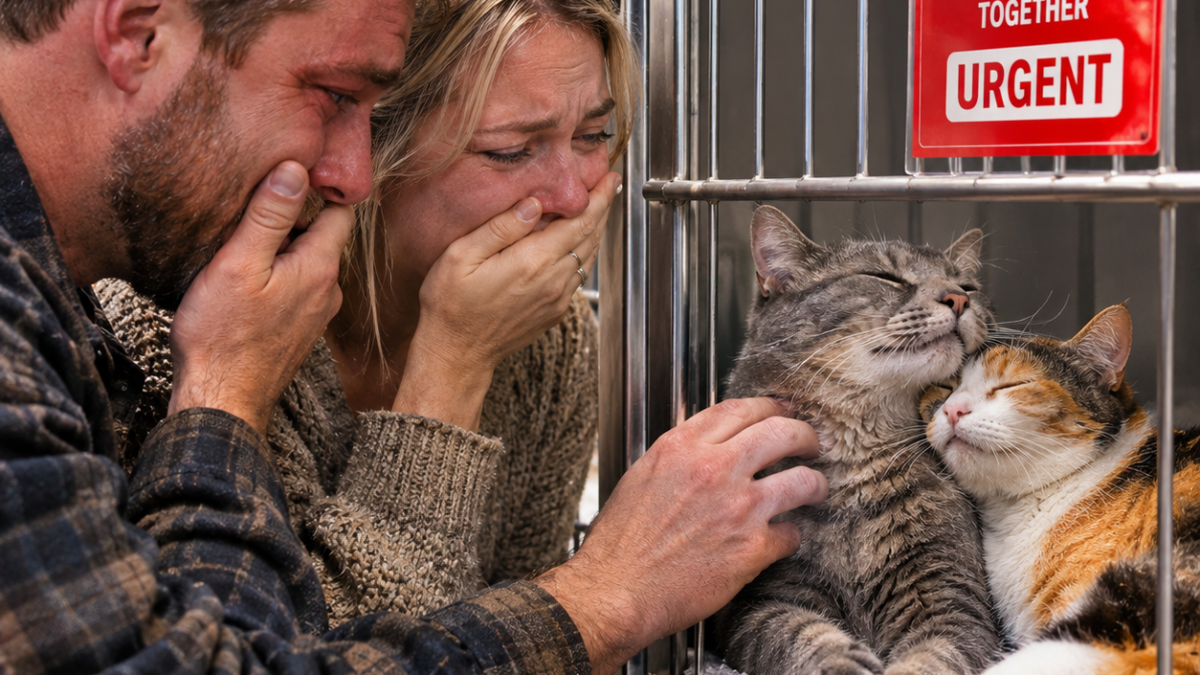
A Bonded Cat Pair Had Until 9 A.M. to Live—Then a Broke Couple Who Could Barely Pay Rent Turned Their Car Around
Nero and Naya had less than eighteen hours left, yet while people passed their shelter cage looking for kittens, the eight-year-old cats simply groomed each other as though neither one understood that by nine the next morning they might both be gone.
Ben and Rachel Carter had only stopped to donate the unopened cat food left behind after losing their own beloved pet, and with Ben unemployed, Rachel’s hours cut, and rent approaching, adopting two senior cats was the last thing they could afford.
But when the shelter briefly separated Nero and Naya and Ben saw the terrified calico clawing at the kennel while the scarred gray tabby reached desperately toward her from a carrier, the man who already believed he had failed his wife whispered, “If we leave them here tonight, I don’t think I’ll forgive myself.”
Ben Carter had been unemployed for forty-three days when he walked into the Franklin County Animal Shelter carrying a twenty-pound bag of unopened cat food.
He knew the number because he had begun counting days the way people count down toward a storm.
Forty-three mornings without work.
Forty-three afternoons refreshing job listings.
Forty-three nights lying beside his wife pretending he was asleep while calculating how much money remained in checking.
Their old cat, Winston, had died four months earlier.
Seventeen years old.
Orange.
Missing one canine tooth.
Bad kidneys during his final year.
A tendency to sleep with his nose pressed against Ben’s forearm.
Winston’s food bag had remained unopened in the hall closet after his death.
Rachel had bought it two days before the veterinarian told them it was time.
Neither had been able to throw it away.
On that cold Saturday in February, Ben finally pulled the bag out.
“We should donate this.”
Rachel looked over from the kitchen table.
Bills were spread around her.
Electric.
Car insurance.
Rent.
Minimum credit-card payment.
A grocery receipt with three things crossed out because she had returned them before checkout.
She looked at the cat food.
“Yeah.”
Neither moved.
Ben stood holding the bag.
For several seconds, they both stared at the printed photograph of a smiling cat on the front.
Winston had eaten that brand almost his entire life.
Rachel swallowed.
“Somebody can use it.”
Ben nodded.
“That’s what I was thinking.”
The shelter was fifteen minutes away.
They could drop it off.
Come home.
No animals.
No emotional decisions.
PART2:
They had agreed on that months earlier.
No new pets until life became stable.
Life was currently the opposite.
Ben had worked maintenance at a commercial office complex for almost nine years before the property was sold to a national management company.
The new company eliminated his position.
No warning beyond two weeks.
A generic letter.
A final paycheck.
A manager who looked embarrassed while telling him the decision had “nothing to do with performance.”
Ben had believed him.
That almost made it worse.
If he had failed, he could have fixed something.
Worked harder.
Learned more.
Apologized.
Instead, a spreadsheet somewhere had decided that a forty-six-year-old man with years of experience cost more than outsourcing the work.
Since then, he had applied everywhere.
Apartment complexes.
Hospitals.
Schools.
Warehouses.
Hotels.
City maintenance.
He had interviewed six times.
Three companies never called back.
Two chose other candidates.
PART3:
One offered twenty hours a week at almost half his previous wage.
Rachel worked reception at a dental practice.
Her office had recently cut staff hours because one dentist retired and patient volume dropped.
Twenty-eight hours one week.
Twenty-six the next.
They had been comfortable before.
Not wealthy.
Comfortable.
Then Winston became sick.
Veterinary bills.
Then Ben lost his job.
Then Rachel’s hours dropped.
Comfort became arithmetic.
Rent first.
Electric.
Insurance.
Food.
Gas.
Everything else waited.
They stopped turning on the heat overnight unless the temperature became dangerously low.
Rachel started bringing leftovers home from office lunches.
Ben learned which grocery store reduced meat prices after seven.
Neither complained much.
That was part of the problem.
Their marriage had always been built on competence.
Ben fixed things.
Rachel organized things.
Together, they handled life.
When life became harder than either could fix, they became quieter instead of closer.
Winston’s death had made the apartment even quieter.
The cat had filled spaces they never noticed until he was gone.
The soft landing from the windowsill.
The scratch at the bedroom door.
The ridiculous howl demanding breakfast.
After he died, Ben sometimes woke at six because he thought he heard his food bowl move.
Nothing.
Just pipes.
Or the refrigerator.
Or memory.
They drove to the shelter without talking much.
The February sky was flat gray.
Dirty snow lined the parking lot.
Ben carried the bag inside.
Rachel held the receipt the rescue had requested for donations.
A volunteer at the front desk smiled.
“Thank you.”
She was a woman in her fifties named Donna.
Her volunteer badge was clipped crookedly to a sweatshirt covered in cat hair.
“Food donations help a lot.”
Ben set the bag down.
“Our cat died.”
Donna’s smile softened.
“I’m sorry.”
“It’s unopened.”
“We bought it right before.”
Rachel stopped speaking.
Donna nodded.
“I understand.”
The correct social interaction should have ended there.
Thank you.
You’re welcome.
Goodbye.
Instead, someone behind the front desk opened a kennel door.
A kitten squeaked.
Rachel looked toward the sound automatically.
Ben saw it.
“No.”
She looked at him.
“I didn’t say anything.”
“You looked.”
“At a noise.”
“That was a cat noise.”
“We are inside an animal shelter.”
“Exactly.”
Donna laughed.
“You’re safe.”
Ben shook his head.
“We are absolutely not safe.”
That made Rachel smile for the first time that morning.
Donna pointed toward the cat wing.
“You can look.”
Ben said:
“That is how people leave with four animals.”
“Only if you’re bad at math.”
“I’m currently unemployed.”
“Then perhaps don’t take four.”
The joke should have ended there.
They walked anyway.
Not because they planned to adopt.
Because the building smelled like Winston’s veterinary clinic and both of them suddenly wanted to see cats.
The first row contained kittens.
Black.
Orange.
Tuxedo.
A tiny gray one climbed the bars when Rachel approached.
She smiled.
Ben watched.
Something inside him hurt.
They moved on.
Young adult cats.
Two seniors.
One enormous white cat sleeping so deeply that three people stood around him laughing.
Then they reached the last row.
That was where the red card caught Rachel’s attention.
BONDED PAIR
MUST BE ADOPTED TOGETHER
URGENT
Below it:
NERO — 8 YEARS
NAYA — 8 YEARS
Inside the kennel were two cats.
Nero was large.
Gray tabby.
Broad face.
Heavy shoulders.
A thin scar crossed the bridge of his nose.
His yellow eyes looked older than eight.
Naya was half his size.
Calico.
White chest.
Orange and black patches.
Delicate face.
Green eyes.
They were pressed together on a folded fleece blanket.
Not sleeping.
Naya was grooming Nero’s forehead.
Slow strokes.
One ear.
Then the scar above his nose.
Nero closed his eyes.
When she finished, he turned and began licking the fur between her ears.
Ben stopped walking.
Rachel stood beside him.
Neither spoke.
Donna had followed at a respectful distance.
Rachel pointed at the card.
“What does urgent mean?”
Donna’s expression changed.
The humor left.
“They’ve been here fifty-seven days.”
“Is that bad?”
“For their situation, yes.”
“Why?”
Donna glanced toward the other cages.
“We’re over capacity.”
Ben knew immediately where this was going.
He hated that he knew.
“When?”
Donna looked at him.
“Tomorrow morning.”
Rachel’s face tightened.
“What happens tomorrow morning?”
Donna hesitated.
“Nine.”
Rachel whispered:
“What happens at nine?”
Donna did not insult them with softer language.
“They’re scheduled for euthanasia.”
The word sat between them.
Ben looked at the cats.
Naya had finished grooming Nero.
Now her front paw rested over his.
“Why them?”
Donna exhaled.
“Age.”
“Space.”
“They have to go together.”
“Most people want kittens.”
“Somebody wanted Naya two weeks ago, but they refused Nero.”
Rachel looked at Nero.
“What happened?”
“We said no.”
Ben turned.
“You turned down an adoption?”
“For one cat.”
“Yes.”
“But they’re bonded.”
“What does that really mean?”
Donna looked toward the kennel.
“We tried separating them once.”
“When?”
“About a month after they arrived.”
“Why?”
“Same reason you’re thinking.”
“Maybe each cat had a better chance alone.”
Donna’s voice became quiet.
“Nero stopped eating.”
Rachel looked at him.
“Naya screamed.”
“For how long?”
“Almost two days.”
“She scratched at the kennel door until her paws bled.”
Ben’s stomach tightened.
“We put them back together.”
“Nero ate within an hour.”
“Naya slept against him for almost eleven hours.”
Donna looked at them.
“We haven’t discussed separating them again.”
Rachel reached toward the bars.
Not inside.
Just close.
Naya lifted her head.
Nero shifted slightly between her and Rachel.
Protective.
But not aggressive.
Rachel whispered:
“He protects her.”
Donna nodded.
“And she looks after him.”
“What happened to their owner?”
“Long-term care.”
“Older woman.”
“Stroke.”
“Family?”
“Out of state.”
“Couldn’t take them.”
“She had owned Nero since he was about six months old.”
“Naya came a year later.”
“So they’ve been together seven years.”
“Yes.”
Ben looked away.
That was dangerous information.
Seven years.
Longer than some marriages.
They were not simply two cats sharing a kennel.
They had an entire private history.
Homes.
Windows.
Meals.
Beds.
Their person’s voice.
Then one day, everything disappeared.
Now they had each other.
That was all.
A staff member entered carrying two food bowls.
Naya stood.
The woman slid one bowl inside.
Nero approached.
Then something happened that Ben would later remember with painful clarity.
Naya moved her own bowl.
Not literally carrying it.
She pushed it across the floor with her nose and paw until it sat closer to Nero.
Then stepped back.
Nero began eating.
Naya waited.
She did not push in.
Did not take the second bowl.
Just watched.
Only after Nero finished and stepped away did Naya eat.
Rachel wiped her face.
“We should go.”
Ben nodded immediately.
“Yes.”
Donna looked at them.
Neither needed to explain.
This was exactly why they had promised not to stay.
Rachel whispered:
“Thank you for taking the food.”
Donna nodded.
“Of course.”
They left.
The shelter doors closed behind them.
Cold air hit Ben’s face.
He walked toward their ten-year-old Toyota.
Rachel followed.
Neither spoke until they were inside.
Ben did not start the engine.
Rachel stared through the windshield.
A family crossed the parking lot carrying a pet carrier.
Ben’s hands rested on the steering wheel.
“We can’t.”
Rachel nodded.
“I know.”
“We can barely pay rent.”
“I know.”
“Two cats.”
“I know.”
“Senior cats.”
“I know.”
“Senior cats mean vet bills.”
Rachel closed her eyes.
“I know, Ben.”
He heard the edge in her voice.
“I’m not trying to be cruel.”
“I didn’t say you were.”
“We came here to donate food.”
“I know.”
“That’s all.”
“I know.”
Silence.
Ben’s hands tightened around the steering wheel.
“I can’t do it.”
Rachel looked at him.
“Then we go home.”
He turned toward her.
“I mean I can’t take them.”
“I know.”
“What if something happens?”
“We have thirty-eight dollars until Thursday.”
“I know.”
“What if Nero gets sick?”
“We can’t even afford—”
His voice stopped.
Rachel waited.
Ben looked down.
“Ever since I lost my job…”
He swallowed.
“I wake up feeling like I’ve failed.”
Rachel’s face changed.
Ben rarely cried.
At his father’s funeral, his eyes filled but he did not cry.
When Winston died, he waited until they reached the car.
Even then, only briefly.
Now his face crumpled.
“I know you’re tired.”
“Ben.”
“I see you calculating everything.”
“I see you putting groceries back.”
“I know you’re working every hour they give you.”
“And I’m sitting at home sending applications into nowhere.”
“You’re looking for work.”
“That doesn’t pay rent.”
“It will.”
“When?”
Rachel did not answer.
Ben laughed bitterly.
“Exactly.”
He looked toward the shelter.
“What if I bring them home and fail them too?”
Rachel leaned back.
For several seconds, she said nothing.
Then:
“What would failing them mean?”
“Not being able to afford them.”
“We can buy food.”
“Vet?”
“We figure it out.”
“How?”
“I don’t know.”
“That’s not a plan.”
“No.”
She wiped her eyes.
“It isn’t.”
Ben looked toward the building.
A side door opened.
Donna emerged carrying a plastic carrier.
Inside was Nero.
“What’s happening?”
Rachel leaned closer to the windshield.
Nero pressed his face toward the carrier door.
Then they saw Naya.
Still inside the kennel visible through the large front window.
The moment Nero disappeared from sight, Naya changed.
She leaped against the kennel door.
Her mouth opened.
Even through the glass they could see her crying.
One paw struck the bars.
Then another.
Donna stopped outside.
Apparently the carrier was being taken toward a small mobile veterinary unit parked near the building.
Routine exam.
Nothing permanent.
Naya did not know that.
She clawed.
Threw herself toward the opening.
Inside the carrier, Nero turned.
His large gray body pressed against the wire.
One paw emerged between the bars.
Reaching.
Toward the shelter.
Toward her.
They were thirty feet apart.
Maybe less.
Could not touch.
Rachel’s hand went over her mouth.
Ben covered his face.
For several seconds, the car filled with the sound of his breathing.
Then he whispered:
“Jesus.”
Rachel did not answer.
Nero’s paw remained through the carrier door.
Naya was still throwing herself against the cage.
Ben lowered his hands.
“Our lease still allows cats?”
Rachel looked at him.
“Yes.”
“Two?”
“Yes.”
“How much is the pet deposit?”
“Two hundred.”
“We don’t have two hundred.”
“I have eighty in savings.”
“That’s for emergencies.”
Rachel looked through the windshield.
“Tomorrow morning is an emergency.”
Ben almost laughed.
Almost.
“This isn’t smart.”
“No.”
“It won’t fix anything.”
“No.”
“We’ll still be broke.”
“Yes.”
“What if I don’t get work?”
“We’ll deal with that.”
“How?”
Rachel looked at him.
“The same way we’ve been dealing with everything else.”
“Badly?”
That made her laugh through tears.
“Together.”
Ben turned the key.
The engine started.
Rachel stared.
He put his hand on the gearshift.
Then turned the engine off.
“Let’s go get them.”
Rachel’s breath caught.
“Are you sure?”
“No.”
“That’s not reassuring.”
“No.”
He opened his door.
“But I’m sure I don’t want to spend tomorrow morning wondering if we could have stopped it.”
They went back inside.
Donna looked surprised.
“Forget something?”
Ben pointed toward C-14.
“Yeah.”
Rachel took his hand.
“Two things.”
Donna’s face changed.
“Are you serious?”
Ben nodded.
“We need to know the costs.”
“All of them.”
“We’re not pretending money isn’t an issue.”
Donna studied him.
“You understand they stay together.”
“Yes.”
“You understand they’re seniors.”
“Yes.”
“Vet history isn’t perfect.”
“Yes.”
“Nero has mild arthritis.”
“Okay.”
“Naya has early dental disease.”
“Okay.”
“They’ve been stressed.”
“I’m unemployed.”
Donna blinked.
Ben continued.
“My wife’s hours got cut.”
Rachel gave him a look.
“Ben.”
“What?”
“We’re supposed to convince them we are good adopters.”
“I’m not lying.”
Donna’s expression softened.
Ben said:
“We have a stable lease.”
“Cats allowed.”
“We have food.”
“We’ll figure out the vet care.”
“We’re not ideal.”
Donna looked toward the kennel.
“Neither are most homes.”
Ben swallowed.
“Will you let us try?”
Donna smiled.
“Yes.”
The adoption fee for bonded seniors had already been reduced.
Fifty dollars total.
The shelter waived it after an anonymous donor covered several senior adoptions.
Ben hated accepting that.
Rachel stopped him from arguing.
“You are currently unemployed.”
“I know.”
“Take the gift.”
The pet deposit remained.
They called their landlord from the shelter.
Mr. Hoffman was seventy-three and sounded as though they had awakened him even though it was only five-thirty.
“Two cats?”
“Yes.”
“Your old cat never damaged anything.”
“No.”
“Same lease rules.”
“Deposit.”
“We know.”
“When can you pay?”
Ben hesitated.
“Not today.”
Rachel closed her eyes.
Mr. Hoffman said:
“How about fifty next month and fifty for three months after?”
Ben stared at the phone.
“You’d do that?”
“Ben.”
“Yes?”
“I’m not financing a motorcycle.”
“They’re cats.”
“Pay it when you can.”
Ben looked away.
“Thank you.”
“Send pictures.”
The paperwork lasted almost until closing.
Medical records.
Microchip transfers.
Feeding instructions.
Emergency contacts.
Nero received his exam.
Nothing alarming.
When staff tried putting each cat into a separate carrier, Naya immediately began crying.
Nero turned frantically.
His paw pushed through the bars.
Donna stopped.
“Never mind.”
She disappeared into storage.
Returned with a large dog carrier.
They lined it with blankets.
Opened both smaller carriers.
Naya rushed directly to Nero.
She pressed beneath his chin.
Nero wrapped his tail around her.
The crying stopped.
Instantly.
Ben crouched.
“No one’s taking you apart again.”
Nero looked at him.
Tired yellow eyes.
Ben whispered:
“I promise.”
The drive home took twenty minutes.
Rachel sat in the back seat beside the carrier.
Naya remained pressed against Nero.
At every stoplight, Rachel spoke softly.
“You’re okay.”
“We’re going home.”
The word felt strange.
Home.
Their apartment was small.
Two bedrooms.
One used mostly for storage since they had no children.
Winston’s scratching post was still beside the living-room window.
His ceramic food bowl remained inside a cabinet.
Rachel had not been able to donate it.
She opened the carrier in the spare bedroom.
Nero did not leave.
Naya did.
One cautious paw.
Then another.
She sniffed the carpet.
Desk.
Wall.
Closet.
Then turned.
Nero remained inside.
Naya walked back.
Touched noses with him.
Nero finally stepped out.
Together, they explored.
Never more than a few feet apart.
When Nero stopped, Naya stopped.
When Naya walked into the hallway, Nero followed.
At one point Ben accidentally dropped a spoon in the kitchen.
Naya bolted.
Nero ran after her.
They disappeared beneath the spare bed.
Ben crouched.
“Sorry.”
No cats.
“I’m apparently terrifying.”
Rachel stood behind him.
“Give them time.”
Money became real immediately.
Litter.
Food.
Two bowls.
A second litter box.
Ben calculated every purchase.
Thirty-seven dollars.
Then another twenty-one.
He stared at the receipt.
Rachel touched his arm.
“They need it.”
“I know.”
That night they ate scrambled eggs and toast.
Nero and Naya stayed under the bed.
At midnight, Ben woke.
A sound in the living room.
He got up quietly.
Nero sat beside the window.
Naya beside him.
Moonlight touched their backs.
Ben stayed in the hallway.
Did not approach.
Naya turned.
Saw him.
Then looked away.
That felt like permission to remain.
Ben sat on the floor.
For twenty minutes, the three of them watched nothing.
The next morning, Nero appeared while Ben was making coffee.
He sat three feet away.
Ben froze.
“Morning.”
Nero blinked.
“You eat breakfast before or after judging me?”
Nero continued staring.
Ben filled their bowls.
Naya emerged.
She pushed one bowl toward Nero.
Just like at the shelter.
Ben watched.
“You don’t have to do that here.”
She waited.
Nero ate.
Then Naya.
Ben’s throat tightened.
He thought about all the ways behavior survives old circumstances.
Maybe she had always fed him first.
Maybe Nero once had health problems.
Maybe it was simple habit.
Whatever the reason, Naya seemed convinced taking care of Nero came before herself.
That first week, the cats did not perform gratitude.
Ben appreciated that later.
At the time, part of him had imagined rescue would feel more obvious.
Maybe they’d climb into his lap.
Purr.
Sleep beside him.
Instead:
Nero hid.
Naya watched.
Both startled easily.
They ate.
Used the litter box.
Slept together.
Ignored most toys.
At night, they wandered.
During the day, they rested.
Then small changes began.
Day four:
Nero sat beside Ben while he applied for jobs.
Not touching.
Just there.
Day six:
Naya followed Rachel into the kitchen.
Day nine:
Nero allowed Ben to scratch beneath his chin.
Day twelve:
Naya climbed onto the couch.
Rachel did not move for thirty minutes because she was terrified of ruining it.
The apartment changed.
Not financially.
The overdue electric bill remained overdue.
Ben still had no job.
But silence disappeared.
Nero made a deep chirping sound whenever Ben opened tuna.
Naya talked constantly around dinner.
They chased each other at three in the morning despite being eight years old and supposedly dignified.
The first time, Rachel woke laughing.
Ben sat upright.
“What is happening?”
Nero thundered down the hallway.
Naya chased him.
A crash.
Silence.
Ben said:
“That sounded expensive.”
Rachel laughed harder.
It was the first time Ben had heard her laugh that way since before he lost work.
Something changed in him.
Not fixed.
Changed.
He still woke worried.
But Nero began joining him.
Every morning Ben sat at the dining table with his laptop.
Job listings.
Applications.
Cover letters.
Nero jumped onto the chair beside him.
Never the table.
Always beside.
At first Ben joked:
“You’re my supervisor.”
Nero blinked.
“You have no qualifications.”
Blink.
“You sleep sixteen hours.”
Nero yawned.
“Management.”
Ben began taking interviews at the table because the bedroom Wi-Fi was unreliable.
During one video interview, Nero jumped into frame.
The maintenance director interviewing Ben laughed.
“Good-looking cat.”
“Thanks.”
“Yours?”
Ben hesitated.
“Recently.”
“Rescue?”
“Yes.”
“Bonded pair.”
The man smiled.
“My wife volunteers with a rescue.”
The conversation shifted.
Not enough to get Ben the job.
He still wasn’t selected.
But the interview felt human.
When the rejection email arrived, Ben stared at it too long.
Nero climbed onto the neighboring chair.
Ben shut the laptop.
“Apparently they wanted somebody with commercial HVAC certification.”
Nero began grooming himself.
“That’s rude.”
Nothing.
“You’re supposed to support me.”
Nero leaned toward Ben.
Pressed his forehead against his arm.
Ben stopped.
The cat remained there.
For the first time since the shelter, Ben cried with another living thing beside him.
Not Rachel.
He still did not want her seeing how frightened he was every day.
That changed one evening.
Rachel came home exhausted.
Her office had cut another Friday shift.
She set her purse down.
Naya ran toward the door.
Not casually.
The little calico had begun waiting around the time Rachel usually arrived.
Every evening.
At 5:15, she sat near the entrance.
At 5:30, closer.
When keys turned, Naya chirped.
Rachel crouched.
“Hi, baby.”
Naya rubbed her face against Rachel’s hand.
Rachel sat on the floor.
Ben watched from the kitchen.
“What happened?”
Rachel looked up.
“Nothing.”
He knew that answer.
“Rachel.”
She wiped her face.
“My hours are twenty-four next week.”
Ben closed his eyes.
“Okay.”
“No.”
Her voice cracked.
“Stop saying okay.”
“What do you want me to say?”
“I don’t know.”
“I’m trying not to make it worse.”
“By pretending you’re fine?”
“I’m not pretending.”
“You are.”
Ben looked away.
Rachel stood.
“You don’t talk anymore.”
“I talk.”
“About the weather.”
“Groceries.”
“Cats.”
“You don’t tell me you’re scared.”
Ben laughed bitterly.
“You know I’m scared.”
“That isn’t the same as hearing you say it.”
Naya moved between them.
Nero appeared from the hallway.
The cats sat several feet apart, watching.
Ben looked at them.
Then at Rachel.
“I’m terrified.”
The words came quietly.
Rachel’s face softened.
“I am too.”
“I keep thinking you’ll look at me one morning and realize marrying me was a mistake.”
Her expression changed.
“What?”
“I can’t provide.”
“Stop.”
“I’m supposed to—”
“No.”
Rachel crossed the room.
“You’re supposed to be my husband.”
“That’s it.”
“Not my employer.”
“Not my bank.”
“My husband.”
Ben’s eyes filled.
“I don’t feel useful.”
Rachel took his hands.
“Then be scared with me.”
“That’s useful.”
He laughed through tears.
Nero walked over.
Sat on Ben’s foot.
Naya rubbed against Rachel’s ankle.
The argument ended on the kitchen floor with two adults crying and two cats apparently convinced this was acceptable household behavior.
Money remained difficult.
They used a food pantry twice.
The first time Ben felt humiliated.
He almost turned around in the parking lot.
Then he remembered carrying Nero and Naya out of the shelter.
People need help.
That did not make them failures.
He went inside.
A local veterinary nonprofit offered low-cost senior wellness exams.
Ben resisted.
Rachel reminded him:
“They exist for people like us.”
“I don’t want charity.”
“You adopted two cats scheduled to die because nobody wanted senior cats.”
“Would you prefer some family with more money had taken them?”
“No.”
“Then stop acting like poverty is a personality defect.”
She had become less gentle since unemployment began.
Ben loved her for it.
Nero’s bloodwork came back mostly normal.
Mild early kidney changes.
Nothing urgent.
Naya needed a dental cleaning.
That would cost money.
The clinic created a payment plan.
Ben agreed.
One night, he looked at the refrigerator where they had taped the estimate.
“What if we shouldn’t have adopted them?”
Rachel was washing dishes.
She stopped.
“Financially?”
“Yes.”
“Emotionally?”
“No.”
“Then what are you actually asking?”
Ben looked toward the living room.
Nero and Naya slept together.
Naya’s paw over Nero’s shoulder.
“Whether love makes irresponsible decisions responsible.”
Rachel dried her hands.
“No.”
He looked at her.
“It doesn’t.”
She sat.
“We made a risky decision.”
“Yes.”
“We knew that.”
“Yes.”
“We are responsible for following through.”
“Yes.”
“That means budgeting.”
“Payment plans.”
“Asking for help.”
“Not skipping their medical care because we’re embarrassed.”
Ben nodded.
Rachel continued:
“But people with money make irresponsible pet decisions too.”
“Having less money doesn’t automatically make us bad owners.”
“I know.”
“Do you?”
He considered.
“I’m trying.”
That became another phrase in their marriage.
I’m trying.
Not:
I’m fine.
Not:
Don’t worry.
Not:
We’ll figure it out.
Just:
I’m trying.
It was more honest.
Three months after the adoption, Ben received a call from a property-management company.
A hospital network had purchased three outpatient buildings.
They needed a maintenance technician.
Full-time.
Benefits.
Pay slightly below his old job.
He interviewed Tuesday.
The director walked him through the building.
Boiler room.
Electrical panels.
Loading dock.
Ben felt awake in a way he had not in months.
Equipment made sense.
Machines did not care whether he had been laid off.
A bad motor needed diagnosis.
A leaking valve needed repair.
Problems had causes.
Solutions.
At the end, the director said:
“You’ve got a gap here.”
“Six months.”
“Layoff.”
“Previous employer confirm?”
“Yes.”
“Why haven’t you accepted other work?”
Ben answered honestly.
“I’ve accepted small repair jobs.”
“But I didn’t want to take a position I couldn’t commit to just to quit two weeks later if something stable came up.”
The director nodded.
“Fair.”
Two days later:
“We’d like to offer you the position.”
Ben said nothing.
“Mr. Carter?”
“Sorry.”
He sat down.
Nero immediately approached.
“Yes.”
His voice broke.
“Yes, absolutely.”
When Rachel came home, Ben said nothing initially.
He waited near the kitchen.
Naya ran to greet her.
Rachel put down her bag.
“What?”
Ben tried to keep a straight face.
Failed.
“Oh my God.”
She covered her mouth.
“You got it?”
He nodded.
Rachel screamed.
Naya ran.
Nero ran.
Ben laughed.
Rachel threw herself into his arms.
They stood in the kitchen holding each other while both cats watched from the hallway, deeply offended by the sudden noise.
Ben’s first paycheck did not make them wealthy.
It caught up the electric bill.
Paid part of a credit card.
Bought groceries without returning anything at checkout.
That felt luxurious.
Rachel’s office later increased her schedule after hiring another dentist.
Thirty-two hours.
Then thirty-six.
Slowly, the emergency became a life again.
Not the old life.
A different one.
They kept the thermostat reasonable.
Still shopped sales.
Still used coupons.
Still worried about vet costs.
But fear no longer sat at the center of every conversation.
One Saturday morning, Ben woke early.
Sunlight filled the living room.
February had become May.
He made coffee.
Rachel slept.
Nero and Naya occupied the rug near the balcony door.
Front paws touching.
Exactly as they had at the shelter.
Ben looked at the microwave clock.
9:00.
He froze.
Nine.
The time.
He remembered Donna.
Tomorrow morning.
Nine.
If they had driven home that February evening without turning around, this exact time would have meant something entirely different.
Ben walked into the bedroom.
“Rach.”
She opened one eye.
“What?”
“Come here.”
“Is something wrong?”
“No.”
“Then why are you waking me?”
“Come here.”
She followed.
Hair messy.
Bare feet.
Ben pointed.
Nero and Naya slept in sunlight.
Their bodies curved toward one another.
Naya’s paw rested against Nero’s.
Rachel smiled.
“What?”
Ben looked at the clock.
She followed.
9:01 now.
Her expression changed.
“Oh.”
Ben nodded.
“I thought we rescued them.”
Rachel slipped her hand into his.
“I think they rescued us too.”
He smiled.
But the sentence became more complicated as years passed.
Because neither believed animals existed to repair human lives.
Nero and Naya had not cured unemployment.
They did not pay bills.
They did not save the marriage through magic.
Ben and Rachel still did those things.
They talked.
Worked.
Asked for help.
Found jobs.
Paid debt.
Made decisions.
But the cats had interrupted something dangerous.
Isolation.
The slow closing of two frightened people.
Nero sat beside Ben when he felt useless.
Naya waited for Rachel when she came home exhausted.
Their need for each other reminded Ben and Rachel that dependence was not shameful.
Being bonded did not mean weakness.
It meant:
When one is frightened, the other stays.
That lesson became important again two years later.
Nero became sick.
At first:
More water.
Less appetite.
Weight loss.
Kidney disease had progressed.
The veterinarian adjusted food.
Medication.
Fluids.
Naya noticed before anyone.
She stopped eating first.
Not because she was ill.
Because Nero ate less.
She waited beside his bowl.
Watched him.
When he walked away, she followed instead of eating.
Rachel crouched.
“Naya, sweetheart.”
The little calico ignored food.
Ben’s chest tightened.
“She’s doing it again.”
“What?”
“Waiting for him.”
They began feeding separately but within sight.
Naya only ate if Nero remained nearby.
Months passed.
Nero stabilized.
Then declined.
The vet eventually told them:
“We’re approaching the point where comfort matters more than numbers.”
Ben knew those words.
Winston.
Different cat.
Same meaning.
He looked toward Naya.
“What about her?”
The veterinarian understood.
“She may grieve.”
“Could she…”
“What?”
“Stop eating again?”
“Yes.”
Ben looked at Rachel.
Their old fear returned.
Not money this time.
Separation.
They had promised.
No one’s taking you apart.
But death does not honor promises.
Nero had a final good month.
He sat beside Ben during breakfast.
Slept in sunlight.
Ate chicken he was technically not supposed to have.
Naya groomed him constantly.
On his final night, he could no longer climb onto the couch.
Ben placed a blanket on the floor.
Naya lay beside him.
Her small body pressed against his ribs.
The veterinarian came to their apartment the next morning.
Ben and Rachel chose home euthanasia because they could not bear the idea of Nero spending his last hour in a place that frightened him.
Naya remained in the room.
The veterinarian advised allowing her to see and smell Nero afterward.
Not forcing.
Just allowing.
Ben sat on the floor.
Nero’s head in his lap.
Rachel beside him.
Naya against Nero’s back.
Ben whispered:
“No one’s taking you away.”
His voice broke.
“I know that’s not exactly true.”
Rachel cried.
Nero died peacefully.
Naya remained still.
Then stood.
Smelled his face.
His paws.
Walked around him once.
Sat.
She did not cry immediately.
That came later.
After the veterinarian left with Nero’s body.
Naya walked room to room.
Calling.
Small sounds.
Searching.
Ben sat on the hallway floor.
“I know.”
Naya went to the front door.
Waited.
Rachel covered her face.
For three days, Naya barely ate.
The old terror from the shelter returned in a new form.
Ben slept on the living-room floor beside her.
Rachel warmed food.
Hand-fed tiny amounts.
The veterinarian prescribed appetite medication.
Slowly, Naya began eating.
Not because she stopped missing Nero.
Because bodies keep moving when they can.
She slept on his blanket for months.
Ben never washed it until the smell had faded naturally.
Naya lived another four years.
She changed after Nero.
Quieter.
More attached to Ben and Rachel.
She began sleeping between them.
Something she had never done while Nero was alive because Nero had always been her first sleeping place.
Ben sometimes woke with Naya’s paw resting against his arm.
The first time, he cried.
She became fourteen.
Then fifteen.
At sixteen, she developed cancer.
There was no reasonable treatment likely to give her quality time.
Ben and Rachel had more money then.
Enough for expensive treatment if it had truly helped.
That mattered.
Because they finally understood something they had once feared.
Love was not proven by spending every dollar.
Sometimes love meant refusing to turn pain into time simply because you could pay for more time.
Naya died in the same apartment.
Sunlight.
Blanket.
Ben.
Rachel.
The framed photograph of Nero nearby.
Afterward, the apartment felt impossibly quiet.
Again.
The same silence that followed Winston.
But Ben and Rachel were different people now.
They did not rush to fill it.
They mourned.
They talked.
They kept Nero and Naya’s large carrier in storage for almost a year.
Then one Saturday, Rachel said:
“We should donate it.”
Ben looked at her.
The sentence felt familiar.
They loaded the carrier into the car.
Drove to the Franklin County Animal Shelter.
Donna was still volunteering.
Older.
More gray hair.
Same crooked badge.
She stared when they walked in.
“Don’t tell me.”
Rachel smiled.
“We’re donating.”
Donna pointed.
“That’s what you said last time.”
Ben laughed.
“We are not adopting today.”
“Dangerous sentence.”
They brought the carrier to the supply room.
Then Donna asked:
“Want to see something?”
Ben looked at Rachel.
“No.”
Rachel said:
“Yes.”
“Traitor.”
Donna led them to the cat wing.
Not the same kennel.
The building had been renovated.
Near the end was a room labeled:
BONDED PAIRS
Ben stopped.
Inside were two cats curled together.
Young adults.
Not seniors.
One black.
One orange.
No red card.
No euthanasia deadline.
Ben looked at Donna.
“What changed?”
She smiled.
“Nero and Naya.”
He stared.
“What?”
“After their adoption, we changed how we handle bonded seniors.”
“Why?”
“Your story got shared.”
“What story?”
Rachel laughed.
“You knew they posted pictures.”
“Not that much.”
Donna explained.
A photograph of Nero and Naya leaving in the shared carrier had circulated locally.
Then somebody created a small fund in their names.
Donors contributed specifically for bonded and senior cats.
That money helped cover adoption fees.
Medical work.
Longer shelter stays.
Foster placements.
The shelter partnered with two rescues.
Bonded pairs no longer automatically faced the same deadline simply because they occupied more space.
Not every animal could always be saved.
The arithmetic still existed.
But there were more options.
Donna pointed toward a small plaque.
NERO & NAYA BOND FUND
Ben stared.
Rachel read it twice.
“You named it after them?”
Donna nodded.
“People remembered the pair who couldn’t be separated.”
Ben’s eyes filled.
“Do you have a photo?”
Donna smiled.
“Of course.”
On the wall was a picture Rachel had sent years before.
Nero and Naya in sunlight.
Front paws touching.
Below it:
TOGETHER WAS THEIR HOME.
Ben covered his mouth.
Rachel put her arm around him.
Donna said:
“You did a good thing.”
Ben shook his head.
“We almost didn’t.”
“But you did.”
He looked through the glass.
The black cat groomed the orange cat’s ear.
For a moment, Ben was back in the old shelter.
Red card.
Two frightened senior cats.
Forty-three days unemployed.
Thirty-eight dollars until payday.
Every sensible reason to leave.
He had once thought courage meant being certain.
Having enough money.
Enough work.
A plan.
Nero and Naya taught him something else.
Sometimes courage begins with admitting:
This is not the smart decision.
I am scared.
I don’t know how this works.
And then deciding what responsibility you are willing to carry anyway.
Ben and Rachel did not adopt another cat that afternoon.
Donna considered that a personal failure.
Six months later, however, a thirteen-year-old black cat named Pearl came home with them after her owner died.
One cat.
Ben insisted.
One.
Pearl immediately claimed the center of their bed.
Rachel said:
“So much for boundaries.”
Ben smiled.
Years after Nero and Naya were gone, he still woke occasionally at nine on bright mornings and remembered the deadline they escaped.
9:00 a.m.
A time that had once meant death.
Then life.
He eventually stopped thinking of that morning as the day he and Rachel saved two cats.
That story was too simple.
They had carried Nero and Naya out of a shelter.
Yes.
Given them food.
Warmth.
Veterinary care.
Years.
But Nero and Naya had given something too.
They entered an apartment where two frightened people had begun protecting each other by hiding the truth.
Ben hid his shame.
Rachel hid her fear.
Both believed love required looking strong.
Then two cats arrived who made no attempt to hide dependence.
When Naya was scared, she searched for Nero.
When Nero would not eat, reunion brought him back.
They slept touching.
Ate within sight of each other.
Called when separated.
Neither seemed ashamed of needing the other.
Watching them slowly taught Ben and Rachel to stop being ashamed too.
The job loss was not Ben’s identity.
Reduced hours were not Rachel’s failure.
Food assistance was not humiliation.
A payment plan was not defeat.
Asking for help was not the opposite of adulthood.
And loving someone did not mean promising:
Nothing bad will happen.
It meant:
Whatever happens, I won’t make you face it alone.
That was the promise Ben had whispered outside the shelter all those years earlier.
“No one’s taking you apart again.”
Life eventually proved him wrong in the literal sense.
Age separated them.
Disease separated them.
Death separated them.
But perhaps the promise had never really meant forever.
No living thing can promise forever.
What Ben had actually promised was simpler.
Not while I have a choice.
Not because you’re old.
Not because caring for two is inconvenient.
Not because one of you would be easier to place alone.
Not because you’re frightened.
Not because life got expensive.
Not today.
For eight years before the shelter, Nero and Naya had belonged to one another.
For one terrible stretch of their lives, that bond became the reason nobody wanted them.
Too old.
Two cats instead of one.
Double food.
Double veterinary care.
Double responsibility.
Then a broke couple who had entered the building intending only to drop off a bag of food stood beside their cage long enough to see the exact thing everyone else considered inconvenient.
They needed each other.
And Ben finally understood that needing someone was not a flaw.
Not in Nero.
Not in Naya.
Not in Rachel.
Not in himself.
Years later, the shelter plaque remained.
The photograph faded slightly.
New volunteers sometimes asked Donna who Nero and Naya were.
She would point at the two cats sleeping in sunlight.
Gray tabby.
Little calico.
Paws touching.
“Two old cats nobody wanted separately.”
Then she would smile.
“And two people who almost convinced themselves they couldn’t afford to care.”
That was true.
But it was only part of the story.
The fuller version was this:
A man walked into a shelter believing losing his job had made him less valuable.
A woman walked beside him carrying fears she did not want to add to his.
They saw two animals whose entire world had already fallen apart once.
The cats had lost their person.
Their home.
Their routine.
Their safety.
But they had not lost each other.
And even with a red card hanging on the cage, even with morning coming, even with strangers passing them for kittens, Nero and Naya spent what might have been their final evening doing the same thing they had probably done thousands of times before.
Taking care of each other.
Naya cleaned Nero’s scar.
Nero cleaned the fur between her ears.
No panic.
No performance.
No begging.
Just companionship.
That was what made Ben stop walking.
Years later, he would still say the most important moment did not happen when he turned off the car engine and said, “Let’s go get them.”
It happened several minutes earlier.
Sitting behind the steering wheel.
Crying in front of his wife for the first time in years.
Admitting:
“I’m afraid I’ll fail them too.”
Because Rachel did not answer:
You won’t.
She could not promise that.
Instead she told him:
“We’ll deal with it together.”
That was the promise.
The same one Nero and Naya had apparently made without words long before Ben and Rachel ever met them.
Together.
When money was short.
Together.
When work disappeared.
Together.
When one was frightened.
Together.
When one got sick.
Together.
Until one could no longer stay.
And even then, love left evidence.
A blanket.
A photograph.
A paw-shaped space in another life.
A shelter fund carrying two names.
A plaque that said:
TOGETHER WAS THEIR HOME.
On the last morning Ben ever visited that plaque, he stood quietly for a while.
Rachel came beside him.
Pearl was waiting at home.
Bills still existed.
Life still had difficult seasons.
Age had added silver to Rachel’s hair and stiffness to Ben’s knees.
He looked at the photograph.
“You remember what I said in the car?”
Rachel smiled.
“That adopting them wasn’t smart?”
“After that.”
She thought.
“You asked if our lease still allowed cats.”
He laughed.
“No.”
“Then what?”
Ben looked at Nero and Naya.
“I said I was afraid I’d fail them.”
Rachel slipped her hand into his.
“You didn’t.”
Ben shook his head.
“I think I was wrong about what failure was.”
She waited.
“I thought failing meant not having enough money.”
“Not being able to fix everything.”
“Losing work.”
“Needing help.”
He looked at her.
“Turns out sometimes failure is just walking away from something you know you can help because you’re ashamed you can’t do it perfectly.”
Rachel leaned against him.
Neither spoke for a while.
Behind the glass, another bonded pair slept curled together.
Safe.
No red card.
No nine o’clock deadline.
Ben smiled.
All those years earlier, he and Rachel had entered the shelter carrying a bag of food left over from the cat they had lost.
They thought they were bringing something the shelter could use.
They had no idea they were walking into the place where two frightened animals would teach them how to survive the hardest season of their marriage.
Nero and Naya never made them rich.
Never solved their problems.
Never guaranteed happy endings.
They simply came home.
They sat beside them.
Waited at doors.
Slept in sunlight.
Reached for one another when afraid.
And little by little, Ben and Rachel remembered how to do the same.
At nine o’clock one February morning, two cats were supposed to disappear because nobody had chosen them.
Instead they woke in a small apartment with secondhand furniture, overdue bills, an unemployed man, a worried woman, two food bowls, one oversized carrier, and almost no financial margin at all.
It was not the perfect home.
It was not the wealthiest home.
It was not a home without fear.
It was simply a home where nobody intended to separate them again.
For Nero and Naya, that was enough.
And in the end, it became enough for Ben and Rachel too.








