A Black Marine Captain Was Handcuffed at a Veterans Day Ceremony After a Cop Called His Bronze Star “Stolen”—Then a Four-Star General Walked Through the Crowd and Asked One Question.
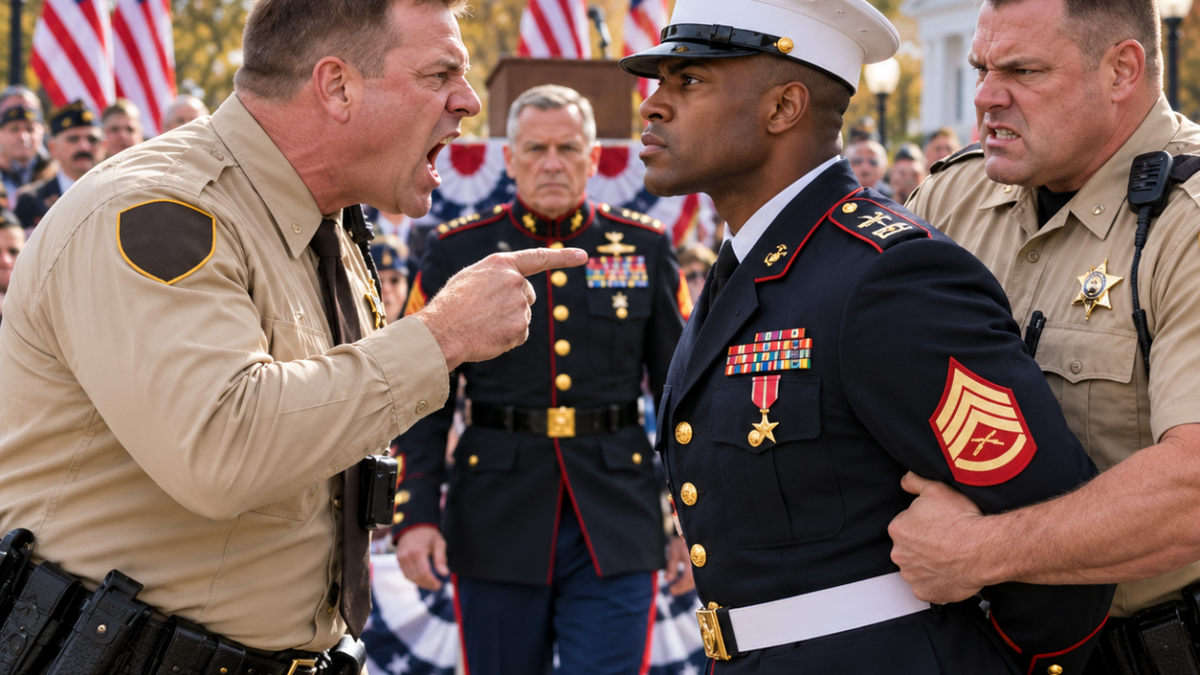
A Black Marine Captain Was Handcuffed at a Veterans Day Ceremony After a Cop Called His Bronze Star “Stolen”—Then a Four-Star General Walked Through the Crowd and Asked One Question.
The officer ripped the Bronze Star off my chest in front of my mother and called me a fraud.
I had just come home from eight months overseas, but that morning, in my own country, I was forced to my knees like I had stolen the uniform I had bled for.
Then a four-star general walked through the crowd, looked at the handcuffs on my wrists, and ended two careers without raising his voice.
My name is Fletcher Vance.
Captain Fletcher Vance, United States Marine Corps.
But on that Saturday morning in Stafford, Virginia, Officer Craig Dawson did not see a captain.
He did not see a Marine.
He did not see a son standing beside his mother on Veterans Day because she had asked him to wear his dress blues one time before he went back to duty.
He saw a Black man in a uniform he believed I did not deserve.
And that belief almost ruined him before the ceremony even began.
I had been back on American soil for eleven days.
Eleven days after eight months in East Africa.
Djibouti.
Somalia.
Places most people only heard about when something went wrong badly enough to make the news.
My deployment was the kind that came back in pieces. A little dust still in your boots. A little tension still in your shoulders. A little part of your mind still counting exits in every room, still listening for sounds that did not belong.
My mother, Denise Vance, had counted every one of those eight months.
She was sixty-one years old, retired after thirty-five years of teaching third grade, and she still had the kind of voice that could quiet a room full of children without ever sounding cruel. Her knees had started giving her trouble. She denied that, of course, because mothers lie about pain when they do not want their children to worry.
That morning, she called me at 7:12.
“Fletcher,” she said, “are you awake?”
“I’m a Marine, Mama.”
“That is not an answer.”
I smiled into the phone.
“Yes, ma’am. I’m awake.”
There was a pause.
Then she said, more softly, “Will you wear your blues today?”
I looked across the room at the garment bag hanging from the closet door.
I had planned to wear civilian clothes.
Jeans.
Jacket.
Maybe stand near the back of the town square and disappear after the wreath ceremony. I did not want attention. I did not want thank-yous. I did not want strangers shaking my hand while my mind was still half a world away.
But my mother had spent eight months waiting for the kind of phone call every military family fears.
She had earned one morning of seeing me whole.
“If that’s what you want,” I said.
“It is.”
“Then I’ll wear them.”
Her breath caught a little.
She tried to hide it.
She failed.
“Thank you, baby.”
I stood in front of the mirror thirty minutes later, buttoning the jacket slowly.
Dress blues do not forgive carelessness.
Every seam matters.
Every ribbon has its place.
PART2:
Every piece of metal carries weight beyond what it weighs in your hand.
The Bronze Star sat on my chest, clean and polished, pinned exactly where it belonged.
I did not like looking at it.
Not because I was ashamed of it.
Because I remembered the night behind it.
A compound outside Mogadishu.
Smoke.
Shouting.
Tracer fire stitching the dark.
Two Marines down in the open.
The voice in my headset cutting in and out.
The smell of dust and burned metal.
My own hands slick with blood that was not mine.
People call medals honors.
Sometimes they are.
Sometimes they are receipts for the worst night of your life.
My mother cried when she saw me.
Not dramatically.
Not loudly.
Just one hand to her mouth, eyes shining, shoulders trembling once before she got herself under control.
“You look like your father,” she whispered.
My father had died when I was nineteen.
He never got to see me become an officer.
I adjusted my cover under one arm and offered my mother the other.
“Come on,” I said. “Let’s go make you proud.”
She looked up at me.
“I already was.”
Stafford’s Veterans Day ceremony was held in the town square.
It was the kind of place built for postcards: trimmed grass, a small wooden stage, American flags hanging from lamp posts, red-white-and-blue bunting draped across railings, folding chairs lined up in neat rows, and children running between adults who kept telling them to slow down.
PART3:
The air smelled like coffee, grilled sausage, wet leaves, and cold sunlight.
Older veterans sat in the front row wearing caps from wars that had reshaped them decades earlier. Families spread blankets on the grass. A high school band warmed up near the gazebo, trumpets cracking through the morning air.
I walked beside my mother near the back of the crowd.
She held my forearm tightly.
Not because she needed that much support.
Because she was afraid I would vanish again if she let go.
I shortened my stride without thinking.
I guided her around a dip in the grass.
I kept my body slightly between her and the moving crowd.
After eight months overseas, protecting my mother from uneven ground felt like a privilege.
We found a spot near the back.
I was glad.
I wanted the ceremony to be about the men and women in the front row, the ones who had carried memory longer than I had been alive.
I was not there to be seen.
But Officer Craig Dawson saw me anyway.
I noticed him before he started walking toward me.
You learn to notice intent.
Not danger exactly.
Intent.
Two officers stood near the edge of the square. One was younger, maybe late twenties, trying to look comfortable in his uniform and failing. The other was older, early forties, with mirrored sunglasses, a wide stance, and both hands resting near his belt like the world owed him authority before he spoke.
That was Dawson.
I did not know his name yet.
But I knew his type.
Men like him do not enter conversations.
They occupy them.
He stared at me across the grass.
Not casually.
Not curiously.
He looked me up and down like he had found a stain on something he owned.
Then he nudged the younger officer and started walking.
My mother felt me change.
She always could.
“What is it?” she asked.
“Nothing yet.”
She followed my gaze.
The officers came closer.
The older one led.
The younger one trailed half a step behind, wearing the expression of a man who had not decided whether he was witnessing leadership or trouble.
Dawson stopped directly in front of me.
Too close.
Intimidation spacing.
Close enough that a civilian might step back without knowing why.
I did not step back.
“Morning,” he said.
It was not a greeting.
It was an opening move.
“Morning, officer,” I replied.
His eyes traveled from my shoes to my trousers, up my jacket, across my ribbons, pausing at the Bronze Star, then finally to my face.
He took his time.
He wanted me to feel inspected.
Measured.
Judged.
“Nice uniform,” he said.
The word nice came out wrong.
Bent.
“Where’d you get it?”
My mother’s fingers tightened on my arm.
“I was issued it,” I said, “like every other Marine.”
“Issued,” Dawson repeated.
The younger officer smirked.
Not because it was funny.
Because he had been trained by weakness to laugh when the senior man laughed.
Dawson tilted his head.
“You got a name?”
“Captain Fletcher Vance.”
“Captain.”
“Yes.”
“United States Marine Corps?”
“Yes.”
He looked at my chest again.
“Bronze Star too.”
“Yes.”
“Interesting.”
There was nothing interesting about it.
Not in the way he meant.
“What seems to be the problem?” I asked.
Dawson smiled.
The crowd moved around us, but a few people nearby had started listening.
“I’ve been around military people my whole career,” he said. “I know what the real thing looks like.”
I held his gaze.
“And?”
“And something about this does not add up.”
My mother said, “Officer, my son just returned from deployment.”
Dawson did not look at her.
That bothered me more than if he had.
“What doesn’t add up?” I asked.
He leaned in slightly.
“You really want me to spell it out?”
“Yes.”
His smile thinned.
“I look at you, with those captain’s bars and all that hardware on your chest, and I’m thinking there’s no way.”
There it was.
Not spoken cleanly.
Men like Dawson rarely say the ugliest part directly at first.
They let it sit under the words.
They let everyone hear it and then deny it later.
No way.
No way a Black man earned this.
No way a man like me belonged in that uniform.
The air around us changed.
A woman nearby stopped mid-conversation.
A teenager lowered his phone.
An older veteran in a faded VFW cap turned his head slowly.
Nobody intervened.
Not yet.
They were waiting for the moment to explain itself.
I had seen that before too.
People often need racism to announce itself with a parade before they trust what they are already hearing.
“I have my military ID,” I said.
I moved slowly.
Very slowly.
When a man with a gun is two feet from you and already looking for a reason, every movement has to be a sentence he cannot twist.
I reached into my inside pocket with two fingers and pulled out my common access card.
Name.
Rank.
Photo.
Chip.
Everything he needed.
“You can verify it right now,” I said. “One call.”
Dawson looked at the card like it offended him.
“That doesn’t prove anything.”
“It proves my identity, branch, and active-duty status.”
“Fake IDs exist.”
“Not like this.”
“You expect me to believe that?”
“I expect you to verify it.”
That should have ended it.
Any officer acting in good faith would have taken the card, made the call, scanned it, contacted the proper channel, or asked another officer to verify.
Dawson did none of that.
Because verification was not what he wanted.
Verification would end the story.
And Dawson had already chosen the story he needed.
A suspicious Black man.
A stolen uniform.
A sharp-eyed officer saving Veterans Day from disrespect.
He waved the card away with the back of his hand.
“You know what I think?”
“I can guess.”
“I think you bought yourself a costume online, pinned some medals on it, and came here to collect praise from people too polite to ask questions.”
My mother inhaled sharply.
“Officer—”
He lifted a hand toward her.
“Ma’am, stay out of this.”
My voice changed.
Not louder.
Colder.
“Do not speak to my mother that way.”
Dawson’s eyes snapped back to me.
“There it is.”
“What?”
“The attitude.”
I almost laughed.
Not because anything was funny.
Because the script was so old.
Calm was arrogance.
Dignity was attitude.
Knowing my rights was aggression.
Offering proof was suspicious.
There was no correct way to stand in front of a man who needed me guilty.
“You are making a mistake,” I said.
“No,” he replied. “I’m catching one.”
More heads turned.
Phones began to appear.
Dawson noticed.
That should have made him cautious.
Instead, it fed him.
Some men back down when watched.
Others perform.
Dawson performed.
He pointed at my chest.
“On a day meant to honor real heroes, you come out here wearing stolen decorations like some kind of joke.”
My jaw tightened.
That was the first sign.
I could control my voice.
My hands.
My breathing.
But my jaw sometimes betrayed me.
“I earned everything I’m wearing.”
“You expect me to believe that?”
“No,” I said. “I expect the records to show it.”
He stared at the Bronze Star.
His face changed for a fraction of a second.
Not suspicion.
Envy.
I saw it clearly.
Later, I would learn why.
Craig Dawson had tried to join the Marine Corps when he was twenty-two. He lasted nine days. Failed standards. Written up twice. Sent home with a bus ticket and a form letter.
He spent nineteen years building a life around the hole that left in him.
He collected military memorabilia.
He posed at veteran events.
He talked about service like it was a club he had almost entered and therefore understood better than actual members.
Then he saw me.
Younger.
Black.
A Marine officer.
Decorated.
Standing there with the thing he had wanted and never earned.
Something broke loose in him.
He reached toward my chest.
“Don’t,” I said.
One word.
Low.
Clear.
His hand stopped for half a second.
Then he did it anyway.
He grabbed the Bronze Star and pulled.
The pin tore through the fabric of my dress blues.
The sound was small.
A rip of thread.
But in that moment, it felt louder than gunfire.
He held the medal in his palm and turned toward the crowd.
“This,” he said, “is stolen property.”
My mother made a sound behind me.
Not a sob.
Not a word.
Something worse.
My entire body wanted to move.
Every instinct told me to take the medal back, to put this man on the ground, to make him understand that touching another Marine’s decoration was not a small thing.
But discipline is not discipline when it is easy.
I breathed in.
Held.
Released.
Survival, evasion, resistance, escape.
SERE training had taught me what pain and humiliation do to the mind when men with power want a reaction. They put you in stress positions. They scream. They strip away comfort and control. They teach you the difference between impulse and survival.
That morning, in the middle of Stafford Town Square, I used every second of that training not to become the threat Dawson wanted to create.
“That medal was awarded to me,” I said, each word measured, “for actions during combat operations. I want it back.”
Dawson shoved it into his pocket.
“You’ll get it back when I verify it’s real.”
“You refused to verify my ID.”
He looked down at the CAC still in my hand.
Then he snatched it.
He held it up, tilted it in the light, and flicked it onto the grass.
“Anybody can buy one of these online.”
The card landed face down.
I bent slowly and picked it up.
Wiped off the dirt.
Put it back in my pocket.
I said nothing.
That silence enraged him.
Men like Dawson do not want compliance.
They want submission.
Compliance says, “I will not escalate.”
Submission says, “You are right about me.”
I refused to give him the second.
“Answer me when I’m talking to you,” Dawson barked.
“I have answered every question you asked,” I said. “I showed you military identification. I offered verification. You refused. So what exactly do you want me to do?”
The question hung between us.
The crowd had gone almost completely still.
My mother stepped forward.
“Please,” she said. “Just check his identification. He just came home. He served. He has every right to be here.”
The younger officer moved before Dawson even spoke.
His name was Tyler Brennan.
I remember that because I repeated it later under oath.
Brennan put his hand on my mother’s shoulder and shoved her backward.
Not hard enough to throw her across the grass.
Hard enough to make a sixty-one-year-old woman with a bad knee stumble.
Her leg buckled.
She fell to one hand.
The whole square gasped.
That was when I moved.
Not toward Dawson.
Toward my mother.
“Don’t touch her,” I said.
The temperature in my voice dropped so sharply Brennan actually stepped back.
“She was interfering,” he said.
“She is a retired schoolteacher with a bad knee asking you to do your job.”
I helped her up.
Her hand shook in mine.
She tried not to cry.
That nearly broke me more than the medal.
A man can endure disrespect directed at himself.
Watching it land on his mother is something else.
Phones were out now.
Not hidden.
Raised.
Recording.
A man in a Marines hoodie stood five feet away with his camera pointed straight at Dawson. His hands shook, but the phone stayed steady.
The band had stopped warming up.
The announcer at the podium had stopped speaking.
Children stared because they did not understand the words but understood the wrongness.
Dawson should have stopped.
That was his last exit.
He could have stepped back, made the call, confirmed my identity, returned the medal, apologized to my mother, and salvaged something from the wreck he was building.
He did not.
He pointed at me.
“You’re coming with us.”
“On what charge?”
“Stolen valor. Impersonating a military officer. Possession of stolen decorations. Fraud.”
“None of those apply.”
“We’ll see.”
“The law requires fraud for tangible benefit. I’m standing at a public ceremony with my mother. I haven’t asked anyone for anything.”
For half a second, I saw it.
Doubt.
Not conscience.
Doubt.
The kind a man feels when the ground under him shifts and he realizes he may not know where he is standing.
Then pride buried it.
“Brennan,” Dawson said.
Brennan took out the handcuffs.
The sound of metal opening silenced what little noise remained.
My mother whispered, “Fletcher, no.”
I looked at her.
“I’m okay.”
I turned around.
Put my wrists together behind my back.
Let Brennan cuff me.
I did not resist.
I did not run.
I did not raise my voice.
Cooperate.
Survive.
Wait for the right moment.
The cuffs tightened around my wrists.
Cold steel against warm skin.
Dawson put a hand on my shoulder and shoved me down.
Not all the way at first.
He wanted the crowd watching.
“Ladies and gentlemen,” he announced, “this individual is being detained for impersonating a United States military officer and possessing stolen military decorations.”
A few people shouted.
“He showed you ID!”
“What are you doing?”
“That’s a Marine!”
Their voices were scattered, uncertain, afraid of crossing the invisible line people feel around a badge.
Dawson pushed again.
“Knees.”
I looked straight ahead.
Then I lowered myself to the grass.
A Marine captain in dress blues.
Hands cuffed behind his back.
Bronze Star ripped from his chest.
Forced to kneel in front of hundreds of people at a ceremony meant to honor military service.
My mother broke then.
She covered her mouth with both hands and cried in a way I had never heard before.
The empty space on my chest felt heavier than the medal ever had.
But I kept my face still.
I looked forward.
I breathed.
In.
Out.
In.
Out.
Behind the crowd, my mother moved.
I did not see it at first.
Later, people told me.
She stepped back, wiped her eyes, opened her purse, and made one call.
It rang twice.
Then a voice answered.
“Denise?”
“General Beckett,” she said, barely holding herself together. “They arrested Fletcher. They say he’s a fraud. They have him on his knees.”
There was a pause.
Then General Nathaniel Beckett said, “I’m eight minutes out. Do not let them move him.”
My mother returned to the crowd changed.
Still crying.
Still trembling.
But with something hard beneath it now.
Certainty.
Five minutes passed.
They were the longest five minutes of my life.
Dawson talked into his radio like he was narrating a victory.
Brennan stood near me, avoiding my mother’s eyes.
The crowd shifted, whispered, recorded.
I knelt and looked at the grass.
A small brown leaf sat near my right knee.
I remember that clearly.
Memory is strange that way.
It will blur a man’s face and preserve a leaf.
Then the crowd parted.
At first, Dawson did not notice.
He was too busy performing.
But I heard the change.
Crowds have sounds.
Fear has one.
Excitement another.
Recognition another.
This was different.
It was the sound of authority entering a space without asking permission.
A black Suburban stopped at the curb.
Two Marines in dress blues stepped out first.
Then the rear door opened.
General Nathaniel Beckett walked through the square.
Four stars on his shoulders.
Silver hair.
Back straight.
Chest covered in ribbons.
Calm as weather over stone.
He did not hurry.
He did not need to.
People moved before he reached them.
Some did not know who he was.
They moved anyway.
General Beckett had that effect.
He stopped four feet from Dawson.
The square went silent.
Completely silent.
He looked at me.
At the handcuffs.
At the torn fabric on my chest.
At my mother’s face.
Then at Dawson.
“Officer.”
One word.
Quiet.
Dawson turned.
For the first time that morning, he looked uncertain.
“My name is General Nathaniel Beckett, United States Marine Corps,” Beckett said. “The man you have on his knees is Captain Fletcher Vance. He serves under my direct command. He has just completed an eight-month deployment to the Horn of Africa with distinction. He is being recommended for promotion to major.”
He paused.
“Remove those handcuffs now.”
Dawson’s face lost color.
“I—sir, we had reason to believe—”
“You had a valid military identification card in your hand.”
Dawson swallowed.
“That card could have been—”
“Verified in under sixty seconds.”
No one breathed.
Beckett’s voice never rose.
That made it worse.
“You chose not to verify it. Instead, you confiscated his identification, threw it onto the ground, ripped a Bronze Star from a combat veteran’s chest, pushed his mother, handcuffed him, and forced him to kneel in front of civilians during a Veterans Day ceremony.”
He stepped half a pace closer.
“Is that an accurate summary, officer?”
Dawson’s mouth opened.
Nothing came out.
“I asked you a question.”
“Yes,” Dawson whispered. “But—”
“Remove the handcuffs.”
Dawson fumbled for the key.
His hands shook so badly it took him three tries.
The cuffs clicked open and fell into the grass.
I stood slowly.
My wrists burned.
I did not look at Dawson.
I looked at my mother.
She crossed the space between us and wrapped both arms around me like I was a boy again and she could still protect me from the world.
“I’m okay,” I whispered.
“No, you are not,” she said into my jacket.
She was right.
But I would be.
General Beckett reached into Dawson’s pocket himself and removed my Bronze Star.
Dawson did not stop him.
No one would have.
The general turned to me.
“Captain.”
I straightened.
He held the medal out.
I took it.
For a moment, I could not put it back on because the fabric was torn.
My mother saw my hand shake once.
Only once.
General Beckett turned back to Dawson.
Then he took out his phone.
He dialed.
Put it on speaker.
Held it up.
The ringtone echoed across the square.
“Sheriff Morrison’s office.”
“This is General Nathaniel Beckett, United States Marine Corps. I am standing in Stafford Town Square. I need Sheriff Alan Morrison immediately.”
Thirty seconds later, another voice came on.
“General Beckett, this is Sheriff Morrison. What can I do for you?”
Beckett’s eyes stayed on Dawson.
“Sheriff, two of your officers, Craig Dawson and Tyler Brennan, have just unlawfully detained and publicly humiliated Captain Fletcher Vance, a decorated Marine officer under my command. They ignored his military ID, confiscated and mishandled it, tore a Bronze Star from his uniform, pushed his mother, handcuffed him, and forced him to his knees in front of hundreds of witnesses.”
The sheriff did not answer immediately.
The whole square heard the silence.
Beckett continued.
“The incident has been recorded by multiple bystanders. I want both officers suspended immediately pending full investigation.”
Morrison’s voice came back slower.
“General, are you certain about the details?”
“I am looking at the handcuffs on the grass.”
Another pause.
“Both officers are suspended effective immediately. Internal affairs will be there within the hour.”
“One more thing,” Beckett said. “Their badges and service weapons should be collected before they leave this square.”
Dawson flinched.
Sheriff Morrison said, “Understood.”
Beckett looked at Brennan.
“Officer Brennan appears capable of hearing you.”
The sheriff’s voice came through the speaker.
“Brennan, collect Officer Dawson’s weapon and badge. Then surrender your own. Both of you are relieved of duty effective immediately. Is that clear?”
Brennan looked like he might be sick.
“Yes, sir.”
The crowd watched as Brennan removed Dawson’s weapon.
Then Dawson’s badge.
Dawson’s face had gone slack.
Not angry anymore.
Not proud.
Empty.
Like a man who had built his whole identity around borrowed authority and just watched someone take the costume away.
Then Brennan placed his own weapon and badge on the hood of the patrol car.
Two badges.
Two guns.
Two careers beginning to end in front of the crowd they had tried to impress.
No one clapped at first.
The silence was too heavy.
Then the man in the Marines hoodie shouted, “We got all of it!”
That broke something open.
People began shouting.
Some cheered.
Some cried.
Some stood there looking ashamed because they had watched too long before speaking.
My mother held my arm with both hands.
General Beckett placed one hand on my shoulder.
“You all right, Captain?”
“No, sir.”
His eyes softened.
“Good answer.”
The video reached the internet before Dawson and Brennan left the parking lot.
By noon, it had spread across the state.
By evening, it was national.
The headline changed depending on who posted it, but the meaning stayed the same.
Cops cuffed a Black Marine for stolen valor.
General ended their careers on the spot.
I did not watch the videos at first.
My mother did.
Over and over.
Not because she wanted to relive it.
Because she needed proof that the world had seen what happened.
For years, she had told children to tell the truth, to stand straight, to believe that doing right mattered.
That morning had almost broken something in her.
The videos helped put a little of it back.
The Marine Corps issued a statement confirming my service, my rank, my deployment, and my Bronze Star.
Veterans organizations called.
Reporters called.
Lawyers called.
People who had never met me wrote messages full of rage, sorrow, apology, and stories of their own.
Black veterans.
Latino veterans.
Asian veterans.
Women veterans.
Men who had been asked if their medals were real.
Women who had been assumed to be spouses instead of service members.
Black officers pulled over in uniform and asked where they got the car.
A Native sergeant told me a gate guard once held him for twenty minutes because he “didn’t look like an officer.”
I read every message I could.
The thing about humiliation is that it tries to make you feel alone.
The aftermath showed me I never had been.
Internal affairs moved first.
Then the state.
Then the federal investigators.
Brennan’s body camera had captured almost everything.
Dawson’s camera had not.
That became important.
His camera activated late.
Too late.
A veteran officer does not forget to activate a camera during a public detention unless he believes the first part is better left unseen.
But other cameras saw what his did not.
Bystanders.
News crews setting up for the ceremony.
A teenager filming for a school project.
Even the town’s event livestream caught part of it from the side.
There was no way to make the truth disappear.
The investigation found six prior complaints against Dawson involving Black drivers, Latino teenagers, a Black pastor, and one Army veteran who had been detained for “suspicious behavior” while changing a tire outside his own church.
All resolved internally.
No discipline.
No retraining.
No pattern acknowledged.
A drawer full of warnings nobody wanted to read.
Brennan took a deal.
He admitted he should have stopped it.
Those four words followed him everywhere.
I should have stopped it.
He was right.
He should have.
Dawson fought.
Men like Dawson often do.
Not because they have a strong case.
Because admitting the truth would require meeting themselves without the uniform.
The trial lasted four days.
I testified on the second.
My mother sat in the front row.
General Beckett sat behind her.
The prosecutor showed the video.
I watched myself kneel on the grass.
I watched Dawson rip the medal off my chest.
I watched Brennan shove my mother.
I heard the crowd gasp.
I heard my own voice stay calm in a way I barely remembered.
The defense tried to say Dawson made a mistake.
A painful mistake.
A public mistake.
But still a mistake.
The prosecutor asked Dawson two questions.
“Did Captain Vance offer you a government-issued military identification card?”
“Yes.”
“Did you verify it?”
“No.”
That was the case.
Everything else was explanation.
The jury convicted him.
Dawson lost his badge permanently.
Brennan lost his certification.
The county settled the civil case, but money was never the point.
My mother asked me once what would be enough.
I told her the truth.
“Enough would have been Dawson making the call when I handed him my ID.”
Since we could not go back to that moment, we built something from what remained.
The settlement required reforms.
Real ones.
Mandatory body camera activation policies.
Independent civilian oversight.
Review of prior complaints.
Bias training with outside monitoring.
Public reporting requirements.
Discipline procedures with teeth.
The department did not change because it wanted to.
It changed because the whole country watched what happened when it refused to.
Six months after the verdict, I stood at a podium in a community center not far from the town square.
No handcuffs.
No torn uniform.
No officer standing over me.
My mother sat in the front row.
General Beckett stood near the back, pretending he had just dropped by and was not personally responsible for half the donors in the room.
I announced the Vance Veterans Legal Defense Fund.
A nonprofit providing legal help to veterans of color facing discrimination, profiling, or civil rights violations.
I funded it with most of my settlement.
People asked later why I did not buy a bigger house.
Or disappear.
Or take a long vacation somewhere no one knew my name.
The answer was simple.
Dawson humiliated me in public because he believed men like me stood alone.
I wanted to make sure the next one did not.
In the first year, the fund took thirty-one cases across four states.
Some went to court.
Some settled.
Some ended with policy changes.
Some ended with apologies that came too late but still had to be written.
Thirty-one veterans who might have swallowed the insult and gone home instead had someone standing beside them.
I also started a mentorship program for young Black men and women who wanted to serve.
Not recruitment.
Preparation.
Fitness.
Applications.
Officer candidate pathways.
Financial aid.
Interview coaching.
The unwritten rules no brochure tells you.
How to stand when someone questions whether you belong.
How to let your record speak louder than their assumptions.
How to remain calm without surrendering your dignity.
On the first Saturday, fourteen teenagers showed up.
By the third month, there were forty.
My mother brought snacks every week.
General Beckett came once and terrified everyone by quietly sitting in the back taking notes.
Three months after the trial, I was promoted to major.
Reporters asked if I planned to leave active duty and build a public career from what happened.
I did not.
I returned to work.
That confused some people.
They thought the ceremony, the video, the lawsuit, the headlines had turned me into something new.
They had not.
They had simply shown the country something I already knew.
Service does not protect you from prejudice.
A uniform does not erase the color of your skin in the eyes of someone determined to see only that.
A medal does not stop a man from believing you stole it if his pride depends on your guilt.
But none of that changes who you are.
Months later, I returned to Stafford Town Square.
Not for cameras.
Not for a ceremony.
Just me and my mother.
It was quiet that afternoon. No flags except the permanent one near the courthouse. No stage. No crowd. No Dawson. No Brennan.
The grass had grown back where I had been forced to kneel.
That bothered me at first.
Then it comforted me.
Places heal too, if people tell the truth about what happened there.
My mother stood beside me.
Her hand found my arm the same way it had that morning.
“I hated seeing you on your knees,” she said.
“I know.”
“I hated that I could not stop it.”
I looked down at her.
“You did stop it.”
She shook her head.
“General Beckett stopped it.”
“No,” I said. “You made the call.”
She looked toward the empty square.
“I was so scared.”
“I was too.”
That surprised her.
Maybe because sons spend too much time trying not to let mothers know when they are afraid.
But I had promised myself after the trial that I would stop lying about what that morning cost.
“You looked so calm,” she said.
“I was trained to look calm.”
She squeezed my arm.
“I wish you had never needed that training here.”
“So do I.”
We stood there a while.
Then she reached into her purse and pulled out a small cloth pouch.
“What is that?” I asked.
She opened it.
Inside was the torn piece of fabric from my dress blues.
The section Dawson had ripped when he tore off the Bronze Star.
I stared at it.
“I thought that was gone.”
“I kept it.”
“Why?”
She folded the cloth over her palm.
“Because one day, when you forget how strong you were, I want to show you what they tried to tear and what they failed to take.”
I could not speak for a moment.
My mother pressed the fabric into my hand.
“You earned that uniform before he touched it,” she said. “You were still wearing it after he did.”
That was the truth I carried from then on.
Not the video.
Not the verdict.
Not the settlement.
That.
Dawson took the medal off my chest for a few minutes.
He did not take what it meant.
He put cuffs on my wrists.
He did not take my service.
He forced me to my knees.
He did not make me small.
A badge can give a man power.
It cannot give him honor.
A uniform can be worn.
It cannot be stolen into meaning.
And dignity, real dignity, is not something another man can rip from your chest.
He can expose it.
He can test it.
He can make the whole world witness it.
But he cannot take it unless you hand it over.
I never did.
And when General Beckett walked into that square, he did not give my dignity back to me.
He made everyone else acknowledge it had never left.








