A Black Cat Had 30 Minutes Left to Live—Then a Stray Grey Tabby Arrived That Morning, Walked to the Euthanasia Room Window, and Pressed Her Nose Against His
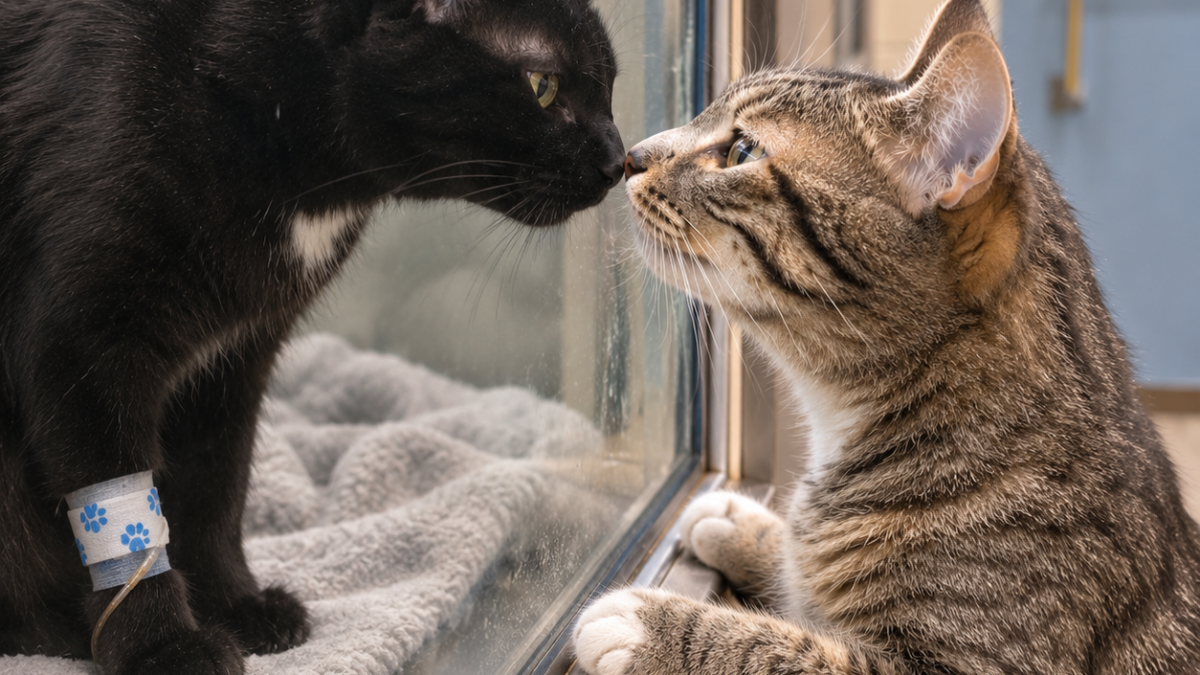
A Black Cat Had 30 Minutes Left to Live—Then a Stray Grey Tabby Arrived That Morning, Walked to the Euthanasia Room Window, and Pressed Her Nose Against His
At 8:45 on a cold November morning, a healthy black cat was placed behind the glass of a California shelter’s euthanasia room because fourteen days had passed and nobody had chosen him.
Seventeen minutes before his scheduled death, a frightened gray stray slipped from a volunteer’s arms, ran straight to that window, and pressed her nose against his as if she had crossed the building for one reason only.
What nobody knew was that the photograph taken in that moment would not just save two cats—it would expose a secret inside the shelter that powerful people had spent months trying to keep buried.
The black cat did not have a name when they moved him into Room C.
He had a number.
A-4176.
On his intake card, under COLOR, someone had typed BLACK.
Under SEX, MALE.
Under AGE, APPROX. 4 YRS.
Under TEMPERAMENT, a green sticker had been placed beside the words FRIENDLY / SOCIAL / HANDLES WELL.
Under HOLD EXPIRES, there was a date printed in small black letters.
Wednesday, November 18.
That morning.
The shelter called Room C a “holding room.”
Everyone who worked there knew what it really was.
Elena Reyes hated that phrase almost as much as she hated the room.
Holding room sounded temporary.
Neutral.
Clean.
Like a place where an animal waited while somebody found a leash.
Room C was where animals waited when time had run out.
It was 8:43 a.m. when Elena stood in Kennel Row Three with a clipboard tucked against her chest and watched the black cat reach one paw between the bars toward her.
“Don’t,” she whispered.
The cat blinked.
His paw stayed there.
Elena had been working at the San Paloma County Animal Care Center for six years. She was thirty-seven, divorced, childless, and living in a rented bungalow outside Modesto with a twelve-year-old terrier named Benji and a refrigerator that made a grinding noise every night at 2:00 a.m.
She was not naïve.
She knew shelters euthanized animals.
She knew why.
There were mornings when trucks brought in twelve dogs before breakfast. Afternoons when cardboard boxes arrived containing entire litters of kittens with their eyes still sealed. Weekends when people surrendered animals because they were moving, having a baby, getting divorced, changing jobs, replacing carpet, or simply “couldn’t deal with it anymore.”
Elena had seen every version of grief and every version of indifference.
She had also seen staff members sleep beside parvo puppies.
She had seen volunteers drive four hours for a single senior dog.
She had watched exhausted technicians spend their own money on medicine.
The shelter was not evil.
It was overwhelmed.
That distinction mattered to her.
At least, it used to.
The black cat had arrived fourteen days earlier in a blue plastic carrier with a cracked door.
A farmworker named Luis had found him behind an irrigation pump east of Patterson.
The cat had walked directly toward Luis instead of running away.
No collar.
No chip.
No injuries.
No fleas.
He weighed eleven pounds and eight ounces.
He let the intake technician trim his nails.
He purred during vaccination.
PART2:
During his behavior assessment, he rubbed his face against the evaluator’s pen.
Green rating.
Highest possible.
Elena had written “VERY SWEET” on his kennel card in purple marker.
It had not helped.
Black cats stayed longer.
Older cats stayed longer.
Adult male cats stayed longer.
That week, nearly everything stayed longer.
The shelter had 126 cat spaces.
One hundred twenty-six were occupied.
Portable crates filled the isolation hall.
The laundry room held three emergency enclosures.
Two cats recovering from respiratory infections were in staff offices.
A mother with six kittens was temporarily housed in a large dog crate beside the break room vending machine.
The county called it a capacity emergency.
Frank Danner called it Tuesday.
Frank was the shelter’s operations director.
He had been hired eleven months earlier after the county board demanded lower costs, shorter intake times, and “improved population turnover.”
PART3:
Frank liked words like turnover.
He liked metrics.
He liked reports with arrows.
He liked saying things such as “We cannot save our way out of irresponsible ownership.”
He was fifty-two, broad-shouldered, silver-haired, and always wore expensive brown boots that never seemed to collect dust despite the fact that the shelter sat beside acres of agricultural fields where the wind carried dirt against every window by noon.
Frank had never been cruel to an animal in front of Elena.
That would have been easier.
Cruelty was simple.
Frank was efficient.
Efficiency could hide behind spreadsheets.
At 7:30 that morning, he had placed the euthanasia list on the stainless-steel counter in the treatment room.
Thirty animals.
Nineteen cats.
Eleven dogs.
A technician named Molly had stared at the list.
“Thirty?”
Frank had not looked up from his tablet.
“We’re over capacity by forty-three.”
“We have rescues picking up tomorrow.”
“We have intake today.”
“There’s a difference between today and tomorrow.”
“There certainly is,” Frank said. “Today is when we make space.”
Elena remembered that sentence because something about it stayed lodged beneath her ribs.
Today is when we make space.
Not save animals.
Not manage capacity.
Make space.
The black cat was number forty-seven in the shelter’s internal priority system.
Thirty would be processed that day.
Somebody had moved him upward.
Elena noticed because she knew his number from the afternoon before.
She had been trying to find him a rescue placement.
She looked at Frank.
“Why is A-4176 on today’s list?”
Frank finally raised his eyes.
“Hold expired.”
“His hold expired today.”
“Yes.”
“Usually animals get at least twenty-four hours after expiration if they’re green.”
“Usually isn’t policy.”
“He’s healthy.”
“So are nine others on the list.”
“He has no behavioral issues.”
“Neither do four others.”
“I contacted Valley Paws yesterday.”
Frank’s expression shifted almost invisibly.
Valley Paws was a rescue organization in Sacramento that pulled cats from rural shelters.
“What did they say?”
“I left two messages.”
“So nothing.”
“They’ve taken from us before.”
“And if they call after lunch?”
“They can choose from the animals still available after lunch.”
Molly turned away.
Elena stared at Frank.
“That’s not an answer.”
“No,” he said calmly. “It’s an operational reality.”
Frank walked past her.
Elena followed him into the hall.
“Give him until tomorrow.”
“No.”
“Until five.”
“No.”
“Until noon.”
Frank stopped.
Behind them, dogs barked from the kennels.
Phones rang at intake.
Someone rolled a metal cart through the treatment area.
Frank lowered his voice.
“You’ve been here six years, Elena.”
“I know how long I’ve been here.”
“Then stop forcing me to explain this like you started Monday.”
“I’m not asking for an explanation.”
“You’re asking me to selectively suspend procedure because you like one cat.”
“I like all of them.”
“That’s exactly your problem.”
She felt the words land.
Frank continued before she could answer.
“You think caring harder changes mathematics.”
“No. I think numbers are supposed to describe what we’re doing, not decide what’s allowed to live.”
For the first time, anger showed in his face.
Small.
Controlled.
But there.
“You have a job because this county runs on decisions, Elena. Not feelings.”
“So does a slaughterhouse.”
Molly’s head snapped toward them.
The hallway went quiet in the strange way workplaces sometimes do when everybody pretends not to be listening.
Frank stepped closer.
“Would you like to repeat that?”
Elena knew she should not.
She also knew the black cat was reaching through the kennel bars twenty feet away.
“No.”
“Good.”
Frank pointed toward the treatment room.
“You’re on intake today.”
“I know.”
“Then do intake.”
He walked away.
By 8:30, Elena had already processed a terrier mix found near a canal, two kittens discovered beneath a forklift, and an elderly beagle surrendered by a woman moving into assisted living.
The black cat remained in his kennel.
At 8:41, Molly appeared at the intake doorway.
She did not speak.
She only looked at Elena.
Elena looked at the wall clock.
8:41.
Molly hated euthanasia days.
Most technicians did.
But Molly had been there nine years.
She had learned how to move quietly through unbearable tasks.
“Is it him?”
Molly nodded.
Elena closed her eyes.
“Give me a minute.”
“Elena—”
“One minute.”
She went to Kennel Row Three.
The black cat came immediately to the front.
Of course he did.
Some animals hid on euthanasia mornings.
Elena always wondered if they somehow sensed the change.
The different footsteps.
The silence.
The smell of staff members trying not to cry.
But A-4176 greeted her like every morning was still possible.
He leaned his forehead against the bars.
Elena reached through.
He pressed into her fingers.
“You should’ve been awful,” she whispered.
He purred.
“You should’ve scratched somebody.”
The purr grew louder.
“You should’ve bitten Frank.”
His eyes narrowed contentedly.
Elena laughed despite herself.
Then the laugh collapsed.
She crouched until her forehead nearly touched the kennel door.
“You were supposed to make this easier.”
The cat pushed his nose between the bars.
She touched it with one finger.
Behind her, Molly waited.
“Elena.”
“I know.”
Molly opened the kennel.
The black cat walked into Elena’s arms.
No struggle.
No fear.
He placed one front paw on her shoulder.
Elena carried him down the hallway.
At the end was Room C.
The room had no cages.
Just a stainless-steel examination table, a small metal bench beneath the interior observation window, a blanket shelf, a sink, and a rolling cart.
The actual euthanasia procedure was normally performed in the adjoining treatment area.
Room C was where animals waited.
Sometimes minutes.
Sometimes longer.
Elena carried the cat inside.
He looked around.
His ears moved toward the sounds in the intake hallway.
She set him on the bench.
He sat.
Perfectly calm.
Molly stood in the doorway.
“Scheduled for nine twenty-two,” she said quietly.
Thirty-seven minutes.
Elena looked at her.
“I thought nine fifteen.”
“Frank moved two emergencies ahead.”
For one ridiculous second, Elena felt relieved.
Seven extra minutes.
As though seven minutes were a gift.
“What time is it?”
“Eight forty-five.”
Elena looked at the black cat.
He had begun washing one paw.
“Thirty-seven minutes,” she murmured.
Molly touched her arm.
“Don’t count.”
Then she left.
Elena stood alone with him.
The glass window beside the bench looked into intake.
People passed on the other side without seeing what was happening in the room.
A man carrying a dog crate.
A volunteer with towels.
A woman filling out paperwork.
Life continued six inches from death.
Elena hated the window.
She always had.
At 8:49, she returned to the intake desk.
The phones were ringing again.
A woman was arguing about a stray dog.
A farmer wanted someone to pick up three feral cats.
A child had found a rabbit in a drainage ditch.
Elena answered questions.
Printed forms.
Checked microchip numbers.
Tried not to look toward Room C.
At 8:52, Volunteer Intake Coordinator Diane Mercer came through the front doors carrying a small gray tabby.
Diane was sixty-four and had been volunteering at San Paloma longer than Frank had been living in California.
She wore jeans, a blue shelter T-shirt, and a canvas jacket with dog hair permanently embedded in both sleeves.
“This one came from Mercado Vista,” she said.
“Owner surrender?”
“Stray.”
“Finder?”
“Customer named Cheryl Banks. Found her near the carts.”
The gray tabby was small enough to fit comfortably against Diane’s chest.
She had dark stripes, white around the mouth, and enormous yellow-green eyes.
Unlike A-4176, she was frightened.
Her claws clung to Diane’s jacket.
“No carrier?” Elena asked.
“Finder brought her wrapped in a bath towel.”
“Of course she did.”
“She’s sweet.”
“They’re always sweet when you say that.”
Diane smiled.
“I have excellent judgment.”
“You got bitten by a chihuahua last week.”
“He apologized.”
Elena almost smiled.
Almost.
Then a metal tray clattered in treatment.
The sound echoed.
The gray cat startled violently.
Diane tightened her hold.
“It’s okay, baby.”
The cat twisted.
One second she was against Diane’s chest.
The next she was on the floor.
“Shoot.”
Diane bent.
The tabby darted beneath a chair.
Elena stepped around the desk.
“Close the front door.”
A volunteer moved quickly.
The gray cat shot from beneath the chair.
Past intake.
Past the scale.
Past a stack of food bags.
“Elena!”
“I see her.”
The tabby ran toward the inner hallway.
Directly toward Room C.
Elena expected her to duck beneath another cart.
She didn’t.
She stopped in front of the glass.
Elena was ten feet away.
Diane was behind her.
The gray cat stared through the window.
Inside Room C, the black cat lay curled on the metal bench.
The tabby rose onto her hind legs.
She placed one paw against the glass.
Then the other.
Elena stopped moving.
Diane whispered, “Well, look at that.”
The black cat raised his head.
He saw her.
For several seconds, neither animal moved.
The intake hallway continued behind them.
A phone rang.
A dog barked.
Someone laughed in the lobby.
But for Elena, every sound seemed to fall away.
The black cat stood.
He jumped down from the bench.
Walked toward the glass.
The gray tabby stretched higher.
He came closer.
Closer.
Then he lifted his face.
His nose touched the window.
The gray cat shifted.
Her nose met his from the other side.
Exact same spot.
Elena felt something tighten in her throat.
Diane did not speak.
The two cats stared at each other.
No hissing.
No flattened ears.
No pawing.
No aggression.
Just stillness.
The black cat’s whiskers spread against the glass.
The tabby’s breath fogged a tiny circle beneath her nose.
A thin pane of safety glass stood between them.
One had just entered the shelter.
One was scheduled to die in thirty minutes.
They knew none of that.
Or maybe, Elena would later think, they knew something human beings did not.
She reached slowly for her phone.
One photograph.
She did not take ten.
Did not adjust lighting.
Did not crouch for a better angle.
She simply lifted the phone and touched the screen.
Click.
The moment remained.
Then she lowered it.
Diane looked at Elena.
Elena looked at the clock.
8:54.
Twenty-eight minutes.
She stared through the glass.
The black cat had sat down.
The tabby remained upright against the window.
Diane whispered, “They know each other?”
“No.”
“You sure?”
“He came from Patterson.”
“She was found two miles from here.”
“Maybe same owner?”
“No chip on him. We haven’t scanned her yet.”
The tabby made a soft chirping sound.
The black cat answered with a quiet trill.
Elena covered her mouth.
Diane’s eyes filled.
“Oh, come on,” she whispered. “That is not fair.”
Elena understood exactly what she meant.
It was not fair because Elena had spent years learning emotional distance.
Not indifference.
Distance.
Distance kept people functional.
Without it, every kennel became a tragedy.
Every surrender became personal.
Every unclaimed animal followed you home in your head.
Distance was how Elena drove home after euthanasia days and still bought groceries.
How she attended her niece’s birthday after holding a dying dog that morning.
How she laughed at television while remembering animals whose names existed only on paperwork.
But something about the window destroyed distance.
The black cat was not a statistic anymore.
He was one side of a moment.
And something alive had come from outside his ending and touched him.
Frank appeared at the end of the hallway.
“What’s happening?”
Nobody answered immediately.
He approached.
The gray tabby dropped to all fours when he came near.
Frank looked through the window.
His face remained unreadable.
Diane said, “She ran straight here.”
Frank looked at the tabby.
“Whose cat?”
“New stray.”
“Then get her into intake.”
Diane stared at him.
“Did you see that?”
“Yes.”
“She touched noses with him.”
“I have eyes, Diane.”
Elena felt heat rise in her chest.
Frank noticed her phone.
“What were you doing?”
“I took a picture.”
“You know the policy on photographing animals in restricted areas.”
“There are no people in it.”
“That isn’t what I asked.”
Diane straightened.
“Frank, for heaven’s sake.”
“Intake animals are county property until disposition.”
Elena almost laughed.
County property.
The black cat was now sitting at the window again.
Waiting.
The gray tabby had risen onto her hind legs once more.
Diane looked from them to Frank.
“Maybe you should consider this one of those moments where being a human being matters more than the manual.”
Frank’s jaw tightened.
“Scan the stray.”
Diane lifted the tabby carefully.
This time she did not fight.
But as Diane carried her toward intake, the cat twisted her head backward.
Her eyes remained on the black cat.
Elena looked at the clock.
8:57.
Frank saw her looking.
“Don’t do this.”
“Do what?”
“Turn coincidence into permission.”
“Permission for what?”
“To make somebody else the villain because you don’t like reality.”
Elena’s hands trembled.
“I’m not making you anything.”
“Good.”
He started to walk away.
Elena said, “I’m adopting him.”
Frank stopped.
Diane froze with the gray cat in her arms.
Molly, standing at the treatment doorway, looked up.
Frank turned slowly.
“What?”
“I’m adopting A-4176.”
“Elena.”
“I’m taking him.”
“You have a dog.”
“My lease allows two animals.”
“You told me last month your rent went up.”
“That’s none of your business.”
“You can’t financially rescue every cat you feel guilty about.”
“I’m not adopting every cat.”
“You cannot make impulsive decisions in the middle of a euthanasia shift.”
“I just did.”
Frank stepped closer.
“You are staff.”
“And staff can adopt.”
“Not while an animal is in disposition.”
“Then move him out of disposition.”
“That requires supervisor approval.”
“Approve it.”
“No.”
The word landed harder than Elena expected.
Diane said, “Frank.”
He ignored her.
Elena stared at him.
“Why?”
“Because paperwork has already been processed.”
“So unprocess it.”
“We do not manipulate records because an employee had an emotional reaction.”
Elena’s disbelief sharpened.
“He’s alive.”
“Obviously.”
“I’m standing here offering him a home.”
“At 8:58 on the morning he is scheduled.”
“Yes.”
“That should have happened before disposition.”
Elena stepped toward him.
“Listen to yourself.”
Frank’s voice lowered.
“You are becoming inappropriate.”
Molly came out of treatment.
“Frank, if she adopts him, space is still created.”
He looked at Molly.
“This doesn’t concern you.”
“It kind of does. I’m the one assigned to—”
“I said it doesn’t concern you.”
Molly stopped.
Elena looked through the glass.
The black cat was watching them.
She would remember his face for the rest of her life.
He had no idea adults were debating whether his rescue was administratively convenient.
Elena walked to the front desk.
“What are you doing?” Frank asked.
“Printing an adoption application.”
“I told you no.”
“You gave me an operational answer. I’m giving you an operational solution.”
“Elena.”
The printer hummed.
She took the form.
Frank reached past her and placed his hand on the page.
“Stop.”
For six years, Elena had followed instructions.
She had stayed late without complaint.
Covered shifts.
Driven animals to emergency clinics.
Cleaned kennels during power outages.
Missed Christmas Eve dinner twice.
She had tolerated decisions she hated because she believed the system was doing its best under impossible circumstances.
But standing there with Frank’s hand over the adoption form, Elena felt something change.
Not explode.
Settle.
A conclusion.
“No,” she said.
Frank blinked.
Elena pulled the paper from beneath his hand.
“No what?”
“No, I’m not stopping.”
“You are refusing a direct instruction?”
“I am adopting a county shelter animal legally available for adoption.”
“He is not currently available.”
“He was listed as adoptable until forty-five minutes ago.”
“He is in disposition.”
“You keep saying that like it’s a force of nature.”
Frank’s face reddened.
“Go home.”
“No.”
“You’re suspended for the remainder of the shift.”
“Then I’m a member of the public.”
The room went silent.
Diane’s eyebrows lifted.
Elena removed her employee badge.
She placed it on the counter.
“Hi,” she said, her voice shaking. “My name is Elena Reyes. I would like to adopt cat A-4176.”
Molly looked down to hide a smile.
Frank stared at Elena.
“You think this is funny?”
“No.”
“You think you’re proving something?”
“No.”
“Then what exactly do you think you’re doing?”
Elena looked at the window.
The black cat had placed his nose against the glass again.
The gray tabby, still in Diane’s arms, was staring back.
Elena swallowed.
“I think I’m refusing to kill an animal while I am standing here offering him my home.”
Frank’s expression hardened.
“You’re finished here.”
Maybe he meant for the day.
Maybe he meant permanently.
Elena did not care.
“Okay.”
She filled out the application.
Her hands shook so badly she misspelled her street name.
Diane corrected it.
The adoption fee was sixty-five dollars.
Elena’s checking account contained $412 until Friday.
She paid.
Frank stood by the door with his arms crossed.
At 9:05, Molly entered Room C.
The black cat walked toward her.
She lifted him.
She did not take him toward treatment.
She brought him to Elena.
When he settled into Elena’s arms, he placed the same paw on her shoulder he had earlier that morning.
Elena buried her face against his neck.
For one moment, she forgot everyone else.
His fur smelled faintly of disinfectant.
He purred against her chest.
“You’re coming home,” she whispered.
Diane began crying.
Molly wiped one cheek.
Frank turned away.
The gray tabby made another small chirp.
The black cat lifted his head.
Elena stepped closer.
Diane brought the tabby near.
The two cats sniffed each other without glass between them.
Just once.
Nose to nose.
Then the gray cat tucked herself against Diane’s jacket.
Elena whispered, “Thank you.”
Diane asked, “To who?”
Elena looked at the tabby.
“I don’t know.”
Frank’s voice came from behind her.
“Take your things and leave.”
Elena looked at him.
“Am I fired?”
“You are suspended pending review.”
“For adopting a cat?”
“For insubordination.”
Elena nodded.
“Put that in writing.”
That bothered him.
She could tell immediately.
Frank had expected tears.
Apologies.
A request to talk privately.
Instead, Elena asked for documentation.
“I’ll have HR contact you.”
“Please do.”
She carried A-4176 toward the employee entrance.
At the door, she stopped.
“What are you going to name him?” Diane asked.
Elena looked at the cat.
Black fur.
Golden eyes.
Thirty-seven borrowed minutes.
“I don’t know yet.”
Molly called from the hallway, “Lucky.”
Elena shook her head.
“He wasn’t lucky.”
Everyone looked at her.
She held him tighter.
“He was almost killed because nobody chose him. Luck shouldn’t have to work that hard.”
Then she left.
Outside, Central Valley morning sunlight stretched across the parking lot.
Beyond the shelter were flat fields, irrigation lines, distant silos, and a pale sky turning blue above the San Joaquin Valley.
Elena put the cat in the passenger seat inside a cardboard carrier.
He immediately pushed his face against the vent holes.
She sat behind the wheel.
Her hands stayed on the steering wheel.
For five minutes, she did not start the car.
Then she began shaking.
Not delicate tears.
Not cinematic crying.
The kind that hurt.
She covered her face and sobbed until her chest ached.
From the carrier came a small sound.
“Mrrrp.”
Elena laughed through tears.
“Yeah.”
“Mrrrp.”
“I know.”
She wiped her face.
“You almost died.”
The cat looked at her through the holes.
“And now I might be unemployed.”
He blinked.
“That makes two of us with bad mornings.”
She drove home.
At noon, she received the email.
SUBJECT: ADMINISTRATIVE LEAVE PENDING INVESTIGATION.
Frank had copied Human Resources and the county animal services administrator.
The allegation was “insubordination, disruption of shelter operations, unauthorized use of electronic photography in a controlled area, and improper interference with disposition procedure.”
Elena read it twice.
Then she looked at the black cat asleep on her sofa.
He had taken less than twenty minutes to claim Benji’s favorite blanket.
Benji stood six feet away, offended.
“You cost me my career,” Elena told the cat.
He rolled onto his back.
She stared at him.
“Worth it.”
That evening, she opened the photograph.
She had avoided looking at it.
Now she sat at her kitchen table while rain began tapping softly against the window.
The image was imperfect.
Slightly crooked.
Fluorescent shelter lighting.
A mop bucket visible in the background.
The gray tabby’s body partly hidden by the window ledge.
The black cat inside Room C.
Their noses touching.
Elena enlarged it.
Something about the picture hurt more than the actual moment had.
Because time had stopped inside it.
The black cat would always be twenty-eight minutes from death in that photograph.
The gray tabby would always be newly arrived.
The glass would always separate them.
Nobody looking at it could know he was asleep fifteen feet from Elena now.
Nobody could know the gray cat was still at the shelter.
Nobody could hear Frank talking about procedures.
Nobody could see the form under his hand.
The photograph contained none of the argument.
Only the truth underneath it.
Two animals.
One barrier.
A moment no rule had planned for.
Elena opened Facebook.
She had 684 friends.
Mostly relatives, shelter volunteers, former coworkers, people from high school, rescue contacts.
She uploaded the photograph.
Then she tried to write a caption.
She typed:
This happened today.
Deleted it.
She typed:
Twenty-eight minutes before this black cat was scheduled to be euthanized—
Deleted it.
She typed:
Sometimes animals understand things we don’t.
Deleted it.
Too sentimental.
She tried:
I will never forget what I saw this morning.
Deleted.
Eleven versions.
Eleven deletions.
Finally, she stared at the photograph and realized every sentence made it smaller.
So she posted it without words.
Then she closed her laptop.
By midnight, it had 1,307 shares.
Elena did not know.
She was asleep on the couch.
The black cat was curled against her stomach.
At 2:13 a.m., the shelter’s night attendant texted her.
WHAT DID YOU POST???
Elena woke, confused.
She opened Facebook.
18,642 shares.
She sat up.
“What the hell?”
The black cat lifted his head.
Her phone vibrated again.
Diane.
CALL ME.
Elena called.
Diane answered immediately.
“Are you seeing this?”
“What happened?”
“People are losing their minds.”
“I didn’t write anything.”
“That’s why.”
“What?”
“You posted a death-row cat touching noses with a stray through glass and said absolutely nothing.”
“I didn’t know what to say.”
“Apparently neither does the entire internet because everybody is inventing their own feelings.”
Elena scrolled.
Comments poured beneath the photograph.
Please tell me they’re both safe.
That glass is breaking my heart.
The black one looks like he knows.
Animals have more compassion than people.
Someone save them.
Please update.
I can’t stop looking at this.
One commenter had written:
One is on the side where tomorrow exists.
Elena put the phone down.
“Diane.”
“Yeah?”
“Is the gray cat okay?”
Silence.
“Diane?”
“She’s still there.”
“Is she on the list?”
“No. New intake hold. She has several days.”
“Good.”
“Frank is furious.”
“I assumed.”
“He called me at eleven.”
“At night?”
“He wants the photo removed.”
Elena laughed once.
“Not happening.”
“He says it violates county social media policy.”
“I’m suspended.”
“That was my response.”
Elena rubbed her eyes.
“Diane?”
“Yeah?”
“Why did she go to the window?”
“I don’t know.”
“Seriously.”
“I don’t know, honey.”
“She had never met him.”
“I know.”
“Why that window?”
Diane was quiet for several seconds.
Then she said, “Maybe because he was there.”
The answer stayed with Elena.
Maybe because he was there.
By morning, a local television station had messaged her.
So had a reporter from Sacramento.
Then Fresno.
Then Los Angeles.
A large animal rescue page reposted the photograph.
By noon, it had crossed 90,000 shares.
At 1:17 p.m., San Paloma County Animal Services released a statement.
It was four paragraphs long.
The statement said the photograph had been “taken out of context.”
It said the shelter “works tirelessly to promote lifesaving outcomes.”
It said euthanasia was “sometimes required due to capacity constraints and public safety responsibilities.”
It said both cats depicted were currently alive.
Elena read that line three times.
Both cats depicted were currently alive.
Technically true.
The gray cat was in holding.
The black cat was in Elena’s living room.
The statement did not mention that one had been minutes from euthanasia.
It did not mention Elena’s suspension.
It did not mention Frank refusing the adoption.
And then she reached the final sentence.
“Contrary to misleading online speculation, at no time was an adoptable animal denied a legitimate lifesaving outcome.”
Elena went still.
Benji was sleeping beneath the table.
The black cat—now unofficially called Cole because Elena had tried six names and he responded to none of them—sat beside the window watching rain.
Denied a legitimate lifesaving outcome.
She read it again.
She remembered Frank’s hand on her application.
No.
She remembered him saying paperwork had already been processed.
No.
She remembered removing her badge.
Hi, my name is Elena Reyes. I would like to adopt cat A-4176.
Elena opened her laptop.
Her suspension email was still there.
Improper interference with disposition procedure.
She read the county statement again.
Then she called HR.
A woman named Sandra answered.
“County Human Resources.”
“My name is Elena Reyes.”
There was a pause.
“Yes, Ms. Reyes.”
“I’m an employee at San Paloma Animal Care.”
“I’m aware.”
“I need a copy of the disposition log for A-4176 and the written policy regarding employee adoptions.”
“I can’t provide shelter records through HR.”
“Then please tell me where to request them.”
“You can submit a county public records request.”
“I also need the complaint against me.”
“The investigation is pending.”
“I’m entitled to know the allegations.”
“You received the administrative leave notice.”
“That isn’t the same thing.”
Sandra sighed.
“Ms. Reyes, given the attention online, I strongly recommend you refrain from public statements until the county completes its review.”
“Is that an order?”
“No.”
“Then I’ll take it as advice.”
“Elena—”
“Did Frank Danner tell the county he refused to let me adopt the cat?”
Silence.
Sandra’s tone changed.
“I cannot discuss statements made during an active personnel investigation.”
“That wasn’t my question.”
“I understand.”
Elena did too.
Someone had told a version.
Maybe not hers.
That afternoon, Elena submitted four public records requests.
She requested euthanasia logs.
Daily capacity numbers.
Transfer requests to rescue partners.
Emails involving Valley Paws.
Disposition changes made within forty-eight hours of euthanasia.
Then she called a woman she had not spoken to in two years.
Tasha Green.
Tasha had worked at the shelter for nine months before quitting abruptly in March.
She had been rescue coordinator.
Frank once described her as “highly emotional.”
Elena had not understood the significance at the time.
Tasha answered on the fourth ring.
“Elena?”
“Hey.”
“You okay?”
“Depends.”
“I saw the picture.”
“Everybody saw the picture.”
“I saw the county statement too.”
Elena leaned against the kitchen counter.
“Tasha, why did you really quit?”
Silence.
“What do you mean?”
“You told everyone you were burned out.”
“I was.”
“Was that all?”
Another silence.
Then Tasha asked, “Are you alone?”
Elena looked at the black cat.
“Except for two animals.”
“Is one of them him?”
“Yes.”
“Good.”
“Tasha.”
“I’m thinking.”
“About what?”
“Whether I want to ruin my afternoon.”
Elena waited.
Tasha finally said, “Frank was blocking transfers.”
The words were simple.
Elena did not immediately understand.
“Blocking how?”
“Rescue transfers.”
“To who?”
“Multiple groups.”
“Why?”
“He said we didn’t have staff to process late pickups.”
“That makes no sense. Rescue transfer reduces population.”
“I know.”
“Then why?”
“Because outgoing rescues made his numbers look bad.”
Elena frowned.
“What?”
“County administration tracks average length of stay, intake-to-disposition time, cost per animal, overtime, live release, euthanasia, all of it. Frank figured out that high-volume euthanasia dropped length of stay faster than rescue coordination.”
Elena felt cold.
“That’s insane.”
“It’s bureaucracy.”
“Live release rate matters.”
“Yes, but Frank was being graded heavily on staffing costs and average stay because those were the metrics the board hammered last budget cycle.”
“You’re saying he killed adoptable animals to improve turnaround?”
“I’m saying he repeatedly chose the cheapest disposition method when he could justify it under capacity policy.”
Elena sat down.
“Tasha.”
“I have emails.”
Her heart stopped for half a second.
“What emails?”
“The ones that made me quit.”
“Why didn’t you report him?”
“I did.”
“To who?”
“County administrator.”
“What happened?”
“They reviewed it internally.”
“And?”
“They said no policy violation could be substantiated.”
“Did Frank know?”
“Oh, yeah.”
“How?”
“Because two days later he called me into his office and repeated a sentence from my confidential complaint.”
Elena closed her eyes.
“Jesus.”
“I was done after that.”
“What kind of emails?”
“One from January where a rescue offered to take seventeen cats if we held them until six thirty. Frank replied that staff could not be authorized for overtime and directed euthanasia of nine that morning.”
Elena covered her mouth.
“Nine?”
“Eight were green. One was yellow.”
“What else?”
“March. Valley Paws offered twenty-two placements.”
Elena straightened.
“Valley Paws?”
“Yes.”
“What happened?”
“Frank reduced the transfer list to seven.”
“Why?”
“He said transport prep would interfere with intake flow.”
Elena thought of A-4176.
“I called Valley Paws Tuesday.”
Tasha went quiet.
“What?”
“I called them about him.”
“Did they respond?”
“Not to me.”
“Ask for Jenna Wallace.”
“Who’s that?”
“Director.”
“You think she’ll talk?”
“She hated Frank.”
Elena looked toward Cole.
He was washing his paw.
Completely unaware that his continued existence might be connected to something much larger than one cruel morning.
“Tasha, would you send me those emails?”
“No.”
Elena’s stomach dropped.
“Okay.”
“I’ll send them to a lawyer.”
Elena blinked.
“What lawyer?”
“One you need to call.”
The lawyer’s name was Marcus Bell.
He worked for a nonprofit legal group focused on county transparency and whistleblower protection.
Elena almost did not call.
She did not see herself as a whistleblower.
She saw herself as a tired shelter worker who had gotten angry.
Marcus corrected her.
“If you witnessed a public agency misrepresenting its actions and you possess information suggesting preventable animal deaths tied to manipulated administrative practices, you’re not just an angry employee.”
“I don’t possess the emails.”
“Someone does.”
“She’ll give them to you.”
“Good.”
“I don’t want money.”
Marcus laughed softly.
“I didn’t offer any.”
“I’m serious.”
“So am I.”
“I don’t want a lawsuit where everybody thinks I saved a cat to get attention.”
“Then don’t file one.”
“What?”
“A whistleblower process is not automatically a lawsuit. First, we protect evidence. Second, we document retaliation. Third, we let public records and oversight processes do what they’re supposed to do.”
Elena looked at the viral photograph on her laptop.
It had crossed 300,000 shares.
“What about the picture?”
“Do you own it?”
“I took it.”
“Did you take it on a county device?”
“No.”
“Were there confidential records visible?”
“No.”
“People?”
“No.”
“Then unless you signed a specific photography restriction broader than what you’re describing, Frank’s problem may be embarrassment, not policy.”
“Animals are technically county property.”
“Cars are county property too. That doesn’t make every photo of a county car confidential.”
Elena smiled for the first time all day.
Marcus said, “Do not delete anything.”
“I won’t.”
“Emails, texts, messages, schedules.”
“Okay.”
“And Elena?”
“Yes?”
“If someone asks you to sign a statement saying the county never denied the adoption, don’t.”
She stared at the wall.
“How did you know?”
“Because that is the next logical move.”
It came the next morning.
9:06 a.m.
Human Resources meeting.
Elena appeared by video.
Sandra from HR was there.
Frank was there.
So was Deputy County Administrator Laura Kim.
Elena had never met Laura.
She was younger than Elena expected, maybe forty, with dark hair pulled into a low bun and the expression of someone who had been given a headache before breakfast.
“Elena,” Laura began, “I want to start by saying the county appreciates your six years of service.”
Elena knew enough to become nervous whenever a sentence started with appreciation.
“Thank you.”
“We are trying to understand what occurred Wednesday morning.”
“I’m happy to explain.”
Frank folded his arms.
Sandra spoke first.
“Did Director Danner instruct you to return to your assigned intake responsibilities?”
“Yes.”
“Did you comply?”
“Yes.”
“Later, did he instruct you not to interfere with the scheduled disposition of animal A-4176?”
Elena paused.
“He told me I could not adopt him.”
“That isn’t exactly the question.”
“It’s exactly what happened.”
Frank leaned toward his camera.
“Elena.”
Laura raised one hand.
“Frank.”
He stopped.
Laura looked at Elena.
“Did you request to adopt the animal?”
“Yes.”
“Before or after he entered the holding room?”
“He was already in Room C.”
“What time?”
“Around 8:57.”
“And scheduled disposition?”
“9:22.”
Frank said, “The time had not been finalized.”
Elena looked directly at him.
“Molly told me 9:22.”
“Molly is not authorized to set schedule times.”
“She was assigned the procedure.”
Laura wrote something.
“Was adoption refused?”
Frank answered before Elena could.
“No.”
Elena laughed.
She could not help it.
Everyone looked at her.
Laura said, “Ms. Reyes?”
“I’m sorry.”
“Why are you laughing?”
“Because he said no twice.”
Frank’s face stiffened.
“I said the adoption could not be processed at that stage without supervisor review.”
“You were the supervisor.”
“I was attempting to explain that.”
“You told me no.”
“Elena, you became confrontational.”
“You put your hand on the application.”
“That is not accurate.”
Elena stopped breathing for a second.
Not because he denied it.
Because he denied it so easily.
Sandra shifted.
Laura’s eyes moved between them.
Elena said, “Diane Mercer witnessed it.”
Frank shook his head.
“Diane entered after the exchange became disruptive.”
“No. She was holding the gray cat.”
“Elena—”
“Molly Chen was there too.”
Laura looked at Frank.
“Were there witnesses?”
He paused.
“Employees and volunteers were moving through the area.”
“Then we’ll speak to them.”
For the first time, Frank looked uncertain.
Only briefly.
But Elena saw it.
The meeting continued.
They asked about the photograph.
Elena acknowledged taking it.
They asked why she posted it.
“I couldn’t stop thinking about it.”
“Was your intention to criticize the county?”
“No.”
“Did you know the cat would have been euthanized?”
“Yes.”
“Did you intentionally omit context?”
“I intentionally omitted everything.”
Laura looked puzzled.
Elena said, “I tried to write a caption eleven times. Every version felt like I was telling people what to feel.”
Frank said, “You knew exactly what response it would provoke.”
“No, I didn’t.”
“You work in animal welfare. You knew a photo involving euthanasia would be inflammatory.”
“I didn’t write euthanasia.”
“You didn’t have to.”
There it was.
The truth Frank understood.
The photograph explained itself.
Laura asked, “Did you tell anyone online the county had refused adoption?”
“No.”
“Did you state that the animal was euthanized?”
“No.”
“Did you claim wrongdoing?”
“No.”
“Then what specifically about the post violated county policy?”
That question was directed at Frank.
He shifted.
“The image was captured in a nonpublic operational area.”
“Is photography prohibited?”
“Photography involving active disposition can compromise confidentiality.”
“Whose confidentiality?”
Frank did not answer immediately.
Elena watched Laura.
Something had changed.
Not allegiance.
Attention.
Laura closed her notebook.
“We will continue fact-finding.”
Frank said, “Laura, the issue here is employee insubordination.”
“And we’ll examine that.”
“I have documented concerns predating this incident.”
Elena turned sharply.
“What concerns?”
Sandra said, “We aren’t litigating your full personnel file today.”
“What concerns?”
Frank looked directly at her.
“Emotional judgment.”
Elena felt her face burn.
He continued.
“You have repeatedly displayed difficulty maintaining professional distance from high-emotion outcomes.”
“Examples?”
“June seventeenth. You challenged disposition of an aggressive shepherd.”
“Because the bite report belonged to another dog.”
“It was corrected.”
“After I challenged it.”
“September fourth, you delayed intake processing for a neonatal kitten.”
“I was warming him because his temperature was too low to vaccinate.”
“You left intake short-staffed.”
“For eleven minutes.”
“October twelfth, you contacted a rescue after transfer hours.”
“They pulled three cats.”
“You bypassed scheduling protocol.”
Laura interrupted.
“Frank.”
He stopped.
Laura looked at him.
“Are any of these disciplinary incidents?”
“No formal discipline.”
“Written warnings?”
“No.”
“Then why are they relevant now?”
Frank’s mouth tightened.
Elena sat very still.
Laura closed the meeting.
“Ms. Reyes, remain on paid administrative leave. Do not access internal systems. Preserve records. We’ll contact you.”
Elena said, “One more thing.”
Laura waited.
“Ask Valley Paws whether they offered space this week.”
Frank looked at Elena.
There was no uncertainty in his face this time.
Only anger.
Laura noticed.
Elena noticed Laura noticing.
The call ended.
Ten minutes later, Frank texted Elena directly.
You are making a serious mistake.
She stared at the message.
Then took a screenshot.
Marcus Bell responded within two minutes.
Perfect. Save it.
By Friday, the photograph passed 600,000 shares.
National media picked it up.
The story people told online was simple.
Black cat.
Thirty minutes.
Gray stray.
Window.
Rescue.
But beneath the simple story, something larger began moving.
Reporters requested shelter records.
Rescue groups compared notes.
Former employees contacted Elena.
A veterinary technician named Rob said Frank once told staff, “A rescue maybe is not an outcome. Euthanasia today is an outcome.”
A former kennel attendant said green-rated cats had been moved ahead of behavior cases because they were “faster to process.”
A volunteer remembered an empty rescue van being turned away because paperwork had not been completed before noon.
Then Jenna Wallace from Valley Paws called Elena.
“I wish I’d answered you Tuesday.”
Elena closed her eyes.
“You got my message?”
“Yes.”
“When?”
“Tuesday afternoon.”
“Why didn’t you call?”
“I did.”
Elena sat up.
“What?”
“I returned the call Wednesday morning at eight twelve.”
“Who did you speak to?”
“Your front desk transferred me.”
“To who?”
“Frank Danner.”
Elena stopped breathing.
“What did he say?”
“I asked about the black cat you described. He said the animal was no longer available for transfer.”
“At eight twelve?”
“Yes.”
“He was still in his kennel.”
Jenna was silent.
Elena stood.
“He wasn’t moved to Room C until eight forty-five.”
“I didn’t know that.”
“He told you he wasn’t available?”
“Yes.”
“Did you offer to take him?”
“Yes.”
The kitchen seemed to tilt.
Elena gripped the counter.
“What exactly did you say?”
“I said we had room for six adult cats and could pick them up Thursday morning.”
“And him?”
“I specifically referenced A-4176 because you left the number.”
Elena covered her mouth.
“He told you no.”
“He said the six spaces should be used for animals with remaining hold time because A-4176 had already been designated for disposition.”
Elena stared at Cole.
He sat on the back of the couch watching birds outside.
“He chose to kill him.”
“Elena.”
“He had a rescue offer.”
“Yes.”
“And then when I offered to adopt him, he said no.”
“I’m sorry.”
“Will you tell the county?”
“I already did.”
Elena turned.
“What?”
“Laura Kim called me an hour ago.”
The county’s internal review became an external audit on Monday.
The official announcement used careful language.
“In light of concerns raised regarding disposition procedures and rescue-transfer practices, San Paloma County has retained an independent animal welfare consultant and initiated a review of shelter operations.”
Frank was placed on administrative leave.
When Elena heard, she felt no triumph.
Only exhaustion.
Because the story was no longer about one morning.
Records obtained through public requests showed patterns.
Not dramatic enough for movie villains.
Worse in some ways.
Ordinary.
Emails.
Declined overtime.
Transfer windows shortened without notice.
Rescue offers not returned.
Animals categorized as “operationally unavailable.”
Lists adjusted to meet target population levels before county inspection days.
One spreadsheet contained a column labeled SPACE RECOVERY.
Each euthanized animal added one.
Elena stared at that column for a long time.
Space recovery.
A senior orange cat.
One.
A scared cattle dog.
One.
Three kittens with mild respiratory infections.
Three.
Lives converted into empty rectangles.
But the most damaging evidence came from a routine email sent nine weeks before the photograph.
Frank had written to the county budget analyst:
“We must maintain daily disposition velocity to prevent staffing inefficiencies associated with prolonged holding. Rescue coordination can be resource-intensive relative to immediate population reduction.”
Immediate population reduction.
Marcus read it aloud in Elena’s living room and then went quiet.
“That’s not illegal by itself,” he said.
“I know.”
“But combined with documentation that rescue offers were available and withheld from staff…”
“I know.”
“And false public statements…”
“I know.”
“Elena.”
She looked at him.
“I’m not happy.”
“I didn’t say you were.”
“I thought I would be.”
“About what?”
“Finding proof.”
Marcus closed the folder.
“Proof doesn’t resurrect anything.”
That broke her.
She looked toward Cole.
He was asleep in a cardboard box that had once held a coffee maker.
Elena began crying.
“What about the nine cats in January?”
Marcus said nothing.
“The twenty-two in March?”
Nothing.
“The animals Tasha tried to transfer?”
“Elena.”
“They were alive.”
“I know.”
“And somebody said paperwork cost too much.”
“I know.”
“How many?”
“We don’t know.”
“I need to know.”
“You may never know.”
She stood and walked into the kitchen.
Marcus followed after a minute.
“You cannot carry every animal backward through time.”
“Don’t tell me that.”
“I’m not telling you not to care.”
“That’s what people always mean.”
“No.”
She turned.
Marcus’s voice remained calm.
“I’m telling you guilt is trying to rewrite your role.”
“My role?”
“You did not create the policy.”
“I worked there.”
“You challenged decisions.”
“Not enough.”
“You saved one cat.”
“One.”
“Yes.”
She laughed bitterly.
“Fantastic.”
Marcus looked toward the living room.
“Ask him whether one matters.”
Elena said nothing.
Three days later, Diane adopted the gray tabby.
She had been named June by intake staff.
No owner came forward.
No chip was found.
No rescue placement was needed because Diane arrived at the shelter at 7:10 a.m. the morning June’s stray hold expired with a carrier, an adoption form, and sixty-five dollars in cash.
Laura Kim happened to be visiting during the operational review.
She watched Diane sign.
“You’re taking the window cat?” Laura asked.
Diane looked offended.
“She has a name.”
“June.”
“Yes.”
Laura smiled faintly.
“Sorry.”
Diane completed the paperwork.
Before she left, she asked one question.
“Is Elena getting her job back?”
Laura hesitated.
“That review is separate.”
“That means you don’t know.”
“It means I can’t discuss personnel matters.”
Diane lifted June’s carrier.
“You county people really do speak your own language.”
Laura almost laughed.
Diane started toward the door.
Then stopped.
“Can I tell you something?”
Laura nodded.
“I’ve volunteered here eleven years.”
“I know.”
“I have never seen Elena refuse hard work.”
“I believe you.”
“She has held animals while they died when their owners couldn’t stay. She has cleaned vomit out of kennels. She once drove a dog to Davis at midnight because nobody else could. She has taken abuse from people surrendering animals and smiled at them because she knew anger wouldn’t help the dog.”
Laura listened.
Diane continued.
“So when Frank says she was too emotional, understand what he means.”
“What does he mean?”
“He means she still noticed.”
Laura looked at her for a long moment.
Diane tapped June’s carrier gently.
“That should not be a disciplinary problem in an animal shelter.”
Then she left.
Two weeks after the photograph, the county board held an emergency public meeting.
The chamber was built for sixty people.
More than two hundred came.
Rescue volunteers.
Shelter employees.
Farmers.
Veterinary staff.
Ordinary residents.
People stood along the walls.
Local news cameras lined the back.
Elena had not planned to speak.
Marcus advised her not to discuss personnel matters publicly.
But during public comment, a man approached the microphone.
He introduced himself as Harold Benton.
Elena recognized the name.
He had surrendered a senior Labrador in August.
Elena remembered because he had cried so hard he could barely sign the form.
His wife had died.
He was moving to assisted living.
The Labrador, Maggie, had been thirteen.
Harold gripped the podium.
“I was told my dog had been transferred to rescue.”
Elena’s stomach tightened.
Harold continued.
“I called that rescue last week because I wanted to donate.”
The room became quiet.
“They told me they never received her.”
Someone behind Elena whispered, “Oh no.”
Harold’s voice broke.
“I went back to the shelter Monday.”
He unfolded a paper.
“They told me Maggie was euthanized two days after I surrendered her.”
Elena closed her eyes.
Harold looked toward the board.
“I signed because I was promised they would try.”
County counsel leaned toward someone.
Harold continued.
“I know promises don’t always work out. I’m seventy-eight years old. I understand death.”
He paused.
“What I don’t understand is being lied to.”
A board member asked staff to confirm records.
Laura stood from the side table.
“The case is included in the ongoing review.”
Harold shook his head.
“I don’t want a review.”
His voice hardened.
“I want someone to say her name.”
No one moved.
Harold looked at the audience.
“My dog’s name was Maggie.”
The room remained silent.
“Maggie Benton.”
He stepped away.
Elena stood.
Marcus touched her sleeve.
“You don’t have to.”
“Yes, I do.”
“Elena.”
She walked to the microphone.
The room shifted when people recognized her.
The woman from the photograph.
The shelter employee.
Elena hated that they knew her face.
She hated cameras.
She hated microphones.
She hated the fact that Cole was becoming a symbol when he was really a cat who stole turkey from sandwiches.
She looked at the board.
“My name is Elena Reyes.”
A reporter raised a camera.
“I’ve worked at the San Paloma County Animal Care Center for six years.”
She glanced at Harold.
“I knew Maggie.”
He looked up.
Elena swallowed.
“She was yellow.”
Harold nodded.
“She had white around her muzzle.”
His face crumpled.
“And she carried a green stuffed frog.”
Harold covered his mouth.
Elena’s own voice shook.
“She slept with it.”
“Yes.”
“I’m sorry.”
Harold nodded through tears.
Elena turned back toward the board.
“I did not come here to say every euthanasia is wrong.”
The room quieted further.
“I wish I could say that. It would make things easier.”
She took a breath.
“But shelters receive sick animals, injured animals, dangerous animals, dying animals, animals with nowhere to go. Staff make decisions that hurt. Sometimes there is no good answer.”
She looked toward several coworkers seated together.
“They are not monsters.”
Molly was crying.
“Most of them are tired people trying to save as many lives as they can with too few kennels, too little money, and too many animals arriving every day.”
Then Elena looked at the board.
“But scarcity can become an excuse.”
Nobody moved.
“And when an excuse becomes routine, people stop asking whether death was truly necessary.”
She gripped the podium.
“The black cat in that photograph was healthy. He was friendly. A rescue organization offered to take him before he was moved to the euthanasia room. That offer was declined.”
Murmurs moved through the chamber.
“The county’s first public statement said no adoptable animal was denied a legitimate lifesaving outcome.”
She looked at Laura.
“That was false.”
Laura did not look away.
Elena continued.
“When I offered to adopt him, I was told no because the paperwork had already been processed.”
A board member leaned forward.
“I took off my employee badge and asked again as a member of the public.”
Someone laughed softly, not because it was funny but because the absurdity had nowhere else to go.
“I got him out seventeen minutes before the time I had been told he would die.”
Elena paused.
“The gray cat in the photograph did not save him.”
The audience became completely still.
“She did not understand county policy. She did not file an appeal. She did not make a rescue call.”
Elena looked toward the cameras.
“She walked to a window.”
Her eyes filled.
“She touched her nose to his.”
“That moment changed what I was willing to accept.”
Elena breathed carefully.
“So maybe the truth is that she saved me from becoming comfortable.”
No one spoke.
“I had worked there long enough to know things were wrong. I had seen rescue calls go unanswered. I had watched animals disappear from lists. I had told myself capacity made everything complicated.”
Her voice broke.
“And it is complicated.”
She looked at Harold.
“But Maggie’s name was not complicated.”
Harold bowed his head.
“A-4176’s life was not complicated.”
Elena wiped one cheek.
“If a rescue says yes, that matters. If an adopter says yes, that matters. If a foster says yes, that matters. We cannot call an animal unwanted after we ignore the people who wanted them.”
The room erupted.
Applause.
Not polite.
Angry.
Grieving.
People stood.
The board chair struck the gavel.
Elena stepped back from the microphone.
For the first time since the photograph went viral, she felt lighter.
Not healed.
But aligned.
She had finally said the thing underneath all of it.
You cannot call them unwanted after ignoring the yes.
The independent report was released six weeks later.
It was 143 pages.
Most people read the executive summary.
Elena read every page.
The findings were devastating.
The shelter had operated over capacity for 78 percent of the previous year.
Staffing shortages were severe.
County funding had not kept pace with intake.
Those problems were real.
But the report also found that management had “systematically prioritized rapid numerical population reduction over available live-outcome opportunities.”
Rescue transfer offers had been declined or delayed without adequate justification.
Disposition timestamps had occasionally been entered before final rescue review.
Green-rated animals had been euthanized while documented rescue capacity existed.
The report identified thirty-one animals over seven months for whom “credible evidence indicates a live outcome was reasonably available at or near the time of euthanasia.”
Thirty-one.
Elena sat at her table with that number.
Not hundreds.
Not thousands.
Thirty-one.
Specific enough to hurt.
Among them was Maggie.
Maggie’s rescue had replied thirteen hours before her euthanasia.
The email had gone unanswered.
Frank Danner resigned the morning before the report became public.
His attorney issued a statement saying Frank had been asked to manage an impossible capacity crisis without sufficient resources and had become “a convenient individual target for systemic governmental failure.”
Elena read it twice.
Then set it aside.
Part of it was true.
That was what made everything harder.
Frank had inherited a broken system.
But he had chosen what to do inside it.
There was a difference between failing under pressure and deciding compassion was inefficient.
The county animal services administrator also resigned.
Two supervisors received discipline.
The board approved emergency funds for weekend rescue coordination, expanded foster support, and mandatory second-review procedures before euthanizing healthy green-rated animals.
A real-time rescue notification system was created.
If a rescue offered placement before disposition, the offer had to be documented and reviewed by someone other than the operations director.
Adopters could complete same-day emergency adoption paperwork up to the point sedation began.
No more “paperwork has already been processed.”
The county also approved something Elena had not expected.
A thirty-minute hold.
For healthy adoptable animals scheduled for euthanasia, the final thirty minutes would now trigger an automated alert to approved rescues, foster volunteers, and shelter staff.
The proposal became informally known as the Window Rule.
Elena hated the name at first.
It sounded sentimental.
Then Diane said, “Sentiment got their attention. Procedure will keep them honest.”
Elena accepted that.
She returned to work in January.
Not because everything was fixed.
It was not.
The shelter was still crowded.
People still surrendered animals.
Dogs still bit.
Cats still arrived sick.
Kittens still came in boxes.
There were still euthanasia days.
There were still impossible choices.
But some things had changed.
Frank’s office became a foster coordination room.
The spreadsheet labeled SPACE RECOVERY disappeared.
A rescue monitor was mounted near intake showing outgoing transfer requests in real time.
And the glass window in Room C remained exactly where it had always been.
Elena considered covering it.
For weeks, she could not walk past without seeing Cole’s nose against it.
One afternoon, Laura Kim visited.
She found Elena standing there.
“You okay?”
Elena nodded.
Laura leaned against the wall.
“I wanted to apologize.”
“For what?”
“The first county statement.”
Elena looked at her.
“You didn’t write it.”
“I approved it.”
“Why?”
“We had incomplete information.”
“You had Frank’s information.”
“Yes.”
“And you trusted him.”
“Yes.”
“That’s what supervisors are supposed to do.”
Laura shook her head.
“Trust is not supposed to replace verification.”
Elena said nothing.
Laura looked through the glass.
“Do you think the cats knew?”
Elena smiled faintly.
“No.”
Laura seemed surprised.
“You don’t?”
“I think people want me to say yes.”
“What do you think happened?”
“A frightened cat ran somewhere.”
“To one very specific window.”
“Yes.”
“And touched noses with an animal she’d never met.”
“Yes.”
“That’s still strange.”
“It is.”
Laura waited.
Elena touched the glass with one finger.
“I just don’t think the meaning depends on whether they understood it.”
Laura considered that.
“No?”
“No.”
Elena looked through the window.
“Maybe meaning is what happened because we saw it.”
That spring, the county unveiled the renovated cat adoption wing.
Harold Benton attended.
So did Diane.
So did Tasha Green, who had been rehired as rescue partnerships coordinator after receiving a formal apology from the county.
Molly became senior veterinary technician.
Jenna from Valley Paws brought a van filled with empty carriers and left with eleven cats.
The press came because the photograph had become famous again after winning a national animal welfare photography award Elena never entered.
Someone else had submitted it.
Elena refused the prize money.
The organizers convinced her to redirect it to the shelter foster fund.
Five thousand dollars.
Diane called that “the most Elena thing Elena has ever done.”
Cole did not attend.
He hated carriers.
June did not attend either.
She hated everyone except Diane and one elderly orange cat who lived next door.
The two cats from the photograph never met again.
People found that disappointing.
Reporters repeatedly asked whether Elena and Diane planned a reunion.
Elena always said no.
“Why?”
“Because they’re cats.”
That answer never satisfied anyone.
People wanted destiny.
They wanted June and Cole to recognize each other.
Run together.
Touch noses again.
Sleep side by side.
Prove the first moment meant what humans hoped it meant.
Elena refused to ask them for proof.
Cole had a home.
June had a home.
That was enough.
On the one-year anniversary of the photograph, Elena arrived at work at 8:30.
A cold November fog hung over the valley.
The same season.
The same gray morning light.
She carried coffee into intake.
Molly was arguing with a printer.
Tasha was on the phone with a rescue.
A volunteer chased a kitten beneath a chair.
Nothing dramatic.
Everything ordinary.
At 8:45, Elena looked at the clock.
She remembered carrying Cole into Room C.
At 8:52, the front door opened.
An elderly man entered holding a cardboard carrier.
Elena’s heart did something stupid before she stopped herself.
Inside was a white cat with orange ears.
Not June.
Not a miracle.
Just another animal.
The man approached the desk.
“My wife died,” he said.
Elena softened.
“I’m sorry.”
“She loved this cat.”
He placed one hand on the carrier.
“I’m moving in with my daughter. Her son’s allergic.”
The cat cried softly.
The man looked ashamed.
“People probably say things.”
“What things?”
“That I’m giving him up.”
Elena came around the desk.
“What’s his name?”
“Biscuit.”
“How old is Biscuit?”
“Ten.”
“Health problems?”
“No.”
“Good with people?”
“Too good.”
The man smiled sadly.
“He slept on my wife’s pillow after she passed.”
Elena crouched beside the carrier.
Biscuit pressed his face against the door.
“You’re not throwing him away,” she said.
The man’s eyes filled.
“No?”
“No.”
“You don’t know that.”
“I know you brought his medical records.”
She pointed to the folder.
“And his food.”
A bag sat beside his shoe.
“And his blanket.”
He looked down.
“And you’ve been standing here ten minutes trying not to cry.”
The man covered his mouth.
Elena put one hand on his arm.
“We’ll take care of him.”
The sentence felt dangerous.
A promise.
Once, the shelter had made promises it could not always keep.
Elena added, “And I’ll tell you exactly what happens.”
The man nodded.
Transparency.
Not perfection.
That was another lesson.
Biscuit spent six days at the shelter.
Then a retired teacher adopted him.
Elena sent the man a photograph.
Biscuit was sleeping on a floral sofa.
The reply came five minutes later.
Thank you for keeping your word.
Elena saved the message.
At home, Cole had changed.
He was heavier now.
Thirteen pounds.
He had become deeply committed to waking Elena at 4:57 every morning by knocking objects from her dresser.
He slept upside down.
He loved rotisserie chicken.
He hated vacuum cleaners.
He tolerated Benji.
He occasionally sat at windows for hours.
Sometimes Elena wondered whether he remembered.
She knew memory in animals did not work like human storytelling.
He probably did not think:
That was the room where I almost died.
That was the cat who came to the glass.
That woman carried me away.
He lived in present things.
Sunlight.
Food.
Warm blankets.
Birds.
The exact spot on Elena’s pillow she needed for her own head.
Maybe that was mercy.
Humans were the ones who kept rooms alive long after leaving them.
On difficult nights, Elena still dreamed about Room C.
Not Cole.
Other animals.
Cats she could not reach.
Dogs behind glass.
Phones ringing while she tried to fill out forms.
In one recurring dream, she was holding an adoption application but every pen she picked up was dry.
She began seeing a counselor through the county’s employee program.
At first she hated it.
The counselor, Dr. Naomi Feld, asked her why she felt responsible for every preventable death.
Elena answered, “Because some of them were preventable.”
Naomi said, “That wasn’t my question.”
Elena disliked her more.
Then gradually, she understood.
Accountability and self-punishment were not the same thing.
You could fight for change without turning grief into a life sentence.
You could remember Maggie without deciding you personally had killed her.
You could save Cole without demanding that his survival compensate for thirty-one others.
Grief did not work like arithmetic.
Neither did mercy.
Two years later, euthanasia of healthy adoptable cats at San Paloma had dropped by sixty-eight percent.
Not zero.
Sixty-eight.
The county expanded spay-neuter assistance.
Rescue partnerships grew.
A network of home fosters handled overflow during kitten season.
Church groups donated food.
High school students built cat shelves.
A local trucking company sponsored monthly transport runs north.
Things improved slowly.
Imperfectly.
Expensively.
The way real systems improve.
The photograph remained everywhere.
Printed in newspapers.
Shared on rescue pages.
Used in presentations.
Displayed in the county building.
Elena never got used to seeing it.
One copy hung in the shelter lobby.
There was no long explanation beneath it.
Only a small brass plate.
A-4176 and June
November 18
That was all.
One morning, Elena found a little girl standing in front of it with her father.
The girl pointed.
“Why are they touching?”
Her father read the plate.
“I don’t know.”
“Are they friends?”
“I don’t think they knew each other.”
The girl frowned.
“Then why?”
Her father looked helplessly toward Elena.
Elena smiled.
“I don’t know either.”
The girl considered this unacceptable.
“Did they both live?”
“Yes.”
That answer satisfied her.
She took her father’s hand.
“Okay.”
They walked toward the adoption rooms.
Elena watched them go.
Maybe adults complicated meaning because they needed explanations before allowing themselves to feel something.
Children sometimes only needed the ending.
Did they both live?
Yes.
Okay.
Years later, Harold Benton died at eighty-one.
His daughter contacted the shelter.
She brought an envelope he had left among his papers.
Inside was a check for twenty thousand dollars.
The memo line said MAGGIE.
The letter with it was short.
Please use this for old dogs whose people can no longer keep them.
No plaque necessary.
Elena cried in the staff room.
The donation started the Maggie Fund.
It paid temporary boarding for elderly owners entering hospitals.
It helped seniors with pet deposits.
It covered medication for people considering surrender because they could not afford veterinary bills.
In the first year, eighty-three animals stayed with their owners because of it.
Harold had wanted someone to say Maggie’s name.
Now staff said it almost every week.
“Put that under Maggie.”
“Maggie Fund can cover the deposit.”
“Check whether Maggie has room.”
Her name became a verb for keeping animals home.
Elena thought Harold would have liked that.
Frank Danner disappeared from public life.
For a while, people online wanted more.
Criminal charges.
A courtroom.
Handcuffs.
A dramatic punishment worthy of a viral story.
That never happened.
He had broken policies.
He had manipulated procedures.
He had misled administrators.
But prosecutors found no charge that fit what people wanted to call evil.
Frank moved to Arizona.
For several years, Elena heard nothing.
Then one day, an envelope arrived at the shelter.
No return address.
Inside was a typed letter.
Elena recognized the name immediately.
Frank Danner.
She almost threw it away.
Instead, she took it home.
She sat at her kitchen table.
Cole, now gray around the muzzle, lay in the sunlight.
The letter began without apology.
I have rewritten this many times and still do not know what the correct first sentence is.
Elena nearly laughed.
Eleven captions.
She kept reading.
Frank wrote that he had spent a year angry.
At Elena.
At the county.
At reporters.
At rescue groups.
At “people who had never managed a shelter telling me what should have happened.”
Then his wife had become sick.
Cancer.
During treatment, she began volunteering at a small cat rescue.
Frank drove her.
One afternoon, she asked him to help clean cages.
He refused.
She asked again.
Eventually he did.
There was an elderly black cat in the rescue.
Seventeen.
Kidney disease.
No teeth.
Nobody wanted him.
Frank wrote:
I caught myself calculating his cost.
Medications. Labor. Space. Probability of adoption.
I realized I had turned that mental process into instinct.
My wife asked what I thought of him.
I said he was not an efficient use of resources.
She stared at me as though she did not know me.
Then she adopted him.
Elena stopped reading.
Cole opened one eye.
She continued.
Frank’s wife died eight months later.
The elderly black cat was with her in hospice.
Afterward, the cat stayed with Frank for another six months.
The final paragraph was handwritten.
I do not expect forgiveness. I am not writing to ask for it.
I still believe shelters are forced into terrible choices by public neglect, insufficient funding, and impossible intake.
But I also know now that I used those truths to protect myself from another truth: sometimes I chose what was easiest to measure.
You told the board that a rescue saying yes matters.
You were right.
You said I told you no when your yes should have ended the discussion.
You were right about that too.
I am sorry.
Frank.
Elena sat for a long time.
She expected satisfaction.
Instead she felt sad.
For Frank’s wife.
For thirty-one animals.
For the old black cat whose final six months had somehow taught something thirty years of management could not.
She folded the letter.
Marcus, when she later told him, asked, “Are you going to respond?”
“I don’t know.”
She never did.
Forgiveness, Elena learned, did not always need communication.
Sometimes you simply stopped carrying someone else’s worst decision inside you.
Cole lived to be sixteen.
By then, his black fur had silvered around his face.
His jumps became smaller.
He slept more.
Benji had been gone for years.
Elena had purchased a small house with a narrow backyard.
There were three cat beds.
Cole ignored all of them.
He preferred an old quilt beside the living room window.
The final winter of his life was rainy.
He developed kidney disease.
Then arthritis.
Then stopped eating enough.
Elena knew the signs.
She had seen them hundreds of times.
Knowing did not make them easier.
One February morning, Cole walked slowly toward the living room window.
Rain streamed down the glass.
He sat.
Elena joined him on the floor.
“You still like windows,” she whispered.
His ears moved.
She stroked his head.
On the other side, a gray neighborhood cat walked along the fence.
Elena laughed softly.
“You’re kidding.”
Cole looked outside.
The gray cat paused.
Not June.
June had died two years earlier at Diane’s house at the age of fifteen, asleep on Diane’s chest.
Just another gray cat.
It jumped down and disappeared.
Elena put her forehead against Cole’s.
“Do you remember her?”
Cole purred faintly.
“Probably not.”
She smiled through tears.
“She remembered you for at least three days.”
That part was true.
Diane had told her June spent her first days at home sitting beside windows.
Humans had decided what that meant.
Maybe it meant nothing.
Maybe everything.
Cole died at home that evening.
Elena’s veterinarian came after sunset.
No stainless-steel room.
No list.
No clock.
Cole lay on his old quilt.
Elena held him.
She told him stories he could not understand.
“You were A-4176.”
His eyes were half closed.
“You were impossible.”
A tiny purr.
“You destroyed my career.”
Another breath.
“Then gave it back.”
She kissed his head.
“You were supposed to have thirty minutes.”
Rain whispered against the window.
“You got twelve years.”
Her voice broke.
“Not enough.”
She pressed her nose gently against his.
“But more.”
Afterward, Elena sat beside the empty quilt until midnight.
The house felt wrong.
Too large.
Too quiet.
She had helped thousands of animals in her career.
Cole was still Cole.
Grief did not care about professional experience.
The next morning, she called in sick.
Then she opened the old photograph.
She had not looked closely at it in years.
There they were.
June outside.
Cole inside.
Two noses.
Glass.
Twenty-eight minutes.
Elena enlarged Cole’s face.
Young.
Healthy.
Four years old.
The face of an animal who had no idea twelve years were waiting for him.
Twelve years of windows.
Turkey.
Cardboard boxes.
Sunbeams.
Veterinary visits he hated.
A dog he tolerated.
A woman he woke every morning before dawn.
Twelve years had existed invisibly on the other side of thirty minutes.
That was what struck Elena now.
People often talked about saving lives as though a life were one object.
Save the cat.
Save the dog.
Save a person.
But you were never saving one moment.
You were saving every ordinary morning that might come after it.
Every meal.
Every nap.
Every irritation.
Every rainy window.
Every day nobody photographed because nothing dramatic happened.
Saving Cole had not saved the black cat in the photograph.
It had saved thousands of completely unremarkable hours.
That was the real miracle.
Not the glass.
Not the viral image.
Not even June.
Time.
The shelter held a small memorial for Cole.
Elena had not wanted one.
Diane insisted.
Molly brought flowers.
Tasha brought a photograph of Cole stealing chicken during a staff picnic.
Laura brought no speech.
She simply hugged Elena.
Someone suggested placing Cole’s ashes beneath the lobby photograph.
Elena said no.
She took them home.
The photograph belonged to everyone now.
Cole belonged to her.
A month later, a new black cat arrived at San Paloma.
Five years old.
Adult male.
Green rating.
No chip.
His intake number ended in 47.
Molly noticed first.
“You have got to be kidding.”
Elena looked at the paperwork.
A-9847.
“No.”
Molly grinned.
“Fate.”
“Database.”
“Same thing with worse customer service.”
Elena laughed.
The cat stayed nine days.
Nobody adopted him.
On day ten, Elena walked past his kennel.
He reached one paw through the bars.
She stopped.
“No.”
The paw remained.
“I know this trick.”
He purred.
“You people have a system.”
Tasha walked by.
“Do not take that cat home.”
“I’m not.”
“Your face says otherwise.”
“I don’t have a face.”
“You have the exact face.”
Elena crouched.
The black cat pressed his forehead against the bars.
She sighed.
Two days later, a couple from Fresno adopted him.
Elena felt relieved.
And, secretly, disappointed.
That was when she knew she was going to be okay.
She did not need every black cat to become Cole.
Cole had already been enough.
On the tenth anniversary of the photograph, the county invited Elena to speak at the opening of a new shelter facility.
The old building was being replaced.
Larger cat rooms.
Separate intake.
Expanded medical space.
A real foster center.
Public funding plus private donations.
The original glass window from Room C had been removed during demolition.
Someone asked whether Elena wanted it.
She stared at the rectangular pane leaning against a wall.
For years, people had treated that piece of glass like a relic.
The barrier between life and death.
The thing that made the photograph.
Elena touched it.
Cold.
Ordinary.
Safety glass.
Nothing magical.
“No,” she said.
The contractor looked surprised.
“You sure?”
“Yes.”
“What should we do with it?”
Elena looked toward the new building.
“Recycle it.”
Diane, now seventy-four, laughed so hard she had to sit down.
At the ceremony, Elena stood before a modest crowd.
No viral speech.
No anger.
No battle.
Just staff, residents, rescue partners, donors, and people holding leashes.
The famous photograph hung near the entrance.
A young reporter asked Elena the question she had answered for ten years.
“What do you think the gray cat was trying to do?”
Elena smiled.
“She was trying to get somewhere.”
“Toward him?”
“Yes.”
“Why?”
“I don’t know.”
“Do you think she sensed he was going to die?”
“I have no evidence of that.”
“Do you believe animals understand death?”
“Sometimes.”
“Was this one of those times?”
Elena looked at the photograph.
“I stopped needing to know.”
The reporter lowered her notebook slightly.
“Then what does the photo mean to you?”
Elena considered the question.
For ten years, strangers had supplied answers.
Compassion.
Fate.
Love.
Instinct.
Divine intervention.
Coincidence.
Animal empathy.
A miracle.
She had stopped arguing with any of them.
Finally, Elena said, “It means a barrier can look permanent right up until somebody decides it shouldn’t be.”
The reporter waited.
Elena continued.
“The glass was real. The clock was real. The policy was real. The paperwork was real.”
She looked toward the adoption wing.
“But none of those things were more real than the fact that he was alive.”
That afternoon, after everyone left, Elena walked through the new cat rooms.
Sunlight entered through wide windows.
No metal benches.
No hidden holding room.
Animals scheduled for end-of-life procedures had a quiet family room with soft blankets, dimmable lights, and a door opening onto a private courtyard.
The county still euthanized animals when necessary.
But nobody called it space recovery anymore.
Names appeared on every form.
Not just numbers.
Elena had fought for that.
A-4176 became Cole Reyes in the permanent record.
Maggie Benton remained Maggie Benton.
June Mercer.
Names.
Lives.
Histories.
At the far end of the new adoption hall, Elena saw a black kitten batting at the glass.
On the opposite side, a gray kitten in another enclosure had noticed him.
The black kitten pressed one paw to the divider.
The gray one pounced.
Elena froze.
Then laughed.
“No.”
Molly came around the corner.
“What?”
“Nothing.”
She followed Elena’s gaze.
“Oh, come on.”
“I know.”
Molly pulled out her phone.
Elena grabbed her wrist.
“Absolutely not.”
“What?”
“We are not doing this again.”
“It’s adorable.”
“The internet survived once.”
Molly laughed.
The kittens continued playing through the glass.
Nobody photographed them.
Nobody needed to.
Some moments could remain ordinary.
And maybe that was the ending Elena had wanted all along.
Not a world where every animal became famous before somebody cared.
A world where they did not have to.
A world where a black cat could simply be a black cat.
Where a gray stray could simply arrive.
Where an empty kennel did not require a death.
Where compassion did not need an audience.
The original photograph still circulates.
Sometimes with the wrong names.
Sometimes with exaggerated details.
Sometimes people claim June traveled miles to find Cole.
She did not.
Sometimes they say the two cats had been siblings.
They were not.
Sometimes they say they were adopted together.
They were not.
The truth is quieter.
A black cat had spent fourteen days waiting for someone.
A gray cat arrived on the morning his waiting was supposed to end.
She escaped from a volunteer’s arms.
She ran to a window.
She stood on her hind legs.
He saw her.
He came closer.
Their noses touched.
An employee took one photograph.
Then she looked at the clock.
And finally decided that a deadline written by human beings was not the same thing as destiny.
The photograph has no words beneath it in Elena’s home.
No explanation.
No statistics.
No mention of audits, resignations, policies, hearings, or reforms.
It sits in a simple wooden frame on a shelf near the window where Cole spent his final years.
Beside it is another photograph.
Cole asleep upside down.
One paw covering his eyes.
Completely safe.
Completely ordinary.
That second photograph never went viral.
Elena loves it more.
Because the famous picture captured the thirty minutes he almost lost.
The other one captured what those thirty minutes became.
Years.
Thousands of meals.
Thousands of mornings.
Rainy afternoons.
Annoying habits.
Aging bones.
A warm house.
A life.
And perhaps that is the part people miss when they stare at the old image of two noses against a sheet of glass.
The most important thing in the photograph is not that one cat appeared to say goodbye.
It is that goodbye never happened.
Someone looked at an ending everyone else had already accepted and said no.
Then another person said yes.
Then another.
And another.
Until a single moment of contact became a question an entire shelter system could no longer avoid.
If a life is still standing on the other side of the glass, how certain should we ever be that its story is finished?
Cole never knew how many people saw his face.
June never knew why strangers cried over hers.
Neither understood hearings or headlines.
Neither knew policies changed because of them.
They simply lived.
June in Diane’s house, where she slept beside the kitchen window and screamed for tuna every evening at six.
Cole in Elena’s home, where he stole blankets, hated vacuum cleaners, and woke one woman before sunrise for twelve years.
Separate homes.
Separate lives.
No grand reunion.
No proof of destiny.
Just more time.
And in the end, more time was all Elena had ever wanted for him.
On one side of the glass had been death.
On the other had been a frightened gray cat.
Between them had been less than an inch.
And for twenty-eight silent minutes on a November morning, that inch looked like the distance between everything that was about to be lost and everything that might still be saved.
Then someone opened the door.








