A Billionaire’s Fiancée Threw Her Ring at Him and Called Him “Useless” in Front of Everyone—Then He Stood From His Wheelchair and a Woman Revealed Who Had Really Saved Him
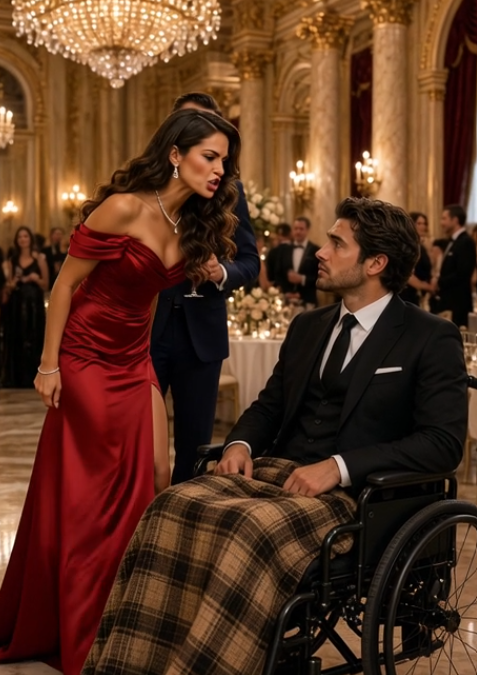
A Billionaire’s Fiancée Threw Her Ring at Him and Called Him “Useless” in Front of Everyone—Then He Stood From His Wheelchair and a Woman Revealed Who Had Really Saved Him.
My fiancée threw her engagement ring into my lap and told an entire ballroom that a broken man belonged in the trash.
She thought my wheelchair meant I had lost my power, my pride, and the truth about the night she tried to erase.
But when the quiet woman everyone treated like a servant knelt beside me, the secret she carried turned the whole room against the people who had buried me alive.
“You’re completely useless now, Gabriel!”
The words cut through the ballroom louder than the string music.
For one brutal second, even the violins seemed to lose their place. The crystal chandeliers above the grand hall of Ashford House glittered as if nothing ugly had happened beneath them, but everyone in the room had heard her. Two hundred guests in black tuxedos and silk gowns turned toward the center of the polished floor, where Vanessa Whitmore stood in an off-the-shoulder red dress with fury in her face and contempt in every step.
She had always known how to make an entrance.
That night, she made an execution.
Before anyone could stop her, she ripped off the diamond engagement ring I had given her eighteen months earlier and hurled it onto the plaid blanket covering my legs.
The ring landed in my lap with a small, ugly sound.
It was not loud.
That somehow made it worse.
A gasp moved through the room, soft and hungry. People who had come pretending to support me leaned closer to witness my humiliation. My mother’s old friends lifted gloved hands to their mouths. Board members from my company exchanged looks that tried to look shocked and failed to hide their relief. Reporters who had been allowed inside for “controlled social coverage” suddenly remembered why they never put their phones too far away.
I sat motionless in my wheelchair.
The blanket over my legs was gray and navy plaid. Maya had folded it neatly over me before we left my room because the ballroom could be drafty in winter and because I had learned, during six months of injury, that small dignities were easier to maintain when someone around you still cared about them.
Vanessa stood over me as if she had rehearsed this moment in a mirror.
Maybe she had.
“Say something,” she snapped.
I looked at the ring.
Then at her.
Then past her shoulder, where Adrian Vale stood with one hand wrapped around a glass of champagne and the other resting possessively at the small of Vanessa’s back. He wore a white dinner jacket in December, because Adrian believed rules existed to prove he was above them. His dark hair was combed back. His smile was beautiful and empty.
He had once been my closest friend.
That, I had learned, was another word people used too carelessly.
“A broken man belongs in the trash, sweetie,” Adrian said with a smug smile.
A few people laughed.
Not many.
Enough.
“Exactly,” Vanessa said, laughing too.
Six months earlier, after the accident on the coastal road, doctors had told me there was no promise I would walk again. They had used careful words, the way doctors do when hope might become a liability. Spinal trauma. Nerve swelling. Incomplete injury. Possible recovery. No guarantees.
No guarantees.
Those two words had followed me through surgery, rehab, sleepless nights, board meetings, family whispers, and the long hollow hours when I lay staring at the ceiling while the woman I was supposed to marry stopped visiting because, as she told everyone, it was “too painful to see Gabriel like that.”
Tonight had been meant to calm the gossip about our postponed wedding.
That was the public reason.
Privately, I had agreed to attend because I needed Vanessa to believe I was weak enough to attack.
And she had not disappointed me.
The Ashford Winter Benefactors’ Ball had belonged to my family for three generations. My grandmother began it to fund children’s hospitals after losing her youngest son to leukemia. My mother turned it into one of the most respected charity events on the East Coast. After my parents died, I continued it because some traditions deserved survival.
Vanessa had wanted the ball to become our engagement celebration.
She had spent months before the accident talking about flowers, sponsors, photographers, and how “a legacy family wedding needed a legacy stage.” She loved legacy. Not because she respected history, but because she believed history looked good behind diamonds.
After the accident, she had stopped saying wedding.
She started saying optics.
“The optics are difficult, Gabriel.”
“You need to think about public perception, Gabriel.”
“People need reassurance, Gabriel.”
That night, she gave them a show.
PART2:
“Do you know what it feels like?” she demanded, turning toward the room as if she were the injured party. “Do any of you know what it feels like to be trapped in a life with a man who won’t even fight for himself?”
My hands tightened on the arms of the wheelchair.
Maya stood near the service entrance, half-hidden beside a marble column. She wore a simple black dress beneath a cream cardigan, because she had refused every formal gown my housekeeper tried to lend her. Her dark hair was pinned at the nape of her neck. She had no jewels, no lipstick bright enough to compete with the room, no desire to be noticed.
That was why people noticed her too late.
For six months, she had been treated like furniture by nearly everyone in my circle.
A nurse.
A caregiver.
A physical therapy assistant.
A woman from nowhere.
Vanessa called her “the girl” even though Maya was twenty-nine and had more courage in her silence than Vanessa possessed in her entire polished body.
“You sit there,” Vanessa said, pointing at me, “letting everyone pity you.”
“Vanessa,” my aunt Cecilia whispered from the front table. “Stop.”
But Vanessa had gone too far to stop.
Or maybe she had gone exactly as far as she intended.
“You know what he asked me last week?” Vanessa said, looking around the ballroom. “He asked if we could set a new wedding date.”
That was a lie.
A clean one.
She was good at those.
Several guests shifted.
“He actually thought I would still marry him.”
She laughed again, brittle and bright.
“I am twenty-eight years old. I am not spending my life pushing a chair around while Gabriel Ashford clings to a last name and a company he can barely enter without help.”
Adrian put on a face of mild sympathy.
“She has suffered too,” he said.
That nearly made me laugh.
Not because it was funny.
Because suffering, in Adrian’s mouth, sounded like a stock option.
He had suffered my existence for years. That was true. As long as we were boys, his envy had been manageable, almost charming. Adrian Vale had been the son of my father’s business partner, raised in houses beside ours, educated in the same schools, invited on the same holidays, seated at the same tables. But no matter how close he stood, he was always near Ashford power, never inside it.
When my father died, I inherited controlling shares of Ashford Maritime and Construction.
Adrian inherited his father’s debts and a talent for smiling while counting other people’s money.
“Vanessa,” I said quietly.
The room leaned in.
She tilted her head. “Yes, Gabriel? Going to tell me I’m being cruel?”
“No.”
That surprised her.
I lifted my eyes to Adrian.
“I was going to ask how long the two of you rehearsed this.”
The smile slipped from Adrian’s face.
Only slightly.
Enough.
Vanessa scoffed. “You always do this. You sit there acting superior because you think being quiet makes you noble.”
“No,” I said. “It makes people careless.”
Something moved across her face.
A flash of uncertainty.
Then contempt returned.
“You’re pathetic.”
The word hung between us.
Maya moved then.
She crossed the ballroom.
Not quickly.
Not dramatically.
She walked past crystal glasses, silk skirts, polished shoes, and people who had spent six months pretending not to stare at my wheelchair. Her expression did not change. Her shoulders were straight. Her eyes were fixed on me.
Vanessa saw her coming and rolled her eyes.
“Oh, of course. Here she comes.”
Maya ignored her.
She knelt beside my chair in front of everyone and took my cold hand in both of hers.
Her palms were warm.
They had always been warm.
“Sir Gabriel,” she said softly, though I had told her a hundred times not to call me that, “please don’t listen to them. You are so much more than what they see.”
Something in the room shifted.
Not because the words were dramatic.
They were not.
But there are moments when simple kindness becomes an accusation. Maya did not insult Vanessa. She did not raise her voice. She did not perform loyalty.
She offered it.
That made everything else look cheap.
I looked at her.
For one suspended moment, the grief in my chest settled into something steadier.
Harder.
“Thank you, Maya,” I said quietly.
Then I threw back the plaid blanket.
A gasp broke through the ballroom before I moved.
Vanessa’s smile froze.
Adrian’s champagne tilted.
I set one foot on the polished floor.
Then the other.
Slowly, deliberately, I pushed myself up from the wheelchair.
My legs trembled.
Only I knew how much.
Maya knew too.
Her hand tightened around mine, not pulling, not helping too much, just giving me one steady point in a room that had mistaken cruelty for power.
I stood.
Tall.
The ballroom erupted into whispers.
“Oh my God.”
“He can stand.”
“Since when?”
“Was it staged?”
Vanessa took one step back.
Adrian’s champagne spilled over his fingers.
I looked at both of them.
“I don’t need this wheelchair anymore,” I said. “Not in the way you hoped.”
Vanessa’s mouth opened.
No sound came.
I reached for Maya’s hand and drew her to my side.
“You were the only one who stayed,” I said.
Maya looked up at me, and for the first time that night, fear entered her face.
Not fear of me.
Fear of what came next.
Before anyone else could speak, an elderly woman near the back dropped her glass.
It shattered across the marble.
Everyone turned.
Mrs. Eleanor Whitcombe stood near the entrance to the winter garden, one hand pressed against her pearls, the other gripping the back of a chair. She was eighty-one, had known my grandmother, and had the dangerous honesty of rich old women who had outlived the need to flatter anyone.
“Stayed?” she whispered.
Her voice was not loud, but the ballroom had gone so silent that every syllable carried.
“That’s not all she did.”
Maya went still beside me.
Mrs. Whitcombe pointed one trembling finger.
“She was in the car that night.”
Vanessa’s lips parted.
Adrian set his glass down very carefully.
Every eye swung toward Maya.
My hand closed around hers.
The secret we had protected for six months had just stepped into the light.
And from the look on Adrian’s face, it had frightened him more than seeing me stand.
I remembered the accident in pieces.
That was the curse of it.
If I had remembered nothing, perhaps healing would have been cleaner. If I had remembered everything, justice might have come sooner. Instead, memory returned like broken glass under skin.
A wet road.
Fog.
Headlights behind me.
Vanessa’s voice through the car speakers, angry and sharp.
“Turn around, Gabriel. We need to talk before you ruin everything.”
I had been driving the coastal road from Larkspur Point toward the city after visiting a property development site. The night was black and slick with rain. The Pacific roared somewhere below the cliffs, invisible but enormous. My phone sat in the console on speaker.
Vanessa had called six times.
I answered on the seventh because ignoring her had become more exhausting than listening.
“I’m not ruining anything,” I told her.
“You’re canceling the Harbor Point deal.”
“I’m postponing it.”
“Adrian said the board already approved.”
“Adrian doesn’t run the board.”
“He should. At least he understands scale.”
Scale.
That was what they called greed when it wore a suit.
Harbor Point was supposed to be the largest luxury marina development on the northern coast. Condos, private slips, restaurants, a boutique hotel, all built over a fishing community that had existed longer than my family’s money. The numbers were spectacular. The environmental reports were not.
I had commissioned a second review after Maya brought me a file.
Back then, Maya was not my nurse.
She was a legal aide at the community clinic in Larkspur, helping fishermen and service workers fight eviction notices connected to the Harbor Point acquisition. We had met in a public hearing where she stood at a microphone in a faded blue dress and calmly dismantled three executives with documents they did not know she had.
I should have disliked her.
Instead, I listened.
That was before everything.
“You’re embarrassing me,” Vanessa said through the car speakers.
“I wasn’t aware Harbor Point was your project.”
“It’s our future.”
“No,” I said. “It’s Adrian’s future. You’re just wearing the ring he wants to sell it with.”
The silence on the line changed.
“What does that mean?”
“It means I know about the side agreements.”
Another car appeared in my rearview mirror.
Too close.
Headlights bright through rain.
“Gabriel,” Vanessa said, now very quiet.
That was when I knew.
The anger had been easier to hear.
The quiet meant calculation.
“What did you find?”
“Enough.”
Behind me, the car accelerated.
I glanced at the mirror.
Black sedan.
No front plate visible through the rain.
My wipers struggled.
The road curved along the cliff.
“Pull over,” Vanessa said.
“No.”
“Pull over right now.”
“Why?”
“Because you don’t understand what you’re doing.”
The headlights behind me surged closer.
My chest tightened.
There are seconds in life that stretch wide enough to contain entire futures.
I reached for the console to end the call.
A horn blared.
A shape appeared ahead on the shoulder.
A woman.
Standing in the rain.
Waving both arms.
I swerved.
The sedan behind me clipped my rear bumper.
Metal screamed.
The world tilted.
Then broke.
Later, everyone said my car went through the guardrail because I was speeding.
That was the official story.
The police report said wet road conditions, driver fatigue, possible distraction.
No other vehicle confirmed.
No witness verified.
No passenger.
I remembered rain.
A woman’s face.
A hand on mine.
The smell of gasoline.
A voice saying, “Stay with me. Don’t close your eyes.”
Maya’s voice.
But when I woke in the hospital three days later, Vanessa was at my bedside wearing a white dress and a face full of tears for the cameras.
She told reporters she had nearly lost the love of her life.
She held my hand while photographers captured grief.
Then, when no one was looking, she leaned close and whispered, “Don’t try to remember too much. You were alone.”
I was too drugged to answer.
But not too drugged to understand.
Maya entered my life officially two weeks after the accident.
Dr. Samuel Kent, my rehabilitation specialist, recommended an at-home trauma nurse and mobility aide.
“She has experience with difficult patients,” he said.
“I’m not difficult.”
He stared at me over his glasses.
“You refused pain medication because you thought needing it was a character flaw.”
“I revised my position.”
“You threw a water pitcher at a television.”
“The television was reporting lies.”
“You missed.”
“That remains my greatest regret.”
He did not smile.
“You need someone who won’t be intimidated by you.”
That was how Maya Pierce walked into Ashford House wearing a simple gray sweater, carrying a medical bag, and looking directly at me without pity.
“You,” I said.
She closed the door behind her.
“Yes.”
The room went quiet.
For two weeks, fragments of her had haunted me.
Rain in her hair.
Blood on her sleeve.
Her voice.
“You were there.”
She nodded.
“Why?”
“Because I saw what happened.”
“Then why didn’t you tell the police?”
“I tried.”
The bitterness in her voice was small but sharp.
“They said I was confused. Then they said I had no proof. Then your fiancée’s lawyer suggested I was stalking you for money.”
My hands curled around the blanket.
“Vanessa.”
“And Adrian Vale.”
Memory flickered.
Headlights.
A black sedan.
“What did you see?”
Maya sat in the chair beside my bed.
“I saw a car following you too closely on the coastal road. I was pulled over because my tire pressure warning came on. I saw the car hit yours before the curve.”
My pulse began to pound.
“I ran to the edge after you went through the barrier. Your car had landed halfway down the slope, caught against two pines. If it had rolled another ten feet…”
She stopped.
I finished it.
“I’d be dead.”
“Yes.”
“How did you get down?”
“Badly.”
Only then did I notice the faint scar near her wrist.
A white line disappearing beneath her sleeve.
“You climbed down.”
“You were unconscious. The door was jammed. I called 911, but reception kept cutting in and out. I thought the engine might catch. So yes, I climbed down.”
I stared at her.
“Why didn’t anyone tell me?”
“Someone did not want you to know.”
For six months, that became our secret and our war.
My recovery was real.
So was my weakness.
At first, I could not move my legs without pain so intense it emptied the room of everything but breathing. Then came flickers. Twitches. Sensation. Dr. Kent warned me not to confuse progress with certainty. Maya warned me not to confuse rage with strength.
She was better at that than anyone.
When I wanted to push too hard, she stopped me.
When I wanted to quit, she did not soothe me.
“Again,” she would say.
“I can’t.”
“You can’t do ten. Do one.”
“One is pointless.”
“One is how every man who ever walked started.”
“I’m not a toddler.”
“Then stop arguing like one.”
I hated her sometimes.
Then I trusted her.
Then I needed her.
That was the order, though I did not admit the last part even to myself.
She never treated me like ruined glass.
She also never pretended the injury was noble.
When I raged, she let me rage until the rage became performance. Then she opened a window and told me the room smelled like self-pity.
When I woke from nightmares, she sat in the hallway with tea, close enough that I could call if I wanted to, far enough that I did not feel watched.
When Vanessa came to visit, Maya disappeared.
Not because she was afraid.
Because she understood that some betrayals need room to reveal themselves.
Vanessa visited less each month.
She always arrived dressed for photographers.
She brought flowers I was allergic to twice.
She called my wheelchair “temporary branding” once, thinking I was asleep.
Adrian came with her more often than he should have.
He spoke loudly in the house.
Too loudly.
Men who feel guilty often confuse volume with innocence.
“Still in the chair?” he asked one afternoon in September, standing by the French doors while I sat with a blanket over my legs.
“Still wearing cologne loud enough to qualify as a chemical spill?” I asked.
He smiled.
“Good to see your humor survived.”
“Something had to.”
His eyes dropped briefly to my legs.
There it was.
The calculation.
The pleasure.
He thought I did not see it because I no longer stood.
That became his first mistake.
Vanessa’s was larger.
She thought humiliation would finish what the accident failed to do.
Instead, it gave me the audience I needed.
After Mrs. Whitcombe spoke, the ballroom held its breath.
“She was in the car that night,” the old woman repeated, stronger now.
Maya’s hand went cold in mine.
Vanessa seized on it instantly.
“Oh my God,” she said, turning toward the crowd with theatrical horror. “Gabriel, is that why you’ve been protecting her?”
Adrian recovered quickly.
He always did when the path to cruelty opened.
“You’ve had the woman from the accident living in your house?”
A murmur spread.
Vanessa pressed a hand to her chest.
“You told me you were alone.”
I laughed then.
Quietly.
The sound startled people more than if I had shouted.
“Careful, Vanessa.”
Her eyes flashed.
“No, Gabriel. You don’t get to stand up like some tragic hero and hide this. Who is she? Why was she there? Was she in the car with you? Is that why you postponed the wedding? Did you betray me before or after you became—”
“Finish that sentence,” Maya said.
Her voice was soft.
Deadly.
Vanessa looked at her as if seeing her for the first time as a person rather than an object.
“Excuse me?”
“Finish it.”
Vanessa’s mouth tightened.
“You don’t speak to me.”
“I just did.”
A ripple moved through the crowd.
Adrian stepped forward.
“Know your place.”
Maya looked at him.
“I do.”
Then she turned slightly, and for the first time, I saw what six months of silence had cost her.
“My place was on that cliff in the rain while you drove away.”
The room changed.
Adrian went still.
Vanessa’s face drained.
I felt the truth arrive before anyone else understood it.
“You saw him,” I said.
Maya did not look away from Adrian.
“Yes.”
Adrian laughed once.
A terrible attempt.
“Absurd.”
Maya’s fingers tightened around mine.
“I didn’t know who he was then. Not from the back. Not in the rain. But I saw the sedan. I saw it clip Gabriel’s car. I saw it stop at the curve.”
Adrian shook his head.
“No.”
“I saw the driver get out.”
Vanessa whispered, “Stop.”
Maya looked at her.
“That was how I knew you were involved too.”
Every face turned toward Vanessa.
She lifted her chin.
“This is insane.”
Maya continued.
“The driver made a call before leaving.”
Adrian’s eyes sharpened.
“You couldn’t possibly hear—”
“No. I couldn’t hear the words.”
Maya reached into the pocket of her cardigan and pulled out a small black object.
Adrian recognized it before anyone else.
A dash camera memory card.
“But my car could.”
Vanessa stumbled one step back.
Adrian’s champagne glass slipped fully from his fingers and shattered.
No one moved.
I had watched many men lose money in boardrooms. Watched executives realize too late that a signature had trapped them. Watched liars understand that denial had outrun evidence.
But I had never seen panic enter a man so completely and so fast as it entered Adrian Vale.
“That’s fake,” he said.
Maya held the card like it weighed nothing.
“Your lawyer said the same thing.”
Vanessa turned to me.
“You knew.”
“Yes.”
“How long?”
“Long enough.”
My aunt Cecilia rose from her table, hand shaking.
“Gabriel, what is going on?”
I looked toward the back of the room.
“Detective Harris?”
A man in a dark suit stepped out from behind the doorway near the service hall.
Adrian cursed under his breath.
Vanessa stared as two uniformed officers entered behind him.
The guests erupted.
Detective Martin Harris had the exhausted face of a man who had spent twenty-seven years watching respectable people commit ugly crimes and act offended when consequences arrived. He crossed the ballroom without theatrics.
“Mr. Vale,” he said. “Ms. Whitmore. We need to discuss the night of June 14th.”
Adrian lifted both hands.
“This is outrageous. Gabriel is manipulating all of you because his fiancée finally told the truth.”
“The truth?” I asked.
My voice carried.
Good.
I wanted everyone to hear.
“The truth is that Harbor Point would have made Adrian millions through shell companies hidden behind three layers of consultants. Vanessa knew because she was listed as a silent beneficiary in two of them.”
Vanessa’s mouth opened.
“Gabriel—”
“The truth is that when I froze the project, both of you stood to lose everything you had already borrowed against future profits.”
Adrian’s face hardened.
“Business disagreements are not murder attempts.”
“No,” I said. “Ramming my car off a cliff is.”
The room gasped.
Detective Harris nodded to a technician near the sound table.
A screen descended behind the orchestra platform.
Vanessa whispered, “No.”
For once, the room understood her perfectly.
The footage was grainy, streaked with rain, taken from the rear camera of Maya’s old Toyota parked along the shoulder that night. Headlights appeared. My car passed first. Then the black sedan.
Too close.
The sedan surged forward.
Clipped my rear bumper.
My car spun.
The guardrail exploded.
People screamed in the ballroom as if the crash were happening in front of them.
On screen, the black sedan stopped.
A man got out.
Tall.
White shirt visible beneath a dark coat.
Adrian.
Even blurred, even rain-distorted, there was no mistaking the way he moved.
He stared toward the broken guardrail.
Then pulled out his phone.
The audio crackled.
His voice emerged beneath rain.
“It’s done.”
A pause.
Then Adrian said, “No, Vanessa, don’t come here. Go home. Cry when they call you.”
The ballroom became a tomb.
Vanessa’s hands covered her mouth.
Adrian turned toward the screen like he could command the past to stop speaking.
Then another figure appeared in the footage.
Maya.
Running through rain.
Sliding down the mud.
Disappearing over the edge.
For four minutes, the camera captured nothing but storm and empty road.
Then Maya climbed back into frame, soaked, bleeding from one arm, screaming into her phone and waving down headlights.
The video stopped.
No one spoke.
Not even Vanessa.
Detective Harris faced Adrian.
“Adrian Vale, you are under arrest for attempted murder, conspiracy, fraud, and obstruction of justice.”
The officers moved.
Adrian backed up.
“This is insane,” he snapped. “You can’t prove intent. I was scared. It was an accident. I panicked.”
Maya looked at him with a sadness that seemed to offend him more than anger would have.
“You looked down the cliff,” she said. “Then you left him there.”
Adrian’s face twisted.
“He was going to destroy everything.”
That was the confession beneath the confession.
Detective Harris nodded once.
The officers took Adrian’s arms.
Vanessa stood frozen as if staying perfectly still might keep the room from seeing her.
Detective Harris turned toward her.
“Vanessa Whitmore, you are under arrest for conspiracy, obstruction, and accessory after the fact.”
“No,” she whispered.
The officer stepped forward.
“No, I didn’t drive. I didn’t touch the car.”
I looked at her.
“You told him where I was.”
She shook her head.
“You called me seven times to keep me on the phone.”
“No.”
“You told him when I was approaching the curve.”
“I didn’t know he would—”
“You told him to go home and wait to cry.”
Her face crumpled.
For a second, I saw not regret but fury at being exposed.
“You were going to ruin us,” she hissed.
“There is no us.”
“You promised me a life.”
“I promised to marry you. You mistook that for ownership.”
The officer took her wrist.
Vanessa jerked away.
“Gabriel, please.”
That word.
Please.
After all of it.
After the lies, the staged devotion, the whispers, the months of watching me suffer while planning how to benefit from my weakness.
Please.
I picked up the ring from the wheelchair blanket.
The diamond caught the chandelier light.
Once, I had thought it meant forever.
Now it looked like evidence from a crime scene.
I held it out.
Not to her.
To Detective Harris.
“This belongs in the file.”
Vanessa made a broken sound as they led her away.
The ballroom remained silent until the doors closed behind them.
Then noise returned all at once.
Questions.
Crying.
Whispers.
My aunt Cecilia rushed toward me, then stopped short, looking at my legs.
“You can walk.”
“A little.”
“Why didn’t you tell us?”
I looked around the room at the people who had pitied me, underestimated me, doubted me, and fed on rumors because tragedy is more entertaining when it belongs to someone wealthy enough to resent.
“Because I needed to know who would stay when they thought I couldn’t.”
That shamed more people than I expected.
Good.
Mrs. Whitcombe approached slowly, helped by her grandson.
“I am sorry,” she said.
“You didn’t know.”
“I suspected something about that girl.” She nodded toward Maya. “I saw her the night of the accident. I was being driven back from Newport. My driver stopped when the ambulances came. I saw her covered in blood near the road. Later, when I saw her in your house, I thought perhaps…” She closed her eyes. “I let gossip fill the gaps.”
Maya’s expression softened.
“You told the truth tonight.”
“Late.”
“Late truth is better than polished lies.”
Mrs. Whitcombe gave a weak laugh.
“Your nurse is wiser than half this room, Gabriel.”
“She isn’t my nurse.”
Maya looked at me sharply.
I turned to the room.
“Maya Pierce is the reason I survived the accident. She is the reason evidence reached the police after my first report was buried. She is the reason I stood tonight.”
Maya whispered, “Gabriel.”
“No,” I said quietly. “Let them hear it.”
Then I looked at the people who had treated her like staff, like scandal, like a woman beneath the room’s concern.
“She climbed down a cliff in the rain to pull me from a crushed car while the man who hit me drove away. She stayed through surgeries, therapy, anger, nightmares, humiliation, and an investigation that put her own safety at risk.”
My voice thickened.
“I stood tonight because Maya Pierce refused to let me believe that being wounded made me worthless.”
The room changed again.
This time, not with shock.
With something closer to shame.
The Winter Ball did not continue.
Not really.
The orchestra packed quietly.
Guests left in clusters, speaking in low voices, carrying the story out into the cold city like contraband. By morning, every paper would have it. By noon, every channel. By evening, everyone who had laughed, doubted, whispered, or enjoyed the spectacle of my downfall would begin revising their memories.
I let them.
People often want to be on the right side once it becomes safe.
Maya helped me back into the wheelchair near midnight after the police finished taking statements.
My legs were shaking badly by then.
The performance had cost me.
She knelt in front of me in the empty ballroom and adjusted the blanket over my knees again, just as she had before everything.
“You overdid it,” she said.
“Yes.”
“You’re going to be in pain tomorrow.”
“Yes.”
“You look pleased with yourself.”
“A little.”
She tried not to smile.
Failed.
The ballroom smelled of extinguished candles and wilting flowers. Somewhere near the far table, a crushed champagne flute glittered under a chair.
Maya’s hands paused on the blanket.
“You shouldn’t have said all that about me.”
“Yes, I should.”
“I didn’t do it for recognition.”
“I know. That’s one reason you deserved it.”
She looked down.
For the first time all night, she seemed close to tears.
“Maya.”
She shook her head.
“I thought when Mrs. Whitcombe said I was in the car…”
“You weren’t in the car.”
“Close enough for them.”
“No.”
I leaned forward.
“You were on the road. In the rain. Alone. You had every reason to keep driving. You didn’t.”
Her eyes lifted.
“I almost did.”
The confession surprised me.
Her voice trembled.
“I was scared. I saw the crash and froze. For maybe five seconds, maybe ten. I thought, I can’t do this. I can’t climb down there. I can’t save him. I’m just a legal aide with a flashlight and a dying phone battery.”
“But you did.”
“I almost didn’t.”
“But you did.”
A tear slipped down her face.
“I still hear the metal sometimes.”
“So do I.”
“I still see the car.”
“So do I.”
“I hate that he left you there.”
“I know.”
She wiped her face quickly, angry at the tear.
I took her hand.
“You once told me one is how every man who ever walked started.”
She looked confused for a second.
Then remembered.
I squeezed her fingers.
“Maybe that applies to healing too.”
Her breath shook.
“One what?”
“One truth. One step. One person who stays.”
Maya looked at me for a long time.
Then she said the thing neither of us had said in six months.
“I didn’t stay because I was assigned.”
“I know.”
“I stayed because every time you got angry at yourself, I wanted to argue with the whole world on your behalf.”
“I know.”
“I stayed because you listened when I spoke about Harbor Point before you knew me.”
“I remember.”
“I stayed because you were not what they said you were.”
I swallowed.
“What was I?”
She smiled through tears.
“Difficult.”
I laughed softly.
“Fair.”
“And proud. And wounded. And sometimes impossible.”
“Still fair.”
“But never useless.”
The word landed gently because she made it gentle.
Never useless.
After Vanessa hurled it like a weapon, Maya returned it as a truth.
The trials took eleven months.
Adrian’s lawyers tried everything.
Mechanical failure.
Wet road conditions.
Emotional distress.
Insufficient visibility.
They suggested Maya fabricated the footage. Then that she edited it. Then that she had been obsessed with me. Then that her testimony was biased because she later became involved in my recovery.
On cross-examination, Adrian’s attorney leaned toward her and said, “Miss Pierce, isn’t it true that you inserted yourself into Mr. Ashford’s life after the accident?”
Maya looked at him calmly.
“I inserted myself into a burning car before that.”
The courtroom went silent.
The jury remembered that.
Vanessa took a plea.
Of course she did.
People like Vanessa rarely chose loyalty once consequences entered the room.
She testified that Adrian had planned to “scare” me into backing off the investigation into Harbor Point, not kill me. She admitted she kept me on the phone so Adrian could track my location and timing. She admitted she lied to police about the calls. She admitted she knew the black sedan had been repaired secretly at a private garage owned through one of Adrian’s companies.
She cried beautifully.
The judge did not seem moved.
Adrian was convicted of attempted murder, conspiracy, fraud, and obstruction. Vanessa was convicted on conspiracy and obstruction charges, with a reduced sentence for cooperation.
Harbor Point collapsed.
The land was placed under conservation review, and Ashford Maritime withdrew permanently from luxury development on the coast. The fishing community Maya had defended formed a cooperative with legal support from a foundation I created under my grandmother’s name.
The first time Maya saw the sign outside their new community legal office, she cried so hard she had to sit on the curb.
“You like it?” I asked.
She looked at the sign again.
THE ELEANOR ASHFORD COASTAL JUSTICE CENTER
Then at me.
“You named it after your grandmother?”
“She started the Winter Ball for children who needed hospitals. I think she’d approve of fishermen who need lawyers.”
Maya wiped her face.
“You could have named it after yourself.”
“I’ve had enough buildings with my name on them.”
“That might be the most attractive thing you’ve ever said.”
I looked at her.
She realized what she had said and turned red.
I did not let her escape it.
“You find me attractive?”
“I find humility attractive.”
“That wasn’t the question.”
“You’re still difficult.”
“You’ve mentioned.”
By then, I walked with a cane.
Some days, without one.
Pain remained.
So did limits.
There were mornings my legs felt like they belonged to someone else and evenings when the old nerve fire ran down my spine until I could not speak politely to anyone, including furniture. Recovery was not a miracle. It was work. Repetitive, boring, humiliating, exhausting work.
But it was mine.
That mattered.
Maya stopped being my nurse officially after the trial.
The conversation was awkward because everything important between us had become awkward by then.
She stood in the library holding her resignation letter like it was a shield.
“You don’t need full-time care anymore.”
“No.”
“And I can’t keep living here.”
“No.”
“It would be inappropriate.”
“Deeply.”
“You agree?”
“No.”
She looked up.
I took the letter but did not open it.
“I agree you cannot remain here as my nurse.”
Her eyes searched my face.
“As anything else?”
“That depends.”
“On what?”
“On whether you’d have dinner with me.”
She stared.
“Gabriel.”
“Maya.”
“This is complicated.”
“I was thrown off a cliff by my fiancée and best friend, exposed them at a charity ball, survived spinal trauma, and spent six months pretending to need a wheelchair longer than I did. My threshold for complicated has changed.”
She tried not to smile.
Failed again.
“I don’t want gratitude mistaken for love.”
“Neither do I.”
“I don’t want people saying I saved you and you rewarded me.”
“People say stupid things when smarter options are available.”
“I’m serious.”
“So am I.”
I stepped closer.
Carefully.
No cane that day.
“I am grateful to you. I will be grateful to you for the rest of my life. But gratitude is not why I look for you in every room before remembering you may not be there. It is not why I hear your voice when I want to quit. It is not why the house feels wrong when you leave.”
Her eyes filled.
“It could still be dependency.”
“Yes.”
That surprised her.
I continued.
“It could be. That’s why I waited. That’s why I said nothing during the investigation, during the trial, during recovery. That’s why I let you resign.”
She glanced at the letter in my hand.
“You haven’t let me yet.”
“I’m working up to it.”
She laughed softly.
Then became serious.
“And if I say no?”
“Then I will be embarrassed with dignity.”
“Will you?”
“No. But I’ll try.”
Maya looked toward the windows, where late afternoon light fell across the library floor.
“When?”
“Dinner?”
She nodded.
“Friday.”
“I have clinic work Friday.”
“Saturday.”
“I have a meeting in Larkspur.”
“Sunday.”
She looked back at me.
“You’re persistent.”
“I prefer resilient.”
“You prefer flattering descriptions.”
“Also true.”
She took the resignation letter from my hand and set it on the desk.
“One dinner.”
“One dinner.”
“No press.”
“God, no.”
“No private chef trying to make it weird.”
“Regular restaurant.”
“No restaurant where people whisper.”
“My kitchen?”
She raised an eyebrow.
“You cook?”
“No.”
“Then absolutely not.”
In the end, we had sandwiches from a deli on a bench overlooking the harbor.
Maya wore jeans and a green sweater.
I wore a jacket she said looked too expensive to be trustworthy.
We talked for three hours.
Not about the accident.
Not about Vanessa.
Not about Adrian.
About her father, who had been a dockworker and taught her to read contracts because “men in offices steal cleaner than men in alleys.” About my grandmother, who kept peppermints in every coat pocket. About how neither of us liked jazz but both pretended to in public for too long. About whether healing meant returning to who you were or becoming someone you could live with next.
At the end, she let me hold her hand.
Not because I needed help standing.
Because she wanted to.
Two years after the ballroom, Ashford House hosted the Winter Ball again.
Smaller.
No press inside.
No Adrian.
No Vanessa.
No corporate sponsors buying virtue by the table.
The event raised funds for emergency trauma care and legal aid for injured workers. The guest list changed. Fewer people with inherited titles. More nurses, fishermen, veterans, physical therapists, social workers, and the kind of donors who did not mind being seated next to people who had actually needed help.
I walked into the ballroom without a wheelchair.
With a cane, because pride is useful only until it becomes stupidity.
Maya walked beside me in a midnight-blue dress she claimed she bought on sale and refused to let me verify.
Halfway through the evening, Mrs. Whitcombe approached us.
Still eighty-something.
Still dangerous.
“You look better standing,” she told me.
“Good evening to you too.”
She turned to Maya.
“And you look better not hiding.”
Maya smiled.
“I wasn’t hiding.”
Mrs. Whitcombe patted her arm.
“Dear, everyone hides. Some people just do it louder.”
Then she looked between us.
“When is the wedding?”
Maya choked on her champagne.
I said, “Subtle as always.”
“I’m too old for subtle.”
“We are not engaged.”
Mrs. Whitcombe looked at Maya’s left hand.
“Yet.”
Maya turned bright red.
I decided I loved Mrs. Whitcombe.
Six months later, I proposed on the coastal road.
Not at the crash site.
Near it.
At a lookout where the ocean opened wide and violent below, where new guardrails stood reinforced into the cliffside, where wild grass bent in the wind and gulls screamed as if they had urgent legal objections to the sky.
Maya knew what was happening before I got the ring box open.
“No,” she said.
I froze.
“No?”
“I mean no kneeling near a cliff. Are you insane?”
I looked at the ground.
Then at my cane.
“Fair.”
“So ask standing.”
“Yes, ma’am.”
Her eyes filled before I spoke.
“Maya Pierce,” I said, “you found me on the worst night of my life, and somehow you never let that night become the only thing you saw when you looked at me. You stayed when staying was dangerous. You told the truth when lying would have been easier. You made me walk toward a life I thought had ended.”
The wind took part of my breath.
I held out the ring.
Not Vanessa’s ring.
Never that.
A new one.
Simple.
A moonstone set in silver because Maya did not like diamonds and because some light was softer and better for having survived darkness.
“I don’t need you to save me,” I said. “I don’t need you to stand behind me. I don’t need you to prove anything to anyone. I’m asking if you’ll stand beside me because every place I go now feels more honest when you’re there.”
Maya cried openly.
“You practiced that.”
“I did.”
“It was good.”
“Thank you.”
“Yes.”
I blinked.
“Yes?”
“Yes, Gabriel.”
I put the ring on her finger with hands that trembled more than my legs.
She kissed me under a gray coastal sky while waves crashed below the road where everything had almost ended.
Three years after Vanessa called me useless, I returned to Cedar Cliff Rehabilitation Hospital, where I had spent the worst early months after surgery.
Not as a patient.
As a donor, technically.
Though I hated that word.
The new wing opened that morning: the Ashford-Pierce Mobility and Trauma Recovery Center. Maya insisted her name not be included. I insisted harder. Marriage, I had learned, was often two stubborn people loving each other loudly in opposite directions until truth chose a side.
Children with spinal injuries painted a mural in the therapy room. Veterans tested adaptive sports equipment. Nurses cried discreetly and denied it. Dr. Kent gave a speech about recovery being a team sport and looked at me pointedly when he said stubbornness was not a treatment plan.
Maya squeezed my hand.
“You needed to hear that.”
“I heard a rumor.”
After the ceremony, a young man in a wheelchair approached me.
Maybe twenty.
Angry eyes.
Fresh injury.
I recognized him immediately, though we had never met.
Not his face.
The stage.
The fury before grief finishes introducing itself.
He looked up at me and said, “People keep telling me I’m inspiring.”
I leaned on my cane.
“That must be annoying.”
His mouth twitched despite himself.
“They say it when I open doors.”
“Low bar.”
“My girlfriend left.”
“I’m sorry.”
“She said she couldn’t watch me become someone else.”
Maya’s hand tightened around mine.
I looked at the young man.
“What’s your name?”
“Eli.”
“Eli, some people leave because they cannot bear what injury reveals about them.”
He swallowed.
“About them?”
“Yes.”
“I thought it revealed me.”
“It does that too. But you may find you can live with your truth better than they can live with theirs.”
He looked away.
“Do you walk all the time now?”
“No.”
“Does that bother you?”
“Sometimes.”
“And the rest of the time?”
“I remember walking was never what made me whole.”
He looked back at me.
“What did?”
I glanced at Maya.
Then at the therapy room where a little girl in leg braces was laughing because she had just taken three steps between parallel bars while her father cried into both hands.
“Being seen clearly,” I said.
Eli absorbed that.
Then nodded once, as if storing it somewhere he might need later.
That night, Maya and I returned to Ashford House, though it no longer felt like the same house.
Not because we renovated it, though we did.
The ballroom remained. The chandeliers remained. The marble floor still held light like water.
But the room had changed because truth had passed through it.
People think houses are made of stone and wood.
They are not.
They are made of what happens inside them and whether anyone has the courage to stop pretending it did not.
Sometimes I still heard Vanessa’s voice there.
Completely useless.
The words no longer cut.
They had become evidence of her emptiness, not mine.
Maya found me once standing near the place where the ring had landed in my lap.
“You okay?”
“Yes.”
She studied me.
“Really?”
“Mostly.”
She came beside me.
No need to fill silence.
That was one of the things I loved most about her. Maya never rushed to decorate pain. She let it stand long enough to tell the truth, then helped me decide what to do with it.
“I was thinking about that night,” I said.
“I figured.”
“Do you ever wish Mrs. Whitcombe hadn’t said anything?”
Maya laughed softly.
“About me being in the car?”
“Yes.”
“No.”
“You were terrified.”
“I was.”
“But you don’t wish it stayed hidden?”
She looked around the ballroom.
“No. Secrets rot. Even when they begin as protection.”
I nodded.
“We kept it because of the investigation.”
“I know.”
“But part of me liked having one piece of the story they couldn’t touch.”
Maya looked at me.
“That makes sense.”
“It wasn’t noble.”
“Not everything has to be.”
I turned toward her.
“I thought standing would be the moment I got my dignity back.”
“Was it?”
“No.”
She waited.
I looked at the empty polished floor.
“The moment was before that. When you knelt beside me. Before I moved. Before anyone knew I could stand. You took my hand when everyone else was waiting to see whether I would break.”
Her eyes softened.
“That wasn’t dignity returning,” she said.
“What was it?”
“It was proof it never left.”
Years pass, and people simplify stories.
They say I exposed my fiancée at a ballroom.
They say I rose from a wheelchair and shocked everyone.
They say the nurse became the wife.
They say justice was served.
All true.
None of it complete.
The truth is harder and better.
I was betrayed by people I trusted because they loved what I owned more than who I was. I was humiliated in a room full of people who had mistaken my injury for weakness. I stood before them not because recovery made me powerful again, but because I finally understood power had never lived in my legs.
Vanessa thought the wheelchair made me useless.
Adrian thought injury made me disposable.
The board thought silence made me finished.
The gossip pages thought tragedy made me entertainment.
They were all wrong.
A man is not broken because he cannot stand.
A woman is not beneath a room because she enters it quietly.
A body can be wounded without losing worth.
And loyalty is not proven by who smiles beside you under chandeliers when life is beautiful.
It is proven by who climbs down into the wreckage when everyone else drives away.
Vanessa threw my ring into my lap and thought she had ended me.
Adrian smiled and thought cruelty made him victorious.
But Maya knelt beside my chair and reminded me of the one truth none of them could steal.
I was still there.
Still breathing.
Still capable of rising.
And when I finally stood, it was not to prove I was whole.
It was to show them I had been whole even when they could not see it.








