A Biker Yanked My Pregnant Wife Out of a Packed Crowd—Then I Realized He Wasn’t Attacking Her… He Was Shielding Her From Something Behind Us
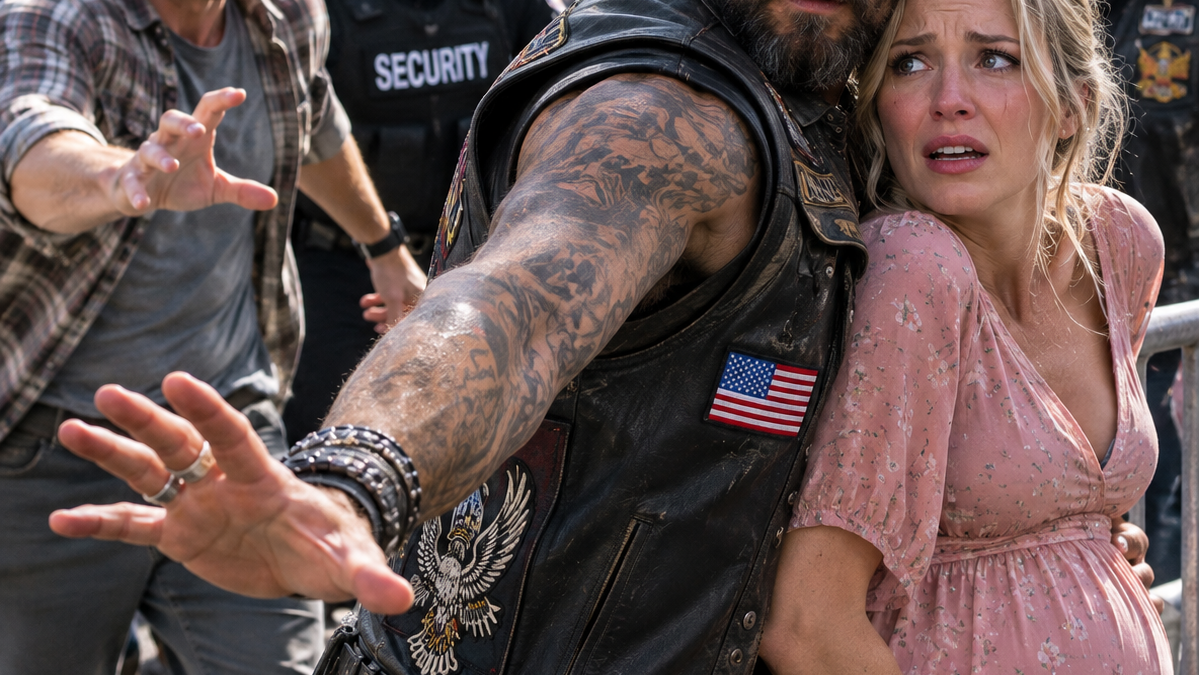
A Biker Yanked My Pregnant Wife Out of a Packed Crowd—Then I Realized He Wasn’t Attacking Her… He Was Shielding Her From Something Behind Us.
I was seconds away from punching the biker who had grabbed my eight-month-pregnant wife when he shoved her behind his body and whispered, “Stay behind me.”
The crowd saw a tattooed stranger attacking a vulnerable woman, security was closing in, and I thought I was watching someone try to take my wife and unborn son right in front of me.
Then a metallic click came from somewhere inside the packed festival, the biker’s entire crew silently changed position, and I realized the man I wanted to hurt might be the only person who had understood the danger before it was too late.
It happened so fast that for the first few seconds, my brain refused to understand what my eyes were seeing.
One moment, Emma and I were standing in line for barbecue at a crowded Saturday food festival in downtown Austin.
The next, a stranger had his hand around my pregnant wife’s wrist.
And he was pulling her away from me.
“Hey!”
My voice came out louder than I intended.
The stranger did not stop.
He was huge.
That was the first useless detail my mind registered.
Six-two, maybe six-three.
Broad shoulders under a weathered black leather vest.
Faded jeans.
Heavy boots.
Gray beginning to show in a dark beard.
Both arms covered in tattoos.
There was a scar running from beneath his right ear toward the collar of his T-shirt.
He looked like the kind of man people noticed without wanting him to notice them back.
And right then he had one hand on Emma.
My wife.
Thirty-four weeks pregnant.
“Get your hands off her!”
I shoved through the people between us.
Emma stumbled sideways.
Her pink summer dress caught against her knee.
She grabbed instinctively at her stomach.
“What are you doing?” she gasped.
The biker said nothing.
Not one word.
He kept moving.
He did not jerk her wildly or drag her toward a vehicle.
He guided her sideways through the crowd with one firm grip above her wrist, moving her away from the dense row of food trucks.
I didn’t notice that distinction yet.
All I saw was a stranger touching my wife.
All I understood was that Emma looked frightened.
PART2:
And when you love someone enough, fear can turn into violence frighteningly fast.
“Let her go!”
People around us were reacting now.
A woman screamed.
Someone shouted, “Call security!”
A young guy carrying a beer pointed his phone at the biker.
“Dude, let her go!”
Another voice rose from somewhere behind me.
“That’s kidnapping!”
Kidnapping.
The word cut through me.
I accelerated.
I remember thinking I would hit him once.
Hard.
Right behind the ear.
I had never been much of a fighter.
I sold commercial insurance.
PART3:
I owned three pairs of loafers and complained when our neighborhood gym replaced the comfortable treadmills.
But my wife was pregnant with our first child, and a strange man was physically pulling her away from me.
In that moment, I believed I could have fought a truck.
Emma looked over her shoulder.
“Daniel!”
I was almost to her.
“Emma, I’m right here!”
The biker still did not look at me.
That made me angrier.
There was something insulting about his focus.
People were yelling at him.
I was threatening him.
Emma was asking him to stop.
And he behaved as though none of us mattered.
His eyes kept moving across the crowd.
Left.
Right.
Back toward the food trucks.
Over shoulders.
Under tables.
Toward the entrance.
Scanning.
I did not understand what he was doing.
I thought he was looking for an escape route.
Then another man in a leather vest appeared.
He moved through the crowd without touching anyone.
Older.
Gray ponytail.
Sunglasses.
He stopped fifteen yards away.
Then another biker emerged near a lemonade stand.
Then a woman in a black riding jacket stepped around a stroller and stopped near the barricades.
They did not come toward the first man.
They spread out.
That was what frightened me.
If they had charged us, I would have understood.
A gang.
A coordinated attack.
Something simple enough for fear to categorize.
Instead, they silently occupied different positions around the crowd.
Watching.
Waiting.
I slowed for half a second.
The younger man beside me noticed too.
“There are more of them.”
His voice had changed.
A moment earlier he had sounded eager.
Now he sounded nervous.
The first security guard pushed through the crowd.
He was perhaps twenty-five, wearing a bright yellow festival-security shirt and a radio microphone clipped near his collar.
“Sir!”
The biker ignored him.
“Sir, release the woman.”
Nothing.
The guard moved closer.
“I’m talking to you.”
The biker finally shifted.
He stepped around Emma.
Not away from her.
In front of her.
His body was now positioned between my wife and the main festival crowd.
Emma was directly behind him.
I reached them.
“What the hell is wrong with you?”
I grabbed his shoulder.
He moved faster than I expected.
His left hand caught my wrist.
Not crushing it.
Not twisting.
Just stopping me.
For the first time he looked directly at me.
His eyes were pale blue.
And they did not look angry.
That confused me more than anything else.
They looked concentrated.
“Stay behind me.”
His voice was low.
Almost calm.
I stared at him.
“What?”
He released my wrist.
“Your wife. Keep her behind me.”
“Are you out of your mind?”
Emma touched my arm.
“Daniel.”
I turned toward her.
Her face had changed.
She was still frightened.
But she wasn’t looking at the biker anymore.
She was looking past him.
“Do you hear that?”
“Hear what?”
Then I heard it.
A metallic snap.
Small.
Sharp.
Easy to miss beneath the music, voices, generators and clattering food trays.
Click.
Then silence.
A child laughed nearby.
Someone shouted an order at a taco stand.
A singer on the small performance stage continued a country song.
Everything looked normal.
But the biker went completely still.
The woman in the riding jacket twenty yards away touched two fingers to her chest.
The older biker nodded once.
The man beside the lemonade stand moved three steps left.
Something changed between them without a single word being spoken.
The biker in front of Emma turned his head slightly.
“Ray.”
The older rider responded immediately.
“Got it.”
“North side.”
Ray began moving.
Not running.
Walking.
Casually.
But with purpose.
The security guard frowned.
“What is happening?”
The biker did not answer him.
I followed his gaze.
For several seconds I saw nothing.
People.
Picnic tables.
Trash cans.
Food trucks.
A portable ATM.
Children.
Then I noticed a black duffel bag.
It sat partly beneath the folding table of a closed vendor booth, pressed against one of the steel crowd-control barricades.
Nobody was beside it.
Nobody was reaching for it.
Nobody seemed to own it.
It was simply there.
I looked at the biker.
He was watching the bag.
My anger faltered.
“What is that?”
He didn’t answer.
The security guard stepped beside me.
“Sir, you need to tell me what you’re doing.”
The biker finally spoke.
“Unattended bag.”
The guard looked at it.
“So?”
“Was it there ten minutes ago?”
The guard hesitated.
“I don’t know.”
“I do.”
That sentence changed the air.
The biker’s eyes did not leave the duffel.
“It wasn’t.”
The security guard raised his radio.
The biker immediately grabbed the guard’s wrist.
“Don’t.”
The guard stiffened.
“Take your hand off me.”
“You call this in over an open channel and somebody yells bomb, you’ll stampede six hundred people through two exits.”
Bomb.
Emma’s fingers dug into my forearm.
The security guard stared at him.
“Who the hell are you?”
The biker’s eyes remained on the bag.
“Nobody important.”
“That’s not an answer.”
“It’s the answer you need.”
I stepped closer.
“You pulled my pregnant wife out of a crowd because of a bag?”
His jaw tightened.
“I pulled the person least capable of running.”
Emma inhaled sharply.
That shut me up.
He had not selected her randomly.
He had seen what I should have seen.
If panic started, Emma could not sprint.
She could not climb a barricade.
She could not absorb the force of hundreds of terrified people surging toward an exit.
She was vulnerable in a way neither of us had considered when we walked into the festival that afternoon.
The biker had.
“What did you hear?” he asked me.
“The click?”
He nodded.
“Yes.”
He looked toward the duffel.
“So did I.”
The woman biker was now quietly redirecting a family with two small children.
She smiled as she spoke to them.
I couldn’t hear the words.
Whatever she said worked.
The father nodded and walked his family toward the opposite side of the festival.
Ray had positioned himself near one of the pedestrian gates.
Another biker stood near the stage.
None of them shouted.
None created panic.
They were slowly spreading people away from the center.
The security guard whispered, “Are you police?”
“No.”
“Military?”
The biker hesitated.
“Used to be.”
The guard looked at the tattoos on his arms.
One was a medical symbol.
Another appeared to be a unit insignia.
I saw dates tattooed beneath three names.
The biker noticed me looking.
“Don’t make assumptions about the tattoos either.”
Normally I might have laughed.
I couldn’t.
Emma whispered, “What do we do?”
The biker looked over his shoulder.
For the first time his expression softened.
His eyes dropped briefly to her stomach.
“How far along?”
“Thirty-four weeks.”
“Any complications?”
Emma shook her head.
“No.”
“Can you kneel?”
“If I have to.”
“Not yet.”
The security guard said, “We need police.”
The biker nodded.
“Yes.”
“I’m calling it in.”
“Quietly. Tell control to contact police directly. Suspicious package. Do not announce it on staff radios. Start soft evacuation from the perimeter.”
“You sound like you’ve done this before.”
The biker did not respond.
The guard stared at him.
Then did exactly what he was told.
That was the moment my fear changed direction.
Less than two minutes earlier, I had been preparing to knock the biker unconscious.
Now I found myself looking past his shoulder because I trusted what he was looking at more than I trusted what I could see myself.
I hated how quickly certainty could disappear.
“You have a name?” I asked.
He did not turn.
“Cole.”
“Cole what?”
“Doesn’t matter.”
“My name’s Daniel.”
“I didn’t ask.”
Emma gave me a look.
Even terrified, my wife could tell when I was being annoying.
I almost smiled.
Then another metallic sound came from the crowd.
Sharper this time.
A crack.
Not an explosion.
More like something small breaking under pressure.
Cole moved immediately.
“Down.”
He pulled Emma behind the nearest steel barricade.
This time I did not fight him.
I dropped with her.
Cole crouched in front of us.
Several people nearby screamed.
The security guard ducked.
“What was that?”
Cole’s eyes narrowed.
“I don’t know.”
The honesty terrified me.
I had expected confidence.
Instead he gave us the truth.
He did not know.
Another biker called from fifteen yards away.
“Cole.”
“Yeah?”
“Phone.”
Cole’s gaze shifted.
“What?”
“Under the table. Screen lit.”
My mouth went dry.
Emma whispered, “Oh God.”
Cole turned to the security guard.
“Move your people farther back. Now.”
The guard finally stopped asking questions.
He moved.
Cole looked at me.
“Can you support her?”
“Yes.”
“If I say move, you take her toward the brick building behind us. Not the street. Brick wall. Stay low.”
“What about you?”
He ignored the question.
Emma’s breathing changed.
I knew that sound.
We had spent enough nights reading pregnancy books and watching childbirth videos to know the difference between ordinary anxiety and the beginning of panic.
“Emma.”
She looked at me.
“I’m okay.”
“You’re not.”
“I’m fine.”
Cole heard us.
He turned slightly.
“Ma’am.”
Emma looked at him.
“Slow breath through your nose.”
She obeyed automatically.
“Hold two seconds.”
She did.
“Out slowly.”
She exhaled.
“Again.”
Emma repeated it.
I looked at Cole.
“You a medic?”
“Once.”
The answer carried something.
I did not ask.
Sirens were still absent.
That bothered me.
Everything seemed to be happening inside a bubble no one beyond the festival knew existed.
Music continued from the stage.
A line remained at the ice-cream truck.
People on the far side had no idea.
Then the woman biker reached Cole.
“Police confirmed. Three minutes.”
“Bomb tech?”
“Requested.”
“What about the phone?”
“Ray says it buzzed once.”
Cole looked toward the bag.
“Anybody approach?”
“No.”
“Camera?”
“Festival security is checking.”
She looked at Emma and me.
Then at Cole.
“This her?”
Cole nodded.
“Thirty-four weeks.”
The woman crouched.
“Hi. I’m Denise.”
Emma somehow managed to answer politely.
“Emma.”
“You’re doing good, Emma.”
“My husband almost punched your friend.”
Denise looked at me.
“That happens.”
Cole said, “Frequently.”
I stared at him.
“Maybe don’t grab pregnant women without explaining.”
“Next time I’ll prepare a brochure.”
Under any other circumstances I might have disliked him.
Instead a nervous laugh escaped me.
Emma laughed too.
Then clutched my arm because laughing pulled at her abdomen.
The tiny flash of humor disappeared immediately.
Cole noticed.
“You having pain?”
“No. Just tightness.”
“Contraction?”
“I don’t think so.”
“You know what Braxton Hicks feels like?”
“Yes.”
“Same?”
Emma waited.
“No.”
My stomach dropped.
“What does that mean?”
“It means I’m scared, Daniel.”
Cole glanced at Denise.
She understood.
“Ambulance when police arrive.”
Emma immediately shook her head.
“I am not having this baby at a food festival.”
Cole finally looked amused.
“That’s between you and the baby.”
Then his expression changed.
Someone had moved near the bag.
A teenage boy wearing headphones was approaching the closed vendor table.
He appeared to be looking at his phone.
He could not see what everyone nearer us had begun to understand.
Cole stood.
“Hey!”
The boy did not hear him.
Cole shouted louder.
“Red shirt!”
The teenager looked up.
Cole pointed away.
“Go around!”
The boy removed one headphone.
“What?”
“Go around the other side.”
“Why?”
“Now!”
Something in Cole’s voice worked.
The teenager backed away.
A woman nearby started asking what was happening.
Denise intercepted her.
The crowd’s confusion was spreading.
You can hide fear only so long before people sense it.
Police arrived with no sirens.
Four officers entered from different points.
One went directly to the security guard.
Another approached Cole.
“Who reported?”
Cole raised one hand.
“I did.”
The officer studied him.
“Keep your hands visible.”
Cole gave him a tired look.
“They are.”
“What did you observe?”
Cole explained the bag.
The sound.
The phone.
Its location.
The officer listened.
His skepticism gradually disappeared.
“What’s your background?”
“Army EOD support and combat medic attachment.”
The officer stared at him.
“You EOD?”
“No. Medic assigned near enough to them to learn what not to touch.”
“You touched the bag?”
“No.”
“Anybody else?”
“Not since we noticed it.”
The officer looked toward Emma.
“Why is she behind the barricade?”
Cole said, “Because if this crowd runs, she gets crushed.”
The officer glanced at Emma’s belly.
Then nodded.
“Good call.”
I felt strangely embarrassed hearing someone confirm it.
The person I had thought was the threat had seen danger around my wife before I had.
“Everybody here needs to move,” the officer said.
Cole nodded.
“That’s what we’ve been doing.”
Police began expanding the perimeter.
The change was subtle at first.
Then people noticed uniforms.
Questions spread.
Security staff directed vendors away from the central street.
A police officer climbed onto the edge of the stage and spoke quietly with the event organizer.
The music stopped.
That silence was worse than screaming.
Hundreds of heads turned.
The organizer stepped toward the microphone.
“Folks, we need everyone to begin moving calmly toward the south and west exits. There is no immediate emergency. Please do not run. Follow staff instructions.”
Nobody moved for one second.
Then everyone moved at once.
Not running.
Not yet.
But faster than normal.
Cole immediately stepped closer to Emma.
“Here we go.”
I understood.
The bag was one danger.
The crowd was another.
People behind us began pressing forward.
Someone shouted, “What happened?”
A woman yelled, “There’s a bomb!”
That single word changed everything.
The calm evacuation fractured.
People screamed.
A man grabbed his children.
Someone knocked over a table.
Hundreds of bodies accelerated toward the exits.
“Move!” Cole barked.
He grabbed the steel barricade and pivoted it, creating a narrow protected lane between us and a brick storefront.
Denise and Ray appeared instantly.
The three bikers positioned themselves shoulder to shoulder.
A human wall.
“Emma,” Cole said. “Behind me.”
I wrapped an arm around her.
People surged around us.
A man slammed into my shoulder hard enough to spin me.
Cole caught me before I fell.
“Stay on her!”
“I’m trying!”
“Then stop watching me!”
He was right.
I turned completely toward Emma.
“Look at me.”
Her eyes were wide.
“I can’t move that fast.”
“You don’t have to.”
Another body crashed into the barricade.
The metal jumped.
Ray grabbed it with both hands.
“Hold!”
Denise pushed a stroller through the gap toward us.
A crying mother followed.
“Please!”
Cole shifted.
“Bring them.”
Suddenly our protected pocket contained Emma, me, a young mother, a toddler and a baby strapped into a stroller.
Cole placed himself on the exposed side.
The crowd rushed past.
A phone flew through the air.
A plastic table collapsed.
Someone fell twenty feet away.
A stranger reached down and pulled him up.
For forty terrifying seconds, the biggest danger at the festival was not the bag.
It was people.
Then police and security regained control.
Officers redirected the flow.
The pressure eased.
The street emptied.
Emma leaned against the brick wall.
Her face was pale.
“I need to sit.”
Cole removed his leather vest.
I thought he was hot.
Instead he folded it and placed it on the pavement behind Emma.
“Sit on this.”
She lowered herself carefully.
I stared at the vest.
Up close, I could read some of the patches.
IRON HORBOR RIDERS.
VETERANS SUPPORT.
A small stitched American flag.
A rectangular patch that said:
DOC.
I looked at Cole.
“That what they called you?”
He followed my eyes.
“Long time ago.”
A paramedic team arrived.
One EMT knelt in front of Emma.
“Any contractions?”
Emma nodded reluctantly.
“One. Maybe two.”
I felt sick.
The EMT checked her pulse.
Asked questions.
The baby moved.
Emma put my hand on her belly.
A hard little kick pressed against my palm.
I almost cried from relief.
“Your son’s annoyed,” Emma whispered.
“He gets that from you.”
She gave me a weak smile.
Twenty yards away, the first bomb technician approached the bag.
Everyone had been moved behind a second perimeter.
The street that had been packed with families only minutes earlier looked abandoned.
Paper plates rolled in the breeze.
A half-eaten funnel cake lay upside down in the road.
One sandal had been left near a trash can.
Normal things made strange by sudden emptiness.
Cole stood beside the police supervisor.
They spoke for several minutes.
Then the officer shook his hand.
Cole returned.
“You okay?”
Emma nodded.
“Apparently my son has decided not to arrive today.”
“Good.”
I looked toward the bag.
“What happens now?”
“Bomb squad handles it.”
“Do you think it’s real?”
Cole did not answer immediately.
“I think pretending it isn’t gets people killed.”
That seemed to be how he saw the world.
Not through certainty.
Through consequences.
If the threat was harmless, caution cost time.
If the threat was real, ignoring it cost lives.
I looked at him.
“I owe you an apology.”
“No.”
“Yes.”
“You saw a stranger grab your wife.”
“I was ready to break your jaw.”
Cole touched his beard.
“Would’ve ruined a perfectly mediocre face.”
“I’m serious.”
“So am I.”
I looked down.
“I judged you in about two seconds.”
Cole shrugged.
“People do it faster.”
“Doesn’t it bother you?”
“Sometimes.”
“You’re used to it?”
His expression changed slightly.
“Getting used to something and being okay with it aren’t the same.”
Before I could respond, an officer approached.
“Mr. Walker?”
I realized he meant me.
“Yes.”
“We need statements from both of you when medical clears your wife.”
“Of course.”
The officer looked at Cole.
“Mr. Mercer, bomb squad wants to speak with you.”
Mercer.
So that was his last name.
Cole nodded.
“I’ll be there.”
The officer walked away.
I smiled.
“Cole Mercer.”
He sighed.
“Congratulations, detective.”
Emma said, “Thank you, Cole.”
He looked at her.
“You’re welcome.”
“No.”
Her voice became firmer.
“Really.”
Cole looked uncomfortable.
That surprised me.
He had stood between hundreds of panicking strangers and my wife without hesitation.
Gratitude made him uneasy.
“You saw me,” Emma said.
Cole frowned.
“What?”
“Out of everyone there. You saw that I couldn’t run.”
He looked away.
“That’s the job.”
“You said you don’t do this anymore.”
He was quiet.
Emma studied him.
“Someone you loved was pregnant.”
Cole looked back at her.
Something passed through his face.
Pain.
Old and deep.
He did not answer.
The paramedic glanced toward him but pretended not to listen.
Emma said softly, “You knew exactly where to put your body.”
Cole’s jaw tightened.
“Emma,” I whispered.
Maybe she was pushing too far.
But my wife had always been better at seeing people than I was.
Cole sat on the edge of the curb.
He rubbed both hands over his face.
For the first time, he looked tired.
Not physically.
Older somehow.
“My wife was seven months pregnant.”
Emma’s hand found mine.
Cole stared at the empty street.
“Ten years ago.”
Neither of us spoke.
“She was at a county fair in Missouri with our daughter. I was deployed.”
His voice was flat.
Too controlled.
The voice people use when they have repeated a painful story enough times to remove themselves from it.
“There was an electrical fire inside one of the exhibition buildings.”
Emma whispered, “Oh no.”
“The fire wasn’t what hurt most people.”
He looked at the barricades.
“Panic did.”
I understood.
The crowd.
“Somebody yelled that a propane tank was going to explode. Everyone rushed one doorway.”
His fingers tightened together.
“My wife couldn’t move fast.”
I felt a sick weight settle in my stomach.
“What happened?”
Cole stared ahead.
“A stranger protected her.”
I blinked.
“She survived?”
“My daughter did.”
Emma covered her mouth.
Cole looked down.
“My wife went down in the crowd. A man named Thomas Greene saw her. Never met her before. He was sixty-one years old. High-school custodian. He got over her and our daughter while everybody pushed around them.”
His voice wavered for the first time.
“He took most of it.”
“What happened to him?” I asked.
“He died two days later.”
I stopped breathing.
Cole continued.
“My wife lost the baby.”
Emma’s hand immediately went to her belly.
“And your wife?”
“She lived another eleven months.”
The entire afternoon seemed to recede around us.
“What happened?”
“Complications. Injuries. Infection. Then her heart.”
Cole swallowed.
“My daughter was six.”
I could not think of anything useful to say.
I hated phrases like I’m sorry because grief that enormous made them sound insulting.
Emma apparently felt differently.
“I’m so sorry.”
Cole nodded once.
“That man—Thomas—didn’t know us. He didn’t know me. Didn’t owe my wife anything.”
He looked at Emma.
“But he saw someone who couldn’t protect herself in that moment.”
I remembered Cole pulling Emma sideways.
His grip.
His silence.
His urgency.
“You did the same thing,” I said.
Cole shook his head.
“No.”
“Yes.”
“I noticed a problem.”
“You put yourself between her and it.”
“That’s different.”
“How?”
He did not answer.
An officer called his name from across the street.
Cole stood.
“I need to go.”
I wanted to stop him.
There were a thousand questions I suddenly wanted to ask.
But Emma touched my wrist.
Let him go.
Cole walked away.
The bomb squad remained for almost three hours.
Police eventually moved Emma and me to an ambulance farther from the perimeter.
Her contractions stopped.
The baby’s heart rate remained normal.
I called my parents.
Then hers.
I made the mistake of telling Emma’s mother there had been a “small security issue.”
By the time we finished explaining, she was already driving toward Austin from San Antonio.
Emma whispered, “You know she’s going to make us move in with her now.”
“I’ll join the bikers.”
“Cole wouldn’t take you.”
“He likes me.”
“He barely tolerates you.”
“Same thing after thirty-five.”
She laughed.
That sound was better than any medical reassurance.
Around six in the evening, a detective approached.
He introduced himself as Detective Aaron Fields with the Austin Police Department.
“We have an update.”
I stood.
Emma gripped my hand.
“The device was real.”
Neither of us spoke.
Fields continued carefully.
“It was incomplete, but functional components were present.”
“How dangerous?” I asked.
“We’re not discussing technical details yet.”
“Could it have exploded?”
“Yes.”
Emma closed her eyes.
I felt the world tilt.
All afternoon I had been telling myself it might turn out to be nothing.
A forgotten tool bag.
A battery pack.
A prank.
Something that would make the terror feel silly afterward.
It had been real.
“How did Cole know?” Emma asked.
Fields glanced toward the far end of the secured street.
“Mr. Mercer noticed the bag being placed.”
“What?”
“He saw a man leave it?”
“He saw someone carrying it earlier. Male, baseball cap, gray hoodie. Mr. Mercer said the individual moved through the crowd differently from everyone else.”
I frowned.
“What does that mean?”
“Apparently he kept looking at cameras instead of attractions.”
Fields gave a small shrug.
“Mr. Mercer also noticed the individual leave without the bag.”
“Did Cole follow him?”
“No.”
“Why not?”
“Because Mr. Mercer saw you.”
He looked at Emma.
My chest tightened.
Fields continued.
“He told us he had to choose between following someone he could lose in a crowd and moving the person he believed would be most vulnerable if something happened.”
Emma looked down.
“Me.”
“Yes.”
I remembered how furious I had been.
How certain.
While I thought he was kidnapping my wife, he had been giving up his chance to follow a suspect because he had chosen to protect her.
“Did they find the guy?” I asked.
“Not yet.”
That answer bothered me.
Fields continued.
“We’re collecting all available video. We’ll need anything either of you remember.”
We gave our statements.
Everything.
Where we entered.
What we ate.
When Cole appeared.
The sounds.
The bag.
The crowd.
My near-assault.
Fields did not seem especially interested in prosecuting me for thinking about punching someone.
“That reaction probably makes you normal,” he said.
Emma smiled.
“Please don’t encourage him.”
When our statements were finished, most of the festival had been dismantled.
Not packed away normally.
Abandoned.
Vendors were permitted to retrieve essential items under police supervision.
The sky was orange.
A cool breeze had finally begun replacing the brutal afternoon heat.
Emma and I should have gone home.
Instead I looked for Cole.
His motorcycle was parked near a police vehicle.
He stood beside it talking to Ray.
When Ray saw me approaching, he nodded.
“Your wife okay?”
“Yes.”
“Baby?”
“Still inside.”
“Good place for him.”
I smiled.
“Thanks.”
Ray walked away.
Cole was putting his leather vest back on.
The same vest that had been beneath Emma on the pavement.
There was dust on one shoulder.
“You’re still here,” I said.
“Police enjoy questions.”
“So does my wife.”
“I noticed.”
He swung one leg over the motorcycle.
“Cole.”
He paused.
“I need to say something.”
“You already apologized.”
“This isn’t that.”
He waited.
I looked toward Emma.
She was thirty yards away talking with a paramedic.
“When you grabbed her, I hated you.”
Cole nodded.
“Fair.”
“No. Let me finish.”
He rested both hands on the handlebars.
“I had the whole story written in my head before you said one word.”
His expression remained neutral.
“Biker. Tattoos. Big guy. Pregnant woman.”
I shook my head.
“I knew who the villain was.”
“Most people like fast stories.”
“Apparently.”
Cole looked toward the street.
I continued.
“And you looked at me and probably saw some office guy who wouldn’t know danger if it parked on his shoes.”
A corner of his mouth moved.
“Your shoes are very clean.”
“I knew it.”
“Distractingly clean.”
Despite everything, I laughed.
Then I became serious again.
“You never judged me for trying to hit you.”
Cole shrugged.
“You were protecting your wife.”
“So were you.”
He did not respond.
“Why didn’t you tell me?”
“Tell you what?”
“About Thomas. Your wife. All of it.”
“That would’ve taken too long.”
“No, I mean afterward.”
Cole looked at me as though the answer was obvious.
“Because it wasn’t about me.”
That sentence stayed with me.
People often imagine heroism as something performed in the center of a room.
Something that waits for applause.
Cole treated it like picking up trash someone else had dropped.
Necessary.
Unremarkable.
Then he reached into one of the small pockets inside his vest.
He removed a laminated card.
It was old enough that the edges had begun separating.
He handed it to me.
There was a photograph on one side.
A man in his early sixties wearing a green work shirt.
Balding.
Thick glasses.
A ridiculous mustache.
He was smiling beside a high-school sign.
THOMAS GREENE.
On the back was a newspaper clipping.
LOCAL CUSTODIAN DIES AFTER SAVING MOTHER, CHILD IN FAIR PANIC.
I looked at Cole.
“You carry this?”
“Every day.”
“Why?”
“So I remember I’m spending time somebody else bought for me.”
I reread the line.
“I don’t understand.”
“Thomas never met me.”
Cole’s voice remained quiet.
“He could’ve protected himself. Instead he protected my family.”
He looked toward Emma.
“My daughter got sixteen more years because of him.”
“Sixteen?”
“She’s twenty-two now.”
“What does she do?”
For the first time, genuine warmth entered his expression.
“Nursing school.”
“That seems appropriate.”
“She’d say it isn’t.”
I handed the card back.
Cole slid it into his vest.
“Thomas’s family ever know what you do?”
“Yes.”
“You stayed in contact?”
“His wife sends me a birthday card.”
“For your birthday?”
Cole shook his head.
“For his.”
I felt something tighten behind my eyes.
“What do you do on his birthday?”
“Something useful.”
“That’s it?”
“That’s enough.”
He started his motorcycle.
The engine rumbled beneath us.
“Cole!”
He looked over.
Emma was approaching.
Slowly.
Both hands under her belly.
“You’re not leaving without saying goodbye.”
Cole turned off the engine.
Emma stopped in front of him.
“You put that vest under me.”
“So?”
“You’re wearing parking-lot dirt now.”
“I’ve worn worse.”
She looked at his chest.
At the DOC patch.
Then she hugged him.
Cole froze.
His arms stayed awkwardly at his sides.
I almost laughed.
The man could face a possible explosive device.
Pregnant women hugging him apparently exceeded his training.
Eventually he placed one hand lightly on Emma’s shoulder.
“Thank you,” she whispered.
“You’re welcome.”
“Our son needs a middle name.”
I turned toward her.
“What?”
Emma ignored me.
“We’ve been arguing about it for four months.”
“This seems like information for your husband.”
“I’m considering Thomas.”
Cole stopped moving.
Emma stepped back.
His eyes were suddenly wet.
He looked away.
“You don’t have to do that.”
“I know.”
“He wasn’t my family.”
Emma touched her stomach.
“No.”
She looked at Cole.
“But maybe that’s the point.”
Cole swallowed.
For several seconds he could not answer.
Finally he said, “Thomas Greene.”
Emma nodded.
“Thomas Greene.”
“He hated country music.”
“I already like him.”
“He put ketchup on steak.”
“That may disqualify him.”
Cole laughed.
The sound surprised all three of us.
He looked at me.
“You okay with this?”
I stared at my wife.
“You decided our son’s middle name without consulting me?”
“Yes.”
“After twelve hours of labor discussions?”
“Yes.”
I considered it.
“Thomas is good.”
Emma smiled.
Cole lowered his eyes.
“Then tell him when he’s old enough that the name isn’t about what happened today.”
“What is it about?” I asked.
He looked at us.
“Not walking past.”
Then he rode away.
For the next three weeks, our lives became something neither Emma nor I wanted.
Public.
Someone’s video of Cole grabbing Emma had gone viral before police released any details.
The first version lasted eleven seconds.
In it, Cole appeared to seize a pregnant woman while I charged toward him.
The caption read:
BIKER TRIES TO ABDUCT PREGNANT WOMAN AT AUSTIN FESTIVAL.
By Sunday morning it had more than two million views.
People identified Cole.
They found Iron Harbor Riders.
They posted photographs of the club’s building.
Someone found his daughter’s social-media account.
Then police released their statement.
The story reversed.
The new headlines were almost as ridiculous.
HERO BIKER SAVES PREGNANT WOMAN FROM BOMB.
VETERAN BIKER SPOTS DEVICE BEFORE POLICE.
TATTOOED GUARDIAN ANGEL SAVES FESTIVAL.
Cole hated every one.
I knew because a television reporter asked him about being called a guardian angel.
His answer was broadcast everywhere.
“I’m a motorcycle mechanic from Round Rock. Angels probably have better credit.”
Emma laughed so hard she nearly went into labor.
But the public version still missed something.
It turned Cole into a superhero.
And once again, everybody decided who he was without knowing him.
They simply switched from one cartoon to another.
A criminal became a saint.
Same shallow judgment.
Different direction.
Then things became more serious.
Police identified the man believed to have left the duffel.
His name was Tyler Warren.
Thirty-one.
Former festival contractor.
Recently fired after threatening a supervisor.
Investigators believed the device was intended to cause panic more than mass casualties, though nobody could know exactly what Tyler had planned.
He disappeared after the festival.
For ten days, police searched.
Emma became nervous about leaving the house.
I became worse.
I checked every parked car.
Every bag.
Every stranger.
I bought three new security cameras for our house.
Then two more.
One night Emma found me standing at the kitchen window at 2:00 a.m.
“Daniel.”
“I heard something.”
“You heard Mrs. Carter’s sprinkler.”
“It could’ve been somebody walking.”
“It wasn’t.”
“How do you know?”
“Because it sprays our fence every morning at two.”
I kept looking outside.
Emma came beside me.
“You’re scared.”
“I’m being careful.”
“You’re scared.”
I hated hearing it.
Maybe because it was true.
“I almost lost you.”
“But you didn’t.”
“I didn’t even know you were in danger.”
“Neither did I.”
“He did.”
Emma knew exactly what was eating at me.
“I’m supposed to protect you.”
“No.”
I looked at her.
She rested both hands on her stomach.
“You’re supposed to love me.”
“That sounds like the same thing.”
“It isn’t.”
She stepped closer.
“If protecting me means you have to predict every bad thing that can ever happen, you’re going to lose your mind.”
I said nothing.
“You were there, Daniel.”
“I almost attacked the guy saving you.”
“Because you thought he was hurting me.”
“Exactly.”
“You changed when you understood.”
“After he understood first.”
Emma sighed.
“This isn’t a competition.”
“I know.”
“No, you don’t.”
She took my hand.
“I don’t need a husband who sees bombs before veterans see them. I need the man who holds my hand in the ambulance afterward.”
That landed harder than I expected.
She guided my hand onto her stomach.
Our son kicked.
“You feel that?”
“Yes.”
“That’s your job.”
“What?”
“Be here.”
Three days later, Tyler Warren was arrested at his brother’s house in Oklahoma.
I expected relief.
Instead I felt exhausted.
For the first time in two weeks, my body seemed to understand that it could stop preparing for catastrophe.
That night I slept nine hours.
Emma slept three because pregnancy had apparently transformed her bladder into a teaspoon.
Life continued.
And then, five weeks after the festival, our son decided he had waited long enough.
Emma woke me at 3:17 in the morning.
“Daniel.”
I was immediately awake.
“What?”
“My water broke.”
I stared at her.
She stared at me.
Then I did everything wrong.
I jumped out of bed and kicked the nightstand.
Forgot where we had packed the hospital bag.
Tried to put on two different shoes.
Grabbed my laptop charger instead of my phone charger.
Emma stood in the bathroom doorway watching me.
“You’re the person responsible for keeping me calm?”
“I’m adapting.”
“You’re wearing one brown shoe and one sneaker.”
“I know.”
“You didn’t.”
“I do now.”
She started laughing.
Then doubled slightly.
“Contraction.”
All humor disappeared.
“How far apart?”
“Six minutes.”
“Hospital.”
“Yes.”
“Car.”
“Yes.”
“Now.”
“That was the plan.”
On the drive, I called our parents.
Emma told me to stop making calls and pay attention to traffic.
Then she said something unexpected.
“Call Cole.”
“What?”
“Call him.”
“It’s four in the morning.”
“He rides motorcycles. They don’t have normal hours.”
“That may be offensive.”
“Daniel.”
I had his number because he had reluctantly given it to us after the investigation.
I called.
He answered on the fourth ring.
“Yeah.”
“Cole?”
“Who died?”
“No one.”
“Then why are you calling before sunrise?”
“Emma’s in labor.”
Silence.
Then his voice became completely awake.
“Hospital?”
“On the way.”
“Contractions?”
“Five or six minutes.”
“Water?”
“Broke.”
“Bleeding?”
“No.”
“Good. Drive normally.”
“I am driving normally.”
Emma said loudly, “He’s going eighty.”
Cole heard.
“Slow down, idiot.”
I slowed down.
“Why does everybody assume I’m incompetent?”
“Evidence.”
Emma laughed.
Then groaned through another contraction.
Cole’s voice softened.
“Emma?”
“Yes?”
“Breathe like before.”
She did.
“Good.”
I heard movement on his end.
“What are you doing?” I asked.
“Getting dressed.”
“You don’t have to come.”
“I know.”
“You’re coming?”
“Apparently.”
“Why?”
He hung up.
Cole arrived forty minutes after we did.
Wearing jeans.
Boots.
Black T-shirt.
No leather vest.
He carried two coffees.
One for me.
One for himself.
Emma could not drink one.
“She’ll remember that,” I warned.
“She already hates me.”
“She named her son after your dead hero.”
“Doesn’t mean she likes me.”
He sat with me through eight hours of labor.
Not inside the delivery room.
That was for me.
But every time I stepped into the hallway, he was there.
Sometimes reading.
Sometimes sleeping in an uncomfortable chair.
Once arguing with the vending machine.
At 1:42 in the afternoon, Theodore Thomas Walker was born.
Seven pounds, eleven ounces.
Healthy.
Loud.
Furious.
Perfect.
Emma held him against her chest.
I cried.
She cried.
Theodore screamed like he had been personally wronged by existence.
Later, after our parents came and went, I stepped into the hallway.
Cole was still there.
“You’re an idiot,” I told him.
He looked up.
“Baby okay?”
“Healthy.”
“Emma?”
“Healthy.”
He exhaled.
I hadn’t realized he had been afraid.
“Come meet him.”
Cole stood.
Then stopped.
“I don’t need to.”
“Yes, you do.”
“Daniel.”
“We named him Thomas.”
“That wasn’t for me.”
“I know.”
I opened the door.
“Come meet him.”
Cole entered as though he were stepping into a church.
Quiet.
Careful.
Emma smiled from the bed.
“There he is.”
Cole approached.
Theodore was asleep.
Tiny red face.
Dark hair.
One fist against his cheek.
Cole stared at him.
Something broke open behind his eyes.
He tried to hide it.
Failed.
Emma said, “Do you want to hold him?”
“No.”
“Yes, you do.”
“No, I don’t.”
“Cole.”
“I’m not good with babies.”
“You were a combat medic.”
“That is completely different.”
“Sit down.”
He obeyed.
Emma placed Theodore into his arms.
Cole held him as though someone had handed him something made of glass.
For a moment nobody spoke.
Then Theodore opened his eyes.
Cole stared down.
“Hey, kid.”
His voice cracked.
Emma took my hand.
Cole swallowed.
“Thomas, huh?”
“Middle name,” I said.
“He doesn’t need the whole burden.”
Cole nodded.
“Good.”
He touched one finger to Theodore’s tiny hand.
The baby gripped it.
Cole stopped breathing.
I looked at Emma.
She was crying.
So was I.
Cole whispered something.
I almost missed it.
“Got another one, Tom.”
Emma heard.
“What?”
Cole looked embarrassed.
“Nothing.”
But I understood.
He was talking to Thomas Greene.
The dead custodian.
The stranger who had thrown himself over a pregnant woman and little girl at a county fair.
The man Cole had never met.
The man whose decision had traveled through ten years and several states and somehow reached my wife at an Austin food festival.
One act.
Passed forward.
We remained in contact after that.
Not constantly.
Cole was not somebody who texted to ask how your weekend was going.
His messages were more like:
Check your tire pressure.
Storm tonight. Garage your car.
Iron Harbor toy drive Saturday. Bring the kid if he stops vomiting on everything.
Theodore grew.
Cole pretended not to care.
He failed spectacularly.
At six months, Theodore grabbed his beard.
At nine months, he fell asleep on Cole’s chest during a barbecue.
At one year, he took three uncertain steps from Emma toward Cole’s motorcycle and nearly gave all of us heart attacks.
“No,” Cole told him.
Theodore laughed.
“Good listening skills,” I said.
“Gets that from you.”
Emma took photographs.
Lots of them.
One became my favorite.
Cole sitting on our back porch in his leather vest with Theodore asleep against his chest.
One tattooed hand covering almost the child’s entire back.
Cole looking down at him.
No smile.
But peace.
A year after the festival, Austin invited Iron Harbor to participate in an emergency-preparedness event.
Cole refused to speak.
Denise accepted for him.
He threatened to stop speaking to her.
She told him that would improve club meetings.
Eventually he agreed to answer questions on a small panel.
Emma and I attended.
The moderator asked him why he noticed the unattended bag when hundreds of others did not.
Cole said, “Because I’m paranoid.”
The audience laughed.
Then he added, “And because everybody else was having fun.”
The room became quiet.
“That isn’t criticism,” he continued. “People are supposed to enjoy their lives. You can’t spend every minute searching for danger. But sometimes someone in the room has learned to watch. If they tell you something feels wrong, maybe give them five seconds before deciding they’re crazy.”
Another person asked about Emma.
“Why did you grab her instead of warning her?”
Cole sighed.
“I’ve received feedback about my customer-service approach.”
More laughter.
Then he answered seriously.
“There wasn’t time for a committee meeting. She was pregnant. If the crowd panicked, she couldn’t move. So I moved her.”
“Were you concerned her husband might attack you?”
Cole looked directly at me in the audience.
“I saw his shoes. Wasn’t worried.”
The room exploded.
I raised both hands.
Emma nearly fell out of her chair laughing.
Then the moderator asked a question that changed the mood.
“Would you do it again?”
Cole’s expression became serious.
“Of course.”
“Even knowing people might misunderstand you?”
“Yes.”
“Why?”
Cole looked toward Emma.
Then Theodore.
Then me.
“Because misunderstanding heals faster than regret.”
Nobody laughed.
I wrote that sentence down afterward.
Not because it sounded profound.
Because I knew what he meant.
A stranger might hate you for a minute.
A crowd might judge you.
A video might make you look like something you are not.
But if you have the ability to protect someone and choose not to because you are afraid of embarrassment, that decision can stay with you forever.
Two years after the festival, Emma and I traveled with Theodore to Missouri.
Cole came with us.
We visited Thomas Greene’s grave.
It sat beneath a maple tree in a small cemetery outside Columbia.
The headstone was simple.
THOMAS EDWARD GREENE.
BELOVED HUSBAND, FATHER, FRIEND.
A LIFE MEASURED BY WHAT HE GAVE.
Cole stood several feet away.
He did not approach at first.
Emma held Theodore’s hand.
Our son was two and understood almost nothing about where we were.
He wanted to collect leaves.
Eventually a woman arrived.
Late sixties.
White hair.
Blue cardigan.
Cole straightened when he saw her.
“Mrs. Greene.”
She smiled.
“How many times have I told you to call me Margaret?”
“At least twenty.”
“And?”
“Mrs. Greene.”
She hugged him.
Then looked at us.
Her eyes immediately moved to Theodore.
“This must be Thomas.”
“Middle name,” Emma said.
Margaret smiled.
“I know.”
I looked at Cole.
“You told her?”
He looked away.
Margaret approached Theodore.
“Hello, young man.”
Theodore held up a leaf.
“Red.”
“It is.”
“Mine.”
“Clearly.”
She laughed.
Then she looked at Emma.
“Cole told me what happened.”
Emma nodded.
Margaret touched her arm.
“I’m glad you’re here.”
“I wanted him to know.”
Emma looked at the grave.
“What your husband did didn’t end that day.”
Margaret’s eyes filled.
She had probably heard variations of that sentence before.
But this was different.
A child stood beside her carrying her husband’s name because of something he had done ten years before the child existed.
Margaret looked at Cole.
“You still carrying that ridiculous clipping?”
“Yes.”
“Thomas hated that picture.”
“I know.”
“He said his mustache looked crooked.”
“It was crooked.”
She laughed through tears.
Then Cole took the laminated card from his vest.
He held it toward Margaret.
“I thought maybe you should keep it.”
She shook her head immediately.
“No.”
“Mrs. Greene—”
“No.”
“It’s getting worn.”
“So replace the plastic.”
He smiled faintly.
She touched his hand.
“You carry it.”
“For how long?”
“For as long as it reminds you.”
“Of him?”
Margaret shook her head.
“Of yourself.”
Cole frowned.
“My husband saved your family once.”
She looked toward Emma.
“You’ve spent ten years trying to pay him back.”
Cole lowered his eyes.
“You don’t owe him anymore.”
He swallowed.
“I know.”
“No, you don’t.”
Margaret stepped closer.
“Thomas didn’t climb over that woman because he expected somebody to spend the rest of his life repaying him.”
Cole’s face tightened.
“He did it because she needed help.”
Margaret pressed the card back toward his chest.
“If you keep turning kindness into debt, eventually it becomes another kind of prison.”
Nobody spoke.
Cole stared at the photograph.
Margaret continued.
“You don’t have to save enough people to make his death fair.”
That sentence destroyed him.
For ten years, Cole had carried himself like a man serving a sentence nobody had imposed except himself.
He turned away.
Covered his mouth.
His shoulders shook once.
Then again.
Emma took Theodore several steps away.
Margaret put both arms around Cole.
And the large tattooed biker who had once stood like a wall between my wife and a possible bomb finally let somebody hold him.
I looked at Thomas Greene’s headstone.
A man I had never met.
A man my son would never meet.
A school custodian who had probably woken that morning worrying about ordinary things.
Bills.
Groceries.
A broken lawn mower.
Maybe his knees hurt.
Maybe he had argued with Margaret about leaving dishes in the sink.
Then one moment came.
A frightened pregnant woman was on the ground.
A child beside her.
A crowd moving.
Thomas had chosen.
That was all.
One choice.
But choices travel.
Thomas protected Cole’s family.
Cole carried that act for a decade.
Cole protected Emma.
Emma named our son.
Our son would grow up hearing why.
Not because he needed to become a hero.
Because I wanted him to understand something I had learned painfully.
People are rarely what the fastest story tells you they are.
Danger does not always look dangerous.
Goodness does not always look gentle.
Fear can disguise itself as anger.
Grief can disguise itself as toughness.
A man in a leather vest may frighten you.
A smiling stranger may deserve your caution.
And sometimes the person you are preparing to fight is already standing between your family and something you have not noticed yet.
Before we left the cemetery, Theodore toddled toward Cole.
He raised both arms.
“Up.”
Cole picked him up.
Theodore immediately grabbed his beard.
“Ow.”
“Beard.”
“Yes, that is unfortunately my beard.”
“Bike?”
“No bike.”
“Bike!”
“Your mother said no.”
Theodore pointed toward me.
“Daddy bike.”
Cole smiled.
“Your daddy can barely operate matching footwear.”
Emma laughed.
I pretended to be offended.
Margaret stood beside Thomas’s grave watching us.
For a moment there was sadness in her face.
Then something else.
Not happiness exactly.
Something quieter.
Completion, maybe.
Cole walked to the headstone.
He crouched while holding Theodore.
“Hey, Tom.”
Our son pressed one palm against the stone.
Cole’s voice lowered.
“I’m trying.”
Margaret heard.
“So did he.”
Cole looked back at her.
She smiled.
He nodded.
Then we walked toward the parking lot together.
Four adults.
One child.
A late-autumn wind moving through the trees.
Nothing dramatic.
No sirens.
No crowd.
No danger.
Just people carrying the consequences of a stranger’s decision forward.
Years have passed since that Saturday in Austin.
I can still see it clearly.
Emma’s pink dress.
Cole’s hand around her wrist.
My fist tightening.
Phones rising.
Strangers shouting.
My certainty.
Especially my certainty.
That part embarrasses me most.
Not because I wanted to defend my wife.
I would do that again.
It embarrasses me because of how quickly I believed I understood everything.
I had a picture.
Biker.
Pregnant woman.
Rough grip.
Fear.
I filled in the rest.
Kidnapper.
Threat.
Villain.
Cole had his own picture.
Crowded street.
Unattended bag.
Pregnant woman.
Limited exits.
He filled in nothing.
He watched.
He assessed.
Then acted.
That difference may have saved my wife and son.
I used to believe intelligence meant reaching the correct conclusion quickly.
Now I think wisdom is partly knowing when you do not have enough information yet.
Theodore is six now.
He knows Uncle Cole rides motorcycles.
He knows Uncle Cole hates ketchup on steak because Thomas Greene apparently did not have good taste.
He knows his middle name belonged to “a man who helped people.”
That is enough for now.
Someday we will tell him the whole story.
We will tell him about the festival.
About panic.
About Thomas.
About Cole.
About the moment his father nearly punched the man saving his life.
Emma insists that detail remain in the story.
I have appealed.
She has rejected every appeal.
Cole supports her.
Of course he does.
A few months ago, Theodore asked why Cole has so many tattoos.
Cole told him every tattoo is a story.
Theodore pointed at the three names on his arm.
“What story?”
Cole became quiet.
Then he said, “Friends I miss.”
Theodore pointed to the medic symbol.
“That?”
“Old job.”
Then Theodore pointed to a tiny tattoo near Cole’s wrist.
I had never noticed it before.
Four small letters.
T.G.
“Who’s that?”
Cole looked at me.
Then at Theodore.
“A man who taught me something.”
“What?”
Cole crouched.
He considered the question for a long time.
Then said, “When you see somebody who needs help, don’t spend too long deciding whether they deserve it.”
Theodore frowned because six-year-olds dislike incomplete explanations.
“What if they’re mean?”
“Help them safely.”
“What if they look scary?”
Cole glanced at me.
“Looking scary is not a crime.”
I rolled my eyes.
Theodore asked, “What if Daddy says they’re bad?”
“Your father thought I was bad.”
Theodore’s mouth dropped open.
“Daddy!”
Emma laughed from the kitchen.
I pointed at Cole.
“You are destroying my authority.”
“You handled that years ago.”
Theodore climbed into Cole’s lap.
“Did Daddy fight you?”
“No.”
“I could have.”
Cole looked at him.
“No, he couldn’t.”
“I absolutely could have.”
Emma shouted from the kitchen.
“No, you couldn’t!”
Betrayed in my own home.
Cole smiled.
And I thought again about that first moment.
Stay behind me.
Three words I originally heard as a threat.
Three words that had actually been a promise.
I think about how little separates misunderstanding from understanding.
Sometimes a few seconds.
Sometimes one question.
Sometimes just enough humility to accept that the person in front of you might know something you do not.
That day, everyone watching thought Cole was dragging a pregnant woman into danger.
He was dragging her out.
I thought he was separating my family.
Instead, for one terrifying minute, he became part of the reason my family stayed whole.
And maybe that is why, whenever I tell this story now, I do not begin with the suspicious bag.
I do not begin with the bomb squad.
I do not begin with the investigation.
I begin with my anger.
Because the lesson would mean less if I pretended I had recognized goodness immediately.
I didn’t.
I saw leather.
Tattoos.
A hard face.
A stranger’s hand on my wife.
And I decided.
I was wrong.
Cole saw a woman who could not run.
And he acted before anyone else did.
That was all Thomas Greene had done years earlier.
No grand plan.
No promise of recognition.
Just one human being noticing another at the exact moment noticing mattered.
Thomas never knew me.
He never knew Emma.
He never knew Theodore.
He never knew a biker named Cole would someday stand at another crowded event, hear a metallic click and remember what panic had once taken from him.
He never knew a child born years later would carry his name.
That is the strange thing about kindness.
You almost never see the full distance it travels.
A person helps someone.
That person remembers.
Years pass.
Circumstances change.
Then one day, somewhere else, somebody is frightened and vulnerable—and the original act happens again through different hands.
Not because anybody owes a debt.
Because someone showed them what was possible.
Cole finally stopped calling it repayment.
Margaret made sure of that.
Now he calls it continuation.
I like that better.
Last summer, Iron Harbor held its annual family picnic.
Theodore ran around with other children while Emma sat beneath a canopy talking with Denise.
Cole stood near the grills arguing with Ray about charcoal.
I walked over.
“You know something?”
Cole sighed.
“Whenever you start a sentence that way, I regret knowing you.”
“I forgive you.”
“For?”
“Grabbing my wife.”
He stared at me.
“Six years and we’re still doing this?”
“I’m working through trauma.”
“You sell insurance.”
“Emotionally demanding profession.”
He handed me a bottle of water.
“What do you want, Daniel?”
I looked toward Emma.
She was laughing.
Theodore ran past wearing an Iron Harbor T-shirt several sizes too large.
“I never actually thanked you properly.”
Cole groaned.
“Don’t.”
“I’m serious.”
“I know. That’s why I said don’t.”
“You changed everything.”
“No.”
“Yes.”
Cole shook his head.
“I moved your wife twenty feet.”
“You saw her.”
He looked at me.
I continued.
“Everybody saw a crowd.”
I pointed toward Emma.
“You saw her.”
Cole became quiet.
“That matters to me.”
He looked toward my family.
After a while he said, “Thomas saw mine.”
“I know.”
“And maybe somebody saw his before that.”
I had never considered it.
“What do you mean?”
Cole shrugged.
“People like making a beginning.”
He took a drink of water.
“Maybe there isn’t one.”
I looked around.
“You’re saying Thomas learned it from somebody.”
“Maybe.”
“And they learned it from somebody else.”
“Maybe.”
“Kind of ruins the story.”
“Life does that.”
I smiled.
Then Theodore screamed from across the field.
“UNCLE COLE!”
Cole immediately turned.
Theodore was holding something.
A frog.
A very large, muddy frog.
Cole’s expression hardened.
“No.”
Theodore ran toward him.
“LOOK!”
“No.”
“It likes you!”
“No, it doesn’t.”
The terrifying biker backed away.
I started laughing.
“You afraid of frogs?”
“No.”
“You’re moving pretty fast.”
“The animal is unsanitary.”
Theodore chased him.
Emma yelled, “Daniel, help!”
I pulled out my phone.
“I am helping.”
Cole pointed at me.
“Put that away.”
“This could go viral.”
“I will destroy that phone.”
“The hero biker versus one frog.”
“Daniel.”
I recorded everything.
Later, watching the video, I realized something.
Six years earlier, every phone in a crowd had been pointed at Cole because people thought he was dangerous.
Now mine was pointed at him while he ran from a laughing child carrying a frog.
Both images were real.
Neither was the entire man.
Maybe no single moment ever is.
That night, after Theodore fell asleep, Emma and I sat on our porch.
She leaned against me.
“Good day,” she said.
“Cole fears amphibians.”
“Everybody has weaknesses.”
“My respect for him is gone.”
She smiled.
Then rested a hand on my chest.
“You remember the festival?”
“Every day.”
“Still?”
“Yes.”
She was quiet.
“So do I.”
I looked at her.
“But not the bag.”
“What do you remember?”
She thought for several seconds.
“His hand.”
“The one grabbing you?”
She nodded.
“I was so angry at first.”
“Understandably.”
“Then when the crowd started moving, he let go.”
I frowned.
I had never noticed that detail.
“He stopped touching me completely.”
She nodded.
“He put himself in front of me. After that, he never grabbed me unless I started falling.”
I thought about it.
“Why does that matter?”
“Because he knew the difference.”
“Between what?”
“Control and protection.”
Emma looked toward the dark yard.
“Granting somebody safety doesn’t mean taking away their choices.”
I smiled.
“You’ve been waiting six years to say something profound about this, haven’t you?”
“Maybe.”
“You practiced that.”
“Absolutely.”
I kissed her forehead.
She laughed.
Then became serious again.
“I think that’s why I trusted him.”
“You trusted him before I did.”
“No.”
She shook her head.
“I was terrified.”
“Same.”
“But there was a moment when he told me to stay behind him.”
“The famous line.”
“I heard his voice.”
She looked at me.
“He was scared too.”
I had never thought about that either.
Cole had looked calm.
Controlled.
Almost emotionless.
But courage is not the absence of fear.
Maybe calm is sometimes what fear looks like after years of practice.
Emma rested her head against my shoulder.
Inside, Theodore slept.
Outside, cicadas hummed in the trees.
No sirens.
No screaming crowds.
No metallic click.
Just an ordinary Texas night.
The kind of ordinary day we had thought we were entitled to six years earlier.
I understand now that ordinary is more fragile than it looks.
But that does not make life something to fear.
It makes it something to notice.
The person beside you.
The stranger falling behind.
The abandoned bag.
The mother struggling with a stroller.
The older man who looks confused.
The child who suddenly goes quiet.
The pregnant woman who cannot run.
You do not have to live searching for disasters.
Cole was right about that.
You just have to avoid becoming so absorbed in your own direction that you stop seeing the people around you.
Thomas Greene saw someone.
Cole saw Emma.
And someday, if I am lucky enough to be standing in the right place when somebody needs help, I hope I see them too.
Not because I owe Cole.
Not because Cole owed Thomas.
Because eventually I understood what those men had been trying to teach without ever intending to teach anyone.
The strongest person in a dangerous moment is not always the loudest.
The safest person may not look safe.
And sometimes courage begins with something unbelievably small.
You notice.
You move.
You stay.
Six years ago, I thought a biker was taking my pregnant wife away from me.
I rushed toward him with my fist clenched, convinced I knew exactly what kind of man he was.
Then he stepped between Emma and the crowd, looked past my anger toward a danger I had not seen, and said three words I will remember for the rest of my life.
“Stay behind me.”
I thought he was warning us away from him.
He was telling us where safety was.
And because he did, my wife came home that night.
My son was born five weeks later.
A dead stranger’s name lived on.
A grieving man finally learned he was allowed to stop paying a debt that had never been asked of him.
And I learned that sometimes the person who frightens you first is not the person you should fear.
Sometimes he is simply the first person who noticed what everyone else missed.








