A Biker Smashed My Disabled Son’s First Bicycle—Then He Showed Me the Crack Hidden Beneath the Paint
PART3:
“For as long as it fits, and then we’ll figure out the next one.”
He wrapped both arms around my waist.
I had imagined that moment for seventeen months.
I had imagined Adam standing somewhere close enough to see it.
Owen adjusted the seat and helped strap Noah’s feet into the cradles. He showed me how to tighten the chest harness and warned me not to lubricate the steering column with household oil.
Then his phone rang.
He stepped toward the van while Noah began his first circle around the parking row.
That was when the motorcycles arrived.
There were nine of them at first.
They rolled into the spaces near the pharmacy, black and chrome beneath the New Mexico sun. Their riders wore leather vests bearing the emblem of the Iron Saints Motorcycle Club.
I had heard of them.
Everyone in Albuquerque had.
Some people described them as criminals. Others knew them as the men and women who escorted fallen soldiers, repaired veterans’ homes, and delivered food during winter storms.
They looked frightening enough to support either story.
The largest rider parked beside the pharmacy window.
Ray “Hammer” Dawson was built like a man who had spent his life lifting things other people needed machines to move. He had tattooed arms, a shaved head, a beard streaked with steel gray, and shoulders broad enough to block half the storefront.
A short steel hammer hung from a loop on his belt.
Noah completed one circle.
Then another.
He was laughing so hard he could barely breathe.
“Mom, look!”
“I’m looking.”
“I’m faster than you.”
“You’re faster than a shopping cart.”
“That still counts.”
The hand lever rattled.
Hammer’s head turned.
He watched Noah for less than three seconds before crossing the parking lot.
He did not greet us.
He did not smile.
He placed one enormous hand over the steering column.
“Stop riding.”
Noah looked at me.
“Please remove your hand,” I said.
Hammer crouched beside the front wheel and moved the steering post from side to side.
The rattle became louder.
“Who fitted this?”
“It was professionally inspected.”
“By who?”
“The vendor.”
“Vendor got a name?”
“Open Roads Mobility.”
His expression changed.
Only slightly.
Behind him, a biker with a gray ponytail had dismounted. Her name, I later learned, was June “Sprocket” Alvarez.
“That outfit closed two years ago,” she said.
“No, it didn’t,” I replied. “The salesman is standing right—”
I turned toward the white van.
It was gone.
Owen had left without saying goodbye.
That should have frightened me.
Instead, I became angry at the man still standing in front of us.
“You’re scaring my son.”
“I’m trying to keep him still.”
“He has been waiting more than a year for this.”
Hammer looked at Noah.
“What’s your name, young man?”
“Noah.”
“You feel anything wrong in the steering?”
“It shakes, but Mr. Vale said new bikes do that until the bearings settle.”
Sprocket swore beneath her breath.
Hammer looked at me again.
“This isn’t new.”
“It was rebuilt.”
“From what?”
“I don’t know.”
“Neither did whoever painted it.”
Noah tightened his hands around the lever.
“Can I do one more lap?”
“No,” Hammer said.
Noah looked at me instead.
That look carried seventeen months of waiting.
It carried every playground afternoon when he watched other children leave on bicycles. It carried every insurance denial, every doctor’s warning, and every stranger who had told him to be careful before allowing him to feel happy.
I had spent years letting people reduce his life to precautions.
I refused to let a stranger in leather do it again.
“One slow lap,” I said.
Hammer stood.
“Ma’am, don’t.”
“The parking lot is flat.”
“It slopes toward the street.”
“I’ll walk beside him.”
“You won’t catch that frame when it folds.”
“You don’t know that it will.”
His voice became quieter.
“I know that sound.”
Noah pushed the hand lever.
The tricycle rolled away.
I walked beside him for the first few yards. He laughed and pulled harder, gaining speed.
The pavement dipped between two rows of parked cars.
The front wheel began to shake.
At first, it was only a vibration.
Then the silver spokes blurred.
The steering post twisted left while the wheel jerked right.
“Noah!” I screamed.
Hammer was already running.
A chain slapped against his jeans. Heavy boots struck the pavement with astonishing speed.
He seized the rear support bar just before the steering post bent and the front wheel snapped sideways.
Noah’s body pitched forward against the harness.
The tricycle lifted onto one wheel.
Hammer planted both boots and held the entire machine off the pavement.
“Take him,” he ordered.
I reached them and released Noah’s chest strap. My fingers shook so badly that I missed the buckle twice.
Hammer supported the tricycle with one arm while Sprocket cut the foot straps.
I pulled Noah free and lowered him to the pavement.
He was pale but conscious.
“Anything hurt?”
“My chest.”
I checked the harness line and found redness but no bruising. I ran my hands along his hips, knees, braces, and feet.
“What did you do to the bike?” I demanded.
Hammer did not answer.
He turned the steering column once.
The front tube made a faint clicking sound.
He held out his hand to Sprocket.
“Tool.”
She opened a roll attached to her motorcycle.
Hammer removed the short steel hammer from it.
The parking lot went quiet except for the idling motorcycles and the electronic chirp of someone’s car alarm.
Customers raised their phones.
A pharmacy security guard hurried toward us.
“Put the tool down!”
Hammer ignored him.
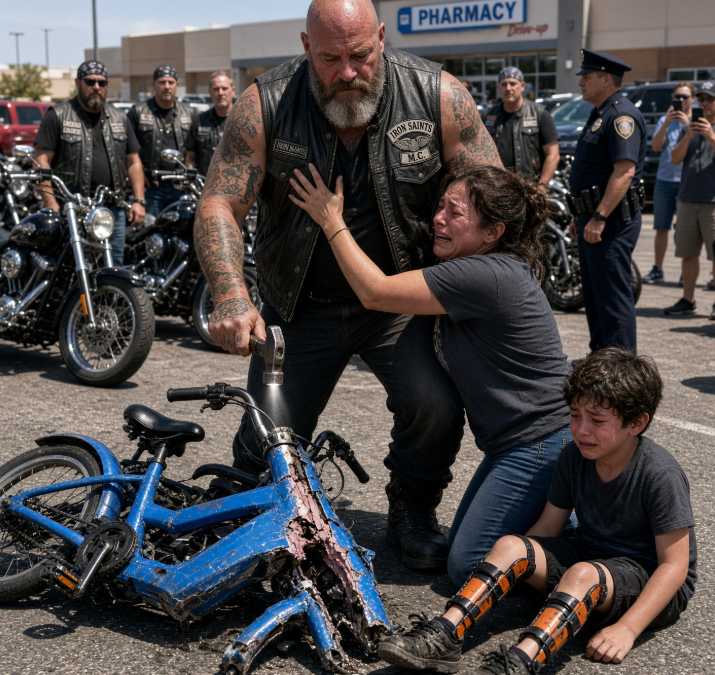
He positioned the tricycle on its side and struck the front tube.
Blue paint burst from the frame.
Noah made a sound I had heard only once before, when doctors wheeled Adam away after the crash that killed him.
It was not a cry.
It was the sound of a child watching hope leave before he could understand why.
Hammer struck the frame a second time.
The metal buckled.
On the third blow, the steering column split.
I lunged at him.
Two Iron Saints stepped forward, but Hammer sent them back with one glance.
“Let her.”
I pounded both fists against his chest.
I called him insane.
I called him cruel.
I told him he had destroyed the first machine that ever made my son feel fast.
Hammer stood there and absorbed every blow.
He did not grab my wrists. He did not raise his voice. He did not defend himself.
When I finally ran out of breath, he turned the broken front tube toward me.
Beneath the clean blue paint lay pink automotive filler.
Below that was a second layer of gray paint.
Underneath both layers, an old fracture reached almost completely around the metal.
The bicycle had already broken once.
Someone had hidden it.
Hammer took a narrow inspection light from Sprocket’s tool roll and shone it through the tube.
The beam escaped from three separate cracks.
“If he reached the street,” he said, “the wheel would have folded under him.”
I stared at the broken metal.
“He said it was reinforced.”
“It was disguised.”
A police cruiser pulled into the parking lot.
The security guard pointed at Hammer.
“That man attacked a child’s wheelchair with a hammer.”
“It’s a bicycle,” Noah whispered.
The officer approached cautiously.
“Sir, place the tool on the ground.”
Hammer obeyed.
I was still shaking with rage and fear.
“That tricycle cost me everything I saved.”
“I know,” he said.
“No, you don’t.”
“You’re right.”
“I want him arrested,” I told the officer.
Hammer turned around and offered his hands without argument.
Before the officer touched the cuffs, Noah spoke from the pavement.
“Did he catch me?”
Nobody answered.
Noah looked directly at me.
“Mom, did that man catch me?”
I swallowed.
“Yes.”
“Would I have crashed?”
I looked at the split steering tube.
“Yes.”
Noah turned toward the officer.
“Then don’t arrest him yet.”
The word yet almost made Sprocket smile.
Blood ran down Hammer’s right forearm. A broken seat bracket had torn through his skin while he held the tricycle off the ground.
He had not noticed.
Another rider approached carrying a folded sheet of paper.
“Saw it fall out of your vest,” he told Hammer.
I recognized the old creases before Hammer opened it.
Noah’s drawing.
The low blue tricycle.
The wide wheels.
The separate supports beneath each leg.
A BIKE THAT FITS ME FIRST.
I grabbed it.
“How did you get this?”
Hammer said nothing.
“You were inside my home?”
“No.”
“Then Owen gave it to you.”
“No.”
“Who are you?”
His gaze shifted toward Noah.
He reached inside his vest and touched a small blue bicycle bell hanging from a leather cord.
His fingers began trembling.
Only then.
Not while I hit him.
Not while the police officer threatened to handcuff him.
Only after he knew Noah was safe.
Hammer folded the drawing along its old creases and handed it back.
Then he looked at the other bikers.
“Open the workshop.”
Sprocket glanced toward the pharmacy clock.
“Every bench?”
“Every bench.”
“Ray, city inspection is Monday.”
“Then they can inspect a mess.”
“What are we building?”
He nodded toward Noah’s drawing.
“That.”
Nine motorcycles left the parking lot.
Hammer remained with us, the police officer, and the shattered tricycle.
He would not explain why he had Noah’s drawing.
He would not explain the blue bell.
He only asked the officer to preserve the broken frame as evidence.
At 6:12 that evening, we heard twenty-seven engines returning.
A long black trailer followed them.
It stopped directly in front of Noah.
The rear door opened.
Inside were eight adaptive bicycles.
Some were handcycles. Others had supportive seats, foot cradles, chest harnesses, or steering systems designed for riders with limited movement.
They were not new. Their frames bore scratches, faded stickers, and signs of repair.
But every weld was exposed.
Every tube had been inspected.
Every safety cable was visible.
Sprocket rolled down a yellow handcycle with a low seat and wide rear wheels.
“This is a loaner,” she said. “It’s not your bike.”
Noah touched one handle.
“Whose is it?”
“It belonged to a Marine named Luis Ortega. He used it after losing both legs. When he died, his wife donated it so somebody else could keep moving.”
“Did he go fast?”
“Faster than was medically advisable.”
Noah smiled.
Hammer knelt beside him.
“You don’t have to ride today.”
“I want to.”
“Then we fit it first.”
For the next forty minutes, the bikers measured everything.
They checked the angle of Noah’s hips, the pressure behind his knees, his reach, his grip strength, and the position of every strap. They placed a thin pressure-sensing pad beneath his feet to make sure the cradles did not create dangerous contact points he would not feel.
Hammer checked every bolt twice.
Before Noah moved, Sprocket inspected the handcycle independently.
Then another rider inspected her inspection.
Noah noticed.
“Do you think she did it wrong?”
“No,” Hammer said.
“Then why check?”
“Because trusting good people doesn’t mean asking them to be perfect.”
He attached an orange safety flag and stepped back.
“Your decision.”
Noah looked at me.
This time I nodded.
He pushed the handles.
The yellow handcycle rolled forward.
Slowly at first.
Then faster.
Twenty-seven bikers formed two lines across the parking lot, blocking the exits with their motorcycles so no car could enter his path.
Noah completed one circle.
Then another.
On the third, he laughed.
The sound broke something open inside me.
I covered my mouth and cried.
Hammer stood several feet away, his injured arm wrapped in gauze. He watched Noah, but he did not smile.
He held the little blue bell in his fist.
A local news crew arrived before sunset.
Someone’s video of Hammer destroying the tricycle had already spread online. The clip did not show the wheel twisting or the hidden fracture. It began with the first hammer blow and ended with me pounding my fists against his chest.
The caption said:
BIKER DESTROYS DISABLED CHILD’S DREAM BIKE IN PHARMACY PARKING LOT.
A reporter pushed a microphone toward me.
“Did the Iron Saints threaten your son?”
“No.”
“Did Mr. Dawson destroy equipment you purchased?”
“Yes, but—”
“Are you pressing charges?”
“I don’t know.”
Hammer walked away before the cameras reached him.
The reporter followed.
“Mr. Dawson, why did you attack a disabled child’s bicycle?”
Hammer stopped.
“I attacked a cracked tube.”
“Why not notify the mother?”
“I did.”
“She says she didn’t believe you.”
“She had seventeen months of hope tied to that machine. A warning wasn’t enough.”
“Did you have the legal right to destroy it?”
“No.”
“Do you regret it?”
Hammer looked toward Noah circling the parking lot.
“I regret being eleven seconds later than I should have been.”
That was the only quote the station aired in full.
By morning, the video had received nearly four million views.
Half the country believed Hammer was a monster.
The other half believed the entire incident had been staged by the motorcycle club for publicity.
People found my social-media account.
Some called me negligent for letting Noah ride after Hammer warned me. Others said I had invented my husband’s death to collect donations, even though I had never requested money.
Someone posted our apartment address.
A stranger sent Noah a message saying children like him should be grateful for wheelchairs instead of demanding expensive toys.
He read it before I could delete it.
“Am I demanding?” he asked.
“No.”
“The bike costs a lot.”
“That doesn’t mean you don’t deserve one.”
“Maybe I should give the yellow one back.”
I sat beside him.
“Why?”
“So people stop being mad.”
I took his tablet away.
“People who are angry that you want freedom were angry before they knew your name.”
He stared at his braces.
“Dad would know what to say.”
“Yes.”
“What would he say?”
I thought about Adam’s terrible jokes, his stubborn optimism, and the way he never allowed pity into our home.
“He’d say you’re keeping the bike because he didn’t raise a quitter.”
Noah looked up.
“He barely raised me.”
The words struck both of us.
His face crumpled immediately.
“I’m sorry.”
“You don’t have to apologize for missing him.”
“I don’t remember his voice.”
I pulled him against me.
“I do.”
We stayed that way until the apartment grew dark.
The next morning, Owen Vale called.
His voice carried exactly the right amount of concern.
“Claire, I just saw the news. I’m horrified.”
“You left us.”
“I went to get help.”
“You drove away.”
“When those men surrounded the bicycle, I became afraid.”
“You didn’t call the police.”
“I panicked.”
“You told Noah the steering would settle.”
“The unit passed inspection when it left our facility.”
“Hammer found an old fracture under the paint.”
There was a pause.
“Mr. Dawson struck the frame repeatedly with a steel tool. Any damage he displayed could have been caused by his own violence.”
“There was filler beneath the paint.”
“Standard cosmetic restoration.”
“The tube was cracked.”
“According to a motorcycle gang.”
He said the last two words carefully.
Not a veterans’ organization.
Not volunteer mechanics.
A motorcycle gang.
“I want my money back.”
“I want to resolve this,” he said. “I can deliver a brand-new replacement at no cost.”
“I don’t trust you.”
“That’s understandable after what happened. I also have a legal department insisting the company protect itself.”
“What does that mean?”
“It means I need you to sign a statement confirming the tricycle was functional before Mr. Dawson seized and destroyed it.”
“It wasn’t functional.”
“You allowed your son to ride it.”
“I didn’t know.”
“The video shows him operating it successfully.”
“The steering failed.”
“After Mr. Dawson interfered with it.”
My stomach turned.
He continued gently.
“I’m not blaming you, Claire. You’re a mother who trusted an inspected product. We both became victims of a violent man.”
Hammer had destroyed our property.
That part was true.
I had seventeen months of savings tied to twisted metal in a police evidence room. I had rent due in nine days, and no way to replace the money.
“How soon can you deliver another one?”
“Tomorrow.”
“And if I don’t sign?”
“My insurer will treat this as vandalism. Refunds would be impossible until the criminal case is resolved.”
“You’re blackmailing me.”
“I’m giving you a path forward.”
I agreed to meet him at a coffee shop that afternoon.
I did not tell Hammer.
Owen arrived with a leather folder and two cups of coffee. He looked more polished than he had in the parking lot. His blue shirt carried the same Open Roads logo, and a silver watch flashed at his wrist.
He placed a photograph of a red adaptive tricycle on the table.
“This model is worth almost seven thousand dollars.”
“It’s too high.”
“The seat adjusts.”
“Noah needs a low center of gravity.”
“It meets federal guidelines.”
“Which guidelines?”
His smile faded slightly.
“You’ve been speaking to Dawson.”
“I’ve been learning.”
He opened the folder.
The statement was three pages long.
It said Hammer had approached Noah aggressively, ignored my objections, damaged a fully operational tricycle, and used the incident to promote his motorcycle club.
It also said neither Open Roads Mobility nor its representatives bore responsibility for any defect discovered after the destruction.
“I’m not signing this.”
“Then I can’t authorize the replacement.”
“You left before the crash.”
“I explained that.”
“You also lied about the company being open.”
“We recently reorganized.”
“The state says your license expired two years ago.”
Owen leaned back.
“Do you know why families struggle to get adaptive equipment?”
“Because insurance companies call it recreational.”
“Because regulation makes everything unaffordable. A manufacturer charges ten thousand dollars for tubing and a seat because the word medical appears on the invoice. I find another way.”
“You hide cracked metal under paint.”
“I restore equipment.”
“You sold my son something that could have killed him.”
His pleasant expression disappeared.
“Your son has a condition that makes almost every physical activity dangerous.”
I felt the air leave my lungs.
He lowered his voice.
“That isn’t cruelty, Claire. It’s reality. Children like Noah need parents willing to accept reasonable compromises.”
“Children like Noah?”
“You know what I mean.”
“Yes,” I said. “I finally do.”
I stood.
Owen caught my wrist.
Not hard.
Just confidently.
“You owe a balance of eight hundred dollars under the purchase agreement.”
“I paid in full.”
“The invoice lists a delivery and fitting fee.”
“You said that was included.”
“Verbal statements are difficult to prove.”
I pulled my hand away.
“So are threats made in coffee shops.”
He smiled again.
“You came alone.”
A chair scraped behind him.
Hammer stood from a table near the window.
I had not seen him enter.
Owen went pale.
Hammer approached slowly.
He did not threaten him.
He did not touch him.
He placed a small digital recorder on the table.
“You weren’t alone,” he said.
Owen gathered his papers.
“You’ve been stalking my business.”
“Your business keeps showing up wherever children almost die.”
“That accusation is defamatory.”
“Then sue me somewhere with discovery.”
Owen walked out.
I rounded on Hammer.
“Did you follow me?”
“Sprocket did.”
The gray-haired rider raised one hand from a table near the door.
“I asked you not to interfere.”
“You didn’t ask me anything.”
“Because this is my problem.”
Hammer looked at me.
“It became mine when his frame almost folded under your son.”
“Noah is not your child.”
The words hit him hard.
I saw it.
Still, he only nodded.
“You’re right.”
I waited for anger.
None came.
He picked up the unsigned statement Owen had left behind.
“But Vale has sold at least fourteen adaptive bicycles in this county. Three families have reported steering failures. One boy needed surgery.”
I sat back down.
“You knew this before Saturday?”
“We knew Open Roads was moving unsafe equipment. We didn’t know Vale had started using home visits and parking-lot deliveries.”
“Why didn’t the police stop him?”
“Because complaints disappear. Serial numbers get altered. Parents accept refunds in exchange for confidentiality. By the time inspectors arrive, the warehouse is empty.”
“Why do you care so much?”
His fingers closed around the blue bell inside his vest.
“Her name was Lily.”
Sprocket looked toward the window.
Hammer sat across from me.
“My daughter was born with spina bifida,” he said. “Strong arms. Loud opinions. Absolutely no respect for speed limits.”
My anger drained away.
“How old would she be?”
“Thirty-two.”
Would be.
I glanced at the bell.
Hammer removed it and set it on the table.
The blue paint was chipped. A tiny white flower had been painted on one side.
“When Lily was eleven, I bought her a used handcycle. I was working construction. Her mother had left. Money was tight, and I found a man who said he rebuilt adaptive equipment.”
I already knew where the story was going.
Still, I hoped I was wrong.
“The steering rattled,” he continued. “I heard it the first week. Lily heard it too. I tightened the bearings and told her it was fine.”
His thumb moved across the bell.
“She wanted to ride down the hill behind our house. I was tired. I told her to wait until Sunday so I could go with her.”
He stopped.
“She went Saturday.”
My chest tightened.
“The steering tube separated at the bottom of the hill. She hit a concrete drainage wall.”
“I’m sorry.”
“She lived for nine days.”
His voice did not break.
That made it worse.
“I found filler beneath the paint after the crash. Same color. Same repair. The man who sold it had removed the serial number. Police called it a tragic equipment failure.”
“So you started destroying bicycles?”
“I started learning how to build them.”
He looked through the window toward the parking lot.
“For years, every time I heard a rattle, I heard Lily’s bike coming apart.”
“That’s why your hands shook.”
He nodded.
“And Noah’s drawing?”
“His physical therapist nominated him for our Wheels First program.”
“Marisol?”
“She took a picture of the drawing during a home visit. Your son had written exactly what we believe—a bicycle should fit the rider first. I printed it because we were planning to surprise him after our city inspection.”
“You were already building him a bike?”
“We had approved the build. We hadn’t started cutting tubing.”
“Why didn’t anyone tell me?”
“The program is small. We don’t make promises until we know we can finish.”
I looked at the old bell.
“Why keep carrying that?”
“Because guilt is heavy until you make it small enough to fit in your pocket.”
I thought of Adam’s running shoes beside our door.
Grief made rituals out of objects.
Some of us kept shoes.
Some kept bells.
The police tested the broken tricycle that week.
A structural engineer confirmed the main steering tube had suffered a nearly complete fracture before Hammer struck it. The crack had been filled with automotive body compound, painted gray, then covered with fresh blue paint.
The front fork came from a different model than the frame.
The restraints did not meet current safety standards.
The serial number had been ground away, but investigators recovered three partial digits beneath the seat bracket.
Those digits led to a girl named Emma Reed.
Emma lived in Rio Rancho. She was thirteen and used a wheelchair after a spinal-cord injury.
Her mother, Denise, recognized the blue frame on the news.
Three years earlier, the tricycle had cracked during a therapy session. The manufacturer classified it as unsafe and instructed the family to surrender it for destruction.
Open Roads Mobility had collected it.
Denise had watched an employee load it into a white van.
Owen later billed Emma’s insurance company eight hundred dollars for “certified medical disposal.”
Instead, he patched the frame and sold it to me.
The police opened a fraud investigation.
That should have ended Owen’s business.
It did not.
He appeared on television the next evening beside City Councilwoman Marla Finch, chair of Albuquerque’s accessibility committee.
Finch had spent years presenting herself as a champion for disabled residents. She cut ribbons at accessible playgrounds, posed beside veterans in wheelchairs, and approved grants for mobility equipment.
She placed one hand on Owen’s shoulder.
“Open Roads Mobility has served vulnerable families who were abandoned by traditional insurers,” she told reporters. “We must not allow a motorcycle gang with a history of violence to destroy a local business based on one disputed incident.”
Owen announced that Hammer had manufactured the damage.
He claimed Emma’s surrendered tricycle had been destroyed as required and that my bicycle came from a separate batch.
Then Finch announced an emergency safety inspection of the Iron Saints’ workshop.
“They build unlicensed medical devices in an unapproved garage,” she said. “Who is protecting children from them?”
The hypocrisy was almost elegant.
The city inspection took place Monday morning.
I arrived with Noah and found Hammer standing outside the workshop while an inspector placed a red closure notice on the door.
The building had once been a city bus maintenance garage. The Iron Saints had repaired its wiring, added ventilation, and installed wheelchair-accessible doors themselves.
It was cleaner than many professional shops I had seen.
The inspector still found violations.
A fire extinguisher hung six inches too low.
Two extension cords crossed beneath a bench.
A welding screen lacked an updated certification label.
The restroom handrail extended one inch less than the revised code required.
None of those issues justified immediate closure.
Councilwoman Finch appeared with a news crew before the inspection ended.
That told us everything.
“We cannot tolerate shortcuts where disabled children are concerned,” she said into the cameras.
Noah stared at the red notice.
“What happens to my bike?”
Hammer crouched beside him.
“We keep building.”
“But the workshop is closed.”
“Buildings close. Hands don’t.”
The riders carried every legal piece of equipment into the parking lot.
They set up folding tables beneath canvas tents. A local welding company loaned them a mobile fabrication truck. An auto shop across the street provided electricity through a heavy outdoor cable.
The city inspector threatened citations.
Then seventy people arrived.
Parents brought children using wheelchairs, walkers, prosthetics, and adaptive strollers. Veterans arrived on handcycles built by the Iron Saints. A firefighter brought a little girl whose wheelchair ramp Hammer had repaired after her landlord refused.
They stood around the parking lot holding photographs.
Not protest signs.
Photographs of lives made easier by people the councilwoman had just called dangerous.
A veteran named Luis held up a picture of himself completing his first marathon in the yellow handcycle Noah had borrowed.
A mother held a photograph of her son riding beside his brothers for the first time.
Sprocket turned toward the cameras.
“We don’t build medical devices,” she said. “We build bicycles. Every completed bike is inspected by an independent adaptive-equipment specialist before a child rides it.”
A reporter asked, “Are you licensed engineers?”
“I spent twenty-eight years welding flight-control assemblies for aircraft,” she replied. “The city accepted my work at thirty thousand feet. Apparently, it becomes dangerous when I do it for free at ground level.”
The clip spread online within hours.
Public pressure forced the city to allow the workshop to reopen temporarily while violations were corrected.
But Owen did not disappear.
He sent me a certified letter demanding the remaining eight hundred dollars.
He also filed a civil suit against Hammer for destruction of property and business interference.
Then somebody threw a bottle through the workshop window.
A note wrapped around it said:
STOP CALLING PARENTS.
Hammer wanted to increase security.
Sprocket wanted to publish every serial number they had connected to Open Roads.
The police asked them to wait.
They did not wait.
That decision saved a child.
The Iron Saints posted a video explaining how parents could check adaptive bicycle frames for concealed cracks. They warned families to stop using equipment sold by Open Roads until it could be inspected.
A mother named Danielle Price saw the video at 10:40 that night.
Her eight-year-old daughter, Kaylee, had received a red handcycle from Owen two months earlier.
Danielle checked beneath the steering collar.
She found gray filler.
The next morning, a structural specialist discovered a fracture extending through eighty percent of the tube.
Kaylee rode down a steep driveway every afternoon.
If the warning had arrived one day later, she might have been on that slope.
Police seized the red handcycle.
Its serial number had also been removed.
This time, investigators found something else inside the frame—a tracking label from a nonprofit equipment-recycling center.
Records showed Owen had received thirty-one damaged mobility devices for certified destruction over four years.
He had destroyed six.
The other twenty-five had vanished.
Councilwoman Finch had approved every disposal contract.
Hammer, Sprocket, and I began calling families.
We found eleven of the missing devices in two days.
Seven contained concealed structural damage.
One had a seat bracket attached with household screws.
Another had foot straps positioned so badly that a child with limited sensation developed an infected pressure wound.
Parents told us the same story.
Owen arrived with kindness, photographs, and a price low enough to feel like mercy.
He accepted cash whenever possible.
If a parent complained, he blamed the child’s disability, the family’s maintenance, or the natural risks of adaptive cycling.
Two families had signed nondisclosure agreements in exchange for partial refunds.
A father named Marcus Hill refused to speak with us at first.
His son Devin had crashed when an Open Roads steering column separated. Devin suffered a broken collarbone and a brain injury.
Owen convinced Marcus that the accident occurred because Devin exceeded the recommended speed.
“He said I had failed my son,” Marcus whispered.
“You didn’t,” Hammer told him.
“I let him ride downhill.”
“So did I.”
Marcus looked at him.
Hammer placed Lily’s bell on the kitchen table.
“I spent twenty-one years believing a salesman’s crime became mine because I trusted him. That shame kept me quiet longer than any legal agreement could have.”
Marcus agreed to testify.
Three days later, the district attorney executed a search warrant at the address listed on Open Roads Mobility’s business registration.
The building was empty.
Owen had cleared it out overnight.
The floor still held blue paint dust, fragments of body filler, and adhesive from removed serial-number labels.
But the bicycles were gone.
So were the records.
Detective Ana Ruiz, who led the investigation, believed someone inside city government had warned him.
Councilwoman Finch called that accusation offensive.
Then Noah noticed something in a news photograph.
He was sitting at our kitchen table while I reviewed images from the warehouse search. He pointed toward a white van visible in the background.
“That’s not Mr. Vale’s van.”
“It looks like it.”
“His door had a dent.”
“Maybe it was repaired.”
“No. The letters are different.”
He enlarged the image.
The Open Roads logo appeared on the van’s side, but the final S in ROADS tilted slightly downward.
Noah ran to the refrigerator and pulled Owen’s old business card from beneath a magnet.
The same S tilted downward.
“What are you showing me?”
“It’s a magnet.”
“What?”
“The logo on his van was a big magnet. I saw the corner lift when he closed the door.”
Hammer arrived twenty minutes later.
Noah explained.
Owen’s white van was not permanently marked. The logo could be removed in seconds.
Sprocket searched traffic-camera footage from the morning Owen fled the warehouse. Once the logo disappeared, the vehicle would look like thousands of ordinary white vans.
But Noah remembered the dent.
“It was under the right taillight,” he said. “Like a crescent moon.”
Detective Ruiz sent the description statewide.
A highway camera found the van traveling south on Interstate 25.
It exited near an abandoned produce warehouse owned by a company connected to Councilwoman Finch’s husband.
Police obtained a warrant.
Inside, they found nineteen adaptive bicycles, boxes of removed serial-number plates, forged inspection certificates, and the missing Open Roads records.
They also found city grant applications.
Finch’s office had approved more than nine hundred thousand dollars in public funding for equipment supposedly provided to low-income families.
Many of the listed recipients did not exist.
Others were real children whose families had never received anything.
The money had been divided among shell companies belonging to Finch, Owen, and two city contractors.
My purchase appeared in the ledger.
Next to my name, Owen had written:
Cash buyer. Husband deceased. Low legal risk.
I read those words three times.
He had not seen a struggling mother and a child who wanted a bicycle.
He had seen a widow unlikely to afford an attorney.
The humiliation burned more deeply than the financial loss.
For seventeen months, I had believed every sacrifice brought Noah closer to freedom.
Owen had studied those sacrifices and calculated how safely he could steal them.
Hammer read the note over my shoulder.
His jaw tightened.
“Don’t,” I said.
“Don’t what?”
“Go after him.”
“I’m standing right here.”
“You carry a hammer, your name is Hammer, and your face looks like a storm warning.”
“That doesn’t mean I’m stupid.”
Noah rolled his wheelchair between us.
“Are you going to punch Mr. Vale?”
“No,” Hammer said.
“Why not?”
“Because your mom asked me not to.”
Noah considered that.
“Would you have punched him otherwise?”
Hammer glanced at me.
“This feels like a question with no safe answer.”
For the first time in weeks, I laughed.
Owen was arrested the following morning at a motel outside Las Cruces.
Finch was not arrested.
Her attorney claimed the warehouse company belonged solely to her estranged husband. She denied knowing anything about the forged grant applications.
She continued overseeing the city’s accessibility committee.
Worse, she scheduled a public hearing to revoke the Iron Saints’ workshop permit permanently.
Hammer’s attorneys advised him not to attend.
He ignored them.
The hearing filled city hall.
Finch sat behind a raised desk beneath the city seal. She wore a cream-colored suit and the expression of someone confident that polished language could erase ugly facts.
Hammer sat at a small table below her.
Noah and I sat behind him.
Finch opened with a speech about safety.
“This proceeding is not about personalities,” she said. “It is about whether an organization with no medical license, no manufacturing certification, and several members with criminal histories should be permitted to construct mobility equipment for vulnerable children.”
Hammer’s attorney began to respond.
Hammer touched his arm.
“I’ll answer.”
Finch smiled thinly.
“Mr. Dawson, do you possess an engineering degree?”
“No.”
“A medical degree?”
“No.”
“A license to manufacture durable medical equipment?”
“No.”
“Have you ever been convicted of a crime?”
“Yes.”
A murmur spread through the room.
Finch leaned forward.
“What crime?”
“Aggravated assault.”
I stared at him.
He had never told me.
“When?”
“Twenty years ago.”
“Please describe the incident.”
Hammer looked toward the audience.
“After my daughter died, I found the man who sold us her bicycle.”
The room became still.
“What did you do?”
“I broke his jaw, three ribs, and his left hand.”
Finch allowed silence to expand.
“So violence is not merely suggested by your appearance or nickname.”
“No.”
“You are, by your own admission, a violent felon.”
“Former felon,” Hammer’s attorney corrected. “The conviction was later reduced, and Mr. Dawson completed all sentencing requirements.”
Finch ignored him.
“Yet you now ask this city to trust you near children.”
Hammer placed both hands on the table.
“No.”
Finch blinked.
“No?”
“I don’t ask parents to trust me because I say I’m good. I show them every weld. I give them the inspection report. I tell them to have someone else check my work. I teach them how to find what I might have missed.”
He looked directly at her.
“Trust without proof is how men like Owen Vale stay in business.”
Applause erupted.
Finch struck her gavel.
Hammer continued.
“I was violent after Lily died. I wanted the person who hurt her to feel what I felt. For a few minutes, he did.”
His voice became quieter.
“Then I went to jail, and Lily was still dead.”
Noah watched him without moving.
“I learned something there,” Hammer said. “Breaking a bad man doesn’t rebuild what he broke. So when I got out, I learned welding. Then machining. Then adaptive seating. I found people who knew what I didn’t, and we built the first bike in Lily’s name.”
Sprocket carried a display board to the front of the room.
It held photographs of sixty-three adaptive bicycles.
Each picture showed a different rider.
Children.
Veterans.
Adults with cerebral palsy, spinal injuries, amputations, or degenerative illnesses.
“We’ve built or modified sixty-three bikes in eighteen years,” Hammer said. “No frame failures. No restraint injuries. No hidden repairs.”
Finch looked at the photographs.
“You still lack the required license.”
“There is no city license for a nonprofit bicycle workshop.”
“There is a medical-device manufacturing license.”
“We don’t bill insurers. We don’t prescribe treatment. We build recreational bicycles to specifications approved by each rider’s medical team.”
“Your attorney taught you that answer.”
“Losing my daughter taught me that answer.”
Finch’s face hardened.
“Your personal tragedy does not exempt you from regulations.”
“No,” Hammer said. “But your title doesn’t exempt you from subpoenas.”
The rear doors opened.
Detective Ruiz entered with two investigators from the state attorney general’s office.
Finch went pale.
One investigator approached the council table and handed her attorney a warrant.
The recovered Open Roads records contained more than forged grants.
They contained emails.
Finch had warned Owen about the warehouse search.
She had instructed city inspectors to close the Iron Saints’ workshop before their safety video could gain attention.
She had received more than two hundred thousand dollars through a consulting company registered in her sister’s name.
Most damning of all, she had personally signed the destruction certificates for the defective bicycles Owen later resold.
The attorney general charged her with fraud, conspiracy, evidence tampering, and reckless endangerment.
Finch stood so abruptly that her chair rolled backward.
“This is political retaliation.”
Detective Ruiz stepped forward.
“Councilwoman, place your hands where I can see them.”
Cameras recorded everything.
Finch looked toward Hammer as officers approached.
“You planned this.”
“No,” he said. “A ten-year-old noticed a crooked letter on a magnet.”
Every face in the room turned toward Noah.
He shrank in his chair.
Then Hammer stood.
He moved between Noah and the cameras, blocking their view with his body.
The other Iron Saints rose around us.
They did not threaten anyone.
They simply formed a wall.
Just as Hammer had protected Noah from the failing bicycle, the club protected him from becoming a spectacle.
Finch was led from the chamber in handcuffs.
The workshop closure order was suspended that afternoon.
Owen eventually pleaded guilty to multiple counts of wire fraud, forgery, theft, and child endangerment. He testified against Finch in exchange for a reduced sentence.
Finch insisted she had only tried to make adaptive equipment affordable.
The prosecutor displayed photographs of the hidden fractures.
“Affordable does not mean disposable,” she said. “And a disabled child’s safety is not worth less because his family has less money.”
The judge sentenced Owen to eleven years in state prison and ordered restitution for every family he had defrauded.
Finch received nine years.
The city established a public registry for adaptive-equipment vendors and independent inspections for refurbished devices. The grant program was transferred to a board that included parents, physical therapists, engineers, and disabled riders.
Hammer refused a seat.
Sprocket accepted one.
“She likes meetings,” Hammer explained.
“I like stopping idiots from controlling budgets,” Sprocket corrected.
My seventeen months of savings were eventually returned through the restitution fund, but that happened much later.
Before any trial, before any apology, the Iron Saints finished Noah’s bicycle.
They did not build it behind closed doors.
They built it with him.
Noah chose the frame angle, seat height, and handle position. Sprocket explained why some of his ideas would work and why others would fail.
When he requested six gears, she asked what he planned to do with them.
“Escape uphill.”
“From what?”
“Probably my mom.”
They settled on eight.
The bike had three wide wheels, a low blue frame, separate adjustable supports beneath each leg, two independent braking systems, and quick-release straps.
Every major tube contained a small inspection port.
Nothing dangerous could be buried beneath filler and paint.
A backup steering cable ran inside a transparent protective sleeve so Noah could see it.
The seat was black with orange stitching to match his braces.
Across the frame, Hammer welded six small words:
A BIKE THAT FITS ME FIRST.
An independent engineer inspected it.
Then Noah’s physical therapist inspected the seating.
Sprocket inspected every weld one final time.
Hammer watched all three inspections without taking offense.
The first ride took place on a closed track at a city park.
Dozens of families attended, but Hammer kept the ceremony simple.
There were no speeches.
No giant bow.
No reporters inside the track.
He rolled the bike toward Noah and knelt.
“It’s yours,” he said.
“Forever?”
“For as long as it fits.”
Noah looked at me.
I nodded.
He transferred into the seat with only a little help. Hammer adjusted the leg supports while I secured the chest harness.
Noah tested both brakes.
“Primary?”
“Left hand,” Hammer said.
“Backup?”
“Right.”
“Steering cable?”
“Visible.”
“Pressure points?”
“Checked.”
“Frame?”
“Ultrasonic scan, dye test, and two people more qualified than me called it obnoxiously strong.”
Noah grinned.
“Bell?”
Hammer became still.
The handlebars had no bell.
Noah reached into the small bag attached to his wheelchair.
He removed a new blue bicycle bell painted with a tiny white flower.
I had helped him order it.
He held it toward Hammer.
“This one is for my bike.”
Hammer accepted it and attached it to the handlebars.
Then Noah pointed at the old bell hanging inside his vest.
“That one stays with you.”
Hammer’s eyes filled.
“Why?”
“So Lily knows you didn’t forget her.”
Hammer looked away.
Noah continued, “And so you remember you don’t have to break every bad thing by yourself.”
Sprocket pretended to examine a wrench.
Brick, one of the largest Iron Saints, openly cried.
Hammer tightened the new bell.
“Ready?”
Noah placed both hands on the cranks.
“Dad better be watching.”
“He is,” I said.
Noah pushed.
The bicycle moved.
Slowly at first.
Then faster.
The blue frame glided around the track as though it had been waiting for him.
His friends chased from the grass.
For the first time, they could not catch him.
He rang the bell as he passed us.
Hammer stood beside me.
“Thank you,” I said.
He shook his head.
“You don’t owe me that.”
“Yes, I do.”
“I destroyed something you paid for.”
“You destroyed a lie.”
“I should have explained first.”
“I wouldn’t have believed you.”
“That doesn’t make the way I did it right.”
I looked at him.
“Do you regret smashing it?”
He watched Noah complete another lap.
“I regret that it was ever sold to him.”
“That isn’t what I asked.”
Hammer considered the question.
“No,” he said. “I’d do it again.”
I smiled.
“I know.”
Noah completed twelve laps before his arms tired.
When he finally stopped, his hair was damp with sweat and his cheeks were red.
“That was fast,” I told him.
“That was warm-up speed.”
“Absolutely not.”
“You said the bike fits me first.”
“It does.”
“So I should control the speed.”
“You are ten.”
“Discrimination.”
Hammer laughed.
It was the first time I heard the sound come from him without sadness attached.
The Iron Saints made Noah an honorary member that afternoon. His vest was denim rather than leather and carried no club colors, only a small patch shaped like a wheel.
Beneath it were the words CHECK THE RATTLE.
Noah wore it everywhere.
He wore it to school.
He wore it to physical therapy.
He tried to wear it to bed until I reminded him the metal snaps would hurt his back.
Six months later, the city reopened its adaptive-mobility grant program.
The first bicycle purchased through the corrected program went to Kaylee Price, the little girl whose red handcycle had contained a hidden fracture.
The second went to Devin Hill, whose father had spent years believing the crash was his fault.
When my restitution check arrived, I kept enough to replace the money I had borrowed for rent.
I donated the rest to the Iron Saints.
Hammer attempted to refuse it.
“It’s Noah’s money,” he said.
“Noah decided.”
He looked at my son.
Noah crossed his arms.
“It buys the next kid’s brakes.”
Hammer accepted the check.
The workshop was renamed Lily’s Garage.
A photograph of Hammer’s daughter hung beside the main workbench.
She was eleven, with long brown hair, metal braces on both legs, and one hand resting on the handlebars of a purple handcycle.
The blue bell hung beneath the photograph.
Not hidden inside Hammer’s vest anymore.
He still carried the leather cord, but the bell finally had a place where other people could see it.
One evening, nearly a year after the parking-lot incident, Noah and I returned to the pharmacy.
He wanted to ride the route he had almost taken that day.
Hammer came with us.
The three of us stood at the top of the low slope between the parking rows.
The street waited at the bottom.
Noah checked his brakes.
Then he looked at Hammer.
“Scared?”
Hammer nodded.
“A little.”
“Me too.”
“That’s allowed.”
“What if something breaks?”
“You use the second brake.”
“And if that fails?”
“Your mom catches you.”
I raised an eyebrow.
Hammer corrected himself.
“We both catch you.”
Noah smiled.
Then he pushed the cranks.
The bicycle rolled down the slope.
Its front wheel remained perfectly straight.
The visible safety cable held firm. The blue frame moved smoothly beneath him, and the new bell rang once in the warm desert air.
At the bottom, Noah applied the first brake.
The bicycle stopped.
He turned around and lifted both fists above his head.
“I told you I was fast!”
Hammer laughed beside me.
I looked toward the place where the broken tricycle had lain.
For months, I had remembered only the hammer blows.
The blue paint bursting from the frame.
Noah’s devastated cry.
My fists striking Hammer’s chest.
But memories change when the truth finally has room to stand beside them.
I could now remember Hammer running.
I could remember his boots hitting the pavement.
I could remember one bleeding arm holding the entire machine off the ground so my child would not strike the asphalt.
Eleven seconds.
Three hammer blows.
One terrifying sentence.
“If I don’t kill this bike, it may kill your boy.”
I had believed cruelty was destroying something beautiful.
That day taught me cruelty can also be painting over a fracture and selling it to a mother desperate enough to trust you.
It taught me that kindness is not always gentle.
Sometimes kindness has tattooed arms, an old blue bell, and the courage to let an angry mother strike him while he waits for the broken metal to reveal the truth.
Sometimes love is seventeen months of saving.
Sometimes it is twenty-one years of guilt transformed into sixty-four safe bicycles.
And sometimes freedom begins when someone refuses to give a child a machine that merely moves.
They give him one that fits him first.








