A Biker Grabbed a 4-Year-Old Boy From His Mother at a Bus Stop—Ten Seconds Later, She Saw Why
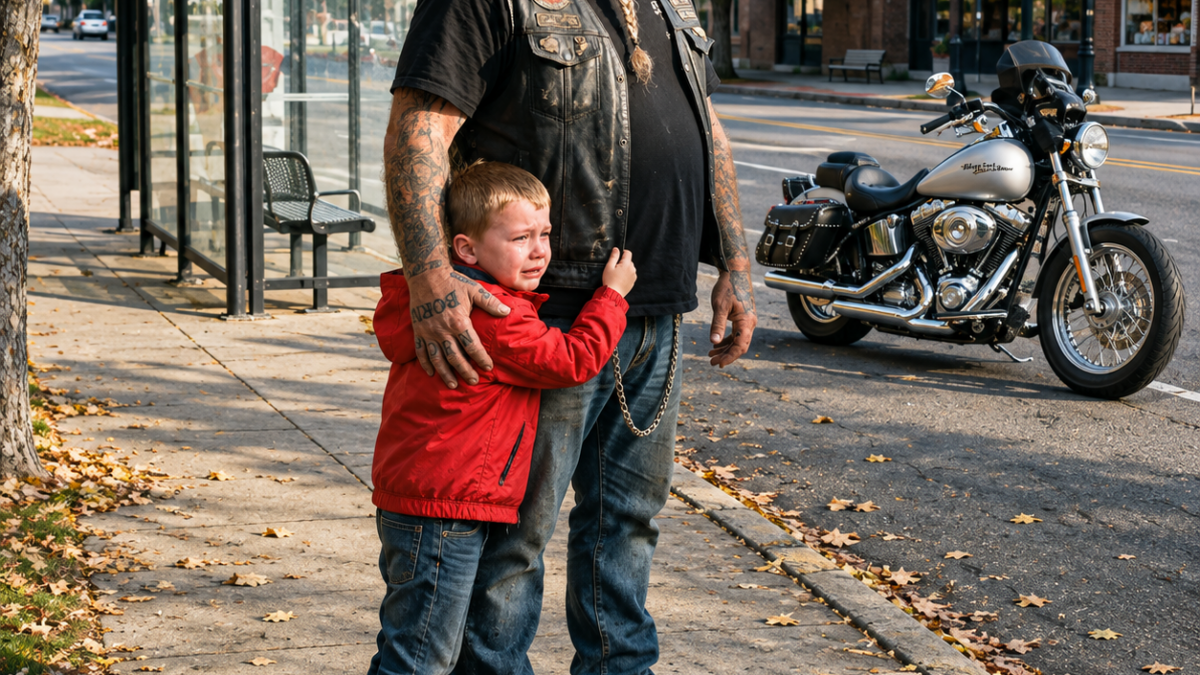
A Biker Grabbed a 4-Year-Old Boy From His Mother at a Bus Stop—Ten Seconds Later, She Saw Why
The boy was four years old, the biker was a complete stranger, and when that enormous man suddenly crossed Main Street, snatched the child from his mother, and carried him away without explaining a word, every person who saw it thought they were watching an abduction.
The mother chased him across the street, struck him three times, and was pulling back for a fourth when the Number 12 bus came screaming down Linwood Hill with no brakes and demolished the exact glass shelter where she and her son had been standing less than ten seconds earlier.
What I did not learn until later was that the biker had been riding the same October road for twenty-six years because of a brother he could never save—and when I finally saw the words tattooed across his knuckles and learned why he refused the mother’s phone number, I began to understand why a man could save a child, accept three punches without defending himself, and ride out of town before anyone could properly thank him.
My name is Ellis Halverson.
I am sixty-four years old.
For thirty-one years, I have owned and operated Halverson Grocery at the corner of Main Street and Linwood Avenue in Beckford, Ohio.
The name sounds larger than the place is.
We are not a supermarket.
We do not have twelve checkout lanes, an in-house pharmacy, a bank kiosk, or enough square footage for anybody to get lost.
We have five short aisles.
A produce wall.
A deli counter that has been repaired so many times I am fairly certain the refrigeration unit contains no original parts.
A coffee station.
Two folding tables near the front windows where local men sit longer than any cup of coffee reasonably justifies.
And a bell over the front door that has made the same tired metal sound since 1994.
I know almost everyone who comes in.
I know who buys whole milk and who pretends two percent tastes the same.
I know which retired men are supposed to be limiting salt and which ones immediately purchase potato chips after leaving their cardiologist.
I know which high school students are buying energy drinks their mothers specifically told them not to buy.
I know who pays on Friday because pension checks land Thursday night.
A small grocery store is an excellent place to learn that human beings are repetitive.
We are creatures of routes.
Times.
Habits.
The same bus.
The same coffee.
The same corner.
Until one morning something breaks the pattern so completely that every ordinary detail around it becomes permanent.
That happened at 8:53 a.m. on October 4.
I remember the time because the clock above my register was two minutes fast, and afterward I checked the security footage enough times to know exactly when everything happened.
October had just started turning cold.
Not winter cold.
Ohio autumn cold.
The kind that makes people put on jackets in the morning and carry them over one arm by afternoon.
I was stocking canned soup near the front.
Tomato on the second shelf.
Chicken noodle below it.
There were three customers in the store.
Mr. Creighton was at the coffee machine.
A woman named Denise Parker was comparing cereal prices.
A delivery driver was unloading milk through the side entrance.
Across Main Street, at the bus stop on the corner, stood a young mother and a little boy.
I had seen them before.
Not enough to know their names.
Enough to recognize them.
She came through the store occasionally.
Mid-thirties, maybe younger.
Brown hair.
Usually rushed.
PART2:
That morning she wore a green parka.
Her son wore a bright red jacket.
That is the strange thing about traumatic moments.
You remember colors better than sentences.
Green coat.
Red jacket.
Black leather.
Brown coffee.
Gray bus.
Blue sky.
The boy was holding one of those small paper bags of animal crackers.
Or he wanted animal crackers.
I did not know which until later.
The mother had a coffee in one hand.
The boy leaned against her leg while they waited.
Nothing unusual.
Then I heard the motorcycle.
Harley.
Deep sound.
You hear enough bikes in a town like Beckford to know the difference between a motorcycle being ridden hard and one simply rolling through.
This one wasn’t speeding.
The rider pulled up on my side of Main.
Large touring bike.
Later I learned it was a Road King.
Black.
Some chrome.
Travel bag strapped behind the seat.
The rider put one boot down at the curb.
He was big.
That was the first thing I noticed.
Even seated.
Broad shoulders.
Long gray beard.
Black leather cut.
Tattoos visible above his collar and along his hands.
The kind of man people make decisions about before hearing him speak.
I did.
I will admit that.
Thirty-one years behind a counter teaches you not to judge too quickly, but instinct is instinct.
I looked at him and thought:
Passing biker.
Probably wants coffee.
Maybe cigarettes.
He sat there for maybe two seconds.
Three at most.
Head turned toward Linwood.
Then something changed.
He killed the bike.
Got off.
And started walking.
Fast.
Not running.
But almost.
Straight across Main.
At the mother.
At the boy.
I stopped stocking soup.
The rider was probably six foot three.
Maybe more in boots.
He moved like a man who knew exactly where he was going.
The mother saw him when he was halfway across.
I could see confusion on her face.
Then alarm.
She moved slightly in front of the boy.
Reasonable.
This enormous stranger was approaching quickly.
He never slowed to explain.
That is what made the whole thing look wrong.
If he had shouted:
Move!
Bus!
Anything—
maybe she would have understood.
But he did not have time.
He reached them.
Bent down.
Scooped up the boy.
Turned.
And carried him away.
That was what we saw.
A biker grabbing a four-year-old.
The child immediately started screaming.
Kicking.
His mother dropped her coffee.
The cup hit concrete.
Brown liquid exploded across the sidewalk.
She screamed something.
I could not hear through the glass.
Probably his name.
Probably stop.
Probably every word any mother would scream if a stranger suddenly took her child.
The biker crossed Main carrying the boy under one arm and across his chest.
Not gently-looking.
Urgently.
The little boy’s red shoes were kicking.
The mother ran after them.
A delivery truck coming down Main hit the brakes hard enough that I heard tires squeal through the front window.
The biker reached my side.
Set the child down on the sidewalk.
Gently.
That I saw clearly.
Both boots first.
Then he let go.
The boy stumbled maybe one step.
The biker turned around.
And waited.
That was strange.
If you have just abducted a child, you do not normally set him down twenty feet from where you took him and wait for his mother.
But I had not processed that yet.
I had the store phone in my hand.
I was calling police.
Denise Parker had come toward the window.
Mr. Creighton was staring.
The mother reached the biker.
She did not ask why.
I do not blame her.
Not then.
Not now.
She slapped him.
Hard.
His head moved.
He did nothing.
She hit him again.
Fist this time.
Somewhere around the chest or shoulder.
Then again toward the face.
He never blocked her.
Never grabbed her wrist.
Never stepped toward her.
Never shouted.
Hands down.
Just took it.
I remember thinking:
What is happening?
Then I heard the air horn.
Not a normal horn.
Long.
Continuous.
Desperate.
Coming down Linwood Hill.
Everybody turned except the mother.
She was still facing the biker.
I looked up the hill.
Number 12.
City bus.
Coming too fast.
Far too fast.
There is a grade on Linwood.
Not a mountain.
Enough that buses usually brake before Main.
This one was not slowing.
It was moving maybe forty miles per hour.
Maybe more.
The horn stayed on.
Cars in the intersection reacted.
One swerved.
Another stopped.
The bus driver was standing against his steering wheel.
I could see him through the windshield.
Later I learned his name.
Calvin Boyd.
Fifty-four years old.
Ten years driving that route.
He told investigators afterward he had pressed the brake pedal and felt almost nothing.
Like stepping onto a wet sponge.
The hydraulic system had failed.
He pumped the brakes.
No meaningful pressure.
Tried downshifting.
Tried everything available in the seconds he had.
He used the horn because there was nothing else left to warn people with.
The Number 12 entered Main without stopping.
Clipped the curb.
The back end began to slide.
Then the bus came sideways.
Directly toward the shelter.
The mother still had her fist raised.
Ready to hit the biker again.
Then she heard the impact.
The glass shelter collapsed.
There is no better word.
Collapsed.
Metal folded.
The bench twisted.
The advertisement panel exploded into thousands of tiny squares of safety glass.
The trash can launched off the sidewalk and bounced down the street.
The bus climbed partly onto the curb.
Its right side slammed into what remained of the shelter.
Then everything stopped.
Not silence.
Mechanical noise.
Hissing.
Horn dying.
Glass falling.
Metal ticking.
People shouting.
But emotionally—
stopped.
The mother turned.
I saw her face.
I will never forget it.
She looked first at the bus.
Then the place where she had been standing.
Then at her son.
Her fist slowly lowered.
Her knees gave out.
She dropped to the pavement.
The sound she made came through the glass.
I heard it inside the store.
Not a scream.
Lower.
Something broken.
There are noises people make when language is too slow.
That was one.
Her son ran to her.
The biker had stepped back.
Two full paces.
Giving them space.
The boy threw himself into his mother’s arms.
She grabbed him.
Wrapped both arms around him.
Pulled him so tightly against her I thought she might hurt him.
Then she looked at the biker.
The same man she had just hit.
Her right hand came off the boy.
Reached.
Grabbed the front of his leather cut.
And pulled him down.
Into the hug.
He resisted for half a second.
Maybe surprise.
Then knelt.
All three of them on the sidewalk.
Mother.
Child.
Stranger.
She was sobbing into his beard.
The boy was crying.
The biker had one large hand on the back of the child’s head.
The other on the mother’s shoulder.
He said nothing.
That image is what I remember most.
Not the bus.
Not the impact.
The three of them kneeling.
Because six seconds earlier she had believed he was the worst man on the street.
Now she understood he was the reason she still had a son to hold.
I put the phone down long enough to run outside.
Other people were already moving.
Two men crossed from the opposite sidewalk.
The delivery driver who had slammed his brakes abandoned his truck in the lane.
Somebody called 911.
Maybe several people.
Calvin Boyd was trying to get out of the bus.
The front door had partially jammed.
He forced it.
Stepped down.
Then nearly collapsed.
His hands shook so badly he had to grab the rail.
There had been passengers aboard.
Fortunately, the bus had not rolled.
Most injuries were minor.
Bruises.
Cuts.
One older woman hit her shoulder badly.
A teenager had a forehead laceration.
Nobody at the shelter had been struck because nobody remained at the shelter.
That fact felt impossible.
The mother and child would have been exactly there.
Same spot.
Maybe she would have stepped aside.
Maybe not.
We all understood the most likely outcome.
You do not survive a city bus folding a glass shelter around you by luck very often.
The biker understood too.
He stood after the mother finally released him.
He looked toward the wreck.
Then down at his hands.
They were shaking.
I noticed because I was close.
Everybody thought of him as calm because he had taken punches without reacting.
He was not calm.
He was controlled.
Different thing.
Someone asked if he was hurt.
He shook his head.
The mother looked at his face.
There was redness near one cheek where she had slapped him.
She put a hand over her mouth.
“I hit you.”
I heard that.
He answered:
“It’s all right.”
She shook her head.
“No.”
He said:
“You didn’t know.”
Then emergency vehicles arrived.
Fire.
Police.
EMS.
Main Street became lights.
Radios.
Cones.
People.
The front of my grocery became an informal staging area because we had room, electricity, coffee, and clean towels.
I brought out bottled water.
Paper towels.
First aid supplies.
A medic asked if they could use one of my folding tables.
I said use everything.
Calvin sat on my front step.
Face in his hands.
“I couldn’t stop it.”
He said that repeatedly.
“I couldn’t stop it.”
A paramedic knelt beside him.
Told him they knew.
Told him to breathe.
Calvin blamed himself anyway.
People often do.
Mechanical failure does not remove the sensation of being behind the wheel.
I later learned a hydraulic line in the brake system had failed catastrophically.
The bus had been serviced three weeks earlier.
There were investigations.
Reports.
Lawyers.
A settlement process that dragged on.
But that morning, none of that existed yet.
There was just a driver who thought he had nearly killed a mother and child.
And a stranger who had prevented it.
Police began taking statements.
I was one of the first.
I explained what I saw.
Motorcycle.
Biker looking up Linwood.
Crossing.
Grabbing child.
Mother following.
Bus.
Officers asked whether he had shouted.
I said not that I heard.
Later they asked him.
That was when I learned his name.
Wendell Cross.
Fifty-eight years old.
Logansport, Indiana.
Passing through.
Not local.
No connection to the mother.
No connection to the child.
No reason to be in Beckford beyond gas and coffee.
That last part stayed with me.
Because if he had decided to stop three miles earlier, Theo would probably be dead.
If he had gotten coffee first, maybe dead.
If one traffic light had delayed him thirty seconds—
I do not like thinking too much about chance.
It makes the world feel flimsy.
Wendell had been riding west-to-east through Beckford on a route he took every October.
Memorial ride.
For his brother Caleb.
Caleb Cross had died in a logging accident in 1998.
Wendell had started riding the route once a year.
Same month.
Same general roads.
Twenty-six years.
He was on his way to continue that ritual.
That was why his Road King entered Beckford that morning.
That was why he stopped.
He had parked intending to get coffee and maybe gas.
Then he looked up Linwood.
Saw the bus.
No brake lights.
Driver on the horn.
Coming too fast.
He said he had maybe four seconds.
An officer asked why he did not yell.
Wendell stared at him.
“No time.”
Why the child first?
“The boy was closest to the curb.”
Why not grab the mother too?
“Couldn’t carry both.”
He figured if he took the child, the mother would follow.
Correct.
He did not expect her to punch him.
Also understandable.
The officer asked if he wanted to file a complaint.
Wendell looked confused.
Against whom?
“The mother.”
He almost laughed.
“No.”
She had hit him three times.
Maybe four depending on what counted.
No charges.
No complaint.
He did not even want it included as some moral issue.
“She saw a stranger take her kid.”
That was all.
As far as Wendell was concerned, she had responded normally.
He had simply not had time to ask permission to save her son.
The little boy was examined by EMTs.
Theo.
That was his name.
Four years old.
No injury.
Not even bruising from Wendell’s grip.
A medic checked his ribs.
Arms.
Shoulders.
Head.
Fine.
Scared.
Very confused.
He kept asking why the bus broke.
Children want mechanical explanations when adults are drowning in existential ones.
His mother was Hannah.
Hannah Mercer.
She sat beside him while the EMT checked him.
Her hands would not stop shaking.
Every few seconds she looked toward Wendell.
Then away.
Guilt all over her face.
Wendell eventually came inside my store.
Not dramatically.
He just wanted coffee.
I gave him one.
Did not charge him.
He tried to pay.
I told him if he argued I would throw the money in the trash.
He sat at the folding table near the coffee station.
Three regulars sat nearby.
Nobody knew what to say.
What do you say to a man who just did something that appears heroic to everybody except him?
Great job?
Nice reflexes?
Thanks for taking three punches?
So we said nothing.
Sometimes silence is the respectful thing.
Wendell held the cup in both hands.
That was when I really noticed his tattoos.
His fingers.
Knuckles.
Eight letters across both hands.
BORN.
LOST.
Four on one.
Four on the other.
I saw them because his hands were wrapped around the paper cup.
At the time, I did not ask what they meant.
Later, at the hospital, I would learn more.
But even then, the words stood out.
BORN.
LOST.
Strange thing to put across your hands.
Or maybe not.
Wendell looked like a man who had lived enough life for both words to make sense.
About an hour after the crash, Hannah came into the store.
Theo held her hand.
Same red jacket.
Her green parka had dried coffee down one sleeve.
Her face looked exhausted.
The adrenaline had burned off.
Now she looked like somebody who had been awake for three days.
She saw Wendell at the table.
Stopped.
He looked up.
Everybody else at the table stood.
Not planned.
Just instinct.
Hannah walked toward him.
No words.
She went around the table.
Put both arms around Wendell’s shoulders.
Pressed her face into his neck.
He closed his eyes.
Did not move at first.
Then one arm came up around her back.
Theo stood beside them.
Reached for Wendell’s other hand.
Wendell looked down.
The little hand disappeared inside his.
That image has stayed too.
Hannah eventually pulled away.
“I’m Hannah.”
Her voice cracked.
“This is Theo.”
Wendell nodded.
“Wendell.”
“I am so sorry.”
He shook his head.
“Ma’am.”
“I hit you.”
“Yeah.”
That almost made her laugh.
Almost.
“I hit you three times.”
“Probably.”
“I thought—”
“I know what you thought.”
She began crying again.
He stood.
Placed one hand lightly on her shoulder.
Then said something I have repeated many times because I think it tells you exactly what kind of man Wendell Cross is.
“Ma’am, you saw a stranger grab your child. You did exactly what you were supposed to do.”
Hannah stared.
There was no sarcasm.
No martyrdom.
No:
Look what you did to me.
He removed her guilt as quickly as he had removed Theo from the bus stop.
Then he asked if he could finish his coffee.
His hands were still shaking.
That was the only admission he made all day that he had been frightened.
Hannah offered him her phone number.
He said no.
She asked if she could get his address.
No.
Email?
No.
Not rude.
Gentle.
But firm.
She wanted some future channel.
A way to thank him after the immediate shock.
Wendell wanted none.
I watched the exchange.
At first I thought it was humility.
Later I realized it was more complicated.
He did not want to become part of their lives.
That sounds harsh.
It was not.
He had acted because action was necessary.
He did not want the act to create a debt.
Hannah said:
“Please.”
Wendell looked at Theo.
Then back at her.
“Take care of the little man.”
That was enough for him.
He left Beckford that afternoon.
No ceremony.
No local news interview.
No photograph.
No social-media post.
He got on the Road King and continued toward the memorial ride for Caleb.
Before he left, he came to the counter.
“Ellis?”
I had introduced myself earlier.
“Yes.”
“If anybody comes asking around, I’d appreciate if you didn’t make a big thing of this.”
I said:
“Why?”
He shrugged.
“Don’t need it.”
I thought of Hannah.
“She may want to find you.”
“I know.”
“You saved her boy.”
He looked uncomfortable.
“I moved him.”
“That is a strange way to say saved.”
He smiled slightly.
Then touched two fingers to the counter.
“Please.”
I said okay.
That promise became important later.
Hannah posted on Facebook that night.
I saw it because half the town shared it.
LOOKING FOR THE BIKER WHO SAVED MY SON IN BECKFORD.
She did not know his full name.
Police had told her first name later, maybe eventually more, but the public post stayed general because she was trying to reach someone who clearly did not want attention.
Long gray beard.
Black Road King.
Leather cut.
Tattoos.
October 4.
Main and Linwood.
She wrote:
I hit you.
I am sorry.
Please let me thank you.
The post moved around Ohio.
Then Indiana.
Thousands of shares.
Six thousand, somebody told me.
Comments became what comments become.
People guessing.
Tagging clubs.
Posting photos of random gray-bearded bikers.
Somebody claimed Wendell was their uncle.
Wrong.
Someone else said he was dead.
Also wrong.
A man from Michigan posted a photograph of himself with:
Wasn’t me but tell the mom she did nothing wrong.
That comment got hundreds of likes.
Wendell never responded.
I knew his full name.
The police report had it.
So did I.
I kept the promise.
For one year.
Hannah returned to Beckford.
First after a few weeks.
Then a few months later.
Always Theo.
She never interrogated me.
Never cornered me.
Never asked:
Do you know who he is?
I think she suspected I did.
Small-town store owner.
Witness.
Police report.
Of course.
But she respected the boundary.
They would come in.
Theo would get animal crackers.
That detail became ritual.
Apparently he had been asking for them at the bus stop that morning.
The coffee she spilled had been from somewhere else.
They had been on their way to buy crackers.
Now every visit to Beckford, Hannah bought the same kind.
Theo sat at the folding table.
Hannah sat too.
Maybe thirty minutes.
Sometimes less.
She did not talk much.
She seemed to need the place.
Trauma does strange things to geography.
A location can become both the worst place in the world and somewhere you need to revisit.
Main and Linwood was where she thought her child was being stolen.
Then where she discovered he had been saved.
My store was where she apologized to Wendell.
Where Theo held his hand.
Maybe returning helped organize the memory.
I never asked.
Theo started kindergarten the following fall.
He drew a picture.
Motorcycle.
Big man.
Long gray beard.
The proportions were terrible.
Children’s art is honest about importance, not scale.
The motorcycle had wheels almost as tall as the person.
Wendell had enormous arms.
Hannah showed me the drawing.
“I put it on the refrigerator.”
She smiled when she said it.
Then cried.
Again, both can happen.
She kept the Facebook post alive for a while.
Then stopped actively searching.
Not because gratitude disappeared.
Because she understood he had chosen privacy.
I admired her for that.
The boy had started calling the biker “the motorcycle man.”
Later, after he knew the name:
Mr. Cross.
October came around again.
Beckford Volunteer Fire Department holds a charity ride every first weekend of the month.
Usually around a hundred bikes.
Sometimes more.
Fundraiser.
Barbecue.
Raffle.
People park along the fairgrounds.
I help with food because apparently owning a grocery store means you eventually volunteer to stand over a grill for every civic event in town.
That year Hannah came with Theo.
Not looking for Wendell.
At least that’s what she told me later.
She wanted Theo to experience motorcycles in a positive way.
The crash had fused too many images together.
Motorcycle man.
Bus.
Screaming.
She wanted another memory.
Engines.
Families.
Food.
People laughing.
That seemed wise.
Theo was five then.
Old enough to remember.
Young enough to reshape what those sounds meant.
I was at the grill.
Bratwurst.
Hot dogs.
Smoke in my eyes.
I looked up.
And there he was.
Wendell Cross.
Standing in line.
Same beard.
Whiter.
Same cut.
Same boots.
Road King somewhere among the bikes.
And beside him was a woman.
Small.
Red hair.
Maybe mid-fifties.
Marlena.
His wife.
I recognized Wendell instantly.
He saw me too.
Small nod.
That was all.
Then I looked past him.
Hannah was thirty feet away.
Theo on her hip.
She turned.
Saw the beard.
Froze.
I stopped moving the brats.
One started burning.
Did not care.
Hannah put Theo down.
She walked.
Slowly.
Wendell saw her when she was maybe ten feet away.
His face changed.
Recognition.
He did not run.
Did not smile broadly.
Just waited.
Again.
Wendell was very good at waiting.
Hannah reached him.
No speech.
No thank-you speech prepared for a year.
No dramatic question.
She wrapped both arms around him.
Held on.
I timed it because for some reason my brain does things like that.
Also because the brats were definitely burning.
Five minutes.
Nearly.
Wendell held her back.
One large hand on her shoulder blade.
Theo stood beside them.
Wendell’s other hand dropped onto the top of the boy’s head.
Theo looked up.
Hannah eventually stepped back.
Could not speak.
Wendell looked at Theo.
Then at her.
“I recognize you.”
Pause.
“Is the little man okay?”
Hannah nodded.
That was all Wendell needed.
Theo walked closer.
“Mister Cross?”
Wendell looked down.
“Yes, little man.”
“You have a motorcycle?”
Wendell glanced around at a field containing approximately one hundred motorcycles.
“I do.”
Theo pointed.
“Which one?”
Hannah laughed through tears.
That broke the moment.
Suddenly it became normal.
They walked toward the Road King.
Marlena introduced herself.
She already knew the story.
Of course she did.
Wendell had not hidden it from his wife.
He simply had not wanted strangers turning it into his identity.
That day I finally got to ask Marlena about the tattoos.
BORN.
LOST.
We were standing near the bikes.
Wendell had taken off his gloves.
I nodded at his hands.
“I’ve wondered about those for a year.”
He looked down.
“Shouldn’t have.”
“What do they mean?”
For a second, I thought he would refuse.
Then Marlena answered.
“Caleb.”
Wendell looked at her.
She touched his forearm.
“Tell him.”
So he did.
Wendell and Caleb Cross were brothers.
Two years apart.
Raised in Indiana.
Working family.
Not much money.
Father had worked factories.
Mother in school cafeteria.
Wendell and Caleb fought constantly as boys.
Then became inseparable as adults.
Caleb went into logging.
Wendell sheet metal.
Both married.
Both rode.
In October 1998, Caleb died in a logging accident.
Wendell had been supposed to be there that morning.
Not working.
Visiting.
He canceled.
His daughter had gotten sick.
Caleb went without him.
Tree rolled unexpectedly during a cut.
Crushed him.
Killed him.
Wendell carried guilt.
I told him there was nothing he could have done.
He said:
“You don’t know that.”
Maybe nobody could argue him out of it.
The memorial ride began the next year.
Every October.
Same idea.
Ride roads they had taken together.
Stop where they used to stop.
Remember.
The knuckle tattoos came later.
BORN on one hand.
LOST on the other.
I asked why those words.
Wendell looked toward Theo, who was touching the motorcycle seat under Hannah’s supervision.
“Everybody gets born.”
Then:
“Everybody loses somebody.”
That was his philosophy, apparently.
Minimal.
Accurate.
I finally understood why saving Theo did not feel like triumph to him.
He had lived twenty-six years with one man he could not save.
Then one morning he happened to look up a hill in time to save a child.
For the rest of us, those events were unrelated.
To Wendell, I am not sure they were.
Maybe that is unfair speculation.
But I watched him.
The way he looked at Theo.
There was relief in it that went beyond one morning.
As if the universe had given him four seconds to do something it once refused him the chance to do.
I asked:
“Is that why you wouldn’t take Hannah’s number?”
He took his time.
Then said:
“She doesn’t owe me.”
“That wasn’t my question.”
He smiled.
Marlena did too.
I pressed.
“Why no number?”
Wendell looked down at his hands.
“Because sometimes people turn one thing you did into who you are.”
I understood.
“You didn’t want to be the hero.”
“I ain’t one.”
“You dragged a four-year-old out of the path of a bus.”
“I picked up a kid.”
“Still saying that.”
“Still true.”
Marlena interrupted:
“He’s impossible.”
Good woman.
Wendell smiled.
Then his expression changed.
“I was going to see Caleb.”
That was the real answer.
He did not need gratitude because, in his mind, the act belonged partly to a private conversation with his dead brother.
Maybe saving Theo was something he needed to carry quietly.
Maybe public praise would have contaminated it.
I stopped asking.
The next year Wendell came through Beckford again.
First weekend of October.
Coffee at my store.
Same folding table.
He sat.
Hands around paper cup.
Beard whiter.
Hannah brought Theo.
By then they had exchanged enough information through Marlena that the relationship was no longer accidental.
Not close in an everyday sense.
They did not call weekly.
Wendell did not become Theo’s substitute grandfather.
That would have been too neat.
They became something else.
Annual.
Every October.
One day.
Coffee.
Maybe lunch.
Motorcycle.
Hannah and Theo drove from Columbus.
Wendell rode through during Caleb’s memorial route.
They met in Beckford.
That was enough.
Some relationships are not measured by frequency.
They are measured by meaning.
Theo called him Mister Cross.
Wendell called him little man.
That never changed.
Last October, Theo was six.
He climbed onto the Road King for a photograph.
Hannah stood nearby.
Nervous mother instincts never disappear.
“Feet stay there.”
Theo:
“I know.”
“Don’t touch that.”
“I know.”
Wendell crossed his arms.
Watched.
Small smile.
I almost never saw him smile fully.
This was enough.
Hannah took the picture.
Theo on motorcycle.
Wendell beside him.
Gray beard now almost white.
Red jacket replaced by a blue hoodie.
The child bigger.
The biker older.
Same story underneath.
Hannah printed it.
Put it on her refrigerator.
Next to the kindergarten drawing.
That is how some people build family archives.
Not blood.
Moments.
When customers ask me about the bus crash, I tell the part they usually already know.
Man grabbed child.
Mother attacked him.
Bus crashed into shelter.
Then I tell them the part I think matters.
Wendell did not get angry.
He understood why she hit him.
That fascinates me more than the reflexes.
Anybody might move fast in a crisis.
Not everybody can absorb being misunderstood while still understanding the person misunderstanding them.
Hannah saw danger.
She reacted.
Wendell knew she had incomplete information.
He did not make her shame permanent.
“Ma’am, you saw a stranger grab your child.”
“You did exactly what you were supposed to do.”
That is grace.
I have thought about that sentence many times.
People are constantly judging others with partial information.
Sometimes we get it wrong.
The question becomes what happens when the missing information arrives.
Hannah did not defend herself.
She apologized.
Wendell did not punish her.
He understood.
Both people moved toward truth quickly.
Maybe that is why their annual connection remained healthy.
No debt.
No hero worship.
Hannah is grateful.
Wendell lets her be grateful now.
Theo gets to know the man.
But nobody pretends the event gave Wendell ownership over their lives.
He saved a child.
Then left.
Later, friendship became a choice.
That distinction matters.
I think about Calvin Boyd too.
People forget the bus driver because the biker story is cleaner.
Calvin suffered.
The investigation cleared him.
Brake failure.
Not negligence.
But legal innocence does not reset your body.
For months after the crash, he could not drive a bus.
He eventually returned to work in transit administration rather than behind the wheel.
He came into my grocery a few times.
Coffee.
Quiet.
One day Theo and Hannah were there.
Pure coincidence.
Calvin froze at the door.
Hannah saw him.
Walked over.
Hugged him.
Calvin broke down.
“I couldn’t stop it.”
Same words.
One year later.
Hannah said:
“I know.”
Theo showed him the animal crackers.
Calvin laughed while crying.
People need forgiveness for things that were never their fault.
I learned that from the crash.
Wendell needed it for Caleb.
Calvin needed it for brakes.
Hannah needed it for hitting Wendell.
Everyone carried responsibility beyond what reality assigned.
Maybe humans prefer guilt to helplessness.
If it’s our fault, at least the world has a rule.
If terrible things simply happen—
that’s harder.
The mechanical investigation found the hydraulic line failure.
The maintenance company faced questions.
Attorneys got involved.
Settlement discussions lasted.
People wanted a clean villain.
Maybe there were failures in maintenance.
I am a grocer.
Not an engineer.
I will not pretend I understood all of it.
What I understood was that Calvin had pressed the brake pedal and nothing happened.
I believed him.
So did investigators.
The man still carried the sound of that horn in his head.
Wendell carried logging equipment.
Hannah carried a green parka with dried coffee.
Theo carried a drawing.
I carried security footage.
Everybody took something home from October 4.
That is how traumatic events work.
The street gets repaired.
Glass swept.
Shelter replaced.
Bus removed.
Insurance paperwork closed eventually.
But pieces continue inside people.
The city replaced the shelter three months later.
New steel.
New glass.
Different bench.
For a while, Hannah could not stand near it.
Then one visit, Theo wanted to sit.
She hesitated.
He sat.
She sat beside him.
They waited for Number 12.
Not the same driver.
A bus came.
Stopped normally.
Doors opened.
People got on.
Theo waved.
Bus left.
Hannah cried afterward.
That was progress.
You do not erase fear by avoiding every place fear happened.
Sometimes you return with control.
Again, not advice.
Just what she did.
Theo’s relationship with motorcycles changed too.
At first, loud engines scared him.
Understandable.
The motorcycle was tied to the moment a stranger grabbed him.
Then charity ride.
Wendell.
Sitting on the Road King.
Now he loves motorcycles.
Hannah says she regrets the success of that exposure strategy every time he points at one.
“Mister Cross has one.”
Yes.
“We should get one.”
No.
“When I’m older?”
Ask me when you’re thirty-five.
Parents negotiate with the future.
Wendell finds it hilarious.
He told Theo:
“Listen to your mother.”
Good.
No rebellion mentorship.
That is another reason Hannah trusts him.
Wendell never tries to leverage the rescue.
He does not tell Theo:
I saved you, therefore listen to me.
He remains simply Mister Cross.
The man with the bike.
The beard.
The weird hands.
When Theo asked what BORN and LOST meant, Wendell gave him the child version.
“It means everybody comes from somewhere, and everybody misses somebody.”
Theo accepted that.
Children often understand grief better when adults stop overexplaining.
When Theo was six, he asked:
“Do you miss your brother?”
Wendell said:
“Every day.”
“Does it hurt?”
“Yes.”
“Still?”
“Yes.”
Theo thought.
“My mom says she almost lost me.”
Wendell looked at Hannah.
Then back at Theo.
“But she didn’t.”
That was it.
No speech.
That man is allergic to speeches.
Which is funny because his existence produces them in everybody else.
Including me.
I have told this story many times now.
Not publicly at first.
Customers.
Family.
Police.
Then people from out of town started asking after Hannah’s post circulated again around the anniversary.
I always worry the story will become too polished.
Hero biker.
Terrified mother.
Miracle rescue.
Real life was messier.
Wendell smelled like cigarettes.
Hannah punched him.
Theo screamed.
Calvin thought he killed people.
The bus passengers were injured.
Maintenance litigation followed.
Wendell carried unresolved guilt about Caleb.
Nobody walked away untouched.
That mess is part of why the kindness means something.
Heroism rarely arrives clean.
It often looks wrong for the first few seconds.
Sometimes the person saving you is the person you think is hurting you.
That is a dangerous sentence if taken metaphorically too far, so I mean it literally here.
One biker.
One bus.
One child.
Specific facts.
I do not believe suffering is secretly good.
I do not believe the crash “happened for a reason.”
The brakes should not have failed.
Caleb should not have died in 1998.
Hannah should never have had to feel her son’s life disappear in her imagination.
But after terrible things happen, people still choose what to do with the next moment.
Wendell chose to move.
Hannah chose to apologize.
Wendell chose to forgive.
Calvin chose eventually to return to public work.
Hannah chose to bring Theo back.
Those choices matter.
They do not justify the pain.
They shape what comes after.
That is the best meaning I know how to make.
The first anniversary was when I broke my promise to Wendell.
Technically.
He had asked me not to help people track him.
I didn’t.
He returned on his own.
But when I saw Hannah recognize him at the fire-department ride, I did not intervene.
Did not warn him.
Did not protect his privacy by moving her away.
I let them meet.
Later, Wendell came into the store.
“Ellis.”
I thought:
Here it comes.
He set coffee on counter.
“You knew she’d be there?”
“No.”
That was true.
“You would have told me?”
I considered lying.
“No.”
He stared.
Then smiled.
“Fair.”
That was all.
Our friendship, if you can call annual coffee and occasional phone calls friendship, started then.
He still passes through.
He is sixty now.
His hands shake more.
Not dramatically.
Age.
Maybe arthritis.
The BORN and LOST tattoos are blurrier.
He tells me Harley seats became less comfortable after fifty-five and apparently this is the motorcycle industry’s fault.
I tell him his spine is old.
He tells me my coffee is weak.
Tradition.
He still does Caleb’s ride.
I asked once whether he would ever stop.
“When I can’t ride.”
“Then what?”
“Drive it.”
“What if you can’t drive?”
He looked annoyed.
“Ellis.”
“I’m asking.”
He finally said:
“Somebody else can take me.”
That answer surprised me.
For years he carried grief alone on a motorcycle.
Now maybe he allows company.
Marlena says that changed after Theo.
Again, I do not pretend to understand their marriage.
But she told me:
“Saving that little boy gave him somewhere to put something.”
I knew exactly what she meant.
Guilt is energy without direction.
Maybe action finally gave part of his somewhere to go.
Wendell does not agree.
Of course.
He says:
“I saw a bus.”
That is all he will concede.
Marlena rolls her eyes.
One year at the store, Hannah brought him a framed copy of Theo’s kindergarten drawing.
Wendell resisted.
“No.”
Hannah said:
“You don’t get to say no to this.”
Interesting reversal.
He looked at the picture.
Little motorcycle.
Huge beard.
Red crayon jacket.
At bottom, teacher had written Theo’s dictated sentence:
THE MOTORCYCLE MAN MOVED ME BEFORE THE BUS.
Wendell stared for a long time.
Then took it.
Marlena later told me it hangs in their house.
Not public room.
His workshop.
Near a photograph of Caleb.
That is where the two stories finally met.
Brother he could not save.
Boy he did.
I did not ask if that placement was intentional.
Some things do not need interrogation.
Hannah’s refrigerator now contains the other half.
Theo’s drawing.
Photo on Road King.
Maybe that is how grief travels between households.
Images on walls.
Ordinary frames.
No monuments.
Beckford itself moved on.
Cities do.
The shelter was rebuilt.
Traffic resumed.
Number 12 still runs the route.
Most people waiting there now do not know what happened.
Some do.
The grocery still stands.
The folding tables remain.
One has a slight dent from an EMT oxygen tank that day.
I never fixed it.
Not as memorial.
I am cheap.
But also maybe a little memorial.
Customers ask why I still run the store.
Thirty-one years.
I tell them retirement sounds like unpaid work with worse coffee.
Truth is I like watching the corner.
Human life moves through it.
Birth announcements on bulletin board.
Death notices.
Lost dogs.
Election flyers.
Kids grow.
Old men disappear.
People fall in love.
Buses come.
Buses stop.
Usually.
And once in a lifetime, an enormous stranger gets off a Harley because he notices something four seconds before everybody else.
I have replayed the footage many times.
Not lately.
At first, police needed copies.
Insurance.
Lawyers.
News requests.
I refused most news requests after Wendell said no.
But I watched privately.
Slow motion.
You can see the exact moment he sees the bus.
His head lifts.
Body changes.
There is no hesitation.
That is what amazes me.
People like to believe courage feels confident.
Watching Wendell taught me maybe courage is simply when your body moves before fear gets a vote.
He later admitted he was terrified.
His hands shook.
He needed coffee.
He had no idea whether the bus might hit him too.
He did not calculate.
He saw distance.
Child.
Bus.
Acted.
Less than ten seconds.
That is why the opening of this story is true.
The boy was four.
The biker was a stranger.
The whole thing took less than ten seconds.
Everything afterward took years.
Understanding.
Forgiveness.
Trauma.
Annual meetings.
That is life.
Events are fast.
Meaning is slow.
Hannah once told me the worst part was the two seconds after she saw the destroyed shelter but before she physically felt Theo in her arms.
He was right beside her.
Still, her mind had already imagined him dead.
She said:
“I saw a whole life disappear that hadn’t happened yet.”
Kindergarten.
Birthdays.
Graduation.
Everything.
Then she grabbed him.
Reality returned.
That kind of moment changes a parent.
She became more anxious afterward.
She admitted that.
Checking car seats.
Holding hands tighter.
Watching traffic.
Therapy helped.
Wendell indirectly helped too because he refused to let her make the day about her “failure.”
Every time she apologized again, he said some version of:
Stop.
You were protecting your kid.
Eventually she believed him.
That mattered.
Imagine if Wendell had reacted differently.
Filed assault charges.
Shamed her publicly.
Let social media attack her.
The story would have become about a mother’s mistake.
Instead, he protected her dignity after protecting Theo’s body.
I think about that.
Heroism after the impact.
Not only during the rescue.
Hannah was vulnerable.
She had made a rational decision using terrible information.
Wendell could have enjoyed being proven right.
He did not.
That tells me more about him than pulling Theo away.
People reveal character when they gain moral advantage.
Wendell gained enormous moral advantage.
He refused to use it.
That is rare.
One October, a reporter finally caught up with him at the charity ride.
Young guy.
Camera.
Asked:
“Mr. Cross, do you consider yourself a hero?”
Wendell looked miserable.
“No.”
“Why not?”
“Because I was there.”
Reporter waited.
“That’s it?”
Wendell:
“That’s generally how being there works.”
Clip went online.
People loved it.
Wendell hated that too.
He complained to me:
“Now everybody thinks I’m funny.”
“You are.”
“No.”
“You accidentally are.”
He drank weak coffee.
Life continued.
Theo is getting older.
Soon the story will shift in his memory.
Children remember events differently based on what adults retell.
Hannah has been careful.
She does not say:
You almost died.
Every year.
She says:
Mister Cross saw something dangerous and moved you.
Simple.
Age appropriate.
When Theo asks more, she answers.
At six, he understands the bus had broken brakes.
He understands his mother thought Wendell was taking him.
He thinks the punches are hilarious.
Hannah does not.
Wendell does.
Theo asked:
“Did Mommy hurt you?”
Wendell said:
“Not much.”
Hannah:
“Wendell.”
He smiled.
Theo laughed.
Normalizing without humiliating.
Again.
Healthy.
One day Theo will understand the full probability of what happened.
That may be hard.
For now, he gets motorcycles and animal crackers.
Good.
Childhood should not carry every adult implication at once.
Wendell understands that too.
He never tells Theo:
I saved your life.
He calls him little man.
Asks about school.
Shows him bike parts.
That is healthier.
Hero stories can become burdens for children.
You owe someone.
Your life exists because of them.
Wendell refuses that framing.
Theo owes him nothing.
I respect that enormously.
Hannah once offered to donate in Wendell’s name to a charity.
He said:
“Donate to your fire department.”
She did.
Every year now.
Quietly.
That is why she attends the charity ride.
Not only for memory.
Support.
The fire department responded that morning.
Community responds.
Money helps.
Wendell redirected gratitude away from himself.
Typical.
One year Hannah funded new pediatric supplies for the volunteer EMS unit.
No plaque with his name.
Just equipment.
Wendell approved of that.
He said:
“Useful.”
Highest praise.
I have become sentimental in old age.
Maybe grocery stores do that.
You watch too many people come and go.
I think the reason this story stays with me is not merely the unlikely rescue.
It is the chain of ordinary people behaving better than they had to.
Wendell could have hesitated.
Hannah could have refused to apologize.
Wendell could have punished her.
Calvin could have disappeared into shame.
Hannah could have stayed away from Beckford forever.
Wendell could have turned the rescue into identity.
None did.
Everybody moved imperfectly toward something healthier.
That is hopeful.
Not because human beings are always good.
I have seen enough from behind this counter to know otherwise.
But goodness exists.
Often without announcement.
A giant biker sees a bus.
Moves.
Takes punches.
Drinks coffee.
Leaves.
That is closer to real goodness than most speeches.
Sometimes customers come in asking where “the famous bus stop” is.
I point through window.
Right there.
They expect more.
Monument?
Plaque?
Nothing.
Just shelter.
Bench.
Route schedule.
People waiting.
I like it that way.
Ordinary place.
Extraordinary memory.
One day, Wendell may stop riding.
He is sixty.
Not ancient.
But time goes fast.
Theo will keep growing.
Maybe at sixteen he will want a motorcycle.
Hannah will blame Wendell.
Correctly.
Maybe Wendell will teach him safely.
Maybe not.
I hope I am still behind the counter long enough to see some of it.
I know stores end too.
My daughter wants me to retire.
I tell her next year.
I have said next year for seven years.
Eventually she will stop believing me.
But there is something about being where stories cross.
I like it.
On the morning of October 4, Wendell intended to pass through.
Hannah intended to catch a bus.
Theo wanted animal crackers.
Calvin intended to complete his route.
I intended to stock soup.
None of us got the morning we planned.
That is life compressed into one intersection.
Planning matters.
Then chance arrives.
What matters after is who you become when the plan breaks.
Wendell became movement.
Hannah became protection.
Calvin became warning.
The rest of us became witnesses.
Maybe that is why I finally tell the full story now.
For a year, I protected Wendell’s privacy.
After he returned publicly and let Hannah into a small corner of his life, the story changed.
He still does not want praise.
I can respect that while telling what I saw.
I am not telling you he is perfect.
He would hate that.
He is stubborn.
Smokes when Marlena tells him not to.
Complains about coffee.
Has opinions about sheet metal nobody asked for.
Uses fewer words than social situations require.
But on October 4, he saw danger.
He moved.
Then when the woman he saved misunderstood him, he accepted the cost without cruelty.
That is enough.
You do not need a perfect man for a good act.
Another lesson.
I sometimes look at the words on his hands when he visits.
BORN.
LOST.
Age has softened the ink.
He has gained people since getting those tattoos.
Grandchildren.
Theo, in a strange annual way.
Friends in Beckford.
Loss remains.
So does connection.
Maybe there should be another word across his fingers now.
FOUND.
No room.
He would hate the suggestion anyway.
I once told him.
He looked at me like I had become unbearable.
“That’s corny, Ellis.”
“It is.”
“Don’t say it again.”
Fine.
But I still think it.
He lost Caleb.
Then years later, on the road he rode because of Caleb, he found a moment where being present mattered.
Maybe that is not cosmic meaning.
Maybe it is simply coincidence.
Coincidence can still change people.
We do not need the universe to plan it.
We only need humans to respond.
Wendell did.
Hannah did.
Theo is alive.
That is enough.
Last October, after the photograph on the Road King, they came into my store.
Wendell at folding table.
Hannah beside him.
Theo eating animal crackers.
Marlena drinking tea because she correctly believes my coffee is terrible.
I watched them from behind the counter.
No crying.
That struck me.
For years, their meetings contained tears.
This one did not.
They talked about school.
Theo had a spelling test.
Wendell asked what words.
Theo rattled them off.
One was “remember.”
Wendell said:
“That’s a good word.”
Hannah looked at him.
He realized what he had done.
“Don’t.”
She smiled.
Nobody cried.
That was progress too.
Eventually the memory stopped needing pain every time it appeared.
It became part of family folklore.
Still serious.
But survivable.
Theo finished crackers.
Wendell finished coffee.
They stood.
Outside, Main Street traffic moved.
Number 12 stopped normally at the shelter.
Doors opened.
Passenger got off.
Bus continued.
Nobody reacted.
That might be my favorite ending.
Normal bus.
Normal stop.
No horn.
No crash.
Wendell put on his gloves.
Theo hugged him.
Hannah hugged him too.
Shorter now.
Not five minutes.
Maybe ten seconds.
Marlena kissed Hannah’s cheek.
They walked outside.
Wendell climbed onto the Road King.
Theo waved.
Engine started.
Deep rumble.
The same sound that had begun the worst and best ten seconds of Hannah’s life.
She did not flinch.
Neither did Theo.
Wendell pulled away.
Continued toward Caleb’s memorial route.
Hannah watched until the motorcycle disappeared.
Then she took Theo’s hand.
They crossed Main.
At the light.
Properly.
Theo complained because he wanted to press the pedestrian button twice.
Hannah let him once.
They reached their car.
Left.
I went back inside.
Stocked soup.
That is what life does after miracles.
It returns to shelves.
Coffee.
Registers.
Routes.
But sometimes, while I stand behind the counter and look across at that bus shelter, I remember the red jacket.
Green parka.
Black leather.
Brown coffee.
I remember Hannah’s fist in the air.
The horn.
Glass.
Then three people kneeling on concrete.
And I remember that the difference between the worst day of a mother’s life and the story she now tells her son about Mister Cross was a stranger looking uphill at exactly the right moment.
Four seconds.
Maybe less.
The boy was four.
The biker was a stranger.
The whole thing took less than ten seconds.
The meaning of it has been unfolding ever since.








