A Barefoot Ten-Year-Old Ran Three Kilometers Behind an Ambulance — Then a Biker Found His Past Inside the Driver’s Uniform
PART3:
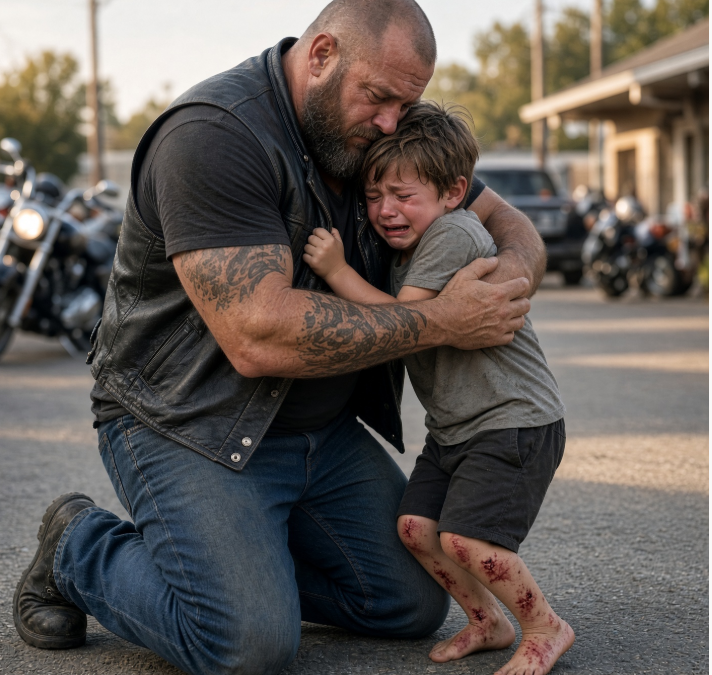
Rook had taken three steps toward him when Noah collapsed beside the gate.
That was how it began.
Not with motorcycles.
Not with old grief.
Not with some grand plan to change the town.
With a barefoot boy who refused to let an ambulance disappear without him.
The social worker arrived less than an hour later.
By then Noah’s feet were bandaged.
He had been given juice, half a sandwich and a chair near the treatment-area doorway.
He had not touched the sandwich.
Every few seconds he looked toward the double doors.
Rook sat beside him.
“Your grandmother take medicine?”
Noah nodded.
“Blood-pressure pills. Morning and night.”
“You remind her?”
“Sometimes.”
“Who makes dinner?”
“Grandma.”
“Every night?”
Noah hesitated.
“When her hands hurt, I heat soup.”
Rook looked at me.
Neither of us said anything.
There was a difference between neglect and a family doing everything possible with too little.
Noah and Evelyn had built a household balanced on two people—one old, one young—with almost no room for either to fall.
Now one of them had fallen.
The social worker made several calls.
Then she returned carrying a clipboard and wearing the careful expression professionals use when the next sentence is going to hurt.
“Evelyn’s emergency guardianship paperwork names a backup caregiver.”
Noah sat straighter.
“Mrs. Bell.”
“She passed away last year.”
Noah looked down.
The social worker continued gently.
“We haven’t found another current guardian.”
“I can stay at home.”
“You can’t stay alone, Noah.”
“I know how to cook eggs.”
“That isn’t the issue.”
His breathing changed.
Faster.
Shallower.
“What’s going to happen?”
“We may need to arrange temporary foster placement while your grandmother receives treatment.”
“What does that mean?”
“A safe family who can look after you.”
“I already have a family.”
Rook leaned forward.
“Nobody’s moving you tonight.”
The social worker turned toward him.
“We cannot promise that.”
Rook’s eyes shifted to her.
“I can.”
“Are you a relative?”
“No.”
“Licensed foster parent?”
“No.”
“Then you cannot promise anything.”
She was right.
Rook knew she was right.
That did not stop him from taking out his phone.
He called his wife.
“Mara.”
I could hear her voice faintly through the speaker.
“What did you do?”
Rook frowned.
“Why do you assume I did something?”
“Because you only use that tone when there’s paperwork involved.”
He looked at Noah.
“There’s a kid.”
There was silence.
Then Mara asked, “What happened?”
Rook explained.
When he reached the part about emergency placement, Mara interrupted him.
“Our foster certification.”
Rook blinked.
Two years earlier, Rook and Mara had completed the foster-care approval process to temporarily care for the grandchildren of another club member during a custody crisis.
Their certification had not fully expired.
It needed renewal checks.
Mara was already reaching for another phone before Rook finished speaking.
“I’ll call the county.”
That was Mara.
Rook broke doors.
Mara found the right form.
Together they had survived thirty-five years of marriage.
—
While Mara handled Noah’s placement, Rook walked toward the ambulance bay.
The young paramedic who had driven Evelyn was standing beside the rig, finishing paperwork.
He looked about twenty-seven.
Short brown hair.
Tired eyes.
Hospital radio clipped to his shoulder.
And beneath the radio, partly hidden by the fold of his uniform shirt, was a small piece of black embroidered cloth.
Rook stopped.
He stared at it.
The paramedic noticed.
“Everything all right?”
Rook pointed.
“That patch.”
The young man looked down.
He unclipped it carefully.
A small motorcycle-club insignia rested in his palm.
Weathered.
Old.
Black thread faded almost gray.
Across the top was one name.
SPARROW.
Rook’s face changed.
Not dramatically.
Rook was not a dramatic man.
But I had known him for twenty years.
I watched every bit of color leave his expression.
“Where did you get that?”
The paramedic looked at him for several seconds.
Then he said, “My father.”
Rook swallowed.
“Your name?”
“Aaron Vale.”
Nobody spoke.
Rook knew before Aaron said anything else.
So did I.
Sparrow’s real name had been Michael Vale.
Ten years earlier, he had belonged to our club.
Not because he rode the biggest motorcycle.
He did not.
Not because he was the toughest.
He definitely was not.
He got the nickname Sparrow because he was thin, loud and incapable of sitting still.
He was also Rook’s closest friend.
One rainy evening, Sparrow complained about pressure in his chest.
He called it indigestion.
We believed him.
Maybe because he joked.
Maybe because he was forty-seven.
Maybe because believing the easier explanation required less courage.
Later that night, he collapsed at the clubhouse.
The district’s only staffed ambulance was already on another call.
We waited.
And waited.
Finally, Rook and Cole put Sparrow into the back of a pickup and drove toward the hospital themselves.
Rook held him the entire way.
Sparrow never woke up.
For years, we blamed the ambulance.
Then we blamed ourselves.
Then we stopped talking about it because grief gets heavier when nobody knows where to put it.
Aaron turned the patch over.
A faint rust-colored stain marked the back.
“You gave this to me,” he told Rook.
Rook frowned.
“At the funeral,” Aaron said. “Mom couldn’t look at Dad’s cut. You handed it to me. I removed one patch before she packed everything away.”
Rook touched the edge of the cloth.
“You carry it every shift?”
Aaron nodded.
“My father died waiting for help.”
His voice remained steady.
“So I became the help.”
Nobody had an answer for that.
Rook looked toward the ambulance.
“One unit covers this whole district?”
“One staffed ambulance.”
“How many people?”
“About forty thousand.”
“And if you’re already on a call?”
“Neighboring districts respond if they’re available.”
“And if they aren’t?”
Aaron looked toward the emergency doors Noah had chased them through.
“People wait.”
Rook picked up Sparrow’s patch.
Held it for a second.
Then returned it.
“We’re done waiting.”
At the time, I thought he was angry.
I did not realize he had just made a promise.
—
Evelyn survived.
Barely.
A clot had blocked blood flow to the left side of her brain.
Because the ambulance arrived within the treatment window, doctors were able to give medication and transfer her for an emergency procedure.
Those minutes saved her life.
They did not leave her unchanged.
The neurologist met Noah, Rook and Mara shortly before midnight.
I waited outside.
Evelyn’s right side remained weak.
Speech was limited.
Rehabilitation would take months.
Noah asked the only questions that mattered to a ten-year-old.
“Can she come home tomorrow?”
“No.”
“Next week?”
“Probably not.”
“Will she walk?”
“We hope she’ll regain some movement.”
Noah stared at the doctor.
“That means you don’t know.”
The doctor nodded.
“It does.”
Children understand uncertainty better than adults think.
They simply hate it more honestly.
That night, Noah went home with Rook and Mara under an emergency temporary placement approved through the county.
He carried one school bag.
Rook stopped by Evelyn’s house to retrieve clothes.
Near the door, he found Noah’s sandals.
The left strap had torn completely away from the sole.
The right heel had worn paper-thin.
They were too small.
Rook put them in his saddlebag.
The next morning Mara bought two pairs of sneakers, socks, pajamas and several changes of clothes.
Noah thanked her for everything except the shoes.
He held the box but would not put them on.
“Wrong size?” Mara asked.
“No.”
“Wrong color?”
He shook his head.
“Then what’s wrong?”
His eyes went toward Rook’s motorcycle bag.
“Grandma promised.”
Mara understood before Rook did.
Putting on somebody else’s new shoes meant accepting that Evelyn might never complete the promise herself.
Mara closed the box.
“They’ll wait.”
Noah wore borrowed slippers to the hospital.
Evelyn was awake.
Her right arm remained still beside her body.
One side of her mouth sagged.
When she saw Noah, tears slid toward her temple.
He approached the bed.
“I stayed with bikers.”
She tried to speak.
Only fragments came.
“I’m okay,” Noah said quickly. “They bought shoes, but I didn’t wear them.”
Rook stood in the doorway wearing his leather vest.
Evelyn noticed him.
Fear entered her eyes.
Rook immediately removed the vest.
“My wife, Mara, is caring for Noah,” he explained. “County approved. He’s safe.”
Her gaze stayed fixed on him.
“No one’s taking him away.”
Evelyn’s fingers moved slightly beneath the blanket.
Noah placed his hand over hers.
For a few minutes, everything felt manageable.
Evelyn had survived.
Noah had somewhere safe to sleep.
Then the county called.
—
Rook’s old foster certification needed review.
That alone was routine.
The problem was a decades-old assault conviction.
At twenty-two, Rook had gotten into a bar fight.
A real one.
Not the polished version men tell later to make themselves sound misunderstood.
He had broken another man’s jaw.
He completed probation.
Paid restitution.
And spent the next thirty years staying out of serious trouble.
The conviction still existed.
Until the review finished, Noah could be moved.
Rook did not send bikers to the county office.
He did not threaten anyone.
He hired a family-law attorney.
Submitted every requested document.
Allowed inspectors into his home.
Answered humiliating questions.
Noah overheard one phone call.
That evening Mara found him near the back door with his purple school bag packed.
“Where are you going?”
“If I leave before they come, you won’t get in trouble.”
“You are ten years old.”
“I ran to the hospital.”
“That does not qualify you for independent living.”
He tightened his grip on the strap.
“Everyone leaves after they promise.”
Mara sat down on the floor so she would not tower over him.
“Your grandmother didn’t leave.”
“She’s in the hospital.”
“She survived.”
“My mom left.”
“Your mother died, honey.”
Noah looked at her.
“She still left.”
Mara had no answer.
Some grief does not care about definitions.
Rook entered from the garage.
He carried Noah’s broken sandals.
And a small repair kit.
He did not ask Noah to unpack.
He sat at the kitchen table.
Cleaned the worn soles.
Cut two strips of leather from an old motorcycle saddlebag.
Punched holes.
Threaded the leather through the broken sandals.
Secured the straps with small brass rivets.
The repair was ugly.
But strong.
Noah watched him.
Rook placed the sandals on the floor.
“Things break,” he said. “Doesn’t mean they’re finished.”
Noah stared at them.
Then at Rook.
Then he slowly opened his school bag and began putting his clothes back into the dresser.
Two days later, the county approved the placement.
—
Keeping Noah safe solved one problem.
Getting him home to Evelyn created ten more.
Her pension barely covered rent.
Medical insurance covered much of her immediate treatment but not everything she would need afterward.
The house had stairs.
A narrow bathroom.
High kitchen cabinets.
No wheelchair access.
Returning home safely would require ramps, doorway modifications, grab bars, transportation, therapy and caregiving.
Some club members suggested Evelyn enter long-term care while Noah remained permanently with Rook and Mara.
Rook’s response was immediate.
“She has half her body working. Not half her rights.”
So we asked Evelyn.
Not around her.
Not for her.
Marcus, a former Army medic in the club, helped arrange an advocate who used picture boards and simple yes-or-no questions until Evelyn’s speech improved.
Did she want continued rehabilitation?
Yes.
Did she want Noah home eventually?
Yes.
Would she accept help modifying the house?
After several minutes, yes.
That became the plan.
But while we were figuring out ramps and therapy schedules, Rook had not forgotten the ambulance.
Neither had Aaron.
Two weeks after Evelyn’s stroke, Aaron came to the clubhouse in civilian clothes.
Sparrow’s patch remained inside his shirt pocket.
He walked slowly through the building.
Near the old workbench he stopped.
His father’s initials were still scratched beneath the edge.
M.V.
Beside the refrigerator was a dent Sparrow had made years earlier trying to open a beer bottle against the handle.
Aaron touched it.
“I forgot this place smelled like oil.”
Cole called from across the room.
“And bad decisions.”
Aaron laughed.
It was the first time I saw Sparrow in his face.
Rook placed Noah’s repaired sandals on the meeting table.
Beside them sat the unopened box of sneakers.
Aaron frowned.
“What do shoes have to do with an ambulance?”
“Nothing.”
“Then why are they here?”
“Because a kid ran three kilometers behind yours.”
Rook had spent the previous week researching ambulances.
A new fully equipped unit cost far more than the club could raise.
A refurbished vehicle was cheaper, but equipment, licensing, insurance, maintenance and staffing pushed the total back into numbers that made everybody uncomfortable.
Aaron explained something important.
“If you donate a truck without a staffing plan, you haven’t donated an ambulance.”
Rook looked at him.
“What did we donate?”
“A dead vehicle behind the station.”
“What makes it alive?”
“Paramedics. Maintenance. Fuel. Insurance. Training. Medical equipment. A municipal commitment to operate it.”
Rook hated complicated kindness.
You could repair a motorcycle and hand over the keys.
Systems were different.
Systems could swallow money and still fail.
“What does a real solution cost?” he asked.
Aaron told him.
Silence followed.
Tank leaned back in his chair.
“We’d need every club in three counties.”
Rook nodded.
“Then call them.”
—
We named it the Sparrow Second Unit Fund.
Aaron objected.
“My father wasn’t the only person who waited.”
“No,” Rook said. “But he’s the one we remember.”
The first event was a benefit ride.
Then restaurants held donation nights.
Construction companies pledged materials and cash.
A regional foundation offered matching funds if the town committed to staffing the second vehicle.
That became the difficult part.
The council was not heartless.
It was cautious.
Accepting an ambulance meant paying for it year after year.
Salaries.
Repairs.
Fuel.
Insurance.
Training.
Budgets were already tight.
At the public meeting, Rook wore a clean button-down shirt instead of his leather cut.
Mara whispered that this was how everyone knew he was serious.
Noah sat beside her.
For the first time, he wore the new sneakers.
The repaired sandals were inside his backpack.
Aaron presented response data.
When the district’s only staffed ambulance was occupied, emergency wait times doubled.
During storms, they stretched longer.
One council member asked the question everyone had been avoiding.
“Does one delayed death justify permanent municipal spending?”
Nobody moved.
Aaron reached into his pocket.
He placed Sparrow’s patch on the table.
“My father died ten years ago while the ambulance was somewhere else,” he said.
“I don’t know whether a faster response would have saved him.”
He paused.
“That uncertainty is what I have carried into every shift since.”
Then he pointed toward Noah.
“Evelyn Carter lived because we were available. Her grandson ran three kilometers barefoot because while we treated her, the district had no other ambulance left.”
The room remained silent.
“We cannot promise who will live,” Aaron continued. “But we can decide whether help is available.”
The staffing commitment passed by one vote.
Fundraising accelerated immediately.
A week later Noah arrived at the clubhouse carrying a plastic bag.
He emptied it onto the table.
Coins rolled everywhere.
“Fourteen dollars and thirty-six cents,” he announced.
Rook pushed the money back.
“No.”
“You let me help Grandma.”
“This is different.”
“No.”
Noah pushed the bag toward him again.
“Somebody else might have a grandma.”
Rook looked at Mara.
She smiled.
Rook picked one penny from the pile.
“I’ll take this.”
“That’s not enough.”
“Every fund needs a first dollar.”
“That isn’t a dollar.”
“Inflation.”
Noah rolled his eyes so hard we all laughed.
The penny went into a small display case beside Sparrow’s patch.
—
Six months after Noah collapsed at the hospital gate, the fund reached its target.
A regional medical foundation covered the final gap.
The district purchased a refurbished ambulance with modern cardiac equipment, stroke-response supplies and improved seating options for family members when protocols allowed.
At the community ceremony, someone produced an enormous ceremonial key.
Rook stared at it.
“Does that start the truck?”
“No.”
“Then give me the real key.”
The administrator laughed and handed it over.
Rook walked directly to Aaron.
He placed the key in his hand.
Everyone expected Aaron to start the engine.
Instead, Aaron turned toward Noah.
“You do it.”
Noah’s eyes widened.
“I’m ten.”
“I know.”
“I can’t drive.”
“Today you can turn a key.”
Under supervision, Noah climbed into the driver’s seat.
His feet did not reach the pedals.
Aaron leaned through the open door beside him.
Noah turned the ignition.
The engine started.
No siren.
No flashing lights.
Just a steady diesel rumble.
Aaron stepped back.
His eyes filled.
Ten years earlier, we had driven his father toward a hospital and arrived too late.
Now his hand rested on a vehicle built to keep someone else from inheriting the same memory.
—
Evelyn spent four months in inpatient rehabilitation.
Speech returned unevenly.
Some days she could form full short sentences.
Other days fatigue stole the words before they reached her mouth.
Movement returned to her right leg before her arm.
With a brace and a therapist beside her, she learned to stand again.
Noah visited as often as school allowed.
He wore the new sneakers.
But he continued carrying the repaired sandals in his backpack.
One afternoon, Evelyn noticed.
She pointed toward the bag.
“Why… keep?”
Noah removed the sandals.
“You were supposed to buy me new ones.”
Evelyn looked down at his sneakers.
“Got… new.”
“Rook bought those.”
She struggled to form the next sentence.
“Promise… completed.”
“No. You didn’t buy them.”
Evelyn looked toward Rook standing in the doorway.
Then back at Noah.
“Asked… help?”
“No.”
“Help… came.”
Noah was quiet.
Evelyn tapped the old sandals.
“Keep old.”
Then she pointed at his shoes.
“Wear new.”
That night, he left the repaired sandals in his backpack.
But the next morning he stopped checking to make sure they were still there every five minutes.
Sometimes healing begins with permission to carry the old thing without refusing the new one.
—
We renovated Evelyn’s home.
Club members built the ramp.
A professional contractor inspected everything because, as Rook put it, “No hero carpentry.”
Doorways were widened.
Grab bars installed.
Kitchen shelves lowered.
Furniture rearranged.
A caregiving fund paid for morning assistance.
Mara and Rook remained Noah’s official foster family while Evelyn rebuilt enough independence to return home, but nobody removed Evelyn from decisions involving her grandson.
Her body had changed.
Her authority had not.
One year after the stroke, Evelyn could walk short distances with a quad cane and ankle brace.
Her right arm remained limited.
She still needed help.
But she returned home.
Noah returned with her.
Rook and Mara did not disappear afterward.
They became family in the way paperwork never fully explains.
Noah spent weekends at the clubhouse.
Learned how to change motorcycle oil.
Called Mara whenever Evelyn had a bad health day.
Rook taught him how to hold a wrench properly and how not to trust anyone who claimed they did not need the instruction manual.
The second ambulance entered service that same month.
Its first major emergency came while the original unit transported a crash victim thirty miles away.
A factory worker developed chest pain.
Aaron drove the new ambulance.
The man survived.
Later, Rook asked Aaron one question.
“In time?”
Aaron nodded.
“In time.”
Nothing else needed to be said.
—
Over the next five years, the district tracked emergency response times.
Delays during overlapping calls dropped sharply.
The second ambulance responded to strokes.
Heart attacks.
Winter crashes.
Workplace accidents.
Complicated births.
It was never officially named Sparrow’s Ambulance.
Everyone called it that anyway.
Noah changed too.
At eleven, he joined his school running club.
His coach discovered he had excellent endurance.
She also discovered he panicked whenever he heard a siren.
They worked slowly.
Stop.
Breathe.
Look around.
Remind yourself that an ambulance driving away does not automatically mean abandonment.
For Noah’s first organized three-kilometer race, Evelyn waited near the finish line with her cane.
Rook stood beside her.
The repaired sandals hung from one hand.
Noah crossed the line wearing proper running shoes.
This time, he did not collapse.
He did not chase anybody.
He walked directly to his grandmother.
She hugged him with her left arm.
Aaron attended in uniform between calls.
Sparrow’s patch was still in his pocket.
Noah noticed.
“Why do you still carry that?”
Aaron smiled.
“So Dad gets to finish the shift.”
Noah opened his backpack.
Inside were the old sandals.
“So Grandma gets to finish the walk.”
Aaron nodded.
They understood each other.
—
The hospital changed the entrance where Noah had collapsed.
A covered bench was installed.
A telephone connected directly to security.
The ambulance service created clearer procedures for minors found alone during family emergencies.
Smaller changes than buying an ambulance.
But important ones.
Every year on the anniversary of Evelyn’s stroke, Rook rode to the hospital gate.
He never organized a ceremony.
He simply parked his Harley, sat on the bench and tested the telephone.
Noah usually joined him.
At first, they spoke about Evelyn.
Later they spoke about school.
Motorcycles.
Fear.
Loss.
And the difference between running toward someone you love and running because you are terrified they will disappear.
Rook rarely had good answers.
He was better at staying.
The broken sandals eventually became too fragile for Noah to carry.
He cleaned them carefully.
They were placed inside a clear display case at the clubhouse.
Beside them sat Sparrow’s patch.
And Noah’s penny.
Three objects.
A pair of shoes that failed.
A piece of cloth carried through a decade of grief.
One cent that bought almost nothing by itself but represented every person who chose to add something more.
New club members heard both stories.
Sparrow had not survived the drive.
Evelyn had.
The difference was not justice.
It did not mean Evelyn deserved life more.
It was time.
Medicine.
Circumstance.
And whether help happened to be available when somebody needed it.
That truth kept everyone humble.
Aaron eventually became station supervisor.
When he trained new paramedics, he taught them something his father’s death and Evelyn’s survival had forced him to understand.
“Never promise outcomes.”
Young recruits would look at him.
“Then what do we promise?”
“Effort,” Aaron said.
“Presence.”
He touched the pocket where Sparrow’s patch still rested.
“Promise that you’ll show up.”
—
Ten years after Noah collapsed at the hospital gate, he returned wearing an emergency-medical uniform.
He was twenty.
Tall now.
Strong.
Still fast.
Evelyn sat beneath the covered entrance in a wheelchair, her cane resting across her lap.
Age had complicated some of what the stroke began, but she still lived mostly independently.
Rook stood beside her.
His beard had turned completely white.
His knees hurt constantly.
His Harley now had three wheels.
He continued calling the modification “temporary,” despite the fact that four years had passed.
Aaron waited beside the ambulance bay.
Noah had completed his emergency medical technician training.
He had chosen Beckford for his first job.
During orientation, Aaron handed him gloves.
A radio.
A station key.
Rook gave him nothing.
Noah looked offended.
“You forgot my ceremony gift.”
Rook pointed through the lobby window.
The old display case had been moved there for the day.
The broken sandals rested behind glass.
Sparrow’s patch lay beside them.
The penny sat underneath.
“You already kept it,” Rook said.
Their first shift remained quiet until late afternoon.
Then the radio came alive.
“County Road Eight. Elderly male down. Possible fall. Child caller. Granddaughter on scene.”
Aaron looked at Noah.
For one second, neither moved.
Then training took over.
Aaron climbed into the original ambulance.
Noah climbed into the second.
Two vehicles.
No waiting.
Evelyn watched from beneath the hospital entrance as both ambulances pulled away.
Rook rested one scarred hand on the back of her wheelchair.
Years earlier, a barefoot boy had chased those lights because he believed love meant never allowing distance between himself and the only person he had left.
Now he rode inside them.
The old sandals remained behind glass.
Their straps were still repaired with leather cut from a motorcycle bag.
Dust from Noah’s three-kilometer run remained embedded near the soles because he had refused to let anyone scrub it away.
That dust proved the distance.
Sparrow’s patch proved what waiting could cost.
The second ambulance proved the same story did not have to happen again.
Its siren faded toward County Road Eight.
And this time—
help was already coming.








