A Barefoot 7-Year-Old Girl Ran Into a Biker Meeting With Bleeding Feet—Then She Whispered Eight Words That Made 200 Hardened Men Go Silent.
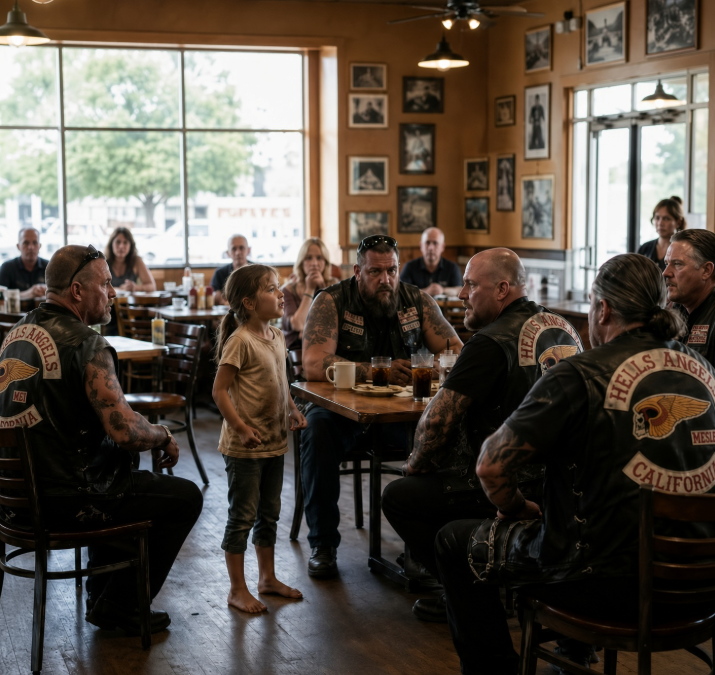
A Barefoot 7-Year-Old Girl Ran Into a Biker Meeting With Bleeding Feet—Then She Whispered Eight Words That Made 200 Hardened Men Go Silent.
She came through our warehouse door with blood on both feet and terror in her eyes, but the sight of her was not what made two hundred bikers forget how to breathe.
She had run through the darkness toward the only light she could find, carrying a message no seven-year-old should ever have been forced to deliver.
Before the night was over, the men everyone in town avoided would have to face the one thing our hard reputations had taught us to hide.
The summer heat in Ridgecrest, Tennessee, did not settle over the town so much as pin it down.
By late June, the asphalt along Route 12 shimmered beneath the sun, and the trailer park at the end of Prescott Lane seemed to breathe through layers of dust, heat, and old disappointment. The sky turned white by noon. The grass along the ditches went yellow. Even the cicadas sounded exhausted.
That was the summer I met Emmy Caldwell.
She was seven years old and had sandy brown hair she usually wore in uneven braids. Her mother had once braided it before school every morning, but Linda Caldwell had become too sick to stand at the bathroom mirror for long. So Emmy had learned to do it herself.
The braids were never even.
One hung lower than the other.
Loose strands escaped around her ears.
Sometimes she tied the ends with rubber bands.
Sometimes she used pieces of yarn.
She never seemed bothered by how they looked.
Her eyes were pale blue and far too observant.
I noticed that the first time I saw her.
I was inside the old equipment warehouse on the edge of town with two hundred men, trying to explain the route for our annual veterans’ charity ride. The warehouse had been empty for years before our chapter leased it. We had cleaned it, repaired the roof, installed lights, and turned the main room into a place where members could meet without being chased away by every business owner in Ridgecrest.
There were folding chairs in rows, motorcycles outside, and a makeshift podium built from an old shipping crate.
I stood behind that crate with a paper in my hand and watched grown men argue about whether the ride should pass through Maryville before lunch or after.
Nobody listened to me until I raised my voice.
Then the bay door darkened.
At first, only the men closest to the entrance noticed.
Their conversations faded one by one.
Heads turned.
Someone lowered a beer bottle.
A chair scraped across the concrete.
I looked toward the door.
A little girl stood there barefoot.
Her dress was dirty at the hem. Her hair had come loose from its braid. Her feet were bleeding badly enough that I could see the red marks even from twenty feet away.
She was shaking.
Not from cold.
The evening air was still hot.
She was shaking because she had run through the dark and had just realized where she had ended up.
Two hundred bikers stared at her.
People in Ridgecrest knew us as the Iron Wolves Motorcycle Club. They knew the sound of our engines and the sight of our leather vests. They knew enough to cross the street when we walked into a restaurant.
Most of them did not know our names.
PART2:
They did not know that Tommy Briggs had spent twenty years taking care of his disabled brother.
They did not know that Dale Whitfield fixed school buses for free when parents could not afford repairs.
They did not know that half the men in that warehouse had served in uniform or buried someone who had.
They knew what we looked like.
That was usually enough.
The girl stepped inside.
Her eyes moved across the room until they found me.
Then she said, “Please. My mama’s real sick, and I don’t have nobody else.”
Her voice was small, but the warehouse was so quiet that every man heard it.
She swallowed hard.
“She’s going to die if somebody don’t help.”
No one moved.
The sentence struck the room harder than any shout could have.
I had spent seventeen years refusing to say my daughter’s name out loud. I had spent seventeen years riding through Tennessee, Kentucky, Virginia, and every state between them because movement was easier than memory.
But when that little girl stood in my doorway, bleeding and terrified, I saw Grace.
Not as she had been when she died.
As she had been at five years old, wearing a yellow raincoat and standing beneath the kitchen table while thunder shook the windows.
I saw her small hands.
I heard her laugh.
Then I looked down at Emmy Caldwell and understood that she had walked more than a mile to find people she had every reason to fear.
I stepped away from the podium.
“What’s your name, sweetheart?”
“Emmy.”
“Where’s your mother?”
PART3:
“At home. Prescott Lane. Lot fourteen.”
“Can she breathe?”
Emmy nodded quickly.
Then shook her head.
“She was breathing bad. She told me to call somebody, but the phone is dead.”
I crossed the room and dropped to one knee.
Her feet were worse up close.
Seven cuts.
Two large blisters.
A deep gash on the left heel.
Dirt packed into the wounds.
I took off my leather vest and wrapped it around her shoulders.
It swallowed her.
“Tommy,” I said.
He was already moving.
“Get my truck.”
Dale climbed down from the wall without being asked.
“I’m coming.”
I lifted Emmy into my arms.
She weighed almost nothing.
That frightened me more than the blood.
As I carried her toward the parking lot, she gripped the front of my shirt.
“Please hurry.”
“I am.”
“My mama said she was sorry.”
I stopped for half a second.
“Sorry for what?”
Emmy pressed her face against my shoulder.
“For needing help.”
I drove too fast.
Tommy sat beside me, calling Ridgecrest General on his cell phone. Dale was in the back seat with Emmy, keeping her feet elevated on a folded blanket.
She sat between us in my leather vest, one small hand curled around the seat belt.
“Turn left at the broken mailbox,” she said.
I slowed just enough to hear her.
“Which mailbox?”
“The one with the red flag.”
“There are three.”
“The one leaning.”
“That does not narrow it down.”
“The one that looks like it is tired.”
Tommy glanced at me.
“She means the one by the dead oak.”
“I know what she means.”
“You just asked.”
“I was confirming.”
Emmy gave directions with the serious concentration of someone who knew another person’s life depended on her memory.
“Go past the church sign. Then turn by the ditch. The road gets bumpy.”
“Your truck will complain,” Tommy said.
“My truck complains about everything.”
Emmy did not smile.
That told me how afraid she was.
We found the trailer in under ten minutes.
Lot fourteen sat at the far end of Prescott Lane. A blue tarp covered most of the roof. The front steps were made of cinder blocks. One window had been sealed with cardboard.
The screen door hung crookedly.
I braked so hard the tires threw gravel against the side of the trailer.
Emmy was out before the truck fully stopped.
I caught her around the waist.
“Wait.”
“My mama.”
“I’m right behind you.”
The door opened into darkness.
The trailer smelled of menthol, old fabric softener, and something metallic beneath both.
Linda Caldwell lay curled on the couch.
She was thirty-four years old, though the illness had taken years from her face. Her cheeks were hollow. Her wrists were thin. Sweat darkened the collar of her shirt.
She looked at me with frightened, glassy eyes.
Then she saw Emmy behind me.
“Mama,” Emmy said, “they’re helping.”
Linda tried to sit up.
“No.”
“Ma’am,” I said, kneeling beside the couch, “my name is Hank Mercer. We’re taking you to the hospital.”
“No money.”
“We’ll figure that out later.”
“No insurance.”
“We’ll figure that out too.”
“No.”
Her voice cracked.
“I can’t leave her alone.”
“You’re not leaving her alone.”
Tommy came inside with a blanket. Dale opened the refrigerator, looked inside, and quietly shut it again.
There was almost nothing in it.
A plastic bottle of water.
Half a jar of mustard.
Two cans of green beans.
A carton of milk that had gone bad.
Linda pressed one hand against her lower back.
“My kidneys,” she whispered. “I missed dialysis.”
“How many sessions?”
She closed her eyes.
“Three.”
“Why?”
“Ray took the truck.”
I did not ask who Ray was.
Not yet.
“Do you have another ride?”
She shook her head.
“Anyone we can call?”
“No.”
“Family?”
“Knoxville. My sister works nights.”
“Neighbors?”
Linda looked toward the window.
“Everybody has their own problems.”
That was the sentence that explained the entire trailer.
I had heard it before.
People said it whenever they had been alone too long.
Tommy and I lifted Linda carefully. She cried out when we moved her legs. Emmy stood at the door with my vest still around her shoulders, watching every movement.
“I’m coming with Mama,” she said.
“Yes,” I told her.
At Ridgecrest General, a nurse named Carol Ann Patterson was waiting at the emergency entrance.
Carol Ann had been working in emergency medicine for nearly thirty years. She had short gray hair, broad shoulders, and a voice that could stop an argument from across a parking lot.
She took one look at Linda and ordered two nurses to bring a wheelchair.
“Get her inside,” Carol Ann said. “Do not waste time explaining anything to me in the parking lot.”
The nurses moved Linda through the doors.
Emmy tried to follow.
Carol Ann caught her gently by the shoulders.
“Sweetheart, you can go in after they get your mother settled.”
“I need to stay with her.”
“You will.”
“She gets scared.”
“So do I,” Carol Ann said. “That is why we help each other.”
Emmy looked at her.
Then she nodded.
It was the first time that night anyone had given her an instruction without making her feel helpless.
Carol Ann noticed the blood on Emmy’s feet.
“You ran here?”
Emmy nodded.
“From where?”
“Prescott Lane.”
Carol Ann looked toward me.
“How far?”
“More than a mile.”
Carol Ann’s mouth tightened.
She took Emmy inside.
Tommy and I stayed near the entrance while Dale returned to the truck for water.
The automatic doors opened and closed around us.
Ambulances arrived.
Nurses moved quickly.
Somewhere behind the walls, machines beeped and people called out numbers.
I stared at the doors.
Tommy stood beside me.
“Hank.”
“I know.”
“That kid ran barefoot through the dark.”
“I know.”
“To a warehouse full of men she had been warned to stay away from.”
“I know.”
“What kind of world makes a seven-year-old do that?”
I had no answer.
I was thinking about Grace.
I was thinking about a five-year-old girl in a yellow raincoat.
I was thinking about the fact that my daughter had died in a vehicle driven by the woman who had once been my wife.
Karen had survived the crash with a broken collarbone.
Grace had not survived at all.
For one year after the funeral, Karen and I tried to remain married.
We failed.
There was no single argument that ended us.
No dramatic betrayal.
We simply became two people standing on opposite sides of a room filled with the same grief.
She blamed herself.
I blamed the weather, the road, the truck coming the other way, the hospital, God, and eventually myself.
Then I blamed silence.
Silence never argued back.
I joined the Iron Wolves because the first member I met knew how to repair a motorcycle and did not ask me how I was doing.
For seventeen years, that was enough.
Until Emmy arrived.
At one-thirty in the morning, Carol Ann came outside.
Linda had been stabilized.
Acute kidney failure.
Severe dehydration.
Malnutrition.
Three missed dialysis sessions.
Her blood pressure had dropped dangerously low.
“She’ll live through tonight,” Carol Ann said.
I let out a breath.
“That is not the same as being all right.”
“No,” she said. “It is not.”
“Can we see her?”
“Not yet.”
“What about the child?”
“She is asleep.”
“Where?”
“In a chair beside the vending machines.”
I looked through the glass.
Emmy was curled beneath my leather vest, her head resting on one arm. Her injured feet had been cleaned and bandaged.
She looked younger asleep.
Seven years old.
Small enough to disappear beneath a table.
Carol Ann stood beside me.
“She told us her mother had not eaten properly in three days.”
I closed my eyes.
“She ate some crackers,” Carol Ann continued. “She saved the rest for Linda.”
I looked back through the glass.
“What happens now?”
“Now a social worker gets involved.”
“Because of the mother?”
“Because a child was left alone in a trailer without a working phone, transportation, or food.”
“Her mother didn’t leave her.”
“I know.”
“Her mother is sick.”
“I know that too.”
“Then don’t treat Linda like she chose this.”
Carol Ann faced me.
“Nobody is trying to punish her.”
“People say that before they start using words like neglect.”
“She may need help she has not been able to ask for.”
I looked through the glass again.
Emmy stirred in her sleep.
Carol Ann lowered her voice.
“Help is not the same as blame, Hank.”
“I know.”
But I did not know.
Not then.
I knew how to organize a ride.
I knew how to repair a roof.
I knew how to stand between a frightened child and a man twice her size.
I did not know how to navigate government offices, medical transportation, insurance forms, or the invisible machinery that decided whether a sick mother was allowed to keep her child.
That was the first thing Emmy taught me.
Being willing to help was not the same as knowing how to help.
At two in the morning, I woke Tommy and Dale.
“Get the boys,” I told Tommy.
He rubbed his face.
“Which ones?”
“All of them.”
Dale was already standing.
“What are we doing?”
“Tomorrow morning, we fix that trailer.”
Tommy looked toward the sleeping child.
“And after that?”
I looked through the glass at Emmy.
“Everything else.”
I did not sleep that night.
I sat in a plastic chair beside the vending machines while Emmy slept with my vest around her.
The vending machine hummed.
The fluorescent lights buzzed.
Every so often, a nurse walked past and glanced at us.
At four-thirty, Emmy woke.
She sat up quickly.
“Mama?”
“She’s still here.”
“Is she okay?”
“She’s getting help.”
“Did you find her?”
“I was there when you found us.”
She stared at me.
“I was scared.”
“I know.”
“I almost turned around.”
“Why didn’t you?”
She rubbed her bandaged foot against the leg of the chair.
“Because Mama told me to call someone.”
“That was brave.”
“I wasn’t brave. I was scared.”
“Those things can happen at the same time.”
She thought about that.
Then she asked, “Are you a bad man?”
The question was so direct that I almost laughed.
“What did you hear?”
“That bikers are bad.”
“Some bikers are bad.”
“Are you?”
“I try not to be.”
“That is not an answer.”
“You sound like your mother.”
“She asks better questions.”
“She probably does.”
Emmy looked at my tattooed hands.
“Have you ever hurt anybody?”
“Yes.”
She leaned away slightly.
“On purpose?”
“Sometimes.”
“Why?”
“Because I was younger and angrier and thought being strong meant making people afraid.”
“Do you still think that?”
“No.”
“Why not?”
I looked toward the emergency room doors.
“Because fear makes people run.”
She was quiet.
Then she lifted the edge of my vest.
“Thank you for letting me wear this.”
“It belongs to me.”
“I know.”
“You can keep it on until your feet stop hurting.”
“Will they stop?”
“Yes.”
“How do you know?”
“Because people here know what they are doing.”
“Do you?”
“I know some things.”
She nodded and leaned back against the chair.
Within minutes, she was asleep again.
At seven the next morning, I called the Iron Wolves.
By eight, fifteen motorcycles were parked along Prescott Lane.
The trailer park woke to the sound of engines.
Curtains moved.
Doors opened.
People stepped onto porches and stared at the men unloading lumber, electrical supplies, tools, boxes of food, and bottled water.
Mrs. Freely from lot nine came outside in a robe and slippers.
She was half deaf, but not blind.
“What happened?” she called.
Tommy shouted back, “We’re fixing the place.”
“Who?”
“Us.”
“Why?”
Tommy looked at me.
I answered.
“Because it needs fixing.”
Mrs. Freely stared at the motorcycles.
Then she went inside.
Twenty minutes later, she returned carrying a casserole dish.
She set it on the hood of my truck.
“Chicken and rice,” she said.
“Thank you.”
“It’s not much.”
“It is enough.”
She looked toward the trailer.
“Linda always helped me carry groceries before she got sick.”
Then she went home.
That was how the work began.
Dale and Perkins handled the electrical system.
They removed the old panel and found wiring that looked like it had been repaired with tape, hope, and several prayers nobody had bothered to write down.
“This is not wiring,” Dale said. “This is a fire making plans.”
Tommy and Sutherland went onto the roof.
The tarp came off in pieces.
Beneath it, the decking had rotted near the kitchen vent. Rain had been leaking into the ceiling for months.
Crawford and Jennings crawled beneath the trailer to replace corroded pipes.
Two other men repaired the siding.
Another built a new front step from treated lumber.
I made trips to the hardware store, the grocery store, and the hospital.
Every time I returned, another problem had been discovered.
The bathroom floor sagged.
The back window would not lock.
The refrigerator had stopped cooling properly.
The furnace filter had not been changed in years.
The air conditioner rattled so loudly that Emmy called it “the angry box.”
By noon, the trailer was a construction site.
Emmy sat in a lawn chair beneath a scrub oak, wearing clean hospital socks and a pair of borrowed sandals. Crawford brought her a sandwich.
She held it with both hands.
“Eat,” he told her.
“I’m not hungry.”
Crawford raised an eyebrow.
“Your stomach just lied to your face.”
She looked at him.
“How does my stomach have a face?”
“Everything has a face if you know where to look.”
She took a bite.
Then another.
Crawford walked away without watching her eat.
That was important.
Children who had been hungry did not like people studying how quickly they ate.
I knew that because I had once been a child who counted slices of bread.
Not because my family had been poor.
Because my father believed withholding food was discipline.
He had never hit me.
He did not need to.
He knew how to make a room feel dangerous without raising his voice.
That was why I hated seeing fear in children.
Fear learned quickly.
It moved into the body and started paying rent.
By three o’clock, the town had noticed us.
A woman from the church on Elm Street brought groceries.
The hardware store in Maryville discounted the building supplies by thirty percent.
A local contractor sent two workers to help with the roof.
Sheriff Boyd Hensley parked his cruiser near the entrance to the trailer park.
He stood beside me while the men carried plywood.
“I heard you boys were causing trouble,” he said.
“We are.”
“What kind?”
“Roof trouble. Plumbing trouble. Electrical trouble.”
“Anything involving weapons?”
“Only hammers.”
He looked at the trailer.
“Linda’s in the hospital?”
“Yes.”
“Child?”
“With her.”
Sheriff Hensley watched Emmy eat.
“She should not have had to run here.”
“No.”
“Department will arrange a welfare check.”
I turned toward him.
“She needs support, not a criminal file.”
“She needs both safety and documentation.”
I did not like the sound of that.
He saw my expression.
“Hank, if a seven-year-old is living in a home without food, a phone, transportation, or a healthy adult, the county has to ask questions.”
“Her mother is sick.”
“And the county needs to know that.”
“What happens if they decide Linda cannot care for her?”
“Then we make sure the county sees the whole truth.”
“What does that mean?”
“It means you stop treating every official like an enemy long enough to let the right one do their job.”
I stared at him.
“You have become annoyingly reasonable.”
“I’ve been waiting years to hear that.”
The county social worker arrived before sunset.
Her name was Melissa Grant. She was in her forties, wore a plain blue blouse, and carried a folder that made me dislike her before she spoke.
That was not her fault.
The folder represented every decision a stranger could make about a family.
She asked to speak with Emmy privately.
Emmy looked at me.
I nodded.
Melissa sat with her on the porch while I stood twenty feet away.
I could not hear every word, but I heard enough.
Where was her mother?
How often did she eat?
Who stayed with her?
Had anyone hurt her?
Was she afraid of Ray?
At that name, Emmy lowered her face.
Melissa noticed.
She did not push.
That made me respect her.
When the interview ended, Melissa came to me.
“Linda has been trying to manage a serious illness without adequate transportation,” she said. “Her situation is dangerous, but not because she does not love her daughter.”
“Then say that in your report.”
“I will.”
“Will the county take Emmy?”
“Not tonight.”
“That is not a permanent answer.”
“No. It is an honest one.”
I looked at her folder.
“What do we need?”
“Stable food. A working phone. Transportation to dialysis. Someone who can check on Emmy when Linda is receiving treatment. A safe home.”
I gestured toward the trailer.
“We are working on it.”
“I can see that.”
“And Ray?”
“Who is Ray?”
“Linda’s boyfriend.”
“Is he living here?”
“He was.”
“Where is he now?”
“He took the truck four days ago.”
Melissa wrote that down.
“He may be part of the problem.”
“He may be.”
“Do you know where he is?”
“No.”
She looked toward the road.
“Then when he comes back, call the sheriff.”
“I can handle him.”
“That is exactly what I am worried about.”
I stared at her.
“I am not planning to hurt him.”
“I believe you.”
“You sound like you don’t.”
“I believe you are trying to protect this family. I also believe men who are used to solving problems physically can create new ones without meaning to.”
I had no answer.
She handed me a card.
“Call me before the county calls you.”
Then she left.
At four-fifteen, Ray Dunlap returned.
He drove the missing pickup into Prescott Lane as if he had never left.
The truck was dusty. The passenger window was cracked. Ray stepped out wearing a wrinkled shirt and jeans. He was thirty-eight, thin, restless, and always seemed to be calculating the distance to the nearest exit.
He stopped when he saw the motorcycles.
Fifteen bikes.
A dozen men.
His trailer with a new roof being built over it.
Emmy sitting in the shade.
Ray’s eyes moved across the scene.
“What the hell is going on?”
I set down the piece of lumber I was carrying.
“Your stepdaughter ran barefoot through the dark because your girlfriend was dying and there was no phone, no car, and no food.”
Ray looked at Emmy.
She lowered her head.
He looked at the roof.
“What do you mean, dying?”
“Three missed dialysis sessions.”
“I didn’t know.”
“You did not want to know.”
His jaw tightened.
“That’s not fair.”
“No. Fair would have been you staying.”
The other men had stopped working.
Nobody moved toward Ray.
Nobody needed to.
The silence was enough.
Ray looked around.
“Where’s Linda?”
“Hospital.”
“Is she alive?”
“Yes.”
He breathed out.
Then he looked at Emmy again.
“Are you okay?”
She did not answer.
Ray took one step toward her.
I moved between them.
“Not yet.”
He stopped.
“What does that mean?”
“It means she does not owe you an answer.”
Ray’s face flushed.
“I live here.”
“You did.”
“I am her mother’s partner.”
“Then you should have acted like one.”
“I had things to deal with.”
“Everyone has things to deal with.”
“I was trying to get work.”
“You took the truck and the money.”
“I needed gas.”
“You were gone four days.”
“I had problems.”
“So did they.”
His eyes moved to the men behind me.
He realized for the first time that he was not standing in a private argument.
He was standing in front of witnesses.
That did not make him ashamed.
It made him careful.
There is a difference.
“What do you want?” he asked.
“I want you to decide whether you are part of the solution or part of the problem.”
“You don’t get to give me orders.”
“No. I get to tell you what I see.”
“And what do you see?”
“A sick woman. A hungry child. A broken trailer. A missing truck. And a man who came home only after strangers started repairing the damage he ignored.”
Ray looked down at his boots.
For a long time, I thought he was going to leave.
Then he reached into his pocket and pulled out his wallet.
He counted three hundred dollars.
His hands shook as he held the money toward me.
“Most of what I have.”
I did not take it immediately.
“Why?”
“I don’t know.”
“That is not enough.”
“I know.”
“Are you going to disappear again?”
Ray looked toward the trailer.
“No.”
“Can you drive Linda to the hospital?”
“Yes.”
“Can you buy groceries?”
“Yes.”
“Can you stop drinking long enough to be useful?”
His face hardened.
“I don’t drink that much.”
Nobody said anything.
Ray looked at the silence around him.
Then he lowered his head.
“Yeah,” he said. “I can.”
I took the money.
Not because three hundred dollars fixed anything.
It did not.
It was barely enough to cover the materials already sitting in the yard.
I took it because every decent action has to begin somewhere, and because I wanted Ray to understand that showing up meant more than apologizing.
He walked to the trailer.
Emmy watched him approach.
He stopped several feet away.
“I’m sorry,” he said.
Emmy’s eyes stayed on the ground.
“For what?”
“For leaving.”
“You took the truck.”
“I know.”
“You took the money.”
“I know.”
“Mama cried.”
Ray swallowed.
“I know.”
“You didn’t come back.”
“I know.”
She finally looked at him.
“Why?”
Ray stared at the child.
For the first time since he had arrived, he looked less like a cornered animal and more like a man who had been cornered by his own choices.
“I was scared,” he said.
Emmy frowned.
“Of what?”
“Everything.”
“You made Mama more scared.”
Ray nodded.
“I know.”
She considered him.
“Are you going to do it again?”
“No.”
“You might.”
Ray looked toward me.
Then back at her.
“I might. But I am going to try not to.”
It was not a heroic answer.
It was not even a reassuring one.
But it was honest.
Emmy nodded once.
“Then try hard.”
Ray wiped his face with one hand.
“I will.”
The men went back to work.
Ray stayed.
He carried boards.
He held the ladder.
He went with Tommy to buy groceries.
He fixed the screen door.
He did not become a different man that afternoon.
He became a man who could no longer pretend he had no idea what was happening.
Sometimes that is the beginning.
By sundown, the trailer had a new roof over the damaged section, repaired plumbing, a safe electrical panel, a working refrigerator, and a front step that did not wobble when someone stood on it.
A pair of white sneakers with pink laces sat beside the door.
Emmy saw them when she returned from the hospital that evening.
She had been allowed to visit Linda for twenty minutes.
She looked at the shoes.
“Are they mine?”
Crawford nodded.
“What size?”
“Three.”
She slipped them on.
They fit.
She stood very still.
The shoes were ordinary.
White canvas.
Pink laces.
Cheap rubber soles.
But she looked at them as if someone had handed her a key to a different life.
She flexed her toes.
Then she looked at me.
“Now I can run without getting hurt.”
I had to turn away.
I pretended to check the truck.
At the hospital, Linda asked me why the hallway smelled like gasoline.
“Because fifteen motorcycles are parked outside.”
Her eyes widened.
“Why?”
“Your daughter found us.”
Linda closed her eyes.
“I’m sorry.”
I had heard that word too many times in twenty-four hours.
“You do not need to apologize.”
“I should have stopped her.”
“You were sick.”
“I should have had food.”
“You needed help.”
“I should have…”
“Linda.”
She looked at me.
“You are allowed to be sick without turning it into a moral failure.”
Her eyes filled.
“People do not understand.”
“People understand what they can see.”
“They see a dirty trailer and a child alone.”
“They need to see the rest.”
“What rest?”
“The part where you kept trying to survive.”
She turned her face toward the window.
“I worked until I couldn’t stand.”
“I know.”
“I missed one appointment because Ray was supposed to drive me.”
“I know.”
“He did not come back.”
“I know.”
“I thought I could make it to the next one.”
“You couldn’t.”
“I did not want Emmy to know.”
“She knew.”
Linda’s mouth trembled.
“She always knows.”
“Yes.”
“I am failing her.”
“No.”
“I am.”
“You are sick. That is not the same thing.”
She looked back at me.
“You have children?”
“I had a daughter.”
The words came out before I could stop them.
Linda noticed.
“What happened?”
“She died.”
“I’m sorry.”
I nodded.
“Her name was Grace.”
It was the first time I had said it to a stranger in seventeen years.
The room did not collapse.
The ceiling did not crack.
The machines kept beeping.
Grace remained dead.
But her name was now in the room with us.
Linda held my gaze.
“How old?”
“Five.”
She closed her eyes.
“No parent should bury a child.”
“No.”
“How did you keep going?”
“I didn’t.”
She waited.
“I moved,” I said. “There is a difference.”
Linda turned her face toward the ceiling.
“Maybe I have been moving too.”
“Maybe.”
“Maybe I was just lying on a couch.”
“Sometimes surviving looks like lying on a couch.”
That night, Linda received dialysis.
Emmy slept in a waiting room chair again.
This time, she wore her new shoes.
The next morning, Carol Ann arranged a meeting with a hospital social worker named Denise Alvarez.
Denise had a practical voice, a stack of forms, and no patience for people who used shame as a substitute for assistance.
She explained transportation programs, emergency food support, medical billing appeals, and temporary home-care services.
Linda shook her head at the first three suggestions.
“I cannot accept charity.”
Denise leaned back.
“Transportation to dialysis is not charity. It is transportation.”
“They will think I cannot care for my child.”
“They will think your kidneys are failing and you need a ride.”
“That is not how people think.”
“Then we will give them the correct information.”
Linda looked at the forms.
“What if the insurance refuses?”
“Then we appeal.”
“What if the appeal fails?”
“Then we find another program.”
“What if there is no program?”
Denise pointed at the next form.
“Then we start making phone calls.”
I stood near the window.
Denise glanced at me.
“You are Hank?”
“Yes.”
“Are you family?”
“No.”
“Friend?”
I looked toward Emmy.
“I am becoming one.”
Denise studied me.
“That is not a legal category.”
“It should be.”
“It would make paperwork more entertaining.”
I almost smiled.
She handed me a list.
“Your motorcycle club can help with some things. It cannot replace medical professionals, social services, or a stable plan.”
“We know.”
“Do you?”
“We are learning.”
“That is better.”
She marked the items that required immediate attention.
Dialysis transportation.
Food.
A working phone.
A home visit.
A responsible adult available during treatment.
She looked at Linda.
“Do you have anyone?”
Linda’s eyes moved toward me.
Then toward Carol Ann.
Then toward the hallway where Tommy and Dale were waiting.
“I have people now,” she said.
Denise nodded.
“Then let’s make sure they are organized.”
That was how the Iron Wolves learned about schedules.
We made a calendar.
Dialysis on Monday, Wednesday, and Friday.
Transportation pickup at six-forty.
Linda’s medications in a labeled box.
Emmy’s school bus at seven-twenty.
Crawford on grocery duty.
Tommy on transportation backup.
Dale responsible for repairs.
I was assigned whatever did not have a name.
By the time Linda returned home eleven days later, the trailer looked different.
The roof was solid.
The siding was repaired.
The kitchen worked.
The air conditioner still sounded angry, but it no longer leaked.
There was food in the refrigerator.
There was a new prepaid phone on the counter.
A list of emergency numbers sat beside it.
The front step was sturdy.
The windows locked.
The new shoes were clean.
Linda stopped in the driveway.
She looked at the roof.
Then at the step.
Then through the window.
She put one hand over her mouth.
Emmy stood beside her.
“Mama?”
Linda shook her head.
“I’m okay.”
“You’re crying.”
“I know.”
“Are you sad?”
“No.”
“Then why?”
Linda pulled her daughter into her arms.
“Because I came home.”
Emmy wrapped both arms around her waist.
For the first time since she ran into our meeting, she began to cry.
The crying came suddenly.
Her shoulders shook.
She buried her face against Linda’s shirt and made the raw, exhausted sound of a child who had been brave for too long.
Linda held her.
Then she began crying too.
I stood near the truck and looked away.
Tommy did the same.
Dale pretended to inspect the tires.
Men like us were very skilled at giving one another privacy while standing three feet apart.
Ray was there as well.
He had stayed every day.
He had driven Linda to two follow-up appointments.
He had bought groceries.
He had repaired the screen door.
He had not disappeared.
That did not make him trustworthy yet.
It made him present.
Presence was the first requirement.
Trust would have to be earned one ordinary day at a time.
After Linda came home, the county did not take Emmy.
Melissa Grant visited twice.
She checked the food, the phone, the medications, and the repairs.
She spoke with Linda privately.
She spoke with Emmy privately.
She asked me questions that I answered carefully.
“Who is responsible if Linda is at dialysis?”
“Depends on the day.”
“Who is the primary person?”
“Tommy.”
“Who is the backup?”
“Me.”
“Who is the backup for the backup?”
“Dale.”
“Who writes this down?”
I looked at the kitchen calendar.
“Emmy.”
Melissa followed my gaze.
Emmy had written the schedule in large, uneven letters.
MONDAY: MAMA DOCTOR
TUESDAY: SCHOOL
WEDNESDAY: DIALYSIS
THURSDAY: GROCERIES
FRIDAY: DIALYSIS
SATURDAY: MR. HANK CHECKS ROOF
Melissa smiled.
“What happens on Sunday?”
Emmy answered from the living room.
“Everybody rests.”
Melissa looked at me.
“Good plan.”
The county closed the immediate investigation two months later.
Not because everything was perfect.
Because it was safe.
There was food.
There was transportation.
There were people checking in.
Linda was receiving regular treatment.
Emmy was attending school.
The phone worked.
The home no longer looked like one electrical spark away from disaster.
Melissa gave Linda a list of additional services.
Linda accepted it.
That mattered.
People often think asking for help is a sign of weakness.
It is not.
Sometimes it is the first sign that a person has stopped confusing suffering with dignity.
The first Sunday after Linda came home, I visited alone.
I told myself I was checking the roof.
The roof was fine.
I stayed forty-five minutes.
Emmy sat on the new front step with a book about a dog that crossed three states to find its family.
“Mr. Hank,” she said, “do you think dogs really know where home is?”
“Some do.”
“How?”
“They remember the people.”
“What if the people move?”
“Then the dog remembers the people, not the house.”
She thought about that.
“Do you remember your daughter?”
The question did not surprise me.
“Every day.”
“Does that hurt?”
“Yes.”
“Then why do you remember?”
“Because forgetting would hurt worse.”
She looked down at the page.
“Do you talk to her?”
“Not out loud.”
“Why?”
“People might think I was strange.”
“People think bikers are strange anyway.”
“That is true.”
“You could talk to her.”
“I could.”
“What would you say?”
I looked at the road.
“I would tell her about you.”
Emmy closed the book.
“What would you say?”
“That you ran barefoot through the dark to save your mother.”
“That sounds like I was not scared.”
“I would tell her you were scared.”
“Then she would know I was brave?”
“She would already know.”
Emmy placed the book beside her.
“What was her name?”
“Grace.”
“Did she like dogs?”
“She liked horses.”
“Did she like music?”
“She liked songs with too much singing.”
“That does not make sense.”
“She was five.”
Emmy smiled.
Then she reached over and took my hand.
Her fingers were warm.
“You can talk about her with me.”
I looked down at our hands.
“Thank you.”
“You’re welcome.”
That was the first time I cried in front of her.
I did not make a sound.
Tears simply came, and I let them.
Emmy did not tell me to stop.
She did not ask whether I was all right.
She sat beside me until the tears ended.
Sometimes children understand grief better than adults because they have not yet learned to dress it up.
The Iron Wolves changed slowly after that summer.
Not because Emmy asked us to.
She never made speeches about kindness. She never told us what kind of men to become.
She simply kept appearing in our lives with the expectation that we would do what we had said we would do.
That expectation was more powerful than any lecture.
In August, we organized a school supply drive.
It began because Emmy told me her class needed notebooks.
“How many?”
“I don’t know.”
“Ask your teacher.”
“Why?”
“So we can get enough.”
“Will you buy them?”
“Maybe.”
“Why maybe?”
“Because I want to know how many.”
Her teacher gave her a list.
The list became three lists.
Then four.
By the end of the week, Tommy had ordered backpacks from three stores, Dale had found donated calculators, and Crawford had convinced the owner of a warehouse to let us use a loading dock.
We filled every classroom at Ridgecrest Elementary with supplies.
The principal asked whether she should put our name on a banner.
I told her no.
She asked why.
“Because the children do not need to know who bought the pencils.”
She smiled.
“Some children might want to know.”
“Then tell them the town did it.”
That was more accurate.
The town had done it.
Mrs. Freely donated canned goods.
The church donated backpacks.
The hardware store gave notebooks.
Sheriff Hensley arranged traffic support.
The Iron Wolves carried boxes.
Ridgecrest had not changed overnight.
It changed one small obligation at a time.
The medical transportation network became another project.
Carol Ann had been trying to help elderly patients reach appointments for years. The problem was always the same: there were more patients than volunteers.
I asked how many vehicles she needed.
“Three on weekdays,” she said.
“How many do you have?”
“One.”
“That is not enough.”
“No.”
So we made a schedule.
The Iron Wolves transported patients who needed dialysis, chemotherapy, cardiac tests, and physical therapy.
We did not drive recklessly.
We did not roar into hospital entrances.
We did not expect praise.
We learned how to fold walkers into trunks, how to wait without rushing, and how to listen when someone wanted to talk about the weather for forty minutes because the weather was easier than talking about fear.
Some riders complained at first.
They had joined the club to ride, not to become unpaid transportation workers.
Nobody forced them.
But most volunteered after the first trip.
They discovered something.
People who looked fragile were often stronger than anyone in the room.
One elderly man named Walter rode with Tommy every Wednesday.
He had lost both legs and had a habit of insulting everyone who helped him.
After the third ride, Tommy asked why he kept coming.
Walter said, “Because you drive worse than my dead son.”
Tommy looked offended.
Walter laughed.
That was enough.
The town noticed.
Sheriff Hensley came to one of our community events and shook my hand in front of forty people.
“I never thought I’d see the day,” Tommy said afterward.
“What?”
“The sheriff touching you voluntarily.”
“He touched my hand.”
“Still.”
Not everyone approved.
Some people still called us a gang.
Some shop owners still watched us carefully.
Parents still told children not to stare.
A man at a diner refused to sit near us until he saw one of our members help an elderly woman carry groceries to her car.
Then he moved to another table anyway.
Suspicion does not disappear simply because people do good things.
It weakens.
It has to be worn down by consistency.
We gave Ridgecrest consistency.
Every Saturday, someone was repairing something.
A porch.
A fence.
A wheelchair ramp.
A school bus.
A roof.
A heart was harder.
That was where I struggled.
I could repair a broken board because the board did not remember what had happened to it.
I could replace bad wiring because wires did not blame me for surviving.
I could not repair Grace.
I could not repair Karen.
I could not repair the part of myself that still believed moving was safer than staying.
But Emmy kept inviting me to sit on the front step.
She asked questions.
She never let me answer with a joke if she wanted the truth.
“Why don’t you have a wife?”
“I did.”
“Where is she?”
“Somewhere in Kentucky.”
“Do you talk?”
“Sometimes.”
“Do you love her?”
I looked at the road.
“I did.”
“That was not my question.”
“No.”
“Do you still love her?”
I thought about Karen.
About the woman who had driven the car.
About the woman who had stood beside Grace’s grave until her knees gave out.
About the woman I had blamed because someone had to carry the blame.
“Yes,” I said finally. “In a way.”
“What way?”
“The way you love someone who is part of something you can never forgive yourself for.”
Emmy was quiet.
“Did she hurt Grace?”
“No.”
“Then why can’t you forgive her?”
“Because she was driving.”
“Was it her fault?”
“The road was wet.”
“That means no.”
“I suppose it does.”
“Then you should forgive her.”
“Adults are not that simple.”
“Adults make things too complicated.”
I looked at her.
“You are seven.”
“I know.”
“You sound ninety.”
“I have seen things.”
That sentence stayed with me.
Children should not have to say it.
But many did.
The difference was that Emmy no longer carried everything alone.
In September, Linda had a setback.
She missed a dialysis session because the transportation van broke down. By the time Tommy reached the trailer, she was vomiting and confused.
He called me from the driveway.
I was forty minutes away.
For those forty minutes, I felt the old panic rise.
The same panic I had felt at the hospital doors when Carol Ann told me Linda might not survive the night.
The same helplessness I had felt seventeen years earlier when a nurse told me the little girl in the yellow raincoat was gone.
I drove too fast.
When I arrived, Carol Ann was already there.
She had brought a medical transport vehicle herself.
Linda was inside, receiving oxygen.
Emmy stood on the porch in her pink-laced shoes.
I knelt in front of her.
“What happened?”
“The van didn’t come.”
“Did you call Tommy?”
“Yes.”
“Good.”
“Is Mama going to die?”
I looked at the ambulance.
Then at Emmy.
“I don’t know.”
She stared at me.
I forced myself not to lie.
“I know she needs help, and people are helping her.”
“But she might die.”
“Yes.”
Her face tightened.
“Everyone dies.”
“Yes.”
“I hate that.”
“So do I.”
“What do I do if she dies?”
The question was so enormous that no adult should ever have to answer it for a child.
But she was asking me.
“You do not face that alone.”
“What if everybody leaves?”
“Then you call.”
“What if nobody answers?”
“Then you keep calling.”
“What if they get tired of me?”
“They will not.”
“How do you know?”
“Because I will answer.”
She looked at me for a long time.
“Promise?”
I put one hand over hers.
“Promise.”
Linda spent three days in the hospital.
The transportation problem was fixed.
Carol Ann spoke to the clinic director.
Denise appealed to the county.
The Iron Wolves created an emergency backup schedule.
After that, no patient in Ridgecrest missed treatment because a van failed.
It was not dramatic.
No television crew appeared.
No one wrote an article.
But sometimes the most important changes are the ones nobody notices because the disaster never happens.
Linda grew stronger that fall.
Not healthy.
Not cured.
But stronger.
She learned how to ask for help before collapsing.
She learned how to tell Ray no.
She learned how to keep a list of emergency contacts.
Ray learned that becoming adequate required more work than apologizing.
He attended counseling through a community program.
He found part-time work repairing small engines.
He stopped taking money from the kitchen can.
He slipped sometimes.
He missed one grocery run and lied about why.
Linda sent him away for three days.
He came back with groceries and no excuses.
That was progress.
Not transformation.
Progress.
Emmy watched all of it.
Children notice the difference between a promise and a pattern.
One evening, she asked me whether Ray was a good man now.
I told her, “He is trying to become one.”
“Is that enough?”
“Sometimes trying is the beginning. It is not the finish.”
“What is the finish?”
“I don’t know.”
She nodded.
“I think people are like houses.”
“How?”
“You can fix them, but you still have to check the roof.”
I looked at her.
“Who taught you that?”
“You did.”
I had no memory of saying it.
Perhaps she had invented it.
Either way, she was right.
A house could be repaired.
A person could change.
But both required maintenance.
By November, Ridgecrest no longer whispered about the night Emmy ran into our warehouse.
People talked about it openly.
The diner owner kept a jar near the register for emergency medical expenses.
The church started a transportation fund.
The school counselor created a list of families who needed help before they reached a crisis.
The hardware store owner in Maryville donated materials to every repair project the Iron Wolves organized.
Even the man who had once called us dangerous asked whether we needed volunteers.
Tommy told him yes.
Then assigned him to clean gutters.
That was how Ridgecrest handled redemption.
It gave you a ladder and made you work.
The final gathering of the year took place on the last Saturday in August.
Two hundred Iron Wolves members came to the warehouse.
The bay doors were open.
Barbecue smoke drifted across the parking lot.
Motorcycles lined the dirt in rows.
The same shipping crate stood at the front of the room.
I had stood behind it two months earlier, talking about a veterans’ ride, when a barefoot child appeared in the doorway.
Now Emmy sat in the front row beside Linda.
She wore white sneakers with pink laces.
Linda still moved carefully, but the grayness had left her face. Her hair was pulled back. One hand held Emmy’s.
Ray stood near the rear wall.
He had not joined the club.
He did not belong there.
But he had been invited because the work was not only ours.
Carol Ann sat beside Sheriff Hensley.
Melissa Grant stood near the side entrance.
Denise Alvarez had driven in from the hospital.
The warehouse was full of people who had become part of the story after Emmy’s feet bled across the floor.
I stepped behind the podium.
The room quieted.
I looked at the men in front of me.
Some had scars.
Some had missing fingers.
Some had spent years convincing the world they needed nothing.
All of them had once been strangers to a seven-year-old girl.
“Two months ago,” I said, “a child walked into this building.”
Nobody moved.
“She had no shoes. She had no working phone. She had no adult beside her. She had nothing except the courage to ask for help from people she had every reason to fear.”
I looked toward Emmy.
“She did not give a speech. She did not tell us what kind of men to become. She said her mother was sick and that she had nobody else.”
The room remained silent.
“That was enough.”
I placed both hands on the crate.
“For years, most of us thought strength meant being the hardest man in the room. We thought it meant never admitting fear, never asking for help, never letting anyone see what mattered to us.”
I looked at Tommy.
At Dale.
At Crawford.
At every man who had carried lumber through the heat.
“Then a seven-year-old girl walked in bleeding, and every man in this room remembered what strength actually is.”
I let the words settle.
“Strength is not what you can break. It is what you can hold together.”
Nobody shifted.
Nobody looked away.
“We fixed a roof. We replaced wires. We carried groceries. We drove people to medical appointments. Those things mattered. But the first thing we did was listen.”
I looked at Emmy.
“She asked us to help her mother. We helped her mother. But she also helped us. She reminded us that a reputation is not a life. A leather vest is not a character. An engine is not a soul.”
A few men lowered their heads.
“We are not the people Ridgecrest thought we were. We are not even the people we sometimes thought we were. We are the men who show up when someone has nowhere else to go.”
I stopped.
“That is enough.”
My voice broke on the last word.
I stepped away from the podium.
The applause began slowly.
Then it filled the room.
Two hundred men applauded.
Not loudly at first.
Then harder.
The sound bounced off the metal walls.
Emmy covered her ears and laughed.
Linda leaned toward her.
“It’s okay.”
“I know,” Emmy said. “They’re happy.”
When the applause ended, Emmy stood.
She walked toward me.
Her steps were careful but steady.
She tugged on my sleeve.
“Mr. Hank?”
I knelt.
“What is it?”
“Thank you for hearing me.”
I looked into her pale blue eyes.
They no longer carried only knowing.
There was trust there now.
A child’s trust.
Fragile, stubborn, and impossible to fake.
“You were the loudest person in the room that night,” I said.
“I was whispering.”
“You still were.”
She smiled.
Then she looked over my shoulder at the men.
“Do you think they are good men?”
I turned.
Two hundred men stood behind us.
Weathered faces.
Leather vests.
Calloused hands.
Men who had done bad things, regretted some of them, justified others, and spent years trying to become better than the stories people told about them.
“I think they are trying,” I said.
Emmy nodded.
“That is a start.”
“Yes.”
Outside, the Tennessee evening had turned soft and golden.
The heat was finally loosening its grip.
Cicadas sang from the trees.
The motorcycles gleamed under the fading light.
Everyone began moving toward the parking lot.
Engines started one by one.
The sound rose across the field.
Emmy stood beside Linda.
Ray carried a box of leftover food toward his truck.
Carol Ann argued with Sheriff Hensley about a medical transportation schedule.
Tommy tried to convince Dale that his motorcycle had developed a strange noise.
Dale told him the strange noise was Tommy.
The world had not become perfect.
Linda was still sick.
Emmy still had bad dreams sometimes.
Ray was still learning how to remain.
The county still had forms.
The hospital still had waiting rooms.
Grief still woke me in the middle of the night.
Nothing had been erased.
But something had changed.
Hank Mercer was no longer riding away from every painful thing he saw.
I stood near the warehouse door while the men prepared to leave.
Tommy came over.
“You riding tonight?”
I looked toward my motorcycle.
Then toward Emmy.
She was sitting on the new front step of the trailer, telling Linda about a book she had finished.
“No,” I said.
Tommy raised an eyebrow.
“You are staying?”
“Tonight.”
“Why?”
I watched Emmy laugh.
“Because I finally found somewhere worth being.”
Tommy nodded.
He did not ask anything else.
That was another thing I had learned.
Sometimes a man does not need advice.
Sometimes he needs someone to understand that staying is a decision.
I walked toward the trailer.
The ride could wait.
The road would still be there tomorrow.
I had spent seventeen years believing grief was something a person outran.
I was wrong.
Grief travels with you.
It sits behind you on the motorcycle, leans when you lean, and waits at every red light.
You do not escape it by moving faster.
You survive it by stopping long enough to face what remains.
Grace remained.
Her name remained.
The love I had for her remained.
So did the man I had been before she died.
But there was another part of me now.
The part that knew how to sit on a porch.
The part that knew how to answer a child honestly.
The part that understood that protecting someone did not mean pretending the world was safe.
It meant making sure they did not face the unsafe parts alone.
Emmy looked up when I approached.
“Are you leaving?”
“Not tonight.”
“Why not?”
“Your mother has food.”
“She does.”
“Your roof is solid.”
“It is.”
“Your shoes are still clean.”
She looked down at them.
“They are.”
“Then I have nothing left to fix.”
She thought about that.
“You can sit.”
I sat beside her.
The new front step held both of us without creaking.
For a while, we watched the last motorcycles disappear down Prescott Lane.
Their taillights became smaller, then vanished beyond the trees.
The evening settled around us.
Linda went inside to make tea.
Ray carried dishes to the kitchen.
Emmy leaned against my arm.
“Mr. Hank?”
“Yeah?”
“Do you think Grace would have liked me?”
I looked at the sky.
The first stars were appearing above the trailer park.
“Yes,” I said.
“How do you know?”
“Because she liked brave girls.”
“I wasn’t brave.”
“You were scared and kept going.”
“Maybe.”
“That is what brave means.”
She leaned more heavily against me.
“Would she like the Iron Wolves?”
I smiled.
“She would probably tell us we are too loud.”
“Most people say that.”
“She would be right.”
“Would she like your motorcycle?”
“She would want to paint it.”
“What color?”
“Pink.”
Emmy considered that.
“Pink would be pretty.”
“It would ruin the motorcycle.”
“Maybe it would make people less scared.”
“Maybe.”
She was quiet for a moment.
Then she said, “You can talk to her now.”
I looked at the empty road.
“I can.”
“Go ahead.”
“Here?”
“Why not?”
I took a breath.
For seventeen years, I had held Grace’s name behind my teeth.
Now I let it out beneath a Tennessee sky.
“Hey, Grace,” I said.
My voice sounded unfamiliar.
Emmy listened.
“I met a girl,” I continued. “Her name is Emmy. She is seven. She sings badly, argues constantly, and thinks pink would improve my motorcycle.”
Emmy whispered, “I do not sing badly.”
I kept looking at the sky.
“She is also the bravest person I know.”
The wind moved through the trees.
Nothing answered.
But for the first time, the silence did not feel empty.
It felt like room.
Room for Grace.
Room for Emmy.
Room for Linda.
Room for the men who were still trying.
Room for the man I might yet become.
Emmy took my hand.
Her fingers were small and warm.
“Did she hear you?”
“I think so.”
“Good.”
We sat together until the porch light came on.
Then Linda opened the door.
“Tea is ready.”
Emmy stood.
“You coming?”
I looked at the warehouse beyond the field.
Then at the road.
Then at the house.
“I’m coming.”
She took my hand and pulled me inside.
The next morning, the Iron Wolves would ride again.
There would be another town, another road, another meeting, another reason to keep moving.
But I would not be the same man who had arrived in Ridgecrest believing that speed could carry him away from everything he had lost.
A barefoot girl had walked into a room full of hardened men and asked for help.
She had not known our names.
She had not cared about our reputation.
She had seen a building with lights on and decided, despite her fear, to knock on the door.
That was all it took.
Not a speech.
Not a threat.
Not a miracle.
Just a child who refused to let fear make the decision for her.
And two hundred bikers who finally understood that the world did not need them to be feared.
It needed them to show up.
So we did.
And this time, when the engines started, I knew where I was going.








