A Barefoot 5-Year-Old Girl Walked Through Freezing Rain Without Saying a Word—Then She Entered a Biker Bar, Showed Them the Bruises on Her Neck, and Pointed Back Toward the Woods.
PART3:
Derek came home smelling like whiskey and rain, with his work boots muddy and his eyes already looking for a reason.
The beans gave him one.
I was sitting on the floor with my coloring book, trying to stay inside the lines because quiet children survive longer. Mama was at the stove. She turned before he reached her.
“Derek, please,” she said.
That was all.
Please.
One word.
He hit her so hard she fell against the cabinet.
My crayon snapped in my hand.
Derek turned toward me.
“What are you looking at?”
I looked down.
Too late.
He crossed the kitchen and grabbed my arm. His fingers wrapped all the way around it.
“You think I’m the bad guy?”
I shook my head.
I did not know what answer would save me.
There usually was not one.
Mama tried to stand.
“Leave her alone.”
He laughed.
That laugh was worse than shouting.
Shouting meant anger.
Laughing meant he was enjoying himself.
He shoved Mama back down. Her head struck the lower cabinet, and the sound it made was dull and final in a way that froze something inside me.
“Mama?”
Her eyes fluttered.
Derek crouched in front of me.
“If either of you makes one more sound tonight,” he said, “you’ll pay for it.”
Then his hand closed around my throat.
I remember his face more than the pain.
Red.
Sweating.
Too close.
His teeth clenched.
His breath sour with beer.
I could not breathe, but I did not fight the way children fight in movies. I did not kick and scream and scratch.
I went still.
That is what fear taught me.
Be small.
Be quiet.
Make the monster lose interest.
Mama made a broken sound from the floor.
Derek released me and stood.
“You see?” he said. “Even the kid knows how to listen.”
He walked to his recliner, grabbed another beer, and turned on the television like the night had become normal again.
Mama was on the floor.
Not moving right.
One arm bent under her.
Her breathing sounded wet and wrong.
I crawled to her.
She opened one eye.
“Stay quiet, Sophie,” she whispered. “Please, baby. If he hears you, it’ll only get worse.”
But I knew something then.
With the strange, cold certainty of children who have seen too much.
It could not get worse unless I stayed.
The back door did not latch properly.
Derek knew it.
Mama knew it.
I knew it.
He had been meaning to fix it for months.
Monsters are not always careful.
Sometimes they are lazy.
Sometimes that is how children escape.
I waited until Derek’s head tipped back against the recliner. The television flickered blue across his face. His eyes closed. The beer can rested against his stomach.
I touched Mama’s cheek.
Her skin was too cold.
“I’m getting help,” I breathed.
Her eyes opened wider.
“No.”
I put one finger to my lips.
The way she always did to me.
Then I crawled.
Not walked.
Crawled.
Past the table.
Past the spilled beans.
Past the broken glass.
Past Derek’s boots.
One boot shifted.
I froze.
His breathing changed.
Then steadied.
I reached the back door.
The storm hit me before I was fully outside.
Cold rain slapped my face and stole the air from my lungs. Mud swallowed my toes. The trailer behind me glowed weak yellow through torn curtains.
For one second, I almost went back.
Not because I wanted to.
Because the world outside was enormous.
The woods were black.
The road was far.
I was five.
Then Mama made a sound inside.
Small.
Barely human.
That sound pushed me forward.
I ran until my feet could not run.
Then I walked.
When the gravel cut me, I bit the inside of my cheek.
When thunder shook the trees, I counted.
One.
Two.
Three.
When headlights appeared far down the road, I dropped into the ditch because Derek had friends with trucks, and fear does not stop to check license plates.
I kept one thought in my head.
The bikers.
The big man.
The stuffed rabbit.
The Iron Pit.
By the time I reached the bar, I could barely feel my legs.
The sign buzzed red and blue through the rain.
IRON PIT.
The door was heavy.
Too heavy for me.
I pushed it with both hands.
It did not move.
Inside, I heard laughter.
Music.
Boots on wood.
Men talking over each other.
I pushed again.
Nothing.
So I stepped back, lowered my shoulder, and hit the door with my whole body.
It opened an inch.
Warm air rushed through the crack.
I pushed again.
This time, the door swung inward.
The bar died.
That is the only way to describe it.
Not quieted.
Died.
The jukebox kept playing some gravelly country song, but every voice stopped. Pool balls clicked once in the back, then rolled into silence.
Fifty pairs of eyes turned toward me.
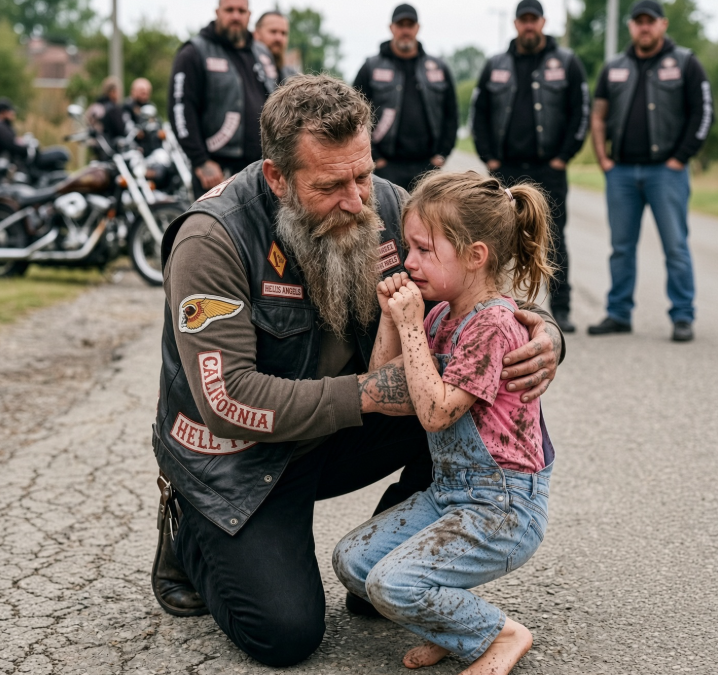
I stood in the doorway, a mud-caked little ghost in a soaked nightgown, leaving red footprints on the wooden floor.
The heat inside hurt worse than the cold.
It brought feeling back to my feet all at once.
I swayed.
A man at the end of the bar set down his glass.
He was the biggest one.
The man from the grocery store.
The stuffed rabbit man.
His beard was black and gray. His shoulders were enormous. His leather vest carried the word PRESIDENT across the chest.
Later, I learned his name was Jonah Mercer.
Everyone called him Preach.
Not because he was holy.
Because when he spoke, people listened.
“Kid?” he said.
His voice was deep and careful.
Not loud.
Not sudden.
Like he knew sudden sounds could break me.
“Where are your folks?”
I did not answer.
I could not.
My throat still felt full of Derek’s hand.
A woman behind the bar whispered, “Jesus.”
A younger biker moved fast toward me.
Preach lifted one finger.
The man stopped.
“Slow,” Preach said.
That one word told me something.
He understood frightened animals.
He understood frightened children.
Maybe the same rule applied.
I walked toward him.
Every step left blood and mud on the floor.
The bikers moved aside.
Not away.
Aside.
Making a path.
No one touched me.
No one asked too many questions.
No one crowded me.
I reached Preach and lifted my hands.
They were small.
Bruised.
Dirty.
Shaking.
Then I pointed back toward the door.
Toward the rain.
Toward the woods.
Toward Mama.
Preach’s face changed.
Just slightly.
His eyes dropped to my hands.
Then to my feet.
Then to my neck.
I pulled the collar of my nightgown down just enough to show the dark thumb-shaped bruises circling my throat.
The room went so still I could hear rain hitting the roof.
Preach stood.
His chair scraped the floor with a sound like a gunshot.
He did not ask if I was okay.
He did not ask who did it.
He did not ask whether I was sure.
He looked at the marks on my throat, and something entered his eyes that was scarier than rage.
It was decision.
“Tiny,” he said without looking away from me.
A man who was not tiny at all stepped forward.
“Yeah, Prez?”
“Blanket. Cocoa. First aid kit.”
“On it.”
“Bear.”
Another man stood near the pool table.
“Get Doc.”
“Already moving.”
“Rico.”
“Yeah.”
“Call 911. Tell them we’ve got a hurt child at the Iron Pit and an injured woman at Ashford trailers. Possible assault. Tell them we’re going there now, but we are not law enforcement.”
Rico already had his phone out.
Preach crouched slowly in front of me.
Now he was no longer towering.
Now we were almost eye level.
“What’s your name, little one?”
My lips trembled.
No sound came.
He nodded.
“That’s all right. You don’t owe me words.”
He reached into his vest pocket and pulled out a clean bandana.
Red.
Folded.
He placed it on the floor between us, not touching me.
“If you can show me, you show me.”
I stared at him.
Then I stepped on the edge of the bandana and dragged it toward the door with my foot.
His jaw tightened.
“Your mama out there?”
I nodded once.
“Man who did that still there?”
I nodded again.
Something moved through the room.
Not noise.
Not speech.
A current.
Men straightened.
Glasses were set down.
Pool cues returned to the rack.
The bartender locked the front door, then unlocked it again when Preach glanced at her.
“No,” he said. “Doors stay open.”
She nodded.
Tiny wrapped a blanket around my shoulders.
It smelled like smoke and dryer sheets.
I flinched when his hand came near my neck.
He stopped immediately.
“Sorry, little bird,” he whispered. “No touching without asking.”
Little bird.
Nobody had called me that before.
A woman with silver hair came from the back room carrying a mug.
She wore a leather vest too, but hers had a patch that said MAMA JUNE.
She knelt several feet away and slid the mug toward me across the floor.
“Hot cocoa,” she said. “Not too hot. You don’t have to drink it. It’s just here.”
That was the first time that night an adult gave me a choice.
I took the mug with both hands.
Preach stood again.
“Listen to me,” he said to the room.
Every biker looked at him.
“We ride to the trailers. We do not touch him unless he makes it necessary to protect someone. Police and ambulance are on the way. Our job is to get between him and them.”
Them.
Mama and me.
Not revenge.
Protection.
I did not understand the difference that night.
Years later, I would.
Preach turned to Mama June.
“Stay with her.”
I grabbed his vest.
It surprised both of us.
My fingers were small and numb, but I held tight.
Preach looked down.
“You want to come?”
I shook my head hard.
No.
I wanted Mama.
I wanted him to understand.
I pointed at myself.
Then pointed toward the door.
Then touched my throat.
Preach’s face softened with terrible sadness.
“You think we won’t know where to go without you?”
I stared at him.
He looked toward Bear.
“Map.”
Bear grabbed a napkin and pen from the bar.
Preach placed both on the floor in front of me.
“Can you draw it?”
My hands shook so badly the lines came out crooked.
But I drew the road.
The ditch.
The broken mailbox.
The trailer.
The oak tree Derek used for target practice.
Preach watched every mark.
When I finished, he folded the napkin like it was a legal document.
Then he looked at me.
“We’ll find her.”
His voice dropped lower.
“I promise.”
The engines started outside one by one.
Deep.
Heavy.
Rolling.
The whole building vibrated.
Through the front window, I saw headlights swing across the rain.
Not police lights.
Not yet.
Chrome and leather and thunder.
Preach walked to the door.
Before he left, he turned back.
“Little bird.”
I looked at him.
“You did the right thing.”
My face twisted.
That was when I almost cried.
Not when Derek hurt me.
Not when the gravel cut my feet.
Not when the bar went silent.
When the biggest man I had ever seen told me I had done right.
Then he stepped into the rain.
The ride to the trailer took seven minutes.
I know because later the police report said the 911 call came in at 10:43 p.m. The first group of bikers reached Ashford trailers at 10:50. Sheriff units arrived at 10:57. EMS at 10:59.
Seven minutes.
For Mama, it must have felt longer.
Derek was still in the recliner when the first engines rolled into the muddy clearing.
He woke to vibration.
Not sound.
Vibration.
The walls trembled.
Beer cans rattled on the floor.
The old television flickered.
He sat up, confused and angry, the way men like him always are when the world refuses to stay smaller than them.
Then headlights flooded the trailer windows.
White.
Brutal.
Unblinking.
Derek staggered to the curtain and pulled it back.
Outside stood a wall of motorcycles.
Men in leather.
Rain running off helmets.
Engines idling low.
Not revving.
Not showing off.
Waiting.
That was what scared him most.
Preach stepped onto the broken porch.
He did not kick the door down.
I know the story grew that way in town.
People like dramatic versions.
But the truth is stronger.
He knocked once.
Hard enough to rattle the frame.
Derek shouted, “Who the hell is it?”
Preach said, “Open the door.”
Derek saw leather through the curtain and reached for the shotgun near the wall.
That was when Bear moved.
Bear had circled behind the trailer and found the back door hanging crooked. He entered fast, with Rico behind him, and knocked the shotgun away before Derek could raise it.
No beating.
No revenge.
Just speed.
Control.
Protection.
Preach came through the front as Bear secured the weapon.
Derek cursed.
Threatened.
Swung once.
Missed.
Then found himself facedown on the dirty carpet with Bear’s knee between his shoulder blades and Rico saying, “Stop fighting before you hurt yourself worse.”
Preach did not look at Derek first.
He looked for Mama.
She was on the kitchen floor where I had left her.
Her eyes half-open.
Breathing shallow.
One hand curled near the broken cabinet.
Preach’s voice changed.
“Doc!”
Doc was not a real doctor.
He was a retired Army medic named Malcolm Hayes, though nobody called him Malcolm unless they wanted to be ignored. He slid beside Mama, checked her pulse, her breathing, her pupils, and started giving orders with the calm authority of someone who had seen chaos before and refused to respect it.
“Blanket. Keep her still. Don’t move her neck. Where’s EMS?”
“Seven minutes,” Rico said.
“Make it five.”
Preach crouched near Mama but did not touch her.
“Ma’am,” he said. “My name is Jonah. Your little girl made it to us. She’s safe.”
Mama’s eyes moved.
Barely.
But they moved.
“She’s safe,” Preach repeated.
A sound came from her throat.
Maybe my name.
Maybe a prayer.
Maybe both.
Derek, pinned near the recliner, spat blood from a bitten lip and laughed.
“She ran to you freaks?”
The whole trailer went quiet.
Preach stood slowly.
Bear’s grip tightened.
Rico looked toward the door like he needed somewhere else to put his anger.
Preach walked to Derek and crouched near his face.
When he spoke, his voice was terrifyingly calm.
“She walked barefoot through freezing rain because you made staying here worse than the storm.”
Derek tried to grin.
“You gonna kill me, old man?”
“No,” Preach said. “That would make this about me.”
Police lights flashed through the rain outside.
Red.
Blue.
Red.
Blue.
Preach leaned closer.
“You’re going to live long enough for that little girl to grow up knowing you lost.”
That was all he said.
Then he stood and stepped back before the sheriff entered.
The deputies found Derek restrained but conscious, the shotgun kicked across the room, Mama alive, and thirty bikers outside forming a human wall between the trailer and the woods.
Derek screamed that he had been attacked.
Preach handed over the shotgun.
Rico handed over a phone with the 911 call still logged.
Doc gave EMS the timeline.
Bear gave a statement.
So did every rider who had entered.
No one lied.
No one needed to.
The truth was ugly enough.
Back at the Iron Pit, I sat in Mama June’s lap wrapped in Preach’s leather jacket.
It was too heavy for me.
It smelled like woodsmoke, gasoline, rain, and something safe I did not yet have a word for.
Mama June cleaned my feet with warm water.
I did not cry until she reached the cuts between my toes.
Even then, I tried to be quiet.
She stopped.
“No, baby,” she said. “Not here.”
I looked at her.
Her eyes were wet.
“You don’t have to swallow pain in this room.”
That sentence confused me.
So she said it differently.
“If it hurts, you get to say it hurts.”
My whole body shook.
“It hurts,” I whispered.
Mama June closed her eyes.
The bar heard me.
Every person in that room heard my first words there.
Nobody told me to hush.
Nobody told me to be brave.
Nobody said it could be worse.
Tiny turned away and wiped his face with both hands.
The bartender placed a hand over her mouth.
Mama June pulled me gently against her.
“I know, little bird,” she said. “I know.”
The ambulance took me to the hospital after Mama.
I rode with Mama June because I would not let go of her vest.
At the hospital, nurses photographed the bruises.
A doctor examined my throat.
Another cleaned my feet and wrapped them in soft bandages that looked too white for someone like me.
A police officer asked questions.
Too many.
Mama June stopped him twice.
“She’s five,” she said. “Slow down.”
A woman from child services came before dawn. Her name was Ms. Alvarez, and she had kind eyes that looked tired in the corners.
She asked if I had family.
I said nothing.
She asked if I felt safe.
I looked at Mama June.
Then at Preach, who stood outside the room because the nurses would not let all the bikers in.
He was soaked.
Mud on his boots.
Beard dripping.
Eyes fixed on the hallway like he expected danger to try again.
I pointed at him.
Ms. Alvarez followed my finger.
“The bikers?”
I nodded.
She did not smile.
But her face changed.
Some adults are smart enough not to mock the first safe thing a child chooses.
Mama survived.
That is the part I need you to know before anything else.
She had broken ribs.
A concussion.
Bruising around her throat.
Damage inside that took time to heal.
But she survived.
For three days, she drifted in and out of sleep.
Every time she woke, she asked for me.
Every time, I was there.
Sometimes in a chair.
Sometimes in Mama June’s arms.
Sometimes asleep on a folded blanket while Preach sat by the door like a guard dog pretending to be furniture.
When Mama finally understood what had happened, she cried so hard the nurse checked her monitors.
“My baby walked all that way,” she whispered.
I was sitting beside her bed wearing hospital socks with rubber grips.
Mama reached for me.
Her hand shook.
“I told you to stay quiet.”
I looked down.
She touched my cheek.
“You were so brave.”
I did not feel brave.
I felt tired.
I felt cold even under blankets.
I felt like Derek might come through any door at any time.
Preach spoke from the corner.
“Brave doesn’t always feel brave while it’s happening.”
Mama looked at him.
She had not really seen him yet.
Not clearly.
He stood when her eyes found him.
“Ma’am,” he said. “I’m Jonah Mercer. Folks call me Preach.”
Mama’s voice broke.
“You saved us.”
Preach shook his head.
“No, ma’am.”
He looked at me.
“She did.”
Derek was charged with enough crimes that adults stopped saying all of them in front of me.
Assault.
Child endangerment.
Domestic violence.
Unlawful restraint.
Weapons charges.
More came later when investigators found old reports, old hospital visits, old neighbors who had heard things and said nothing because fear and inconvenience often dress themselves as minding your own business.
He did not come home.
That mattered.
For the first time in my life, the monster did not come home.
But safety is not the same as healing.
People forget that.
They think once the bad man is gone, the story is over.
It is not.
The first night Mama and I were placed in temporary housing, I slept under the bed.
Mama found me there at two in the morning.
She lowered herself carefully to the floor because her ribs still hurt.
“Sophie?”
I did not move.
She did not pull me out.
She simply lay beside the bed on the floor, one hand where I could see it.
“I’m here,” she whispered.
For a long time, neither of us moved.
Then I reached out and touched her fingers.
That was how we slept.
Her on the floor.
Me under the bed.
Both of us learning the room would not explode if we made noise.
Preach visited the next day with Mama June.
He brought a paper bag.
Inside was a pair of boots.
Small.
Black.
Warm.
Sturdy enough for mud.
Soft enough inside that they did not hurt my bandaged feet.
I stared at them.
Mama started crying before I did.
Preach cleared his throat.
“Figured a girl who walked through hell barefoot deserves proper boots.”
I touched one.
The leather was smooth.
Real.
Mine.
Derek had thrown my shoes into the woods because he wanted me trapped.
Preach gave me boots because he expected me to walk.
“You did good, Sophie,” he said.
I looked up.
He knelt so he was not towering.
“You kept your silence when it mattered. But from now on, if you ever need to scream, you scream.”
His voice roughened.
“We’ll hear you.”
I believed him.
Not all at once.
But enough to put on the boots.
The Iron Saints did not disappear after the hospital.
That surprised people.
It did not surprise me.
Preach had the kind of face that made promises look permanent.
Mama June drove us to appointments when Mama was too dizzy.
Tiny fixed the lock on our temporary apartment.
Bear installed a security camera, then taught Mama how to use it without making her feel stupid.
Rico found a donated couch.
Doc checked on Mama’s medication schedule more often than she liked.
The bartender, whose name was Elise, taught me how to make hot cocoa with cinnamon.
I started talking more at the Iron Pit than anywhere else.
Not a lot.
Never all at once.
But enough.
The first time I laughed there, every biker froze like someone had dropped a glass.
Then Mama June snapped, “Act normal before you scare her quiet again.”
They all pretended very badly to act normal.
Tiny missed the pool ball entirely.
Bear stared at a napkin like it contained secret orders.
Preach smiled into his coffee.
The Iron Pit changed too.
Before that night, it had been a place people feared because they did not understand it.
After that night, the town still feared it a little.
But differently.
Fear mixed with shame is an uncomfortable thing.
Neighbors who had ignored screams from our trailer started dropping off casseroles at the women’s shelter.
The sheriff’s department reopened older domestic violence calls.
A church group donated children’s shoes after Mama June told them, in language not fit for church, what it meant for a child to run without any.
The Iron Saints started a fund.
Boots for Little Birds.
That was Preach’s idea, though he denied it.
The fund bought shoes, coats, emergency phones, motel rooms, bus tickets, locks, and whatever else women and children needed when leaving became more dangerous than staying.
Preach refused to put his name on it.
Mama June said that was because he had “emotional constipation.”
He told her she was banned from fund meetings.
She chaired them anyway.
Three months after the storm, Mama and I moved into a small yellow duplex on Maple Street.
Not perfect.
The kitchen cabinets stuck.
The heat clanked.
The front steps needed paint.
But the door locked.
The windows opened.
No one inside smelled like beer and rage.
Mama got a job at a bakery.
At first, she came home exhausted, flour in her hair, ribs aching, hands trembling from standing too long.
But she came home smiling sometimes.
That was new.
I started kindergarten again.
The first week, I did not speak.
The teacher, Mrs. Bell, did not push.
On Friday, a boy took my red crayon without asking.
My whole body went cold.
I wanted to disappear.
Instead, I heard Preach’s voice in my head.
If you need to scream, you scream.
I did not scream.
I said, “That’s mine.”
The boy gave it back.
That was the beginning.
Small words.
Small steps.
Boots on the floor.
One year later, Derek’s trial began.
I did not have to testify in open court.
A child advocate recorded my statement in a soft room with stuffed animals and a camera hidden behind dark glass. Mama held my hand. Preach waited outside the building because he said courtrooms had enough men trying to look important.
Derek’s lawyer tried to make things sound smaller.
A family argument.
A misunderstanding.
A troubled man under pressure.
But the pictures of my neck were not small.
Mama’s medical records were not small.
The 911 call was not small.
The bikers’ statements were not small.
And neither was the muddy trail of small bloody footprints leading from our trailer toward the county road.
Derek was convicted.
The judge said he had used fear as a weapon against people who trusted him.
He said a lot more, but I remember only one sentence.
“This child’s silence was not consent. It was survival.”
Mama squeezed my hand so tightly it hurt.
I let her.
Outside the courthouse, reporters waited.
Preach stepped between them and us.
One asked if he believed justice had been served.
Preach looked at the cameras.
Then at me.
Then back at the reporter.
“Justice is what the court does,” he said. “Our job is making sure she gets to grow up.”
That night, we went to the Iron Pit.
No alcohol on the tables.
No loud music.
Just food, soda, cake, and bikers pretending they had not spent all afternoon worrying.
Mama June had baked a chocolate cake shaped like a pair of boots.
It looked terrible.
I told her so.
She said, “Art is subjective.”
Tiny gave me a small patch.
Not a real club patch.
Preach had rules about that.
This one was round, purple, and stitched with a tiny bird wearing boots.
LITTLE BIRD.
I held it like treasure.
Preach knelt in front of me.
“You don’t owe us anything,” he said.
I frowned.
Adults always said things like that before asking for something.
He seemed to understand.
“I mean it,” he said. “You don’t have to be brave for us. You don’t have to be happy to make us feel better. You don’t have to turn what happened into something pretty.”
I looked at the patch.
“What do I have to do?”
His eyes softened.
“Grow.”
That sounded hard.
It was.
Years passed.
I grew.
I grew into the boots, then out of them.
Preach bought the next pair.
Then Mama bought the pair after that because she said she could now, and everyone understood what that meant.
Mama healed slowly.
Some days she still flinched when someone dropped a pan.
Some nights she checked the locks too many times.
But she laughed more.
She sang in the kitchen.
She danced badly while folding laundry.
She learned that love did not have to arrive with apology bruises.
When I was ten, she started dating a quiet man named Luis who asked permission before entering rooms and never raised his voice at me.
Preach hated him on principle for six months.
Then Luis fixed Mama June’s car in the Iron Pit parking lot without charging her, and Preach grudgingly said, “He breathes okay.”
That was biker approval.
At twelve, I gave a school presentation about emergency safety plans.
I did not mention Derek.
I did not mention the Iron Pit by name.
But I told my class that children should know where safe adults are.
Not just parents.
Not just teachers.
Neighbors.
Store owners.
Nurses.
Firefighters.
The old woman with the porch light.
The mechanic who always says hello.
The biker bar everyone tells you to avoid, if that is the only door where someone will open.
Mrs. Bell cried in the back of the room.
I pretended not to see.
At sixteen, I rode on the back of Preach’s motorcycle for the first time.
Mama nearly fainted.
Preach drove eight miles under the speed limit and complained the entire time about my helmet strap.
I told him he sounded like an old woman.
He said, “Good. Old women survive.”
We stopped at the edge of the county line where the Iron Pit sign buzzed red against the evening sky.
For years, I had remembered that building as enormous.
A fortress.
A castle.
A place where monsters could not enter.
Standing there at sixteen, I saw it clearly.
The paint was peeling.
The roof sagged.
The neon sign flickered.
It was only a bar.
The magic had never been in the building.
It had been in the door opening.
When I turned eighteen, I spoke at a fundraiser for Boots for Little Birds.
The room was full.
Bikers.
Nurses.
Teachers.
Police officers.
Survivors.
Mothers with children on their laps.
Women who kept one eye on the exit because the body remembers even after the danger is gone.
I stood at the microphone wearing black boots and the purple Little Bird patch pinned inside my jacket.
Preach sat in the front row.
Arms folded.
Jaw tight.
Already crying.
Mama sat beside him, holding tissues she claimed were for herself.
I told the story.
Not all of it.
Some parts still belonged only to the little girl in the rain.
But enough.
I told them about the cold road.
The heavy door.
The silence in the bar.
The way nobody touched me without asking.
The boots.
The sentence that saved me long after Derek was gone.
If you need to scream, you scream. We’ll hear you.
Then I looked at the families in the room.
“I used to think silence meant obedience,” I said. “Then I learned silence can be a map. It can show you where someone has been hurt. It can show you where fear has built walls. But someone has to notice. Someone has to listen to what is not being said.”
Preach covered his face.
I kept going.
“The night I walked into the Iron Pit, I did not have words. So I gave them my silence. And they understood it.”
That became the line people repeated.
She gave them her silence, and they understood it.
But my favorite part came afterward.
A little girl about seven approached me with her foster mother. She had red shoes, serious eyes, and a stuffed fox tucked under one arm.
She looked at my boots.
Then at my patch.
“Were you scared?” she asked.
I crouched the way Preach once crouched for me.
“Yes.”
“But you walked anyway?”
“Yes.”
She thought about that.
Then she whispered, “I can walk too.”
I did not touch her.
I did not hug her.
I only nodded.
“Yes,” I said. “You can.”
Preach found me later outside the hall.
He stood beside me under the parking lot light, older now, beard more white than black, shoulders still broad but tired at the edges.
“You did good, little bird.”
I smiled.
“You always say that.”
“You keep doing good.”
“You kept your promise.”
He looked at me.
“So did you.”
“What promise?”
He tapped the side of his boot against mine.
“You kept walking.”
For a long time, neither of us spoke.
The night smelled like rain, though the sky was clear.
I thought about the five-year-old girl I had been.
Barefoot.
Silent.
Certain the world was made of monsters and closed doors.
I wanted to reach back through time and carry her.
But I could not.
So I did the next best thing.
I lived.
I grew.
I spoke.
And whenever I saw a child go too quiet in a room full of noise, I paid attention.
That is what the Iron Saints taught me.
Not violence.
Not revenge.
Not fear.
Attention.
Protection.
The courage to open a door when someone small arrives with no words left.
People still ask whether I was saved by bikers.
The answer is yes.
But not because they were frightening.
Derek was frightening.
Fear is easy.
Any weak man can make someone smaller afraid.
The men and women at the Iron Pit saved me because they were gentle when gentleness mattered, controlled when rage would have been easier, and loud only after they had listened to my silence.
They did not teach me to hate the dark.
They taught me there could be people inside it watching for me.
Waiting.
Ready.
Not to create more monsters.
To stop one.
I still have the first pair of boots Preach gave me.
They sit on a shelf in my office now, too small for any child I know, black leather cracked with age, laces stiff, soles worn from the first year I learned to walk without fear.
Sometimes survivors come into that office and stare at them.
Women.
Children.
Once, an old man who had never told anyone what his father did.
They ask why I keep tiny boots on a shelf.
I tell them the truth.
Because someone once threw my shoes into the woods to keep me trapped.
And someone else gave me boots so I would know I was meant to keep going.
That is the whole story, really.
Not the storm.
Not the bar.
Not even the bikers.
The story is this:
A monster taught a little girl to stay silent.
But he forgot to teach her to stay still.
And the night she finally walked, the right people heard every word she could not say.








