A 94-Pound Military K9 Failed Every Drill and Was Hours From Being Written Off—Then a Quiet Logistics Corporal Knelt Beside Him and Whispered One Word No One Else Could Hear. Văn bản đã dán (1)
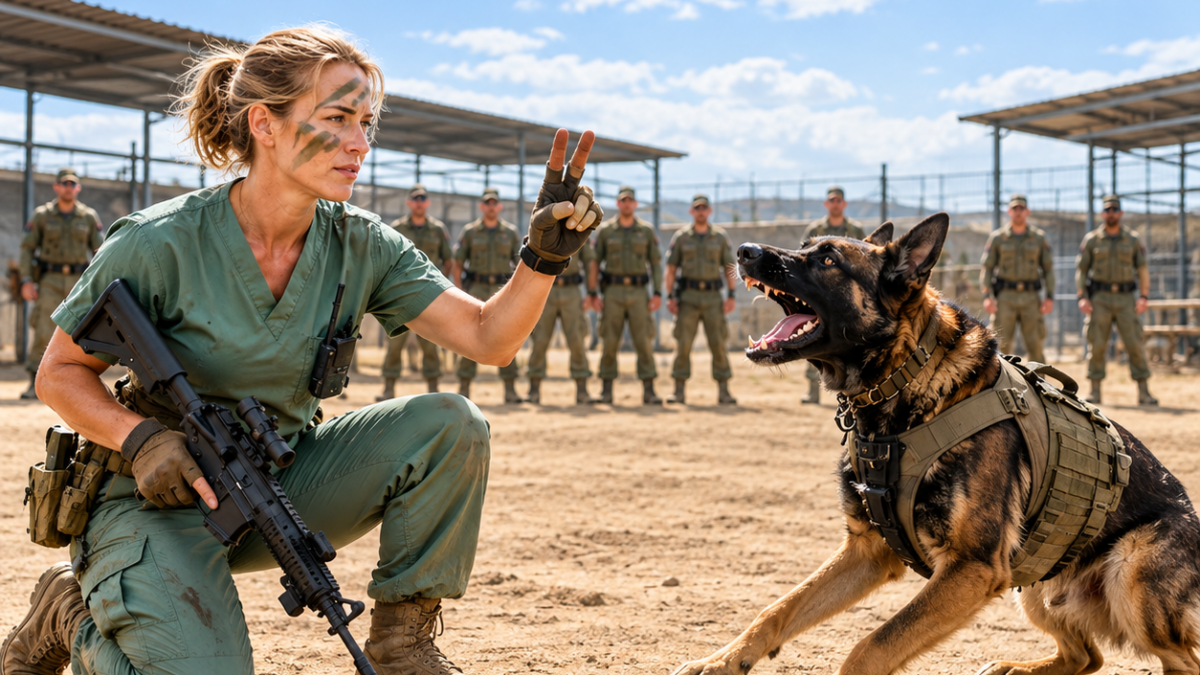
PART2:
The cold was still low to the ground, clinging to the concrete and the short winter grass.
Fort Drum in November had a colorless quality to it, as if the sky had been rinsed too many times and hung back up before drying. Everything looked pale, flat, and damp.
I was walking from the medical annex toward the logistics office with vehicle requisition forms pressed against my chest when shouting cracked across the base.
It came from the K9 compound on the eastern edge of the installation.
A cluster of chain-link runs.
Concrete training slabs.
Rubber obstacle equipment.
A long course that always smelled like sweat, wet dog, and old discipline.
“Atlas, sit!”
Sergeant Derek Hale.
I knew his voice already, even though I had never spoken to him directly.
Some voices become landmarks on military installations.
His was one of them.
Loud.
Fast.
Unavoidable.
“I said sit, you stupid—”
The crash of a metal gate cut him off.
Then silence.
Then the sound.
A bark, but not exactly.
A warning, but not simple aggression.
A low, violent burst that came out of the animal like pressure escaping from a sealed room.
I stopped walking.
The papers shifted against my chest.
For three seconds, I stood still in the cold morning air.
I had heard that sound before.
Not from Atlas.
I did not know Atlas yet.
But from dogs in a particular state most people misread.
A dog past frustration.
Past confusion.
Past normal fear.
A working dog who still had all his training, all his strength, all his memory, and no one speaking the language that made any of it usable.
I turned my head toward the K9 compound.
Then I looked away.
It was not my compound.
Not my patient.
Not my problem.
I had survived the past eight months by making myself small.
Small people did not step toward trouble.
Small people did not volunteer truths.
Small people filled forms, checked expiration dates, saluted correctly, slept badly, and stayed out of rooms where their real names might be remembered.
So I kept walking.
I handed the requisition forms to Specialist Greer at the motor pool window.
Signed the acknowledgment slip.
Nodded when he complained about cold coffee.
Then I headed back toward the medical annex.
That was when Lieutenant Amber Voss fell into step beside me.
Voss ran the K9 Operations Attachment at Braddock.
Tall.
Sharp-jawed.
Permanent expression of someone who had just caught you making a preventable mistake.
She did not waste time pretending the conversation was casual.
“You’re the new transfer.”
“Yes, ma’am. Corporal Callum. Medical support.”
“I know what your jacket says.”
That made me look at her.
Only for half a second.
Voss glanced sideways.
“I also know you stopped outside the K9 compound this morning for about forty seconds before you kept walking.”
I said nothing.
“We have a problem dog,” she continued. “Atlas. German Shepherd. Six years old. Former working dog. Been here eight weeks on behavioral rehabilitation.”
I kept my face neutral.
“Failed every evaluation. Hale’s ready to recommend disposition.”
Disposition.
A clean bureaucratic word.
A word designed to make death sound like paperwork.
In canine language, for a dog who had failed rehabilitation and could not be safely handled, disposition usually meant one thing.
“I’m sorry to hear that, ma’am,” I said carefully.
Voss stopped walking.
I stopped with her.
“I’m not K9 qualified.”
“Your jacket says that, yes.”
The wind pushed cold air between us.
Somewhere in the distance, a truck engine turned over and died.
“But I’ve been doing this long enough,” Voss said, “to know that look does not come from paperwork.”
I held her gaze.
Said nothing.
Silence was a skill.
People underestimated it because they thought silence meant absence.
It did not.
Sometimes silence meant control.
“Captain Harlan Reynolds is giving Atlas one more evaluation Friday morning,” Voss said. “After that, the recommendation goes up the chain. You may observe if you want.”
“I’m assigned to medical support.”
“I didn’t ask you to interfere.”
“No, ma’am.”
“I said observe.”
She walked away before I could answer.
That night, I did not sleep.
That was not new.
Sleep had become a negotiation after Kandahar.
Most nights, I lost.
I lay on the narrow bunk in the transient barracks, staring at the ceiling, listening to the pipes knock behind the wall and the base settling into night.
I told myself Atlas had nothing to do with me.
I told myself dogs failed rehabilitation all the time.
I told myself there were trained handlers assigned to him, officers responsible for him, procedures in place, reports written by people whose job it was to decide what could be saved and what could not.
Then, at 0307, I stopped lying to myself and sat up.
By 0400, I was running.
Not because I loved running.
Because there are only so many hours a person can lie still while memory climbs into bed beside them.
I took the perimeter road around the installation. Cold air burned my lungs. My boots struck the pavement in a steady rhythm. The eastern edge of the base was quiet at that hour, the kind of quiet that belongs to places full of people trained to wake fast.
The K9 compound sat dark behind the fence.
Most of the dogs slept in their runs.
No shouting.
No clanging gates.
No audience.
Only the low sound of my own breathing and the faint movement of animals shifting in sleep.
Then I saw him.
Atlas stood at the back of his run.
He was not pacing.
Not lunging.
Not throwing himself against the fence.
He stood facing the tree line beyond the compound.
Ears forward.
Head slightly lowered.
Body settled but alert.
In the pre-dawn dark, he looked nothing like the out-of-control animal everyone described.
He looked like a working dog doing the only job that still made sense to him.
Watching the perimeter.
I slowed.
Stopped outside the fence.
Did not speak.
Did not crouch.
Did not click my tongue.
Did not extend a hand through the chain link like an idiot with a death wish.
I simply stood there beside the fence and looked where he looked.
For thirty seconds, we watched the same trees.
Then Atlas turned his head.
His eyes found mine.
Dark.
Clear.
Tired.
A scar ran along one side of his muzzle. Another line of old tissue marked his right shoulder. His body was thick with muscle but carried that hard, compressed quality I had seen in animals that had survived too much and had never been allowed to stop.
I met his eyes for one second.
Then looked away.
Not submissively.
Neutrally.
The way another dog might.
A message without words.
I see you.
I am not competing with you.
I am not afraid of you.
Then I started running again.
Behind me, I heard him sit.
Friday’s assessment was scheduled for 0900 in the main training yard.
By 0845, half the company seemed to know.
Word had spread that Atlas was getting his final chance.
The German Shepherd who had put two handlers on medical leave.
The dog who had destroyed six weeks of rehabilitation.
The war animal no one could control.
The broken one.
People who found drama professionally interesting had lined the fence with coffee cups and carefully neutral expressions.
I stood near the back in my medical uniform, hands in my pockets, trying to look like someone who had wandered into the wrong place and did not fully understand what she was seeing.
Sergeant Derek Hale stood in the yard with Atlas on a heavy lead.
The relationship between them was visibly bad.
Not careless.
Not incompetent.
Wrong.
Hale knew what he was doing. Fourteen years in K9 operations. Four deployments. A handler’s posture, handler’s hands, handler’s instincts.
But Atlas was not with him.
That was the simplest way to put it.
The dog sat at Hale’s side, but the sit was not obedience.
It was contempt performed within the minimum legal boundary of compliance.
Atlas did not snap.
Did not redirect aggression.
Did not show any of the obvious dangerous behaviors that had filled his file.
He simply gave Hale the smallest amount of cooperation necessary to prove that he had heard the command and decided it did not matter.
Captain Harlan Reynolds stood to one side with a clipboard.
He had the expression of a man who had already written the report in his head but hated the report enough to keep checking if reality might still change.
Reynolds was practical.
That was obvious.
He did not want to kill a dog.
Also obvious.
But a K9 who could not be handled was a liability, and liabilities hurt people. Every person in that yard knew it.
Hale ran Atlas through the basic sequence first.
“Sit.”
Atlas sat.
“Stay.”
Atlas stayed.
“Heel.”
Atlas moved.
“Down.”
Atlas went down.
Every command was completed with such cold minimal effort that several handlers shifted uncomfortably along the fence.
“He’s in compliance,” Reynolds said, writing. “Grudging, but in compliance.”
“Wait until the approach drill,” Hale said.
The approach drill required the handler to move Atlas toward a designated target, in this case a padded decoy at the far end of the yard, using a command sequence designed to test control drive.
Atlas knew the drill.
Everyone knew he knew it.
His previous notes had him testing in the ninety-eighth percentile before transfer.
Hale gave the release command and stepped forward.
Atlas planted.
Not aggressively.
He did not pull back.
Did not vocalize.
Did not lunge.
He simply stopped moving and sat down as if forward motion had become a concept beneath his dignity.
Hale corrected once.
Firm.
Atlas looked at him.
Hale corrected again with a sharp lead pop.
Atlas looked away.
“That’s been the pattern for six weeks,” Hale said, voice tight. “He can do every element. He did them perfectly before he came here. But he will not perform a coordinated sequence for me or anyone else on this team.”
“Any idea why?” someone asked from the fence.
“Dogs don’t explain themselves,” Hale snapped. “And if anyone wants to tell me I just need to build rapport, I’ve had eight weeks to build rapport and I am fresh out.”
Silence spread along the fence.
Reynolds lowered the clipboard.
“Let’s talk disposition timeline.”
That was when I heard my own voice.
“Can I try something?”
It came out quiet.
Not uncertain.
Quiet in the way a blade is quiet before it cuts rope.
Everyone looked.
I had stepped away from the fence without realizing I had decided to move.
Reynolds turned toward me.
“Corporal?”
“Callum. Medical support.”
“I know who you are.”
“I know this isn’t my lane, sir. But I’ve been watching him, and I have an idea.”
Hale stared at me like I had just asked to land a helicopter with kitchen utensils.
“If you’re already writing the evaluation,” I said, “the worst I can do is confirm what you already know.”
Reynolds looked at me.
Then Atlas.
Then back at me.
“You have K9 experience?”
“Some.”
It was not a lie.
It was not the truth either.
Reynolds picked up his clipboard.
“Five minutes, Corporal. Don’t get hurt.”
The yard went very quiet.
Hale handed me the lead with the controlled expression of a man giving a stranger the keys to a vehicle already on fire.
I took it.
Atlas looked up at me.
The first thing I did was nothing.
No command.
No correction.
No leash pressure.
I stood in front of him for three seconds, holding the lead loosely, letting the line between us stay soft.
His ears went forward.
I crouched.
Not submissively.
Not with exaggerated gentleness.
I simply brought myself level with him.
Close enough to see the old scars under the fur.
Close enough to see the narrow line near his left eye where shrapnel or rock or metal had once opened him.
Close enough to smell his coat, clean beneath the compound dust.
His breathing stayed steady.
But his eyes changed.
Recognition is not always joy.
Sometimes recognition is a wound reopening because the body has remembered before the mind is ready.
I leaned near his ear and said one word.
Not loudly.
Not for the yard.
For him.
“Anchor.”
Atlas’s ears twitched.
His breathing changed.
The dog everyone had called broken disappeared.
No.
That is not right.
He did not disappear.
He came back.
His body shifted in one complete movement, the kind Sergeant Hale later described in his official report as a “postural reset,” which was accurate in the same way calling a hurricane “weather” is accurate.
Atlas stood.
Squared himself toward me.
Weight slightly forward.
Hindquarters engaged.
Head level.
Eyes locked.
Not obedience.
Not performance.
Working stance.
Real working stance.
Someone along the fence whispered, “What the…”
I stood.
I did not give a command.
I began walking.
Atlas fell into position at my left knee.
Not at the end of the lead.
Not near me.
Heel position.
Perfect.
Automatic adjustment for my pace.
The kind of synchronization most teams built over months and some never achieved at all.
We walked the length of the yard.
Turned.
Walked back.
I stopped.
“Check.”
He sat.
Reynolds did not move.
Nobody did.
The coffee cups along the fence had lowered.
“What did she say?” Sergeant Ortega whispered.
“I don’t know,” Hale said.
His voice had something in it that was not exactly anger and not exactly humility.
Something worse than either.
I did not stop at heel work.
If this was going to happen, it had to happen fully.
I took Atlas to the obstacle course.
Tire jump.
Balance beam.
Tunnel.
Elevated platform.
He performed each element cleanly, reading my body before my hand finished moving.
He was not responding to the standard commands Hale had tried for weeks.
He was reading the language he already knew.
The language they had taken out of his file because the file could not admit where he came from.
Every handler at that fence knew enough to feel uncomfortable.
Because what they were seeing implied history.
Not talent.
Not instinct.
History.
After the obstacle course, I brought him to the approach drill he had refused for Hale.
I did not use the manual sequence.
I used the old one.
Shorter.
Lower.
A breath cue before movement.
A two-finger signal close to the thigh.
A hand rotation Hale would not have recognized.
Atlas drove toward the padded decoy with controlled, focused intensity.
No rage.
No chaos.
No loss of control.
On my stop signal, he called off cleanly and returned to heel.
The whole yard went silent.
Reynolds wrote something.
Then stopped writing and just watched.
Lieutenant Voss stood at the fence, her face unreadable.
“How long have you been working dogs?” she asked.
I walked Atlas back to the center of the yard.
He was breathing normally.
Ears forward.
Alive in his own body in a way he had not been when I first stepped into the yard.
“I’ve had some experience,” I said.
“That’s not an answer.”
“No, ma’am.”
I met her eyes.
“It’s not.”
The silence stretched.
Reynolds finally spoke.
“Corporal Callum.”
“Yes, sir.”
“Whose dog is this right now?”
It was a strange question if you heard only the surface.
Atlas belonged to the K9 operational pool, assigned to Sergeant Hale for rehabilitation.
But Reynolds was not asking ownership.
He was asking truth.
I looked down at Atlas.
He looked up at me.
“He’s his own dog, sir,” I said. “Same as he’s always been.”
Reynolds wrote something else.
“Come see me after PT formation Monday morning.”
Then he turned away, and the evaluation was over.
Not officially.
Officially, there would be reports.
Meetings.
Notes.
Revised recommendations.
Questions nobody wanted to ask in public.
But Atlas’s death order had stopped moving forward the moment he heard the word.
Anchor.
That word belonged to a place no one at Fort Drum was supposed to know about.
It belonged to a night in the Kandahar Basin.
It belonged to Task Force K97.
It belonged to a team the official record said had been entirely lost.
Except that was not true.
Not anymore.
The forty-eight hours after the yard demonstration were the loudest quiet days of my life.
I said almost nothing.
The base did the talking for me.
By Friday evening, the story was that a nurse had walked into the K9 compound and trained a violent attack dog in under ten minutes.
By Saturday morning, I had become a former dog whisperer.
By Saturday afternoon, someone had decided I was probably part of a secret evaluation of the K9 program.
None of those versions were accurate.
The accurate version was both less dramatic and more dangerous.
A female corporal with a suspiciously thin service record had demonstrated an established working relationship with a dog nobody else could reach.
That was the version Sergeant Hale told in the NCO club Saturday night, according to Specialist Rita Okafor, the youngest handler on his team and one of the few people at Fort Drum who seemed more interested in truth than gossip.
“She didn’t do anything I haven’t tried,” Hale reportedly said.
“Same basic approach. Same body language. It’s not magic.”
“She said something to him,” Ortega replied.
“So she knows a command word.”
“From his previous handler,” Ortega said. “That she somehow knows.”
I was not there.
But I knew the shape of that conversation before anyone repeated it.
Questions move through military installations like weather.
They build.
They gather pressure.
Then they break.
Monday morning, 0800, I knocked on Captain Reynolds’s office door.
“Come in.”
His office was small and practical.
One desk.
Two chairs.
A whiteboard with a training calendar erased and rewritten so many times the surface carried ghost marks of old schedules.
On the corner of the desk sat a framed photograph of a shepherd mix wearing a green working vest and a service citation ribbon.
Reynolds had had dogs for twenty years.
You could tell by the way he looked at me.
Not at my rank.
Not at my uniform.
At the spaces my uniform did not explain.
“Sit.”
I sat.
“I pulled your file.”
“Yes, sir.”
“It’s remarkably light for six years of service.”
“I have steady evaluations, sir.”
“Ivy.”
He used my first name without warmth or familiarity.
Just the way a good officer uses a first name when he wants a person to stop performing.
“I’ve been doing this twenty-two years,” he said. “I’ve seen a lot of service records. The ones that look like yours usually look like that for a specific reason.”
I said nothing.
“You knew that dog,” he said. “Not just the approach. Not just a word. You knew him.”
I looked at the framed photograph on his desk.
“The way he moved with you was not two animals figuring each other out,” Reynolds continued. “That was an established communication system.”
Outside the window, pale November light flattened the yard into shades of gray.
“What I can tell you, sir,” I said carefully, “is that I have worked with dogs before in contexts that are not in my current service jacket. When I heard Atlas last week, I recognized something in what he was doing.”
“What?”
“He’s not broken.”
Reynolds waited.
“He’s grieving,” I said. “There’s a difference.”
“Grieving.”
“He was waiting for someone. Or he had been. At some point, he may have stopped waiting and switched to existing. That was what you saw as contempt.”
“Not defiance?”
“Resignation.”
Reynolds looked at me for a long time.
Then he leaned back.
“I’m going to do something that will make people uncomfortable.”
I did not answer.
“I’m attaching you to K9 operations on a temporary basis. Rehabilitation support. Your medical support duties will be redistributed.”
“Yes, sir.”
“Sergeant Hale will have opinions.”
“I imagine so.”
“He’s a good handler. A decent NCO. He takes professional assessment seriously, which means he takes being assessed poorly personally. Give him time.”
“Yes, sir.”
“One more thing.”
I stood halfway.
Stopped.
“Whatever word you said to that dog,” Reynolds said, “whatever you used to get through to him, I am not going to ask you what it was.”
I looked at him.
“That’s between you and him,” he said. “But if there comes a point where you decide to tell me where you learned it, I’d like to hear it.”
I straightened my uniform jacket.
“When that point comes, sir, I’ll tell you.”
I meant it.
I did not know when that point would be.
Or whether I was ready for what would come after.
The first week in the K9 compound was harder than expected, and I had expected it to be hard.
Sergeant Hale did not make a scene.
He was too professional for scenes.
But he made his position clear through a very specific, very elaborate professionalism that only another NCO would recognize as anger wearing a clean uniform.
Correct salutes.
Detailed briefings.
Exact distances.
No open disrespect.
No warmth.
The other handlers followed his lead.
Cool.
Careful.
Watching.
Atlas did not care about any of that.
From the first morning I opened his run, he oriented to me with a completeness that was almost startling.
Not frantic.
Atlas was not a frantic dog.
Total.
He tracked me with the focused awareness working dogs reserve for their true handlers and extended it to me as though it had always belonged there.
I began with standard rehabilitation protocol.
Not because I thought the protocol was wrong.
Because I needed a baseline.
And because the handlers watching needed to see something they recognized before they would trust what they did not.
Once I knew his state—what he still had, what had dulled, where he compensated, where his frustration had turned inward—I began adjusting.
His scent work was degraded but present.
His obstacle work was clean and strong.
Physically, he was in excellent condition, which meant Hale’s team had exercised him properly even during the breakdown. That mattered. It meant they had not neglected him. They had simply failed to understand him.
The tactical responses were the key.
They required handler communication under stress.
What they revealed was not absence of training, but the presence of a specific system nobody at Fort Drum was running.
Atlas had been trained in a handler language that did not exist in the standard military K9 manual.
I knew that language because I had helped build it.
Piece by piece, I brought it back.
A breath before a turn.
A pressure cue in the lead.
A hand signal below the line of sight.
A word spoken low enough that it belonged to the dog and not the room.
Every time Atlas recognized one of those old signals, his response lit up with the unmistakable relief of someone hearing a native language after months of being shouted at in something close but wrong.
By Thursday, I knew what I had suspected from the first bark.
Atlas had not lost his training.
He had been trapped inside it.
On Friday morning, Sergeant Hale came to watch a full evaluation sequence.
He stood with arms crossed, expression professionally neutral.
Atlas performed cleanly.
Completely.
At the exact level his pre-transfer records indicated he could.
When I called the dog in and he dropped smoothly into a down-stay, Hale remained silent for a long time.
Then he said, “What system is that?”
“The hand signals?”
“The secondary cues.”
“They’re not standard.”
“No,” I said. “They’re not.”
“Where did he learn them?”
I scratched Atlas behind his left ear.
He leaned into my hand slightly.
Not dramatically.
Just enough to say he registered the contact.
“From his previous handler.”
Hale watched me with the expression of a man who had been doing math for several days and had arrived at an answer he did not trust.
“And how do you know his previous handler’s system?”
I stood.
Atlas stood with me, automatically tracking my posture.
“I know this has been a strange week for your section,” I said.
“That’s one way to put it.”
“I’m not trying to make your program look bad.”
“Then what is this?”
He did not ask with anger.
The anger had settled into something more durable.
Professional frustration.
A good handler stuck on the wrong side of a comparison he could not explain.
I looked at Atlas.
“It’s a dog who needed to be found by the right person,” I said. “That’s all.”
I did not say I was that person.
I did not say I had thought he was dead.
I did not say I had spent eight months hiding in medical supply rooms because every time I let myself be still, I could feel the Kandahar dirt under my cheek and the weight of Atlas pressed against me while the rest of the team did not answer.
I did not say any of that.
Not then.
I took Atlas back to his run.
Hale walked away.
The morning continued.
On the ninth day of my attachment, Specialist Rita Okafor fell into step beside me during afternoon equipment check.
Okafor was twenty-three.
Fourteen months in K9 operations.
Smart eyes.
Quiet curiosity.
She had been watching all week like someone with a lot of questions and enough sense to wait for the right moment.
“Can I ask you something?”
“You can ask.”
That was not the same as saying I would answer.
“He’s different with you,” she said.
I kept moving down the equipment row, checking harness fittings.
“Not just that he performs better,” she added. “He’s present. Like whatever was making him go somewhere else in his head when we worked with him… that’s gone.”
“Yes.”
“That’s not just a command word.”
I stopped at Atlas’s tactical harness and ran my thumb along the chest strap. A small wear mark had formed on the left side that had not been there at the start of the week. He was compensating for something in his gait.
I noted it on the clipboard.
“Sometimes dogs go somewhere in their head,” I said carefully, “when they’ve been through something they don’t have a way to process. They’re still functional. Still present in a basic sense. But they’re not available. Not really.”
Okafor did not interrupt.
“The thing that brings them back isn’t always a different training technique.”
“What is it?”
I looked toward Atlas’s run.
His eyes were on me.
“Someone who has been in the same place.”
Okafor was quiet for a moment.
“Where have you been, Corporal Callum?”
I picked up the clipboard.
“Places that don’t show up in my service record.”
Then I handed her the harness.
“Check the left mid-sternum strap before tomorrow’s session. He’s compensating.”
The second week began with a summons from Reynolds.
When I arrived at 0730, someone else was in his office.
A man in civilian clothes.
Late forties.
Good jacket.
No visible insignia.
The kind of neutral appearance chosen specifically to avoid communicating anything useful.
He did not introduce himself.
He looked at me the way a man looks at something he has been trying to locate.
Reynolds cleared his throat.
“Corporal Callum, this gentleman has requested five minutes on behalf of an office I’ve been instructed not to identify.”
“That’s irregular, sir.”
“It is.”
Reynolds picked up his coffee cup.
“I’ll be in the hallway.”
He left.
The man in civilian clothes watched me across the desk.
“Corporal.”
“Sir.”
“We know who you are.”
I kept my hands relaxed at my sides.
“We’ve known since the transfer request came through,” he continued. “The question we’ve been asking internally is why you came here. Specifically here. To this installation. Eight months after your last operational posting concluded.”
“I came here for medical logistics work.”
“Yes.”
He did not sound disbelieving.
Only recording the shape of the answer.
“The dog is a coincidence?”
Something moved through my face before I could stop it.
“I heard the dog,” I said, “and recognized him.”
He went still.
“His records were supposed to be sanitized. Everything linking him to the previous posting, team, handler, deployment history—gone from standard personnel systems.”
“They were.”
“You recognized him directly.”
“I recognized what he was doing.”
“And why.”
Outside in the hall, Reynolds shifted. Not listening, exactly. Present.
“There are people,” the man said carefully, “who will be interested in the fact that you are here. And in the fact that you have reestablished a working relationship with that specific animal.”
“I imagine.”
“Is that why you came?”
I thought about that.
The answer was complicated.
A chain of half decisions that started with a transfer request and ended in a room with a man from an office that did not have a name, discussing a dog that was not supposed to exist on paper.
“I came because I needed somewhere to be,” I said. “I stayed because he needed someone to come back.”
The man looked at me.
Then stood.
“We’ll be in touch.”
“I expect you will.”
After he left, Reynolds returned.
He sat down and looked at me like several suspicions had just confirmed themselves.
“That was a short meeting.”
“Yes, sir.”
“You’re not going to tell me who he was.”
“I know what office he probably came from. I don’t know him specifically.”
Reynolds set down his coffee.
“In twenty-two years, I have never had a medical corporal visited by someone from an office that does not have a name.”
I said nothing.
“I’m not asking for classified information,” he said. “But whatever you were before you showed up here, I have a dog functioning again because of it. I am not in a hurry for that to change.”
Something shifted in my chest.
Unexpected.
Unwelcome.
Almost relief.
“Thank you, sir.”
The Friday of the second week, I ran Atlas through a full tactical simulation.
Reynolds attended.
So did Voss.
So did Hale, who had stopped avoiding observation and now watched with the focused attention of someone who had decided that losing a professional comparison was survivable as long as he learned something from it.
The scenario was standard.
Approach route.
Building entry.
Interior search.
Two planted sample sources.
Controlled indication.
Timed extraction.
I read the sheet for three minutes, set it down, and began.
Atlas and I moved through the approach route with synchronized efficiency.
Okafor later described it as not looking like a handler and K9 working together.
“It looked like one thing using two bodies.”
The building entry was clean.
The search was methodical and unhurried, which was harder than fast and much harder to train.
Atlas located both planted sources.
Indicated correctly.
Held position.
Came off signal.
Total time: seven minutes, forty seconds.
Penalty points: zero.
Advanced K9 standard allowed eight minutes, thirty seconds, with two penalties.
Hale was quiet for a long time.
Then he said, to no one in particular, “What posting was she on before this?”
Nobody answered.
Nobody knew.
But the question entered the air of the K9 compound and stayed there.
By Monday, the answer started moving toward us.
Reynolds called me into his office at 0800.
Voss was already there.
So was a woman I had seen once before from a distance. Program Coordinator Yates.
Dark eyes.
Tablet.
Careful stillness.
The kind of person who had been in operational environments often enough to be comfortable but never forgot how unusual they were.
Atlas lay at my left foot, chin on his paws.
“We’ve received a formal request,” Reynolds said, “from Joint Special Operations K9 Command to evaluate Atlas’s operational status.”
I did not move.
“They want to know,” Voss said, “whether he is sufficiently rehabilitated to return to an operational unit.”
“He has been in rehabilitation eight weeks,” I said carefully. “Two of which have been productive.”
“They know the timeline,” Reynolds said. “They also know the simulation results from Friday.”
“Who submitted them?”
Reynolds and Voss exchanged half a look.
Enough.
The man in civilian clothes.
Or someone like him.
“The evaluation team arrives Thursday,” Reynolds said.
“They’ll run active deployment readiness protocol. Not rehab benchmarks. Your presence is requested for handler matching.”
“Assessing Atlas,” I said. “Or assessing us?”
Reynolds did not soften it.
“Both.”
The team arrived in unmarked vehicles.
Sergeant First Class Devlin Burrell led it.
Lean.
Precise.
Physical economy of a man who did not waste motion.
A junior evaluator named Corporal Tate carried clipboards and said almost nothing.
A medical officer checked Atlas’s physical status for forty minutes.
Yates stood near Reynolds and wrote things she did not explain.
The evaluation ran most of the day.
Long scent sequences.
Contaminant arrays.
Tactical variations.
Off-lead distance work.
Burrell tried to run Atlas through one sequence himself.
Atlas responded with the same flat refusal Hale had documented.
Not aggression.
Not confusion.
A wall.
With me in working position, he performed.
Not perfectly.
Better than perfectly would have been suspicious.
He performed honestly.
Strong when he knew.
Brief hesitation when the scenario triggered memory.
Clean recovery.
Precise call-off.
Complete presence.
Halfway through the afternoon session, Burrell stopped me.
“Run the building entry again.”
I did.
He watched.
“Where did you learn that entry protocol?”
“It’s the standard approach.”
“No,” he said. “It’s close. But the way you’re reading the dog’s position before you move—that isn’t in standard curriculum.”
I said nothing.
“Where did you learn it?”
I looked at him directly.
“By working with dogs in environments where getting it wrong had consequences.”
Burrell stared for a moment.
Then turned to Yates.
They spoke quietly.
I could not hear the words.
I did not need to.
By evening, Voss found me in the medical annex hallway.
“They want to reconvene at 0730. Reynolds’s conference room. All parties.”
“All parties meaning?”
“You. Reynolds. Me. Burrell. Yates.”
She paused.
“Burrell pulled Atlas’s pre-transfer records tonight. Full file. Not the sanitized version.”
“I didn’t know a non-sanitized version was accessible here.”
“It isn’t supposed to be.”
Her eyes stayed on mine.
“Apparently Yates has clearance into systems the rest of us do not know exist.”
The fluorescent light above us flickered.
“What do you think is in that file, ma’am?”
Voss pressed her lips together briefly.
“I think Atlas has a service history nobody here was supposed to know. And I think you are in it.”
I did not sleep until 0300.
When I did, I dreamed about the Kandahar Basin.
Not the exact night.
Just the quality of it.
The blackness of that sky.
The way sound moved in mountain air.
The taste of dust behind my teeth.
I woke before the alarm and went to the K9 compound at 0545.
Not to run Atlas.
He needed rest.
I sat on the concrete outside his run with my back against the chain-link fence and my knees drawn up.
Atlas lay on the other side, nose almost touching the mesh.
For an hour, we existed in the pre-dawn quiet without any requirement to perform or explain.
At 0640, boots approached.
Hale stopped ten feet away, hands in his jacket pockets.
For a moment, he just looked at me and Atlas and the ridiculous picture we made: a supposed nurse sitting on cold concrete beside a classified war dog she had been pretending not to know.
“Burrell briefed me last night,” he said. “Some of it.”
I waited.
“The dog’s name wasn’t always Atlas.”
“Yes,” I said.
“What was it?”
“It was Atlas. He has always been Atlas. What changed was the documentation.”
Hale absorbed that.
He looked at the dog.
“He hated me.”
“Not personally.”
“I know that now. I just wasn’t the right person.”
“You’re a good handler,” I said. “You did everything right. The problem wasn’t technique.”
“No.”
He kicked a small piece of concrete off the path.
“The problem was I had no idea who I was working with.”
He paused.
“Either of you.”
The sky began shifting from black into the flat gray of winter morning.
“What did Burrell tell you?” I asked.
“That your name isn’t in the K9 system because you were never officially a K9 handler. That your record has been managed. That Atlas’s previous unit designation is classified above my access level.”
He paused.
“And whatever happened to that unit, this dog and one other person were the only things that came out of it.”
The fence was cold against my back.
Atlas’s warmth radiated through the mesh.
“You said one other person.”
“Yes.”
“Burrell said that specifically?”
“He did.”
“Was he wrong?” Hale asked.
I looked at the eastern sky.
“No,” I said. “He wasn’t wrong.”
Hale nodded once, slowly.
“All right.”
He started to walk away.
Then stopped.
“For what it’s worth,” he said, choosing each word like it cost him something, “I’ve been in K9 operations fourteen years. Worked with good handlers and great handlers.”
He looked at Atlas, not me.
“What you have with him is not a technique.”
Then he walked away.
When the 0730 meeting began, the room was already heavy with things nobody had said.
Reynolds sat at the head of the table.
Voss to his right.
Burrell across from the empty chair meant for me.
Yates at the end with her tablet.
I sat.
Atlas settled at my left foot.
No one spoke for several seconds.
Yates began.
“I want to be straightforward. What we found in the full operational record requires adjustment in how this situation is managed.”
Her voice was measured.
Exact.
“Corporal Callum, I’m going to give you an opportunity to correct the record before we proceed. You may decline.”
“I won’t decline.”
Yates nodded.
“Atlas was assigned to Forward Operating Team K9-7 under classified operational parameters during a deployment cycle that concluded approximately nine months ago. The team operated in a high-risk environment and sustained catastrophic losses during an event classified above the access level of everyone in this room except myself.”
No one moved.
“The record indicates one human survivor. It also indicates one K9 survivor. Those two were separated during casualty management. The K9 was routed through the rehabilitation pipeline. The human survivor was processed through a medical protocol that resulted in administrative reassignment.”
“Meaning,” Reynolds said quietly, “reassignment to medical support.”
“Yes.”
Burrell leaned back.
“And nobody connected them.”
“The connection was deliberately not made,” Yates said. “That is different.”
She looked at me.
“The decision to transfer you here to Fort Drum specifically came through your reassignment processing officer. I have reviewed the paperwork. The transfer was approved by someone aware of Atlas’s presence at this installation.”
Voss’s face tightened.
“You’re saying someone arranged for them to be in the same place.”
“I’m saying the paperwork is consistent with that interpretation. I cannot confirm intent.”
The room went still.
Reynolds looked at me.
“Corporal Callum, did you know Atlas was here before your transfer?”
“No, sir.”
My voice was steady because I built it steady.
“I did not know he was here. I did not know where he was.”
I paused.
“I thought he was dead.”
The word landed like a dropped weight.
“I thought he was dead,” I said again, quieter. “Because everything I was told in the immediate casualty assessment said no canine assets were recovered from the site. I was told that twice.”
Atlas shifted beside my boot.
“I put him in the documentation as lost. I wrote it. Then I spent eight months in a medical supply office believing I had filed the correct paperwork on his death.”
I looked at the table.
“Nobody told me otherwise.”
Reynolds unfolded his hands.
Burrell looked at me with the expression of a man who had seen enough operational environments to know that some costs do not show up in paperwork.
“And then I heard him,” I said. “And I knew immediately that I had not.”
Silence.
“The evaluation results,” Burrell said after a moment, “will reflect what we observed: a dog performing at full operational readiness with a specific handler. The question of that handler’s official designation is above my pay grade, but performance data does not lie.”
“There are channels,” Yates said, “for retroactive classification and formal handler designation. Given the circumstances, those channels can be expedited.”
Reynolds looked at her.
“Meaning?”
“It means Corporal Callum’s canine handler designation may have been administratively omitted during casualty processing. Correcting that omission is a documentation function rather than a new qualification.”
She set down her tablet.
“Practically speaking, she may already be rated. The paperwork simply does not know it yet.”
The paperwork simply does not know it yet.
I thought about eight months of saline inventory.
Motor pool requests.
Transient barracks.
Clipboards.
Careful invisibility.
Existing somewhere that required nothing from me except to remain small and not make anything harder for anyone.
“There is one more thing,” Yates said.
I looked up.
“The JSOC evaluation was not initiated purely for Atlas’s benefit. There is a current operational requirement, classified and time-sensitive, that requires a specific canine capability. Atlas’s profile matches. Your profile, given what the full record now shows, also matches.”
The room was quiet.
“We are not asking anything right now,” Yates added. “There are process steps first. But you need context.”
“What kind of requirement?” I asked.
“That conversation requires a different clearance level. I can say this much. It involves other dogs. Dogs like Atlas. Dogs who came out of situations like his and are currently labeled non-deployable for the same behavioral pattern.”
I already understood.
“They’re waiting.”
“Some have been waiting a long time.”
Before anyone could say more, Yates’s tablet buzzed.
She looked down sharply.
Her expression changed.
“What is it?” Reynolds asked.
“We have a situation,” she said. “Training Complex B. Structural failure.”
We were moving before she finished.
Training Complex B sat on the northeastern edge of the installation, past the K9 compound. A set of three prefabricated training structures used for urban operations simulations. Plywood facades, staged rooms, upper platforms, questionable tolerances under Fort Drum’s freeze-thaw cycle.
I understood the problem before I saw it.
The sound came first.
A low groan of stressed material.
Then sharper cracks.
Then the scene opened.
The center structure had partially collapsed on the southern side. A section of the upper level had folded inward, debris across the access path, soldiers gathering at that uncertain distance between wanting to help and not knowing how.
Three soldiers were inside the collapse zone.
One was Sergeant Paul Nordstrom, the senior NCO running the urban operations training program.
The other two were junior soldiers who had gone in after him.
Brave.
Also catastrophically unwise.
“Get those two out,” Reynolds ordered.
Burrell moved.
The structure groaned.
Dust sifted from the upper facade.
I assessed fast.
Southern section collapsed.
Northern supports still standing.
Partial failure, not total.
Yet.
Nordstrom was visible through a narrow gap, kneeling beside someone pinned inside.
“Medical on the way?” I asked.
“Inbound,” someone said.
I was already at the perimeter.
Burrell pulled one junior soldier back.
The second came out on his own.
Nordstrom remained inside.
“Nordstrom!” Reynolds called. “Status!”
“I’ve got a casualty. Barker. Something on his leg. Truss came down on his lower left. I can’t move him without risk.”
“How’s the ceiling above you?”
A pause.
“Not good.”
I looked at the structural gap.
Wide enough for one person moving carefully.
The upper facade was tilted but not actively progressing.
Which meant either the remaining supports were holding or they were about to stop holding.
From outside, those two conditions looked nearly identical.
I took off my jacket.
Voss saw.
“What are you doing?”
“Going in.”
“You’re not a medic.”
“I have medical training.”
True.
Undersold.
Reynolds looked at the structure.
Then at the gap.
He understood the fastest qualified medical response was still minutes out, and the structure did not have minutes.
“Go.”
I went.
The gap required turning sideways through a section where broken plywood scraped my shoulder. Debris shifted under my boots. I tested each placement before loading weight, losing six seconds and staying upright because of it.
Nordstrom looked up as I came through.
His expression moved from surprise to reassessment to acceptance in half a second.
“Corporal.”
“Status on Barker.”
I was already moving.
Private First Class Barker lay on his back, conscious but unfocused. Early shock. Pain. Lower left leg pinned under a section of truss.
“Barker,” I said. “Look at me.”
His eyes found mine.
Good.
“Does it hurt more when you breathe?”
“No.”
“Good. I’m checking your leg. If the pain changes from pressure to sharp, you tell me.”
I assessed by touch and response.
The truss was resting more than driving. Mid-thigh compression. Probable non-displaced femur fracture. No sign of arterial compromise. Pulse present at the ankle.
“We can move him.”
“You sure?” Nordstrom asked.
“Not entirely. Alternative is leaving him, and the ceiling timeline doesn’t support that.”
Above us, the structure groaned.
A piece of plywood broke free and hit the debris floor three meters away.
Barker’s breathing spiked.
“Don’t look up,” I said. “Look at me. Keep looking at me.”
I coordinated the move with Nordstrom in nine words.
Grip here. Lift on three. Leg steady. Stop means stop.
It was not textbook.
It was fast.
Controlled.
Enough.
We got Barker to the gap.
Too narrow for two across.
I went through first and pulled while Nordstrom supported from inside.
The moment Barker’s legs cleared the debris edge, the structure above the gap shifted visibly.
Three centimeters.
Not collapse.
A warning.
Nordstrom came through fifteen seconds later.
Medical arrived.
I gave the handoff in forty-five seconds.
Mechanism.
Probable injury.
Pulse status.
Grip points.
Movement method.
Specialist Wren, a compact trauma medic with efficient confidence, absorbed it, nodded once, and worked before I finished speaking.
I stepped back.
My hands shook.
Normal.
Adrenaline.
I pressed them flat against my thighs and breathed.
In measured.
Out slower.
Behind me, the southern section finally collapsed.
Not an explosion.
A grinding surrender of material to gravity.
Dust lifted pale over the wreckage.
If we had been thirty seconds slower, it would have come down on all three of us.
Nobody spoke for a moment.
Then Reynolds said quietly, “Account for everyone.”
Everyone was out.
Barker was on a stretcher.
Nordstrom sat on the ground with someone holding pressure on his arm laceration, looking at me like he had not decided what exactly he had just witnessed.
I reached for my jacket.
My uniform sleeve had torn at the shoulder during the extraction.
I had not felt it.
The tear exposed the edge of my left upper arm.
And the tattoo there.
Small.
Precise.
A unit designation no one in that compound should have recognized unless they had read a classified file that morning.
Burrell saw it.
So did Yates.
The moment lasted three seconds.
Then I had the jacket on.
But the air had changed.
Burrell walked toward me with the directness of a man done managing process and ready to manage revelation.
Yates followed.
Reynolds came from the other direction.
They stopped in front of me.
“Callum,” Burrell said. “I need to ask you directly.”
I looked at him.
“Task Force K97. Kandahar Basin. Fourteen months ago.”
He paused.
“You were not the administrative survivor, were you?”
It was not phrased like a question.
The compound noise faded behind him.
I stood in the middle of the debris dust and made the decision I had avoided for eight months.
The decision to stop performing the smaller version of myself.
“No,” I said. “I wasn’t.”
Burrell’s jaw tightened.
Reynolds closed his eyes for half a second.
“You were the team leader,” Burrell said.
“Yes.”
“Classified rank?”
“Yes.”
“And the record listing you as a medical support corporal contains true facts,” I said, “but omits the facts that matter.”
Reynolds opened his eyes.
The look he gave me was not anger.
Not exactly.
It was the look of a man realizing he had not been lied to.
He had been shown a frame too small for the truth inside it.
“Who did this?” he asked.
“The processing system during casualty management. I don’t know exactly by whom. I know it was done quickly. I know I did not fight it.”
I paused.
“I was not in a state to fight anything.”
“And the transfer here?”
“I told Yates the truth. I did not know Atlas was here. I did not engineer it.”
Yates looked up from her tablet.
“The transfer order originated from a processing officer whose name also appears in Atlas’s classified handling record. Someone connected the dots without informing Staff Sergeant Callum.”
Staff Sergeant.
The title landed before I was ready for it.
Voss looked at me.
Reynolds looked at Yates.
“What rank signed off?”
“Above everyone in this compound.”
That settled over us.
Somewhere above our access level, someone had known where Atlas was.
Known where I was.
And quietly put us close enough that one day, I might hear him.
I thought of that first bark.
The decision to stop.
To listen.
To step into the yard.
Maybe someone had arranged the chance.
But the decision had still been mine.
Yates’s tablet buzzed again.
“The team scheduled for day after tomorrow has moved arrival up. They’re landing in four hours.”
“Who’s on the team?” Reynolds asked.
Yates looked at me.
“Colonel Marcus Devereaux. JSOC Command. He has been requesting access to Atlas’s full case file for nine months.”
She paused.
“And requesting information on the location of Atlas’s original handler for the same amount of time.”
“Devereaux,” I said.
It came out softer than I intended.
“You know him?” Reynolds asked.
“He was my commanding officer before Kandahar.”
Nobody spoke.
“He approved the K97 deployment?” Burrell asked.
“He approved the channel,” I said. “Not the final parameters.”
But I stopped there.
Because the rest was bigger than the compound.
Bigger than Atlas.
Bigger than the torn sleeve and the exposed tattoo.
Four hours.
Devereaux was four hours away.
I used none of that time to prepare a speech.
Instead, I did practical things.
I ran Atlas through a thirty-minute session, not for performance but to settle both of us into the parts of ourselves that worked best under pressure.
I checked his right forepad.
Cleaned it.
Re-taped it.
Sat with him in his run for twenty minutes.
The quiet between us had become something I trusted.
Not emptiness.
A resource.
Two survivors who had stopped needing to explain the fire to each other.
At 1630, Colonel Marcus Devereaux crossed the Fort Drum entrance.
Sixty-one years old.
Gray at the temples.
Moving with the controlled patience of a man used to rooms waiting for him.
I watched from outside the K9 compound with Atlas beside me.
I brought the dog because he was part of the meeting.
Also because I did not trust myself to walk into that conference room without an anchor.
Devereaux saw me the moment he cleared the gate.
He stopped.
Not stumbled.
Stopped.
His aides nearly walked into him.
He said something to them, and they stepped back.
Then he crossed the parking apron alone.
Stopped five meters away.
“Callum.”
“Sir.”
He looked at Atlas.
Atlas looked back with calm, neutral assessment.
Devereaux’s jaw tightened.
“I was told he didn’t make it out.”
“So was I.”
He absorbed that.
Grief moved through his face.
Relief too.
And something under both that I would need the evening to understand.
“There is a lot we need to talk about,” he said.
“Yes,” I said. “There is.”
The meeting began at 1803.
People remember dramatic meetings as if they turn on a single moment.
This one did not.
It was the accumulation that mattered.
Document by document.
Clarification by clarification.
Question by question.
Until everyone could see the full shape.
Yates laid out the files in order.
My original service record.
The casualty processing documents.
The administrative reassignment chain that produced the medical support jacket.
The classified K97 operational record.
Devereaux read each one.
When he reached the correction notation that changed my status after the initial casualty report, he stopped for four seconds.
Then looked at Yates.
“Who signed this?”
Yates said one name.
Brigadier General Clifton Marsh.
The room went still.
Marsh was not unknown at Fort Drum. He had commanded regional training authority until six months earlier, then moved to a Pentagon position far above everyone present.
“This notation was made seventy-two hours after the initial casualty report,” Devereaux said.
“Yes.”
“In those seventy-two hours, the operational record was processed as a complete loss event.”
“Yes.”
“Which meant the mission parameters and authorization chain were reviewed under the assumption that no surviving personnel could provide an after-action account.”
“Yes.”
“And an after-action account from the team leader would have introduced complications.”
“For the authorization chain,” Yates said. “Yes.”
Specifically, for the risk assessment that approved the insertion parameters.
Burrell spoke next.
“Who approved the final insertion parameters?”
Devereaux looked at him.
Then at me.
“The final approval signature belongs to Brigadier General Clifton Marsh.”
I stared at the table.
Marsh.
The same name on the authorization.
The same name on the correction that reclassified me.
The same hand that helped send K97 into a threat environment two grades higher than the official parameters admitted.
The same hand that made sure the one surviving team leader did not speak before the review closed.
Reynolds said, very carefully, “The correction notation that changed her status came from the same authority who approved the mission?”
“Yes,” Yates said.
Burrell’s voice was flat.
“Someone with authorization power managed the evidentiary record of their own decision after the fact, while the review was active.”
No one needed anger.
The statement did its own work.
Devereaux looked at me.
“What happened on that insertion? I have read the initial report. I have read the review finding. I want to hear what you would have said if you had been allowed to give an after-action account.”
I thought about the nights I spent not thinking about Kandahar.
Then the nights I spent thinking about it at 0300.
The team.
The names.
Atlas pressed against me.
The word I had whispered with a mouth full of dust.
Anchor.
“The insertion parameters specified a threat level two grades below the actual intelligence estimate,” I said. “I flagged it forty-eight hours before insertion through proper channels in writing.”
“Response?”
“Dismissed with an administrative notation that the parameters had been reviewed and were within guidelines.”
“Who reviewed them?”
“The notation did not specify. That was part of why I flagged it.”
“What happened on the ground?”
“We were in contact within nine minutes of insertion.”
Nobody moved.
“That means either the threat environment was assessed incorrectly or correctly assessed and incorrectly reported. Three personnel were KIA in the first twelve minutes. Two more in the following hour.”
My voice stayed steady.
It had to.
“I took a head injury in the fourth hour. Period of unconsciousness. Atlas stayed with me.”
I paused.
“The extraction team found us together seventy-one hours after insertion.”
“Seventy-one hours,” Nordstrom said quietly from the end of the table.
Not a question.
An acknowledgment.
“When I came out of medical protocol, I was told Atlas had not survived. I was given a medical support assignment and told the record was being managed for security reasons. I was not well enough to challenge it.”
I looked at Yates.
“Maybe they did not understand what shape I was in. Maybe they were counting on it.”
The formal recording took two hours.
Yates ran it like evidence, not therapy.
Questions in sequence.
Timeline.
Names.
Notifications.
Signals.
Medical state.
Canine behavior.
Extraction details.
I answered everything.
Fully.
Without embellishment.
The hard parts remained hard.
The names.
The fourth hour.
The command I gave Atlas when I was losing consciousness, trying to keep him with me and not let him go searching for extraction that was not coming.
“Anchor,” I had whispered then.
Not attack.
Not search.
Not guard.
Stay with me.
Stay here.
Do not disappear into the dark.
When I whispered it in the training yard, Atlas had not heard a magic word.
He had heard the moment both of us survived.
At 2200, Yates closed the documentation system.
“It’s submitted,” she said. “The amendment is in the classified record. Inspector General notification has been generated.”
The process would be slow.
It always was.
But the account existed now.
My name was in the record.
The team’s names were in the record.
Atlas’s survival was in the record.
That was something the last eight months had not had.
Devereaux looked at me before he left.
“I’m sorry,” he said.
Not polished.
Not formal.
“For the record and for what isn’t in the record. I should have elevated your flag. I should have pushed harder when the authorization came down. I should have found you sooner.”
I looked at him.
He meant it.
That mattered.
It did not erase anything.
“The flag dismissal wasn’t your decision,” I said. “The final parameters weren’t yours.”
“No,” he said. “But the channel was mine. And when the channel failed, I should have used another.”
I was quiet.
“Yes,” I said finally. “You should have.”
Not absolution.
Not condemnation.
Truth.
He accepted it.
Four days later, my record corrected.
No ceremony.
Paperwork.
The correct form for the wrong that had been done.
My service jacket reflected actual rank: Staff Sergeant.
Actual designation: Canine Team Leader, Special Operations Qualified.
Six years of active duty in the position I had truly held.
Atlas’s handler record corrected simultaneously.
K97 assignment restored.
Documentation gap closed.
Full service history returned.
Reynolds called me into his office.
When I entered, he stood and shook my hand.
He did not often do that.
“Staff Sergeant Callum,” he said.
“Sir.”
The title sat differently than corporal.
Not lighter.
Different.
The weight was earned rather than assigned, and that made all the difference.
Hale waited in the corridor when I stepped out.
He had been there about thirty seconds too long for coincidence.
“Staff Sergeant.”
“Sergeant Hale.”
A pause.
“I should have understood what I was looking at,” he said. “I kept trying to fix him.”
“You kept him functional until I got here.”
He looked at Atlas.
“That’s not nothing,” I said.
He nodded once.
Accepted it.
That was the right response.
Six weeks later, Devereaux asked if I would travel to evaluate four military working dogs classified non-deployable after losing handlers in operational contexts.
Dogs like Atlas.
Resistant to handling.
Performing below capacity.
Waiting in a grief the standard protocol did not speak.
“You know what they need?” Devereaux asked.
“I know what Atlas needed. That is not the same thing.”
“No,” he said. “But it is closer than anything else we have.”
I thought about the four dogs.
I did not know their histories.
I did not know whether what Atlas and I had could be translated.
Some bonds are singular.
Some languages belong to two survivors and no one else.
That was the honest version.
“When?” I asked.
“As soon as you can travel.”
“I need to bring Atlas.”
“Why?”
“Because he has been where they are. Sometimes the thing that reaches another survivor is not a technique. It is proof.”
Devereaux was quiet.
“All right,” he said. “Bring him.”
The morning I left Fort Drum, Okafor was running the feeding rotation.
She stopped when she saw my travel kit and Atlas in harness at my left knee.
“You’re going.”
“Yes.”
“The four dogs?”
“Yes.”
“Is it going to work?”
“I don’t know.”
It was the only true answer.
Okafor nodded slowly.
“You’ll figure it out.”
“Maybe.”
I placed one hand on her shoulder.
“You’re going to be a good handler. You already are most of the way there. Stop second-guessing what the dog is telling you.”
“How do I know when my read is right?”
“You don’t,” I said. “You make the call anyway. That’s the job.”
Hale was near the gate.
He did not say anything.
He raised his chin once.
An NCO goodbye.
Enough.
Reynolds met me at the vehicle pool.
The transport van waited with the engine running.
He walked beside me in silence until we reached it.
“Come back when it’s done,” he said.
“I will.”
He looked at Atlas.
Then at me.
“What you did here,” Reynolds said, “the part where you could have stayed small and didn’t—that part matters.”
“You gave me five minutes,” I said. “In the training yard, when nobody knew what I was.”
He accepted that.
“Yes. I did.”
“That part matters too.”
I got into the van.
Atlas jumped in beside me, settled, and placed his chin on his paws.
As Fort Drum’s gate passed behind us, I watched it through the rear window for a moment.
Then I looked forward.
Here is what I knew on that road.
Broken is not the same as finished.
Sometimes the systems built to contain inconvenient truths are not as strong as they appear. They depend on the person inside them staying quiet, and quiet is a choice. Choices can change.
A dog who guards an unconscious handler for seventy-one hours in a mountain environment is not performing loyalty.
He is being what he is.
Atlas was never broken.
He was grieving.
He was waiting.
And maybe so was I.
Waiting for someone to say my name correctly.
Waiting for the record to admit what had happened.
Waiting for the part of me that had survived to become more than an administrative inconvenience.
I still woke at 0300 sometimes.
I still dreamed of Kandahar.
I still carried the names of people who did not come home.
There was no clean before and after.
No simple healing.
No perfect ending.
But Atlas shifted beside me in the van and settled his head against my left thigh.
I rested my hand on top of his head.
The road went forward.
The morning was clear.
Somewhere ahead, four dogs were waiting.
I knew they might not respond to me.
I knew I might fail.
But I also knew waiting was not the same as lost.
Some things only need someone who speaks the language to come close enough and say:
I’m here.
I know where you’ve been.
You can come back now.
That was what I had whispered to Atlas.
Not with the word itself.
With everything behind it.
Anchor.
Stay.
You are not alone in the dark anymore.
And the dog they called broken stood up, came back to me, and showed an entire base what happens when someone finally understands the difference between failure and grief.








