A 93-Year-Old Woman Found a Marine and His Starving K9 Alone in the Snow—Then She Whispered Something That Made Him Realize Their Story Wasn’t Over
PART2:
Bruno could no longer walk more than a block without collapsing.
David had not eaten in four days.
Bruno had not eaten in two.
The storm had come in before dawn, driving needles of snow through the streets. By afternoon, the temperature had dropped so hard the city seemed to empty of sound. People disappeared into warm houses, warm cars, warm offices, warm lives.
David and Bruno stayed in the alcove.
Because there was nowhere else to go.
A pair of black boots stopped in the snow in front of them.
David did not look up.
He expected the usual.
Move along.
You can’t sleep here.
Is that dog dangerous?
Sir, I need to see your hands.
“We’re moving,” David muttered, though he had no idea how. “Just give me a minute to get him up.”
“I am not the police, young man.”
The voice was female.
Old.
Sharp.
Not fragile.
“And if you force that animal to walk in this ice, his hip will finally give out entirely.”
David lifted his head.
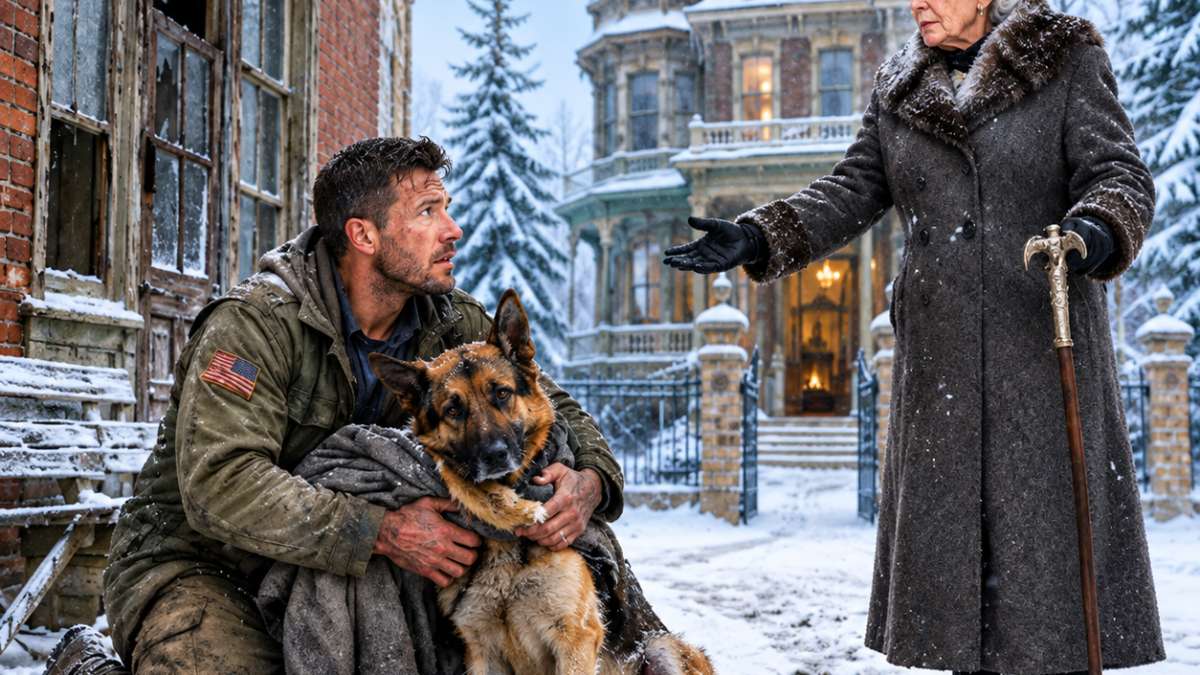
The woman standing over them looked as though she had stepped out of another century and brought the weather under control by pure disapproval.
She was ancient, but not frail.
A sweeping charcoal wool coat wrapped around her thin frame, its fur collar framing a face lined by nearly a hundred years of command, grief, and refusal. Her white hair was pinned beneath a dark hat. Her eyes were pale blue and piercing, made even colder by the snow caught in her lashes.
She leaned on a polished mahogany cane tipped with a silver eagle’s head.
But her spine was straight.
Her gaze moved from David’s face to Bruno’s tactical harness, then to the jacket wrapped around the dog.
David tightened his grip.
“We don’t want trouble, ma’am.”
“No,” she said. “You want death to arrive quietly enough that no one asks questions.”
David stared at her.
She pointed the silver tip of her cane at his chest.
“That is a standard-issue Marine Corps K9 tactical vest beneath the grime. You are shielding that dog using a warming protocol taught to military working dog handlers. And judging by the fact that you look like a corpse instead of sitting in a VA hospital, I assume you took him without permission.”
David’s blood turned colder than the snow.
His hand moved toward the heavy steel flashlight hooked to his belt.
Bruno sensed the shift.
Even half-starved and freezing, the German Shepherd tried to raise his head. A weak growl rattled in his throat.
The woman did not move.
“Who are you?” David demanded.
“My name is Margaret Sullivan.”
David said nothing.
“And you are currently freezing on my street,” she continued. “I do not tolerate casualties in my neighborhood.”
“I said we don’t want trouble.”
“You already have trouble. What you need is heat.”
David’s eyes narrowed.
“You military?”
“My late husband was.”
That did not ease him.
It made it worse.
The MPs had nearly caught up to him twice. Once outside Kansas City. Once near Casper. Men in plain clothes had asked about a scarred veteran with a large German Shepherd. A gas station clerk had warned David after they left, whispering, “They didn’t feel like cops.”
Since then, David trusted nobody.
Especially not people who recognized tactical gear at a glance.
Margaret looked down at Bruno.
Something changed in her face.
Not pity.
Respect.
“My house is two blocks away,” she said. “You will pick up that dog, and you will follow me.”
David laughed once, harsh and humorless.
“Lady, if this is a trap—”
“If it is a trap, you are too weak to escape it.” Her eyes snapped back to his. “If it is not, then you and the dog will live through the night. Choose quickly, Corporal Hensley.”
The name struck him harder than a fist.
David lurched upright, nearly dropping Bruno.
“How do you know my name?”
Margaret turned away as if the question bored her.
“The same way the men hunting you know it.”
She began walking into the snow.
David stayed frozen in place.
Bruno’s breathing hitched.
Once.
Twice.
A shallow, dangerous rhythm.
David looked down at the dog who had once thrown himself between David and an IED blast.
The dog who had taken shrapnel meant for him.
The dog the military had called damaged equipment.
The dog David had carried across borders, highways, back roads, and nightmares.
Trap or salvation.
He was out of choices.
With a groan, David gathered Bruno in both arms.
The dog was lighter than he should have been.
That terrified him more than the cold.
He buried his face in Bruno’s icy fur.
“Okay,” he whispered. “Okay, buddy. One more time.”
Then he stumbled after the old woman into the blizzard.
The house at the end of Hawthorne Lane looked like something built by a man who had believed walls should make promises.
It was a three-story Victorian mansion set behind wrought iron fencing, its dark wood siding standing severe against the snow. Warm light glowed from tall windows. Smoke rose from a stone chimney. The yard was half-buried, but the walkway had been cleared perfectly, as if the storm had not dared disobey Margaret Sullivan.
She unlocked the heavy oak front door and stepped aside.
“Quickly. You are letting the heat out.”
David staggered inside.
The moment the door closed behind them, the roar of the storm vanished.
Warmth hit him so suddenly his body almost folded.
The foyer smelled of polished wood, old books, pine smoke, and faint pipe tobacco. A grandfather clock ticked somewhere deep in the house. Heavy rugs softened the floors. Framed photographs lined the walls.
Margaret pointed her cane toward an adjoining parlor.
“Put him on the rug. Not too close to the fire. His temperature needs to rise slowly.”
David obeyed before pride could argue.
He lowered Bruno onto a Persian rug near the stone fireplace. The dog sighed, long and trembling, as warmth touched his frozen limbs.
David collapsed beside him.
His hands shook so badly he could barely stroke Bruno’s head.
Margaret removed her coat, revealing a high-collared black dress beneath. Without the coat, she looked even thinner, but somehow more formidable.
“Stay,” she said.
Then she disappeared down the hallway.
David’s eyes moved around the room.
Habit.
Exits.
Windows.
Objects that could become weapons.
Then his gaze caught on the walls.
Military photographs.
Shadow boxes.
Medals.
Citations.
A folded American flag in a triangular glass case.
One photograph showed a severe-looking man in Marine dress blues. Two stars on his shoulders. Major General.
David struggled to his knees.
Before he could get closer, Margaret returned carrying a silver tray.
On it sat a steaming mug of black coffee, a bowl of thick beef stew, and a smaller shallow bowl of boiled chicken and rice.
“Feed the dog first,” she said. “Small amounts. If he eats too fast, his stomach could twist.”
David stared at her.
She stared back.
“Do not make me repeat myself.”
He took the bowl.
Bruno’s nose twitched.
At the smell of food, his eyes opened.
For the first time in two days, life sparked there.
He tried to lunge, but David held him gently.
“Easy. Wait.”
His voice broke on the command.
Bruno obeyed.
Of course he did.
Even starving, even broken, even after everything, Bruno obeyed.
David fed him small handfuls from his palm.
Chicken.
Rice.
Pause.
Again.
Bruno swallowed each bite with desperate hunger, but David kept him slow, whispering through tears he refused to acknowledge.
Only when Bruno lowered his head onto David’s knee, exhausted but fed, did David reach for the stew.
He ate like an animal.
Too fast.
Barely chewing.
Hot broth burned his throat, but he did not care. His stomach cramped around real food with something close to pain.
Margaret sat in a high-backed leather chair across from him.
She watched in silence.
When the bowl was empty, David wiped his mouth with the back of his hand.
“You didn’t ask for my name,” he said.
“I do not need to ask for information I already possess, Corporal Hensley.”
The spoon slipped from David’s hand and clattered against the tray.
The room went still.
Only the clock continued.
Tick.
Tick.
Tick.
David’s body tensed.
“How do you know my name?”
Margaret leaned forward, both hands resting on the silver eagle’s head of her cane.
“My husband was Major General Arthur Sullivan. He served thirty-five years in the Corps. His final work involved restructuring the Armed Forces Canine Tactical Program.”
David looked at the photograph again.
The room seemed to tilt.
“Then you know what they do to dogs like him.”
“I know what regulations claim they do. I also know what cruel men do when regulations become inconvenient.”
David’s jaw tightened.
“They were going to kill him.”
“Yes.”
“He saved me.”
“I know.”
“No,” David snapped, anger flaring through exhaustion. “You don’t know. You weren’t there.”
Margaret’s expression did not change.
“Then tell me.”
He did not want to.
But the warmth, the food, the old woman’s impossible knowledge, the photograph of the general, the dog asleep against his leg — all of it cracked open a door he had kept shut for fourteen months.
So he told her.
Helmand Province.
Dust.
Heat.
A village that had been too quiet.
Bruno stopping mid-step, body rigid.
The split-second warning.
David turning just as the world exploded.
The blast lifting them both off the ground.
The taste of blood.
The ringing in his ears.
Bruno’s body slamming into his.
The dog taking the shrapnel meant for David’s chest.
When David woke in the medical tent, Captain Thomas Miller had been standing at the foot of his cot with a clipboard.
Not a doctor.
Not a handler.
A logistics officer with cold eyes and a clean uniform.
“The dog is deaf and crippled,” Miller had said. “No longer combat effective. Reclassified as damaged excess equipment. Euthanasia scheduled for 0800.”
David had begged.
Not requested.
Begged.
Let me adopt him.
Let me pay for transport.
Let me take responsibility.
Miller cited restrictions. Behavioral concerns. Classified training. Liability. Specialized asset protocols.
Words.
So many words to make murder sound administrative.
That night, David did not pack his gear.
He slipped into the veterinary holding area, found Bruno sedated and shivering, cut the tracking chip from beneath the dog’s skin with a sterilized combat knife, wrapped the wound, lifted him onto a rolling cart, and disappeared.
By sunrise, David Hensley was a deserter.
By noon, he was a fugitive.
By the end of the week, he understood something worse.
They were not only trying to recover Bruno.
They were trying to erase him.
Margaret listened without interrupting.
When David finished, her face was pale with anger.
“You saved his life,” she said.
“Yes.”
“And then you did something very foolish.”
David’s eyes flashed.
“If you think I regret it—”
“I did not call you a fool for saving the dog,” Margaret snapped. “I called you a fool because you believed Captain Miller has hunted you across three states for fourteen months merely because you stole government property.”
David went silent.
Margaret reached into the side pocket of her dress and removed a thick manila envelope sealed with red tape.
She tossed it onto the coffee table.
It landed with a heavy slap.
“Open it.”
David stared at it.
Bruno shifted in his sleep.
“Open it,” she repeated.
Slowly, David reached for the clasp.
Inside were documents.
Some old.
Some recent.
Some marked with classification stamps David recognized and several he did not.
The top page was heavily redacted.
But enough remained visible.
SUBJECT: K9 B-74 — BRUNO
OPERATION DESERT VIPER
TACTICAL CAPSULE INGESTION
HANDLER UNAWARE
RETRIEVE ASSET AT ALL COSTS
David’s heartbeat slammed against his ribs.
“What is this?”
Margaret’s voice dropped.
“Two nights before the ambush, your unit raided a compound believed to belong to an insurgent financier. Officially, the raid found nothing.”
David’s mind reached backward.
The compound.
The desk overturned.
Bruno nosing through debris.
A sudden burst of gunfire outside.
The order to move.
“We were hit before we could finish clearing.”
“Yes,” Margaret said. “And in the confusion, your dog did exactly what he was trained to do.”
David looked at Bruno.
Military working dogs trained in sensitive operations were taught retrieval denial.
If a small object was located during a raid and the handler could not safely collect it, the dog could be commanded to swallow a protected capsule or item to prevent enemy recovery.
But David had never given that command.
“He swallowed something?”
“A tactical microdrive housed in a titanium protective capsule.”
David shook his head slowly.
“No.”
“The drive contained the financial ledger of a black-market operation involving seized insurgent funds.”
Margaret’s eyes hardened.
“Captain Thomas Miller was not merely a callous officer. He was using military logistics channels to move stolen money.”
David’s mouth went dry.
“The euthanasia order.”
“He needed Bruno dead before anyone learned what was inside him.”
The room seemed to constrict.
David looked down at the sleeping dog.
For fourteen months, Bruno had carried not just injury, hunger, and pain.
He had carried evidence.
A death sentence.
A secret powerful enough to make men cross state lines with weapons.
David whispered, “Why didn’t it pass?”
Margaret removed another sheet from the envelope.
An X-ray.
She slid it across the table.
The image showed the outline of a large dog’s body.
And there, lodged in the upper intestinal tract, glowed a small rectangular shape.
David stared at it.
“The capsule is too large,” Margaret said. “It was designed to survive fire, water, pressure, and acids. Not to move safely through a wounded dog’s body. It has been lodged inside him for over a year.”
David felt sick.
“I thought it was his hip. The infections. The cold. The hunger.”
“All of those hurt him,” Margaret said. “But this is killing him.”
David’s vision blurred.
He had run to save Bruno.
But all that time, something inside Bruno had been slowly poisoning him.
“We need a vet,” David said. “A real one. But if I take him to a clinic, they’ll scan him. They’ll call—”
Margaret pulled a velvet cord beside the fireplace.
Somewhere in the house, a bell rang softly.
“I told you,” she said, “I do not tolerate casualties. And I do not fight wars without a medic.”
A door opened at the back of the parlor.
A man in his late sixties stepped in carrying a stainless steel medical kit. He wore a faded denim shirt beneath a sterile scrub top. His gray hair was cropped short, his face lined and serious.
“Dr. Richard Hayes,” Margaret said. “Former chief veterinary surgeon at Camp Pendleton.”
Dr. Hayes nodded to David.
“I served under General Sullivan for twenty years. He saved my career. Margaret saved my marriage. I owe this family more than one impossible surgery.”
David looked between them.
“Can you save him?”
Dr. Hayes crouched beside Bruno and began examining him with steady hands.
Bruno opened one eye.
David placed a palm on his head.
“He’s okay.”
The veterinarian listened to Bruno’s heart. Checked his gums. Pressed gently along his abdomen.
His face darkened.
“We have a narrow window,” he said. “He is malnourished, dehydrated, hypothermic, and compromised by chronic injury. Anesthesia is dangerous. Not operating is worse.”
David swallowed hard.
“If he dies on that table—”
“Then he dies warm, fed, and cared for,” Dr. Hayes said quietly. “Not in an alley.”
David closed his eyes.
Bruno’s tail tapped once against the rug.
Once.
Weak.
Trusting.
That broke him.
David bent over the dog and pressed his mouth to the top of Bruno’s head.
“You saved me,” he whispered. “Now let them save you.”
Then he looked at Dr. Hayes.
“Do it.”
The basement beneath Margaret Sullivan’s mansion was not a basement.
It was a bunker disguised as a wine cellar and storage corridor.
Behind a reinforced steel door was a fully sterilized medical room with surgical lights, oxygen, monitors, cabinets of supplies, and an operating table large enough for a military working dog.
David helped lift Bruno onto the table.
The German Shepherd looked at him, amber eyes cloudy but fixed.
Dr. Hayes began preparing an IV.
“You need to step outside.”
“No.”
“I need space.”
“No.”
Dr. Hayes looked at him.
Margaret had followed them down and stood near the doorway, one hand on her cane.
“Corporal,” she said.
David did not turn.
“I left him once in a medical tent. When I woke up, they were going to kill him.”
Dr. Hayes softened.
“You can stay until he is under. Then you step outside that door. Not because I do not understand love. Because I do.”
David’s jaw worked.
Finally, he nodded.
He kept one hand on Bruno’s paw as the sedative entered the line.
“Easy, buddy,” he whispered. “I’m right here.”
Bruno’s eyes fluttered.
His breathing slowed.
David did not move until the dog was fully under.
Then Dr. Hayes said, “Now.”
David stepped back like every inch hurt.
Before he reached the door, the surgical lights flickered.
Once.
Twice.
Then the basement went black.
For three seconds, there was only darkness.
Then a low mechanical hum vibrated through the floor as backup power kicked in. The surgical room lights returned, but dimmer.
A crackle came through the wall-mounted intercom.
Margaret’s voice.
“He cut the main breaker outside.”
David went still.
Dr. Hayes looked up sharply.
Margaret continued, calm as winter steel.
“He is on the property.”
David felt something ancient and familiar move through him.
Not panic.
Not fear.
Mission.
The exhaustion vanished beneath adrenaline.
The hunger disappeared.
The cold became irrelevant.
He was a Marine again.
He looked at Dr. Hayes.
“Can you keep operating?”
“If no one interrupts me.”
David reached for his steel flashlight.
“Lock this door after me. Do not open it until I say so. Not for anyone.”
“Corporal—”
“Save my dog.”
Dr. Hayes held his gaze.
Then nodded.
David slipped out.
The door locked behind him.
The mansion above was dark except for the dying glow of the fireplace.
Wind hammered the windows. Somewhere outside, loose shutters banged against wood. The house that had felt like a fortress now felt alive with shadows.
David moved through the kitchen with silent precision.
He had no rifle.
No sidearm.
No body armor.
He had a flashlight, a surgical scalpel he had taken without thinking, and the instincts of a starving man who had spent fourteen months hunted.
He found Margaret in the parlor.
She had not hidden.
She stood near the fireplace, perfectly upright, holding a Colt M1911 pistol in both hands.
The weapon looked old.
It did not look decorative.
“Get down,” David hissed.
Margaret did not look at him.
“I survived three wars as Arthur Sullivan’s wife, Corporal. I am not hiding in a closet in my own home.”
“This isn’t a debate.”
“No. It is an intrusion.”
A faint sound came from the east side of the house.
Glass.
Not shattering loudly.
Cutting.
Professional entry.
David motioned for Margaret to stay back.
She gave him a look that suggested she had never obeyed a motion in her life.
But she remained near the fireplace.
David moved into the hallway.
He slowed his breathing.
Listened.
There.
A soft shift of weight.
Wet snow pressed into antique rug.
The intruder was careful.
Trained.
David knew the type.
Not a desperate man.
Not a burglar.
A cleaner.
A man sent to remove problems.
David also knew something else.
In darkness, the intruder had the advantage.
Night vision.
Suppressed weapon.
Full strength.
David needed to change the environment.
His eyes moved to the grandfather clock.
Huge.
Old.
Heavy brass pendulum weights hanging behind glass.
David reached into his pocket and removed the scalpel.
He slipped to the clock, opened the front panel, and sliced through the braided cord holding the weights.
They dropped.
Crash.
The sound exploded through the house like a gunshot.
The intruder reacted instantly.
A shape swept into the hallway, rifle raised.
For half a second, the green glow of night vision optics marked his face.
That half second was enough.
David launched himself from behind a marble bust and swung the flashlight with everything he had left.
It struck the side of the night vision rig.
Glass cracked.
The man cursed.
Three suppressed shots punched into the wall above David’s head.
Thwip.
Thwip.
Thwip.
David drove into him low, tackling him into the parlor.
They hit the floor hard.
The rifle skidded across the wood.
The assassin was stronger.
Better fed.
Uninjured.
He drove a knee into David’s ribs, and pain exploded white-hot through his chest.
David gasped.
The man slammed an elbow into his jaw.
David tasted blood.
The assassin drew a knife.
David caught his wrist with both hands.
The blade hovered inches from his throat.
The man leaned down.
“Miller says hello.”
A gunshot shattered the room.
Not suppressed.
Not soft.
A thunderclap.
The assassin’s body jerked.
His eyes went wide.
Then he collapsed sideways, the knife falling from his hand.
David shoved him off, gasping for air.
Margaret stood ten feet away, the Colt steady in her hands.
Smoke curled from the barrel.
Her face was unreadable.
“He does not get to say hello in my house,” she said.
The intercom crackled.
“Margaret?” Dr. Hayes’s voice came through, strained but steady. “Corporal?”
David dragged himself toward the wall.
“I’m here.”
There was a pause.
Then Dr. Hayes said, “Surgery is complete. We have the capsule. Bruno is stable.”
For one moment, David did not understand.
Then the words broke over him.
Stable.
Bruno was stable.
The nightmare that had started in fire and dust, that had chased them across borders and highways and winter streets, loosened its grip.
David dropped his forehead to the floorboards.
A sound tore out of him.
Not a sob exactly.
Something deeper.
Margaret lowered the pistol.
Outside, sirens began to rise through the storm.
This time, David did not run.
Seventy-two hours later, the contents of the titanium microdrive reached the Inspector General of the Department of Defense through channels Margaret Sullivan had spent decades learning how to access and bypass.
She did not trust local command.
She did not trust polite processes.
She trusted evidence, leverage, and old generals who still answered when Arthur Sullivan’s widow called.
The drive contained names.
Accounts.
Transfers.
Orders.
Communications.
Enough to turn suspicion into handcuffs.
Captain Thomas Miller was arrested at his desk in Virginia.
The news called it a corruption scandal.
Then a military conspiracy.
Then a national embarrassment.
David did not watch much of it.
He spent most of those first days on a cot beside Bruno’s recovery bed in Margaret’s house, one hand always resting near the dog’s paw.
Bruno survived the operation.
Barely.
But he survived.
The capsule had caused infection, inflammation, and partial obstruction. Dr. Hayes said another week might have killed him. Maybe less. Bruno needed fluids, antibiotics, careful feeding, and eventually orthopedic support for his hip.
But he ate.
He slept.
He lifted his head when David entered the room.
On the fifth day after surgery, Bruno thumped his tail once when Margaret walked in.
She froze.
David smiled for the first time in what felt like years.
“He likes you.”
“Nonsense,” Margaret said. “He respects me.”
Bruno thumped again.
Margaret turned away too quickly, but David saw her wipe one eye.
The investigation cleared David slowly.
Not because justice was slow by nature, though it was.
Because institutions hated admitting they had hunted the wrong man.
AWOL.
Theft of government property.
Destruction of a tracking device.
Unauthorized transport of a military working dog.
Every charge had a file.
Every file had signatures.
Every signature belonged to people who now had to explain why a corrupt officer’s lies had been easier to believe than a handler’s loyalty.
Margaret did not let them explain slowly.
She called senators.
Retired generals.
Investigators.
Reporters when necessary.
She spoke in a voice that could freeze warm rooms.
“My husband built parts of that program,” she told one official over the phone while David sat in the parlor listening. “If the Marine Corps wants to honor him, it can start by not murdering the dog who exposed a traitor.”
David stared at her.
When she hung up, he said, “You always talk like that?”
“Only when people are being stupid.”
“So yes.”
She looked at him over her glasses.
Bruno, lying near the fireplace with a bandaged abdomen and new orthopedic brace, gave a low huff that sounded suspiciously like agreement.
A month later, David stood in the sunlit parlor holding a document signed in blue ink.
Not a printout.
Not a promise.
An official transfer of ownership.
K9 B-74, Bruno, legally released to former Corporal David Hensley.
Former Corporal.
That part still hurt.
His honorable discharge had been reinstated. Back pay approved. Medical benefits restored. A presidential pardon granted for actions taken under extraordinary circumstances. The language was clean and careful, written by people allergic to admitting moral failure.
David did not care.
He had the only paper that mattered.
Bruno was his.
Legally.
Forever.
The German Shepherd lay by the fireplace chewing a thick rawhide bone, his coat brushed, his ribs slowly disappearing beneath returning weight. The brace on his back leg helped him stand. His right ear still did not hear, but his left tracked every sound in the room. His eyes were clearer now.
Alive.
Margaret entered, leaning on her eagle-headed cane.
“He looks good by the fire,” she said.
David looked around the massive house.
“He does.”
A silence settled.
Not uncomfortable.
But full.
David folded the document carefully.
“We should go soon.”
Margaret stopped.
“Go?”
“We’ve overstayed your kindness.”
“My kindness is not a hotel reservation.”
David smiled faintly.
“You know what I mean.”
“No, I do not.”
“Margaret.”
“Do not Margaret me in my own parlor.”
Bruno paused chewing.
David sighed.
“You saved us. You got Miller. You got Bruno legal. You got me cleared. I can’t just stay in your house forever.”
“Why not?”
He blinked.
“Because that is not how things work.”
Margaret looked genuinely offended.
“I am ninety-three years old, young man. I no longer organize my household around how things work.”
David did not know what to say.
She moved closer to Bruno.
The dog’s tail thumped against the rug.
“This house is too large for one old woman,” Margaret said. “Dr. Hayes needs help with the garden. The roof requires attention in spring. The north fence is leaning. And Bruno has already decided the fireplace belongs to him.”
David swallowed.
“Margaret—”
“My husband always said a Marine never leaves his post.”
Her voice softened then.
Just slightly.
“I believe this is where you belong.”
David looked at the woman who had stepped into a blizzard and seen through every lie surrounding him.
Then he looked at Bruno, the dog who had saved his body in Afghanistan and his soul in every dark month afterward.
For the first time in fourteen months, David did not calculate exits.
He did not listen for sirens.
He did not wonder where they would sleep next.
Bruno placed one paw over the rawhide and looked up at him.
Waiting.
David’s throat tightened.
“Yes, ma’am,” he said softly. “I think you’re right.”
Spring came late to Montana.
Snow melted from the iron fence. The street outside Margaret’s mansion emerged gray and cracked beneath the thaw. Crocuses pushed through the garden beds Dr. Hayes insisted could be revived with “discipline and manure,” a combination Margaret said described most military institutions.
David stayed.
At first, he slept in the small guest room near the back stairs because the larger rooms felt too formal. Then Margaret ordered him to move into the old carriage-house apartment, which had heat, a workshop, and enough space for Bruno’s therapy equipment.
David repaired the north fence.
Then the greenhouse door.
Then the porch railing.
Then the leak above the library that Margaret claimed had been “minor” despite the bucket beneath it being older than some countries.
He started physical therapy through the VA.
He hated it.
He went anyway because Margaret threatened to attend and correct his posture in public.
Bruno began hydrotherapy at a veterinary rehab clinic two towns over. The first time he walked on the underwater treadmill, David cried behind his hand. The technician pretended not to see. Bruno looked deeply betrayed by the concept of walking in water for medical reasons but accepted chicken afterward.
Piece by piece, the world returned.
Not the old world.
David knew better than to want that.
The old world had uniforms, orders, dust, explosions, and men like Miller hiding corruption behind salutes.
This new world had Margaret’s sharp voice from the kitchen.
Dr. Hayes arguing with squirrels in the garden.
Bruno snoring by the fireplace.
Snow giving way to mud.
Mail arriving under David’s real name.
One evening, David found Margaret in the parlor staring at the photograph of her husband.
Major General Arthur Sullivan looked severe in the frame.
David stopped in the doorway.
“You okay?”
Margaret did not turn.
“I am ninety-three. That is no longer a yes-or-no question.”
He came to stand beside her.
For a while, neither spoke.
Then she said, “Arthur knew Miller was rotten.”
“I know.”
“He tried to do it the proper way. Reports. Channels. Testimony. Evidence.”
David looked at the folded flag on the wall.
“And Miller killed him.”
“The official report says accident.”
“What do you say?”
Margaret’s hand tightened on the cane.
“I say my husband drove mountain roads in worse weather than that for fifty years and never once mistook a guardrail for a suggestion.”
David did not answer.
Margaret’s voice changed.
Smaller, though still steady.
“I spent years knowing. Not proving. Knowing.”
“That’s a hard place to live.”
“Yes.”
She looked at him then.
“You and Bruno gave me proof.”
“No,” David said. “You saved us first.”
Her eyes glistened.
“Perhaps we were all waiting in different kinds of snow.”
David looked down.
Bruno had wandered in silently, brace clicking softly against the floor. He leaned his large body against Margaret’s leg.
She placed one thin hand on his head.
“You ridiculous heroic beast,” she whispered.
Bruno sighed.
David smiled.
After that, Margaret began coming with them to Bruno’s therapy sessions.
She sat in the waiting room like a visiting monarch, terrifying receptionists and charming children. When people asked about Bruno, she gave a version of the story that left out classified details but kept the important truth.
“He is a veteran,” she would say. “Treat him accordingly.”
No one argued.
One day, a little boy with a cast on his leg asked if Bruno was brave.
Margaret looked at David.
David looked at Bruno.
Bruno was licking peanut butter from a rubber mat with no dignity whatsoever.
“Yes,” David said. “But not because he isn’t scared.”
The boy frowned.
“Then why?”
David crouched beside him.
“Because he keeps trying.”
The boy looked at Bruno again.
Then at his own cast.
“I keep trying too.”
David smiled.
“I can see that.”
That night, Margaret said, “You are good with children.”
“No, I’m not.”
“You are. Which means, naturally, you should do something about it.”
David groaned.
“Here it comes.”
She ignored him.
“Dr. Hayes knows a group that pairs retired working dogs with veterans and children in rehabilitation settings.”
“Bruno is still recovering.”
“So are you.”
“That’s not the same.”
“No. But it is not unrelated.”
David tried to argue.
He lost.
Margaret Sullivan did not win arguments because she was loud. She won because she spoke as though the matter had already been settled and everyone else was embarrassing themselves by being late to the conclusion.
By autumn, David and Bruno were visiting the local veterans center twice a month.
At first, Bruno mostly slept beside David’s chair while other veterans pretended not to care and then gradually migrated closer. A Vietnam veteran named Earl began saving bits of toast from breakfast for him. A young Army medic with tremors in her hands brushed Bruno’s coat during group therapy. A former infantryman who had not spoken in three sessions whispered, “Good boy,” and then broke down crying into the dog’s neck.
Bruno accepted all of it.
The fear.
The shaking.
The silence.
The grief.
He had carried worse and still loved.
David began speaking too.
Not speeches.
Not inspirational nonsense.
But truth.
He talked about running.
About shame.
About loyalty becoming the only thing he could hold on to.
About how easy it was to mistake survival for living.
About the old woman who had found him freezing in an alley and refused to let him die because, in her words, she did not tolerate casualties in her neighborhood.
The first time he said that, the veterans laughed.
David did too.
Then he looked at Bruno, asleep under the table, and added, “Sometimes you need someone who sees you at your worst and gives you an order you can still obey.”
A Marine in the back whispered, “Follow me.”
David nodded.
“Exactly.”
Winter returned.
One year after the blizzard, snow began falling over Billings just before dawn.
David woke before six, not because he was cold, but because Bruno’s tail was thumping against the floor.
“Yeah,” David muttered from bed. “I hear it.”
Bruno stood near the window, staring at the snow.
His brace leaned against the wall. He did not need it inside the house anymore most days.
David dressed and walked with him to the parlor.
Margaret was already awake, of course, sitting by the fire with tea.
“You’re up early,” David said.
“I am old. Sleep is now a negotiation, not a guarantee.”
Bruno went to her first.
Always now.
She pretended not to like it.
Always now.
David looked out the window.
Snow covered the street.
The alcove where Margaret had found them was only a few blocks away. He had not walked past it since.
Margaret followed his gaze.
“You are thinking about it.”
“Yes.”
“Good.”
He looked at her.
“Good?”
“If ghosts are going to live in a place, it is best to visit and inform them you have moved.”
So after breakfast, they went.
David, Margaret, and Bruno.
The storm was gentler than the one that had nearly killed them, but the cold still bit. Bruno wore a fitted winter coat. David carried extra treats in his pocket. Margaret wore the same charcoal coat and carried the eagle-headed cane.
The alcove looked smaller in daylight.
Just a recessed doorway beside an abandoned brick storefront now under renovation. Someone had cleared the sidewalk. A construction permit was taped to the window.
David stopped.
For a moment, he saw it all again.
The ice.
The hunger.
Bruno’s failing breath.
His own hand unzipping the field jacket.
The certainty that nobody was coming.
Then Bruno leaned against his leg.
Solid.
Warm.
Alive.
David placed a hand on his head.
Margaret stood beside them.
“This is where you said it,” David told her.
“Said what?”
“I do not tolerate casualties in my neighborhood.”
“Ah.”
“You know that saved us.”
Margaret’s face remained forward.
“I suspected.”
He laughed softly.
“Of course you did.”
Bruno sniffed the snow, then sneezed.
The moment broke.
Gently.
David reached into his coat and pulled out a small metal tag. He had made it in the carriage-house workshop the night before.
He fixed it to a nail beside the doorway.
It read:
HERE A MARINE AND HIS DOG WERE SEEN
AND BECAUSE THEY WERE SEEN, THEY LIVED
Margaret read it.
For once, she did not correct him.
Her eyes shone.
“Arthur would have liked you,” she said.
David swallowed.
“I wish I could’ve met him.”
“You did, in a way.”
He looked at her.
She nodded toward Bruno.
“The best parts of him lived in the program he built. In dogs like Bruno. In handlers like you. In the belief that loyalty is not equipment.”
David could not speak.
Bruno pressed closer.
Snow fell around them.
Not as an enemy now.
Just weather.
Years later, people would tell the story in many ways.
Some focused on the conspiracy.
The corrupt officer.
The hidden microdrive.
The assassin in the mansion.
The old widow with a pistol and a spine made of iron.
Others told it as a story of loyalty between a Marine and his K9, a man willing to lose his name rather than abandon the dog who had saved his life.
Both versions were true.
But David always believed the real story was smaller.
A ninety-three-year-old woman saw a man and a dog freezing in the snow.
She did not walk past.
That was the beginning of everything.
Not the files.
Not the surgery.
Not the pardon.
Not the arrest.
Those came later.
The miracle began when someone looked at what everyone else had dismissed as a homeless veteran and a dangerous dog, and saw a handler shielding his partner.
Saw training.
Saw loyalty.
Saw a casualty before death made it official.
Margaret lived three more years.
Stubbornly.
Commandingly.
Exactly as she pleased.
She died in her sleep in the upstairs bedroom overlooking the garden, with Bruno sleeping outside her door and David in the carriage house, unaware until morning that the house had become quieter in a way it would never fully recover from.
Her funeral filled the church.
Veterans came.
Generals came.
Neighbors came.
People from the clinic came.
Dr. Hayes stood beside David.
Bruno wore his old tactical harness, cleaned and restored, with one addition Margaret had ordered before her death: a small silver patch stitched beside his name.
SULLIVAN HOUSE
NO CASUALTIES
David delivered the eulogy because Margaret had demanded it in writing.
“She once told me she did not tolerate casualties in her neighborhood,” he said, standing before the crowd with Bruno seated beside him. “I thought she meant she didn’t tolerate death. I was wrong.”
His voice trembled.
“She did not tolerate abandonment. She did not tolerate systems that used people and animals and then discarded them. She did not tolerate cowardice disguised as procedure. She did not tolerate pity when action was required.”
Bruno leaned against his leg.
David steadied himself.
“She saved my life because she refused to look away. She saved Bruno because she understood that loyalty does not expire when usefulness ends. And she gave me a home when I believed I no longer deserved one.”
He looked at the folded flag near her casket.
“Margaret Sullivan was not gentle in the way people expect old women to be gentle. She was sharper than that. Better than that. Her kindness had orders in it. Her mercy came with instructions. When she loved, she mobilized.”
Soft laughter moved through the church.
David smiled through tears.
“So in her honor, I will say what she said to me in the snow. If you see someone freezing, do not ask whether helping them is convenient. If you see a wounded veteran, a frightened animal, a child, a neighbor, a stranger, do not wait until you understand the whole story before you offer heat. You may be the first person who has seen them clearly in a very long time.”
He looked down at Bruno.
The dog’s muzzle had gone gray.
His eyes remained bright.
David placed a hand on his head.
“Margaret saw us. And because she saw us, we lived.”
After Margaret’s death, the house became the Sullivan Haven for Veterans and Working Dogs.
That had been in her will.
Of course it had.
David found out she had planned it for years, long before she found him. She had simply been waiting for someone stubborn enough, damaged enough, and loyal enough to run it properly.
Dr. Hayes became veterinary director.
David became program director.
Bruno became, unofficially, chairman.
No one argued.
They took in retired working dogs with medical needs. Veterans struggling with transition. Handlers grieving lost partners. Dogs no longer considered useful by agencies but still full of life. Men and women who needed purpose but did not know how to ask for it.
The mansion changed.
Not in structure.
In sound.
Laughter returned to rooms that had once held only ticking clocks. Dogs barked in the yard. Veterans repaired fences, cooked meals, attended therapy, trained service animals, and sat by the fire on bad nights when memories made sleep impossible.
On the parlor wall, beneath Arthur Sullivan’s photograph and Margaret’s folded flag, David hung the field jacket he had wrapped around Bruno in the snow.
Beside it was Margaret’s cane.
The silver eagle still caught the light.
Visitors often asked about them.
David would tell the story.
Not all of it.
Some things remained classified.
Some things belonged only to the dead, the guilty, and the people who had survived.
But he always told them this part:
A Marine was freezing.
A dog was dying.
A woman stopped.
Sometimes that was enough to make people understand.
Bruno lived six more years after the storm.
Good years.
Not painless years.
But good ones.
He grew old by the fire Margaret had given him. His hip ached in winter. His hearing never returned on the right side. His abdomen bore a long scar beneath his fur. But he ate well, slept deeply, worked gently, and spent his final years surrounded by people who understood that a warrior could be tired and still worthy of honor.
When Bruno died, David lay beside him on the rug in the parlor.
The same rug where Margaret had ordered him to place the dog that first night.
Dr. Hayes sat nearby.
No needles until David was ready.
No rushing.
No cold.
No fear.
David pressed his forehead to Bruno’s.
“You saved me,” he whispered.
Bruno’s tail moved once.
Barely.
Enough.
David cried without shame.
The big German Shepherd let go with his head in David’s hands, warm, safe, and loved beyond measure.
They buried Bruno beneath a young pine tree in the garden.
Margaret’s ashes had been scattered nearby.
Dr. Hayes carved the marker himself.
BRUNO
K9 B-74
HE CARRIED THE TRUTH
AND BROUGHT A MARINE HOME
David stood there long after everyone left.
Snow began falling lightly.
He did not move away.
For a moment, he felt the old cold reaching for him.
Then the mansion door opened behind him.
A young veteran named Riley stepped out with a retired Labrador whose front leg had been amputated after a training accident.
“You okay, sir?” Riley asked.
David looked at the dog.
At the house.
At the light spilling warm across the snow.
At the silver eagle cane visible through the parlor window.
He heard Margaret’s voice in memory, sharp as ever.
I do not tolerate casualties in my neighborhood.
David wiped his face.
“Yes,” he said.
Then, after a moment, “But bring that dog inside. His paw’s getting cold.”
Riley smiled.
“Yes, sir.”
David took one last look at Bruno’s marker.
Then he went inside.
There was work to do.
There always would be.
Someone needed heat.
Someone needed food.
Someone needed the truth restored.
Someone needed to be seen before the snow covered them completely.
And David Hensley, once a hunted Marine with a starving K9 in his arms, had finally learned the lesson Margaret Sullivan had carried through ninety-three years of life:
You do not have to save the whole world at once.
You start with the casualty in front of you.
You open the door.
You make them warm.
You feed the dog first.
And sometimes, if you are brave enough not to look away, that is how history changes.








