A 9-Year-Old Girl Pointed at a Hells Angel’s Tattoo and Said, “My Mom Has the Same One”—Then the Biker Asked Her One Question That Silenced the Entire Diner.
PART2:
It could mean Maggie had pulled over somewhere to cry for ninety seconds before fixing her face and getting back on the road because Laya was waiting.
But he only nodded.
“She’ll get here.”
“I know.”
Laya said it with perfect loyalty.
Children of single mothers often do.
They defend the person who keeps failing time, even when the failure is not love but exhaustion.
Mr. Garrison went back behind the counter.
The bell over the door jingled.
Laya’s head snapped up.
But it was only a man in a denim jacket stepping in to grab a takeout order. Her smile faded, but only a little. She looked back down at her drawing and shaded the metal wings darker.
Outside, the wind shifted.
That was when the rumble started.
At first, it came from far away, low and uncertain, like thunder somewhere beyond the highway. The old man at the counter lowered his newspaper slightly. The trucker stopped chewing. Mr. Garrison looked toward the window with the wary expression of a man who knew engines by sound.
The rumble grew.
One engine became several.
Deep. Heavy. Rolling.
PART3:
The water in Laya’s glass trembled, tiny rings spreading across the surface. Her warm milk rippled. The ceiling fan seemed to click louder. Outside, red dust whipped across the parking lot in frantic spirals.
Mr. Garrison set down the coffee pot.
“Hell’s Angels,” he muttered.
The old man at the counter folded his newspaper very slowly.
The two college girls stopped laughing.
Laya looked out the window with bright curiosity.
Six Harley-Davidsons turned into the parking lot, black and chrome under the burning Arizona sunset. They came in formation, smooth and loud, each bike rolling with the confidence of something that did not ask permission from the road. Their headlights swept across the diner windows. The engines shook the glass.
Then, one by one, they stopped.
The silence after was worse than the noise.
Not quieter.
Heavier.
Like the air had been pressed down.
The first biker swung off his bike and removed his gloves. Thick beard, leather vest, tattooed hands. The second was broader, with a shaved head and sunglasses still on despite the fading light. The third was younger, curly hair tied low at his neck, scanning the lot with sharp, nervous eyes. The fourth and fifth looked like brothers, both tall, both hard-faced, both wearing the same expression men get after years of being looked at with fear and learning to use it.
The sixth entered last.
He was the tallest.
Not just tall.
Huge in a way that made the diner feel smaller before he even opened the door. His shoulders filled his leather vest. His beard was dark with streaks of gray. His steel-blue eyes moved over the windows, the cars, the door, and the street beyond like he was reading danger in every reflection.
His name was Briggs.
No one in the diner knew that yet.
To them, he was just the kind of man people lowered their voices around.
The door opened.
Cold desert wind rushed in first, carrying dust and gasoline and the smell of hot engines. Then the bikers stepped inside.
Boots hit tile.
One.
Two.
Three.
The diner seemed to shrink around them.
Mr. Garrison straightened behind the counter, trying to look friendly and not frightened. The grandmother near the window clutched her purse. The trucker looked down at his plate. One of the college girls whispered, “Oh my God,” so softly she probably thought no one heard.
Laya heard.
She looked from the girl to the bikers and frowned slightly, as if trying to understand why grown-ups were suddenly acting like deer near headlights.
Briggs paused just inside the door.
His eyes swept the room.
They passed over Laya once.
Then moved on.
He nodded toward the large table near the center, only a few feet from Laya’s little booth.
The men moved without talking.
Chairs scraped. Leather creaked. The table looked too small for them. Briggs sat with his back to the wall, facing the entrance, exactly like a man who trusted no door behind him.
Mr. Garrison approached with a pad in his hand.
His smile looked painful.
“What can I get you gentlemen?”
Briggs raised two fingers. His voice was low and gravelly, like stone dragged across concrete.
“Six waters. Coffee. Black.”
The couple in the back flinched at the sound of him.
Mr. Garrison nodded quickly. “Sure thing.”
His hands shook when he reached for the mugs. A spoon clinked too loudly against ceramic.
Laya noticed none of that.
She was looking at Briggs’s left arm.
His sleeve had pulled up slightly when he leaned on the table. Just enough to reveal a tattoo wrapping around the muscle of his forearm and disappearing beneath leather.
A skull wearing a helmet.
Sharp wings spread wide.
Dark lines, white highlights, small cracks worked into the bone like lightning. Not a cartoon. Not a decoration. A symbol drawn with enough detail that it seemed alive beneath the diner’s yellow lights.
Laya stared.
Her mouth parted slightly.
She had seen that picture before.
Not exactly like that. Not as large. Not as dark.
But the same skull.
The same wings.
On her mother’s shoulder.
Maggie’s tattoo was smaller and faded, tucked near the top of her left arm where a T-shirt sleeve almost covered it. Laya had traced it with one finger when she was little and asked what it meant.
“It keeps the bad dreams away,” Maggie had said.
“Like a night-light?”
“Something like that.”
“Does it work?”
Maggie had smiled, but her eyes had gone sad.
“Sometimes.”
Now the same image sat on the arm of the biggest biker in the diner.
Laya tilted her head, fascinated.
At the bikers’ table, the younger one with curly hair leaned closer to Briggs.
“We’re close,” he said low.
Not loud enough for most of the diner.
But Laya was only a few feet away.
She heard.
“The route she used,” he continued. “It matches the Flagstaff sighting.”
Briggs said nothing.
Another biker, the one with the shaved head, added, “If she’s still around here, we’ll find her.”
The adults nearby stiffened.
Searching for someone.
The words moved through the diner like smoke.
No one knew who the bikers meant, so everyone’s imagination chose the worst possible version. A runaway. A witness. A debt. Trouble with boots and engines and old violence attached.
Only Laya did not hear danger.
She heard they were looking for someone.
She wondered if the someone was lost.
Briggs reached for his coffee when Mr. Garrison brought it. His arm shifted. The tattoo flexed.
Laya’s eyes brightened.
The youngest biker noticed.
He glanced at the little girl staring openly at Briggs’s arm. His mouth twitched.
Then he nudged Briggs once with his elbow.
Briggs turned his head slowly.
The diner froze.
Everyone saw it.
The giant biker looking down at the small girl.
The small girl looking up at the giant biker.
This was the moment everyone feared without knowing exactly what they feared. The collision between innocence and danger. Between a child who did not understand warning signs and a man who looked built from them.
Laya smiled.
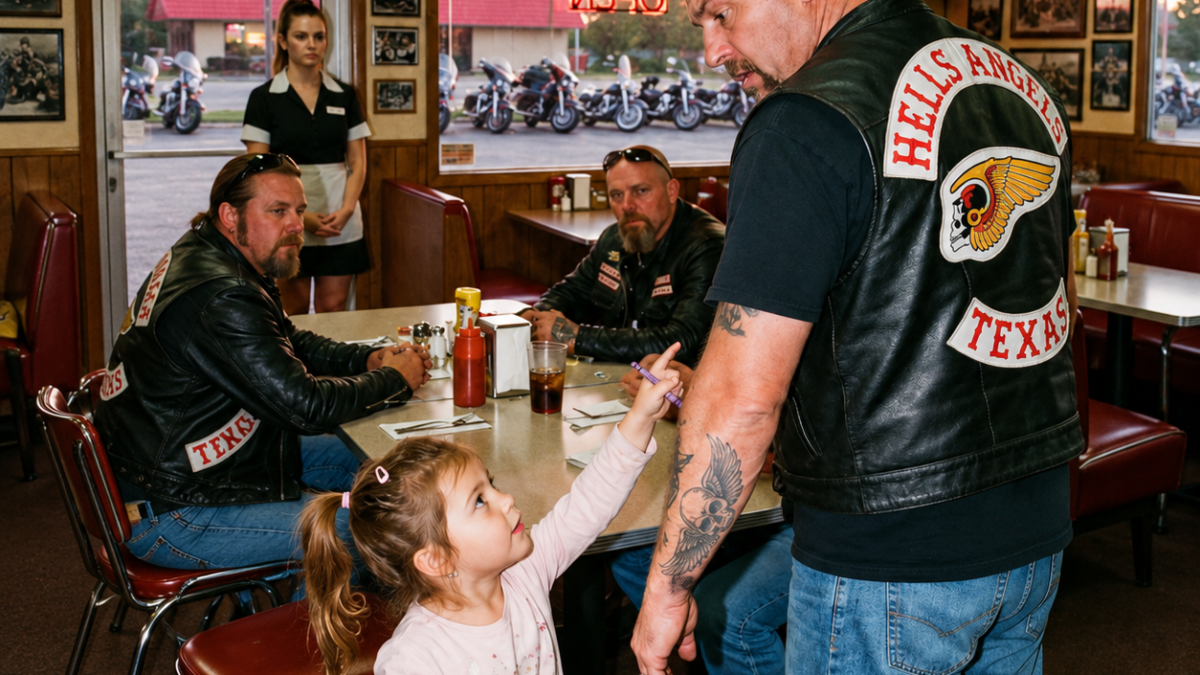
“Hello, sir,” she said, clear and bright as a bell. “My mom has a tattoo just like yours.”
The whole diner went dead silent.
Not quiet.
Dead.
Even the ceiling fan seemed to hesitate.
Briggs stopped with the coffee cup halfway to his mouth.
The five bikers around him went rigid.
The youngest one’s smile vanished.
The shaved-headed biker slowly turned to stare at Laya. The bearded one beside him lowered his hand to the table like he needed something solid beneath it.
Briggs’s eyes locked on the little girl.
“What did you say?”
His voice was not angry.
That almost made it worse.
It was deep enough to rattle silverware.
Mr. Garrison reached under the counter, fingers brushing the phone.
Laya, unaware that every adult in the diner had forgotten how to breathe, pointed at Briggs’s arm.
“The picture,” she said. “The skull with the wings. My mommy has the same one right here.” She tapped her own shoulder. “But hers is smaller. She says it keeps the bad dreams away.”
Briggs set the coffee down very slowly.
The cup clicked once against the table.
His whole body turned toward her.
The scary intensity in his face shifted into something else.
Disbelief.
The kind that lands so hard it makes a man forget to hide pain.
“What’s your mom’s name, little bit?”
Laya liked the nickname immediately.
“Maggie,” she said. “Maggie Harper. But I’m Laya. My mom’s late because trucks are slow and people don’t know how to drive when there’s dust.”
One of the bikers sucked in a breath.
The curly-haired one whispered, “Briggs.”
Briggs did not look away from Laya.
His face had gone pale beneath the weather and beard.
“Maggie,” he repeated.
Laya nodded. “She works at the laundry and then she cleans offices. She says coffee is a food group, but I don’t think that’s true.”
No one laughed.
Briggs leaned forward slightly.
His voice dropped.
“Does your mom have a scar?”
Laya thought about it. “Where?”
“Right here.” He touched the space above his left eyebrow.
Laya’s face lit up. “Yes! A little white one. She says she fell off a bike when she was little, but she always says it fast like when grown-ups don’t want more questions.”
Briggs closed his eyes.
His chest expanded with a breath so deep it looked painful.
The man with the shaved head whispered, “Is it her?”
Briggs opened his eyes.
They were wet.
“Call it off,” he said.
The curly-haired biker already had his phone in his hand. “All chapters?”
“All of it,” Briggs said. “We found her.”
The diner did not understand.
No one did.
Laya glanced around, then back at Briggs.
“You know my mom?”
Briggs stared at her like she had become the center of the room, the answer to three years of road maps, dead ends, motel receipts, false names, and sleepless nights.
“Yeah,” he said roughly. “I know your mom.”
The bell over the diner door rang.
A woman rushed in, breathless, hair coming loose from a messy bun, uniform stained from a double shift, purse slipping from one shoulder.
“Laya, baby, I am so sorry,” she said before the door even closed behind her. “The highway was backed up past the overpass, and then Mrs. Kline at the laundry—”
Maggie Harper stopped.
Her eyes found Laya first.
Then the table of bikers.
Then Briggs.
Everything drained from her face.
Her purse slipped from her shoulder and hit the floor.
“Mama!” Laya said brightly. “Look! He has your tattoo.”
Maggie did not move.
Her breathing changed.
Fast. Shallow. Panicked.
She looked at the five bikers around the table, then at Briggs standing slowly, rising until he seemed to tower over the whole diner.
“No,” Maggie whispered.
Laya’s smile faded.
“Mama?”
Maggie moved toward her daughter with the instinct of a hunted animal.
“Please,” she said, voice trembling. “Please, she has nothing to do with this. Don’t touch her.”
Mr. Garrison grabbed the phone under the counter.
The old man at the counter slid off his stool.
The trucker pushed his plate away and stood halfway.
Everyone braced for violence.
But Briggs did not move toward Laya.
He stepped out from behind the table and stopped three feet from Maggie.
She flinched so hard it looked like pain.
“Maggie,” he said.
Not loud.
Not threatening.
Soft.
The softness was what broke her.
Her hands, raised slightly as if to shield her face, lowered a fraction.
She looked at him properly then.
Past the beard.
Past the lines.
Past the road years and the leather and the size of him.
Her mouth trembled.
“Briggs?”
He swallowed.
“Mags.”
The word was barely more than a breath.
Maggie made a sound like something torn out of her.
“Big brother?”
The diner changed again.
Not peaceful.
Not safe.
But confused enough for fear to lose its grip.
Briggs opened his arms.
Not wide and dramatic.
Carefully.
Like he was afraid she might run if he moved too fast.
“We’ve been looking for you for three years,” he said, and his voice cracked on the last word. “Three years, Mags. We turned half the Southwest upside down.”
Maggie shook her head, tears already spilling. “I thought you’d be mad.”
“Mad?” His face twisted. “You were gone.”
“I left the life. I had to. I didn’t want to bring trouble to the club. I didn’t want Laya anywhere near—”
“Family doesn’t get left behind,” Briggs said.
Maggie covered her mouth.
Briggs took one careful step closer.
“And family doesn’t let anyone hurt their little sister.”
That was when Maggie collapsed into him.
She went from standing to sobbing in one heartbeat, falling against his chest like all the strength she had been using for three years finally left at once. Briggs caught her. His huge arms wrapped around her with stunning gentleness. He held her like she was something breakable and precious and already broken in places he could not see.
Laya sat at her table, wide-eyed, watching her mother cry into the chest of the scariest man she had ever met.
“Mom?” she asked softly.
Maggie lifted her head immediately, wiping her face with both hands.
“Oh, baby. I’m okay. I’m okay.”
But she was not okay.
Not yet.
Briggs looked down at Laya.
For the first time, truly looked.
The lopsided ponytail. The big eyes. The stubborn chin that was Maggie’s exactly. The little hand still holding a purple crayon. The face of a niece he had never known existed.
His breath caught.
Laya studied him back.
“So,” she said carefully, “are you my uncle?”
The bikers around the table went very still.
Briggs’s face crumpled in a way that made him look less like a giant and more like a boy who had been waiting too long outside a locked door.
“If your mama says I am,” he said.
Laya looked at Maggie.
Maggie wiped another tear.
“Yes,” she whispered. “That’s your Uncle Briggs.”
Laya considered this with serious importance.
Then she looked at Mr. Garrison, who was still holding the phone with his mouth half-open.
“See?” she said. “I told you. He has the same tattoo.”
The youngest biker laughed first.
It burst out of him like he could not stop it.
Then the bearded one slapped a hand over his face and laughed too. The tension in the diner cracked like ice under spring sun. Someone exhaled loudly. The grandmother near the window started crying without knowing why. Mr. Garrison slowly returned the phone to its cradle.
Briggs reached into his vest, pulled out a crisp hundred-dollar bill, and slapped it on the table.
“Pie,” he announced, voice thick but stronger now. “For everyone. And get my niece whatever she wants.”
Laya’s eyes widened. “Anything?”
Briggs looked at Maggie.
Maggie gave the smallest broken laugh.
“Within reason,” she said.
Laya turned to Mr. Garrison.
“Chocolate pie and fries.”
Maggie closed her eyes. “That is not dinner.”
Briggs leaned down slightly. “It is today.”
For a while, it almost became joyful.
Almost.
Pie came out. Coffee was refilled. The bikers introduced themselves in ways that made Laya giggle. The curly-haired one was Rowan. The shaved-headed one was Tank. The bearded one was Miles, though everyone called him Bishop because he gave advice nobody asked for. The two tall men who looked like brothers were actually cousins, Dean and Caleb.
Laya drew them immediately.
She made Tank’s head too round and gave Bishop wings “because his name sounded churchy.” Bishop pretended to be offended and then tucked the drawing inside his vest like it was a legal document.
Maggie sat beside Briggs in the booth, one hand never far from Laya’s shoulder.
She answered small questions.
Yes, she lived in Flagstaff now.
Yes, she used Harper instead of Moreno.
Yes, Laya was hers.
Yes, she had been alone.
No, she had not called because she thought she could not.
Every answer seemed to hurt Briggs more.
But he did not push hard in front of Laya.
Not then.
The diner slowly returned to noise, but it was not the same noise.
People stole glances. Whispered. Tried to understand what they had almost witnessed wrongly. Some smiled now as if they had known all along the bikers were harmless. Others looked embarrassed and hid it behind coffee cups.
Only one person remained openly uneasy.
A woman named Carol Finch, seated near the back, who had filmed nearly the entire thing on her phone.
Maggie saw the phone.
The color left her face again.
“Please don’t post that,” she said.
Carol blinked, caught.
“I was just—”
“Please,” Maggie repeated, and this time the fear in her voice was naked. “Please.”
Carol lowered the phone.
“Fine,” she said, offended, as if privacy were rudeness.
Briggs’s eyes moved to Carol.
He said nothing.
He did not have to.
She put the phone in her purse.
But not before the video had already been sent to someone.
That was how trouble found them again.
Later, after the pie was eaten and the customers drifted out into the dusty twilight with a story they would tell badly before bedtime, Maggie finally agreed to go with Briggs and his men—not to the clubhouse, not yet, but to a quiet motel on the north side where they could talk somewhere without every eye in town leaning over a coffee cup.
Laya fell asleep in the back seat of Briggs’s truck within ten minutes, chocolate still at the corner of her mouth, one small hand wrapped around the sketchbook.
Maggie sat in the passenger seat.
Briggs drove.
For a long time, neither spoke.
Flagstaff slid past in dark strips of neon, gas stations, pine shadows, and traffic lights swaying in the wind. Maggie watched every mirror. Every car behind them. Every sudden turn.
Briggs noticed.
Of course he did.
“You still running from him?” he asked.
Maggie’s hands clenched in her lap.
She did not pretend not to understand.
“Yes.”
Briggs’s jaw hardened.
“Derek?”
She nodded once.
The name sat in the truck like a loaded weapon.
Derek Vale.
Three years earlier, he had been handsome in the way cheap men can be when they know exactly how to reflect what a lonely woman wants to see. He met Maggie in Las Vegas after she left a bad relationship and started working at a bar that the club used to pass through on charity runs and long rides. He wore clean shirts. Smiled easily. Held doors. Complimented Laya’s baby pictures. Told Maggie she deserved a life that was not full of engine noise and men with criminal records.
He had studied her before he touched her.
That was what Briggs would realize later.
Derek learned her fears first.
Then he became them.
At first, he convinced her Briggs’s club looked down on her. Then that they used her. Then that she was better off away from them. He told her the tattoo on her shoulder made her look like property. He told her family was just another word for control.
When Maggie found out she was pregnant, Derek changed.
Not overnight.
Worse.
By inches.
A cruel comment. An apology. A slammed cabinet. Flowers. A hand too tight on her wrist. Tears. A promise. A phone broken against the wall. Another promise. One night, a shove that put her eyebrow against the corner of a dresser and gave her the scar Laya believed came from a childhood bike fall.
Then came the money.
Derek stole from people he should not have stolen from, including a mechanic connected to Briggs’s chapter. He used Maggie’s name on motel records, storage rentals, and a bank transfer she never made. Then, when everything started closing in, he told her Briggs believed she had helped him.
“He said you hated me,” Maggie whispered in the truck. “He said if I came back, the club would make me pay. He said I brought shame on everybody.”
Briggs gripped the wheel so hard his knuckles went white.
“And you believed him?”
Maggie looked at him then, eyes wet and exhausted.
“I was twenty-six, pregnant, broke, and he had already convinced me I ruined everything I touched.”
That answer hit harder than anger would have.
Briggs stared at the road.
“I never hated you.”
“I know that now.”
“No,” he said, voice rough. “You need to hear it right. I never hated you. Not for one hour. Not for one second.”
Maggie turned toward the window, crying silently.
Briggs continued, “When you disappeared, I thought he killed you.”
Her shoulders shook.
“We found blood in that motel room, Mags. Your blood. Your phone smashed in the sink. Your bag gone. Nobody knew if you left walking or wrapped in a tarp.”
She pressed a hand over her mouth.
“I didn’t know.”
“We searched Nevada. New Mexico. California. Arizona. Every shelter. Every clinic. Every truck stop. I paid people I hate to look for you.”
“I changed names.”
“I figured.”
“I cut my hair.”
“I figured that too.”
“I was scared.”
His voice softened.
“I know.”
They reached the motel.
Laya slept through Briggs carrying her inside.
He carried her awkwardly at first, like a man who knew engines better than children. But when Laya murmured and tucked her face against his shoulder, something in him changed. He held her more carefully. Slower. As if the weight of her had rearranged his entire understanding of family in one hallway.
Maggie watched, one hand pressed to her heart.
In the motel room, Laya slept on the bed nearest the wall.
The bikers gathered outside like a guard no one had asked for but everyone needed.
Inside, Briggs sat in a chair by the table while Maggie paced.
“I can’t stay here,” she said.
“You’re not going back to hiding.”
“You don’t understand.”
“I understand more than you think.”
“No, you don’t.” Her voice rose, then she glanced at Laya and lowered it fast. “Derek always finds a way. He files reports. He calls my jobs. He says I’m unstable. He told one landlord I was using drugs. He sent police to check on Laya twice in Phoenix. Twice. Do you know what that feels like? To smile at officers while your daughter hides behind you because a man who hurt you learned how to weaponize concern?”
Briggs said nothing.
Maggie wiped her face angrily.
“He won’t show up swinging. That would be easier. He shows up with paperwork. Lies. A calm voice. He makes people wonder.”
Briggs leaned forward.
“Then we stop wondering.”
“How?”
“We prove.”
Maggie laughed once, bitter. “You think the world believes women like me? Single mom, two jobs, no money, moved too many times? He wears a tie now. He runs security for a casino contractor. He knows cops. He knows exactly how to look reasonable.”
Briggs’s expression hardened.
“Then we become more reasonable.”
She stared at him.
He pulled out his phone.
“Rowan.”
The curly-haired biker answered on speaker outside the room almost instantly.
“Yeah.”
“Lawyer. Private investigator. Quietly. I want Derek Vale’s last three years on paper by morning.”
Maggie’s eyes widened.
Briggs continued, “No street justice. No noise. Everything clean.”
Rowan’s voice sharpened.
“You sure?”
Briggs looked at Maggie.
Then at Laya asleep on the bed.
“I’m sure.”
Outside, Rowan said, “On it.”
Maggie sank onto the edge of the other bed.
“You can’t fix this in one night.”
“No,” Briggs said. “But I can stop letting you fix it alone.”
That was when Maggie broke again.
Not loud this time.
Quietly.
She folded forward, hands over her face, and cried like a person who had been strong so long she no longer remembered how to stop.
Briggs did not rush her.
He sat there, elbows on knees, huge hands hanging open, eyes full of helpless rage.
Then Laya stirred.
“Mama?”
Maggie wiped her face fast.
“I’m here, baby.”
Laya blinked at the room, confused, then saw Briggs.
“Uncle Briggs?”
His whole face changed at the title.
“Yeah, little bit.”
“Are we safe?”
The question sliced through everyone in the room.
Maggie went still.
Briggs leaned closer.
“We’re working on it.”
Laya considered that.
Then nodded.
“Okay.”
Children should not have to accept answers like that.
But Laya had learned to accept too many adult half-promises. She turned over, hugged her sketchbook, and fell asleep again.
By morning, the video had surfaced.
Carol Finch had not posted it herself. She had sent it to her sister, who sent it to a cousin, who posted a trimmed clip with a caption that read:
Little girl alone in diner approached by Hell’s Angels. Mother terrified when she walks in. Something is very wrong here.
The clip showed the bikes arriving.
The bikers entering.
Laya pointing.
Maggie rushing in and saying, “Please, she has nothing to do with this. Don’t touch her.”
Then it cut before Briggs said her name.
By breakfast, it was on local Facebook pages.
By noon, strangers were calling Silver Creek Diner.
By two, someone had identified Maggie as an employee at Desert Star Laundry.
By three, her manager told her not to come in until things “settled.”
By four, the medical office canceled her cleaning shift.
By five, Derek Vale saw the video.
Maggie knew because he texted her from a number she had blocked before.
Found you.
Two words.
Nothing else.
She was standing outside the motel room when the message came through.
For a second, all the desert air vanished.
Briggs saw her face and knew before she spoke.
He took the phone from her hand.
Read it.
Then handed it to Rowan.
“Save it.”
Maggie shook her head. “No. No, no, no.”
Briggs stepped in front of her, blocking her view of the parking lot like his body alone could keep the world away.
“Mags.”
“I have to go.”
“No.”
“I have to take Laya and go right now.”
“No.”
“You don’t know what he does.”
Briggs’s voice stayed low.
“I know what he did.”
“That’s not the same.”
“No,” he said. “It isn’t.”
She tried to move past him.
He did not grab her.
That mattered.
He did not touch her at all.
He only stepped aside enough to show he would not become another man blocking her body, then spoke with a steadiness that stopped her better than force ever could.
“If you run tonight, he keeps the power. If you stay, we take it back.”
Maggie trembled.
“I don’t know how to stay.”
Briggs’s eyes filled.
“Then borrow us.”
The first police visit came that evening.
Two officers knocked on the motel room door at 7:18 p.m.
Maggie turned gray.
Laya was sitting cross-legged on the bed drawing Tank as a mountain with sunglasses. She looked up.
Briggs opened the door.
The younger officer looked past him nervously.
“We’re looking for Maggie Harper.”
Maggie stood.
“That’s me.”
The older officer glanced at Briggs, then at the men visible outside near their bikes.
“We received a welfare call regarding a minor child possibly in the company of gang members.”
Maggie closed her eyes.
Derek.
Briggs said nothing.
Rowan stepped forward with a folder.
“Officers,” he said politely. “Before this goes sideways, Ms. Harper is represented by counsel as of this afternoon. There is no kidnapping, no child endangerment, and no criminal complaint. The child is with her mother. The men present are family.”
“Family?” the younger officer repeated.
Laya hopped off the bed and came to the door before Maggie could stop her.
“That’s my Uncle Briggs,” she said. “He has the same tattoo as my mom.”
The officers looked at her.
Then at Maggie.
Then at Briggs.
The older officer’s expression softened slightly. “You okay, kiddo?”
Laya nodded. “I had pie yesterday.”
“Good to know.”
The officer’s mouth twitched.
Maggie handed over her ID with shaking hands.
They checked. Asked questions. Looked around the room. Spoke gently to Laya. Not perfectly, but gently enough. Rowan stayed calm. Briggs stayed silent. Maggie answered everything.
When the officers left, they looked embarrassed.
The younger one paused at the door.
“Ma’am,” he said to Maggie, “the caller said your child was in immediate danger.”
Maggie’s voice was thin.
“Did he leave a name?”
The officer hesitated.
“No. But the number traces to Nevada.”
Maggie nodded once.
After they left, she sat on the bed and shook so hard Laya climbed into her lap.
“Mama,” Laya whispered, wrapping her small arms around Maggie’s neck. “Is it the bad-dream man?”
The room froze.
Briggs’s face changed.
Maggie shut her eyes.
She had never called Derek that in front of anyone.
“What bad-dream man?” Briggs asked softly.
Laya looked at her mother first.
Maggie gave a tiny nod, more surrender than permission.
Laya turned back to Briggs.
“The one who calls sometimes. Mom says wrong number, but after, she locks the chair under the doorknob and sleeps with her shoes on.”
Maggie started crying silently.
“She thinks I don’t know,” Laya added. “But I know.”
Briggs turned away.
His shoulders rose and fell once.
When he turned back, his face was controlled, but his eyes looked like a storm behind glass.
“No more chairs under doors,” he said.
Laya leaned against her mother.
“Promise?”
Briggs’s voice softened.
“Promise.”
The investigation began that night.
Not biker revenge.
Not movie violence.
Paper.
Records.
Receipts.
Screenshots.
Witnesses.
A lawyer named Nora Velez arrived from Phoenix before midnight, wearing a blazer over a T-shirt and the expression of a woman who had made powerful men regret speaking too long. She took Maggie’s statement at the motel table while Laya slept and Briggs stood by the window.
Nora asked hard questions.
Dates.
Places.
Names.
Hospital visits.
Police reports.
Aliases.
Fake welfare calls.
Landlords.
Jobs lost.
Threats.
Maggie answered until her voice went flat from exhaustion.
At one point, she stopped and whispered, “This makes me sound stupid.”
Nora looked up sharply.
“No,” she said. “It makes him sound practiced.”
Maggie stared at her.
Nora continued, “Abuse works because it teaches smart people to doubt obvious danger. We are not putting you on trial in this room.”
Briggs looked at Nora with something like respect.
By morning, Rowan and Nora had enough to file for an emergency protective order.
By afternoon, they found more.
Derek had been using Maggie’s old Social Security number to track employment databases through a contact. He had requested school records in New Mexico pretending to be Laya’s father, though he was not. He had filed anonymous complaints in three different cities. He had opened a storage unit under Maggie’s former name. He had a sealed domestic violence arrest from Nevada that never went anywhere because Maggie had vanished before trial.
And the money?
The money he told her she stole from the club?
Rowan found the transfer record.
Derek had moved it through an account he controlled.
Maggie had been a name on a form.
A shield.
A woman turned into evidence against herself.
When Briggs saw the proof, he sat down hard.
Maggie was across the table, arms wrapped around herself.
“I believed him,” she said.
Briggs shook his head slowly.
“No,” he said. “He built a cage and called it truth.”
Maggie looked away.
“I should’ve called you.”
“I should’ve found you faster.”
“That’s not your fault.”
“Then it’s not yours either.”
She looked at him then.
Brother and sister.
Three years stolen by one man’s lies.
Both carrying guilt that belonged somewhere else.
That night, Derek came to Flagstaff.
He was not what Laya imagined.
There were no horns. No monster face. No dramatic villain coat.
He arrived in a silver sedan wearing a navy button-down, neat jeans, and expensive shoes. Clean-shaven. Handsome in a polished, ordinary way. The kind of man who could speak to police without raising suspicion. The kind who smiled at receptionists and made women feel dramatic for fearing him.
He walked into Silver Creek Diner at 8:12 p.m.
Maggie was not there.
Briggs was.
So were Rowan, Tank, Bishop, Dean, Caleb, Nora the attorney, Mr. Garrison, and two Flagstaff police officers sitting at the counter drinking coffee they had not ordered by accident.
It had been Nora’s idea.
“If he thinks she’s afraid and isolated, he’ll come where she used to be seen,” she said. “Men like him enjoy public pressure.”
She was right.
Derek entered with a sad, worried expression ready for an audience.
“I’m looking for Maggie Harper,” he told Mr. Garrison. “She’s my partner. I’m concerned about her and her daughter.”
The word partner made Briggs’s jaw flex.
Mr. Garrison leaned on the counter.
“Is that right?”
Derek sighed as if burdened by kindness.
“She’s been unstable for a while. I got a disturbing video. Bikers around my stepdaughter. I just want to make sure they’re safe.”
Stepdaughter.
Briggs stood.
The room changed instantly.
Derek turned.
For half a second, something real flashed in his eyes.
Fear.
Then he covered it with confusion.
“Can I help you?”
Briggs walked toward him slowly.
No fists.
No threats.
Just presence.
Derek took one step back before he could stop himself.
Nora stood too.
“Derek Vale?” she asked.
His eyes flicked to her.
“Yes.”
“I’m Nora Velez, counsel for Maggie Harper. You’ve been served electronically with a temporary protective order, and there are two officers present to confirm receipt in person.”
Derek blinked.
“I’m sorry?”
One of the officers rose.
Derek’s charm shifted.
“I don’t know what she’s told you, but Maggie has a history of—”
“Stop,” Nora said.
He smiled thinly. “Excuse me?”
“Stop speaking as if every woman you hurt becomes unreliable by default. It won’t work here.”
The diner went silent again.
But this silence was different from the first.
Not fear.
Witness.
Nora opened a folder.
“We have records of false welfare calls, unauthorized school inquiries, employment interference, identity misuse, documented threats, and evidence regarding the Nevada transfer you blamed on Ms. Harper.”
Derek’s face tightened.
Briggs said one word.
“Three years.”
Derek looked at him.
Briggs stepped closer.
“You let her think I hated her for three years.”
Derek’s mask cracked.
“She ran because she knew what she did.”
Nora’s voice cut in.
“The bank records say otherwise.”
Derek looked at the officers.
“This is intimidation. These men are gang members.”
The younger officer at the counter spoke calmly.
“Sir, right now the only person named in a protective order is you.”
Derek’s eyes hardened.
There he was.
Not the polished man.
The one underneath.
He leaned toward Nora.
“You have no idea what kind of woman she is.”
Briggs moved.
Only one step.
But Derek flinched so badly everyone saw.
The diner saw the truth before paperwork explained it.
Derek had not flinched from danger.
He had flinched from recognition.
He knew Briggs.
He knew exactly why Maggie should have come home years ago.
And he had made sure she didn’t.
Mr. Garrison came around the counter then, wiping his hands on a towel.
“You need to leave my diner.”
Derek laughed softly. “Your diner?”
“Yes,” Mr. Garrison said. “Mine. And I’m tired of cowards using calm voices in here.”
Derek’s face flushed.
“You people have no idea what you’re getting involved in.”
Briggs’s voice was low.
“We do now.”
Derek was escorted out with the protective order in his hand and two officers watching every step.
He was not arrested that night.
That frustrated everyone.
But justice is often slowest when danger is wearing clean shoes.
Two days later, he violated the order by texting Maggie from a blocked number.
Three days after that, he called Laya’s school pretending to be her father.
This time, the school had been warned.
The call was recorded.
The number traced.
The warrant came by Friday.
Derek Vale was arrested outside a motel near I-40 with a packed bag, two phones, and a folder containing Maggie’s old documents.
Laya was drawing at the diner when Maggie got the call.
Maggie listened.
Sat down slowly.
Then started crying.
Laya looked up, alarmed.
“Mama?”
Maggie reached for her.
“It’s okay,” she sobbed. “It’s good crying.”
Laya frowned.
“Adults need better categories.”
Briggs, standing nearby, laughed under his breath.
Maggie pulled Laya into her arms and held her so tightly the little girl squeaked.
“He can’t chase us right now,” Maggie whispered. “He can’t chase us.”
Laya’s face changed.
Children understand safety differently after fear.
Not as comfort.
As disbelief first.
Then trembling.
Then a cautious little opening inside the chest.
She turned toward Briggs.
“Because of Uncle Briggs?”
Maggie kissed her hair.
“Because of all of us.”
Briggs looked away, but not fast enough.
Laya saw his eyes.
She always saw too much.
The custody hearing came three weeks later, though Derek had no legal claim to Laya. That did not stop him from trying to create one. He filed a motion claiming he had acted as a father figure and that Maggie’s association with a motorcycle club placed Laya at risk.
Nora called it “a desperate pile of garbage in legal formatting.”
But they still had to answer it.
Maggie walked into the courthouse in a simple blue dress borrowed from Nora, her scar above her eyebrow visible because Laya had insisted she stop covering it with makeup.
“It’s part of your face,” Laya said that morning. “And your face is allowed.”
Briggs arrived in a black button-down instead of his vest because Nora told him the judge needed to see the man before the patches.
He hated it.
Laya told him he looked like a substitute teacher who could lift a truck.
That helped.
The courtroom smelled like paper, polished wood, and nervous sweat.
Derek sat at one table with his attorney, wearing a gray suit and concern like a costume.
Maggie sat at the other with Nora.
Briggs sat behind her.
The other bikers filled the row behind him.
Quiet.
Clean.
Hands visible.
No intimidation.
Just presence.
Derek’s attorney tried to paint Maggie as unstable.
Frequent moves.
Multiple jobs.
Name change.
Association with dangerous men.
He spoke gently, which made it worse. Every accusation wrapped in concern. Every insult polished smooth.
Maggie’s hands shook under the table.
Laya was not in the courtroom at first. Nora had arranged for her to wait outside with a victim advocate unless the judge wanted to speak to her privately.
Briggs leaned forward once.
Not touching Maggie.
Just close enough to say quietly, “Breathe, Mags.”
She did.
Nora stood when it was her turn.
She did not yell.
She did not need to.
She laid out the timeline.
The hospital record from Nevada.
The false reports.
The blocked numbers.
The school call.
The identity misuse.
The money transfer.
The video edited to make Maggie look endangered when the full diner footage showed a family reunion.
Then she called Mr. Garrison.
He walked to the stand in his best shirt, which was still wrinkled, and told the truth.
He admitted he had been scared when the bikers entered.
He admitted he reached for the phone.
He admitted Laya had recognized the tattoo.
He admitted Maggie had been terrified not because of Briggs, but because she thought the past had found her.
Then Carol Finch was called.
She looked smaller in court than she had in the diner.
Nora asked if she recorded the video.
Carol said yes.
Asked if Maggie requested she not post it.
Carol said yes.
Asked if she sent it anyway.
Carol hesitated.
The judge looked over his glasses.
Carol whispered yes.
Asked if the online attention led to Maggie losing shifts.
Carol began crying.
“I didn’t know,” she said.
Nora’s voice remained steady.
“You didn’t ask.”
That sentence landed hard.
The judge wrote something down.
Derek took the stand last.
He performed well at first.
Men like him often do.
He expressed concern. He said Maggie was overwhelmed. He said he only wanted Laya safe. He said the bikers were dangerous. He said Maggie had a history of disappearing.
Nora let him talk.
Then she played the school call.
Derek’s voice filled the courtroom, claiming to be Laya’s father.
The judge’s face hardened.
Nora asked, “Are you Laya Harper’s biological father?”
“No.”
“Adoptive father?”
“No.”
“Legal guardian?”
“No.”
“Did Maggie Harper give you permission to request school records?”
“No.”
“Did a protective order prohibit you from contacting or monitoring Maggie Harper?”
Derek’s jaw tightened.
“Yes.”
“Did you do it anyway?”
He did not answer.
The silence answered for him.
Then Nora placed the full diner video into evidence.
Not Carol’s edited clip.
The whole thing.
Laya pointing at the tattoo.
Briggs asking about the scar.
Maggie entering terrified.
The moment she recognized her brother.
The hug.
The hundred-dollar bill for pie.
The laughter afterward.
The judge watched without expression until Laya’s voice came through the speakers:
“See? I told you. He has the same tattoo.”
A few people in the room smiled despite themselves.
Nora turned to the judge.
“Your Honor, Mr. Vale wants this court to believe that family is dangerous because it arrived wearing leather. The evidence shows the actual danger was a man in clean clothes using systems meant to protect children as tools to terrorize their mother.”
Maggie lowered her head.
Briggs closed his eyes.
The judge ruled that day.
Derek’s petition was denied.
The protective order was extended.
The court referred evidence of identity misuse and harassment for prosecution.
Maggie retained full custody.
And, perhaps most importantly to Laya, the judge looked directly at her when she was brought in afterward and said, “Young lady, you have a good eye for details.”
Laya nodded seriously.
“My sketchbook helps.”
“I imagine it does.”
Outside the courthouse, the bikers did not cheer.
Not loudly.
They simply surrounded Maggie and Laya in a loose circle as cameras from two local stations waited near the steps.
A reporter called, “Maggie, do you feel safe now?”
Maggie stopped.
For a moment, Briggs looked ready to move her along.
But Maggie lifted her chin.
The scar above her eyebrow caught the sunlight.
“I feel believed,” she said. “Safe starts there.”
The clip went local first.
Then wider.
But this time, the story was harder to twist.
Not impossible.
People can twist anything.
But harder.
Because the full video existed now.
Because Mr. Garrison spoke.
Because Carol publicly apologized.
Because the court record told a story Derek could no longer edit.
Silver Creek Diner changed after that.
Not overnight.
No place does.
But people looked at Laya differently, and Maggie too. Some with pity, which Laya hated. Some with respect, which Maggie did not know how to accept. A few customers came in just to stare at the table where it happened until Mr. Garrison told them to order pie or leave.
Briggs and his men stayed in Flagstaff longer than planned.
At first, Maggie protested.
“You have lives.”
Tank looked around her tiny apartment with its thrift-store couch, broken kitchen drawer, and window that did not lock properly.
“So do you,” he said.
They fixed things.
Quietly at first.
A lock.
A deadbolt.
A loose bathroom tile.
A squeaking bedroom window.
Then bigger things.
A used car, put in Maggie’s name, purchased legally, insured properly, no strings. A lawyer fund. A bank account Derek could not touch. A school transfer plan. A schedule so Maggie did not have to leave Laya waiting alone at the diner for hours between shifts.
Maggie resisted every bit of help.
Pride and fear look almost the same from the outside.
“You don’t owe me this,” she told Briggs one night as he installed a chain lock on her apartment door.
He tightened the final screw.
Then looked at her.
“I know.”
“Then why?”
His voice softened.
“Because I missed three years.”
“That wasn’t your fault.”
He stood, wiping his hands on a rag.
“Maybe not. But I’m here now.”
Maggie leaned against the kitchen counter.
“I don’t know how to be someone’s sister anymore.”
Briggs’s face changed.
The giant biker, feared in diners and highways and half the desert routes in Arizona, suddenly looked helpless.
“You don’t have to know today.”
She laughed once, through tears.
“That’s your advice?”
“That’s all I’ve got.”
It was enough.
Laya adapted fastest.
Children do, when love gives them space and honesty.
She began calling the bikers by their road names and correcting adults who called them scary.
“That’s Tank,” she would say. “He cries during dog commercials.”
Tank denied this furiously.
It was true.
She drew the tattoo over and over again.
Skull with wings.
But each version changed.
The first one was fierce.
The second had softer wings.
The third had a small girl sitting on top of the helmet holding a crayon.
Briggs kept that one in his wallet.
The tattoo itself had a history Maggie finally told Laya one quiet Sunday afternoon.
They sat in the small apartment with the window open and the desert cooling after rain. Briggs sat in the armchair that looked too small for him. Laya sat on the rug with her sketchbook open. Maggie touched the faded ink on her shoulder.
“It belonged to your grandpa first,” she said.
“My grandpa with the motorcycle?”
“Yes. His name was Victor. He started riding after he came home from war because he said roads made more sense than rooms.”
Briggs smiled faintly.
“He was stubborn,” Maggie said.
“Mean stubborn or good stubborn?” Laya asked.
“Yes,” Briggs said.
Maggie laughed.
“He got this tattoo after losing a friend. Skull for death. Helmet for the road. Wings because he believed nobody really leaves if you carry them right.”
Laya traced the drawing in her sketchbook.
“So it does keep bad dreams away?”
Maggie thought about it.
“No,” she said honestly. “Not always.”
Laya looked up.
Maggie continued, “But it reminds me I’m not the first person in our family to survive something hard.”
Briggs touched his own arm.
“And not the last,” he said.
Laya nodded as if filing that away.
Then she said, “I want one.”
Both adults answered at once.
“No.”
She sighed dramatically and went back to drawing.
Derek’s trial took months.
He took a plea eventually, as men like him often do when performance stops working and evidence begins speaking. Harassment. Identity misuse. Violation of protective order. Financial fraud connected to the transfer he used to frighten Maggie away from her family.
It was not enough to erase three years.
No sentence could.
But it was something official.
Something stamped.
Something that said the nightmare had a name, and the name was not Maggie’s fault.
At the sentencing, Maggie read a statement.
Her hands shook.
Briggs sat behind her.
Laya stayed home with Mr. Garrison’s wife because Maggie did not want her daughter in the same room as Derek again.
Maggie stood before the judge and unfolded a piece of paper.
“For three years,” she read, “I thought running meant I was weak. I thought hiding meant I had failed my daughter. I thought asking for help would make me a burden. But I know now that the shame was never mine. The fear was real, but the lies were not. You stole time from me. You stole family from my daughter. You made me believe love was something I had to avoid to stay safe.”
She looked at Derek then.
He did not meet her eyes.
“But I am done letting you be the author of my life.”
Her voice steadied.
“My daughter recognized a tattoo in a diner because even after everything, I still carried family on my skin. I thought it was only ink. I know now it was a map home.”
Briggs bowed his head.
Maggie finished with tears on her face but her shoulders straight.
“I am not running anymore.”
Derek went away in handcuffs.
Not forever.
But long enough for Maggie to breathe.
Long enough for Laya to stop checking every strange car.
Long enough for a new life to grow roots.
The day Maggie got her job back at the laundry, she quit.
Not dramatically.
She simply walked in, handed over her apron, and told the manager she had found something better. Mr. Garrison had offered her a full-time position managing the front of Silver Creek Diner, with steady hours that let her pick Laya up from school herself.
“I can’t pay fancy,” he said gruffly, pretending the offer was business and not apology. “But I can pay fair. And I don’t scare easy.”
Maggie looked around the diner.
At the counter.
The pie case.
The table where Laya had pointed at Briggs’s tattoo.
The room where fear had turned into family.
“I’ll take it,” she said.
Briggs celebrated by ordering pie for everyone again.
This time, Mr. Garrison refused the hundred-dollar bill.
“House special,” he said.
Briggs frowned. “That’s bad business.”
“So is letting children wait hungry at table four for three years, but here we are.”
Maggie’s eyes filled.
Mr. Garrison looked away fast.
“I’m just saying,” he muttered, “pie’s on me.”
Carol Finch came in a week later.
The diner went quiet when she entered. Not dead silent like when the bikers first came, but watchful.
She approached Maggie at the counter, holding her phone in both hands.
“I deleted the video,” she said.
Maggie nodded once.
“Thank you.”
Carol swallowed. “I should have done that when you asked.”
“Yes.”
The honesty seemed to hurt Carol.
“I’m sorry.”
Maggie wiped the counter slowly.
“I believe you.”
Carol looked relieved too quickly.
Maggie lifted her eyes.
“But sorry doesn’t give me those shifts back. It doesn’t give my daughter back the week she thought the bad-dream man found us because of her. It doesn’t erase what happened.”
Carol’s face fell.
Maggie’s voice softened, but only slightly.
“You can be sorry. And I can still need time.”
Carol nodded, crying now.
“That’s fair.”
Laya, sitting at the end of the counter doing homework, looked up.
“My therapist says repair is an action.”
Everyone turned to her.
She shrugged.
“What? She does.”
Carol managed a small laugh through tears.
“What action would help?”
Laya thought seriously.
Then pointed to the pie case.
“Buy pie. Tip twenty percent. Don’t film people without permission.”
Carol nodded.
“Okay.”
“And maybe thirty percent if you were really rude.”
Mr. Garrison coughed into his hand.
Briggs, at the corner booth, laughed so hard his coffee shook.
Life became ordinary in pieces.
Maggie learned to sleep without a chair under the doorknob.
Not every night at first.
But some.
Then more.
Laya stopped asking if they were moving whenever Maggie bought extra groceries. She started leaving drawings taped to the apartment fridge instead of packing her favorite crayons in a backpack “just in case.” She made friends at school. Real friends. Ones who knew her as the girl who drew motorcycles and birds, not the girl whose mom looked tired.
Briggs visited often.
Too often, Maggie said.
Not often enough, Laya argued.
He sat at the diner’s corner booth most afternoons now, not because he needed to guard them, he insisted, but because the coffee was “almost tolerable” and the pie was “a civic responsibility.”
Maggie knew better.
So did he.
Protection slowly became presence.
Presence slowly became family.
And family, after fear, takes practice.
Sometimes Maggie snapped when Briggs asked too many questions. Sometimes Briggs went quiet when Maggie mentioned Derek. Sometimes Laya got angry at both of them for treating her like a baby when she had known more than they wanted to admit.
One night, months after Derek’s sentencing, Laya slammed her sketchbook shut at the diner.
“I’m not made of glass,” she said.
Maggie froze.
Briggs looked up from his coffee.
Laya’s eyes were bright with tears.
“Everybody keeps whispering like I’ll break. I know he was bad. I know Mom was scared. I know the tattoo means Grandpa and family and not bad dreams. I know Uncle Briggs was looking for us. I know people posted stuff. I know more than you think.”
Maggie sat down slowly.
“You’re right.”
Laya blinked, surprised by the lack of argument.
Maggie’s voice shook.
“I’m sorry. I wanted to protect you from all of it.”
“You can’t protect me by pretending I didn’t live it.”
Briggs looked down.
That one hit him too.
Maggie reached across the table.
Laya hesitated, then took her hand.
“You’re not glass,” Maggie whispered. “You’re my daughter. And you deserved more truth than I gave you.”
Laya wiped her nose with her sleeve.
Briggs pushed a napkin toward her.
She took it.
Then looked at him.
“You too.”
He raised his brows.
“You act like if you’re big enough, nobody has to worry about you.”
Maggie turned to hide a smile.
Briggs stared at Laya.
Then grunted.
“I’m fine.”
Laya narrowed her eyes.
“Mama says that when she’s lying.”
Maggie lost the fight and laughed.
Briggs sighed.
“Fine. I’m not glass either.”
“That wasn’t the assignment,” Laya said.
He looked helplessly at Maggie.
“She gets that from you.”
Maggie smiled softly.
“No. She gets it from all of us.”
On Laya’s tenth birthday, Briggs brought her a gift wrapped so badly it looked like the paper had survived a fight.
Inside was a leather-bound sketchbook.
On the front, burned carefully into the cover, was the skull with wings.
Not fierce.
Not threatening.
Protective.
Under it were three words:
Found. Safe. Home.
Laya ran her fingers over the letters.
Then she hugged Briggs around the waist.
He froze for half a second.
Then his huge hand came down gently on her back.
Maggie watched from behind the counter, tears in her eyes.
The diner watched too.
But no one took out a phone.
That mattered.
A year after the day the bikers first rode in, Mr. Garrison installed a small framed drawing by the entrance.
Laya had made it.
Six motorcycles outside Silver Creek Diner.
A little girl at table four.
A woman with a scar behind the counter.
A giant biker with a skull-wing tattoo standing in the doorway, not blocking it, just holding it open.
Underneath, in Laya’s careful handwriting, were the words:
Sometimes the person who looks scary is the person who came to find you.
Customers asked about it all the time.
Mr. Garrison always gave the same answer.
“Long story. Order pie.”
But if they were kind, if they did not ask like gossip was a meal, Maggie sometimes told them a piece of it.
Not all.
Some stories belong first to the people who survived them.
She would say she got lost for a while.
She would say her brother found her.
She would say her daughter noticed what everyone else missed.
And when people asked about the tattoo, Maggie would touch her shoulder and smile.
“It was a map,” she’d say. “I just forgot where it led.”
Briggs still rode with the club.
He was still intimidating.
Still loud when he laughed.
Still capable of clearing a gas station aisle just by walking into it.
But in Flagstaff, children waved at him now. Old women asked him to carry boxes. Mr. Garrison yelled at him for parking too close to the entrance. Laya corrected his grammar on text messages. Maggie forced him to eat vegetables when he stayed for dinner.
He complained about all of it.
He never stopped showing up.
One late afternoon, almost exactly like the first one, Laya sat at the same table drawing while Maggie finished her shift. The desert wind rattled the windows. The ceiling fan creaked. Coffee steamed behind the counter. Outside, the sunset turned the parking lot red.
Engines rumbled in the distance.
The customers looked up.
But nobody went silent this time.
Briggs and his men rolled into the lot, six Harleys gleaming under the Arizona sky. They entered with dust on their boots and road on their jackets, and the diner made room for them the way a home makes room for weather it has learned to trust.
Briggs walked to Laya’s table.
She looked up from her sketchbook.
“Hello, sir,” she said, eyes sparkling. “My mom has a tattoo just like yours.”
Maggie laughed from behind the counter.
Briggs put one hand over his heart like she had wounded him.
“You gonna tell that story every year?”
“Yes,” Laya said. “It’s historically important.”
“Is that right?”
“Also funny.”
He sat across from her.
The chair creaked under his weight.
Just like it had the first day.
Only now, no one flinched.
Laya turned the sketchbook toward him.
It was a new drawing.
A skull with wings, but behind it stood a woman, a little girl, and a biker with his hand resting on both their shoulders.
Not holding them down.
Not pulling them back.
Just there.
Briggs stared at it.
His face softened.
“You made me look too nice,” he said.
“You are nice.”
“Don’t spread that around.”
“I already did.”
Maggie brought him coffee, black.
He looked up at his sister.
For a moment, the noise of the diner faded around them.
Three years lost.
One child’s sentence found them.
A thousand miles of fear ended in a booth that smelled like coffee and pie.
Maggie placed the mug in front of him.
“Hey, big brother.”
Briggs swallowed.
“Hey, Mags.”
Laya picked up her purple crayon and kept drawing while the adults pretended their eyes were not wet.
Outside, the wind pushed red dust across the highway.
Inside, the diner was warm.
And this time, when the bell over the door rang, Laya still looked up with hope.
Not because she was waiting to be rescued.
Not because she was afraid someone would leave.
But because now she knew the truth her mother had forgotten for too long.
Family can be lost.
Family can be lied about.
Family can be separated by fear, shame, distance, and one cruel man’s carefully built cage.
But sometimes family comes back roaring on six black Harleys at sunset.
Sometimes it wears leather and carries old scars.
Sometimes it looks terrifying to everyone except the one child who notices the tattoo first.
And sometimes one innocent sentence in a silent diner is enough to bring a whole broken family home.








