A 9-Year-Old Boy Clutched a Torn Piece of His Father’s Old Biker Vest—Then One Familiar Patch on a Stranger’s Back Led Him to a Brotherhood He Never Knew Was Waiting
PART3:
Can I keep his jacket?
Did Dad know he was going to die?
Where do people go when they stop breathing?
Some questions made his grandmother cry. Some made his uncle leave the room. Some made his mother’s face close so fast that Eli regretted speaking before the words finished leaving his mouth.
This sentence had the same effect.
Brenna’s hand tightened around the grocery bag.
“Let’s get in the car,” she said.
But Eli did not move.
The biker stood up.
He had heard something.
Maybe not the words. Maybe only the change in the air. But he turned his head, and his eyes fell on Eli.
They were blue.
A pale, washed-out blue that looked almost gray in the desert light.
“You all right, kiddo?” the biker asked.
His voice was deep but gentle.
Eli’s mouth went dry.
Brenna stepped forward quickly.
“He’s fine. I’m sorry. We were just leaving.”
The biker nodded politely and turned back toward his bike.
That should have been the end of it.
Eli knew that.
He was a quiet boy. People called him polite, though most of the time he was only careful. Since his father died, careful had become the shape of his life.
Careful not to ask too many questions.
Careful not to make his mother cry.
Careful not to bring up the motorcycle, the vest, the smell of oil in the garage, or the way Daniel used to lift him onto the seat and say, “One day, when your mom stops pretending she doesn’t like bikes, we’ll teach you how to balance.”
Careful not to touch grief unless an adult touched it first.
But the patch was right there.
The hawk.
The same wing.
The piece in his pocket suddenly felt hot against his palm.
Eli took one step forward.
Then another.
“Excuse me, sir?”
Brenna whispered, “Eli.”
But the biker looked back.
“Yeah?”
Eli pulled the tissue from his pocket and unfolded it with shaking fingers.
The torn leather scrap lay in his palm.
“My dad had a patch like yours.”
The biker’s expression changed before he moved.
It was subtle.
A flicker.
A narrowing of the eyes.
Then he walked toward Eli slowly, leaving space, as if approaching a frightened animal.
He stopped several feet away and looked down at the scrap.
The color left his face.
Brenna noticed.
So did Eli.
The biker swallowed.
“Where did you get that?”
Eli’s fingers closed protectively around it.
“It was my dad’s.”
The man’s voice dropped.
“What was your dad’s name?”
Brenna stepped between them.
“That’s enough.”
The biker lifted both hands immediately.
“I’m sorry, ma’am. I didn’t mean to scare him.”
“You didn’t,” Eli said.
His voice was small, but it cut through the space between adults.
Brenna turned toward him, warning and fear in her eyes.
But Eli could not stop now.
Not after nine months of holding a question he had not known how to ask.
“His name was Daniel Mercer.”
The biker stared at him.
For a moment, the gas station seemed to disappear.
The pumps.
The cars.
The hum of refrigerators behind the store wall.
The desert wind pushing a receipt across the pavement.
Everything fell away.
The man looked at Eli as if someone had said a name that belonged to the dead and the living at the same time.
Then he whispered, “Flint.”
Brenna’s face changed.
Eli looked at her.
“Mom?”
The biker took one step back, like the name had physically struck him.
“Daniel Mercer was your father?”
Eli nodded.
The man’s eyes filled so fast Eli almost looked away.
“My God,” he said. “Flint had a boy?”
Brenna’s voice went sharp.
“Who are you?”
The biker looked at her then, really looked, and whatever suspicion had been on his face turned into something softer.
Painful.
Respectful.
“My name is Wade Lawson,” he said. “Daniel rode with us.”
Brenna’s lips parted.
“No.”
Wade did not argue.
He did not look offended.
He simply nodded, slowly, as if he understood denial as a place people stop when truth is coming too quickly.
“Yes, ma’am. He did.”
“My husband did not belong to a gang.”
That made Wade wince.
Not from anger.
From the old exhaustion of being mistaken for something easier to fear.
“We’re not a gang,” he said quietly. “We’re a riding brotherhood. Veterans, mechanics, laborers, truckers, a couple of retired firefighters, one school bus driver who scares all of us more than the highway ever could. We ride. We raise money. We show up when one of ours needs help.”
Brenna’s face hardened.
“Daniel never told me about you.”
Wade looked down at the torn patch in Eli’s hand.
“He kept parts of his life separate.”
That sentence held more than Eli understood, but Brenna understood enough to go pale.
Wade looked at Eli again.
“Your dad’s road name was Flint.”
“Why?” Eli asked before his mother could stop him.
The question came out too fast.
Too eager.
But Wade smiled through the grief in his eyes.
“Because he could spark a fire out of nothing,” he said. “Cold camp, wet wood, dead battery, bad day, didn’t matter. Flint could get something started. Sometimes a motorcycle. Sometimes a barbecue. Sometimes an argument no one needed.”
Eli almost smiled.
His father had started unnecessary arguments with broken toasters, weather forecasts, and football referees on television.
“That sounds like him,” Eli said.
Wade’s face crumpled a little.
“Yeah,” he whispered. “It does.”
Brenna reached for Eli’s shoulder.
“We need to go.”
The panic in her voice made Eli turn.
His mother looked terrified.
Not angry.
Not embarrassed.
Terrified.
“Mom, he knew Dad.”
“I said we need to go.”
Wade took another step back.
“I won’t stop you. But ma’am, please.” His voice broke slightly. “We didn’t know Daniel had a son.”
Brenna froze.
Eli looked from his mother to Wade.
“You didn’t know about me?”
Wade shook his head, and the sadness in his face was so honest Eli believed him immediately.
“No, son. If we had known, we would have come.”
Something opened in Eli’s chest.
For nine months, he had wondered why nobody came.
At the funeral, there had been people from Daniel’s job. Family from out of town. Neighbors with casseroles. Men who shook Brenna’s hand and said Daniel was a good man. But no one with patches. No motorcycles lined outside. No silver hawks. No one who looked like the torn piece of leather in Eli’s pocket belonged to them too.
He had thought maybe his father’s vest had been only a costume from before he became a dad.
Maybe Daniel had put that life away because Eli was not part of it.
Now Wade was saying they had not known.
Brenna held the grocery bag so tightly that one of the handles began to stretch.
Wade lowered his voice.
“Did Daniel ever mention Russell Pike?”
Brenna looked away.
“Bear,” Wade added.
Eli’s head lifted.
“Uncle Bear?”
Wade sucked in a breath.
Brenna closed her eyes.
Eli stared at her.
“You know Uncle Bear?”
Wade crouched slowly, bringing himself closer to Eli’s height without crowding him.
“Your dad told you about Bear?”
Eli nodded.
“He said Uncle Bear made pancakes bigger than plates. And if you ate three, he would call you a champion and give you a wrench.”
Wade laughed once.
It sounded broken and beautiful.
“That is the stupidest, truest thing I’ve ever heard.”
Eli smiled then.
For the first time in what felt like a very long time, he smiled because of his father and it did not hurt the same way.
Brenna saw it.
That was what weakened her.
Her face did something Eli had seen only in the dark, when she thought he was asleep and she sat beside his bed touching Daniel’s old dog tag necklace.
It opened.
It hurt.
Wade stood.
“Mrs. Mercer,” he said, careful with her name. “I’m not asking you to trust a stranger in a gas station. You shouldn’t. But I can call Russell right now. I can call the whole brotherhood. Or I can give you my number and walk away, and you decide later. Whatever keeps your boy safe.”
Brenna did not answer.
Cars moved in and out around them. A man complained at pump six that the receipt printer was broken. The cashier announced over the speaker that someone had left a wallet inside. Life kept acting normal, which seemed wrong to Eli.
His entire world was shifting beside an ice freezer, and people still cared about gasoline receipts.
Eli unfolded the tissue again.
The torn patch lay in his hand.
“Was this from his vest?”
Wade’s eyes lowered to it.
“Yes.”
“How do you know?”
“Because I was there when it tore.”
Brenna’s head snapped up.
“What?”
Wade’s jaw tightened.
“Not the accident that killed him. Before. Years before.” He looked at Eli. “Your dad laid his bike down outside Flagstaff during a charity run. Nothing terrible. Scraped his arm. Ripped the vest. Bear told him to fix the patch properly, and Daniel said the tear gave it character.”
Eli’s breath caught.
His father had said that about lots of things.
The old kitchen table.
His work boots.
A dent in his truck.
Gives it character.
Wade smiled faintly.
“He refused to repair it. Said every scar should tell the truth.”
Brenna made a small sound and turned away.
Eli held the scrap to his chest.
For months, he had carried it because it was torn.
Now he knew his father had left it that way on purpose.
“Mom,” he whispered.
She looked down at him.
“Please.”
One word.
But it held everything he did not know how to say.
Please don’t close this door.
Please don’t make Dad disappear again.
Please don’t protect me so much that I lose the people who remember him.
Brenna looked at Wade.
“You really didn’t know about Eli?”
“No, ma’am.”
“Daniel never told you?”
“He talked about having someone he wanted to be better for. He said there were things in his life he was trying to earn back. We thought…” Wade stopped. “We thought he meant you.”
Brenna’s eyes filled.
“He did.”
Wade nodded.
“I believe that.”
“He kept that vest in the garage. I hated it.” Her voice shook now, no longer sharp. “I hated what it represented. Not because of you. I didn’t even know you. I hated that there was a part of him that felt like it could vanish down the road and leave me waiting.”
Wade listened without defending himself.
“He stopped riding when Eli was born,” she continued. “Mostly. He said he was done taking risks. Then after…” She looked toward the road, where desert heat shimmered above the asphalt. “After he died, I packed everything away because every object became a way for Eli to hurt.”
Eli stared at her.
“I wasn’t trying to hurt.”
Brenna turned quickly.
“Oh, baby, no. I know.”
“I just wanted to remember.”
That broke her.
Her mouth trembled.
“I know,” she whispered. “I know, Eli. I was scared that if you held on too tightly, you would never heal.”
Wade’s voice came gently.
“Sometimes kids don’t need less remembering. They need safer remembering.”
Brenna looked at him.
He continued, steady and kind.
“You were trying to protect him. I respect that. But he doesn’t need silence. He needs people who can help him remember with love instead of fear.”
Brenna’s tears spilled over.
Eli reached for her hand.
“Mom,” he said softly. “Please.”
She squeezed his fingers.
“I’m scared,” she admitted. “I don’t want you to hope for something and lose it too.”
Wade’s answer came without hesitation.
“Then let us prove we’re not going anywhere.”
Brenna closed her eyes.
For a long moment, the only sound was wind and the low hum of the gas pump.
Then she nodded.
Once.
Small.
But enough.
Wade took out his phone.
He did not make a dramatic speech. He did not smile like he had won. He simply turned slightly away and called someone.
When the person answered, Wade said, “Bear.”
Silence.
Wade swallowed.
“Sit down.”
Another pause.
“It’s Flint’s boy. He’s here with me.”
Eli watched Wade’s face.
Whatever Russell Pike said on the other end made Wade close his eyes.
“I know,” Wade said. “I know, brother.”
He listened.
Then he looked at Brenna.
“They’re near Prescott. I’m bringing them to the clubhouse if she says yes.”
Brenna took a shaking breath.
“Yes,” she said.
Wade nodded into the phone.
“You hear that? She said yes. Call the others. Quietly. Respectfully. He’s nine, Bear. Don’t scare him.”
Eli heard a voice roar faintly through the phone.
Wade pulled it away from his ear and winced.
“Quietly, I said.”
For the first time that day, Brenna let out a tearful laugh.
It surprised her.
It surprised Eli too.
Wade ended the call and looked down at him.
“You may hear some engines when we get there,” he said. “Don’t be afraid. They’re coming because your father was loved.”
They followed Wade along a quiet stretch of Arizona road where the land opened wide and golden under the afternoon sky.
Eli sat in the back seat with the leather scrap unfolded on his lap.
Brenna drove with both hands on the wheel. Her jaw was tense, but she had stopped crying. Or maybe she had simply run out of tears for the moment.
Ahead of them, Wade’s motorcycle moved steadily, not too fast, not showing off, always checking his mirrors to make sure they were still behind him.
Eli watched the silver hawk on his back.
For nine months, his father had existed mostly in fragments.
A photo on the mantel.
A voicemail Brenna could not delete.
A tool chest in the garage nobody opened.
The smell of sawdust trapped in an old flannel shirt.
A torn piece of leather.
Now the fragment had become a road.
And the road was leading somewhere.
“Mom?” Eli said.
“Yes?”
“Why didn’t Dad tell them about me?”
Brenna’s hands tightened on the wheel.
“I don’t know all of it.”
“But some?”
She glanced at him in the rearview mirror.
He could see the battle in her face. The mother part wanting to soften everything. The honest part knowing he had already lived through too much for lies to be kindness.
“Your dad loved you more than anything,” she said.
“I know.”
“He had some years before you were born that were… difficult. He did things he wasn’t proud of. Not terrible things,” she added quickly, seeing his eyes widen. “But reckless things. Drinking too much. Riding too fast. Getting into fights. Disappearing for days when he was upset. When we found out I was pregnant, he wanted to change.”
Eli looked at the patch.
“He stopped seeing them?”
“Some of them. Maybe not all. I think he was afraid if he brought that old life too close, he might become that version of himself again.”
“Was Wade bad?”
“No.” She shook her head. “I don’t think so. I think I let my fear turn everything from that time into one dark shape.”
“Like a shadow.”
Brenna swallowed.
“Yes. Like a shadow.”
Eli looked out the window.
Desert brush blurred past. Pale stone. Dry washes. Distant mountains turning purple at the edges.
“Dad told me about Uncle Bear,” he said.
“I know.”
“Why did you never ask?”
Brenna’s eyes filled again.
“Because I was afraid the answer would open a door Daniel had worked hard to close.”
Eli thought about that.
Then he said, “Maybe he didn’t close it all the way.”
Brenna did not answer.
Ahead, Wade turned off the main road onto a gravel lane.
A weathered wooden sign stood near the entrance.
IRON HAWK BROTHERHOOD
PRESCOTT CHAPTER
RIDE WITH HONOR. STAND WITH FAMILY.
The clubhouse was not what Eli expected.
He had imagined something dark and frightening, maybe from movies he had half-seen before Brenna changed the channel. Smoke. Loud music. Scary men. Broken bottles. Maybe a skull painted on the wall.
Instead, it looked like an old community hall that had learned to wear leather.
The building was low and sturdy, with faded wood siding and a long porch out front. Several motorcycles were already parked along one side, angled neatly in the dust. An American flag moved in the wind. Beside it hung another flag with the silver hawk and sunset.
There were chairs on the porch.
A cooler near the door.
A hand-painted sign that said:
NO DRUGS. NO WEAPONS INSIDE. NO DISRESPECT. NO EXCEPTIONS.
Eli read it twice.
“That’s a lot of no,” he said.
Brenna gave a nervous laugh.
Wade parked and removed his helmet.
He approached the car carefully after Brenna stopped.
“You all right?”
She nodded, though she did not look all right.
Eli opened his door.
Wade smiled at him.
“Ready?”
Eli held the scrap tightly.
“No.”
Wade nodded.
“Fair answer.”
That made Eli breathe easier.
Then the sound came.
Distant at first.
A low vibration beneath the open sky.
One engine.
Then another.
Then many.
Eli turned toward the road.
Motorcycles appeared in the distance, headlights bright in the dust. They came in slowly, not roaring, not racing, but steady and solemn. Some riders wore leather vests. Some denim. Some helmets with faded stickers. One woman rode a red bike with white stars painted near the tank. Another man rode with an oxygen tube clipped beneath his nose, a small tank secured behind him.
They parked one by one.
No one rushed Eli.
No one crowded him.
They climbed off their bikes and stood in the lot, looking at him with faces that seemed to break and mend at the same time.
Wade leaned close and spoke softly.
“That’s what it sounds like when family answers.”
Brenna put one hand over her mouth.
The clubhouse door opened.
A man stepped onto the porch.
He was huge.
That was Eli’s first thought.
Not fat. Not scary. Just large in the way old trees are large. Broad chest. Thick arms. Heavy beard streaked with white. A bald head shining slightly in the sun. His leather vest hung open over a dark gray shirt, and across one side was stitched:
BEAR
PRESIDENT
He did not move at first.
He simply stared at Eli.
Then his face folded.
“Flint,” he whispered.
Not because he thought Eli was Daniel.
Eli understood that.
But because, for one moment, he was seeing both.
Wade spoke quietly.
“Eli, this is Russell Pike. Your dad called him Bear.”
Bear came down the porch steps slowly.
When he reached Eli, he stopped.
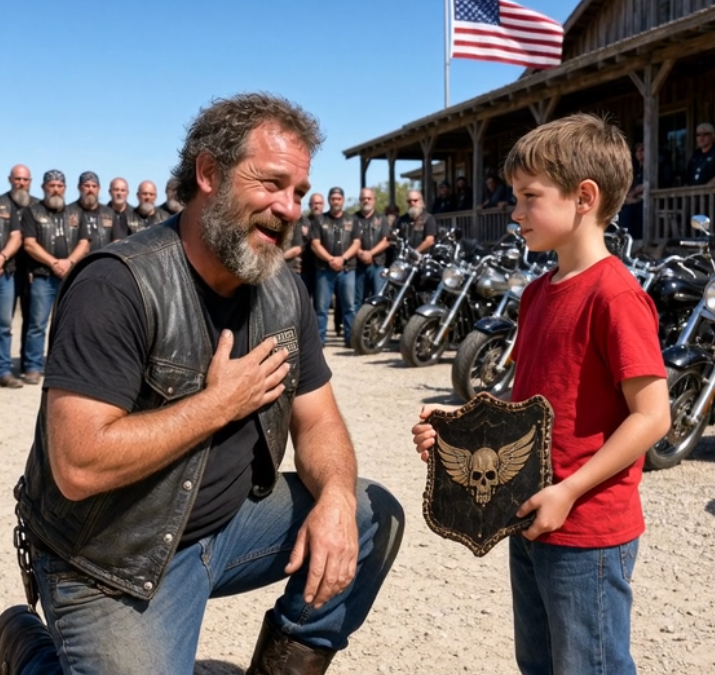
Then, without one word of warning, the enormous man lowered himself to one knee in the dust so his eyes were level with Eli’s.
It looked painful.
He did it anyway.
“You have your father’s eyes,” Bear said.
His voice was rough, like gravel under tires.
Eli did not know what to say.
People had told him that before, but never like this. Usually they said it with sadness, as if his face had accidentally hurt them. Bear said it like Eli was carrying something precious and the sight of it nearly knocked him down.
“Same steady look,” Bear continued. “Same way of paying attention before speaking.”
Eli held out the leather scrap.
Bear stared at it.
His mouth opened, then closed.
He reached toward it, then stopped.
“May I?”
Eli nodded.
Bear took the scrap in his big hand as if it were made of glass.
“That came from Flint’s old vest,” he whispered.
“Wade said you told him to fix it.”
Bear let out a broken laugh.
“I did. He told me the tear gave it character.”
“That sounds like Dad.”
Bear closed his eyes.
“Yeah. It does.”
Then Eli said the thing that had been sitting in him since the gas station.
“Dad said you made pancakes bigger than plates.”
The laugh that came out of Bear was not small.
It burst from him, shook once, then broke into something close to a sob.
“That lying fool,” Bear said, wiping at his eyes. “They were normal pancakes. He was just bad at describing food.”
A few riders laughed behind him.
Eli smiled.
Bear’s face softened.
“Your dad used to eat six of them and then complain he couldn’t move.”
“He did that with Mom’s biscuits.”
Brenna made a small sound behind him.
Bear looked at her.
“Brenna,” he said gently.
She nodded, unable to speak.
“I’m sorry,” Bear said.
Two words.
Plain.
Heavy.
Brenna hugged herself.
“For what?”
“For not finding you. For not knowing. For letting Flint’s boy grow up thinking this part of him was gone.”
Brenna’s face crumpled.
“You didn’t know.”
“No,” Bear said. “But I still hate that we didn’t.”
Eli looked at the huge man kneeling in the dust.
Something in him decided.
He stepped forward and wrapped his arms around Bear’s neck.
Bear froze.
Then he held Eli carefully, not too tight, one enormous hand across his back.
The hug felt different from his mother’s hugs.
Brenna’s hugs were soft and afraid, as if she thought grief might crack him if she held wrong.
Bear’s hug felt like a wall.
Not trapping him.
Holding the world back.
“We’re here now,” Bear murmured. “Late, but here.”
Inside, the clubhouse quieted the moment Eli stepped through the doorway.
Not because it was empty.
Because everyone stopped talking.
The room was larger than it looked from outside. Wooden floors. Old sofas. A long table made from thick planks. Motorcycle parts displayed like strange art. Framed photos covered the walls: charity rides, veterans’ events, cookouts, Christmas toy drives, men and women standing beside bikes in rain, dust, sun, and snow.
In one photo near the door, Daniel Mercer stood between Wade and Bear.
Younger.
Smiling.
Alive.
Eli stopped.
His father wore the vest.
The whole patch was visible, except for the tear near one wing.
His arm was slung around Wade’s shoulder. Bear stood behind them holding a spatula like a weapon.
Eli moved toward the photo.
Brenna followed, one hand pressed to her chest.
“That was him,” she whispered.
Wade stood beside her.
“After the charity ride for the children’s hospital. He spent the whole afternoon fixing a generator that wasn’t ours.”
Brenna laughed through tears.
“That sounds like him.”
Eli touched the photo frame.
“Can I see more?”
Bear looked around the room.
“Kid, we can bury you in embarrassing pictures.”
Chairs were pulled into a loose circle.
Coffee appeared in mismatched mugs. Someone brought lemonade for Eli. A woman named Jo put a plate of cookies on the table and told him she would deny it if anyone said she baked them, because she had a reputation to protect.
The room softened.
That was the only way Eli could explain it.
At first, the men and women seemed too large, too intense, too full of patches and scars and deep voices. But once they sat, once they began talking, they became something else.
People who had missed his father.
People who had stories.
Not funeral stories.
Not the polished things adults say when someone dies.
Real stories.
“Flint once tried to teach Bear’s nephew how to change a tire,” said a man called Mac. “Kid was six. Couldn’t lift the wrench.”
“Flint said every man ought to know,” Bear said.
“He also said that about folding fitted sheets,” Jo added.
“Because none of you savages knew how,” Wade said.
Bear pointed at him. “Do not bring domestic skills into my clubhouse.”
The room laughed.
Eli laughed too.
It came out before he could stop it.
Everyone heard.
No one made it too big.
That helped.
A thin older man named Luis, who everyone called Padre though he insisted he was not a priest, told Eli that Daniel whistled whenever he worked on an engine.
“A terrible whistle,” Luis said. “Same three notes. Over and over. Drove us insane.”
“He whistled when he fixed our sink,” Brenna whispered.
Eli looked at her.
“You remember?”
She nodded, tears on her cheeks.
“I had forgotten until now.”
Another rider said Daniel could never tell a short story.
“He’d start telling you about buying spark plugs and somehow end up explaining a conversation he had with a dog in a parking lot in Tucson.”
“That dog understood me,” Wade said solemnly.
“No one understands you,” Jo replied.
Laughter filled the room again.
But not all the stories were funny.
Bear told Eli that Daniel had once stayed all night at a hospital with a rider whose wife had been in surgery, even though he barely knew the man at the time.
“He didn’t like people being alone in bad rooms,” Bear said.
Wade told him Daniel always carried extra gloves on winter rides because somebody forgot theirs.
“He pretended to be annoyed,” Wade said. “But he packed three extra pairs every time.”
Jo told him that Daniel loved kids.
“If a kid waved from a car, he’d wave back like the president had personally requested it.”
Eli smiled.
His father had done that.
He remembered.
From the back seat, when Daniel drove him to kindergarten, Eli used to wave at bikers, truck drivers, police officers, dogs, anybody. Daniel always waved too. Big, ridiculous waves that made Eli laugh until his stomach hurt.
For months after the accident, Eli had been afraid that if he remembered too much, it would make his mother sadder. So he had tried to remember quietly.
But in that room, remembering did not make Daniel disappear.
It made him bigger.
Not larger than life.
More life.
More whole.
Brenna sat beside him, listening as if someone had opened a window in a room she had kept closed too long.
She cried often.
No one stared.
No one told her to stop.
At one point, Wade handed her a napkin without interrupting Bear’s story about Daniel accidentally setting a grill brush on fire.
She took it and whispered, “Thank you.”
Wade only nodded.
Later, when the first round of stories had softened into quieter conversation, Eli asked the question he had carried most carefully.
“Did he talk about me?”
The room went still.
Not empty still.
Careful still.
Bear looked at Wade.
Wade looked at Brenna.
Brenna’s hand found Eli’s shoulder.
Bear leaned forward, elbows on knees.
“Yes,” he said.
Eli’s throat tightened.
“But you didn’t know I was his son.”
Bear nodded slowly.
“That’s true. We didn’t know your name. We didn’t know where you were. Flint kept that part private.”
“Why?”
Brenna made a small sound, but Bear held up one hand gently—not stopping her, only asking permission to answer honestly.
“I think because he was ashamed of who he had been before you.”
Eli frowned.
“My dad was good.”
“He was,” Bear said immediately. “But good people can still carry shame. Your dad came to us during a rough part of his life. He was angry. Reckless. Hurt in ways he didn’t explain. The brotherhood gave him a place to put that instead of letting it destroy him. But when he met your mom and then became your father, he wanted to be better.”
“He was better,” Brenna said, voice breaking.
Bear looked at her.
“Yes, ma’am. He was.”
Wade spoke then.
“He told us he had a son without telling us he had a son.”
Eli looked confused.
Wade smiled sadly.
“He would say things like, ‘There’s a little guy I’m trying to deserve.’ Or ‘I need to stop being stupid because somebody small is watching.’ Once, after a bad storm, he said he used to think home was where you slept, but now home had a voice that asked for cereal at six in the morning.”
Eli’s mouth trembled.
“That was me.”
“Yes,” Wade said. “That was you.”
Brenna covered her face.
Bear’s voice became rougher.
“He loved you before we knew your name.”
That sentence did something Eli did not expect.
It hurt.
But it also settled somewhere deep, like a piece finding its place.
He had wondered, secretly, whether Daniel had hidden the brotherhood because Eli was separate from it. Because fatherhood had replaced it. Because the patch belonged to a part of Daniel that Eli was not invited to know.
But maybe Daniel had hidden it because he did not know how to bring his past and his future into the same room.
Maybe he had been planning to.
Maybe someday, when Eli was older, he would have said, Come on, buddy, there are some people I want you to meet.
Maybe death had interrupted before he got the chance.
Eli hated death for that.
Not for the first time.
Wade disappeared into a back room while Bear was telling Brenna about a toy drive Daniel had helped organize.
When Wade returned, he carried a small cardboard box sealed with old tape.
The room went quiet again.
The kind of quiet Eli had felt at the funeral, but different.
Not cold.
Sacred.
Wade set the box on the table in front of Brenna and Eli.
“What is that?” Brenna asked.
Wade looked at Bear.
Bear nodded once.
Wade said, “Flint left this here.”
Brenna’s face went white.
“When?”
“About a year before he died.”
She shook her head slightly.
“No.”
“He said if anything ever happened, and if we ever met the little guy he’d been trying to deserve, we should give it to him.”
Eli stopped breathing.
Brenna stared at the box.
“You had this all this time?”
Wade flinched.
“Yes.”
“And you never—”
“We didn’t know where to send it,” Bear said, voice heavy. “We didn’t even know who to ask. Flint never gave us your last name then. After he died, the accident report used Daniel Mercer, but by the time we connected it, the funeral had passed. We went to the address we found. House was empty. We tried the number we had. Disconnected.”
Brenna looked down.
“We moved six weeks after.”
“I know,” Bear said. “We found out too late.”
Brenna’s eyes filled with pain so sharp Eli felt it in his own chest.
“All this time,” she whispered.
“I’m sorry,” Wade said.
She looked at him.
This time, her voice held anger.
“My son carried a torn scrap in his pocket because he thought it was all he had left. And this was sitting in a back room?”
Wade absorbed the words like he deserved them.
“Yes,” he said. “And I am sorry.”
Bear leaned forward.
“If you need to be angry, be angry at us. Not at yourself. Not at him.” He nodded toward the box. “But don’t let anger keep that closed if it belongs to Eli.”
Brenna closed her eyes.
Her hand trembled as she touched the tape.
Then she pulled back.
“Eli,” she whispered. “Do you want to open it?”
Eli nodded.
But when he reached for the box, his fingers would not work.
Wade handed him a pocketknife, then stopped.
“May I help?”
Eli nodded again.
Wade cut the tape carefully.
The sound seemed too loud.
Inside the box was another box.
Wooden.
Small.
Handmade.
The lid had the silver hawk burned into the top, but beneath it was something else.
Eli’s name.
ELI
Not perfectly carved.
A little crooked.
Exactly like Daniel’s handwriting looked when he labeled things in the garage.
Brenna made a broken sound.
“My God,” she whispered. “He made that.”
Eli touched the letters.
His father had carved his name.
His father had held this box.
His father had thought of him.
Inside was a folded letter, a photograph, a small toy motorcycle wrapped in cloth, a tarnished keychain shaped like a wrench, and a patch.
Not the brotherhood patch.
A smaller one.
A child-sized patch.
The silver hawk at sunrise.
Beneath it:
ELI MERCER
LITTLE HAWK
Eli could not move.
Brenna reached for the letter.
Her hands shook.
“It’s addressed to both of us,” she said.
She unfolded it.
For a moment, she only stared.
Then she began to read aloud.
Bren,
If this box reaches you, it means I never got brave enough to give it to you myself, or life did something cruel before I could fix what I was still trying to fix.
I’m sorry for both.
I know I kept the Iron Hawks separate from our home. I told myself I was protecting you from the roughest parts of me. Maybe I was. Maybe I was also hiding because I didn’t know how to admit that the brotherhood helped save me before I knew how to let you save me too.
Brenna stopped.
Her voice failed.
Wade bowed his head.
Bear stared at the floor.
She swallowed and continued.
Those men are not perfect. God knows Bear is too loud, Wade is too serious, Jo cheats at cards, Mac cannot cook, and Padre gives advice even when nobody asked. But they loved me when I was not easy to love. If I become the man I want Eli to know, part of that came from them.
I want Eli to know the good parts of me. Not the polished parts. The true parts.
I want him to know I was scared sometimes. I want him to know I made mistakes. I want him to know love is not pretending you were never broken. Love is letting people help you become better than you were.
Eli, if you’re reading this someday, hey, buddy.
Eli pressed both hands over his mouth.
The room blurred.
Brenna’s voice shook harder, but she kept reading.
I don’t know how old you are. Maybe you’re still little. Maybe you’re taller than your mom by now, which will make her furious, so don’t mention it too much.
The room gave a soft, tearful laugh.
I want you to have this patch because you are part of every good thing I ever tried to become. You don’t have to ride motorcycles. You don’t have to be like me. You don’t have to carry my mistakes or my unfinished dreams.
But you should know this: there are people in the world who will stand with you if you let them.
If you ever meet the Iron Hawks, make Bear show you the pancake trick. It’s not a trick. He just uses too much batter and acts proud. Tell Wade he still owes me twenty bucks. Tell Jo I know she marked the deck. Tell Mac his chili is a crime. Tell Padre I heard every word, even when I pretended not to.
And tell them I said thank you.
Brenna paused again.
Tears fell onto the paper.
The last part was shorter.
Bren, I love you. I know I wasn’t always easy. But you and Eli are my home.
Eli, I love you bigger than the Arizona sky.
Be steady. Be kind. And when something hurts too much to carry alone, find your people.
Dad.
No one spoke after she finished.
The ceiling fan hummed overhead.
Outside, a motorcycle ticked as its engine cooled.
Eli stared at the patch in the box.
Little Hawk.
He reached for it, but his vision blurred so badly he could barely see.
Bear moved first.
The enormous man stood, walked away, and faced the wall, one hand over his mouth.
Jo wiped her eyes openly.
Wade sat down hard in the nearest chair.
Brenna folded the letter carefully and pressed it to her chest.
Eli picked up the patch.
The thread was thick.
The hawk bright.
His father had wanted him to have it.
Not because Eli had earned it.
Because he belonged.
“Can I wear it?” Eli asked.
Bear turned back.
His face was wet.
“Son,” he said, voice breaking, “nothing in this room would honor us more.”
A denim vest appeared.
Eli did not know from where.
Maybe they had extras. Maybe someone found one in the back. Maybe this brotherhood had a way of producing exactly the right thing when grief demanded ceremony.
It was a little too big, but Wade rolled the shoulders and Jo pinned the patch in place for now, promising to sew it properly later.
When Eli put it on, the room stood.
All of them.
Every rider.
Every brother and sister.
Bear walked to the center of the room and placed one hand over his heart.
“The Iron Hawk Brotherhood recognizes Eli Mercer,” he said, voice thick but strong, “son of Daniel ‘Flint’ Mercer, as Little Hawk. Not because he rides. Not because he has to become anything for us. But because he is Flint’s boy, and because family left behind is still family.”
Eli could not stop crying.
He tried.
He was nine.
He hated crying in front of strangers.
But they were not strangers anymore, and nobody laughed, nobody looked away in discomfort, nobody told him to be brave in the way adults usually meant stop feeling.
Bear knelt again.
“May I?”
Eli stepped into his arms.
This time, the whole room seemed to come around him.
Not touching all at once.
Just close.
A circle.
A wall.
A promise.
Brenna sat in the chair with Daniel’s letter in her hands, crying so hard Jo sat beside her and put an arm around her shoulders.
“I should have let him have this sooner,” Brenna whispered.
Jo answered gently, “You were surviving.”
“I packed him away.”
“No,” Jo said. “You kept breathing until the door opened again.”
Brenna looked at her.
Jo smiled sadly.
“Sometimes that’s all a person can do.”
The evening stretched into night.
Nobody wanted to leave.
Pizza arrived. Eli ate two slices and half a cookie, which Brenna noticed because she had spent months watching him pick at food whenever grief swallowed his appetite. Someone found more photos. Someone else brought out a photo album labeled FLINT, 2012–2018 in messy marker.
Eli saw his father younger than he remembered.
Daniel with longer hair.
Daniel covered in grease.
Daniel asleep in a lawn chair with a paper plate balanced on his stomach.
Daniel holding a sign at a charity ride that said RIDE FOR RYAN, while standing beside a little boy with no hair and a huge smile.
Daniel hugging Bear.
Daniel arguing with Jo over a deck of cards.
Daniel sitting alone on the clubhouse porch at sunset, looking down at something in his hands.
“What’s he holding?” Eli asked.
Wade leaned close.
The photo was a little blurry.
Then his face changed.
“Your baby picture.”
Brenna looked over.
“What?”
Wade pointed.
“He showed me that photo once. Said it was the only picture that ever made him afraid.”
Eli frowned.
“Why?”
Wade smiled faintly.
“Because he wanted to deserve you so badly.”
Brenna touched the album page.
“He did.”
Eli leaned against her.
“He did, Mom.”
She put her arm around him.
“Yes,” she whispered. “He did.”
At nine o’clock, Brenna said they had to go.
Eli did not want to.
The panic rose faster than he expected.
“What if we don’t come back?” he asked.
The room quieted.
Brenna crouched in front of him.
“We’ll come back.”
“When?”
She looked at Bear.
Bear answered.
“Saturday morning. Breakfast. Pancakes.”
Eli looked suspicious.
“Big ones?”
Bear sat back proudly.
“Legendary.”
Wade muttered, “Dangerous.”
Jo said, “Undercooked in the middle.”
Bear pointed at all of them.
“Lies from jealous people.”
Eli laughed.
The panic loosened.
Bear handed Brenna a card with his number, Wade’s number, Jo’s number, and the clubhouse address.
“Any time,” he said. “Questions. Trouble. Memories. Flat tire. School project. Bad day. You call.”
Brenna looked at the card like she was not sure she deserved it.
Wade said, “He was ours too. Let us help carry him.”
That made her cry again.
But this time, she did not apologize.
The ride home was quiet.
Eli wore the denim vest over his T-shirt.
The patch was only pinned, and Brenna kept reminding him not to pull at it.
He held Daniel’s letter in both hands.
Brenna drove slower than usual.
The desert outside had turned dark, the sky full of stars so sharp they looked close enough to touch. Eli thought of what his father had written.
I love you bigger than the Arizona sky.
He had always thought the sky was too big to measure.
Maybe that was the point.
When they got home, Brenna did not tell him to put the box away.
Instead, she cleared a space on the kitchen table.
They laid everything out carefully.
The letter.
The photograph.
The toy motorcycle.
The wrench keychain.
The torn scrap.
The Little Hawk patch.
Brenna went to the hallway closet.
Eli followed.
She pulled down the plastic bin she had not opened in months.
For a moment, she rested both hands on the lid.
Then she opened it.
Daniel’s leather vest lay on top.
The damaged patch on the back was missing the piece Eli carried.
Brenna lifted the vest out slowly.
“I thought putting things away would make it easier,” she said.
Eli stood beside her.
“Did it?”
She shook her head.
“No. It just made the house quieter.”
He touched the torn area.
“Can we fix it?”
Brenna looked at him.
Then at the scrap.
“I think maybe we should leave it.”
“Because scars tell the truth?”
Her face crumpled into a smile.
“Because scars tell the truth.”
The following Saturday, Eli woke before sunrise.
He dressed himself in jeans, his cleanest sneakers, and the vest with the pinned patch. He sat at the kitchen table until Brenna came out in her robe and nearly dropped her coffee mug.
“You’re awake early.”
“Pancakes.”
“Of course.”
At the clubhouse, Bear had not exaggerated.
The pancakes were enormous.
Possibly too enormous.
Possibly illegal in several states.
Eli ate one and declared himself a champion.
Bear gave him a small wrench.
Brenna laughed for the first time in a way that did not sound like it had to push through pain to reach the air.
That became their new rhythm.
Not every Saturday.
Life was not a movie. There were school projects, stomach bugs, bills, work schedules, hard days when Brenna could not face the clubhouse, and harder days when Eli wanted nothing but the clubhouse and could not understand why grief still had rules.
But they returned.
Again and again.
The Iron Hawks did not replace Daniel.
No one could.
They did something more honest.
They helped him become speakable.
Before the gas station, Daniel’s name lived carefully in Brenna’s house. It appeared on anniversaries, at bedtime, sometimes in tears, often in silence. After the Iron Hawks, his name began to move again.
Daniel would have hated this burnt toast.
Your dad once tried to fix a blender and made it worse.
Flint said every bike has a voice if you listen.
Your father loved that song.
Your father was stubborn.
Your father was kind.
Your father was wrong sometimes.
Your father tried.
That mattered most to Eli.
He did not want a saint.
Saints felt far away.
He wanted a father.
The Iron Hawks gave him Daniel back with grease under his nails, bad jokes in his mouth, fear in his chest, and love big enough to leave a box behind.
Brenna changed too.
Slowly.
The first time she stayed at the clubhouse after Eli went outside with Bear to look at a bike, Wade found her standing near Daniel’s photo.
“I hated motorcycles after he died,” she said.
Wade stood beside her.
“I can understand that.”
“I blamed them.”
“He died in a truck accident, Brenna.”
“I know.” She wiped her eyes. “Grief doesn’t care about accuracy.”
Wade smiled sadly.
“No. It doesn’t.”
“I thought if Eli loved anything from Daniel’s old life, I’d lose him too.”
Wade did not answer quickly.
That was one of the reasons Brenna began to trust him.
He did not rush to make pain tidy.
Finally, he said, “Daniel’s old life helped him reach the life he built with you.”
She looked at him.
“That’s what I’m learning.”
For Eli’s tenth birthday, the Iron Hawks gave him a vest that fit.
The Little Hawk patch was sewn properly onto the back. The stitching was neat and strong, done by Jo, who threatened violence against anyone who claimed she was sentimental.
Bear gave Eli a photo of Daniel eating pancakes with a miserable expression.
Wade gave him a set of small tools.
Padre gave him a journal.
“Your dad wrote things down when he couldn’t say them,” Padre said.
Eli took the journal seriously.
That night, his first entry was:
Today I turned ten. Dad’s friends came. Mom smiled. Bear’s pancakes are too big. Wade says engines are easier when you listen before touching. I think people are too.
The journal became a place for questions.
Some he asked adults later.
Some he kept.
Did Dad know he was good?
Why did he hide the brotherhood?
Can people be scared and brave at the same time?
If I forget his voice, does that mean I loved him less?
One afternoon, after finding Eli crying over that last question, Brenna took out her phone and played Daniel’s old voicemail greeting.
“Hey, it’s Dan. Leave a message unless you’re calling about your car warranty, in which case congratulations on being a robot.”
Eli laughed and sobbed at the same time.
They saved the recording in three places.
Wade helped make a digital backup.
Bear said no machine on earth should be trusted fully, so he recorded it again on an old handheld device he kept in the clubhouse “for emergencies and ghosts.”
By the end of that year, Eli knew how to change oil, patch a bicycle tire, scramble eggs without burning them too badly, and identify almost every patch on the Iron Hawk wall.
He also knew grief did not disappear because a room filled with love.
Sometimes grief sat right in the middle of the table while everyone passed syrup around it.
On Daniel’s birthday, Eli asked if they could go to the clubhouse.
Brenna hesitated.
Then said yes.
When they arrived, the Iron Hawks had already set up a small table with Daniel’s photo, a candle, a wrench, and a plate of pancakes.
Brenna broke down before she reached the porch.
Bear met her halfway.
She tried to apologize.
He shook his head.
“No apologies on birthdays.”
They ate. They cried. They laughed. They told stories Eli had heard and stories he had not.
Then Wade handed Eli a marker.
“What’s this for?”
Wade pointed to a wooden beam near the clubhouse door. It was covered in names written in black marker.
Brothers and sisters lost.
People loved.
Lives carried forward.
“Flint’s name is already there,” Wade said. “But you can add something if you want.”
Eli stood before the beam for a long time.
Then, beneath DANIEL “FLINT” MERCER, he wrote:
MY DAD. HE CAME BACK IN STORIES.
When Brenna saw it, she had to sit down.
Years passed, as years do, both slowly and all at once.
Eli grew taller.
His voice changed.
His questions changed.
At twelve, he asked Bear whether Daniel had ever gotten into real trouble.
Bear looked at Brenna first.
She nodded.
So Bear told him the truth.
Not every detail.
Enough.
He told Eli that Daniel had been angry after his own father died young. That he drank too much for a while. That he rode too fast because part of him did not care whether he made it home. That the Iron Hawks had not saved him through speeches, but through showing up, again and again, until Daniel ran out of ways to pretend he did not need people.
Eli listened.
Then said, “So he was broken.”
Bear shook his head.
“No. He was hurting. There’s a difference.”
At thirteen, Eli stopped wearing the vest for almost six months.
Brenna worried.
Bear told her not to chase him with it.
“Let him decide what belonging looks like at thirteen,” he said. “At thirteen, I belonged mostly to bad hair decisions.”
Eli still came to the clubhouse sometimes, but less eagerly. He wanted friends his age. Video games. Basketball. Space. He did not want to be the dead biker’s kid every Saturday.
The Iron Hawks let him be.
That was another gift.
They did not turn love into obligation.
On his fourteenth birthday, Eli wore the vest again.
No announcement.
No explanation.
He simply arrived wearing it.
Bear saw and looked away quickly, pretending the grill needed attention.
Wade smiled into his coffee.
At fifteen, Eli began helping at charity rides.
Not riding, not yet.
Registration table.
Water station.
Helping younger kids choose helmets for bicycle safety events.
He was good with kids who were shy or overwhelmed.
He did not crowd them.
He had learned from being handled carefully.
At sixteen, he asked Brenna if he could take motorcycle safety classes someday.
Brenna turned white.
Eli immediately said, “Not now. Someday.”
She took a long breath.
“Someday we can talk about it.”
“That means no.”
“That means I love you and have blood pressure.”
He laughed.
They did talk about it, eventually.
With Wade.
With safety instructors.
With boundaries.
With tears.
With Daniel’s photo on the kitchen table because Brenna said if they were going to make decisions about his legacy, he could at least supervise silently.
Eli learned to ride at seventeen.
Not because he wanted speed.
Because he wanted to understand the road his father had loved and feared.
His first ride with the Iron Hawks was not a roaring highway scene.
It was a short, slow loop on a closed training course while Brenna watched with both hands pressed together under her chin.
When Eli stopped, removed his helmet, and smiled, Brenna cried.
Bear did too, but claimed desert dust.
At eighteen, Eli stood in front of the Iron Hawk Brotherhood during a memorial ride for fallen members and read from Daniel’s letter.
Not the whole thing.
Just one part.
I want Eli to know the good parts of me. Not the polished parts. The true parts.
His voice carried clearly over the gathered riders.
Then he looked up.
“My father left me a box because he was afraid he would not know how to open the door himself. For a long time, my mom and I lived on one side of that door. The brotherhood lived on the other. Grief kept it closed. Fear kept it locked. But one day at a gas station, a patch made me brave enough to ask a question.”
He looked at Wade.
Wade’s eyes were wet.
“Thank you for answering.”
Then he looked at Brenna.
“And thank you for saying yes even though you were scared.”
Brenna covered her mouth.
Eli touched the patch on his vest.
“People say blood makes family. Sometimes it does. But sometimes family is a man kneeling in the dust because he sees your father in your face. Sometimes it is a room full of people telling stories until a dead man feels alive enough for his son to know him. Sometimes it is a patch sewn onto a vest that says you belong before you understand why.”
The riders stood silent.
Even the engines seemed quiet.
Eli finished with Daniel’s words.
“When something hurts too much to carry alone, find your people.”
Then Bear stepped forward and embraced him.
The applause came later.
The hug came first.
Brenna kept the original torn leather scrap in a frame beside Daniel’s box.
The full vest hung below it.
The tear remained unfixed.
Not because they lacked thread.
Because some missing pieces become part of the story.
The scrap Eli had carried in his pocket for months was mounted next to the torn space on Daniel’s patch, close enough that anyone could see where it belonged, but not reattached.
A small plaque beneath it read:
THE PIECE THAT LED HIM HOME.
When Eli left for college in Tucson, he took the Little Hawk vest with him.
Brenna asked whether he wanted to leave it safely at home.
He looked at her as if she had suggested leaving his lungs behind.
“No.”
She smiled.
“Okay.”
He also took the toy motorcycle from Daniel’s box, the wrench keychain, and a copy of the letter.
The original stayed with Brenna.
On his first night away, he called her from the dorm parking lot.
Not because something was wrong.
Because he had seen a motorcycle pass on the street and missed home.
Brenna sat at the kitchen table, touching Daniel’s letter.
“You can come home whenever you need,” she said.
“I know.”
“And you can stay there and be okay too.”
He was quiet.
Then he said, “Mom?”
“Yes?”
“I think Dad would be proud.”
Brenna looked at the photo of Daniel on the wall.
“He would be unbearable.”
Eli laughed.
It was one of her favorite sounds.
Years later, when people asked Eli why he worked with grieving children through a motorcycle charity, he never gave the short answer.
The short answer was easy.
My dad died. His biker brotherhood helped me.
But the true answer was longer.
The true answer was a gas station outside Prescott. A silver hawk patch. A torn scrap in a boy’s pocket. A mother terrified to open the past. A stranger named Wade who did not push. A man called Bear kneeling in the dust. A box Daniel Mercer had carved by hand. A letter honest enough to let a son love his father fully, not perfectly.
The true answer was that grief becomes dangerous when it is locked away alone.
But when shared carefully, it can become a road.
Not away from the person lost.
Toward a life where their love still moves.
Eli never stopped missing Daniel.
That mattered too.
Finding the Iron Hawks did not cure the ache of fatherless birthdays, empty bleachers, unfinished conversations, or the sharp pain of watching other boys stand beside their dads at graduation.
But it changed the shape of the ache.
It gave it witnesses.
It gave it stories.
It gave it pancakes too big for plates and a clubhouse beam with his father’s name on it.
It gave him people who could say, “Your dad would have loved this,” and mean it because they had loved him too.
And Brenna?
She learned that protecting a child from grief by hiding every reminder can sometimes make grief lonelier.
She forgave herself slowly.
Not in one speech.
Not in one dramatic moment.
In small acts.
Leaving Daniel’s photo on the table.
Letting Eli wear the vest.
Going to the clubhouse even on days it hurt.
Telling stories she had once swallowed.
Laughing when she remembered something funny instead of apologizing for not crying.
Eventually, she and Wade became friends.
True friends.
The kind who could sit on the clubhouse porch after everyone else went inside and talk about Daniel without turning him into a saint or a wound.
One evening, years after the gas station, Brenna asked Wade, “Do you think Daniel meant for us to find you?”
Wade looked out at the line of motorcycles under the setting sun.
“I think Daniel hoped the door would open someday,” he said.
“And if Eli hadn’t seen your patch?”
Wade smiled faintly.
“Then maybe we’d still be waiting on opposite sides of it.”
Brenna nodded.
The desert sky burned orange and purple behind the bikes.
“He carried that scrap everywhere,” she said.
“I know.”
“I used to think it was unhealthy.”
“What do you think now?”
She looked toward the clubhouse, where Eli and Bear were arguing about whether pancakes counted as dinner.
“I think sometimes children know which pieces matter.”
Wade nodded.
Inside, Bear shouted, “Pancakes are an anytime food!”
Eli shouted back, “That doesn’t make them dinner!”
Brenna laughed.
The sound moved into the evening, light and real.
Daniel was not there.
But somehow, because of the people who remembered him, because of the boy who had refused to let go of a torn piece of leather, because of the mother who had finally dared to open the past, his love was.
That was what remained.
Not the accident.
Not only the loss.
The love.
The patch.
The box.
The brotherhood.
The son who found the courage to ask a stranger one quiet question.
Years later, Eli would still remember every detail of that gas station.
The heat rising off the pavement.
The outdoor ice freezer humming beside him.
The grocery bag stretching in his mother’s hand.
The smell of gasoline and dust.
The silver hawk on Wade’s vest.
The way his own voice shook when he said, “My dad had a patch like yours.”
He would remember Wade’s face changing.
He would remember his mother saying they needed to leave.
He would remember deciding, for the first time since Daniel died, that protecting his mother from pain could not mean losing another piece of his father.
And he would remember the road after.
The engines gathering.
The clubhouse door.
Bear dropping to one knee.
The box on the table.
The letter.
Little Hawk.
Family left behind is still family.
That sentence would follow him his whole life.
When he became a man, when he helped other children who carried grief in pockets, backpacks, locked drawers, and silence, Eli would tell them the truth he had learned at nine years old.
You are allowed to keep a piece.
A photo.
A shirt.
A voicemail.
A smell.
A song.
A torn scrap of leather no one else understands.
People may call it unhealthy. They may say you should move on. They may pack boxes because they are scared of what remembering will do.
But love does not disappear because someone puts it away.
Sometimes the smallest piece becomes the map.
Sometimes a torn wing leads you back to the whole hawk.
Sometimes a patch on a stranger’s vest becomes a door.
And sometimes, when you are brave enough to ask, “Did you know my dad?” the answer does not only bring back stories.
It brings back family.
Eli Mercer found his father’s brotherhood because he refused to let go of a broken piece.
And in the end, that broken piece was not broken at all.
It was the part that led him home.








