A 9-Month-Old Kitten Finally Found His Forever Home—Then the Blue Collar I Bought Him Never Made It Around His Neck
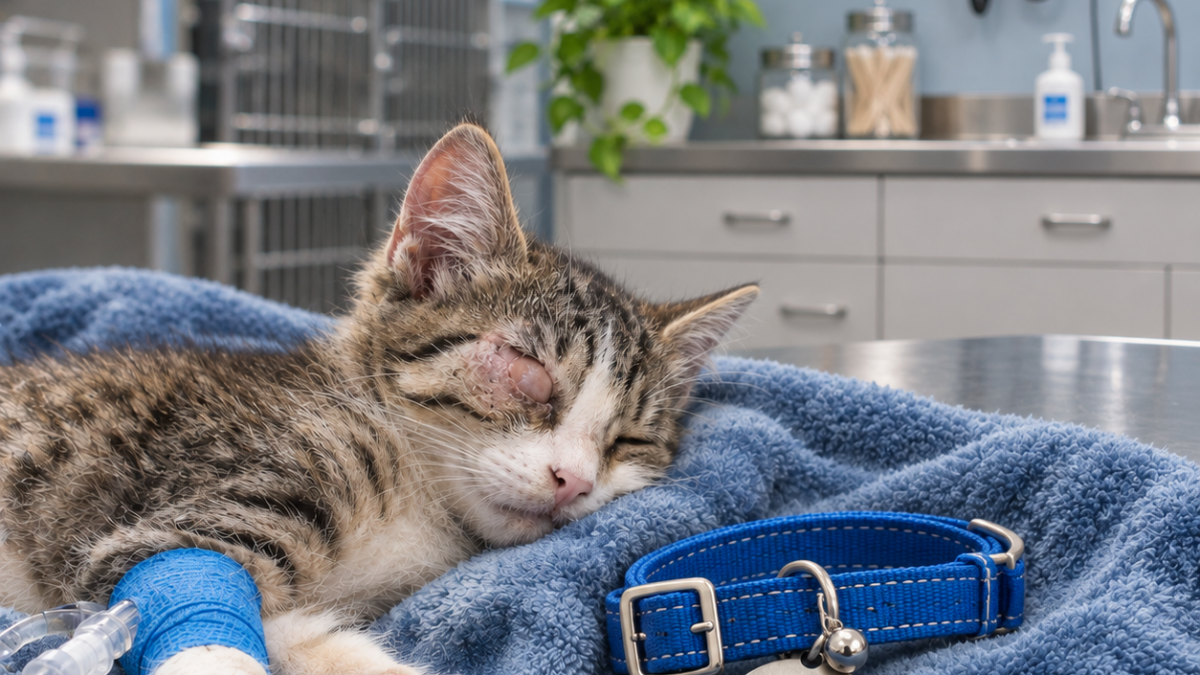
A 9-Month-Old Kitten Finally Found His Forever Home—Then the Blue Collar I Bought Him Never Made It Around His Neck.
I bought a tiny blue collar for a nine-month-old kitten named Pippin after a lonely seventy-one-year-old man looked at him and whispered, “I guess I’ve been picked.”
On the little silver tag, beneath Pippin’s name, I had two words engraved because for the first time in his short, painful life, they were finally true: I’M HOME.
Three days later, I was sitting at my kitchen table holding that collar in both hands while the cat bed waiting beside Eldon Mercer’s recliner remained empty forever.
My name is Darla Penrose.
I’m fifty-eight years old, and for almost twelve years I’ve helped rescue animals in a small Pennsylvania town where everybody seems to know which dogs bark at mail trucks, which barn cats belong to nobody, and which veterinarian will still answer her phone after midnight.
I’ve bottle-fed kittens at two in the morning.
I’ve driven injured dogs through snowstorms.
I’ve sat in parking lots with people who had just surrendered animals they loved because they could no longer afford medical care.
I’ve seen happy endings.
I’ve seen endings I still don’t know how to talk about.
But when my house gets quiet, when the foster room is empty and there is nothing moving except the clock above my kitchen door, Pippin is the one I think about.
He was only nine months old.
That is the part that still feels unfair.
Nine months is barely enough time for a kitten to figure out which windows get afternoon sun.
It is not enough time to have one bad life and then finally start a good one.
The first time I saw Pippin, he was curled into the farthest corner of a plastic carrier at Dr. Corinne Vale’s veterinary clinic.
Corinne had called me that morning.
“Darla, I’ve got a kitten here who needs somewhere safe.”
That sentence was never good.
People imagine rescuers receiving dramatic calls every day.
Most are quieter.
Someone is moving.
Someone died.
Someone cannot afford treatment.
A cat was found behind a restaurant.
A dog has been tied outside too long.
A litter appeared beneath a porch.
But something in Corinne’s voice made me put my coffee down before she finished speaking.
“What happened?”
“He’s young.”
“Front leg fracture.”
“Old injury to one eye.”
“Several healed scars.”
“Current caretakers can’t manage what he needs.”
She paused.
“They’ve agreed to surrender him to rescue care.”
“How old?”
“About nine months.”
I closed my eyes.
“Is he stable?”
“Yes.”
“In pain?”
“Managed.”
“Can I take him today?”
“I was hoping you would.”
I arrived twenty minutes later.
Corinne met me in the treatment room.
She was forty-five, calm in the way good veterinarians often become after years of learning that panic does not help frightened animals.
She nodded toward the carrier.
“He hasn’t tried to bite.”
“That’s good.”
“He hasn’t tried to do much of anything.”
That was worse.
I crouched.
Pippin was small.
Smaller than I expected for nine months.
Orange-and-white.
Thin.
His front left leg rested awkwardly against his body.
One eye was clear and amber.
PART2:
The other was clouded from an older injury that had healed poorly before he ever reached Corinne.
There were small scars along one shoulder and beneath his fur.
Nothing fresh.
Nothing dramatic.
Just evidence that comfort had not been a regular part of his life.
I put my hand near the carrier door.
He pressed himself farther back.
I did not touch him.
“Hey, sweetheart.”
One ear moved.
“I’m Darla.”
Corinne leaned against the counter.
“You know he doesn’t understand introductions.”
“I do.”
“Then why do you always introduce yourself?”
“Because I understand them.”
Corinne smiled.
Fair enough.
I opened the carrier.
Not wide.
Just enough to slide a folded towel inside.
Then I sat on the floor.
That was all.
No reaching.
No pulling him out.
PART3:
No baby voice trying to convince him the world had suddenly become safe because I said so.
Animals that have been frightened for a long time do not owe us immediate trust.
Twenty minutes passed.
Corinne came and went.
A technician stepped over my legs twice.
Pippin barely moved.
I finally put one hand on the floor.
Palm down.
Not near him.
Just there.
“I’m going to get too old for this floor someday.”
Nothing.
“I’ll probably keep doing it anyway.”
Still nothing.
Then, just as I started shifting my weight to stand, something touched my finger.
Barely.
One paw.
Tiny.
Pippin had stretched forward just far enough to put the tips of his toes against my hand.
He pulled them back immediately.
That was it.
I had handled animals bleeding badly enough that I could see bone.
I had watched dogs arrive so thin I could count every rib.
I had sat through euthanasias where families could not stop apologizing to the animal they loved.
That one little paw broke me more than many of those moments.
Because it was not trust.
Not yet.
It was a question.
Are you safe?
I whispered:
“I’ll try to be.”
That afternoon Pippin came home with me.
My foster room was small.
Warm.
Quiet.
No cages except when medically necessary.
I set up a low bed with soft sides so he would not have to climb.
Heating pad under half of it.
Food and water close.
Litter box with a shallow entrance.
A little stuffed gray mouse one of our volunteers had donated.
Corinne sent pain medication and strict instructions.
“Do not let him jump.”
“He can barely walk.”
“He’s a kitten.”
“Kitten logic does not respect orthopedic injuries.”
“I know.”
“Call if he stops eating.”
“I will.”
“Call if his breathing changes.”
“I will.”
“Call if—”
“Corinne.”
She looked at me.
“I’ll call.”
I took Pippin home.
For the first two days, he mostly slept.
He ate.
That mattered.
He drank.
Used the litter box.
Accepted his medication hidden in wet food.
But he did not seek me out.
I would sit on the floor and read invoices.
Answer rescue messages.
Fold towels.
Sometimes talk to him.
No expectations.
On the third evening, I noticed his clear eye following me around the room.
When I stood, he watched.
When I sat, he watched.
When I left, his head lifted.
That was progress.
Fourth morning, I opened the door and found him sitting near it.
Not close enough to touch.
Waiting.
“Well.”
I sat down.
“Good morning to you too.”
He took two limping steps toward me.
Stopped.
I placed my hand on the floor.
He sniffed.
Then rubbed one cheek against my knuckle.
My heart nearly stopped.
By the fifth morning, he purred.
Tiny sound.
So soft I thought at first it was the heating pad vibrating.
I scratched beneath his chin.
There it was again.
A little motor trying to remember how to run.
I cried.
Right there.
Sitting cross-legged on the floor like an idiot while Pippin leaned into my fingers.
People sometimes ask how rescuers avoid getting attached.
We don’t.
Not if we’re doing it honestly.
You learn boundaries.
You learn that loving an animal and keeping an animal are different things.
You learn to hand them to good families even when part of you wants to close the door and pretend nobody came.
But attachment?
No.
You do not stop that.
You just learn to survive it.
Pippin’s leg required surgery.
Corinne took new radiographs.
The fracture needed stabilization.
She ran bloodwork.
Preoperative evaluation.
Everything looked reassuring.
“He’s young.”
She showed me the films.
“This is fixable.”
“Eye?”
“Probably limited vision.”
“Pain?”
“Not from the old injury as far as I can tell.”
“So he can have a normal life?”
Corinne looked at me.
“That’s the goal.”
Those words made me reckless enough to imagine things.
Running.
Jumping.
A window perch.
Somebody complaining he knocked a glass off a counter.
Normal cat trouble.
I wanted that for him.
Then I posted his photograph.
Not an adoption listing exactly.
More of an update.
Pippin was not ready to go anywhere until after surgery and recovery.
The picture showed him wrapped in a cream blanket.
One clear amber eye looking toward the camera.
I wrote:
This little guy has had a rough beginning, but we’re hoping the rest of his story gets much softer.
The next morning, my phone rang.
“Is this Darla?”
“Yes.”
“My name is Eldon Mercer.”
His voice sounded older.
Gentle.
“I’m calling about the orange kitten.”
“Pippin?”
“Yes.”
“I know he’s not ready yet.”
“That’s right.”
“I just wanted to ask about him.”
That was how I first met Eldon.
Seventy-one.
Retired machinist.
Widower.
Lived alone in a small house outside town.
His wife, Margaret, had died three years earlier.
They had been married forty-six years.
Their old cat, Annie, died the previous spring at seventeen.
“The house is too quiet,” Eldon told me.
There was no self-pity in his voice.
Just fact.
“I don’t need a fancy cat.”
“I’m not sure cats know which ones are fancy.”
He chuckled.
“You know what I mean.”
“I do.”
“Just somebody to keep me company.”
I explained Pippin’s injuries.
Broken leg.
Surgery.
Cloudy eye.
Unknown long-term needs.
Eldon listened.
Then:
“I’ve got one bad knee.”
“Can’t see a thing without my glasses.”
“Take four pills every morning.”
“Sounds like we’d have plenty to talk about.”
I laughed.
That was the first time I thought:
Maybe.
Not because Eldon sounded lonely.
Loneliness is not enough reason to adopt an animal.
But because he never asked whether Pippin would become pretty.
Never asked if the eye would clear.
Never asked whether he would be playful.
He asked:
“Does he like being near people yet?”
“A little.”
“What scares him?”
“Sudden movement.”
“What food does he like?”
“Chicken.”
“Does he sleep through the night?”
“Mostly.”
“Would stairs be difficult after surgery?”
“Yes.”
“I can keep everything downstairs.”
Then:
“Could I meet him?”
I said yes.
The following afternoon Eldon arrived in a brown jacket and carried nothing.
No toy.
No treats.
No expectation that the kitten should perform.
I liked that.
I brought him into the foster room.
“Sit here.”
He lowered himself carefully into the chair beside Pippin’s bed.
His knee bothered him more than he had admitted.
Pippin watched.
Eldon did not reach.
He simply started talking.
“I’ve got three bird feeders outside my kitchen window.”
Pippin blinked.
“Cardinals come in the morning.”
“Blue jays are thieves.”
“One squirrel has figured out how to hang upside down from the feeder.”
Pippin’s ear turned toward him.
Eldon continued.
“My wife, Margaret, used to yell at the squirrels.”
“She’d stand at the window like they cared.”
Pippin shifted.
“I told her they were winning.”
“She told me to mind my own business.”
I sat quietly near the door.
Eldon talked about his garden.
Tomatoes.
Peppers.
How Margaret always planted too many zucchini.
How she left a lamp on in the front room whenever he worked late.
His voice changed when he mentioned her.
Not breaking.
Softening.
Pippin slowly moved to the edge of the blanket.
Eldon noticed.
Did nothing.
That was exactly right.
The kitten took another small step.
His injured leg held close.
Then stretched one paw toward Eldon’s hand.
Touched him.
Eldon stopped speaking.
Pippin left the paw there.
I saw Eldon’s eyes fill.
He whispered:
“Well.”
Then, after a moment:
“I guess I’ve been picked.”
I turned my face away because there are only so many times one woman can cry in a foster room before she loses all authority.
Eldon stayed almost an hour.
Before leaving, he asked:
“If his surgery goes well…”
“Yes?”
“I’d like to be the one waiting for him.”
I said:
“Let’s get him through surgery first.”
“I know.”
“But can I get ready?”
“Yes.”
That evening Eldon sent me a photograph.
His living room.
Old recliner beside a window.
Small cat bed on the floor.
Inside it:
A faded green knitted blanket.
His message:
Tell Pippin his room is ready.
I called him.
“Is that Margaret’s blanket?”
“Yes.”
“She made it?”
“Long time ago.”
“You sure you want a cat sleeping on it?”
He paused.
Then said:
“That’s what blankets are for.”
The next morning I drove into town.
I did not need to buy Pippin anything.
Eldon had already told me he planned to get supplies.
But I wanted something small.
Something marking the transition.
Foster kitten.
Adopted cat.
I stood in the pet aisle looking at collars.
Red.
Green.
Black.
Purple.
Then blue.
Soft fabric.
Tiny silver bell.
Adjustable.
I imagined it against Pippin’s orange fur.
I bought it.
At the engraving kiosk, I typed:
PIPPIN.
For the reverse side, I stared at the screen.
Phone number?
Eldon’s address?
Too early.
Then I typed two words.
I’M HOME.
I watched the machine scratch them into metal.
I still have no good explanation for why that mattered so much to me.
Maybe because Pippin had spent his short life being passed through situations that never became safe enough to belong to.
Maybe because Eldon had made space before the kitten ever arrived.
Maybe because rescuers spend so much time moving animals between temporary places that “home” becomes one of the most beautiful words we know.
I put the collar in my purse.
I planned to give it to Eldon after surgery.
The night before the operation, Pippin was unusually affectionate.
He limped into my lap on his own.
First time.
I froze.
Did not want to scare him away.
He turned once.
Curled against my stomach.
Purred.
Louder now.
I stroked his head.
“You’re getting brave.”
Purr.
“You know you have a house waiting?”
Purr.
“Birds.”
“Old man.”
“Green blanket.”
Pippin pressed his face into my hand.
I whispered:
“You have no idea how good you’ve got it coming.”
That sentence still hurts.
The morning of surgery, I drove him to Corinne’s clinic.
He complained once from the carrier.
A tiny meow.
I told him:
“You’re fine.”
At the clinic, Corinne examined him.
Heart.
Lungs.
Temperature.
Bloodwork already good.
Everything as expected.
She scratched his chin.
“Ready?”
Pippin purred.
Corinne looked surprised.
“He likes me now.”
“No.”
“He likes everybody now.”
“That’s worse.”
“Why?”
“Harder to give him up.”
I laughed.
Pippin rubbed his cheek against my fingers.
I leaned down.
“Be a good boy.”
His clear eye looked at me.
“You’ve got somebody waiting.”
Then the technician carried him toward surgery.
I went home.
Made coffee.
Did not drink it.
Answered emails.
Washed dishes already clean.
Checked my phone approximately every thirty seconds.
At 10:17, it rang.
CORINNE VALE.
I answered before the second vibration.
“Hey.”
Silence.
Not much.
Enough.
“Darla.”
I sat down.
“What happened?”
Corinne’s professional voice was gone.
“We had a cardiac arrest under anesthesia.”
My hand closed around the edge of the table.
“No.”
“We started resuscitation immediately.”
“No.”
“We gave emergency drugs.”
“Ventilated.”
“Everything.”
“Corinne.”
“I’m so sorry.”
“No.”
She was crying now.
That scared me more than anything.
Corinne did not cry during phone calls.
“Please.”
“We couldn’t bring him back.”
My kitchen went silent.
Not quiet.
Silent.
The kind where you notice electricity humming inside the refrigerator.
I do not remember ending the call.
I remember opening my purse.
I do not know why.
Maybe I was looking for keys.
Instead I saw blue.
The collar.
Still attached to the cardboard display strip.
I took it out.
Held it.
Silver bell.
Tiny tag.
PIPPIN.
I turned it over.
I’M HOME.
I sat at my kitchen table.
And I stared at those words until I could no longer see them clearly.
My first thought was ridiculous.
Eldon’s cat bed.
Not Pippin.
The bed.
I pictured it beside his recliner.
Margaret’s green blanket.
Lamp.
Bird feeders outside the window.
Empty.
I kept thinking:
He almost made it.
As though there had been some finish line.
One surgery.
Then recovery.
Then Eldon.
Then home.
Pippin had gotten close enough that we could see it.
That made losing him feel crueler.
I had been doing rescue nearly twelve years.
I knew anesthesia was not nothing.
I knew complications existed.
I knew medicine does not guarantee outcomes because we want them badly.
None of that helped.
Calling Eldon was harder than calling families after animals died in rescue care because Eldon had not even gotten his beginning.
He answered:
“Darla.”
I could not speak immediately.
His voice changed.
“What happened?”
I told him.
Slowly.
Surgery.
Cardiac arrest.
Resuscitation.
Corinne.
Gone.
Eldon made no sound.
When I finished, there was a long silence.
Then he asked:
“Was he alone?”
That question nearly destroyed me.
“No.”
“Corinne was there.”
“Her staff was there.”
“They did everything.”
Another silence.
Then Eldon said:
“But before that…”
His voice broke.
“Did he know somebody loved him?”
I closed my eyes.
“Yes.”
I told him about the night before.
Pippin climbing into my lap.
Purring.
Waiting at the foster-room door.
Reaching for my hand.
Sleeping warm.
Eating well.
Being spoken to gently.
I told him:
“He knew people were safe.”
“I believe that.”
Eldon began crying.
Not loudly.
Then he whispered:
“Then at least he knew.”
I wanted that sentence to comfort me.
It did not.
Not then.
I wanted more.
I wanted years.
I wanted Pippin sitting on Eldon’s windowsill.
I wanted cat hair on the green blanket.
I wanted scratched furniture.
Vet bills.
Midnight zoomies.
Eldon calling me because Pippin refused a particular brand of food after happily eating it for six months.
I wanted ordinary annoyances.
“Then at least he knew” felt far too small.
The next morning, Eldon arrived at my house.
He carried the little cat bed.
I opened the door and immediately started crying.
“You don’t have to bring that back.”
“I know.”
“Keep it.”
He shook his head.
“I don’t want it sitting empty.”
He carried it into the rescue room.
Placed it beneath the window.
Then returned to his truck.
Came back with the green blanket.
I stared.
“Eldon.”
“My wife made six of these.”
“That one was ours.”
“I know.”
“You don’t have to—”
“Margaret would be furious if I packed it away because I was sad.”
He folded it into the bed.
“There are other cats.”
I could not say anything.
Eldon looked around the room.
“Maybe an old one.”
“What?”
“Maybe some old cat nobody asks about can use it.”
I sat beside him.
“Are you sure?”
“No.”
That made me laugh through tears.
He smiled sadly.
“But do it anyway.”
I went to my purse.
Took out Pippin’s collar.
“I bought this.”
Eldon held it.
Read the name.
Turned the tag over.
His face collapsed.
I’M HOME.
He pressed the collar into his palm.
For a moment I thought he might keep it.
Then he handed it back.
“Put it somewhere.”
“Where?”
“Where people can see.”
So we hung Pippin’s collar beside the foster-room doorway.
Nothing elaborate.
A small hook.
Below it, I printed one photograph.
Pippin on the cream blanket.
Clear amber eye.
Tiny face.
Underneath, I wrote:
PIPPIN
9 MONTHS
No inspirational quote.
No explanation.
I could not reduce him to a lesson yet.
For several weeks, I avoided looking directly at the collar.
I would see blue in the corner of my eye.
Keep walking.
There were animals to feed.
Applications to review.
Medication schedules.
Laundry.
Rescue work has an inconvenient mercy.
It does not stop because your heart is broken.
Three weeks after Pippin died, Eldon called.
“I’d like to come by.”
“For another cat?”
“No.”
“Okay.”
“Just come by.”
He arrived with a newspaper.
Sat in the foster room.
The green blanket was occupied.
By Marbles.
A twelve-year-old tortoiseshell whose owner had died.
Marbles disliked nearly everyone.
She stared at Eldon.
He opened the newspaper.
“Local council is raising property taxes again.”
Marbles blinked.
“Thought you’d want to know.”
She turned away.
Eldon continued reading.
Twenty minutes later, Marbles walked over.
Sat beside his shoe.
He did not touch her.
Next week, Eldon returned.
Then again.
Sometimes he read.
Sometimes he talked about Margaret.
Sometimes he sat quietly.
Cats came near him because he did not ask them to.
One afternoon I found Marbles sleeping partly on his foot.
“You know she hates people.”
“She has good judgment.”
“Apparently not.”
He smiled.
Eventually Marbles was adopted by a woman in her sixties.
Eldon helped carry her carrier to the car.
Then returned to the rescue room.
Sat beside the empty green blanket.
For a moment, I worried the emptiness would hurt him all over again.
He smoothed one corner.
“Good.”
“What?”
“She got picked.”
I understood.
Eldon never adopted another cat.
Not during the next year.
He said he was not ready.
I believed him.
But he became part of the rescue.
Not officially.
No volunteer shirt.
No schedule.
He simply arrived.
Tuesday afternoons usually.
Newspaper under one arm.
Sometimes treats.
He sat with the cats nobody had asked about.
The old ones.
Shy ones.
Cats hiding beneath blankets.
Cats recovering from surgery.
He read aloud.
Weather.
Baseball.
Obituaries.
Politics, until I banned politics from the cat room because his commentary was upsetting the kittens.
He complained.
I held firm.
“Sports only.”
“What if the Pirates are terrible?”
“They usually are.”
“Fair.”
The cats loved him.
Or tolerated him.
With cats, the distinction can be philosophical.
Pippin’s collar remained beside the door.
Months passed.
The silver bell never rang.
That bothered me.
I had imagined hearing it across Eldon’s hardwood floor.
Instead it hung completely still.
One afternoon, a new volunteer named Grace asked:
“Whose collar is that?”
I told her.
Not the full story.
Just enough.
Young kitten.
Injured.
Adopter waiting.
Died during surgery.
Grace looked at the tag.
“I’m home.”
“Yes.”
“But he never went to the adopter.”
“No.”
She looked confused.
“Then why leave that on it?”
For months, I had asked myself the same thing.
The words felt like a mistake.
A cruel engraving made before I knew better.
Then I thought about Pippin’s final days.
The towel.
Heating pad.
Stuffed mouse.
My hand.
Corinne.
Eldon sitting beside him talking about birds.
For the first time in his life, people had been arranging their days around making him comfortable.
Maybe home is not only an address.
I told Grace:
“Because I think it was still true.”
That was the first time I believed it.
Grief changes shape.
At first it is accusation.
Why?
Why him?
Why now?
Why after everything?
Why let us get close enough to imagine the future?
Then it becomes memory.
Not easier exactly.
Wider.
You remember more than the ending.
I remembered Pippin’s first paw on my finger.
The tiny purr.
Eldon saying:
“I guess I’ve been picked.”
I remembered the photograph of the waiting bed.
Not only the phone call.
That helped.
Corinne carried the loss too.
Veterinarians do.
People sometimes act as though a medical complication belongs only to the pet’s family or rescue.
Corinne called me two days later.
“I keep reviewing it.”
“Don’t.”
“I need to.”
“Anything you would’ve done differently?”
Silence.
“No.”
“Anything in the labs?”
“No.”
“Anything in the exam?”
“No.”
“Then stop punishing yourself.”
She laughed bitterly.
“You sound like me.”
“You taught me.”
Anesthesia complications can happen even when screening looks reassuring.
Rare does not mean impossible.
Knowing that intellectually did not make Pippin less dead.
But it mattered that nobody had ignored a warning.
Nobody had rushed him carelessly.
His death was tragic.
Not neglect.
That distinction mattered to me because Pippin had already had enough neglect in his life.
His final chapter deserved truth.
A year after his death, Eldon showed up carrying a small wooden frame.
He had made it himself.
Inside was a photograph of Pippin touching his paw to Eldon’s hand.
I did not know anyone had taken it.
Apparently I had.
On my phone.
Eldon had asked me for the file months earlier without saying why.
Beneath the photograph he had placed a tiny brass plate.
PIPPIN
HE PICKED ME FIRST.
I started crying.
“You’re terrible.”
“I know.”
He hung it below the blue collar.
Now the collar had context.
Visitors stopped.
Asked.
Some cried.
Some did not.
A few people adopted older cats after hearing about Pippin.
I am careful saying that.
I do not like stories that turn a dead animal into a marketing device.
Pippin did not die so somebody else could be adopted.
There was no cosmic bargain.
But his story changed how people saw animals with uncertain futures.
That mattered.
One couple arrived looking for a kitten.
Then met a ten-year-old orange cat named Franklin.
The husband said:
“Ten seems old.”
Eldon, reading nearby, looked up.
“So am I.”
The man laughed.
Eldon returned to his newspaper.
They adopted Franklin.
Another woman hesitated over a one-eyed cat.
I told her about Pippin.
Not to guilt her.
To explain that an imperfect eye does not make an imperfect companion.
She went home.
Returned the next morning.
Adopted the cat.
Eldon said nothing.
Later:
“Pippin would’ve liked her.”
“You met him once.”
“Long enough.”
That was Eldon.
Certain about things he had no evidence for.
Usually harmless.
By the second anniversary, I could touch Pippin’s collar without crying every time.
Not every time.
His little silver bell had tarnished slightly.
I polished it.
Eldon watched.
“You’re cleaning a collar nobody wears.”
“Yes.”
“Good.”
I looked at him.
“Why good?”
“Some things deserve taking care of even if they aren’t useful anymore.”
That sounded like Margaret.
I asked.
“She say that?”
“All the time.”
“About what?”
“Me, usually.”
I laughed.
Eldon eventually adopted.
Not a kitten.
Not even a cat I expected him to choose.
Her name was Dottie.
Fifteen years old.
Black.
Thin.
Kidney disease.
Arthritis.
No teeth left except four.
Her owner had entered assisted living.
Dottie had spent three months in foster care because everyone said the same thing.
Too old.
Eldon came in one Tuesday.
Sat.
Read.
Dottie climbed into his lap.
Not beside him.
Onto him.
Eldon stopped reading.
I looked over.
He whispered:
“Oh, no.”
I smiled.
“What?”
“She’s doing it.”
“Doing what?”
“Picking me.”
Dottie went home with Eldon two weeks later after medical review and home preparation.
The green blanket returned to his house.
He placed it in the same little bed beside his recliner.
This time, an animal slept there.
He sent me a photograph.
Dottie curled into a black comma.
Message:
Occupied.
I cried again.
Because apparently that had become my main hobby.
Dottie lived eleven months.
Some people might call that another sad ending.
Eldon did not.
When she died, he called me.
“She got almost a year.”
“Yes.”
“She slept on Margaret’s blanket every day.”
“I know.”
“Then we did okay.”
That was the sentence Pippin had been trying to teach me before I was ready.
Length is not the only measure of a good ending.
Dottie had eleven months.
Pippin had days.
Of course I wanted more for both.
Wanting more does not mean what they had was meaningless.
Pippin’s final days were not enough.
But they were different.
Warm.
Fed.
Medicated.
Safe.
Touched only gently.
Spoken to as if his life mattered.
A man he barely knew had already made space for him.
That counted.
Years have passed now.
I still rescue.
I still get too attached.
Corinne still tells me to stop sitting on clinic floors because my knees make noises when I stand.
Eldon is older.
He visits less often.
But he still comes.
His newspaper is mostly digital now, which he hates.
He brings a tablet and complains it does not fold properly.
The cats do not care.
Pippin’s photograph remains beside the foster-room door.
The collar above it.
Blue faded slightly.
Silver bell quiet.
One afternoon, a little girl visiting with her mother pointed toward it.
“Did that cat get adopted?”
I looked at Pippin’s photograph.
What answer do you give a child?
“Yes.”
Technically, the paperwork never finished.
Pippin never crossed Eldon’s doorway.
Never slept on the green blanket.
Never watched birds.
But he had been chosen.
She asked:
“Where did he go?”
I crouched.
“He died before he got to his new house.”
Her face fell.
“Oh.”
Then she read the tag.
“But it says he was home.”
“Yes.”
“Why?”
I looked toward Eldon.
He was sitting across the room reading to an elderly gray cat.
Then I looked back at the child.
“Because sometimes home starts before you get to the house.”
She thought about that.
Children do that better than adults.
Then she nodded.
“Okay.”
Maybe that is all I have been trying to understand since Pippin died.
I spent months believing the tragedy was that he had almost reached home.
Three more days.
One surgery.
A recovery period.
Then Eldon.
That was the future I had written in my head.
When it disappeared, I thought the entire ending disappeared with it.
But Pippin did reach something.
He reached the part where people stopped failing him.
That is not nothing.
Before rescue, his body carried scars.
A broken leg.
Damaged eye.
Fear.
By the end, he reached for hands.
He waited by the door.
He purred.
He climbed into my lap.
He touched Eldon’s fingers as if making a choice.
Animals do not understand adoption applications.
They do not understand engraved tags.
They do understand warmth.
Pain easing.
Food arriving.
A person who waits instead of grabbing.
A voice becoming familiar.
A hand that never hurts.
Maybe those were Pippin’s version of the words I put on his tag.
I’m home.
I still wish I had heard that little bell.
I can imagine it perfectly.
Eldon in his recliner.
Newspaper spread across his knees.
Pippin chasing something invisible down the hallway.
Bell jingling.
Eldon shouting:
“Stop running on that leg!”
Pippin ignoring him.
Morning light across the hardwood floor.
Birds at the kitchen window.
The green blanket covered in orange hair.
I wanted that life for him.
I always will.
There is no lesson big enough to make losing it fair.
I do not believe every sad story happens for a reason.
Sometimes a kitten dies at nine months old after surviving things he should never have experienced.
Sometimes the people waiting to love him are left holding empty beds.
Sometimes medicine tries and loses.
That is the truth.
But another truth can exist beside it.
Pippin did not die unwanted.
He did not die forgotten.
He did not die thinking every human hand meant fear.
Corinne was beside him.
I loved him.
Eldon was waiting.
And if love could have carried him through that surgery by itself, he would have lived forever.
The blue collar still hangs beside the rescue-room door.
Sometimes it moves when someone opens the window.
The little silver bell makes one soft sound.
Every time, I look up.
For half a second, I still imagine an orange kitten running through Eldon’s house.
Then the room returns.
Other cats.
Other beds.
Other animals waiting for someone.
And I go back to work.
Because Pippin’s story did not teach me that love always saves them.
It doesn’t.
It taught me something harder.
Love still matters when it cannot change the ending.
Sometimes we get fifteen years.
Sometimes eleven months.
Sometimes only a few days.
We do not get to choose.
What we can choose is what those days feel like.
Pippin spent his last ones warm.
Comfortable.
Fed.
Safe.
He learned to purr.
He learned to reach for a hand instead of hiding from it.
He met an old man who had already placed a bed beside his favorite chair.
And for one brief moment in a little room in Pennsylvania, a frightened kitten put his paw on that man’s hand and chose him.
Pippin never wore the blue collar I bought.
He never heard its bell.
He never slept beneath Eldon’s window.
But I no longer believe those two words were wrong.
He had finally found people who were waiting for him.
People who knew his name.
People who would miss him.
People who had already made room.
Pippin was home.








