A 78-Year-Old Widow Was Trapped in Her Attic for 31 Hours as Floodwater Rose—Then Her 6-Pound Cat Jumped Into the Water Twice and Came Back Carrying Something in Her Mouth.
PART3:
But she watched everything.
Florence pouring coffee.
Florence taking medicine.
Florence folding laundry.
Florence sitting alone at the kitchen table with George’s empty chair across from her.
Minnow followed her from room to room as if Florence were something fragile that needed supervision.
Every evening, when Florence watched the news, Minnow sat on the arm of the couch.
Every night, she slept on the pillow beside Florence’s head.
Every morning, when sunlight came through the kitchen window, Minnow jumped onto the table and watched Florence take her heart medication.
Florence had a pacemaker.
High blood pressure.
A long list of instructions written in careful print on papers from doctors who were young enough to be her grandchildren.
The most important pill was small and blue.
She took one in the morning and one at night.
The bottle sat on the kitchen windowsill above the sink because that was where the morning light hit first.
Light was Florence’s reminder.
Minnow became the second.
If Florence forgot, Minnow would sit on the kitchen table and stare.
“You are not my nurse,” Florence would say.
Minnow would stare harder.
Florence would take the pill.
“Bossy little thing.”
Minnow would blink slowly, satisfied.
For nine years, that was their rhythm.
An old woman.
A small cat.
A house by a river.
A life that looked lonely from the outside but had become, in its own quiet way, bearable.
Then, at the end of April, the ice jam broke upstream.
It happened on a Wednesday afternoon.
Florence remembered the exact sound.
Not thunder.
Not an explosion.
Something lower.
A deep, rolling crack that seemed to move through the earth before it reached the air.
Minnow lifted her head from the couch.
Florence, who had been washing a teacup in the kitchen, turned toward the window.
The river beyond the backyard had changed color.
It was no longer brown.
It was black.
Dark water rushed past the trees faster than Florence had ever seen it move.
Branches spun in the current.
A piece of someone’s fence slammed against an oak and disappeared.
Florence dried her hands slowly.
“Well,” she whispered.
That was all she said.
Then the emergency siren began.
The sound rose from town, thin and terrible.
Florence walked to the wall phone.
Dead.
She picked up her cell phone from the counter and saw only twelve percent battery.
No service.
Minnow jumped down from the couch.
The water came faster than Florence believed possible.
By the time she crossed the living room, it had swallowed the lowest part of the backyard.
By the time she placed a few things in her purse, it had reached the back steps.
By the time she called Claire and got nothing but a failed connection, muddy water was pushing beneath the kitchen door.
Florence stood still for one second too long.
That was the mistake she would remember forever.
One second of disbelief.
One second of thinking, It has never reached the porch.
One second of trusting fifty-one years over what her own eyes could see.
Then cold water rushed across the kitchen floor.
Minnow hissed and leapt onto a chair.
Florence moved.
She grabbed her purse.
Her wool cardigan.
The flashlight from the drawer.
Then Minnow.
The cat squirmed once, frightened by the water already swirling around Florence’s ankles.
“I know,” Florence said. “I know, baby.”
She could not make it outside.
The front steps were already gone beneath the flood.
The road was a current.
A trash can floated past the porch and struck the railing with a hollow bang.
Florence turned toward the narrow stairway that led to the second floor.
Halfway up, her arthritis screamed through both knees.
She clutched Minnow to her chest and kept climbing.
The second floor was dry.
For a moment, Florence thought that would be enough.
She stood in the hallway, breathing hard, listening to water smash through the rooms below.
Then she heard glass break.
The kitchen window.
The river was entering her home now, not politely through seams and cracks, but violently, as if it had found the right to everything.
Florence looked up.
The attic.
There was a narrow wooden staircase behind a door at the end of the hall.
George had built extra shelves up there years ago.
Christmas decorations.
Old trunks.
Boxes of photographs.
A cedar chest.
A small window facing the river.
Florence climbed.
Minnow pressed her face into Florence’s neck.
By the time they reached the attic, Florence’s lungs burned.
She opened the small window.
Cold air struck her face.
The view below made her stomach turn.
Water surrounded the house.
Not puddles.
Not a flooded yard.
A moving, living thing.
The river had taken the lawn, the driveway, the road, the lower porch, the lilac bush George had planted, the shed, the mailbox.
Florence sat on the old cedar chest beneath the window.
Minnow climbed into her lap.
“It’ll stop,” Florence whispered.
She believed it because she needed to.
At dusk, the first floor was completely underwater.
At nightfall, water seeped through the attic floorboards.
Not much.
At first.
Just a dark line spreading between wooden planks.
Then drops.
Then small, cold fingers touching the soles of Florence’s slippers.
The attic was unheated.
Outside, the temperature fell close to forty degrees.
Florence wore only a thin cotton house dress and the wool cardigan she had grabbed on the way up.
Her purse sat beside her.
Inside were tissues, a wallet, a packet of peppermint candy, a photograph of George, and the little notebook where she wrote blood pressure readings.
No medicine.
The white plastic bottle was still on the kitchen windowsill.
Above the sink.
Where morning light always reminded her.
Except now the sink was beneath four feet of freezing, muddy water.
Florence had taken her morning pill.
She had not taken the evening one.
One missed dose might be all right.
Maybe two.
Not three.
She knew that with the calm, practical terror of a woman who had lived with her own heart as an unreliable companion for eleven years.
She shouted from the attic window for nearly an hour.
“Help!”
Her voice vanished beneath the roar of water.
The nearest neighbor’s house stood nearly a quarter mile away.
Or had stood.
She could not see it in the dark.
She could see nothing but moving black water and bits of the world floating past.
A chair.
A cooler.
Branches.
Something that looked like a child’s plastic slide.
Minnow remained on her lap, trembling and purring.
That was Minnow’s habit.
Whenever Florence was upset, Minnow purred as if she could patch fear with vibration.
Florence stroked her wet-looking little head with shaking fingers.
“It’s all right,” she lied.
At 11:30 that night, Florence did something she later said she could never fully explain.
She took Minnow’s small face between both hands.
She looked into the cat’s yellow eyes.
“I need my medicine,” she whispered. “The little bottle. Near the sink. Do you understand? The little white bottle.”
Minnow stared at her.
Florence almost laughed at herself.
She was an old woman in an attic talking to a cat because the world had shrunk to one living creature who could hear her voice.
“You can’t, of course,” she whispered. “I’m sorry. I don’t know why I said that.”
Then Minnow jumped down from her lap.
“Minnow?”
The cat walked to the window.
She placed both front paws on the sill.
Outside, the floodwater churned beneath them, black and cold.
Florence’s heart lurched.
“No.”
Minnow climbed onto the sill.
“No, baby. No.”
Florence reached for her.
Minnow jumped.
Florence screamed.
The sound tore out of her so violently that it hurt her throat.
She stumbled to the window and looked down.
For a second, she saw a flash of white in the black water.
Tiny.
Terribly tiny.
Then she heard frantic splashing.
The rapid, desperate movements of a cat trying to swim.
“Minnow!”
The water swallowed the sound.
Then the splashing vanished.
Florence stood at the window, one hand pressed against the frame, unable to breathe.
She had killed her.
That was all she could think.
She had spoken a foolish sentence into the cold, and a faithful animal had obeyed what she should never have asked.
For twenty minutes, Florence cried harder than she had cried since George’s funeral.
She called Minnow’s name until her voice broke.
She cursed herself.
She begged God.
She promised everything she had left to promise.
The attic grew colder.
Water continued to seep through the floor.
Her hands went numb around the window frame.
At 12:14, by the watch on her wrist, Florence heard a wet thud beneath the attic window.
She stopped crying.
Another scrape.
A weak sound.
She leaned out as far as she dared.
Minnow was clinging to the outside trim below the window.
Her body was soaked flat against her bones.
Her claws scraped desperately against the old wood siding.
Florence made a sound she did not recognize as her own.
She grabbed Minnow by the scruff and shoulders and pulled her inside.
The cat collapsed against the floorboards.
She had nothing in her mouth.
Florence did not care.
She wrapped Minnow in her wool cardigan and held her against her chest.
The cat trembled so violently Florence could feel it in her ribs.
“Oh, baby,” Florence sobbed. “I’m sorry. I’m so sorry. I never should’ve said it.”
Minnow was too cold to purr.
That frightened Florence more than anything.
For forty minutes, she held her inside the cardigan, rubbing her gently, breathing warm air against her fur.
Minnow’s trembling slowly eased.
Not stopped.
Eased.
“You’re staying right here,” Florence whispered. “Do you hear me? You stay with me.”
Minnow opened one eye.
Then, as if Florence had not spoken at all, she pushed herself out of the cardigan.
“No.”
Minnow staggered toward the window.
“No, no, no.”
Florence tried to grab her, but the cat moved with sudden desperate purpose.
She climbed onto the sill.
Florence lunged.
Her fingers brushed wet fur.
Minnow jumped again.
Florence did not scream this time.
Shock stole the sound.
She collapsed beside the window and stared into the darkness.
The second wait was worse.
The first time, panic had filled her.
This time there was something colder.
Knowledge.
Minnow knew what was below.
She had felt the water.
She had climbed the siding.
She had nearly frozen in Florence’s arms.
And still she had gone back.
Florence began to pray.
Not beautifully.
Not with memorized words.
“Please. Please. Please. Please.”
For more than an hour, there was nothing.
Only the flood.
Only the dark.
Only the attic floor growing wetter beneath her.
Only her own heart beating wrong inside her chest.
At 1:47, she heard the sound again.
A wet thud.
Then scratching.
Florence leaned out.
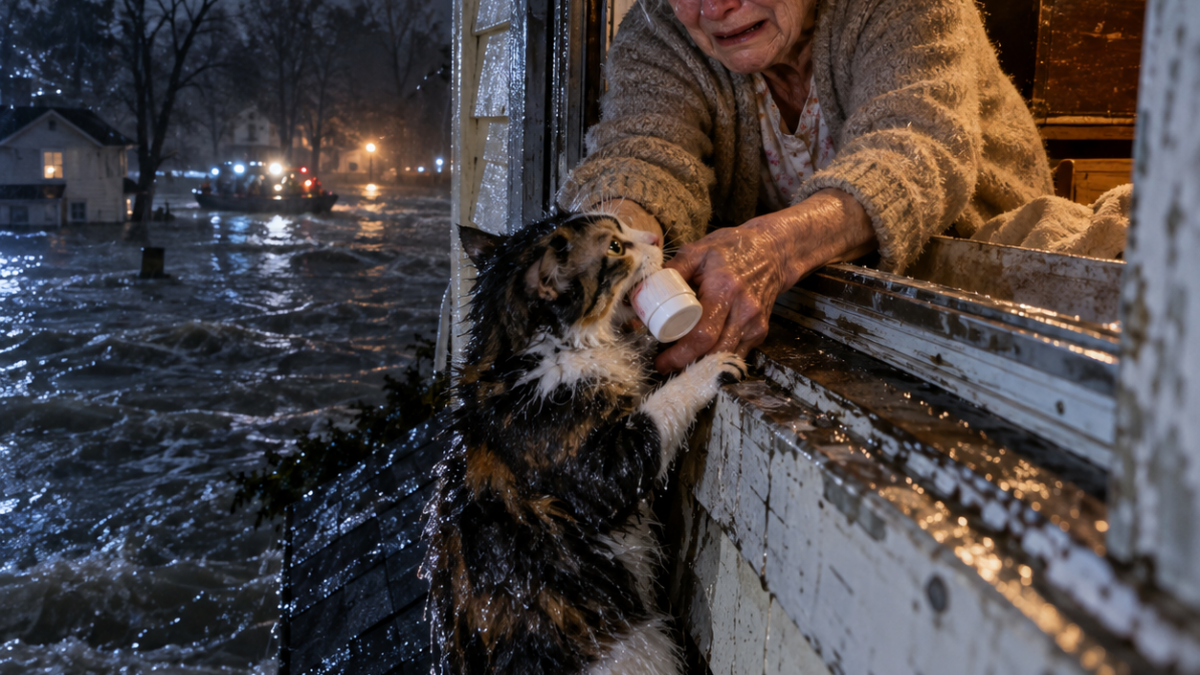
Minnow clung to the siding below the window.
Her little body shook.
A cut on her right front paw left thin streaks on the white paint.
And in her mouth was a small white plastic pill bottle.
Florence cried out.
She reached down, nearly falling through the window, and pulled Minnow inside.
The cat dropped against her chest.
Florence took the bottle from her mouth.
It was the right one.
The label was soaked and peeling.
The safety cap had not fully sealed.
Three of the blue pills had dissolved in the water that seeped inside.
Fourteen remained.
Florence clutched the bottle so tightly her fingers hurt.
Minnow had swum through the flooded second-floor stairwell.
Through the kitchen.
Past floating debris.
To the windowsill above the sink.
She had found the bottle.
Picked it up.
Carried it in her mouth through freezing floodwater.
Then climbed the outside of the house again with the plastic between her teeth.
She had made the trip twice.
Once to find the way.
Once to bring back what Florence needed to live.
Florence gathered rainwater in a teacup she found inside an old box and took her evening pill with shaking hands.
Then she wrapped Minnow in the cardigan again.
The cat did not fight.
That frightened Florence.
Minnow’s breathing was shallow.
Her fur was ice cold.
Her mouth was streaked with blood where the hard plastic cap had cut her tongue.
“Stay,” Florence whispered. “Please, baby. You stay now. I took it. I’m all right. You stay.”
Minnow gave one faint tremble.
Florence pressed the cat against her heart.
All night, Florence fought sleep.
When she felt herself drifting, she pinched her own arm.
If she slept, Minnow might stop breathing.
If she slept, she might miss rescue.
If she slept, the water might rise too high.
Morning came gray and merciless.
The floodwater had not reached the attic window.
But it had reached the bottom of the cedar chest.
Florence’s legs were numb from cold.
Her fingers ached.
Her heart fluttered twice in a way that made fear bloom behind her ribs.
She took another pill at sunrise.
Minnow remained wrapped in the cardigan.
Barely moving.
The day stretched.
At some point, Florence thought she heard voices.
She shouted until she gagged.
Nothing.
At noon, rain began again.
She collected water in the teacup.
At dusk, she saw lights far away.
Not close enough.
At night, she spoke to George.
“I’m trying,” she told the photograph in her purse. “I’m trying, but she did more than I did.”
Minnow’s head moved once at the sound of Florence’s voice.
Florence cried softly.
“I know. You’re tired.”
She stroked the cat’s wet head.
“You can rest. I won’t ask you for anything else. Never again.”
But Minnow did not rest.
Not fully.
Each time Florence’s breathing changed, Minnow stirred.
Each time Florence reached for the pill bottle, Minnow opened her swollen eye.
The second night was worse.
Florence began to feel unreal.
Cold and exhaustion do strange things to the mind.
At one point, she thought George was standing near the Christmas boxes.
He looked younger.
Wearing the flannel shirt with the torn pocket.
“You painted the shutters too bright,” she told him.
George smiled.
“You always said that.”
“I did not.”
“You did.”
“I’m scared.”
“I know, Flo.”
“I don’t want to die up here.”
He looked toward Minnow.
“You’re not alone.”
Florence blinked.
The attic was empty except for the boxes, the cedar chest, the rising water, the little white bottle, and the cat on her lap.
At 4:30 on Friday morning, she heard an engine.
Not the river.
Not wind.
An engine.
Florence lifted her head.
“Help!”
Her voice was barely a rasp.
A light swept across the attic window.
“Is someone in there?”
She began sobbing.
“Yes!”
The rescue boat came close enough for a man in a helmet to reach the second-story roofline. Another rescuer climbed onto the porch roof, then toward the attic window.
When he looked inside and saw Florence, his face changed.
“Ma’am, we’ve got you.”
“No,” Florence said.
He blinked.
“We’re getting you out.”
“My cat first.”
The rescuer looked down.
Minnow lay wrapped in the cardigan on Florence’s lap, barely conscious.
“She goes first,” Florence said.
“Ma’am—”
“She goes first.”
Maybe the rescuer understood that arguing would waste time.
Maybe he saw something in Florence’s face.
He reached inside.
Florence kissed Minnow’s head once.
“Go,” she whispered.
Minnow did not respond.
They wrapped the cat in a thermal blanket.
Then they lifted Florence out through the attic window.
She saw her house from outside for the first time since the flood began.
The water had swallowed the first floor entirely.
The porch railing was broken.
The blue shutters hung crooked.
The lilac bush was gone.
The river had moved through her life and rearranged it without permission.
In the rescue boat, Florence kept one hand on Minnow’s wrapped body.
“Is she breathing?” she asked every few minutes.
“Yes, ma’am.”
“Check again.”
“She’s breathing.”
At the evacuation center, Florence refused to let go until someone promised Minnow would go to a veterinarian immediately.
“You need a hospital too,” a paramedic said.
“I will go where she goes.”
“Ma’am, you may be hypothermic.”
“So is she.”
In the end, they separated them only because both needed emergency care.
Florence spent one night in a regional hospital nearly eighteen miles away.
Her blood pressure was unstable.
Her heart rhythm was concerning.
She had mild hypothermia, dehydration, and bruising from climbing through the attic window.
But she was alive.
Minnow spent six days at a veterinary hospital.
Severe hypothermia.
Aspirated floodwater.
Early pneumonia.
Torn pads.
One claw ripped from her right front paw.
A swollen right eye.
A cracked canine tooth from gripping the pill bottle so hard.
Dr. Aaron Vale, the veterinarian who treated her, called Florence’s daughter Claire on the second day.
“I need you to understand,” he said carefully, “this cat should not be alive.”
Claire, standing outside her mother’s hospital room with mud still on her shoes from traveling through blocked roads, began to cry.
“My mother says the cat brought her medicine.”
There was a pause.
“I heard.”
“Do you believe her?”
Dr. Vale was quiet for several seconds.
“I believe that bottle has bite marks matching a small cat’s mouth. I believe the cap damaged Minnow’s tooth. I believe the medication was in the attic with your mother when rescuers arrived. And I believe animals do remarkable things when bonded to people.”
“That isn’t an answer.”
“It’s the only answer I have.”
Florence saw Minnow three days after the rescue.
Claire wheeled her into the veterinary clinic against medical advice and common sense.
Minnow was inside a warmed recovery cage.
Her right paw was bandaged.
One side of her face remained swollen.
Her fur had been cleaned but still looked uneven from the floodwater.
When Florence spoke, Minnow lifted her head.
“Hi, baby.”
The cat tried to stand.
Dr. Vale opened the cage carefully.
Minnow took two unsteady steps.
Florence reached in.
The cat pressed her head into Florence’s palm.
Florence cried so hard Claire had to grip the wheelchair handles.
“I’m sorry,” Florence whispered. “I’m sorry I asked.”
Minnow, too weak to purr loudly, made the smallest sound.
It was enough.
News of the story spread because one of the rescuers mentioned it in a local interview.
At first, Florence hated that.
She did not want cameras.
She did not want strangers calling Minnow a miracle while standing far away from the smell of flood mud and ruined photographs.
She did not want people turning her guilt into something charming.
But the story traveled anyway.
A 78-year-old widow trapped in an attic.
A tiny cat swimming through floodwater.
A heart medication bottle.
Fourteen pills remaining.
People sent cards.
Cat toys.
Blankets.
One church group sent a crocheted cat bed that Minnow ignored completely.
Children drew pictures of a small white cat carrying a pill bottle like a trophy.
Florence kept every one.
Her house could not be saved.
The foundation had shifted.
Mold spread through the walls.
The kitchen where George died and Minnow found the pill bottle was gutted.
The blue shutters were removed and stacked in the mud.
When Florence was allowed to return weeks later to collect what remained, she stood in the doorway and did not step inside.
Claire stood beside her.
“I can go in for you.”
Florence shook her head.
“I lived here fifty-one years.”
“I know.”
“I raised three children here.”
“I know.”
“I buried your father from here.”
Claire touched her arm.
“I know, Mom.”
Florence stared at the waterline staining the wall nearly to the ceiling.
“I can’t come back.”
The admission broke something between them.
Not badly.
Honestly.
Claire put her arm around her mother.
“You don’t have to.”
Florence moved into a small ground-floor apartment three blocks from a pharmacy and far from any river.
Daniel wanted her to come live with him.
Claire wanted her closer to Boston.
Michael offered to fly her to Arizona for a few months.
Florence listened.
Nodded.
And chose the apartment.
It had wide windows.
No stairs.
A kitchen table just big enough for two chairs.
And a sunny sill where Minnow could watch sparrows.
The white plastic pill bottle came with them.
Empty now.
The label still warped and peeling.
Bite marks around the cap.
Florence placed it at the center of the new kitchen table.
Claire tried to throw it away once while unpacking.
Florence saw her reach for it.
“Don’t.”
Claire froze.
“It’s empty.”
“I know.”
“Mom…”
“I said don’t.”
Claire looked at the bottle.
Then at her mother.
Then gently placed it back.
Every night after that, before Florence took her evening pill from the new bottle, Minnow climbed onto the kitchen table and sat beside the old one.
The empty one.
The flood bottle.
She did not move until Florence swallowed.
Every night.
No exceptions.
People liked that part of the story.
They called it sweet.
Florence did not.
To Florence, it felt like being watched by love that had paid too high a price.
Minnow recovered, mostly.
Her cracked tooth was polished smooth, but it remained shorter than the other canine.
The claw on her right front paw never grew back correctly, leaving a hard little callus where the pad had healed.
Her right eye opened again, though sometimes it watered in cold weather.
She could still jump.
Still purr.
Still sleep beside Florence’s head.
But after the flood, she hated running water.
The kitchen faucet frightened her.
Rain against the window made her restless.
Whenever thunder rolled, she climbed onto Florence’s chest and pressed down as if pinning the old woman safely to the bed.
Florence began having nightmares too.
In hers, Minnow jumped from the attic window and did not return.
She woke shouting.
Each time, Minnow was there.
Small.
Warm.
Alive.
A year passed.
Florence turned seventy-nine.
The town rebuilt what it could.
The riverbank changed shape.
Her old house was demolished in September.
Florence did not go watch.
Claire went.
She brought back one blue shutter that had survived in the garage.
Florence leaned it against the wall near the balcony.
“It’s too bright,” she said.
Claire smiled through tears.
“Dad would say it looks patient.”
Florence touched the peeling paint.
“Yes,” she whispered. “He would.”
That winter was hard.
Florence’s heart weakened.
Not dramatically.
Not all at once.
But enough.
More appointments.
More medication.
More warnings from doctors.
Her children visited more often, frightened by the flood in a way distance had prevented them from being frightened before.
Daniel fixed shelves.
Michael installed grab bars.
Claire stayed for two weeks and cooked too much soup.
Florence appreciated all of it.
She also knew something had shifted.
Her children had nearly lost her, and now they looked at her the way people look at a glass object near the edge of a table.
She hated it.
Minnow did not.
Minnow simply continued her duties.
Morning pill.
Evening pill.
Chair by the window.
Pillow at night.
On a cold March evening, nearly two years after the flood, Florence sat at the kitchen table with Claire during a visit.
Minnow was beside the empty bottle.
Florence had just taken her pill.
Claire watched the cat.
“She still does it.”
“Every night.”
“Do you think she remembers?”
Florence looked at Minnow.
“I think she remembers enough.”
Claire folded her hands.
“Mom, I need to ask you something.”
Florence sighed.
“If this is about assisted living—”
“It’s not.”
“Good.”
“It’s about what happened in the attic.”
Florence looked away.
Claire continued carefully.
“You always tell the story like Minnow decided everything. Like you didn’t mean for her to go.”
“I didn’t.”
“I know.”
“Do you?”
Claire reached across the table.
“I know you didn’t want her hurt.”
Florence’s eyes filled.
“But I did ask.”
“You were scared.”
“I asked a six-pound cat to go into floodwater.”
“You were not thinking clearly.”
“I was thinking clearly enough to know where the medicine was.”
Claire’s face crumpled.
“Oh, Mom.”
“That is the part people skip,” Florence whispered. “They say she was brave. They say she was miraculous. They say I was lucky. But before any of that, I said the words.”
Minnow blinked slowly.
Florence touched the empty bottle.
“She almost drowned because of my fear.”
Claire moved around the table and knelt beside her mother.
“She came back because of love.”
Florence cried then.
Not loudly.
She had become quiet in grief.
“She came back because I was all she had.”
Claire held her hand.
“And you were all she had.”
That was true.
It did not erase the guilt.
But it sat beside it.
Sometimes that was the best mercy could do.
As Minnow grew older, she became smaller.
Her spine rose beneath her fur.
Her jumps shortened.
Florence placed steps beside the bed.
Then beside the couch.
Then beside the kitchen chair.
Minnow accepted these accommodations with the dignity of a queen receiving architectural improvements.
At eleven, she stopped jumping onto the kitchen table.
Florence began lifting her.
Every morning.
Every night.
“Up you go, nurse.”
Minnow would settle beside the old bottle.
Florence would take her pill.
The ritual continued.
At twelve, Minnow’s kidneys began to fail.
Florence refused to discuss it for three days.
Then Dr. Vale, the same veterinarian who had treated Minnow after the flood, sat across from her in the exam room.
“She’s comfortable right now,” he said gently. “But this is progressive.”
Florence stroked Minnow’s head.
“How long?”
“I don’t know.”
“Don’t say that.”
“I won’t lie to you.”
Florence nodded.
She appreciated honesty and hated it.
Minnow came home with special food, fluids, medication, and a schedule taped to the refrigerator.
For months, Florence cared for her the way Minnow had once cared for Florence.
She warmed blankets in the dryer.
She learned to give fluids beneath the skin, though her hands shook.
She woke at night to check breathing.
She carried Minnow to the table for pills.
Only now, there were two patients in the kitchen.
One old woman.
One old cat.
Both held together by medication, habit, stubbornness, and love.
On the last night, rain fell.
Not hard.
A soft spring rain against the apartment windows.
Minnow became restless at dusk.
Florence lifted her onto the kitchen table.
The empty flood bottle sat there.
The current pill bottle beside it.
Minnow touched the old bottle with her nose.
Then lay down.
Florence knew.
People say animals tell you when they are ready.
Florence had never believed that.
She believed people told themselves such things because helplessness needed gentler language.
But that night, Minnow looked at her with one cloudy eye and one tired eye, and Florence understood something had changed.
She called Claire first.
Then Dr. Vale.
Claire arrived in twenty minutes, hair wet from rain, coat buttoned wrong.
“Mom.”
Florence sat at the table with Minnow wrapped in George’s old blue flannel shirt.
“I don’t want her to be afraid.”
“She won’t be.”
“I don’t want her to think I’m sending her away.”
Claire’s eyes filled.
“You’re not.”
Dr. Vale came to the apartment because Florence could not bear the thought of Minnow’s last moments happening on a metal table beneath clinic lights.
He knelt beside the kitchen chair.
Minnow lifted her head when he touched her paw.
“Hello, brave girl,” he whispered.
Florence broke.
Completely.
Not the quiet crying she had done for years.
This was the sound from the attic window.
The sound of thinking she had lost Minnow the first time.
The second time.
All the times.
“I’m sorry,” Florence sobbed into Minnow’s fur. “I’m sorry I asked you. I’m sorry you had to be brave. I’m sorry you had to save me.”
Minnow, weak as she was, moved one paw.
It came to rest against Florence’s wrist.
Just there.
Light.
Certain.
The same way she had sat beside the pill bottle every night.
Florence pressed her lips to the cat’s head.
“I took it, baby,” she whispered. “I took my medicine. You can rest now.”
Dr. Vale gave the first injection.
Minnow relaxed in Florence’s arms.
The rain touched the windows.
Claire stood behind her mother with both hands on her shoulders.
Florence kept whispering.
“Thank you. Thank you. Thank you.”
Minnow died with her head against Florence’s heart.
For the first time in twelve years, Florence slept without the weight of a cat beside her head.
She woke reaching for fur that was not there.
The apartment was unbearable.
Not empty exactly.
Full of absence.
The steps beside the bed.
The table.
The old bottle.
The little dish that no longer needed washing.
For two weeks, Florence refused to move Minnow’s blanket.
On the fifteenth morning, she carried the empty flood bottle to the kitchen sink.
Claire, who had been staying with her, stopped in the doorway.
“Mom?”
Florence turned the bottle in her hands.
Bite marks.
Peeling label.
A faint rattle from one hardened fragment of pill dust trapped beneath the cap.
“I thought I kept this because it proved she saved me,” Florence said.
Claire waited.
“But I don’t need proof.”
She looked toward the empty chair.
“I remember.”
She did not throw the bottle away.
Instead, she placed it inside a small shadow box with Minnow’s collar, one photograph, and the blue shutter George had painted.
Below it, Claire added a small brass plate.
Minnow
She heard what was needed and went anyway.
Florence hung it beside the kitchen table.
Every evening after that, Florence still took her pill at the same time.
For the first few nights, Claire sat with her.
Then Daniel.
Then Michael.
They took turns for a while, afraid of leaving her alone with the silence.
But Florence eventually asked them to stop.
“I need to learn the room again,” she said.
So they did.
One year later, Florence turned eighty-one.
She moved more slowly.
Her heart remained unreliable.
Her hands shook a little more.
But she lived.
Every morning, sunlight still crossed the kitchen table.
Every evening, before taking her pill, she looked at the shadow box.
“You can stand down, nurse,” she would say softly.
Then she swallowed the small blue pill.
People often asked whether she would adopt another cat.
Florence always smiled.
“No.”
Not because she had no love left.
Because some loves are not repeated.
Some animals do not open a door to more animals.
They become the door.
And you spend the rest of your life walking differently because they once passed through it.
Two summers after Minnow died, the town built a small memorial near the rebuilt riverwalk for animals lost and rescued during the flood.
Florence attended in a wheelchair because Claire insisted, though Florence complained the entire way.
Children placed painted stones near the base.
Dogs barked.
Someone played a violin badly.
A local official spoke too long.
Then Florence was asked to say a few words.
She had not planned to.
She hated microphones.
But Claire squeezed her hand.
So Florence stood with help.
Her voice was thin but steady.
“I adopted Minnow because I was lonely,” she said.
The crowd quieted.
“I thought I was giving her a home.”
She looked toward the river.
It moved calmly that day, sparkling in the sun, innocent as if it had never climbed through windows or stolen floors from under old women.
“But when the water came, she gave mine back to me.”
Florence swallowed.
“People call her a hero. She was. But she was also a cat who liked warm pillows, hated thunder, stole chicken when she thought I wasn’t looking, and bit my daughter once for trying to trim her nails.”
Soft laughter moved through the crowd.
Florence smiled.
“I don’t want anyone to remember only the brave part. Brave was one night. Love was every day before it and every day after.”
Her voice broke.
“She did not save me because she was trained. She saved me because she knew I was hers.”
Claire wiped her face.
Florence looked down at her hands.
“And I was.”
That was all.
She sat.
The applause came gently.
Not loud.
Respectful.
That evening, Florence returned to her apartment exhausted.
Claire made tea.
Florence took her pill.
Then she sat at the table beneath the shadow box and looked at the empty chair.
Rain began after sunset.
Soft at first.
Then harder.
For a moment, Florence’s hand went to her chest.
Old fear.
Old water.
Old attic darkness.
Then she heard something.
Not real.
She knew that.
But memory has its own sounds.
A wet thud beneath a window.
Tiny claws on siding.
A plastic bottle against teeth.
A cat too small for the task coming back anyway.
Florence closed her eyes.
“I’m still here,” she whispered.
Outside, rain ran down the glass.
Inside, the kitchen was warm.
The pill bottle in the shadow box caught the light.
And though Minnow was gone, Florence took her medicine, every evening, without exception.
Not because the cat was there to watch her.
Because once, in the black floodwater below an attic window, a six-pound shelter cat had decided Florence’s life was worth swimming back for.
No ending could make that less heartbreaking.
No memorial could make it fair.
Minnow had given Florence more years, but she had spent part of her own little body to buy them.
Her tooth.
Her paw.
Her lungs.
Her fear of rain.
Finally, her tired heart.
That was the truth Florence carried.
Love had saved her.
Love had also cost something.
And every morning after Minnow was gone, when sunlight touched the kitchen table and Florence reached for her pill, she remembered the same thing.
Some animals are saved from shelters.
Some animals spend their lives saving us back.
And some, if they love us enough, will go into the dark water twice—not because they understand death, or medicine, or miracles, but because they heard our voice tremble when we said we needed them.
Minnow was not there on the table anymore.
But Florence never took a pill alone again.
Not really.
Because every time the bottle opened, every time the small blue tablet touched her palm, every time she swallowed and felt her heart continue, she heard one truth as clearly as the flood outside that attic window.
A tiny cat had come back.
And because she had, Florence did too.








