A 77-Year-Old Widow Hung the Same White Cloth on Her Porch Every Morning for 5 Years—Then It Vanished for 3 Days, and a Marine’s K9 Refused to Keep Running
PART2:
He had no memory of telling her he was a Marine.
Maybe the haircut gave him away. Maybe the posture. Maybe the way he ran like he was still following formation even with no one else on the road.
For several mornings, he considered asking how she knew.
He never did.
He preferred the small mystery.
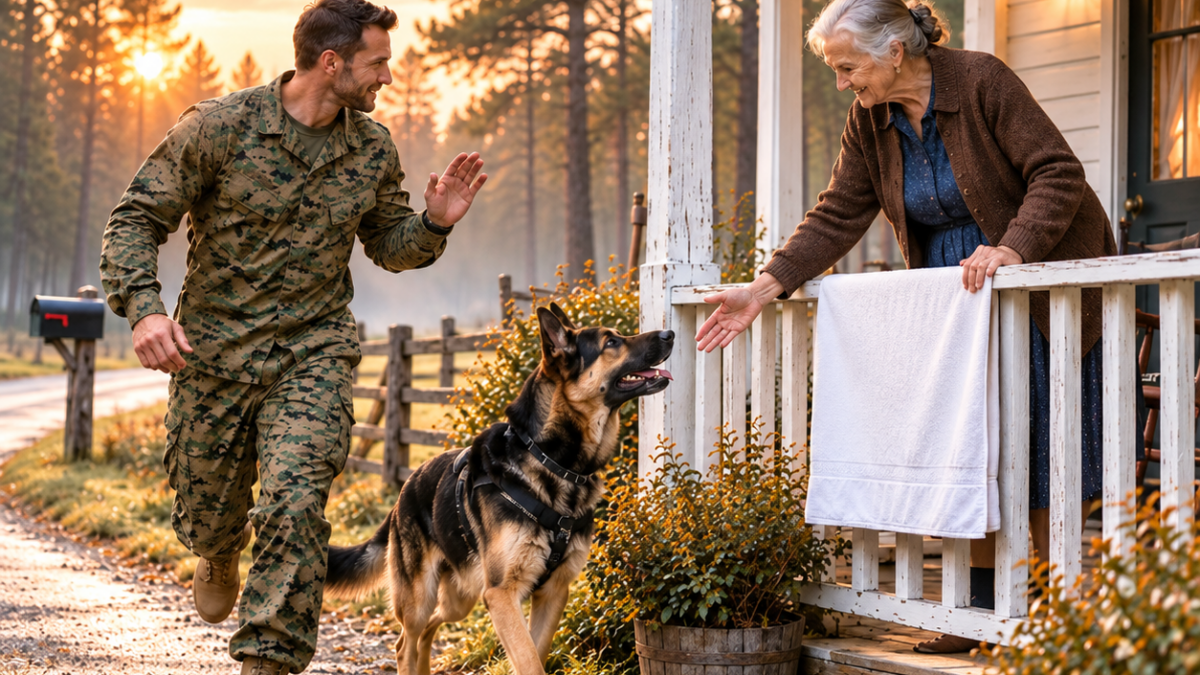
Flint, however, had no use for distance or mystery. Whenever the farmhouse appeared beyond the trees, the shepherd’s ears shifted forward. He never pulled toward the property or broke stride, but his eyes searched the porch until he found Norah.
She noticed.
One especially cold morning, she stood beside the railing with her cardigan buttoned high against her throat while the white cloth moved gently in the wind.
“Morning, handsome,” she called.
Grant glanced toward her.
“Well, that’s generous this early.”
Norah stared at him for one beat, then raised one crooked finger and pointed toward Flint.
“I meant him.”
Grant laughed hard enough to disturb his breathing.
Behind him, Norah laughed too.
The sound was soft and brief, but he carried it down the road longer than he expected.
After that, something changed.
Not much.
They did not become friends in any official sense. Grant never walked onto her property. Norah never invited him inside. He did not know whether she preferred coffee or tea, whether she had children, whether she watched the news, whether anyone came by on holidays. She did not ask about his deployments, his rank, or why a man his age ran like something behind him might catch up if he stopped.
But gradually, the porch became part of his morning.
If the light glowed through the fog, he felt a small internal check mark.
If the white cloth moved on the railing, the world was where he had left it.
If Norah stood there with her hands folded, Flint’s ears went forward and Grant found himself lifting a hand before thinking.
He began to notice things he told himself he was not noticing.
The second chair beside the little porch table.
Always empty.
The neat row of clay pots beneath the window.
Only two still planted.
The way Norah sometimes leaned more heavily on the railing during damp weather.
The fact that only one set of footprints usually crossed the porch after a frost.
The way she seemed to wait for Flint to look at her before she smiled.
Once, she called out, “You keep that dog working too hard.”
“He’d run twice this far if I let him,” Grant answered.
Norah looked at Flint.
“Don’t listen to him. You deserve breakfast.”
Grant shook his head.
“Now you’re undermining discipline.”
“Good,” she said. “Discipline needs undermining now and then.”
He found himself smiling half a mile later.
Then he caught himself and slowed his breathing.
Grant was good at boundaries.
Better than good.
He had built a whole life out of them after coming home.
A wave from the road was safe. A few words exchanged in passing required nothing from either person. Kindness, kept brief, did not become attachment. Attachment became worry. Worry became responsibility. Responsibility became loss.
Grant had spent enough years learning how quickly people could become important and how abruptly circumstances could take them away.
He had never consciously decided to keep others at a distance.
Somewhere along the way, distance had simply become easier.
Flint had no respect for that philosophy.
The dog simply liked Norah.
Grant suspected Norah liked Flint more than she liked him.
He could live with that.
What he did not know was that Norah Winslow had been carrying that white cloth onto the porch every morning for five years.
Three years before Grant’s running route ever brought him past her farmhouse.
He did not know her nearest living relative was a niece in Raleigh who called twice a month and visited twice a year when guilt and schedule aligned.
He did not know the neighboring houses were too far apart for casual checking, that Sundays sometimes came and went without a visitor, that some evenings passed without another human voice inside the old house except the weather report on the radio.
Most importantly, he did not know the white cloth was never really there to dry.
It was a message.
One nobody had been told to read.
That particular Friday morning, everything looked exactly as it should.
The porch light glowed weakly through the fog.
The front door opened.
Norah stepped out with the folded white cloth tucked beneath one arm.
Grant felt Flint’s attention shift toward her before his own.
“Morning, ma’am.”
“Morning, Marine.”
Her eyes moved to Flint.
“And good morning to the handsome one.”
Grant sighed.
“You’re going to give him an ego.”
“He earned one.”
Flint’s tail gave one restrained sweep, as if he agreed but did not wish to appear unprofessional.
Norah laughed.
Grant continued running.
Behind them, she unfolded the cloth and placed it over the railing. Her fingers lingered against the fabric for a moment longer than usual. She smoothed the corner. Then she stood quietly watching the Marine and his German Shepherd disappear into the thinning fog.
Grant did not look back.
Why would he?
Tomorrow morning, the farmhouse would still be there.
Norah would step through the same door.
The white cloth would appear on the same railing.
Flint would turn his head.
Grant would raise his hand.
After nearly two years, the sequence felt almost permanent.
That was the danger of repetition. It turned something unusual into something ordinary, and then made the ordinary almost invisible.
Grant would begin wondering about the white cloth again when it was gone.
Sunday night brought a harder cold to the countryside outside Newport.
Wind pushed through the pines and rattled the loose screen door at the back of Norah Winslow’s farmhouse. The porch light burned yellow above the front steps. Inside, the kitchen smelled faintly of cornbread and dish soap. A kettle rested on the stove. A half-finished crossword lay beside Norah’s reading glasses. A basket of clean white cloths sat on the bench near the back door, folded into careful squares.
Norah had always folded things neatly.
Even grief.
At 8:12 p.m., headlights swept across the front window.
Norah looked up from the kitchen table.
She was not expecting anyone.
Her first thought was that somebody had taken a wrong turn. That happened sometimes, though not often. The house stood far enough from the main road that anyone coming up the driveway usually meant to be there.
The vehicle stopped.
Engine idling.
Norah stood slowly.
Her knees ached in the cold.
She crossed to the front window and moved the curtain only an inch.
A gray SUV sat in the driveway.
The driver’s door opened.
A man stepped out.
For one moment, Norah did not recognize him.
Twelve years had added weight to his frame and deep lines around his mouth. His hair was close-cropped and grayer now. He wore a charcoal jacket, dark jeans, and heavy boots. He moved with a slow confidence that seemed practiced rather than natural.
Then he lifted his face toward the porch light.
Norah’s fingers tightened on the curtain.
Calvin Reic.
The name did not merely return to her.
It entered the room like a cold draft.
She had not seen him in twelve years, not since the courthouse, not since the trial, not since she sat in a witness chair with both hands folded in her lap and told the truth while his dark eyes stared at her as if memorizing where she lived.
For several seconds, fear held her still.
Then came the knock.
Three heavy strikes against the door.
Norah did not answer.
The knock came again.
“Mrs. Winslow,” he called. “I know you’re in there.”
His voice was calm.
That was worse than anger.
Norah moved toward the telephone on the kitchen counter.
Before she reached it, another knock sounded. Harder this time.
“I only want to talk.”
She stopped.
The reasonable part of her mind knew that opening the door was foolish. The older, stubborn part of her resented being frightened inside her own home. Another part, the part that had lived alone long enough to understand that panic could make a person clumsy, told her to keep him where she could see him.
She approached the door but opened it only halfway, one foot braced behind it.
“What do you want?”
Calvin Reic smiled.
Not warmly.
“You remember me.”
“I remember enough.”
He glanced past her into the house.
“Twelve years is a long time.”
“Not long enough.”
His smile faded.
“I came to ask for something that belongs to me.”
“I don’t have anything of yours.”
His eyes settled on her face.
“You kept papers.”
Norah’s body went cold.
The old case flashed through her mind in fragments. A small commercial property outside town. Rain on pavement. A truck parked where it should not have been. Two men near the rear door. A shout. A blow. A young man accused at first because he was easy to accuse. Norah’s statement changing everything because she had seen the vehicle, seen enough of the men, seen enough of the timing to know the story authorities first believed was wrong.
She had told the truth.
She had not known then how much truth could cost.
“I gave my statement,” she said. “That was twelve years ago.”
“You gave more than a statement.”
“I don’t know what you mean.”
His calm cracked at the edges.
“Don’t lie to me.”
Norah’s hand tightened on the door.
“You need to leave.”
He stepped forward.
She tried to close the door.
His boot blocked it.
At seventy-seven, Norah Winslow had survived enough to understand the difference between danger that could be negotiated and danger that had already decided what it came to do.
“Get out,” she said, louder now.
He shoved the door.
Norah stumbled backward into the hall.
He entered quickly, closing the door behind him.
The chair scraped violently across the kitchen floor when she reached for the table to steady herself. Her reading glasses fell, one lens cracking. She tried to grab the telephone, but Reic crossed the kitchen in three strides and knocked it from the counter.
It hit the floor and slid beneath the cabinet.
“Where is it?”
“I don’t have anything.”
He seized her wrist.
Pain shot through her hand.
“Old women always keep things,” he said. “Letters. Copies. Little insurance policies tucked away because you think being harmless makes you clever.”
Norah stared at him, breathing hard.
“I told the truth.”
His grip tightened.
“And men lost years because of it.”
“Men went to prison because they earned it.”
For the first time, his face changed completely.
There was the man from the courthouse.
Not calm.
Not reasonable.
Just rage, aged and concentrated.
He pushed her into the chair.
“Then you’re going to help me get those years back.”
Monday morning arrived beneath a low gray sky.
Grant and Flint followed their usual route, their breath turning white in the cold. The rain from Sunday had frozen in shallow puddles along the shoulder. Pines stood black and still beyond the drainage ditch. The world smelled like wet leaves and cold earth.
As the farmhouse came into view, Grant looked toward the porch without consciously deciding to.
It was empty.
So was the railing.
For several seconds, he expected the door to open and Norah to emerge with the white cloth tucked under one arm.
The door remained closed.
Grant kept running.
One missed morning meant nothing.
Norah was seventy-seven. She could have slept late. Felt unwell. Decided the cold was too much. Left early for an appointment. Maybe someone had come by. Maybe she was visiting family.
People had lives outside the ten seconds you saw them each morning.
Still, Grant glanced back before the farmhouse disappeared behind the trees.
The empty railing stayed in his mind longer than it should have.
Flint looked back too.
Grant noticed.
“You too?” he muttered.
Flint gave no answer, only kept pace.
By Tuesday, the absence felt different.
Flint noticed first.
As they approached the property, the German Shepherd shortened his stride and turned his head toward the porch.
No Norah.
No white cloth.
The porch light was on, but weakly, as if it had burned through the night.
Flint glanced up at Grant.
“Keep moving.”
The dog obeyed, but Grant slowed too.
He almost stopped.
Almost.
Then reason intervened.
He did not know Norah’s schedule beyond the few minutes their mornings overlapped. Maybe family had picked her up. Maybe she had gone into town. Maybe she was ill but being cared for. Two years of greetings did not give him ownership over the rest of her life.
Still, halfway through the run, irritation rose in him.
Not with Norah.
With himself.
Part of him wanted to turn around. Another part warned that he was building danger from an empty porch and an absent towel.
Grant had spent years learning the difference between observation and assumption.
A change mattered.
But a change did not automatically mean a threat.
So he finished the run.
That evening, the farmhouse crossed his mind again while he stood at his kitchen sink washing a coffee mug.
The image came sharply.
Empty railing.
No white cloth.
He dried the mug and set it in the cabinet harder than necessary.
Flint lay near the back door, eyes open, watching him.
“What?” Grant asked.
Flint thumped his tail once.
“You don’t know either.”
The dog’s ears lifted.
Grant sighed.
“Tomorrow.”
The word felt like a compromise and a cowardice at the same time.
Wednesday morning came colder still.
This time, Flint stopped.
There was no bark. No dramatic pull. No cinematic warning. The shepherd simply slowed near Norah’s driveway, planted his paws against the roadside, and refused to continue.
Grant took another step before the lead tightened.
“Flint.”
The dog’s ears stood forward.
His gaze fixed on the farmhouse.
His nose lifted briefly into the air.
Grant followed his attention.
The porch light was off.
The railing was empty.
The curtains looked exactly as they had Monday.
Something settled heavily inside Grant.
Three mornings.
Once could be chance.
Twice could be explained.
Three times meant the routine had changed.
And Norah Winslow did not seem like a woman who changed routines casually.
“All right,” Grant said.
He walked up the driveway with Flint beside him.
The gravel crunched under his running shoes. A newspaper lay near the edge of the path, darkened by moisture. Another had landed partly beneath it.
Grant’s unease sharpened.
He climbed the porch steps and knocked.
“Nora?”
Nothing.
He waited.
Knocked harder.
“Ma’am, it’s Grant. The Marine from the road.”
Silence pressed against the other side of the door.
For the first time, Grant felt something colder than the morning air move through him.
He pictured Norah on the kitchen floor, injured and unable to reach a phone. The possibility was ordinary enough to be frightening.
His hand moved toward the doorknob.
Then stopped.
Concern was not permission.
There was no cry for help, no smoke, no visible emergency that justified forcing entry. He was still a man on a porch outside a woman’s home, and worry did not erase her right to privacy.
Grant stepped back and called the Carteret County Sheriff’s Office.
He explained that Norah Winslow was seventy-seven, lived alone, and had failed to appear for a morning routine he had observed almost daily for nearly two years.
Saying it aloud made him realize how little he knew about her.
A deputy arrived twenty minutes later.
Deputy Aaron Pike was thirty-six, medium height, solidly built, with sandy hair cut short and pale blue eyes that moved carefully across the property. His manner was calm and deliberate rather than dismissive, which Grant appreciated immediately. A man who preferred evidence before conclusions was a man worth speaking to.
“You family?” Pike asked.
“No.”
“Neighbor?”
“Not exactly.”
Pike waited.
“I run past every morning. She comes outside around the same time.”
“For how long?”
“Almost two years.”
“And she hasn’t for three days?”
“No.”
Pike looked toward the railing.
“You mentioned a cloth.”
Grant nodded.
“There’s usually a white cloth on that railing.”
“No cloth either.”
“No.”
For a moment, Grant heard how strange the evidence sounded.
But Pike did not laugh.
He asked several more questions, then walked around the farmhouse, checking doors and windows while Grant remained near the porch with Flint. At the rear of the house, Pike stopped.
His posture changed.
“Stay here,” he called.
Grant tightened his hold on Flint’s lead.
The kitchen door was slightly open.
Pike announced himself before entering.
Grant waited.
Thirty seconds became a minute.
Then another.
Flint stood motionless beside him, attention fixed toward the house.
When Pike finally returned, his expression had lost its earlier neutrality.
“She isn’t inside.”
Grant’s stomach tightened.
Another unit was requested.
During the initial check, several small details emerged.
Nothing looked dramatically destroyed, yet the kitchen felt interrupted rather than abandoned. A chair stood several feet from the table at an awkward angle. Norah’s reading glasses lay on the floor, one lens cracked. Her phone remained under the edge of the cabinet. Her brown winter coat hung beside the door.
If she had left voluntarily, she had done so without the things a seventy-seven-year-old woman would reasonably take into late November cold.
Grant looked at Flint.
The shepherd’s nose worked quietly toward the side of the farmhouse, but Grant kept the lead short.
Not yet.
Whatever this was, it had moved beyond a morning run.
Then Grant noticed a wicker basket on a bench beside the rear door.
Inside were several clean white kitchen cloths folded into careful squares.
He stared at them.
For nearly two years, one of those pieces of cloth had appeared on Norah’s railing every morning. Grant had seen it so often it had become invisible to him. Now the empty railing felt louder than anything inside the house.
Three mornings without the cloth.
Three mornings without Norah.
And for the first time, Grant wondered whether those two absences had always been meant to mean the same thing.
By late Wednesday morning, fog had lifted from the countryside outside Newport, but the cold remained beneath a colorless sky. Pines behind Norah’s farmhouse stood motionless in the weak November light.
A second patrol vehicle arrived, followed by an investigator from the sheriff’s office. The house was treated as a possible missing person scene, not yet a kidnapping. There was no obvious forced entry, no blood, no witness who could say Norah had been taken.
Deputy Pike made that distinction clear without dismissing Grant’s concern.
“People leave homes unexpectedly,” he said. “Elderly residents sometimes become confused, accept rides without telling neighbors, experience medical emergencies away from home. We keep possibilities open until evidence narrows them.”
Grant understood.
He still did not like it.
“Her phone was under the cabinet,” Grant said.
“I saw.”
“Her coat is inside.”
“I saw that too.”
“She doesn’t break routine.”
Pike looked at him.
“You know that for certain?”
Grant paused.
“I know what I’ve seen.”
Pike waited.
“Almost every morning for two years. Same door. Same time. Same cloth.”
It sounded inadequate even to him.
Yet Grant had spent much of his adult life learning that patterns mattered precisely because people stopped noticing them.
While deputies worked, Flint remained beside him. The shepherd was controlled but increasingly interested in the rear of the farmhouse. His nose lifted repeatedly toward the kitchen door before shifting toward the yard.
Grant noticed.
So did Pike.
“He trained for scent work?”
“Yes.”
“Military?”
Grant nodded.
Pike considered the dog, then Grant.
“Keep him controlled. Don’t disturb anything we haven’t cleared.”
Grant nodded.
Only after the immediate area had been checked did Pike allow them near the rear yard. Grant loosened the lead slightly.
Flint moved forward, nose working close to the ground. Then he lifted his head and changed direction toward the fence.
Grant followed without urging.
The dog stopped beside an old wooden post.
Something small had caught against a rusted nail.
Grant crouched.
A narrow piece of brown knitted fabric fluttered in the breeze.
He recognized the color immediately.
Norah’s cardigan.
“Pike.”
The deputy approached quickly, then stopped Grant before he touched it.
“Leave it.”
Pike photographed the fabric and called the investigator over.
Beyond the fence, disturbed leaves and compressed grass continued toward a narrow dirt track disappearing between the pines.
Flint pulled forward once.
Grant held him.
Every part of him wanted to follow.
The path was right there.
So was the possibility that Norah had gone down it.
But wanting an answer did not make charging into the woods intelligent.
Grant looked at Flint, then at Pike.
“Get your K9 team.”
Pike nodded.
Grant stepped back.
Waiting became harder once he had somewhere to go.
The sheriff’s canine unit arrived less than half an hour later. Its handler, Sergeant Melissa Vance, was compact, forty-two, with dark auburn hair pulled tightly beneath her cap and the calm direct gaze of a woman who trusted evidence more than excitement. Beside her stood Ranger, a five-year-old Belgian Malinois with a fawn coat, black mask, lean muscular frame, and intense dark eyes.
Unlike Flint’s measured calm, Ranger seemed built from compressed energy, waiting for a command to give it direction.
Vance spoke briefly with Grant about Flint’s behavior, then took over.
Grant did not interfere.
Ranger was given a scent reference from Norah’s belongings and worked from the rear of the property toward the fence. Within minutes, the Malinois picked up the same direction Flint had indicated into the pines.
Grant and Flint remained behind while Vance, Pike, and another deputy followed at a controlled distance.
Grant hated that part more than he expected.
His training had conditioned him to move when something was wrong. Standing still felt almost like choosing not to help. But discipline was not always movement. Sometimes it was knowing when someone else was better equipped to take the next step.
Nearly forty minutes later, Pike returned.
“We found where the trail ends.”
Grant searched his expression.
“Norah?”
Pike shook his head.
“A vehicle.”
The dirt track opened roughly three-quarters of a mile into the woods onto a wider service road. Ranger’s trail had ended beside an area of recently disturbed soil. Tire impressions remained visible in the damp ground.
Someone had stopped there.
Someone had left.
The case changed after that.
Deputies began asking residents along nearby roads whether they had seen unfamiliar vehicles Sunday night. Most remembered nothing. Then a man living farther down the county road recalled a gray SUV parked near the tree line after dark. He had not considered it suspicious enough to report.
A gas station several miles from the service road had exterior cameras facing the highway.
By midafternoon, investigators had footage.
Grant waited near the farmhouse while the investigation moved beyond anything he could contribute. He watched people enter and leave Norah’s house, carrying evidence bags and cameras.
The white railing remained empty.
Pike eventually approached him.
“We’ve got a vehicle matching the witness description on camera Sunday night.”
Grant straightened.
“Plate?”
“Readable enough.”
Grant looked toward the farmhouse.
“So she was taken.”
Pike remained careful.
“We’re closer to saying she didn’t leave in any normal way.”
That was enough.
Later, a plate search led investigators to a name.
Pike did not immediately share it, and Grant did not ask him to violate procedure, but the deputy’s expression changed after speaking with another investigator beside the patrol car.
Something had connected.
Pike returned holding a thin printout.
“The registered connection to that vehicle appears in an old case.”
“How old?”
“Twelve years.”
Grant felt Flint shift beside him.
Pike looked down at the page again.
“Norah’s name is in it too.”
For a moment, Grant said nothing.
His eyes moved toward the farmhouse, the worn porch, the second chair beside the little table, and the empty railing where a white cloth had appeared every morning.
For two years, he had known Norah only in fragments.
Morning, Marine.
Morning, handsome.
A crooked finger pointing toward Flint.
A woman alone on a porch.
Grant had mistaken simplicity for the absence of history.
Now somewhere inside a twelve-year-old file was another version of Norah Winslow, one he had never known existed. And whoever had driven that gray SUV Sunday night apparently knew that version very well.
By Wednesday evening, darkness settled early over Newport, and the temperature dropped fast.
At Norah Winslow’s farmhouse, patrol lights moved silently across the empty porch and bare wooden railing. The twelve-year-old file changed the investigation.
Grant was not shown everything, nor did he expect to be, but Deputy Pike eventually gave him enough to understand why Norah’s disappearance was no longer being treated as an unexplained absence.
Twelve years earlier, Norah had witnessed part of a violent crime near a small commercial property outside town. She had not gone looking for trouble. She had been an ordinary woman returning home at the wrong hour, close enough to see a vehicle, two men, and enough of what followed to contradict the story investigators were initially given.
A different man had become the early suspect.
Norah could have stayed silent.
She had not.
Her statement helped establish that the suspected man could not have committed the crime and redirected investigators toward the people actually involved. The investigation widened. Other offenses surfaced. One of the men eventually sent to prison was Calvin Reic.
Reic had recently been released.
An unresolved portion of the old investigation had begun drawing attention again. Investigators believed he had learned authorities might review evidence connected to the original case. Somewhere during those twelve years, he had become convinced Norah still possessed an old document, something retained from the time of her statement, something that could connect him to an act prosecutors had never fully proved.
Whether such a document actually existed was unclear.
What mattered was that Reic believed it did.
Grant listened without interrupting.
“She told the truth,” he finally said.
Pike nodded.
“And twelve years later, someone came back because of it.”
Grant looked toward Norah’s porch.
For two years, he had known her through fragments: a white cloth, dry humor, a nod in the morning, the way she looked at Flint.
Nothing about those moments had suggested courage because Grant had spent too much of his life imagining courage as something visible under pressure. A person rushing into gunfire. A person holding position. A person refusing to leave.
Now he wondered how many forms of courage looked exactly like ordinary life.
A widow answering questions in a courthouse.
An elderly woman hanging a white cloth every morning.
A person continuing to exist in the open after danger once learned her name.
The gray SUV gave investigators their next direction. Traffic camera footage and gas station video allowed them to reconstruct portions of its movement Sunday night. Combined with the service road where Ranger had lost Norah’s scent, the search narrowed toward a heavily wooded area northwest of town.
A property record produced another connection.
An old hunting cabin stood deep inside the search area on land once used by a relative of Reic’s.
That was enough for law enforcement to move.
Grant was not part of the entry team.
He did not argue.
There had been a time when every instinct in him would have demanded movement. But experience had taught him that discipline was not measured by how quickly a man stepped into danger. Sometimes it meant recognizing when his presence would make a situation worse.
He and Flint remained at a staging point well away from the cabin while deputies and the tactical team moved in.
Waiting was brutal.
Grant stood beside a sheriff’s vehicle with Flint close to his leg. The German Shepherd seemed to sense the tension around them, watching every movement without making a sound.
Minutes stretched.
Grant kept thinking about Monday morning.
The empty railing.
He had seen it and continued running.
Then Tuesday.
He had done the same.
Reason told him he could not have known. Norah had a life outside the ten seconds he saw each morning. Calling authorities after one missed appearance would have been unreasonable.
None of that completely quieted the thought.
What if three days had been too long?
What if the white cloth had been gone because it was already too late?
Flint leaned against his leg.
Grant looked down and placed one hand between the dog’s ears.
“I know,” he whispered.
The burst of radio traffic came suddenly.
Grant could not make out every word.
Then Pike, standing several yards away, turned toward him.
“They found her.”
Grant did not move.
The world seemed to contract around those three words.
“Alive?”
Pike nodded.
“Alive.”
Only then did Grant realize how tightly he had been holding Flint’s lead.
Norah had been held for nearly three days.
Calvin Reic had taken her to the hunting cabin and demanded the location of documents she insisted she did not have. He had tied her wrists with rope, left her in a back room without heat, and returned again and again with questions that made less sense as his panic grew. He had searched her home after forcing her to tell him where keepsakes were stored. He had torn through boxes of old letters, tax papers, and photographs, looking for proof of a crime he had spent twelve years believing she could still expose.
What Reic never understood was that Norah had told the truth once, fully, in a sworn statement. She had not kept secret evidence out of cunning. She had kept only ordinary things. Church bulletins. Grocery receipts. Her husband’s postcards. A photograph of herself at forty, laughing with one hand over her mouth. A pressed flower from a garden long gone.
Reic’s guilt had invented a hidden weapon because men like him believed everyone else thought like they did.
When tactical deputies entered the cabin, Reic tried to run through the rear door.
Ranger found him first.
No shots were fired.
That was a mercy Grant did not spend much time appreciating.
When paramedics brought Norah from the woods, a blanket wrapped around her shoulders, the first thing Grant noticed was that she was walking.
Not strongly.
Not without assistance.
But walking.
Her face was pale with exhaustion. One cheek was bruised. Red marks circled her wrists. Her silver hair had come loose from its bun and hung against her face in tangled strands.
Yet her eyes were open.
Alert.
Searching.
They moved across the deputies, the paramedics, the vehicles, the lights.
Then they found Grant.
Then Flint.
She stopped.
One paramedic said something to her, but Norah barely seemed to hear.
“The cloth,” she said.
Her voice was rough.
Grant understood the question before she finished it.
“It wasn’t there.”
Something changed in Norah’s face.
Not surprise exactly.
Recognition.
“You noticed?”
Grant looked down at Flint.
The shepherd was already staring at her.
“We both did.”
For several seconds, Norah said nothing.
Her eyes filled, but she did not cry.
She simply closed them briefly, as though those three words had answered a question she had been carrying for years.
Grant still did not understand.
He wanted to ask.
This was not the moment.
Flint took a small step forward, then stopped at the limit of the lead.
Grant looked toward the paramedic.
“Is it okay?”
After receiving permission, he loosened his grip.
Flint approached slowly.
There was none of the excited energy he sometimes showed when seeing someone familiar. The shepherd seemed to understand Norah was hurt. He stopped directly in front of her.
Norah lowered one trembling hand.
Flint pressed his head gently beneath her palm.
Her fingers disappeared into the thick fur behind his ear.
“Hello, handsome,” she whispered.
Grant looked away for a second.
Behind them, deputies continued moving around the property. Radios crackled. Vehicles idled. Somewhere beyond the lights stood the cabin where Norah had spent nearly three days believing whatever she had believed about that white cloth.
Grant looked back at her.
He knew now why she had disappeared.
He knew who had come for her.
He knew what twelve years of buried history had brought back to her door.
But the one thing he still did not understand was the thing Norah had asked about first after being rescued.
Not her house.
Not Reic.
Not the investigation.
The cloth.
And judging by the relief in her eyes when Grant said he had noticed it was gone, that simple piece of white fabric had never been simple at all.
A week later, morning sunlight returned to the countryside outside Newport, thin and pale after several days of rain, touching the wet pines and the familiar white farmhouse with a quiet warmth November rarely offered.
Norah Winslow was home.
Grant did not visit the first day.
He understood that returning home after what she had survived was not the same as returning to normal. She needed rest, medical follow-ups, statements to investigators, and time to walk through rooms that no longer felt innocent.
On the third afternoon, Norah called him herself.
“Marine?”
“Yes, ma’am.”
“You still drink coffee?”
Grant smiled.
“When available.”
“Tomorrow. Seven.”
Then she hung up.
Grant arrived with Flint at exactly seven the next morning.
For the first time in nearly two years, he did not remain on the road.
Norah sat on the porch wrapped in her brown cardigan, one hand curled around a steaming cup. The bruising on her cheek had faded to yellow, and exhaustion still shadowed her eyes, but the quiet steadiness Grant remembered had returned.
Flint settled beside her chair after receiving permission, close enough for Norah to rest her fingers against the thick fur along his neck.
For several minutes, they spoke about ordinary things.
The cold.
The rain.
Flint’s appetite.
The way Deputy Pike had apparently been adopted by half the neighborhood’s elderly women after the story spread.
Ordinary things mattered after danger. They reminded the body that life was allowed to continue.
Then Norah’s eyes moved toward the empty section of railing.
“You’ve been wondering about the cloth.”
Grant looked at her.
“Since you asked about it before anything else.”
Norah lowered her gaze to her coffee.
“My husband died five years ago. Arthur. He used to sit right there.”
She nodded toward the second chair.
Grant had wondered about that chair so many mornings he felt almost embarrassed by the answer now.
“He was the kind of man who made noise without trying. Humming in the kitchen. Tapping spoons against coffee cups. Talking to the radio like the weatherman might answer. After he died, the house went so quiet I could hear the refrigerator from the bedroom.”
She smiled faintly.
“I thought grief would be the hard part. It was, of course. But loneliness is sneaky. Grief has manners sometimes. It announces itself. Loneliness just sits down beside you and waits until you stop noticing it.”
Grant said nothing.
He had learned that silence, used properly, could give a person room to keep going.
“Four months after Arthur died, I fell in the kitchen,” Norah continued. “Nothing dramatic. I was reaching across the counter for a jar, lost my balance, and went down. I didn’t break a hip. Didn’t hit my head. I just landed badly enough that I couldn’t get back on my feet.”
Her fingers tightened around the cup.
“My phone was in the living room.”
Grant looked toward the door.
“I tried using a chair. Then the cabinet. Then the tablecloth, which was foolish. My arms gave out. So I lay there.”
The porch was very quiet.
“One hour became two. Sunlight moved across the tile. The refrigerator hummed. The old kitchen clock kept ticking like it was being paid to ignore me.”
She laughed softly, but there was no humor in it.
“You know what frightened me most?”
Grant shook his head.
“It wasn’t pain. It wasn’t even dying. It was realizing everything outside probably looked normal. Cars going by. People buying groceries. Somebody somewhere complaining about weather. And I was lying ten yards from that porch, wondering how long it would take before anybody noticed I wasn’t part of the world anymore.”
Grant felt the words settle inside him.
A woman from a nearby farm had found Norah later that day while delivering eggs. Norah had been dehydrated, bruised, and badly shaken, but otherwise unharmed.
The fall ended.
The fear did not.
Her nearest relative lived hours away. Neighboring houses were scattered too far apart for casual watching. Norah refused to ask someone to call every morning merely to confirm she had survived the night.
“I didn’t want to become somebody’s assignment,” she said.
Grant understood that stubbornness because he had seen it in her from the road for two years.
Norah did not fear accepting kindness nearly as much as she feared becoming someone else’s responsibility.
“So you made the cloth,” Grant said.
She nodded.
“The morning after I fell, I chose a white kitchen cloth because it could be seen from the road. If I woke up and everything was all right, I carried it outside and hung it over the railing. In the afternoon, I brought it back inside. The next morning, I did it again.”
“Who did you tell?”
“No one.”
Grant frowned.
“Then how was anybody supposed to know?”
Norah looked toward the road.
“They weren’t.”
He stared at her.
She continued quietly.
“I thought if people saw it long enough, maybe someday they’d notice when they didn’t.”
Grant leaned back slowly.
Monday morning.
The empty railing.
Tuesday, empty again.
Wednesday, Flint stopping at the driveway.
The damp newspapers.
The basket of folded white cloths beside the kitchen door.
For nearly two years, Grant had believed he was watching an elderly woman perform some harmless household ritual. Now he understood that Norah had been sending a message to nobody in particular and everybody who happened to pass.
I’m still here.
You didn’t know anybody was paying attention,” Grant said.
“No.”
“But you kept doing it.”
Norah’s expression softened.
“I had to believe somebody might.”
Flint lifted his head.
Grant rested a hand between the shepherd’s ears and looked at Norah.
“Turns out somebody was.”
Norah looked away, wiping quickly beneath one eye before Grant could acknowledge it.
He let her have that small piece of dignity.
Yet something in him shifted too.
For years, Grant had thought noticing people meant accepting responsibilities he was not sure he wanted. Norah had taught him something different.
Sometimes attention demanded nothing heroic.
Sometimes it was simply remembering that another human being should be where they had always been.
Several mornings later, Norah was finally strong enough to resume the ritual.
At 6:20, the farmhouse door opened.
She stepped carefully onto the porch carrying a clean white cloth, shook it once, draped it over the railing, and smoothed one corner with her palm.
Then she waited.
Down the county road came the familiar rhythm of running shoes and four steady paws.
Grant saw the white cloth from a distance, and something inside him relaxed before he could stop it.
He smiled and intended to keep running.
Flint stopped.
Grant took another step before noticing.
“You’re getting predictable,” he told the dog.
The German Shepherd remained where he was, staring toward the porch.
Grant followed his gaze and saw Norah beside the little table.
Two cups of coffee waited on top.
Beneath it sat a bowl of water.
Grant laughed softly.
“All right. This time we leave the road.”
Norah said nothing when Grant climbed the porch steps.
Grant said nothing when he took the second chair, the same chair he had wondered about so many mornings before.
Flint drank from the bowl and settled between them, close enough that Norah could touch him whenever she wanted.
No one needed to explain what had changed.
Grant and Flint continued running the same route after that.
Most mornings, they passed the farmhouse with a wave.
But a few mornings each week, six miles took a little longer.
There was coffee on the porch.
Sometimes there was conversation.
Sometimes there was comfortable silence.
Flint usually received something Norah insisted was not breakfast, despite all evidence to the contrary.
The investigation continued.
Calvin Reic was charged not only with kidnapping and assault, but with witness intimidation and obstruction tied to the old case that had first connected him to Norah. The old file reopened wider than he expected. Documents he believed Norah held did not exist in her house, but investigators found enough through his movements, phone records, and statements during arrest to expose what he had spent twelve years fearing.
A man once wrongly suspected in the original case came to Norah’s porch one afternoon.
His name was David Mercer.
Grant was there by coincidence, repairing a loose step because Norah had mentioned it in passing and he had arrived with tools before she could object.
Mercer stood at the gate with a cap in both hands.
He was in his fifties now, with tired eyes and the cautious manner of someone who had learned how quickly a town could turn suspicion into identity.
“Mrs. Winslow,” he said. “You probably don’t remember me.”
Norah stood slowly.
“I remember you.”
He swallowed.
“You told the truth when it would’ve been easier not to.”
Norah’s hand tightened on the railing.
“I told what I saw.”
“That saved my life,” Mercer said. “Maybe not from prison forever. Maybe not from everything people said after. But it saved enough of me to build something after.”
His voice broke.
“I heard what happened. I should’ve come sooner.”
Norah looked at him for a long moment.
Then she opened the gate.
“Coffee’s fresh.”
Grant watched from the porch as Mercer stepped inside the yard.
He thought again about forms of courage.
The quiet ones.
The ones nobody put in movies.
The ones that looked like telling the truth in a courthouse, or knocking on a gate twelve years late, or hanging a cloth every morning because hope needed a visible shape.
Winter deepened.
The white cloth kept appearing.
Some neighbors, embarrassed by what they had missed, began noticing more things.
Mrs. Tillman down the road called if Mr. Alvarez’s truck did not move for two days.
Deputy Pike organized a voluntary morning check system for elderly residents who wanted it, though he made sure to call it a neighborhood routine rather than a welfare list because Norah told him old people had pride and he ought not step on it with government boots.
A church group fixed Norah’s back steps.
A farm family dropped off eggs again, more regularly this time.
Grant installed a better phone system, one Norah claimed was unnecessary until Flint placed his chin on her knee and looked at her with such solemn judgment that she gave in.
One bright January morning, Grant arrived to find three white cloths hanging along the railing.
He stopped at the driveway.
Flint looked up at him.
“That’s new.”
Norah opened the door and stepped out before he reached the porch.
“Don’t look so alarmed,” she called. “I washed curtains.”
Grant narrowed his eyes.
“So that’s not a coded message?”
“It means I cleaned curtains.”
“Does Pike know about this?”
Norah rolled her eyes.
“Marine, if I accidentally start a countywide response every time I do laundry, that’s on you.”
Flint wagged his tail.
Grant laughed.
It came easier now.
Not always.
Not completely.
But easier.
On the first anniversary of Norah’s rescue, the community held a small gathering at the farmhouse.
Norah objected for two weeks.
Nobody listened.
Pike brought folding chairs. Mrs. Tillman brought pies. David Mercer brought flowers. The sheriff’s K9 unit came with Ranger, who sniffed Flint politely and then acted as if the entire gathering existed under his supervision. Children from down the road tied white ribbons along the fence, not in sadness, but in recognition.
Norah stood on the porch looking deeply uncomfortable.
Grant recognized the expression.
It was the face of someone being cared for against her instincts.
He leaned toward her.
“You can be irritated later.”
“I’m irritated now.”
“I know.”
“This is unnecessary.”
“I know that too.”
She glanced at him.
“You’re enjoying this.”
“A little.”
“Traitor.”
Flint sat between them, accepting scraps from three directions.
Deputy Pike spoke briefly, though Norah had threatened him if he turned her porch into a press conference.
“This isn’t about making Mrs. Winslow into a symbol,” he said. “She’d hate that.”
“I do,” Norah called.
A ripple of laughter moved through the yard.
Pike smiled.
“It’s about remembering that safety is not always one big heroic act. Sometimes it’s attention. Routine. A neighbor noticing mail. A friend remembering when a porch light usually turns on. A dog refusing to keep running because something is wrong.”
Grant looked down at Flint.
The shepherd sat calmly, ears forward, as if accepting official recognition with professional modesty.
Pike continued.
“Mrs. Winslow hung a white cloth every morning for five years. She hoped someone might notice if it was gone. Staff Sergeant Callaway and Flint did. That saved her life.”
Norah looked away.
Grant saw her wipe beneath one eye and pretended not to.
Later, after most people had gone and the yard had grown quiet again, Norah stood beside the railing. White ribbons moved gently along the fence in the late afternoon wind.
“I never meant to become a lesson,” she said.
Grant stood beside her with Flint between them.
“Most lessons don’t.”
She glanced at him.
“That sounded wise. Did you practice it?”
“No, ma’am.”
“You should. It suits you.”
He smiled.
For a while, they watched the road.
The same road he had run for years. The same road that had made a witness out of routine. The same road that had once allowed him to keep his distance and then, when it mattered, forced him to cross it.
“Grant,” Norah said.
He looked at her.
It was the first time she had used his name without “Marine” attached.
“I’m glad you noticed.”
He swallowed.
The words hit harder than he expected.
“I’m sorry it took three days.”
Norah’s eyes softened.
“You noticed before everyone who had known me longer.”
That did not absolve him completely.
Maybe nothing would.
But it let him breathe.
She placed one hand on the white cloth hanging over the railing.
“For five years, I hung this because I was afraid nobody would know if I disappeared.”
Grant looked toward the road, where the last sunlight lay across the pavement.
“And now?”
Norah smiled faintly.
“Now I hang it because I like the way it looks in the morning.”
Flint leaned against her leg.
Norah looked down.
“And because he expects it.”
Grant nodded.
“He’s demanding.”
“He’s handsome. He’s allowed.”
“Still undermining discipline.”
“Still needed.”
The next morning, at exactly 6:20, Norah Winslow stepped onto her porch carrying a clean white cloth.
She moved slower than she once had, but with the same stubborn care. She shook it once, draped it across the railing, and smoothed one corner with her palm.
Down the road came Grant and Flint, breath visible in the cold.
Grant lifted his hand.
Norah lifted hers.
Flint’s ears went forward.
To anyone driving past, it was an ordinary scene.
An elderly woman on a porch.
A Marine on a morning run.
A German Shepherd watching the world with amber-brown eyes.
A white cloth moving softly in the wind.
But ordinary things are not always small.
Sometimes they are signals.
Sometimes they are prayers.
Sometimes they are proof that someone is still here.
For five years, Norah had hung that cloth hoping the world might notice if one morning she did not.
Now she knew.
If the railing was ever empty again, someone would stop.
Someone would knock.
Someone would call.
Someone would bring help.
The final words of the message had changed.
It no longer needed to say, Please notice.
Now the white cloth only said, I’m still here.
And on that quiet road outside Newport, a Marine and his faithful K9 made sure she never had to say it alone again.








