A 74-Year-Old Waitress Saw the Silver Ring on a U.S. Marine’s Hand and Whispered, “My Son Had One Exactly Like That”—Then He Learned Her Son Had Been Missing for 19 Years. Văn bản đã dán (1)
A 74-Year-Old Waitress Saw the Silver Ring on a U.S. Marine’s Hand and Whispered, “My Son Had One Exactly Like That”—Then He Learned Her Son Had Been Missing for 19 Years.
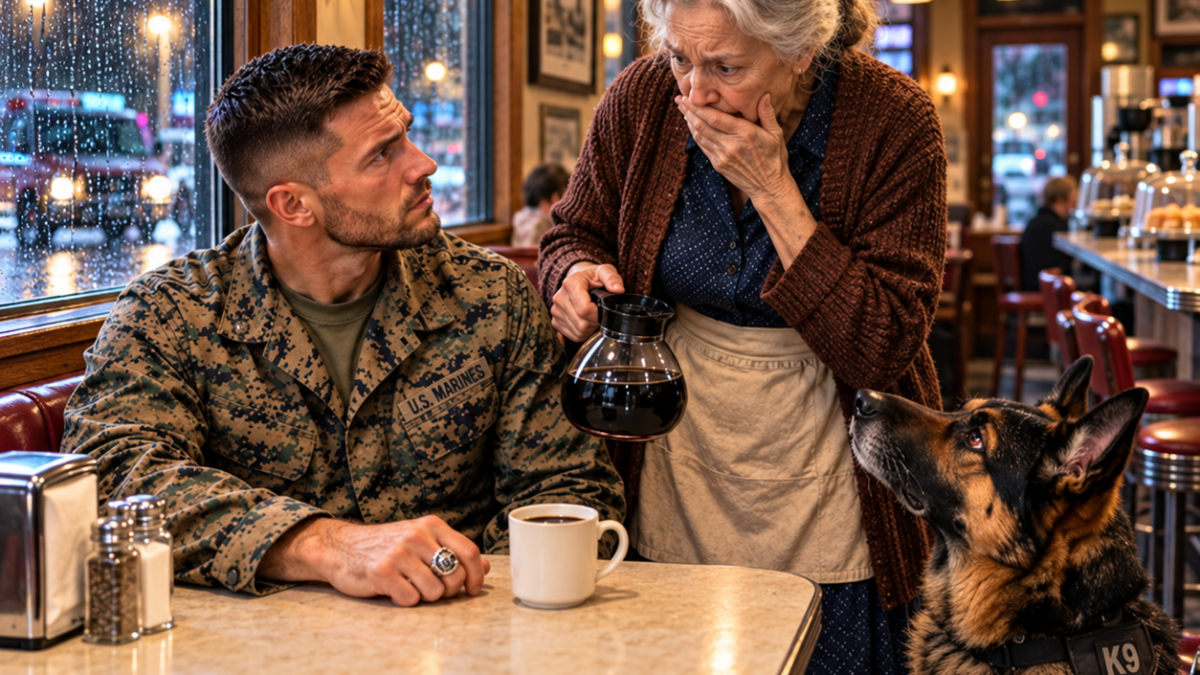
The diner was nearly empty when the old waitress reached for my coffee cup.
Then her eyes fell to the silver ring on my hand.
A lighthouse split by a single wave.
Her face went pale, her fingers tightened around the coffee pot, and she whispered, “My son had a ring exactly like yours.”
I froze.
At my feet, Brutus, my German Shepherd K9, slowly lifted his head.
Her son had been a United States Marine.
He had disappeared nineteen years earlier.
And the ring on my hand—the one my old mentor had given me without explanation—was supposed to be one of only four ever made.
My name is Silas Vance.
Gunnery Sergeant, United States Marine Corps.
Forty-one years old.
Six-foot-one.
Broad-shouldered.
Short dark hair beginning to gray at the temples.
A scar under my right cheekbone.
A habit of choosing seats with my back to the wall.
A lifetime of leaving places before they could become home.
For most of my adult life, I carried everything I needed in bags that could be packed in under ten minutes. Uniforms. Boots. Documents. A few photographs. A watch. A knife. The ring.
I had never thought much about the ring.
That is not exactly true.
I had thought about it every day.
I just never let myself ask enough questions.
It was heavy silver, worn smooth around the edges from years of use. On its face, a small lighthouse stood against a single curling wave, as if the sea were trying to split the light in half. Inside the band, almost hidden by age, were five words:
NO ONE WALKS HOME ALONE.
Master Sergeant Owen Mercer had given it to me twelve years earlier in a parking lot outside Camp Lejeune. I had been younger then, angrier, harder, and convinced that surviving meant needing no one.
Owen was already old by Marine standards. Not weak. Never weak. Just weathered in the way men become when too many young faces have looked to them for answers in places where no good answers exist.
He pressed the ring into my hand and said, “A good Marine gave meaning to this before I did.”
That was all.
I asked what he meant.
He shook his head.
“Wear it until you understand.”
Then he walked away.
Owen Mercer was good at walking away before anyone could ask him to stay.
I became good at that too.
The only exception in my life was Brutus.
PART2:
Brutus was a seven-year-old German Shepherd K9, black and tan, broad-chested, amber-eyed, with the torn edge of one ear and silver beginning around his muzzle. He had worked beside me long enough to respond to the movement of two fingers or the smallest change in my breathing.
He knew when I was alert before I spoke.
He knew when a room felt wrong.
He knew when to stay still.
He also knew, better than any human alive, that I had no idea what to do with loyalty when it was offered without conditions.
That cold November night, rain swept across Milbrook, West Virginia, turning the mountain highway black beneath my headlights. The little roadside diner appeared out of the mist shortly after midnight, its faded sign glowing weakly above the road.
I had been driving too long.
Brutus had been patient too long.
And coffee was easier than sleep.
I pulled my dark pickup beneath the diner’s awning and shut off the engine.
Brutus looked toward the diner, then back at me.
“Coffee,” I muttered. “Then we move.”
He climbed down carefully and followed me inside.
The diner was nearly empty. An old country song played somewhere behind the kitchen. Rain tapped against the windows. The air smelled like burned coffee, old grease, lemon cleaner, and the kind of loneliness found only in places that stay open after midnight because somebody out there has nowhere else to stop.
Behind the counter stood Eleanor Whitaker.
I did not know her name yet.
She was seventy-four, maybe five-foot-four, slender but not fragile, with weathered fair skin, blue-gray eyes, and silver-white hair gathered into a low bun. A brown knitted cardigan covered a faded dark-blue work dress. Brown leather ankle boots showed beneath the hem.
Age had touched her.
It had not bent her dignity.
PART3″
Her hands were calloused, the hands of someone who had worked all her life and refused to make a performance out of endurance.
“Anywhere you like,” she said.
I chose a booth facing the entrance.
Automatic.
Brutus settled beside me.
Eleanor noticed.
She also noticed the way I positioned myself where I could see both the front door and the kitchen corridor. She asked no questions. People who work night shifts learn which silences deserve respect.
“Coffee?” she asked.
“Black.”
“Yes, sir.”
She poured.
Brutus watched her with calm interest.
“He working?” she asked.
“Not tonight.”
“Then may I?”
I nodded.
She offered him the back of her hand first.
Good instincts.
Brutus sniffed, then unexpectedly leaned closer.
Eleanor scratched gently behind his ear.
“Well,” she whispered, “aren’t you an old gentleman?”
“Don’t tell him that.”
A faint smile touched her mouth.
“I think he already knows.”
I almost smiled myself.
Almost.
For several minutes, nothing happened. Rain. Music. Coffee. Brutus resting against my boot. A clock over the counter ticking too loudly.
Then Eleanor returned with the pot.
I had removed my gloves.
That was when she saw the ring.
Her hand stopped mid-pour.
Coffee continued streaming toward the rim until I shifted the cup away.
“Ma’am.”
She lowered the pot slowly.
For a moment, she looked much older than she had seconds earlier. Not weaker. Just struck by something invisible.
Her eyes stayed fixed on my hand.
“Where did you get that ring?”
My fingers curled instinctively.
“Why?”
Her gaze rose to my face.
There was something behind her eyes I recognized immediately.
Not fear exactly.
The terrible caution of someone approaching a memory sharp enough to cut.
“My son had a ring like yours.”
The diner disappeared around me.
The rain softened.
The coffee smell faded.
Only her words remained.
“My son?”
She swallowed.
“Corporal Daniel Whitaker. United States Marine Corps.”
The name meant nothing at first.
Then something shifted deep in memory.
Daniel Whitaker.
I had never known him.
But I had heard the name once.
Maybe twice.
Not from Owen directly.
From someone who stopped talking the moment he realized Owen was nearby.
Eleanor continued before I could place it.
“Daniel sent his home before his last deployment. Told me to keep it safe until he came back.”
Her voice remained controlled.
Her fingers tightened around the coffee pot handle.
“He never did.”
“How long?” I asked.
“Nineteen years.”
I looked down at the lighthouse beneath my thumb.
The ring suddenly felt heavier.
“Missing?”
“Later presumed dead. They never brought my boy home.”
Brutus lifted his head fully now.
He looked from her to me, sensing the change in the room.
I wanted to tell her coincidence existed.
I wanted to tell her military rings, unit rings, memorial rings, deployment rings—men made symbols for everything because words often failed.
I wanted to leave before an old woman mistook my confusion for hope.
Instead, I asked the only question that mattered.
“Was the symbol exactly the same?”
Eleanor nodded.
I said nothing for a long time.
At dawn, the rain weakened into a gray drizzle.
Eleanor watched through the diner window as Brutus and I walked back to the truck. I knew she expected never to see us again. That was the reasonable expectation. Men like me passed through. Drank coffee. Paid cash. Left before questions could grow roots.
Ten miles outside Milbrook, I slowed the pickup.
Brutus lifted his head from the passenger side.
The wet road stretched ahead through mist and bare trees.
I stared at it.
Then at the silver lighthouse on my hand.
For years, Owen Mercer had never told me whose story stood behind that symbol.
For years, I had let him keep his silence because I understood silence better than confession.
But Eleanor Whitaker had looked at my hand like she was seeing a ghost.
I tightened my grip on the wheel.
Then I turned the truck around.
Brutus watched the road reverse beneath us.
“We’re going back,” I said.
He did not look surprised.
Morning settled over Milbrook beneath low clouds.
Eleanor was wiping down the counter when the bell above the diner door sounded again.
She looked up.
Stopped.
I removed my cap.
Brutus stood beside me.
“Mrs. Whitaker,” I said, “I need to understand how Owen Mercer knew your son.”
She studied me for several seconds.
“You know this Owen?”
“I did.”
“Did?”
“He taught me a great deal when I was young.”
My thumb moved over the ring.
“Including things he apparently never explained.”
Eleanor folded the cleaning cloth and placed it beside the register.
“Then you’d better come see what Daniel left behind.”
Her farmhouse stood several miles outside Milbrook at the end of a gravel road bordered by bare maples and dark pasture. It was an aging white house with a deep porch and a red barn behind it, cared for rather than restored.
I noticed immediately that Eleanor maintained everything she could reach herself.
Split firewood stacked under canvas.
Gutters cleared.
Porch swept.
A board near the far railing needed replacing, but nothing about the place suggested helplessness.
Brutus climbed the steps ahead of us and waited until Eleanor opened the door.
Inside, the house smelled faintly of cedar, coffee, and old wood.
Eleanor hung her cardigan near the kitchen.
Then she hesitated at the hallway.
“His room is upstairs.”
The change in her voice made me stop.
“We don’t have to do this today.”
“Yes,” she said. “We do.”
The bedroom door opened with a soft scrape.
Nothing inside looked staged like a shrine. Yet time seemed to have moved more slowly there.
A narrow bed stood beneath the window.
Books filled one shelf.
An old baseball glove rested beside photographs.
Under a chair sat a pair of worn combat boots.
Brutus entered without command, sniffed the room once, then walked to the boots. He lowered himself beside them, stretched his front paws forward, and rested his head between them.
Eleanor stared.
Her mouth trembled.
Then, unexpectedly, a smile appeared.
“Daniel loved dogs,” she said.
She leaned against the doorframe.
“Every stray within five miles somehow learned where we lived. His father used to say Daniel could leave for school alone and come home leading a parade.”
I looked at Brutus.
“Sounds expensive.”
Eleanor laughed softly.
Brief.
Genuine.
“It was.”
For a moment, Daniel existed in that room not as a missing Marine, not as a name on a file or a mother’s unanswered question, but as a boy dragging muddy animals through his mother’s kitchen.
That memory was harder to face than grief.
Grief I understood.
Life was more dangerous.
Eleanor knelt beside an old military trunk at the foot of the bed. I helped lift it onto a bench, then stepped back while she opened it.
Inside were letters tied with string.
Photographs.
An old field cap.
Postcards.
A few patches.
Ordinary pieces of a young man’s life that had become precious because he never returned to reclaim them.
Eleanor removed one photograph and frowned.
“I’d forgotten this one.”
Four young Marines stood shoulder-to-shoulder beneath hard white sun, tired and grinning. Daniel was easy to identify because Eleanor’s eyes moved to him immediately.
Mine went to the taller man beside him.
Owen Mercer.
Younger.
Harder.
No gray beard.
No lines carved by years of choosing who could be saved.
But there was no mistaking him.
More important were their hands.
All four Marines wore matching silver rings.
“Owen,” I said.
Eleanor looked at the photo.
“That’s him?”
“Yes.”
She reached into the trunk and removed a small cloth pouch.
From it, she tipped another ring into her palm.
Same lighthouse.
Same wave.
Same worn silver.
I slowly placed my hand beside hers.
Daniel’s ring.
My ring.
Two pieces of a story neither of us had been allowed to finish.
“Daniel mailed this home before that last mission,” Eleanor said. “There was a note.”
She found a folded paper tucked inside the pouch and handed it to me.
The message was short.
Keep this safe for me, Mom. I’ll take it back when I get home.
Eleanor closed her fingers around the ring.
“For years, I kept thinking I shouldn’t move it. Foolish, I suppose.”
“No,” I said.
She looked up.
“No, ma’am. It isn’t.”
I removed my ring and examined the inside more carefully than I had in years. The engraving was worn, but readable.
No one walks home alone.
Eleanor turned Daniel’s ring.
Same words.
“So Owen’s ring became yours.”
I nodded.
“Years after that photograph. He gave it to me when our paths separated. Said it had reminded him of something he didn’t want me forgetting.”
“Did he tell you about Daniel?”
“No.”
The answer bothered me more than it should have.
Owen Mercer had taught me to read a room, control anger, understand fear as information instead of shame. He taught me how to keep men alive and how to carry loss without letting it spill into every decision.
But he had never once mentioned Daniel Whitaker.
Eleanor placed the photograph on the bed.
“Can you find him?”
I hesitated.
I had an old number for Owen. I also knew, through occasional messages from mutual acquaintances, that he had settled near Tellico Plains, Tennessee. He had withdrawn from nearly everyone over the years.
“I believe so.”
“When do we leave?”
I looked up.
“We?”
“You heard me.”
“I can speak to him first.”
“No, Gunnery Sergeant.” Eleanor’s voice never rose. “I spent nineteen years having men come to my door and tell me what they thought I was strong enough to hear. If Owen Mercer knows what happened to my son, I will hear it from him.”
Argument would only insult her.
“All right,” I said. “Pack for a couple of nights.”
We left Milbrook before noon.
Eleanor brought one small suitcase and a thermos of coffee. Brutus occupied the rear seat, occasionally pushing his muzzle between the front seats whenever conversation interested him.
Miles passed beneath bare ridge lines before Eleanor asked, “Where’s home for you, Silas?”
I kept my eyes on the road.
“Depends where I’m assigned.”
“That wasn’t what I asked.”
I almost smiled.
“No, ma’am.”
She waited.
I realized I had no better answer.
Later, she asked what would happen when Brutus grew too old to work beside me.
“He stays with me,” I said.
“Where?”
The question was gentle.
That made it worse.
I looked in the mirror. Brutus was asleep with his muzzle resting against the seat.
I could describe every place I had served.
Almost nowhere I belonged.
Beside me, Eleanor held Daniel’s ring inside her closed hand.
I thought I was driving an old woman toward an answer.
For the first time, I wondered whether the road was taking me somewhere too.
By late afternoon, the Tennessee mountains had swallowed the last weak sunlight. The road outside Tellico Plains narrowed beneath bare hardwoods, dark pines, and a cold wind carrying the promise of another hard night.
Owen Mercer’s cabin stood alone near the end of a gravel track. Weathered cedar. Small porch. Woodsmoke curling from the chimney.
I slowed the truck.
Brutus rose in the rear seat.
Eleanor had barely spoken for the last twenty minutes. Daniel’s ring remained closed inside her hand.
I parked.
A man appeared in the doorway.
Master Sergeant Owen Mercer was sixty-three now, a little over six feet tall, with the remnants of a once-powerful build softened by age and old injuries. His shoulders remained broad beneath a faded olive work shirt. His left leg carried a noticeable stiffness. Thick silver hair had receded above a deeply lined forehead. A short gray beard framed a square jaw.
A pale scar disappeared beneath his right ear into his collar.
His eyes were dark brown and steady.
The eyes of a man who had once made decisions while other lives depended on him.
Age had not removed his discipline.
Guilt had changed what he used it for.
He recognized me first.
“Vance.”
Then Eleanor stepped out of the passenger side.
Owen’s face emptied.
He looked at her for several seconds before removing his cap.
“Mrs. Whitaker.”
Eleanor stopped at the bottom of the porch.
“You know who I am.”
“Yes, ma’am.”
“How?”
Owen lowered his eyes.
“Because I’ve known your face for nineteen years.”
The wind moved through the trees.
“I practiced an apology for nineteen years,” Owen continued. “Now you’re standing here, and I don’t know how to begin it.”
“Then don’t begin with an apology,” Eleanor said. “Begin with my son.”
Owen nodded once and opened the door.
Inside, the cabin was clean but almost aggressively bare. A table. Four chairs. A wood stove. Books. Little else.
I recognized the habit immediately.
Nothing unnecessary.
Nothing that could hurt much to leave behind.
Brutus settled near Eleanor’s chair while Owen remained standing until she sat.
“Daniel was twenty-seven,” Owen began. “Best field sense in the team. Terrible poker player.”
Eleanor’s expression shifted almost imperceptibly.
“He got that from his father.”
For one fleeting moment, Daniel existed between them as something other than a casualty.
Then Owen told her what happened.
Their team had been supporting an operation that collapsed into an emergency withdrawal. The extraction point came under sustained pressure before the helicopter arrived. Several men were wounded. Owen had taken fragments through his leg and side and was losing blood quickly.
A canine handler had been injured badly enough that he could barely stand. His working dog had suffered a leg wound and was panicking from pain.
“The aircraft could remain exposed only long enough to load those who could no longer move themselves,” Owen said.
Eleanor sat completely still.
“Daniel could still fight. So could another Marine with us. They volunteered to hold the perimeter while we loaded.”
“Volunteered?” she asked.
“Yes.”
“Did you order him to stay?”
“No, ma’am.”
“Would he have stayed if you had told him to get on that helicopter?”
Owen’s jaw tightened.
“Probably.”
“That isn’t what I asked.”
I saw the old commander in Owen disappear under the weight of the mother sitting across from him.
“No,” he admitted. “If I could have stood, I would have dragged him aboard myself.”
Eleanor lowered her eyes to Daniel’s ring.
Owen continued.
“Daniel helped lift the wounded handler into the aircraft. Then he went back for the dog.”
Brutus shifted beside Eleanor.
“The animal was frightened and snapping from pain. Daniel covered its head with his field jacket and carried it the final yards with another Marine. Only after everyone incapable of withdrawing on foot was aboard did Daniel step away from the helicopter.”
Owen’s voice quieted.
“He wasn’t trying to die. I need you to understand that.”
Eleanor looked up.
“People clean these stories up afterward,” Owen said. “Make men sound fearless because it’s easier for everyone listening.”
He swallowed.
“Daniel was scared.”
Eleanor’s fingers tightened.
“Good,” she whispered.
Owen seemed surprised.
“He was my son,” she said. “Of course he was scared.”
Something broke behind Owen’s eyes.
“As the helicopter prepared to lift,” Owen continued, “Daniel crouched beside my stretcher. Dust and debris were whipping through the cabin. His face was dirty. His hands were shaking. He asked me if we were coming back.”
Eleanor did not move.
“I told him yes.”
“Did you believe it?”
Owen stared toward the stove.
“I wanted to.”
“That isn’t an answer.”
“No,” he said, voice rough. “I didn’t know.”
The helicopter lifted with Daniel and another Marine still below, holding the defensive line. Weather deteriorated quickly. Fighting intensified around the return route. A second attempt was delayed.
Then canceled.
Later searches found evidence that Daniel and the other Marine had moved away from the original position.
But neither man was recovered.
Eventually both were declared missing.
Then presumed dead.
For nineteen years, Eleanor had imagined hundreds of endings.
Daniel alone.
Daniel wounded.
Daniel calling for someone who never came.
An empty grave allows every nightmare to survive.
Now one truth replaced at least some of them.
Her son had wanted to live.
He had been afraid.
And he had stayed because others could not leave without him.
“Did he leave anyone behind?” Eleanor asked.
Owen shook his head.
“No, ma’am.”
Silence settled over the cabin.
Brutus rose and crossed to Eleanor. He rested his head against her knee. Her hand found the silver beginning around his muzzle.
Then she asked the question Owen had feared since the moment we arrived.
“Why didn’t you come to me?”
Owen’s face changed.
There was more.
Without answering, he pushed himself slowly from the table and walked down the short hallway. His uneven steps disappeared into another room.
When he returned, he carried a yellowed envelope.
Eleanor stopped breathing.
Her name was written across the front in faded ink.
Mrs. Eleanor Whitaker.
Owen held it with both hands.
“Daniel gave me this before they loaded me,” he said. “He put it inside my vest and told me that if he didn’t make it home, I was to give it to you myself.”
Eleanor stared at the envelope.
My blood went cold despite the fire.
“How long have you had that?” I asked.
Owen looked directly at her.
“Nineteen years.”
Eleanor slowly lifted her eyes to his face.
The grief that had occupied them all afternoon changed into something else.
And this time, Owen Mercer had nowhere left to hide.
Night settled heavily around the Tennessee cabin, sealing the mountains beneath cold darkness while the wood stove burned steadily inside.
Eleanor did not reach for the envelope.
Owen stood across the table, holding it carefully by the edges, as though nineteen years had made the paper too fragile for ordinary touch.
I remained near the window.
Brutus sat beside Eleanor’s chair, watching the room with that quiet attention he always carried when human voices changed.
Eleanor stared at her own name on the yellowed paper.
She knew the handwriting. The slight rightward slant. The uneven capital W. The way Daniel pressed too hard with a pen.
For nineteen years she had wondered whether her son had been frightened, whether he had called for her, whether there had been something he wanted to say before he disappeared.
The answer had existed all that time inside an envelope another man carried.
“Nineteen years,” she said.
Owen nodded.
“Yes, ma’am.”
“You knew where I lived?”
“Yes.”
“You knew Daniel was my only child?”
“I did.”
Eleanor slowly stood.
Her voice never rose.
“Then explain to me how nineteen years happened.”
Owen placed the envelope on the table.
“The first year, I told myself I needed to recover before I came. Then I told myself I needed to know more about what happened to Daniel, so I could give you answers with the letter.”
He gripped the back of a chair.
“When there weren’t any answers, I ran out of excuses.”
“You still didn’t come.”
“No.”
“I tried more than once. The first time I made it into Virginia before I turned around. Another time, I crossed into West Virginia. Once I got within an hour of Milbrook.”
Eleanor’s face tightened.
“An hour?”
“Yes, ma’am.”
“And you turned around.”
“Yes.”
“Why?”
Owen looked at the envelope instead of her.
“Because every time I saw your name, I remembered Daniel below that helicopter. I remembered him asking whether we were coming back. I remembered telling him yes.”
His voice roughened.
“Then I remembered that I came home and he didn’t.”
I watched his shoulders sink beneath an invisible weight.
I had seen survivor’s guilt.
I had carried pieces of it myself.
But Owen had given his guilt nineteen years to build a house around him.
“I kept telling myself showing up without your son would destroy you,” Owen continued. “That maybe the letter would make things worse.”
Eleanor’s eyes sharpened.
“Was that really what you believed?”
Owen was silent for several seconds.
“No.”
The answer seemed to cost him something.
“I was protecting myself.”
Eleanor closed her eyes.
“You had no right.”
“I know.”
“No.”
She looked directly at him.
“You don’t get to decide when a mother is ready to hear her child’s last words. You don’t get to choose which part of her grief she can survive.”
“I know.”
“You stole nineteen years from me.”
Owen did not defend himself.
“Yes, ma’am. I did.”
The anger left Eleanor almost as quickly as it had risen, replaced by exhaustion.
She sat again and finally picked up the envelope.
Her fingers trembled against Daniel’s handwriting.
She remembered receiving his letters at the farmhouse mailbox, sometimes stained with rain, sometimes carrying sand in the folds.
Back then, she had opened them immediately.
This one frightened her more than all the years of silence.
“What if I open this,” she whispered, “and there’s nothing left to wait for?”
The question settled over the room.
I could have told her Daniel had already been gone nineteen years.
I knew better.
Facts and acceptance are not the same thing.
Brutus moved first.
He stepped closer and pressed his head gently against Eleanor’s knee.
She rested one hand between his ears.
Then she opened the envelope.
The paper inside had been folded twice. Daniel’s handwriting filled both sides.
Eleanor began reading silently.
After several lines, her mouth twitched.
“He says my biscuits were never as good as I claimed.”
A small laugh escaped her.
Then broke into a sob.
She kept reading.
Daniel wrote about ordinary things.
The kitchen window that rattled whenever wind crossed the hill.
His father falling asleep in the same chair after supper.
Coffee so strong it could remove paint.
A dog he owned as a boy that once stole an entire roast from the counter.
Those details hurt Eleanor more than anything heroic could have.
Daniel had not spent his final hours thinking about medals.
He had been thinking about home.
Then she reached the part where his handwriting became less steady.
Daniel admitted he was scared.
He wanted another morning in West Virginia.
He wanted to hear his mother complain about muddy boots.
He wanted one more ordinary Sunday when nothing important happened.
But there were men around him who could no longer get themselves out.
If his place on a helicopter meant leaving one of them behind, he wrote, then he already knew which choice he could live with.
Daniel did not call himself brave.
He wrote that courage without fear had never made sense to him anyway.
Eleanor stopped when she reached one sentence.
Her lips moved, but no sound came.
Tears rolled down her face.
Finally, she read aloud.
“If I don’t make it back, Mom, please don’t turn the rest of your life into a waiting room for me.”
The room became completely still.
Eleanor lowered the letter.
Nineteen years.
Daniel’s bedroom unchanged.
His boots under the chair.
The ring kept exactly where he left it.
Vehicles slowing on the county road still making her heart lift before reason pulled it down.
Late shifts at the diner because strangers ordering coffee were easier than returning to a farmhouse filled with silence.
She had done exactly what Daniel asked her not to do.
“I waited anyway,” she whispered.
Owen lowered his head.
“I waited nineteen years.”
Brutus remained against her leg.
Eleanor forced herself to finish.
At the bottom, Daniel had written one final line.
No one walks home alone.
Her eyes moved instinctively toward my ring.
Then toward Owen.
For the first time, she understood what I was only beginning to understand.
The words had never promised that everyone would physically return.
Maybe they meant those who survived were responsible for carrying one another beyond the place where someone had been lost.
Eleanor folded the letter carefully against her chest.
Owen turned away.
“Don’t,” she said.
He stopped.
“Don’t turn your back on me now.”
Slowly, Owen faced her.
“I’m still angry with you,” Eleanor said. “I don’t know when I’ll forgive you.”
“I understand.”
“But listen to me.” Her voice softened. “My son stayed so wounded men could come home. If you spend the rest of your life punishing yourself because you were one of them, then what exactly did Daniel save?”
Owen’s face broke.
He sat heavily, covering his eyes with one hand.
No dramatic apology came.
Only the quiet, uneven breathing of a man who had spent nineteen years believing suffering was the debt he owed the dead.
Later, Eleanor took Daniel’s letter to the guest room.
I stepped onto the porch with Brutus and stared into the black Tennessee woods.
Owen joined me several minutes later.
For a while, neither Marine spoke.
Through the window, I could see the inside of Owen’s cabin.
Few photographs.
Almost no personal possessions.
Nothing that would hurt much to leave behind.
Then I thought about my own life.
Different bases.
Different roads.
Bags that could be packed quickly.
Rooms I occupied without belonging to them.
Owen stared into the darkness.
“You think we’re different?”
I looked at him.
“I hid by staying in one place,” Owen said. “You hide by never staying anywhere.”
I wanted to reject it.
I could not.
My eyes dropped to Brutus, resting faithfully beside my boots.
The dog had followed me everywhere.
Maybe because I had never learned how to stop.
My thumb moved over the silver ring.
No one walks home alone.
Owen had worn those words while isolating himself for nineteen years.
I had inherited them while making sure almost no one could become important enough to lose.
Inside the cabin, Eleanor unfolded Daniel’s letter and began reading it again.
I stared at the engraving.
For years, I thought the ring represented loyalty to the people you refused to abandon.
That night, I finally understood the other side of the promise.
Sometimes you also had to let someone walk home with you.
Three mornings later, winter sunlight broke weakly through Tennessee clouds. Eleanor prepared to visit the place where, for nineteen years, her son’s name had stood in place of a grave.
The military cemetery lay several hours from Owen’s cabin, spread across rolling ground beneath bare November trees and an enormous washed-blue sky. Rows of white headstones followed the earth’s contours with an order I had always found both beautiful and unbearable.
Beyond them stood a memorial wall bearing the names of service members whose remains had never been recovered.
Eleanor walked toward it with Daniel’s letter folded inside her coat and his silver ring held in her right hand.
Owen followed several steps behind.
He used neither age nor injury as an excuse to shorten the distance.
I walked beside Eleanor while Brutus moved quietly at my left knee.
No one filled the silence.
Some journeys become smaller when people talk too much.
Eleanor found Daniel’s name before I did.
Daniel Whitaker
United States Marine Corps
She stopped.
For nineteen years, those letters had been the closest thing she possessed to a grave. Yet she had never known what to bring here.
Flowers had seemed too final.
Hope had seemed increasingly dishonest.
So she had carried questions.
Today, she carried answers.
Eleanor touched the cold stone.
“I know you were scared,” she whispered.
Owen lowered his head.
“I know you wanted to come home.”
Her voice trembled.
“And I know why you stayed.”
I stepped back, giving her space.
Brutus remained still beside me.
Eleanor closed her eyes.
She no longer had to imagine Daniel charging fearlessly toward death like the polished version of sacrifice strangers preferred to tell.
Her son had wanted another cup of terrible farmhouse coffee.
He had wanted muddy boots, rattling windows, and another ordinary Sunday.
He had been afraid because his life mattered to him.
And he had stayed anyway.
That truth hurt.
But unlike uncertainty, it did not keep changing shape in the dark.
Eleanor took Daniel’s ring from her palm and placed it against the memorial.
For a moment, I thought she might leave it there.
She did not.
She closed her fingers around it again.
Owen watched her.
“I thought I was supposed to give this back someday,” she said. “That’s why I kept it exactly where he left it.”
She looked at the ring.
“I’m keeping it now because he lived.”
Not because she was waiting.
Because she remembered.
That distinction seemed small enough to fit inside one sentence.
It contained nineteen years.
Owen approached only when Eleanor turned toward him.
He stopped several feet away.
“I’m not asking you to forgive me,” he said.
“I know.”
“I should have brought you that letter.”
“Yes.”
“I can’t give those years back.”
“No.”
There was no cruelty in Eleanor’s answers.
There was also no attempt to make the truth comfortable.
Owen nodded.
Then Eleanor stepped closer.
“Daniel didn’t stay behind so you could spend the life he helped save wishing you hadn’t survived.”
Owen looked away.
She continued.
“I’m still angry with you, Owen. Maybe some part of me always will be. But I don’t want my son’s last act to become the reason another man disappeared.”
Owen’s eyes filled.
For once, he did not turn away.
Eleanor touched his arm briefly.
It was not forgiveness.
Not yet.
But I understood that sometimes healing begins much smaller than forgiveness.
Sometimes it is simply permission to stop making the wound deeper.
They stood together before Daniel’s name for several minutes.
Then Eleanor turned first.
She walked away without looking back.
I noticed that.
So did Owen.
At the parking area, Owen stopped beside my truck. He ran one hand across Brutus’s head before looking at me.
“You heading back to Milbrook?”
“I told her I would.”
“And after?”
I glanced toward Eleanor, waiting near the passenger door.
“I don’t know.”
Owen gave me a tired half-smile.
“Maybe that’s better than pretending you do.”
Something about him seemed different.
Not healed.
Certainly not.
But less committed to remaining broken.
“You going back to the cabin?” I asked.
“For now.”
He looked toward the cemetery.
“Maybe I’ll put another chair on the porch.”
I understood.
We shook hands.
No speeches.
No promises.
Just two Marines finally understanding that survival was not supposed to be a sentence.
The drive north took most of the day.
Eleanor slept for part of it with Daniel’s ring resting loosely in her palm. Brutus slept behind her seat. I drove through Tennessee, Virginia, and eventually into the familiar mountains of West Virginia.
By the time Milbrook appeared, the sky had darkened.
Eleanor woke.
Neither of us spoke about the cemetery.
We did not need to.
The farmhouse emerged beyond the bare trees after sunset. I parked beside the porch and carried Eleanor’s suitcase to the door.
Brutus climbed out behind me and shook himself hard.
Eleanor unlocked the house.
“Coffee,” she said.
I looked toward my truck.
My overnight bag sat behind the seat.
The road beyond the farmhouse stretched into darkness, connecting to another highway, another town, another temporary room.
My first instinct arrived automatically.
Keep moving.
“Thank you, ma’am,” I began. “But I should probably—”
Brutus walked past me.
“Brutus.”
The German Shepherd ignored me completely.
He climbed the porch steps, circled once beside Eleanor’s old chair, and lay down.
Eleanor looked at the dog.
Then at me.
She said nothing.
That somehow made it worse.
I stared at Brutus.
“You’re supposed to wait for a command.”
Brutus rested his chin on his paws.
Eleanor’s mouth curved.
“Seems to me he’s been waiting on one from you.”
I looked back toward the road.
There was nowhere I needed to be that night.
That realization should have felt empty.
Instead, for the first time, it felt like freedom.
I removed my cap.
“Coffee sounds good.”
Inside, Eleanor turned on the kitchen lights.
I started a fire while Brutus explored the familiar rooms before settling beneath the kitchen table. Eleanor filled the old coffee maker.
Soon the farmhouse carried sounds it had not held together in years.
Cupboards opening.
A chair scraping against wood.
A Marine complaining that Eleanor’s coffee might actually be stronger than his.
The steady click of Brutus’s nails across the floor whenever he decided someone might have food.
Eleanor laughed.
I heard it from the other side of the kitchen and stopped.
The farmhouse was no longer silent.
Later, Eleanor placed Daniel’s ring on the mantle beside a photograph of him smiling in uniform.
Not hidden in a trunk.
Not waiting to be returned.
Remembered.
Miles away, Owen sat on his porch beneath the Tennessee stars.
For the first time in years, his porch light remained on after dark.
And in Milbrook, I sat at Eleanor’s kitchen table long after my coffee had gone cold.
My ring caught the warm light.
No one walks home alone.
For years, I had believed those words meant refusing to abandon someone on the worst day of their life.
Daniel understood that.
Owen was beginning to understand what came afterward.
Eleanor finally did too.
I looked beneath the table.
Brutus slept with one paw resting across my boot.
Maybe coming home was not about finding the place you had left.
Maybe it was recognizing the moment you no longer needed to leave.
Outside, the highway disappeared into the West Virginia darkness.
For once, I did not look toward it.
I stayed.








