A 72-Year-Old Waitress Was Told to Leave a Bleeding Marine K9 Outside—or Lose the Job She’d Held for 11 Years—Then She Untied Her Apron.
PART3:
Intelligent amber eyes.
Six years old, maybe.
He walked close to Caleb’s left leg, shoulder almost brushing his knee. He did not pull, sniff tables, beg, bark, or look for attention. His focus stayed on Caleb in a way that told me this dog had a job deeper than obedience.
“Good morning,” I said.
“Morning, ma’am,” Caleb replied.
His manners were formal but not cold.
Without asking too many questions, I guided him to the small table beside the front window. It sat against the wall with a clear view of the entrance and no one behind it. I had learned over the years that some people breathe easier when they can see what is coming.
Caleb noticed.
He did not thank me out loud.
But his shoulders lowered half an inch when he sat.
Ranger curled beneath the table and rested his head on his paws.
I poured coffee.
Black.
Caleb had not told me yet, but men who sit like that usually drink it black.
He looked at the cup, then at me.
“Thank you.”
“You’re welcome.”
I did not ask about the dog.
I did not ask about his scars.
I did not ask why a man built like a locked door flinched almost invisibly when a bus hissed to a stop outside.
Sometimes respect means allowing silence to remain silence.
Over the following weeks, Caleb returned again and again.
Same table.
Same coffee.
Same quiet nod.
Ranger beneath his feet.
I noticed little things.
Caleb wrapped both hands around his mug before taking the first sip, as if the warmth steadied something inside him.
If plates clattered too loudly in the kitchen, Ranger lifted his head immediately and nudged Caleb’s leg. Just one touch. One reminder. Then he settled again.
When a group of teenagers came in laughing too loudly after a football game, Ranger shifted his body slightly between Caleb and the noise.
Not aggressive.
Protective.
The gesture lasted only a second, but I understood enough.
That dog was not merely well trained.
He was watching over a man who had not yet learned how to fully come home.
One rainy morning, Caleb arrived early and caught me replacing the water bowl outside.
“You really do that every day?” he asked.
I nodded and set it beside the entrance.
“I’ve never seen it empty.”
“Neither have I,” I said. “Maybe that’s because someone always needs it.”
Ranger walked over and drank before entering the diner.
Caleb watched him.
For some reason, that simple moment seemed to stay with him.
Little by little, Maple Road Diner became more than a place he ate breakfast.
It became one place outside his small cabin where he did not need to watch every shadow.
I never tried to fix him.
I simply made room.
Sometimes that is all a person can accept at first.
Then Victor Hale arrived.
Victor was our new general manager.
Forty-eight years old.
Tall.
Clean-shaven.
Expensive glasses.
Dark hair combed so neatly it looked afraid of making a mistake.
He came from corporate restaurant management, which meant he understood efficiency, presentation, table turnover, profit margins, and the art of smiling without warmth.
During his first week, he timed everything.
How long guests stayed.
How fast coffee was refilled.
How often servers checked tables.
How many napkins were used per shift.
How much time I spent talking to regulars.
That last one bothered him most.
“Hospitality is not loitering with a coffee pot,” he told me one evening after closing.
I dried my hands on a towel.
“No, sir. It’s knowing when to pour and when to listen.”
He did not like that answer.
By the end of his second week, his attention had settled on Caleb and Ranger.
He watched them the way a man watches an expense he cannot justify.
The wall table.
The slow breakfast.
The service dog.
The old waitress who never hurried either of them.
One evening, after the last customer left, Victor called me into the narrow office behind the kitchen.
He stood behind the desk even though it had never been his desk before, which told me he was the kind of man who needed furniture to agree with him.
“Starting tomorrow,” he said calmly, “if that Marine comes back with his dog, you’ll ask them to leave.”
For a moment, I thought I had misunderstood.
“Excuse me?”
“The dog creates sanitation concerns and makes some customers uncomfortable.”
“Ranger is a service dog.”
Victor’s mouth tightened.
“I am aware of what the harness says.”
“It’s not a decoration.”
“I didn’t ask for a legal lecture, Eleanor.”
I looked through the office window toward the front door. The ceramic bowl still sat outside beneath the awning, empty now except for a few drops of rain.
“He sits under the table,” I said. “He bothers nobody.”
“He slows turnover.”
That was the truth.
Not sanitation.
Not discomfort.
Money.
“Caleb pays his check every time.”
“He occupies a premium window table during morning rush.”
“He comes before morning rush.”
Victor removed his glasses, cleaned them slowly, and put them back on.
“You have a habit of confusing sentiment with business. I am telling you plainly. If he comes back with the dog, you ask him to leave.”
I did not answer.
“Do you understand?”
“I hear you.”
“That is not the same thing.”
“No,” I said. “It isn’t.”
For the first time in eleven years, I walked home wondering whether kindness could truly become a reason for losing a job.
The thought followed me through the night.
It was waiting when I woke before dawn.
It stood beside me while I buttoned my uniform, twisted my silver hair into a bun, and took my blood pressure pill with half a glass of water.
Fear is a strange thing at seventy-two.
When you are young, you imagine fear as something sharp and loud.
At my age, it is quieter.
It sounds like a utility bill.
A medicine bottle.
An envelope from the tax office.
An old house settling at night while you wonder how long you can afford to keep it.
I needed that job.
But I had lived long enough to know need is not the same as surrender.
The next morning, cold drizzle settled over Pine Haven. The sidewalks shone beneath wet maple leaves. I arrived earlier than usual, unlocked the diner, brewed coffee, arranged mugs, and carried the ceramic bowl outside.
My knees protested as I bent.
I filled the bowl with fresh water and placed it beside the entrance exactly where it had been every morning for years.
Some habits are too deeply rooted to abandon.
A few minutes later, Caleb’s aging pickup rolled into the parking lot.
Ranger jumped down beside him, his coat dampened by rain. Caleb preferred the rear entrance because it avoided the busier front sidewalk, so they crossed the lot toward the delivery door.
Halfway across the pavement, Ranger cried out.
Sharp.
Sudden.
Wrong.
I heard it from inside.
So did Caleb.
I was already moving before I understood why.
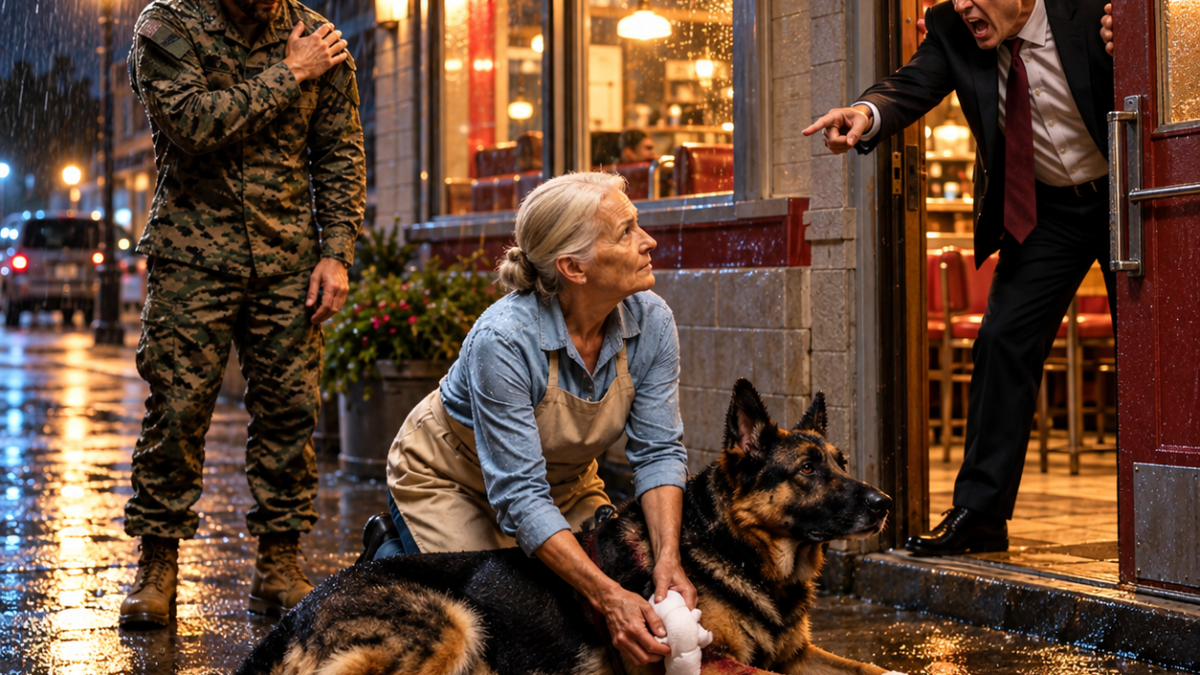
A broken piece of glass lay hidden beneath rain-soaked leaves near the rear entrance. It had sliced deep into Ranger’s front paw.
Blood dripped onto the concrete.
Caleb dropped to one knee beside him, but the moment he reached forward, pain hit his injured shoulder. I saw his arm tremble. He tried again through gritted teeth, but he could not apply enough pressure without making his own injury worse.
“It’s okay, Ranger,” he whispered, though worry had overtaken confidence in his voice.
I came through the back door carrying the small first aid kit we kept beneath the register.
The moment I saw the blood spreading across the pavement, hesitation left me.
“Oh, sweetheart,” I murmured, kneeling beside Ranger.
The dog recognized my voice.
He stayed perfectly still while I examined the wound.
Deep cut.
Steady bleeding.
Not a scratch.
“We need somewhere dry,” I said. “Help me get him inside.”
Together, Caleb and I guided Ranger into the storage room behind the kitchen, a clean supply area separated from both the dining room and food prep stations. The floor was concrete. The shelves held sealed paper goods, cleaning supplies, and extra linens. No food was prepared there. No customers entered it.
I wrapped sterile gauze around Ranger’s paw and pressed firmly.
Ranger did not fight me.
His breathing was fast, but controlled.
I kept my hands steady.
“Call a veterinarian,” I told Caleb.
He pulled out his phone immediately.
“Price Veterinary Clinic.”
“My name is Caleb Warren,” he said. “My service dog has been injured. We need help right away.”
Before he could finish, footsteps sounded in the hallway.
Slow.
Hard.
Polished.
Victor Hale stopped in the doorway.
His eyes moved from Ranger’s blood to my hands to Caleb’s face.
His expression showed irritation before concern even had a chance to appear.
“What exactly is happening here?”
I did not lift my hands.
“Ranger cut his paw on glass outside.”
Victor stepped carefully around the drops of blood, as if his shoes mattered more than the animal bleeding in front of him.
“I have a business meeting in less than half an hour,” he said sharply. “Take the dog outside. Now.”
“He can’t move yet.”
“I wasn’t asking.”
Caleb ended the call and slipped the phone into his pocket.
“Dr. Hannah Price is already on her way,” he said. “She’ll be here in a few minutes.”
“Then wait outside,” Victor replied. “This is a restaurant, not an animal clinic.”
Caleb tried to lift Ranger himself.
He bent carefully, sliding one arm beneath the dog’s chest. The moment he tried to raise him, pain shot through his injured shoulder. His muscles gave way, and he had to stop before Ranger lost balance.
I saw his face tighten.
“Don’t force it,” I said. “You’ll only make both injuries worse.”
Victor’s patience vanished.
“I gave you an order.”
I replaced the blood-soaked gauze with clean gauze and kept pressure on the wound.
“If I let go now, the bleeding starts again.”
“You are choosing a dog over your job.”
I finally looked up.
“I’m choosing to stop unnecessary suffering.”
For a brief moment, the room fell silent except for rain tapping against the back door.
Victor’s voice lowered.
“Take your hands off that animal.”
“I can’t.”
“You mean you won’t.”
“Until the bleeding stops, no.”
The answer came without anger.
Only certainty.
Victor stared at me.
Then he said, “Then you’re finished here.”
The words landed harder than I expected.
Eleven years.
Birthday candles in pancakes.
Coffee poured for widowers.
Children growing tall enough to order for themselves.
Holiday shifts.
Storm mornings.
Funeral lunches.
Veterans who sat quietly and never needed to explain why.
Eleven years ended in one sentence.
I nodded slowly.
“If that’s your decision.”
Victor pointed toward the hallway.
“Turn in your apron before you leave.”
Several employees had gathered silently outside the storage room. No one spoke. Some looked ashamed. Some looked afraid. I did not blame them. People with rent due often learn silence before they learn courage.
A white pickup stopped outside the rear entrance.
Dr. Hannah Price hurried in carrying a veterinary emergency bag.
Hannah was thirty-eight, auburn hair tied into a practical ponytail, green eyes clear and focused. She had treated everything from retired working dogs to stubborn barn cats to goats that ate things goats should know better than to eat.
She knelt beside Ranger, examined the wound, and gave me a reassuring nod.
“You did exactly what I would have done,” she said. “Keeping pressure on it prevented much heavier blood loss.”
Only then did I remove my hands.
They shook after the job was done.
Not before.
Hannah bandaged Ranger for transport. Caleb stayed close, one hand near the dog’s head.
I stood slowly.
My knees complained.
My heart did too.
Then I untied my faded blue apron.
The strings felt strange in my fingers.
For eleven years, I had tied that apron every morning. I had wiped coffee on it, flour on it, tears on it when customers lost someone and needed a hug more than a refill.
I folded it neatly, smoothing the fabric with trembling hands, and placed it on a nearby shelf.
No speech.
No bitterness.
Just quiet dignity.
Outside beneath the awning, rain continued to fall.
Caleb stood beside me while Hannah loaded Ranger into her truck.
“I’m sorry,” he said quietly. “If I hadn’t come here today—”
“No, Caleb.”
I looked once toward the apron I had left behind.
“The person who cost me my job wasn’t you.”
He lowered his eyes.
“It was the man who made his own choice.”
Hannah drove away with Ranger.
Caleb watched until the truck disappeared.
For the first time since I had met him, the Marine looked helpless in a way Ranger could not nudge away.
I wanted to comfort him.
Instead, I placed one hand on his arm.
“Go with your dog.”
He nodded.
Then left.
I walked home in the rain.
The next afternoon, sunlight returned to Pine Haven, cool and soft after the storm.
Ranger was recovering well at Dr. Price’s clinic. The cut was deep, but not permanently damaging. Hannah told Caleb that immediate pressure had made the difference.
I heard that later.
At the time, I was home, sitting at my kitchen table with my checkbook, a notebook, and three folded bills from the little metal box in my cabinet.
I had enough for my medicine.
Enough for groceries if I stretched them.
Enough for property taxes if no other emergency happened.
For about three weeks.
Three weeks is not long when you are seventy-two and unemployed.
That afternoon, Caleb came to my farmhouse.
Ranger limped beside him with a fresh white bandage around his paw.
The sight of that dog walking on his own filled me with more relief than I expected.
I welcomed them inside.
The house smelled like cinnamon and fresh bread because worry makes me bake.
Caleb noticed the photographs above the stone fireplace. His eyes settled on one of Thomas and me standing beside the half-built porch, both of us covered in sawdust.
“My husband,” I said.
“Thomas?”
I smiled faintly.
“Yes. He always believed a house should be built slowly enough to collect memories.”
Caleb nodded.
“I think he was right.”
We sat at the small oak table while Ranger settled near the window, careful with his injured paw.
For a few moments, neither of us spoke.
Then Caleb placed a plain white envelope on the table.
“I can’t replace your job,” he said. “But maybe this can buy you some time.”
I looked at the envelope.
I knew what it was without opening it.
“No.”
“Please.”
“I appreciate it.”
“You need it more than I do.”
“That may be true.”
I stood, walked to the cabinet, and opened the small metal box. Inside were folded bills and my notebook of careful handwriting.
“I have enough for medicine and taxes,” I said.
“For how long?”
I could have lied.
I did not.
“About three weeks.”
Caleb’s face tightened.
“Then why won’t you take it?”
“Because gratitude and charity aren’t the same thing.”
He lowered his eyes.
“I still feel responsible.”
“You aren’t.”
“I was the reason you were in that room.”
“No,” I said. “Ranger was hurt, and I helped. That is not a debt.”
He said nothing.
“Promise me something,” I added.
He looked up.
“Don’t call your commanders. Don’t ask Marines to come here. Don’t use your uniform to punish Victor.”
His silence told me the thought had crossed his mind.
“I’ve met enough good soldiers to know one phone call could make that man’s life very difficult,” I said. “But if kindness needs power to win, then it wasn’t kindness that won.”
Those words stayed with Caleb longer than I expected.
I did not know that until later.
He left with the envelope untouched.
I stood in the doorway and watched his truck disappear between the trees.
That night, the house felt larger than usual.
I washed one plate.
One fork.
One cup.
I checked the lock twice.
Then I sat in Thomas’s old chair and listened to the silence.
Losing a job at my age is not like losing one when you are young. There is no easy confidence that another door will open. There is no extra energy waiting in your bones. There is only the question of whether your usefulness has ended before your life has.
I did not sleep much.
The next morning, Caleb drove to the Pine Haven Veterans Association.
The building was a modest brick place that had once been the town post office. Faded military photographs lined the walls beside handwritten thank-you notes from local families.
Franklin Boyd, the association’s president, waited near the coffee pot.
Franklin was sixty-seven, a retired Marine with a white beard, broad shoulders softened by age, and the kind of patience that comes from listening to too many men say they are fine when they are not.
Caleb told him everything.
Not to complain.
Not for revenge.
Simply because he could not stop thinking about me.
Franklin listened until the story ended.
Then he stared out the window for a long moment.
“You know,” he said, “our association has been trying to save the old Pine Haven railway station for nearly six years.”
“The abandoned one near Mill Creek?”
Franklin nodded.
“We wanted to turn it into a place where veterans, military families, and neighbors could gather. Coffee. Simple meals. Community events. Somewhere people could slow down.”
“What stopped you?”
Franklin smiled faintly.
“The building was never the real problem.”
“What was?”
“We never found the right person to make strangers feel welcome.”
Caleb told me that idea two days later.
He came back to the farmhouse with Ranger, whose bandage had been changed again. I had two cups of coffee ready before he reached the porch.
“I thought about what you said,” he began.
“I hope you didn’t ignore it.”
“I didn’t.”
He told me about the abandoned railway station and Franklin’s dream.
Before he finished, I shook my head.
“No.”
“You haven’t even heard the whole idea.”
“I’ve heard enough.”
I looked toward the old barn behind the house.
“I’m seventy-two years old. My knees complain every morning. I can’t lift half the boxes I used to, and I just lost the only job I’ve had in more than a decade.”
I smiled sadly.
“Some seasons are meant for beginning. Others are meant for letting go.”
Caleb did not argue.
Ranger slowly stood beside him.
His injured paw was still wrapped in white, and every step remained careful. Yet he continued forward without hesitation.
Caleb watched him.
Then he spoke softly.
“Ranger will never go back into combat.”
I looked at the German Shepherd.
“He knows that,” Caleb said. “So do I.”
He rested his hand on Ranger’s neck.
“But losing one purpose didn’t make him worthless. He just needed another one.”
The porch fell silent.
Ranger limped toward the ceramic bowl I had placed beside the front steps, the same way I used to at the diner. He lowered his head and drank without hurry.
For the first time since leaving Maple Road Diner, I saw myself in that simple moment.
I had spent days believing my usefulness ended with a folded blue apron.
Perhaps I had been measuring my life by the wrong doorway.
Without another word, I picked up my coat from the porch chair.
Caleb looked surprised.
“Where are we going?”
I slipped my house key into my pocket.
“I suppose it’s time I looked at an old train station.”
The abandoned railway station stood beneath a pale winter sky.
Weathered wooden walls.
Broken windows.
Weeds pushing through cracked concrete.
A faded station sign leaning as if time had grown too heavy to carry.
Inside, dust covered nearly everything. Part of the roof had collapsed over what had once been the waiting area. The air smelled of old timber and rust.
It was hard to imagine families laughing there again.
“It looks worse than I remembered,” Franklin admitted when he joined us.
He rested both hands on his cane, but looked around with affection instead of disappointment.
“Buildings are a lot like people,” he said. “They don’t stop having value just because they’ve been forgotten.”
I walked carefully across the creaking floorboards and stopped beside the old ticket window. Years of dust covered the wooden counter.
I brushed it away with my fingertips.
For a moment, I could almost hear voices.
Travelers.
Children.
Goodbyes.
Homecomings.
People waiting.
People returning.
“I can almost hear them talking,” I whispered.
Caleb smiled.
“Maybe one day they will.”
Within a week, work began.
Nobody received a paycheck.
Nobody was ordered to come.
People simply started appearing.
Retired veterans carried toolboxes.
Neighbors brought ladders and paint.
Teenagers cleared weeds after school.
Some people had only one hour before work.
Others stayed until sunset.
Every contribution mattered.
Caleb took responsibility for heavier repairs. He climbed onto the roof with volunteers, replacing rotten beams and damaged shingles despite the stiffness in his shoulder.
Years in the Marines had taught him to finish difficult tasks before admitting pain existed.
I noticed.
So did Franklin.
By the third afternoon, while lifting a support beam into place, Caleb froze. His hand went to his left shoulder and pain crossed his face before he could hide it.
“I’m fine,” he said automatically.
Nobody believed him.
Franklin climbed down from a ladder and calmly took the other end of the beam.
“You’re not twenty-two anymore,” he said.
“I can still handle it.”
“I know.”
Franklin’s expression softened.
“But today, you don’t have to.”
For several seconds, Caleb hesitated.
Accepting help had always been harder for him than giving it. I could see that clearly. During his military career, weakness could endanger a team. Even after coming home, that lesson had stayed rooted in him.
Finally, he released the beam.
Another volunteer stepped forward without a word.
Instead of embarrassment, Caleb looked almost startled by relief.
Meanwhile, I found myself carrying responsibilities I never imagined.
Mornings at town offices, learning about health permits and business licenses.
Afternoons comparing equipment prices.
Evenings organizing donation lists at my kitchen table.
I asked the same questions twice more often than I liked.
Sometimes three times.
But every day, I came home with another answer.
One afternoon, volunteers gathered around folding tables for sandwiches and coffee while Franklin unrolled an old blueprint across a workbench.
“We still need one thing,” he said. “A name.”
Everyone grew quiet.
Dozens of ideas came and went.
The Veterans Station.
Mill Creek Table.
Second Home Café.
The Waiting Room.
None felt right.
Then Caleb looked across the room.
Ranger had just finished drinking from my familiar ceramic bowl, which now rested beside the station entrance. The German Shepherd lay down near the doorway exactly as he used to beneath the table at Maple Road Diner.
Caleb smiled.
“I think he already chose it.”
Every eye turned toward Ranger.
“The station should be called Ranger’s Table,” Caleb said.
For a moment, nobody spoke.
I looked at the dog resting peacefully beside the old water bowl.
“Not because he’s a hero,” I said softly. “Because he reminded us what this place is really for.”
Franklin nodded.
“A place where nobody has to stand outside wondering if they’re welcome.”
The name stayed.
Over the next several weeks, the station transformed.
Fresh paint covered faded walls.
Broken windows were repaired.
Warped floorboards replaced.
Long wooden tables were built from reclaimed pine.
I insisted the kitchen stay simple.
Fresh coffee.
Homemade soup.
Warm bread.
Honest conversation.
People do not need fancy food to feel welcome.
They need to know they are not in the way.
Just as everything seemed ready, Victor Hale filed a formal complaint with the Pine Haven Town Council.
His letter claimed I had violated health regulations at Maple Road Diner by bringing an injured dog into the building. According to him, someone who ignored sanitation policies should never receive permission to operate a food establishment.
The permit review was scheduled for the following Tuesday.
I wore my good blue dress.
The one Thomas liked.
My hands shook when I buttoned it.
Not because I feared Victor.
Because I feared coming this far and watching one bitter man close another door.
The council chamber filled quietly.
Volunteers.
Veterans.
Local residents.
Former diner employees.
No protest signs.
No shouting.
Just people who wanted the truth heard.
Victor spoke first.
He described company policies, customer expectations, food safety, liability, public perception, and operational discipline.
He did not mention Ranger’s blood.
He did not mention the broken glass behind his building.
He did not mention that the dog had been kept in a separate storage room away from all food preparation and dining areas.
When he finished, Dr. Hannah Price stood.
“As the veterinarian who treated Ranger,” she said calmly, “I can confirm Mrs. Briggs followed proper emergency first aid procedures. The dog remained in a storage room completely separated from both the kitchen and dining area. Immediate pressure on the wound prevented severe blood loss.”
Several former Maple Road Diner employees confirmed the same sequence.
No food had been prepared there.
No customers had entered the storage room.
No one had been endangered.
The facts did not move.
Finally, Caleb stood.
He wore an ordinary flannel shirt instead of a Marine uniform.
That mattered to me.
He introduced himself simply as a resident of Pine Haven.
“I didn’t come here because of my military service,” he began. “I came because I owe someone the truth.”
The room stilled.
“If Eleanor had listened to the order to stop…”
He glanced toward Ranger, who lay quietly beneath a nearby bench.
“I might have lost the partner who saved my life more than once.”
His voice stayed steady.
“She never chose a dog over people. She chose compassion over convenience.”
When Caleb returned to his seat, no applause followed.
Only silence.
The kind that comes when words have already done enough.
After a short recess, the council returned.
The operating permit for Ranger’s Table was approved.
Not out of sympathy.
Because every inspection requirement had been met.
Victor’s complaint was dismissed.
The council also ordered Maple Road Diner to repair the hazardous area behind the building where the broken glass had injured Ranger and to update its written policy regarding legally protected service dogs.
Victor lowered his eyes.
For the first time, he seemed to understand that the consequences of his choice had reached far beyond one employee.
Three days later, volunteers gathered beneath the restored station entrance.
Franklin and Caleb lifted a handcrafted wooden sign into place.
Dark letters stretched across polished oak.
RANGER’S TABLE
NO ONE EATS ALONE
Before anyone stepped inside, I carried the old ceramic water bowl to the front door.
I filled it to the brim.
Placed it in its familiar spot.
Ranger walked over, drank slowly, and settled beside the entrance as if he had been guarding that doorway his entire life.
I looked at the station that had once been forgotten.
For the first time in years, it looked ready to welcome someone home.
Ranger’s Table opened without fanfare.
No television cameras.
No ribbon cutting.
No speeches from officials.
No line of military vehicles outside.
I wanted the day to begin the same way I believed kindness should begin.
Quietly.
Before unlocking the door, I filled the ceramic bowl with clean water and set it outside.
Ranger padded over, drank without hurry, then settled near the doorway and watched the empty street awaken.
Inside, sunlight poured through repaired windows onto long wooden tables. Coffee filled the room with its rich smell. Homemade bread cooled beside the kitchen counter.
I paused before the first customer arrived and smoothed the blue apron I wore now.
New apron.
Same hands.
And I realized the pain of losing the old one had finally faded.
A job had ended.
My purpose had not.
The first guests came not because they had been invited, but because they already considered the station part of their lives.
Franklin brought apples from his orchard.
Dr. Hannah Price arrived before opening her clinic, leaving blueberry muffins on the counter with nothing more than a smile.
Retired veterans greeted young families.
Neighbors introduced themselves to strangers.
Laughter slowly replaced the silence that had once filled the building.
By mid-morning, Ranger’s Table found its rhythm.
Nobody hurried breakfast.
Some stayed twenty minutes.
Others stayed for hours over endless coffee refills.
An elderly veteran quietly paid for a college student’s meal and slipped outside before she could thank him.
A local electrician fixed a flickering light and refused payment.
Kindness multiplied each time someone witnessed it.
We hired two people I believed deserved another chance.
Noah Carter was twenty-six, an Army veteran with sandy blond hair and a limp left by a training accident. He had spent months believing his military career was the only meaningful thing he would ever accomplish.
At first, he moved between tables like he expected to be judged.
But every grateful smile rebuilt something in him.
In the kitchen, Maria Alvarez stirred homemade soup while humming softly. She was thirty-four, a single mother with warm brown eyes, dark curls tucked beneath a colorful scarf, and a laugh that made the room feel larger.
For the first time in years, she worked only one job, giving her enough evenings to eat dinner with her daughter.
Caleb arrived shortly before lunch with Ranger beside him.
His shoulder was growing stronger through therapy. Official orders confirmed he would soon return to the Marine Corps as a training instructor instead of a combat Marine.
At first, he had thought that assignment meant losing a piece of himself.
Looking around Ranger’s Table, he no longer saw it that way.
Sometimes the greatest service is not protecting people in battle.
Sometimes it is helping them believe they still belong afterward.
Just before the lunch crowd thinned, the front door opened again.
Victor Hale stepped inside.
The room did not go silent, exactly.
But it noticed him.
Victor remained by the doorway for several seconds. He watched Noah laughing with an elderly veteran while carrying bowls of soup. He saw Franklin helping a young couple move tables together. He saw Ranger resting beside the ceramic bowl, greeting newcomers with calm eyes instead of suspicion.
Nothing inside Ranger’s Table was luxurious.
No expensive lighting.
No polished branding.
No corporate strategy.
Yet the room had something Victor had spent years trying to purchase through renovations and marketing and never found.
Trust.
“I owe you the truth,” he said at last.
I stepped from behind the counter.
No anger rose in me.
That surprised me.
“I convinced myself that protecting profit meant protecting the business,” Victor said. “I was wrong. A business survives because people trust it, and I forgot that before I forgot everything else.”
He lowered his head.
“I’m not asking you to forgive me.”
I was silent for a moment.
“No apology changes yesterday.”
Victor nodded.
“I know.”
“But it can change the way you treat the next person who walks through your door.”
A small, tired smile appeared.
“It already has.”
He thanked me quietly and left.
Three weeks later, a short notice appeared in the Pine Haven newspaper.
Maple Road Diner would host a free breakfast on the first Saturday of every month for veterans, military families, and anyone accompanied by a service dog.
No photographs.
No interviews.
No grand reopening.
Victor had finally chosen to let his actions speak longer than his apology.
Not long after, Caleb received orders to return to Camp Lejeune.
On his final morning in Pine Haven, he sat once more at the small table beside the front window.
“When I’m gone,” he asked with a quiet smile, “who gets this seat?”
I refilled his coffee before answering.
“It was never waiting for you.”
He laughed softly.
“Then who?”
“The next person who believes they’ve run out of places to belong.”
Almost as I finished speaking, the front door opened.
A young Marine in camouflage stood outside carrying a weathered duffel bag.
His shoulders were tense.
His eyes uncertain.
For several long seconds, he simply looked through the window as if deciding whether to turn away.
Ranger slowly stood.
Without being called, he walked to the doorway and sat beside the young Marine.
He did not bark.
Did not pull.
Did not rush him.
He simply waited.
The Marine looked down, rested one hand gently on Ranger’s head, and finally stepped inside.
Without asking a single question, I poured a fresh cup of coffee and placed it on the table beside the window.
The young Marine sat down.
Caleb looked at him.
Then at me.
Then at Ranger.
For the first time since Ranger’s Table had opened, the empty seat was no longer empty.
Caleb picked up his bag and walked toward the door.
When he passed me, he said softly, “Thank you, Eleanor.”
I smiled.
“For what?”
“For not letting the world teach you to look away.”
Outside, the ceramic bowl remained beside the entrance, filled with clean water for whoever might need it next.
Years from now, people may forget the exact details.
They may forget Victor’s complaint.
The council meeting.
The broken glass.
The rain.
The blue apron folded on a storage shelf.
But I will remember.
I will remember Ranger’s paw beneath my hands.
Caleb’s face when he realized he could not lift the dog alone.
Hannah saying I did exactly what she would have done.
Franklin standing inside a broken station and insisting forgotten things still had value.
Volunteers arriving without being asked.
A sign rising over an old doorway.
A young Marine choosing to come inside.
People think losing a job means losing purpose.
Sometimes it only reveals where your purpose was supposed to go next.
I was fired for helping a wounded service dog.
That is true.
But I was also handed a doorway into a life I never would have found if the old one had not closed so painfully.
Ranger healed.
Caleb found a mission that did not require a battlefield.
Noah found confidence.
Maria found time with her daughter.
Victor found humility.
Pine Haven found a table big enough for strangers.
And I found out that at seventy-two years old, a woman can still begin again.
Every morning, before I unlock Ranger’s Table, I fill the ceramic bowl and place it outside.
Some days a dog drinks from it.
Some days a cat.
Once, a little girl poured half of it into a paper cup for a tired-looking bird that had no interest in being rescued.
Most mornings, Ranger drinks first.
Then he settles beside the door, calm and watchful, while the town wakes up around us.
I smooth my apron.
Turn the key.
Breathe in coffee, bread, wood polish, and old hope made new.
And when the first person steps inside carrying something too heavy to explain, I smile the same way I did for Caleb on his first morning.
Not because I know how to fix them.
Because I know how to make room.
“Good morning,” I say. “Sit wherever you feel safest.”
And the table by the window waits.








