A 72-Year-Old Waitress Was Fired for Saving a Marine’s Injured K9—Then, Days Later, the People of Her Town Began Showing Up for a Reason She Never Expected
PART3:
He looked down as Ranger stepped forward and drank before entering the diner. Something in Caleb’s face softened.
“Maybe that’s because someone always needs it,” I said.
He did not answer, but the words seemed to follow him inside.
After that, Maple Road Diner became one of his places.
I could tell.
Not home. Not comfort exactly. But a place where he did not have to brace quite so hard.
Then Victor Hale arrived.
Victor was forty-eight, tall, clean-shaven, sharp-eyed behind expensive glasses, and dressed as if a diner were a boardroom that smelled faintly of bacon grease. He had been sent by the ownership group that bought Maple Road Diner from the original family two years earlier. Until then, they had mostly left us alone as long as the accounts balanced.
Victor came with folders, spreadsheets, polished shoes, and a way of looking around that made everything seem guilty of inefficiency.
His first week, he timed table turnover.
He redesigned the menus.
He reduced portions of side dishes and called it “waste correction.”
He changed the coffee supplier to something cheaper and pretended nobody would notice.
Everyone noticed.
He watched employees like we were leaks in a pipe. He noticed when I spent too long refilling coffee for Mr. Ramsey. He noticed when I gave a bowl of soup to a woman who came in short three dollars. He noticed the ceramic water bowl by the front door and frowned as if hospitality itself needed a permit.
By the end of his first week, his attention had settled on Caleb, Ranger, and me.
That evening, after the last customer left, Victor called me into the back hallway.
“Mrs. Briggs,” he said.
Nobody called me that unless they wanted something unpleasant to sound official.
“Yes?”
“Starting tomorrow, if that Marine comes back with his dog, you’ll ask them to leave.”
I stared at him.
“I beg your pardon?”
“This is a food establishment, not a kennel.”
“Ranger is a service dog.”
Victor’s mouth tightened.
“We don’t need animals creating sanitation concerns or making other guests uncomfortable.”
“He lies under the table and bothers no one.”
“He creates an image issue.”
I looked toward the front door, where the ceramic bowl still sat beside the entrance.
“An image issue.”
“Yes.”
“Victor, that dog has better manners than half the men who come in after church.”
His eyes narrowed.
“This is not a joke.”
“No, it isn’t.”
“Then you understand.”
“I understand that federal law protects service animals.”
He inhaled slowly through his nose.
“I also understand that older employees sometimes have difficulty adapting to modern standards.”
There it was.
Not said loudly.
Not said crudely.
But there it was.
Older.
Difficult.
Outdated.
A woman like me learns to recognize when people start speaking around the word useless.
Victor smiled without warmth.
“Going forward, I expect compliance.”
I said nothing.
That night, I walked home under bare trees and wondered whether doing the right thing might cost me the only job I had left.
The next morning, cold drizzle settled over Pine Haven.
The sidewalks shone beneath gray light. Maple leaves stuck wetly to the curb. My knees ached before I even reached the diner. Victor’s warning followed me step by step.
Ask them to leave.
I unlocked the front door.
Brewed coffee.
Arranged mugs.
Wiped counters.
Then carried the ceramic bowl outside.
For a moment, I stood beneath the awning with the water rippling in the cool breeze.
Fear said, Don’t.
Habit said, Do.
Love said, Always.
I placed the bowl in its familiar spot.
Some roots run too deep to pull out without tearing the whole tree.
Caleb’s pickup arrived only a few minutes later.
He parked toward the side of the lot, as usual, near the quieter rear entrance where deliveries came in. Ranger jumped down beside him, black-and-tan coat damp from rain, red harness bright against the gray morning.
They crossed the pavement.
Halfway to the rear door, Ranger cried out.
Not a bark.
A sharp, pained sound that cut through the rain and into the kitchen.
I was already moving before I thought.
I grabbed the small first aid kit from beneath the register and hurried out the back.
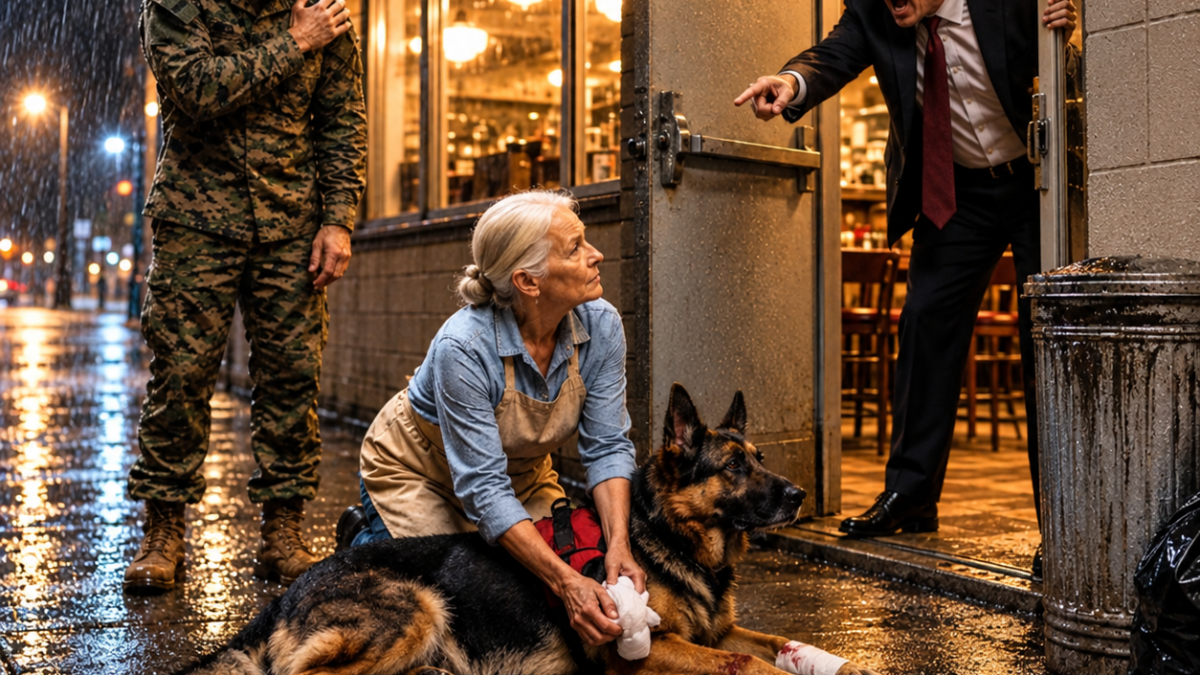
Ranger held one front paw lifted. Blood dripped onto the concrete, bright and terrible against the wet gray. A sharp piece of broken glass lay half-hidden under rain-soaked leaves near the rear entrance.
Caleb knelt beside him.
“It’s okay, Ranger,” he whispered, but his voice carried more fear than confidence.
He reached for the paw, then froze as pain shot through his shoulder. I saw it immediately. The way his left arm trembled. The way his jaw clenched. The way his breath caught.
His old injury.
He tried again anyway.
“Stop,” I said gently. “You’ll hurt yourself.”
“I need to—”
“I know.”
I knelt beside Ranger.
“Oh, sweetheart.”
Ranger looked at me.
He knew my voice.
That mattered.
He remained perfectly still while I examined the wound. The glass had sliced deep into the pad. Blood kept welling up fast.
“We need somewhere dry,” I said. “Help me get him inside.”
Caleb hesitated.
“The dining room—”
“Storage room.”
Together, carefully, we guided Ranger through the rear door into the clean supply room behind the kitchen. It was separate from food prep and closed off from the dining area. Dry. Warm enough. Space to work.
I wrapped sterile gauze around Ranger’s paw and pressed firmly.
“Call a veterinarian,” I said.
Caleb pulled out his phone with his good hand.
“Price Veterinary Clinic,” a voice answered.
“My name is Caleb Warren,” he said. “My service dog has been injured. We need help right away.”
Before he could continue, slow footsteps echoed down the hallway.
Victor stopped in the doorway.
He looked at Caleb.
Then Ranger.
Then me kneeling on the floor with both hands pressing gauze against the bleeding paw.
His expression showed irritation before concern even had a chance.
“What exactly is happening here?”
I did not lift my hands.
“Ranger stepped on broken glass outside.”
“I have a business meeting in less than half an hour,” Victor said sharply. “Take the dog outside. Now.”
“He can’t move yet.”
“I wasn’t asking.”
Caleb ended the call and slipped the phone into his pocket.
“Dr. Hannah Price is on her way,” he said. “She’ll be here in a few minutes.”
“Then wait outside,” Victor replied. “This is a restaurant, not an animal clinic.”
Caleb stepped forward, determined to lift Ranger himself. He bent carefully, sliding one arm under the shepherd’s chest, but the moment he tried to raise him, pain burned across his face. His injured shoulder gave way before Ranger could even get balanced.
“Don’t force it,” I said. “You’ll make both injuries worse.”
Victor’s patience vanished.
“I gave you an order.”
I calmly replaced the blood-soaked gauze with a clean one and pressed down again.
“If I let go now, the bleeding will start again.”
“You are choosing a dog over your job.”
I finally looked up.
“I’m choosing to stop unnecessary suffering.”
For a moment, the room went silent except for rain tapping against the back door.
Victor’s voice became colder than before.
“Take your hands off that animal.”
“I can’t.”
“You mean you won’t.”
“Until the bleeding stops, no.”
The answer came without anger.
Only certainty.
Victor stared at me.
“Then you’re finished here.”
The words landed harder than I expected.
For more than eleven years, Maple Road Diner had been part of my daily life. I had celebrated birthdays there, comforted grieving families, watched children grow into adults, served coffee to widowers, veterans, exhausted mothers, teenagers on first dates, truck drivers, teachers, nurses, and lonely people who needed somewhere to sit.
Eleven years ended in one sentence.
I nodded slowly.
“If that’s your decision.”
Victor pointed toward the hallway.
“Turn in your apron before you leave.”
Several employees had gathered silently outside the storage room. Maria from the kitchen had one hand over her mouth. Noah, the dishwasher, stared at the floor. Nobody spoke.
Not because they agreed.
Because fear has a way of locking mouths.
A white pickup stopped outside the back entrance.
Dr. Hannah Price hurried inside carrying an emergency veterinary bag. She was thirty-eight, with auburn hair tied in a ponytail and clear green eyes that took in everything at once.
After a quick examination, she looked at my hands.
“You did exactly what I would have done,” she said. “Pressure kept him from losing a lot more blood.”
Only then did I slowly remove my hands.
Hannah bandaged Ranger properly for transport. Caleb stayed near his head, speaking softly, apologizing to him as if love always believes it should have prevented pain.
While Hannah worked, I untied my faded blue apron.
My fingers trembled as I folded it.
I smoothed the fabric once.
Twice.
Then placed it on the shelf by the storage room door.
There was no argument.
No shouting.
No dramatic speech.
Just an old woman folding the last piece of a life she thought she understood.
Outside beneath the awning, rain continued to fall.
Caleb stood beside me while Hannah loaded Ranger carefully into her truck.
“I’m sorry,” he said quietly. “If I hadn’t come here today—”
“No, Caleb.”
I glanced once toward the apron I had left behind.
“The person who cost me my job wasn’t you.”
His eyes were full of guilt.
“It was the man who made his own choice.”
Hannah drove away with Ranger.
Caleb watched the truck until it disappeared down the street.
For the first time since he had started coming to the diner, he looked completely helpless.
That hurt me more than losing the apron.
“Go with him,” I said softly.
“You shouldn’t be alone.”
I smiled.
“I was alone before you came in.”
His face changed.
I regretted the words, though they were true.
“Go,” I said again. “Ranger needs you.”
He hesitated.
Then left.
I walked home in the rain.
No umbrella.
No apron.
No job.
By the time I reached the farmhouse, my cardigan was soaked and my knees ached so badly I had to sit on the porch steps before unlocking the door.
Inside, the house smelled faintly of cinnamon from the bread I had baked the day before. Thomas smiled from the mantle in his old photograph, sawdust on his shirt, one hand resting on the porch railing we had built together.
“Well,” I said to him, because talking to photographs becomes less strange after enough years alone, “I suppose I’ve done it now.”
The house did not answer.
I changed clothes, made tea, and opened the small metal box in the kitchen cabinet where I kept emergency money. Several folded bills. A notebook filled with careful handwriting. Medicine costs. Property tax estimate. Electric bill. Groceries.
Enough for maybe three weeks.
Four if I ate very plainly.
I closed the notebook.
The strange thing was, I did not regret it.
I was afraid.
Deeply afraid.
But regret was different.
Ranger had needed help.
I helped.
Some truths are simple even when consequences are not.
The rain stopped by the next afternoon.
Cool sunlight wrapped Pine Haven in the earthy smell of damp leaves. I had just taken bread from the oven when a truck pulled into my driveway.
Caleb stepped out first.
Then Ranger, carefully.
His injured paw was wrapped in a clean white bandage, and he limped slightly, but he was standing.
I pressed one hand against my chest before opening the door.
“He’s all right?”
Caleb nodded.
“He’ll need time. But Dr. Price says there shouldn’t be permanent damage because someone acted immediately.”
Relief moved through me so sharply I had to grip the doorframe.
“Come in.”
My farmhouse was modest, but warm. The kitchen table was old oak. The curtains needed washing. The floor sloped slightly near the pantry. Framed photographs covered the mantle above the stone fireplace. Thomas and me building the porch. Thomas holding a hammer like a king holding a scepter. Thomas laughing with a smear of white paint across his nose.
Caleb noticed.
“My husband,” I said.
“He built this place?”
“With me correcting him.”
A small smile touched Caleb’s mouth.
“Sounds like a good system.”
“He believed a house should be built slowly enough to collect memories.”
Caleb nodded.
“I think he was right.”
We sat at the kitchen table.
Ranger settled by the window, careful not to put too much weight on his paw.
For a few moments, none of us spoke.
Then Caleb placed a plain white envelope on the table.
“I can’t replace your job,” he said. “But maybe this can buy you time.”
I looked at the envelope.
I knew what was inside without touching it.
Money.
Probably more than I had in the metal box.
Probably enough to help.
I pushed it gently back toward him.
“No.”
His brow furrowed.
“Please.”
“I appreciate it.”
“You need it more than I do.”
“That may be true.”
I stood, walked to the cabinet, and took out the metal box. I opened it, removed the notebook, and showed him because pride can be a useful thing until it starts lying.
“I’ve saved enough to pay my medicine and the property taxes,” I said. “For about three more weeks.”
His face fell.
“Then why won’t you take it?”
“Because gratitude and charity are not the same thing.”
He lowered his eyes.
“I still feel responsible.”
“You aren’t.”
“I watched you lose your job because of my dog.”
“You watched me make a choice.”
His jaw tightened.
“I could call people.”
“I imagine you could.”
“My old commanders. Marines I served with. Veterans’ groups. Local reporters. I could make Victor regret what he did.”
I folded my hands.
“Promise me something.”
He looked up.
“Don’t call your commanders to punish him. Don’t use your uniform like a weapon. Don’t turn kindness into revenge.”
He was quiet.
“I’ve met enough good soldiers to know one phone call from you could bring a storm to his doorstep,” I said. “But if kindness needs power to win, then it wasn’t kindness that won.”
Those words seemed to trouble him.
Good.
Some words should.
When Caleb left, the envelope stayed on my table for a moment before he finally took it back.
Ranger paused at the porch, limped to the ceramic water bowl I had moved from the diner and placed beside my front steps, and drank.
Watching him there, I felt something inside me ache.
A doorway had closed behind me.
Maybe I had been staring at the wrong doorway.
The next morning, Caleb went to the Pine Haven Veterans Association.
I did not know that until later.
The building had once been the town post office, a modest brick place with faded military photographs along the walls and handwritten thank-you notes from local families. Franklin Boyd, the association president, was sixty-seven, a retired Marine with a neatly trimmed white beard, broad shoulders softened only slightly by age, and steady brown eyes that had seen enough to listen before speaking.
Caleb told him everything.
Not to complain.
Not to seek revenge.
Simply because he could not stop thinking about me.
Franklin listened.
Then he said, “You know, we’ve been trying to save the old Pine Haven railway station for nearly six years.”
Caleb frowned.
“The abandoned station near Mill Creek?”
“That’s the one.”
I knew the building.
Everyone in Pine Haven did.
It had stood empty for decades, its windows broken, sign leaning, weeds pushing through cracked concrete. Children dared each other to peek inside. Teenagers took pictures there. Old folks remembered when trains still passed through and soldiers came home through that platform, duffel bags over shoulders, mothers waiting with gloved hands and Sunday hats.
“We wanted to turn it into a place for veterans, military families, and neighbors,” Franklin told Caleb. “Coffee. Simple meals. Community events. Somewhere people could slow down.”
“What stopped you?”
“The building isn’t the problem.”
“What is?”
Franklin smiled faintly.
“We never found the right person to make strangers feel welcome.”
Two days later, Caleb came back to my farmhouse.
I had seen his truck from the kitchen window and poured two cups of coffee before he knocked.
He stood on the porch with Ranger at his side, looking like a man carrying an idea he was not sure I would allow him to set down.
“I thought about what you said,” he began.
“I hope you didn’t ignore it.”
“I didn’t.”
He told me about the railway station.
Franklin’s dream.
Veterans and families.
Coffee, meals, a place where people could gather.
Before he finished, I shook my head.
“No.”
“You haven’t heard the whole idea.”
“I’ve heard enough.”
His mouth closed.
I looked toward the old barn behind my house.
“I’m seventy-two years old, Caleb. My knees complain before I get out of bed. I can’t lift half the boxes I used to. I just lost the only job I’ve had in more than a decade.”
I tried to smile.
“Some seasons are meant for beginning. Others are meant for letting go.”
Caleb did not argue.
That was wise.
Ranger slowly stood beside him.
His injured paw was still wrapped. Every step remained careful. Yet he walked forward without hesitation, limped to the ceramic bowl beside my steps, and drank.
Caleb watched him.
Then spoke softly.
“Ranger will never go back into combat.”
I looked at the German Shepherd.
“He knows that. So do I.”
Caleb rested one hand on Ranger’s neck.
“But losing one purpose didn’t make him worthless. He just needed another one.”
The porch went quiet.
I looked at Ranger.
Then at my own hands.
Hands that had carried plates, poured coffee, bandaged a paw, folded an apron, counted too little money inside a metal box.
Maybe usefulness had not ended with a job.
Maybe I had been measuring my life by the wrong doorway.
Without speaking, I picked up my coat from the porch chair.
Caleb looked surprised.
“Where are we going?”
I slipped my house key into my pocket.
“I suppose it’s time I looked at an old train station.”
The station looked worse than I remembered.
Its weathered wooden walls bore scars of neglect. Broken windows reflected the pale winter sky. One part of the roof had collapsed over what used to be the waiting area. The air inside smelled of old timber, rust, dust, and rainwater that had found too many ways in. The faded ticket counter sagged. Weeds pushed through cracks in the platform outside.
Franklin Boyd stood near the entrance, leaning on his cane.
“It looks worse than I remembered,” he admitted.
“That supposed to encourage me?”
“No, ma’am. Honesty first. Encouragement second.”
I liked him immediately.
I walked carefully across creaking floorboards and paused beside the old ticket window. I brushed dust from the wooden counter.
“I can almost hear people talking,” I whispered.
Caleb smiled.
“Maybe one day they will.”
Within a week, work began.
Nobody was ordered.
Nobody was paid.
People simply appeared.
Retired veterans with toolboxes.
Neighbors with ladders.
Teenagers after school.
A church group with sandwiches.
Dr. Hannah Price with coffee and medical tape because someone was always scraping a knuckle.
Maria from the diner came on her day off and scrubbed the old kitchen walls so fiercely I thought she might scrub through them.
Noah, the dishwasher, showed up with a toolbox and refused to say whether Victor knew.
Some people could only spare an hour.
Some stayed until sunset.
Every contribution mattered.
Caleb naturally took on heavy repairs. Too naturally. He climbed onto the roof, replaced beams, hauled lumber, lifted what he should not lift, and treated pain like it was an annoying civilian he could ignore.
By the third afternoon, I saw him freeze while helping raise a support beam.
His hand clamped over his left shoulder.
“I’m fine,” he said automatically.
Nobody believed him.
Franklin climbed down from a ladder and took the opposite end of the beam.
“You’re not twenty-two anymore.”
“I can still handle it.”
“I know.”
Franklin’s expression softened.
“But today, you don’t have to.”
Caleb stood there for several seconds.
Accepting help was harder for him than giving it. I understood that. Pride can disguise itself as discipline for a long time.
Finally, he released the beam.
Another volunteer stepped forward without a word.
Caleb looked embarrassed at first.
Then relieved.
I pretended not to see the moment.
Some dignities are best protected by looking elsewhere.
Meanwhile, I found myself doing things I never imagined I would do at seventy-two.
Town office visits.
Health permits.
Business licenses.
Food service inspections.
Donation lists.
Equipment prices.
Menu planning.
I filled notebooks with calculations. I asked the same questions twice and sometimes three times. I learned which forms needed signatures in blue ink and which inspector liked phone calls before email. Every evening, I returned home tired enough to feel my bones humming.
But it was a living kind of tired.
The kind I had not felt since Thomas and I built the farmhouse porch.
One afternoon, volunteers gathered around folding tables for sandwiches and coffee when Franklin unrolled an old blueprint across a workbench.
“We still need one thing,” he said. “A name.”
Everyone grew quiet.
Names matter.
Dozens of ideas came and went.
The Depot.
The Veterans Station.
Mill Creek House.
The Rail House.
None felt right.
Then Caleb looked across the room.
Ranger had just finished drinking from my ceramic bowl, which now sat beside the station entrance during workdays. The German Shepherd lowered himself near the doorway exactly as he once had beneath the table at Maple Road Diner.
Caleb smiled.
“I think he already chose it.”
Every eye turned toward Ranger.
“The station should be called Ranger’s Table,” Caleb said.
For a moment, nobody spoke.
I looked at Ranger resting peacefully beside the old bowl.
A smile came before I could stop it.
“Not because he’s a hero,” I said softly. “But because he reminded us what this place is really for.”
Franklin nodded.
“A place where nobody has to stand outside wondering if they’re welcome.”
The name stayed.
Ranger’s Table.
No One Eats Alone.
The sign would come later.
The trouble came first.
Just as the station neared completion, Victor Hale filed a formal complaint with the Pine Haven Town Council.
He claimed I had violated health regulations at Maple Road Diner by bringing an injured dog into the building. According to his letter, someone who ignored sanitation policies should not receive permission to operate a food establishment.
The permit review was scheduled for the following Tuesday.
The council chamber filled quietly.
No protest signs.
No shouting.
No spectacle.
Just volunteers, veterans, neighbors, former diner customers, local business owners, and people who had quietly decided the truth deserved witnesses.
Victor spoke first.
He wore a dark suit and the same polished calm he had used when firing me. He discussed company policies, customer expectations, sanitation, liability, and the importance of consistent standards.
He did not mention the broken glass behind the diner.
He did not mention Ranger’s blood.
He did not mention Caleb’s injured shoulder.
He did not mention the storage room being separated from both kitchen and dining areas.
When he finished, Dr. Hannah Price was invited to testify.
She stood calmly before the council.
“As the veterinarian who treated Ranger,” she said, “I can confirm Mrs. Briggs followed proper emergency first aid procedure. Ranger was kept in a storage room separate from food preparation and dining areas. Immediate pressure on the wound prevented much heavier blood loss.”
Several former Maple Road employees confirmed the same facts.
No food had been prepared there.
No customers had entered the storage room.
The sequence remained consistent.
Then Caleb stood.
He wore an ordinary flannel shirt instead of a Marine uniform.
That mattered.
He introduced himself simply as a resident of Pine Haven.
“I didn’t come here because of my military service,” he began. “I came because I owe someone the truth.”
The room grew still.
“If Eleanor had listened to the order to stop, I might have lost the partner who saved my life more than once.”
He glanced toward Ranger, lying quietly beneath a nearby bench.
“She never chose a dog over people. She chose compassion over convenience.”
When he sat, there was no applause.
Only silence.
The kind that arrives when words have already done enough.
After a short recess, the council returned with its decision.
The operating permit for Ranger’s Table was approved.
Not because of sympathy.
Because every inspection requirement had been met.
The complaint was dismissed.
The council also ordered Maple Road Diner to repair the hazardous rear entrance area where broken glass had caused Ranger’s injury and update its policy regarding legally protected service dogs.
Victor lowered his eyes.
For the first time, he seemed to understand that the consequences of his decision had gone far beyond one employee.
Three days later, volunteers gathered beneath the restored station entrance while Franklin and Caleb lifted a handcrafted wooden sign into place.
Dark letters stretched proudly across polished oak.
Ranger’s Table.
No One Eats Alone.
Before anyone stepped inside, I carried the old ceramic bowl to the front door.
I filled it to the brim.
Then placed it in its familiar spot.
Ranger walked over, drank slowly, and settled beside the entrance as if he had been guarding that doorway his entire life.
I looked at the station.
Once forgotten.
Now warm.
Ready.
Waiting.
For the first time in many years, it looked like somewhere a person could come home to.
Ranger’s Table opened quietly.
No television cameras.
No ribbon cutting.
No speeches from officials.
I wanted the first morning to begin the way kindness should begin.
Simply.
I filled the water bowl.
Unlocked the front door.
Smoothed my new blue apron.
And breathed.
The pain of losing the old one had finally faded.
A job had ended.
My purpose had not.
The first guests came because they already considered the station part of their lives.
Franklin brought apples from his orchard.
Hannah came before opening her clinic and left blueberry muffins on the counter.
Veterans greeted young families.
Neighbors introduced themselves to strangers.
Laughter slowly replaced the silence that had once filled the abandoned room.
Nobody hurried breakfast.
Some stayed twenty minutes.
Some stayed for hours over endless coffee refills.
An elderly veteran paid quietly for a college student’s meal before slipping out. A local electrician repaired a flickering light and refused payment. A retired teacher started a bookshelf near the window. Maria came to work in the kitchen and, for the first time in years, held only one job, which meant she could eat dinner with her daughter. Noah Carter, a young Army veteran with a slight limp from a training accident, began waiting tables and slowly learned that a life could still have meaning after the uniform came off.
Kindness multiplied every time someone witnessed it.
Caleb arrived before lunch with Ranger beside him.
His shoulder was improving with therapy. Official orders had confirmed he would return to the Marine Corps as a training instructor instead of a combat Marine. He had expected that to feel like losing a part of himself.
Instead, he looked around Ranger’s Table and understood something.
Sometimes the greatest service is not protecting people in battle.
Sometimes it is helping them believe they still belong afterward.
Just before the lunch crowd thinned, the front door opened.
Victor Hale stepped inside.
The room quieted, but not dramatically.
He stood just inside the doorway for several seconds, looking at Noah laughing with an elderly veteran while carrying soup bowls, Franklin helping a young couple move tables together, Ranger resting beside the ceramic bowl, and sunlight lying warm across reclaimed wood.
Nothing inside Ranger’s Table was luxurious.
But the room had something Victor had spent years trying to manufacture through renovations, branding, and marketing.
Trust.
He approached me carefully.
“I owe you the truth,” he said.
I stepped from behind the counter.
There was no anger in me then.
Only attention.
“I convinced myself protecting profit meant protecting the business,” he said. “I was wrong. A business survives because people trust it, and I forgot that before I forgot everything else.”
He lowered his head.
“I’m not asking you to forgive me.”
“No apology can change yesterday,” I said.
“I know.”
“But it can change the way you treat the next person who walks through your door.”
He nodded.
A small, tired smile appeared.
“It already has.”
He thanked me quietly and left.
Three weeks later, a notice appeared in the Pine Haven newspaper.
Maple Road Diner would host a free breakfast on the first Saturday of every month for veterans, military families, and anyone accompanied by a service dog.
No photographs.
No interviews.
No grand reopening.
Victor had chosen to let his actions speak longer than his apology.
Not long afterward, Caleb received orders to return to Camp Lejeune.
On his final morning in Pine Haven, he sat one more time at the small table beside the front window.
Ranger lay beneath it, his paw fully healed, head resting on Caleb’s boot.
“When I’m gone,” Caleb asked with a quiet smile, “who gets this seat?”
I refilled his coffee.
“It was never waiting for you.”
He laughed softly.
“Then who?”
“The next person who believes they’ve run out of places to belong.”
As if the words had opened the door, a young Marine stepped inside carrying a weathered duffel bag.
His shoulders were tense.
His eyes uncertain.
For several seconds, he stood just inside the entrance as if deciding whether to turn away.
Ranger slowly rose.
Without being called, he walked to the doorway and sat beside the young Marine.
He did not bark.
He did not pull.
He simply waited.
The Marine looked down, rested one hand gently on Ranger’s head, and finally stepped inside.
Without asking a single question, I poured fresh coffee and placed it on the table by the window.
The young Marine sat down.
Caleb smiled, picked up his bag, and walked toward the door.
For the first time since Ranger’s Table opened, the seat was no longer empty.
Outside, the ceramic bowl remained beside the entrance, filled with clean water for whoever might need it next.
I have thought often about the morning I lost my job.
People sometimes ask whether I would do it again.
At seventy-two, after eleven years at Maple Road Diner, with three weeks of money in a metal box and no guarantee anything better would come, would I still kneel on that storage room floor and keep pressure on Ranger’s bleeding paw?
Yes.
Without hesitation.
Because some choices reveal who we are when comfort is no longer part of the bargain.
I was afraid that day.
Do not let anyone make courage sound cleaner than it is.
My hands trembled when I folded that apron.
My stomach tightened when I counted my savings.
I lay awake wondering whether the farmhouse Thomas and I built would slip away from me because I had refused to obey one cruel instruction.
But fear is not always a stop sign.
Sometimes it is only proof that the thing in front of you matters.
Ranger needed help.
Caleb needed someone calm enough to act when his own body would not let him.
And I needed, though I did not know it yet, to discover that my life was bigger than the diner that had employed me.
I thought I was an old waitress losing the only job she had left.
But I was not finished.
I was only being moved to a larger table.
Now, every morning at Ranger’s Table, I fill that same ceramic bowl and place it by the door.
Some days, a service dog drinks from it.
Some days, a stray cat.
Some days, a child points and asks why it is there, and I answer the way I always have.
“Every creature gets thirsty eventually.”
Then I go inside.
I pour coffee.
I learn names.
I remember who sits facing the door.
I notice who needs conversation and who needs silence.
I watch people who thought they were alone discover an empty chair waiting for them.
And sometimes, when sunlight falls through the restored station windows just right, I think of Thomas.
I think he would like this place.
I think he would say the beams are solid but the porch could use work.
I think he would sit near the counter, drink coffee too slowly, and smile at Ranger by the door.
I think he would understand that a house should be built slowly enough to collect memories.
So should a community.
Maybe miracles do not always arrive with thunder.
Maybe they do not come dressed in light or announced by bells.
Maybe sometimes a miracle starts with a broken piece of glass behind a diner.
A Marine who cannot lift his injured dog.
An old waitress who refuses to let go.
A manager making the wrong choice.
A town deciding the right one should not stand alone.
What seemed like an ending became a beginning.
Not just for me.
For Caleb.
For Ranger.
For Noah.
For Maria.
For Franklin.
For Victor, perhaps, in his own quieter way.
And for every person who has since walked through the door of Ranger’s Table believing they had no place left to belong.
I lost my job for saving a Marine’s K9.
Days later, the whole town stood behind me.
But the truth is simpler than that.
I knelt beside a wounded dog and chose compassion over convenience.
Then the town remembered it could do the same.








