A 7-Year-Old Was Told She Could Choose Any Cat in the Shelter—She Picked the One With Only 2 Hours Left and Said, “That One Needs Me the Most.”
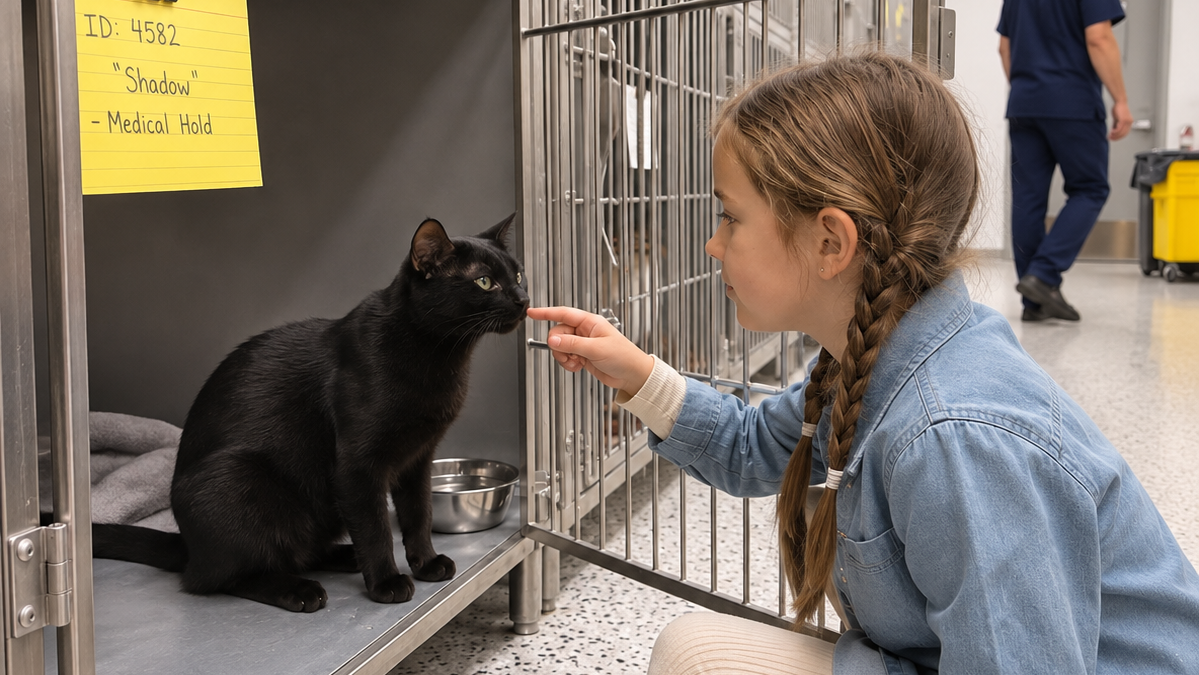
A 7-Year-Old Was Told She Could Choose Any Cat in the Shelter—She Picked the One With Only 2 Hours Left and Said, “That One Needs Me the Most.”
Everyone expected seven-year-old Lucy Bennett to choose a kitten for her birthday, but she walked to the darkest kennel in the shelter and pointed at the sick-looking black cat marked for euthanasia.
When a shelter manager tried to convince her parents that the animal was “not a practical choice,” Lucy emptied three months of saved coins onto the counter and quietly said, “That one needs me the most.”
What nobody knew was that saving Penny with less than two hours left would uncover why the old cat had been labeled unwanted in the first place—and force an entire Georgia county to answer for a mistake hidden behind one yellow card.
The first thing Lucy Bennett noticed about the Chatham County Animal Care Center was the noise.
Dogs barked behind concrete walls.
Metal kennel doors rattled.
A phone rang near the front desk.
Somewhere in the back, a dryer thumped every few seconds with a heavy, uneven rhythm.
Lucy stood between her parents in a pink sweatshirt with a small cloth backpack hanging from both shoulders and stared through the double doors leading into the cat wing.
She had been talking about this morning for three months.
Actually, according to her father, she had been talking about it for seven years.
“Technically,” Mark Bennett had told his wife, Rachel, over coffee before they left home, “she’s been asking for a cat since she learned the word cat.”
Rachel had smiled.
“She learned dog first.”
“That was Cooper’s fault.”
Cooper had been Mark’s Labrador when Lucy was born.
He had died the previous winter at fourteen.
Lucy had been devastated.
For weeks, she left his water bowl beside the kitchen cabinet because putting it away felt too much like agreeing he was gone.
Rachel and Mark did not want to replace Cooper.
They told Lucy that clearly.
“You don’t replace somebody you love,” Rachel said. “But someday, when we’re ready, we can make room for another animal.”
Lucy had thought about that sentence for months.
Make room.
Not replace.
On her seventh birthday, her parents finally told her she could choose a cat.
Any cat.
They made rules.
Indoor only.
They would handle veterinary bills.
Lucy would help with food, brushing, litter, and playtime.
No begging for a second cat two weeks later.
No naming the cat before meeting one.
That last rule had been added because Lucy had already written twenty-three possible names in a purple notebook.
She had also saved money.
Not enough for veterinary care.
Not enough for food.
But money mattered to her because she wanted to “buy part of my own birthday present.”
Every allowance coin went into a clear plastic zipper bag.
Quarters.
Nickels.
Dimes.
The occasional dollar bill.
She had counted it so many times she knew the amount almost perfectly.
Thirty-one dollars and sixty cents.
The county shelter adoption fee for an adult cat was thirty-five.
Mark had planned to cover it.
Lucy did not know that.
She believed she was close.
PART2:
That Saturday morning in Savannah was cool and bright, with sunlight reflecting off wet pavement after overnight rain.
Rachel had expected the shelter to feel sad.
Instead, it felt busy.
People carried bags of donated food through the lobby.
A young couple filled out paperwork.
A volunteer in a blue T-shirt knelt beside a nervous beagle.
Someone laughed near the front desk.
That helped.
Until Lucy noticed the yellow cards.
She did not know what they meant yet.
The woman who greeted them was named Carol Jensen.
She was fifty-eight, with silver hair cut above her shoulders and reading glasses hanging from a cord around her neck.
“Birthday girl?” Carol asked.
Lucy nodded.
“How old?”
“Seven.”
Carol lowered her voice dramatically.
“That is a very serious cat-choosing age.”
Lucy smiled.
Mark said, “We’ve been warned.”
Carol handed them sanitizer and explained the rules.
“Let the cats come to you. Don’t put fingers through cages unless a volunteer says it’s okay. Some are scared. Some are sick. Some think fingers are snacks.”
Lucy nodded as if receiving military instructions.
Rachel squeezed her hand.
“You ready?”
PART3:
Lucy looked at the double doors.
“Yes.”
The first cat was a twelve-week-old orange kitten named Tater Tot.
He climbed the front of his kennel like a squirrel.
Lucy laughed.
“Oh my gosh.”
Carol smiled.
“He does that all day.”
Tater Tot stuck one paw through the bars.
Lucy touched it gently.
Mark looked at Rachel.
Rachel raised one eyebrow.
They had both privately assumed the trip would end within five minutes.
Then Lucy stood.
“What about the others?”
Carol blinked.
“All of them?”
“I want to see.”
“Of course.”
They moved down the row.
Three gray kittens.
A long-haired white cat named Pearl.
A young Siamese mix who shouted every time anyone looked away from him.
A calico named Daisy reached toward Lucy through the bars and rubbed her cheek against Lucy’s fingers.
Lucy smiled.
“She’s pretty.”
“She is,” Rachel said.
“She’d probably be a great fit,” Carol added.
Lucy read Daisy’s card.
AGE: 2 YEARS.
SPAYED.
FRIENDLY.
GOOD WITH CHILDREN.
She stood there for almost a minute.
Then moved on.
Mark leaned toward Rachel.
“She’s shopping like you buy shoes.”
Rachel elbowed him.
“I heard that,” Lucy said.
“You were supposed to.”
At kennel 9, two kittens chased a toy mouse.
Lucy watched.
At kennel 10, a large orange cat slept with one foot sticking out of a blanket.
At kennel 11, a black-and-white cat pressed his head into Lucy’s palm.
At kennel 12, a tiny tortoiseshell hissed and then immediately purred.
At kennel 13, there was an empty enclosure being cleaned.
Then they reached kennel 14.
Bottom row.
End of the hallway.
The lighting was darker there because one fluorescent tube overhead had burned out.
Lucy stopped.
Rachel almost bumped into her.
Inside was a black cat.
Not the glossy, smooth black of a young animal.
Her fur looked uneven.
Thin along the spine.
Patchy near one shoulder.
One eye was green.
The other looked cloudy blue-gray and stayed partly closed.
She was curled directly on the kennel floor.
No toy.
No bed.
No colorful blanket.
Only a folded white towel pushed against the back wall.
The cat did not get up.
Lucy crouched.
“Hi.”
Nothing.
Carol’s expression changed.
Just slightly.
Rachel noticed.
Lucy looked at the kennel card.
PENNY.
FEMALE.
8 YEARS.
Then she saw the yellow card clipped above it.
A handwritten time appeared beneath the date.
12:30 PM.
Lucy pointed.
“What’s yellow?”
Carol looked at Rachel.
Rachel understood immediately.
Mark did too.
His hand moved lightly to Lucy’s shoulder.
Carol did not answer.
Lucy turned.
“What does it mean?”
Rachel swallowed.
She had promised herself she would not lie to Lucy about difficult things simply because they were difficult.
She nodded to Carol.
Carol crouched beside Lucy.
“It means Penny has been here a long time.”
“How long?”
“Ninety-three days.”
Lucy looked through the bars.
“That’s a lot.”
“Yes.”
“And?”
Carol took a breath.
“And the shelter is very full.”
Lucy waited.
Children could be mercilessly patient when adults hoped they would accept half an answer.
Carol continued.
“Penny hasn’t found a home.”
Lucy frowned.
“So yellow means she has to leave?”
“In a way.”
“Where?”
Rachel closed her eyes for half a second.
Carol’s voice softened.
“If nobody adopts her today, the veterinarian is going to put her to sleep.”
Lucy looked at her mother.
“The forever kind?”
Rachel’s throat tightened.
“Yes.”
Lucy looked back at Penny.
For several seconds, nobody spoke.
The sounds from the rest of the shelter seemed louder.
A kitten meowed.
A dog barked twice.
Someone pushed a cart past the hall entrance.
Lucy stared at the cloudy eye.
“Why?”
Mark crouched beside her.
“Because shelters only have so much room.”
“But she’s not sick?”
Carol answered carefully.
“She has some things we need to treat. Her eye needs to be checked. Her skin too. But she isn’t dying.”
“Does she bite?”
“No.”
“Scratch?”
“She hissed when she came in.”
“Did she hurt somebody?”
“No.”
Lucy looked confused.
“Then why her?”
Carol’s eyes filled.
“That’s a very good question.”
Behind them, a voice said, “Because length of stay matters.”
Carol stiffened.
A man stood at the end of the hallway.
Tall.
Dark slacks.
White button-down shirt under a county shelter jacket.
He was perhaps forty-five.
His name tag read:
DONALD HARPER
FACILITY MANAGER
He approached.
“Good morning.”
Mark stood.
“Morning.”
Donald looked at the yellow card.
Then at Lucy.
“We try very hard to place every animal.”
Lucy stared at him.
“What does length of stay mean?”
Donald hesitated.
“It means how long an animal has been here.”
“Ninety-three days?”
“Yes.”
“That’s why?”
“Not by itself.”
He looked at the parents.
“This may not be the best conversation for—”
“She asked,” Rachel said.
Donald nodded.
He chose his words more carefully.
“Penny is older. She has some medical needs. She hasn’t shown well with visitors. We have younger cats arriving every day. Sometimes we have to make very difficult decisions.”
Lucy looked at Penny.
“Did anybody ask for her?”
“No.”
Carol glanced at Donald.
He did not notice.
Lucy asked, “Nobody?”
“Not that I’m aware of.”
Lucy put one hand against the bars.
Penny’s good eye opened wider.
The cat lifted her head.
Lucy waited.
Penny did not move closer.
Lucy whispered, “Hi, Penny.”
Mark looked at the wall clock.
10:32.
Two hours.
He did not consciously calculate it.
His mind did it anyway.
Lucy stood.
She walked backward toward kennel 13.
Then toward Daisy.
For a moment Rachel thought she had decided the situation was too much.
That would have been reasonable.
She was seven.
She stood in front of Daisy’s kennel.
The calico came forward immediately.
Friendly.
Healthy.
Beautiful.
Daisy rubbed against the door.
Lucy watched her.
Then looked at the kittens.
Then back down the hallway.
She walked to kennel 14.
Crouched again.
Penny had lowered her head.
Lucy turned to her parents.
“That one.”
Mark glanced at Rachel.
Rachel knew immediately.
“Penny?”
Lucy nodded.
Donald stepped forward.
“Sweetheart, Penny might require more care than some of these other cats.”
Lucy looked up.
“I know.”
“She may need veterinary treatment.”
“My dad said we can take a cat to the doctor.”
Mark looked at Donald.
“I did say that.”
Donald smiled awkwardly.
“She also may take longer to adjust. Older animals can sometimes have—”
Lucy interrupted him.
“She has two hours?”
Nobody answered.
Lucy looked at Carol.
Carol nodded.
“Yes.”
Lucy pointed toward Daisy.
“She has more?”
“Yes.”
“Tater Tot has more?”
“Yes.”
“The white one?”
“Yes.”
Lucy looked through the bars.
“That one needs me the most.”
Rachel felt tears hit her eyes before she could stop them.
Mark stared at his daughter.
Donald said, “There are other factors to consider.”
Mark turned.
“Such as?”
Donald shifted.
“I just want to be certain you understand what you’re taking on.”
“We do.”
“Her eye could become expensive.”
“I’m a mechanical engineer,” Mark said. “My wife is a nurse practitioner. We understand veterinary bills.”
Donald gave a small nod.
“Of course.”
Rachel looked at him.
“You seem unusually interested in discouraging this adoption.”
Carol looked down.
Donald’s tone changed.
“I’m not discouraging it.”
“You’ve mentioned three reasons not to adopt her in less than a minute.”
“I’m trying to make sure expectations are realistic.”
Lucy was no longer listening.
She sat cross-legged in front of Penny’s kennel.
The cat had finally moved.
Just a few inches.
Her nose touched the bars.
Lucy held one finger near them but did not push it through.
Penny sniffed.
Then sat.
That was all.
Lucy smiled.
“She knows.”
Mark whispered, “Knows what?”
“I picked her.”
The adoption paperwork took longer than expected.
That was the first thing Rachel found strange.
They returned to the front desk at 10:46.
Carol began printing forms.
Donald appeared again.
He spoke quietly to the receptionist.
The receptionist looked confused.
Then Carol stopped typing.
“What?” Rachel asked.
Carol glanced toward Donald’s office.
“There’s a note.”
“What note?”
“She’s already been transferred to disposition status.”
Mark stared.
“What does that mean?”
Donald returned.
“It means Penny has been administratively moved out of adoptable inventory.”
Rachel looked toward the cat wing.
“But she’s alive.”
“Yes.”
“And physically sitting in an adoption kennel.”
“Yes.”
“Then move her back.”
Donald clasped his hands.
“It requires authorization.”
“Whose?”
“Mine.”
Mark waited.
Donald did not speak.
Mark’s expression changed.
“Authorize it.”
Donald glanced at Lucy.
“Mr. Bennett—”
“Authorize it.”
Carol said quietly, “Don.”
He looked at her.
“She has an adopter.”
Donald lowered his voice.
“We have protocols.”
Rachel felt anger rise.
“Your protocol says kill a cat someone is standing here asking to adopt?”
“I did not say that.”
“Then what are you saying?”
“That a status change needs to be processed correctly.”
“Process it.”
Lucy stood near the counter listening.
Mark did not want her hearing adults argue.
He knelt.
“Hey, bug.”
She looked at him.
“Why don’t you sit with Mom for a minute?”
“Is Penny still mine?”
Mark looked at Donald.
“Yes.”
Donald said nothing.
Mark repeated, “Yes.”
Lucy reached into her jacket pocket.
She pulled out the clear zipper bag.
Coins clinked onto the counter.
Carol blinked.
Lucy pushed the bag toward her.
“I want to pay.”
Carol opened her mouth.
Nothing came out.
Mark smiled despite the tension.
“You saved that?”
“Three months.”
“How much?”
“Thirty-one sixty.”
Carol looked at Mark.
“The fee is thirty-five.”
“I’ve got the rest.”
Lucy immediately shook her head.
“No, this is mine.”
“I know. You’re paying almost all of it.”
“Can I pay later?”
Carol laughed through tears.
“Sweetheart, I think your dad can loan you three dollars and forty cents.”
“Do I have to pay him back?”
Mark said, “With interest.”
Rachel hit his arm.
“He’s joking.”
Lucy looked suspicious.
Donald stared at the bag of coins.
Something in his face softened.
For a moment.
Then he exhaled.
“Fine.”
Mark’s eyebrows rose.
“Fine?”
“I’ll reverse the status.”
Carol moved immediately.
Donald walked away.
Rachel watched him.
She still did not understand why the entire thing had been so difficult.
At 11:18, the adoption was complete.
One hour and twelve minutes before Penny’s scheduled euthanasia.
Carol opened kennel 14.
Penny flattened herself into the back corner.
Lucy did not reach for her.
Carol smiled.
“Good instinct.”
“She’s scared.”
“Yes.”
“Can I put the carrier near her?”
“We can.”
They removed the carrier door and placed it inside the kennel.
Penny sniffed.
Waited.
Then slowly crawled inside.
Lucy whispered, “You’re going home.”
The yellow card remained clipped to the kennel door after Penny left.
Lucy pointed at it.
“Can we take that off?”
Carol looked at Donald’s office.
Then back at Lucy.
“Yes.”
She removed it.
Lucy took it.
Rachel said, “Honey, I don’t think we need to keep that.”
Lucy folded it carefully.
“I do.”
“Why?”
“So Penny knows she beat it.”
Nobody corrected her.
The veterinary appointment was Monday.
Until then, Penny hid.
She came out of the carrier in Lucy’s bedroom, looked around once, then slipped behind the bookshelf.
The gap was barely six inches wide.
Penny somehow compressed herself into it.
Lucy lay on the floor.
“Hi.”
Penny hissed.
Lucy sat up.
Mark appeared at the door.
“You okay?”
“She said no.”
“To what?”
“I don’t know yet.”
Mark smiled.
“Give her time.”
They placed food, water, and a litter box nearby.
Penny ate only at night.
The first morning, Lucy found the bowl empty.
“She ate!”
Rachel came running as if a major medical event had occurred.
“Good.”
“Can I pet her now?”
“No.”
“Why?”
“Because eating is not the same as trusting.”
Lucy considered that.
“Okay.”
After school that afternoon, Lucy brought three picture books into her room.
She sat three feet from the bookshelf.
She did not look behind it.
She opened The Velveteen Rabbit.
Rachel stood quietly in the hallway.
Lucy read aloud.
Slowly.
Not performatively.
Not even directly to Penny.
Just into the room.
The second day she read again.
The third day, Penny came out.
Only her head at first.
Lucy saw.
She did not stop reading.
Rachel had taught her not to react.
Penny took three steps.
Sat beside the bookshelf.
Lucy turned one page.
Five minutes later, Penny lay down.
On the fourth day, she sat closer.
On the fifth, she climbed into Lucy’s lap halfway through a book about a bear looking for his mother.
Lucy froze.
Penny circled once.
Settled.
Lucy whispered toward the hallway, “Mom.”
Rachel appeared.
Lucy looked terrified to move.
“She picked me.”
Rachel covered her mouth.
“Yes.”
Penny’s eye was not permanently damaged.
The veterinary ophthalmologist diagnosed scarring and inflammation from an old infection, but much of the cloudiness improved with medication.
Her patchy fur came from overgrooming.
Stress.
Once the inflammation was treated and she settled into the house, the bald areas began filling in.
At the two-month checkup, Dr. Leighton ran bloodwork.
“Everything looks surprisingly good.”
Lucy sat beside Penny’s carrier.
“How long will she live?”
Dr. Leighton smiled.
“Nobody can promise that.”
“Like a year?”
“Hopefully much longer.”
“Five?”
“Possible.”
“Six?”
“Possible.”
“Seven?”
Mark laughed.
“She’s negotiating.”
The veterinarian looked at Penny.
“If she stays this healthy, I would not be surprised if she had six or seven good years ahead.”
Lucy nodded seriously.
“Okay.”
On the drive home she said, “She had two hours.”
Rachel looked back from the passenger seat.
“What?”
“At the shelter.”
“Yes.”
“And now maybe seven years.”
Rachel felt something twist inside her.
“Maybe.”
Lucy looked out the window.
“That’s a lot more than two hours.”
It was.
That should have been the end of the story.
A child chose the overlooked cat.
The cat recovered.
The family loved her.
A shelter posted a photograph.
People shared it.
Simple.
But nothing about Penny’s file was as simple as it first appeared.
Carol discovered that three weeks after the adoption.
She was updating archived kennel records when she found an email.
The subject line said:
PENNY / POSSIBLE FOSTER PLACEMENT.
Sent seventy-one days before Lucy’s birthday.
Carol opened it.
The sender was a rescue organization called Coastal Senior Paws.
Despite the name, they worked with both cats and dogs.
The email said:
We may have a foster willing to take Penny if county can provide eye medication through initial treatment. Please let us know. Foster available beginning next Wednesday.
Carol frowned.
She checked Penny’s shelter record.
No rescue interest.
No foster note.
Nothing.
She searched again.
Another email appeared nine days later.
Following up on Penny. Foster is still interested. Can someone confirm medical estimate?
No response.
Carol felt cold.
She checked the rescue log.
Penny was listed:
NO RESCUE INTEREST.
That was wrong.
Carol printed the emails.
She went to Donald Harper.
He was eating lunch at his desk.
“What’s this?”
Donald glanced.
His expression changed almost imperceptibly.
“Old correspondence.”
“Why isn’t it in Penny’s file?”
“I don’t know.”
“You were copied.”
He looked again.
“So?”
“So they had a foster.”
“They had a possible foster.”
“They followed up.”
Donald set down his sandwich.
“Carol, what exactly are you asking?”
“Why was she marked no interest?”
“Because there was no confirmed placement.”
“Did anyone respond?”
“Apparently not.”
“You were copied.”
“I get hundreds of emails.”
“You remember trying to talk the Bennetts out of adopting her?”
His eyes narrowed.
“I did not try to talk anyone out of anything.”
“You told them she was impractical.”
“I explained medical uncertainty.”
“You delayed the adoption because she was already dispositioned.”
“Which was accurate.”
Carol held up the pages.
“And this?”
“What about it?”
“She could have left seventy-one days earlier.”
“No.”
Carol stared.
Donald continued.
“A possible foster contingent on medical subsidy is not a placement.”
“Did we have money for medication?”
“The budget was restricted.”
“That eye medication cost forty-two dollars.”
“You know that now.”
“We knew it then.”
Donald’s tone hardened.
“Carol, rescues send vague interest all the time. Half disappear. Some want the shelter to fund treatment, transport, supplies, vaccinations—”
“That’s why you answer.”
“We do not have staff to chase every maybe.”
“This one chased us.”
Silence.
Carol lowered her voice.
“She almost died.”
Donald leaned back.
“She didn’t.”
“That’s your answer?”
“She was adopted.”
“Because a seven-year-old child walked to the last kennel two hours before the procedure.”
“And?”
“And that should not be our backup plan.”
Donald stood.
“You have worked here long enough to understand reality.”
“I do understand reality.”
“Do you?”
His voice sharpened.
“Last month we took in one hundred ninety-three cats. Do you know how many left alive?”
“One hundred fifty-eight.”
“So you know the numbers.”
“I also know Penny’s name.”
“That is emotional rhetoric.”
Carol stared at him.
“No.”
She held up the email.
“This is written evidence.”
Donald looked toward the door.
“Do not turn this into something it isn’t.”
“What is it?”
“A missed email.”
“Two emails.”
“Fine.”
“And a false rescue status.”
“Not false. Unconfirmed.”
Carol looked at him.
“How many others?”
Donald went still.
She saw it.
That tiny pause.
“How many others, Don?”
“Leave my office.”
Carol did not.
“Have we been labeling possible placements as no interest?”
“Leave.”
“Have we?”
“Carol.”
She folded the emails.
“I’m making copies.”
His voice became quiet.
“That would be a very bad idea.”
Carol stopped.
Not because she was afraid.
Because the sentence was too deliberate.
“What does that mean?”
“It means internal correspondence belongs to the county.”
“I work for the county.”
“You are front-desk staff.”
“And?”
“And you do not conduct investigations.”
“Maybe someone should.”
Donald stood very still.
Carol left.
That afternoon, she called Rachel Bennett.
She almost did not.
Penny was safe.
Why reopen anger?
Then she remembered Lucy asking:
Nobody?
Not one person?
Carol had answered no.
She had unknowingly lied to a child.
“Rachel?”
“Yes?”
“This is Carol from the shelter.”
“Oh, hi. Penny’s doing great.”
“I’m glad.”
“You should see her fur.”
Carol smiled despite herself.
“I’d love to.”
There was a pause.
“Is something wrong?”
Carol looked at the copied emails on her kitchen table.
“I found something in Penny’s record.”
Rachel listened.
Carol explained.
When she finished, Rachel was silent.
Then:
“So someone did want her.”
“A rescue had a possible foster.”
“And the shelter never responded.”
“That’s what it looks like.”
Rachel stood in her kitchen watching Penny sleep beside Lucy’s backpack.
“Why are you telling me?”
“Because I told your daughter nobody asked.”
“You believed that.”
“I did.”
“Then you didn’t lie.”
“It feels like I did.”
Rachel looked toward the living room.
Lucy was on the rug reading.
Penny was beside her.
“What do you want me to do?”
“I don’t know.”
“Does Donald know you called me?”
“No.”
“Should he?”
“No.”
That told Rachel more than anything else.
The shelter posted Penny’s adoption story the following week.
A photograph showed Lucy sitting on her bedroom floor reading while Penny lay across her lap.
The caption used Lucy’s words:
“That one needs me the most.”
The post spread fast.
Ten thousand shares.
Then fifty.
A local Savannah station called.
A national rescue page reposted it.
People sent adoption donations.
The county loved the story.
Donald gave an interview.
He stood in front of the shelter sign and said, “Stories like Penny’s remind us why adoption matters.”
Carol watched from the front desk.
Her jaw tightened.
A reporter asked, “Was Penny truly only two hours from euthanasia?”
Donald nodded solemnly.
“Yes. Unfortunately shelters across the country face heartbreaking capacity decisions.”
“Did she have any previous rescue or adoption interest?”
Donald answered without hesitation.
“No.”
Carol closed her eyes.
That changed everything.
A missed email could be negligence.
A false record could be bad procedure.
But Donald knew now.
He had seen the emails.
And he had just lied publicly.
Carol called Rachel again.
“I need you to see the interview.”
Rachel watched.
Then called Mark.
He watched.
Then they sat at the kitchen table after Lucy went to sleep.
Penny lay between them, stretched across two chairs as though chair ownership had recently transferred.
Mark said, “What exactly are we supposed to do?”
Rachel shook her head.
“I don’t know.”
“We have Penny.”
“That’s not the point.”
“I know.”
“Do you?”
Mark looked at her.
Rachel softened.
“Sorry.”
“No, you’re right.”
He stroked Penny’s back.
“What happens if Carol loses her job?”
“That’s what I’m worried about.”
“What happens if we say nothing?”
Rachel looked down.
“Another yellow card.”
That was the answer.
The Bennetts contacted county animal services administration.
Not Facebook.
Not reporters.
Not yet.
They sent a formal email.
Attached screenshots of the rescue correspondence Carol had shown them.
Asked whether Penny’s record had been reviewed.
The reply came four days later.
Thank you for bringing your concern to our attention. We take animal welfare and record accuracy seriously. The matter will be reviewed internally.
Nothing else.
Two weeks passed.
Carol received a written warning.
“Unauthorized dissemination of internal communications.”
She called Rachel crying.
“I knew it.”
Rachel felt anger rise.
“Did they address the emails?”
“No.”
“Did they ask Donald?”
“I don’t know.”
“What did your warning say about Penny?”
“Nothing.”
Rachel was silent.
Carol said, “Maybe I should have kept my mouth shut.”
“No.”
“I’m sixty years old. I need the insurance.”
“I know.”
“I can’t lose this job.”
“You shouldn’t.”
“But I could.”
Rachel looked through the back door.
Lucy sat on the porch.
Penny was in her lap.
“Carol.”
“Yes?”
“We’re not letting them make you the problem.”
The story reached Dana Holt at the Savannah Ledger through a public records request.
Rachel had not contacted her.
Dana had been requesting county shelter euthanasia records for an unrelated article about overcrowding.
She saw Penny’s ID on the disposition schedule.
Then noticed the cancellation.
ADOPTED — 10:46 AM.
Scheduled euthanasia: 12:30.
She remembered the viral post.
A child saves cat two hours before death.
Dana requested Penny’s complete administrative record.
The county sent most of it.
The rescue emails were missing.
But another document caught her attention.
A monthly performance worksheet.
One column:
LONG STAY OVER 60 DAYS.
Penny appeared.
Another:
DISPOSITION PRIORITY.
Penny: HIGH.
Another:
RESCUE COMMITMENT.
Penny: NONE.
Dana called Coastal Senior Paws.
The director, Hannah West, answered.
“Yes, we asked about Penny.”
Dana sat straighter.
“You did?”
“Twice.”
“Did the shelter respond?”
“No.”
“Do you still have the emails?”
“Yes.”
“Would you share them?”
Hannah hesitated.
“Why?”
“Because the county record says nobody expressed rescue interest.”
Silence.
Then Hannah said, “Send me your email address.”
The article ran on a Tuesday morning.
SHELTER CAT SAVED BY 7-YEAR-OLD HAD PRIOR FOSTER OFFER COUNTY RECORDS FAILED TO SHOW
It was careful.
No accusations of cruelty.
No dramatic language.
Just dates.
Emails.
Records.
Quotes.
Donald declined comment.
The county said it was reviewing “apparent documentation discrepancies.”
The public reacted differently this time.
Not just emotion.
Questions.
How many animals had similar missing rescue interest?
Why had long-stay animals been marked high-priority for disposition before every rescue opportunity was exhausted?
Why was a front-desk employee disciplined after flagging the discrepancy?
The county commission requested an external audit.
Donald was placed on administrative leave.
Carol’s warning was suspended.
Lucy knew almost none of this.
Her parents intentionally kept it that way.
She was seven.
Her job was school.
Friends.
Missing front teeth.
Reading.
And reminding everyone that Penny’s dinner was “supposed to be at exactly five.”
She knew a newspaper wrote about Penny.
She thought that was funny.
“Does Penny get paid?”
“No,” Mark said.
“Then why would she do an interview?”
“She didn’t.”
“Good.”
For a school assignment, Lucy’s teacher, Ms. Perez, asked students to draw their families.
Most drew stick people.
Parents.
Siblings.
Dogs.
One child drew seventeen cousins.
Lucy drew four people.
Her father.
Mother.
Herself.
Her older brother Noah, who was away at college and therefore complained that she made him too short.
And Penny.
Penny’s name was written bigger than everybody else’s.
Ms. Perez crouched beside the paper.
“Why is Penny’s name so big?”
Lucy shrugged.
“She had less space before.”
Ms. Perez looked at her.
“What do you mean?”
“Her cage was little.”
“So now she gets more space on the paper?”
Lucy nodded.
Ms. Perez had to turn away.
The external audit took six weeks.
It examined twenty-two months of records.
The problem was not exactly what people expected.
There was no secret order to euthanize cats for profit.
No conspiracy.
No employee taking money.
The truth was more ordinary.
And therefore more dangerous.
The shelter used a case-management system that required staff to mark rescue interest as CONFIRMED before it appeared on the disposition review screen.
Possible interest.
Pending foster.
Rescue questions.
Requests for medical estimates.
None of those appeared unless an employee manually copied them into another field.
Staff were overloaded.
Often they did not.
Management knew this.
Donald Harper had raised the problem in a meeting nine months earlier.
Then continued using the disposition screen as though it showed complete rescue history.
The audit found thirty-eight animals euthanized while unresolved rescue correspondence existed elsewhere in the system.
Not thirty-eight confirmed homes.
That distinction mattered.
Some rescues had only asked questions.
Some had declined later.
But eleven had credible live-placement possibilities that were never fully followed up.
Four had explicit foster availability.
Penny was one.
The report also found that Donald had instructed staff to prioritize reducing the number of animals housed longer than sixty days because county commissioners repeatedly criticized average length of stay.
Long stays looked bad in reports.
The longer an animal remained, the worse the metric.
The shelter had been rewarded for moving animals out.
Adoption.
Rescue.
Owner reclaim.
Or euthanasia.
The spreadsheet counted all of those as exits.
Not equally in official welfare statistics.
But equally in population reduction.
Donald had not invented that structure.
He had adapted to it.
Then stopped asking what it was teaching him to value.
The report included one email from Donald to supervisors:
We need to clear the 60+ day list before month-end. Prioritize realistic outcomes and avoid consuming staff time on low-probability rescue inquiries.
Low-probability.
Penny’s foster had been considered low-probability because the rescue asked the county to cover eye medication.
Forty-two dollars.
The adoption fee Lucy paid was thirty-five.
The county had nearly ended an eight-year-old animal’s life partly because nobody wanted to spend forty-two dollars on medication for a rescue placement.
Rachel read that section twice.
Then she got up from the kitchen table and walked outside because she did not want Lucy to see her crying.
Mark followed.
“What?”
Rachel handed him the report.
He read.
“Forty-two dollars.”
“Yes.”
He looked through the window.
Lucy was sitting on the floor.
Penny on her lap.
“That’s insane.”
“No.”
Rachel wiped her face.
“That’s what scares me.”
“What?”
“It probably looked reasonable on a spreadsheet.”
Donald resigned before the county commission could vote on his termination.
He submitted a three-page letter.
He defended his staff.
He described chronic overcrowding.
Budget shortages.
Underfunding.
Public abandonment.
Kitten season.
Emergency intake.
People surrendering animals faster than the shelter could move them out.
He wrote that administrators who had demanded lower costs and shorter stays were now condemning managers for responding to those demands.
Much of it was true.
Then he wrote:
I regret that individual cases, including Penny’s, have been reduced to simplistic narratives in which administrative necessity is portrayed as personal cruelty.
Rachel read that sentence aloud to Mark.
“What do you think?”
Mark sat quietly.
“I think he still doesn’t understand.”
“What?”
“People aren’t angry because decisions were difficult.”
He looked at Penny.
“They’re angry because once Penny became a problem on paper, nobody kept checking whether the facts had changed.”
Donald later agreed to one interview with Dana Holt.
It was not friendly.
But it was fair.
Dana asked, “Do you believe Penny should have been euthanized?”
Donald looked tired.
“No.”
That surprised her.
“Why not?”
“Because she had an adopter.”
“Two hours before.”
“Yes.”
“And apparently a foster inquiry much earlier.”
“Yes.”
“Then why was she scheduled?”
Donald looked down.
“Because the process failed.”
“Your process.”
He paused.
“Yes.”
“Do you take responsibility?”
Another pause.
“Yes.”
Dana waited.
Donald rubbed both hands together.
“I also think it is easy to judge a shelter from one saved animal.”
“That sounds defensive.”
“It probably is.”
He looked at her.
“You want honesty?”
“Yes.”
“Every morning you come in and there are more animals than cages.”
He swallowed.
“You tell staff to make calls. They make calls. Rescue groups say full. Foster families say full. Owners don’t answer. People show up crying because they’re being evicted and can’t keep a dog. Animal control brings six cats from a trailer. Then somebody online says if you cared, you’d save them all.”
Dana said nothing.
Donald continued.
“You start believing numbers are the only thing that won’t break your heart.”
His voice lowered.
“That was my mistake.”
“What was?”
“I started trusting the numbers more than the people behind them.”
“Or animals.”
He nodded.
“Or animals.”
That quote appeared in the article.
Rachel saved it.
Not because it excused him.
Because she wanted Lucy to read it someday when she was older.
People rarely became cruel all at once.
Sometimes they became exhausted.
Defensive.
Certain.
They built systems to protect themselves.
Then forgot the systems could hurt what they were created to protect.
The county changed the shelter’s procedures.
Every euthanasia review now required a manual check of rescue email, foster correspondence, medical inquiries, and adoption notes.
Animals with pending placement inquiries could not be marked NO INTEREST.
Long-stay animals were moved to the front adoption kennels on a rotating schedule.
Senior animals received sponsored medical support from a new community fund.
The county removed average length of stay as a standalone management target.
Instead, officials had to report why animals stayed longer and what placement efforts had been made.
Carol’s disciplinary warning was removed.
Three months later, she was promoted to adoption coordinator.
When Rachel heard, she called immediately.
Carol laughed.
“I’m not sure if this is a reward or punishment.”
“It’s a raise.”
“Barely.”
“You’ll take it.”
“I already did.”
Coastal Senior Paws created something called Penny’s Forty-Two Dollar Fund.
The name began as a joke.
It became real.
People donated forty-two dollars at a time.
The fund paid small medical expenses that might otherwise prevent rescues from taking senior animals.
Eye drops.
Antibiotics.
Skin medication.
Basic bloodwork.
Transportation fuel.
In the first year, it helped 118 animals leave shelters.
Hannah West sent Lucy a card.
Inside was a photograph of an eleven-year-old orange cat named Murphy sleeping in a foster home.
The note said:
Penny helped pay for his medicine.
Lucy carried the card around for two days.
Then she asked her mother, “How did Penny pay?”
Rachel explained the fund.
Lucy looked confused.
“But Penny doesn’t have money.”
“No.”
“People gave money because of her?”
“Yes.”
“Why?”
“Because sometimes one story helps people notice another.”
Lucy considered that.
“Can my thirty-one sixty go in it?”
Rachel stared.
“What?”
“My birthday money.”
“You already spent it adopting Penny.”
“Oh.”
She thought.
“Next birthday, then.”
Rachel hugged her.
Lucy squirmed.
“I can’t breathe.”
“Sorry.”
“No you’re not.”
Penny became a different cat.
Not instantly.
That mattered.
People liked rescue stories where animals seemed to understand within hours that they were safe.
Penny did not.
For months, sudden noises sent her beneath furniture.
If Mark wore heavy boots, she disappeared.
If someone moved too quickly near her food bowl, she stopped eating.
She hated carriers.
She hated the doorbell.
She hated men wearing baseball caps for reasons nobody understood.
Sometimes she woke from sleep and ran.
Nowhere.
Just ran.
Dr. Leighton said shelter stress could linger.
“You don’t erase ninety-three days because the address changed.”
Lucy did not try.
She kept reading.
Every afternoon.
Picture books at first.
Then early chapter books.
Charlotte’s Web.
Because of Winn-Dixie.
The Tale of Despereaux.
When she struggled over words, Penny did not correct her.
Lucy considered that one of Penny’s best qualities.
By eight, Lucy no longer read because she thought Penny needed it.
She read because that was what they did.
Penny slept beside her.
By nine, Penny followed Lucy to the bathroom.
By ten, she waited beside the front door before the school bus arrived.
By eleven, the black fur around Penny’s face had started turning silver.
The cloudy eye never became perfectly clear.
Lucy liked it that way.
“It makes her look like she knows secrets.”
At twelve, Lucy began volunteering at the shelter with Carol.
County rules required a parent present.
Rachel came.
Lucy filled water bowls.
Folded towels.
Sat with frightened cats.
She was not allowed to handle animals marked for behavioral caution.
She complained.
Carol told her, “Rules.”
Lucy pointed at her.
“You almost got in trouble because of rules.”
Carol laughed.
“Good rules and bad rules are different.”
“How do you know?”
“You ask what they protect.”
Lucy remembered that.
One Saturday, they passed a gray senior cat named Henry.
Eleven years old.
Nobody had asked about him in thirty-two days.
Lucy stopped.
Carol smiled.
“I know that face.”
“What face?”
“The one you made at seven.”
Lucy rolled her eyes.
“I’m not adopting Henry.”
“You sure?”
“My mom will kill me.”
“Then don’t.”
Lucy stared at Henry.
“Can we feature him?”
Carol handed her the shelter tablet.
“Write the post.”
Lucy typed:
Henry is eleven and has been here 32 days. He does not do anything exciting. He likes blankets, naps, and being scratched under the chin. He would probably like a quiet house. Please don’t make him learn TikTok dances to get adopted.
Carol stared.
“What?”
“You’re twelve.”
“Yes.”
“You sound sixty.”
“Penny raised me.”
Henry was adopted that afternoon by a retired couple.
Lucy pretended that was normal.
In the car, she cried.
Rachel smiled.
“Happy?”
“No.”
“You’re crying.”
“I know.”
“What is it?”
Lucy looked out the window.
“Somebody stopped.”
Rachel knew exactly what she meant.
When Penny was fourteen, her kidneys began failing.
Slowly.
Manageably at first.
Special food.
More water.
Bloodwork.
Medication.
Lucy was thirteen.
Old enough to understand.
Young enough to hate understanding.
“Can’t we fix it?”
Dr. Leighton shook his head gently.
“We can manage it.”
“That means no.”
“It means not everything can be cured.”
Lucy folded her arms.
“That’s a bad system.”
Mark almost smiled.
Dr. Leighton did too.
“Yes.”
Penny did well for another year.
Then declined.
More sleep.
Less appetite.
Weight loss.
Lucy began weighing her every Sunday.
One morning Penny refused chicken.
That frightened everyone.
Penny had once stolen half a chicken sandwich from Mark’s plate while maintaining direct eye contact.
The veterinarian adjusted medication.
She improved.
For a while.
When Lucy turned fifteen, Penny was sixteen.
Almost twice the age listed on the yellow card all those years earlier.
Sixteen.
The cat who had been two hours from death at eight had been given eight more years.
Rachel sometimes thought about that arithmetic.
Two hours.
Eight years.
There was something almost impossible about it.
One winter evening, Lucy sat on her bedroom floor reading.
Not because Penny needed training.
Because Penny was too weak to climb onto the bed.
Lucy read aloud from the same picture book she had used the first week.
The Velveteen Rabbit.
Her voice was older now.
Deeper.
Steadier.
Penny lay beside her.
Rachel stood in the doorway.
The scene looked exactly the same and completely different.
Lucy glanced up.
“She remembers this.”
Rachel sat beside her.
“You think?”
“Yes.”
“How?”
“She keeps looking at me.”
Penny’s green eye was half open.
The cloudy eye almost white now.
Rachel stroked her back.
“Maybe she just likes your voice.”
“That means she remembers.”
Rachel did not argue.
Two weeks later, Dr. Leighton told them it was time.
Not immediately.
Soon.
Penny’s kidney values had worsened dramatically.
She was dehydrated despite fluids.
Nauseated.
Tired.
Lucy listened.
Then asked the hardest question.
“Is she hurting?”
“Yes.”
“Can you stop the hurting?”
“For a little while.”
“How little?”
Nobody wanted to answer.
Lucy looked at Penny.
Then at her parents.
“When I picked her, everybody said she needed me.”
Rachel’s face crumpled.
Lucy continued.
“I think she needs me again.”
They scheduled an at-home euthanasia for Saturday.
Lucy hated the word.
She also understood it now.
Saturday morning was sunny.
Almost exactly like the day Penny came home.
Mark moved Penny’s favorite blanket near the living room window.
Rachel made coffee nobody drank.
Noah drove down from Atlanta.
Carol came.
She brought the original yellow card.
Lucy had forgotten Carol had copied it years earlier.
“I thought you might want this.”
Lucy unfolded it.
PENNY.
8 YEARS.
12:30 PM.
She stared.
“That was today?”
Carol nodded.
“Saturday.”
“Same time?”
“No. Different date.”
Lucy sat beside Penny.
“You almost didn’t get any of this.”
Penny breathed slowly.
Lucy touched the cat’s head.
“You got eight years.”
Mark turned away.
Carol cried openly.
The veterinarian arrived at eleven.
She explained everything.
Lucy listened.
No one rushed her.
Before the sedative, Lucy took the little plastic bag from a drawer.
The same bag.
Old now.
Cloudy from age.
Inside were three coins she had kept.
A quarter.
A dime.
A nickel.
Forty cents left over from some childhood counting mistake after her father paid the final three dollars and forty cents.
Lucy placed the bag beside Penny.
Rachel smiled through tears.
“What’s that?”
“My money.”
“You kept it?”
“Yes.”
“For eight years?”
“Yes.”
Lucy looked offended that this surprised anyone.
“I keep things.”
That was true.
The yellow card.
The adoption receipt.
Penny’s first collar.
Every birthday picture.
The school family drawing with Penny’s name enormous.
She had all of it.
The veterinarian gave the sedative.
Penny relaxed.
Lucy lay beside her.
She began reading.
The same first page.
Her voice broke.
She stopped.
Penny lifted one paw weakly.
Touched Lucy’s wrist.
Lucy closed her eyes.
“That one needs me the most,” she whispered.
Rachel covered her face.
Lucy put her forehead against Penny’s.
“But I think I needed her too.”
Penny died at 12:17.
Thirteen minutes before the time printed on the old yellow card.
Eight years late.
Lucy noticed that.
Of course she did.
She laughed through tears.
“She missed her appointment.”
Mark cried harder than anyone.
Penny’s ashes came home two weeks later.
Lucy placed them on the bookshelf.
The same bookshelf Penny had hidden behind the first two days.
She added the yellow card beside them.
No elaborate memorial.
Just one photograph.
Seven-year-old Lucy.
Missing front tooth.
Penny in her lap.
A book open between them.
When Lucy graduated high school three years later, Carol attended.
So did Hannah West from Coastal Senior Paws.
The county shelter director came too.
Not Donald.
His replacement was a veterinarian named Dr. Renee Morgan.
Under her leadership, euthanasia had dropped dramatically, though not disappeared.
Senior placements had doubled.
Long-stay animals received dedicated outreach.
Penny’s Forty-Two Dollar Fund had paid more than $190,000 in small rescue expenses across southern Georgia.
Nobody expected that.
Least of all Lucy.
At graduation, Dr. Morgan handed her an envelope.
“What’s this?”
“Open it.”
Inside was a scholarship letter.
The county humane foundation had created the Penny Bennett Animal Welfare Scholarship.
Five thousand dollars.
Lucy stared.
“No.”
Dr. Morgan laughed.
“Yes.”
“I didn’t apply.”
“Carol did.”
Lucy turned.
Carol waved from across the room.
“I’m going to kill her.”
Rachel said, “Poor word choice.”
Lucy laughed.
The scholarship application Carol submitted had included Lucy’s fifth-grade school drawing.
Four people.
One cat.
PENNY in enormous letters.
Lucy planned to study veterinary medicine.
Not because of the viral story.
Not exactly.
Because she wanted to understand systems.
Medicine.
Shelters.
The point where compassion had to become practical or it was only a feeling.
In her college admissions essay, she wrote:
When I was seven, adults told me Penny was unwanted.
Years later, I learned that wasn’t true.
A rescue had asked.
A foster had been available.
The message simply did not reach the decision.
That taught me something I still think about.
Sometimes “nobody wanted her” really means “the right information never got to the right person.”
And sometimes an animal’s entire future depends on whether somebody checks one more email, makes one more call, or walks all the way to the last kennel.
She was accepted.
On her first day of college, Rachel helped move boxes into the dorm.
Mark assembled a desk incorrectly, then insisted the manufacturer was responsible.
Lucy placed Penny’s photograph beside her lamp.
Rachel noticed.
“You okay?”
Lucy nodded.
“I wish she could see this.”
“She probably would’ve slept on your textbooks.”
“She did that anyway.”
Rachel sat on the bed.
“You know something?”
“What?”
“When you were seven, I thought we were taking you to choose a birthday present.”
Lucy smiled.
“You got tricked.”
“Completely.”
“You said any cat.”
“I know.”
“You should’ve put conditions.”
“We tried.”
“Badly.”
Rachel looked at the photograph.
“I thought you were choosing Penny.”
Lucy’s smile faded into something softer.
“I was.”
“I know.”
“But?”
Rachel touched the frame.
“I think you were also choosing what kind of person you wanted to be.”
Lucy rolled her eyes.
“That is such a mom sentence.”
“I practiced it in the car.”
“I can tell.”
They laughed.
Years later, when Lucy was twenty-three and beginning veterinary school, the original shelter building was renovated.
Kennel 14 was removed.
Carol had retired by then.
She called Lucy.
“They’re taking the old row out.”
Lucy was quiet.
“Okay.”
“Do you want the kennel card holder?”
“No.”
“The door?”
“Definitely not.”
“I thought you’d say that.”
Lucy smiled.
“What are they doing with it?”
“Scrap.”
“Good.”
Carol paused.
“You sure?”
“Yes.”
“Why?”
Lucy looked at Penny’s yellow card, still framed on her wall.
“Because I don’t need the cage.”
She had learned that from Penny too.
People liked to preserve the place where a rescue happened.
The bars.
The room.
The yellow card.
The death-row kennel.
But the cage was not what mattered.
The door opening was.
On the tenth anniversary of Penny’s adoption, the shelter posted the original photograph again.
Lucy, seven years old.
Sitting on the floor.
Penny curled against her.
The caption said:
Ten years ago today, a seven-year-old walked past every kitten in our shelter and chose an eight-year-old black cat scheduled for euthanasia less than two hours later.
When asked why, she said:
“That one needs me the most.”
Penny lived eight more years.
Her story helped change our rescue policies, created a medical assistance fund, and inspired hundreds of senior-animal adoptions.
But Lucy asked the shelter to add one sentence.
They did.
Penny did not need to become famous to deserve those eight years.
That sentence was shared almost as much as the photograph.
Lucy had grown uncomfortable with how rescue stories worked online.
People loved dramatic animals.
The cat who hugged.
The dog who cried.
The senior pet saved at the final second.
The animal with the perfect expression.
But Lucy had spent enough time in shelters by then to understand something uncomfortable.
Not every animal performed desperation beautifully.
Some hid.
Some hissed.
Some looked away.
Some were too frightened to reach through bars.
Some did absolutely nothing memorable before someone chose them.
They deserved the same chance.
When Lucy became a veterinarian, she returned to coastal Georgia.
Not to Cedar Ridge or Jackson or any other imagined symbol.
To the same county system where Penny had once occupied kennel 14.
The building was different.
The policies were different.
Carol’s old desk was gone.
Donald’s office had become a foster coordination room.
The long hallway ended in a sunny adoption lounge.
Lucy’s first week, she reviewed a euthanasia list.
She hated that part.
Every shelter veterinarian did.
Or should.
A twelve-year-old tabby was on it.
Medical issues.
Kidney disease.
No adopter.
No rescue.
Lucy read the file.
Then read it again.
She checked email.
Foster notes.
Rescue messages.
Medical estimates.
Nothing.
She called two senior-cat rescues anyway.
Both full.
A third asked for bloodwork.
Lucy sent it.
At 4:18, a message arrived.
We can take him tomorrow if county can supply one month renal diet.
Lucy stared.
Thirty-eight dollars.
She laughed.
A technician looked over.
“What?”
“Nothing.”
She approved the food.
The cat left the next morning.
Nobody took a photograph.
No post went viral.
No seven-year-old arrived with coins.
No dramatic rescue at the final minute.
Just a veterinarian checking one more place before accepting a conclusion.
That evening, Lucy went home.
She still had Penny’s yellow card.
It was faded now.
The ink had browned.
She read the time.
12:30.
For years, that time represented death.
Eventually it represented something else.
A deadline that turned out not to be destiny.
Lucy placed the card back in its frame.
Then she opened a book.
She no longer owned a cat.
Not yet.
Her schedule was terrible.
Her apartment small.
She knew better than to adopt simply because loneliness made her sentimental.
That was another lesson animals had taught her.
Love required more than wanting.
It required capacity.
Time.
Money.
Planning.
Follow-through.
All the boring things that never went viral.
A few months later, a black cat arrived at the shelter.
Nine years old.
No special story.
Owner entered assisted living.
Mild arthritis.
Overweight.
Extremely opinionated.
He hissed at Lucy during intake.
She laughed.
“Okay.”
The technician said, “Not exactly Penny.”
Lucy looked at him.
“No.”
The cat hissed again.
“Good.”
“What’s good?”
“He doesn’t have to be.”
The cat was adopted twelve days later by an elementary school librarian.
That pleased Lucy more than she admitted.
One afternoon, a school group visited.
A little girl stood in front of a nervous senior cat and asked Lucy why older animals stayed longer.
Lucy crouched.
“People like babies.”
“Why?”
“They’re cute.”
The girl looked at the old cat.
“He’s cute.”
“I agree.”
“Is he going to die?”
Lucy paused.
The question returned her to age seven.
Yellow card.
Bottom kennel.
Carol’s face.
Her mother’s hand on her shoulder.
She answered carefully.
“Not today.”
“Could he?”
“Someday. Everybody does.”
The girl frowned.
“I mean here.”
Lucy looked through the glass.
“We’re trying very hard to make sure he doesn’t.”
The girl considered that.
Then asked, “Can I pet him?”
Lucy opened the meeting room.
The old cat came out slowly.
The girl sat.
He climbed halfway into her lap.
Her mother smiled.
Lucy walked away before anyone saw her eyes fill.
She never learned whether that girl had heard Penny’s story.
It did not matter.
The old cat went home with them that afternoon.
Sometimes one story echoed without anyone naming it.
Years later, people still shared the photograph of seven-year-old Lucy reading to Penny.
Some posts got details wrong.
They said Penny had thirty minutes.
She had a little more than an hour by the time paperwork was finished.
Some claimed Lucy paid the entire adoption fee.
She did not.
Her father covered three dollars and forty cents.
Some said Penny was blind.
She was not.
Some said the shelter deliberately planned to kill a healthy cat despite hundreds of interested adopters.
That was not true either.
Reality was less dramatic.
And more important.
Penny was an old black cat in a crowded shelter.
She had an ugly eye.
Stress-damaged fur.
A poor kennel location.
A rescue inquiry lost inside a flawed system.
A management culture too focused on reducing long stays.
And ninety-three days in which no ordinary adopter stopped.
Then a seven-year-old did.
That did not make Lucy a saint.
She had no idea what systemic failure meant.
She did not know about county metrics.
She did not understand rescue coordination.
She could barely count the coins correctly.
She saw one thing.
Every other cat had more time.
Penny did not.
So she made the decision children sometimes make before adults explain why it is inconvenient.
That one needs me the most.
Eight years later, when Penny needed her again, Lucy made another decision.
This time not to save.
To let go.
That was harder.
It taught her the part of love no birthday story had prepared her for.
Saving a life did not mean keeping it forever.
It meant taking responsibility for the time you were given.
Two hours became eight years.
Eight years became thousands of small things.
Books read aloud.
Medicine hidden in tuna.
Hair on black sweaters.
Scratches on furniture.
Vet bills.
Birthdays.
School mornings.
Thunderstorms.
Christmas wrapping paper.
A child growing taller.
A cat growing older.
None of those moments appeared on the yellow card.
No spreadsheet could have predicted them.
That was why Lucy kept the card.
Not because she wanted to remember how close Penny came to dying.
Because she wanted to remember how much future could be hiding behind a deadline.
At thirty-two, Dr. Lucy Bennett became medical director of the county shelter.
On her first day, a reporter asked whether Penny had influenced her career.
Lucy smiled.
“Obviously.”
“Do you still have the yellow card?”
“Yes.”
“Do you believe your adoption changed the shelter?”
“No.”
The reporter looked surprised.
“No?”
“People changed the shelter.”
Lucy leaned forward.
“Carol spoke up.”
“Coastal Senior Paws kept their emails.”
“Journalists asked questions.”
“Staff admitted the process was broken.”
“County officials changed reporting.”
“Donors funded treatment.”
“Fosters opened homes.”
“Adopters chose older animals.”
She paused.
“Penny was the reason people looked.”
“But looking is not the same as changing.”
The reporter wrote that down.
Then asked the question Lucy had heard her entire life.
“Why did you choose Penny?”
Lucy smiled.
“Because I was seven.”
The reporter laughed.
“I’m serious.”
“So am I.”
Lucy looked toward the adoption hallway.
“At seven, I didn’t know enough to calculate whether she was a good investment.”
She thought about her childhood coins.
“I didn’t know older cats cost more.”
“I didn’t know senior animals were harder to place.”
“I didn’t know what length-of-stay metrics were.”
She looked back.
“I only knew every other cat in that room had tomorrow.”
“And Penny?”
“Penny had twelve-thirty.”
The reporter went quiet.
Lucy continued.
“I think adults sometimes need a lot of information before we give ourselves permission to care.”
“At seven, I didn’t.”
“What would you tell people now?”
Lucy considered.
Then said, “Walk to the end of the row.”
The reporter waited.
“That’s it?”
“That’s it.”
Walk past the obvious choices.
Past the loud ones.
The beautiful ones.
The young ones.
The ones placed at eye level.
Walk to the bottom kennel.
The back room.
The animal who stopped performing for visitors.
The one whose card has too many days written on it.
Look twice before accepting the words nobody wanted them.
Sometimes nobody saw them.
Sometimes someone called and the message was missed.
Sometimes a foster asked and paperwork failed.
Sometimes everybody assumed somebody else would stop.
And sometimes, yes, an animal simply waited until one small person who did not understand the rules looked down and saw what everyone else had learned to walk past.
Penny had once been described in the county database with five words:
BLACK.
FEMALE.
EIGHT.
LONG STAY.
NO INTEREST.
None of those words were technically false.
Not when written.
But they were never the whole truth.
The whole truth was that Penny loved being read to.
That she slept with one paw over her face.
That she hated salmon but adored chicken.
That she learned the sound of Lucy’s school bus.
That her cloudy eye cleared enough to chase dust in sunlight.
That she grew her fur back.
That she lived long enough to appear in school drawings, birthday photographs, Christmas cards, and college essays.
That her story paid for medicine for animals she never met.
That a girl grew up because of her as surely as Penny grew old because of the girl.
And none of it would have happened if Lucy had stopped where everyone expected her to stop.
At the kittens.
At the pretty calico.
At the easy choice.
Instead she walked to kennel 14.
She looked down.
And somewhere between a yellow card and a plastic bag holding thirty-one dollars and sixty cents, an ending became a beginning.
Penny had been scheduled to leave the world at 12:30 that Saturday.
She missed the appointment by eight years.
And for Lucy Bennett, that would always be the best three dollars and forty cents her father ever spent.








