A 7-Year-Old Girl With Terminal Cancer Asked for One Last Thing—Her Cat in Her Hospital Bed; 47 Days Later, His Purring Stopped the Same Second Her Heart Did
PART3:
We brought Oliver on a Tuesday night at nine o’clock.
Mark carried him in a soft-sided carrier beneath an old blue blanket. I walked beside him with a tote bag full of pajamas, wipes, a stuffed rabbit Lily no longer held but still wanted near her, and enough guilt to make me look calm.
The hospital lobby was quiet.
The woman at the front desk was on the phone.
An older man sat asleep in a chair beside a vending machine.
A janitor pushed a mop bucket near the elevators.
Nobody stopped us.
We rode to the pediatric floor in silence.
Oliver did not make a sound.
That alone felt like permission.
Lily’s room was dim when we entered. The monitor cast green light against her cheek. She was awake, though barely. Her eyes moved toward us slowly.
Then she saw the carrier.
For the first time in eleven days, my daughter smiled.
Not a polite smile.
Not the tired little curve she gave nurses so they would not worry.
A real one.
The kind that made her look five again.
“You brought him?”
Mark’s face crumpled.
“Yeah, bug,” he whispered. “We brought him.”
We set the carrier on the bed.
I unzipped it.
Oliver stepped out carefully.
He paused, looked around the hospital room, and gave one low offended sound, as if the entire medical system had failed to meet his standards.
Then he saw Lily.
Everything about him changed.
His tail lowered.
His body softened.
He crossed the blanket, climbed onto her chest, circled once, and settled beneath her chin.
Lily placed both hands on his back.
Her fingers sank into his fur.
She closed her eyes.
And peace entered that room like something physical.
I had forgotten what peace felt like.
For weeks, maybe months, every quiet moment had held terror. Every machine beep made my heart jump. Every breath she took felt borrowed. Even sleep was not rest. It was just exhaustion winning temporarily.
But when Oliver began to purr, Lily’s face changed.
Her forehead smoothed.
Her mouth relaxed.
Her breathing eased beneath him.
The sound filled the room.
Low.
Steady.
Alive.
Mark turned away and covered his mouth.
I stood at the foot of the bed, both hands gripping the rail, and cried without making a sound.
A night nurse found Oliver during her midnight rounds.
Her name was Paula Ramirez.
She was fifty-two, had worked pediatrics for twenty-two years, and had the kind of calm that comes only from seeing too much and still choosing tenderness.
She opened the door softly, looked at the bed, and stopped.
Oliver lifted his head.
Paula looked at him.
He stared back, unbothered.
Lily’s hands remained in his fur.
For a moment, nobody moved.
Then Paula stepped inside and checked Lily’s IV line.
She did not mention the cat.
She checked the monitor.
She did not mention the cat.
She adjusted the blanket around Lily’s feet.
Still nothing.
At the door, she paused and looked at me.
“He vaccinated?”
I nodded quickly.
“Yes. Fully. Indoor only. We have records.”
“Good,” she said.
Then she left.
I thought that was the end of it.
Of course it was not.
By morning, the administration knew.
Someone had reported it. Maybe Paula. Maybe another staff member. Maybe policy itself had grown eyes.
At 9:15 a.m., a woman from hospital administration came into the room with a clipboard pressed against her chest and regret preloaded onto her face.
Mrs. Patterson.
I will never forget her name.
She spoke gently, which made me dislike her more.
“Mrs. Moore, I understand how meaningful this is. Truly. But we do have infection-control policies.”
I was standing beside Lily’s bed with one hand on Oliver’s back.
Lily was asleep.
Oliver was purring.
I said, “She asked for one thing.”
“I understand.”
“No,” I said. “You don’t.”
Mrs. Patterson blinked.
Mark stood from the chair.
His voice was hoarse.
“My daughter is dying.”
The administrator swallowed.
“I am very sorry.”
“She is seven.”
“I know.”
“She wants her cat.”
“I wish we could allow it, but—”
“There is no but,” Mark said.
His voice did not rise.
That made it worse.
Mrs. Patterson looked genuinely pained. Maybe she was. I do not think she was evil. That is important to say. Most cruelty in hospitals does not enter wearing horns. Sometimes it enters carrying liability forms and speaking in soft voices.
“I will give you some time,” she said. “But the animal cannot remain in the room.”
Animal.
Not Oliver.
Animal.
After she left, Lily opened her eyes.
“Is Oliver in trouble?”
My heart split.
“No, baby.”
“Do they want him to go?”
Mark knelt beside her.
“No one is taking him right now.”
That was not exactly an answer.
Lily knew it.
She pressed both hands weakly against Oliver’s back.
He purred louder.
An hour later, security came.
One man.
Mid-forties.
Kind eyes.
Uncomfortable posture.
His name tag said Harris.
He clearly did not want to be there.
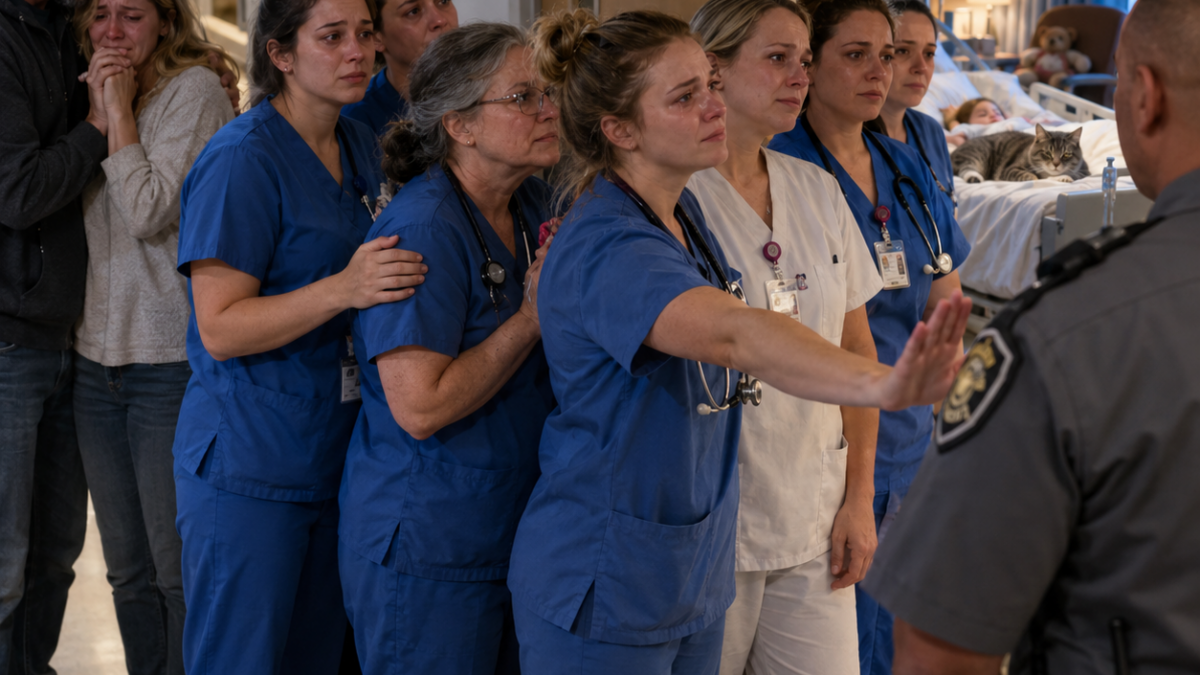
He stepped into the pediatric hallway and stopped.
Because seven nurses stood in front of Lily’s door.
Shoulder to shoulder.
Not blocking aggressively.
Not shouting.
Not touching him.
Simply standing there.
Paula was in the center.
Beside her were Grace, Mei, Robin, Tasha, Elizabeth, and Jordan. I knew their names because parents in pediatric units learn the names of the people who hold the line between their child and chaos. They were in scrubs with tired eyes and badge reels. Some held charts. One had a stethoscope around her neck. Another still had cartoon bandage stickers in her pocket.
They looked ordinary.
They were not.
Mr. Harris approached slowly.
“Ladies.”
“Morning,” Paula said.
“I was asked to come speak with the family.”
“No,” Paula said.
The word was quiet.
Final.
He sighed.
“Paula.”
“This child may have forty days,” she said.
The hallway went still.
“She asked for one thing.”
Mr. Harris lowered his gaze.
Paula continued.
“If you remove that cat, you will need to remove every nurse on this floor first. And once you do that, there will be no one to care for the children tonight.”
Nobody raised a voice.
Nobody threatened.
No one touched him.
Paula simply stood there, a woman who had spent twenty-two years washing vomit from blankets, holding terrified parents upright, charting pain levels, and learning which rules were meant to protect life and which ones forgot what life was for.
Mr. Harris looked past her toward the closed door.
Inside, Oliver purred against my daughter’s chest.
The security officer’s jaw tightened.
Then he nodded once.
“I never saw the cat,” he said.
He turned around and walked away.
No report was filed.
No incident was documented.
Mrs. Patterson did not return.
Oliver stayed.
For forty-seven days, Oliver lay on Lily’s chest.
Not beside her.
On her.
His body stretched over her sternum. His head tucked beneath her chin. His paws rested lightly against the hospital gown. His purr moved through her like a second heartbeat.
At first, I worried his weight would bother her.
It did not.
When nurses shifted him for care, Lily stirred even in sleep.
When doctors examined her, Oliver allowed it with cold tolerance, stepping aside only as much as necessary. The moment they finished, he returned to the same spot.
Always.
Same position.
Same weight.
Same purr.
The nurses began writing it in her chart.
Patient resting. Cat positioned on chest. Patient calm.
Cat removed briefly for assessment. Patient agitated. Cat replaced. Patient relaxed.
Oliver purring. Respiratory rate improved.
It was not medical language exactly.
It was not standard.
It was true.
And after a while, truth has a way of making room for itself even in official documents.
Other people on the floor learned about him.
Parents whispered.
Children asked if they could meet the hospital cat.
They could not, of course. Oliver did not leave Lily’s room. He was not there for the hospital. Not for morale. Not for a story. Not for anyone’s healing but hers.
Still, his presence changed the floor.
Nurses smiled more when they entered her room.
Doctors lowered their voices differently.
Parents passing the doorway looked in and went quiet.
There is something about an animal beside a dying child that strips away all the useless words adults hide behind.
There is no spin.
No explanation.
No bargaining.
Just love doing the only thing it can.
Staying.
As Lily’s condition worsened, the world inside that room became smaller.
Pain increased.
Speech decreased.
Her breathing changed.
At first, she still whispered.
“Oliver.”
“Water.”
“Mommy.”
“Daddy.”
Then fewer words.
Then none.
During her final week, she stopped speaking completely.
But her hands stayed on Oliver.
Both of them.
Resting on his back.
Sometimes her fingers moved faintly, just enough to press into his fur. Sometimes she had no strength even for that. But her hands remained there, as if her body remembered the shape of comfort after her voice no longer could.
And Oliver purred.
He purred through medication changes.
Through whispered consultations.
Through Mark sleeping badly in the chair.
Through me pretending to read the same page of a book for three hours.
Through the monitor beeps.
Through the oxygen hiss.
Through visitors who stepped in and left quickly because they could not bear how small she looked in that bed.
Forty-seven days of purring.
The nurses said it became the sound of the room itself.
Like rain.
Like a fan.
Like a prayer spoken so continuously that eventually you stop hearing the words and only feel their presence.
One night, around 3 a.m., Paula came in to check Lily’s line.
I was awake.
Mothers of dying children do not sleep so much as lose time in chairs.
Paula adjusted the pump, then stood looking at Oliver.
“He hasn’t stopped,” she whispered.
“No.”
“Not once?”
“Not really.”
Paula’s eyes shone.
“I’ve seen a lot of things in this job.”
I looked up.
She swallowed.
“Never this.”
I placed my hand gently on Oliver’s back beside Lily’s.
His purr vibrated through my palm.
“Do you think he knows?” I asked.
Paula did not answer quickly.
Then she said, “I think he knows enough.”
Lily died on a Thursday morning at 6:14.
Her mother held her left hand.
Her father held her right.
Oliver was still lying on her chest.
The sunrise had barely begun. The room was gray-blue, soft at the edges. I remember a cart rolling somewhere far down the hall. I remember Mark whispering, “I love you, baby,” over and over, even after she could no longer answer. I remember Paula standing near the monitor with tears streaming openly down her face.
I remember Oliver’s purr.
Still steady.
Still there.
Then the heart monitor changed.
One long tone.
A line.
A sound no parent should ever hear.
At that exact second, Oliver stopped purring.
Not before.
Not after.
The same second.
The room fell into a silence so deep it seemed to erase the machines, the hall, the hospital, the world beyond the bed.
Oliver did not move.
His head remained beneath Lily’s chin.
His body stayed warm against hers.
For forty minutes, he lay there while Mark and I held our daughter’s hands and learned what it meant for time to continue after the worst thing had happened.
No one rushed us.
No one cleared the room.
No one said anything about procedure.
The nurses stood outside the door and kept everyone away.
When Mark finally lifted Oliver, the cat hung in his arms like all the strength had gone out of him.
He was not injured.
Not sick.
Not sedated.
Just empty.
Mark pressed his face into Oliver’s fur and made a sound I had never heard from him before.
A father’s grief does not always come out as crying.
Sometimes it comes out like something tearing.
We brought Oliver home that afternoon.
Without Lily.
That sentence is still impossible.
The car seat in the back was empty.
Her purple jacket was still hanging by the front door.
Her toothbrush was in the bathroom.
Her drawings were taped to the refrigerator.
Her room still smelled faintly of strawberry shampoo and crayons.
Oliver walked through the house once.
Slowly.
He went into Lily’s room.
Jumped onto her bed.
Circled three times.
Then lay down on her pillow.
He did not purr.
Not that night.
Not the next.
Not the next week.
At first, I thought grief had made me imagine it. We were all quiet then. The whole house had become a place where sound felt disrespectful. But days turned into weeks, and Oliver remained silent.
He still ate.
He still drank.
He still slept near the window.
He still walked through the house and sat in squares of sun.
But he did not purr.
Not when I stroked his head.
Not when Mark rubbed beneath his chin.
Not when he slept.
Not when he stretched in the morning.
Never.
Two months after Lily died, I took him to the vet.
Dr. Wallace had cared for Oliver since he was a kitten. He listened carefully as I explained, though I felt foolish.
“My cat stopped purring” sounded small compared to everything else.
But Dr. Wallace did not make it small.
He examined Oliver thoroughly. Checked his throat. Listened to his chest. Looked into his mouth. Ran his hands along Oliver’s neck and jaw.
Physically, Oliver was fine.
His vocal structures worked.
His laryngeal muscles were intact.
There was no medical reason he could not purr.
“He can,” Dr. Wallace said softly.
I looked at Oliver sitting on the exam table, tail wrapped around his paws.
“He just doesn’t.”
The vet’s expression changed.
“No,” he said. “He doesn’t.”
It has been two years now.
Oliver is still alive.
Older.
Slower.
A little thinner.
He spends most mornings near the living room window where Lily used to build block towers in the sunlight. He sleeps on her bed more than anywhere else. Sometimes he carries one of her socks into the hallway and leaves it there like an offering.
He has never purred again.
Not once.
People try to explain it.
They mean well.
They say maybe he aged.
Maybe he associates purring with the hospital.
Maybe we do not hear it because it is quieter now.
Maybe it is psychological.
Maybe cats are mysterious.
Maybe we are grieving and turning silence into meaning.
Maybe.
I have heard all of it.
But I was there.
I felt that purr under my hand for forty-seven days.
I heard it fill the room while my daughter’s body failed.
I saw Oliver give every vibration his small body could make to the chest of a child who had loved him her entire life.
And I heard him stop when she did.
So when people say it is just a cat, I do not argue anymore.
Some people need the world to remain smaller than it is.
Some people are frightened by love when it appears outside human language.
Some people cannot bear the idea that an animal might grieve with a devotion cleaner than anything we know how to perform.
That is their burden.
Not mine.
I know what I saw.
Oliver gave Lily his purr.
For forty-seven days, in a hospital room that smelled of antiseptic, fear, plastic tubing, and the last weeks of a seven-year life, he gave her the one thing he had that did not require medicine, permission, or hope.
Warmth.
Weight.
Sound.
Presence.
And when she no longer needed it, he laid it down.
Sometimes I sit beside him in Lily’s room and place my hand on his back.
He lets me.
He closes his eyes.
He breathes.
But he does not purr.
I used to wait for it.
I used to hope that one day, if the house was quiet enough and the light was right and my hand moved the way Lily’s had, I might feel that vibration again.
Now I do not ask him for it.
He gave it where it was needed most.
Maybe that is the final lesson Oliver taught me.
Love is not always about holding on.
Sometimes love is spending everything you have on the one who needs it, then living afterward with the silence.
The hospital tried to take him away.
The nurses stood in the doorway.
And because they did, my daughter did not spend her final weeks listening only to machines.
She listened to Oliver.
She felt him on her chest.
She held him until her hands could no longer hold.
And when she left this world, she did not go alone.
Her mother held one hand.
Her father held the other.
And the cat who had slept beside her since she was a baby purred her all the way home.








