A 7-Year-Old Girl With Terminal Cancer Asked for One Final Thing—When Hospital Security Came to Remove Her Cat, Seven Nurses Blocked the Door and Let Him Stay for Her Last 47 Days
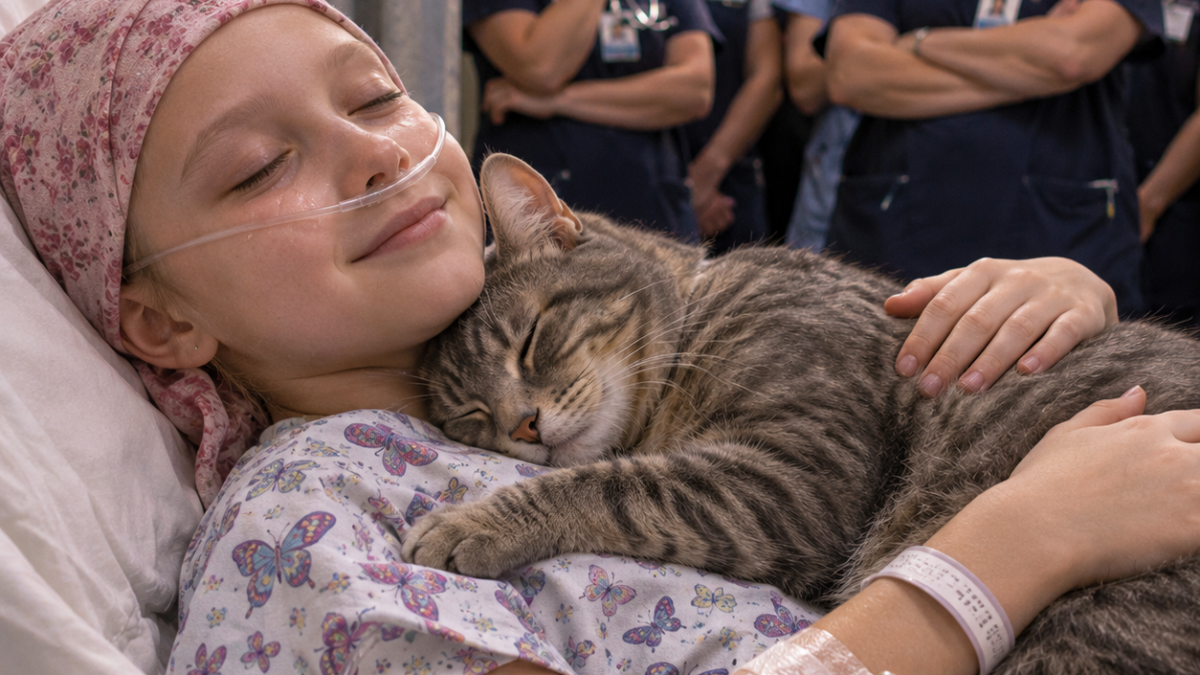
A 7-Year-Old Girl With Terminal Cancer Asked for One Final Thing—When Hospital Security Came to Remove Her Cat, Seven Nurses Blocked the Door and Let Him Stay for Her Last 47 Day.
The seven-year-old girl had been told there was nothing more the doctors could do, and when her parents asked for one final wish, she didn’t ask for a trip, a toy, or anything expensive—she asked for her gray cat, Oliver, to sleep beside her.
Hospital rules said no, but when security came to remove him the next morning, seven pediatric nurses quietly stood shoulder to shoulder outside her room and refused to move.
Oliver stayed on the little girl’s chest for the next forty-seven days, purring through every painful night—until 6:14 one Thursday morning, when her heartbeat stopped and, at almost the same moment, so did the sound he had made for her every day.
By the time October reached central Vermont, most of the maples along the river had already turned.
Red.
Gold.
Orange.
The hills surrounding the small town looked almost unreal beneath the pale autumn sky.
Families stopped along the highway to photograph them.
Tourists bought cider from roadside stands.
Children collected leaves beneath trees that seemed to be on fire.
Inside the pediatric wing of the town’s regional hospital, none of that mattered much anymore to seven-year-old Lily Bennett.
For most of her life, hospitals had been temporary places.
Places she entered.
Places she endured.
Places she left.
This time was different.
Lily had stage-four neuroblastoma.
The cancer had been discovered shortly after her fifth birthday.
At first, everyone had spoken the language families learn when they are trying desperately to remain optimistic.
Treatment.
Response.
Protocol.
Numbers.
Percentages.
Next scan.
Next cycle.
Next surgery.
Next chance.
Lily learned that language too.
She learned which nurses could start an IV without hurting her much.
She learned that chemotherapy made orange juice taste wrong.
She learned that her father’s jokes became worse when he was frightened.
She learned that her mother could sleep sitting upright in a vinyl chair with one hand still touching the edge of her blanket.
She learned the names of medications most seven-year-olds should never have to pronounce.
And she learned that adults sometimes smiled before entering her room because they had been crying in the hallway.
For almost two years, Lily fought.
Chemotherapy.
Surgery.
Radiation.
Another round of chemotherapy.
Weeks when food wouldn’t stay down.
PART2:
Days when walking to the bathroom felt like climbing a mountain.
A birthday celebrated beside an IV pole decorated with balloons.
Christmas in a hospital room.
Then several beautiful months at home when everyone allowed themselves to believe the worst had passed.
During those months, Oliver rarely left her.
He was an eight-year-old gray tabby, unusually large, with white beneath his chin and a small nick in his left ear from a fight he’d apparently won before Lily was old enough to remember.
Her parents had adopted him when Lily was a baby.
There had never really been a time in her memory when Oliver wasn’t there.
Toddler Lily had pulled his tail.
Oliver had moved.
Three-year-old Lily had dressed him in a doll bonnet.
Oliver had endured it with the expression of a man reconsidering all his life choices.
When Lily started kindergarten, Oliver waited at the front window every afternoon.
When chemotherapy began, he changed.
He seemed to understand that something was wrong.
He stopped sleeping at the foot of her bed.
Instead, he climbed onto her chest.
PART3:
He would lower himself carefully across her ribs, tuck his head beneath her chin, and purr.
Lily called it her “Oliver blanket.”
Her mother worried he was too heavy.
Lily insisted he wasn’t.
“He’s medicine.”
Her father once asked:
“What kind?”
Lily thought seriously.
“Cat medicine.”
Nobody argued with that diagnosis.
During hospital admissions, Oliver stayed home.
Those separations were always difficult.
Lily would video-call him.
Her parents would hold the phone near his face.
Oliver usually stared at the screen without comprehension before walking away.
Lily found this hilarious.
“He’s bad at phones.”
But when she came home, Oliver would meet her at the door.
Then sleep on her.
Every time.
When Lily relapsed, the disease returned aggressively.
A new tumor.
Then more.
Treatment continued.
Her parents, Sarah and Michael Bennett, kept fighting because parents do not stop fighting simply because the odds become cruel.
But eventually the conversations changed.
Doctors stopped saying:
“When this treatment works…”
They began saying:
“If we see a response…”
Then:
“We need to think about comfort.”
Finally:
“There are no remaining curative options.”
Sarah heard the sentence while holding a paper cup of coffee she never drank.
Michael stared at the oncologist’s shoes.
Lily was six weeks past her seventh birthday.
The doctors believed she had weeks.
Maybe a little longer.
No one could know precisely.
Sarah asked the question every parent in that room eventually asks.
“Are you sure?”
The oncologist didn’t insult her with false certainty.
She said:
“I wish I weren’t.”
That was worse.
Lily was admitted permanently in October.
Her parents never called it permanently.
They said:
“For a while.”
Her favorite blanket came from home.
Then photographs.
Her stuffed rabbit.
Her colored pencils, although she no longer had much strength to draw.
A framed picture of Oliver sat on the bedside table.
She often looked at it.
One evening, when pain medication had made her sleepy but comfortable, Sarah sat beside the bed.
Michael stood near the window.
They had been discussing wishes with the palliative-care team.
Not “bucket list” wishes.
That phrase felt too cheerful.
Simple things.
A favorite meal.
Music.
Someone she wanted to see.
Anything.
Sarah brushed Lily’s hair back.
“Honey?”
Lily opened her eyes.
“Yeah?”
“If you could have anything right now, what would you want?”
Lily thought.
Sarah expected ice cream.
Maybe snow.
Lily loved snow.
Michael had quietly wondered whether they could somehow arrange a horse visit outside the hospital.
Lily took so long that Sarah assumed she’d fallen asleep.
Then:
“Anything?”
“Anything we can do.”
Lily looked toward Oliver’s picture.
“I want Oliver.”
Sarah’s hand stopped.
Lily continued:
“I want him to sleep with me.”
Michael looked away.
Sarah knew the hospital rules.
No ordinary pets in patient rooms.
Certified therapy animals only.
Vaccinations documented.
Handlers.
Screening.
Specific visitation zones.
No personal animals in pediatric inpatient rooms because immunocompromised children were vulnerable to infection.
There were reasons for those rules.
Good reasons.
Rules written because somewhere, sometime, something had gone wrong.
Sarah said carefully:
“We can ask.”
Lily nodded.
“Okay.”
Then closed her eyes.
The next morning, they asked.
The answer was no.
The nurse who delivered it looked miserable.
“I pushed.”
Sarah nodded.
“I know.”
“Infection control won’t approve it.”
“Even if he stays in her room?”
“I’m sorry.”
“What if we get a veterinary exam?”
“They said only certified therapy animals.”
Michael asked:
“For a dying child?”
The nurse looked down.
“I know.”
Nobody yelled.
They were too tired.
Sarah returned to Lily’s room.
Lily looked toward the door.
“Oliver?”
Sarah sat beside her.
“Not today.”
“Tomorrow?”
Sarah couldn’t answer.
Lily didn’t cry.
That made it worse.
She simply looked at the photograph again.
Later she whispered:
“I miss his motor.”
Sarah knew what she meant.
The purring.
That night, Michael drove home alone.
Oliver was sitting on Lily’s bed.
Not curled comfortably.
Sitting upright.
Facing the bedroom door.
Michael stood there.
“She wants you.”
Oliver blinked.
Michael started crying.
He sat on the floor.
The cat walked over.
For several minutes, Michael pressed his face into Oliver’s fur and sobbed in a way he had never allowed himself to do at the hospital.
Oliver purred.
That sound settled something.
Not grief.
Decision.
At 8:36 the next evening, Sarah texted Michael:
Bring him.
Michael stared at the message.
Then:
Are you sure?
Her answer came immediately.
She has weeks.
Bring our daughter’s cat.
Michael put Oliver into a carrier.
Oliver objected.
Loudly.
For once, Michael was grateful.
“Keep yelling.”
The cat yowled.
“Good.”
Michael draped a navy blanket over the carrier.
He parked near the hospital side entrance.
At 9:02 p.m., Sarah met him downstairs.
They looked like terrible criminals.
Two exhausted parents smuggling a nineteen-pound gray tabby into a regional hospital.
Sarah whispered:
“This is ridiculous.”
Michael said:
“I’m sweating.”
“It’s forty degrees.”
“I know.”
Oliver meowed from beneath the blanket.
“Shh.”
Another meow.
Sarah looked at the carrier.
“He has never followed instructions.”
They reached the pediatric floor.
The nurses’ station was busy.
One child had a fever.
Another needed medication.
A phone rang.
A respiratory therapist walked past.
Sarah moved naturally.
Michael followed.
Nobody stopped them.
Inside Lily’s room, Michael put the carrier on the bed.
Lily’s eyes opened.
The blanket moved.
She stared.
“Dad?”
Michael lifted the blanket.
For the first time in eleven days, Lily smiled.
Not the small polite smile she gave adults trying to cheer her.
A real smile.
“Oliver.”
The cat heard her voice.
He began scratching at the carrier door.
Michael opened it.
Oliver walked straight out.
No exploring.
No fear.
No hesitation.
Across the blanket.
Onto Lily.
He settled over her chest.
Exactly as he did at home.
His head tucked beneath her chin.
Lily put both arms weakly around him.
Oliver started purring.
Loud.
Sarah covered her mouth.
Michael turned toward the window.
Lily closed her eyes.
“That’s better.”
Those were the only words she said for almost an hour.
Oliver purred continuously.
Around midnight, Nurse Amy Caldwell entered.
She had worked pediatrics seventeen years.
She saw the cat immediately.
Stopped.
Sarah woke in the chair.
Their eyes met.
Nobody spoke.
Amy looked at Lily.
The child’s hands rested in Oliver’s fur.
Her face was relaxed.
For the first time that evening, Lily’s breathing wasn’t tight with anxiety.
Amy looked at Sarah.
Then Michael.
Then Oliver.
Finally:
“Is he vaccinated?”
Sarah blinked.
“Yes.”
“Indoor cat?”
“Mostly.”
“Flea prevention?”
“Yes.”
“Veterinarian?”
“Maple Street Animal Hospital.”
Amy nodded.
“Good.”
Then she checked Lily’s medication pump.
Listened to her breathing.
Adjusted the blanket.
She did not remove Oliver.
At the door, Sarah whispered:
“Are you going to tell them?”
Amy stopped.
“I have to document that I saw him.”
Sarah’s face fell.
Amy added:
“I didn’t say how quickly.”
She left.
By 6:30 a.m., everyone knew.
Nurses.
Residents.
Environmental services.
Probably dietary.
Hospitals have faster communication networks than governments.
At 7:15, charge nurse Rebecca Lawson entered Lily’s room.
Rebecca had worked pediatric nursing for twenty-two years.
Her hair had gone silver at the temples.
She had learned how to start IVs in screaming toddlers.
How to explain death to siblings.
How to stand beside parents after monitors went silent.
She had also learned when rules existed to protect patients—
and when protecting a patient required understanding what the rule was actually protecting them from.
Rebecca looked at Oliver.
He looked back.
“That’s the criminal?”
Michael nodded.
“Repeat offender.”
Rebecca almost smiled.
She washed her hands.
Examined the room.
Oliver’s litter box was in the private bathroom.
Covered.
Food bowls separate.
Cat remained on the bed.
She asked about veterinary records.
Michael had brought them.
Of course he had.
Everything current.
Rebecca photographed the vaccination page.
“I cannot authorize this.”
Sarah said:
“We know.”
“I also cannot promise administration ignores it.”
“We know.”
Rebecca looked at Lily.
“How much does he weigh?”
“Nineteen pounds.”
Rebecca raised an eyebrow.
“That’s not a cat. That’s furniture.”
Lily smiled faintly.
Oliver purred.
At 8:20, infection control called.
At 8:41, pediatric administration called.
At 9:06, hospital security received instructions to remove the unauthorized animal.
The officer assigned was Thomas Greene.
Fifty-four.
Former corrections officer.
Not cruel.
Not eager.
He read the order twice.
Then asked:
“Terminal pediatric patient?”
His supervisor nodded.
“Family pet.”
“Yes.”
“Is the animal aggressive?”
“No.”
“Contaminating anything?”
“No reported incident.”
Thomas sighed.
“Great.”
He took the elevator upstairs.
When the doors opened, he immediately knew something was wrong.
Seven nurses stood in the corridor.
Not gathered casually.
Standing.
Shoulder to shoulder.
Across the approach to Lily’s room.
Rebecca in the middle.
Amy beside her.
Then Marisol.
Jen.
Tasha.
Emily.
Grace.
None crossed their arms.
None clenched fists.
Nobody looked dramatic.
They simply occupied the hallway.
Thomas walked toward them.
“Morning.”
Rebecca nodded.
“Tom.”
“You know why I’m here.”
“Yes.”
“Please don’t make this difficult.”
Rebecca glanced toward Lily’s closed door.
“We’re trying very hard to make things less difficult.”
Thomas lowered his voice.
“Administration ordered the cat removed.”
Rebecca said:
“The child is actively dying.”
“I know.”
“She has asked for one thing.”
“I know.”
“She isn’t asking to leave.”
Thomas said nothing.
“She isn’t asking us to stop medication.”
Nothing.
“She isn’t asking for something dangerous.”
“Technically—”
Rebecca lifted one hand.
Not threatening.
Just enough.
“Tom.”
He stopped.
Rebecca spoke quietly.
“Her doctors believe she has perhaps forty days.”
The estimate had been approximate.
It didn’t matter.
“That cat is the only thing she has asked us for.”
Thomas looked past them.
Couldn’t see the room.
Rebecca continued:
“If you intend to remove him, you will have to remove every nurse standing here first.”
One nurse swallowed hard.
Rebecca’s voice didn’t change.
“And then there will be no one available to care for the children on this floor until replacements arrive.”
Thomas stared at her.
“You know I can’t physically remove seven nurses.”
“Correct.”
“You know this is insubordination.”
“Probably.”
“You willing to lose your job?”
Rebecca answered:
“For that room?”
She nodded.
“Yes.”
The others did too.
No hesitation.
Thomas looked at Amy.
“You too?”
“Yes.”
Marisol?
“Yes.”
He rubbed his forehead.
“You people are making my day terrible.”
Rebecca almost smiled.
“Sorry.”
He looked toward Lily’s room again.
Then asked:
“Cat staying in one room?”
“Yes.”
“Vaccinated?”
“Current.”
“Litter contained?”
“Yes.”
“Family responsible?”
“Yes.”
Rebecca waited.
Thomas sighed.
“I didn’t find a cat.”
Nobody spoke.
He pointed.
“I found seven nurses blocking a hallway, which I will note mentally and never put on paper.”
Then he turned.
Walked back toward the elevator.
Rebecca called:
“Tom.”
He looked back.
“Thank you.”
He shook his head.
“I was never here.”
Security never returned.
Neither did administration.
Officially, no exception was ever announced.
No policy changed.
No email granted permission.
Oliver simply stayed.
The nurses quietly created their own precautions.
Hand hygiene before and after touching him.
No wandering outside Lily’s room.
No contact with other pediatric patients.
Litter managed by family.
Veterinary documentation kept in the chart pocket.
Bedsheets changed more frequently.
Oliver brushed regularly.
His paws wiped.
Rebecca called the veterinarian herself.
The veterinarian said:
“If you want me to certify he’s healthy, I’ll drive there.”
Two hours later, she did.
Oliver passed his examination with considerable irritation.
The veterinarian listened to his heart.
Checked his mouth.
Eyes.
Ears.
Coat.
Vaccination records.
Then wrote:
HEALTHY INDOOR FAMILY CAT. NO EVIDENCE OF COMMUNICABLE DISEASE.
At the bottom, beneath her signature, she wrote something less official:
LET HIM STAY.
Rebecca placed the note behind Lily’s medication sheet.
Oliver’s first night became two.
Then three.
Then a week.
He barely left Lily’s chest.
At home, Oliver had usually slept beside her.
At the hospital, he changed.
He lay directly over her sternum.
Front paws beneath him.
Head under her chin.
His body covering the center of her chest.
Purring.
Constantly.
Whenever staff needed to examine Lily, he moved.
Not happily.
But he moved.
Michael would lift him to the chair.
Oliver watched every hand.
Every syringe.
Every stethoscope.
Every repositioning.
The second the nurses finished, Oliver returned.
Same position.
Chest.
Chin.
Purr.
Marisol joked:
“He’s clocking in.”
Rebecca responded:
“Then somebody put him on payroll.”
Amy began writing in her personal notes:
Oliver present, resting on chest.
It started as a joke.
Then other nurses did it.
LILY COMFORTABLE. PARENTS PRESENT. OLIVER ON CHEST, PURRING.
Nobody officially ordered them to document the cat.
They did because his presence became part of Lily’s comfort care.
Her pain medication still mattered.
Oxygen mattered.
Antiemetics mattered.
Nursing mattered.
But Oliver mattered too.
When Lily became anxious, her heart rate sometimes climbed.
Oliver would settle.
Purr.
Lily’s fingers moved in his fur.
Her breathing eased.
Nobody claimed the cat was curing anything.
He wasn’t.
That mattered.
Love was not going to reverse neuroblastoma.
Purring wasn’t chemotherapy.
Oliver was not a miracle treatment.
He was comfort.
At the end of a child’s life, comfort isn’t a small thing.
Days passed.
Autumn ended.
Trees outside the hospital lost their leaves.
Lily became weaker.
She stopped sitting up.
Then stopped wanting food.
Sarah offered favorites.
Macaroni.
Vanilla pudding.
Strawberries.
Nothing.
Lily took sips.
Then less.
Oliver ate normally.
But he never ate until Michael lifted him from Lily’s chest and placed him beside the bowl.
Then he ate quickly.
Drank.
Used the litter box.
Returned.
Same position.
On day seventeen, Lily whispered:
“Do you think Oliver knows?”
Sarah knew what she meant.
She sat beside the bed.
“I don’t know.”
Lily stroked his ear.
“I think he does.”
“Why?”
“He won’t leave.”
Sarah nearly broke.
Instead she said:
“He loves you.”
Lily looked down.
“I love him too.”
Oliver purred.
On day twenty-two, Lily asked Rebecca:
“Are you the nurse who saved Oliver?”
Rebecca crouched beside her.
“No.”
“Mom said nurses made the guard go away.”
Rebecca looked toward Sarah.
Sarah suddenly became interested in the window.
Rebecca said:
“We had a disagreement.”
“Did you fight him?”
“No.”
Lily looked disappointed.
“We stood there.”
“That’s all?”
“Sometimes standing somewhere is enough.”
Lily considered this.
Then:
“Thank you.”
Rebecca squeezed her hand.
“You don’t owe me anything.”
Lily looked at Oliver.
“He would’ve been scared.”
Rebecca felt her throat tighten.
The dying child was worried the cat would have been scared.
Not herself.
“He’s safe.”
Lily nodded.
“Good.”
By day thirty, she rarely spoke more than a few words at a time.
Oliver’s purr continued.
Night.
Morning.
Medication changes.
Visitors.
Rain.
Early snow.
His purring became part of the room.
Nurses could hear it before entering.
A low mechanical vibration.
Steady.
Like a small engine.
One respiratory therapist stood at the doorway and whispered:
“I can feel it through the mattress.”
Michael rested his palm beside Oliver.
He could too.
Vibration passing through the hospital bed.
Through Lily’s chest.
Through blankets.
Through hands.
Sarah began sleeping with her fingers touching Oliver’s side because the purring reassured her that both of them were still there.
Sometimes she woke at three in the morning in absolute terror.
Before opening her eyes, she listened.
Purr.
Then Lily breathing.
Okay.
Still here.
Still here.
Still here.
Day thirty-five.
First snow.
Lily opened her eyes when Sarah told her.
“Snow?”
“Yes.”
“Big?”
“Not yet.”
Michael lifted the blinds.
Outside, tiny flakes moved beyond the window.
Lily smiled.
Oliver remained on her chest.
She whispered:
“He hates snow.”
Michael laughed.
“He hates wet feet.”
Oliver’s ear twitched.
Lily laughed too.
The laugh turned into coughing.
Then pain.
The nurse entered.
Medication adjusted.
Oliver lifted his head.
Watched.
Once the pain eased, he put his head beneath Lily’s chin again.
Purring resumed.
By day forty, nurses no longer wondered whether administration would intervene.
Nobody did.
The cat had become an open secret.
A hospital administrator once walked past the room.
Saw Oliver through the glass.
Stopped.
Rebecca watched from the nurses’ station.
The administrator and Rebecca looked at each other.
Neither spoke.
The administrator continued walking.
That was the closest anyone came to discussing it.
Day forty-three.
Lily stopped speaking.
Not suddenly.
Words simply became too expensive.
She answered with eyes.
Small movements.
Fingers.
Her hands still rested on Oliver.
One across his shoulders.
One along his back.
Sometimes her fingers moved.
Sometimes they didn’t.
Oliver remained.
Purring.
Day forty-five.
Her breathing changed.
Longer pauses.
More effort.
The medical team explained what was happening.
Sarah listened.
Michael nodded.
Neither understood how parents were supposed to receive instructions for the death of their child.
They were told Lily could still hear them.
So they talked.
Stories.
Home.
Christmas.
Kindergarten.
The time she cut her own bangs.
The pink bicycle.
The frog she smuggled into the kitchen.
Oliver.
Always Oliver.
Sarah said:
“Do you remember when you put that doll hat on him?”
Lily’s fingers moved slightly in his fur.
Oliver purred.
Michael said:
“He still hasn’t forgiven you.”
The corner of Lily’s mouth moved.
Maybe smile.
Maybe reflex.
They chose smile.
On Wednesday night, Rebecca stayed beyond her scheduled shift.
Nobody asked her to.
Amy stayed too.
The nurses rotated through quietly.
No crowds.
No solemn procession.
Just people who had cared for Lily for months checking the room one more time.
The weather outside was clear.
Cold.
Stars over the river.
At 5:52 Thursday morning, Sarah woke.
Something had changed.
Mothers know changes before machines explain them.
She stood.
“Michael.”
He woke instantly.
Lily’s breathing had become shallow.
Long gaps.
Oliver was awake.
Head up.
He looked at Lily’s face.
Purring.
Rebecca entered at 6:02.
She checked the monitor.
Then Lily.
She didn’t say:
This is it.
She simply touched Sarah’s shoulder.
Sarah understood.
Michael took Lily’s right hand.
Sarah held the left.
Oliver lowered his head beneath Lily’s chin.
The purring continued.
6:08.
Breath.
Pause.
Breath.
6:10.
Another.
6:12.
Sarah said:
“We’re right here, baby.”
Michael could barely speak.
“We love you.”
Oliver purred.
6:13.
Lily’s fingers moved once against his back.
Barely.
Sarah saw.
“Oliver’s here.”
A final shallow breath.
Then another much smaller one.
The monitor changed.
At 6:14 a.m., Lily Bennett died.
The room became impossibly quiet.
Sarah would later swear that Oliver’s purring stopped at almost the same moment.
Rebecca remembered it the same way.
So did Michael.
Whether it was exactly simultaneous could never truly be proven.
Nobody in that room cared.
What they knew was that one sound had been there—
and then it wasn’t.
Heartbeat.
Purring.
Gone.
Oliver did not move.
He remained on Lily’s chest.
Head beneath her chin.
Eyes open.
Silent.
Rebecca silenced the monitor.
Nobody touched the cat.
Nobody tried to hurry the parents.
Forty minutes passed.
Maybe a little more.
Time became meaningless.
Sarah stroked Lily’s hair.
Michael kept holding her hand.
Oliver remained.
No purr.
Eventually Michael whispered:
“Buddy.”
Oliver looked at him.
Michael slid both hands beneath the cat.
For the first time in forty-seven days, Oliver resisted being removed.
Not violently.
He simply became heavy.
Pressed himself down.
Michael cried.
“I know.”
Oliver looked toward Lily.
Michael’s voice broke.
“I know.”
He lifted him.
Oliver’s body sagged against his chest.
Sarah kissed Lily’s forehead.
Then kissed Oliver’s head.
The cat made no sound.
Rebecca stepped into the hallway.
All seven nurses who had stood there on the first morning were working or had come in.
Amy.
Marisol.
Jen.
Tasha.
Emily.
Grace.
Rebecca.
No one had planned it.
They simply gathered.
Thomas Greene, the security officer, stood near the elevator.
He had heard.
He removed his cap.
Rebecca saw him.
Their eyes met.
He asked quietly:
“Cat still there?”
Rebecca nodded.
Thomas looked toward Lily’s room.
“Good.”
Then walked away.
Oliver returned home that afternoon.
He walked through the front door.
Stopped.
Listened.
The house hadn’t changed.
Lily’s shoes still sat near the stairs.
Her drawings were on the refrigerator.
A sweater draped over a chair.
Her bedroom waited upstairs.
Oliver climbed the steps.
Sarah and Michael followed.
He entered Lily’s room.
Jumped onto the bed.
Circled once.
Then lay in the center.
Not on the pillow.
Not at the foot.
Exactly where Lily’s chest would have been.
Sarah sat on the floor.
Oliver did not purr.
They didn’t think much of it initially.
Grief changes animals too.
He ate.
Drank.
Used the litter box.
Slept.
Sat near windows.
Followed Sarah occasionally.
But he remained quiet.
Days passed.
No purring.
Michael stroked him in the old place beneath his chin.
Nothing.
Sarah held him.
Nothing.
The veterinarian examined him.
Heart normal.
Lungs clear.
Throat healthy.
No obvious neurological issue.
“Some cats purr less with age or stress.”
Sarah nodded.
Weeks.
Months.
Still nothing.
They never tried to force it.
The absence became part of Oliver.
Like the empty bedroom.
Like the small shoes Sarah couldn’t move.
Like the silence at dinner when one of them almost said Lily’s name and then realized there was no reason not to say it.
So they began saying it.
They talked about her constantly.
The funny things too.
Especially the funny things.
Oliver often sat nearby.
When they watched old videos and heard Lily’s voice, his ears moved.
Sometimes he walked toward the television.
Once, during a video of Lily laughing on the kitchen floor, Oliver touched the screen with one paw.
Sarah left the room crying.
But he never purred.
One year after Lily died, the hospital invited Sarah and Michael to a private memorial gathering for families who had lost children.
They almost didn’t attend.
Then Sarah said:
“The nurses will be there.”
So they went.
Rebecca hugged them.
Amy cried.
Thomas Greene stood awkwardly in the back.
Michael shook his hand.
Thomas said:
“I didn’t do anything.”
Michael answered:
“Exactly.”
They both understood.
The seven nurses had never received official punishment.
Nobody had formally acknowledged what happened.
That was probably intentional.
Several hospital policies were quietly reviewed later.
A process was created allowing limited end-of-life visits from personal companion animals under exceptional circumstances.
Veterinary clearance.
Private rooms.
Infection-control approval.
No guarantees.
But a path existed.
Rebecca never took credit.
She said:
“Lily did that.”
Sarah corrected her.
“You all did.”
Rebecca shook her head.
“We just stood in a hallway.”
Sarah remembered what Rebecca had told Lily.
Sometimes standing somewhere is enough.
The family created a small fund in Lily’s memory.
Not enormous.
Not national.
Nothing polished.
It helped families with terminally ill children arrange veterinary screenings when a beloved family pet might be approved for a final visit.
They named it:
LILY’S LAST WISH FUND.
The first family they helped had a fourteen-year-old boy with an old Labrador named Winston.
The hospital approved the visit.
Winston spent six hours beside him.
The boy died three weeks later.
His mother later wrote Sarah:
Thank you for helping us bring home into the hospital.
Sarah read that sentence repeatedly.
Bring home into the hospital.
That was exactly what Oliver had done.
The hospital room had never become home.
The IV pumps remained.
Antiseptic remained.
Cancer remained.
Death remained.
But for forty-seven days, Oliver carried one piece of Lily’s normal life into that room.
Warm fur.
Weight.
Breath.
Purring.
A memory of bedtime before cancer had turned sleep into something monitored.
People sometimes told Sarah the story was beautiful.
She hated that word at first.
There was nothing beautiful about burying a seven-year-old.
Nothing beautiful about choosing a dress for a coffin.
Nothing beautiful about walking past a bedroom that would never become a teenager’s room.
But eventually she understood what people meant.
The ending was not beautiful.
The love inside it was.
Two years passed.
Oliver became ten.
Then eleven.
His muzzle lightened.
He slept more.
Still no purring.
The family veterinarian found no physical explanation.
“Maybe he’ll do it again someday.”
Michael said:
“Maybe he won’t.”
Sarah looked at Oliver.
“That’s okay.”
They stopped waiting.
That mattered.
Oliver didn’t owe them the sound.
He had given it when he wanted.
When Lily needed it.
One winter evening, Sarah found him sleeping on Lily’s old blanket.
She sat beside him.
For years she had avoided telling him things because it felt ridiculous.
That night she said:
“I miss her too.”
Oliver opened his eyes.
Sarah touched his head.
“You took care of her.”
No purr.
“Better than we knew how.”
His eyes closed.
Sarah kept stroking him.
“You can rest now.”
He slept.
The room remained quiet.
And quiet no longer felt like something wrong.
Michael kept one photograph framed in the living room.
Lily in her hospital bed.
Oliver on her chest.
Not the final day.
Earlier.
She was awake.
Smiling.
Oliver looked mildly irritated by the camera.
On the back, Rebecca had written:
DAY 19.
OLIVER STILL ON DUTY.
Sarah discovered the note months later.
She laughed for the first time while holding that photograph.
Then cried.
Then laughed again.
That became grief.
Not one emotion replacing another.
Two emotions learning how to sit beside each other.
Years later, when new nurses joined the pediatric ward, some heard the story.
The cat.
The little girl.
The seven nurses.
The security officer.
It became almost folklore.
Rebecca corrected people whenever they exaggerated.
“No, we didn’t fight security.”
“No, nobody threatened anyone.”
“No, the cat wasn’t officially made a therapy animal.”
“No, Oliver did not cure her.”
Then she would say:
“He comforted her.”
As if that were not enough.
Sometimes a young nurse would ask:
“Would you do it again?”
Rebecca never hesitated.
“Yes.”
“Even if you lost your job?”
“Yes.”
“Why?”
Rebecca would look down the corridor toward Lily’s old room.
Because hospitals were full of rules.
They had to be.
Medication dosages.
Sterile procedures.
Hand hygiene.
Privacy.
Safety.
Rules saved lives.
Rebecca had spent decades respecting them.
But there are moments when caring for a patient means understanding that medicine is no longer trying to extend life.
Sometimes medicine is helping a person leave life with as little fear as possible.
Lily had seven years.
Cancer took almost two of them.
Oliver gave her forty-seven days of something cancer couldn’t take.
Routine.
Warmth.
Belonging.
The feeling of falling asleep beneath the weight of the same cat who had slept beside her since before she understood what illness was.
Sarah once said:
“I think that was why she wanted him.”
Michael asked:
“Why?”
“Because everything else at the hospital reminded her she was dying.”
She looked at Oliver.
“He reminded her she had lived.”
That became the sentence they kept.
Oliver reminded her she had lived.
Not fought.
Not battled.
Not been brave.
People had called Lily brave constantly.
She was.
But seven-year-olds shouldn’t be required to make adults comfortable by being brave.
Oliver didn’t need her bravery.
He didn’t care about blood counts.
Scans.
Treatment plans.
Prognosis.
He knew Lily.
The girl who dropped cereal.
The girl who put doll clothes on him.
The girl whose pillow he stole.
The girl whose chest had always been his favorite place.
When her body changed, he didn’t.
He simply climbed back where he belonged.
Maybe his purring stopped because grief changed him.
Maybe coincidence.
Maybe age.
Maybe something veterinary medicine couldn’t explain easily.
No one truly knew.
Sarah didn’t need to know.
She knew what she had heard for forty-seven days.
A low vibration against her daughter’s chest.
Night after night.
Morning after morning.
Through medication.
Through pain.
Through fear.
Then at 6:14 on a Thursday morning, the room changed.
Lily stopped breathing.
And sometime in that same terrible instant, Oliver became quiet.
That was enough.
Not proof of anything supernatural.
Not evidence that cats understand death exactly as people do.
Just one animal who stayed.
One child who wanted him there.
Seven nurses who believed forty-seven days of comfort mattered more than the safest interpretation of a rule.
One security officer who decided not every order needed to become an action.
Two parents willing to risk embarrassment because their daughter had asked them for almost nothing.
And one very ordinary gray cat who became extraordinary simply because he refused to leave the person who had been his whole world.
Oliver eventually died at fourteen.
At home.
On Lily’s blanket.
Sarah and Michael were beside him.
His body had grown thin.
His kidneys were failing.
The veterinarian came to the house.
Before the medication, Sarah lifted Oliver carefully against her chest.
“You remember her?”
Oliver’s cloudy eyes opened.
Sarah cried.
“I know you do.”
Michael touched his head.
“Go find your girl, buddy.”
Oliver remained silent.
He had not purred in all those years.
Sarah no longer expected him to.
She kissed between his ears.
“Thank you for staying.”
The veterinarian gave the medicine.
Oliver relaxed.
His breathing slowed.
Then stopped.
There was no dramatic final sound.
No miracle.
Just quiet.
But this time Sarah wasn’t afraid of it.
She wrapped him in the same blanket he had shared with Lily at the hospital.
Later, they placed his ashes beside hers.
On a small stone beneath a maple tree were two names.
LILY BENNETT
OLIVER
Beneath them:
HE STAYED.
Sarah chose those two words.
Not:
He saved her.
He couldn’t.
Not:
He healed her.
He didn’t.
He stayed.
Sometimes that is the greatest gift one living thing can give another.
To remain when the room becomes frightening.
To stay when there is nothing left to fix.
To offer warmth when medicine has reached its limit.
To keep making one small reassuring sound while someone you love is still able to hear it.
For forty-seven days, Oliver did exactly that.
And whether he understood cancer, hospitals, death, or any of the rules people had almost used to separate them never mattered.
He understood Lily.
She had asked for him.
He came.
He climbed onto her chest.
He purred.
And he stayed there until she no longer needed him to.








