A 7-Year-Old Girl Walked Up to a Biker Everyone Avoided and Whispered, “I Know Where They Hid Her”—Minutes Later, 700 Riders Were Waiting for One Radio Call.
PART3:
This child sat like someone who had already learned not to waste movement.
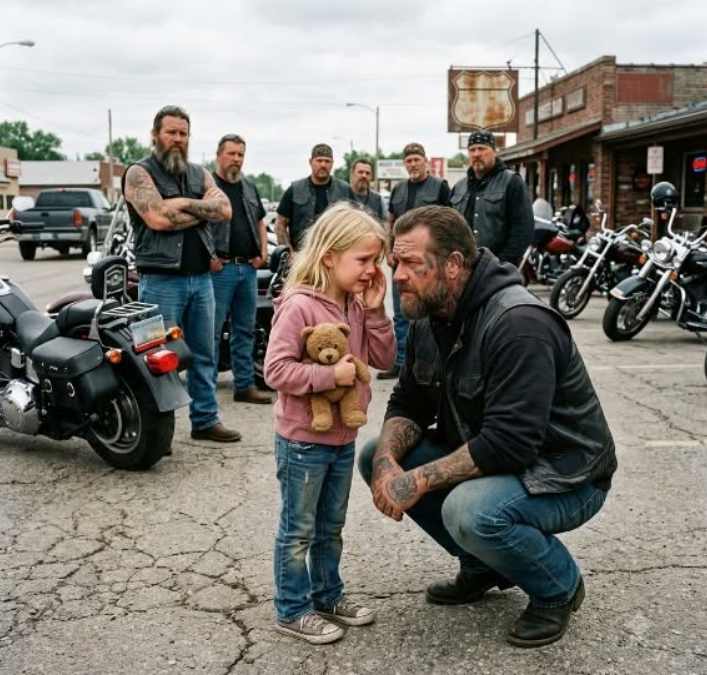
Cole approached slowly and crouched three feet away, keeping enough distance that she would not feel trapped. His voice, when he spoke, was low and rough, the kind that sounded like gravel even when he was trying to be gentle.
“Hey there. You waiting on somebody?”
The girl looked up.
Her eyes were green.
Wide.
Still.
Not empty, not exactly.
More like she had taken every feeling and locked it behind them.
She studied his face first. Then his vest. Then the patches. Then the tattoos on his forearms. She looked at him with the careful attention of someone who had learned that adults were weather systems: unpredictable, dangerous if read too late.
She did not answer his question.
Instead, she stood.
Cole remained crouched.
The girl walked toward him, stopped close enough that he could smell dust and old laundry on her jacket, then gripped the edge of his vest with one small hand.
She rose on her tiptoes.
Her mouth came near his ear.
“I know where they hid her,” she whispered.
The words struck somewhere deep in Cole’s chest, somewhere he had sealed off five years earlier and never expected to feel open again.
He pulled back slowly.
The girl’s face had not changed.
She was not playing.
She was not confused.
She held the kind of certainty children carry only when they have seen something they were never supposed to see.
“Who?” Cole asked, though he already knew.
“Lily,” she said. “They took Lily, and I know where she is.”
Cole’s pulse shifted.
The whole world seemed to narrow.
The pumps.
The cicadas.
The television behind the glass.
The highway.
The woman still clutching her purse at pump three.
Everything became background.
“What’s your name?” he asked.
“Harper.”
“Harper what?”
“Caldwell.”
“Okay, Harper. Where’s your mama?”
“Working. She works at the diner until dark.”
Cole looked around again.
Still no one.
He pulled out his phone and called Frank Brennan.
Frank answered on the second ring.
“Cole.”
Frank’s voice was deep and measured, the voice of a man who had spent twenty years in the Marine Corps before ever throwing a leg over a motorcycle. He had led convoys through deserts, briefed commanders under fire, and buried friends whose names he still whispered on their birthdays.
Nothing rattled Frank Brennan except children in danger.
Cole kept his eyes on Harper while he spoke.
“I’m at Crossroads on 42. There’s a little girl here alone. Says her name’s Harper Caldwell. She just told me she knows where Lily Ashford is.”
The silence on the other end lasted three full seconds.
“You believe her?”
Cole looked at Harper again.
She had sat back down on the curb, hands folded in her lap, watching a line of ants move along a crack in the concrete. She looked patient in a way no seven-year-old should be patient.
Not peaceful.
Practiced.
“Yeah,” Cole said. “I do.”
“Don’t move. I’m calling Welden.”
Detective Patricia Welden arrived twenty-two minutes later in an unmarked sedan, badge clipped to her belt, expression set in the careful neutrality of someone who had been running on three hours of sleep for four days straight.
She was thirty-eight, sharp-featured, dark hair pulled tight at the back of her head.
She had been lead detective on the Ashford case since the first night. The weight of it had settled beneath her eyes. She had interviewed forty-six people, searched twelve properties, and followed every lead into every dead end.
She approached Cole first.
Her gaze moved over his vest, his boots, his tattoos, and Cole saw the calculation happen in real time.
The same calculation everyone made.
“Mr. Harrington,” she said.
Not unfriendly.
Not warm.
“Frank Brennan called the station. Said you have information about Lily Ashford.”
“Not me.”
Cole gestured down.
Harper was standing behind his left leg now, one hand gripping the leather of his vest again.
“Her.”
Welden crouched to Harper’s level.
Her voice softened, but her eyes remained sharp.
“Hi, sweetheart. I’m Detective Welden. Can you tell me what you told this man?”
Harper looked up at Cole.
Then at Welden.
She shook her head slowly.
“I told him.”
“I know,” Welden said. “But I need you to tell me too so I can help.”
Harper’s fingers tightened around Cole’s vest.
“I only told him.”
Welden stood.
For one second, frustration flashed across her face.
Not anger at the child.
Anger at time, heat, fear, and the fact that a ten-year-old girl was missing while the only witness in front of her refused to speak to a badge.
She pulled Cole aside.
“She won’t talk to me,” Welden said quietly. “Has she given you anything specific? A location? A vehicle? A name?”
“She said she knows where they hid Lily. That’s all she gave me before you got here.”
“That’s all?”
“That’s all.”
Welden pressed her lips together.
Cole looked toward Harper.
“She trusts me for some reason. I’m not going to break that.”
Welden studied him.
Cole met her eyes.
“I know what you see when you look at me,” he said evenly. “But right now, that little girl chose to talk to me. Not you. Not her teacher. Not her mother’s coworkers. Me. So either we work together, or we stand here arguing while Lily Ashford is still somewhere waiting.”
Something shifted behind Welden’s eyes.
Not trust.
Not yet.
Pragmatism overtaking prejudice.
“Fine,” she said. “You stay with her. You ask the questions. Everything she says comes to me immediately. No side missions. No club business. No cowboy rescue.”
Cole nodded.
“Agreed.”
He walked back to Harper and sat down on the curb beside her.
The concrete was hot through his jeans.
He did not ask anything right away.
He simply sat.
His own father, a farrier outside Knoxville, had taught him that with spooked horses.
Trust is not a door you kick in.
It opens toward you, and you have to stand still long enough for it to swing.
After two full minutes, Harper spoke.
“My mama and me live on Birch Lane.”
Cole nodded.
“Lily lives across the street.”
“Okay.”
“She’s my friend. She’s the only one at school who sits with me at lunch because the other kids say my clothes smell like the diner.”
Cole felt his throat tighten.
He kept his face steady.
“Four days ago, I was in my room,” Harper continued. “My window looks at Lily’s yard. I saw a white van pull up. Two men got out. They talked to Lily, and she went with them.”
“She knew them?”
“I don’t know. She looked scared, but she went. She kept looking back at her front door like she was hoping her daddy would come out.”
Cole’s eyes moved to Welden, standing six feet away, listening.
The detective’s face had gone pale.
“Did you see their faces?” Cole asked.
“One had a red hat. One had a beard. Not like yours. Shorter. The van had a dent on the back bumper.”
“Did you tell anyone?”
Harper looked down.
“I tried.”
Cole waited.
“The police came to our street Tuesday. I tried to talk to one of them, but he told me to go inside and let the adults handle it. He didn’t even look at me.”
Cole felt something crack open inside his chest.
A child had tried.
She had tried to do the right thing, and the world had moved around her.
“What changed today?” he asked gently.
Harper’s fingers picked at a loose thread on her jacket.
“I saw the van again yesterday.”
Cole stopped breathing for half a second.
“Where?”
“Behind the old Garrett farm on Millstone Road. The barn with the red door.”
Welden was already reaching for her radio.
“I was riding my bike on the trail behind the creek,” Harper said. “I saw it through the fence. Same van. Same dent.”
Cole turned to Welden.
Their eyes met.
This time, there was no skepticism left.
Only motion.
“I need units near the Garrett property on Millstone,” Welden said into her radio, voice tight and controlled. “Possible location on Lily Ashford. Keep distance. No sirens. I need backup, and I need it quiet.”
Cole looked down at Harper.
“Why didn’t you tell your mama?”
Harper’s mouth twisted.
“Mama’s always tired. She works all day and comes home and falls asleep on the couch with her shoes still on. I tried to tell her, but she said I was making up stories.”
She paused.
“I waited for someone else to ask me.”
Cole’s chest hurt.
He reached out, then stopped before touching her.
“You did the right thing, Harper. You did exactly the right thing.”
Within an hour, the situation had shifted from a whispered secret at a gas station to a coordinated operation stretching across three counties.
Detective Welden worked from her sedan, confirming property records for the old Garrett farm, cross-referencing the van description with motor vehicle databases, and pushing for a warrant with a prosecutor who kept asking for certainty no one had time to provide.
The afternoon light turned golden, casting long shadows across the parking lot.
Cole knew something Welden knew too, though she could not say it aloud.
Ridgewood Police Department had fourteen officers for a town of nine thousand people. Every deputy in the county had been working doubles since Monday. Volunteers had dwindled after the third day, as the first surge of outrage gave way to the quiet assumption that someone else was handling it.
The old Garrett farm sat on eighty-seven acres of overgrown land, surrounded by back roads, logging trails, creek crossings, and forgotten dirt tracks that locals used for hunting access and teenagers used for trouble.
If Lily was there and the men moved her, the police might never know which road they took.
Cole called Frank again.
“She gave us a location. Welden’s moving on it.”
Frank was silent for a moment.
Cole lowered his voice.
“Frank, they’re running on fumes. If this thing goes sideways, if Lily gets moved, if the location is wrong, they’ll need eyes and ears across every back road and dead-end hollow in the county.”
Frank understood immediately.
“I’ll make calls.”
Those three words changed the night.
Frank Brennan did not just call Iron Ridge.
He called every motorcycle club president within two hundred miles.
Knoxville.
Nashville.
Chattanooga.
Bristol.
Johnson City.
Clubs that had old rivalries with Iron Ridge.
Clubs that did charity rides.
Clubs that did not speak to one another unless forced.
Retired riders who had not been on a bike in years but kept their leathers in the back of the closet the way some people keep uniforms.
Not out of nostalgia.
Out of readiness.
The message was simple.
A little girl is missing.
Another little girl found her.
We ride.
By five that evening, the first wave arrived.
Forty-seven riders from Stone Valley Brotherhood rolled into Ridgewood in a formation so tight the rumble shook the hardware store windows on Main Street. Behind them came twenty-three riders from Mountain State out of Knoxville. Then eighteen from Cumberland Sons. Then thirty-one from a Nashville club whose president shook Frank’s hand like they had known each other forever.
They kept coming.
Motorcycles.
Pickup trucks towing trailers.
Men and women in leather, denim, boots, bandannas, helmets, and patches that told stories longer than most novels.
They filled the Ridgewood Community Center parking lot first.
Then the Baptist church lot next door.
Then the shoulder of Route 42 for a quarter mile in each direction.
The sound of idling engines created a low vibration that could be felt through pavement, shoes, ribs, and teeth.
Cole stood on the steps of the community center and watched them arrive.
He had been riding fifteen years. He had attended rallies and charity runs across six states. He had seen hundreds of bikes gather for memorials, benefits, protests, and funerals.
He had never seen anything like this.
These were people the world called outlaws, misfits, troublemakers. People whose appearance alone made mothers pull children closer and store owners watch security cameras with one hand near the phone.
And yet here they were.
Hundreds of them dropping everything on a Thursday evening because a ten-year-old girl they had never met needed help.
No one offered them money.
No one promised recognition.
They came because a child was missing.
That was enough.
Detective Welden stood beside Cole, arms crossed, expression caught somewhere between disbelief and cautious hope.
“This is either the best thing that has ever happened to this case,” she said, “or the biggest headache of my career.”
“Why not both?” Cole replied.
Welden almost smiled.
Inside the community center, Frank stood at a folding table with a county map spread out, edges held down by coffee mugs, phones, and a half-eaten bag of barbecue chips.
His military training returned without effort, the way a language learned young comes back when heard in a crowd.
He divided riders into groups of ten and assigned grid sections covering every road and trail within a ten-mile radius of the Garrett property. He marked fire roads in red, creek crossings in blue, and possible exit paths in black.
He stationed experienced riders at intersections, younger riders as runners, and older riders with trucks at staging points where they could carry water, flashlights, and first aid.
Then he laid out the rules.
“We are here to help. We are not here to be heroes.”
The room quieted.
“You find something, you call it in. You do not approach. You do not engage. You report to Detective Welden’s team, and you hold your position. Anyone who goes rogue answers to me personally, and I promise you that is worse than anything the law can do to you.”
A ripple of laughter moved through the room.
But everyone understood.
Ray Prescott, Iron Ridge’s sergeant-at-arms, pulled Cole aside near the coffee machine.
Ray was stocky and red-haired, with a childhood spent in seven foster homes that gave him a radar for suffering that never turned off.
“How’s the kid?”
“Harper?”
Ray nodded.
“Welden sent an officer to the diner. Brought her mother in. Donna Caldwell. She’s terrified. Didn’t realize what Harper had been trying to tell her.”
Ray shook his head.
“Kid tried to talk, and nobody listened.”
“Story of my life,” Cole said quietly.
Ray looked at him.
They both knew what he meant.
Five years earlier, Cole’s daughter Emma had been nine years old.
She complained of headaches for weeks.
At first, they seemed ordinary.
Too much screen time.
Too little water.
Growing pains.
Sinus pressure.
She was nine.
Kids got headaches.
Kids complained.
Kids recovered.
Cole told her to drink more water.
His wife, Marcy, told her to get more sleep.
Emma kept saying her head felt too full.
Cole remembered that phrase more than anything.
Too full.
He had laughed gently and said, “That’s because you’ve got too many unicorn facts in there.”
She had smiled because she loved unicorns and wanted to believe him.
By the time they took her to a specialist, the tumor was the size of a golf ball.
Emma died eleven weeks later.
Cole’s marriage did not survive the year.
Marcy moved to Atlanta to live with her sister.
Cole moved into the apartment above his repair shop and rode until distance became the only medication that worked for more than an hour.
He had spent five years filling silence with engine noise because quiet reminded him of a hospital room where a little girl’s breathing slowed and then stopped.
Harper had walked up to him at a gas station and gripped his vest.
For one sharp, impossible second, Cole had felt Emma’s hand again.
“You okay?” Ray asked.
“No,” Cole said. “But that’s not what matters right now.”
By nine o’clock, the count passed six hundred.
By nine-thirty, local news had picked up the story, and a helicopter circled overhead.
Ridgewood had never seen this many motorcycles.
It had never seen this many people care about the same thing at the same time.
And somewhere in the dark hills east of town, on an abandoned farm behind a barn with a red door, Lily Ashford might be waiting.
At 10:15 p.m., Detective Welden received confirmation that the warrant for the Garrett property had been approved.
She gathered her team in the back room of the community center.
Four deputies.
Two state police officers from the Knoxville field office.
County Sheriff Douglas Barrett, jaw tight, face drawn.
Frank Brennan.
Cole Harrington.
The room smelled of burnt coffee and nervous sweat. A fluorescent light buzzed overhead, making everyone look pale and older than they were.
Welden briefed them with the precision of someone who had rehearsed every word during the wait.
“The property is eighty-seven acres, mostly wooded. Main structure is a farmhouse vacant for six years since Walter Garrett died. Behind it, approximately two hundred yards east, is a barn with a red painted door. That is our target based on Harper Caldwell’s description.”
She tapped the map.
“Property records show no active lease, no utility accounts, no registered occupants. Single access road off Millstone. Unpaved. Quarter mile long. We go in quiet. Headlights off for the last two hundred yards. No sirens. No radios unless necessary until confirmation.”
Sheriff Barrett leaned forward.
“What about the army outside?”
Welden looked through the window at the sea of motorcycles.
“Seven hundred fourteen riders by latest count. Brennan has them organized across every back road, fire trail, logging path, and creek crossing within a five-mile radius. If anyone tries to leave by vehicle, they pass a rider checkpoint. Riders report only. They do not engage.”
Frank nodded.
“They’ll hold.”
“They’d better,” Barrett said.
Frank’s eyes moved to him.
“They will.”
The sheriff wisely let it go.
Welden turned to Cole.
“Harrington, you ride with me.”
Cole looked up.
“If we find Lily alive, I want someone nearby who does not look like a uniform,” Welden said. “Kids who have been through trauma sometimes shut down when they see badges. Harper trusted you. Lily might too.”
Cole nodded.
He did not trust his voice.
His hands trembled slightly, so he pressed them against his thighs to keep them still.
The convoy moved out at 10:40.
Welden’s sedan led, followed by two patrol cars with lights off and the sheriff’s truck.
A mile behind them, sixty riders followed in tight formation, headlights cutting through darkness like a slow-moving constellation. The rest spread across the county in groups of ten, their presence turning every back road into a watched road.
A rider at the old covered bridge.
Two near Highway 9.
Four outside Miller’s Feed Mill.
Three along the creek trail.
A dozen staged by the abandoned grain depot.
Every exit.
Every route.
Every path a vehicle could take was covered by someone who had driven hours to be there for a girl whose name they had learned only that evening.
The Garrett property appeared through the trees like a wound in the landscape.
The farmhouse had begun collapsing inward, its windows dark and broken, porch sagging, roofline bent under years of neglect. Weeds grew through the gravel drive. Kudzu crawled along the fence posts like the land was slowly trying to reclaim the place.
Behind the house, across a clearing of tall grass, stood the barn.
Its walls were weathered gray.
But the door was red.
Faded.
Peeling.
Unmistakably red.
Beside it, half hidden beneath a canvas tarp, sat a white van with a dent in the rear bumper.
Cole’s chest tightened.
Harper had been right.
Every detail.
A seven-year-old girl on a bicycle had seen what an entire town had missed.
Welden killed her headlights and rolled to a stop two hundred yards from the barn.
Deputies fanned out through tall grass with flashlights off.
Crickets screamed in the dark.
Far away, motorcycle engines idled on surrounding roads, a low steady pulse like a heartbeat under the night.
Cole stayed by the sedan, fingers gripping the doorframe, every muscle screaming for him to move.
Run.
Tear that red door off its hinges.
Carry Lily out himself.
Do something.
But he had given his word.
This was Welden’s operation.
He was there because one child trusted him.
He would not betray that trust by becoming the reckless biker everyone expected him to be.
He stood still.
He waited.
He let the door open toward him.
Five minutes passed.
Then seven.
Then nine.
Time lost shape.
The radio crackled once.
Silence.
Then Detective Welden’s voice came through, sharp and controlled but breaking underneath.
“We have her. She’s alive. Requesting medical immediately.”
Cole’s knees buckled.
He caught himself on the car door and pressed his forehead against cool metal.
His breath came out in a ragged exhale carrying five years of grief and four days of desperate hope.
Alive.
Inside the barn, deputies found Lily Ashford in a small room partitioned off with plywood walls.
She was thin and pale, with dark circles beneath her eyes, but conscious. She had water bottles, canned food, a battery-powered lantern, and a wool blanket wrapped around her shoulders. She had been drawing on the back of a cereal box with a crayon when officers opened the door.
Welden approached first.
Lily flinched at the badge.
Then Cole stepped into the doorway behind her.
He did not enter.
He crouched outside the small room.
“Hey, Lily,” he said gently. “My name’s Cole. Your friend Harper sent us.”
The girl’s eyes shifted toward him.
“She did?”
“She did.”
Lily’s lower lip trembled.
“I knew she saw.”
“She told me.”
“She’s okay?”
“She’s okay. Worried about you.”
Lily’s face crumpled then.
Not loudly.
No dramatic scream.
Just collapse after four days of holding herself together in the dark.
Cole stayed where he was.
“Your dad’s coming,” he said. “We’re getting you out now.”
“Are the men gone?”
“They’re not here. And they’re not getting near you again.”
That was a promise he could keep because outside the Garrett property, seven hundred fourteen riders and half the county law enforcement apparatus were making sure no road remained unwatched.
The two men responsible were identified through the van’s registration and fingerprints inside the barn.
They were not caught at the farm.
They had gone to a motel forty miles east, likely planning to move Lily before dawn.
They never made it.
A state patrol unit arrested them after a group of riders stationed near a county road spotted a vehicle matching the description. The riders followed Frank’s instructions exactly.
No approach.
No confrontation.
No hero act.
Just a radio call, a plate number, and location passed to the proper channels.
That mattered.
It mattered because Lily lived.
It mattered because no one gave defense attorneys a convenient story about vigilantes.
It mattered because discipline saved what rage might have ruined.
Welden walked Lily out of the barn wrapped in a silver shock blanket. The girl’s brown hair fell across her face. Her hand gripped the detective’s fingers. An ambulance waited at the end of the access road, lights painting the trees red and blue.
Glenn Ashford arrived twelve minutes later.
He had been waiting at the community center, unable to sit or stand, pacing the same twelve feet of linoleum until the tiles looked scuffed. When the radio call came, Sheriff Barrett drove him out personally.
Glenn stumbled from the truck before it fully stopped.
When he saw Lily standing near the ambulance, alive, wrapped in silver, he made a sound Cole had never heard a human being make.
Somewhere between laugh, cry, prayer, and wound.
He dropped to his knees on the gravel.
Lily ran to him.
They collided near the ambulance doors, father and daughter folding into each other so completely it looked like one body trying to become two people again.
Seven hundred riders stood in the darkness and said nothing.
Because there was nothing to say better than what they were seeing.
Cole stood apart, his back against his motorcycle, eyes burning.
He thought about Emma.
How he had not saved her.
How he had not listened when she said her head felt too full.
How no amount of road could outrun the fact that his little girl was gone.
But tonight, another little girl had spoken.
And this time, someone listened.
Three days after Lily Ashford was found, Ridgewood held a community gathering at the park behind the library.
It was not planned by the mayor or chamber of commerce.
It was organized by Margaret Hensley, a seventy-one-year-old woman who lived across from the Ashfords and had spent four days baking casseroles for Glenn because she did not know what else to do with her fear.
She called the library, reserved the pavilion, and posted one flyer at the grocery store.
THANK YOU GATHERING
SATURDAY, 2:00 P.M.
EVERYONE WELCOME.
BRING A CHAIR.
By two o’clock, three hundred people filled the park.
Families with strollers.
Teenagers sitting in grass.
Church ladies with foil-covered trays.
The high school band director with a portable speaker playing instrumental music nobody truly heard.
The hardware store owner brought lemonade in two ten-gallon coolers.
Scattered through the crowd like stones in a river were riders from Iron Ridge and a dozen other clubs who had not yet gone home.
Cole almost did not come.
For two days, he had sat alone in his apartment above the repair shop on Willow Street, in the chair by the window where Emma used to read. The adrenaline was gone. The purpose was gone. And what remained was the same silence that had been there before Harper grabbed his vest.
Ray showed up at 1:30 with two coffees and a look that said he was not leaving without him.
“You don’t get to disappear,” Ray said.
“Watch me.”
“No.”
Cole looked at him.
Ray handed him coffee.
“Not today.”
So Cole went.
The park smelled of grass, barbecue smoke, sunscreen, and the peculiar nervousness of a town that had almost lost a child and did not yet know how to celebrate without admitting how close it came.
Cole sat on a bench near the edge of the pavilion.
Frank was near the drink table, talking with Sheriff Barrett. The two men shook hands, and Cole noticed the handshake lasted longer than necessary.
A badge and a patch acknowledging the distance between them was smaller than either had believed.
Detective Welden found Cole on his bench.
Without the badge energy, she looked different.
Younger.
More tired.
More human.
“Mind if I sit?”
“Free country.”
She sat and stretched her legs.
“The men who took Lily have been charged,” she said. “Both of them. Multiple counts. Federal charges being added because of the movement across county and state lines. Evidence from the barn and van is solid. They’re not getting out.”
Cole nodded.
“That’s good.”
“I owe you an apology.”
He looked at her.
“When I pulled up to that gas station and saw you standing there in your vest, I had already decided who you were. I categorized you before I heard one word. That was wrong.”
Cole watched a child run across the grass.
“You were doing your job.”
“My job is to listen. I almost didn’t.”
He said nothing.
Welden continued.
“How’s Harper?”
That surprised him.
“Ain’t you the detective?”
A real smile touched her face.
“She’s something else. We did the full interview with a child psychologist present. Calm, detailed, precise. Descriptions. Timelines. License plate digits. Distinguishing marks on the van. She tracked its movement on her bicycle over three days and mapped the route to Garrett farm in her head. Seven years old.”
“She tried to tell people.”
“I know.”
“That’s the part.”
“It’s the part keeping me up too,” Welden admitted. “We had officers canvassing that street. One told her to go inside and let adults handle it. If he had knelt down for two minutes, we might have found Lily days earlier.”
Cole’s jaw tightened.
“He going to learn that?”
“Yes.”
“Good.”
Across the grass, Harper appeared in her pink jacket, blond braids bouncing. Beside her, holding her hand, was Lily Ashford.
Lily looked pale but alive.
A little thinner.
A little slower.
But alive.
The two girls ran toward a tree, touched it, then ran back laughing as though laughter had become proof that the world had not won.
Something opened in Cole’s chest.
This time it did not feel like grief.
It felt like air entering a room sealed for years.
Donna Caldwell approached ten minutes later.
Harper’s mother was thin, with tired eyes, calloused hands, and the posture of someone who had spent years apologizing for arriving late even when life had not given her enough hours. She stood in front of Cole twisting her fingers together.
“I’m Harper’s mother.”
“I know.”
“She tried to tell me about Lily. About the van. About everything.”
Cole waited.
Donna’s voice broke.
“I was so tired from working doubles that I told her she was making up stories. What kind of mother says that?”
“The exhausted kind,” Cole said gently. “The kind working two shifts to keep the lights on.”
“That doesn’t make it right.”
“No.”
Donna looked at him.
He did not soften the truth.
Then he said, “But wrong and unforgivable aren’t always the same thing.”
She pressed one hand over her mouth and cried quietly.
Cole did not speak because some moments do not need words.
They need presence.
When she composed herself, she looked at him with red-rimmed eyes.
“She talks about you every day since Thursday.”
Cole looked away.
“She calls you the man who listened.”
The words settled into his bones.
The man who listened.
He had spent five years wishing he had listened to his own daughter.
Now a different child had given him a name that meant exactly that.
Later, as the sun descended behind the Blue Ridge foothills and painted the sky amber and rose, Cole walked toward his motorcycle in the library parking lot.
He ran one hand over the leather seat and looked out at the town.
Frank appeared beside him with two bottles of water.
“Seven hundred fourteen riders,” Frank said. “Final count. Eleven clubs. Four states. Some drove six hours. Some had old grudges. Didn’t matter.”
“All because of a seven-year-old girl.”
“All because a seven-year-old girl trusted the right man.”
Cole took a slow drink.
The mountains were turning purple in the distance.
“I kept thinking about Emma,” he said.
It was the first time he had spoken her name aloud in months.
Frank did not move.
“When Harper grabbed my vest, for one second, I felt Emma’s hand. And I thought maybe this is why. Maybe all the riding, all the miles, all the years I put between myself and that hospital room… maybe they brought me to that gas station because a little girl needed someone to listen.”
Frank did not answer with platitudes.
He put one hand on Cole’s shoulder and squeezed once.
Firm.
Brief.
The way men do when words are too small for what they mean.
Cole kicked his motorcycle to life.
The engine rumbled beneath him.
For years, that sound had meant escape.
Tonight, it meant something else.
Not running away.
Riding forward.
Carrying what he had lost and what he had found, and understanding for the first time that both could exist in the same chest without one destroying the other.
Behind him in the park, Harper Caldwell held Lily Ashford’s hand and watched the motorcycles disappear down the road, taillights glowing like a string of red stars stretched across the darkening Tennessee sky.
She did not wave.
She only watched with wide green eyes that saw everything.
And she smiled the quiet smile of a child who had learned something many adults never do.
The people who look the scariest are sometimes the ones who listen the closest.
And a whisper, if it reaches the right ear, can move the whole world.
The story did not end at the park.
Stories like that never do.
People prefer endings because they are easier to share.
Girl found alive.
Father reunited.
Bikers praised.
Detective apologizes.
Town heals.
But healing is rarely that clean.
Lily had nightmares for months.
She woke screaming from dreams of plywood walls and red paint. She could not stand the sound of van doors sliding open. She refused canned peaches because that was what the men had left in the barn. Glenn slept on the floor outside her bedroom for three weeks before the therapist told him love did not require turning himself into a guard dog forever.
He cried when she said it.
Lily cried too.
Then they bought a baby monitor because compromise is sometimes the first form healing takes.
Harper changed too.
At school, children who had once mocked her clothes now wanted to sit beside her. Some wanted to hear the story. Some wanted to be close to the girl who had “solved the case.”
Harper did not enjoy that.
She had not wanted to become famous.
She had wanted someone to listen sooner.
When a local reporter asked her how she figured it out, Harper said, “I looked.”
The clip went viral.
Adults loved it.
Cole hated it.
Not because Harper was wrong.
Because a seven-year-old should not have to remind adults to look.
Donna Caldwell changed her work schedule.
Not easily.
Not without losing hours she needed.
But the diner owner, embarrassed by how close one of his employee’s children had come to being ignored entirely, adjusted shifts and helped organize a childcare rotation with two other mothers from Birch Lane.
Donna started eating dinner at the table with Harper every night.
No television.
No phone.
Just twenty minutes where Harper could talk and Donna would listen with both elbows on the table as if listening itself were a job she intended to do well.
Sometimes Harper had nothing important to say.
Sometimes she described a spelling test.
Sometimes a weird bug.
Sometimes she said, “Today I thought I saw the van again.”
Donna learned not to say, “You’re fine.”
She learned to say, “Tell me.”
That difference saved them both.
Cole saw Harper every Saturday morning for a while.
It began by accident.
She and Donna came to his repair shop because Harper’s bicycle tire was flat. Cole patched it without charging, and Harper wandered through the garage staring at tools, engine parts, oil stains, and the faded photograph of Emma taped near his workbench.
“Who is she?” Harper asked.
Cole looked up.
“My daughter.”
“She died?”
He froze.
Most adults avoided the question.
Harper did not know how to be politely indirect about grief.
“Yes,” he said.
“How old?”
“Nine.”
Harper looked at the photograph.
“She looks funny.”
“She was.”
“Did you listen to her?”
The wrench slipped from Cole’s hand and clattered against the concrete.
Donna said, “Harper.”
Cole held up one hand.
It took him a moment to answer.
“Not enough.”
Harper nodded.
Not judging.
Understanding in the terrible way children sometimes understand too much.
“Maybe that’s why you listened to me.”
Cole swallowed.
“Maybe.”
After that, Harper came most Saturdays.
Sometimes with Donna.
Sometimes with Lily and Glenn.
Sometimes with both girls, who sat on overturned milk crates drinking soda while Cole explained the difference between a carburetor and fuel injection in terms no child had asked for but both pretended to understand because he looked calmer while explaining machines.
Lily liked drawing on old cardboard.
Harper liked watching people.
“Observation skills,” Detective Welden called it.
Cole called it surviving.
One afternoon, Lily drew the barn.
Not accurately.
The red door was enormous, taller than the rest of the building, bleeding color into the sky. A small yellow square in the corner represented the lantern. A silver blanket floated over a stick figure.
Cole looked at it for a long time.
“You want me to throw it away?” Lily asked.
“No.”
He reached for an empty frame normally used for certificates.
“Can I keep it?”
She shrugged, embarrassed.
“Okay.”
He hung it in the shop beside Emma’s photograph.
People noticed.
Nobody asked.
That winter, the Iron Ridge Motorcycle Club established the Emma Harrington Listening Fund.
Cole hated the name.
Frank insisted.
The fund paid for child safety workshops, school outreach, anonymous tip lines, community advocate training, emergency family support, and meals for overworked parents who might otherwise be too exhausted to hear what their children were trying to tell them.
The first workshop took place in the Ridgewood Elementary cafeteria.
Detective Welden spoke.
So did a child psychologist.
So did Frank.
Cole sat in the back, arms crossed, hoping no one would ask him to say anything.
Harper ruined that plan.
She stood from her seat beside Donna and said, “Cole should tell the adults what to do because he did it right.”
Every head turned.
Cole glared at her.
Harper smiled faintly.
Frank leaned over and whispered, “Outranked by a seven-year-old.”
Cole walked to the front.
He stood there for several seconds, looking at teachers, parents, officers, volunteers, church ladies, bikers, and the diner owner wiping his hands nervously on his apron.
“I’m not an expert,” Cole said.
The microphone squealed.
He lowered it.
“I don’t know much about children. I messed up with my own.”
The room went quiet.
“But I know this. If a child is trying to tell you something and the timing is inconvenient, that usually means the child has already been waiting too long.”
Donna lowered her head.
Welden looked at the floor.
Cole continued.
“You don’t have to know if they’re right before you listen. Listening ain’t signing a contract. It’s opening a door. Ask the question. Kneel down. Put your phone away. Look at them. Two minutes might save a life.”
That was all he said.
It was enough.
The fund grew.
Riders donated.
Then businesses.
Then churches.
Then people who had once crossed the street to avoid Cole Harrington.
He never fully trusted the praise.
Praise can be another kind of misunderstanding.
But he trusted the work.
The work was simple.
Children who tried to speak needed adults who had been taught to stop.
Five years after Lily was found, Ridgewood held the first annual Listening Ride.
No balloons.
No speeches longer than ten minutes because Cole threatened to leave.
Riders gathered at Crossroads Fuel Stop, then rode past Birch Lane, past the Garrett farm—now demolished, with the barn door preserved as evidence until the trial ended—then to the library park where Lily and Harper planted two trees.
One for Emma.
One for every child still waiting to be heard.
The red barn door eventually became part of a display at the community center.
It was cleaned, sealed, and mounted upright on a plain wooden frame. The paint remained faded and peeling. The handle remained rusted. The bottom edge was scarred where deputies had forced entry.
Beneath it, a plaque read:
THE DOOR BEHIND WHICH LILY ASHFORD WAS FOUND ALIVE.
A CHILD SAW.
A CHILD SPOKE.
SOMEONE LISTENED.
Cole stood before it on dedication day with Harper on one side and Lily on the other.
Lily slipped her hand into his left.
Harper slipped her hand into his right.
For a moment, he could not breathe.
Emma would have been fourteen then.
He imagined her rolling her eyes at the attention. Imagined her telling him his beard was crooked. Imagined her standing beside those girls, alive in another version of the world.
Grief rose.
Then settled.
It no longer crushed everything beneath it.
It had made room for something else.
Harper looked up at him.
“You okay?”
“No.”
She nodded solemnly.
“That’s allowed.”
He laughed, rough and surprised.
“Who taught you that?”
“My therapist.”
“Expensive wisdom.”
“Worth it.”
Lily leaned her head briefly against his arm.
“Thank you for coming that day.”
Cole looked at the red door.
“I almost didn’t go inside the gas station.”
“But you did.”
“I almost didn’t notice Harper.”
“But you did.”
“I almost didn’t call Frank.”
“But you did.”
He looked down at her.
Lily’s eyes were steady now.
Not healed completely.
But steadier.
“Sometimes the almost doesn’t matter,” she said. “Only the did.”
Cole thought about that for a long time.
Years later, people still told the story wrong.
They made it sound like seven hundred bikers stormed the night and saved a child by force.
That version traveled well.
It was not the truth.
The truth was quieter.
A girl in a pink jacket sat beside an ice machine because no one else had listened.
A biker with grief under his vest sat on a hot curb and waited.
A detective chose usefulness over prejudice.
A Marine veteran organized chaos into discipline.
Seven hundred fourteen riders obeyed rules when every instinct told them to chase.
A kidnapped girl stayed alive in a barn by counting lantern batteries and drawing on cardboard.
A father waited.
A town learned shame.
And somewhere in the middle of it all, a dead child named Emma became part of a living rescue because her father finally understood that listening too late once did not mean he had to spend the rest of his life deaf.
Cole still rode Route 42 often.
Sometimes he stopped at Crossroads Fuel Stop and bought water he did not need.
The ice machine had been replaced.
The curb had been repainted.
The teenager behind the counter was gone now, off to community college according to a handwritten note taped near the register by his mother.
But Cole could still see Harper there.
Small.
Still.
Waiting with a secret too large for her body.
One afternoon, nearly ten years after the rescue, Cole pulled into Crossroads and found a teenage girl sitting on that same curb.
For one impossible second, his chest tightened.
Then she looked up.
Green eyes.
Blond hair shorter now.
Pink jacket replaced by a denim one covered in pins.
Harper Caldwell was seventeen.
“You’re getting sentimental,” she said.
“I stopped for gas.”
“You have three-quarters of a tank.”
“You spying on my fuel gauge?”
“You taught me observation.”
“I regret that.”
She smiled.
Lily stepped out of the store behind her, carrying three bottles of water. At twenty, she was studying criminal psychology. Harper wanted to become a detective. Welden pretended not to be proud and sent her reading lists longer than any syllabus.
The girls were not girls anymore.
Not exactly.
But Cole still saw the children they had been, because saving someone fixes a version of them inside you forever.
Harper handed him a folded piece of paper.
“What’s this?”
“Scholarship essay.”
“Why are you giving it to me?”
“You’re in it.”
Cole unfolded it slowly.
The first line read:
When I was seven, I learned that the right adult is not always the one with the badge, the clean shirt, or the answer. Sometimes the right adult is the one who kneels down, listens first, and calls everyone else after.
Cole looked away.
“Kid.”
“I’m not done,” Harper said.
“I am.”
“You have to read the rest.”
“Later.”
“You always say that when you’re emotional.”
Lily grinned.
“He does.”
Cole folded the essay carefully and put it inside his vest.
Near his heart.
Near Emma’s name.
“Thank you,” he said.
Harper shrugged, suddenly embarrassed.
“You listened.”
“No,” Cole said. “You spoke.”
She looked toward Route 42.
The highway shimmered in the heat, trucks passing, ordinary and loud.
“Only because someone finally looked like he might hear me.”
Cole followed her gaze.
That was the thing about whispers.
They do not need to be loud.
They need to land in the right silence.
In the end, Ridgewood remembered the night of the red barn as a miracle.
Cole did not.
Miracle made it sound soft.
Unexplainable.
Dropped from heaven.
But what happened that night had fingerprints all over it.
Harper’s.
Lily’s.
Frank’s.
Welden’s.
Glenn’s.
Donna’s.
Seven hundred fourteen riders who left dinner tables, garages, recliners, shops, jobs, and arguments unfinished because a child needed a net stretched across every dark road in the county.
It was not magic.
It was listening turned into motion.
It was grief turned into service.
It was discipline stronger than rage.
It was a whisper becoming a map, a map becoming a search, a search becoming a rescue, and a rescue becoming the reason a man who had spent five years running from silence finally learned to live inside it.
Late on certain nights, Cole still sat in his repair shop after closing, the lights low, the smell of oil and metal around him, Emma’s photograph above the bench, Lily’s red-door drawing beside it.
He would hear bikes passing on Route 42.
He would hear the echo of seven hundred engines in the dark.
And sometimes, if the shop was quiet enough, he would hear a small voice near his ear.
I know where they hid her.
He no longer heard it as a wound.
He heard it as a calling.
A reminder.
A command.
Listen.
Because somewhere, always, a child is trying to tell the truth before the adults are ready to hear it.








