A 7-Year-Old Girl Walked Past Every Kitten in the Shelter—Then She Stopped at a Black Cat With Just Two Hours Left.
PART3:
“Yes.”
“Sweetheart, we talked about this.”
“I’m helping.”
Daniel started the car.
Rachel looked at him.
He shrugged.
“She’s an investor.”
“You are the reason she thinks everything is negotiable.”
Lily leaned between the front seats.
“Can I choose any cat?”
Rachel turned.
“Within reason.”
“What does that mean?”
“It means we need to choose one that will be happy in our house.”
“We don’t have dogs.”
“Correct.”
“We don’t have babies.”
“Also correct.”
“I’m quiet.”
Daniel coughed.
Lily ignored him.
Rachel smiled.
“We’ll talk to the shelter people.”
“But I get to choose?”
Daniel answered.
“You get the biggest vote.”
Lily leaned back, satisfied.
The Chatham County shelter was already busy when they arrived.
Saturday adoption events tended to be.
Families moved through the lobby.
Dogs barked from beyond double doors.
A volunteer carried a stack of blankets past them.
Someone was filling out paperwork while holding a small white dog that seemed determined to escape up his shoulder.
Lily stopped just inside.
Her eyes widened.
“This is where all of them live?”
“For now,” Rachel said.
A woman behind the desk heard her.
“For now is exactly right.”
Her name tag read MARISOL.
She had dark curly hair pulled into a bun and the tired, kind expression of someone who had already cleaned three kennels before breakfast.
“Birthday visit?”
Lily looked surprised.
“How did you know?”
Marisol pointed at the sparkly HAPPY 7TH BIRTHDAY badge Rachel had pinned to her jacket.
“Oh.”
Marisol smiled.
“Looking for a cat?”
Lily nodded.
“One.”
Daniel said, “Definitely one.”
Marisol glanced at him.
“Of course.”
Something in her voice made Rachel laugh.
They filled out a visitor form.
Marisol explained the rules.
No opening kennel doors without staff.
Hands washed between certain animals.
Ask before handling.
Some cats might hide.
Some might hiss.
Hissing did not always mean mean.
“Cats can be scared,” Marisol explained.
Lily nodded seriously.
“I get scared too.”
“That’s good to remember.”
The cat room was quieter than the dog wing.
Not silent.
There were meows.
Purring.
The metallic rattle of paws touching kennel doors.
But the atmosphere felt different.
Rows of kennels lined both walls.
Some were decorated with little blankets.
Cards listed names, ages, personalities.
MANGO — 6 MONTHS — LOVES TO PLAY.
SOPHIE — 2 YEARS — LAP CAT.
MR. BISCUIT — 10 MONTHS — PROFESSIONAL TROUBLEMAKER.
Lily laughed at that one.
Mr. Biscuit reached through the bars and hooked one claw gently around her sleeve.
“Oh!”
Daniel grinned.
“Looks like you’ve been selected.”
Lily carefully freed herself.
“He’s cute.”
“He is.”
“But?”
She moved on.
A pair of kittens wrestled in one enclosure.
One rolled onto its back.
The other attacked its tail.
Lily pressed her hands together.
“They’re babies.”
Rachel’s face softened.
“You like them?”
“Yes.”
Marisol stood nearby.
“They can be adopted together.”
Daniel looked alarmed.
Rachel laughed.
“No.”
Lily watched them another minute.
Then walked on.
A fluffy calico named Daisy reached a white paw through the door.
Lily let Daisy sniff her finger.
Daisy rubbed against the bars.
“She likes you,” Rachel said.
Lily smiled.
But she kept walking.
Daniel exchanged a look with his wife.
They had expected a decision within six minutes.
Maybe seven.
They had imagined Lily falling in love with the first kitten that climbed into her lap.
Instead, she moved slowly.
She read every card.
Asked ages.
Asked why cats were there.
Some were strays.
Some owners had moved.
Some families had allergies.
One owner had died.
One cat had been found inside an abandoned house.
Lily listened to every answer.
Then they reached the end.
Final kennel.
Bottom row.
Lily almost walked past.
There was nothing designed to attract attention.
No colorful blanket.
No toy.
No handwritten sign saying SWEET GIRL.
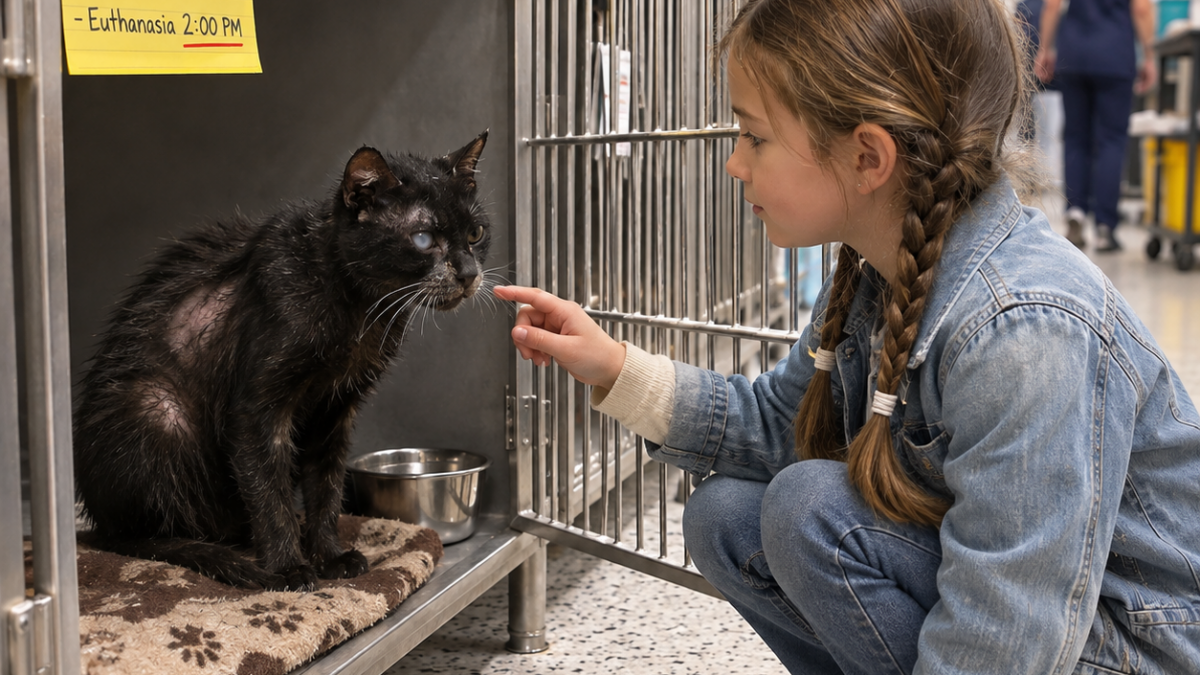
Just a black cat lying near the back.
Thin.
Older.
Her coat looked uneven along her spine.
One eye was clear green.
The other cloudy and partly closed.
She did not stand when the family stopped.
She barely lifted her head.
Lily crouched.
“What’s her name?”
Marisol’s expression changed.
“Penny.”
“How old?”
“Eight.”
Lily read the card.
PENNY.
FEMALE.
8 YEARS.
QUIET HOME PREFERRED.
Then she saw the yellow card clipped beside it.
“What’s yellow?”
Marisol went still.
Rachel noticed.
So did Daniel.
Lily looked up.
“What does it mean?”
Marisol glanced at Rachel.
It was a question adults sometimes answered with lies when children were present.
Rachel did not want that.
She gave a small nod.
Tell her.
Marisol crouched beside Lily.
“Some animals stay here longer than others.”
“Okay.”
“And sometimes the shelter gets too full.”
Lily looked around.
There were empty kennels.
But only a few.
“What happens?”
Marisol chose her words carefully.
“Sometimes animals that have been here a long time have to be put to sleep.”
Lily frowned.
“Like surgery?”
“No.”
Marisol’s voice softened.
“They don’t wake up.”
Silence.
Lily looked back at Penny.
The cat had lowered her head again.
“That card means her?”
“Yes.”
“When?”
Marisol hesitated.
Rachel’s eyes filled.
Daniel looked toward his daughter.
Lily asked again.
“When?”
Marisol answered.
“Today.”
Lily stared.
“What time?”
“Sweetheart,” Rachel said.
But Lily turned toward Marisol.
“What time?”
“Early this afternoon.”
Daniel checked his watch without meaning to.
10:06.
Marisol saw.
“The medical team begins around noon.”
Lily looked at the clock on the wall.
Then Penny.
“She has two hours?”
“About that.”
Rachel’s stomach tightened.
This was not what they had planned.
A birthday adoption was supposed to be joyful.
A child chooses a cat.
Photos.
Ice cream afterward.
Not mortality.
Not a countdown.
Lily asked, “Is she sick?”
Marisol shook her head.
“Not in a way that means she’s dying.”
“Then why?”
Daniel closed his eyes briefly.
There it was.
The question adults hated.
Because the truthful answer was ugly.
Marisol did not hide from it.
“Because she’s been here ninety-three days.”
Lily looked shocked.
“That’s not even a reason.”
Marisol swallowed.
“No.”
“Did she bite somebody?”
“No.”
“Scratch somebody?”
“She hissed when she first came in.”
Lily waited.
“That’s it?”
“That’s it.”
“Why doesn’t anybody want her?”
Marisol looked at Penny.
“She’s older.”
“So?”
“Some people want kittens.”
Lily glanced back down the hall.
The wrestling kittens.
Daisy.
Mr. Biscuit.
All the bright faces.
Penny did not move.
“One eye looks funny.”
“Yes.”
“Does it hurt?”
“We don’t think so now.”
“Will it stay like that?”
“Maybe not. A vet might be able to help.”
Lily’s face hardened with seven-year-old logic.
“So she’s old and her eye looks funny.”
Rachel knelt beside her.
“Lily.”
“That’s stupid.”
“Watch the word.”
“It is.”
Daniel almost agreed aloud.
Lily turned back to Penny.
The cat opened her good eye.
Their eyes met.
No dramatic movement.
No paw through the bars.
No meow.
Just looking.
Lily stood.
“That one.”
Rachel blinked.
“What?”
“I want Penny.”
Daniel crouched.
“Sweetheart, you can think about it.”
“I did.”
“You’ve only been here fifteen minutes.”
Lily looked irritated.
“You said I could pick.”
“We did.”
“Then her.”
Rachel’s eyes moved toward Penny.
She wanted to be careful.
Not because she did not want the cat.
Because she did not want Lily choosing out of panic.
“Are you picking Penny because you’re scared about what happens today?”
Lily thought.
“Yes.”
Rachel appreciated the honesty.
“And because you want her?”
“Yes.”
“How do you know?”
Lily looked back through the bars.
Penny had not moved.
“Everybody else has people looking at them.”
Daniel followed her gaze.
A family was playing with the kittens.
A teenage girl was holding Daisy.
Mr. Biscuit had attracted two boys.
Nobody stood near Penny.
Lily said quietly:
“That one needs me the most.”
Daniel looked at Rachel.
Rachel was already crying.
Not dramatically.
One tear.
She wiped it away.
Daniel sighed.
“Okay.”
Lily’s whole face changed.
“Really?”
“Really.”
She spun toward Marisol.
“We want Penny.”
Marisol stared.
“You’re sure?”
“Yes.”
“Absolutely sure?”
“Yes.”
Lily looked suspicious.
“Why does everybody keep asking?”
Marisol laughed despite herself.
“Because adults are annoying.”
Daniel nodded.
“Finally, something we agree on.”
Penny’s adoption file was thicker than expected.
Marisol brought it to the front desk.
Lily sat in a chair swinging her legs while Rachel and Daniel reviewed paperwork.
The history was simple on paper.
OWNER SURRENDER.
Elderly owner moved into assisted living.
No family able to take animal.
Age: approximately eight.
Spayed.
Vaccinations current at intake.
Old untreated eye infection.
Stress alopecia suspected.
Initial intake behavior: fearful, hissed, swatted once during examination.
Subsequent behavior: withdrawn, quiet, low interaction.
Daniel frowned.
“What does low interaction mean?”
Marisol lowered her voice.
“She stopped responding much.”
“Depression?”
“We don’t diagnose that exactly, but stress can do a lot.”
“How long was she with her owner?”
“Looks like seven years.”
Rachel looked at Penny’s original intake photo.
The cat looked completely different.
Thicker coat.
Rounder face.
Bright eyes.
“She changed this much in three months?”
“Yes.”
“Didn’t anyone foster her?”
“We tried.”
“No placement.”
“Why?”
“Medical needs. Age. She wasn’t showing well.”
Rachel hated that phrase.
Showing well.
As though grief were a sales problem.
“What happened to her owner?”
Marisol looked at the file.
“A woman named Margaret Hale.”
“Still alive?”
“It says assisted living transfer.”
“Can she be contacted?”
“We’d have to check privacy rules.”
Rachel nodded.
Lily approached carrying something.
The sandwich bag.
Daniel saw.
“No.”
“What?”
“I’m paying.”
“You are not.”
“Yes.”
“Lily.”
“It’s my cat.”
“The adoption fee is our gift.”
“No.”
She placed the bag on the counter.
Coins landed with a heavy clatter.
Marisol stared.
“What is this?”
“My money.”
Rachel covered her mouth.
Daniel sighed.
“How much?”
“Thirty-one dollars and sixty cents.”
He stared.
“You counted?”
“Three times.”
Marisol checked the adoption sheet.
“Penny’s fee is thirty-five.”
Lily’s face fell slightly.
“I don’t have enough.”
Daniel reached for his wallet.
“I happen to be extremely wealthy in four-dollar increments.”
Lily looked at him.
“You’ll pay the rest?”
“I think I can survive.”
They counted the coins.
Quarters.
Dimes.
Nickels.
A few pennies.
Thirty-one dollars and sixty cents.
Daniel paid three dollars and forty cents.
Marisol printed the receipt.
Lily took it with both hands.
“Is she mine now?”
“Almost.”
Penny needed a final release examination.
Those twenty minutes felt longer than everything else.
Lily waited beside the front desk.
She watched the clock.
10:41.
10:47.
10:53.
At 10:58, Marisol returned with a carrier.
Inside was Penny.
Her yellow card was gone.
Lily noticed immediately.
“Where’s the card?”
Marisol smiled.
“Trash.”
Lily smiled too.
“Good.”
Daniel carried Penny to the car.
The cat did not cry.
Did not scratch.
Did not meow.
She sat pressed into the back corner of the carrier.
Lily sat beside it.
“Hi.”
Penny’s good eye watched her.
“My room is pink.”
No reaction.
“You probably don’t care.”
Daniel started the engine.
“We bought food.”
Rachel turned.
“And we’re going to the pet store for supplies.”
Lily nodded.
“You can hide if you want.”
Penny blinked.
“I hide sometimes too.”
Daniel caught Rachel’s eye in the mirror.
Neither spoke.
At home, Penny hid immediately.
Not under the bed.
Behind a bookshelf in Lily’s room.
There was an eight-inch space between the shelf and wall.
Penny squeezed into it and disappeared.
Lily lay on the floor.
“Penny?”
Nothing.
Daniel moved toward the shelf.
“We can pull it out.”
“No.”
Lily sat up.
“She picked there.”
“She needs food.”
“We can put food close.”
“What about water?”
“Close.”
“What about litter?”
Lily pointed.
“Over there.”
Rachel looked at Daniel.
“She’s right.”
He raised his hands.
“Outvoted again.”
The first day, Penny did not emerge while anyone was awake.
Food disappeared overnight.
The litter box was used.
Water dropped slightly.
That was enough.
Second day.
Same.
Lily sat near the bookshelf after breakfast.
“Do you think she hates me?”
Rachel sat beside her.
“No.”
“She won’t come out.”
“She doesn’t know you.”
“I picked her.”
“That doesn’t mean she knows what picking means.”
Lily thought about it.
“How does she learn?”
“Time.”
“I’m bad at time.”
“I know.”
That afternoon, Lily brought a book.
The Very Hungry Caterpillar.
She sat three feet from the bookshelf.
Did not look into the gap.
Just opened the book.
“In the light of the moon…”
Daniel stood in the hallway.
Rachel whispered:
“What is she doing?”
“Reading.”
“I can see that.”
“To Penny.”
They listened.
Lily finished.
Then another.
Goodnight Moon.
Then a book about a dragon who could not fly.
Penny did not come out.
Lily returned Monday after school.
Backpack dropped.
Shoes kicked off.
Straight to bedroom.
She sat.
Read.
Tuesday.
Same.
On Wednesday—the third full day—something changed.
Lily was halfway through a book about a bear learning to swim when she heard movement.
She stopped reading.
Then remembered she was not supposed to stare.
She continued.
Penny’s black face appeared beside the bookshelf.
One eye bright.
One cloudy.
Lily kept reading.
Penny stepped out.
Slowly.
Her belly stayed low.
She looked toward the door.
Then Lily.
Lily turned one page.
Penny walked three feet.
Sat.
That was all.
Lily finished the entire book without touching her.
When Rachel entered twenty minutes later, Penny ran back behind the shelf.
Lily beamed.
“She came out.”
Rachel smiled.
“That’s huge.”
“She listened.”
“Maybe she likes the story.”
“She likes me.”
Rachel kissed the top of her head.
“I think she’s trying.”
On day five, Penny sat beside Lily.
Not touching.
Beside.
Lily read.
Penny closed her eyes.
On day six, Penny rubbed once against Lily’s pajama leg.
Lily gasped so loudly Penny almost ran.
“Sorry!”
She froze.
Penny stayed.
Lily whispered:
“I’m learning too.”
On day eight, Penny climbed into her lap.
Lily did not call anyone.
That surprised Rachel later.
She simply sat there.
For forty-five minutes.
Her legs went numb.
She did not move.
Eventually Daniel walked past the doorway.
Stopped.
Penny was curled tightly against Lily’s stomach.
Lily put one finger to her lips.
Daniel backed away.
He found Rachel downstairs.
“You need to come upstairs.”
“What happened?”
“Nothing.”
“Then why?”
“Exactly.”
They looked through the doorway.
Rachel cried.
Daniel whispered:
“We paid thirty-five dollars for a cat.”
Rachel smiled.
“Best thirty-five dollars we’ve ever spent.”
Penny’s veterinary visit happened the following week.
Dr. Samuel Greene examined the cloudy eye.
“Old infection.”
“Can it be fixed?” Lily asked.
“Maybe improved.”
“Does she see?”
“Some.”
“How much?”
“Hard to say.”
Lily frowned.
“Can she see me?”
Dr. Greene smiled.
“Yes.”
“That’s enough.”
Treatment started.
Antibiotic drops.
Anti-inflammatory medication.
Nutrition.
Skin evaluation.
The patchy coat was likely caused by stress grooming and poor condition.
Her weight concerned him.
Not dangerously thin.
But too low.
“She needs time.”
Everyone kept saying that.
Time.
Lily decided she hated the word less now.
Because Penny was proving time could do good things too.
Two weeks.
Penny began sleeping on Lily’s bed.
Three weeks.
She started meeting Lily at the bedroom door.
Four weeks.
Her coat began filling in.
Six weeks.
She gained nearly two pounds.
Eight weeks.
Her cloudy eye had cleared enough that the deep green beneath became visible.
Not perfect.
Never would be.
But brighter.
Penny became a cat people would have noticed at the shelter.
That irritated Rachel.
One evening she sat beside Daniel after Lily had gone to bed.
“You know what bothers me?”
“Several things usually.”
“She was always this cat.”
Daniel understood.
“She didn’t become worth adopting after she got prettier.”
“No.”
“She just needed somewhere safe enough to look like herself.”
He took her hand.
“I know.”
Rachel stared toward the stairs.
“How many animals don’t get that?”
Daniel had no answer.
The first complication came from school.
Lily’s teacher, Mrs. Patterson, assigned a family drawing.
Simple project.
Draw the people who live in your home.
Label everyone.
Lily spent twenty minutes with crayons.
Her mother.
Rachel with red hair.
Father.
Daniel approximately twice Rachel’s size for reasons nobody understood.
Lily in yellow.
Her older brother, Noah, who had been mostly absent from this story because sixteen-year-old boys were rarely impressed by birthday-cat drama, drawn wearing headphones.
Then Penny.
Black body.
One green eye.
One pale eye.
Lily wrote PENNY in giant purple letters.
Larger than everybody else.
Mrs. Patterson laughed when she saw it.
“Penny is important.”
“She almost died.”
The teacher’s smile disappeared.
“What?”
Lily told the story.
Yellow card.
Two hours.
Thirty-one dollars and sixty cents.
The reading.
The eye medicine.
Everything.
Mrs. Patterson listened.
Then asked:
“Can I share this with the class?”
Lily shrugged.
“Okay.”
The story spread from seven-year-olds to parents.
A parent worked for a local newspaper.
Another volunteered at the shelter.
Within days, Marisol called Rachel.
“Would you be comfortable if we shared Penny’s adoption story?”
Rachel hesitated.
“What exactly?”
“Photo at the shelter.”
“Photo now.”
“Lily’s quote.”
“What quote?”
“That one needs me the most.”
Rachel looked toward Lily, who was building a blanket fort for Penny.
“Let me ask her.”
Lily’s first question was:
“Will it help other old cats?”
Rachel looked at Daniel.
“That’s what she wants to know.”
Marisol answered.
“We hope so.”
Lily agreed.
The shelter post went live on a Thursday morning.
Two photos.
The first showed Penny in her kennel.
Thin.
Cloudy eye.
Withdrawn.
The second showed Penny on Lily’s bed, black coat already recovering, one paw resting on an open book.
The caption ended:
“That one needs me the most.”
By lunch, the post had been shared thousands of times.
By evening, Marisol’s phone would not stop buzzing.
People called asking about senior cats.
People donated.
People sponsored adoption fees.
One local business offered to cover medical expenses for ten older cats.
A woman drove forty minutes to adopt a twelve-year-old tabby.
Another family asked specifically:
“Which cat has been here longest?”
Marisol cried in the supply room.
Not because social media had solved shelter overcrowding.
It had not.
But for three days, people looked toward the kennels they usually passed.
That mattered.
Lily knew none of this.
She was reading Charlotte’s Web to Penny.
The second complication arrived as a letter.
A handwritten letter.
Addressed to the shelter.
Marisol called Rachel.
“Someone saw Penny’s post.”
“Okay.”
“She knows Penny.”
Rachel’s stomach tightened.
“Previous owner?”
“Not exactly.”
“Who?”
“Margaret Hale’s daughter.”
The elderly woman who had surrendered Penny.
Rachel remembered the file immediately.
“Is Margaret okay?”
Marisol went quiet.
“She’s in assisted living.”
“Alive?”
“Yes.”
“She saw the story?”
“No.”
“Her daughter did.”
Rachel sat down.
“What does she want?”
“To meet you.”
Rachel looked upstairs.
Penny slept beside Lily.
“Why?”
“There’s more history than we had.”
That sentence frightened her.
The meeting happened at the shelter the following Saturday.
Margaret’s daughter was named Susan Hale.
Fifty-six.
School librarian.
She arrived carrying a cardboard box and an expression full of guilt.
Rachel and Daniel came without Lily initially.
They wanted to understand before involving her.
Susan sat opposite them.
“Thank you for coming.”
Rachel nodded.
“What happened?”
Susan looked at the box.
“My mother had Penny since she was a kitten.”
“We know that much.”
“My father died when Penny was about two.”
Susan swallowed.
“After that, Penny became everything to her.”
Daniel listened.
“Mom lived alone.”
“Penny slept with her.”
“Sat in the kitchen while she ate.”
“Followed her everywhere.”
“Then Mom started forgetting things.”
Rachel understood.
“Dementia?”
“Early stages.”
Susan nodded.
“At first, little things.”
“Appointments.”
“Keys.”
“Then the stove.”
“Medication.”
“She fed Penny twice because she forgot she already had.”
“Then sometimes not at all.”
Susan’s eyes filled.
“I didn’t know how bad it was.”
Rachel said nothing.
“We tried home care.”
“It stopped being enough.”
“Mom fell in the bathroom.”
“Hospital.”
“Then assisted living.”
“And they wouldn’t allow Penny?”
“No pets.”
The same stupid sentence had destroyed countless bonds.
“No one in the family could take her?”
Susan’s face tightened.
“My husband is severely allergic.”
“My brother lives in California with two large dogs that hate cats.”
“We tried friends.”
“No one said yes.”
She wiped her eyes.
“I told myself a shelter would find her a home.”
Daniel asked:
“Did you know she stayed ninety-three days?”
“No.”
Her voice cracked.
“I didn’t know about the euthanasia list.”
Rachel looked down.
“If I had known…”
She stopped.
Daniel said quietly:
“What?”
“I don’t know.”
“That’s the terrible part.”
Susan looked at them.
“I keep saying I would have done something.”
“But what?”
She shook her head.
“I had already failed her.”
Rachel’s expression softened.
“You took care of your mother.”
“And surrendered her cat.”
“Both can be true.”
Susan stared.
“That doesn’t make me feel better.”
“It isn’t supposed to.”
Silence.
Then Susan opened the box.
Inside were photographs.
Penny as a kitten.
Penny asleep in Margaret’s lap.
Penny under a Christmas tree.
Penny sitting beside a birthday cake.
Penny watching birds from a kitchen window.
Healthy.
Loved.
Completely relaxed.
Rachel touched one photograph.
“She looked so different.”
Susan smiled sadly.
“She was spoiled.”
The box also contained Penny’s old collar.
Purple.
A tiny silver bell.
And a blanket.
“I thought Lily might want these.”
Rachel hesitated.
“There’s one more thing.”
Susan took a breath.
“My mother thinks Penny died.”
Daniel looked up sharply.
“What?”
“When we moved her…”
Susan started crying.
“She kept asking where Penny was.”
“I told her Penny went to a new home.”
“She would forget.”
“Ask again.”
“Again.”
“Again.”
“One day she asked if Penny was dead.”
“I was exhausted.”
“And I said yes.”
Rachel stared.
Susan covered her face.
“I know.”
“No judgment,” Daniel said.
“I lied to her because I couldn’t keep explaining.”
“She cried for two days.”
“Then sometimes forgot.”
“Then remembered the lie.”
Susan lowered her hands.
“She still asks about Penny.”
Rachel felt something cold in her chest.
“Does she know now?”
“No.”
“I was afraid to tell her Penny almost…”
Susan could not say it.
“Can she meet Penny?”
That was the real question.
Rachel looked at Daniel.
Neither could decide for Lily.
Or Penny.
They brought Lily into the conversation that evening.
She sat cross-legged on the rug.
Penny beside her.
Rachel explained Margaret.
Not every detail.
Enough.
“She was Penny’s person before us.”
Lily’s hand stopped.
“Does she want Penny back?”
“No.”
Immediate.
“Can she?”
“No.”
“Why?”
“She lives somewhere Penny can’t stay.”
Lily looked suspicious.
“That’s a bad rule.”
“Yes.”
Rachel continued.
“Margaret misses her.”
Lily looked at Penny.
“Penny misses her?”
“We don’t know.”
“Can cats remember people?”
Daniel said, “Yes.”
Lily thought.
Then:
“She should see her.”
Rachel blinked.
“You’re okay with that?”
“She’s her first mom.”
Rachel’s eyes filled.
“She is.”
“But Penny comes home.”
“Yes.”
“Promise?”
“Promise.”
The visit was arranged privately.
Magnolia Grove Assisted Living.
Quiet room near the garden.
Susan warned them.
“Mom has good days and bad days.”
“What kind of day is today?” Daniel asked.
“We’ll find out.”
Lily carried Penny’s carrier herself.
Margaret Hale was eighty-two.
Small.
White hair.
Blue cardigan.
She sat near a window holding a magazine she was not reading.
When Susan entered, Margaret smiled.
Then looked confused.
“Are we going somewhere?”
“No, Mom.”
Susan knelt.
“Someone came to see you.”
Lily stepped inside.
Margaret looked at her.
“What a pretty girl.”
“Thank you.”
Lily placed the carrier on a chair.
Penny was quiet.
Margaret looked toward the sound.
The moment she saw the black face behind the door, something happened.
Her whole body changed.
Not gradual recognition.
Immediate.
“Penny?”
Susan began crying before anyone else moved.
Margaret stood too quickly.
“Penny?”
The cat’s ears lifted.
Lily opened the carrier only after Rachel nodded.
Penny stepped out.
She looked around.
Then toward Margaret.
Margaret held out both hands.
“My baby.”
Penny froze.
One second.
Two.
Then crossed the space.
She jumped onto Margaret’s lap.
The old woman sobbed.
Not gently.
She wrapped both arms around the cat.
“Oh, Penny.”
Penny buried her face against her chest.
The same cat who had hidden behind Lily’s bookshelf for two days.
The same cat who barely moved in the shelter.
Purring so loudly everyone could hear it.
Margaret kissed the top of her head again and again.
“I’m sorry.”
Susan turned away.
“I’m sorry I left you.”
Lily watched.
Her face serious.
Margaret looked at her suddenly.
“Is she yours?”
Lily nodded.
Margaret’s expression changed.
Fear.
“You’re taking her?”
The room tightened.
Lily walked closer.
“She lives with me now.”
Margaret looked down at Penny.
“Oh.”
Lily sat beside her.
“But she remembers you.”
Margaret’s eyes filled.
“She does?”
“Yes.”
“How do you know?”
“She came right to you.”
Margaret stroked Penny’s back.
The fur had grown in considerably.
“She used to sleep right here.”
She touched her side.
“She’d take half the bed.”
Lily smiled.
“She still does that.”
“She likes chicken.”
“She still does.”
“She hates thunder.”
“She hides under my blanket.”
Margaret laughed.
For twenty minutes, seven-year-old Lily and eighty-two-year-old Margaret compared notes about the same cat.
Favorite foods.
Sleeping habits.
The strange chirp Penny made at birds.
How she hated having her back paws touched.
How she preferred water from a wide bowl.
How she would stare accusingly if dinner was late.
The conversation created a bridge across the months Penny had been lost between them.
Not lost physically.
Lost in the way lives can become disconnected through circumstances nobody intended.
Eventually Margaret looked at Lily.
“Are you good to her?”
Lily seemed offended.
“Yes.”
“Do you read?”
“Every day.”
“Good.”
Margaret nodded.
“She likes voices.”
Susan covered her mouth.
That explained something.
At the shelter, after Margaret disappeared, Penny had gone quiet.
Lily had brought her out by reading.
Not touching.
Not coaxing.
Voice.
Something Penny knew from seven years with an elderly woman who probably talked to her constantly.
Margaret took Lily’s hand.
“You keep reading to her.”
“I will.”
“And don’t let her get fat.”
Lily looked at Penny.
“She’s not fat.”
“Not yet.”
For the first time, everyone laughed.
The visit lasted an hour.
At the end, Margaret became tired.
Susan warned Lily before it happened.
Memory could shift suddenly.
Margaret looked at Penny.
Then at Lily.
Then asked:
“Whose cat is that?”
The room broke all over again.
Susan closed her eyes.
Rachel gripped Daniel’s hand.
Lily simply answered:
“Her name is Penny.”
Margaret smiled.
“Pretty.”
“She likes you.”
“Does she?”
“Yes.”
Margaret stroked Penny’s head.
“I like her too.”
No correction.
No attempt to force memory back.
Lily accepted Margaret wherever she was.
When they left, Penny looked back once.
Margaret was already watching the garden.
Susan walked them outside.
“I don’t know how to thank you.”
Lily hugged the carrier.
“You don’t have to.”
Susan cried.
Lily looked uncomfortable with adult tears.
“She can visit again.”
Susan nodded.
“She may not remember.”
“That’s okay.”
“Why?”
Lily looked genuinely confused.
“Penny will.”
That sentence became the second line from Lily that people later repeated.
But unlike the first, the shelter never posted it.
Some moments belonged to families.
Penny visited Margaret four more times that year.
Sometimes Margaret remembered immediately.
Sometimes not.
One visit, she called Penny “Midnight,” the name of a cat she had owned as a child.
Penny did not care.
She climbed into her lap anyway.
On another, Margaret remembered Lily.
“You’re the reader.”
Lily smiled.
“Yes.”
“Good girl.”
“Thanks.”
“Keep the cat.”
“I plan to.”
Margaret laughed.
The last visit happened the following spring.
Margaret was weaker.
Hospice had become involved.
Susan called Rachel.
“You don’t have to bring Penny.”
Lily overheard.
“We’re going.”
They went.
Margaret was in bed.
Eyes mostly closed.
Penny was placed gently beside her.
For several minutes, nothing happened.
Then Margaret’s fingers moved.
Touched black fur.
Her eyes opened.
Not fully.
“Penny?”
Susan sobbed.
Penny pushed her head beneath Margaret’s hand.
Margaret whispered:
“There you are.”
Those were the last words anyone heard her say clearly.
She died two days later.
Susan called.
Lily cried.
She held Penny that night.
“I think she waited to see you.”
Daniel sat beside her.
“Maybe.”
“Do you think she knew?”
“I hope so.”
Lily looked down.
Penny was purring.
“I think Penny knew.”
Margaret left one small thing for Lily.
A book.
Charlotte’s Web.
Old hardcover.
Inscribed inside:
For Lily,
Thank you for loving my Penny when I couldn’t keep her with me.
Please keep reading.
Love,
Margaret
Susan explained that she had helped her mother write it during one of her clearer mornings.
Lily kept the book beside her bed.
She read it to Penny so many times the spine eventually loosened.
The shelter story continued spreading long after the original post.
A local television station interviewed Marisol.
They asked what it felt like when Lily chose Penny.
Marisol hesitated.
Then told the truth.
“I was relieved.”
“Because Penny was saved?”
“Yes.”
“But also ashamed.”
The reporter looked surprised.
“Why?”
“Because it shouldn’t have required a seven-year-old girl.”
Marisol glanced toward the cat kennels behind her.
“We had staff who loved Penny.”
“Volunteers who cared.”
“But the system was full.”
“Animals were coming in faster than they were leaving.”
“And after ninety-three days, a quiet older black cat with a cloudy eye became a number on a list.”
She swallowed.
“That’s the part people need to understand.”
The reporter asked:
“Was the shelter wrong?”
Marisol answered carefully.
“Shelters make impossible decisions every day when communities surrender more animals than there are homes.”
“That doesn’t mean we should pretend those decisions don’t hurt.”
After Penny’s story, the shelter made changes.
Not miraculous ones.
They still had limited space.
Still dealt with overcrowding.
Still had emergencies.
But volunteers created a “Last Kennel First” program.
Visitors entering the cat wing were encouraged to meet the longest-stay cats before the kittens.
A local veterinary clinic sponsored senior-cat medical care.
A pet store created an adoption fund for animals over seven.
Several foster families signed up specifically for stressed cats who were “not showing well.”
Marisol hated that phrase more every month.
Penny’s yellow card was kept in a drawer.
Not displayed.
Not used for drama.
Just kept.
Years later, Marisol would still remember removing it.
The simplest movement.
Unclip.
Throw away.
A piece of yellow paper that had represented the end of one life until a child asked a question.
What does yellow mean?
Penny flourished.
By her first adoption anniversary, she weighed eleven pounds.
Her coat was glossy.
The bald patches were gone.
Her eye remained slightly hazy, but she could see from it.
She became aggressively attached to routine.
Breakfast at 6:15.
Not 6:20.
If Daniel slept late on Sunday, Penny sat on his chest.
If that failed, she placed one paw directly over his mouth.
“She’s trying to suffocate me,” Daniel complained.
Lily laughed.
“She’s feeding-motivated.”
“She’s homicidal.”
Penny also developed strong opinions about homework.
Every worksheet became a bed.
Every pencil became a toy.
Reading remained different.
When Lily opened a book, Penny settled.
Always.
Sometimes beside her.
Usually on her lap.
By age nine, Lily had moved from picture books to chapter books.
Penny listened through all of them.
Magic Tree House.
Ramona.
Because of Winn-Dixie.
The Tale of Despereaux.
Then Harry Potter, though Daniel argued the cat did not understand British magic.
Lily said:
“She doesn’t understand Georgia either.”
Fair.
At ten, Lily began volunteering at the shelter with Rachel.
Officially, she was too young for many duties.
So she folded towels.
Filled enrichment bags.
Read to scared cats.
That became her specialty.
People called it “Lily’s reading program.”
She hated that name.
“It’s not mine.”
“What should we call it?” Marisol asked.
“Reading.”
“That’s not a program name.”
“Why does it need one?”
Eventually they called it Quiet Pages.
Children came on Saturday mornings and sat outside kennels reading.
Something happened.
Cats who hid from adults sometimes emerged for children.
Not all.
No miracle claims.
But enough.
A nervous tabby named Jasper stopped striking at kennel doors after three weeks of reading sessions.
A senior Siamese named Pearl began approaching the front when a boy named Mateo read comics aloud.
A one-eyed cat named Cricket was adopted by the family of the girl who read to him every Saturday.
Lily took no credit.
“They just needed people to sit down.”
That became a philosophy far larger than cats.
When Lily was eleven, another child asked her about Penny.
“Were you scared she was going to die?”
“Yes.”
“Did you save her?”
Lily thought.
“I picked her.”
“That saved her.”
Lily shrugged.
“The shelter kept her alive ninety-three days.”
“The vet helped her.”
“My parents paid for everything after my thirty-one dollars.”
Daniel, overhearing, called:
“Thirty-one dollars and sixty cents.”
Lily rolled her eyes.
“I remember.”
Penny aged.
Eight became nine.
Nine became ten.
Then eleven.
Her muzzle developed a few white hairs that were almost invisible against black fur unless sunlight hit them.
Her jumping became less elegant.
Daniel built small steps beside Lily’s bed.
Penny refused them for six months because cats consider accessibility equipment a personal insult.
Then one day she started using them.
Lily pretended not to notice.
At twelve, Penny developed hyperthyroidism.
Medication controlled it.
At thirteen, early kidney disease.
Special food.
More water bowls.
Regular bloodwork.
Lily was seventeen by then.
College applications sat on the kitchen table.
That created a problem nobody wanted to discuss.
Savannah State was nearby.
University of Georgia was not.
Lily had been accepted to both.
Then a college in North Carolina offered a scholarship.
Rachel wanted her to choose based on school.
Lily wanted to choose based on Penny.
They argued.
For the first time in years, really argued.
“You cannot plan your education around a cat,” Rachel said.
“She’s old.”
“I know.”
“What if I leave and she dies?”
Rachel stopped.
Lily’s eyes filled.
“What if she dies when I’m gone?”
Daniel stayed silent.
This was mother-daughter territory until somebody requested reinforcements.
Rachel lowered her voice.
“Then you’ll be heartbroken.”
“That’s not helpful.”
“No.”
“But if you stay here only because you’re afraid Penny might die, you’ll start turning love into a cage.”
Lily stared.
“That’s not fair.”
“I know.”
“I’m not trapping her.”
“You’re trapping yourself.”
Lily got up.
Penny, asleep on a chair, opened one eye.
“I picked her because nobody else stayed.”
Rachel’s face changed.
“And you stayed.”
Lily began crying.
“For ten years.”
“Yes.”
“What if she thinks I left her?”
Rachel stood.
“Sweetheart.”
“No.”
“She lost Margaret.”
“Then the shelter.”
“What if—”
Rachel held her daughter’s face.
“Penny knows home now.”
Lily cried harder.
“How?”
“Because you taught her.”
Penny climbed down from the chair.
Slowly.
Walked toward them.
Meowed.
Daniel muttered:
“She would also like the argument to end before dinner.”
Neither laughed.
Eventually Lily chose North Carolina.
Scholarship.
Strong program.
Three and a half hours away.
Move-in day was brutal.
Not because of dorms.
Because of Penny.
Lily sat on her bedroom floor.
Penny in her lap.
“You’re not allowed to die.”
Daniel stood outside pretending not to listen.
“Seriously.”
Penny purred.
“I come home in October.”
Purr.
“Thanksgiving.”
Purr.
“Christmas.”
Penny head-butted her.
Lily laughed through tears.
“You don’t care.”
She left the Charlotte’s Web book on the shelf.
Not at college.
At home.
“Mom will read.”
Rachel, from the hallway:
“I heard that.”
“Voices matter.”
“I know.”
Penny waited by Lily’s bedroom for three nights.
Then adjusted.
She slept with Rachel.
Sat on Daniel’s paperwork.
Video-called with Lily occasionally, which meant staring at a phone with contempt.
When Lily came home in October, Penny ran.
Actually ran.
Old legs.
Arthritis.
All of it forgotten for fifteen seconds.
Lily dropped her bag.
Penny jumped onto the couch.
Then into her lap.
“I told you I’d come back.”
That became their rhythm.
Leave.
Return.
Leave.
Return.
Penny had once spent ninety-three days learning what disappearance felt like.
Now she learned something else.
People could go and come back.
Margaret had not abandoned her intentionally.
Lily did not disappear.
Home could stretch.
Penny was fifteen when things changed.
She stopped finishing meals.
Lost weight.
Started drinking more.
The veterinarian adjusted medication.
Kidney disease had progressed.
At first, supportive treatment helped.
Then less.
Lily was in her third year of college.
Rachel called on a Wednesday.
“Can you come home?”
Lily knew.
“What happened?”
“Nothing emergency.”
That phrase meant emergency.
“Mom.”
“Penny’s having a hard week.”
Lily drove home that night.
Penny was on the old blanket from Margaret’s box.
The one Susan had given them years earlier.
She looked small.
Older than Lily remembered from three weeks before.
Lily sat beside her.
“Hey.”
Penny lifted her head.
Then stood.
Walked toward Lily.
Curled into her lap.
Lily cried immediately.
“Okay.”
She held her.
“I’m here.”
The veterinarian gave them options.
Hospitalization.
More aggressive fluids.
Additional testing.
Possible temporary improvement.
Lily asked:
“Will it make her feel good?”
“Maybe.”
“For how long?”
“We don’t know.”
Rachel looked at her daughter.
The seven-year-old who once asked why a healthy cat had a yellow card was now twenty.
Still asking the same kind of question.
Not:
Can we make the ending go away?
But:
What does she need?
They chose comfort care at home.
Penny had six good days.
She ate chicken.
Sat in sunlight.
Slept with Lily.
Listened while Lily read Charlotte’s Web one more time.
On the seventh morning, she stopped getting up.
Dr. Greene—the same veterinarian who had treated her cloudy eye years earlier—came to the house.
He looked older too.
“So do you,” Lily told him.
He laughed.
“Thank you.”
“Sorry.”
“No, I earned it.”
Penny lay in Lily’s lap.
Rachel sat beside her.
Daniel near the window.
Noah had driven from Atlanta.
The entire family.
Four people.
Exactly like Lily’s old school drawing.
Four people and a black cat.
Lily stroked Penny’s forehead.
“You know something?”
Penny blinked slowly.
“You were supposed to have two hours.”
Rachel covered her mouth.
Lily smiled through tears.
“You cheated.”
Dr. Greene waited.
No rush.
No yellow card.
No schedule.
No kennel.
When everyone was ready, he gave the first medication.
Penny relaxed.
Lily opened Charlotte’s Web.
Her hands shook.
She read.
Not the whole book.
Just a few paragraphs.
The words did not matter as much as the voice.
They never had.
Penny’s breathing slowed.
Lily stopped reading.
“You can go.”
Her voice broke.
“You don’t need me anymore.”
Rachel whispered:
“Lily.”
Lily shook her head.
“No.”
She kissed Penny’s forehead.
“You needed me then.”
Tears fell onto black fur.
“I need you now.”
She smiled.
“But that’s okay.”
Penny’s good green eye rested on her.
Lily whispered:
“Margaret’s waiting.”
Nobody corrected her.
Dr. Greene gave the final medication.
Penny died in the lap of the girl who had chosen her thirteen years earlier.
She was twenty-one years old, give or take.
Far more than the six or seven additional years anyone predicted after adoption.
Daniel later joked that Penny had always been bad with deadlines.
Lily laughed the first time he said it.
Then cried.
The family buried Penny’s ashes beneath a camellia bush in the backyard.
Lily placed Margaret’s old collar beside the urn before burial.
Not the book.
She kept that.
The shelter had changed by then.
Marisol was director.
Quiet Pages still existed.
Senior adoption sponsorships had expanded.
The yellow-card system was gone.
Not because euthanasia had disappeared.
It had not.
Shelters still faced overcrowding and illness and impossible decisions.
But animals scheduled for end-of-life decisions were reviewed through a wider foster and rescue network first.
No system became perfect.
That would have been a dishonest ending.
But Penny’s story had changed enough people to change procedures.
Sometimes that is how institutions improve.
Not because one viral story magically fixes everything.
Because enough people become uncomfortable with what they used to accept.
After Penny died, Marisol asked Lily whether the shelter could post a memorial.
Lily hesitated.
“What would it say?”
“That she lived thirteen years after adoption.”
“That you chose her two hours before…”
Lily interrupted.
“No.”
Marisol waited.
“I don’t want the euthanasia countdown to be the whole story again.”
“What should we say?”
Lily thought.
Then smiled.
“Tell them she liked chicken.”
Marisol laughed.
“I’m serious.”
“Okay.”
“She hated getting her back feet touched.”
“Noted.”
“She slept on homework.”
“Yes.”
“She liked Charlotte’s Web.”
Marisol nodded.
“She used to wake Dad up for breakfast by standing on his face.”
Daniel, nearby, said:
“That should absolutely be included.”
Lily continued.
“She remembered Margaret.”
Her voice softened.
“She taught kids to read to scared shelter cats.”
“Not technically.”
“She inspired it.”
“Fair.”
“And she lived a really long time.”
Marisol smiled.
“That’s the story?”
“Yes.”
So the shelter posted:
Penny lived.
That was the title.
Not:
Cat Saved Two Hours Before Euthanasia Dies.
Not:
Girl’s Childhood Rescue Passes Away.
Penny lived.
The post described thirteen years.
Sunlight.
Books.
Chicken.
Margaret.
College homecomings.
A black cat growing old in a house where she had once arrived terrified.
At the end, Marisol included the photograph that had started everything.
Seven-year-old Lily sitting cross-legged on her bedroom floor.
Penny beside her.
Book open.
The caption:
She was never “the cat nobody wanted.”
She was Penny.
She just needed enough time for the right person to find her.
The post spread again.
Not as far as the first.
That was fine.
Lily did not care.
A week later, she went to the shelter.
She had not visited since Penny’s decline began.
The cat room looked different but familiar.
Kittens.
Young cats.
Adults.
A fluffy tortoiseshell reaching through the bars.
Lily smiled.
Then walked to the end.
Bottom kennel.
Old habit.
Inside was a thirteen-year-old white cat named Norman.
Missing half his tail.
Diabetic.
Owner deceased.
He stared at Lily.
Marisol stood behind her.
“No.”
Lily turned.
“What?”
“I know that face.”
“What face?”
“The face you made when you were seven.”
Lily laughed.
“I live in a college apartment.”
“Exactly.”
“No pets.”
“Excellent.”
“I’m not adopting him.”
“Good.”
Lily crouched.
Norman came toward the front.
“What happens to him?”
Marisol crossed her arms.
“He has a medical foster lined up.”
Lily relaxed.
“See?”
Marisol smiled.
“We learned something.”
Lily sat on the floor.
“Can I read to him?”
Marisol handed her a book.
Not Charlotte’s Web.
A children’s book from the Quiet Pages cart.
Lily opened it.
Norman sat near the kennel door.
Twenty minutes later, a family came through.
They stopped.
The mother asked:
“Is that cat friendly?”
Lily looked at Norman.
“He’s listening.”
The family smiled.
They stayed.
Maybe they adopted him.
Maybe not.
That was never the only measure.
The important thing was they stopped.
That was where every rescue began.
Somebody stopped.
A seven-year-old girl once stopped at the last kennel because everyone else was walking toward kittens.
She asked about a yellow card because adults assumed she might not want the answer.
She heard the truth.
She did not look away.
Thirty-one dollars and sixty cents.
Three dollars and forty cents from her father.
Thirty-five dollars total.
That was what Penny’s adoption receipt said.
People later joked that Penny had been bought for thirty-five dollars.
Lily always corrected them.
“No.”
She had not purchased a life.
She had paid an adoption fee.
The life already had value.
That distinction mattered.
Penny had value when Margaret loved her.
Value when dementia forced their separation.
Value when she hissed at intake.
Value when stress made her fur fall out.
Value during all ninety-three days nobody asked to meet her.
Value when the yellow card appeared.
Value before Lily ever walked down the hallway.
The child did not create Penny’s worth.
She noticed it.
Years later, when Lily became a veterinary social worker, people often asked whether Penny was the reason.
Partly.
Her job sat at the intersection most people forgot existed.
Animals did not live separately from human hardship.
Elderly owners entered assisted living.
Families lost housing.
People were hospitalized.
Some died.
Some escaped abuse.
Some could not afford emergency care.
Sometimes surrender was cruelty.
Sometimes it was desperation.
Sometimes the difference was invisible on an intake form.
Lily worked with shelters, hospitals, senior facilities, foster networks, and families trying desperately to keep animals from becoming collateral damage in human crises.
One of the first programs she helped develop paired assisted-living communities with temporary pet foster networks.
If a resident had to enter care but hoped to return home, their animal did not automatically lose its family.
Another program arranged pet visits for residents who could not keep animals onsite.
The first participant was an eighty-seven-year-old man named Henry and his twelve-year-old beagle.
The dog walked into Henry’s room.
Henry sobbed.
Lily stood in the hallway and thought of Margaret.
“There you are.”
Sometimes a sentence travels through a life.
Margaret had said it to Penny.
Years later, other people got to say it too.
Lily kept the sandwich bag.
The original one.
Coins gone.
Plastic cloudy with age.
Inside she stored Penny’s adoption receipt.
$35.00.
Paid $31.60 cash.
Balance $3.40.
Every once in a while Daniel reminded her:
“I was technically a four-dollar investor.”
“Three forty.”
“Plus emotional support.”
“Debatable.”
“You’re welcome.”
He also kept Lily’s second-grade family drawing.
Four people.
One black cat.
PENNY written larger than everyone else.
He framed it.
Rachel thought that was ridiculous.
Then hung it in the hallway.
People visiting the house saw it before family portraits.
Before graduation pictures.
Before wedding photographs.
A child’s drawing.
Uneven bodies.
Crayon faces.
Black cat.
Huge purple name.
That was Penny’s memorial long before she died.
Not because anyone expected loss.
Because belonging had happened quickly.
Sometimes family takes years to build.
Sometimes it takes five days and a picture book.
Lily never forgot the yellow card.
But as she grew older, she understood the people behind it differently.
At seven, she had been angry.
How could anyone let this happen?
At seventeen, she volunteered enough to see intake numbers.
Emergency surrenders.
Litters of kittens arriving in boxes.
Senior cats after owners died.
Medical cases.
Behavior cases.
Kennels full.
Foster homes full.
Staff crying in break rooms.
She understood that the shelter workers were not villains.
Marisol had loved Penny before Lily knew she existed.
That made the situation sadder, not easier.
Systems could harm even when individuals cared.
That became another lesson.
Compassion needed structure.
Funding.
Foster homes.
Affordable veterinary care.
Housing policies.
Senior-care options.
People liked the beautiful moment:
“That one needs me the most.”
But behind that sentence was a harder question.
Why had Penny needed a seven-year-old girl two hours before death in the first place?
Lily spent much of adulthood working on that question.
She never solved it completely.
Nobody could.
But she helped.
One cat.
One owner.
One temporary foster.
One policy.
One assisted-living facility willing to reconsider.
The work was slower than viral stories.
Less dramatic.
More important.
Decades after that birthday, Lily still remembered the shelter hallway exactly.
The kittens wrestling.
Daisy’s paw.
Mr. Biscuit attacking her sleeve.
The bottom kennel.
Penny lying flat.
She remembered asking:
“What’s yellow?”
She remembered Marisol looking at her mother.
She remembered adults hesitating.
Then telling her the truth.
That mattered too.
Had they lied—
“She’s going somewhere else.”
“She’s sick.”
“Don’t worry about it.”
—Lily might have walked away.
Instead, they trusted a child with reality.
And the child responded with compassion.
Not because children are magical.
Not because they are always kinder than adults.
Because nobody had yet taught Lily all the sophisticated reasons people use to ignore suffering.
She did not calculate age.
Appearance.
Adoptability.
Future veterinary bills.
Social-media appeal.
She saw a cat alone at the end of a hallway.
She learned time was running out.
Then she asked the only question that made sense to her.
Who needs me?
The answer was obvious.
Years later, after Penny was gone, Lily sometimes wondered what would have happened if she had chosen the kittens.
They would probably have been adopted.
Penny might have died that afternoon.
Lily would have grown up without ever knowing.
That thought used to frighten her.
Eventually she stopped torturing herself with it.
No person could save every animal.
No child should carry that burden.
The lesson was not:
Always choose the saddest one.
The lesson was simpler.
Look.
Ask.
Do not assume someone else has already noticed.
And when you can help, let compassion count as a reason.
On Penny’s final night, after everyone else had gone to bed, Lily sat alone in the living room.
The old copy of Charlotte’s Web rested beside her.
She opened to Margaret’s inscription.
For Lily,
Thank you for loving my Penny when I couldn’t keep her with me.
Please keep reading.
Lily touched the handwriting.
Margaret had been gone more than a decade.
Penny gone one day.
The house felt wrong.
Quiet.
She expected black fur to appear around every corner.
Expected the sound of paws on stairs.
Expected a judgmental stare from the kitchen doorway.
Loss filled spaces before memory learned how to occupy them.
Lily cried.
Then smiled.
Because she remembered the first week.
Penny behind the bookshelf.
A seven-year-old girl sitting nearby.
Book in hand.
Not reaching.
Not demanding.
Just reading.
She had thought she was teaching Penny that the new house was safe.
Maybe Penny had been teaching her something too.
Love does not always rush in.
Sometimes it sits three feet away.
Turns a page.
Comes back tomorrow.
And waits.
On the third day, something frightened steps out.
On the fifth, it sits beside you.
Eventually, if you are lucky, it climbs into your lap.
And stays for thirteen years.
People kept telling Lily she had saved Penny.
All her life.
At seven, she believed them.
At twenty, she was less sure.
By thirty, she had her answer.
She had saved Penny from one terrible afternoon.
That was true.
But Penny had given Lily thousands of ordinary days afterward.
Days that shaped how she understood fear.
Patience.
Old age.
Grief.
Second chances.
Human responsibility.
The difference between pity and respect.
The difference between keeping someone alive and giving them a life.
Penny taught her that an animal hiding behind a bookshelf was not ungrateful.
She was scared.
An elderly woman surrendering a beloved pet was not necessarily abandoning her.
She might be losing everything too.
A shelter worker holding a euthanasia list was not necessarily heartless.
She might be trapped inside impossible numbers.
A child could not repair all of those things.
Neither could an adult.
But one act could interrupt the chain.
On a Saturday morning in Savannah, that interruption cost thirty-five dollars.
Thirty-one dollars and sixty cents in coins.
Three dollars and forty cents from Dad.
The receipt remained in Lily’s desk long after the ink faded.
The yellow card did not.
Marisol had thrown that away.
That was where it belonged.
Because Penny’s story was never supposed to end with a yellow card clipped to a kennel door.
It ended years later in a quiet house.
An old black cat.
A grown woman holding her.
A worn children’s book nearby.
A family surrounding them.
And thirteen years of life nobody in that shelter hallway could have imagined when a seven-year-old girl crouched beside the final kennel, looked at the cat everyone else had passed, and said:
“That one needs me the most.”








