A 7-Year-Old Girl Walked Into a Motorcycle Garage and Asked, “Does Anyone Need a Daughter?”—Then the Toughest Biker Knelt Down
A 7-Year-Old Girl Walked Into a Motorcycle Garage and Asked, “Does Anyone Need a Daughter?”—Then the Toughest Biker Knelt Down

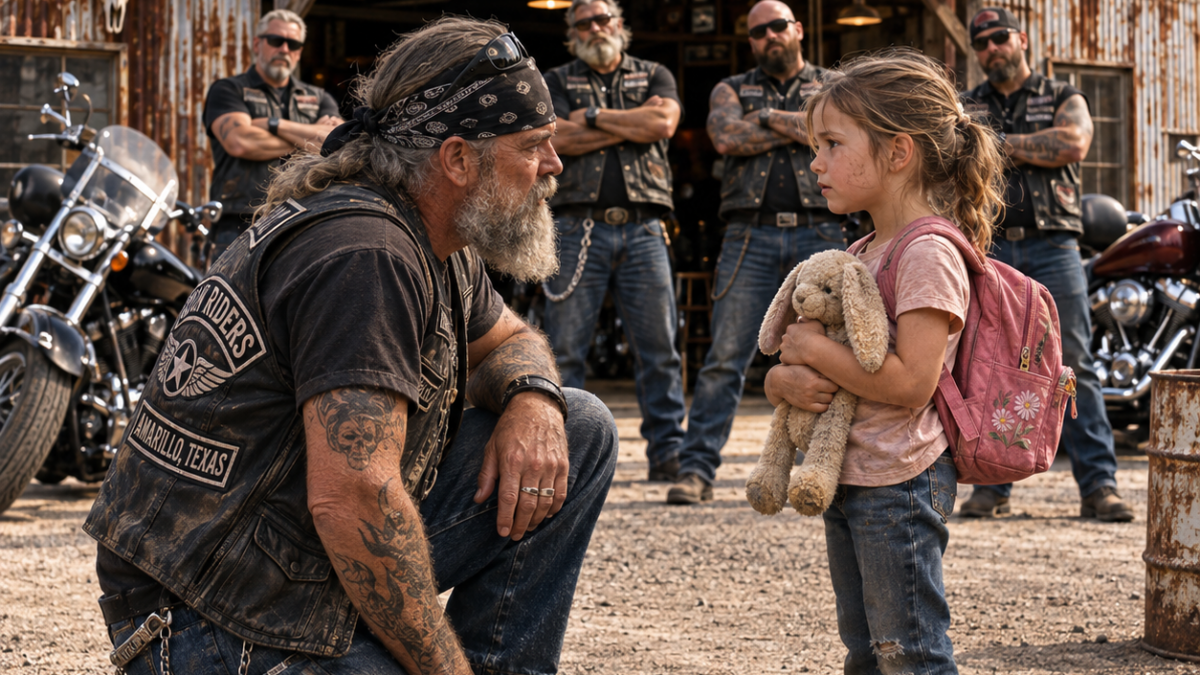
A seven-year-old girl walked into our motorcycle garage carrying a stuffed rabbit worn nearly flat and asked the toughest man in Amarillo if he knew anyone who needed a daughter.

She didn’t cry, didn’t say she was lost, and didn’t seem frightened by the leather vests, tattoos, roaring engines, or thirty grown men staring at her in stunned silence.

Then Garrett “Stone” Calloway knelt on the hot concrete, looked at her faded pink backpack, and asked one quiet question that made every biker in the lot understand this child had not wandered there by accident.

My name is Mason Reed.

I had worked at Thunder Ridge Motorcycle Garage for twelve years when she walked into our lives.

It was late afternoon in Amarillo.

Texas heat shimmering above the asphalt.

Country music coming through an old radio.

Motor oil.

Hot rubber.

Barbecue smoke from the place next door.

Nothing unusual.

Then every conversation stopped.

The little girl stood at the edge of the lot.

Light-brown hair pulled into a crooked ponytail.

Dusty sneakers.

One shoelace dragging.

A pink backpack hanging from one shoulder.

And against her chest, she held an old stuffed rabbit.

One ear sagged.

One button eye was missing.

Someone had replaced it with black thread stitched into an X.

That rabbit looked like it had survived everything with her.

She started walking toward us.

Straight toward Stone.

That surprised me.

Most adults were nervous around Garrett Calloway.

Kids usually hid behind their parents.

Stone was sixty.

Broad shoulders.

Silver beard.

Scar down his jaw.

Former president of the Iron Sons.

Hands permanently stained from decades of engines.

A voice like gravel.

He was leaning against Bay Two wiping grease from a socket wrench when she stopped in front of him.

Stone looked down.

She looked up.

“Sir?”

His expression softened immediately.

“Yeah, sweetheart?”

She squeezed the rabbit tighter.

“Do you know anybody who needs a daughter?”

The wrench almost slipped from his hand.

Nobody laughed.

Nobody even moved.

Stone put the wrench down.

Slowly.

Then knelt so they were eye level.

“What’s your name?”

“Maisie.”

“How old are you, Maisie?”

“Seven.”

Stone glanced toward the road.

No parent running toward us.

No car waiting nearby.

No frantic adult calling her name.

Just heat and traffic in the distance.

“Are you lost?”

She shook her head.

“No.”

“You know where your house is?”

Another nod.

That answer worried me more.

Stone noticed it too.

“Does somebody know you’re here?”

Maisie looked down at the rabbit.

Her thumb rubbed the stitched eye.

“I don’t think they care.”

The entire lot changed.

Not loudly.

Just men quietly setting things down.

A helmet.

A rag.

A coffee cup.

Everyone listening now.

Stone stayed calm.

PART2:

“You hungry?”

She hesitated.

That told us enough.

I went inside and brought water.

Someone else found crackers.

Maisie thanked us like a tiny adult.

That nearly broke me.

Children shouldn’t know how to make themselves convenient.

Stone waited until she finished drinking.

Then nodded toward the backpack.

“You packed that yourself?”

“Yes.”

“What’s in it?”

“Two shirts.”

She paused.

“Toothbrush.”

Another pause.

“Rabbit food.”

I stared at her stuffed rabbit.

Stone did too.

Maisie suddenly looked embarrassed.

“He doesn’t really eat it.”

Stone’s jaw tightened.

But his voice stayed gentle.

Then he asked the question I still remember word for word.

“Maisie, sweetheart… did you leave home because you wanted a new family, or because you were afraid to go back to the one you have?”

Her fingers stopped moving against the rabbit.

For the first time since she arrived, her calm disappeared.

Her lower lip began to shake.

She looked past Stone toward the road.

Then whispered:

“Can you lock the garage door first?”

Every man in that lot turned toward the entrance.

And that was when we saw the vehicle slowing down outside.

Disclaimer: This story is fictional and created for entertainment purposes only. Any names, characters, places, or events are fictitious or used fictitiously. No real person or organization is intended to be portrayed.

Recommended for You

View Archive arrow_forward
News

A whole clubhouse full of armed bikers went silent because a 9-year-old boy pointed at the ceiling. I was standing closest to him when it happened. Close enough to see his hand shake. We’d told his mom a hundred times not to bring him around. A kid doesn’t belong where men keep guns in their waistbands and a federal case is hanging over the president’s head. But there he was, sitting under the old oak bar with a toy motorcycle, quiet as a mouse. I thought he wasn’t paying attention. Then he set the toy down, slow and careful, like he already understood something the rest of us hadn’t figured out yet. He stood up and pointed one small finger at the dark corner above the bar. “Camera,” he said. Just that. One soft word. But it landed in that room like a grenade with the pin pulled. Nobody breathed. The president put his glass down without a sound. The sergeant-at-arms reached behind his back. And every brother in that clubhouse turned at the exact same time to look at the thing a 9-year-old had spotted that none of us had bothered to look for. My name is Walt. I’ve been wearing this club’s patch for twenty-six years. I’d never seen a room of grown bikers go that still that fast. The corner was just shadow to me. A smoke detector. An old water stain. Then Tank moved — our sergeant-at-arms, six foot four, hands like cinder blocks. He dragged a barstool under the corner, and the legs scraped the concrete so loud in the silence it made me flinch. He climbed up, pushed up the ceiling tile an inch. Then he froze. “Son of a—” Tank breathed, yanking his hand back. A small black box wedged in the dark. A glass eye on the front. A thin wire running off into the ceiling. A camera, pointed straight down at the bar. Straight down at all of us. Nobody in this club had put it there. The boy’s name was Eli. His mom, Dana, tended bar for us a couple nights a week. She was barely twenty-six, raising him alone after his father walked out. Eli was small for nine, the kind of quiet kid who watched everything and said almost nothing. Some brothers grumbled about a child being in the clubhouse. But Dana had nobody — no family, no sitter money. And Boone, our president, had a soft spot for that boy the size of a county. “He’s no trouble,” Boone always said. “Leave him be.” So we left him be. And on the worst night of the whole year, that one stubborn kindness saved every single man in that room. That night wasn’t a party. Boone was staring down federal charges — conspiracy, racketeering. For months we’d had a leak. Things said inside these walls turned up where they had no business being. Boone was convinced it was a rat, a brother who’d flipped. He called the meeting to smoke him out. Twenty bikers, every one armed, every one suspicious of the man beside him. Men sitting apart who normally sat shoulder to shoulder. Hands too close to belts. Boone was mid-sentence at the head of the bar, a name half-formed in his mouth, a finger starting to lift toward one of our own. He never finished it. When Tank held that camera up in the light, the room exploded. Chairs went over. Two brothers had each other by the collar. Someone shouted “FEDS,” someone shouted “RAT.” Then Boone roared from deep in his chest. “QUIET.” The room slammed shut. You could hear the refrigerator humming. Boone took the camera from Tank, turned it over in his fingers, and set it on the bar gentle, like it might go off. Then he turned to Eli. The boy had backed into the corner, toy motorcycle clutched to his chest, eyes huge and wet. Boone crossed the room and crouched down, folding all six feet of himself to the floor. This huge man with a gray beard and a federal case hanging over his head, getting small so a child wouldn’t be afraid. “Hey,” Boone said. “You’re not in any trouble, son. I give you my word.” Eli’s chin trembled. “How’d you know it was up there, Eli?” What that boy said next made the whole room go cold again. “Because I’ve seen one before,” Eli whispered. “At my house. In my room.” Boone went still. “The man put it up high in my room. He said it was so he could watch me and keep me safe. But Mom didn’t know about it. He said Mom didn’t need to know.” “What man?” “Mom’s friend. Greg. He comes over sometimes. He fixes stuff. He’s good with computers and wires and things.” “And he told you to keep it secret?” Eli nodded fast. “He said if I told Mom, she’d get real mad at me. He said it was our secret and that’s how I knew he was my friend.” Boone closed his eyes for one second. Then he stood up, and his face was wearing something I’d never seen on him. Past anger. The still, terrible face of a man doing arithmetic and hating every number. Dana came out of the storeroom drying her hands on a bar rag. She walked into a silent room full of frozen men. Saw the black box on the bar. Saw her son crying in the corner. “What happened? Is Eli okay?” “He didn’t do anything wrong,” Boone said carefully. “Dana, you got a friend named Greg? Comes around, fixes things?” The color drained from her face. “Greg. He’s been helping me out for a few months. He set up my internet. He set up the camera at my front door so I could see who’s—” She stopped. Her hand drifted to her mouth. “He was at my apartment last week. He was up in Eli’s room. He said he was fixing the wifi.” Boone lifted the camera where she could see it. “This Greg. He ever spend time alone in this clubhouse?” “Last month. My car wouldn’t start in the back lot. I gave him my spare key and told him to wait inside. He was in here alone for maybe an hour.” The rat we’d been hunting for months wasn’t a brother. It had never been a brother. Here’s the part that turns my stomach. Boone had been one sentence from naming Cisco. Cisco had been jumpy for weeks, sitting apart, snapping at people. Turned out Cisco’s wife had been diagnosed with cancer and he was buried under hospital bills, too proud to ask. That was the whole secret. If Eli hadn’t pointed at the ceiling, Boone might have done something to Cisco in front of all of us that could never have been undone. I looked across the room and found Cisco’s face. He’d gone gray, just now realizing how close the edge had been. Boone sat Dana on a barstool and told her everything — that Greg had put a camera in her son’s bedroom and used her spare key to plant one here. Dana came apart, saying she didn’t know, she swore to God she didn’t know. “This is not on you,” Boone said, holding her shoulders. “A man like that counts on you not knowing. He smiled and fixed your car so you’d trust him. This is on him.” He turned to Eli, still clutching that motorcycle. “And you. You did the bravest thing anybody has done inside these walls in years. You told the truth, son, even when a grown man told you to keep it buried.” “You’re really not mad at me?” Boone’s voice cracked. “Son, you’re a hero. Don’t you ever let anybody tell you different.” We didn’t call the police. That’s not our way. The brothers found Greg. I won’t tell you how, and I won’t tell you a word of what was said. There were more cameras. One in Dana’s living room. Another feeding video to an account watching more than just adults — watching more children than only Eli. The matter got handled in a way that made certain no other child would ever wake up to a glass eye watching from the corner of their bedroom. Not ever again. Dana and Eli moved out within the week. New apartment, new locks. The club paid for all of it and wouldn’t let her say thank you once. And Cisco. His wife’s hospital bills got handled, quiet and anonymous. A brother does not get hunted for the crime of being scared and then get forgotten the moment the real wolf shows his face. Eli’s nearly a grown man now. Tall. Steady. He still calls Boone every year on his birthday. Boone still tears up every time the phone rings and it’s him. Every brother who stood in that clubhouse knows the truth. We didn’t protect that boy.







