A 7-Year-Old Girl Walked 12 Miles Barefoot Through 103-Degree Heat—Then She Collapsed at a Biker Rally and Whispered One Terrified Request to the Man Who Caught Her.
PART3″
Because crowds teach the eye to ignore what it assumes belongs to someone else.
A child walking between adults looks like she belongs to one of them.
Until she doesn’t.
Garrett dropped the rib.
“Marcus.”
“I see her.”
The girl was twenty feet away.
Fifteen.
Her eyes were open but unfocused.
Garrett started toward her.
“Hey, sweetheart?”
No response.
Ten feet.
Her right knee folded.
Five.
Both legs gave out.
Garrett lunged.
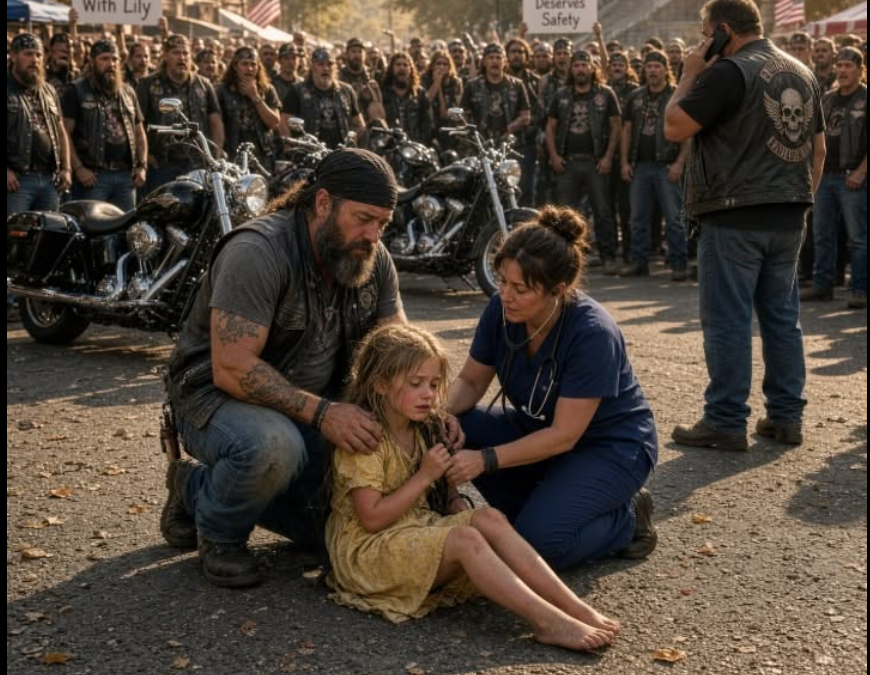
He caught her shoulders before her face struck the pavement.
His water bottle hit the ground behind him.
“Hey. Hey, can you hear me?”
The girl felt impossibly light.
Not child-light.
Empty-light.
Garrett lowered her carefully.
Her eyelids fluttered.
Her skin was burning.
Her lips were cracked, dry, almost colorless.
Marcus was already shouting.
“Medical! Somebody get medical over here!”
People turned.
Then stopped.
A circle formed.
Garrett slipped one arm beneath the girl’s shoulders.
“Sweetheart, open your eyes.”
A faint sound left her throat.
A whimper.
It was barely audible beneath the music and engines.
Garrett felt something inside him tear.
Not because it sounded like Lily.
It didn’t.
It sounded worse.
It sounded like a child who had learned making noise rarely helped.
A woman pushed through the crowd.
“Move.”
She dropped beside Garrett.
“My name’s Rita. I’m an RN.”
Garrett nodded once.
Rita Pennington attended the rally every year with her husband. She was thirty-five, compact, sunburned across her nose, calm in the way medical people become calm when everyone else needs permission to panic.
She touched two fingers to the girl’s neck.
“Pulse is fast.”
She looked toward Marcus.
“Call 911.”
“Already happening.”
Rita touched the child’s forehead.
“Severe dehydration. Heat exhaustion, maybe heatstroke. We need shade.”
Garrett lifted the girl without being asked.
She weighed so little that anger rose in him immediately.
They carried her beneath the saloon awning.
Dean Ashford appeared through the crowd.
Sixty-one.
Silver beard.
Club president.
The kind of man who could quiet a room without raising his voice.
“What happened?”
“Kid collapsed,” Garrett said.
“Whose?”
Nobody answered.
Dean looked around.
“Whose child is this?”
Nothing.
Rita pulled back one sleeve of the yellow dress to place a damp cloth near the girl’s shoulder.
Then she stopped.
Garrett saw her expression change.
“What?”
Rita did not answer.
She lifted the fabric slightly.
The world seemed to narrow.
Bruises covered the little girl’s upper arm.
Some dark.
Some yellowed at the edges.
Some faint.
Different stages.
Different days.
Not playground bruises.
Not one fall.
A history.
Marcus swore under his breath.
Dean’s jaw tightened.
Rita examined the other arm.
Then stopped again.
“There are marks around her wrists.”
Garrett looked.
Thin red-brown bands.
Partially healed.
The kind of marks that should never appear on a child.
His heartbeat changed.
A familiar heat rose through him.
He remembered combat.
The moment training took over.
The mind becoming very still.
Garrett forced himself to remain kneeling.
He looked at the little girl.
Not at the bruises.
Not at the marks.
Her.
“Hey.”
Her eyelids fluttered.
Rita leaned closer.
“What’s your name, sweetheart?”
Nothing.
“Can you tell me your name?”
Her lips moved.
Garrett bent down.
“Ellie.”
Rita nodded.
“Okay, Ellie. I’m Rita. This is Garrett.”
Ellie’s eyes opened a fraction.
Gray-blue.
Clouded with exhaustion.
Her gaze moved.
Found Garrett’s leather vest.
Then his face.
Her right hand lifted weakly.
Her fingers curled into the leather near his chest.
Garrett went completely still.
“Okay,” he whispered.
He covered her hand lightly with his.
“I’m right here.”
Rita spoke softly.
“Ellie, do you know where your mom is?”
A flinch ran through Ellie’s entire body.
Garrett saw it.
Everyone close enough saw it.
Rita changed direction.
“Your dad?”
Ellie’s fingers tightened on Garrett’s vest.
“No.”
“What?”
Her voice was barely there.
“No.”
Rita leaned closer.
“You’re safe. We just need to know who takes care of you.”
Ellie opened her eyes wider.
Fear came before the words.
“Don’t tell him.”
Garrett felt his stomach drop.
“Don’t tell who?”
Her small hand pulled at his vest.
“Don’t tell him where I am.”
The street went quiet in a way streets with thousands of people are not supposed to.
The silence moved outward from the circle.
Dean looked at Marcus.
Marcus’s expression hardened.
Garrett lowered his voice.
“Nobody is telling anybody anything right now.”
Ellie stared at him.
“Promise?”
There are promises adults should hesitate before making.
Promises about courts.
About safety.
About tomorrow.
Garrett knew that.
He had once promised Lily she would get better.
He had learned what promises could cost.
Still, he said, “I promise you nobody here is taking you anywhere you’re afraid to go.”
Ellie’s eyes closed.
Her hand stayed locked in his vest.
Dean stood.
He turned toward the growing wall of riders.
“Find out who she is.”
Marcus moved immediately.
Dean caught his arm.
“And Marcus.”
Marcus looked back.
“We do it legally.”
The words mattered.
Several men nearby had the same expression Garrett felt burning inside himself.
Dean saw it.
“No stupid moves.”
Nobody argued.
“We gather information. We call law enforcement. We get witnesses. We do this right. If somebody hurt this child, I want them in a courtroom, not using us as an excuse to walk free.”
That settled something.
Phones came out.
People started asking vendors whether anyone had seen the girl earlier.
Others checked with local deputies.
One rider went to rally security.
Another began walking the direction Ellie had come from.
Within minutes, nearly three hundred people were looking without becoming a mob.
Garrett barely noticed.
Ellie still held his vest.
Rita wet a cloth and touched it to the girl’s forehead.
“Easy cooling,” she said.
Garrett nodded.
“What can I do?”
“Keep talking.”
“About what?”
“Anything.”
Garrett looked down at Ellie.
He had not spoken to a seven-year-old in four years.
“What do you like?”
Nothing.
“Dogs?”
Her eyelids twitched.
“Cats?”
Tiny shake.
“Okay. Horses?”
Her eyes opened.
A fraction.
“Horses?”
Garrett smiled.
“Good. Horses.”
“I like yellow ones.”
Rita glanced at him.
Garrett did not correct her.
“Yellow horses are excellent.”
“They’re called…”
Ellie struggled.
“Palominos?” Garrett offered.
Her eyes opened a little more.
“Yeah.”
“Palominos.”
A faint siren appeared beneath the crowd noise.
Ellie heard it.
Her body tensed.
“No.”
“It’s an ambulance.”
“No.”
“You need water and a doctor.”
“No police.”
Garrett’s throat tightened.
“Not police.”
“He knows police.”
Garrett looked at Rita.
Rita’s eyes darkened.
“Who does?”
Ellie’s breathing sped up.
“Don’t.”
“Okay,” Garrett said. “No more questions.”
Ellie searched his face.
“You staying?”
The question hit harder than anything else had.
He had once heard another child ask almost the same thing.
Lily.
The night before a spinal tap.
Daddy, you staying?
Till morning.
Garrett looked down.
“Yeah,” he said, his voice rough. “I’m staying.”
The ambulance arrived eight minutes later.
To Ellie, it felt like an invasion.
Paramedics moved around her.
Blood pressure cuff.
Oxygen saturation.
IV supplies.
Questions.
Garrett nearly stepped aside out of instinct.
Ellie’s hand tightened so hard that her knuckles went pale.
“No.”
He looked down.
“Okay.”
The female paramedic noticed.
“You family?”
Garrett shook his head.
“She collapsed in front of me.”
The paramedic looked at Ellie’s grip.
Then at Garrett.
“You want to ride?”
“Yes.”
It came out before she finished asking.
Dean heard.
“I’ll handle things here.”
Garrett nodded.
Marcus grabbed his shoulder.
“I’ll call.”
Garrett climbed into the ambulance.
The doors shut.
For the first time in years, the sound of motorcycles disappeared.
Inside was antiseptic.
Plastic.
Monitor tones.
Air-conditioning.
The same cold medical smell Garrett had spent four years avoiding.
His body reacted before his mind did.
Hospital.
Lily.
White blankets.
Tiny bald head.
He stared at the floor.
Not now.
Ellie’s fingers pulled weakly at his vest.
He looked up.
Her eyes were open.
“You there?”
“Yeah.”
The paramedic glanced toward him.
Garrett leaned closer.
“I’m right here.”
She closed her eyes again.
The ride lasted less than fifteen minutes.
Garrett experienced all fifteen as two timelines layered over each other.
Ellie breathing on the stretcher.
Lily breathing in a hospital bed.
Ellie’s IV.
Lily’s IV.
Ellie’s small bare feet.
Lily’s purple socks.
He pressed both palms against his knees.
This is not then.
This child is alive.
This child needs now.
At Sturgis Regional Hospital, they took Ellie behind double doors.
Her fingers finally slipped from his vest.
Garrett felt strangely exposed without them.
A nurse stopped him.
“You’ll have to wait here.”
He nodded.
Then stood in the hallway.
Marcus arrived twenty minutes later.
He did not ask whether Garrett was okay.
That was why Garrett loved him.
Instead, he handed him coffee.
“Found something.”
Garrett looked up.
“Already?”
“Girl matching her description was reported missing.”
“By who?”
Marcus paused.
“Stepfather.”
Garrett’s expression changed.
“Name?”
“Vernon Cross. Forty-four. County Road 34. Twelve miles out.”
“Twelve miles.”
Marcus nodded.
Garrett looked toward the emergency-room doors.
“She walked it.”
“Looks that way.”
“Barefoot.”
Marcus nodded again.
Garrett’s jaw flexed.
“What else?”
“Mother died two years ago. Car wreck. No biological father listed. Cross got custody.”
“Any reports?”
Marcus looked around and lowered his voice.
“Two CPS calls. Neighbor named Karen Fletcher called twice. Both cases closed.”
Garrett said nothing.
Marcus continued.
“According to Karen, Cross knew they were coming at least once.”
“How?”
“Don’t know yet.”
Garrett looked toward the floor.
“How does a seven-year-old end up with bruises like that after two investigations?”
“Paul’s digging.”
Paul Whitfield was a club member and retired attorney.
If there was paperwork, he would find the lawful way to obtain it.
Garrett’s phone buzzed.
Dean.
He answered.
“What?”
Dean’s voice was measured.
“We’ve got enough to know Cross is the person she’s afraid of.”
Garrett closed his eyes.
“Where is he?”
“At home, according to a neighbor.”
“What’s being done?”
“Sheriff’s department has been notified.”
Garrett said nothing.
Dean knew that silence.
“Garrett.”
“I’m here.”
“You stay at the hospital.”
“I know.”
“You do not go to that house.”
“I said I know.”
“I mean it.”
Garrett’s voice dropped.
“I know what I promised her.”
“And I know what you want to do.”
“No, you don’t.”
Dean went quiet.
Garrett looked through the narrow window in the emergency-room door.
“You know what it was like when Lily died?”
“No.”
“Exactly.”
His hand tightened around the phone.
“I couldn’t fight that.”
Dean answered softly.
“I know.”
“This one has a face.”
“I know.”
Garrett’s eyes burned with something hotter than tears.
“That makes it worse.”
“Then stay where the child is.”
Garrett breathed.
Dean continued.
“Don’t give Cross the privilege of turning you into the story.”
That landed.
Garrett stared ahead.
“Okay.”
“What are you doing?” Garrett asked.
“Making sure everybody else remembers the same thing.”
The line went dead.
Forty minutes later, Dr. Patricia Caldwell walked into the hall.
Garrett knew bad news faces.
He had memorized them.
This was not the face doctors wore when someone had died.
But it was close to the face they wore when they wished the world were different.
“Mr. Holloway?”
“Yes.”
“Are you a relative?”
“No.”
“She identifies you as the person she wants present.”
Garrett swallowed.
“Okay.”
The doctor glanced at Marcus.
“Privately.”
Marcus nodded.
“I’ll be around the corner.”
Dr. Caldwell led Garrett into a consultation room.
He hated consultation rooms.
Small table.
Box of tissues.
No windows.
“Ellie is stable.”
Garrett’s shoulders loosened slightly.
“Severe dehydration. Heat exhaustion bordering on heatstroke. Malnutrition.”
He waited.
“Two cracked ribs. One partially healed. One more recent.”
His eyes changed.
The doctor continued carefully.
“Multiple bruises in different stages of healing. Marks consistent with restraint. Signs of prolonged food restriction.”
Garrett stood.
The chair scraped backward.
Dr. Caldwell remained calm.
“Mr. Holloway.”
He turned away.
One hand covered his mouth.
Not because he was about to cry.
Because he was afraid of what he might say.
“She’s seven.”
“I know.”
“She weighs what?”
“Forty-one pounds.”
Lily had weighed more near the end.
Garrett pressed both hands against the table.
“How long?”
“We can’t know exactly.”
“How long?”
The doctor understood what he meant.
“This is chronic.”
Garrett nodded once.
“Systematic?”
“Yes.”
That word nearly undid him.
Dr. Caldwell gave him a moment.
Then she said, “She asked whether you were still here.”
His head turned.
“What?”
“When she woke up.”
Garrett looked at the door.
“Can I see her?”
“Yes.”
Ellie looked smaller in the hospital bed.
Clean sheets made it worse somehow.
The faded dress had been replaced by a hospital gown. Her hair had been gently combed away from her face. An IV ran into her left arm.
Her eyes found him immediately.
“You stayed.”
Garrett sat.
“Made a promise.”
She looked toward the door.
“Is he here?”
“No.”
“You sure?”
“Yes.”
“How?”
Garrett hesitated.
“Because a lot of people are making sure.”
She absorbed that.
“Motorcycle people?”
“Yeah.”
“All of them?”
“Pretty much.”
“Why?”
He almost said because of what happened to you.
Instead, he said, “Because you needed somebody.”
Ellie looked confused by the simplicity.
Garrett recognized that look.
Children who receive love consistently rarely question why someone helps.
Children taught that love has conditions always do.
“You don’t know me,” she said.
“No.”
“What if I’m bad?”
Garrett went completely still.
“Who told you that?”
She looked away.
Garrett forced his voice to remain gentle.
“Ellie.”
“He says I make things happen.”
“What things?”
“When he gets mad.”
Garrett’s jaw tightened.
“He says I make him.”
“Look at me.”
She didn’t.
“Ellie.”
Slowly, she did.
“You cannot make a grown man hurt you.”
Her eyes filled.
“I talk. Sometimes when he says be quiet, I forget.”
“That doesn’t matter.”
“He says it does.”
“He’s wrong.”
“He’s bigger.”
“That doesn’t make him right.”
Ellie considered this.
For a child, size had probably been the closest thing to law she had known.
“Are you bigger than him?”
Garrett almost smiled.
“Probably.”
“So you’re right?”
A small laugh escaped him before he could stop it.
“No. That’s not how it works.”
“How does it?”
Garrett thought.
“You’re right because what he did was wrong.”
She stared at him for a long time.
Then looked toward his vest.
“Can I hold it?”
Garrett removed it and placed it over the bed rail.
Ellie took a fistful of leather.
Her breathing slowed.
After several minutes, she whispered, “I heard you.”
“What?”
“The motorcycles.”
“At the rally?”
“No.”
She shook her head.
“Before.”
He waited.
“When I left.”
Garrett did not move.
“He was sleeping,” she said. “The bad kind.”
Garrett said nothing.
“I opened the back door. I didn’t have shoes.”
He fought the urge to interrupt.
“He took them.”
“Why?”
“So I couldn’t run.”
Garrett’s throat closed.
Ellie continued.
“I went anyway.”
“How did you know where to go?”
“I didn’t.”
She looked at him.
“I heard motorcycles.”
“From the highway?”
She nodded.
“They were loud.”
Garrett’s eyes burned.
“He always said quiet,” she whispered. “Quiet when he was mad. Quiet when I ate. Quiet when I cried. Quiet when people came. Quiet all the time.”
Her fingers curled tighter into the vest.
“So when I heard loud…”
She shrugged slightly.
“I thought loud might be safe.”
That sentence entered Garrett Holloway and found every empty place grief had left behind.
His daughter Lily had loved his motorcycle.
As a toddler, she called it Thunder.
When Garrett came home from work, Lily used to hear the engine from inside and run to the window.
Daddy loud.
That was what she called him.
Daddy loud.
He had not remembered those words in years.
Ellie watched his face.
“Why are you crying?”
Garrett wiped one eye.
“Old memory.”
“Bad?”
“Some bad.”
“And good?”
He nodded.
“Mostly good.”
She looked at the vest.
“Can you read?”
Garrett blinked.
“Yes.”
“Kids books?”
“Probably.”
“There’s one over there.”
A nurse had left a thin picture book on the shelf.
Garrett picked it up.
A bear lost in the woods.
He opened to the first page.
“You want the voices?”
Ellie frowned.
“What voices?”
Garrett froze.
Lily.
He swallowed.
“For different characters.”
Ellie’s expression changed.
“You can do that?”
“I used to.”
“Do it.”
Garrett began.
His bear voice was terrible.
Ellie corrected him twice.
By page five, she smiled.
A tiny smile.
But real.
At the same hour, riders gathered behind the Iron Horse Saloon.
Dean stood on an overturned milk crate.
The sun hung low.
Heat shimmered above parked motorcycles.
Nobody spoke.
Dean looked across the crowd.
“Her name is Ellie.”
A few men lowered their heads.
“She’s seven. She walked approximately twelve miles barefoot in this heat.”
A murmur moved through the group.
Dean raised one hand.
Silence returned.
“She was running from her stepfather.”
Faces hardened.
“Hospital documented injuries consistent with prolonged abuse. Neighbor says CPS was called twice.”
Anger moved through the crowd like a current.
Dean raised his voice just enough.
“I know what some of you are thinking.”
He looked at veterans.
Mechanics.
Fathers.
Grandfathers.
Men who had spent parts of their lives believing force was the clearest form of justice.
“We do not touch him.”
Someone in back muttered.
Dean heard.
“I said we do not touch him.”
The crowd quieted.
“If he goes down because we got stupid, his lawyer gets to stand in court and talk about us instead of what he did to that child.”
Paul Whitfield nodded.
Dean continued.
“We are witnesses. We are pressure. We are not executioners.”
Marcus stood near the front.
“What’s the plan?”
“Thirty at the hospital in shifts. Paul’s team coordinates statements and evidence.”
Dean looked toward County Road 34.
“Everybody else rides.”
The sound of hundreds of engines starting at once rolled across Sturgis like thunder.
Ellie heard it from the hospital.
She stopped Garrett mid-sentence.
“What’s that?”
He listened.
Distant.
Fading.
Motorcycles.
He smiled.
“Friends.”
“Where are they going?”
Garrett turned a page.
“To make sure somebody knows you’re not invisible anymore.”
Two hundred forty motorcycles turned onto County Road 34 as the sun lowered behind the Black Hills.
They did not enter Vernon Cross’s property.
They did not block the road.
They did not shout.
They lined the public shoulder legally, engines shutting down one by one.
Silence became more intimidating than noise.
Neighbors came onto porches.
Phones appeared.
Curtains moved.
For years, the weathered house at the end of Cross’s driveway had been private enough to hide almost anything.
That evening, it became the most watched house in the county.
Vernon appeared behind the screen door eleven minutes later.
Thin.
Tall.
Forty-four.
One hand hidden behind the frame.
Dean stepped forward.
Only one step.
No words.
Vernon stared past him at motorcycles stretching down the road.
At men and women who had never known Ellie that morning and somehow now looked like they would remember her name forever.
Vernon went inside.
Twenty minutes later, sheriff’s vehicles arrived.
Paul had done his job.
Dr. Caldwell’s medical report had been transmitted.
Karen Fletcher and two other neighbors had given sworn statements.
An emergency warrant had been approved.
Deputy Thomas Bridger approached the house.
Dean moved everyone farther back.
“No interference.”
The riders obeyed.
The deputy knocked.
“Sheriff’s Department.”
Nothing.
He knocked again.
“Vernon Cross, we have a warrant.”
A sound came from behind the house.
Another deputy moved around the side.
Thirty seconds later, Vernon appeared near his rusted pickup carrying a duffel bag.
Keys in hand.
Trying to leave.
“Stop.”
Vernon froze.
He looked toward the road.
Saw the riders.
For the first time, the man who had built his power around a child’s isolation understood what it meant to be seen.
Deputy Bridger placed him in handcuffs.
Vernon started talking immediately.
“You don’t understand. She lies. She’s difficult. She hurts herself.”
A biker behind Dean took one step forward.
Dean raised a hand without looking.
The man stopped.
Vernon kept talking.
“I take care of her.”
Deputy Bridger opened the patrol-car door.
“You can tell investigators.”
Then Vernon saw Dean.
“What are you looking at?”
Dean’s expression did not change.
Nothing was said.
That absence of answer seemed to frighten Vernon more than a threat might have.
He was placed in the car.
The doors shut.
Red and blue lights eventually disappeared over the hill.
Marcus called Garrett.
“They got him.”
Garrett stood in the hospital hallway.
“You sure?”
“Cuffed. Transported.”
Garrett closed his eyes.
“Charges?”
“Aggravated child abuse, neglect, unlawful restraint. Maybe more after investigation.”
“Good.”
“Dean says everybody behaved.”
“That a miracle?”
“Historic event.”
Garrett almost laughed.
Marcus’s voice softened.
“How is she?”
“Sleeping.”
“You?”
Garrett looked through the window.
Ellie’s small hand still held his vest.
“I don’t know.”
Marcus understood.
“Want me there?”
“Not yet.”
“Okay.”
Another silence.
“Garrett?”
“Yeah?”
“I know this isn’t Lily.”
Garrett shut his eyes.
Almost nobody said her name.
Marcus continued carefully.
“But you don’t have to be afraid that caring about this kid means replacing her.”
Garrett’s throat tightened.
“I know.”
“No, you don’t.”
He almost snapped.
Then stopped.
Marcus knew him too well.
“You loved one little girl. That doesn’t use up whatever was in you.”
Garrett leaned against the wall.
“You done?”
“For now.”
“Good.”
“I’ll bring coffee.”
“Don’t.”
“I’m bringing coffee.”
The line disconnected.
Ellie stayed in the hospital eight days.
The first two were medical.
Fluids.
Nutrition.
Monitoring.
Imaging.
Careful treatment of her ribs.
The next six were harder.
Healing physically allowed fear more room.
Ellie woke from nightmares.
Sometimes screaming.
Sometimes completely silent.
The silent ones frightened Garrett more.
She would wake rigid, eyes open, not knowing where she was, then reach for the leather vest Garrett began leaving beside the bed every night.
On the third night, he slept in the chair.
A nurse woke him at 2:11 a.m.
Ellie was whispering.
“Garrett.”
He sat up instantly.
“What?”
“Door.”
The room door stood partly open.
He looked.
“What about it?”
“Close it.”
He closed it.
“More.”
He pushed until it clicked.
Ellie relaxed slightly.
“Okay?”
She nodded.
“Do you want the light on?”
“No.”
“Hall light?”
She nodded.
He opened the bathroom door enough to let a strip of light fall across the floor.
“Better?”
“Yes.”
Garrett returned to the chair.
A few minutes later, she whispered, “Garrett?”
“Yeah?”
“Are you sleeping?”
“I was.”
“Sorry.”
“Don’t be.”
She stared at the ceiling.
“Did your kid sleep?”
Garrett froze.
“How do you know I had a kid?”
“You look at the picture.”
His hand moved automatically toward his wallet.
He had shown Rita a photo earlier.
Lily with missing front teeth, wearing oversized sunglasses.
“Her name was Lily.”
“Where is she?”
Garrett took a breath.
“She died.”
Ellie turned toward him.
“Did somebody hurt her?”
“No.”
“Were you there?”
“Yes.”
“Could you stop it?”
His eyes filled.
“No.”
“Did you try?”
Garrett nodded.
“Everything.”
Ellie thought for a long time.
“Then it wasn’t because you were bad.”
Garrett stopped breathing.
Hours earlier he had told Ellie she wasn’t responsible for what a grown man had done.
Now this child was offering him the same mercy about something entirely different.
He covered his mouth.
Ellie looked puzzled.
“What?”
Garrett wiped his face.
“Nothing, kid.”
She closed her eyes.
Within minutes, she slept.
Garrett did not.
The investigation widened quickly.
Police found a bedroom with a lock on the outside.
A mattress on the floor.
Kitchen cabinets latched far above Ellie’s reach.
A pantry containing enough food for one adult.
Neighbors admitted they had seen less and less of Ellie.
One remembered her standing at a window.
Another remembered Vernon saying she was being homeschooled.
Karen Fletcher gave the hardest statement.
She was fifty-six, a ranch owner across a field. She had tried twice to get help. She had called. She had watched cars come and go. She had started doubting herself when nothing changed.
That sickened Garrett.
Systems fail twice when they teach witnesses not to trust what they saw.
Paul helped Karen document everything.
Dates.
Calls.
Names.
Observations.
The state opened an internal review.
The findings came months later.
Errors.
Incomplete interviews.
Failure to isolate the child from the guardian.
Insufficient follow-up.
Administrative phrases for consequences visible on a seven-year-old body.
Ellie did not care about the language yet.
She cared about food.
At first, she hid it.
Rolls from dinner.
Crackers.
Packets of peanut butter.
A banana beneath her pillow.
A nurse found them.
Garrett expected the staff to correct her.
Instead, Dr. Caldwell explained.
“Food insecurity and deprivation behavior.”
“What do we do?” Garrett asked.
“Don’t shame her.”
“So let her hide it?”
“Give her control.”
That night Garrett brought a small plastic box.
He filled it with packaged snacks.
Crackers.
Applesauce.
Granola bars.
He put it beside Ellie’s bed.
“What’s that?” she asked.
“Yours.”
“All of it?”
“Yeah.”
“When?”
“Whenever.”
She stared.
“What if I eat it?”
“I refill it.”
“What if I eat everything?”
“Then you’re probably going to have a stomachache, and I refill it tomorrow.”
Ellie touched the lid.
“He counted.”
Garrett knew instantly who.
“Food?”
She nodded.
“Sometimes he put a line on the cereal box.”
Garrett’s eyes burned.
“You won’t count?”
“No.”
“Promise?”
Garrett nodded.
“That one I can promise.”
For three days, she still hid food.
On day four, the banana remained on the tray.
On day five, she ate half a granola bar and left the other half openly in the box.
Garrett noticed.
He said nothing.
Healing can be insulted by too much celebration.
On day six, social worker Christine Palmer arrived.
Garrett distrusted her immediately.
Not because she did anything wrong.
Because she represented a system that had already failed Ellie.
Christine understood.
She had been a child-welfare social worker for nineteen years.
She was no longer offended by distrust.
She sat with Ellie.
Alone.
Door partly open.
Garrett waited outside.
Forty minutes later, Christine found him.
“She’s going to need placement.”
Garrett nodded.
“Foster care.”
“Temporary, likely.”
“With who?”
“We’re evaluating options.”
“Karen.”
Christine studied him.
“She volunteered.”
“She has horses.”
“I know.”
“Ellie trusts her.”
“I know.”
Garrett crossed his arms.
Christine waited.
He hated when professionals waited.
It made him talk.
“What would I need?”
“For what?”
“To foster her.”
Christine’s face remained neutral.
“You live in Tennessee.”
“Yes.”
“You’re not related.”
“No.”
“You’ve known her six days.”
“I know.”
Christine glanced toward his vest.
He noticed.
“No criminal record. Marine. Honorable discharge. Own my shop. Own my house. Three bedrooms.”
Christine listened.
“I had a daughter,” he said.
Her expression softened.
“She died four years ago.”
“I’m sorry.”
“So is everybody.”
Christine let that pass.
“I know this isn’t simple,” he said.
“No.”
“I don’t want simple.”
He looked through the window.
“I want the process.”
Christine folded her arms.
“Why?”
Garrett stared.
“What do you mean why?”
“Because wanting to rescue a traumatized child and being ready to parent one are different things.”
That made him angry.
Then he realized she was right.
He sat down.
“Okay.”
Christine sat across from him.
Garrett looked toward Ellie’s room.
“I don’t know.”
“That’s an acceptable answer.”
He thought.
“She grabbed my vest.”
Christine waited.
“That sounds stupid.”
“It doesn’t.”
He rubbed his face.
“The truth?”
“Yes.”
“I failed my daughter.”
Christine did not interrupt.
“I know cancer isn’t something you win by trying harder. But knowing that and feeling it are different.”
His voice became rough.
“I spent four years trying not to need anybody. Then this kid falls at my feet.”
Christine said softly, “You cannot use Ellie to repair Lily.”
Garrett’s eyes flashed.
“I know.”
“Do you?”
He started to answer.
Stopped.
Christine continued.
“You would need therapy. Training. Home study. Interstate approval. Supervised contact at first.”
“Fine.”
“Ellie may reject you.”
That stopped him.
“She may attach strongly now because you were present during rescue. That attachment may change. She may become angry. She may lie. She may hide food. She may break things. She may tell you she hates you.”
Garrett pictured Lily at five yelling I hate you because he would not let her eat candy before dinner.
Different child.
Different meaning.
He swallowed.
“Okay.”
Christine’s voice softened.
“She may never call you Dad.”
That one hurt more than he expected.
He nodded anyway.
“I’m not asking for a title.”
“What are you asking for?”
Garrett looked through the glass.
Ellie sat up in bed coloring a motorcycle bright purple.
“A chance to be one of the people who stays.”
Christine was quiet for a long time.
Then she opened her folder.
“Then we can start.”
Ellie did not leave the hospital with Garrett.
That mattered.
Stories often cheat here.
They turn emotional certainty into legal certainty.
Real children deserve better.
Karen Fletcher completed emergency foster certification. Her ranch was nearby. Ellie knew her. There were horses, space, and no unknown adult men living in the home.
It was the best immediate option.
Garrett understood.
He hated it.
On discharge morning, Ellie wore a blue jacket Karen had bought her and shoes that felt strange enough she kept wiggling her toes. Garrett carried a bag of hospital supplies. Ellie carried a giant stuffed horse the bikers had given her.
Outside, six riders waited.
Not three hundred.
Garrett had requested six.
Too much attention would turn Ellie’s life into a spectacle.
Marcus leaned against his bike.
Dean stood beside him.
Ellie stopped.
“Where’s everybody?”
Dean smiled.
“You disappointed?”
“No.”
She sounded disappointed.
Marcus crouched.
“The rest are trying to pretend they have jobs.”
Ellie looked at his bike.
“Is yours loud?”
“Very.”
“Good.”
Marcus glanced at Garrett.
Nobody else understood why that word mattered.
Garrett did.
“So you’re going with Miss Karen,” Garrett said.
Ellie nodded.
“You’re coming?”
Garrett’s stomach tightened.
“Not today.”
Her face changed immediately.
He crouched.
“But I’m seeing you tomorrow.”
“How?”
“I have a place nearby for a little while.”
“Why?”
“Because I’m doing paperwork.”
“What paperwork?”
Garrett looked at Christine.
Christine nodded slightly.
He turned back.
“I’m trying to get permission to be somebody you can live with someday, if you want that.”
Ellie stared.
“What?”
“No promises,” he said. “Grown-up systems take time.”
“You want me?”
Garrett’s throat closed.
Children should not ask that as if the answer might be embarrassing.
“Yes.”
Her eyes filled.
“Why?”
He smiled sadly.
“Because you’re you.”
“What if I’m hard?”
“Then you’re hard.”
“What if I get mad?”
“Everybody gets mad.”
“What if—”
“Ellie.”
She stopped.
His voice softened.
“You do not have to audition.”
She stared.
“That means you don’t have to behave perfectly so people keep you.”
Her face crumpled.
Karen turned away, crying.
Garrett stayed crouched.
“You hear me?”
Ellie nodded.
“Say it.”
“I don’t have to…”
She struggled.
“Audition.”
“Audition,” she repeated.
“For what?”
“To stay.”
Garrett nodded.
She threw her arms around his neck.
He closed his eyes.
Behind her, Dean looked toward the sky.
Marcus stared at the ground.
Nobody mocked Garrett when he cried.
For three months, Ellie lived at Karen’s ranch.
She met Butterscotch, the palomino mare.
The first time she brushed the horse, Ellie cried without warning.
Karen did not ask why.
She simply stayed nearby.
Garrett returned to Tennessee after three weeks.
The first night back in his house nearly broke him.
Silence.
Three bedrooms.
One had been Lily’s.
Garrett had kept the door shut for four years.
Not a shrine exactly.
But close.
Her bookshelf remained.
A faded moon sticker still clung to the closet.
Garrett stood outside the door with his hand on the knob.
Marcus was behind him.
“You don’t have to.”
Garrett nodded.
“I know.”
Five minutes passed.
Then ten.
Garrett opened the door.
Dust.
Stillness.
Pink curtains.
A child’s lamp.
A box of clothes he had never donated.
Garrett entered.
He sat on the edge of the bed.
“I can’t put Ellie in here.”
Marcus leaned against the frame.
“Okay.”
“Feels like…”
He rubbed both hands over his face.
“Feels like I’m deleting Lily.”
“No.”
“It does.”
Marcus waited.
Garrett looked around.
“I want another room.”
“You have the guest room.”
“Yeah.”
“Then use that.”
Garrett nodded.
They closed Lily’s door.
Not permanently.
Just for now.
The guest room became Ellie’s.
Garrett painted it yellow.
Not pale yellow.
Ellie rejected the paint swatches over video call.
“That looks like old teeth.”
“That is a sentence I wish you hadn’t said.”
“That one looks like mustard.”
“Ellie.”
“Brighter.”
He eventually found a warm sunflower yellow.
She approved.
“Two coats.”
“Yes, boss.”
“Ceiling too?”
“No.”
“Why?”
“Because I have dignity.”
“What’s dignity?”
“Something your paint choices are attacking.”
Ellie laughed.
He bought a bookshelf.
Stars for the ceiling.
A desk.
Nothing pink unless she asked.
She did not.
He left half the room undecorated because Christine had told him to let Ellie choose.
Every night at 7:30, he called Karen’s house.
Sometimes Ellie talked for thirty minutes.
Sometimes two.
Sometimes she refused.
The first time she refused, Garrett panicked.
“What happened?”
Karen spoke quietly.
“She had a rough day.”
“Did I do something?”
“Garrett.”
“I’m asking.”
“She got in trouble at school.”
“What happened?”
“She hit a boy.”
Garrett closed his eyes.
“Why?”
“He grabbed her backpack.”
His anger rose.
Karen continued.
“Teacher handled it.”
“Did the boy hurt her?”
“No.”
“Then why—”
“Because someone touched something that belonged to her without asking.”
Garrett exhaled.
Trauma.
Not bad kid.
“Can I talk to her?”
“She says no.”
His chest tightened.
Christine’s words returned.
She may reject you.
He forced himself.
“Tell her I called. And I’ll call tomorrow.”
At 7:30 the next night, Garrett called.
Ellie answered.
“You mad?”
“No.”
“You should be.”
“Why?”
“I hit Mason.”
“I heard.”
“He was stupid.”
“That is not a defense.”
Silence.
“You still want me?”
There it was.
Garrett sat down hard.
“Yes.”
“But I hit somebody.”
“We need to talk about hitting. That doesn’t mean I disappear.”
A long silence.
“Okay.”
They talked about boundaries.
Teachers.
Backpacks.
Hands.
Alternatives.
Not perfectly.
Garrett made mistakes.
He raised his voice once when Ellie ran toward a road during a supervised visit.
She dropped to the ground instantly.
Arms over her head.
Garrett felt sick.
He knelt ten feet away and did not touch her.
“I’m sorry. I was scared you’d get hit by a car. I should not have yelled like that.”
Ellie trembled.
“I’m staying right here.”
Five minutes later, she uncovered her face.
“Are you mad?”
“No.”
“You sound mad.”
“I was scared.”
“You said mad is different.”
“You’re right. I mixed them up.”
Children who have been abused are often taught adults never make mistakes.
Or that the child causes every mistake.
Garrett wanted Ellie to learn something else.
Adults could be wrong.
And stay.
In October, Vernon Cross went to trial.
The courtroom was smaller than Garrett expected.
No dramatic television lighting.
No speeches from bikers.
No hundreds of motorcycles.
Just benches.
Lawyers.
Files.
A judge.
A jury.
Ellie did not sit in the courtroom.
Her recorded forensic interview was used where legally appropriate, along with medical testimony.
Dr. Caldwell testified.
Karen testified.
Neighbors testified.
Investigators described the bedroom.
The locks.
The food restrictions.
The defense tried to explain.
Accidents.
Discipline.
A difficult child.
Garrett sat three rows behind the prosecutor.
Dean beside him.
Marcus on his other side.
When Vernon entered, he looked smaller than Garrett had imagined.
That surprised him.
Monster was an easier word when the person became less human in your mind.
Vernon was human.
That was worse.
A human being had made choices.
Repeated choices.
The jury convicted him.
At sentencing, Vernon spoke.
Garrett wished he had not.
“I loved that girl.”
Ellie was not present.
Garrett’s hands clenched.
Vernon continued.
“She needed discipline.”
Dean leaned close.
“Hands.”
Garrett realized his fists had closed.
He opened them.
The judge sentenced Vernon to twenty-two years.
Not forever.
Not enough, some people said.
Garrett felt almost nothing when the sentence was announced.
Justice was quieter than revenge fantasies.
No lightning.
No transformation.
Just a number.
Twenty-two years.
Outside, reporters waited.
One shouted, “Mr. Holloway! Do you feel justice was served?”
Garrett stopped.
Dean touched his arm.
“You don’t owe them.”
Garrett looked at the camera.
Then answered anyway.
“Justice isn’t what happens to him. Justice is what happens to Ellie next.”
Then he walked away.
Four months after Ellie collapsed at his boots, Tennessee approved Garrett’s foster placement.
He read the email three times.
Then called Christine.
“It says approved.”
“Yes.”
“Approved approved?”
Christine laughed.
“Yes, Garrett.”
“Like she can come here?”
“After final transition planning.”
He stood in his kitchen with one hand over his mouth.
Marcus happened to be there repairing a carburetor part at the table.
He looked up.
“What?”
Garrett could not speak.
Marcus stared.
Then understood.
“No.”
Garrett nodded.
“Seriously?”
Another nod.
Marcus stood and grabbed him.
Garrett laughed and cried at once.
“Get off me.”
“Absolutely not.”
“Marcus.”
“My brother’s getting his kid.”
Garrett stopped laughing.
His kid.
Not legally adopted.
Not yet.
Foster daughter.
Placement.
Terms mattered.
But his heart did something anyway.
“Yeah,” he whispered. “Yeah.”
Life in Knoxville was not a fairy tale.
The first week, Ellie loved everything.
Yellow bedroom.
Bookshelf.
Stars.
Garage.
Garrett’s pancakes.
Then the honeymoon ended.
She screamed because Garrett threw away expired yogurt.
She hid four sandwiches under her mattress.
She lied about brushing her teeth.
She woke at 3 a.m. and moved a chair in front of her door.
She panicked when Garrett locked the pantry—not to keep food from her, but because the latch had broken and cleaning chemicals were inside.
He removed the lock that same night.
She broke a lamp and blamed the cat next door even though Garrett did not own a cat.
He sat with her.
“Why’d you lie?”
“I didn’t.”
“Ellie.”
“I didn’t!”
He felt frustration rise.
Therapy.
Breathe.
“Okay,” he said, standing. “We’ll talk later.”
“You’re sending me back.”
Garrett turned.
“What?”
“You’re mad.”
“So?”
“So you’re sending me back.”
Garrett’s heart cracked.
“No.”
“You said lying is bad.”
“It is.”
“So I’m bad.”
“No.”
She began crying.
Garrett crouched.
“Listen to me.”
She backed away.
He stopped.
Kept distance.
“You did a bad thing. That is different from being bad.”
“What if I do another?”
“You will.”
She blinked.
Garrett shrugged.
“So will I.”
“You lie?”
“Sometimes.”
“What?”
“Yesterday I told Marcus I was five minutes away when I hadn’t left the house.”
Ellie stared.
“That’s lying.”
“Exactly.”
“Why?”
“Because Marcus is annoying.”
A tiny laugh escaped her.
Garrett smiled.
“Actions have consequences. You’re helping me clean the lamp. But you’re not being sent anywhere because you made a mistake.”
She looked down.
“Okay.”
Garrett hesitated.
“Can I hug you?”
Ellie nodded.
He hugged her.
Months passed.
Then a year.
Foster placement became pre-adoptive placement.
The first time adoption was raised formally, Garrett was terrified to mention it.
Christine insisted Ellie needed agency.
So Garrett sat at the kitchen table while Ellie colored.
She was eight now.
“Can we talk?”
“Am I in trouble?”
“No.”
“That sounds like trouble.”
“It’s not.”
She kept coloring.
Garrett took a breath.
“There’s something called adoption.”
Her crayon stopped.
“I know.”
“Okay.”
She looked up.
“Are you doing it?”
“If you want.”
Her face became unreadable.
“What if I don’t?”
Garrett’s heart pounded.
He smiled anyway.
“Then we talk about what you do want.”
“You’d be mad.”
“No.”
“Sad?”
He decided honesty mattered.
“Probably. But that wouldn’t be your job to fix.”
That sentence came from therapy.
Ellie recognized it.
“You sound like Dr. Maya.”
“She’s infecting me.”
Ellie smiled.
Then looked down.
“If you adopt me…”
“Yes?”
“Does Vernon stop being my dad?”
Garrett’s jaw tightened.
“He’s your stepfather.”
“He said dad.”
“What do you want to call him?”
She thought.
“Vernon.”
“Then Vernon.”
“And you?”
Garrett forced himself to stay still.
“You choose.”
Ellie looked at the yellow wall.
Then at his wrist.
Lily’s dates.
“I already have a mom.”
“Yes.”
“She died.”
“Yes.”
“I don’t want another mom.”
“That’s okay.”
“I never had a good dad.”
Garrett’s eyes filled.
Ellie whispered, “Can I try?”
His voice broke.
“Try what?”
“Dad.”
Garrett looked away and covered his face.
Ellie frowned.
“Is that bad?”
“No,” he said, laughing through tears. “No, kid.”
She came around the table.
“Dad?”
Garrett opened his arms.
She climbed into them.
He held her carefully.
Then tightly.
The adoption became final eleven months later.
Dean flew in.
Marcus wore a tie badly.
Karen came from South Dakota.
Christine attended despite insisting social workers were not family guests.
Ellie wore a yellow dress.
New.
Bright.
Chosen by her.
That detail mattered to Garrett.
The first yellow dress had been faded, torn, tied forever in his memory to heat and fear.
This one looked like sunlight.
The judge asked Ellie whether she understood what adoption meant.
Ellie nodded.
“It means he can’t get rid of me easy.”
Everybody laughed.
Garrett almost cried.
The judge smiled.
“More or less.”
Then Ellie raised her hand.
The judge blinked.
“Yes?”
“If I get adopted, can Karen still be family?”
The courtroom went quiet.
Karen covered her mouth.
The judge smiled warmly.
“Families can be larger than legal papers.”
Ellie looked satisfied.
“Good.”
After the hearing, three hundred motorcycles were not waiting outside.
Garrett had forbidden it.
There were twelve.
Dean ignored the exact number restriction.
Garrett stared at the row.
“I said small.”
Dean shrugged.
“Twelve is small.”
Marcus handed Ellie a child-sized leather vest.
No club insignia.
Just one patch.
LOUD IS SAFE.
Garrett saw it.
He looked at Marcus.
“You did that?”
Marcus shrugged.
“Kid needed a jacket.”
Ellie put it on.
Then spun around.
“Dad.”
Garrett stopped breathing.
Even after months, the word could still surprise him.
“What?”
“Look.”
He looked.
Yellow dress.
Tiny leather vest.
Huge smile.
For a split second, Garrett saw Lily too.
Not replacing her.
Beside the moment.
Two truths.
Two daughters.
One gone.
One here.
His heart had finally learned grief and love were not competing tenants.
There was room.
Years passed.
Ellie grew.
The nightmares became less frequent.
Food stopped disappearing under mattresses.
She still kept snacks in her backpack.
Garrett never asked her to stop.
Some survival habits deserved to fade on their own schedule.
At ten, Ellie learned to ride horses properly.
At eleven, Garrett let her sit on his motorcycle while it was off.
At twelve, she told him his music was old.
He considered this betrayal.
At thirteen, she found Lily’s room.
Garrett had left the door unlocked for years by then.
Ellie stood inside looking at photographs.
Garrett found her there.
“You okay?”
Ellie nodded.
“She looked like you.”
“No, she didn’t.”
“Yes.”
“She was pretty.”
“So are you.”
Ellie rolled her eyes.
“Dad.”
“What?”
“That’s embarrassing.”
“Excellent.”
She picked up a picture.
“Do you think she’d like me?”
Garrett’s face changed.
He sat on the bed.
“Yeah.”
“You don’t know.”
“I know her.”
“What if she got jealous?”
He smiled sadly.
“Probably sometimes.”
Ellie looked worried.
“Really?”
“She was six.”
That made Ellie laugh.
“But she loved people hard,” Garrett said. “I think she’d make you play dolls.”
“I hate dolls.”
“She’d be devastated.”
Ellie sat beside him.
For a while, neither spoke.
Then Ellie said, “I’m glad you didn’t empty the room for me.”
Garrett looked at her.
“I used to think you should.”
“When?”
“Before you came.”
“Why didn’t you?”
“Felt wrong.”
Ellie leaned her head against his shoulder.
“Good.”
“Why?”
“Because I don’t want my life to erase hers.”
Garrett closed his eyes.
Neither do I.
He kissed her hair.
“It doesn’t.”
When Ellie was fourteen, the state review into her original child-welfare cases became part of procedural reforms.
Not sweeping.
Not miraculous.
But real.
Children in high-risk abuse investigations were to be interviewed separately from guardians whenever possible.
Repeat reports required supervisory review.
Neighbor information had to be documented more fully.
Garrett hated that reform had needed a child’s suffering.
Ellie saw it differently.
“Maybe another kid doesn’t have to walk twelve miles.”
She said that at a public hearing.
Garrett sat behind her.
Karen cried.
Christine sat in the audience.
Ellie did not tell every detail.
Some pain belonged to her.
But she said enough.
“When adults came to my house, I wanted to tell them,” she said.
Her voice shook.
“But he was there.”
The room went still.
“I thought if I said anything, they would leave. And then he would know.”
Garrett’s hands tightened.
“So I smiled. I answered questions. And they left.”
She looked down at her notes.
“I am not saying every social worker is bad. Some saved my life later.”
Christine cried.
“I’m saying scared kids are good at looking normal when the person they’re scared of is watching.”
The hearing room remained silent.
“That’s all.”
Ellie stood.
Garrett met her at the aisle.
She looked at him.
“I hate public speaking.”
“You were good.”
“I almost threw up.”
“Still counts.”
“Can we get tacos?”
“Absolutely.”
At sixteen, Ellie got her first job at Garrett’s shop.
She was terrible at customer service.
A man once asked whether Garrett could give him a better price.
Ellie said, “He can give you the door.”
Garrett heard.
“Ellie.”
“What?”
“We negotiate.”
“He was rude.”
“We still negotiate.”
The customer laughed and paid full price.
At seventeen, she learned to ride.
Not on the highway.
Closed training area.
Helmet.
Protective gear.
Garrett followed every safety rule so obsessively Marcus accused him of becoming a suburban father.
“I am a suburban father.”
“You live behind a motorcycle shop.”
“Technicality.”
Ellie stalled the bike six times.
On the seventh, it moved.
She screamed.
Garrett ran toward her.
“I’m fine!”
“Why did you scream?”
“I’m happy!”
“Do that quieter.”
Ellie stared.
Then both started laughing.
At eighteen, Ellie graduated high school.
Three hundred riders came that time.
Not all at once.
The school would have killed Garrett.
But enough arrived that parking overflowed.
Ellie walked across the stage.
Karen screamed.
Marcus whistled.
Dean stood.
Garrett simply cried.
He did not hide it anymore.
Afterward, Ellie found him near the bleachers.
“You okay?”
“No.”
“What’s wrong?”
“You were seven yesterday.”
“I was not.”
“Definitely.”
She hugged him.
“Dad.”
“Yeah?”
“Thank you.”
“For what?”
She looked toward the motorcycles.
Then back.
“For staying.”
That remained the word.
Not saving.
Staying.
When Ellie was twenty-one, Garrett returned to Sturgis with her.
They had not gone back together since the rescue.
Ellie asked.
He worried.
Her therapist approved cautiously.
So they rode.
Ellie on her own motorcycle.
Garrett beside her.
Marcus behind them.
When they entered town, Ellie slowed.
Main Street had changed.
Different vendors.
New signs.
Some buildings repainted.
But the Iron Horse still stood.
Garrett parked near the old bench.
Ellie removed her helmet.
For several seconds she said nothing.
“You okay?”
“Yeah.”
She looked at the pavement.
“Where?”
Garrett knew.
He pointed.
“About there.”
Ellie walked toward the spot.
Tourists passed.
Nobody knew.
She stood quietly.
Garrett waited several feet away.
“I don’t remember falling.”
“That’s good.”
“I remember feet.”
“Mine?”
“Boots.”
“Same thing.”
“I remember leather. And beard.”
“My beard was better then.”
“No.”
He laughed.
Ellie’s eyes filled.
“I thought you were scary.”
“I am scary.”
“You cried reading a bear book.”
Garrett groaned.
Marcus arrived.
“Please continue humiliating him.”
Ellie smiled.
Then saw something across the street.
A little girl walking with her father.
Yellow sundress.
Ellie froze.
Garrett saw.
He moved closer.
Not touching.
Waiting.
Ellie breathed slowly.
Then the child laughed.
Her father lifted her onto his shoulders.
Ellie watched.
Tears came.
But she smiled.
“That used to hurt.”
“What?”
“Seeing kids with dads.”
Garrett swallowed.
“And now?”
She looked at him.
“Depends on the dad.”
He laughed.
That evening, Ellie asked Garrett to ride County Road 34.
He hesitated.
“You sure?”
“Yes.”
They rode.
The old Cross house no longer belonged to Vernon.
New owners had renovated it.
White paint.
New porch.
Children’s bicycles near the driveway.
Ellie slowed.
Stopped on the shoulder.
Garrett parked beside her.
She removed her helmet.
For a while, she simply looked.
“That window.”
Garrett followed her gaze.
Small upstairs window.
“I used to look at stars.”
He said nothing.
“I thought about running a lot.”
“Why that day?”
Ellie smiled sadly.
“The motorcycles.”
Garrett nodded.
“No,” she said. “There was something else.”
“What?”
“He told me nobody wanted me. That morning. He said even if I ran, people would bring me back because I was trouble.”
Garrett wanted to hate Vernon all over again.
Ellie continued.
“I believed him.”
“Then why leave?”
She looked down the road.
“I heard the bikes.”
A faint smile.
“And I thought…”
She laughed softly at herself.
“What?”
“It sounds stupid.”
“Try me.”
“I thought if there were people loud enough that he was scared of them…”
Her voice shook.
“Maybe they wouldn’t be scared of him.”
Garrett closed his eyes.
Ellie continued.
“I didn’t know where you were. I just followed sound.”
“Twelve miles,” he whispered.
“I was very stubborn.”
“That has not changed.”
She laughed.
Then grew serious.
“Dad.”
“Yeah?”
“I don’t think you saved me.”
Garrett looked at her.
“No?”
She shook her head.
“I think I saved me.”
Garrett’s eyes filled.
“Yes.”
Ellie looked uncertain.
He stepped closer.
“Yes,” he said, voice breaking. “You did.”
“But you helped.”
“A little.”
“A lot.”
He smiled.
“Okay.”
“And Karen.”
“Yes.”
“And Christine.”
“Yes.”
“And Dean.”
“Unfortunately.”
“And Marcus.”
“Against my better judgment.”
Ellie laughed.
“And all those ridiculous motorcycle men.”
Garrett looked at her.
“Here’s the thing. You walked out.”
He pointed toward the house.
“You did the first impossible part.”
She swallowed.
“And then?”
“And then you let people carry some of it.”
Ellie nodded.
They stood there until the sky darkened.
Stars appeared.
The same stars Ellie had once looked at through glass, imagining another life.
Now she stood outside.
Free.
Adult.
Helmet in one hand.
Her father beside her.
Not the man who had been assigned power over her.
The man she had chosen to trust, and who had chosen every day afterward to deserve it.
They climbed onto their motorcycles.
Garrett started his engine.
Ellie started hers.
Two sounds.
Then Marcus, waiting down the road, started his.
More riders joined them later.
The sound rolled through the hills.
Ellie smiled inside her helmet.
When she had been seven, loud meant the opposite of hiding.
Opposite of footsteps outside a locked room.
Opposite of being told not to cry.
Over time, loud changed again.
It became laughter in Garrett’s kitchen.
Marcus banging on the garage door.
Dean arguing about barbecue.
Karen calling across a pasture.
Therapy sessions where Ellie learned she could say no.
Courtrooms where adults finally listened.
A motorcycle engine beneath her own hands.
Her voice at a public hearing.
Her father yelling from the driveway that she was going to be late.
Life.
Full-volume life.
At a red light, Ellie raised her visor.
“Dad!”
“What?”
“I love you!”
He stared.
Traffic waited.
Marcus honked behind them.
Garrett shouted back.
“I love you too!”
The light changed.
They moved.
Years later, when Garrett was sixty-seven and finally retired from the shop, Ellie surprised him with a framed photograph.
He stood at the retirement party surrounded by riders who had gone gray, children who had grown up, and younger club members who knew the story mostly as legend.
The photograph showed Garrett on the hospital floor beside Ellie’s bed.
He had never seen it.
Rita had taken it quietly on Ellie’s second day.
Garrett asleep in a chair.
Head tilted back.
Arms crossed.
Ellie asleep under a blanket.
One small hand stretched through the bed rail.
Her fingers wrapped around the edge of his leather vest.
Under the photograph, Ellie had placed a small metal plate.
It read:
YOU STAYED.
Garrett covered his mouth.
Ellie hugged him.
“Thought you’d like it.”
“I hate it.”
“You’re crying.”
“Allergies.”
“Inside?”
“Severe.”
People laughed.
Later, after most guests left, Garrett sat with his grandson on one knee.
James played with the zipper of Garrett’s vest.
“Grandpa?”
“Yeah?”
“Mom says you found her.”
Garrett looked toward Ellie.
She was across the room helping Marcus carry dishes.
“No,” he said.
He looked back at James.
“Your mom found me.”
The boy frowned.
“How?”
Garrett smiled.
“She followed the motorcycles.”
James considered that.
“Was she scared?”
“Yes.”
“Were you scared?”
Garrett looked at Ellie.
The hospital.
Lily.
The courtroom.
The yellow bedroom.
The first time she called him Dad.
“Yes.”
James looked surprised.
“But grown-ups aren’t scared.”
Garrett laughed softly.
“That is the biggest lie grown-ups tell kids.”
James leaned against him.
“What did you do?”
“When?”
“When scared.”
Garrett looked at the old leather vest hanging over his chair.
“Stayed.”
Across the room, Ellie heard.
Her eyes met his.
She smiled.
Garrett understood then that the day Ellie collapsed at his feet had never really been about three hundred bikers losing their temper.
It had been about three hundred people choosing not to look away.
It had been about one neighbor who kept calling.
One doctor who documented everything.
One social worker willing to ask hard questions.
One retired lawyer who understood that anger mattered less than evidence.
One biker president who knew justice could be destroyed by revenge.
One grieving father who discovered the love he buried with one daughter had not died with her.
And most of all, it had been about a seven-year-old girl who had been told silence was obedience, fear was love, and suffering was her fault.
A little girl who walked anyway.
Bare feet.
Hot asphalt.
No water.
No map.
No certainty that anybody at the end of that sound would help her.
Just thunder in the distance.
Decades after the hottest day of Ellie’s childhood, Garrett’s original vest hung in a glass case at Holloway Custom Cycles.
Not because Garrett wanted a shrine.
Ellie made him agree.
Beside it was the tiny patch Marcus once gave her.
LOUD IS SAFE.
Underneath, Ellie added another plaque years later.
Garrett complained that she was ruining his minimalist display.
Nobody believed he had ever cared about minimalism.
The new plaque read:
LOUD HELPED ME FIND THE DOOR.
LOVE TAUGHT ME I COULD STAY.
Customers sometimes asked what it meant.
Garrett, when he was still alive and sitting behind the counter drinking coffee, usually pointed toward the framed photograph nearby.
A little girl in a yellow dress.
A younger Garrett crouched beside her hospital bed.
Her hand holding his leather vest.
Then he would say, “My daughter found me before I knew I was lost.”
And if Ellie happened to be visiting, she would roll her eyes and answer, “He makes everything dramatic.”
Garrett would smile.
“Runs in the family.”
That word always made her smile back.
Family.
The thing Ellie once believed other children had.
The thing Garrett believed had ended in a hospital room four years before she entered his life.
Neither understood then that family was not a limited supply.
Love was not a room where somebody had to leave before another person could enter.
Lily remained his daughter.
Ellie became his daughter.
One love lived partly in memory.
The other grew beside him.
Neither erased the other.
And that became Garrett Holloway’s final lesson.
He had spent four years believing grief proved how much he had lost.
Ellie taught him that sometimes grief also proves how much love still exists with nowhere to go.
Until one day, someone reaches for your vest.
Years after Garrett passed away peacefully at seventy-nine, Ellie stood inside the shop alone.
James was grown.
Marcus was gone too.
Dean had died several years earlier.
The old generation had become photographs.
Ellie touched the glass covering Garrett’s vest.
Her fingers stopped exactly where she had grabbed it as a child.
She closed her eyes.
For one second, she could hear him.
Not motorcycle thunder.
Not rally noise.
His voice.
I’m right here.
Ellie smiled through tears.
“You stayed.”
Outside, a motorcycle started.
Deep.
Loud.
The sound rolled through the open garage door.
Ellie turned toward it.
She no longer heard escape.
She no longer heard rescue.
She heard home.
And somewhere inside the woman that frightened little girl had become, seven-year-old Ellie was still walking toward the sound.
Only now she knew how the story ended.
She reached it.
She was believed.
She was loved.








