A 7-Year-Old Girl Threw Her Shoe at a Biker Outside School—Then He Realized She Was Warning Him About a Man Watching the Children
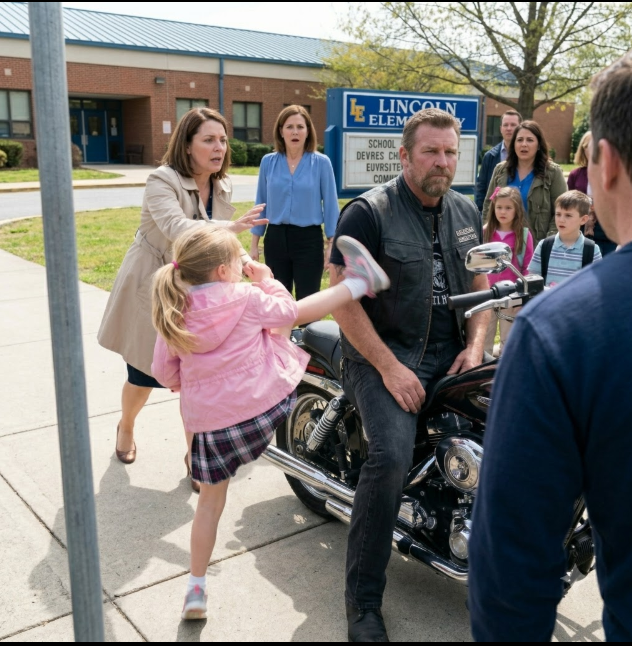
A 7-Year-Old Girl Threw Her Shoe at a Biker Outside School—Then He Realized She Was Warning Him About a Man Watching the Children.
Everyone outside Lincoln Elementary thought seven-year-old Ellie Dawson had lost her mind when she ripped off her sneaker and hurled it at the tattooed biker sitting across from the school.
Her mother apologized, a security guard ordered the man away, and dozens of parents raised their phones—never realizing Ellie wasn’t trying to attack the stranger; she was desperately trying to make him notice the dark blue sedan whose driver had been watching her for three mornings.
Then the biker looked through that car window, saw what was hidden beneath the dashboard, and whispered the name of Ellie’s dead father.
The morning had started quietly.
Too quietly, Ellie would remember years later.
At 7:41 a.m. on a bright Thursday in Dayton, Ohio, Lincoln Elementary looked exactly the way an elementary school was supposed to look.
Yellow buses groaned against the curb.
Crossing guards lifted red STOP signs.
Parents kissed foreheads and checked backpacks.
Teachers stood by the double doors calling names.
Children in bright jackets raced toward friends they hadn’t seen since the afternoon before.
Someone had dropped a travel mug near the curb, and the smell of coffee mixed with exhaust and damp spring air.
Normal.
Safe.
Forgettable.
Except for the biker.
He sat fifty yards from the school entrance on a matte-black Harley-Davidson Road King.
Engine off.
Boots planted on the pavement.
Hands loose around the handlebars.
He wasn’t doing anything.
That somehow made people more uncomfortable.
He was around forty-five, maybe older.
Tall.
Broad through the shoulders.
A dark beard threaded with silver.
Weathered skin.
A thin white scar cutting from his left temple toward his cheekbone.
His sleeveless black leather vest exposed arms marked with faded tattoos.
An eagle.
A Marine Corps insignia.
Several dates.
A black band around his right forearm.
The kind of man parents noticed before they realized they were staring.
Melissa Grant noticed him first.
She nudged another mother.
“You see that guy?”
“What guy?”
Melissa tilted her chin.
“The biker.”
Her friend glanced over.
“Oh.”
“Has he been there long?”
“I don’t know.”
“He’s looking at the entrance.”
“He could have a kid here.”
Melissa looked at him again.
“Does that look like a Lincoln Elementary dad to you?”
Her friend didn’t answer.
But the question traveled.
PART2:
Within five minutes, eight parents were watching him.
By 7:48, somebody had mentioned security.
By 7:50, someone had taken his picture.
By 7:52, a father named Todd Brennan was telling anyone close enough to hear that he’d seen “men like that” hanging around schools before.
Nobody asked what “men like that” meant.
They didn’t have to.
Leather.
Tattoos.
Motorcycle.
Unsmiling face.
People built the rest themselves.
The biker noticed them watching.
He didn’t react.
That made it worse.
“He knows we’re onto him,” Melissa whispered.
The truth was almost the opposite.
The biker’s name was Cole Mercer.
And he wasn’t watching the children.
He was watching a car.
A dark blue Chevrolet Malibu parked across the street behind a row of flowering pear trees.
It had been there when Cole arrived at 7:18.
Its engine remained running.
Its windshield was clean enough to reflect the morning sky.
The driver’s side window was cracked an inch.
Cole couldn’t see much through the tint.
A man’s silhouette.
Baseball cap.
One hand occasionally lifting.
Then lowering.
Cole had seen that car before.
Tuesday.
PART3:
Same block.
Wednesday.
Different parking space.
And now Thursday.
Cole didn’t know who the driver was.
Not yet.
But twenty-two years in law enforcement had taught him something that retirement hadn’t erased.
People waiting for someone looked impatient.
They checked clocks.
They searched faces.
They leaned forward when the right person appeared.
People watching a place were different.
They were patient.
Still.
Methodical.
The driver of the Malibu wasn’t waiting.
He was observing.
Cole had been observing him.
Neither man knew that a seven-year-old girl had been observing both of them.
Ellie Dawson stood beside her mother near the school crossing.
She was small for her age.
Blonde hair tied into a loose ponytail.
Blue cardigan.
Purple backpack covered in tiny silver stars.
One sneaker properly tied.
The other barely hanging on.
Her mother, Sarah, was reading an email on her phone.
Ellie wasn’t.
She was staring across the street.
At the Malibu.
Her face had gone pale.
“Mom.”
“One second, honey.”
“Mom.”
“I just need to answer Mrs. Kelley.”
Ellie grabbed Sarah’s sleeve.
“Mom.”
Sarah finally looked down.
“What?”
“He’s here again.”
“Who?”
“The man.”
Sarah frowned.
“What man?”
Ellie pointed.
Not at the biker.
At the Malibu.
But Sarah followed the wrong line.
Her eyes landed on Cole.
Her expression changed instantly.
“The motorcycle man?”
“No.”
“Don’t point.”
“Mom, not him.”
Sarah lowered Ellie’s hand.
“It’s rude.”
“The blue car.”
“What blue car?”
Ellie looked.
A minivan moved between them and the street.
For two seconds, the Malibu disappeared.
When the minivan passed, Sarah was checking her phone again.
“Come on. You’re going to be late.”
Ellie didn’t move.
The man in the Malibu had been there yesterday.
And the day before.
Tuesday, she’d first noticed him because he’d been holding something toward the school.
At first Ellie thought it was a phone.
Yesterday she’d realized it was a camera.
Not a big one.
Just something small with a lens.
He had photographed children.
She’d told her teacher.
Her teacher thought Ellie meant a parent.
She told her grandmother.
Grandma Joan said adults took pictures all the time.
She tried to tell Sarah the previous night.
Sarah had been crying in the laundry room.
Quietly.
She stopped when Ellie entered.
“What is it, baby?”
Ellie had forgotten what she’d come to say.
Sarah had been doing that more lately.
Crying where she thought Ellie wouldn’t see.
It had been fourteen months since Ellie’s father died.
Fourteen months since a state trooper and a police chaplain knocked on their front door.
Fourteen months since Ellie learned that grown-ups could walk into a room carrying words that changed the shape of everything forever.
Her father had been Detective Michael Dawson.
Dayton Police Department.
Thirty-eight years old.
Killed when a drunk driver crossed the center line on State Route 4 while Michael was driving home after a late shift.
At least that was the official version.
Ellie didn’t understand official versions.
She understood that Dad left one Wednesday night wearing a navy jacket and promised pancakes on Thursday morning.
And Thursday morning happened without him.
Since then, Sarah had become both parents badly and bravely.
She forgot library days.
Burned dinner.
Worked too much.
Checked door locks three times.
Slept with Michael’s old T-shirt folded beneath her pillow.
Loved Ellie with a kind of frightened intensity that sometimes made it difficult to hear her.
“Sweetheart,” Sarah said now, “school.”
Ellie looked at the Malibu again.
The driver’s window lowered slightly.
A hand appeared.
Something black rested against the opening.
A lens.
Ellie’s stomach tightened.
Then she noticed something worse.
The lens wasn’t pointed toward the school doors.
It was pointed at her.
She stepped behind her mother.
“Mom.”
Sarah finally heard the fear.
“What?”
Ellie couldn’t speak.
Across the street, Cole saw the lens too.
His posture changed.
Not dramatically.
Just enough.
His right hand came off the handlebar.
He leaned forward.
The camera disappeared.
Cole looked toward the school entrance.
He followed where the lens had been aimed.
A girl.
Blonde ponytail.
Purple backpack.
Holding her mother’s sleeve.
Cole’s chest tightened.
Something about the child felt familiar.
Not her face.
The way she stood.
Weight on her left foot.
Chin tilted when frightened instead of lowered.
Michael used to stand like that.
Cole immediately dismissed the thought.
Michael had been gone over a year.
Grief made ghosts out of strangers.
Then Ellie saw the man in the Malibu reach down.
She had seen that movement yesterday.
The same movement.
He would photograph.
Then bend down toward the passenger seat.
Then photograph again.
Yesterday he’d done it each time a different child walked out of the building.
Ellie had watched from the library window.
Something about it had scared her.
Today, it terrified her.
She looked around for an adult.
Her mother wasn’t looking.
Teacher Mrs. Benton was greeting students.
Security guard Frank Wilson stood inside the gate.
The biker was looking away from the Malibu.
For just one second.
Ellie made a decision with the strange, irrational logic available only to frightened children.
She needed the biker to turn around.
She needed him to see the car.
She shouted first.
“Hey!”
Nobody heard.
School noise swallowed her.
“Hey!”
Cole still didn’t turn.
Then Ellie looked at her loose sneaker.
She ripped it off.
Sarah felt Ellie’s hand leave hers.
“Ellie?”
The little girl ran.
Straight toward Cole.
Parents shouted immediately.
“Hey!”
“Whose kid is that?”
“Ellie!”
Sarah dropped her phone.
“Ellie, stop!”
Cole turned at the sound of running feet.
He saw a small blonde girl coming directly toward him.
Before he could move—
Ellie stopped.
Raised her arm.
And threw her sneaker as hard as she could.
The shoe hit Cole squarely in the shoulder.
Everything stopped.
For half a second.
Then chaos.
“What is wrong with that kid?”
“Oh my God!”
“Get her!”
“Ellie!”
Sarah caught her daughter from behind.
She grabbed her around the waist.
“What are you doing?”
Ellie twisted desperately.
“No!”
“Have you lost your mind?”
“He didn’t see!”
“See what?”
“He didn’t see him!”
Sarah pulled Ellie backward.
Cole didn’t look angry.
He looked confused.
Then he saw Ellie’s face.
Not defiant.
Not amused.
Terrified.
Cole stepped off the motorcycle.
That single movement changed the crowd.
A father pulled his son behind him.
Mrs. Benton hurried forward.
Frank Wilson came through the gate.
“Sir.”
Cole ignored him.
He was looking at Ellie.
“Hey, kid.”
Sarah tightened her arms around her daughter.
“Don’t talk to her.”
Cole lifted both hands slightly.
“Okay.”
“Stay away.”
“Ma’am, I’m not coming closer.”
“You shouldn’t be sitting outside an elementary school watching children.”
Several people murmured agreement.
Cole looked toward the Malibu.
The driver’s window was closed again.
“I wasn’t.”
Todd Brennan shouted from behind Sarah.
“Sure looked like it.”
Cole ignored him.
Frank stepped between Cole and the family.
“Sir, I’m school security. I’m going to ask you to leave the area.”
Cole looked at Frank.
Then at the car.
“You might want to look across the street first.”
Frank’s expression hardened.
“You need to leave.”
Ellie struggled.
“No!”
Sarah grabbed her shoulders.
“Stop.”
“He’s still there!”
Everyone paused.
Mrs. Benton crouched.
“Who, sweetheart?”
Ellie pointed with a trembling hand.
“The man.”
This time, people followed her finger correctly.
Across the street.
Dark blue Malibu.
Parked.
Engine running.
Tinted windows.
Nothing illegal about that.
Nothing obviously dangerous.
Todd scoffed.
“A car?”
“He watches us,” Ellie said.
Sarah stared at her.
“What?”
“He was here yesterday.”
Frank looked at Sarah.
“You knew about this?”
“No.”
“I told Mom.”
Sarah’s face changed.
“You said something about a man taking pictures.”
“That man.”
The Malibu’s brake lights flickered.
Cole saw it.
“So did I,” he said.
Frank turned.
“What?”
“He was here yesterday too.”
“You’ve been here before?”
The crowd reacted immediately.
“There it is.”
“I knew it.”
“He admits it.”
Cole exhaled.
“No. I rode past yesterday. Saw the car.”
Todd stepped forward.
“And today you decided to come sit outside a school?”
Cole looked at him.
“Pretty much.”
“That’s creepy as hell.”
“Maybe.”
Todd wasn’t expecting agreement.
Cole turned back toward Ellie.
“What did he do?”
Sarah snapped, “Don’t interrogate my daughter.”
Cole nodded.
“Fair.”
He looked at Frank.
“You ask.”
Frank hesitated.
Then crouched beside Ellie.
“What did the man do?”
“He takes pictures.”
“Of what?”
“Kids.”
A murmur rolled through the parents.
Frank’s expression became more serious.
“You saw that?”
Ellie nodded.
“When?”
“Yesterday.”
“Anything else?”
Ellie looked toward the car.
“He reaches down.”
Frank frowned.
“For what?”
“I don’t know.”
Cole’s eyes remained on the Malibu.
The engine revved slightly.
“He’s reaching again!” Ellie cried.
Cole moved.
Fast.
He stepped off the curb.
Frank grabbed his arm.
“Sir, don’t.”
Cole pulled free without striking him.
“Call police.”
“I already radioed.”
“Good.”
Cole crossed the street.
Todd shouted, “Stop him!”
Someone raised a phone.
Then ten more phones appeared.
Sarah held Ellie tightly.
Mrs. Benton whispered, “Maybe we should get everyone inside.”
Frank didn’t answer.
He was watching Cole.
The biker didn’t run.
He walked.
Slowly.
Deliberately.
Eyes locked on the Malibu.
The driver’s silhouette shifted.
Cole was twenty feet away.
Fifteen.
Ten.
The passenger-side brake light blinked.
Cole stopped beside the window.
He bent slightly.
Looked inside.
And everything in his face changed.
The driver’s right hand was beneath the seat.
Cole saw the elbow moving.
He saw the man’s eyes.
Not angry.
Cornered.
Searching.
Cole’s old instincts took over before thought caught up.
“Hands!”
The man jerked.
Cole reached through the partially opened window.
His left hand clamped the driver’s wrist.
His right arm braced against the door frame.
The driver shouted.
“Get off me!”
The crowd screamed.
“He’s attacking him!”
“Oh my God!”
Frank sprinted across the street.
Parents dragged children backward.
Phones continued recording.
Ellie didn’t move.
She stared.
Because she knew.
She didn’t know how.
But she knew.
Cole’s voice dropped.
“Everyone back.”
The driver yanked his arm.
Cole held him.
“Let go!”
“No.”
“You psycho!”
“Hands where I can see them.”
“Who the hell are you?”
Cole looked down.
There.
Under the driver’s seat.
Black polymer.
A grip.
Partially visible.
Gun.
Cole’s grip tightened.
“Don’t.”
The driver froze.
Frank reached them.
“Sir! Release him!”
“Gun under the seat.”
Frank stopped.
Everything changed in his face.
“What?”
“Driver’s reaching for a handgun.”
The man shouted, “He’s lying!”
Frank took two steps backward and reached for his radio.
“School lockdown. Now.”
Behind them, Mrs. Benton heard the words.
“Inside!” she screamed.
Teachers moved instantly.
“Everybody inside!”
“Go!”
“Move!”
Sarah grabbed Ellie.
Ellie resisted.
“My shoe!”
“Forget the shoe!”
“But—”
“Ellie!”
They ran toward the building.
Cole kept the man’s wrist pinned.
The driver breathed hard.
“You don’t know what you’re doing.”
Cole’s eyes sharpened.
“That right?”
“Let me go.”
“Not happening.”
“You’re making a mistake.”
Cole leaned closer.
“I’ve made plenty.”
The driver’s gaze flicked toward the school gate.
Cole noticed.
“Don’t look over there.”
The man’s breathing changed.
Cole followed his line of sight.
Children disappearing through doors.
Teachers pulling gates closed.
He looked back into the car.
The passenger seat was covered by a gray jacket.
Beneath it, something rectangular protruded.
A camera bag.
On the dashboard, a phone mounted horizontally.
Its screen was dark.
Then a notification lit it.
Cole saw a photograph.
Ellie.
Taken from a distance.
Cole went completely still.
“What the hell?”
The driver noticed where he was looking.
His face changed.
He yanked harder.
Cole slammed his wrist against the inside of the door.
“Stop moving.”
“Get off me!”
Police sirens sounded.
Close.
The man panicked.
He reached with his free hand toward the center console.
Cole reacted.
He forced the driver’s arm upward.
The car horn blared as the man’s shoulder hit the steering wheel.
Frank shouted, “Both hands!”
The driver screamed.
“You’re breaking my arm!”
“Then stop reaching.”
Two Dayton police cruisers turned onto the street.
Doors flew open.
“Hands!”
“Everybody back!”
Cole released the driver immediately.
He stepped away from the vehicle.
Hands visible.
“Gun under driver’s seat.”
An officer moved toward Cole.
Another covered the driver.
“Sir, get on the ground.”
Cole complied.
Parents watching from school windows gasped.
The man they had feared lay face-down on the asphalt.
Officer Daniel Ruiz handcuffed him.
Cole didn’t resist.
“Name?”
“Cole Mercer.”
Ruiz paused.
Looked at him again.
“Mercer?”
Cole looked up.
“Yeah.”
Something flickered in Ruiz’s expression.
But there wasn’t time.
Two other officers pulled the Malibu driver from the car.
He was forty-one.
Thin.
Wire-rimmed glasses.
Navy baseball cap.
Ordinary.
Painfully ordinary.
Nothing about him matched what parents expected danger to look like.
An officer searched beneath the driver’s seat.
“Gun!”
Frank closed his eyes briefly.
Loaded Glock 19.
One round chambered.
Another officer opened the passenger door.
Moved the jacket.
Found the camera.
Then notebooks.
Photographs.
A handheld radio.
Two school visitor passes.
Both fake.
Zip ties.
A roll of duct tape.
And a laminated map of Lincoln Elementary.
The officer stared.
“Lieutenant.”
Lieutenant Anne Keller stepped closer.
“What?”
“You need to see this.”
She looked inside.
Her face hardened.
“Clear the street.”
The school remained locked down.
Nobody left.
Nobody entered.
Police tape went up.
Parents who’d been preparing to leave now pressed against fences demanding information.
Within twenty minutes, local television vans appeared.
Within thirty, the story was online.
The first clip carried the headline:
BIKER ATTACKS DRIVER OUTSIDE DAYTON ELEMENTARY SCHOOL.
It had 90,000 views before police announced there had been a weapon in the vehicle.
Then another video appeared.
Ellie throwing the shoe.
Cole crossing the street.
The driver reaching down.
Cole grabbing him.
That version received half a million views.
People argued immediately.
Hero.
Vigilante.
Criminal.
Savior.
Dangerous biker.
Former cop.
Nobody knew the truth yet.
Inside the school gym, Ellie sat beside Sarah.
She had one sneaker.
A teacher had given her a pair of oversized fuzzy socks from the lost-and-found.
Sarah’s hands wouldn’t stop shaking.
“I told you to stop.”
Ellie looked down.
“I know.”
“You ran into the street.”
“I know.”
“You threw a shoe at a stranger.”
“He wasn’t a stranger.”
Sarah stared at her.
“What?”
Ellie looked toward the doors.
“I’ve seen him.”
“Where?”
Ellie hesitated.
“With Dad.”
Sarah stopped breathing.
“What did you say?”
“I think I’ve seen him with Dad.”
“No.”
“There was a picture.”
Sarah’s face tightened.
“What picture?”
“In Dad’s box.”
Sarah knew exactly which box.
Michael’s things.
Badges.
Service awards.
Old photographs.
Letters.
Items Sarah still couldn’t throw away and couldn’t bear to display.
It lived on the top shelf of her bedroom closet.
“You went through that?”
“I wanted his blue hat.”
Sarah closed her eyes.
“What picture?”
“Dad was standing with the motorcycle man.”
Sarah stared at her daughter.
Impossible.
Then she remembered.
Cole Mercer.
The name came back like an old song.
Michael had mentioned him.
Years earlier.
Before Ellie was born.
A partner.
Not exactly a partner.
A detective from another unit.
Someone Michael trusted.
Then something happened.
Sarah couldn’t remember the details.
Cole left the department.
Michael stopped talking about him.
The gym doors opened.
Officer Ruiz approached.
“Mrs. Dawson?”
Sarah stood.
“Yes?”
“Can we speak privately?”
Her stomach dropped.
“Is somebody hurt?”
“No.”
“What happened?”
Ruiz looked at Ellie.
“Your daughter did something very important this morning.”
Sarah looked down at her.
Ellie’s bare foot curled beneath the chair.
Ruiz crouched.
“Ellie?”
She nodded.
“How long have you been seeing that blue car?”
“Three days.”
“Are you sure?”
“Yes.”
“What made you notice it?”
“The camera.”
“You saw him photographing children?”
“Yes.”
“Did he ever speak to you?”
Ellie shook her head.
“Did he follow you?”
She hesitated.
Sarah noticed.
“Ellie?”
“Yesterday.”
Ruiz’s expression changed.
“What happened yesterday?”
“I walked to Grandma’s car.”
“And?”
“He drove slow.”
“How slow?”
“Like me.”
Sarah went pale.
“You never told me.”
“I tried.”
Those two words hit harder than accusation.
Sarah sat down.
Ellie immediately looked guilty.
“Mom?”
Sarah pressed both hands against her face.
“I tried.”
“I know.”
“No, baby.”
She lowered her hands.
“I mean—I know you tried.”
Tears filled her eyes.
“I wasn’t listening.”
Ellie leaned against her.
Sarah hugged her.
Ruiz gave them several seconds.
Then he asked, “Do you know the biker?”
Sarah looked up.
“Cole Mercer?”
Ruiz nodded.
“So you do.”
“Barely. My husband knew him.”
“Detective Michael Dawson?”
Sarah stared.
“How did you know that?”
Ruiz looked toward the hallway.
“Mr. Mercer had your husband’s old card in his wallet.”
Sarah’s face lost color.
“Why?”
“He hasn’t explained.”
Cole sat in the back of a police cruiser without handcuffs now.
Lieutenant Keller stood outside.
She remembered him.
Everyone who’d been around Dayton law enforcement long enough remembered Cole Mercer.
Detective Cole Mercer had once been considered one of the best investigators in Montgomery County.
Then eight years earlier, he walked away.
Officially, he’d resigned for personal reasons.
Unofficially, rumors circulated.
Mental health.
Alcohol.
Conflict with supervisors.
Excessive force.
Nobody ever seemed to have the same story.
Keller had never believed most of them.
She opened the door.
“You can get out.”
Cole stepped onto the pavement.
“Driver?”
“In custody.”
“Name?”
“Evan Rourke.”
Cole’s expression changed instantly.
Keller noticed.
“You know him.”
Cole looked at the Malibu.
“Maybe.”
“That’s not an answer.”
“Name sounded familiar.”
“From where?”
Cole didn’t answer.
“Mercer.”
He looked at her.
“You found photographs?”
“Yes.”
“What kind?”
“I can’t discuss—”
“Of children?”
Keller said nothing.
That was enough.
Cole looked toward the school.
“Ellie Dawson?”
Keller’s eyes narrowed.
“You know the girl’s name?”
“Just learned it.”
“How?”
“One of your officers mentioned Sarah Dawson.”
“You knew Michael.”
Cole laughed once without humor.
“Yeah.”
“How well?”
“He was my best friend.”
Keller waited.
Cole’s jaw tightened.
“He was also the reason I left the department.”
That wasn’t what Keller expected.
“Explain.”
Cole reached inside his vest slowly.
Keller watched his hands.
He pulled out a folded photograph.
Old.
Edges soft from years of handling.
Michael Dawson stood beside Cole.
Both younger.
Both wearing Dayton Police tactical jackets.
Between them was a little girl, maybe three years old.
Blonde.
Smiling.
Holding a plastic police badge.
Ellie.
Keller looked at Cole.
“When was this?”
“Four years ago.”
“She doesn’t remember you.”
“Probably shouldn’t.”
“What happened between you and Michael?”
Cole refolded the picture.
“Long story.”
“We’ve got time.”
“No, Lieutenant.”
He looked toward Rourke’s car.
“You don’t.”
Keller’s expression hardened.
“What does that mean?”
Cole nodded toward the evidence technicians.
“Check the trunk lining.”
“We checked the trunk.”
“Check underneath the lining.”
“Why?”
“Because Evan Rourke isn’t his real name.”
Keller stared.
“What is?”
Cole finally looked at her.
“Ask Michael Dawson.”
Silence.
“Michael’s dead.”
“I know.”
“Then what the hell are you talking about?”
Cole’s eyes looked older suddenly.
“Michael was investigating him when he died.”
Within an hour, the school incident became part of something much larger.
The car wasn’t registered to Evan Rourke.
That identity had existed for only eighteen months.
Fingerprints identified him as Travis Vane.
Forty-four.
Former private investigator.
Former confidential informant.
Arrested eleven years earlier in Kentucky on stalking and unlawful-surveillance charges.
Charges dismissed when the primary witness disappeared.
Three years later, Vane appeared in Ohio under another name.
That was where Michael Dawson encountered him.
Not during a homicide.
Not a narcotics case.
Missing children.
Michael had been assigned to a joint task force investigating suspicious approaches around schools in Montgomery County.
Parents reported strange cars.
Children described men taking pictures.
Nothing connected clearly enough for arrests.
Michael became obsessed with one name.
Travis Vane.
Cole had been in organized crime then.
Their units overlapped because Vane had ties to a document-forgery ring.
Together, Michael and Cole built a case.
Then everything fell apart.
An informant vanished.
Evidence went missing.
A search warrant was denied after someone leaked details.
Vane disappeared.
Michael accused someone inside law enforcement of protecting him.
Cole thought Michael was exhausted and seeing conspiracy everywhere.
They argued.
Badly.
Their friendship broke.
Months later, Michael apologized.
Cole did too.
But things never returned to what they’d been.
Then Michael died.
Cole left the department eleven days later.
Nobody knew why.
The reason had been sitting inside a locked metal case beneath Cole’s bed for fourteen months.
That night, after police finished questioning him, Cole drove home.
Not to an apartment.
Not to a biker clubhouse.
To a small ranch house south of Dayton surrounded by maple trees and motorcycle parts.
He showered.
Made coffee he didn’t drink.
Then pulled the metal case from beneath his bed.
Inside were Michael’s notes.
Copies of reports.
License plates.
Photographs.
A flash drive.
And an envelope addressed in Michael’s handwriting.
COLE — IF I DON’T GET TO FINISH THIS.
Cole had read the letter only once.
The day after Michael’s funeral.
He read it again.
Cole,
If you’re reading this, either I’m being dramatic, or something happened.
I hope dramatic.
You were right that I let this case get too close.
You were wrong that there wasn’t something there.
Vane isn’t just photographing children.
He’s collecting families.
Schedules.
Routes.
Custody arrangements.
Parents with money.
Parents with enemies.
Kids who walk alone.
Some of the information gets sold.
Some of it goes somewhere else.
I don’t know where yet.
Someone keeps killing warrants before we get there.
I think someone inside is helping.
I know you don’t trust my judgment anymore.
I don’t blame you.
But I trust yours.
If anything happens to me, stay away from Sarah and Ellie unless there’s a reason.
I mean that.
Don’t make my family live inside my unfinished case.
But if there is a reason—
You’ll know.
Michael
Cole sat with the letter in his hand.
A reason.
He had spent fourteen months wondering what qualified.
He hadn’t contacted Sarah after the funeral.
Not once.
She probably thought he didn’t care.
The truth was crueler.
He cared so much he’d stayed away.
He’d promised Michael.
Then three days earlier, while riding past Lincoln Elementary on his way to his repair shop, Cole saw a blue Malibu.
Something about the driver bothered him.
Yesterday, he saw it again.
This morning, he finally recognized the face through the glass.
Older.
Thinner.
Glasses.
But the eyes were the same.
Travis Vane.
Cole should have called police immediately.
Instead, he watched.
That mistake would haunt him.
Because he’d spent too long not knowing who inside the department Michael had feared.
He didn’t know whom to trust.
So he waited.
And seven-year-old Ellie Dawson noticed danger before he made a decision.
The next morning, Sarah opened her front door and found Cole Mercer on the porch.
She almost slammed it shut.
“You.”
Cole removed his sunglasses.
“Morning.”
“Do you have any idea what yesterday did to my daughter?”
“Yes.”
“Do you?”
Her voice rose.
“Television vans were outside our house until midnight.”
“I know.”
“People have posted her school online.”
“I know.”
“She won’t sleep.”
Cole looked down.
“I know.”
Sarah gripped the door.
“You don’t get to stand there saying you know.”
“Fair.”
“Where were you?”
Cole looked at her.
“For what?”
“For fourteen months.”
The question landed harder than anything else.
Sarah’s eyes filled.
“You were Michael’s friend.”
Cole didn’t speak.
“He called you brother.”
“I know.”
“He defended you when everybody said you lost your mind.”
Cole swallowed.
“I know.”
“You didn’t come to the funeral.”
“I was there.”
Sarah froze.
“What?”
“Across the street.”
Her face twisted.
“That is somehow worse.”
“I know.”
“Stop saying that.”
Cole nodded.
Sarah wiped her cheek angrily.
“Why are you here?”
“Because Michael left me something.”
She stared.
“What?”
Cole held out the letter.
Sarah didn’t take it.
“What is that?”
“His handwriting.”
She recognized it immediately.
Her knees weakened.
“Where did you get this?”
“He gave it to me before he died.”
“You had something from my husband for fourteen months?”
“Yes.”
“And never thought maybe his wife deserved to know?”
“He told me not to involve you unless Vane came back.”
Sarah’s eyes sharpened.
“Vane?”
“The man in the car.”
Silence.
Sarah slowly opened the door wider.
“Come in.”
Ellie sat on the living room floor.
One sneaker on.
The other still missing.
Police had collected the thrown shoe as part of the scene and hadn’t returned it yet.
She looked up.
“Motorcycle man.”
Cole almost smiled.
“Morning, Shoe Assassin.”
Sarah gave him a look.
Ellie smiled for the first time since the incident.
Then she noticed the letter.
“Is that Dad’s?”
Cole’s expression softened.
“Yeah.”
Sarah sat on the couch.
“Tell me everything.”
Cole did.
Not everything Michael had investigated.
Not the darkest suspicions.
But enough.
Sarah listened without interrupting.
When Cole described the argument that ended their friendship, her face softened.
“He talked about that.”
Cole looked surprised.
“He did?”
“He said he was an ass.”
“That tracks.”
“He also said you were an ass.”
“That also tracks.”
Sarah almost laughed.
Then she looked at the letter.
“He thought his death might not be an accident?”
Cole hesitated.
“I don’t know.”
“You hesitated.”
“Sarah.”
“Was Michael murdered?”
Ellie looked up sharply.
Cole immediately regretted saying anything in front of her.
Sarah saw it.
“Ellie, go upstairs.”
“No.”
“Honey.”
“No.”
Sarah closed her eyes.
Cole crouched.
“Ellie.”
She looked at him.
“Your dad died in a car crash.”
“I know.”
“We don’t know that anything else happened.”
“But you think maybe.”
Cole considered lying.
Michael would have wanted him to protect her.
But protection had nearly gotten Ellie hurt once already.
Adults kept deciding children couldn’t handle truth, then wondered why children stopped telling them things.
“We’re checking,” Cole said.
Sarah looked at him.
Ellie nodded.
“Okay.”
“Okay?”
“If Dad taught me something, I’m supposed to tell.”
Cole’s chest tightened.
“What did he teach you?”
Ellie stood.
She disappeared upstairs.
A minute later, she returned holding a small wooden box.
Sarah frowned.
“What is that?”
“Dad’s secret box.”
Sarah stared.
“His what?”
“It was in my closet.”
“Why was there a box in your closet?”
“Dad said grown-ups never look where kids keep stuffed animals.”
Cole’s heart began pounding.
Ellie opened it.
Inside was a toy police car.
Two baseball cards.
An old coin.
And a USB drive.
Cole stared at Sarah.
Sarah stared at Ellie.
“When did he give you this?”
“Before he went away.”
“What did he say?”
Ellie concentrated.
“He said if Uncle Cole ever came back, give him the silver thing.”
Cole stopped breathing.
“Uncle Cole?”
Ellie shrugged.
“I forgot your face.”
Cole turned away.
His eyes burned.
Sarah covered her mouth.
Ellie held out the drive.
Cole didn’t take it immediately.
Michael had known.
Not that he would die that night.
But that something was wrong.
He’d hidden evidence in the one place nobody would search.
His daughter’s stuffed-animal closet.
Cole finally took the drive.
“We call Lieutenant Keller.”
Sarah nodded.
“No secrets.”
“No secrets.”
The drive contained twelve folders.
Photographs.
Financial records.
Audio.
Names.
Vehicle registrations.
A list of law enforcement database searches.
One name appeared repeatedly.
Captain Richard Sloane.
Thirty-year veteran.
Highly decorated.
Former commander of Michael’s unit.
He had accessed protected information on families involved in custody cases, missing-child investigations, domestic violence shelters, and school incidents.
Some searches happened minutes before Vane photographed the same people.
Michael had discovered the connection.
He’d copied records.
He’d started documenting Sloane.
Then Michael died.
Lieutenant Keller called Internal Affairs.
Then the FBI.
Nobody warned Sloane.
For forty-eight hours, investigators watched.
On Saturday afternoon, Sloane drove to a warehouse outside Moraine.
Agents followed.
Travis Vane, released from the hospital into county custody after treatment for his injured wrist, had already started talking.
Not because he was remorseful.
Because he was afraid.
Sloane wasn’t simply selling information.
He had built a private pipeline.
Custody litigants.
Private investigators.
People seeking protected addresses.
Abusive spouses trying to find former partners.
Businesses wanting leverage over employees.
Parents trying to circumvent court orders.
Vane gathered photographs and routines.
Sloane provided database access.
Other people paid.
Children became entries on spreadsheets.
Families became products.
Michael had nearly exposed it.
Sloane found out.
What happened next took investigators another week to prove.
Michael Dawson’s crash had never made sense to Cole.
The drunk driver who hit him, nineteen-year-old Aaron Bell, had no memory of the collision.
His blood alcohol level was high.
The case closed quickly.
But Michael’s USB contained a photograph of Aaron’s pickup taken two nights before the crash.
Another showed Sloane speaking to Aaron outside a bar.
The connection was thin.
Then federal agents pulled Aaron’s old financial records.
Two days after Michael died, $40,000 was deposited into an account belonging to Aaron’s mother.
Cash.
Nobody had investigated the source.
Aaron was brought back for questioning.
He was twenty-one now.
He lasted three hours.
Then he broke.
He had been drunk.
But not accidentally on the same road.
Sloane had paid him to scare Michael.
Force him off the road.
Make him stop digging.
Aaron claimed he never meant to kill anyone.
He remembered pulling beside Michael.
Swerving.
Michael swerving back.
Then headlights.
Impact.
Metal.
Silence.
Sloane paid the promised money afterward.
Aaron’s mother was told it came from an insurance settlement.
The detective questioning him asked the obvious question.
“You killed a police detective for forty thousand dollars?”
Aaron sobbed.
“I didn’t know he would die.”
The detective leaned back.
“You knew he could.”
Aaron couldn’t answer.
At 6:03 the following morning, Richard Sloane was arrested outside his home.
Television cameras were already gathering when agents led him toward a vehicle.
He wore sweatpants.
No uniform.
No medals.
No authority.
Just an older man whose arrogance had finally run out of rooms to hide in.
He looked toward the reporters.
“Michael Dawson was unstable.”
Cole watched the broadcast from his repair shop.
His hands tightened.
Sloane continued shouting.
“He was obsessed! He destroyed his own career!”
Cole shut the television off.
Samuel Ortega, one of his riding friends, sat nearby.
“You okay?”
“No.”
“Want me to say something wise?”
“No.”
“Good. I didn’t have anything.”
Cole rubbed his face.
“I should’ve believed Michael.”
Samuel said nothing.
“I told him he was seeing connections that weren’t there.”
“You didn’t kill him.”
“I walked away.”
“You argued with a friend.”
“I walked away when he needed somebody.”
Samuel leaned forward.
“Cole.”
“I knew he wasn’t sleeping.”
“You didn’t know why.”
“I knew something was wrong.”
“And?”
Cole looked at him.
Samuel’s voice remained calm.
“You think loving somebody means you’re supposed to correctly interpret every bad decision they ever make?”
Cole didn’t answer.
“Michael hid evidence in his kid’s stuffed animals.”
“That was smart.”
“That was insane.”
Cole almost smiled.
Samuel pointed.
“There. That’s the face of a man who knows I’m right.”
“Don’t get used to it.”
The criminal case exploded nationally.
Captain Richard Sloane was charged with conspiracy, unlawful database access, bribery, obstruction of justice, witness intimidation, and charges connected to Michael’s death.
Aaron Bell accepted a plea deal and agreed to testify.
Travis Vane faced federal and state charges involving stalking, unlawful surveillance, illegal firearm possession, identity fraud, and conspiracy.
More victims surfaced.
A woman named Rebecca Lane learned Sloane had given her protected address to an abusive former husband.
A father discovered Vane had sold his son’s school routine during a custody dispute.
A domestic violence shelter changed locations after records showed Sloane had accessed its confidential files.
The story was no longer about a biker outside an elementary school.
It was about what happened when trusted systems were used by people who believed nobody would inspect them closely.
Sarah testified before a grand jury.
So did Cole.
Ellie did not.
Everyone agreed she’d already carried enough.
But justice didn’t erase what happened.
Ellie became afraid of blue cars.
For months, she checked through curtains before leaving home.
She stopped wanting to walk into school alone.
If a vehicle sat too long outside the house, she became quiet.
Sarah found a counselor.
At first Ellie refused to speak.
Then the counselor placed a basket of shoes on the floor.
Different sizes.
Different colors.
Ellie laughed.
“That isn’t funny.”
“I didn’t say anything.”
“You put shoes there.”
“Yes.”
“Because I threw mine.”
“Maybe.”
Ellie picked up a red sneaker.
“Everybody thought I was bad.”
“How did that feel?”
“Stupid.”
“You felt stupid?”
“No. They were stupid.”
The counselor smiled.
“Tell me more.”
Eventually Ellie did.
She talked about adults not listening.
About Dad.
About the blue car.
About Uncle Cole.
About hearing people scream when he reached into Vane’s car.
About being scared that she had caused everything.
That belief took months to undo.
“You didn’t make Vane come to the school,” Sarah told her repeatedly.
“You didn’t make Sloane do what he did.”
“You didn’t make Dad die.”
“You noticed danger.”
“You asked for help.”
“You threw a shoe because nobody was listening.”
The last part always made Ellie smile.
Cole became part of their lives slowly.
He didn’t move in.
Didn’t replace Michael.
Didn’t try.
He came by Sundays.
Fixed a cabinet Sarah had been ignoring for six months.
Taught Ellie how to check bicycle tire pressure.
Burned hamburgers.
Got corrected by Sarah.
Told terrible stories about Michael.
Especially the embarrassing ones.
“Your father once handcuffed himself to a fence.”
Ellie’s eyes widened.
“No.”
Sarah laughed.
“Yes.”
Cole pointed at her.
“You knew?”
“Michael told me.”
“He made me swear never to tell anybody.”
“He told everyone.”
Ellie laughed until milk came out of her nose.
Those stories mattered.
Michael slowly became a person again instead of a tragedy.
He was no longer just Dad Who Died.
He was Dad Who Danced Badly.
Dad Who Hated Pickles.
Dad Who Got Lost Using GPS.
Dad Who Once Arrested a burglar while wearing one cowboy boot because he’d been interrupted getting dressed.
Dad who loved Sarah.
Dad who adored Ellie.
Dad who trusted Cole enough to leave him unfinished work.
One Sunday afternoon, Ellie asked the question Cole had dreaded.
“Why did Dad stop talking to you?”
They were in the garage.
Cole was helping her paint a bicycle frame yellow.
He set down the wrench.
“We got angry.”
“Why?”
“I thought your dad was wrong about something.”
“Was he?”
“No.”
Ellie considered.
“So you were wrong.”
“Painfully.”
“Did you say sorry?”
“Eventually.”
“Did he forgive you?”
Cole looked at the yellow frame.
“Yeah.”
“Then why are you still sad?”
Children could be brutal in ways that didn’t feel cruel.
Cole wiped grease from his hands.
“Because sometimes somebody forgives you before you forgive yourself.”
Ellie thought about that.
“That’s dumb.”
Cole laughed.
“Very.”
“Dad wouldn’t like it.”
“No.”
“He’d probably yell.”
“He definitely would.”
“Then stop.”
Cole looked at her.
“Stop what?”
“Being mad at yourself.”
If an adult had said it, Cole might have resisted.
From Ellie, it sounded almost reasonable.
“I’ll work on it.”
“No. Dad hated when people said that.”
Cole stared.
“He did.”
“He said ‘I’ll work on it’ means ‘leave me alone.’”
Cole laughed so hard he had to sit down.
“My God, you really are his kid.”
The trial began eleven months after the school incident.
Sloane’s lawyers attacked Michael first.
They described him as obsessive.
Unstable.
A grieving detective chasing patterns.
Then they attacked Cole.
Disgraced former officer.
Biker.
Vigilante.
A man who took the law into his own hands outside a school.
The prosecutor played the full video.
Not the viral clip.
All seventeen minutes.
Cole sitting quietly.
Parents watching.
Ellie pointing.
Cole asking Frank to call police.
Vane reaching.
Cole intervening.
The gun recovered.
The photographs found.
Then prosecutors introduced Michael’s USB.
Database access logs.
Financial records.
Audio.
Finally, they played Michael’s recording of a conversation with Sloane.
Michael’s voice filled the courtroom.
“You ran my plate search.”
Sloane: “So?”
“You accessed Rebecca Lane.”
“You’re imagining connections.”
“She got attacked two days after you pulled her protected address.”
“Careful, Dawson.”
“No. You be careful.”
A pause.
Then Sloane’s voice changed.
“You have a daughter, don’t you?”
The courtroom became utterly silent.
Michael answered.
“Don’t you ever talk about my daughter.”
Sloane laughed softly.
“I’m saying family gives you perspective.”
“No. You’re telling me you know where to hurt me.”
The recording ended.
Sarah gripped Cole’s hand.
Not romantically.
Not delicately.
Like a person grabbing something solid during an earthquake.
Cole held on.
Sloane was convicted.
Not on everything.
Courts rarely provide the perfection grief wants.
But enough.
Conspiracy.
Obstruction.
Bribery.
Illegal database access.
And criminal responsibility connected to the scheme that led to Michael Dawson’s death.
Aaron Bell was sentenced separately.
Travis Vane pleaded guilty before trial.
At sentencing, Sarah spoke.
She walked to the podium carrying no photographs.
No props.
Nothing dramatic.
“My husband was not perfect.”
Sloane looked at her.
“He could be stubborn. He could become obsessed. He could forget to eat when he was working. He once missed our anniversary because he was sitting in a surveillance van eating gas-station peanuts.”
A few people smiled.
Sarah continued.
“But Michael believed authority was a responsibility, not a possession.”
She looked directly at Sloane.
“You believed your badge made you untouchable.”
Sloane’s jaw tightened.
“You used information meant to protect people as currency.”
Her voice remained steady.
“You took fear from families and turned it into profit.”
She paused.
“And when my husband noticed, you didn’t just try to destroy his career. You tried to make him doubt himself. You made his friends doubt him. You made him look unstable so that when he told the truth, everyone would hear obsession.”
Cole lowered his eyes.
Sarah saw.
“And for a while, it worked.”
She turned slightly toward Cole.
“But truth is stubborn too.”
Then back to Sloane.
“You couldn’t control every person.”
“You couldn’t control every camera.”
“You couldn’t control every record.”
“And you certainly couldn’t control a seven-year-old girl with one loose sneaker.”
A laugh broke through the courtroom.
Even Sarah smiled.
Then her voice softened.
“My daughter will grow up knowing her father died because he refused to stop paying attention when powerful people wanted him to look away.”
Sarah’s eyes filled.
“And someday I hope she understands that she did the same thing.”
Sloane received decades in federal and state custody.
No cheering erupted.
Sarah had imagined justice feeling louder.
Instead, it felt like exhaling after holding her breath for fourteen months.
Outside the courthouse, reporters surrounded them.
Sarah declined interviews.
Cole tried to disappear.
Ellie, now eight, spotted him near his motorcycle.
“Uncle Cole!”
Every camera swung.
Cole winced.
“Fantastic.”
Ellie ran to him.
She was wearing two matching sneakers.
Yellow.
Cole looked down.
“Planning to assault somebody?”
“Maybe.”
Sarah laughed.
A reporter called out, “Ellie! Can we ask you one question?”
Sarah started to refuse.
Ellie looked at her.
“Can I?”
Sarah hesitated.
Then nodded.
One question.
The reporter crouched.
“Why did you throw your shoe at Mr. Mercer that morning?”
Ellie looked at Cole.
Then at the cameras.
“Because he wasn’t looking.”
The reporter smiled.
“What do you mean?”
“The bad man was doing something and I needed Uncle Cole to look.”
“Were you scared of Mr. Mercer?”
Ellie frowned.
“No.”
“A lot of adults were.”
She shrugged.
“They didn’t know him.”
“Neither did you.”
Ellie looked at Cole.
“I knew he looked at the car.”
The reporter paused.
“What made you trust him?”
Ellie thought for a long time.
Then said something that appeared on front pages the next morning.
“Because everybody was looking at him, but he was looking at what everybody else missed.”
Cole turned his face away.
Sarah saw tears in his eyes.
She didn’t mention them.
A year later, Lincoln Elementary installed additional cameras and redesigned its drop-off procedures.
Frank Wilson received specialized training in threat recognition.
He also became one of Cole’s closest friends, though their friendship began awkwardly.
“You know,” Frank said the first time he visited Cole’s motorcycle shop, “I almost tackled you.”
“You would’ve bounced.”
“I weigh two hundred pounds.”
“Soft.”
Frank laughed.
Todd Brennan apologized publicly after his video—where he called Cole a predator—went viral for all the wrong reasons.
People attacked Todd online.
Cole told them to stop.
“He was wrong,” Cole said in an interview. “Being wrong isn’t a life sentence.”
Todd heard that.
A week later he came to the shop.
“I don’t deserve you defending me.”
Cole kept working on an engine.
“Probably not.”
Todd stood awkwardly.
“I judged you.”
“Yep.”
“I told people you were dangerous.”
“Yep.”
“I would’ve stopped you from crossing that street if I could.”
“Yep.”
Todd waited.
Cole looked up.
“You got another sentence?”
“I want to apologize.”
“Okay.”
“That’s it?”
“What do you want, absolution?”
Todd looked embarrassed.
Cole wiped his hands.
“You were scared.”
“That doesn’t excuse it.”
“No.”
“I was prejudiced.”
“Probably.”
Todd nodded.
“So what do I do?”
Cole returned to the engine.
“Next time, look twice.”
Todd began volunteering at school safety events.
Nobody gave him an award.
That was fine.
Real change rarely came with applause.
Cole’s biker friends also became familiar around Lincoln Elementary.
Not as guards.
Not as vigilantes.
They partnered with a local nonprofit to teach child-safety awareness.
Samuel Ortega handled most of it because Cole hated speaking.
Their program had one rule printed at the top of every sheet:
LISTEN WHEN A CHILD SAYS SOMETHING FEELS WRONG.
That line came from Michael Dawson.
Ellie knew it before anyone else.
On what would have been Michael’s forty-first birthday, Sarah, Ellie, and Cole visited his grave.
They brought pancakes.
Cole thought this was ridiculous.
Michael would have loved it.
Ellie placed a folded napkin on the headstone.
“Dad?”
Wind moved through the cemetery trees.
“I did something stupid.”
Sarah smiled.
Cole crossed his arms.
“She means the shoe.”
“I know what she means,” Sarah said.
Ellie continued.
“But it worked.”
Cole looked away.
Ellie placed Michael’s old police challenge coin beneath the flowers.
“Uncle Cole says you were right.”
Cole groaned.
“Don’t drag me into this.”
“You were.”
“Fine.”
“He also says he should’ve believed you sooner.”
Cole’s face changed.
Sarah glanced at him.
Ellie touched the stone.
“I think you forgave him.”
Cole swallowed.
“Kid.”
“What?”
“Your dad isn’t taking questions.”
“He might.”
“That’s not how—”
Sarah elbowed him.
Ellie smiled.
Then she became serious.
“I miss you.”
Nobody spoke.
“I don’t remember all your voice anymore.”
Sarah’s eyes closed.
Cole stared at Michael’s name carved into granite.
Ellie continued.
“But Uncle Cole tells stories.”
She looked at Cole.
“He says you cheated at poker.”
“He did.”
Sarah laughed through tears.
“He absolutely did.”
Ellie smiled.
“So I remember new stuff.”
Cole felt his throat tighten.
Children weren’t supposed to teach adults how grief worked.
They did anyway.
Years passed.
The shoe became family mythology.
Sarah kept it after police finally returned it.
She placed it in a clear storage box.
Ellie hated that.
“Mom, that’s weird.”
“It’s history.”
“It’s a dirty shoe.”
“Same thing.”
When Ellie turned thirteen, Cole bought her first motorcycle helmet.
Sarah nearly killed him.
“She is not riding a motorcycle.”
“She’s riding behind me.”
“No.”
“With full gear.”
“No.”
“At neighborhood speed.”
“No.”
“Parking lot?”
Sarah stared.
Cole sighed.
“Fine.”
Ellie whispered, “I’ll ask Grandma.”
“Do not weaponize my mother,” Sarah said.
At sixteen, Ellie learned to ride.
Sarah stood in Cole’s driveway with both hands over her face.
Cole shouted instructions.
“Clutch!”
“I know!”
“Don’t dump it!”
“I know!”
“Look where you want to go!”
“I KNOW!”
The motorcycle rolled twenty yards.
Stopped.
Ellie removed her helmet.
Her smile looked so much like Michael’s that Cole couldn’t speak.
“What?”
“Nothing.”
“You’re crying.”
“Wind.”
“We’re standing still.”
“Residual wind.”
At eighteen, Ellie graduated from Lincoln’s district high school.
She intended to study criminal psychology.
Not policing.
Not because she disliked police.
Because she wanted to understand the part that happened before emergencies.
Why people watched.
Why people ignored.
Why children sometimes saw things adults explained away.
At graduation, Sarah cried.
Grandma Joan cried.
Frank cried and denied it.
Todd cried openly because he’d stopped caring who knew.
Samuel slept through part of the ceremony.
Cole sat in the aisle wearing a black button-down shirt because Sarah had forbidden his leather vest.
“You look weird,” Ellie told him afterward.
“So do you. What’s that hat?”
“It’s a graduation cap.”
“Looks ridiculous.”
“You wore one.”
“Never graduated anything.”
“You graduated the police academy.”
“Not voluntarily.”
Ellie hugged him.
He hugged back without freezing now.
Progress.
Later, she handed him a wrapped box.
“My graduation and you’re giving me things backward?”
“Open it.”
Inside was a black shadow box.
Mounted behind glass was Ellie’s old sneaker.
The one she’d thrown.
Beneath it was a small brass plate.
COLE MERCER
FOR THE MORNING YOU FINALLY LOOKED WHERE I WAS POINTING.
Cole stared at it.
“That’s disrespectful.”
Ellie laughed.
“You love it.”
“Absolutely not.”
Sarah whispered, “He’s going to hang it in the shop.”
It was hanging above his desk by Monday.
Underneath it, Cole added his own plate.
ELLIE DAWSON
FOR THE MORNING YOU DIDN’T STOP POINTING UNTIL SOMEBODY LISTENED.
Years later, when people asked Ellie about that morning, they often focused on the dramatic parts.
The gun.
The hidden photographs.
The corrupt captain.
The connection to her father’s death.
The shoe.
Especially the shoe.
Ellie understood why.
People liked stories to have one clear moment when everything changed.
But to her, that wasn’t what mattered most.
What mattered happened before she threw anything.
Three mornings.
She had noticed the same car.
She had felt afraid.
She had mentioned it to adults.
And each time, someone had offered a harmless explanation.
Probably a parent.
Probably waiting for someone.
Probably nothing.
Nobody meant to dismiss her.
That was important too.
Her mother loved her.
Her teacher cared.
Her grandmother cared.
They weren’t cruel.
They were busy.
They were reasonable.
And sometimes reasonable explanations become dangerous when they are used to stop looking.
Cole taught safety classes for years afterward.
He never told children to distrust everyone.
He never told parents that danger hid behind every parked car.
Fear was not the lesson.
Attention was.
At the beginning of every class, he placed Ellie’s old yellow sneaker on a table.
Then he’d ask the room a question.
“What do you see?”
Children usually laughed.
“A shoe.”
Adults said the same.
Cole nodded.
“That’s what it is.”
Then he’d wait.
“But one morning, this shoe meant: Look over there.”
He would point across the room.
“The kid who threw it wasn’t misbehaving.”
Another pause.
“She had already used words.”
Parents always went quiet at that.
“She’d already tried pointing.”
“She’d already tried telling people.”
“So when you see behavior that makes no sense, especially from a child, before you decide it’s bad behavior, ask one more question.”
Why?
Why are they running?
Why are they hiding?
Why are they suddenly afraid of the bus stop?
Why won’t they go into a room?
Why are they throwing a shoe at a biker they’ve never met?
Sometimes the answer is nothing serious.
Sometimes it’s embarrassment.
Sometimes it’s imagination.
Sometimes it’s a misunderstanding.
But the question still matters.
Because on one bright Thursday morning outside Lincoln Elementary, dozens of adults thought they understood exactly what they were seeing.
A suspicious biker.
A badly behaved child.
A frightened mother.
A harmless man sitting in an ordinary blue car.
Every assumption was reasonable.
Every assumption was wrong.
The dangerous man wore glasses.
The frightened child had been paying attention.
And the biker everyone wanted removed from the school turned out to be the only adult who recognized the pattern quickly enough to stop what might have happened next.
But Cole never accepted the word hero.
Reporters kept using it.
He hated it.
“You grabbed a man’s gun hand outside an elementary school,” Ellie once reminded him.
“I also failed to call police the moment I recognized Vane.”
“You didn’t know if police were involved.”
“I still should’ve called.”
“You helped.”
“Eventually.”
Ellie rolled her eyes.
Cole had never learned how to accept uncomplicated praise.
Maybe that was why she trusted him.
He didn’t rewrite himself into something cleaner than he was.
He had doubted Michael.
He regretted it.
He had stayed away from Sarah and Ellie.
He regretted parts of that too.
He had recognized Vane and waited too long because old fear made him cautious.
He admitted it.
And when the moment came, he acted.
People were allowed to be flawed and still do the right thing.
That became one of Ellie’s most important lessons.
So did forgiveness.
Years after Richard Sloane went to prison, Aaron Bell wrote Sarah a letter.
The young man who had forced Michael’s car from the road.
He had written before.
Sarah burned the first letter unopened.
The second sat in a drawer for six months.
The third reached her when Ellie was seventeen.
Sarah finally read it.
Aaron didn’t ask for forgiveness.
He described what happened.
Not as an excuse.
He said he was drunk, stupid, broke, and eager to impress a man who made him feel important.
He said Sloane told him Michael was corrupt.
That scaring him would protect good officers.
Aaron believed what made his decision easier to live with.
Until Michael died.
At the end he wrote:
I know saying I’m sorry cannot give you anything back. I don’t expect an answer. I just need your daughter to know her father looked at me through the window after the crash. He was hurt and I was panicking. I expected him to curse me. Instead, he asked if I was injured.
I think about that every day.
Sarah cried for an hour.
Then she called Cole.
He read it.
Neither knew what to do with it.
Ellie did.
She asked to keep the letter.
Sarah hesitated.
“Why?”
“Because Dad asked if he was okay.”
“Yes.”
“That sounds like Dad.”
Cole nodded.
“It does.”
“I want to remember that too.”
Michael’s life kept growing after his death.
Not literally.
But through stories.
A man he had arrested came to one of the memorial events and told Ellie Michael once bought him a sandwich.
A former victim said he sat outside her hospital room for four hours because she was afraid her attacker would return.
A retired dispatcher remembered Michael calling every Christmas.
Frank remembered Michael arguing with a crossing guard over a parking ticket.
Sarah remembered Michael leaving wet towels on the bed.
Cole remembered everything.
The good.
The irritating.
The unfinished.
And eventually, Cole stopped believing his obligation to Michael was to remain guilty forever.
That took the longest.
On the tenth anniversary of the school incident, Lincoln Elementary invited Ellie back.
She was twenty-seven.
Working as a behavioral threat-assessment specialist with a regional school safety program.
Sarah sat in the front row.
Her hair had silver in it now.
Cole sat beside her wearing the same leather vest he’d worn that morning.
The tattoos were older.
So was he.
The scar on his face hadn’t changed.
A new generation of parents filled the auditorium.
Most didn’t know the story.
The principal introduced Ellie.
She walked onto the stage carrying one object.
A child’s yellow sneaker.
Laughter moved through the students.
Ellie placed it on the podium.
“I threw this at that man.”
She pointed at Cole.
Children turned.
Cole raised one hand.
More laughter.
“He looked scary.”
Cole mouthed, Thank you.
“He was sitting outside my elementary school on a motorcycle. A bunch of adults thought he was watching children.”
Ellie paused.
“They were wrong.”
She told them about the blue car.
Not the darkest details.
Not the gun in graphic terms.
Not the conspiracy.
She focused on the beginning.
“I had seen something that made me uncomfortable for three days.”
She looked toward the children.
“I tried telling people.”
Then toward the adults.
“They loved me.”
Sarah’s eyes filled.
“They cared about me.”
Another pause.
“But they didn’t understand what I was trying to tell them.”
Ellie rested one hand beside the sneaker.
“So I threw a shoe.”
The auditorium laughed again.
Then Ellie became serious.
“I don’t recommend that part.”
More laughter.
“What I recommend is this.”
She looked across the room.
“If a child tells you something feels wrong, don’t teach them that their fear is stupid just because you don’t see the danger yet.”
Silence.
“And kids?”
She faced the students.
“If the first adult doesn’t understand you, tell another.”
“Then another.”
“Keep talking.”
“You are allowed to be wrong.”
“You are allowed to misunderstand something.”
“But you are also allowed to ask for someone to look.”
Ellie glanced at Cole.
“Sometimes one person looking is enough.”
Afterward, children lined up to see the famous shoe.
Cole remained near the back.
Sarah joined him.
“You okay?”
“No.”
“You’re crying.”
“Air conditioning.”
She laughed.
“You used to say wind.”
“Climate changes.”
Ellie walked toward them.
“Uncle Cole?”
“Yeah?”
“I need you on stage.”
“Absolutely not.”
“They want a picture.”
“No.”
“You survived a gun.”
“Barely.”
“You survived federal court.”
“Against my wishes.”
“You can survive a school picture.”
“No.”
Sarah grabbed one arm.
Ellie grabbed the other.
They dragged him forward while he complained.
The final photograph showed three people.
Sarah laughing.
Ellie holding the yellow shoe.
Cole pretending to look miserable.
Behind them, painted across the auditorium wall, was Lincoln Elementary’s new safety motto.
NOTICE.
LISTEN.
ACT.
Cole saw it after the photographer finished.
He stared for a long moment.
Ellie stood beside him.
“Dad would’ve liked that.”
“Yeah.”
“You think he’d be proud?”
Cole looked at her.
She was twenty-seven.
Still his best friend’s daughter.
Still the little girl with one sneaker and a shaking hand.
Still someone who had changed the course of dozens of lives because she’d refused to accept that adults knew better simply because they were adults.
“He’d be unbearable.”
Ellie smiled.
“What would he say?”
Cole knew immediately.
Michael’s voice still lived clearly inside him after all those years.
He imitated it badly.
“That’s my kid.”
Ellie’s eyes filled.
Cole put an arm around her.
Outside, motorcycles waited in the parking lot.
Not dozens.
Just three.
Cole’s.
Ellie’s.
And Samuel’s old Indian, now ridden by his grandson.
They walked outside together.
A dark blue sedan passed on the road.
Ellie’s eyes followed it automatically.
The old reflex never disappeared entirely.
Cole noticed.
“You good?”
She nodded.
“Yeah.”
And she was.
Being healed didn’t mean forgetting what frightened you.
It meant fear no longer decided where you were allowed to go.
Ellie put on her helmet.
Cole climbed onto his motorcycle.
Sarah stood by the doors.
“Speed limit!”
Cole pretended not to hear.
“I mean it!”
Ellie shouted, “She means you!”
“I know!”
They started their engines.
The sound rolled through the school parking lot.
Years earlier, parents would have looked out windows and wondered what men like Cole were doing there.
Now children waved.
Cole waved back.
Before pulling away, Ellie looked once toward the corner where the blue Malibu had been parked.
Then at the place where seven-year-old Ellie had stood in one sock.
She remembered the fear.
The adults shouting.
Her mother’s hands around her shoulders.
The shoe leaving her fingers.
Cole turning.
Looking.
Finally seeing what she needed someone else to see.
For years, people told the story as if throwing the shoe had saved the school.
Ellie knew better.
The shoe was only noise.
What saved them was what happened afterward.
Someone listened.
Someone looked again.
Someone refused to dismiss the detail that didn’t fit.
A biker questioned the harmless-looking car.
A security guard admitted his first assumption might be wrong.
Police searched deeper.
Investigators opened an old case.
A widow agreed to face truths that hurt.
A former detective stopped hiding from his friend’s unfinished work.
And a little girl learned that losing her father had not taken away everything he taught her.
If something feels wrong, pay attention.
Not because fear is always right.
Not because strangers are always dangerous.
Not because the world should be viewed with suspicion.
But because intuition is sometimes the mind noticing pieces before it knows how to explain the picture.
Michael Dawson had taught that lesson to detectives.
His daughter learned it as a child.
And on a spring morning outside Lincoln Elementary, when adults saw a rough-looking biker and decided they understood the threat, Ellie Dawson looked past him.
Across the street.
Toward the ordinary blue car.
Toward the man no one was afraid of.
Her voice had failed.
Pointing had failed.
Adults were talking over her.
So she took off her shoe.
And threw it.
People remembered the impact.
Cole remembered something else.
He remembered Ellie’s face the instant he turned around.
Not mischievous.
Not angry.
Not confused.
Terrified.
That was the clue.
Before the gun.
Before the photographs.
Before the hidden files.
Before they learned her father’s death wasn’t the accident everyone had accepted.
Before a decorated captain went to prison.
Before headlines turned a frightened child into a symbol.
There had simply been a little girl whose expression didn’t match the story everyone else had already decided to believe.
And one man finally noticed.
Years later, Cole kept that yellow sneaker above his desk.
Visitors always asked about it.
Some knew the story.
Most didn’t.
“What happened to that thing?” they’d say.
Cole usually shrugged.
“Kid threw it at me.”
“Why?”
That was when his expression would change.
He’d look up at the small shoe behind glass.
At the scuffed toe.
The faded laces.
The ridiculous thing that had once struck his shoulder hard enough to turn his head.
Then he’d answer the same way every time.
“Because I was looking in the wrong direction.”
And perhaps that was the lesson nobody expected from the morning everyone thought a seven-year-old girl had lost her mind.
Danger didn’t always look dangerous.
Good people didn’t always look safe.
Children didn’t always have the words adults wanted.
Mistakes didn’t have to become permanent failures.
And sometimes the difference between tragedy and survival was not extraordinary courage, perfect judgment, or heroic strength.
Sometimes it was simply the willingness to stop—
turn around—
and look where the frightened child was pointing.








