A 7-Year-Old Girl Hid Behind a Gas Station Dumpster and Begged a Biker, “Don’t Tell Them I’m Here”—Four Days Later, 800 Hells Angels Surrounded the Courthouse… Then Her Five Words to the Judge Silenced the Entire Room.
PART3:
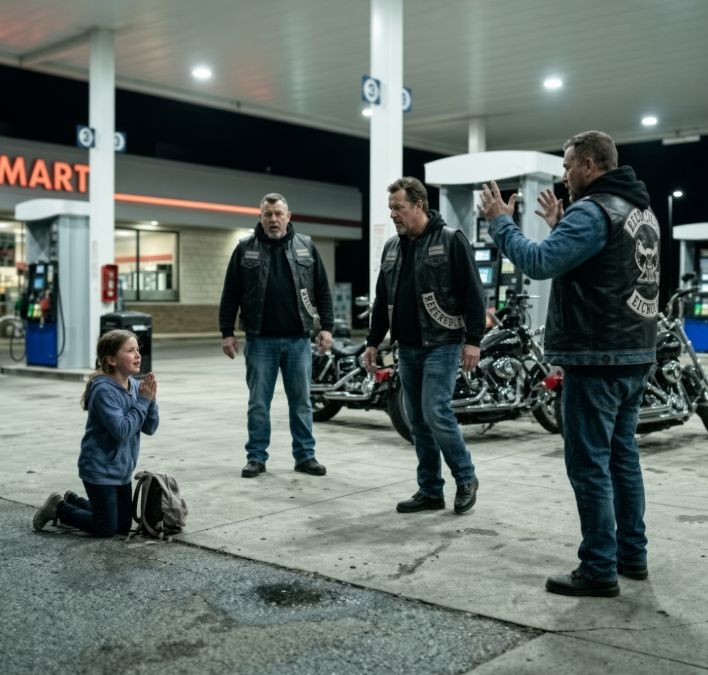
Her eyes moved over his vest, his tattoos, his scarred hands.
Most children saw him and hid behind safe adults.
This child was already hiding from one.
Finally, she whispered five words.
“Don’t tell them I’m here.”
Jake felt the sentence hit him in a place he had spent most of his life armoring.
He had been eight once, hiding in a closet in Savannah, listening to a man stomp through the house while his mother whispered prayers she did not believe would be answered.
He remembered holding his breath until his chest hurt.
He remembered learning that danger did not always kick in doors.
Sometimes it paid rent.
Sometimes it sat at the kitchen table.
Sometimes it used your name like a threat.
Jake swallowed.
“I won’t tell them,” he said. “Who are they?”
The girl looked toward the road.
“Ray.”
“Who’s Ray?”
“My mom’s boyfriend.”
Jake nodded slowly, though something inside him had gone still.
“What’s your name?”
“Lily.”
“Lily what?”
“Lily Holloway.”
“That’s a good name.”
She looked at him as if deciding whether good names mattered.
“You hungry, Lily?”
Her eyes dropped to the ground.
She nodded once.
Jake stood carefully.
“Stay right here. I’ll be back in one minute.”
Panic flashed across her face.
“I’m not leaving,” he said. “I’m getting food. You’ll see me the whole time.”
He walked backward until he reached the corner, then turned into the store.
Patty was already watching through the glass.
“What’s going on?” she asked.
Jake grabbed a turkey sandwich, a juice box, a bag of chips, two bananas, and a pack of cookies.
“Girl behind your dumpster. Says she’s hiding from a man named Ray.”
Patty’s face changed.
Not surprise.
Something worse.
Recognition.
“You’ve seen her before.”
“Once,” Patty said. “Maybe twice. Walking along Old Clinton Road. I thought she lived nearby.”
“She doesn’t look like she’s out for a walk.”
Patty came around the counter faster than her bad hip should have allowed.
“Bring her inside.”
Jake took the food out first.
Lily had not moved.
He set the sandwich and juice on the concrete halfway between them and stepped back.
“It’s yours,” he said. “Nobody’s taking it.”
She reached for it with both hands and ate like a child trying not to look desperate while hunger betrayed her. She finished half the sandwich before she seemed to remember breathing.
Jake sat on an overturned milk crate nearby, not facing her directly.
“Where’s your mom?” he asked.
Lily pressed the straw into the juice box. Her hands shook.
“She left.”
“When?”
“Three months ago. Ray says she’s not coming back.”
“You live with him?”
She nodded.
“Is he your legal guardian?”
“I don’t know what that means.”
Fair answer, Jake thought bitterly.
“Did he hurt you?”
Lily’s whole body tightened.
Jake let the question go.
“You walked here today?”
“Yes.”
“From where?”
“Gray house past the old church. He was sleeping. I went out the back door.”
“That’s miles.”
“I had to go before he woke up.”
Patty appeared at the corner of the building.
She stopped when Lily flinched, then softened her voice.
“Honey, I’m Patty. I own this place. It’s too hot out here. You can come inside. Door locks from the inside, and nobody gets past me unless I say so.”
Lily looked at Jake.
He nodded.
“She’s all right.”
Patty’s mouth twitched.
“High praise from the scary man.”
Inside the gas station, Patty locked the front door and flipped the sign to CLOSED.
She poured Lily ice water from a pitcher behind the counter and set cookies on a paper plate.
Lily sat in a plastic chair near the soda cooler, feet not touching the floor, eyes fixed on every window.
Jake stepped outside and called Dean Hargrove.
Dean answered on the second ring.
“You on your way back?”
“I’ve got a situation.”
“That bad?”
“Little girl. Seven. Hiding behind Patty Winslow’s dumpster. Says she ran from her mom’s boyfriend.”
Dean went quiet.
Jake gave him the facts, not the feelings.
That was how men like them survived hard conversations.
Facts had handles.
Feelings cut your palms.
When he finished, Dean said, “You call law enforcement?”
“Not yet.”
“You need to.”
“I know.”
“You called me first because you don’t trust what happens after.”
Jake looked through the store window.
Lily had both hands around the water cup as if someone might demand it back.
“No,” Jake said. “I don’t.”
Dean exhaled.
“Call Donna Caldwell. She helped with Tommy Reese’s custody mess. She knows the system and the system actually listens to her. Then call Sheriff Mercer before Ray does.”
“Ray already might have.”
“Then move faster.”
Donna Caldwell arrived at Patty’s station forty minutes later in a dented blue sedan with DFCS parking permits on the dash and a canvas bag full of files.
She was fifty-two, compact, gray-haired, and carried herself like a woman whose compassion had been sharpened by exhaustion rather than dulled by it.
She spoke to Lily first.
Not Jake.
Not Patty.
Lily.
“My name is Donna,” she said, sitting on the floor so Lily did not have to look up. “My job is to help children when adults make things unsafe. I’m not here to make you go anywhere before you understand what’s happening.”
Lily watched her.
“Are you police?”
“No.”
“Do you tell police?”
“Sometimes. If it helps keep you safe.”
“Ray says police bring kids back.”
Donna’s face did not change.
“Ray says a lot of things.”
Jake liked her immediately.
Sheriff Dan Mercer arrived next.
He was a large man in his mid-fifties with tired eyes, a tan uniform, and the careful walk of someone used to entering rooms where everyone already had a version of the truth.
He knew Jake.
He knew Dean.
He knew the club.
Their relationship was built on wary respect, a few old arguments, and an understanding that neither side wanted trouble unless trouble insisted.
“Brennan,” he said.
“Sheriff.”
Mercer looked at Lily through the glass door.
“Missing child report came in twenty minutes ago. Ray Toomes. Says his girlfriend’s daughter was taken by an unknown biker.”
Jake’s jaw tightened.
“He knows already.”
“Seems that way.”
“He’s not her father.”
“No,” Donna said from behind them. “And according to my first check, he’s not her legal guardian either.”
The sheriff looked at her.
“You sure?”
“Christine Holloway left Lily with him informally. No court order. No kinship placement. No custody authorization.”
“Where is Christine?”
Donna’s expression hardened.
“Unknown. Prior substance abuse history. Prior disappearances. Last known contact three months ago.”
Sheriff Mercer rubbed the bridge of his nose.
“I need to interview the child.”
“On her terms,” Donna said.
He nodded.
“On her terms.”
Lily told them enough that afternoon to stop the world from moving the way Ray wanted.
Not everything.
Not yet.
Just enough.
That Ray drank.
That he yelled.
That food depended on his mood.
That he locked the back door from the inside at night.
That she missed school because he slept through mornings.
That she hid in the bathroom when he broke things.
That he told her if she talked, nobody would believe a kid whose own mother had left.
Sheriff Mercer listened with his hands resting on his knees.
By the end, his fingers had curled into fists.
“Lily,” he said gently, “do you feel safe going back to Ray?”
Her answer was immediate.
“No.”
That was enough for an emergency hold.
Not enough for forever.
Not yet.
Donna explained it carefully.
Lily would be placed under protective supervision while the court reviewed her situation.
Patty could not keep her overnight because she had no approved placement status.
The local emergency foster options were limited.
A group home had a bed open, but it was two counties away.
Jake felt Lily go still at those words.
Group home.
Two counties.
Away.
He had lived those words once.
Dean arrived just before sunset in his black pickup.
He stepped out wearing jeans, boots, and his club vest, gray beard neat, eyes taking in every detail.
Dean Hargrove was president of the Macon chapter, but he had the quietness of a man who never needed to prove he was in charge.
He crouched near Lily.
“Miss Lily,” he said, “I’ve got a clubhouse with a spare room behind the kitchen. Donna here says it can be approved for emergency overnight if I sign more papers than a mortgage. There’s a real bed, a fan that works, and three women from the chapter who will stay with you so nobody can say anything improper. You don’t have to decide right this second.”
Lily looked at Jake.
“Will you be there?”
Jake felt the question land.
“I’ll be there,” he said.
“You won’t let Ray come?”
“No.”
Donna watched him carefully.
“Jake.”
He looked at her.
“No hero nonsense,” she said. “No threats. No disappearing with her. No turning this into club business outside the law.”
Jake held her gaze.
“Then help me do it inside the law.”
Donna studied him for a long second.
Then she nodded.
Patty drove Lily in her old Ford pickup.
Jake rode alongside on the Harley.
Dean followed behind.
Sheriff Mercer stayed on the radio, making sure every officer in the county knew Lily was safe, documented, and not being hidden by anyone.
Still, as they pulled away from the gas station, Lily ducked low in the passenger seat.
“Is he coming?” Patty asked softly.
Lily whispered, “He always comes when somebody tells him no.”
The clubhouse sat outside Macon in a converted warehouse behind a chain-link fence and a gravel lot. Motorcycles lined one side. A faded American flag hung near the door.
Inside, the place smelled like coffee, leather, oil, old wood, and fried food from the kitchen.
The men inside went quiet when Lily entered.
Not cold quiet.
Careful quiet.
Brenda Mills from the Savannah chapter, who had raised three daughters and had a look that could stop a grown man mid-sentence, took one glance at Lily and said, “Kitchen first. Child needs real food.”
Lily ate chicken soup at a small table while Jake stood near the doorway.
“Are you guarding me?” she asked.
He looked down.
“Maybe.”
“Do you get paid?”
“No.”
“Then why?”
Jake did not know how to answer in a way that would not frighten her with too much feeling.
Brenda answered for him.
“Because some folks remember what it feels like when nobody stands by the door.”
Lily looked back at her soup.
That night, she slept in the small room behind the kitchen with Brenda in a chair near the door and Donna on the couch outside, paperwork spread across her lap.
Jake did not sleep.
He sat at the bar with Dean and Sheriff Mercer until after midnight.
By morning, Ray Toomes had begun telling his version.
He called the sheriff’s office twice.
He called DFCS.
He posted online that his girlfriend’s daughter had been kidnapped by a violent biker gang.
He claimed Lily was troubled, manipulative, and prone to lying.
He claimed Jake had lured her away.
He claimed the club was hiding her.
Men like Ray understood something about systems.
If you made enough noise early, people might mistake volume for truth.
Donna spent the next three days building the case.
She pulled school attendance records showing Lily’s absences had tripled after Christine disappeared.
She found a nurse’s note from April describing Lily as underweight and watchful around male pickup contact.
She found a neighbor who had heard breaking glass and shouting.
Patty gave a sworn statement.
Sheriff Mercer documented Lily’s interview.
Brenda took Lily to a pediatric clinic, where a doctor recorded signs consistent with neglect and chronic stress without forcing Lily through questions she was not ready to answer.
Jake did everything Donna told him.
He signed forms.
He gave fingerprints.
He submitted to a background check even though he knew what would come up.
His record.
Aggravated assault at twenty-six.
Bar fight.
Prison time.
Parole.
Years of rebuilding one hard day at a time.
He had not hidden it.
But Ray’s cousin, a lawyer from Warner Robins, would use it.
Jake knew that before Donna said it.
On the third day, Ray came to the clubhouse.
His truck was a rusty brown pickup with a cracked windshield and a missing hubcap. He stopped outside the fence and got out wearing a stained white T-shirt, jeans, and the swagger of a man who had always counted on people getting out of his way before they realized he was small.
“I know she’s in there!” Ray shouted, gripping the chain-link. “That’s my kid!”
Jake was checking tire pressure near the garage.
He rose slowly, wiped his hands on a rag, and walked to the gate.
“She’s not your kid.”
“The law says different!”
“The law says you don’t have custody.”
Ray’s face reddened.
“Her mother left her with me.”
“Her mother isn’t here to answer for that.”
“You don’t know anything about Christine.”
“I know she left a child with you.”
Ray slammed a fist into the fence.
Lily, watching from behind the clubhouse window, flinched so hard Brenda put an arm around her.
Jake saw it.
So did Dean.
So did Sheriff Mercer, who pulled in three minutes later because Patty had called him the second Ray’s truck turned down the road.
Ray tried to perform concern.
He talked about responsibility.
About Lily being confused.
About bikers filling her head.
About how a little girl needed discipline and structure, not criminals pretending to be saviors.
Then Sheriff Mercer stepped close enough that Ray had to lower his voice.
“You’re not taking her today,” the sheriff said.
Ray pointed at Jake.
“You letting him steal a child?”
“No,” Mercer said. “I’m preventing you from intimidating a witness.”
That word changed Ray’s face.
Witness.
For the first time, he seemed to understand that Lily was not just a runaway to retrieve.
She was a person who had spoken.
“You’ll regret this,” Ray said.
Jake gave him nothing.
Ray leaned closer to the fence.
“You think all these motorcycles scare me?”
Dean stepped beside Jake.
“No.”
Ray looked at him.
Dean’s voice stayed mild.
“But I think consequences might.”
Ray left with dust spinning behind his truck.
No one believed he was finished.
That night, Jake called Dean into the garage.
“We need the rally.”
Dean looked at him for a long moment.
The annual rally was supposed to be in three weeks at a campground outside Macon.
Eight hundred members from chapters across Georgia, Alabama, Tennessee, Florida, Kentucky, West Virginia, Virginia, the Carolinas, Mississippi, Louisiana, and Texas.
Moving it up would be a nightmare.
Routes.
Permits.
Food.
Security.
Campground contracts.
Local police coordination.
Dean crossed his arms.
“You want eight hundred bikes here before the hearing.”
“I want Lily to walk into court knowing Ray isn’t the biggest thing in the world.”
Dean studied him.
“No threats.”
“No threats.”
“No intimidation.”
“Presence.”
Dean nodded slowly.
“Presence.”
The calls went out before dawn.
They came in waves over the next three days.
The first fifty from Savannah.
Then Atlanta.
Then Birmingham, Jacksonville, Knoxville, Charleston, Tallahassee, Mobile, Asheville, Nashville.
Riders came from small towns and big cities, from garages, farms, machine shops, trucking companies, construction sites, diners, and long-haul routes.
Men and women.
Fathers and mothers.
Grandparents.
Veterans.
Welders.
Mechanics.
Nurses.
Accountants.
People the world had flattened into one frightening image until they gathered in a field outside Macon and became something else.
A wall made of witnesses.
By Saturday evening, the campground held more than eight hundred motorcycles in rows across the grass.
Tents and RVs dotted the hills.
Coffee brewed in industrial urns.
Kids of members tossed footballs under the trees.
Women sorted donated clothes and toiletries.
Men checked generators and strung lights.
The smell of barbecue, pine, and engine oil moved through the humid air.
Lily arrived with Donna’s approval and Sheriff Mercer’s grudging escort.
When she saw the motorcycles stretching across the field, she stopped.
“They came because of me?”
Jake crouched beside her.
“They came because what happened to you matters.”
She looked at the rows of bikes.
“That’s a lot of mattering.”
He smiled.
“Yeah, it is.”
Brenda braided Lily’s hair beneath a shade tent.
A man named Hank from Birmingham carved her a tiny wooden horse with a pocketknife and asked permission before handing it to her.
A retired teacher from Charlotte brought picture books.
A couple from Jacksonville gave her new sneakers with both laces intact.
Patty arrived with cookies from the gas station and announced that anyone who complained about oatmeal raisin could fight her bad hip.
By dusk, Lily smiled.
Not the careful smile she used when adults expected one.
A real one.
Dean spoke by the bonfire that night.
“Most of you know why we moved the rally,” he said, standing in firelight while hundreds of faces turned toward him. “Monday morning, a little girl walks into a courtroom to tell the truth. The man who scared her is counting on shame, fear, and our reputations to make her look alone.”
He paused.
“She is not alone.”
No one cheered.
They listened.
“We are not going to that courthouse to threaten anybody. We are not going to make fools of ourselves. We are not giving one lawyer a reason to call us what he already thinks we are. We are going to stand there quiet, lawful, and impossible to ignore. Because sometimes protection is not a raised fist. Sometimes protection is eight hundred people showing up so a child can breathe.”
A low murmur moved through the crowd.
Then engines began starting one by one.
Not revving.
Not roaring wild.
Idling.
Eight hundred motorcycles filled the Georgia night with a deep, steady sound that rolled through the pines like thunder held under control.
Lily stood beside Jake, her hand in his.
For the first time since he had found her behind the dumpster, her eyes were wide without fear.
Monday morning came with a bleached cotton sky and air so still the flags outside the Bibb County Courthouse hung limp.
At 8:30, the first motorcycles turned onto Mulberry Street.
They came two by two, engines low, formation tight, headlights burning in the morning haze.
People stopped on sidewalks.
Office workers stood at windows.
Reporters arrived before the last row parked.
The riders filled every legal parking space, then spread on foot along sidewalks and courthouse grass under the direction of deputies who had been briefed in advance.
No shouting.
No signs threatening violence.
No chaos.
Just eight hundred men and women standing in leather vests, arms folded or hands clasped, faces calm, making one fact visible from three blocks away.
A child inside mattered.
Lily wore a blue dress with small white flowers. Brenda had bought it for her the day before. Her hair was braided neatly. Her new sneakers tapped under the table until Jake caught her eye from the second row and pressed one hand flat against his knee.
Breathe.
She copied him.
Ray sat across the aisle in a suit that did not fit. His cousin-lawyer, Jeremy Toomes, arranged papers with theatrical irritation.
“This is outrageous,” Jeremy told the judge before testimony even began. “My client has been publicly intimidated by a criminal motorcycle organization.”
Judge Helen Ashford looked over her glasses.
She was sixty-three, silver-haired, precise, and known across Bibb County for tolerating neither nonsense nor performance.
“Counselor,” she said, “I see no motorcycle organization in my courtroom. I see a child welfare hearing. Proceed accordingly.”
Donna presented evidence methodically.
Patty testified first.
She described Lily behind the dumpster, shaking, hungry, begging not to be found.
Sheriff Mercer testified about Lily’s initial statement and Ray’s behavior at the clubhouse fence.
The pediatrician testified to neglect indicators.
School records showed missed days, falling grades, and repeated notes about hunger and anxiety.
Then Jeremy Toomes stood.
He pointed at Jake.
“Is it true you are a convicted felon?”
Jake felt the courtroom turn toward him.
“Yes.”
“Is it true you served prison time for aggravated assault?”
“Yes.”
“Is it true you are a member of the Hells Angels?”
“Yes.”
Jeremy looked at the judge as if he had just solved the case.
“And this is the man DFCS wants near a vulnerable child?”
Donna rose.
“Mr. Brennan is not currently petitioning for unsupervised permanent custody in this hearing. We are addressing emergency protective placement and Ray Toomes’s custodial claim.”
Jeremy ignored her.
“Your Honor, this child was found by a violent criminal and then surrounded by hundreds of his associates. How can any statement she gives be considered free from influence?”
Lily’s hands tightened in her lap.
Jake looked at the floor.
This was the part he had feared.
Not for himself.
He had lived with his past long enough to know it could still enter any room before him.
He feared Lily would hear it and wonder if she had chosen wrong.
Then Judge Ashford spoke.
“Mr. Brennan.”
Jake stood.
“Yes, ma’am.”
“You disclosed your record voluntarily to DFCS?”
“Yes, ma’am.”
“You completed the required background process?”
“Yes, ma’am.”
“You remained in contact with Ms. Caldwell and Sheriff Mercer after locating the child?”
“Yes, ma’am.”
“You transported the child anywhere without approval?”
“No, ma’am.”
“You threatened Mr. Toomes?”
“No, ma’am.”
Ray laughed under his breath.
The judge turned sharply.
“Mr. Toomes, one more sound and you will wait in the hallway.”
Ray went still.
Then the judge looked at Lily.
“Lily, would you be willing to answer a few questions?”
Donna leaned down.
“You can say no.”
Lily looked at Jake.
He nodded once.
She stood.
Her voice was small, but it did not shake.
“I was scared all the time,” she said. “Not just when Ray yelled. All the time. When it was quiet too, because quiet meant he might be asleep or he might be getting mad.”
The courtroom went silent.
“I didn’t know when there would be food. I didn’t know if my mom was coming back. I didn’t know if school was mad at me for missing days. I didn’t know why adults kept asking Ray questions and then leaving me there.”
Ray’s face reddened.
Jeremy touched his sleeve, warning him to stay quiet.
Lily kept her eyes on the judge.
“When I ran, I hid behind the gas station because I thought if police came, they would bring me back. Jake found me. He didn’t grab me. He didn’t yell. He asked if I was hungry.”
She swallowed.
“Nobody ever asked me that before.”
Jake stared at the floor while his eyes burned.
Dean, sitting beside him, put a hand on his shoulder and left it there.
Judge Ashford removed her glasses and set them on the bench.
“Lily,” she said gently, “did anyone tell you what to say today?”
“No, ma’am.”
“Did Mr. Brennan?”
“No. He told me I could tell the truth small if big was too hard.”
A few people in the gallery lowered their heads.
The judge turned to Ray.
“Mr. Toomes, do you have legal documentation granting you custody of Lily Christine Holloway?”
Ray shifted.
“Her mother left her with me.”
“That is not what I asked.”
“No.”
“Are you her biological father?”
“No.”
“Did you enroll her in school, arrange medical care, or contact DFCS when her mother failed to return?”
Ray’s mouth tightened.
“I was doing the best I could.”
Judge Ashford looked at the file in front of her.
“Your best appears to include missed meals, missed school, intimidation, and a missing child report that omitted the fact that you had no legal custody.”
Jeremy rose.
“Your Honor, my client was overwhelmed.”
Ray snapped before his lawyer could stop him.
“She’s lying because she doesn’t want rules. Her mother dumped her on me. You think I asked for some brat that cries every time a man raises his voice?”
The courtroom froze.
Jeremy closed his eyes.
Ray realized too late what he had said.
Lily sat back down slowly.
Judge Ashford looked at him for a long moment.
“Thank you, Mr. Toomes,” she said coldly. “That clarified more than your attorney intended.”
The ruling came twenty minutes later.
Ray Toomes’s claim was terminated.
A protective order was issued.
Lily was placed under DFCS supervision, with Donna Caldwell as primary caseworker.
Temporary guardianship was granted to Jake Brennan under strict review conditions, supported by Patty Winslow, Brenda Mills, Dean Hargrove, and a court-approved safety plan.
Judge Ashford looked directly at Jake.
“This court is placing a great deal of trust in you, Mr. Brennan.”
Jake stood.
“I understand.”
“I expect you to honor it.”
His voice was rough.
“I will.”
Outside the courthouse, the riders lined both sides of the walkway.
They did not cheer when Lily came out.
They did not shout.
One by one, as she walked between them holding Jake’s hand, they nodded.
A gesture of respect.
A welcome.
A promise.
At the end of the line, Dean knelt in front of her.
“You’re one of us now,” he said. “That doesn’t mean noise and motorcycles. It means wherever you go, whatever happens, you’ve got people who choose to show up.”
Lily looked up at Jake.
“Is that true?”
“Every word,” he said.
Ninety days later, the full custody review lasted less than an hour.
Jake’s home inspection had passed.
His parenting classes were complete.
Lily’s teachers reported steady attendance, improved focus, and the first raised hand in class.
Donna’s reports grew shorter every two weeks because there was less to fear.
Patty picked Lily up from school on days Jake had route work.
Brenda helped with clothes and hair.
Dean taught Jake how to pack a school lunch without making every sandwich look like it had been assembled during a hostage negotiation.
Ray Toomes did not appear at the final hearing.
He had been arrested weeks earlier after violating the protective order by driving past Jake’s house at midnight.
This time, there had been cameras.
Deputies.
Consequences.
The kind he had spent years avoiding.
Judge Ashford granted Jake permanent guardianship of Lily Christine Holloway.
That evening, Jake stood in the doorway of the spare room he had painted pale yellow because Lily asked for it.
“Why yellow?” he had asked.
She had looked at the walls, then at him.
“It was the color of the shirt I wore when you found me,” she said. “I don’t want to remember it as the day I hid. I want to remember it as the day somebody looked.”
Now the room had a small white bed, a bookshelf, a desk, a nightlight shaped like a moon, and a pair of new sneakers by the closet.
Lily sat at the desk doing math homework while Jake leaned against the doorframe with a cup of coffee.
“Jake?”
“Yeah?”
“You said you lost your family a long time ago.”
He went still.
“Did you ever find them again?”
The house was quiet except for cicadas outside and the low hum of the refrigerator.
Jake looked at the little girl who had trusted him from behind a dumpster because she had no one else.
He thought about the boy he had been in Savannah.
The closet door.
The footsteps.
The years of running.
The brothers who found him.
The child who had finally made him stay.
“Yeah,” he said softly. “I did.”
Lily smiled and went back to her worksheet.
Outside, a motorcycle engine rumbled somewhere down the road, then faded into the warm Georgia night.
Inside the small yellow room, a child was safe.
And in the kitchen doorway, a man who had spent his life being mistaken for danger finally understood that sometimes the most powerful thing you can do is stand between a child and the world, keep your hands open, and refuse to move.








