A 7-Year-Old Girl Couldn’t Lift Her Arms to Reach a Water Bottle in 103-Degree Heat—Then One Biker Noticed Why, and 412 Riders Showed Up for Her
PART3:
The girl looked at the floor.
No answer.
Hank pointed at the bottle.
“That one?”
She nodded.
He took it from the shelf.
Then, instead of handing it down from six feet away, he crouched.
His knees protested.
He ignored them.
“Here you go.”
She stared at his hand.
Then at his vest.
Then at his face.
Her eyes were pale blue-gray.
Too serious.
That was the thought that hit him.
A child that age should have had messy eyes.
Curious eyes.
Annoyed eyes.
Happy eyes.
Not those.
Those eyes measured danger.
She took the bottle with both hands.
“Thank you.”
Her voice was almost inaudible.
“You’re welcome.”
She moved away quickly.
Hank stayed crouched for another second.
When he stood, he saw her at the register.
The cashier, a twenty-something kid wearing earbuds around his neck, barely looked at her.
She counted coins.
Not enough.
The cashier sighed.
“You’re short seventeen cents.”
The girl froze.
Hank stepped forward.
“I got it.”
She turned immediately.
Fear.
Not gratitude.
Fear.
That bothered him.
“It’s just seventeen cents,” he said.
She looked at the cashier.
Then Hank.
Finally she whispered, “Okay.”
Hank placed a dollar on the counter.
“Keep the change.”
The cashier shrugged.
Lily—though Hank did not know her name yet—hugged the bottle against her chest and left.
Hank watched her through the window.
She crossed the parking lot.
Each step looked careful.
Not limping.
Guarded.
As though her whole body had learned not to move too suddenly.
The cashier followed Hank’s gaze.
“She yours?”
“No.”
“Oh.”
“You know her?”
“Not really.”
“She come in often?”
“Couple times a week.”
“Alone?”
The kid finally looked up.
“Yeah.”
“How old is she?”
“Seven? Eight?”
“You let a seven-year-old walk around alone in this heat?”
The cashier’s expression changed.
Defensive.
“Man, I just work here.”
Hank looked back outside.
That sentence followed him for the rest of the day.
I just work here.
A perfect little sentence.
Small enough to hide behind.
He paid for coffee he no longer wanted and walked outside.
The girl had disappeared around the corner.
Hank sat on his motorcycle.
Did not start it.
Ten minutes passed.
A pickup truck arrived.
Left.
A woman bought cigarettes.
A delivery driver rolled cases of soda inside.
Hank still sat there.
Finally he turned the key.
The engine came alive beneath him.
He rode toward the Desert Iron clubhouse.
But all the way down Gurley Street, past Courthouse Square and the old brick shops and tourists taking photographs, he kept seeing one thing.
A little arm rising halfway.
Stopping.
Dropping.
And a seven-year-old child in long sleeves beneath an Arizona sun.
Hank had spent most of his adult life being told he looked dangerous.
At twenty-two, he had enjoyed that.
At forty-seven, it mostly made restaurants seat him near exits.
He had joined Desert Iron after returning from three years working oil fields in West Texas, angry at the world and unable to sit still.
The motorcycle club gave him structure.
Brothers.
Rules.
Road.
He became president because nobody else wanted the responsibility badly enough to survive it.
He owned a motorcycle repair shop now.
Paid taxes.
Employed six people.
Had two assault convictions from bar fights in his twenties.
Had not been arrested in nineteen years.
None of that fit neatly into what strangers saw.
The part of Hank’s life he carried hardest had nothing to do with motorcycles.
Her name was Brooke.
His daughter.
She had been five when his marriage to Karen collapsed.
Eleven when Karen moved her to Flagstaff.
Fourteen when Brooke stopped wanting weekends with him.
Nineteen now.
The custody fight had been ugly.
Hank told himself Karen poisoned Brooke against him.
For years, that story helped him sleep.
Then sometime around forty, he had admitted another truth.
He had helped.
He had missed school plays because of rides.
Missed a birthday because a club brother crashed near Kingman.
Showed up late for a father-daughter event smelling like gasoline and cigarettes.
He loved Brooke.
He simply had not always chosen in a way that made a child feel chosen.
There was a difference.
And by the time Hank understood it, Brooke had already learned not to expect him.
Their relationship now existed through texts.
Happy birthday, Dad.
Thanks, sweetheart.
Merry Christmas.
You too.
Hope work is good.
Yep.
A whole fatherhood reduced to punctuation.
That evening at the clubhouse, Dean Caldwell found Hank staring at an untouched beer.
Dean was fifty-one, shaved head, thick neck, Desert Iron vice president, and one of three people alive who could tell Hank he was being stupid without starting an argument.
“What?”
Hank looked up.
Dean pointed at the beer.
“You’ve been holding that ten minutes.”
“So?”
“You drink faster when you’re happy and slower when you’re mad.”
“That sounds unhealthy.”
“It is. What happened?”
Hank told him about the girl.
Dean listened.
No jokes.
No interruption.
When Hank finished, Dean leaned back.
“You think somebody’s hurting her.”
Hank stared at the table.
“I think something’s wrong.”
“That’s not what I asked.”
Hank looked up.
“Yes.”
Dean rubbed his jaw.
“You know where she lives?”
“No.”
“Name?”
“No.”
“Parents?”
“No.”
“Then right now you’ve got a kid in a shirt and sore shoulders.”
“I know.”
Dean waited.
Hank hated when Dean waited.
It forced honesty.
“I don’t want to be the guy who sees something and rides away.”
Dean nodded.
“Then don’t.”
Three days later Hank saw her again.
He had driven past Bradshaw Junction twice pretending it was on his way to work.
It was not.
The third afternoon he parked across the street.
At 4:07, the girl appeared.
Same jeans.
Different shirt.
Long sleeves again.
Navy blue.
Too large.
She walked into the gas station.
Hank waited.
He did not want to corner her inside.
Five minutes later, she came out holding a small juice bottle.
Hank crossed the street.
“Hey.”
She saw him.
Stopped.
“Water bottle guy.”
A tiny change touched her face.
Not quite a smile.
Hank took that as progress.
“That’s me.”
She started walking.
Hank stayed several feet away and walked in the same direction.
“Hot today.”
She nodded.
“Think my boots are melting.”
She glanced at them.
“They’re not.”
“You sure?”
Another almost-smile.
Hank pointed to himself.
“I’m Hank.”
The girl kept walking.
He did not ask again.
After half a block, she said, “Lily.”
“Nice to meet you, Lily.”
“You already met me.”
“Fair point.”
They passed a row of tired little houses behind chain-link fences.
A dog barked.
Someone had a car on blocks.
Sprinklers clicked over a patch of brown lawn.
“You live around here?”
Lily pointed toward a pale yellow house with peeling trim.
An old pickup sat in the driveway.
Hank noticed immediately how her body changed when she saw it.
Shoulders up.
Steps slower.
Eyes down.
“Your mom home?”
“My stepmom.”
“Okay.”
Lily looked at the truck.
“Glenn is.”
Hank did not know Glenn.
But he knew what fear sounded like when it said a name.
He stopped walking.
Lily stopped too.
“Hank?”
“Yeah?”
“Are you a bad guy?”
The question surprised him.
He looked down at his vest.
“Depends who you ask.”
Her face became worried.
He corrected quickly.
“No. Not to you.”
She studied him.
“Glenn says men with motorcycles go to jail.”
Hank almost laughed.
Then he saw she was serious.
“Some do.”
“Did you?”
There were moments when adults decided what kind of trust they wanted from children.
Hank could lie.
Make himself clean.
Instead he said, “A long time ago, I got into fights I shouldn’t have gotten into.”
“You went to jail?”
“Overnight twice.”
Lily’s eyes widened.
“For fighting?”
“Yeah.”
“Did you stop?”
“Yes.”
“Why?”
Hank thought about Brooke.
“Because being angry all the time costs you people.”
Lily looked toward the yellow house.
“Glenn gets angry.”
Hank’s chest tightened.
“Does he?”
She immediately shut down.
Her fingers pulled the sleeves over her hands.
“I have to go.”
“All right.”
She took two steps.
Hank said, “Lily?”
She turned.
“If you ever need help, you can ask me.”
She stared at him.
Then whispered, “Adults say that.”
And walked away.
That sentence hurt more than it should have.
Adults say that.
Hank watched her enter the house.
The door closed.
A shadow moved behind a curtain.
Hank stood there another thirty seconds.
Then a voice came from the neighboring yard.
“You worried about her too?”
Hank turned.
An elderly woman stood holding a green watering can.
Silver hair.
Round glasses.
Floral blouse.
She looked exactly like someone who had spent forty years reminding children to use inside voices.
Hank approached the fence.
“Yes.”
She put the watering can down.
“I’m Ruth Pennington.”
“Hank Mercer.”
“I know who you are.”
He smiled faintly.
“Good or bad?”
“That depends who you ask.”
He laughed.
She didn’t.
Then her eyes moved toward Lily’s house.
“I called child services in March.”
Hank’s smile vanished.
“What happened?”
“They came.”
“And?”
“Darla cleaned the house.”
“Stepmother?”
Ruth nodded.
“Lily’s mother died when she was little. Her father disappeared from the picture before that. Darla was her mother’s half sister. Took guardianship.”
“And Glenn?”
“Boyfriend.”
Ruth’s mouth tightened.
“Moved in last year.”
“What have you seen?”
Ruth hesitated.
Hank said, “Only tell me what you actually know.”
She looked surprised.
Maybe she expected a biker to ask where Glenn slept.
“I hear arguments.”
“Between adults?”
“Mostly Glenn and Darla.”
“Anything involving Lily?”
Ruth looked down.
“Crying sometimes.”
“What kind?”
Her eyes filled.
“The kind a child tries not to make.”
Hank said nothing.
Ruth continued.
“I hear doors slam. Things breaking. Once Lily came outside at midnight and sat behind my trash cans.”
Hank’s jaw tightened.
“What did she say?”
“Nothing. She just asked if she could stay until Glenn went to sleep.”
“You let her?”
“I sat with her.”
“Then?”
“Darla came looking. Said Lily had thrown a tantrum.”
“Did you report that?”
“Yes.”
“What happened?”
“Nothing I could see.”
Hank rested both hands on the fence.
Ruth whispered, “Maybe I didn’t say it right.”
“This isn’t your fault.”
“I’m next door.”
“You called.”
“I should have done more.”
Hank knew that feeling.
He thought of Brooke standing on a porch with a suitcase at eleven, asking whether he was really leaving for a three-day ride the same weekend she had a soccer tournament.
He had said, I’ll make the next one.
There was always a next one until there wasn’t.
“You noticed,” Hank told Ruth. “That matters.”
“It hasn’t helped her.”
“Not yet.”
That evening Hank called a “church meeting.”
Desert Iron called leadership meetings church.
President.
Vice president.
Road captain.
Secretary.
Sergeant-at-arms.
Five people sat around a scarred oak table in the back room of the clubhouse.
Dean already knew.
Bobby Chambers did not.
Bobby was six-four and built like a vending machine.
He listened with both arms folded.
When Hank finished, Bobby asked, “Address?”
Dean immediately said, “No.”
Bobby looked at him.
“I asked for an address.”
“And I know exactly why.”
Hank leaned forward.
“We’re not touching this man.”
Bobby’s nostrils flared.
“If he hurt a kid—”
“We don’t know what happened.”
“We know enough.”
“No.”
Hank’s voice hardened.
“We know enough to report. Enough to watch. Enough to make sure somebody qualified looks harder.”
Bobby stared at him.
Hank continued.
“If we ride to that house, Glenn becomes the victim.”
“That’s garbage.”
“It’s reality.”
Dean nodded.
Hank pointed around the table.
“And Lily becomes the kid defended by a bunch of bikers who scared her guardian. Every lawyer in Arizona will turn that against her.”
Bobby looked away.
“What do you want?”
“Documentation.”
“Meaning?”
“Ruth logs what she hears.”
Dean nodded.
“Hank keeps contact public.”
“Gas station only,” Hank said. “No following her around. No private rides. Nothing anyone can twist.”
The secretary, Maria Santos, spoke.
“Call CPS.”
“I will.”
“School?”
“Maybe through CPS.”
Maria nodded.
“You need somebody who knows procedure.”
Hank looked at her.
“You know somebody?”
“My sister works with victim services in Phoenix. She’ll give us the right numbers.”
Bobby exhaled.
“So we do paperwork.”
“Yes.”
Bobby looked miserable.
Hank leaned toward him.
“You know what takes more discipline than punching somebody?”
“What?”
“Not punching somebody when every part of you wants to.”
Dean smiled.
“Put that on a T-shirt.”
Bobby raised one finger.
“I hate all of you.”
Over the next two weeks, Hank did exactly what he promised.
He showed up.
Nothing dramatic.
Nothing secret.
He stopped at Bradshaw Junction around the same time each afternoon.
Sometimes Lily came.
Sometimes she didn’t.
He bought coffee.
Jerky.
Once an absurdly large blue sports drink Dean had challenged him to try.
Lily laughed when she saw his face after the first sip.
“That is disgusting.”
“You bought it.”
“That’s how mistakes work.”
She giggled.
The sound shocked Hank.
Not because it was unusual for a child.
Because it seemed unusual for her.
One afternoon they sat on the curb eating popsicles.
Hank chose orange.
Lily chose purple.
Of course.
He learned purple was her favorite color.
Butterflies her favorite animal.
She liked drawing horses but had never ridden one.
She hated mashed potatoes.
Loved pancakes.
Thought motorcycles were too loud.
Hank pretended to be offended.
“You’re telling the president of a motorcycle club motorcycles are too loud?”
“Yes.”
“This friendship may not survive.”
She smiled.
Then her smile disappeared.
“Hank?”
“Yeah?”
“Why are you nice to me?”
He looked at her.
Popsicle juice ran down her wrist.
She did not seem to notice.
“What do you mean?”
“You buy me stuff.”
“It’s a two-dollar popsicle.”
“You talk to me.”
“People should talk to you.”
She looked down.
“Glenn says people get tired of kids who need things.”
Hank’s hand tightened around the wooden popsicle stick.
He forced it loose.
“Glenn is wrong.”
“He says I make everything harder.”
“He’s wrong.”
“He says Darla would have a better life if she never took me.”
Hank breathed through his nose.
He could feel anger rise like heat.
But Lily was watching him.
Watching carefully.
So he made his voice calm.
“Look at me.”
She did.
“You are not responsible for adults being adults.”
She blinked.
“If a grown person has a bad day, that is not because you exist.”
Her eyes filled.
“If somebody is angry, you do not have to earn the right for them to be kind.”
Lily looked away.
Hank continued softly.
“You deserve food because you’re hungry. Water because you’re thirsty. A bed because you’re tired. Safety because you’re a kid.”
She whispered, “Even if I’m bad?”
“You’re seven.”
“That doesn’t mean I’m not bad.”
His heart cracked.
“No.”
He shook his head.
“It means you’re seven.”
Lily rubbed one sleeve against her eye.
“Hank?”
“Yeah?”
“Are you going to tell Glenn I said stuff?”
“No.”
Her shoulders loosened.
“Are you going to tell someone?”
Hank did not lie.
“If I think you’re in danger, I’m going to find people whose job is keeping kids safe.”
Her whole body stiffened.
“No.”
“Lily—”
“No.”
She stood too quickly.
Pain crossed her face.
She pressed her arms against herself.
“If people come, he gets mad.”
Hank stayed seated.
He wanted to reach for her.
He didn’t.
“Okay.”
She looked surprised.
“Okay?”
“I’m not going to grab you.”
She stared.
“I’m not going to make you tell me anything.”
Her breathing slowed.
“But I need you to hear one thing.”
She waited.
“If someone gets mad because you told the truth, that does not make the truth wrong.”
Lily’s eyes filled completely.
Then she ran.
Hank sat alone on the curb.
The purple wrapper blew against his boot.
That night he called Yavapai County Child Protective Services.
His first report felt exactly as he feared.
A woman took the information.
Asked questions.
Recorded details.
Promised review.
Hank hung up dissatisfied.
Maria told him to give the system a chance.
He did.
Two days passed.
Then four.
No visible action.
On the fifth day, Ruth heard shouting.
She called Hank.
He did not go to the house.
He called police.
A deputy arrived.
Glenn said everything was fine.
Lily was apparently asleep.
The deputy left.
Hank nearly broke his phone after Ruth told him.
Instead he called Maria.
“Give me the supervisor.”
That was how Hank met Margaret Foster.
Margaret was fifty-two, blonde hair twisted into a practical bun, reading glasses, no patience for theatrics.
She agreed to meet him at a coffee shop because, as she said, “If you are going to keep calling my office, I want to know who I’m talking to.”
Hank arrived in jeans and a clean gray shirt.
No vest.
Margaret noticed.
“You normally wear club colors?”
“Yes.”
“Why not today?”
“Didn’t want you making up your mind before I spoke.”
She raised an eyebrow.
“You assume I would?”
“Everybody does.”
“Interesting.”
“What?”
“That you noticed exactly what Lily has been dealing with.”
Hank went quiet.
Margaret opened a file.
“Tell me everything.”
He did.
No exaggeration.
No speculation stated as fact.
Long sleeves.
Limited arm movement.
Fear response.
Comments about Glenn.
Ruth’s reports.
The police call.
Margaret took notes.
When he finished, she said, “Do you have photographs?”
“No.”
“Good.”
Hank frowned.
“You sound surprised.”
“You would be amazed what well-meaning adults do that contaminates investigations.”
“I’m not examining a kid.”
“Exactly.”
“What happens now?”
“I review the prior case.”
“You already had one.”
“Yes.”
“And nothing happened.”
Margaret met his eyes.
“You’re angry.”
“Yes.”
“So am I.”
That surprised him.
“The first visit was announced.”
Hank stared.
“Why?”
“Scheduling mistake.”
He said nothing.
Margaret continued.
“Darla presented documentation that Lily had a pediatric appointment scheduled for shoulder pain.”
“Did she?”
“The appointment was canceled.”
“By who?”
“Darla.”
Hank leaned back.
Margaret’s expression was grim.
“The case was closed too early.”
“The system failed her.”
“Yes.”
No defensiveness.
No excuse.
Just yes.
Hank respected her for that.
“What do you need?”
“An unannounced visit.”
“When?”
“I’m not telling you.”
“Why?”
“Because you are not part of law enforcement.”
He almost smiled.
“Fair.”
“I need you to continue doing what you’re doing. Public contact only. No questioning her about suspected abuse.”
“Okay.”
“She trusts you.”
“Some.”
“That matters.”
Margaret took off her glasses.
“Children in unsafe homes become experts at reading adults. If she thinks you need her to say something, she may say what she thinks you want.”
“I don’t want that.”
“I know.”
She paused.
“And Mr. Mercer?”
“Yeah?”
“If Glenn confronts you?”
Hank smiled without humor.
“I walk away.”
“Can you?”
He thought about his two assault convictions.
Brooke.
Twenty years of learning what anger cost.
“Yes.”
Margaret nodded.
“Good.”
Three days later, Glenn confronted him.
Hank was outside the gas station.
Lily had just left.
A white pickup screamed into the parking lot.
Glenn Stokes got out.
Mid-forties.
Red face.
Work boots.
Stained T-shirt.
The kind of man who moved like the world had personally insulted him.
“You Mercer?”
Hank stood beside his motorcycle.
“Who’s asking?”
“You stay away from Lily.”
Hank’s heart began pounding.
Not fear.
Old instinct.
The part of him that knew exactly how quickly a conversation could become a fight.
He kept his hands visible.
“You Glenn?”
“You deaf?”
“No.”
“You been buying her stuff?”
“Popsicles.”
“You been asking questions about my house?”
“No.”
“Bull.”
Hank saw the cashier watching through the window.
Good.
Witness.
Glenn stepped closer.
“You think because you got that vest people are scared of you?”
Hank looked at him.
“No.”
Glenn pushed one finger against Hank’s chest.
Every nerve in Hank’s body ignited.
For one second, twenty-five-year-old Hank Mercer came back.
Fast.
Hot.
Violent.
Then he saw Brooke.
Not literally.
Memory.
His daughter at fourteen saying, Mom says you always choose the club and fighting over me.
Hank stepped backward.
Glenn smiled.
“That’s what I thought.”
Hank said quietly, “Don’t touch me again.”
“Or what?”
“Or I call police.”
Glenn laughed.
“You?”
“Yes.”
“Little tough guy biker calling the cops?”
Hank pulled out his phone.
Glenn stopped laughing.
“You’re pathetic.”
“Maybe.”
Hank dialed.
Glenn got into his truck and left.
The cashier came outside.
“Dude, I thought you were going to kill him.”
Hank stared after the truck.
“So did I.”
That evening Dean heard the story.
“You walked away?”
“Yes.”
Dean whistled.
“What?”
“Nothing.”
“What?”
“I’m proud of you.”
Hank flipped him off.
Dean smiled.
“That’s the emotional growth I expected.”
On Monday morning at 9:18, Margaret Foster knocked on the yellow house door with a deputy beside her.
Darla was not home.
Glenn answered.
He had been drinking.
Margaret smelled it immediately.
Lily sat on the couch.
Long sleeves.
Television low.
She looked at Margaret.
Then the deputy.
Fear flooded her face.
Margaret crouched.
“Hi, Lily. My name is Margaret.”
Lily said nothing.
“I talk to kids.”
Still nothing.
“Can we talk somewhere private?”
Glenn stepped forward.
“She ain’t talking to anybody without me.”
The deputy moved between them.
Margaret’s voice stayed even.
“State law permits a private welfare interview.”
Glenn swore.
Lily flinched.
Margaret saw.
Twenty-three minutes later, Margaret came out of Lily’s bedroom.
Her face had changed.
She asked the deputy to step outside with her.
Then she made one phone call.
Then another.
Within an hour, Lily was transported for medical evaluation under emergency protective custody.
Hank did not learn details immediately.
Nor should he have.
Margaret called that evening.
“She is safe.”
Hank sat at his kitchen table.
“Safe where?”
“I cannot tell you.”
“Okay.”
“There is an ongoing investigation.”
“Glenn?”
“Sheriff’s office is handling it.”
“Darla?”
“We’re locating her.”
Hank closed his eyes.
“Was I right?”
Margaret became quiet.
“Yes.”
One word.
It felt like a punch.
Hank had wanted to be wrong.
God, he had wanted to be wrong.
“How bad?”
“I can’t discuss medical findings.”
He understood.
“Can I see her?”
“Not yet.”
“Does she know I called?”
“No.”
“Good.”
Margaret hesitated.
“Why good?”
“Because I don’t want her thinking she caused something by talking to me.”
“That’s exactly what she thinks.”
Hank’s throat tightened.
Margaret continued.
“She thinks all of this is punishment because she told you Glenn was mean.”
“Tell her it isn’t.”
“We are.”
“Tell her again.”
“We will.”
Hank stared at the beer in front of him.
Untouched.
“Margaret?”
“Yes?”
“Tell her I didn’t go away.”
“I will.”
Glenn was arrested the next afternoon.
Charges accumulated over the following weeks.
Child abuse.
Endangerment.
Unlawful restraint connected to one incident investigators uncovered.
Darla was located two days later at a motel in Camp Verde.
When authorities questioned her, she began by blaming Glenn.
Then Lily.
Then stress.
Then money.
Then childhood trauma.
All of those things could be true.
None changed the fact that Darla had repeatedly left a child with a man she knew frightened her.
The investigation uncovered canceled doctor visits.
Missed school days.
A teacher’s concern that Darla had dismissed as Lily being “dramatic.”
Messages between Darla and Glenn.
One text became central later.
Darla had written:
You left marks again. Stop grabbing her where people can see.
When Hank eventually learned about that message during court proceedings, he had to walk outside.
He stood behind the courthouse with both fists closed until his nails hurt.
Dean followed.
“You okay?”
“No.”
“Good.”
Hank looked at him.
Dean leaned against the wall.
“If you said yes, I’d worry.”
Lily entered foster care with Thomas and Ellen Chamberlain.
No relation to Bobby.
Thomas was fifty-six, a high school custodian.
Ellen was fifty-three and worked part-time at a bakery.
They had fostered eleven children.
Adopted two who were now adults.
Their home was not impressive.
Three bedrooms.
Yellow kitchen.
Golden retriever named Charlie who believed personal space was a government conspiracy.
Margaret called Hank after ten days.
“She asked about you.”
Hank stood so quickly he hit his knee on the desk.
“What did she say?”
“She asked whether you were mad.”
His chest hurt.
“Why would I be mad?”
“She believes adults get angry when children cause trouble.”
“She didn’t cause trouble.”
“I know.”
“Can I tell her?”
“You can tell her yourself Saturday.”
Hank froze.
“I can see her?”
“Supervised visit.”
He swallowed.
“Okay.”
“Mr. Mercer?”
“Yeah?”
“Do not arrive with fifty motorcycles.”
He almost laughed.
“I can manage one.”
Saturday morning Hank parked his Harley two houses away because he remembered Lily thought motorcycles were too loud.
He walked to the Chamberlains carrying nothing.
No present.
Margaret had told him not to make visits about gifts.
Ellen opened the door.
“You must be Hank.”
“Yes, ma’am.”
“Come in.”
Charlie the golden retriever immediately shoved his head against Hank’s thigh.
“Traitor,” Ellen said to the dog. “You met him four seconds ago.”
Hank scratched Charlie’s ears.
“Good judge of character.”
“We’ll see.”
He liked Ellen immediately.
Lily sat at the kitchen table.
Short sleeves.
For the first time.
Hank stopped.
Her arms were thin.
There were faint healing marks along the upper areas and shoulders.
Nothing graphic.
Nothing Hank needed explained.
His eyes burned.
Lily saw him looking.
She immediately pulled her elbows inward.
Hank forced his gaze to her face.
“Hey, kid.”
“You came.”
“Yeah.”
“You know where I am?”
“Apparently.”
“Did Margaret tell you?”
“She did.”
Lily looked down.
“I caused trouble.”
“No.”
“Glenn got arrested.”
“Because of Glenn.”
“Darla got arrested.”
“Because of Darla.”
“They’re mad because I talked.”
“Listen to me.”
Hank sat across the table.
“You can tell the truth and other people can hate it.”
She looked up.
“That doesn’t make the truth wrong.”
Her lip trembled.
“I thought you’d go away.”
“Why?”
“Everybody does when stuff gets bad.”
Hank felt something tear open inside him.
He thought of Brooke.
He had gone away in smaller ways.
Not physically always.
But enough.
“I’m not going anywhere.”
Lily stared.
“You promise?”
Hank hated promises.
He had broken too many.
So he chose his words carefully.
“I promise I will not disappear without telling you.”
“That’s weird.”
“It’s the best promise I know how to make.”
She considered.
Then nodded.
“Okay.”
Charlie put his head in her lap.
Lily smiled.
That was how the healing began.
Not dramatically.
A dog.
A kitchen table.
A biker sitting with his hands folded because he did not want a frightened child to think she owed him a hug.
Hank visited twice a week.
Always cleared through Margaret and the Chamberlains.
Sometimes they drew.
Hank was terrible at butterflies.
Lily told him his looked like “flying potatoes.”
Sometimes they did homework.
Hank discovered second-grade math had become suspiciously complicated.
Ellen once heard him say, “Why are there so many steps? Seven plus six is thirteen. This feels like bureaucracy.”
Lily laughed until milk came out her nose.
The first time Hank heard her laugh without immediately looking over her shoulder, he went home and cried.
He did not tell anyone.
Dean knew anyway.
“You cried.”
“No.”
“You did.”
“Shut up.”
Months earlier, Hank had believed helping Lily meant saving her from a bad house.
He learned quickly that removal was only the first mile.
Trauma traveled.
Lily had nightmares.
Loud voices shut her down.
If Thomas dropped a pan, she sometimes hid.
She hoarded crackers under her pillow.
She apologized when asking for seconds.
The Chamberlains never punished her for it.
Ellen put a small basket of snacks beside Lily’s bed.
“You never need to hide food here.”
Lily still hid it.
For three weeks.
Then one morning Ellen found the basket untouched.
That was progress.
Physical therapy helped Lily’s shoulders.
A pediatric specialist explained that her movement had become limited from injury, tension, and fear.
The exercises hurt at first.
She hated them.
Hank attended one session only because Lily asked.
She stood facing a wall.
The therapist told her to walk her fingers upward.
Lily’s hand climbed.
Stopped.
Her breathing changed.
“I can’t.”
The therapist said gently, “That’s okay. We stop there today.”
Lily looked at Hank.
He did not say, You can do it.
He had learned something.
Sometimes encouragement becomes pressure.
So he said, “That’s higher than last week.”
She nodded.
“Two inches.”
“Two inches is still a road.”
She smiled.
The criminal case moved slowly.
Slower than anger wanted.
Faster than fear expected.
Glenn’s attorney argued that some injuries could have come from accidents.
Then prosecutors produced medical records, texts, witness statements, and Lily’s forensic interview.
Ruth’s logs mattered.
The gas station cameras mattered.
One clip showed Lily struggling to lift her arms days before removal.
Another showed Glenn confronting Hank.
He had claimed Hank threatened him.
The video showed the opposite.
Hank stepping backward.
Phone in hand.
Glenn advancing.
When Dean saw the footage, he slapped Hank’s shoulder.
“You look terrified.”
“I was practicing emotional restraint.”
“You looked like your mother told you to behave.”
“That woman was terrifying.”
Glenn eventually accepted a plea that guaranteed prison time.
Darla pleaded to child neglect and endangerment.
She lost guardianship.
But before those criminal matters concluded, Lily’s custody hearing arrived.
That was the day the motorcycles came.
The idea started with Bobby.
“I want to be there.”
Hank shook his head.
“Courtroom won’t fit you.”
“I mean outside.”
“No.”
“Why?”
“Because four bikers outside family court looks like intimidation.”
Bobby looked offended.
“I was thinking twelve.”
“Worse.”
Dean leaned against the clubhouse bar.
“What if it isn’t intimidation?”
Hank stared.
Dean continued.
“What if it’s support?”
“How does a judge tell the difference?”
“We ask.”
That changed things.
Maria contacted Margaret.
Margaret contacted the guardian ad litem.
The guardian contacted courthouse administration.
Clear rules were established.
No blocking entrances.
No engines running near court.
No threatening signs.
No club confrontations.
No contact with Glenn or Darla.
No weapons.
No attempts to influence testimony.
Hank told the full chapter.
“This is not a show of force.”
One hundred twelve Desert Iron members stood beneath the clubhouse canopy.
“This is not revenge.”
Everyone listened.
“We do not shout at anyone.”
Bobby sighed theatrically.
“We do not surround anyone.”
Another sigh.
“We do not threaten anybody.”
Bobby muttered, “Taking all the fun out.”
People laughed.
Hank waited.
Then he said, “A seven-year-old girl spent months thinking nobody would come.”
The yard went silent.
“We show up.”
That was all.
Dean contacted other chapters.
Phoenix.
Tucson.
Flagstaff.
Yuma.
Kingman.
Sedona.
Veteran riding groups heard.
Independent riders heard.
A women’s motorcycle association heard.
Retired firefighters with bikes heard.
A pediatric nurse in Mesa who rode weekends heard.
The count reached 180.
Then 260.
Then 387.
Hank panicked.
“This is too much.”
Dean shook his head.
“You told people why.”
“I wanted support, not Sturgis.”
“We can cap it.”
“How do you cap people caring?”
Dean smiled.
“That sounded almost inspirational.”
Hank hated him.
The night before the hearing, Hank could not sleep.
At 1:13 a.m., he sat at his kitchen table.
His phone lay beside him.
Brooke’s name on the screen.
He had not told her about Lily.
Why would he?
They barely spoke.
But the local newspaper had run a short story about the community ride.
Someone would send it to her.
He opened their messages.
His last text three weeks earlier:
Hope school is going okay.
Brooke:
Yep.
Hank typed:
There’s something happening tomorrow I wish you could see.
Deleted.
Typed:
I met a kid who made me realize things about us.
Deleted.
Typed:
I’m sorry I wasn’t there enough.
His thumb hovered.
Then he sent it.
The message showed delivered.
Hank stared.
Five minutes.
Ten.
Nothing.
He put the phone face down.
At 1:41, it buzzed.
Brooke:
Why are you saying that now?
Hank stared.
He typed slowly.
Because I should have said it before.
Three dots appeared.
Disappeared.
Returned.
Brooke:
Mom says you blame her.
Hank closed his eyes.
There it was.
The old easy story.
He could defend himself.
Instead he wrote:
I blamed her for a long time. Some of that was unfair. I made choices too. You had reasons to be hurt.
Brooke:
Are you sick?
Despite himself Hank laughed.
No.
Brooke:
Drunk?
No.
Long pause.
Then:
I saw the article about the little girl.
Hank’s chest tightened.
He typed:
Lily.
Brooke:
Is that why?
Hank thought.
Partly.
Then another message came.
Brooke:
I wanted you at my 8th grade graduation.
Hank shut his eyes.
He remembered.
A Desert Iron brother had been hospitalized after a crash.
Hank went to Tucson.
Told himself Brooke would understand.
She hadn’t.
I know.
You said Uncle Ray needed you.
He did.
So did I.
Hank stared until the words blurred.
He typed:
You did. I chose like I only had one responsibility. I was wrong.
He waited.
Nothing came for almost twenty minutes.
Then:
Good luck tomorrow.
That was all.
But Hank sat there crying anyway.
At sunrise, Prescott began to rumble.
Motorcycles approached from every direction.
Not racing.
Not roaring for attention.
Rolling steadily.
Hank stood at Courthouse Square and watched rows form.
Black Harleys.
Red Indians.
Old Hondas.
Triumphs.
Custom choppers.
Touring bikes with saddlebags.
Men.
Women.
Veterans.
Nurses.
Teachers.
Mechanics.
Grandparents.
One rider arrived wearing a suit because he had court elsewhere later.
Final count:
Thirty-two more than expected.
Courthouse administration nearly had a heart attack.
Hank walked the line reminding everyone.
“Engines off.”
They shut them down.
The sudden silence was enormous.
Hundreds of bikers standing quietly around parked motorcycles.
Someone had signs.
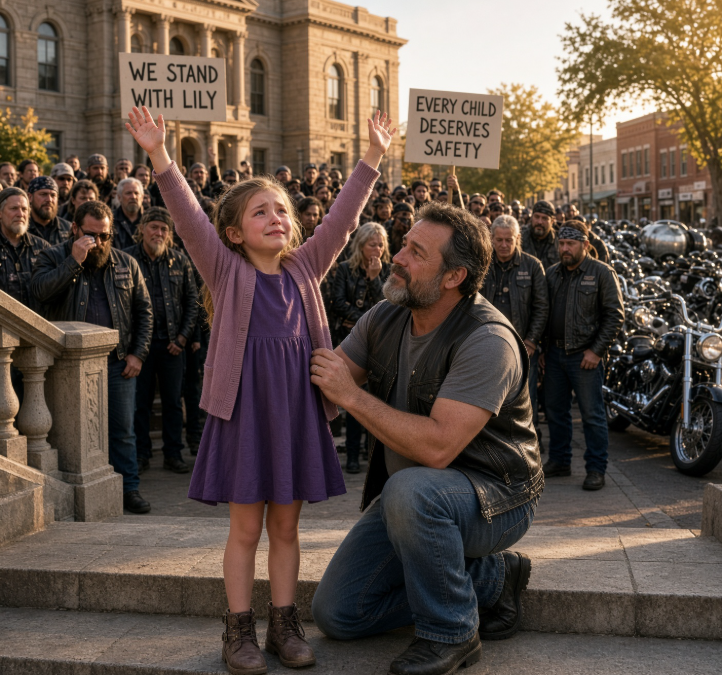
EVERY CHILD DESERVES SAFETY.
WE SEE YOU, LILY.
SHOW UP.
One sign said:
LOUD BIKES. QUIET COURTHOUSE.
Hank kept that one.
At 8:35, the Chamberlains’ car arrived.
Lily got out.
Purple dress.
White sneakers.
Hair brushed neatly.
She looked toward the courthouse.
Then saw the motorcycles.
She froze.
Hank approached slowly.
“Too much?”
Lily stared.
“All those?”
“Yeah.”
“Why?”
He crouched.
“They heard about you.”
Her eyes widened.
“What did you tell them?”
“That you’re brave.”
Her face tightened.
“I’m not.”
“Okay.”
She looked surprised.
Hank continued.
“You don’t have to be brave.”
The bikers watched.
Quiet.
“You just have to walk inside.”
Lily looked at the courthouse steps.
“I’m scared.”
“I know.”
“Are they all staying?”
“Yep.”
“Even if court takes long?”
“Bikers are very good at wasting entire days.”
She smiled nervously.
Then a woman rider near the front placed her fist over her heart.
No sound.
The rider beside her did the same.
Then another.
Then another.
Four hundred twelve people.
Fists over hearts.
Silent.
Lily stared.
Her chin trembled.
Hank whispered, “They’re not asking you for anything.”
Tears filled her eyes.
“They just wanted you to see them.”
Lily took one step.
Then another.
Halfway up the courthouse steps, she stopped.
She turned.
Looked back at the riders.
Then slowly lifted her right arm.
Higher than Hank had ever seen.
Past her shoulder.
Her face tightened with effort.
She lifted the left.
Not perfectly.
Not all the way.
But up.
Both arms raised.
The crowd broke.
Applause exploded across Courthouse Square.
Not yelling.
Not chanting.
Applause.
Bobby Chambers, a man who had once broken his hand punching a steel door, cried openly.
Dean pretended something was in his eye.
Maria did not bother pretending.
Hank stood beside Lily with his throat closed.
She looked at him.
“I did it.”
“Yeah.”
His voice broke.
“Yeah, kid. You did.”
Inside the courtroom, things became harder.
Glenn sat at one table with counsel because the custody matter and related proceedings had created overlapping questions.
Darla sat separately.
Lily did not sit where she could see them directly.
Judge Patricia Caldwell entered.
Everyone rose.
The hearing lasted more than two hours.
Margaret testified.
Ruth testified.
Medical reports were entered.
A child psychologist explained Lily’s trauma responses.
The Chamberlains spoke about her progress.
Darla’s attorney argued that Darla had been manipulated by Glenn.
There was truth in that.
But Margaret’s counsel asked the necessary question.
“Did Ms. Whitmore know Lily was afraid of Mr. Stokes?”
“Yes.”
“Did she know Lily had unexplained injuries?”
“Yes.”
“Did she cancel medical appointments?”
“Yes.”
“Did she leave Lily alone with Mr. Stokes?”
Silence.
“Yes.”
Darla began crying.
Hank watched from the back.
Part of him felt angry.
Part felt nothing.
Then the judge asked Darla directly, “Why?”
Darla wiped her face.
“I loved him.”
The courtroom went still.
Judge Caldwell’s expression changed slightly.
“More than the child?”
Darla shook her head rapidly.
“No.”
“Then why did the child repeatedly absorb the consequences of protecting the adult relationship?”
Darla had no answer.
Glenn looked bored until Hank was mentioned.
His attorney claimed Hank Mercer had manipulated public opinion and turned the custody process into a “motorcycle spectacle.”
Judge Caldwell looked toward Hank.
“Mr. Mercer.”
Hank stood.
“Yes, Your Honor.”
“Did you organize the gathering outside?”
“I helped.”
“Did you ask anyone to contact the court?”
“No.”
“Contact opposing parties?”
“No.”
“Threaten anyone?”
“No.”
“Why are they here?”
Hank looked toward Lily.
Then back at the judge.
“Because she thought nobody would come.”
The courtroom became silent.
Judge Caldwell watched him.
“That’s all?”
Hank thought about four hundred bikes.
“All that mattered.”
Glenn snorted loudly.
Everyone heard.
Judge Caldwell turned toward him.
“Mr. Stokes?”
His lawyer whispered something.
Glenn ignored him.
“This is ridiculous.”
The judge’s face hardened.
Glenn continued.
“That kid lies. She always has. Now she’s got a bunch of freaks treating her like some little princess.”
Hank’s blood went cold.
Dean’s hand closed around Hank’s forearm.
Not because Hank moved.
Because Dean knew him.
Glenn pointed toward the gallery.
“You people don’t know what she’s like.”
The judge said sharply, “Mr. Stokes, stop.”
But Glenn had already exposed what every lawyer had been trying to package.
“She pushes buttons. She cries over everything. She won’t listen unless you make her.”
His attorney physically touched his arm.
“Stop talking.”
Glenn pulled away.
Hank looked at Lily.
She could hear him.
Her shoulders had curled inward.
Then something unexpected happened.
Mrs. Chamberlain reached beneath the table.
She held out her hand.
Lily took it.
Then Margaret placed her hand over Lily’s other hand.
Lily’s shoulders slowly came down.
Hank saw it.
So did Judge Caldwell.
The judge removed her glasses.
“Mr. Stokes, this court has heard enough.”
The final ruling came twenty-three minutes later.
Darla’s guardianship rights were terminated subject to separate appellate timelines.
The state retained custody.
The Chamberlains’ foster placement would continue.
Adoption evaluation was approved.
Judge Caldwell paused before finishing.
“This court cannot order a child to trust.”
She looked toward Lily.
“Trust is earned.”
Then toward the adults.
“It is earned through consistency.”
Hank felt those words.
“So I will say something to everyone in this room, not merely the parties.”
Her voice softened.
“Safety is not created by one dramatic rescue.”
She looked toward Hank.
“It is created when adults continue showing up after the dramatic part is over.”
Hank nodded.
That was the real challenge.
Outside, the bikers waited.
When Hank exited, applause started.
He raised both hands.
“Stop.”
Confused silence spread.
Hank pointed behind him.
“This is Lily’s day.”
The doors opened.
Ellen Chamberlain emerged.
Thomas beside her.
Lily between them.
The applause returned.
Lily looked overwhelmed.
Then she found Hank.
She walked down the steps.
He crouched.
“How you doing?”
“Good.”
He smiled.
“That sounded suspicious.”
She looked back at the courthouse.
“Scared.”
“Better answer.”
She looked at the motorcycles.
“They stayed.”
“Every one.”
“For me?”
“For you.”
Lily’s eyes filled.
“Hank?”
“Yeah?”
“Thank you for not going away.”
He could not speak.
So he held out one hand.
Palm up.
Exactly as he had learned.
Her choice.
Lily placed her small hand in his.
Behind them, four hundred riders stood quietly.
Not heroes.
Not saviors.
Witnesses.
The months afterward mattered more.
Hank remembered the judge’s words.
Safety is created when adults continue showing up after the dramatic part is over.
So they showed up.
Not all 412 at once.
That would have been insane.
But they organized.
Maria helped create a nonprofit fund for children in foster care.
Dean called it Lily’s Road.
Hank hated the name because he thought it sounded sentimental.
Lily loved it.
Lily won.
Desert Iron members donated school supplies.
Not just for Lily.
For dozens of children.
Some members completed mentoring background checks.
Others funded therapy.
One rider who owned a dental clinic donated care.
A woman from the Phoenix riders group organized backpacks for emergency removals so children would not have to carry belongings in garbage bags.
That idea came from Lily.
She had arrived at the Chamberlain house with her clothes in two black trash bags.
Months later she told Hank, “Trash bags make you feel like your stuff is trash.”
Hank never forgot it.
Within a year, Lily’s Road had given out 237 backpacks.
Hank kept showing up on Wednesdays.
Dinner at the Chamberlains.
Homework.
Charlie under the table.
Ellen cooking too much.
Thomas telling terrible jokes.
Lily slowly becoming louder.
The first time she interrupted Hank in the middle of a story, Ellen smiled.
Hank looked confused.
“What?”
Ellen whispered, “Six months ago she barely spoke.”
He looked at Lily.
She was arguing that butterflies did not all live for only one day and Hank was spreading “fake bug information.”
He smiled.
“Continue insulting my education.”
Lily did.
She grew.
Physically.
Emotionally.
Her arms healed.
The therapist measured progress.
One October afternoon Lily reached both arms straight overhead.
No hesitation.
No wince.
She looked at Hank through the therapy-room mirror.
He clapped once.
Lily grinned.
“See?”
“I see.”
The hardest progress could not be measured.
She stopped apologizing for food.
Started sleeping with the bedroom door slightly open.
Stopped checking every window when a truck drove by.
Had fewer nightmares.
Started inviting a girl from school named Mia over.
Came home once furious because another child cheated during four-square.
Ellen later told Hank she had nearly cried with happiness.
“Why?”
“Because Lily was angry about something normal.”
Hank understood.
One ordinary problem at a time.
That was healing.
Six months after the custody hearing, Lily asked the question that changed Hank.
They were at the Chamberlains’ kitchen table.
Spelling homework.
Hank pretending to read the newspaper.
Lily said, “Mrs. Foster says the Chamberlains might adopt me.”
Hank lowered the paper.
“She told you?”
“Kind of.”
“How do you feel?”
Lily chewed her pencil.
“What if they change their minds?”
Hank’s heart tightened.
“They’ve been talking about this a long time.”
“That doesn’t mean they won’t.”
“No.”
Hank had learned not to promise other people’s choices.
“It doesn’t.”
Lily looked at him sharply.
“You think they will?”
“I think they love you.”
“That’s not the same.”
“No.”
She had become smart about uncertainty.
Too smart.
Hank respected it.
She stared at her worksheet.
“Would you still come if they adopt me?”
“Yes.”
“What if they don’t?”
“Yes.”
“What if I move?”
“Yes, if the adults responsible for you say it’s okay.”
She nodded.
Then quietly:
“Could you be family too?”
Hank stopped breathing.
“What?”
“You’re not my foster dad.”
“No.”
“You’re not my uncle.”
“No.”
“Not my grandpa.”
“I’m too young and handsome.”
Lily rolled her eyes.
He smiled.
Then she became serious.
“What are you?”
Hank had no answer.
For most of his life he had relied on labels.
President.
Mechanic.
Biker.
Ex-husband.
Father.
Estranged father.
Now a seven-year-old wanted to know where he belonged in her life.
“Hank?”
“Yeah?”
“Could you just be Hank?”
His throat closed.
“I can do that.”
“Like family Hank.”
He laughed once.
Then covered his face.
Lily frowned.
“Are you crying?”
“No.”
“You are.”
“Arizona dust.”
“We’re inside.”
“Very aggressive dust.”
Lily giggled.
Hank lowered his hands.
His eyes were wet.
“Yeah, kid.”
His voice broke.
“I’d be honored to be family Hank.”
That night he drove home slowly.
At a red light his phone buzzed.
Brooke.
Their relationship had changed since the courthouse hearing.
Not fixed.
Changed.
She had called twice.
Long conversations.
Awkward.
Painful.
Useful.
Hank told her about Lily only when she asked.
Brooke told him about college.
Her boyfriend.
Her job at a bookstore.
Then one Sunday she said, “I’m still mad at you.”
Hank answered, “You’re allowed.”
That surprised her.
He did not defend.
Did not demand forgiveness.
He showed up.
Phone calls.
Texts.
Once drove to Flagstaff for lunch.
He arrived twenty minutes early.
Brooke noticed.
“You’re never early.”
“Trying a new personality.”
She smiled.
That dinner after Lily asked him to be family, Hank sent Brooke a message.
A kid asked me to be part of her family today.
Brooke responded minutes later.
How does that feel?
Scary.
Why?
Because I know now how easy it is to love somebody and still fail them.
Long pause.
Brooke:
Then don’t fail her the same way.
Hank stared.
I won’t.
Brooke:
And don’t use her to fix what happened with us.
His heart sank.
He typed:
I won’t do that either.
Then another message came.
You can’t replace me, Dad.
Hank’s eyes filled.
Never.
Lily isn’t you.
You aren’t her.
I’m sorry if anything I did made it feel that way.
He waited.
Brooke:
Okay.
A minute later:
Can I meet her someday?
Hank smiled so hard his face hurt.
Whenever you’re ready.
The adoption was scheduled for the following spring.
Lily would become Lily Chamberlain.
The judge permitted a small group inside.
The bikers planned to wait outside again.
This time Hank tried to discourage the whole state.
“Seriously. You don’t all need to come.”
Bobby stared.
“We came for custody.”
“Yes.”
“And you think we’re missing adoption?”
“Yes.”
“Are you stupid?”
“Occasionally.”
“You have your answer.”
Again, more than four hundred arrived.
But Hank had another surprise.
At 8:42, while riders parked along designated streets, a small blue Honda pulled up.
Brooke stepped out.
Hank froze.
She was nineteen.
Tall.
Dark hair like her mother.
His eyes.
He had seen photographs.
Video calls.
But she had not stood in front of him in almost two years.
“Hey, Dad.”
Hank swallowed.
“Hey.”
She looked at the motorcycles.
“This is subtle.”
“We’re known for restraint.”
“Sure.”
He wanted to hug her.
Did not.
Brooke stepped forward and hugged him first.
Hank shut his eyes.
Held her.
Not too tight.
When they separated, she said, “You crying?”
“Dust.”
She looked at the courthouse pavement.
“So aggressive.”
Hank laughed.
“Lily taught you that?”
“You’ve used it three times on the phone.”
Lily arrived ten minutes later.
Purple ribbon in her hair.
The Chamberlains with her.
She saw Hank.
Ran halfway toward him.
Then stopped when she noticed Brooke.
Hank crouched.
“Lily, this is my daughter.”
Lily looked at Brooke carefully.
“Your real daughter?”
The words hit both of them.
Brooke answered before Hank could.
“Yep.”
Lily looked worried.
Brooke smiled.
“And you must be family Hank’s kid.”
Lily blinked.
“What?”
Brooke crouched too.
“My dad told me you gave him that title.”
Lily nodded.
“Is that okay?”
Brooke’s expression softened.
“Yeah.”
Then she added, “As long as you understand he’s terrible at texting.”
Lily smiled.
“He’s bad at math too.”
“See? We already have things in common.”
Hank looked away because his eyes had started burning again.
The adoption hearing was small.
Judge Caldwell remembered Lily.
This time she smiled when Lily entered.
Paperwork was reviewed.
Questions asked.
The judge turned toward Lily.
“Do you understand what adoption means?”
Lily nodded.
“Can you tell me?”
“They stay my parents forever.”
Ellen covered her mouth.
Thomas looked down.
The judge said gently, “And do you want Thomas and Ellen to become your legal parents?”
“Yes.”
“Why?”
The lawyer started to object that the question was unnecessary.
The judge waved him off.
Lily thought.
“Because they don’t make me earn being safe.”
Silence.
Not a person in the courtroom moved.
Hank felt Brooke’s hand slip into his.
His nineteen-year-old daughter held his hand like she had when she was little.
He squeezed.
Judge Caldwell needed a moment before continuing.
“All right.”
Her voice was softer.
“Then it is the great privilege of this court to grant the petition.”
The gavel came down.
Lily Ashford became Lily Chamberlain.
Ellen cried.
Thomas cried.
Margaret cried.
Hank cried.
Brooke whispered, “Dust?”
He nodded.
“Terrible.”
Outside, 412 motorcycles waited.
Someone had counted.
Exactly the same number as the custody hearing.
Bobby had apparently become obsessive.
When Lily appeared between her new parents, applause erupted.
Then the riders started their engines.
One after another.
The sound built.
Thunder across downtown Prescott.
But this time Lily did not flinch.
She laughed.
She covered her ears.
Then lifted both arms high above her head.
Straight up.
Completely.
Purple ribbons moving in the wind.
Hank stared.
The first time he met her, she could not reach a bottle of water on a second shelf.
Now both arms reached for an Arizona sky so blue it almost hurt.
Brooke stood beside him.
“That her?”
“Yeah.”
“You helped do that.”
Hank shook his head.
“A lot of people did.”
Brooke looked at him.
“You always do that.”
“What?”
“Act like if other people mattered, you didn’t.”
Hank went quiet.
Brooke nodded toward Lily.
“You showed up.”
“So did everyone.”
“Yeah.”
She looked directly at him.
“But you showed up first.”
Hank could not answer.
Lily ran toward them.
“Brooke!”
Brooke laughed.
“What?”
“You want to see my bike?”
Hank frowned.
“What bike?”
Thomas pointed toward a purple bicycle behind their car.
“You bought that,” Hank accused.
Thomas raised both hands.
“Ellen.”
Ellen shouted, “Margaret.”
Margaret pointed at Dean.
Dean pointed at Bobby.
Bobby said, “I plead the Fifth.”
Lily grabbed Hank’s hand.
“Come on!”
That afternoon, more than forty bikers ended up at the Chamberlain house.
Four hundred would have violated several zoning ordinances and probably destroyed the lawn.
Someone grilled burgers.
Charlie stole two hot dogs.
Maria brought a cake that read:
WELCOME HOME, LILY.
Lily corrected everybody.
“I was already home.”
Ellen cried again.
Hank stood near the fence watching Brooke talk with Dean.
For a moment he thought of all the life he had missed with his daughter.
There was no undoing it.
No grand gesture could recover birthdays.
No heroic act for Lily could rewrite Brooke’s childhood.
That truth hurt.
But he had learned something from Lily.
The past was not permission to disappear from the future.
Brooke approached.
“Can I ask you something?”
“Sure.”
“Were you scared today?”
“Of what?”
“This.”
She gestured toward Lily.
“Family.”
Hank thought.
“Yes.”
“Why?”
“Because I know loving someone doesn’t automatically make you good at it.”
Brooke looked at him for a long time.
“That’s probably the smartest thing you’ve ever said.”
“Your confidence in me is inspiring.”
She smiled.
Then her expression softened.
“I don’t forgive everything.”
“I know.”
“I may never.”
“I know.”
“But I don’t want our relationship to be four texts a year.”
Hank’s throat closed.
“Neither do I.”
“I need you to show up.”
He nodded.
“Okay.”
“Not huge stuff.”
“Okay.”
“If I call, answer.”
“I can do that.”
“If you say you’re coming, come.”
“I can do that.”
“If you can’t, tell me before I’m waiting.”
Hank felt the weight of that last word.
Waiting.
He nodded.
“I can do that.”
Brooke looked toward Lily.
“She asks if people are going away?”
“All the time.”
Brooke whispered, “I used to wonder that too.”
Hank closed his eyes.
“I’m sorry.”
Brooke’s eyes filled.
For once, he did not add anything.
No explanation.
No Karen.
No club.
No custody judge.
Just sorry.
Brooke stepped closer.
Then she rested her head briefly against his shoulder.
Hank stared across the backyard.
Lily was holding both arms above her head while Bobby pretended to measure how high she could reach.
Dean was cheating by standing on his toes.
Lily yelled at him.
Everyone laughed.
Hank put one arm around Brooke.
He did not think he deserved the moment.
That was not the point.
Sometimes love gives you another chance before you deserve it.
Your job is not to argue.
Your job is to stop wasting it.
Two years passed.
Lily grew taller.
Nine years old.
Then ten.
She joined an art club.
Still loved butterflies.
Still hated mashed potatoes.
She occasionally rode on the back of Hank’s motorcycle in a helmet so oversized-looking that Bobby called her a bobblehead.
Only short rides.
Only with her parents’ permission.
Only after Hank took more safety precautions than the state required.
She became one of the loudest children at Desert Iron events.
At eleven, she stood at the clubhouse microphone during the annual Lily’s Road fundraiser.
More than six hundred people had come.
Hank expected a short thank-you.
Lily had other plans.
She unfolded a paper.
“When I was seven, I thought being safe depended on being good.”
The entire yard went quiet.
Hank stood near the back.
Brooke beside him.
Brooke had moved to Phoenix after college.
She and Hank talked every Sunday now.
Sometimes they argued.
That was progress too.
Lily continued.
“I thought if I stayed quiet enough, didn’t ask for food, didn’t make people angry, and didn’t tell anybody what happened, then maybe things would be okay.”
Ellen wiped tears.
“But I was wrong.”
Lily looked toward Hank.
“A grown-up hurting you is not your fault.”
She looked at the bikers.
“And asking for help is not causing trouble.”
People listened.
“Sometimes the first person you tell cannot fix it.”
Ruth Pennington sat in the front row.
Older now.
Still wearing round glasses.
“Sometimes people make mistakes.”
Margaret Foster stood beside Ruth.
“But you tell again.”
Lily’s voice became stronger.
“You tell until somebody listens.”
Hank lowered his head.
“And if you’re the grown-up who notices…”
Lily looked directly at him.
“…don’t be the person who says it’s none of your business.”
Hank’s eyes filled.
Lily smiled.
“My business was a water bottle.”
People laughed softly.
“I couldn’t reach it.”
Then her voice broke slightly.
“Hank reached it for me.”
Hank shook his head.
No.
Too much credit.
Lily saw him.
She smiled.
“He thinks that’s all he did.”
More laughter.
“But he stayed.”
The yard became still again.
“He stayed when court was over.”
“He stayed when I had nightmares.”
“He stayed when I yelled.”
“He stayed when I didn’t want to talk.”
“He stayed when I got better and didn’t need saving anymore.”
That one destroyed Hank.
Because that was it.
The thing most people misunderstand about rescue.
Eventually, if you do it right, the person no longer needs rescuing.
Then you find out whether you loved them or loved being their hero.
Hank never wanted Lily to need him forever.
He wanted her strong enough to choose him when she didn’t.
Lily folded the paper.
“So thank you to everybody who showed up.”
She raised both arms above her head.
Still a symbol.
But now effortless.
“And thank you for staying.”
The applause went on for almost a minute.
That year Lily’s Road raised enough money to supply emergency backpacks to every foster child entering care in three Arizona counties.
The bags included clothes.
Toothbrushes.
A stuffed animal.
A journal.
Snacks.
And a purple card Lily designed herself.
It said:
YOUR STUFF IS NOT TRASH.
YOU ARE NOT TROUBLE.
WHAT HAPPENED TO YOU IS NOT WHO YOU ARE.
Hank kept one card above the desk at his repair shop.
Brooke saw it one afternoon.
“You need one more line.”
“What?”
She took a pen.
At the bottom she wrote:
AND PEOPLE CAN LEARN TO SHOW UP LATE.
Hank stared.
Brooke immediately became nervous.
“Too cheesy?”
“No.”
He cleared his throat.
“Little.”
She smiled.
“Runs in the family.”
Hank framed it.
Years later, people in Prescott still told the story about the morning four hundred motorcycles surrounded the courthouse for one little girl.
Like most stories repeated long enough, details became exaggerated.
Some said five hundred bikers.
Some said a thousand.
Some said they threatened Glenn.
They didn’t.
Some said Hank broke down the door himself.
He absolutely did not.
Some said Lily ran into his arms the first day.
She didn’t.
She barely trusted him enough to accept seventeen cents.
The truth was less dramatic.
And more important.
Hank saw something.
He paid attention.
He listened.
He reported.
When the first response failed, he tried again through proper channels.
Ruth documented.
Margaret investigated.
Doctors examined.
Police gathered evidence.
Lawyers built cases.
A judge ruled.
The Chamberlains opened their home.
Therapists did slow, painful work.
Hundreds of riders stood outside.
No single person saved Lily.
That was the point.
Children should never have to depend on one hero.
They need systems that work.
Neighbors who speak.
Professionals who listen.
Adults who put pride aside.
Families who stay.
Communities willing to show up long after the cameras would have gone home.
Hank understood that better every year.
On Lily’s sixteenth birthday, he gave her something unexpected.
Not a motorcycle.
Ellen had threatened to bury him in the desert if he tried.
He gave her a small glass bottle.
Inside were seventeen pennies.
Lily frowned.
“What is this?”
“You remember the first day?”
Her eyes widened.
“The water.”
“You were seventeen cents short.”
She laughed.
“You remember that?”
“I remember everything about that day.”
Lily tipped the bottle.
Pennies clicked against glass.
“You paid a dollar.”
“I know.”
“Then this isn’t accurate.”
“You’ve become very annoying.”
“I learned from you.”
He smiled.
Then she looked at the bottle again.
“Why seventeen?”
Hank took a breath.
“Because sometimes people think changing a life has to start with something huge.”
He nodded toward the pennies.
“Sometimes it starts with seventeen cents.”
Lily’s eyes filled.
Hank continued.
“Not because seventeen cents saved you.”
“It didn’t.”
“No.”
He looked at her.
“It made me stop.”
Lily wiped her cheek.
“And stopping made you look.”
“Yeah.”
“And looking made you care.”
“I cared before.”
“You didn’t know me.”
“Fair.”
She smiled through tears.
Then she hugged him.
At sixteen, she was nearly tall enough to put her chin over his shoulder.
Hank closed his eyes.
“You still family Hank?”
She whispered.
“Unfortunately.”
She laughed into his vest.
“Good.”
Brooke was there too.
She had brought her three-year-old son.
Hank’s grandson.
The little boy spent the afternoon climbing on Bobby, who was now sixty-something and still shaped like industrial equipment.
At one point Brooke stood beside Hank watching Lily blow out birthday candles.
“You know what I used to hate?”
Hank braced himself.
“What?”
“The club.”
He nodded.
“I know.”
“I thought they took you from me.”
His chest tightened.
“Sometimes I let them.”
Brooke glanced at him.
“Yeah.”
There was no cruelty in it.
Just truth.
Then she looked toward the riders gathered around Lily.
“I don’t hate them anymore.”
“No?”
“No.”
“Why?”
Brooke smiled.
“Because eventually you learned family isn’t whoever needs you most dramatically.”
Hank laughed softly.
“No.”
“It’s who you keep showing up for.”
He looked at her.
“At all of them.”
Brooke nodded.
“Better late than never.”
Lily’s sixteenth birthday party ended at sunset.
Most people left.
The yard quieted.
Hank sat alone on the Chamberlains’ porch.
His knee hurt worse these days.
His beard had gone mostly gray.
The Desert Iron vest fit tighter around the middle.
Lily came outside.
Sat beside him.
For a while they said nothing.
Then she asked, “Do you ever think about what would’ve happened if you didn’t stop that day?”
Hank hated the question.
“Yes.”
“Me too.”
He looked at her.
She stared at the road.
“I used to think about it a lot.”
“Do you still?”
“Not as much.”
“Good.”
She held the bottle of pennies in her lap.
“I don’t like thinking my whole life depended on you being thirsty.”
Hank smiled.
“I was buying coffee.”
“That’s worse.”
“Why?”
“One bad beverage decision.”
He laughed.
Then she became serious.
“I don’t want kids to need luck.”
Hank looked at her.
“That’s why I think I want to be a social worker.”
He stared.
“Margaret will be unbearable.”
“She already knows.”
“You told her before me?”
“She helped with college planning.”
“You’re sixteen.”
“I plan ahead.”
“Traitor.”
Lily smiled.
Then leaned against his shoulder.
“I want to be the person who comes the second time.”
Hank swallowed.
“What does that mean?”
“When somebody already asked once and nobody listened.”
His eyes filled.
“The second person.”
“Yeah.”
“The one who believes them.”
Lily nodded.
Hank stared across the darkening Arizona sky.
“Good job.”
“What?”
“You just found the whole point.”
At eighteen, Lily graduated high school.
Four hundred twelve motorcycles did not attend.
Hank tried.
The school threatened him with several policies.
They settled on twenty.
Still excessive.
Lily crossed the stage.
The principal called:
“Lily Ellen Chamberlain.”
She received her diploma.
Turned toward the audience.
Found the riders.
Found the Chamberlains.
Found Margaret.
Ruth.
Dean.
Bobby.
Brooke.
Then Hank.
She lifted both arms.
Same gesture.
Every time.
Hank stood.
Applauded until his hands hurt.
After graduation Lily ran toward him.
Not the frightened seven-year-old.
A young woman.
Strong.
Healthy.
Going to Arizona State.
Scholarship.
Social work program.
She wrapped her arms around Hank.
“You came.”
He laughed into her hair.
“Kid, at this point you should probably stop being surprised.”
“I’m not.”
She pulled back.
“That’s why I say it.”
Hank frowned.
“Why?”
“Because I like hearing you answer.”
His heart broke in the best way.
“I came.”
She smiled.
“I know.”
Hank Mercer spent most of his early life thinking strength meant being hard enough that nobody could push you around.
Then he thought strength meant protecting your people.
Lily taught him something better.
Strength was staying calm enough to do the right thing when anger wanted something faster.
Strength was reporting instead of retaliating.
Documenting instead of threatening.
Listening instead of interrogating.
Offering a hand without grabbing.
Showing up without making yourself the center of the story.
And staying after everyone stopped applauding.
Years after that first courthouse morning, a reporter asked Lily what she remembered most about the 412 motorcycles.
The reporter expected her to say the sound.
The leather.
The crowd.
The applause.
Lily thought for a moment.
Then said, “The silence.”
The reporter looked confused.
“What silence?”
“When I first got there.”
She smiled.
“All those people were waiting.”
“They could have been loud.”
“They could have yelled.”
“They could have made it about how angry they were.”
“But they didn’t.”
“They let me decide when to walk.”
The reporter asked, “And what did that mean to you?”
Lily looked across the room toward Hank.
Older now.
Gray beard.
Still wearing the same faded vest.
“It meant they were there for me, not for themselves.”
That was the sentence Hank carried afterward.
There for me, not for themselves.
It explained everything.
The old Hank would have wanted to break Glenn Stokes.
That would have felt powerful for five minutes.
The man Hank became wanted Lily to grow old enough that Glenn’s name became a footnote.
That took years.
Patience.
Therapy.
Family.
Justice.
Work.
And love that did not demand repayment.
Glenn eventually left prison.
By then Lily was an adult.
She was informed.
She did not panic.
Did not hide.
She updated a safety plan.
Then went to work.
Hank asked whether she wanted riders outside her apartment.
Lily laughed.
“No.”
“Two?”
“No.”
“One?”
“Hank.”
“Half a biker?”
“How would that work?”
“Dean’s pretty short.”
Dean heard about that and did not speak to Hank for two days.
The important thing was Lily chose.
Nobody chose for her anymore.
When Hank turned sixty-five, Desert Iron threw a retirement party even though he refused to retire from anything.
Lily stood to speak.
She was twenty-five.
Licensed social worker.
Working with children entering emergency foster placements.
Brooke sat beside her husband and son.
The Chamberlains sat near the front.
Margaret Foster had retired.
Ruth Pennington had passed two years earlier, but her photograph sat beside a vase of marigolds.
Lily looked at Hank.
“You know, people still tell the story wrong.”
Hank smiled.
“What part?”
“They say four hundred bikers saved me.”
The crowd quieted.
“They didn’t.”
A few people exchanged looks.
Lily continued.
“They supported me.”
“They protected space around me.”
“They gave money.”
“They kept promises.”
“They became family.”
“But they didn’t save me.”
Hank watched.
“Ruth saved evidence.”
“Margaret reopened a case.”
“A deputy did his job.”
“Doctors told the truth.”
The Chamberlains gave me a home.”
“A judge listened.”
“Therapists helped me learn my body belonged to me.”
She put one hand over her heart.
“And eventually I saved parts of myself.”
Hank’s eyes filled.
“Do you know what Hank did?”
Someone yelled, “Bought a water bottle!”
People laughed.
Lily smiled.
“He noticed.”
Silence.
“That was the first thing.”
“He noticed.”
Her voice softened.
“And then he believed that what he noticed mattered.”
She looked around.
“That’s the lesson.”
“You do not have to be a biker.”
“You don’t have to be powerful.”
“You don’t need four hundred friends.”
“You just need to refuse to make somebody else’s pain convenient for yourself.”
Hank lowered his head.
Lily continued.
“And then you keep showing up.”
She raised her glass.
“To family Hank.”
Everyone stood.
Hank covered his face.
Dean shouted, “He’s crying!”
“Shut up!”
“Dust?”
“Inside!”
Brooke called, “Very aggressive dust!”
Laughter filled the clubhouse.
Hank looked around.
At the daughter he nearly lost.
At the little girl who became a woman.
At friends who had grown old beside him.
At people who had once been strangers.
And for once, Hank did not feel embarrassed by tears.
He let them fall.
Because there are moments in life when pretending you are not moved is just another form of cowardice.
Later that night, after everybody left, Hank stood alone in the clubhouse yard.
Lily came outside.
She was holding something.
An old purple drawing.
Butterfly.
Crayon.
Uneven wings.
One of the first pictures she had shown him at the Chamberlains’ house.
“I found this.”
Hank took it.
“I remember.”
“You kept it?”
“Ellen did.”
Lily looked at the butterfly.
“Those wings are terrible.”
“You said my butterflies looked like flying potatoes.”
“They did.”
“Yours isn’t much better.”
She laughed.
Then pointed at the wings.
“Remember when I couldn’t do this?”
She raised both arms.
Hank nodded.
He always remembered.
“I used to think getting my arms back was the biggest thing.”
“What was?”
She lowered them.
“Learning I was allowed to take up space.”
Hank swallowed.
Lily looked at him.
“You gave me the water bottle.”
“Yeah.”
“The Chamberlains gave me a home.”
“Yeah.”
“Everybody gave me things.”
She placed one hand over his.
“But what changed my life was people finally giving me room to exist without being afraid.”
Hank’s eyes filled.
Lily smiled.
“Thank you.”
He shook his head.
“You don’t owe me that.”
“I know.”
That stopped him.
Of course she knew.
That was the beauty of it.
Gratitude without debt.
Love without fear.
Family without ownership.
She hugged him.
Hank wrapped both arms around her.
Above them, Arizona stars stretched across the desert sky.
No engines.
No cheering.
No courthouse.
Just two people standing in a quiet parking lot nearly two decades after a little girl failed to reach a bottle of water.
Hank whispered, “You know what?”
“What?”
“The first time I saw you, I thought I was helping you reach something.”
Lily smiled against his shoulder.
“You were.”
“No.”
He pulled back.
“You were teaching me.”
“What?”
“How to stay.”
Lily’s eyes filled.
She looked down at the old butterfly drawing.
Then back at him.
“You learned.”
Hank laughed softly.
“Eventually.”
Lily kissed his cheek.
“Goodnight, family Hank.”
“Goodnight, kid.”
He watched her walk toward her car.
She opened the door.
Then turned.
Lifted both arms above her head.
Just once.
No pain.
No fear.
No hesitation.
Hank raised one hand.
Lily drove away.
He stood there long after her taillights disappeared.
Years earlier, he had believed the most important sight of his life was 412 motorcycles stretching around a courthouse.
He had been wrong.
It was not the bikes.
Not the courtroom victory.
Not the arrest.
Not even the adoption.
It was this.
A grown woman driving away on her own.
Safe enough not to need him standing beside her.
Certain enough to know he would still be there when she came back.
That was the ending Hank had never known to ask for.
And maybe that is what saving someone is supposed to become.
Not a person forever holding your hand because they are afraid to walk without you.
But a person strong enough to let go because you spent years proving they could always reach back.
The first day Hank met Lily, she had looked at a bottle of water she could not reach and quietly accepted that maybe it was not meant for her.
That had been the world she knew.
Needs too high.
Kindness too expensive.
Safety available only to other children.
Then one stranger stopped.
One neighbor documented.
One social worker listened again.
One family opened a door.
Hundreds of bikers stood silently outside a courthouse.
And slowly, painfully, patiently, Lily learned a new version of the world.
One where adults could be wrong and still correct themselves.
One where asking for help did not make her trouble.
One where a door opening did not automatically mean danger.
One where love did not leave bruises.
One where family was not defined only by blood.
One where somebody saying “I’m not going anywhere” could eventually become a fact instead of a promise she was afraid to believe.
For years afterward, people remembered the thunder of four hundred motorcycles.
Hank remembered something quieter.
The small voice in a gas station saying, “Thank you.”
The trembling question on a foster family’s kitchen table.
“Are you going to go away?”
The child on courthouse steps raising both arms.
The teenager saying she wanted to become the second person who listened.
The adult woman saying she had finally learned she was allowed to take up space.
Those were the sounds that mattered.
Not engines.
Not applause.
Not court gavels.
A child slowly learning she belonged in the world.
Hank once believed strength was something people could see from across a room.
A leather vest.
A scar.
A loud motorcycle.
A fist that did not back down.
Lily taught him strength could be almost invisible.
A phone call.
A written log.
A social worker saying, “We failed once. We will look again.”
A foster mother leaving crackers beside a bed without demanding they be eaten.
A man holding out his palm and waiting for a frightened child to decide whether she wanted to touch it.
Four hundred riders turning off their engines.
A father telling his grown daughter, “I was wrong.”
A woman lifting both arms into the sky simply because she could.
That was strength.
And on the wall inside Hank Mercer’s motorcycle shop, beneath old photographs of rides across Arizona and faded pictures of men no longer alive, there eventually hung one small glass bottle containing seventeen pennies.
Beside it was Lily’s first purple butterfly drawing.
And beneath both, Hank framed a sentence.
Brooke wrote it.
Lily approved it.
Hank lived by it.
It read:
You cannot change the day nobody came—but you can decide to be the person who comes next, and stays.








