A 7-Year-Old Boy Walked 11 Miles Into a Biker Bar Dragging His Dead Father’s Chain—Then 400 Riders Recognized the Vest Tied to the Other End
PART3:
He remembered placing it into Claire Whitfield’s arms.
He remembered Cole too.
A five-year-old boy standing beside his mother in a tiny black suit.
Tucker had crouched in front of him at the cemetery.
He had said, “Your daddy was my brother.”
Cole had stared silently.
Tucker had added, “That means you’re family too.”
Then Tucker had stood.
Hugged Claire.
Put an envelope containing three thousand dollars from the club’s emergency fund into her hand.
And said the words bikers had been saying at funerals for generations.
“If you need anything, you call us.”
Claire had nodded.
Tucker had believed he meant it.
Every man there had believed he meant it.
Then they had ridden home.
Now the five-year-old boy from the funeral was seven.
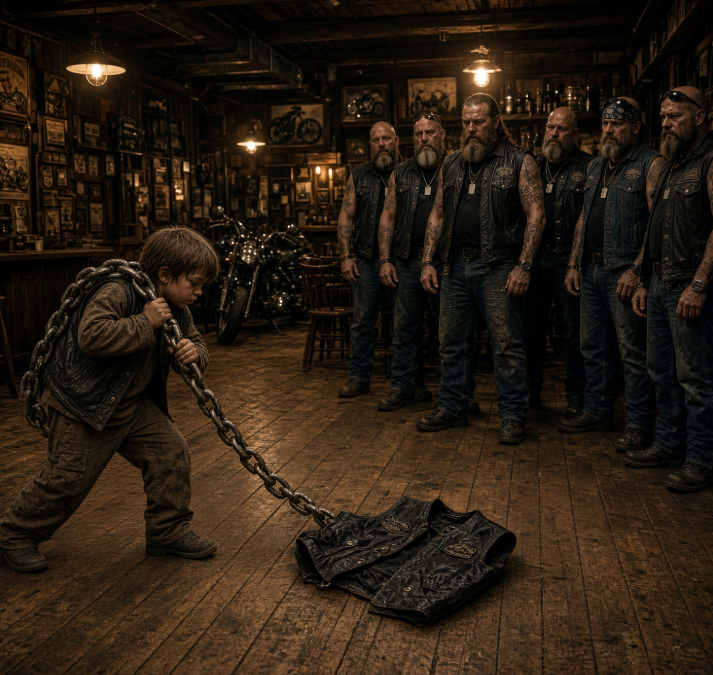
And he was standing inside the Rusty Spoke dragging his father’s vest across the floor.
The child looked over hundreds of faces.
He seemed terrified.
But too exhausted to run.
His eyes finally found Tucker because presidents wear patches that tell strangers who to look for.
The boy swallowed.
“My daddy told me to bring the chain.”
Tucker moved before deciding to.
He crossed the bar floor.
Dropped to one knee.
Up close, Cole looked worse.
His cheeks were hollow.
There were scratches on his shins.
Dried mud on one leg.
Dust inside his hair.
The skin beneath the chain was torn in two places.
“Hey, son.”
Tucker’s voice sounded wrong.
Too rough.
He tried again.
“Hey.”
The boy stared at him.
“What’s your name?”
“Cole.”
Tucker already knew.
But hearing it still hurt.
“Cole what?”
“Whitfield.”
Behind Tucker, someone sucked in a breath.
The name moved through the crowd.
Whitfield.
Ghost’s kid.
Derek’s boy.
Tucker lifted one hand.
Not touching him yet.
“Can I take that chain off?”
Cole immediately closed his other hand over it.
“No.”
Tucker stopped.
“Okay.”
“My daddy said don’t lose it.”
“You won’t lose it.”
Cole stared.
“How do I know?”
Tucker looked at the vest.
Then at him.
“Because I knew your father.”
Something changed in the boy’s face.
“You knew Daddy?”
“Yeah.”
“Really?”
“Really.”
“Were you his boss?”
A few men behind Tucker made sounds somewhere between laughter and pain.
Tucker smiled faintly.
“He probably would’ve said no.”
“Are you Tucker?”
That wiped the smile away.
“Yes.”
Cole looked relieved.
Not happy.
Relieved.
Like reaching Tucker had been the final item on a list he had been terrified he might not finish.
“Daddy said Tucker.”
Then the boy swayed.
Tucker caught him.
Four hundred men moved at once.
“Water!”
“Get Gloria!”
“Clear some room!”
“Somebody turn that damn music off!”
The jukebox died.
Tucker lifted Cole into his arms.
He weighed almost nothing.
That frightened Tucker more than the chain.
A seven-year-old boy should not feel like an empty jacket.
“Easy.”
Cole’s eyes fluttered.
“No hospital.”
Tucker froze.
“What?”
“Mama’s at hospital.”
“All right.”
“She said no money.”
“We’ll worry about that later.”
“No.”
Cole suddenly became frantic.
“Mama said hospitals cost too much. She said if I get hurt, I gotta be careful because we don’t got—”
“Cole.”
Tucker held him tighter.
“Listen.”
The boy went still.
“You are not going to worry about money tonight.”
“But Mama—”
“Your mama can yell at me later.”
That apparently made sense to him.
Russell Tate’s wife, Gloria, appeared through the crowd.
Gloria was sixty.
Retired emergency-room nurse.
Five feet six.
And one of the only people in the world who could tell four hundred bikers to shut up and be obeyed immediately.
“What happened?”
“Chain.”
She looked at Cole’s wrist.
Her expression sharpened.
“Who wrapped this around you?”
“I did.”
“Why?”
“So I wouldn’t lose it.”
Gloria inhaled slowly through her nose.
“Sweetheart, I’m going to take it off.”
Cole looked at Tucker.
Tucker said, “I’ll hold it.”
“You promise?”
Tucker placed one hand over his heart.
“I promise.”
Cole released the chain.
Gloria began unwrapping it.
The first loop came free.
Cole winced.
Several riders looked away.
Not because the injury was horrifying.
Because the idea of a little boy tightening steel around his own wrist so he would not lose the one thing his father told him to carry did something to grown men that blood never could.
Second loop.
Third.
The chain fell heavily into Tucker’s hands.
Nine or ten pounds.
Maybe more.
Cole rubbed his wrist.
Gloria examined it.
“How long were you walking?”
Cole shrugged.
“Since morning.”
Tucker thought he misheard.
“Since what?”
“Morning.”
“What time?”
“The sun came up.”
Hank stepped closer.
“Where did you come from?”
“Home.”
“Where’s home?”
Cole named an apartment complex.
Tucker knew it.
He looked toward Hank.
Eleven miles.
At least.
Maybe twelve depending on the route.
Tucker stared at Cole.
“You walked here?”
Cole nodded.
“All the way?”
“Mama showed me.”
“What do you mean?”
Cole’s lower lip trembled.
“Mama fell.”
The room somehow became quieter.
“She was making eggs.”
His voice got smaller.
“She started coughing.”
He demonstrated with two soft coughs.
“Then she grabbed the table.”
Tucker’s stomach turned.
“And?”
“She fell down.”
“Was she awake?”
“At first.”
“Did you call 911?”
Cole nodded.
“Mama taught me.”
Good.
Something.
“Then what?”
“People came.”
“Paramedics?”
“The ambulance people.”
“They took your mom?”
“Yes.”
“And who stayed with you?”
“Mrs. Patterson.”
“Neighbor?”
Cole nodded.
“She said she had to get medicine for her husband.”
Tucker’s jaw tightened.
“How long did she stay?”
“I don’t know.”
“Did another adult come?”
Cole shook his head.
“No.”
“You were alone?”
“Yes.”
“And then?”
Cole looked at the chain in Tucker’s lap.
“Mama said if something bad happened…”
He swallowed.
“…and she couldn’t be there…”
He touched the vest.
“…Daddy left a plan.”
Tucker’s eyes burned.
“What plan?”
“Closet.”
“What was in the closet?”
“Daddy’s box.”
Hank whispered, “Jesus.”
Cole continued.
“Mama showed me before.”
“Showed you what?”
“The chain.”
He pointed.
“She said if I ever got scared and she couldn’t help me, take Daddy’s chain and Daddy’s vest and go where the motorcycles are.”
Tucker closed his eyes.
“Did she tell you the name?”
“Rusty Spoke.”
“How did you know how to get here?”
Cole started listing landmarks.
“Big water tower.”
“The bridge.”
“Gas station with the red roof.”
“The tire place with the giant man.”
A few riders knew exactly what he meant.
“There’s a Muffler Man statue outside Benson Tire,” Hank whispered.
Cole nodded eagerly.
“Then the road with horses.”
“Then straight.”
Tucker realized what Derek had done.
He had built a child’s emergency route.
Not street names.
Not highway numbers.
Landmarks.
Things a six- or seven-year-old could recognize.
Someone must have driven it with him.
Practiced.
Prepared.
As though Derek had known.
“Did your daddy show you?”
Cole shook his head.
“Mama.”
Then he reached into his shorts.
“Daddy wrote you.”
Tucker stopped.
Cole pulled out a folded piece of paper.
So worn along the creases that the edges looked translucent.
“Mama kept it with his stuff.”
Tucker took it.
His hand was shaking now.
Hank saw.
“Open it.”
Tucker did not.
Not yet.
“First we find Claire.”
He stood.
The room came alive.
Not noisy.
Purposeful.
“Hank.”
“Yeah.”
“Hospital.”
Hank already had his phone.
“Russell.”
The older man stepped forward.
“Apartment.”
“Find Mrs. Patterson. Find out exactly what happened.”
Russell nodded.
“Dean.”
“Here.”
“Food.”
Dean looked confused.
“For Cole?”
“For the apartment.”
The confusion disappeared.
“Understood.”
“Gloria stays with him.”
“Obviously,” Gloria said.
“Anybody sober enough to drive—”
Half the room raised hands.
Tucker looked around.
Too many.
“Thirty riders with Hank. Ten with Russell. Everybody else stays until we know something.”
Somebody objected.
“Tucker—”
“That’s an order.”
Silence.
Then helmets came off hooks.
Leather zipped.
Phones appeared.
Within four minutes, motorcycles were starting outside.
Cole watched through the front window.
His eyes widened.
“All those are Daddy’s friends?”
Tucker looked at the parking lot.
“Yeah.”
“Four hundred?”
“Something like that.”
Cole stared.
“Why didn’t I ever meet them?”
The question landed so hard Tucker could not answer.
Not immediately.
Neither could anyone else.
Finally Tucker said, “That’s a very good question.”
Cole looked at him.
Tucker forced himself not to look away.
“And I think we owe you an answer.”
Gloria cleaned Cole’s wrist.
He hardly complained.
That worried her.
Children who expected pain often became too good at tolerating it.
“Does this hurt?”
“A little.”
“Little like mosquito bite or little like getting hit by a truck?”
Cole thought.
“Middle.”
“Good. Tell me if it changes.”
He watched her wrap the bandage.
Tucker sat beside him.
The letter remained unopened.
Cole noticed.
“Aren’t you gonna read Daddy?”
Tucker looked down.
“I will.”
“He said you had to.”
Tucker gave a broken smile.
“Sounds like him.”
“Was Daddy bossy?”
Hank would have laughed.
Tucker almost did.
“Very.”
Cole smiled for the first time.
A tiny thing.
Then asked, “Was he really brave?”
Tucker leaned back.
“Who told you he was?”
“Mama.”
“She was right.”
“How brave?”
Tucker thought about Derek Whitfield.
Ghost.
Quietest man in the club.
Never looking for attention.
Never starting fights.
Usually the one ending them before they began.
A gifted mechanic.
Terrible poker player.
Drove too fast.
Hated pickles.
Loved Claire openly enough that the other men teased him.
Had photographs of Cole taped inside his toolbox.
Tucker had not seen that toolbox since Derek died.
Why?
Because he had not gone to Claire’s apartment.
The guilt arrived quietly.
Like cold water rising around his ankles.
Cole asked again.
“How brave?”
“Your daddy died saving somebody.”
Cole’s face changed.
“Mama says accident.”
“It was.”
“What happened?”
Tucker hesitated.
Gloria looked at him.
Children deserved truth.
But not every detail.
“A truck crossed the center line.”
Cole listened.
“There was a family in another car.”
“Kids?”
“Two.”
Cole’s fingers tightened.
“Your daddy was riding behind them.”
Tucker spoke slowly.
“He saw the truck coming.”
“And?”
“He moved his motorcycle.”
“Why?”
“To make the truck hit him instead.”
Cole stared.
Tucker’s throat closed.
“The family was okay.”
“All of them?”
“Yes.”
“And Daddy?”
Tucker looked into the exact blue eyes Derek had possessed.
“Your daddy died.”
Cole’s face folded.
Not loudly.
No scream.
Just a child’s mouth trembling while he fought tears.
“But he knew?”
Tucker frowned.
“Knew what?”
“He knew he might die?”
Tucker wished the answer were simpler.
“I think he knew he could get hurt.”
“Why’d he do it?”
“Because children were in that car.”
Cole looked down.
“He didn’t know them.”
“No.”
“He still did it?”
“Yes.”
Cole wiped his eyes with his good hand.
“I want to be like Daddy.”
Tucker leaned closer.
“Listen to me.”
Cole looked up.
“Being brave doesn’t mean getting hurt.”
The boy frowned.
“Okay.”
“Sometimes bravery is calling 911.”
Cole nodded.
“Sometimes it’s asking for help.”
Another nod.
“Sometimes it’s walking through a door full of scary-looking old men.”
A rider nearby said, “Old?”
Tucker didn’t turn.
“Shut up, Eddie.”
Cole smiled faintly.
Tucker touched the chain.
“You already did something brave.”
Cole looked uncertain.
“I was scared.”
“That’s what makes it brave.”
His phone buzzed.
Hank.
Tucker answered immediately.
“Talk.”
“Found Claire.”
Every rider close enough went still.
“Rapid City Regional.”
“Condition?”
Hank hesitated.
Tucker hated that hesitation.
“Bad?”
“Stable now.”
Tucker exhaled.
“How bad?”
“Severe pneumonia.”
“What else?”
Hank’s voice became quieter.
“Malnutrition.”
Tucker’s eyes moved to Cole.
The boy was watching.
“Explain.”
“She’s severely underweight.”
“Anything else?”
“Dehydrated.”
“Insurance?”
“None.”
“Forget insurance.”
“That’s what I told them.”
“Is she conscious?”
“On and off.”
“Does she know where Cole is?”
“She woke long enough to ask.”
“What did you say?”
“That he found us.”
Silence.
Then Hank’s voice cracked.
“She started crying.”
Tucker closed his eyes.
Hank continued.
“Doc says she should recover.”
“Should?”
“If treatment works.”
“All right.”
“There’s more.”
Tucker opened his eyes.
“What?”
“Russell reached the apartment.”
Tucker put the phone on speaker.
Russell’s voice came through faintly in the background.
“Tell him.”
Hank did.
“There’s almost nothing there.”
“What do you mean?”
“Nothing.”
“Furniture?”
“Cole has a mattress.”
“Claire?”
“Blankets on the floor.”
Tucker looked around the bar.
Men began hearing.
“Kitchen?”
“Peanut butter.”
Pause.
“Two apples.”
Another pause.
“Half a loaf of bread.”
Nobody moved.
Hank continued.
“Power shutoff notice on the counter.”
Tucker’s face became hard.
“How long?”
“Overdue sixty-three days.”
“Rent?”
“Behind.”
“How much?”
“Two months.”
“Car?”
“Gone.”
“Where?”
“Sold.”
Tucker already knew the answer to the next question.
“For bills?”
“Looks like.”
Cole was staring at him.
Tucker asked, “Any food for adults?”
Hank did not answer immediately.
Then:
“No.”
Gloria’s hand went over her mouth.
Tucker looked at Cole’s thin arms.
“What did Cole eat?”
“School meals mostly.”
The guilt was no longer cold water at Tucker’s ankles.
It was at his throat.
Eighteen months.
Eleven miles.
They had been eleven miles away.
Four hundred men had ridden across entire states for motorcycle rallies.
Tucker himself had ridden six hundred miles to attend a brother’s retirement party.
But nobody had driven eleven miles to ask Claire Whitfield whether she was okay.
They had given her three thousand dollars.
They had said call if you need something.
Then convinced themselves offering counted as helping.
Tucker hung up.
Nobody spoke.
Cole asked, “Mama gonna die?”
Tucker immediately crouched.
“No.”
“You promise?”
Tucker stopped himself.
He would not promise what he did not control.
“The doctors think she’s going to get better.”
“Think?”
“They’re helping her.”
Cole looked frightened.
“We’re going to help too.”
“How?”
Tucker looked around the room.
Four hundred men.
The Black Iron Motorcycle Club.
Men who called one another brothers.
Men who tattooed loyalty onto their skin.
Men who wore patches symbolizing family.
And they had allowed a fallen brother’s wife to sleep on a floor and skip meals so her son could eat.
Tucker lifted Derek’s folded letter.
“First, I’m going to hear what your daddy has to say.”
He opened it.
The paper shook.
He recognized Derek’s handwriting instantly.
Small.
Left-slanted.
Crossed T’s extending too far.
He read silently.
The first sentence destroyed him.
Tucker,
If you’re reading this, then I’m gone, Claire is in trouble, and Cole made it to you.
Tucker stopped.
Hank had returned from the hospital entrance by then and stood at the edge of the crowd.
“Read it.”
Tucker looked at him.
Hank’s eyes were red.
“Everybody should hear it.”
Tucker did not want to.
That was exactly why he did.
He stood beside the bar.
Cole sat on top with Gloria beside him.
Tucker unfolded the letter fully.
Four hundred men listened.
“Tucker,
“If you’re reading this, then I’m gone, Claire is in trouble, and Cole made it to you.
“I know this sounds insane.
“I know a paper plan hidden with a motorcycle chain is not what responsible fathers are supposed to leave behind.
“I should have life insurance.
“Savings.
“A lawyer.
“A file somewhere with neat instructions.
“I don’t.”
Tucker’s voice became rough.
“I have a motorcycle, a mechanic’s paycheck, a wife too proud to ask anybody for anything, a little boy who thinks I can fix everything, and brothers I trust more than I have any right to.”
Several men looked down.
“Claire is sick.
“She will tell you she isn’t.
“Do not believe her.
“Her lungs have been getting worse.
“She skips appointments when money is short.
“If I’m around, I make her go.
“If I’m not, she’ll convince herself Cole needs groceries more than she needs doctors.
“She will feed him first.
“She will pay rent first.
“She will go without before she tells anybody she’s drowning.
“And she will not call the club because she will think asking for help makes her a burden.”
Tucker stopped.
Claire had done exactly that.
Every line.
He continued.
“So I made another plan.
“I showed Claire the route from our apartment to the Rusty Spoke.
“Eleven miles.
“Mostly back roads.
“Water tower.
“Bridge.
“Red-roof gas station.
“Benson’s giant tire man.
“Horse pasture.
“Then straight until you see motorcycles.
“If Claire ever can’t take care of Cole, she’s supposed to send him with my vest and chain.
“I know what you’re thinking.
“Eleven miles is too far for a kid.
“You’re right.
“So don’t make him walk it.”
The room changed.
Tucker stopped breathing.
The next line waited.
He read it anyway.
“Because by the time he has to, one of you should already know they’re in trouble.”
A man near the back whispered, “Oh God.”
Tucker continued.
“I’m writing this as the backup plan, Tucker.
“Not the real plan.
“You’re the real plan.
“Hank is.
“Russell.
“Dean.
“Every idiot who ever looked me in the face and called me brother.”
Tucker’s eyes blurred.
“If I die, check on them.
“Not once.
“Not at the funeral.
“Not with one envelope and a speech.
“Keep checking.
“Claire will say she’s fine.
“Ask again.
“She’ll say she has groceries.
“Look at the refrigerator.
“She’ll say Cole has shoes.
“Look at his feet.
“She’ll say she can pay the electric bill.
“Turn on a lamp.”
Nobody in the Rusty Spoke moved.
“I grew up wondering whether anyone would notice if I disappeared.
“I will not have my boy grow up that way.
“I’m asking you as the man who gave me my full patch.
“Take care of my son.
“Not because he belongs to Black Iron.
“He doesn’t.
“He belongs to himself.
“Make sure he has the chance to grow into whoever he wants to be.
“Maybe he rides.
“Maybe he hates motorcycles.
“Maybe he becomes a doctor.
“Maybe a teacher.
“I don’t care.
“I just want him to reach eighteen knowing there were adults in the world who kept showing up after his father couldn’t.”
Tucker had to stop.
Hank turned away.
Russell sat down hard.
Bobby Kane, who had once taken twelve stitches above his eye without anesthesia because he hated needles, was openly crying.
Tucker wiped his face.
Then read the ending.
“Brothers do not forget brothers.
“But anybody can say that beside a grave.
“Show me you mean it after I’m gone.
“If Cole ever has to carry this letter to you, then something went wrong.
“Fix it.
“Ghost.”
No applause.
No shouting.
Nothing.
Tucker folded the paper.
Then unfolded it again.
Read one line silently.
Show me you mean it after I’m gone.
He looked at Cole.
Seven years old.
Bandaged wrist.
Too-thin body.
Broken shoes.
The boy had walked eleven miles carrying proof of their failure.
Tucker placed the letter against his chest.
Then looked at four hundred men.
“We forgot him.”
Nobody argued.
“We forgot Claire.”
Still nothing.
“We buried Derek.”
His voice rose.
“We cried.”
“We rode in formation.”
“We put flowers on his casket.”
“We gave speeches about brotherhood.”
His face hardened.
“And then we did the easiest goddamn thing in the world.”
Pause.
“We went home.”
Several men lowered their heads.
Tucker continued.
“We told a sick widow to call if she needed help.”
He laughed once.
Bitter.
“What a convenient promise.”
Hank whispered, “Tuck.”
“No.”
Tucker looked around.
“Say it.”
Nobody moved.
“We failed them.”
Russell stood first.
“Yes.”
One word.
Then Hank.
“Yes.”
Then Dean.
“Yes.”
Soon voices came from everywhere.
Yes.
Yeah.
We did.
Tucker nodded.
“Good.”
He looked at Cole.
“Then we stop lying about it.”
He pointed toward the door.
“Tonight.”
The club moved.
Not emotionally.
Practically.
That mattered.
Anybody can cry.
Help requires lists.
Dean took twenty riders to a twenty-four-hour grocery store.
The manager almost locked the doors when twenty motorcycles pulled up at midnight.
Then Dean explained.
The manager reopened two registers.
They filled six carts.
Food.
Soap.
Toothpaste.
Laundry detergent.
School snacks.
Frozen meals.
Fresh fruit.
Vegetables.
Milk.
Cereal.
Chicken.
Things people need but poor families learn to treat like luxury.
Russell stayed at the apartment.
He found overdue notices.
Medical bills.
A handwritten budget taped inside a cabinet.
Rent.
Electric.
Food.
Medication.
Numbers had been scratched out repeatedly.
One item appeared every month.
COLE SCHOOL LUNCH ACCOUNT.
Always paid.
Claire’s medication?
Not always.
Russell sat on the kitchen floor and cried.
Another group contacted the landlord.
Two riders owned a construction company.
Another ran a property management business.
They paid the overdue rent before sunrise.
A lawyer in the Wyoming chapter started reviewing Claire’s medical debt.
A rider who owned a used-car lot said, “She needs transportation.”
A mechanic answered, “I’ll service it.”
Someone asked what model.
“Something boring.”
“Why boring?”
“Because she has a kid.”
“Fair.”
At the hospital, Hank remained.
Thirty-one bikers had arrived initially.
Security stopped them.
Of course.
The night supervisor looked at a corridor full of leather and said, “Only immediate family.”
Hank stepped forward.
“We’re family.”
“All thirty-two of you?”
“Yes, ma’am.”
“That is not what hospital policy means.”
Hank nodded.
“You’re right.”
The nurse looked surprised.
“We’ll wait downstairs.”
That surprised her more.
Hank chose two men.
Everyone else moved to the waiting room.
No argument.
No intimidation.
No speeches.
At 12:48 a.m., Dr. Alan Mercer came out.
“You’re with Claire Whitfield?”
“Yes.”
“Husband?”
“Friend of her late husband.”
The doctor glanced at the patch.
“Motorcycle club?”
“Yes.”
Hank waited for judgment.
It didn’t come.
“She’s very sick.”
“How sick?”
“Bilateral pneumonia. Significant malnutrition and dehydration.”
“Will she recover?”
“We believe so.”
“Believe?”
“Her oxygen saturation is improving. She’s responding to treatment.”
Hank breathed.
“Why didn’t she come sooner?”
The doctor gave him a look that doctors reserve for obvious questions.
“Cost.”
Hank closed his eyes.
“She delayed treatment?”
“Based on what she told us, yes.”
“How long?”
“Several weeks.”
“And if she waited?”
“A few more days could have been dangerous.”
Hank looked through the glass doors toward ICU.
“Can I see her?”
“When she wakes properly.”
“What about bills?”
The doctor blinked.
“That’s not my department.”
“It is now.”
“What does that mean?”
“Anything not covered, send it to us.”
“The hospital doesn’t work that way.”
“Then tell me how it works.”
Dr. Mercer studied him.
Hank was accustomed to suspicion.
Instead the doctor said, “Financial services opens at seven.”
“I’ll be here at seven.”
“You’ve been drinking?”
“One beer three hours ago.”
“You riding home?”
“No.”
The doctor nodded approvingly.
Hank almost laughed.
At 2:06 a.m., Claire woke.
She knew where she was.
Then remembered Cole.
Her heart rate jumped.
“Cole?”
A nurse pressed a hand gently to her shoulder.
“He’s safe.”
“No.”
Claire tried to sit.
“Where?”
“Mrs. Whitfield—”
“My son.”
“Hank Dawson is outside.”
Claire froze.
“Hank?”
“From Black Iron.”
Something broke across Claire’s face.
Not relief.
Shame.
That hurt Hank later when he heard.
The nurse asked permission.
Claire nodded.
Hank entered without his vest.
He had taken it off.
He did not want a symbol entering the room before the man.
Claire looked impossibly thin.
Her cheekbones sharp.
Dark circles beneath her eyes.
Oxygen beneath her nose.
“Hank.”
“Hey, Claire.”
“Cole?”
“Safe.”
“Where?”
“Rusty Spoke.”
Her eyes widened.
“He made it?”
Hank nodded.
“All the way.”
Claire began crying.
“He walked?”
“Yes.”
“I told him only if—”
Her voice failed.
Hank moved closer.
“He did exactly what you taught him.”
“He shouldn’t have had to.”
“No.”
Claire looked at him.
Hank did not hide.
“No, he shouldn’t.”
She closed her eyes.
“I didn’t know who else—”
“You had us.”
A tear rolled toward her ear.
“I didn’t.”
Hank stopped.
Claire opened her eyes.
“You weren’t there.”
Four words.
No anger.
That was worse.
Hank sat.
“You’re right.”
Claire looked away.
“I called once.”
He stared.
“What?”
“Six months after Derek died.”
Hank’s stomach dropped.
“Who?”
“Clubhouse.”
“When?”
“January.”
“Who answered?”
“I don’t know.”
“What happened?”
“I asked for Tucker.”
Her breathing became harder.
“They said he was on a ride.”
“He was.”
“I asked about help with rent.”
Hank felt sick.
Claire continued.
“Guy told me emergency fund had already paid survivor benefit.”
Hank’s fists closed.
“Who?”
“I don’t know.”
“He said to call county assistance.”
Hank looked down.
Claire whispered, “So I did.”
“And?”
“Waiting list.”
“Why didn’t you call again?”
She gave him a tired, almost offended look.
“Because I had already begged once.”
Hank shut his eyes.
This was worse than forgetting.
Somebody had heard her.
And treated policy as brotherhood.
“I’m sorry.”
Claire turned her face toward the ceiling.
“I didn’t want apologies.”
“I know.”
“I wanted Derek.”
Hank’s eyes filled.
“I know.”
“And when I couldn’t have him, I wanted to prove I could do it.”
Hank nodded.
“I know that too.”
“I sold the truck.”
“We know.”
Her head snapped toward him.
“What have you done?”
“Nothing you didn’t need.”
“I don’t want charity.”
“There she is.”
Claire glared weakly.
“Don’t.”
“Derek said you’d say that.”
Claire went completely still.
“What?”
Hank took out his phone.
“I heard the letter.”
Her eyes flooded.
“Cole gave it to Tucker?”
“Yes.”
Claire began sobbing.
Quiet.
Exhausted.
“I hated that letter.”
“Why?”
“Because Derek knew me.”
Hank smiled sadly.
“Yeah.”
“He knew I’d wait too long.”
“Yeah.”
“He knew I’d send Cole.”
Hank’s voice softened.
“Yeah.”
Claire covered her face.
“I failed him.”
“No.”
Hank leaned forward.
“No.”
“I sent our baby walking—”
“You were unconscious in an ambulance.”
“I taught him the road.”
“You taught him where help was supposed to be.”
Claire’s eyes found his.
Hank swallowed.
“We failed Derek.”
She stared.
“Not you.”
“We did.”
“Hank—”
“All of us.”
His voice cracked.
“We told him we were family.”
“We were there when he died.”
“We promised you.”
“And then we expected you to do the hardest part.”
“What?”
“Ask.”
Claire looked confused.
Hank continued.
“We made the person drowning shout across the water.”
He shook his head.
“That’s not rescue.”
Claire cried harder.
Hank sat there.
Did not touch her.
Did not tell her to stop.
When she finished, she whispered, “Is Cole scared?”
“Yes.”
That honesty surprised her.
“He’s also fed.”
Claire closed her eyes.
“He ate?”
“Sandwich.”
“What kind?”
Hank almost laughed.
“Peanut butter, I think.”
“He likes grape jelly.”
“I’ll report the complaint.”
Claire smiled weakly.
It was the first good thing in the room.
Back at the Rusty Spoke, Cole finally fell asleep at 2:32.
Not in a bed.
Against Tucker.
The president of Black Iron sat on a bench along the back wall with Cole’s head tucked against his side.
Tucker barely moved.
He was afraid waking him might remind him where he was.
Derek’s vest sat folded nearby.
The chain lay beneath it.
Cleaned of dust but still stained faintly from Cole’s wrist.
Tucker stared at it.
Lorraine called.
His wife of thirty-one years.
“What happened?”
Tucker told her.
Everything.
When he finished, Lorraine was silent.
Then:
“Bring that boy here.”
Tucker closed his eyes.
“Lorraine—”
“Don’t Lorraine me.”
“Claire’s alive.”
“Thank God.”
“She may be hospitalized awhile.”
“Then where is Cole sleeping?”
“We’ll figure—”
“At our house.”
“Lorraine.”
“Tucker Graves, I have watched you bring three drunk men, two injured dogs, one stranger with a broken motorcycle, and an entire bachelor party into this house without asking me first.”
Tucker almost smiled.
“True.”
“And now you’re asking whether a seven-year-old whose daddy died can use our guest room?”
“I was going to ask.”
“No.”
“No?”
“You are being told.”
Tucker looked down at Cole.
“Yes, ma’am.”
“And Tucker?”
“Yeah?”
“We failed them.”
His eyes filled.
“I know.”
“Then don’t turn guilt into one big night.”
He frowned.
“What?”
“Anyone can care for forty-eight hours.”
Lorraine’s voice softened.
“Show up in six months.”
Tucker looked at Cole.
Then Derek’s chain.
“I will.”
“No.”
Lorraine corrected him.
“We will.”
Cole woke at seven.
For a moment he forgot where he was.
Tucker saw it happen.
The child’s eyes opened.
Confusion.
Panic.
Then memory.
“Mama.”
“She’s okay.”
“You talked to her?”
“Hank did.”
“I want her.”
“I know.”
“Can I see her?”
“As soon as the doctors say yes.”
Cole looked around.
Most bikers were gone.
Several slept in chairs.
Dean snored with his boots on a table.
Gloria sat nearby drinking coffee.
“Where’d everybody go?”
“Helping.”
“With what?”
“You.”
Cole frowned.
“I didn’t ask.”
Tucker felt Derek’s letter inside his jacket.
“Your daddy did.”
Cole thought about that.
Then asked, “Am I in trouble for the vest?”
“What?”
“It got scratched.”
Tucker looked at Derek’s vest.
Nearly destroyed along the bottom edge.
“No.”
“Daddy said patches are important.”
“They are.”
“I dragged it.”
“Yeah.”
“Is that bad?”
Tucker picked up the vest.
He laid it across his knees.
“Your dad’s vest used to mean he belonged to us.”
Cole watched.
“Last night it meant you knew where to find us.”
He touched a torn rocker.
“I’d say it did its job.”
Cole looked relieved.
“Can you fix it?”
Tucker hesitated.
“Maybe.”
“Don’t make it new.”
That surprised him.
“Why?”
“Then it won’t look like my walk.”
Tucker stared at the child.
“No.”
His voice nearly broke.
“We won’t make it new.”
He took Cole home to Lorraine.
The first thing Lorraine did was kneel.
The second was not hug him.
She had raised three children.
She knew frightened kids needed choices.
“Hi, Cole.”
“Hi.”
“I’m Lorraine.”
“I know.”
“How?”
“Tucker said wife.”
Lorraine looked up at Tucker.
“Just wife?”
“He was sleepy.”
She returned to Cole.
“You hungry?”
He nodded.
“What do you want?”
Cole looked overwhelmed.
“What do you have?”
“Eggs.”
“Pancakes.”
“Cereal.”
“Toast.”
“Bacon.”
“Fruit.”
“Yogurt.”
He stared.
Lorraine realized the mistake.
Too many choices.
“Pancakes?”
Cole nodded.
“With syrup?”
Another nod.
While Lorraine cooked, Cole sat at the kitchen table.
Tucker watched him put two pieces of bacon into his pocket.
He said nothing.
Later Lorraine found a pancake wrapped in a napkin under the pillow.
She did not remove it.
Instead she placed a small basket beside the bed.
Crackers.
Granola bars.
Applesauce.
A note.
FOR COLE. ANYTIME.
Two days later, the hidden pancake disappeared.
The basket remained.
On day five, Cole ate a granola bar in the kitchen instead of carrying it upstairs.
Lorraine later cried in the laundry room.
Claire stayed in the hospital three weeks.
The doctors treated pneumonia.
Then malnutrition.
Then everything else poverty had taught her to ignore.
Black Iron paid the remaining medical costs through a newly established fund.
Claire objected.
Repeatedly.
Tucker listened.
Then asked, “Would Derek pay Hank’s hospital bill?”
“Yes.”
“Russell’s?”
“Yes.”
“Mine?”
“Yes.”
“Then stop making yourself less family because you aren’t wearing a patch.”
She hated that argument because it worked.
The club learned other things too.
Painful ones.
Tucker investigated the January phone call.
The man who answered was found.
Tommy Vale.
Member for eight years.
He remembered.
Barely.
Claire had called while the bar was busy.
Asked for help.
He had assumed survivor payments were finished.
He told her county assistance existed.
Tucker called him into church.
Tommy looked terrified.
Tucker did not yell.
That was worse.
“She asked for help.”
Tommy stared at the table.
“I didn’t know how bad it was.”
“You didn’t ask.”
“I thought—”
“That’s the problem.”
Tommy swallowed.
“I’m sorry.”
Tucker nodded.
“So am I.”
“You kicking me out?”
“No.”
Tommy looked surprised.
“Why?”
“Because you’re going to spend the next year running family-support calls.”
Tommy blinked.
“What?”
“Every widow.”
“Every injured rider.”
“Every family.”
“You call.”
“You visit.”
“You open refrigerators.”
“You check shoes.”
Tommy’s eyes filled.
“You want me doing that?”
“I want you remembering what happens when we make help somebody else’s job.”
The club changed its rules.
Not dramatically.
Structurally.
That mattered more.
Every fallen member’s family received an assigned two-person contact team.
Monthly check-ins for two years.
Then quarterly indefinitely.
Emergency requests could no longer be denied by whoever happened to answer a phone.
School needs.
Housing problems.
Medical transport.
Food.
Legal referrals.
Not unlimited money.
Not reckless charity.
Systems.
Accountability.
A promise with paperwork.
Derek had said he should have built something out of paper.
Black Iron finally did.
Claire left the hospital on an October morning.
Tucker drove her.
Not because she could not ride in a car with someone else.
Because he had promised.
Cole waited at the temporary house on Elk Creek Road.
Carl Fletcher, a retired Black Iron member, owned it.
Three bedrooms.
Big porch.
Gravel driveway.
Claire had objected the moment she learned rent was free.
Carl responded:
“Your boy walked eleven miles carrying ten pounds of steel. I think I can survive losing rent.”
Claire tried again.
Carl said, “You argue like Derek.”
That ended it.
When Claire arrived, Cole ran out.
He stopped halfway.
For a second, Tucker wondered why.
Then he understood.
Cole was afraid running too hard might hurt her.
Claire understood too.
She opened both arms.
Cole crashed into them.
She bent around him.
Mother and son stood in the driveway crying.
Tucker turned away.
Not because he was embarrassed.
Because some moments do not belong to witnesses.
That evening, Claire asked Tucker to sit on the porch.
Cole rode the purple bicycle the club had given him up and down the driveway.
“You bought him too much.”
“Probably.”
“The bicycle alone—”
“Lorraine bought it.”
“That woman is dangerous.”
“Yes.”
Claire watched Cole.
“He looks different.”
“He eats.”
She flinched.
Tucker regretted the bluntness.
But Claire nodded.
“So do I.”
“Yes.”
She took a breath.
“Tucker?”
“Yeah?”
“I hated you.”
He looked at her.
“After Derek died.”
“I figured.”
“No.”
She looked directly at him.
“I really hated you.”
“All of you.”
“The motorcycles.”
“The flowers.”
“The speeches.”
“You rode past my apartment sometimes.”
Tucker felt cold.
“You saw us?”
“Yes.”
“Why didn’t you—”
She smiled sadly.
“Wave down forty motorcycles and ask if anyone wanted to pay my electric bill?”
He looked away.
“Fair.”
“I thought if you cared, you’d stop.”
Tucker’s jaw tightened.
“We should have.”
“Yes.”
No softness.
He appreciated that.
Claire continued.
“Then I hated myself for expecting it.”
“Don’t.”
“I thought Derek made me dependent.”
“You weren’t.”
“He always said the club was family.”
“Yeah.”
“I thought family should know.”
Tucker looked toward Cole.
“You were right.”
Claire wiped one tear.
“What happens now?”
“What do you mean?”
“You all feel guilty.”
Tucker frowned.
“That will fade.”
“Probably.”
“And when it does?”
There it was.
The real question.
Tucker thought of Lorraine’s words.
Anyone can care for forty-eight hours.
“We build something guilt doesn’t have to carry.”
Claire studied him.
“What?”
“A system.”
He explained the new family program.
Assigned contacts.
Emergency checks.
Medical transportation.
Financial review.
Education fund.
Claire listened.
“You did all that because of us?”
“No.”
Tucker looked at Cole.
“We did it because Derek was right.”
“About what?”
“We were good at funeral promises.”
He shook his head.
“Bad at Tuesday afternoons.”
Claire smiled faintly.
“That sounds like him.”
“Yeah.”
Three months after Cole entered the Rusty Spoke, Derek’s chain went onto the wall.
Cole supervised.
Very seriously.
Tucker suggested polishing it.
Cole said yes.
Then no.
“Why not?”
“Leave scratches.”
So they did.
They cleaned the dirt.
Removed anything unsafe.
But left the road marks.
The scraped links.
The wear.
A brass plate beneath it read:
GHOST’S CHAIN
CARRIED ELEVEN MILES BY COLE WHITFIELD, AGE 7
A REMINDER THAT FAMILY IS NOT WHO YOU MOURN.
FAMILY IS WHO YOU KEEP SHOWING UP FOR.
Derek’s vest hung beside it.
Repaired enough to preserve.
Not restored enough to erase.
Cole’s road remained visible along the leather.
The letter went into a protective frame.
Tucker initially objected.
“Private.”
Claire disagreed.
“Derek wrote it to all of you.”
“He addressed me.”
“He knew you’d read it aloud.”
“How?”
“Because he knew you.”
Tucker hated when dead men won arguments.
Ghost’s Ride began the following August.
Initially it was supposed to honor Derek.
Then Claire changed the idea.
“There are other families.”
Tucker looked at her.
“What?”
“Other dead riders.”
“Injured riders.”
“Divorced dads whose kids still need school clothes.”
“Widows.”
“Parents.”
“People who won’t ask.”
Tucker understood.
So Ghost’s Ride became a fundraiser for motorcycle-family hardship cases and local children’s assistance programs.
The first year, more than five hundred riders came.
Cole stood beside Tucker on a makeshift stage.
He wore a small black vest.
No Black Iron membership patch.
Tucker refused.
“He’s seven.”
Instead, Gloria stitched one silver chain link onto the back.
Under it:
HONORARY BROTHER.
Tucker stepped toward the microphone.
The crowd quieted.
He had given speeches before.
Funerals.
Weddings.
Club anniversaries.
This one scared him.
“Most of you know Derek Whitfield.”
A few riders shouted Ghost’s name.
Tucker raised one hand.
Silence returned.
“He died saving a family he never met.”
Pause.
“We buried him like a brother.”
“We rode for him.”
“We cried for him.”
“We promised his wife and son they’d never be alone.”
Tucker looked at Cole.
“Then we broke that promise.”
Nobody expected that opening.
Good.
“I’m not going to stand here and rewrite what happened so we look heroic.”
He pointed toward the bar.
“That chain is not proof of our loyalty.”
“It is proof of our failure.”
The parking lot became still.
“A seven-year-old boy had to walk eleven miles before we remembered where his house was.”
Tucker’s throat tightened.
“He dragged steel until his wrist bled because his dead father trusted us.”
“He arrived hungry.”
“His mother was in ICU because she had been feeding him instead of herself.”
“No food.”
“No car.”
“Rent behind.”
“And eleven miles away, we were drinking beer under a sign that said brotherhood.”
Nobody moved.
Tucker continued.
“Do not clap for us because we helped after Cole arrived.”
“That was debt.”
“We’re here today because we learned something.”
He lifted Derek’s letter.
“Ghost wrote that anybody can call somebody brother beside a grave.”
Tucker looked across hundreds of riders.
“The test comes afterward.”
“Tuesday morning.”
“January rent.”
“Doctor visit.”
“School shoes.”
“The phone call you don’t feel like making because you’re busy.”
“That’s brotherhood.”
He stepped aside.
Cole pulled his sleeve.
Tucker leaned down.
“What?”
“Can I say something?”
“You want the microphone?”
Cole nodded.
Tucker hesitated.
Then lifted him onto a wooden crate.
Cole stood in front of more than five hundred bikers.
He looked terrified.
Tucker whispered, “You don’t have to.”
Cole shook his head.
Then leaned toward the microphone.
“My daddy told me you would help.”
The crowd went completely still.
“I was scared you wouldn’t.”
Tucker’s chest tightened.
Cole looked back toward the chain visible through the open bar door.
“But you did.”
A few men began clapping.
Cole lifted one hand.
Tucker nearly laughed.
The kid had watched him control crowds.
They stopped.
Cole said, “Mama says people can mess up and still be good if they fix stuff.”
Tucker covered his eyes.
Claire laughed through tears.
Cole continued.
“So thank you for fixing stuff.”
That destroyed them.
Applause rolled across the lot.
Cole stepped down.
Tucker caught him.
The boy wrapped both arms around Tucker’s neck.
A year earlier Tucker might have worried about looking soft in front of hundreds of riders.
At fifty-seven, he had developed better fears.
He held Cole.
Two years passed.
Then three.
Cole grew.
Slowly at first.
Then suddenly.
Children do that.
One summer, Tucker realized the top of Cole’s head reached his shoulder.
“How’d that happen?”
“What?”
“You’re huge.”
“I’m eleven.”
“Exactly.”
Claire recovered fully enough to return to work.
Not the two-job schedule she had maintained before.
Black Iron members helped her enroll in a respiratory therapy program.
She resisted assistance.
Naturally.
Then accepted a scholarship through the Ghost Foundation.
“Not charity,” Tucker told her.
“Investment.”
“You sound like a banker.”
“I feel dirty.”
Claire graduated.
Got a hospital job.
The first time she received an employee health-insurance card, she sat in her car and cried.
Then sent Tucker a photograph.
Caption:
LOOK. I AM OFFICIALLY EXPENSIVE TO KEEP ALIVE.
Tucker replied:
DEREK ALREADY ESTABLISHED THAT.
Cole excelled at school.
Not because hardship magically produces gifted children.
Sometimes hardship just produces tired children.
But once he slept.
Ate.
Had stability.
He discovered he loved science.
Especially mechanical things.
Surprising no one.
At twelve, he could rebuild a carburetor.
At thirteen, he began helping Hank at the shop.
At fourteen, he asked Tucker if he could ride.
Claire said no.
Tucker agreed.
Cole looked betrayed.
“You ride.”
“I’m fifty-something.”
“That means you’re slower.”
“That is not how motorcycles work.”
Claire crossed her arms.
“Sixteen.”
Cole appealed to Hank.
Hank pretended not to hear.
At sixteen, Cole took the motorcycle safety course.
Not because the club required it.
Because Claire did.
He scored highest in the class.
Tucker gave him an old Honda Rebel.
Not a Harley.
Cole stared at it.
“This is small.”
“You’re sixteen.”
“You have a Road Glide.”
“I also have arthritis and bad judgment.”
Cole grinned.
The first ride was six miles.
Tucker in front.
Hank behind.
Claire following in a car even though everyone begged her not to because her panic was visible through the windshield.
They stopped at an overlook above the Black Hills.
Cole removed his helmet.
His face glowed.
“Dad would love this.”
Tucker looked away.
“Yeah.”
“Did you ever ride here with him?”
“Hundreds of times.”
“Can you show me his favorite road?”
Tucker nodded.
“When you’re ready.”
“I’m ready.”
“No.”
Cole frowned.
“You just said—”
“Learning to ride means learning that wanting a road doesn’t mean you’re ready for it.”
“That sounds fake.”
“It’s deeply wise.”
“It sounds like something Mom told you to say.”
“She’s deeply wise.”
Cole groaned.
Tucker smiled.
The relationship between them had changed over the years.
When Cole was seven, Tucker had been protector.
At ten, uncle.
At fourteen, mentor.
By sixteen, he had become something harder to label.
Cole once asked Claire:
“Is Tucker like my second dad?”
Claire thought.
“No.”
Cole looked disappointed.
Then she continued.
“He’s Tucker.”
“What does that mean?”
“It means nobody replaces your father.”
“And nobody has to.”
Cole thought about that.
“So I can love both?”
Claire smiled.
“You can love as many people as your heart has room for.”
Cole remembered that.
At seventeen, a school assignment asked students to write about the person who had influenced them most.
Tucker assumed Cole would choose Derek.
He was wrong.
Cole wrote about Claire.
When Tucker learned, he felt proud.
“Why Mom?” he asked.
Cole looked surprised.
“She survived.”
That simple.
“She lost Dad.”
“She got sick.”
“She was poor.”
“She almost died.”
“Then she went back to school.”
“Now she helps people breathe.”
Cole shrugged.
“Dad was brave once at the end.”
“Mom had to be brave every morning.”
Tucker stared at him.
“Don’t ever tell her you said that.”
“Why?”
“She’ll cry on me.”
Cole smiled.
“You cry constantly.”
“I have allergies.”
“To feelings?”
“Exactly.”
Cole graduated high school at eighteen.
The parking lot outside the ceremony held motorcycles.
Claire had negotiated the number down to seventy-five.
Tucker called that oppression.
Cole walked across the stage.
Diploma in hand.
When he found Tucker afterward, he gave him an envelope.
“What’s this?”
“Open it.”
Inside was a photocopy of Derek’s original letter.
On the bottom, Cole had written something.
Dad told you to get me to eighteen knowing adults would keep showing up.
You did.
Tucker read it twice.
Then a third time.
Cole waited.
Finally Tucker said, “You made this difficult.”
“What?”
“Not crying in public.”
“There are seventy-five bikers watching.”
“Exactly.”
Cole hugged him.
That ended the fight.
At eighteen, Cole decided to study engineering.
Not medicine.
Not motorcycle mechanics.
Civil engineering.
Tucker asked why.
Cole said:
“Bridges.”
“Bridges?”
“Yeah.”
“What about them?”
“They’re just ways to make sure people can get somewhere they couldn’t reach before.”
Tucker had no answer.
Maybe kids raised around metaphors become dangerous adults.
College took Cole two states away.
Claire panicked.
Tucker did too.
Neither admitted it.
The club wanted to escort him to campus.
Cole refused.
“One motorcycle.”
Tucker negotiated.
“Three.”
“One.”
“Two.”
“Mom drives me.”
“Traitor.”
Claire won.
Before leaving, Cole visited the Rusty Spoke.
The chain still hung behind the bar.
The scratches remained.
Derek’s vest.
The letter.
Cole stood there a long time.
Tucker joined him.
“You remember the walk?”
“Pieces.”
“What parts?”
“Heat.”
“My wrist.”
“Thinking I had gone the wrong way.”
Tucker looked at him.
“Were you scared?”
“Terrified.”
“You didn’t look it.”
“I was seven.”
Cole laughed softly.
“I thought if I cried too much, I’d run out of water.”
Tucker’s throat tightened.
Kids remember things adults never imagine.
Cole touched the glass covering Derek’s letter.
“Did you ever forgive yourself?”
Tucker knew what he meant.
“For forgetting us,” Cole clarified.
Tucker thought.
“Not completely.”
“Why?”
“Some things shouldn’t disappear just because you did better later.”
Cole nodded.
“But?”
“But guilt has to work.”
“What?”
“If guilt just hurts you, eventually it becomes vanity.”
Cole frowned.
Tucker continued.
“You sit around saying, look how terrible I feel.”
“That doesn’t help anybody.”
“So you make it build something.”
Cole looked around.
The family-support board now listed dozens of names.
Widows.
Children.
Injured riders.
Hospital contacts.
Emergency coordinators.
The Ghost Foundation had raised hundreds of thousands over the years.
No rider’s family had been lost after a funeral again.
Cole smiled.
“So it worked.”
“Your dad’s letter?”
“Yeah.”
Tucker looked at the chain.
“It’s still working.”
College years passed.
Cole came home for summers.
Claire built her own life.
She dated once.
Then stopped.
Then dated again.
Cole struggled with it.
Tucker stayed out.
Mostly.
“Mom has a boyfriend.”
“Good.”
“You’re supposed to hate him.”
“Why?”
“Dad.”
Tucker stared.
“Your dad loved Claire.”
“Yeah.”
“Then why would he want her lonely?”
Cole hated when Tucker was reasonable.
The boyfriend, Mark, turned out to be decent.
Annoyingly.
Tucker investigated him anyway.
Claire found out.
Threatened murder.
Black Iron continued.
Members aged.
Some died.
Young riders joined.
Each new full patch was required to read Derek’s letter.
Not as religious scripture.
As history.
Tucker insisted.
“If you wear brotherhood on your back, understand what it costs.”
At twenty-two, Cole came home from college for Ghost’s Ride.
More than seven hundred motorcycles attended that year.
The event now funded food, rent relief, medical transportation, and educational support for families in the riding community and local children regardless of motorcycle connection.
Cole stood on the stage.
Tall now.
Broad shoulders like Derek.
Same eyes.
Tucker introduced him.
“The bravest rider who walked.”
People applauded.
Cole hated the nickname.
He stepped to the microphone.
“I need to correct something.”
Tucker groaned theatrically.
Cole smiled.
“I was not brave because I walked eleven miles.”
The crowd quieted.
“I walked because I was seven and my mother was gone and I thought I had no choice.”
He looked toward the bar.
“The brave part happened before I was born.”
He held up a copy of Derek’s letter.
“My father was afraid.”
“Most people don’t think of him that way.”
“They call him Ghost.”
“They talk about how he died.”
“How he saved a family.”
“And that was brave.”
“But Dad was brave before that.”
“He admitted he might die.”
“He admitted my mother might need help.”
“He admitted he had not prepared enough.”
“He wrote it down.”
Cole paused.
“A lot of men are better at risking their lives than admitting their family might need somebody after they’re gone.”
Murmurs moved through the riders.
Cole continued.
“And this club messed up.”
Tucker nodded.
No flinching.
“They admitted that too.”
“They didn’t rewrite history.”
“They didn’t pretend they saved us from the beginning.”
“They failed.”
“Then they changed.”
Cole looked at Tucker.
“That may be the thing I respect most.”
Tucker’s eyes filled.
Cole smiled.
“Sorry.”
“You should be.”
Laughter.
Then Cole grew serious.
“People think family means never failing one another.”
“No.”
“Family fails.”
“Parents fail.”
“Kids fail.”
“Friends fail.”
“Clubs fail.”
“What matters is whether your pride matters more to you than repairing what you broke.”
Silence.
“My dad left a chain.”
Cole looked toward it.
“When I was seven, I thought I was carrying it because I could not lose it.”
He shook his head.
“Now I think that chain carried a message.”
“What we are connected to creates responsibility.”
“That’s the whole thing.”
He stepped away.
Applause erupted.
Tucker stood.
So did Claire.
Hank.
Gloria.
Russell.
One by one, hundreds of riders rose.
Not for Cole’s walk.
For what the walk had become.
Years later, Tucker retired as Black Iron president.
He hated the word retired.
“I still have a motorcycle.”
Hank said, “Your prostate has seniority.”
Tucker threw a wrench at him.
Dean took over.
The transition ceremony happened at the Rusty Spoke.
Tucker removed his president patch.
Held it for a moment.
Then handed it over.
Afterward, he sat alone beneath Derek’s chain.
Cole joined him.
Twenty-six now.
Civil engineer.
Working on highway infrastructure projects in western South Dakota.
“You okay?”
Tucker nodded.
“Liar.”
Tucker smiled.
“You sound like Lorraine.”
“Highest compliment.”
“She’ll be pleased.”
Cole looked toward the chain.
“You know something weird?”
“Everything about you?”
“I drive past our old apartment sometimes.”
Tucker turned.
“Why?”
“Not sure.”
“Does it hurt?”
“Less.”
“Good.”
“The red-roof gas station is gone.”
“I know.”
“Water tower still there.”
“Yeah.”
“Benson Tire replaced the giant man.”
“Tragedy.”
“Horse pasture became houses.”
Tucker nodded.
Cole looked down.
“So if a kid tried walking the road now, the landmarks wouldn’t work.”
Tucker understood before Cole finished.
“The road’s disappearing.”
“Yeah.”
Tucker looked toward Derek’s letter.
“Maybe that’s okay.”
Cole frowned.
“Why?”
“It did what it needed.”
Cole considered.
Then smiled.
“Bridges replace roads sometimes.”
“There’s my engineer.”
Lorraine died when Tucker was seventy-one.
Cancer.
Fast.
Brutal.
Cole came home immediately.
Claire too.
For the first time since Derek’s death, Tucker became the one people had to keep checking.
He hated it.
Of course.
He said he was fine.
Cole opened the refrigerator.
Empty.
Tucker glared.
“You little—”
“My dad literally wrote instructions about this.”
Tucker almost laughed.
Almost.
Cole bought groceries.
Hank checked medication.
Claire arranged appointments.
Dean handled errands.
People showed up.
Not once.
Again.
And again.
One night, three months after Lorraine died, Tucker sat on his porch.
Cole joined him.
“You staying?”
“For awhile.”
“I don’t need babysitting.”
“I know.”
“You have work.”
“I know.”
“Then go.”
“No.”
Tucker looked at him.
Cole smiled.
“Ask again.”
Tucker closed his eyes.
Derek.
Damn him.
“Fine.”
They sat.
That was all.
Tucker finally understood the other side of the promise.
Receiving help was harder than offering it.
Maybe Claire had always known.
When Tucker died years later, peacefully at seventy-eight, the Rusty Spoke could not hold everyone.
Hundreds gathered outside.
Cole stood near the front.
His hair showed gray at the temples now.
Claire sat beside him.
Hank was gone too by then.
Russell.
Gloria.
A generation disappearing.
Dean asked Cole whether he wanted to speak.
Cole said no.
Then changed his mind.
He stood beneath the chain.
The same one.
Decades old.
Still marked by that eleven-mile walk.
He looked at the room.
“My father gave Tucker a job.”
Cole smiled through tears.
“Get me to eighteen.”
A few old riders laughed softly.
“Tucker made it a little farther.”
He looked toward Tucker’s photograph.
“He taught me that being there once is dramatic.”
“Being there for years is love.”
Cole swallowed.
“When my father died, Tucker failed us.”
The room grew still.
“Tucker never asked us to forget that.”
“He built his life afterward around making sure it meant something.”
Cole touched the chain.
“This used to hurt my wrist.”
“Then it hung on a wall.”
“Then it became a rule.”
He looked around.
“Never let the people you love become someone you used to check on.”
Several people cried.
Cole continued.
“My father wrote that brothers do not forget brothers.”
“Tucker eventually understood something Dad didn’t have room to write.”
“Sometimes they do.”
“People get busy.”
“Grief gets quieter.”
“Life moves.”
“We forget.”
“So brotherhood isn’t promising that you will never fail.”
“It is building a way back when you do.”
Cole lowered his head.
“Tucker found his way back to us.”
“He spent the rest of his life making sure other people did too.”
He stepped away.
No giant applause.
The crowd simply stood.
Quiet.
Like that first night.
Years later, the Rusty Spoke became something different.
Still a biker bar.
Still loud.
Still rough around the edges.
But the back room became headquarters for the Ghost Family Fund.
A young rider could walk in there and see photographs.
Derek.
Claire.
Cole.
Tucker.
Lorraine.
Hank.
A history of imperfect people keeping promises after learning how easily promises disappear.
And the chain remained above the bar.
The brass plate changed once.
Cole authorized it after Tucker’s funeral.
The new one read:
GHOST’S CHAIN
CARRIED ELEVEN MILES BY A SEVEN-YEAR-OLD BOY
BECAUSE HIS FATHER BELIEVED FAMILY WOULD BE WAITING AT THE END.
WE WEREN’T.
SO HE TAUGHT US HOW.
Below that:
SHOW UP BEFORE THEY HAVE TO WALK.
Every August, Ghost’s Ride still passed the old route.
Not exactly.
Roads changed.
Buildings vanished.
New neighborhoods rose.
But riders stopped near the spot where Cole’s apartment once stood.
Engines off.
One minute of silence.
Then they rode eleven miles to the Rusty Spoke.
Not to celebrate a child’s suffering.
Cole was very clear about that.
Nobody romanticized the walk.
A seven-year-old child should never have had to make it.
That was the point.
At the fiftieth Ghost’s Ride, Cole stood outside the bar with his grandson.
The boy was six.
He stared at the chain.
“Grandpa?”
“Yeah?”
“Did you really carry that?”
“I did.”
“Was it heavy?”
“Very.”
“Why didn’t you leave it?”
Cole looked up at the old links.
Because a seven-year-old version of him still existed somewhere inside.
Sweaty.
Thirsty.
Scared.
Walking from landmark to landmark.
Water tower.
Bridge.
Red roof.
Giant tire man.
Horses.
Motorcycles.
“I thought it was how people would know who I was.”
His grandson frowned.
“What do you mean?”
“My dad belonged here.”
“So?”
“So I thought I needed his things to prove I belonged too.”
The little boy considered.
“Did you?”
Cole smiled.
“No.”
“Then why keep it?”
Cole looked around.
Hundreds of riders.
Families.
Children.
Widows.
Old men.
Young women.
Veterans.
Mechanics.
Teachers.
Nurses.
People Derek never met.
People Tucker never met.
All connected by something that began with one forgotten family.
“Because grown-ups forget lessons too.”
His grandson nodded as if this made perfect sense.
Children are generous that way.
That evening, after everyone left, Cole walked inside alone.
The Rusty Spoke was quieter now.
Different ownership.
Cleaner.
No cigarette smoke.
Better health codes.
Tucker would have complained.
Cole stood beneath the chain.
Derek’s letter remained beside it.
A replica.
The original safely archived.
Cole had read it hundreds of times.
But one line still caught him.
Make sure he reaches eighteen knowing there were adults in the world who kept showing up after his father couldn’t.
Cole was well past eighteen.
Father.
Grandfather.
Engineer.
Husband.
A whole life.
He touched the bottom of the frame.
“Made it, Dad.”
His voice echoed faintly.
He thought of Claire.
Still alive.
Eighty-something.
Sharp enough to correct everyone.
Living near Cole and refusing assisted living on principle.
He thought about Tucker.
Lorraine.
Hank.
Gloria.
All gone.
Or mostly gone.
People had shown up.
Then time took them.
That did not erase the showing up.
That was another lesson.
Nothing lasts forever.
Not parents.
Not clubs.
Not promises in the form they begin.
But what people build from those promises can outlive them.
Cole walked behind the bar.
The bartender had gone home.
He poured himself water.
Funny.
Water.
The first thing Tucker gave him that night.
He drank.
Then sat beneath the chain.
Sometimes he wondered what would have happened if the Rusty Spoke had been closed.
If he had turned wrong at the bridge.
If he had lost the chain.
If Tucker had died before Derek.
If the ambulance had not reached Claire in time.
There were too many places the story could have broken.
Life is like that.
People like to look backward and call survival destiny.
Usually it was people.
A paramedic answering.
A neighbor calling.
A nurse staying.
A wife saying bring the boy home.
A biker admitting he had failed.
A mother surviving because her child needed her.
A dead father writing a plan at five in the morning because fear made him practical.
Cole no longer believed the chain saved him.
It didn’t.
Steel saves nothing by itself.
The chain only made people look.
Then people had to choose.
That was always the choice.
Look away.
Or move.
Tucker moved.
Too late.
But he moved.
For decades.
Cole smiled.
Then heard the door open.
His grandson came in.
“I thought you left.”
“Mom says come home.”
Cole laughed.
“Your mom is bossy.”
“She says you say that about Grandma too.”
“Family tradition.”
The boy looked at the chain again.
“Can I ask something?”
“Sure.”
“If your dad was dead, how did he help you?”
Cole stopped.
That question took him fifty years backward.
Seven years old.
Dust.
Heat.
Pain.
The chain cutting his wrist.
“My dad left directions.”
“Like a map?”
“Kind of.”
“Did Tucker save you?”
Cole smiled.
“Tucker helped.”
“So who saved you?”
Cole thought of Claire starving quietly so he could eat.
The paramedics.
Doctors.
Lorraine’s pancakes.
Gloria’s bandages.
Hank’s hospital vigil.
Russell on the kitchen floor.
Carl’s house.
Hundreds of riders.
Derek’s letter.
His own two feet.
“No one person.”
His grandson frowned.
“Stories are usually easier.”
“I know.”
Cole stood.
“That’s how you know this one is true.”
They walked to the door.
The boy grabbed Cole’s hand.
At the threshold, Cole looked back.
The chain caught the warm light above the bar.
Not a weapon.
Not a burden anymore.
A line.
Connecting one generation to another.
A dead father to a living son.
A broken promise to a better one.
A child who had once walked alone to a man who would spend his life making sure other children did not have to.
Cole switched off the lights.
Outside, the evening air over the Black Hills was cool.
His grandson skipped toward the car.
Cole followed more slowly.
He had spent his life thinking about eleven miles.
When he was young, they felt impossibly long.
Then shamefully short.
How could four hundred men have been only eleven miles away and still not know?
When he got older, he understood.
Distance is not measured only in roads.
Sometimes people can live next door and never see each other.
Sometimes a whole community can stand close enough to hear your name and still not know you are hungry.
Sometimes the hardest distance in the world is the space between saying, “Call me if you need anything,” and actually knocking on someone’s door.
His father had understood that before anyone else.
That was why he wrote the letter.
Why he built the route.
Why he chose the chain.
Nobody ignores a kid dragging a chain.
Derek had been right.
Four hundred riders froze.
Then they moved.
And because they moved, the chain never had to move again.
That became the real ending.
Not that Claire recovered.
Though she did.
Not that Cole grew up loved.
Though he did.
Not that the bikers paid bills, bought food, built a trust fund, created a foundation, or turned an old failure into decades of service.
All of those things mattered.
But the ending was simpler.
A promise stopped being words.
It became behavior.
That is the difference nobody teaches you when you are young.
People will tell you they love you.
They will tell you they are family.
They will say call anytime.
They will say I’m here.
They may even mean every word when they say it.
But love is not measured at the moment of the promise.
It is measured later.
When the funeral is over.
When the flowers are dead.
When everyone else has gone back to work.
When grief becomes inconvenient.
When money is short.
When the person in trouble is embarrassed.
When they stop asking.
When nobody is watching.
That is when a promise becomes true.
Derek Whitfield knew he might not live long enough to teach his son that.
So he wrote a letter.
He wrapped hope inside steel and leather.
He trusted men who eventually failed him.
And somehow, even that failure became part of the lesson.
Because eighteen months after Ghost died, his seven-year-old son walked through the doors of the Rusty Spoke dragging a chain.
Four hundred bikers looked at him.
And every one of them saw the same thing.
Not a brave little boy.
Not first.
They saw their broken promise walking toward them.
Bleeding.
Hungry.
Exhausted.
Still trusting them anyway.
That trust was the part that broke Tucker Graves.
Cole had every reason not to believe his father.
Every reason to think the men at the end of those eleven miles would be strangers.
Yet he walked.
Because Daddy said.
And for the rest of Tucker’s life, whenever someone praised what Black Iron had done afterward, Tucker corrected them.
“We didn’t save that kid.”
Then he would point at the chain.
“He came and found us.”
And if anyone called Cole brave because he had walked eleven miles, Tucker would shake his head.
“The boy shouldn’t have needed courage.”
Then he would touch the brass plate beneath the chain.
“Our job was to make sure the next child didn’t.”
That was why the chain stayed on the wall.
Scratched.
Scarred.
Imperfect.
Never restored enough to hide what it had cost.
Because some objects should not be made beautiful.
Some should remain honest.
And every rider who walked beneath that chain understood exactly what it meant.
Do not wait for the child to come find you.
Do not wait for the widow to beg twice.
Do not wait for the refrigerator to become empty.
Do not wait for the shoes to split.
Do not confuse offering help with giving it.
Do not call somebody brother only while he is alive to hear you.
And above all—
if somebody you love disappears into hardship quietly, do not assume silence means they are fine.
Go.
Knock.
Ask again.
Look inside the refrigerator.
Turn on the lamp.
Check the shoes.
Show up.
Because somewhere in the world, there will always be somebody carrying something far heavier than anyone can see.
And they should never have to drag it eleven miles just to prove they need help.








