A 7-Year-Old Boy Offered Bikers His Last $11 to “Hire a Dad” for Father-Son Day—Then One Man Heard His Father’s Name and Suddenly Stood Up
PART3:
Dale made a sound under his breath, not quite a curse and not quite prayer.
Vince stood up.
“I’ll get him water.”
Ben looked alarmed, as if water might cost extra.
“It’s free,” Vince said quickly.
“I can pay.”
“No, you can’t,” Cal said.
Ben stiffened.
Cal softened his voice.
“You don’t pay for water here. That’s a rule.”
That seemed to make sense to him.
He accepted the glass when Vince brought it, though he held it with both hands and did not drink until Cal nodded.
I asked for his mother’s phone number.
He knew it.
Of course he knew it.
Children who have to solve adult-shaped problems often memorize the important things.
I called.
A woman answered on the third ring.
“Hello?”
“Is this Ben’s mother?”
There was a pause.
“Yes. Who is this?”
“My name is Lena. I’m calling from Rourke’s Garage Bar on Route 31. Your son is here, and he’s safe.”
The sound she made was small and sharp.
“What?”
“He’s safe,” I repeated quickly. “He is inside. He is drinking water. Nobody has touched him. He came here by bus.”
For a moment, there was only breathing.
Then she said his name in a voice that made every mother in every story I had ever heard seem pale beside it.
“Ben?”
I held out the phone.
Ben took it with both hands.
“Hi, Mom.”
He listened.
His face crumpled and tightened at the same time.
“I’m okay.”
More listening.
“I’m inside.”
Listening.
“I didn’t talk to anybody on the bus.”
Listening.
“I know.”
His eyes filled, but he kept the tears from falling by sheer force.
“I’m sorry.”
He gave the phone back to me.
“She’s coming,” I told Cal.
Ben looked at his money.
“I still need to ask.”
Cal sat on the chair across from him.
“Then ask.”
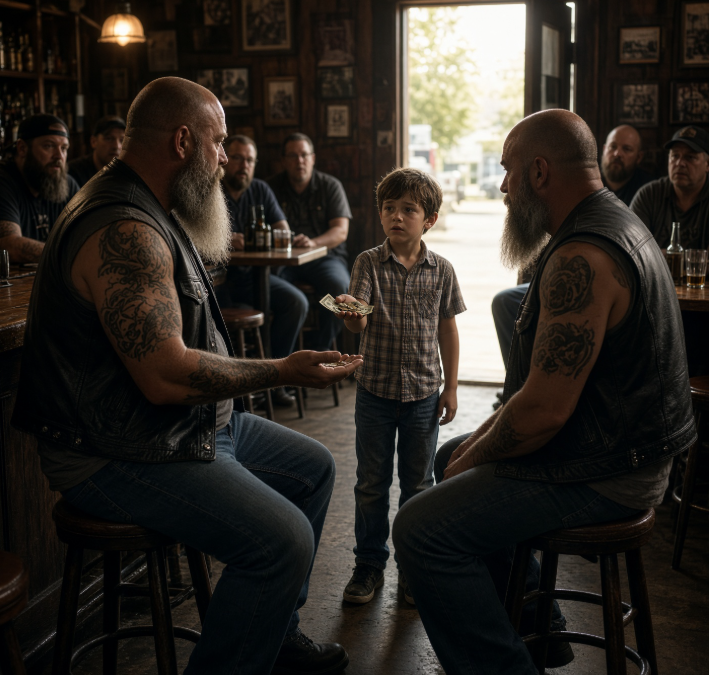
Ben unfolded the school form.
It took him a moment because his hands shook.
Father-Son Day.
Saturday.
A morning of games, lunch, and a birdhouse project on the elementary school field.
A line near the bottom read:
Accompanying Adult: ___________________________
Parent/Guardian Signature: _______________________
The adult line was blank.
Ben smoothed the paper carefully, as if creases might make his problem harder to solve.
“My teacher asked me Monday,” he said. “Then Tuesday. Then this morning.”
His face reddened.
“I didn’t know what to write.”
Cal looked at the form.
Then at Ben.
“Your dad can’t come?”
Ben’s eyes dropped to the table.
“He died.”
No one moved.
The boy said it plainly.
Not because it did not hurt.
Because he had probably learned that if he said it too slowly, adults reacted in ways that made everything worse.
Cal did not say he was sorry.
Not yet.
He waited.
Ben continued.
“I don’t need you to say you’re really him. You could just come with me.”
His fingers touched the little pile of money.
“I can pay eleven dollars.”
I looked around the room.
Vince had turned toward the window.
Dale had his hands clasped between his knees.
Marcus, who had once spent two years pretending grief had not cracked him open after his brother died, stared down at his plate like it had accused him of something.
Cal leaned his forearms on the table.
“What did your dad do?”
Ben looked up.
“Fixed things.”
That answer came fast.
Certain.
The kind of answer children give when a person’s work is part of their shape in memory.
“Cars?” Cal asked.
“And lawn mowers. And motorcycles. And Mr. Padilla’s snowblower even though it was summer and Mom said that was ridiculous because nobody needed it.”
A few men smiled.
Ben saw the smiles and seemed encouraged.
“He had a garage. Not like this.”
He looked around the bar.
“I mean, it wasn’t a bar.”
“No,” Cal said. “Most garages aren’t.”
“My dad’s had two big doors. And an office in the middle that smelled like coffee and old paper. He had a drawer with bolts in little boxes. He could tell which one I took without looking.”
“How?”
Ben shrugged.
“He just knew.”
“What was his name?”
“Daniel Mercer.”
The air left the room.
At least, that is how it felt.
Cal did not move.
Not at first.
Then his eyes lifted toward the front windows as if Daniel Mercer might be standing on the sidewalk outside, older now, wiping grease from his hands with a rag and wondering why everyone had gone quiet.
Vince pushed back his chair.
So did Dale.
Then Marcus.
Then everyone.
No one had planned it.
No one gave an order.
Men who had been half-slouching over lunch stood up because Daniel Mercer’s name had entered the room and some part of them understood before Ben did that respect had become necessary.
Ben startled.
He gathered the money quickly in both hands.
“Did I do something wrong?”
Cal shook his head.
His voice, when it came, was rough.
“No, son.”
He sat back down slowly.
“Your dad did something for me once.”
Ben stared at the biggest man in the room, still holding the eleven dollars he had brought to hire him.
“What?”
Cal looked at the table.
Then at me.
Then back at Ben.
“When I was eighteen,” he said, “I owned a Harley that looked better from twenty feet away than it did up close.”
A few of the older riders smiled because they knew exactly which bike he meant.
Cal still owned it.
Old black machine.
Scuffed tank.
Stubborn engine.
A dent near the left side that Daniel Mercer once told him not to fix because repairing it would cost more than the dent deserved.
“I bought it with money from warehouse shifts,” Cal said. “Every dollar I had. Rode it three weeks before it refused to start outside a gas station.”
Ben leaned forward slightly.
“I pushed that bike nearly a mile to Mercer’s shop.”
“My dad’s shop?”
“Yes.”
Cal’s eyes softened.
“Your dad was closing for the day. Had somewhere to be. Didn’t matter. He rolled that bike inside and told me to hold a light.”
Ben’s grip on the money loosened.
“He fixed it?”
“He found a loose connection. Then two other things I needed to watch. He explained everything without making me feel stupid, which was good because I was stupid.”
Ben frowned.
“You were?”
“Deeply.”
Vince muttered, “Still are some days.”
Cal pointed at him without looking away from Ben.
“Quiet.”
Ben almost smiled.
“When I asked how much I owed him,” Cal continued, “your dad handed me a rag and said, ‘You can pay me by keeping it running.’”
Ben stared.
“He didn’t charge you?”
“Not a cent.”
“He did that sometimes.”
“I heard.”
“Mom said the shop couldn’t run like that forever.”
“Your mom was right.”
Ben looked down, and something like pride moved across his face.
The kind of pride that hurts because the person who earned it is no longer there to see it.
Cal continued.
“He made me stay another half hour so I could learn where the connection was and how to check it myself. I came back a week later to thank him. Then again the next month when the bike made a sound I didn’t recognize. He showed me how to listen before taking anything apart.”
Ben’s eyes lifted.
“My dad said machines tell you things if you listen.”
Cal’s face changed.
“He told me that too.”
The boy sat very still.
Children do not always understand money or paperwork or adult grief, but they understand when a lost person has suddenly stepped back into the room through someone else’s memory.
“Did you know him a lot?” Ben asked.
“For years.”
“Were you friends?”
Cal thought before answering.
“I was a kid who kept needing help. Your dad kept letting me come back.”
That answer seemed to matter more than a quick yes would have.
Ben nodded.
“My dad let people come back.”
The front door opened hard enough that the bell slammed against the frame.
A woman came in so quickly the door nearly hit the wall.
Work clothes.
Hair pulled back.
Face pale with fear and anger.
Ben jumped from his chair.
“Mom!”
She crossed the room in three strides and dropped to her knees, wrapping both arms around him so tightly that his feet almost left the floor.
For a moment, there was no scolding.
No questions.
Just a mother making sure the child in front of her was real.
Then she pulled back and checked him the way terrified parents check.
Face.
Hands.
Arms.
Eyes.
“Are you hurt?”
“No.”
“Did anyone touch you?”
“No.”
“Did you get off the bus alone?”
“Yes.”
“Benjamin Mercer.”
His eyes filled.
“I’m sorry.”
“We are going to talk about the bus at home.”
“I know.”
She held his shoulder with one hand, like she feared he might vanish if she let go.
I introduced myself and explained how we had called her immediately.
She nodded, still breathing hard.
Cal stood several feet away, not pushing into their reunion.
Only when Leah looked up at him did he speak.
“Ma’am.”
She studied him.
“You knew Daniel?”
Cal’s throat moved.
“For a long time.”
Her face changed slowly.
Then she said, “Daniel talked about a kid with an old Harley who kept coming back to learn repairs.”
The entire room watched Cal absorb that.
“He did?”
“He said the kid acted tough but listened better than most grown men.”
Vince whispered, “That part sounds false.”
Leah looked toward him.
Vince cleared his throat and studied the ceiling.
Cal’s mouth trembled once before he got it under control.
“I didn’t know he remembered me that way.”
“He remembered everybody who wanted to learn,” Leah said.
Ben carried his form to her.
“I asked if one of them could come Saturday.”
Leah looked at the paper.
At the blank line.
Her face softened and tightened all at once.
“I know about Father-Son Day.”
“I didn’t know who to write.”
“I told you I could go.”
“I know.”
“You said you wanted me at your soccer game next week.”
“I do.”
“But this felt different.”
Ben nodded without looking up.
“I didn’t want people to ask.”
Leah closed her eyes briefly.
Not because she was angry now.
Because she understood too late the size of the thing her child had been carrying alone.
She sat with him at our quieter back table.
Cal asked if he could sit too.
Leah nodded.
He did not offer to sign the form in the middle of the room.
That mattered.
I loved him for it later.
At that table, Cal asked what the event involved, what Ben wanted from it, whether the school allowed another trusted adult, and what Leah needed before she could feel safe even considering the idea.
Ben watched the adults make a plan, the eleven dollars still cupped in his hands.
The hardest moment came after Leah called the school.
The principal’s office confirmed the event allowed a father or another approved adult. There was still time to add a name. The school would need the adult’s full name and phone number.
Leah put the phone down.
“Cal could be considered,” she told Ben, “if we all agree.”
Ben’s face opened with such naked hope that half the men in the room had to look elsewhere.
Cal saw it too.
For one dangerous second, I thought he would say yes before anyone finished speaking.
He did not.
He held back.
Leah had met him only minutes earlier.
Ben had ridden forty minutes on a bus without permission.
Even a good offer, made in that room for all the right reasons, still had to become safe and sensible outside it.
Cal folded his hands.
“I’d like you and your mom to come by the garage tomorrow,” he said. “In daylight. Meet a couple of people. Look around. Ask anything you want. Then your mom decides.”
Ben frowned.
“But Saturday is soon.”
“I know.”
“What if you change your mind?”
“I won’t change my mind about wanting to help. But being someone’s grown-up for a school event means talking to the parent first.”
Ben considered this.
He looked at Leah.
She nodded.
“Okay,” he said reluctantly.
When Leah stood to take him home, Ben held out the eleven dollars again.
Cal gently folded the boy’s small hand closed around it.
“Keep track of it for me.”
Ben looked uncertain.
“So you’ll still come?”
“If your mom says yes after tomorrow, I’ll come.”
“You don’t need the money first?”
“No.”
“But it’s the deal.”
Cal’s face softened.
“Then you hold it safe until we know exactly what kind of deal we’re making.”
Ben took that seriously.
He counted the money in Leah’s car, she told us later, and put it into an envelope under his pillow.
He was afraid if he spent even one coin, Cal would decide the agreement no longer counted.
The next morning, Leah brought Ben to the garage.
Not the bar side.
The real garage.
We had cleared the front workbench and put away anything a child could reach without understanding what it did. Vince made coffee. I found a stool high enough for Ben to see over the bench. Leah stayed the whole time.
Cal was different that morning.
Still big.
Still leathered.
Still Cal.
But careful in a way I had seen only around skittish dogs and grieving people.
He did not perform.
Did not try to become funny Uncle Bear.
Did not crowd Ben with affection.
He simply showed him the garage.
The wall of tools.
The parts drawers.
The oil-stained floor.
The row of bikes along the back.
Then he led him to the old Harley.
Ben stopped.
“This one?”
“This one.”
It had changed over the years, of course.
Newer tires.
Rebuilt parts.
Better wiring.
But the worn patch on one side of the tank remained, as did the small dent Daniel had once advised Cal to leave alone.
Ben ran one finger just beside it.
“My dad fixed this?”
“More than once.”
“Did he ride it?”
“Once around the block after a repair.”
“Was he good?”
“He rode like a man who wanted to get back to work.”
Ben smiled.
That sounded like Daniel, even to me, though I had never met him.
Cal showed him an old photograph from a charity ride.
Daniel stood at the edge of the group in a plain work shirt, half turned toward somebody outside the frame. Ben recognized him immediately.
“Dad.”
Leah had never seen the photograph.
She took the phone from Cal with shaking hands when he sent her a copy.
“He never showed me this.”
“He didn’t like having his picture taken,” Ben said.
Leah gave a broken laugh.
“No. He didn’t.”
The visit lasted nearly two hours.
Ben asked whether every motorcycle in the garage belonged to a biker, how many tools were in Vince’s drawer, why the floor had dark marks that never washed out, and whether Cal had ever crashed.
Cal answered what he knew.
When Ben asked about something dangerous, Cal moved him to a safe distance first.
Leah watched everything.
Not passively.
She watched the way a mother watches when deciding whether trust can be built.
Near the end, she asked Cal to step outside.
I could see them through the open garage door but not hear them.
Later, Leah told me what she had said.
Daniel had been ill for months before he died.
Ben remembered parts of that time vividly and other parts barely at all. Sometimes he spoke about his father easily. Other times one innocent question could silence him for the rest of the day.
Leah wanted Cal to let Ben decide how much to say at school.
No pushing.
No speeches.
No making Daniel into a lesson.
No promises like “anytime” or “always” unless Cal meant them in the practical, calendar-checking, phone-calling way children actually need.
Cal agreed.
When they returned, Ben was sitting beside the Harley with a folded cloth in his lap.
He had asked Vince if he could wipe dust from the rear light.
Vince had given him one safe area and stayed beside him.
Cal waited until Leah nodded.
Then he crouched beside Ben.
“You still want me to come to Father-Son Day?”
“Yes.”
“Then I’d like to come.”
Ben reached into his pocket.
Cal said, “We can talk about the money later.”
Ben took out the eleven dollars anyway and set it on the workbench.
He had counted it three times that morning.
Leah unfolded the school form.
On the line for accompanying adult, she wrote Cal’s full name.
Calvin Rourke.
Then his phone number.
Ben watched every letter.
“Can I write Bear in parentheses?”
Cal looked at Leah.
Leah looked at Ben.
“Is that what you want to call him?”
Ben nodded.
Cal said, “The school will probably want the name on my ID. But you can call me Bear.”
Ben wrote it carefully beside Cal’s name.
(Bear)
The word spread through the club that afternoon.
Of course it did.
No secret survives a motorcycle garage where half the members pretend not to gossip and the other half do it professionally.
Dale said he could help carry supplies at the event.
Vince said he might come watch the games from outside the school fence.
Marcus asked whether the school needed chairs.
Three more riders offered to escort Cal like Ben was royalty.
Lena—me—pointed out that the school had a schedule, limited space, and probably no desire to have thirty leather vests descend on an elementary field unannounced.
Cal pointed at me.
“Listen to her.”
Dale groaned.
“She always ruins the fun with sense.”
“It’s a gift,” I said.
Cal called the principal.
The principal, to her credit, did not panic when he explained who he was and what had happened. She welcomed volunteers for setup and cleanup, but guests had to register in advance. No surprises. No crowding Ben. No motorcycles blocking school traffic.
By Friday, twenty-two riders had signed up for short volunteer shifts or been approved as guests.
Leah knew the number.
Ben did not.
Friday evening, Ben laid out the same button-down shirt he had worn to the bar.
Leah fixed the mismatched buttons and ironed it while he slept.
Before bed, he asked whether Cal would recognize him without the eleven dollars in his hand.
Leah told him she thought Cal would recognize him anywhere.
Saturday morning came gray and damp, with low clouds over town and a strip of wet pavement along Route 31.
I arrived at the school early to help set up folding tables.
Teachers were carrying craft supplies toward the field. The principal checked names against the volunteer list and directed us to the far edge of the parking lot.
Cal arrived alone before everyone else.
He had left his louder bike at the garage and ridden the old Harley Daniel had repaired.
He parked, took off his helmet, and stood for a minute looking at the school doors.
I knew him well enough not to fill the silence.
Finally, I said, “You nervous?”
He looked at the old Harley.
“I want to get the first part right.”
“What’s the first part?”
“Find Ben. Say hello to Leah. Follow their lead.”
That was Cal.
People imagined bikers as men who solved things with engines, noise, and fists.
Cal knew most important things began quietly.
Ben came through the school doors holding Leah’s hand.
Over his clean shirt, he wore a small black leather vest.
No club emblem.
No patches pretending he belonged to something Leah had not approved.
Just a small, simple vest with soft lining so it would not scrape his neck.
Lena’s sister had made it overnight after Leah said yes to the idea. There was room for Ben to grow.
He kept touching the front as if making sure it was still there.
Cal crouched beside the old Harley.
Ben saw the dent in the tank.
His whole face changed.
“You brought Dad’s bike?”
Cal shook his head gently.
“My bike. Your dad just helped make sure it kept becoming my bike.”
Ben considered that.
Then nodded.
Leah took a photograph of them beside it.
Cal did not put his arm around Ben without asking.
Ben did not ask.
They stood close enough.
Then Cal said, “Where do we go first?”
Ben pulled the schedule from his pocket.
He had folded it exactly twice.
“We sign in. Then relay. Then birdhouse table. Then lunch. Then the other game if we’re not tired.”
“We?”
Ben looked at him seriously.
“You’re old.”
Cal barked a laugh.
Behind them, Vince nearly choked.
The rest of the riders arrived in small groups.
Twenty-two Harleys filled the designated row at the edge of the lot. Volunteers signed in and went to work carrying water, setting out craft supplies, and moving tables where the ground stayed firm. Several parents stared until they saw Marcus patiently taping down a tablecloth while Vince tried and failed to fit a paper cover onto the birdhouse table.
The school day did not become about us.
That mattered.
Children were looking for their own adults.
Teachers were managing the schedule.
The first game began whether or not we had found all the hammers.
That helped Cal.
He could be there with Ben rather than spend the morning being thanked by strangers.
Their relay went terribly.
Cal was fast over a short distance, but he missed a turn while Ben shouted directions.
“No! Around the cone! Bear! The cone!”
Cal turned too late and nearly took out a folding chair.
They finished behind most of the pairs.
Ben laughed so hard he had to sit on the grass.
Cal stood over him breathing hard.
“I blame unclear instructions.”
“I said cone!”
“There were many cones.”
“There was one orange cone!”
“I’m colorblind when betrayed.”
Ben rolled onto his back, laughing harder.
Leah watched from the shade tent with one hand over her mouth.
I could not tell whether she was laughing or crying.
Probably both.
At the birdhouse table, they were quieter.
Cal held the pieces steady while Ben decided which side should face out. Daniel had taught his son to turn a screw a little way, check whether it was straight, and only then keep going.
Ben remembered the lesson at exactly the right moment.
“Dad always did it this way.”
The words changed the air between them.
Cal did not rush past it.
He handed Ben the screwdriver.
“Show me.”
Ben did.
His small hand turned carefully.
A little.
Stop.
Check.
A little more.
Cal watched like he was being taught something sacred.
Maybe he was.
I was passing with a box of supplies when I saw Leah under the shade tent.
She had worried that spending a day beside Cal might make Daniel’s absence sharper for Ben.
Some moments did.
Ben paused when another child shouted “Dad!” across the field.
His hand tightened around the screwdriver.
Cal noticed.
He did not speak.
He simply stayed.
After a moment, Ben returned to his birdhouse.
Cal held the wood steady again.
That was the whole promise, really.
Not fixing grief.
Staying near it without making it perform.
At lunch, Ben asked why Cal still kept the old Harley.
Cal wiped mustard from his beard and said, “It was the first expensive thing I ever had to be responsible for. Your dad helped me learn how.”
Ben looked down at his sandwich.
“Did he charge you for the first repair?”
“Not a cent.”
“He didn’t charge people sometimes.”
“That’s what I heard.”
“He told Mom the shop couldn’t run like that forever.”
Cal laughed.
“Your mom was right.”
Ben smiled.
Then he asked the question I think he had been carrying all morning.
“Was my dad a good mechanic?”
Cal answered without hesitation.
“Yes.”
Ben waited.
Cal understood the real question beneath it.
“He was a good man too.”
Ben’s eyes dropped.
Cal continued.
“He noticed when a young man needed to learn something more than he needed a bill.”
For a moment, Ben said nothing.
Then he nodded once, as if storing that sentence somewhere important.
A few children came to look at Ben’s vest.
One boy asked whether all twenty-two riders were his dads.
Ben gave the question serious thought.
“No,” he said. “That’s Bear. Those are his friends.”
It was a small distinction.
It mattered.
Cal had come for Ben.
The rest of us came because the school needed help and because Daniel Mercer had once made room for our friend.
Ben did not have to claim a roomful of fathers to justify asking one adult to attend.
Near the end of the event, the principal thanked the volunteers over the portable speaker. She named the local groups that had helped. Ben stood beside Cal with the crooked birdhouse under his arm. When the riders applauded the children, he looked at the row of leather vests and then at Leah.
She waved.
After cleanup, Ben led Cal behind the craft tent.
I saw the envelope in his hand.
The eleven dollars.
Cal sat on the edge of a folding chair.
Ben held out the money.
“I brought it.”
“I know you did.”
“You came.”
“I did.”
“So this is yours.”
Cal looked at the bills and coins in Ben’s small palm.
He understood what refusing outright would do.
To us, it was payment.
To Ben, it was proof the agreement was real.
Cal said, “I can’t accept money for spending the day with you.”
Ben’s face fell.
“But—”
Cal continued quickly.
“I know you saved it. Could you let me keep it somewhere safe, and we decide together what to do with it?”
Ben studied him.
“You’ll know it’s mine?”
“I’ll put your name beside it.”
“You won’t spend it?”
“No.”
“You won’t put it with other money?”
“No.”
Ben considered that.
Then he placed the bills and coins in Cal’s hand.
After a moment, he asked the question he had been holding back all morning.
“Would you come to another school thing if I asked?”
Cal glanced toward Leah.
She stood a few steps away, close enough to hear.
Cal chose his words with care.
“If your mom says yes and I can make it, I will. Ask me early so I can put it on my calendar.”
A careful promise.
A real one.
Ben seemed satisfied.
He ran to show Leah the birdhouse, leaving Cal with eleven dollars and a responsibility far heavier than the money.
The story traveled around town faster than our club liked.
Someone who saw the motorcycles in the school lot posted a picture of the parking row and wrote that twenty-two bikers had shown up for one fatherless boy.
People shared it with generous comments.
Then the requests began.
Who was the boy?
Could they see his face?
Was there a video?
What happened to his dad?
Could the bikers come to their school?
Could somebody interview him?
Leah said no.
Cal said no louder.
We took down our own club post and asked every member not to identify Ben.
He had enjoyed his Saturday.
He had not asked to become the subject of strangers’ arguments about schools, masculinity, fathers, grief, or motorcycles.
The principal appreciated the restraint.
She had already received messages from parents asking whether riders could visit other classes without arranging it first.
Noise gathers around tender things if you let it.
Cal did not let it.
But he could not stop seeing a simpler question beneath all that noise.
How many children had forms like Ben’s with no name on them?
Lena—yes, me—had a daughter who worked with a local youth program. Through her, I knew families who struggled with events built around one particular arrangement. Father-Son Day. Mother-Daughter Tea. Donuts with Dad. Muffins with Mom. Good intentions, sometimes. Painful outcomes, often.
I brought it up at a club meeting.
“We cannot just start showing up at schools like a rescue squad for sad children.”
Dale raised a hand.
“No one said sad children.”
I stared at him.
He lowered the hand.
Leah came to one of our meetings too.
That was the night everything became real.
She stood at the front of the garage in work clothes, holding a mug of coffee Vince had overfilled because he was nervous.
She told us what had made the first visit work for Ben.
Cal had contacted her immediately.
He had asked permission.
He had let Ben set the pace.
He had spoken about Daniel as a person rather than trying to take his place.
He had made a promise with conditions instead of pretending he could always come.
“That mattered,” Leah said. “Ben has heard adults say ‘anytime’ and then disappear into busy lives. He needed someone who could say, ‘Ask me early so I can check my calendar.’ That sounds less magical. It is more honest.”
The principal visited another evening.
She explained school rules.
Guest lists.
Background checks for ongoing volunteers.
Supervision.
Boundaries.
The importance of letting children attend with whatever trusted adult they had, not forcing one title onto every child.
Some fathers were dead.
Some were deployed.
Some were incarcerated.
Some were absent by choice.
Some children had two mothers.
Some were raised by grandparents.
Some did not want to explain anything to anybody.
“If you help,” the principal said, “you help through the family and the school. Not around them.”
That became our rule.
Through, not around.
Some members wanted to sign up that night.
Lena—that would be me again—asked them to slow down.
Being willing to attend a fun Saturday was only the beginning.
A child might ask for another event.
Or might not.
A parent might decide the fit was wrong.
A volunteer might discover that showing up once felt good, but consistency felt hard.
Children do not need adults who enjoy being needed for one morning.
They need adults who understand that being needed carries consequences.
For months, we worked with the school and a local family support group.
Members who wanted to participate completed screening and training. Families chose whether to meet a volunteer. Children could say no. Events were scheduled through adults responsible for them. Nobody was asked to call a volunteer father unless the child chose that word.
The program acquired a nickname at our garage.
Backup Dads.
Leah laughed when she heard it.
“That sounds like an amateur baseball team.”
Ben loved it.
The first year was modest.
A few riders accompanied children to school breakfasts, craft days, and a community ball game. Others helped with setup so a parent working a shift could arrive late and still find a place to sit.
Vince discovered he was good at decorating cupcakes if someone else handled the frosting bag.
Dale was less good at reading picture books aloud, but he practiced after one child told him he turned pages too fast.
Ben remained close to Cal, though their plans rarely looked like the first Saturday.
Sometimes he and Leah came by the garage with dinner.
Sometimes Cal took them to a small diner Daniel used to like.
Ben learned to sort clean bolts into labeled drawers.
Cal attended a science fair after Leah asked.
He missed one soccer match because he was sick and called ahead to tell Ben.
Then he watched a recording with him the next week.
That missed game did not end their friendship.
Keeping his word about the call helped it survive.
One rainy afternoon, Leah brought in a box from Daniel’s old shop.
She had finally been ready to sort it.
Inside were photographs, receipts, a worn measuring tape, and a notebook of repairs.
Ben sat on a stool while Cal opened the book.
The pages smelled faintly of oil and paper dust.
Tucked between two pages was an entry for Cal’s first Harley.
A description of the loose connection.
A note about the wiring.
A zero in the charge column.
Beside it, in Daniel Mercer’s handwriting, were six words:
Showed him how to check it.
Cal read the line twice.
He had remembered Daniel refusing payment.
He had not known Daniel recorded the lesson as part of the work.
Leah let him keep a copy.
Ben found another entry several months later, when Cal had returned for help with a noise in the engine. Daniel had charged him for a small part but listed the labor as zero.
Ben grinned.
“Dad liked you.”
Cal looked at the paper.
“He was patient with me.”
“That means he liked you.”
Cal opened his mouth.
Closed it.
There was no argument he could make against that.
He slipped the copy into a clear sleeve and pinned it beside the garage workbench where members left repair notes.
People occasionally asked whose handwriting it was.
Cal told them.
In that way, Daniel Mercer became familiar to riders who had never met him.
That was one of the strangest gifts of all.
A dead man becoming known in rooms he had never entered because one boy brought eleven dollars through our door.
Years passed.
The program grew.
Not explosively.
Carefully.
By the time Backup Dads had been running several years, more than sixty children a year were matched with an approved club volunteer for at least one school or community event.
Some wanted a companion for a single morning.
Some families stayed in touch.
Some children decided after one meeting that the person was not right.
That was allowed.
The number did not impress Cal as much as the calendar did.
Real appointments.
Names written down.
Adults confirming schedules.
Calls made early.
Volunteers showing up when they said they would.
The eleven dollars stayed at the bar.
Cal did not spend it.
Did not put it into the club account.
He asked Ben what kind of frame he wanted.
Ben chose a plain wooden one with room for the bills, the coins, and his name written on a small card.
Leah approved the wording.
There was no photograph of Ben.
No story of Daniel’s death.
No sentimental plaque.
Just eleven dollars and a small card:
BEN MERCER
FOR ONE SATURDAY
We hung it near the back table, away from the front windows.
People who knew the story sometimes stopped to look.
New customers often thought it marked the first money our club had ever raised.
Vince liked answering that question.
“No,” he would say. “A boy brought it in to pay for one adult to attend a school event. The adult asked permission to keep the money safe.”
Every so often, Ben came in with Leah for lunch.
He checked that all the coins were still there.
When he got older, he noticed one quarter had been turned over since his last visit.
He made me take the frame down so he could put it back the way he remembered.
I told him nobody looking at it would know the difference.
He said he would.
Cal’s old Harley stood in our garage most winters.
Ben learned its parts a little at a time.
He also learned that knowing a part’s name was different from knowing when to touch it.
Cal started him with cleaning.
Listening.
Watching.
“What do you hear?” Cal would ask.
Ben would tilt his head.
At first, he heard nothing.
Then he began to hear differences.
A rough idle.
A rattle that belonged.
A rattle that did not.
He complained about wearing eye protection until he began reminding younger visitors to put theirs on.
Once a year, near Daniel’s birthday, Leah invited a few people to dinner.
Not a memorial exactly.
Not a party.
Something in between.
She told stories about Daniel that had nothing to do with engines.
How he burned toast because he read the newspaper while making breakfast.
How he sang with no tune at all.
How he could never remember where he put his keys.
Ben gradually added his own memories.
The tin of bolts.
The drawer Daniel knew he had opened.
The way his father smelled like soap and grease after work.
One year, Ben announced that Daniel had been terrible at drawing dogs.
Leah found a sketch that proved it.
Cal listened more than he spoke.
Daniel had helped him long before Ben was born.
Leah and Ben knew the man Daniel became at home.
None of them held the whole picture alone.
That, I think, comforted them.
At the next Father-Son Day, Ben asked Cal to attend again.
He asked earlier this time.
They returned to the birdhouse table, where Ben showed a younger student how to start a screw straight.
The following year, the school changed the event name to Family Build Day.
Ben chose to go with Leah because she wanted a turn.
Cal volunteered to help carry tables instead.
That afternoon, Ben came over to the parking lot with a half-built box under one arm.
“My mom measures better than you,” he told Cal.
Cal placed one hand over his heart.
“Wounded.”
“There was no relay,” Ben added, “which was fortunate for everybody.”
We kept doing the quieter work around the program.
Checking schedules.
Training volunteers.
Accepting when a family wanted someone different.
Making sure no one turned a child into a symbol.
The twenty-two motorcycles from that first Saturday made a striking picture.
But the program endured through phone calls, forms, background checks, careful introductions, and the ordinary care of getting to know a child.
Ben had started it by opening our door.
Whenever someone asked why Cal gave so much time to Backup Dads, he pointed toward Daniel’s repair note in the garage.
A man once stayed late to teach him how to fix his first Harley.
Years afterward, that man’s son came looking for an adult willing to spend a Saturday beside him.
Cal had the time.
And he knew the boy’s name.
Ben turned eleven in the spring.
He no longer wore the little leather vest Lena’s sister had made. It had become too small years earlier. Leah kept it folded in a drawer with the photograph from the first Father-Son Day.
In that picture, Ben held a birdhouse with one crooked side.
Cal crouched beside him.
The school field stretched behind them.
For his birthday, Ben asked to visit the garage.
Cal thought he wanted another lesson on the Harley.
Ben arrived carrying Daniel’s old tin of bolts and a wooden box he had made at school.
Its corners were not quite square.
“I measured twice,” Ben said, “but one piece moved while I was cutting it.”
Cal turned it over in his hands and showed him how to steady a piece for the next one.
Then Ben opened the box.
Inside was a copy of the photograph of Daniel at the charity ride, the one where he stood at the edge of the group half turned away.
Ben had found the person Daniel was looking at.
Cal.
Eighteen years old.
Standing beside his first Harley just outside the original frame.
Leah had found a second photograph taken a moment later.
Cal set the two pictures side by side on the bench.
In the first, Daniel looked away from the group.
In the second, young Cal stood near the Harley, awkward and proud, while Daniel pointed at something near the tank.
A teacher and a student.
A mechanic and a kid.
A moment nobody had known would become important.
Cal was quiet for a long time.
Ben shifted beside him.
“I thought you should have one.”
Cal cleared his throat.
“You sure?”
“I have the other.”
Leah stood near the door, watching.
Cal placed the picture beside Daniel’s handwritten repair note.
Then he rested one hand on Ben’s shoulder.
Not heavily.
Not claiming.
Just there.
“Thank you.”
Ben nodded.
That evening, after Leah and Ben had gone home, Cal and I stopped at the bar.
The eleven dollars hung where they always had.
Cal checked the frame’s corners because Ben had once noticed it was crooked.
I straightened it a little.
He stepped back to judge the distance from the door.
“Does it look right?” I asked.
He nodded.
Outside, someone started a Harley, and its engine settled into a low, familiar rumble.
For a moment, we both listened.
Engines have language if you learn them.
Daniel Mercer had taught Cal that.
Cal had taught Ben.
Maybe someday Ben would teach someone else.
I turned off the light above the back table.
The frame remained visible in the last of the window light.
Eleven dollars.
A school form.
A boy brave enough to ask strangers for help because grief had given him a problem too large for a child.
People like to tell this story as if it is about bikers.
It is not.
Not really.
It is about a father who stayed late at his garage for a broke eighteen-year-old and wrote the lesson down like it mattered.
It is about a mother who loved her son enough to be careful with help, even when help looked kind.
It is about a boy who wanted one adult beside him, not twenty-two men pretending to replace someone irreplaceable.
It is about a club learning that showing up is not the same as showing off.
And maybe it is about debts that do not behave like debts.
Daniel Mercer never asked Cal for money.
He asked him to keep the bike running.
Cal did.
For decades.
Then Daniel’s son walked through our door with eleven dollars in his fist.
Cal could not pay Daniel back.
The dead are beyond repayment.
But he could keep something else running.
A boy’s trust.
A mother’s permission.
A memory.
A promise made carefully enough to survive.
Years later, when new volunteers join Backup Dads, Cal still tells them about Ben.
Not his full story.
Not his private grief.
Just what they need to understand.
“You are not there to become somebody’s father in a day,” he says. “You are there because a child has a place beside them that morning, and an adult has agreed you may stand in it. Stand carefully.”
Then he points toward the repair note.
“Anybody can fix a machine,” he tells them. “People take more work.”
The younger riders used to think Cal invented that.
He always corrects them.
“No,” he says. “A better man taught me.”
The last time I saw Ben check the eleven-dollar frame, he was taller than Leah.
Not grown, but growing.
The little boy who once asked whether Cal would recognize him without money in his hand had become a kid with longer arms, bigger shoes, and the same serious eyes.
He stood near the back table for a long moment.
Cal came up beside him.
“All there?”
Ben counted silently.
“Yeah.”
“Quarter facing the right way?”
Ben glanced at him.
“It matters.”
“I know.”
They stood without speaking.
Then Ben said, “Do you think Dad would think this is weird?”
Cal looked at the frame.
Then at the garage side where Daniel’s repair note hung.
“Probably.”
Ben smiled.
“Yeah.”
“He’d also probably say the frame is crooked.”
“It is a little.”
“I knew it.”
Ben reached up and straightened it.
Cal let him.
That was the thing about grief we all learned from that boy.
Sometimes healing is not a grand moment.
Sometimes it is adjusting a crooked frame that holds eleven dollars you once offered to pay someone to stand beside you.
Sometimes it is hearing one more story about the person you lost.
Sometimes it is discovering your father helped people before you were born, and those people still remember.
Sometimes it is learning that nobody can be replaced, but someone kind can still show up with permission, patience, and a calendar.
The day Ben first walked into our bar, he thought he was buying a father for one Saturday.
He was wrong.
Not because he got more than he paid for.
Because love was never something Cal could sell him.
What Ben bought with those eleven dollars—if bought is even the word—was a question placed bravely in the middle of a room.
Can someone stand with me?
Cal’s answer began that day.
Daniel’s answer had begun years earlier in a little repair shop off Route 31, when he fixed a used Harley for a young man with no money and made him stay long enough to learn.
Everything after that was just the sound of one good deed still running.








