A 7-Year-Old Boy Collapsed From His Broken Bicycle in Front of 300 Bikers—Then Their Leader Saw the Marks He’d Been Hiding and Asked Him One Question No Adult Had Asked Before.
PART2:
She let him sit in the corner by the window and read until the words became a door he could walk through.
On library mornings, Ethan could pretend his life was about maps, storms, treasure, and boys who made it home.
He made it halfway down Montezuma Street before the world began to tilt.
At first, he thought it was the bicycle.
The chain caught, slipped, caught again.
His legs felt watery.
Sweat ran down his back, but his skin felt cold.
He had eaten a peanut butter sandwich the night before, but nothing that morning. He had meant to grab cereal, but the box was empty.
His stomach had stopped complaining hours ago, which he knew from experience was worse than hunger.
Then he heard the motorcycles.
Not one.
Hundreds.
The sound rolled through downtown Prescott like thunder trapped between buildings.
Ethan coasted around the corner near the old lodge and almost stopped breathing.
Motorcycles lined both sides of the street.
Chrome flashed in the morning sun.
Leather saddlebags hung from big touring bikes.
Helmets sat on seats.
Men and women in vests stood in groups outside coffee shops and storefronts.
Some had tattoos up their arms.
Some wore bandanas.
Some leaned against bikes with faces that looked carved by weather and years.
Dale had talked about motorcycle clubs before.
“You stay away from people like that,” he said once, pointing at a television screen. “They don’t play.”
Ethan wanted to stay away.
But the library was on the other side of them.
He gripped the handlebars and pedaled.
For forty yards, he was almost invisible.
Just a little boy on a broken bike, weaving through a charity ride gathering before departure.
Then the chain slipped again.
His foot plunged down too hard.
The front wheel struck a pothole.
His vision narrowed to a bright white tunnel.
For one strange second, he felt weightless.
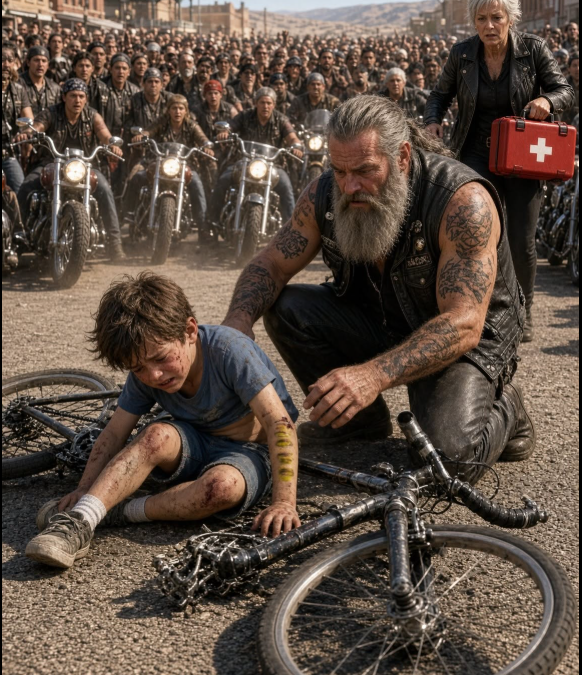
Then the pavement came up and hit him.
PART3:
His palms scraped across asphalt.
His knee tore open.
His shoulder slammed down.
Pain burst fresh and sharp across his body, then sank into the older pains already living there.
The bike skidded away, rear wheel spinning.
Ethan lay still.
Don’t cry.
That was the first rule.
Crying made Dale angrier.
Crying made his mother panic.
Crying made teachers ask questions he was not brave enough to answer.
So Ethan swallowed the sound, pushed one hand under himself, and tried to rise.
The engines went silent.
All of them.
Ethan lifted his head.
Three hundred riders were looking at him.
The first man to reach him was enormous, with a gray beard down his chest and shoulders wide enough to block the sun. His leather vest was covered in patches, and when he knelt, the whole street seemed to kneel with him.
“Easy, little man,” the man said.
His voice was deep but gentle.
“That was a rough landing. You with me?”
Ethan nodded automatically.
“I’m fine,” he said.
The lie came out fast because it always did.
The man’s eyes moved to Ethan’s palms, bloody and full of grit.
Then his gaze traveled up Ethan’s arm.
Ethan saw the moment he noticed.
The fresh scrapes were obvious. Anyone could see those. But the big man was not looking at the scrapes anymore. He was looking at the marks around Ethan’s wrist, yellow-green and shaped like fingers. He was looking at the older bruise on his upper arm. When Ethan shifted, his shirt lifted just enough to show the dark edge of the bruise on his ribs.
The man’s face did not change much.
That scared Ethan more than if he had shouted.
“What’s your name, son?” the man asked.
“Ethan.”
“Ethan. I’m Duke Harrington.”
A woman with short silver hair and a first aid kit pushed gently through the gathered riders. She was older, maybe around his grandmother’s age if he had one, and she moved with the calm speed of someone who had patched up people in worse places than a downtown street.
“This is Rachel,” Duke said. “She used to be a nurse. She’s going to clean up your hands if that’s all right.”
Ethan looked at the blood on his palms.
He wanted to say no.
No meant less attention.
No meant the moment ended faster.
But Rachel was already crouching, opening the kit.
“I’ll be careful, sweetheart,” she said.
The word sweetheart almost made him cry.
He hated that.
He stared at the ground while she cleaned gravel from his skin.
The antiseptic stung.
His jaw locked.
He did not make a sound.
Rachel talked while she worked.
She talked about the ride, about how they were supposed to be raising money for children’s programs in Yavapai County, about how Duke drank coffee like it was a dare, about how she had once patched up a grown man who cried louder over a paper cut than Ethan did over both palms.
A few riders laughed softly.
Ethan almost smiled.
Then Rachel’s thumb brushed his wrist, and he pulled back.
She paused.
Her eyes met Duke’s.
The look that passed between them was quiet and heavy.
“Ethan,” Rachel said, “some of these marks aren’t from the bike, are they?”
Ethan tugged his sleeve down.
“I fall a lot.”
Duke’s jaw tightened.
Rachel finished bandaging his palms.
“When did you eat last?”
That question confused him.
Adults asked about homework, chores, where his mother was, why his shirt was dirty.
They did not usually ask about food unless they were angry about how much it cost.
“Last night,” Ethan said.
“What did you have?”
“A sandwich.”
“And before that?”
He tried to remember.
School lunch Friday.
Maybe macaroni.
Maybe chicken nuggets.
The days blurred when he was hungry.
He shrugged.
The movement hurt his ribs, and he could not hide the wince.
Duke saw that too.
“Change of plans,” Duke said.
His voice was not loud, but it carried across the street.
Within twenty minutes, Ethan was sitting at an outdoor table beside the Lone Spur Cafe with more food in front of him than he had seen in days.
Pancakes.
Eggs.
Toast.
Bacon.
Orange juice.
Water.
A breakfast burrito someone insisted was the best in Prescott.
The riders kept a respectful distance, forming a loose circle that somehow made the crowded sidewalk feel safer instead of smaller.
Ethan ate carefully.
Small bites.
Eyes down.
Waiting for someone to say enough.
Nobody did.
Duke sat across from him with a cup of black coffee.
“You said you were headed to the library.”
Ethan nodded.
“What are you reading?”
“A book about a boy who sails across the ocean.”
Duke leaned back.
“The one with the homemade raft?”
Ethan looked up, surprised.
“You know it?”
“Read it with my grandson last Christmas. Tyler. He’s about your age. He likes adventure books too.”
For a few minutes, Ethan forgot to be scared.
He told Duke about the book.
Not all at once.
In little pieces.
The raft.
The storm.
The map.
The part where the boy almost turns back but keeps going because he realizes the island he is searching for might be real.
Duke listened like every word mattered.
That was new.
Nearby, Rachel stepped away to make a phone call. She stood with one hand over her ear, speaking low and fast. Ethan watched her. He could feel adults shifting around him, the way air changes before bad weather.
When Rachel returned, she touched Duke’s shoulder.
“They’re sending someone,” she said quietly. “Emily Prescott. Four minutes out.”
Duke nodded.
Ethan’s fork stopped halfway to his mouth.
“Am I in trouble?” he asked.
Duke set his coffee down.
“No, Ethan.”
“Dale says when people come, it’s because I talked too much.”
“Dale is wrong.”
Ethan looked toward the street, where his bike lay near a young rider kneeling beside it with tools.
“Then why is everybody being nice?”
The question quieted the table.
Duke leaned forward, elbows on his knees.
“Because that’s what people are supposed to do,” he said. “Sometimes the world forgets. Sometimes grown-ups get busy or scared or lazy, and they forget a child standing right in front of them. But not today.”
Ethan did not know what to do with that answer.
So he took another bite of pancake.
A younger rider named Brandon Steel fixed the bicycle without being asked.
He straightened the handlebars, adjusted the chain, and rewrapped the grips with new tape bought from a hardware store down the block.
“You don’t have to fix it,” Ethan said.
Brandon glanced up.
“I know.”
“Then why are you?”
Brandon’s hands slowed.
He was maybe twenty-five, with close-cut hair and eyes that looked older than the rest of him.
“When I was your age, my bike was the only thing that could get me somewhere else,” he said. “Figured yours might be important too.”
Ethan looked down at his plate.
“It goes to the library,” he whispered.
“Then it better work.”
By the time the white sedan arrived, Ethan’s hands were bandaged, his stomach was full enough to hurt a little, and three hundred bikers had quietly rearranged their entire day around him.
Emily Prescott stepped out of the car wearing slacks, a light blue blouse, and an ID badge clipped to a lanyard. She had kind eyes behind wire-frame glasses and a calmness that felt practiced but not fake. She introduced herself as a social worker with Yavapai County Department of Child Safety.
“No relation to the town,” she said, with a small smile that made Ethan think she had said it many times.
She did not start with the bruises.
She asked about his bike.
She asked about the library.
She asked whether his hands hurt.
She asked if he wanted another napkin for the syrup on his shirt.
Then, gently, she asked if she could see his arms.
Ethan looked at Duke.
Duke gave him a small nod.
Not pressure.
Permission.
Ethan rolled up his sleeves.
Three hours passed in fragments.
Emily’s voice.
Rachel’s hand on his shoulder.
Duke standing nearby like a wall that had chosen his side.
A police officer taking notes.
Someone calling his school.
Someone else speaking to Mrs. Callaway.
Sarah arriving in the back of a patrol car, not handcuffed, but pale and shaking, her hair unbrushed and her eyes huge when she saw him sitting at the table surrounded by leather vests and bandaged kindness.
“Ethan,” she whispered.
He did not know whether to run to her or hide.
Sarah stopped six feet away, arms wrapped around herself.
Then she saw the bruises uncovered, the bandages, the plate of food, the social worker, the riders standing silent behind her son.
Her face crumpled.
“I couldn’t stop him,” she said.
It came out so small that only the nearest people heard.
Emily stepped toward her.
“Sarah, I need you to tell the truth now.”
Sarah covered her mouth.
For months, she had survived by minimizing.
Dale was stressed.
Dale had been drinking.
Ethan was clumsy.
She would leave when she had money.
She would protect him next time.
She would fix it tomorrow.
Tomorrow had become a place where cowards stored promises.
Now three hundred strangers were looking at her son, and every excuse she had built fell apart.
“He hurt him,” Sarah said, sobbing quietly. “He hurt both of us. I tried to keep Ethan away from him. I tried. But I kept staying.”
Ethan stared at his mother.
He had wanted her to say it for so long.
Now that she had, he felt both relieved and heartbroken.
Duke did not comfort Sarah.
Not yet.
His sympathy belonged first to the child.
Dale Weston was arrested at a gas station in Chino Valley just after noon.
He did not resist.
According to the officer, he looked more annoyed than afraid, as if consequences were an inconvenience other people had invented.
When told he was being detained in connection with suspected child abuse and domestic violence, Dale laughed.
“That kid falls over air,” he said. “Ask anybody.”
The officer looked at the warrant paperwork, then at Dale’s hands.
“I think we’ll ask a judge.”
Back in Prescott, Ethan’s world had become the picnic table outside the Lone Spur.
His bicycle stood beside him, repaired.
A new paperback adventure book lay next to his plate.
Rachel kept refilling his lemonade.
Brandon pretended not to watch for Ethan’s reaction every time he glanced at the fixed bike.
Emily spoke with Sarah for a long time.
When they returned, Sarah looked destroyed, but there was something in her eyes Ethan had not seen in months.
Not confidence.
Not peace.
Something smaller and rawer.
A decision.
“There’s a family support center in Prescott Valley,” Emily told Duke. “Residential program. Mothers and children leaving violent homes. They have an opening. Sarah agreed to go.”
Duke nodded.
“What do they need?”
“Transportation. Clothing. Toiletries. A few familiar things if Ethan wants them. The center provides essentials, but the first night is always hard.”
Duke turned toward the street full of riders.
These men and women had come to town for a charity ride. They had planned a route, lunch stop, donation ceremony, and photos. Instead, they had spent their morning standing guard around a boy with bandaged hands while the truth climbed into daylight.
Duke raised his voice.
“You heard her.”
No one had to ask what he meant.
Within minutes, the charity ride had become an escort.
Three hundred motorcycles followed Emily’s sedan toward Prescott Valley. Ethan sat in the back seat beside his mother, watching the bikes fill the road behind them in the mirror and ahead of them through the windshield. His bicycle was strapped to the roof with bungee cords Brandon had produced from somewhere.
Sarah held his hand in both of hers.
She kept crying.
Not loud.
Not the kind of crying that frightened him.
The quiet kind.
“Mom?” Ethan said.
She turned quickly.
“Yeah, baby?”
“Are we going back?”
Sarah looked out at the motorcycles around them.
“No,” she said.
Her voice shook, but it did not break.
“We’re not going back.”
At the Prescott Valley Family Support Center, two counselors and a program director waited outside.
The building was plain, tan stucco with clean windows and a small courtyard. Nothing about it looked magical. But the room they gave Sarah and Ethan had two beds, folded towels, a small desk, and a door that locked from the inside.
Ethan tested it three times.
Click.
Open.
Click.
Open.
No one yelled.
No one told him to stop.
Sarah sat on one bed and watched him with tears on her face.
“I’m sorry,” she said.
Ethan looked at her.
She had said sorry before.
Sorry after Dale yelled.
Sorry after she slept too long.
Sorry when there was no dinner.
Sorry when she promised things would change and then Dale came home.
This one sounded different because there was nowhere for it to hide.
“I should have protected you,” she said. “I was scared, and I stayed. That was wrong. You were the child. I was the mom. I’m going to get help now, Ethan. I’m going to do the work.”
He wanted to forgive her immediately.
He wanted to stay angry forever.
Both feelings sat inside him, too big for his small chest.
“I’m tired,” he said.
Sarah nodded, crying harder.
“Okay. You can be tired.”
Most of the riders stayed outside in the parking lot, engines off, standing beside their bikes in the late afternoon sun.
Duke came inside with Rachel and Brandon.
He crouched in front of Ethan, though his knees protested loudly.
“Ethan,” Duke said, “you know what you did today?”
Ethan shook his head.
“You fell off your bike.”
Ethan blinked.
“That’s it,” Duke said. “You didn’t cause trouble. You didn’t ruin our ride. You didn’t make adults angry by needing help. You fell off your bike, and because you did, we saw what we needed to see.”
Ethan looked down at his bandaged hands.
“I didn’t want people to see.”
“I know.”
“I tried to hide it.”
“I know that too.”
Duke reached into his vest pocket and pulled out a small silver pin shaped like a wing.
He placed it in Ethan’s palm and closed his fingers around it.
“When you feel like disappearing,” Duke said, “hold this and remember there were three hundred people outside today who were glad they saw you.”
Ethan held the pin tightly.
For the first time all day, he cried.
No one told him to stop.
The next months were not easy.
Stories like Ethan’s always look cleaner from the outside.
People want the rescue to be the ending, the motorcycles to ride away, the mother to be brave forever, the child to sleep peacefully because the bad man is gone.
Real healing did not work like that.
Ethan still flinched when doors slammed.
He still hid food beneath his pillow.
He still woke some nights convinced he had heard Dale’s truck outside.
Sarah entered the center’s recovery program and domestic violence counseling. She attended parenting classes on Thursday nights, group therapy three times a week, and individual counseling every Tuesday. She got a job answering phones at a dental office on Main Street and saved money with the fierce discipline of someone building a future one dollar at a time.
Some days she was strong.
Some days she cried in the laundry room.
Some days Ethan hated her for not leaving sooner, then felt guilty for hating her, then cried because guilt felt disloyal to himself.
Dr. Brooke Palmer, the center counselor, told him healing was not a straight road.
“It’s more like climbing a mountain road,” she said. “Sometimes you come around and see the same view again, but from higher up. That still means you’re moving.”
Ethan liked that.
He had seen mountain roads from Emily’s sedan, curving upward through the pines, turning back on themselves but still rising.
Duke visited once a month.
He brought books, usually adventure stories.
Sometimes Tyler, his grandson from Flagstaff, came with him. The two boys were awkward for the first fifteen minutes, then inseparable after discovering they both hated long division and both believed any book was better with a map inside.
They began writing letters.
Tyler’s letters were messy, enthusiastic, and full of opinions about books. Ethan kept them in a shoebox under his bed with the silver wing pin, his first library card from Prescott Valley, a photo of Sarah smiling at Thanksgiving, and the black electrical tape Brandon had removed from his old handlebars.
The bicycle, repaired and cleaned, hung in the center’s storage room until Sarah and Ethan moved into their own small apartment in January.
The apartment was small.
Smaller than the trailer.
But it was clean.
It had a kitchen window over the sink.
A secondhand couch from a church donation room.
A tiny balcony where Sarah put two plastic chairs and one pot of basil that refused to grow evenly.
Most importantly, the front door had a lock Sarah controlled.
The first night, Ethan checked it eleven times.
Sarah did not tell him to stop.
She sat on the couch folding towels and said, “It locks from the inside.”
Ethan turned the deadbolt again.
Click.
“I know,” he said.
“Want me to check with you?”
He looked at her.
Then nodded.
So they checked it together.
Click.
Open.
Click.
Locked.
Sarah placed her hand gently on the door.
“No one gets to come in here and hurt you,” she said.
Ethan stared at the lock.
“What if you get scared again?”
Sarah’s face changed.
Not defensive.
Hurt.
But she did not look away.
“Then I call someone before fear makes the decision for me.”
“Who?”
“Emily. Dr. Palmer. Duke. Rachel. The center. The police. Anyone safe.”
Ethan thought about that.
“Not Dale.”
“No,” she said. “Never Dale.”
He leaned against the door.
“I’m still mad.”
Sarah’s eyes filled.
“You’re allowed.”
“That makes you sad.”
“Yes.”
“I don’t want to make you sad.”
She crossed the room slowly and sat on the floor, not too close.
“Baby, my sadness is mine to handle. You don’t have to protect me from the truth.”
That sentence was one of the first real bricks in the new life they were building.
Dale Weston pleaded guilty after photographs, medical records, Sarah’s testimony, and Ethan’s careful forensic interview made denial impossible.
At sentencing, he tried one last time to shrink what he had done.
“The boy was sensitive,” Dale said. “Sarah and I had problems. I disciplined him too hard sometimes. This got blown out because of bikers.”
Judge Helena Morris looked down at him for a long moment.
“No,” she said. “This got exposed because a child collapsed in public and strangers paid attention. You are not being sentenced because three hundred riders stood on a street. You are being sentenced because you injured a child and terrorized his mother.”
Dale received prison time, mandatory treatment, and a no-contact order.
Sarah sat in the back of the courtroom with Ethan’s hand in hers.
She did not shake when the sentence was read.
Ethan noticed that.
He noticed everything.
Afterward, reporters waited near the courthouse steps.
Duke stood between Ethan and the cameras without needing to be asked.
“Not today,” he said.
One reporter tried anyway.
“Mr. Harrington, can you comment on the biker group’s role in—”
Duke turned his head.
The reporter stopped speaking.
Rachel took Ethan’s other side.
Sarah walked behind them, chin up, eyes red, hands steady.
Later, when they were safely in Emily’s car, Ethan asked, “Why didn’t Duke talk to them?”
Emily looked at him in the rearview mirror.
“Because some stories belong to the people who lived them.”
Ethan touched the silver wing pin in his pocket.
“Do I have to tell it?”
“No.”
“Ever?”
“Only if you choose to.”
He looked out the window.
For the first time, he understood that silence could be different when it was chosen instead of forced.
Spring came slowly.
The charity ride Duke’s club had missed was rescheduled.
This time, five hundred riders registered.
The route passed through Prescott Valley, and the family support center became the official rest stop. Staff set up tables in the parking lot. Sarah helped pour coffee. Ethan stood beside her wearing a clean blue jacket, sneakers that fit, and the silver wing pin clipped to his collar.
When the motorcycles arrived, the sound no longer made him afraid.
It made him stand taller.
Duke pulled to the front and cut the engine. He climbed off slower than before, one hand on his knee, and walked toward Ethan.
“You ready?” he asked.
“For what?”
Duke smiled.
“Brandon special ordered something.”
Brandon stepped forward carrying a small black helmet.
Ethan stared at it.
Sarah’s hand went to her mouth.
“Only around the parking lot,” Duke said. “Slow. If your mom says yes.”
Ethan looked at Sarah.
For a second, she looked scared.
Then proud.
Then both.
She nodded.
“Yes.”
Duke buckled the helmet under Ethan’s chin with careful hands. Then he lifted him onto the motorcycle and climbed on in front.
Ethan wrapped his arms around Duke’s vest.
The engine started beneath him, deep and steady, vibrating through his ribs, through his hands, through all the places fear used to live.
They moved slowly across the lot while hundreds of riders watched.
Sarah cried, but she smiled while she did it.
Ethan held on tighter.
He was not invisible.
He was not trapped.
He was not a bruise someone had decided not to mention.
He was a boy on a motorcycle in the spring sun, with his mother safe behind him, a whole crowd around him, and the road opening ahead like a promise.
Later, when Duke helped him down, Ethan reached into his pocket and pulled out a folded piece of paper.
“I made you something,” he said.
Duke opened it.
It was a drawing of a little boy on a bicycle, fallen in the street.
Around him stood hundreds of riders.
Above them, in careful letters, Ethan had written:
THEY STOPPED.
Duke stared at the paper for a long time.
Then he crouched, ignoring the pain in his knees.
“Yes, we did,” he said. “And someday, you will too.”
Ethan looked toward the road, where the motorcycles waited.
“I already know what to do,” he said.
“What’s that?”
Ethan touched the silver wing pin on his collar.
“You stop.”
Duke did not answer right away.
His eyes were wet.
Rachel, standing beside Sarah, wiped her face openly and did not pretend it was allergies.
Brandon looked down at the pavement like the asphalt had become fascinating.
Sarah placed one hand over her heart.
Duke finally nodded.
“That’s right,” he said. “You stop.”
That drawing stayed behind the bar at Duke’s clubhouse from that day forward.
Not in a fancy frame.
Not under glass.
Just taped to the wall near the coffee machine where every rider saw it before a run.
THEY STOPPED.
It became more than a picture.
It became a rule.
If you see a child struggling, you stop.
If you notice marks that do not match the story, you stop.
If a mother looks afraid to speak, you stop.
If a teacher asks once and then lets fear answer for the room, you ask again.
If the world trains you to look away because getting involved is inconvenient, you stop anyway.
Duke said it at every charity meeting after that.
“Money helps,” he told the riders. “Toys help. Fundraisers help. But the first thing a hurt kid needs is not always a check. Sometimes it’s one adult who stops long enough to see.”
He never turned Ethan into a symbol while the boy was still healing.
That mattered.
When people asked about “the kid from Prescott,” Duke only said, “He’s doing better, and that’s all you need.”
But inside the club, everyone knew.
They knew about the broken bike.
The scraped hands.
The way Ethan ate pancakes waiting to be told enough.
The way he had asked why everybody was being nice.
The way Duke had answered:
Because that’s what people are supposed to do.
Sometimes the world forgets.
But not today.
That sentence became another kind of patch.
Not sewn onto leather.
Sewn into memory.
Years later, Ethan would still remember the smell of that morning.
Hot pavement.
Motor oil.
Coffee.
Antiseptic.
Pancakes.
He would remember Duke’s shadow falling across him on the street.
He would remember Rachel calling him sweetheart.
He would remember Brandon saying his bike mattered because it went to the library.
He would remember his mother telling the truth in front of three hundred strangers.
He would remember the door at the support center locking from the inside.
He would remember the first time a motorcycle engine sounded like protection instead of danger.
He would remember the drawing.
THEY STOPPED.
And one day, when he was older, walking home from the community college library with a stack of books under one arm, he would see a little girl sitting alone behind the bus stop, knees pulled to her chest, backpack ripped open beside her, face turned away from the street.
People walked past.
Not because they were cruel.
Because people often mistake urgency for permission not to notice.
Ethan stopped.
His hand went to the small silver wing pin he still kept on his keychain.
He crouched several feet away.
Not too close.
Not too loud.
“Hey,” he said gently. “You okay?”
The girl did not answer.
Ethan waited.
He knew how to wait now.
He knew how to make his body smaller.
He knew how not to grab.
He knew how to ask again without making fear feel like trouble.
After a while, the girl whispered, “I’m fine.”
Ethan heard the old lie.
The fast one.
The practiced one.
The one he had once said through scraped palms and hunger and bruised ribs.
He took a slow breath.
Then he said the sentence Duke had given him when he needed it most.
“Sometimes people say that because they’re scared. I’m going to stay right here until we figure out who can help.”
The girl looked at him then.
For one second, Ethan saw himself.
Seven years old.
Barefoot in spirit if not in fact.
Trying to disappear.
He did not know yet what had happened to her.
He did not need to know everything to begin doing the right thing.
He stopped.
And that was where help started.
Back in Prescott, the charity ride kept happening every spring.
Duke grew older.
His beard went white.
His knees got worse.
Rachel stopped riding long distance but still carried a first aid kit everywhere, including places where no reasonable person expected one to be needed.
Brandon opened a bike repair shop and kept a shelf of children’s parts in the back. Whenever a kid came in with a broken bicycle and no money, he called it “community maintenance” and sent them away with brakes that worked.
Sarah stayed in counseling long after the emergency passed.
That was important.
Leaving was not the end of becoming safe.
It was the beginning.
She built a life that did not depend on pretending anymore. She spoke at support groups sometimes, not with polished confidence, but with honest shaking hands.
“I stayed too long,” she told women who sat where she had once sat. “That is true. But shame did not get me out. Help did. So take the help before shame talks you out of living.”
Ethan heard her say that once from the hallway.
He did not interrupt.
He just stood there, older now, taller, holding a library book against his chest, and felt something inside him loosen.
His mother had failed him.
His mother had chosen him.
Both were true.
Healing made room for both truths to stand without killing each other.
That is what people do not understand about stories like Ethan’s.
They want clean villains and clean heroes.
They want the abuser gone, the mother redeemed, the child healed, the bikers heroic, the ending bright.
Real life was messier.
Dale was the villain.
That part was simple.
But Sarah was not just failure, and she was not just redemption. She was a frightened woman who had not protected her child soon enough and then had to spend years learning how to tell the truth without drowning in it.
Duke was not just a hero.
He was a man who had lived long enough to know he had missed things before.
Rachel was not just kind.
She was experienced enough to recognize what many adults had avoided.
Brandon was not just the young rider who fixed a bike.
He was a grown version of a boy who once needed a way out too.
And Ethan was not just a victim.
He was a child.
A reader.
A bicyclist.
A boy who liked maps.
A boy who loved his mother and was angry at her.
A boy who learned that being seen could hurt at first and save you anyway.
That was the real ending.
Not the arrest.
Not the ride.
Not even the helmet.
The real ending was Ethan growing into a person who did not look away.
Because three hundred people had not looked away from him.
On the fifth anniversary of the day Ethan crashed his bike, Duke invited Sarah and Ethan to the charity ride breakfast.
Ethan was twelve by then.
Tall for his age.
Still quiet in new rooms.
Still carrying books everywhere.
Duke handed him the old drawing.
The original.
The one that had hung near the coffee machine for years.
The tape on the corners had yellowed.
The paper had curled.
The letters were still there.
THEY STOPPED.
Ethan stared at it.
“You’re giving this to me?”
Duke nodded.
“You drew it.”
“It belongs here.”
“No,” Duke said. “It belonged here while we needed reminding. Now we remember.”
Ethan looked at the wall.
In its place, Duke had hung a new sign.
Not fancy.
Just black letters on white board.
STOP LONG ENOUGH TO SEE.
Ethan read it twice.
Then he looked at Duke.
“That’s better.”
Duke smiled.
“Thought you’d say that.”
Sarah took a picture of them standing beneath the sign.
Duke with one hand on Ethan’s shoulder.
Ethan holding the old drawing.
Both of them looking slightly uncomfortable because neither liked posing for pictures.
Later, that photo joined the shoebox under Ethan’s bed.
Beside Tyler’s letters.
The silver wing pin.
The library card.
The piece of old black electrical tape from his handlebars.
The life he carried forward was not perfect.
No life is.
But it was his.
No longer hidden under sleeves.
No longer waiting for adults to notice and walk away.
No longer made entirely out of survival.
Some days, he still had bad dreams.
Some days, a man raising his voice in public made his stomach clench.
Some days, he checked the door more times than he needed to.
But some days, he rode his repaired bike to the library with the Arizona sun on his shoulders and a book list in his pocket.
Some days, he laughed so hard with Tyler that Sarah called from the kitchen, “What are you two breaking?”
Some days, he helped Brandon at the bike shop and learned how to true a wheel.
Some days, he sat beside Duke on the curb outside the clubhouse and talked about books with maps inside.
And some days, when he saw a child standing too quietly, too carefully, too alone, he remembered.
You stop.
That was the gift the riders had given him.
Not just rescue.
A rule for living.
The morning Ethan fell, three hundred bikers had planned to ride for children they did not know.
Then one child fell in front of them.
Hurt.
Hungry.
Bruised.
Trying to say he was fine because every adult in his life had taught him the cost of needing help.
They could have called someone and kept riding.
They could have said it was not their place.
They could have trusted the next person to notice what teachers and neighbors had already seen and avoided.
Instead, they stopped.
And because they stopped, a boy ate breakfast.
A mother told the truth.
A violent man faced a judge.
A bicycle went to the library again.
A door locked from the inside.
A child learned he was not invisible.
That is how lives change sometimes.
Not with a miracle.
With a pause.
With one adult kneeling on hot pavement.
With one nurse saying sweetheart.
With one biker fixing handlebars.
With one social worker asking gently.
With three hundred engines going silent because a child’s pain mattered more than a schedule.
Ethan Mitchell did not crash his bicycle because he was careless.
He crashed because his body could no longer carry what the grown-ups around him had refused to see.
And when he hit the pavement, the world finally did what it should have done much sooner.
It stopped.
It looked.
It believed him.
And for a seven-year-old boy who had spent months trying to disappear, that was the first mile of the road home.








