A 7-Year-Old Asked Why 20 Bikers’ Harleys Didn’t Have Names—Then the Club President Let Her Name Every Single One
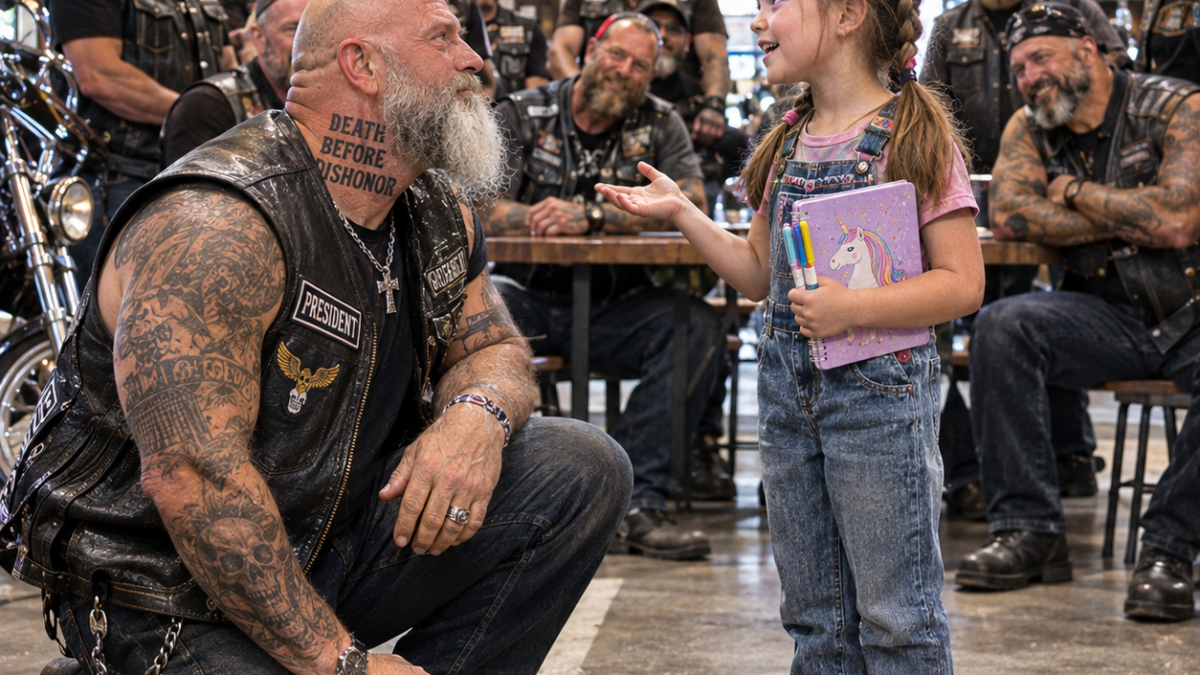
A 7-Year-Old Asked Why 20 Bikers’ Harleys Didn’t Have Names—Then the Club President Let Her Name Every Single One.
The sixty-year-old motorcycle-club president had DEATH BEFORE DISHONOR tattooed across his throat and enough old prison ink to make strangers cross a Spokane parking lot to avoid him, but when my seven-year-old daughter walked into his clubhouse and asked why none of the Harleys had names, he got down on one knee so he could hear her answer at eye level.
Twenty grown bikers laughed when she announced names like Patches, Marshmallow, Jellybean, and Buttercup—until one of those childish names revealed a tiny brass bell a grieving father had carried on his handlebars for twenty-two years because his six-year-old daughter had given it to him before she grew up and moved away.
Then our terrifying president secretly spent an entire week printing twenty tiny labels with a unicorn in the corner, and by Thanksgiving some of the hardest men I have ever known were sending messages like, “Patches ran sweet all weekend,” without a trace of embarrassment.
My name is Renata Alvarez.
I am thirty-six years old.
I am a registered dental hygienist in Spokane, Washington.
I have been married to my husband Ezra for nine years.
His road name is Doctor.
He is not a doctor.
I should explain that first.
Ezra got the name when he was twenty-four because he once rebuilt a carburetor on the shoulder of Interstate 90 using a screwdriver, two zip ties, and part of a ballpoint pen while repeatedly telling everyone around him, “Stand back, I’m performing surgery.”
The name stuck.
Motorcycle clubs are not always creative.
We have one daughter.
Her name is Wren.
She was seven when this happened.
Dark brown hair from me.
Pale blue eyes from Ezra.
Small for her age.
Serious when she is thinking.
Very loud when she is not.
She wore light-up sneakers for almost three years longer than I considered reasonable because, according to her, “Normal shoes do not celebrate walking.”
I could not argue with that logic.
Wren had been coming to the clubhouse on Sunday mornings since she was three months old.
That fact matters.
Because if you saw the place without knowing us, you probably would not imagine it as somewhere a little girl would consider normal.
The clubhouse sits at the end of a gravel access road outside Spokane.
It used to be an auto-body shop.
Corrugated metal exterior.
High windows.
Two large roll-up doors.
Concrete floor polished smooth by years of boots and tires.
A wood-burning stove in the far corner that runs almost continuously from October through May.
There is an American flag above the long table.
A POW/MIA flag.
The charter flag.
Old photographs.
Memorial plaques.
A corkboard covered in ride notices, hospital fundraisers, funeral dates, handwritten phone numbers, and three faded drawings made by children who are now old enough to have children of their own.
It smells like coffee.
Leather.
Motor oil.
Dust.
Cold metal in winter.
Warm metal in summer.
PART2:
And Marlboro Reds because Pop still refuses to quit smoking even though everybody, including his wife, his sons, his doctor, my husband, and Wren, has informed him he is an idiot.
He smokes outside.
That was Wren’s rule.
Not his.
There are twenty motorcycle bays painted onto the floor.
Two rows of ten.
White lines.
Each bay has the rider’s road name stenciled near the front.
HUTCH.
WHEELS.
HAMMER.
DOC—technically Doctor, but the stencil guy ran out of patience.
TANK.
RED.
MOUSE.
GRINDER.
POPEYE.
RICO.
Names like that.
Men had names.
PART3:
Parking spaces had names.
Clubhouse dogs had names.
The ancient refrigerator had a name.
Frank.
Nobody remembered why.
But not one motorcycle had a name.
Not officially.
That had apparently never bothered anyone.
Until Wren.
I want you to picture Pop before I tell you what she did to him.
Pop’s real name is Walter Henning.
He was sixty then.
Six-foot-three.
Two hundred seventy pounds.
Completely bald.
Gray beard down to about the fourth button of his leather cut.
Both arms covered in faded blue-black tattoos from his younger years.
He did four years at the Washington State Penitentiary when he was barely more than a kid.
He does not romanticize that.
If you ask him, he will say:
“I was stupid, angry, and twenty. That’s a dangerous combination.”
Across the entire front of his throat are the words:
DEATH BEFORE DISHONOR.
Big old-school letters.
Heavy black.
The tattoo is older than I am.
It makes waitresses nervous.
It makes suburban dads stare.
It once caused an elderly woman in a Costco parking lot to abandon a shopping cart and walk three aisles farther away even though Pop was only trying to return a dropped scarf.
He picked up the scarf.
Walked after her.
She thought he was following her.
Started moving faster.
Pop realized what was happening, stopped, placed the scarf on a cart, and backed away.
He told us the story later.
Wren asked:
“Did that hurt your feelings?”
Pop said:
“I’m sixty. I ain’t got feelings.”
His wife Marlene laughed for almost a full minute.
Pop has been a patched member for thirty-one years.
President for fourteen.
He grew up in Colville, north of Spokane.
His father worked at a lumber mill.
His mother cleaned motel rooms.
Older brother Dale joined the Marines, came back from Vietnam carrying things nobody in the family had words for, and died of an overdose at thirty-six.
Pop rarely talks about Dale.
But when he does, the whole room gets quiet.
Pop met Marlene at a diner in Sprague in 1989.
She was twenty.
He was twenty-four, fresh out of prison, working construction, driving an old Ford pickup with one door a different color from the rest.
Marlene says her mother took one look at him and prayed.
They married anyway.
Two sons.
Cole and Carter.
Three grandchildren.
And a motorcycle club that eventually started calling him Pop because Cole’s wife refused to let her first child say “Grandpa Walter.”
“Grandpa Walter sounds like a Civil War ghost,” she told him.
Pop accepted the insult.
The club adopted the name within forty-eight hours.
By the time Wren was born, everybody called him Pop.
She never knew him as Walter.
And she had never been afraid of him.
Not once.
At eighteen months old she grabbed his beard with both fists.
At three she fell asleep on his stomach during a club barbecue.
At five she asked him whether the throat tattoo meant “you die if you lie.”
He spent fifteen minutes trying to explain honor to a kindergartner.
She concluded:
“So basically don’t be a butthead.”
Pop thought about that.
Then said:
“Pretty much.”
That became a joke in the clubhouse.
DEATH BEFORE DISHONOR.
Also:
DON’T BE A BUTTHEAD.
Two equally binding moral codes.
Wren came through the clubhouse side door at 9:43 on a Sunday morning in early September.
I remember the time because she had made us late by refusing to wear matching socks.
Her logic was that nobody sees both socks at the same time unless you take your shoes off, so why should matching matter?
I chose peace.
She wore light blue denim overalls over a yellow T-shirt with a tiny hummingbird embroidered near the collar.
Crooked braids.
Light-up sneakers.
Pink backpack.
Unicorn notebook.
Four-color click pen.
In the truck, she had announced:
“I’m doing science today.”
I asked:
“What science?”
She said:
“I don’t know yet.”
Apparently science would reveal itself.
It did.
She stepped into the clubhouse.
Stopped two steps inside.
Twenty motorcycles were parked in their bays.
Chrome catching September light.
Several brothers sat around the folding table drinking coffee.
Someone had brought donuts.
Henry, Pop’s six-year-old grandson, was surgically removing all the frosting from one chocolate donut.
Theo, four, was asleep on Mouse’s lap with his mouth open.
A football game played silently on a television nobody was watching.
Wren stood there.
Looked left.
Looked right.
Tilted her head.
When Wren tilts her head, you should prepare yourself.
She stared at the motorcycles for exactly long enough that I became suspicious.
Then she walked across the shop floor.
Straight toward Pop.
His back was partly turned.
He was reading meeting notes.
“Pop.”
He looked up.
“Morning, bird.”
That was his nickname for her.
Wren.
Bird.
“Can I ask you something?”
Pop closed the notebook.
“Always.”
She looked at his chair.
Then at him.
He understood.
Pop pushed back.
Got up.
And then this enormous man with DEATH BEFORE DISHONOR tattooed across his throat lowered himself onto one knee in front of a seven-year-old wearing flashing sneakers.
“What you got?”
Wren pointed toward the motorcycles.
“How come they don’t have names?”
Pop stared at her.
Behind him, somebody stopped pouring coffee.
My husband looked up.
Hutch said:
“What?”
Wren repeated it.
“The motorcycles.”
She pointed again.
“How come they don’t have names?”
Silence.
Not angry silence.
Not confused silence exactly.
The kind that happens when twenty adults have just been confronted with something embarrassingly obvious.
Pop looked toward the bikes.
Then back at Wren.
“Tell me what you mean.”
Wren sighed with the patience children reserve for adults who require unnecessary explanation.
“Cars have names.”
Pop glanced at me.
I shrugged.
She continued.
“Mama’s Subaru is Greenie.”
It was dark green.
“Daddy’s truck is Big Steve.”
My husband had named it that before we met.
“Grandma’s car is Pearl.”
White Buick.
Wren pointed to the closest Harley.
“What’s that one’s name?”
Hutch answered before Pop could.
“That’s my Heritage.”
Wren looked at him.
“No.”
Hutch blinked.
“No?”
“That’s what kind it is.”
She pointed at him.
“You’re Hutch.”
“Correct.”
“That’s what kind of man you are?”
The room laughed.
Hutch looked offended.
“Apparently.”
Wren looked at the bike.
“So what’s her name?”
Hutch glanced around.
“Her?”
Wren frowned.
“Does she want to be a boy?”
Hutch opened his mouth.
Closed it.
Pop turned away so Wren wouldn’t see him laughing.
Doctor put his face into his coffee.
Finally Pop looked back at her.
“You know what?”
“What?”
“You’re right.”
The clubhouse went quiet again.
Pop stood.
Walked beside Wren toward the center aisle.
Looked at twenty motorcycles as if seeing them differently.
“Thirty-one years riding,” he said.
He scratched his beard.
“Never named a bike.”
Hammer called from the table:
“Because bikes ain’t dogs.”
Wren turned.
“Dogs have names.”
“Exactly.”
“People have names.”
Hammer frowned.
“Yeah.”
“Horses have names.”
“Yeah.”
“Boats have names.”
Hammer’s confidence weakened.
“Some.”
Wren pointed at his Harley.
“So motorcycles should have names.”
Hammer looked toward Pop.
“Why am I arguing logic with a second grader?”
“Because you’re losing,” Pop said.
Wren clicked the blue button on her four-color pen.
Then the red.
Then green.
Then black.
Click-click-click-click.
Pop looked at the notebook.
“You wanna name them?”
Every head turned toward him.
Hutch nearly dropped his coffee.
“Pop.”
Pop ignored him.
Wren’s eyes widened.
“All of them?”
“All twenty.”
“Can I choose any names?”
Pop thought.
“Within reason.”
“What does that mean?”
He considered the audience.
“No bad words.”
“I don’t know bad words.”
Three men coughed.
I looked at my husband.
He looked innocent.
Wren definitely knew some bad words.
Pop continued:
“And maybe don’t name anybody Poop.”
Wren wrote something in her notebook.
Pop became suspicious.
“What’d you write?”
“Nothing.”
“Wren.”
She showed him.
DON’T USE POOP.
Pop nodded.
“Good.”
He pointed toward the motorcycles.
“Get to work, kid.”
She did.
For eleven minutes, twenty of the roughest-looking men in eastern Washington watched my daughter conduct what she later described as “motorcycle personality science.”
She started at bay one.
Red’s bike.
Custom-painted Road King.
Dark base with thin stripes of red, orange, gold, blue.
Wren walked around it.
Bent down.
Looked at the tank.
Touched one stripe with a finger.
She clicked red ink.
Wrote.
Moved on.
Bay two.
Yellow-and-black Softail.
Easy.
Bay three.
Chrome everywhere.
So much chrome that Ezra had once said you could signal aircraft with it.
Wren squinted at her own reflection.
Wrote.
Bay four.
My husband’s Harley.
Black touring bike.
HARLEY-DAVIDSON USA emblem.
Wren read it aloud.
Thought.
Wrote.
Ezra leaned toward me.
“I’m worried.”
“Why?”
“She knows me.”
“You should be.”
Bay five.
White Road Glide.
Wren touched the paint.
“Looks like food.”
Its owner, Grinder, said:
“Please don’t name it Mayonnaise.”
Wren ignored him.
Wrote.
Bay six.
Hammer’s black-and-red bike.
Bandana tied around the handlebars.
Wren noticed.
Wrote.
By bay eight, the men had started following her.
Not obviously.
They pretended to refill coffee.
Stretch.
Check tires.
Within minutes, fifteen enormous bikers were drifting behind a little girl with a unicorn notebook like students on a museum tour.
She stopped at Hutch’s motorcycle.
A small embroidered club patch hung from a chain near the handlebars.
“What’s that?”
Hutch said:
“My daughter made it.”
“When?”
“Long time ago.”
Wren touched it carefully.
Wrote.
At bay fifteen, she noticed a tiny brass bell hanging low near the front.
“What’s the bell for?”
Wheels stiffened.
Nobody answered immediately.
I knew enough not to fill the silence.
Wheels was fifty-one.
Powder-coater.
Eighteen years patched.
Divorced.
One grown daughter named Lacey in Tacoma.
He had a reputation for talking too loudly and laughing even louder.
Now his voice became quiet.
“Somebody gave it to me.”
“Who?”
“My kid.”
“How old?”
“When she gave it?”
Wren nodded.
“Six.”
Wren smiled.
“Like Henry.”
“About that.”
“Did she buy it?”
“No.”
“She saved allowance money.”
Wren touched the bell with one finger.
It gave a tiny chime.
She clicked black ink.
Wrote.
Wheels looked away.
At bay twenty, Pop’s motorcycle waited.
Bright yellow custom Harley.
Yes.
The same man with DEATH BEFORE DISHONOR tattooed on his throat rode a yellow motorcycle.
Nobody made jokes because nobody had a death wish.
Wren stared at it longest.
Walked around twice.
“What color is this?”
Pop said:
“Yellow.”
“No.”
He frowned.
“No?”
“This is super yellow.”
Marlene, sitting near me, whispered:
“Oh, he’s in trouble.”
Wren wrote the final name.
Then marched back to the long table.
“Pop.”
He turned.
“I’m done.”
Pop sat.
Wren stood beside him.
Twenty bikers gathered.
“Read them.”
She opened the notebook.
“Bay one.”
Red leaned forward.
“Rainbow.”
Red blinked.
A couple men snickered.
“Because it has all the colors.”
Red looked at his tank.
“Rainbow.”
“Yes.”
He nodded slowly.
“Okay.”
“Bay two. Bumblebee.”
Its owner, Mouse, smiled.
“Fair.”
“Bay three. Princess.”
The room exploded.
Princess belonged to Grinder.
Grinder was fifty-seven.
Six-foot-two.
Built like a refrigerator.
Former Marine.
Gray horseshoe mustache.
He stared at Wren.
“Princess?”
She nodded.
“Because it’s the shiniest.”
The men laughed harder.
Grinder looked at Pop.
Pop lifted both hands.
“Kid science.”
Grinder muttered something.
Wren asked:
“What?”
“Nothing, sweetheart.”
“Bay four. Captain.”
My husband straightened.
“Captain?”
“Because your tank says USA and captains are important.”
Ezra looked absurdly proud.
I whispered:
“You did not earn that.”
He ignored me.
“Bay five. Marshmallow.”
Grinder stopped laughing because Marshmallow belonged to Popeye, who had mocked Princess.
Justice arrived quickly.
“Bay six. Bandito.”
Hammer nodded.
“Now that’s respectable.”
“Because it has a bandana.”
Hammer’s pride dropped slightly.
“Still respectable.”
“Bay seven. Pearl.”
“Bay eight. Patches.”
Hutch winced.
“Patches?”
“Yes.”
“Hutch.”
He looked at Pop.
“That sounds like a poodle.”
Wren frowned.
“Poodles are smart.”
Hutch had no answer.
“Bay nine. Smoky.”
“Bay ten. Sunbeam.”
“Bay eleven. Velvet.”
“Bay twelve. Tank.”
Tank smiled.
“Mine’s Tank?”
“Yes.”
“My bike has my name?”
“No. Your name is Tank.”
He frowned.
She continued.
“Your motorcycle’s name is also Tank because you’re both big.”
Tank nodded solemnly.
“I accept.”
“Bay thirteen. Cocoa.”
“Bay fourteen. Stormy.”
“Bay fifteen.”
She looked at Wheels.
“Bell.”
The laughter stopped.
Wheels looked down.
Wren continued.
“Because of the little bell his daughter gave him.”
Nobody said anything.
Wheels’ throat moved.
Wren looked at the notebook.
“Bay sixteen. Jellybean.”
Someone groaned.
“Bay seventeen. Bull.”
Immediate approval.
“Bay eighteen. Hawk.”
“Bay nineteen. Mister Black.”
That belonged to Rico.
He looked delighted.
“Sounds like a hit man.”
Wren said:
“No. It looks polite.”
The room laughed.
Then Wren reached the final name.
“Bay twenty.”
Pop leaned forward.
His yellow Harley sat behind her.
Wren smiled.
“Buttercup.”
The clubhouse detonated.
I mean men actually slapped the table.
Hammer bent over.
Hutch nearly fell out of his chair.
Doctor choked on coffee.
Somebody shouted:
“President Buttercup!”
Pop sat completely still.
Wren’s smile disappeared slightly.
“You don’t like it?”
Silence.
Every man in the room suddenly realized they had gone too far.
Pop looked at her.
Then looked at his motorcycle.
Bright yellow.
Super yellow.
Then back at Wren.
“Why Buttercup?”
“Because buttercups are yellow.”
“That’s it?”
She thought.
“And they grow even when people don’t plant them.”
Something moved behind Pop’s eyes.
Marlene noticed too.
Later I learned that Pop’s mother had loved buttercups.
There were wild buttercups behind the motel where she cleaned rooms.
As a child, Walter would wait for her after school and pick them while she finished shifts.
Wren could not possibly have known.
Pop looked toward his bike again.
Then said:
“Buttercup it is.”
The laughter stopped.
Completely.
He reached inside his leather cut.
Pulled out the small notebook he had carried for fourteen years.
Then took a carpenter pencil from behind one ear.
“Read them again.”
Wren’s face brightened.
“All?”
“All.”
“Slow?”
“Slow.”
She read every name again.
Pop wrote every one.
Rainbow.
Bumblebee.
Princess.
Captain.
Marshmallow.
Bandito.
Pearl.
Patches.
Smoky.
Sunbeam.
Velvet.
Tank.
Cocoa.
Stormy.
Bell.
Jellybean.
Bull.
Hawk.
Mister Black.
Buttercup.
When she finished, Pop closed the notebook.
“You did real good, bird.”
Wren looked toward the motorcycles.
“Are you going to tell them?”
Pop glanced around at nineteen men who had heard every word.
“I believe they know.”
“No.”
She shook her head.
“Tell them the motorcycles’ names.”
Pop smiled slightly.
“I’ll make sure everybody knows.”
That should have been it.
A funny Sunday morning.
A seven-year-old’s game.
Twenty bikers humoring a child.
We would have remembered it for maybe a month.
Then moved on.
Except Pop went home.
And Pop Henning has a dangerous personality trait.
If a child tells him something matters, he takes it seriously.
That afternoon at 5:15, he drove to Office Depot on East Sprague.
Marlene told me every detail later.
He purchased a Brother P-touch label maker.
Four cartridges of clear vinyl tape.
Double-sided 3M adhesive.
He came home.
Ate half a meatloaf sandwich.
Put his leather notebook beside the label maker.
And began experimenting.
At 7:00, Marlene walked into the kitchen.
Clear labels covered the table.
Different fonts.
Sizes.
Bold.
Not bold.
All caps.
Lowercase.
“Walter.”
“Yeah?”
“What are you doing?”
“Nothing.”
“You bought a label maker.”
“Needed one.”
“For what?”
He covered several test labels with one hand.
Marlene stared.
“Are you labeling the motorcycles?”
“No.”
“Walter.”
Pop sighed.
“The kid named them.”
“I was there.”
“She asked if they’d know.”
Marlene looked at him.
“And?”
He seemed genuinely offended by the question.
“They gotta know.”
Marlene sat across from him.
“You’re putting Buttercup on your Harley?”
Pop’s jaw tightened.
“Yes.”
She started laughing.
“Don’t.”
“I’ve been married to you thirty-five years.”
“I can make it thirty-four.”
“You can’t subtract years.”
“Watch me.”
He worked until 11:30.
Not only labels.
Pop wanted something else.
A mark.
Something that made them Wren’s names instead of generic stickers.
On Tuesday afternoon he called me.
“Renata.”
“Yes?”
“Bring the bird by.”
“Why?”
“Research.”
“What kind of research?”
“Important.”
That should have worried me.
We stopped after school.
Pop handed Wren a piece of paper.
“Draw a unicorn.”
She looked at him suspiciously.
“What kind?”
“How many kinds are there?”
“A lot.”
He sighed.
“Simple unicorn.”
“Standing or flying?”
“Standing.”
“Happy?”
“Sure.”
“Boy or girl?”
“Wren.”
“What?”
“Just draw the damn—”
I looked at him.
He corrected himself.
“Draw the unicorn, please.”
She did.
Round body.
Four stick legs.
Big horn.
Tail like a feather duster.
Smile.
It was objectively terrible.
Pop studied it like museum art.
“Perfect.”
Wren beamed.
“What’s it for?”
“Research.”
She accepted that.
He scanned the drawing.
Put a tiny unicorn in the lower-right corner of every name label.
Clear oval.
Black serif letters.
One small seven-year-old unicorn.
Twenty labels.
He cut them by hand.
With manicure scissors.
A sixty-year-old ex-con motorcycle-club president sat at his kitchen table cutting tiny unicorn labels with cuticle scissors at eleven o’clock at night.
Marlene took a picture.
It remains one of my favorite photographs.
Saturday morning, Pop unlocked the clubhouse alone.
Coffee.
Rubbing alcohol.
Labels.
He went motorcycle by motorcycle.
Cleaned each tank.
Dried it.
Applied the label low enough to be subtle.
Pressed every one with his thumb for thirty seconds.
Rainbow.
Thirty seconds.
Bumblebee.
Thirty seconds.
Princess.
Thirty seconds.
All twenty.
Buttercup last.
Marlene asked later whether he hesitated.
He said:
“No.”
Then she showed me a photograph proving he had stood in front of Buttercup for nine minutes before putting the sticker on.
Sunday morning, Wren and I got there early.
Pop had asked us.
“The kid named them. Kid should see the reaction.”
We sat in the back.
Wren had her notebook.
The first rider to arrive was Hutch.
He walked through the side door.
Coffee thermos.
Leather cut.
Red beard.
He said morning.
Walked toward bay eight.
Stopped.
Looked down.
Bent closer.
PATCHES.
Tiny unicorn.
Hutch stared.
Then turned.
“Pop.”
Pop kept drinking coffee.
“Yes?”
“What in the hell is on my motorcycle?”
Wren looked up.
Pop said:
“Name.”
“My motorcycle doesn’t have a name.”
Pop finally turned.
“Hutch.”
“Yeah?”
“Walk over.”
Hutch did.
Pop pointed toward Wren.
“That little girl named your motorcycle.”
Hutch looked at Wren.
She smiled.
Hutch looked back.
“I know she did.”
“I wrote it down.”
“I know.”
“I made the labels.”
“I see that.”
“The motorcycle’s name is Patches.”
Hutch folded his arms.
“Pop.”
“What?”
“Patches is the name of a girl’s dog.”
Pop nodded.
“Okay.”
“Okay?”
“You wanna go tell her it’s stupid?”
Hutch turned.
Wren sat in the back corner.
Crooked braids.
Unicorn notebook.
Pale blue eyes.
Light-up shoes.
Watching.
Hutch’s shoulders dropped.
“No.”
Pop sipped coffee.
“Then congratulations.”
“On what?”
“You own Patches.”
Hutch muttered:
“Ridiculous.”
He walked back to the Heritage.
Stood beside it.
Looked at the label.
Then something happened.
He reached down.
Pressed the sticker with his thumb.
As if making sure it wouldn’t peel.
And said quietly:
“Morning, Patches.”
I almost cried from trying not to laugh.
The next brother came in.
Same thing.
Then another.
By 9:40, protests echoed through the clubhouse.
“Marshmallow?”
“Who the hell is Princess?”
“Jellybean is disrespectful.”
“Mister Black actually ain’t bad.”
“Why is mine Cocoa?”
“Because it’s brown.”
“That’s racist against motorcycles.”
“Shut up, Rico.”
Then Wheels came in.
He walked to bay fifteen.
Saw BELL.
Stopped.
Everyone watching knew this one was different.
He touched the tiny brass bell.
Then the label.
Walked to Pop.
“How did she know?”
Pop looked confused.
“She saw it.”
“No.”
Wheels shook his head.
“I mean how did she know it mattered?”
Pop looked toward Wren.
“She didn’t.”
Wheels sat.
“My daughter gave me that bell.”
Pop nodded.
“I remember.”
“She was six.”
Wheels looked toward the bike.
“Saved up seven dollars.”
His voice changed.
“Bought it at some tourist place in Coeur d’Alene.”
Nobody spoke.
“She told me it kept bad things away.”
Pop said:
“Guardian bell.”
“Yeah.”
Wheels smiled faintly.
“She thought it was magic.”
“When did you last talk to Lacey?”
The question came from Wren.
Nobody had noticed her approach.
Wheels looked down.
“What?”
“Your daughter.”
He swallowed.
“Couple weeks.”
Wren frowned.
“That’s too long.”
Several men suddenly became fascinated with the floor.
Wheels smiled sadly.
“She’s busy.”
“You can call.”
“I can.”
Wren pointed at the bike.
“Bell can remind you.”
Wheels looked at her.
Then at the tiny brass bell.
Then at the clear label.
That afternoon, he called his daughter.
I know because Lacey came to the clubhouse two months later for Thanksgiving lunch.
First visit in three years.
She hugged her father beside the bike.
Saw the label.
“Bell?”
Wheels nodded toward Wren.
“Kid named it.”
Lacey touched the same brass bell she’d bought twenty-two years earlier.
Then cried.
That’s when I began realizing the names were doing more than making the men laugh.
Kids notice things adults train themselves not to see.
Wren saw chrome.
Color.
Little objects.
But those objects had histories.
The bandana tied to Hammer’s handlebars had belonged to his younger brother Danny, who died of pancreatic cancer.
She called that motorcycle Bandito because she saw a bandana.
Hammer heard his brother’s voice every time he said it.
The feather on Hawk belonged to Rico’s father, who was Native and had carried it in his truck for twenty years.
Patches carried the little embroidered patch Hutch’s daughter made when she was nine.
Stormy’s cloud paint had been designed by its owner’s late wife.
Pearl matched the color of a rider’s mother’s old Cadillac.
Wren didn’t know any of that.
She just looked.
Really looked.
That was enough.
Then Pop’s turn came.
Everyone waited.
He walked toward bay twenty.
Bright yellow Harley.
BUTTERCUP.
Tiny unicorn.
Hammer said:
“President Buttercup.”
Pop looked at him.
Hammer immediately found something important to do near the coffee maker.
Wren stood beside Pop.
“You like it?”
Pop looked down.
“Yeah.”
“Really?”
“Really.”
“Because nobody can change it.”
That caught him.
“What?”
“You said the names are the names.”
“I did.”
“So even President can’t change.”
Pop smiled.
“That’s fair.”
Wren touched the gas tank.
“My grandma says buttercups mean happy things.”
Pop’s face shifted.
“Marlene told you?”
“No.”
“My Grandma Rosa.”
He nodded.
Then said:
“My mama liked buttercups.”
Wren looked up.
“Is she dead?”
Children ask death questions with an honesty adults often avoid.
“Yeah.”
“Do you miss her?”
“Every day.”
“Then Buttercup is good.”
Pop looked away.
Wren took his big tattooed hand.
He let her.
That was the first time anyone in the club stopped laughing at Buttercup.
By week three, the names had entered casual conversation.
Not openly.
Not proudly.
But there.
“Move Captain so I can get the lift out.”
“Who’s parked behind Rainbow?”
“Marshmallow needs air.”
“Don’t lean that box on Princess.”
Grinder objected every time.
Then eventually stopped.
By week six, the group chat had changed.
I began saving screenshots.
TANK:
Tank is leaking oil from the primary. Anybody got a gasket?
Ezra:
Captain is back from the shop. New tires. Ready Sunday.
Hutch:
Patches and me ran Lewiston. 380 miles. She ran sweet.
Hutch.
The man who had called Patches a girl dog’s name.
She ran sweet.
I sent the screenshot to Wren.
She replied with fourteen unicorn emojis.
By Thanksgiving, every single motorcycle was referred to by name.
Even Buttercup.
Especially Buttercup.
One cold morning in November, a visiting rider from Idaho came into the clubhouse.
Big guy.
Maybe fifty.
He saw Pop’s label.
“Buttercup?”
Several local brothers went quiet.
The visitor laughed.
“Who named your bike, your granddaughter?”
Pop took one drag from his cigarette outside.
Crushed it.
Walked inside.
“Close.”
He pointed toward Wren, who was coloring at the table.
“That kid.”
The visiting rider laughed again.
“You kept it?”
Pop stared at him.
“Why wouldn’t I?”
The man realized he had misread the room.
“No reason.”
Pop nodded.
“Good.”
Later Wren asked:
“Was that man making fun of Buttercup?”
Pop said:
“Little bit.”
“Were you mad?”
“No.”
“Why not?”
Pop thought.
Then lowered himself onto one knee again.
Same way he had the first morning.
“Because if you know what something means to you, other people don’t get to decide what it should mean.”
Wren took that in.
Then said:
“So if somebody makes fun of my purple glasses at school—”
“Don’t hit them.”
“I wasn’t going to.”
Pop looked at her.
She looked innocent.
“Tell your teacher.”
“I know.”
“And remember you like the glasses.”
“I do.”
“Then that’s enough.”
Apparently naming motorcycles had become educational philosophy.
A month later, the club did its annual toy run for Sacred Heart Children’s Hospital.
Twenty motorcycles.
Stuffed animals strapped to saddlebags.
Toys boxed in trailers.
Wren came with me in the truck.
When the bikes lined up outside, a little boy receiving treatment came to the entrance with his mother.
Maybe eight.
Bald from chemotherapy.
Mask over his face.
He saw the motorcycles.
His eyes widened.
Pop noticed.
Walked over.
The mother looked nervous at first.
Understandable.
Pop’s throat does not communicate pediatric warmth.
He crouched.
“Like motorcycles?”
The boy nodded.
“Got a favorite?”
He pointed to the yellow one.
Of course.
Pop smiled.
“That’s Buttercup.”
The boy looked at him.
“What?”
“Her name.”
Behind Pop, nineteen bikers suddenly became very serious.
The boy smiled.
“Buttercup?”
Pop nodded.
“A little girl named her.”
The boy laughed.
First time his mother had heard him laugh all morning.
Then he asked:
“Do all of them have names?”
Pop turned.
“Sure do.”
He began pointing.
“Rainbow.”
“Bumblebee.”
“Princess.”
Grinder groaned.
The boy laughed harder.
“Marshmallow.”
“Patches.”
“Jellybean.”
By the time Pop reached Mister Black, the kid was nearly bouncing.
His mother had tears above her mask.
Before they left, the boy asked if he could touch Buttercup.
Pop lifted him carefully.
Set him on the seat.
The boy placed both hands on the handlebars.
Looked at the DEATH BEFORE DISHONOR tattoo.
Then asked:
“Are you a bad guy?”
His mother went pale.
Pop smiled.
“Sometimes.”
The child thought.
“Are you bad today?”
“No.”
“Okay.”
Problem solved.
Pop told us later:
“Kid’s got better threat assessment than most adults.”
The names spread outside the clubhouse.
At first as a joke.
Then as identity.
A local mechanic wrote PRINCESS on Grinder’s invoice.
He threatened to find a new mechanic.
He did not.
Wheels ordered a small brass tag engraved BELL.
Tank found a novelty license plate frame saying TANK ON TOUR.
Hammer started polishing Bandito’s bandana clip.
One brother replaced his damaged label after winter storage.
He drove to Pop’s house to ask for another.
Pop stared.
“You made fun of these.”
“That was six months ago.”
“You called them kindergarten stickers.”
“Can you make another or not?”
Pop smiled.
“You miss the unicorn?”
“Shut up.”
The labels became something no one had planned.
A small piece of clubhouse culture.
Then something happened that made them permanent.
One of the brothers, Red, had a heart attack.
Not on the road.
At home.
He survived.
Barely.
Fifty-eight.
Two stents.
Doctor ordered him off the motorcycle for three months.
Red hated it.
For a man who had ridden nearly every weekend for thirty years, the restriction felt like punishment.
He stopped coming to Sunday meetings.
Pop called.
No answer.
Doctor called.
Nothing.
Wren asked where Red was.
I told her he was recovering.
“Why doesn’t he come?”
“He’s upset he can’t ride.”
“But Rainbow is here.”
I looked at her.
“So?”
“She probably misses him.”
I should have known.
The following Sunday Wren made a card.
Front:
GET WELL SOON RED.
Inside:
RAINBOW IS WAITING.
She drew the motorcycle.
Terribly.
Twenty bikers signed it.
Pop delivered it.
Red came back the next Sunday.
Couldn’t ride.
His wife drove him.
He entered slowly.
Went straight to Rainbow.
Put one hand on the gas tank.
Then touched the label.
He stood there a long time.
Wren walked over.
“You came.”
Red nodded.
“Rainbow waited.”
“I know.”
“You can sit on her.”
Red laughed.
“Doctor says no riding.”
“I said sit.”
So Red sat.
Engine off.
Wren climbed onto the passenger seat.
For ten minutes, they pretended they were riding.
He came to every Sunday meeting after that.
When he was medically cleared three months later, twenty motorcycles escorted Rainbow on Red’s first ride back.
Wren rode in my car.
Pop later said:
“Names matter because you can miss something with a name.”
I think he was right.
The biggest surprise, though, was what the motorcycles did to the men.
Motorcycles had always mattered.
Nobody needed a child to teach them that.
These bikes carried memories.
Divorces.
Funerals.
Cross-country rides.
Hospital visits.
Sons learning to ride.
Wives riding pillion.
Brothers gone.
But bikers often speak about machines mechanically.
Horsepower.
Torque.
Mileage.
Engines.
Parts.
A name changed the language.
Captain wasn’t just “Doctor’s Road Glide.”
Bell wasn’t just “the 2009.”
Buttercup wasn’t just Pop’s yellow bike.
Names gave permission to be sentimental without admitting to sentimentality.
One January morning, I arrived early.
Pop was alone.
Wood stove running.
Snow outside.
Buttercup parked near the wall.
I watched him wipe dust from the tank.
He didn’t know I was behind him.
He looked at the little unicorn.
Then whispered:
“Morning, Ma.”
I froze.
He saw me reflected in the chrome.
“Didn’t hear anything.”
I understood.
“Nothing happened.”
“Good.”
Later Marlene told me the full story about his mother.
Helen Henning.
Motel housekeeper.
Hard hands.
Bad knees.
Worked six days a week.
When Walter was little, he waited behind the motel after school because they couldn’t afford childcare.
Wild buttercups grew beside the chain-link fence.
He picked them.
His mother put them in a jelly jar at home.
When he went to prison, she visited every month until she got sick.
She died while he was serving his third year.
He was not allowed out for the funeral.
That was the wound behind Buttercup.
Wren had not uncovered it.
She had simply handed it a name.
That is different.
And maybe more powerful.
When I told Wren later that Pop’s mother liked buttercups, she nodded.
“I know.”
I stared.
“How?”
“He told me.”
“When?”
“When we were coloring.”
Of course.
Pop told children things he rarely told adults.
Children asked without trying to fix.
Pop’s throat said DEATH BEFORE DISHONOR.
His seven-year-old confidante said:
“Did your mama like yellow?”
And somehow that was easier.
One year after the naming day, we celebrated.
Not formally.
No ceremony.
Wren walked in at 9:43 on purpose because Pop insisted history should be accurate.
The labels were still there.
Some faded.
Some scratched.
Two replaced.
Bell’s unicorn was partly worn away from Wheels touching it.
Patches had a small crack in the clear vinyl.
Buttercup looked almost new because Pop polished around it with obsessive care.
Wren walked through the rows with her notebook.
Eight years old now.
She inspected every name.
Then Pop called everyone to the table.
He had made something.
A small wooden sign.
Burned lettering.
NEW BIKES GET NAMED BY WREN.
HOUSE RULE.
The brothers laughed.
Wren read it.
Looked at Pop.
“Really?”
“Really.”
“What if I don’t like the motorcycle?”
“Still needs a name.”
“What if the owner doesn’t like the name?”
Pop looked around.
“That sounds like his problem.”
Hutch raised his hand.
“I would like the record to show I objected.”
Pop said:
“Patches disagrees.”
The room laughed.
Two new patched members joined that year.
First was a man called Finch.
Forty-two.
Electrician.
Silver Street Glide.
He walked into the clubhouse for his patch ceremony expecting club business.
Pop stopped him.
“Not yet.”
Finch looked confused.
“What?”
“Bike.”
“What about it?”
“Needs inspection.”
“For what?”
Pop pointed toward Wren.
Finch had heard the stories.
His face fell.
“No.”
Wren walked around the silver Street Glide.
Studied it.
Clicked black ink.
Finch looked worried.
She eventually announced:
“Moonlight.”
Finch blinked.
“That’s actually good.”
Pop said:
“You don’t get to rate it.”
Second new bike belonged to a former Army mechanic called Bones.
Dark green.
Aggressive fairing.
Loud exhaust.
Wren studied it for almost a minute.
Then wrote:
PICKLE.
Bones looked physically wounded.
“Pickle?”
Wren nodded.
“Because green.”
“Anything else?”
“No.”
He looked at Pop.
Pop folded his arms.
“House rule.”
For three weeks Bones refused to say Pickle.
Then his battery died.
Group text:
Anyone near Cheney? Pickle won’t start.
No one commented.
That is how traditions win.
Slowly.
Against dignity.
The story went outside our charter only once.
Somebody posted a photograph of Buttercup’s label online.
Caption:
WHEN YOUR MC PRESIDENT LETS A 7-YEAR-OLD NAME YOUR HARLEY.
People loved it.
Most comments were kind.
Some mocked.
One said:
“Real bikers don’t name bikes Buttercup.”
Pop saw it.
Marlene asked if he was angry.
He said:
“No.”
She said:
“You’re lying.”
He looked at Wren’s unicorn.
Then answered:
“Some stranger on the internet thinks I need his permission to love something my granddaughter’s friend named?”
Marlene corrected:
“She isn’t your granddaughter.”
Pop looked at her.
“She keeps eating my donuts. Close enough.”
When Wren learned someone online said real bikers wouldn’t name a motorcycle Buttercup, she became furious.
“How many motorcycles does he have?”
“We don’t know.”
“Then how does he know?”
Good question.
Pop explained:
“Sometimes people build rules so they can feel like they’re in charge of something.”
Wren asked:
“Are there rules for bikers?”
“Yes.”
“Is Buttercup against them?”
“No.”
“Then he’s wrong.”
Pop smiled.
“Pretty much.”
Wren looked at the throat tattoo.
“What does dishonor mean again?”
Pop thought.
“Doing something you know is wrong because you’re scared what people will think.”
Wren pointed at Buttercup.
“So changing her name because somebody laughed would be dishonor?”
The clubhouse became silent.
Pop looked at her.
Then at his tattoo.
Then laughed.
Deep.
Loud.
He slapped the table.
“Kid just weaponized my own neck tattoo against me.”
Doctor said:
“She has your number.”
Pop pointed toward Wren.
“You’re dangerous.”
She smiled.
Her shoes flashed.
There is an old stereotype about men like these.
That toughness and tenderness occupy opposite sides.
That if a man is hard enough to survive prison, war, divorce, addiction, blue-collar work, funerals, and decades on motorcycles, he must protect that hardness carefully.
No softness.
No silly names.
No unicorns.
No Buttercup.
But I have spent eleven years around these men.
That isn’t how it works.
Often the hardest men are carrying the softest things in the most protected places.
A tiny bell from a daughter.
A photograph of a dead brother.
A hospital bracelet.
A wedding ring on a chain.
A child’s drawing tucked inside a vest.
A ridiculous motorcycle label.
Wren did not make them soft.
They already were.
She just didn’t know she was supposed to pretend otherwise.
That may be the gift children bring into adult rooms.
They ignore the social agreements.
Nobody told Wren a 270-pound biker with prison tattoos shouldn’t have a motorcycle named Buttercup.
Nobody told her a master plumber should be embarrassed by Patches.
Nobody told her Bell was supposed to be “the Road Glide.”
She saw a bell.
She named what she saw.
Adults spend years learning to hide meaning inside respectable language.
Children point directly at it.
A year and two months after that first Sunday, I walked into the clubhouse with Wren.
She was eight.
Third grade.
Purple glasses now.
Still light-up shoes.
Different unicorn notebook.
Pop sat at the head of the table.
Wren walked over.
“Pop.”
He got down on one knee.
He still did that.
Every time.
“What you got, bird?”
She pointed toward Buttercup.
“The label is peeling.”
Pop stood immediately.
“Where?”
Lower-left corner.
Barely.
He stared like someone had discovered structural damage on a bridge.
“Unacceptable.”
Hutch shouted:
“Use tape.”
Pop looked offended.
“We do not put Scotch tape on Buttercup.”
The room erupted.
Wren smiled at me.
Not because it was funny.
Because she understood.
The name was real now.
Pop replaced the label that afternoon.
Same font.
Same clear vinyl.
Same tiny unicorn.
He keeps spare labels in the clubhouse office.
Twenty-two now.
The original twenty.
Moonlight.
Pickle.
Each one has a backup.
I asked him once why.
“Because things wear out.”
“Labels?”
“Everything.”
He looked toward the bikes.
“Doesn’t mean you stop caring for them.”
Maybe he was talking about motorcycles.
Maybe not.
Wheels’ daughter Lacey now visits more often.
Red still rides Rainbow after his heart attack, though slower.
Hutch calls his granddaughter Frankie every Wednesday because Wren asked him once why grandparents wait for children to call first.
Princess remains obnoxiously shiny.
Grinder secretly bought microfiber cloths specifically for her.
He denies this.
Bandito still carries Danny’s bandana.
Captain belongs to my husband, who has become unbearable about it.
Buttercup remains yellow.
Very yellow.
Super yellow.
And every Sunday morning, men arrive.
Boots on concrete.
Coffee.
Cold air.
Engines.
They walk to their bays.
Sometimes I hear it.
“Morning, Patches.”
“Let’s go, Bell.”
“Come on, Marshmallow.”
“Don’t embarrass me today, Pickle.”
They say it jokingly.
Mostly.
But they say it.
Wren hears.
She pretends not to be proud.
She is.
One Sunday I asked her:
“Do you remember when the motorcycles didn’t have names?”
She thought.
“No.”
It had only been a year.
But to her, twenty unnamed motorcycles belonged to an ancient period of history.
“Why’d you ask Pop?”
She shrugged.
“They looked lonely.”
That answer stopped me.
“Motorcycles looked lonely?”
“They all had parking spots with the men’s names.”
She pointed at the floor.
“But nothing said who they were.”
There it was.
The thing twenty adults had missed.
The bays were named.
The riders were named.
The machines that carried decades of memory were only machines.
Until a child noticed.
I told Pop what she said.
He went quiet.
Then walked toward Buttercup.
Put one hand on the tank.
“Kid’s weird.”
“That all?”
“Yep.”
He rubbed his thumb across the unicorn label.
“She ain’t wrong.”
Pop turned sixty-one this year.
Marlene threw a party.
Wren gave him a present.
Small box.
He opened it.
Inside was a metal motorcycle keychain shaped like a yellow flower.
Engraved on the back:
BUTTERCUP.
Pop stared.
Wren immediately became nervous.
“You don’t have to use it.”
He looked up.
“Who said that?”
“Nobody.”
“Then don’t invent problems.”
He took his motorcycle key off the old plain ring.
Transferred it.
The yellow flower looked ridiculous hanging from his hand.
Perfect.
“Thank you, bird.”
She hugged him.
Pop held her with one arm.
Then quietly said:
“My mama would’ve liked you.”
Wren answered:
“I think I would’ve liked her.”
Pop closed his eyes.
Nobody laughed.
Later that night I watched him stand outside beneath the awning.
Smoke from his cigarette rising.
Yellow-flower keychain in his hand.
DEATH BEFORE DISHONOR across his throat.
A contradiction only if you misunderstand strength.
Twenty years earlier, I might have looked at Walter Henning and seen every warning sign adults teach daughters to notice.
Prison ink.
Leather.
Motorcycle club.
Old criminal record.
A throat tattoo threatening death.
Now I know him as the man who will leave a meeting halfway through because a five-year-old’s bicycle chain came off.
The man who has never missed one of his grandchildren’s birthdays.
The man who keeps applesauce pouches in a clubhouse refrigerator because Theo likes them.
The man who learned how to braid hair from YouTube after Hazel asked him to.
Badly.
The man who spent six hours choosing fonts because a seven-year-old asked whether motorcycles could know their names.
People are complicated.
Symbols are easy.
Leather is easy.
Tattoos are easy.
A person takes longer.
Maybe that is why Wren has never been afraid of them.
She met the people before anyone taught her the symbols.
She knew Pop’s lap before she could read his throat.
She knew Hutch as the guy who brought her purple donuts before she understood what patches meant.
She knew Wheels as the man who cried when talking about his daughter.
She knew Hammer as the person who carries Band-Aids in his saddlebag.
She knew motorcycles as things adults loved, not as things strangers feared.
Children start with behavior.
Adults often start with appearance.
There are advantages to being seven.
The charter still has twenty bays.
More motorcycles rotate through now.
People trade.
Upgrade.
Sell.
One brother gave up riding because of his eyesight.
His label came off the old bike before it sold.
Wren asked Pop what happened to names when motorcycles left.
He thought.
Then gave her the removed label.
“Keeper decides.”
“What does that mean?”
“If the name belongs to the bike, it goes.”
“And if it belongs to the memory?”
“You keep it.”
Wren put the label in her notebook.
Her first retired name.
I don’t know what she will do with all this when she’s older.
Maybe motorcycles won’t matter to her.
Maybe she’ll become a doctor.
An artist.
A mechanic.
A dental hygienist like me.
Maybe she’ll move to Boston and complain that her parents live too far away.
Maybe she’ll forget which bike was Cocoa and which one was Velvet.
But I don’t think she will forget Pop getting down on one knee.
I don’t think she’ll forget twenty men waiting while she read from a unicorn notebook.
And I know they won’t forget her.
There is a handwritten note above the clubhouse corkboard.
Pop’s carpenter-pencil handwriting.
Eight words.
NEW BIKES GET NAMED BY WREN. HOUSE RULE.
It has been there more than a year.
Nobody has removed it.
Nobody has challenged it.
Not even Hammer.
Especially not Hammer.
Recently a prospect asked:
“Is that serious?”
Pop looked at him.
“Does it look like a joke?”
The prospect glanced at the motorcycles.
“There’s one called Marshmallow.”
Popeye shouted from across the room:
“You got a problem with Marshmallow?”
“No, sir.”
“Good.”
Pop nodded toward Wren.
“When you patch, kid names your bike.”
“What if I don’t like the name?”
The entire clubhouse laughed before Pop answered.
The prospect looked around.
“What?”
Hutch patted him on the shoulder.
“Brother, trust me.”
Then looked toward Patches.
“You’ll get used to it.”
That is how culture changes.
Not always through a vote.
Not always through speeches.
Sometimes through a seven-year-old asking a question nobody else thought to ask.
Why don’t they have names?
It was so simple.
Nobody had an answer.
So Pop did something I have come to admire about him more than all the intimidating stories.
He did not pretend he knew.
He did not dismiss her because she was seven.
He did not laugh and return to adult conversation.
He said:
“You’re right.”
Then he gave her responsibility.
“Name them.”
And when she did, he treated her answer as real.
That may be the entire reason it lasted.
Children can tell when adults are pretending.
If Pop had smiled, humored her, and forgotten the list, Wren would’ve understood.
Instead, he wrote every name into the notebook he used for charter business.
The same notebook containing dues.
Votes.
Ride routes.
Member issues.
Funeral information.
Right there among adult things:
Patches.
Bell.
Princess.
Buttercup.
He gave her idea weight.
Then twenty men followed.
There is a lesson in that too.
Respect does not require someone to be old enough to have earned it in the conventional way.
Sometimes respect is simply listening carefully when somebody notices what you missed.
Last month I came to the clubhouse without Wren.
She had a sleepover.
Pop looked behind me.
“Where’s the bird?”
“Friend’s house.”
He frowned.
“Is she coming later?”
“No.”
He looked genuinely disappointed.
Hutch arrived.
Same reaction.
Wheels:
“No Wren?”
“No.”
Hammer walked in.
“Where’s the little scientist?”
I laughed.
Twenty intimidating bikers had become emotionally dependent on a third grader.
“She’s back next week.”
Pop nodded.
“Good.”
Then he walked to Buttercup.
Put on his gloves.
Started the engine.
The yellow flower keychain bounced beneath the ignition.
I heard him say:
“Easy morning, girl.”
Girl.
Buttercup.
A sixty-one-year-old former prisoner with DEATH BEFORE DISHONOR tattooed across his throat had become a man who talked to a yellow Harley because a little girl told him motorcycles deserved names.
I smiled the entire drive home.
Wren asked that night:
“What happened at the clubhouse?”
“Nothing.”
“Did Pop ask about me?”
“Yes.”
“How many times?”
“Once.”
That was a lie.
She grinned.
“I knew it.”
“How?”
“He misses me.”
“Very confident.”
“He does.”
She was right.
Children are often right about love.
They simply haven’t learned to make it complicated yet.
Someday Wren will understand more about the men in that clubhouse.
She will learn what some patches mean.
She will learn why Pop went to prison.
She will learn what addiction did to Dale.
She will understand why some men arrive on Sunday mornings looking exhausted and leave looking lighter.
She will learn that brotherhood is not always clean.
That men can love one another and still disappoint one another.
That motorcycles can be freedom and danger at the same time.
That intimidating people can be gentle.
That gentle people can make terrible mistakes.
That nobody is only the thing strangers first notice.
But right now, at eight, her understanding is simpler.
Pop is Pop.
Hutch owns Patches.
Wheels owns Bell.
Daddy rides Captain.
Buttercup belongs to the man with the scary neck tattoo.
And every motorcycle deserves a name.
Maybe that is enough.
I began this by asking you to picture the clubhouse.
Corrugated metal.
Concrete.
Leather.
Flags.
Coffee.
Oil.
Twenty Harleys.
Twenty patched men.
A president whose throat tells strangers not to get close.
Now picture the same room after Wren.
Look closely.
Lower-right corner of every gas tank.
Small clear oval.
Black letters.
Tiny unicorn.
Names.
Some serious.
Some ridiculous.
All protected.
Then watch the side door open.
A little girl walks in.
Sneakers flash red and blue against the concrete.
Twenty men look up.
Pop puts down his coffee.
The most intimidating man in the room turns his entire body toward her before she even reaches the table.
Because she might have something to say.
She usually does.
Last Sunday, she stood beside Buttercup.
Looked at Pop.
“Can I ask something?”
He got down on one knee.
“What you got, bird?”
Wren pointed toward his throat.
“When you die, who gets Buttercup?”
The entire clubhouse stopped.
Pop stared.
Marlene whispered:
“Oh, Lord.”
I said:
“Wren.”
“What?”
Pop lifted one hand.
“It’s okay.”
He thought.
Then said:
“I don’t know.”
Wren frowned.
“You should know.”
“Probably.”
“Can I have her?”
Marlene burst out laughing.
Pop stared at Wren.
“You know how to ride?”
“No.”
“You got a license?”
“No.”
“You can touch the ground?”
“No.”
“Then currently, no.”
Wren considered.
“When I’m grown up.”
Pop looked toward Buttercup.
Then toward me.
Then Marlene.
Then Wren.
“I’ll put it in writing.”
Wren nodded.
“Okay.”
Like she had just completed estate planning.
She opened the unicorn notebook.
Wrote something down.
Pop became nervous.
“What’d you write?”
She showed him.
BUTTERCUP = WREN WHEN POP DIES.
Pop read it.
Closed his eyes.
“Could’ve phrased that nicer.”
“What should I write?”
He thought.
Then smiled.
“Nothing.”
He tapped the notebook.
“That’s accurate.”
The room laughed.
Pop laughed too.
And I realized that one day, far from now if we are lucky, Buttercup may actually belong to Wren.
The tiny unicorn label may still be on the tank.
Maybe faded.
Maybe replaced ten times.
Maybe she will touch the yellow paint and remember a September morning when she was seven.
Remember that she asked a question.
Remember that an entire room listened.
And maybe that is why this silly little story matters to me.
Not because twenty bikers now call their motorcycles ridiculous names.
Though they do.
Not because Buttercup is funny.
Though it absolutely is.
It matters because a child walked into an adult world and noticed something nobody else had noticed.
Then she asked why.
And instead of telling her that was simply how things were, the hardest-looking man in the room said:
“You’re right.”
Those two words changed the clubhouse.
Not dramatically.
No lives were saved.
No villains were defeated.
Nothing exploded.
Nobody went viral inside the building.
Something smaller happened.
A child was taken seriously.
Twenty men were given permission to be sentimental.
Old memories found new names.
A father called his daughter.
A recovering heart patient came back to Sunday meetings.
A dead mother returned for one man in the shape of a yellow flower.
And twenty machines that had carried decades of grief, freedom, friendship, funerals, marriages, mistakes, recovery, and love stopped being only model names and engine sizes.
They became Rainbow.
Bumblebee.
Princess.
Captain.
Marshmallow.
Bandito.
Pearl.
Patches.
Smoky.
Sunbeam.
Velvet.
Tank.
Cocoa.
Stormy.
Bell.
Jellybean.
Bull.
Hawk.
Mister Black.
And Buttercup.
All because a seven-year-old girl in light-up sneakers looked at a room full of motorcycles, tilted her head, and asked the most obvious question in the world.
“Pop. How come the motorcycles don’t have names?”
And a sixty-year-old biker with DEATH BEFORE DISHONOR across his throat was wise enough not to laugh.
He got down on one knee.
He listened.
Then he said:
“Kid, you’re right.”
And from that Sunday forward, every motorcycle in the clubhouse knew exactly who it was.








