A 7-Day-Old Kitten Crawled Beneath My 100-Pound Rottweiler and Fell Asleep—Then She Grew Up Believing He Was Her Family
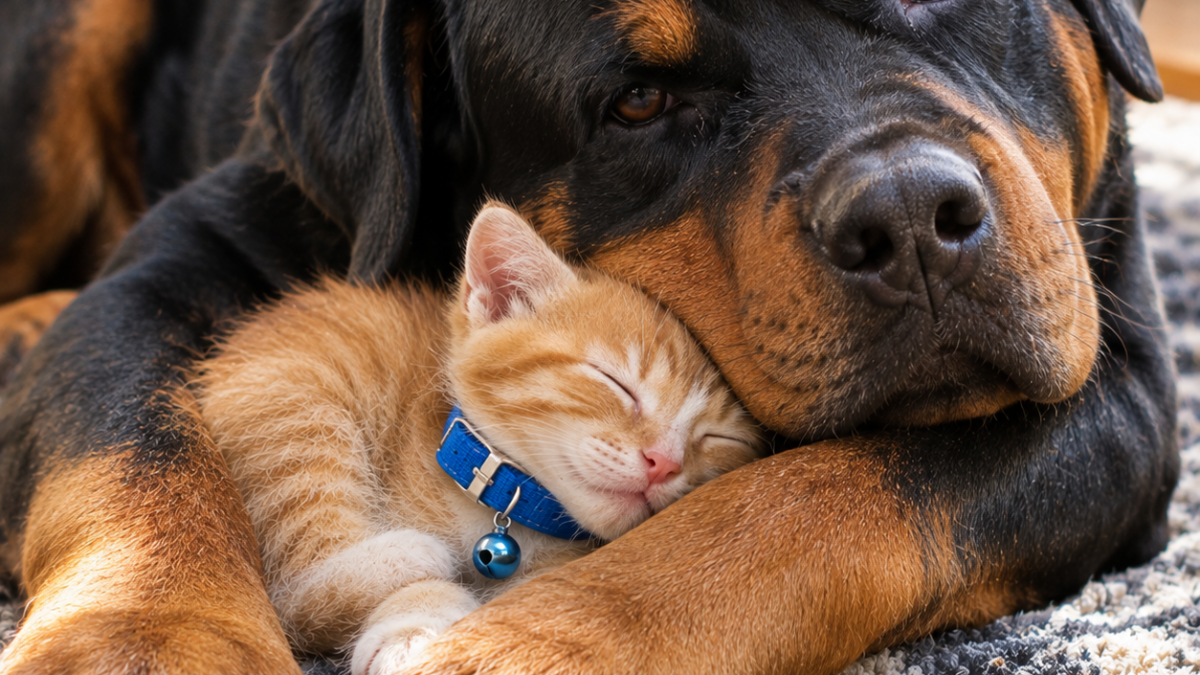
A 7-Day-Old Kitten Crawled Beneath My 100-Pound Rottweiler and Fell Asleep—Then She Grew Up Believing He Was Her Family
The first time my seven-day-old kitten crawled between my hundred-pound Rottweiler’s front paws and fell asleep against his chest, I was sure I had made a terrible mistake.
Moxie grew up believing every large dog was as gentle as Walter, and one afternoon that trust nearly cost her life when a German Shepherd reacted before I could pull her away.
But when she finally came home from the veterinary hospital, bruised, stitched, and missing a damaged tooth, she walked straight past me, curled against Walter’s chest again, and taught me something about trust and family that I had been too lonely to understand on my own.
My name is Erin Holloway.
I was forty-eight when Moxie came into my life, although “came into my life” makes it sound as if she arrived politely.
She did not.
She arrived in a cardboard produce box lined with an old blue bath towel.
At seven days old, she weighed less than a pound.
Her eyes were still mostly closed.
Her ears looked too small to belong to an actual animal.
Her fur was pale orange with a white patch beneath her chin, and her legs were so thin that the first time she stretched them, I thought there could not possibly be enough bones inside.
Her mother had died shortly after giving birth.
A woman I knew through a local animal-rescue group called me because I had bottle-fed kittens before.
Not many.
Enough to know what I was agreeing to.
Or at least I thought I knew.
“Smallest of the litter,” she told me.
“How small?”
She hesitated.
“That small.”
Then she handed me the box.
I looked inside.
Moxie made one squeaking sound.
Not even a proper meow.
More like a rusty hinge somewhere very far away.
I said:
“Oh, no.”
The rescuer laughed.
“That’s not usually what people say.”
“I know what newborn kittens require.”
“That’s why I called you.”
“I have three dogs.”
“You have Walter.”
That was true.
Walter was my eight-year-old Rottweiler.
Almost one hundred pounds.
Broad chest.
Black coat with rust markings.
Head large enough to make strangers reconsider whether they truly needed to deliver a package to my front porch.
He had that classic Rottweiler expression that looked serious even when he was thinking about cheese.
Delivery drivers hated him.
Children adored him.
Walter had never bitten anyone.
Never even tried.
PART2:
He had once allowed my niece’s three-year-old son to place six toy cars along his back while he lay on the living-room floor.
Still, “gentle Rottweiler” and “seven-day-old kitten” were two facts I had no intention of testing carelessly.
My other dogs were Maggie, a Labrador mix, and Otis, an aging Australian Shepherd who believed every visitor existed to throw tennis balls.
All three were good dogs.
All three were enormous compared with Moxie.
So I set up the spare bedroom.
Heating pad beneath half of a small box.
Soft fleece.
Digital thermometer.
Formula.
Bottles.
Scale.
Washcloths.
Everything.
Newborn kittens cannot regulate their body temperature well.
They cannot eat whenever they feel like it.
They cannot use the bathroom properly without help.
They are tiny, demanding little emergencies with paws.
For the next week, my life became numbers.
2:00 a.m.
Bottle.
4:00 a.m.
Bottle.
6:00.
Bottle.
Weight.
Warmth.
Cleaning.
Repeat.
I began forgetting normal things.
PART3:
I put my coffee in the microwave and discovered it three hours later.
I once walked into the laundry room holding a bottle of kitten formula and could not remember why I was there.
I sent an email to a client at 3:17 in the morning and signed it:
Love, Erin.
I work from home as a bookkeeping consultant.
The client called later and asked whether we had reached a new stage in our professional relationship.
I blamed the kitten.
Moxie ate aggressively.
That was good.
She would wrap both front paws around the tiny bottle as if someone planned to steal it.
Afterward she would collapse into my palm, belly round, completely unconscious.
Those first nights, Walter watched from the hallway.
I had closed the spare-room door.
Every time I carried the bottle down the hall, I heard his nails behind me.
Click.
Click.
Click.
He followed.
I entered the room.
He sat outside.
When I came back out twenty minutes later, Walter was still there.
“What?”
He stared at the door.
“It’s a kitten.”
His ears moved.
“You don’t need to be involved.”
Walter disagreed silently.
The next night, he lay outside the door.
The night after that too.
He stopped following me back to bed.
Instead, he remained in the hallway until I finished each feeding.
At 4:00 one morning, I stepped out and nearly tripped over him.
“Walter.”
He opened one eye.
“You have a perfectly good dog bed.”
Nothing.
“This is obsessive.”
He put his head back down.
By the end of that week, I was too tired to argue with anybody, including dogs.
So one morning I decided to introduce them properly.
I chose Walter first because he was the calmest.
Maggie loved everything too enthusiastically.
Otis had no concept of personal space.
Walter understood stillness.
I sat on the spare-room floor.
Moxie was in my lap.
Walter waited outside.
“Okay.”
I opened the door.
He stood.
Not rushing.
I kept one hand on his collar.
“Easy.”
Walter lowered his head.
Moxie smelled like formula and warm towels and something slightly medicinal.
Walter sniffed once.
Then again.
His nose looked enormous beside her body.
I held my breath.
Moxie did not.
She crawled off my leg.
“Wait.”
She ignored me.
Her eyes were barely open enough to know where she was going.
She stumbled across the rug.
Straight toward Walter.
I tightened my grip on his collar.
He froze.
Moxie reached one front paw.
Then the other.
Climbed between Walter’s paws.
Pressed herself into the warm space beneath his chest.
Turned once.
And fell asleep.
Walter stared at me.
His expression said:
What exactly am I supposed to do now?
“Don’t move.”
He did not.
I mean that literally.
For almost an hour.
Walter’s legs eventually began trembling slightly from holding the same position.
Still, he would not shift.
Moxie slept beneath him with her tiny face tucked against his chest.
I sat there watching.
My fear slowly became something else.
Wonder.
When she finally woke, Walter lowered his nose and touched the top of her head.
One tiny lick.
That was the beginning.
I remained careful.
For weeks.
Supervised interaction only.
No food nearby.
No unsupervised access.
No assuming good behavior yesterday guaranteed good behavior today.
People sometimes see one sweet video of a big dog with a tiny animal and think instinct disappears.
It does not.
Animals are animals.
Safety matters.
But Walter seemed to understand that Moxie was fragile.
He moved differently around her.
Slowly.
Deliberately.
If she crawled beneath him, he checked where she was before standing.
If she squeaked, he looked toward me.
If I fed her, he lay nearby.
When Moxie was three weeks old, I found Walter asleep outside her box.
At four weeks, she climbed onto his paw.
At five, she began attacking his tail.
That tested his patience.
I watched carefully.
Moxie pounced.
Walter looked behind him.
Tail moved.
Moxie pounced again.
Walter sighed.
I swear dogs can sigh with moral judgment.
“She’s a baby.”
He looked at me as if that was not his problem.
By six weeks, Moxie had decided Walter belonged to her.
Not the other way around.
If he lay down, she climbed on him.
If he walked away, she followed.
If he drank water, she appeared beside the bowl.
She had her own tiny ceramic dish.
Ignored it.
Walter’s stainless-steel bowl was apparently better.
I would find her standing with both front feet on the rim, drinking while Walter waited behind her.
“Walter.”
He looked at me.
“You’re enabling this.”
He looked away.
Moxie copied the dogs.
That was the funniest part.
When someone knocked at the door, three dogs ran toward it.
Then came Moxie.
Tiny orange blur.
She had no idea why everyone was running.
She simply understood:
Door activity.
Must attend.
If Walter sat beside the kitchen counter while I cooked, Moxie sat beside him.
If the dogs waited by the back door, Moxie waited.
If Walter went to investigate the fence, Moxie followed until I scooped her up and reminded her she weighed four pounds and had no jurisdiction.
By four months old, she had developed what I called her “security patrol.”
Every morning:
Living room window.
Kitchen.
Back door.
Walter’s bed.
Food bowl.
Then me.
She would walk into my office.
Meow once.
I would say:
“I’m working.”
She would jump onto the printer.
Then watch.
That was when I realized how much I had changed too.
Two years earlier, my marriage had ended.
There was no dramatic betrayal.
No screaming divorce.
No one person who became the villain.
Twenty-six years simply wore down.
My husband and I became people who shared bills, furniture, and increasingly little else.
When he finally moved out, the quiet surprised me.
I had wanted peace.
Then I got it.
Too much.
My daughter, Sophie, was grown and living in Arizona.
We spoke often.
But phone calls are not the same as another person moving through the kitchen.
I worked from home.
Some days I realized at dinner that the cashier at the grocery store had been the only human being I had spoken to face-to-face.
Loneliness did not arrive like sadness.
It arrived like routine.
Coffee for one.
Dinner for one.
A television playing in a room I was not watching because voices made the house feel occupied.
I still had the dogs.
They helped.
Of course they did.
But Moxie needed me differently.
Every two hours.
No negotiation.
When she arrived, I could not stay in bed because she might die if I did.
At first I thought I was saving a kitten.
Later, I realized being necessary had saved something in me too.
Not everything.
Animals are not therapy replacements.
They do not fix marriages or erase loneliness.
But responsibility can pull you back into motion.
Wake up.
Warm formula.
Hold this tiny life.
Do it again.
Moxie gave my empty hours shape.
Walter gave Moxie something I could not.
A kind of constant physical safety.
He was warm.
Solid.
Predictable.
She slept against his chest.
Later on his back.
Once directly across his face.
Walter woke with orange fur covering one eye and looked at me as though I had personally betrayed him.
I took a photograph.
He looked even more offended.
When Moxie was old enough, I bought a harness.
Blue.
Tiny.
At first she fell sideways as though wearing it had disabled her spine.
Cats are dramatic about harnesses.
Five minutes later she was fine.
Eventually I clipped on a leash and brought her into the yard beside Walter.
She followed him naturally.
No coaxing.
No treats.
Walter walked.
Moxie walked.
I thought:
This cannot become normal.
It did.
Within weeks, we were doing short neighborhood walks.
Walter.
Maggie.
Otis.
And one orange cat.
People stared.
A pickup slowed one morning.
The passenger window rolled down.
A woman shouted:
“IS THAT A CAT?”
Moxie stopped.
Stared at her.
The woman laughed.
I said:
“Yes.”
“WHY?”
I had no answer.
Moxie did not appreciate the interruption and continued walking.
Another neighbor called her “the little Rottweiler.”
That nickname stuck.
The funniest moment happened at the living-room window.
A gray neighborhood cat appeared outside.
Normal cat.
Probably eight pounds.
Sat beneath the bird feeder.
Moxie spotted him.
Her body went rigid.
Tail puffed.
Back arched.
Then she made a sound.
Low.
Rumbling.
Almost a growl.
I stared.
“Moxie.”
She growled again.
Walter came over.
Moxie stood beside him, both of them glaring through the glass.
I laughed so hard I had to sit down.
“Moxie, honey.”
She looked at me.
“I hate to tell you this.”
I pointed toward the cat outside.
“Those are your people.”
Moxie returned her attention to the intruder.
Apparently not.
Walter was her people.
Maybe that should have worried me more.
Moxie had spent her entire life around gentle dogs.
Walter.
Maggie.
Otis.
She had never learned the normal caution cats develop around unfamiliar dogs.
To her:
Dog meant safety.
Big dog meant Walter.
That mistake nearly killed her.
She was six months old.
Late summer.
Warm afternoon.
We were walking a familiar loop near the edge of our neighborhood.
Walter and Moxie.
Only the two of them because Otis’s arthritis was bothering him and Maggie had decided the temperature was unreasonable.
Moxie wore her harness.
Walter walked on my left.
We rounded a corner.
A man was approaching with a German Shepherd.
Young dog.
Maybe three.
Healthy.
Alert.
I did not know them.
That should have been enough for me to increase distance.
Normally, I would have.
But the sidewalk was wide.
The dog appeared under control.
I shortened Walter’s leash.
Then Moxie noticed him.
Her ears came forward.
Tail up.
Friendly.
Before I could shorten her leash fully, she moved toward the shepherd.
Not running.
Just confident.
The shepherd saw a small animal approaching.
Everything happened in less than one second.
Lunge.
Snap.
Scream.
Moxie hit the pavement.
I do not remember dropping the leashes.
I remember Walter barking.
Deep.
Terrifying.
The other man pulling his dog backward.
I remember kneeling.
Moxie’s body limp in my hands.
Blood near her mouth.
“No.”
I lifted her.
“No, no, no.”
Her eyes were open.
But she was not making noise.
That frightened me more than screaming.
Walter stood beside me whining.
Not barking now.
Whining.
The other man kept saying:
“I’m sorry.”
“I’m so sorry.”
“He’s never—”
I barely heard him.
I wrapped Moxie inside my jacket.
Ran for home.
My car was in the driveway.
Walter jumped into the back seat without being asked.
I normally would never take him into an emergency vet visit unplanned.
That day I did not think.
Moxie lay in my lap at the red light.
I kept saying:
“Stay with me.”
Her breathing was shallow.
Blood touched my sleeve.
Then came the thought.
Maybe I did this.
Not the attack.
I knew which dog had bitten.
But maybe I had taught Moxie the wrong rule.
Maybe Walter’s gentleness had become dangerous education.
Maybe I had allowed her to believe all dogs were safe.
All big bodies were warm.
All paws were places to sleep.
I cried while driving.
“I’m sorry.”
Walter leaned forward between the seats.
His nose nearly touched Moxie.
“I’m sorry.”
The emergency clinic took her immediately.
I stood in the lobby with blood on my shirt.
Walter was beside me.
A technician asked whether he was involved.
“No.”
“He’s hers.”
The woman looked confused.
“What does that mean?”
“I don’t know.”
Walter lay down facing the treatment-room door.
We waited.
Thirty minutes.
Forty-five.
An hour.
The veterinarian came out.
Moxie was alive.
The bite had caught her face rather than crushing her chest or neck.
One puncture near the jaw.
Significant trauma inside the mouth.
Damaged tooth.
Bruising.
No skull fracture.
No internal injuries they could find.
She would stay overnight.
I sat down.
Actually sat on the floor.
Walter pressed against me.
The vet said:
“She was lucky.”
I nodded.
I hated the word.
Lucky.
Lucky would have been nothing happening.
But I understood.
It could have been much worse.
The man with the shepherd called later.
He had gotten my number from a neighbor.
He apologized again.
Offered to cover the veterinary bill.
I said yes.
I did not yell at him.
His dog had reacted to an unfamiliar small animal approaching.
That did not make the injury acceptable.
But I could not honestly pretend Moxie had respected normal boundaries either.
The responsibility was complicated.
That was harder than having someone simple to hate.
Moxie stayed two nights.
When I brought her home, she looked small again.
Like the baby from the cardboard box.
Her mouth was swollen.
Medication made her sleepy.
One damaged canine tooth would need removal after inflammation settled.
For several days she stayed in my bedroom.
Quiet.
No dogs unless supervised.
Walter sat outside the door.
Same as when she had been seven days old.
Full circle.
He would lie there for hours.
When I opened the door, Moxie looked toward him.
I was afraid to let them together.
Not because Walter had done anything.
Because I did not know what fear had done inside Moxie.
Maybe dogs now meant pain.
Maybe even Walter.
The first evening she felt well enough to wander, she slipped through the partially open bedroom door before I could stop her.
“Moxie.”
She continued down the hallway.
Walter was asleep on the living-room rug.
He opened his eyes.
Moxie stopped.
I stood six feet behind her.
Held my breath.
Walter lifted his head.
Moxie walked toward him.
Slowly.
No hesitation.
She reached his front legs.
Circled twice.
Then lay down against his chest.
Exactly as she had when she was a week old.
Walter looked at me.
Then lowered his head.
He licked the top of hers.
Once.
Very gently.
I cried harder than I had during my divorce.
That embarrassed me afterward.
It should not have.
Divorce had been slow grief.
This was relief arriving all at once.
Moxie had learned something painful.
Not every dog was Walter.
But she had not learned the wrong lesson from it.
She had not decided:
No dog is safe.
That distinction stayed with me.
Trust does not have to mean blindness.
Caution does not have to mean fear.
Moxie healed.
The damaged tooth came out.
Afterward, because of the way her lip sat, one small fang showed slightly whenever her mouth was closed.
It gave her a permanently mischievous expression.
For weeks, I hated seeing it.
Evidence.
Every glance reminded me of the sidewalk.
Her body in my arms.
My own failure to shorten the leash quickly enough.
Then Moxie stopped letting me use it as punishment.
She did not care.
She ate.
Played.
Attacked Walter’s tail.
Slept on his back.
She became more cautious around unfamiliar dogs.
Finally.
On walks, if she saw one, she moved closer to Walter or me.
She watched first.
No automatic approach.
That made me sad and relieved at the same time.
Innocence had changed into judgment.
That is what growing up is, I suppose.
The German Shepherd’s owner stayed in touch for a while.
His name was Marcus.
His dog was Ranger.
Marcus hired a trainer.
Changed walking equipment.
Worked on prey response and leash control.
He paid every veterinary expense without argument.
One afternoon, months later, we saw each other from opposite sides of the street.
Marcus stopped.
So did I.
Ranger sat beside him.
Moxie noticed.
She moved behind Walter.
Did not panic.
Did not approach.
Marcus raised one hand.
I raised mine.
That was all.
No reconciliation scene.
No forced meeting between animals.
Sometimes respectful distance is the happy ending.
Years passed.
Maggie died first.
Cancer.
She was thirteen.
Otis followed eighteen months later.
Old age.
A gentle decline.
The house changed.
Walter and Moxie became the remaining pair.
By then, Moxie was four.
Walter twelve.
His muzzle went gray.
His hind legs slowed.
Stairs became difficult.
Moxie adjusted without anyone teaching her.
She no longer jumped onto his back when he was standing.
She waited until he lay down.
If he struggled to rise, she moved aside.
When I installed non-slip runners along the hallway, Moxie decided they were racetracks.
Walter did not approve.
He became deaf in one ear.
Then mostly both.
Moxie learned to wake him.
She would touch his face with one paw.
Sometimes gently.
Sometimes with the social grace of a tiny orange dictator.
He would open one eye.
She would walk toward the door.
He followed.
Watching them age together did something strange to time.
I could still see the enormous Rottweiler frozen over a week-old kitten.
Then I would look again.
Old dog.
Adult cat.
Years gone.
One evening I found them asleep on the original living-room rug.
Same rug.
I had nearly thrown it away twice.
Walter lay on his side.
Gray muzzle.
Slow breathing.
Moxie curled against his neck.
Tiny fang showing.
I stood in the hallway for several minutes.
Did nothing.
Took no picture at first.
I simply watched.
People had joked for years:
“Moxie thinks she’s a dog.”
I used to laugh.
But standing there, I realized I did not think that was true.
Moxie knew she was a cat.
She climbed.
She stalked bugs.
She ignored commands.
She knocked objects from shelves for reasons known only to her species.
She did not think she was a dog.
She simply thought Walter was family.
Those are different things.
Family does not require confusion about identity.
You do not need to become like someone to belong with them.
That realization hit me harder than expected.
Maybe because I had spent years after my divorce thinking family was something that had failed.
My daughter lived far away.
My marriage ended.
Parents gone.
Home quieter than I thought it would be at forty-eight.
Then this absurd little kitten had arrived needing milk every two hours.
Walter had made room beneath his chest.
I had made room in my schedule.
Moxie had made room in the house’s silence.
None of us looked like the life I thought I would have.
Still family.
Walter’s final year was difficult.
Arthritis worsened.
Then heart disease.
Medication helped.
Until it did not.
One winter morning he stopped finishing breakfast.
That was how I knew.
Walter had treated food as a religious obligation his entire life.
I called our vet.
Tests.
Heart enlargement.
Fluid.
Medication adjustment.
We got several good months.
Moxie stayed close.
Almost too close.
If Walter changed rooms, she followed.
When he slept, she slept beside him.
The day came in spring.
Warm.
Rain overnight.
Walter could no longer stand without help.
He tried.
Front legs lifted.
Hind legs failed.
His face changed.
Not pain exactly.
Confusion.
That broke me.
The vet came to the house.
My daughter Sophie flew in.
Walter lay on the living-room rug.
Moxie sat nearby.
I considered moving her.
The vet said:
“Let her choose.”
So I did.
Walter received the first sedative.
His breathing relaxed.
I sat with his head in my lap.
Sophie stroked his shoulder.
Moxie approached.
Sniffed his nose.
Then crawled between his front legs.
The same place.
Years earlier, she had barely fit beneath his chest.
Now she curled against him.
Walter opened his eyes.
Barely.
His nose touched the top of her head.
I whispered:
“Don’t move.”
The same words I had said the first day.
Only this time, I was talking to myself too.
Stay here.
Do not run from the ending because it hurts.
Walter died with Moxie pressed against his chest.
Afterward, she remained beside him.
The vet gave her time.
Moxie sniffed.
Waited.
Then walked away.
For three days she searched for him.
Not constantly.
But enough.
His bed.
Kitchen.
Back door.
Rug.
She cried at night.
A strange short sound I had never heard before.
I slept on the couch.
Moxie slept on my chest.
I think both of us were looking for the same weight that was gone.
People asked whether I would get another dog.
Not immediately.
Maybe someday.
Moxie and I needed the house to become ours before introducing another shape into it.
The first week after Walter died, I found Moxie sitting beside his water bowl.
I had not removed it.
She stared at me.
I sat on the floor.
“He’s not coming back.”
Moxie walked over.
Climbed into my lap.
She was nine years old then.
Far too large to fit into one hand.
Still tried.
I held her.
That was when the circle completed.
When Moxie arrived, Walter taught her safety.
When Walter left, Moxie stayed with me in the empty house.
We had traded roles.
That happens in families.
The one needing care becomes the one providing it.
Not deliberately.
Just because there is space.
A year later, I adopted another dog.
Not a Rottweiler.
I could not.
Not because I was afraid.
Because I did not want to spend every day comparing.
Her name was June.
A five-year-old mixed breed from a county shelter.
Forty pounds.
Gentle.
Nervous around cats.
The first introduction was nothing like Walter and Moxie.
I took weeks.
Gates.
Leashes.
Scent exchange.
Separate rooms.
No romantic belief that love would simply happen.
Moxie watched June carefully.
June respected distance.
Eventually, one afternoon, June lay on the living-room rug.
Moxie walked over.
Not between her paws.
Beside them.
Sat.
June looked away politely.
Moxie lay down.
I smiled.
Different relationship.
Different rules.
Still possible.
That taught me something else.
Walter did not need replacing.
Family could expand without pretending old relationships were reproducible.
Moxie never treated June like Walter.
She should not have.
She had become wiser.
So had I.
I still have the picture from that first week.
Seven-day-old Moxie beneath Walter’s chest.
Walter frozen.
Eyes wide.
My hand visible at the edge of the frame because I was too nervous to move away.
The photograph is slightly blurry.
Bad lighting.
Nothing professional.
It is my favorite.
Not because it is cute.
It is.
But because I now know what came after.
The walks.
The water bowl.
The growling at neighborhood cats.
The attack.
The little fang.
Walter aging.
Moxie returning to his chest after she had learned the world could hurt her.
Their final afternoon together.
All of that exists inside the photograph for me.
A beginning that already contains the ending.
I used to think the most important lesson was that unusual animals can become friends.
That is too easy.
The internet loves unlikely friendships because they look magical.
Dog and cat.
Lion and lamb.
Big and small.
But friendship is not magical.
It is behavioral.
Walter earned Moxie’s trust one careful movement at a time.
He did not chase.
Did not crowd.
Did not take her food.
Did not punish her curiosity.
He simply made room.
Again and again.
Moxie responded to that.
Then the German Shepherd incident complicated everything.
For a while I believed I had failed her by letting her grow up too trusting.
Maybe partly.
I should have managed that walk better.
I should have recognized that an animal raised around unusually tolerant dogs lacked some caution.
I accepted that.
But I no longer believe teaching Moxie trust was the mistake.
The mistake would have been teaching her trust without discernment forever.
Pain taught the part I had missed.
Unfair teacher.
Effective.
Moxie learned:
Walter is safe.
Not every dog is Walter.
Both statements can be true.
People need that lesson too.
For years after my divorce, I made the opposite mistake.
One important relationship ended, and some part of me quietly concluded closeness itself was dangerous.
I stopped saying yes to dinner invitations.
Stopped going places unless there was a reason.
Worked.
Came home.
Dogs.
Television.
Bed.
Nobody could disappoint me if I needed very little.
Moxie ruined that arrangement.
She needed too much.
Then Walter demonstrated another way.
You can remain yourself.
Keep boundaries.
Move carefully.
And still let something small crawl into your safe space.
That sounds embarrassingly sentimental.
I am fifty-eight now.
I have earned the right.
Sophie lives closer these days.
Two hours away.
She visits.
I have friends again.
Real ones.
People who know where the spare key is.
People who call without scheduling.
I still like being alone.
There is a difference between solitude and loneliness.
I know it now.
Moxie is older.
Her orange face has pale fur around the eyes.
The little fang still shows.
Every veterinarian who meets her asks:
“What happened there?”
I tell them.
Dog bite.
Six months old.
Then they usually ask:
“Is she afraid of dogs?”
I look toward June asleep nearby.
“No.”
“Just selective.”
That is Moxie.
Selective.
Wiser trust.
Sometimes she still sits at the front window when a neighborhood cat appears.
She no longer growls.
Age has apparently introduced diplomacy.
She watches.
Then loses interest.
One evening last winter, I found her asleep on Walter’s old rug.
June was beside her.
Not touching.
Close.
I stood in the hallway.
Same place.
Different animals.
Different year.
Same sense of something settling into place.
I thought about the day Moxie arrived.
Cardboard box.
Old towel.
Eyes mostly closed.
No mother.
No idea where she was.
I thought about Walter lying outside the spare-room door.
He did not know what was behind it.
He only knew I kept going in.
So he waited.
Then, when I finally let him closer, Moxie made the choice.
She crawled across the rug.
Past my hands.
Between his paws.
Into the warmest place she could find.
I thought I had made a terrible mistake.
Maybe Walter did too.
He certainly looked like it.
But neither of us moved.
Sometimes that is how family starts.
Not with certainty.
With someone staying still long enough for somebody frightened to decide they are safe.
People always said Moxie thought she was a dog.
They were wrong.
She knew exactly what she was.
A cat.
A ridiculous one.
A stubborn one.
A cat who walked on a leash, drank from a Rottweiler’s bowl, growled at other cats, and slept against a dog almost twenty times her size.
Walter never needed Moxie to become a dog.
He simply made room for a kitten.
Moxie never needed Walter to become a cat.
She simply knew his chest was safe.
I spent a long time thinking family meant people who shared your name, history, house, or blood.
Those things can create family.
They do not guarantee it.
Sometimes family is the daughter living several states away who calls every Sunday.
Sometimes it is the friend who brings soup without asking.
Sometimes it is a one-hundred-pound Rottweiler afraid to move because a seven-day-old kitten has fallen asleep between his paws.
And sometimes it is that same kitten, years later, returning to his chest after the world has taught her that not every creature deserves her trust.
Moxie did not forget the attack.
Her little fang made sure of that.
But she did not let one frightening moment rewrite every gentle thing that came before it.
She became careful.
Not closed.
That may be the bravest kind of trust there is.
I understand that now.
Because Walter taught it to Moxie.
And Moxie taught it to me.
Family is not always the one that looks like you.
It is not even always the one you expected to have.
Sometimes family is simply whoever made room for you when you were small, frightened, exhausted, lonely, or unsure where you belonged.
Walter made room for Moxie.
Then, without realizing it, both of them made room for me.
And when I look at that old blurry photograph now—the enormous black dog, the newborn orange kitten, and my nervous hand hovering at the edge—I no longer see the moment I almost made a terrible mistake.
I see the moment our family found its shape.








