A 6-Year-Old Girl Walked Two Miles Through the Arizona Heat and Clung to a Hells Angel’s Leg at a Gas Station—Then She Whispered Six Words That Made 350 Bikers Go Silent.
PART3:
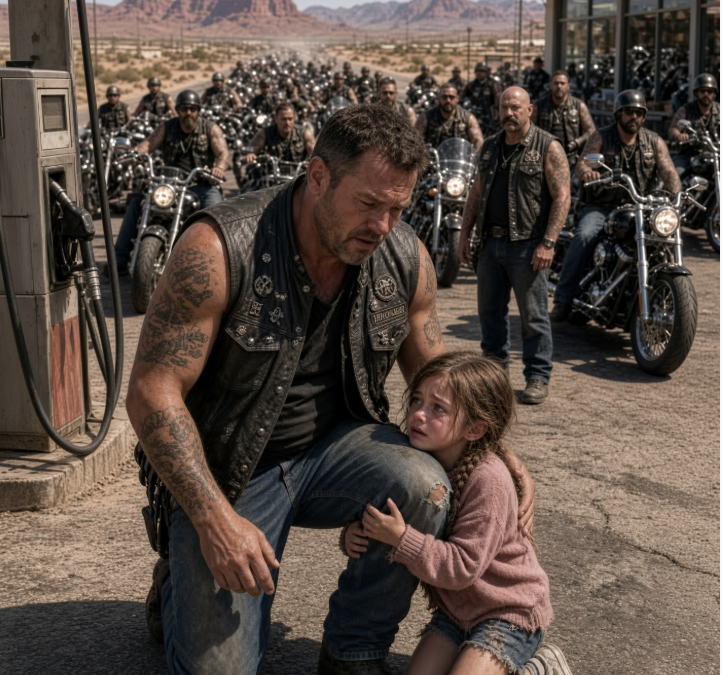
Marcus had seen men bleed out in parking lots.
He had seen broken teeth on barroom floors.
Highway wrecks at two in the morning.
Kids hiding behind motel vending machines while adults screamed at each other inside rooms paid for by the week.
He had seen enough pain to become careful about what he let reach him.
But those words went straight through everything.
Please don’t let them take me away.
He did not stand.
He stayed crouched in front of her, his knee burning on the concrete, his hands open.
“Nobody’s taking you anywhere right now,” he said. “I promise. But I need to know your name.”
She searched his face with the cautious intelligence of a child who had learned that adults often lied while sounding gentle.
“Ellie,” she whispered.
“Ellie. That’s a good name. I’m Marcus.”
She glanced at his vest.
Not at the death’s head.
Not at the patches.
At the leather itself.
“Ellie,” he said, “can you tell me where you came from?”
She swallowed.
“Grandma’s house.”
“Where is that?”
She pointed vaguely down the highway toward town.
“How did you get here?”
“I walked.”
A cold feeling moved through Marcus despite the heat.
“You walked from town?”
She nodded.
“Where’s Grandma?”
Ellie’s eyes filled again.
“She fell down.”
The riders nearest them had gone completely still.
Marcus kept his voice even.
“What do you mean she fell down?”
“In the kitchen. She made toast and then she grabbed the counter and made a sound.” Ellie’s face pinched as if the memory hurt physically. “Then she fell. I tried to wake her up. I shook her arm. I got the phone like she taught me. I pressed the button with the star because she said that calls help.”
Marcus understood.
Emergency call shortcut.
“She went in an ambulance?”
Ellie nodded.
“Mrs. Mercer came over. Grandma told me to stay with her. But Mrs. Mercer got a phone call and started crying and told me to wait in the car. I waited a long time.”
Her voice became smaller.
“Then I got scared.”
“So you got out?”
“I wanted Grandma.”
“You walked to find her?”
Ellie nodded again.
The Arizona sun beat down on the gas station lot. Marcus looked at her sweater, her flushed cheeks, the dust on her legs. Prescott proper was at least two miles away, depending where she had started. Two miles along a highway shoulder in August.
A grown man would feel it.
A six-year-old could collapse.
“Have you eaten today?”
She hesitated.
That told him enough.
“What did you eat?”
“Toast.”
“When?”
“Morning.”
Marcus turned his head slightly.
“Torch.”
Derek “Torch” Brennan appeared almost immediately, as if the name had pulled him out of the air.
Torch was six foot two, two hundred sixty pounds, shaved head gleaming with sweat, handlebar mustache framing a mouth that could frighten people before it ever opened. He had been smiling a minute earlier.
He was not smiling now.
“What happened?”
“Need water. Something soft to eat. Not candy. And get Wyatt.”
Torch looked from Marcus to Ellie and back again.
Then he nodded.
“On it.”
He moved through the riders with purpose, and the crowd parted for him.
Marcus looked back at Ellie.
“Can I ask you something?”
She nodded faintly.
“Why did you grab me?”
Her eyes moved again to his vest.
“My daddy had a jacket like that,” she said. “Before he went to heaven.”
The words hit harder than Marcus expected.
He had no good answer to that.
Men had built whole religions trying to answer children who said things like that, and most of them still sounded weak when the child was standing right there.
“What was your daddy’s name?”
“James.”
“James rode?”
She nodded.
“He said motorcycles sounded like dragons that loved freedom.”
A rider behind Marcus made a broken noise and turned away.
Marcus blinked slowly.
“He sounds like he knew things.”
“He did.”
“What happened to him?”
Ellie looked down.
“Grandma says the road took him.”
Route 89, Marcus thought.
There were crosses all along that highway.
Torch returned with a bottle of cold water, a banana, and a pack of crackers. Wyatt Donovan walked beside him.
Wyatt was the chapter president, silver-streaked hair pulled back, eyes pale blue and hard to read. He did not need to raise his voice. He did not need to swagger. Men quieted when he came near because he carried authority like weather.
He stopped in front of pump number two and looked at Marcus.
“Talk to me.”
Marcus told him everything.
Fast.
Clear.
No drama.
Grandmother collapsed.
Ambulance.
Neighbor supposed to watch her.
Child left in car.
Child walked highway.
Afraid of being taken.
Father dead.
No mother mentioned.
Wyatt listened without interrupting. His eyes moved to Ellie, who had shifted from Marcus’s leg to his hand. Her small fingers were threaded through his calloused ones, clutching as if his hand was now part of the earth.
“What’s Grandma’s name?” Wyatt asked.
Marcus looked down.
“Ellie, what’s your grandma’s name?”
“Dorothy Whitmore.”
Wyatt turned to Torch.
“Find the hospital. Yavapai Regional. Call and ask about Dorothy Whitmore. Find Linda Mercer too.”
“Linda?”
“That’s Mrs. Mercer,” Ellie whispered.
Torch was already dialing.
Ray Hutchinson emerged from the convenience store, sweating through his flannel shirt, phone in hand.
“I called the sheriff,” he said, voice cracking. “Just so you know. Not because—I mean, I didn’t know what was happening.”
Marcus stood slowly, careful not to pull his hand from Ellie’s.
“That’s fine.”
Ray looked at the riders filling his lot, then at the child.
“I just didn’t want trouble.”
“Neither do we.”
Ray’s eyes said he was not sure men like Marcus knew how to avoid it.
Marcus had seen that look for twenty years.
The quick judgment.
The fear.
The assumption that leather and tattoos and loud engines meant danger before anything else.
He had taught himself not to care.
Mostly.
Ellie tugged his hand.
“Is Grandma going to die?”
The gas station went silent around them.
Marcus crouched again.
“I don’t know,” he said. “But we’re going to find out.”
“Promise?”
“Yes.”
She studied him.
“Grandma says promises are heavy.”
“She’s right.”
“Can you carry it?”
Marcus swallowed.
“Yes,” he said. “I can carry this one.”
A sheriff’s cruiser arrived nine minutes later.
Deputy Alan Rourke stepped out first, one hand near his belt, eyes widening at the sight before him. He was young, maybe late twenties, with the nervous posture of a man who had expected one problem and found three hundred and fifty potential complications.
“Everyone stay where you are,” he called.
Wyatt lifted one hand.
“No one’s moving, Deputy.”
Rourke looked relieved and offended by his own relief.
Ray hurried toward him, speaking quickly. The deputy’s eyes moved from Ray to the riders to Ellie. When he approached Marcus, he softened slightly.
“This the child?”
Marcus nodded.
“Her name’s Ellie Whitmore. Her grandmother Dorothy was taken to Yavapai Regional. Neighbor Linda Mercer lost track of her. She walked here from town.”
The deputy crouched a few feet away.
“Hi, Ellie. I’m Deputy Rourke.”
Ellie pressed closer to Marcus.
Rourke noticed and did not push.
“Can you tell me if you’re hurt?”
She shook her head.
“Thirsty?”
Marcus held up the water bottle.
“She’s had some.”
“Okay.”
Rourke stood and spoke quietly to Marcus and Wyatt.
“I’ll need to contact child welfare.”
Marcus’s jaw tightened.
Wyatt saw it.
The deputy did too.
“It’s protocol,” Rourke said.
Marcus’s voice stayed controlled.
“She’s scared of being taken away.”
“I understand.”
“No,” Marcus said. “You heard the words. That doesn’t mean you understand.”
Rourke took that without snapping back, which earned him a small measure of respect.
“I don’t want to traumatize her,” the deputy said. “But we need to verify the grandmother’s condition and locate the neighbor.”
Torch returned, phone still in hand.
“Dorothy Whitmore is at Yavapai Regional. Admitted four hours ago. Acute care. Heart-related. Hospital won’t give details without family, but they confirmed she’s there.”
Ellie inhaled sharply.
Marcus squeezed her hand.
“What about Linda Mercer?” Wyatt asked.
“Still trying.”
Deputy Rourke nodded.
“I’ll escort you to the hospital.”
Marcus looked at Ellie.
“We’re going to Grandma.”
Her grip tightened.
“Now?”
“Now.”
Torch offered his truck.
Marcus accepted at first.
It was safer.
Air-conditioned.
Logical.
But when Ellie saw the line of motorcycles and Marcus moving toward Torch’s pickup, she stopped walking.
“What is it?”
“I want the dragon.”
Marcus blinked.
“What?”
She pointed at his Harley.
“Daddy said when you’re scared, the dragon makes the fear fly behind you.”
Torch turned away fast, rubbing his face.
Marcus looked at Rourke.
The deputy sighed.
“Absolutely not.”
Ellie’s eyes filled.
Marcus closed his eyes for one second.
Then he crouched.
“Ellie, motorcycles can be dangerous. You don’t have a helmet.”
A rider named Big Pete was already pulling a small spare half-helmet from his saddlebag.
“My niece uses this when she rides in parades,” he said. “DOT approved.”
Rourke rubbed his forehead.
“This is a terrible idea.”
Wyatt said, “We’ll go slow. You escort. Torch’s truck follows. Forty-seven bikes max. The rest stay here.”
“Forty-seven bikes max?” Rourke stared at him. “That is not a reassuring sentence.”
But Ellie was looking at Marcus with absolute certainty.
He knew that look.
It was the look of a child not asking for fun.
She was asking for continuity.
For something connected to her father.
For the sound that meant courage.
Marcus lifted the helmet.
“You ride in front of me. I hold you the whole time. You keep both hands on the tank strap. If I say hold still, you hold still. If you get scared, you tell me.”
Ellie nodded solemnly.
Rourke exhaled.
“I’m going to regret this.”
“No,” Wyatt said. “You’re going to lead carefully.”
The ride to Yavapai Regional Medical Center took less than fifteen minutes.
Marcus kept the Harley steady and slow, Ellie seated in front of him, her small back against his chest. His left arm held her securely while his right hand worked the throttle. The little helmet sat low on her head. The oversized pink sweater fluttered in the wind.
Behind them, forty-six motorcycles fell into formation without discussion.
Not a show.
Not intimidation.
An escort.
Deputy Rourke led with lights flashing but no siren. Torch’s truck followed the bikes. The remaining riders stayed near the gas station, spilling into the nearby diner lot and lining the shoulder, where curious locals watched from behind windshields and store windows.
Prescott had seen biker runs before.
It had never seen anything like this.
At the hospital, Marcus carried Ellie through the automatic doors into the emergency waiting room. The air-conditioning hit them like cold water. Ellie shivered and wrapped one arm around his neck.
Every head turned.
An elderly couple stopped whispering.
A construction worker holding a bloody rag to his hand stared openly.
A young mother pulled her toddler closer before she seemed to realize what she was doing and looked ashamed.
Marcus walked to the reception desk.
The nurse behind it looked up. Her name tag read Pamela Greer, RN. She saw the vest, the tattoos, the child, the motorcycles outside, and to her credit, she did not flinch.
“I’m looking for Dorothy Whitmore,” Marcus said. “Brought in by ambulance earlier. This is her granddaughter.”
Pamela’s eyes moved to Ellie.
“What’s your name, sweetheart?”
Ellie hid her face against Marcus.
“Ellie,” Marcus answered softly.
Pamela typed quickly.
“Mrs. Whitmore is in acute care. She was admitted about four hours ago.”
“Can Ellie see her?”
Pamela hesitated.
“Are you family?”
“No.”
“Guardian?”
“No.”
“Then I need social services, and I need to speak with the charge nurse upstairs.”
Marcus nodded.
“Do it.”
The tone was firm, but not rude.
Pamela studied him.
“Who are you to the child?”
Marcus looked down at Ellie’s hand still holding his vest.
“Right now,” he said, “I’m the person she found.”
Pamela’s face changed.
She picked up the phone.
Torch entered ten minutes later and sat heavily beside Marcus in the waiting area.
“Found Linda Mercer,” he said low. “She’s a wreck. Hospital called her. Said Dorothy’s condition was serious. She ran inside to grab purse and keys, left Ellie in the car. When she came back, Ellie was gone. She’s been driving around for two hours.”
Marcus felt anger flare.
A child left in a car.
A child gone.
A woman panicking too late.
Then he looked at Ellie asleep against his chest, drained by fear and heat, and forced the anger down.
Panic made people foolish.
Shame made them slower to fix it.
He had known both.
“What about Dorothy?” he asked.
Torch’s expression darkened.
“Heart failure. They’re running tests. Might need transfer to Phoenix if they can’t stabilize her.”
Marcus looked across the waiting room.
Deputy Rourke stood near the doors speaking into his radio. Wyatt was outside with the riders, making sure nobody crowded the entrance. Pamela Greer was still on the phone. A hospital social worker would come soon.
Then questions.
Forms.
Procedures.
A grandmother in acute care.
A dead father.
A missing mother.
A frightened child.
The system would open its mouth.
Marcus had seen it before.
Good people inside bad machinery.
Bad people hiding inside good policies.
Children processed by categories, shuffled by risk level, assessed by strangers who used words like placement and temporary care as if a child could not hear the difference between safety and exile.
He stood carefully, still holding Ellie.
“Torch.”
“Yeah?”
“Get Wyatt. Hospital riders. Parking lot. Five minutes.”
Torch looked at him.
“What are we doing?”
Marcus’s eyes stayed on the social services sign near the hallway.
“We’re making sure nobody can call this child unsupported.”
Torch nodded once.
“Copy that.”
Twenty minutes later, Marcus stood in the hospital parking lot facing forty-six men who had followed him from the Sunoco with no explanation beyond need. The sky had turned copper over the western ridge. Heat still rose from the pavement, but evening had begun loosening the day’s grip.
Wyatt stood slightly behind him, arms crossed.
Deputy Rourke lingered near his cruiser, pretending not to listen while absolutely listening.
“You all know enough,” Marcus said. “Little girl inside has got nobody right now except a grandmother in a hospital bed. The system is going to show up. They’ll ask the right questions. Maybe they’ll make the right call. Maybe not. But I’m not standing here and watching a kid get swallowed because the paperwork says she’s alone.”
No one spoke.
Marcus looked at the rows of weathered faces.
Some of these men had been in prison. Some had been soldiers. Some had buried children. Some had lost marriages, brothers, homes, faith. Most had been judged by people who never asked what brought them to the road.
“I’m not asking anyone to break the law,” Marcus said. “I’m asking what we can do legally, today, to make sure Ellie Whitmore and her grandmother have support.”
Silence lasted four seconds.
Then Wyatt stepped forward.
“You heard him,” he said. “We build a net.”
That was how it started.
With a helmet.
Wyatt removed his black helmet, turned it upside down, and dropped a hundred-dollar bill into it. Torch added two fifties. Big Pete added everything in his wallet and cursed when someone tried to count it before the helmet had made a full lap.
Within thirty minutes, the helmet was heavy with cash.
Fourteen thousand six hundred dollars.
Crumpled twenties, fifties, hundreds, small bills from men who looked away while giving because generosity embarrassed them more than violence ever had.
Enough to cover Dorothy’s hospital deductible.
Enough for three months of mortgage payments.
Enough groceries, medication, utilities, and breathing room.
But Wyatt was right.
Money was only the beginning.
At 6:43 p.m., a hospital social worker named Karen Liu arrived with a clipboard and the guarded expression of someone who had been warned there were bikers involved.
Marcus met her in the family consultation room.
Deputy Rourke stayed near the door. Pamela Greer stood just inside. Ellie sat beside Marcus with a juice box and crackers, wearing the small helmet in her lap because she did not want anyone taking it away.
Karen Liu sat across from them.
“Ellie,” she said gently, “do you know where your grandmother is?”
“In a hospital bed.”
“That’s right. Do you know who this man is?”
“Marcus.”
“How did you meet Marcus?”
“I grabbed him.”
The deputy coughed into his hand.
Karen blinked.
“You grabbed him?”
“His leg.”
“Why?”
Ellie looked at Marcus, then back at Karen.
“Because his jacket looked like Daddy’s.”
Karen’s face softened before she could stop it.
“Your daddy rode motorcycles?”
“He’s in heaven now.”
“I’m sorry.”
Ellie nodded, accepting condolences with the solemn exhaustion of a child who had heard them too often.
Karen asked questions slowly. Where she lived. Who cared for her. What happened when Dorothy fell. What Linda Mercer said. How long she walked.
At the end, Karen closed her folder.
“I need to assess immediate safety,” she said to Marcus. “If Mrs. Whitmore remains hospitalized and no legal guardian is available, temporary placement may be necessary.”
Ellie’s body went rigid.
Marcus felt it instantly.
“She can hear you,” he said.
Karen looked ashamed.
“I’m sorry.”
Ellie’s breathing quickened.
“No,” she whispered. “No, please. I’ll be good. I won’t touch anything. Please don’t take me.”
Marcus turned fully toward her.
“Ellie. Look at me.”
She did.
“No one is deciding that in front of you. And no one is punishing you. You did nothing wrong.”
Karen’s face changed. She had seen panic before. But maybe not like this.
Not triggered by one word.
Placement.
The sterile word adults used for the place a child feared most.
Linda Mercer arrived before Karen could continue.
She rushed into the waiting room with swollen eyes, hair half loose, blouse buttoned wrong. She saw Ellie and stopped so abruptly she nearly stumbled.
“Ellie.”
Ellie hid behind Marcus.
Linda broke.
She sank onto a chair and covered her face.
“I’m so sorry,” she sobbed. “I’m so sorry, baby. I panicked. I heard them say Dorothy might not make it, and I—I was supposed to watch you. I left you for one minute, and when I came back—”
Marcus stood.
Linda flinched when he approached.
He stopped a few feet away.
“You made a terrible mistake,” he said.
She nodded, sobbing.
“Yes.”
“But she’s safe.”
Linda looked up.
She expected rage.
Maybe she deserved it.
Marcus surprised her by placing one hand gently on her shoulder.
“That’s what matters right now. We fix from there.”
Linda cried harder.
Karen Liu watched.
So did Deputy Rourke.
That moment became the first entry in a new kind of report.
Not a child alone.
A child surrounded.
Dorothy Whitmore woke fully at 8:12 p.m.
She was seventy-one, silver-haired, sharp-eyed even through exhaustion, with a face carved by years of worry and love. When Marcus carried Ellie into the acute care room, Dorothy tried to sit up too fast and set off a monitor alarm.
“Grandma!”
Ellie scrambled onto the bed.
Dorothy wrapped thin arms around her granddaughter and closed her eyes like the whole world had returned to her.
“Oh, my baby,” she whispered. “My baby.”
Ellie cried into her hospital gown.
“I thought you died.”
“No, sweetheart. Not yet. I’m too stubborn.”
Marcus stood at the foot of the bed, suddenly feeling too large for the room.
Dorothy looked at him over Ellie’s head.
“You’re the one.”
“She found me.”
Dorothy studied him.
That same measuring look Ellie had.
Same green eyes.
Same ability to look past the vest and search the man underneath.
“My son rode,” Dorothy said.
“Ellie told me.”
“James. Army mechanic. Came home from Afghanistan with quiet in his bones and thunder under his skin. Motorcycle helped.”
“I’m sorry.”
“He died three years ago on Route 89. Driver crossed the center line. Ellie was three.” Dorothy’s voice held steady, but only because it had carried this grief for years. “Her mother left when Ellie was two. Said she wasn’t made for motherhood. Walked out before breakfast and never came back.”
Ellie clung tighter.
Dorothy stroked her hair.
“I’ve been raising her since. She’s my world.”
Marcus nodded.
“The social worker is outside.”
Dorothy’s eyes sharpened with fear.
“They’re going to take her.”
“Not if there’s a safe plan.”
“I don’t have family.”
“You have Linda.”
Dorothy’s mouth tightened.
“Linda means well. She falls apart.”
“You have a house.”
“With a leaking roof and a mortgage I’m two months behind on.”
“You have us.”
Dorothy stared.
Marcus stepped closer.
“There are three hundred and fifty people connected to what happened today. They’re not all standing outside this room because the hospital would probably call the National Guard, but they’re here. We can help fix the house. We can help with groceries, rides, medical appointments, whatever the social worker needs to see.”
Dorothy’s eyes filled.
“Why?”
Marcus looked at Ellie curled against her grandmother.
“Because your granddaughter grabbed my leg.”
Dorothy gave a weak laugh that turned into a cough.
Marcus waited until she caught her breath.
“Mrs. Whitmore, you were never supposed to do this alone.”
She looked out the window.
In the parking lot below, rows of motorcycles gleamed beneath hospital lights. Riders stood in clusters, waiting. Not demanding. Not performing.
Just present.
Dorothy reached for Marcus’s hand.
Her skin was papery and cool.
“Then help me keep her,” she whispered.
Marcus closed his hand around hers.
“Yes, ma’am.”
For the next seventy-two hours, Prescott became a town divided between what it thought it knew and what it could no longer deny.
Some people complained first.
They called the sheriff about noise.
They posted online about biker intimidation.
They peered through blinds at riders parked near the hospital and said things like, “This can’t be safe,” while ignoring the fact that the safest place in town for a six-year-old girl had become the middle of those motorcycles.
But reality is stubborn.
By morning, riders were at Dorothy’s house on Elm Street.
The home was a small single-story ranch with peeling paint, a sagging porch, and a front yard where grass had surrendered months ago. The roof dipped on the east side. Gutters hung crooked. A cracked bedroom window let in dust. The porch steps shifted dangerously under weight. The kitchen faucet leaked into the cabinet below, warping the floorboards.
Torch stood on the sidewalk with twelve men behind him.
He cracked his knuckles.
“Boys,” he said, “we’ve got work.”
Pete Holland, a retired contractor from Tucson, assessed the roof and started assigning tasks like a battlefield commander.
Gary Sinclair, a plumber from Phoenix, crawled under the house and emerged twenty minutes later covered in dirt and muttering words no child should hear.
A younger rider named Luis ran to the hardware store and returned with lumber, screws, caulk, paint rollers, pipe fittings, and enough bottled water to hydrate a football team.
Three women from the Phoenix chapter cleaned the kitchen, sorted expired food, scrubbed the refrigerator, and filled it with groceries.
Someone repaired the porch.
Someone cleared gutters.
Someone trimmed dead branches from the oak tree.
Someone replaced Ellie’s cracked bedroom window.
Someone found her shelf of picture books arranged with careful childish precision and dusted each one before putting it back exactly where it belonged.
At noon, Ray Hutchinson from the Sunoco arrived with sandwiches.
He looked embarrassed.
Torch looked at him.
“You here to inspect us?”
Ray rubbed the back of his neck.
“I was wrong yesterday.”
“About what?”
Ray glanced at the men working on the house.
“About what I thought this was.”
Torch considered him.
Then took a sandwich.
“Apology accepted if there’s mustard.”
“There’s mustard.”
“Then you’re on probation.”
Ray smiled despite himself.
By late afternoon, Deputy Rourke stopped by.
He stood in the yard looking at the roof crew, the fresh groceries, the repaired steps, the riders sweating through leather and denim in the Arizona heat.
“This is unusual,” he said to Wyatt.
Wyatt wiped paint from his hand.
“That legal language?”
“No. Personal confusion.”
Wyatt nodded.
“Fair.”
Rourke looked toward the house.
“Social services needs documentation. Names of people willing to help. Emergency contacts. Transportation plan. Medication schedule for Dorothy. School drop-off if she’s unable.”
Wyatt pointed to the kitchen.
“Mrs. Alvarez is making a binder.”
“Who’s Mrs. Alvarez?”
“Retired school secretary from Flagstaff chapter. Terrifies everyone. We listen.”
Inside, Mrs. Alvarez had already divided the binder into tabs.
Medical.
School.
Meals.
Transportation.
House repairs.
Emergency contacts.
Financial support.
She had handwriting so neat it looked typed and a voice that made grown bikers apologize for standing in the wrong place.
By evening, Karen Liu returned to the hospital with Deputy Rourke and reviewed the plan.
She saw the binder.
The funds.
The volunteers.
Linda Mercer, tearful but present, signed as secondary caregiver under supervision and admitted plainly that she had panicked and needed help herself.
Pamela Greer offered to coordinate Dorothy’s discharge instructions.
A cardiology nurse connected Dorothy with a local heart failure program.
The report changed.
No immediate removal recommended.
Kinship caregiver remains primary.
Extensive community support documented.
Child to remain with grandmother pending medical stability, with temporary supervised overnight arrangement through approved neighbor network if needed.
Marcus read those words twice.
Then looked at Ellie.
She was asleep in a chair beside Dorothy’s bed, one hand resting on Marcus’s vest folded across her lap.
The next morning, his phone rang.
Unknown number.
He stepped into the hospital hallway.
“Caldwell.”
A woman’s voice said, “Dad?”
The word hit him so hard he leaned against the wall.
“Claire.”
Silence.
Then his daughter said, “You called.”
“I did.”
“I didn’t think you would.”
“I should have.”
“Years ago.”
“Yes.”
The hallway blurred slightly.
Marcus turned away from passing nurses.
“I’m sorry,” he said.
Claire laughed once, but there was no humor in it.
“Which part?”
“All of it.”
“That’s broad.”
“It needs to be.”
She went quiet.
Marcus could hear traffic in the background, maybe a city street, maybe a parking lot.
“Why now?” she asked.
Marcus looked through the glass into Dorothy’s room.
Ellie slept curled in the chair. Dorothy watched her with the fierce tenderness of someone who knew how easily everything could be taken.
“A little girl asked me not to let anyone take her away,” he said.
“What?”
“It’s a long story.”
“With you, it always is.”
He closed his eyes.
“I’m not calling to ask for anything.”
“You said that in the message.”
“I meant it.”
“You also said you should have called years ago.”
“I meant that too.”
Claire’s voice softened despite herself.
“Mom said you wouldn’t change.”
“She had reasons.”
“I have reasons too.”
“I know.”
Another silence.
Then Claire said, “Tell me the long story.”
So he did.
Not all of it.
Enough.
He told his daughter about a barefoot child at a gas station, a grandmother in a hospital bed, a father with a biker jacket, a house full of strangers repairing what neglect and poverty had worn down.
When he finished, Claire was quiet.
Then she said, “That sounds like something you would do for strangers.”
Marcus felt the sentence twist.
“But not for us,” she added.
He accepted the wound because he had earned it.
“I know.”
“Dad…”
“I can’t undo it.”
“No.”
“But I can stop pretending absence was protection.”
Her breathing changed.
For years, Marcus had told himself his daughter was better without him. The divorce had been ugly. The custody battle uglier. His club life, his record, his temper, his inability to live inside polite structures had all been used against him in court. Some of it unfair. Some deserved. Eventually, he convinced himself that staying away spared Claire embarrassment and instability.
The truth was simpler and uglier.
He had been ashamed.
And shame had become silence.
Claire said, “I don’t know what to do with this.”
“You don’t have to do anything.”
“I’m angry.”
“You should be.”
“I missed you.”
That nearly broke him.
He pressed his fist against his mouth.
“I missed you too.”
“Are you still in Prescott?”
“Yes.”
“Send me the address.”
Marcus opened his eyes.
“What?”
“I’m not promising anything. But send it.”
His hand shook slightly as he texted her the hospital address.
When he returned to Dorothy’s room, Ellie was awake.
“Are you sad?” she asked.
Marcus wiped his face quickly.
“No.”
She tilted her head.
“Grandma says grown-ups say no when yes hurts.”
Dorothy looked at the ceiling as if innocent.
Marcus sat down.
“Your grandma talks too much.”
Ellie smiled.
It was the first real smile he had seen from her.
Small.
Crooked.
Bright enough to hurt.
Dorothy came home five days after Ellie grabbed Marcus’s leg.
The riders escorted her from the hospital, though only twenty bikes this time because Karen Liu had firmly explained that “supportive community presence” did not require “a rolling thunderstorm outside cardiac discharge.”
Dorothy cried when she saw the house.
The porch was painted.
The roofline straight.
The front door fixed.
The yard cleared.
Marigolds and desert sage planted beneath the oak.
The kitchen stocked.
The medicine schedule taped neatly inside a cabinet.
Ellie’s room cleaned, window repaired, quilt washed and folded.
Dorothy stood in the doorway for a long time.
Then she turned to Marcus.
“I don’t know how to repay this.”
Torch, standing behind him, muttered, “Coffee.”
Dorothy blinked.
“What?”
“Make coffee. We’re simple.”
She laughed until she had to sit down.
The first weeks were not a miracle.
They were work.
Dorothy’s medications had side effects. She tired easily. Some mornings she woke frightened by the pressure in her chest and had to call the nurse line. Ellie began having nightmares, often waking convinced an ambulance had returned and everyone was leaving.
Marcus stayed in Prescott longer than planned.
The Southwest run continued without him. Wyatt approved it with one nod and no discussion.
“You’re on assignment,” he said.
“What assignment?”
Wyatt looked at Ellie’s house.
“The one that grabbed you.”
Marcus slept on the couch twice when Dorothy had rough nights. Torch took over yard work. Linda Mercer came every afternoon, slowly earning back trust not with apologies but with reliability. She took Ellie to school. She drove Dorothy to appointments. She started therapy after Karen Liu handed her a brochure and said kindly but firmly, “Panic that endangers children needs treatment, not shame.”
Linda went.
That mattered.
The town watched.
At first, with suspicion.
Then curiosity.
Then something like participation.
Ray Hutchinson placed a donation jar at the Sunoco labeled simply:
For Dorothy and Ellie.
He put the first fifty dollars in himself.
A church group brought casseroles.
A mechanic offered to fix Dorothy’s old Buick.
A retired teacher asked whether Ellie needed school supplies.
Not everyone changed.
Some people still muttered.
Some still called them criminals.
Some still crossed the street when riders arrived.
But others had seen too much kindness to keep their old certainty comfortable.
Three weeks after the gas station, the house on Elm Street looked like it belonged to a different story.
Ellie looked different too.
Not healed.
Children do not heal on command.
But safer.
She laughed more.
Asked questions.
Carried a small notebook where she drew motorcycles with dragon wings.
She developed fierce loyalty toward Marcus’s Harley and refused to accept that other bikes might be equally good.
“That one is ours,” she would say.
Ours.
The word terrified Marcus.
One Saturday morning in September, he stood on Dorothy’s porch holding black coffee in a chipped ceramic mug while Ellie chased a butterfly across the yard. Dorothy sat in a rocker near the door, wrapped in a light sweater despite the heat because hospital stays had left her cold in strange ways.
Motorcycles sounded at the end of the street.
Ellie stopped mid-chase.
“Dragons!”
A line of bikes turned onto Elm Street.
Five.
Ten.
Twenty.
Then more.
Torch led.
Wyatt followed.
Riders from Phoenix, Tucson, Flagstaff, and beyond rolled to the curb in a formation that was half parade, half family reunion.
Marcus frowned.
“I thought we said small gathering.”
Dorothy smiled into her coffee.
“Did you tell bikers the meaning of small?”
Wyatt walked up the porch steps with an envelope in hand.
“Morning.”
Marcus eyed him.
“What did you do?”
“Democracy.”
“That sounds expensive.”
Wyatt handed him the envelope.
Marcus opened it.
Inside was a check.
The number made him look up sharply.
“Wyatt.”
“College fund,” Wyatt said. “Eighteen chapters contributed. Enough to give her a start when the time comes.”
Marcus stared at the check.
Three hundred and fifty men, most judged by the world before they opened their mouths, had reached into pockets and bank accounts and emergency stashes to buy a future for a six-year-old girl who had grabbed the wrong man’s leg and somehow found the right one.
Ellie came running up the steps, breathless, braids bouncing.
“Marcus, more motorcycles!”
“I see them.”
“Are they here for Grandma?”
Wyatt crouched so she could see his face.
“They’re here for you, kid.”
Ellie looked confused.
“For me?”
He nodded.
“Every dragon needs a rider. Every rider needs family. You got a lot of family now.”
She looked at Marcus.
“Is that true?”
Marcus’s throat tightened.
“Looks that way.”
Dorothy stood slowly in the doorway.
The riders filled the street, laughing, dismounting, stretching, waving awkwardly at neighbors peeking from windows. A few children from nearby houses had come outside and were staring with open wonder.
Dorothy put a dish towel over her shoulder.
“Well,” she said, “I suppose I’d better make more coffee.”
Marcus laughed.
Full and real.
A sound he had not made in years.
Then a car pulled onto Elm Street behind the motorcycles.
A silver sedan.
It parked across from the house.
A young woman stepped out.
Marcus stopped laughing.
Claire.
She was twenty-three now.
Tall.
Brown hair like his, eyes like her mother’s.
She wore jeans, a white blouse, and the guarded expression of someone arriving at a place where she might either find answers or reopen wounds.
Marcus stepped off the porch.
For a moment, neither moved.
The riders sensed something and quieted.
Claire looked around at the motorcycles, the repaired house, Ellie peeking from behind Dorothy, Wyatt standing like a sentinel near the steps.
“So,” she said, voice shaking slightly, “this is the long story.”
Marcus nodded.
“Part of it.”
She looked at him.
He looked older than she remembered.
More tired.
Less invincible.
That hurt in a way she had not expected.
“I almost didn’t come,” she said.
“I wouldn’t have blamed you.”
“That’s annoying.”
“What is?”
“You not making this easy by being defensive.”
He almost smiled.
“I’m trying something new.”
“Accountability?”
“Badly.”
Claire looked down.
“I used to wait for you to call.”
Marcus closed his eyes briefly.
“I know.”
“No, you don’t. You know in theory. You don’t know what it felt like on birthdays. Graduation. When Mom remarried. When people asked if my father was coming.”
His face tightened.
“You’re right.”
“I wanted to hate you.”
“You had reason.”
“I did hate you sometimes.”
He nodded.
“I understand.”
Her eyes filled.
“But then you left that message. And you sounded…” She searched for the word. “Different.”
“I am trying to be.”
Ellie suddenly stepped off the porch and walked toward Claire.
Dorothy whispered, “Ellie,” but did not stop her.
Ellie stopped beside Marcus and looked up at the young woman.
“Are you his little girl?”
Claire blinked.
Marcus looked like he had been struck.
Ellie waited seriously.
Claire swallowed.
“I used to be.”
Ellie frowned.
“Grandma says you don’t stop being somebody’s little girl. Even if you get big.”
Claire’s face changed.
The sentence undid something years of anger had kept tied.
She looked at Marcus.
He could not speak.
Ellie reached for Claire’s hand.
“Do you like motorcycles?”
Claire laughed through tears.
“I don’t know.”
Ellie nodded solemnly.
“That’s okay. They’re loud at first.”
Claire crouched.
“I’m Claire.”
“I’m Ellie. I grabbed his leg.”
“I heard.”
“I was scared.”
“Me too,” Claire whispered.
Marcus looked away, eyes burning.
Dorothy watched from the porch with her hand over her heart.
That morning became another beginning.
Not a perfect reconciliation.
Nothing that old heals because a child says one wise thing.
Claire did not suddenly forget birthdays missed or years of silence.
Marcus did not forgive himself because she stood in front of him.
But she stayed for coffee.
That mattered.
She sat on Dorothy’s porch while riders filled the street and Ellie explained the difference between Marcus’s dragon and Torch’s loud dragon with a mustache. Claire laughed. Marcus watched like a man afraid sudden movement would scare the moment away.
Later, Claire walked with him to the oak tree.
“You’re good with her,” she said.
“I wasn’t good with you.”
She did not deny it.
“I don’t know what I want from you,” she said.
“I’ll take whatever you’re willing to give.”
“That sounds noble.”
“It’s not. It’s all I have.”
She studied him.
“I’m not ready to call you Dad like nothing happened.”
Marcus nodded.
“You can call me Marcus.”
“That seems weird.”
“It is my name.”
She rolled her eyes.
The gesture was so familiar, so young, so like the child he remembered, that he almost smiled.
“I’ll call you when I’m ready,” she said.
“I’ll answer.”
“You better.”
“I will.”
“And you don’t get to disappear if it’s uncomfortable.”
“No.”
“You don’t get to decide for me that I’m better off without you.”
His jaw tightened.
“No.”
“Say it.”
He looked at her.
“I don’t get to decide that for you.”
Claire nodded.
“Good.”
Across the yard, Ellie shouted for Marcus to watch her jump from the porch step.
She jumped six inches and landed like an Olympic champion.
Everyone applauded.
Claire wiped her eyes quickly.
“She saved you too, didn’t she?”
Marcus watched Ellie bow dramatically.
“Yes,” he said. “I think she did.”
The antagonist in Ellie’s story was not one person at first.
It was fear.
Illness.
Poverty.
A dead father.
An absent mother.
A system that could have taken her simply because Dorothy had collapsed at the wrong hour and the wrong neighbor had panicked.
But then Denise Whitmore returned.
Ellie’s mother appeared three months after the gas station, when the story had quieted enough for people to stop posting about it but not enough for Prescott to forget.
She arrived in a white SUV with California plates, oversized sunglasses, and a lawyer named Brent Haskins who wore a suit too dark for Arizona sun.
Dorothy opened the door and nearly dropped the laundry basket.
Denise stood on the porch looking exactly like the kind of woman who had convinced herself abandonment was complicated enough to deserve a better name.
“Hi, Mom,” she said.
Dorothy’s face went gray.
Ellie was at school.
Thank God.
“What are you doing here?”
Denise removed her sunglasses.
“I heard about what happened.”
“You heard three months late?”
“I’ve been trying to get my life together.”
Dorothy said nothing.
Denise looked past her into the house, at the fresh paint, the repaired floor, the shelf of organized medicine, the framed drawing Ellie had made of dragons parked around the house.
“I want to see my daughter.”
Dorothy’s hand tightened on the door.
“You don’t get to walk away for four years and say my daughter like you misplaced a purse.”
The lawyer stepped forward.
“Mrs. Whitmore, my client retains parental rights.”
Dorothy looked at him.
“My granddaughter retains the right not to be shattered by a stranger.”
Denise flinched.
“I’m not a stranger.”
Dorothy’s voice broke.
“You made yourself one.”
By evening, Marcus knew.
So did Wyatt.
So did Karen Liu.
So did Deputy Rourke.
Denise filed for emergency custody two days later, claiming Dorothy’s health made her unstable and that the child was being exposed to dangerous gang members. Her petition described Marcus and the riders as criminal associates. It described the house on Elm Street as previously unsafe. It described Denise as a mother who had suffered from untreated postpartum depression and had now returned to claim her child.
Some of that was true.
Enough to make it dangerous.
Denise had struggled after Ellie was born. Dorothy knew that. James had tried to get her help. Denise had refused, then vanished.
Pain explained her leaving.
It did not erase it.
The court date was set for early December.
Ellie began having nightmares again.
She heard whispers from adults and understood more than anyone wanted her to.
Children always do.
One night, Marcus found her sitting on the porch steps in pajamas and a coat, staring at the street.
“Can’t sleep?” he asked.
She shook her head.
He sat two steps below her.
“Me neither.”
“Is my mom going to take me?”
Marcus chose his words carefully.
“There are adults working to make sure the judge understands what is best for you.”
“That’s not an answer.”
“No,” he admitted. “It isn’t.”
She pulled her knees to her chest.
“I don’t remember her face unless I look at pictures.”
Marcus’s heart twisted.
“Do you want to see her?”
Ellie thought for a long time.
“I want her to be nice.”
“That makes sense.”
“But what if she’s nice and still leaves?”
Marcus had no easy answer.
He thought of Claire.
Of leaving.
Of calling absence protection.
Of all the lies adults tell themselves to make children’s pain less accusing.
“Then that would be wrong of her,” he said. “And it would not be because you weren’t enough.”
Ellie looked at him.
“Promise?”
Marcus knew promises were heavy.
“Yes.”
The investigation into Denise’s return revealed more.
Torch and Linda Mercer, who had become unexpectedly fierce allies, started gathering records.
Not illegally.
Not dramatically.
Just phone calls, documents, dates.
Denise had remarried in California. Her husband, Trevor Vale, operated a questionable investment firm and had recently been sued by two clients. Financial pressure hung over them.
Ellie, as it turned out, was the named beneficiary of a small life insurance policy from James, held in trust until adulthood, with Dorothy as guardian.
The amount was not massive.
Eighty-five thousand dollars.
But to desperate people, money becomes motive.
Karen Liu documented everything. Wyatt paid for a family law attorney named Rachel Kim, though Dorothy protested until Wyatt said, “Consider it a loan,” and then never mentioned repayment again.
Rachel was sharp, direct, and entirely unimpressed by Brent Haskins.
At the custody hearing, Denise wore soft colors and cried at appropriate moments.
She spoke about regret.
About depression.
About wanting to reconnect.
About learning from mistakes.
Dorothy sat beside Rachel with her heart medication in her purse and both hands folded tightly.
Marcus sat behind her with Claire on one side and Torch on the other. Outside the courthouse, not 350 riders, but fifty stood silently across the street. No engines running. No signs.
Just presence.
The judge, Helen Marbury, reviewed the petition.
Then Rachel stood.
“Your Honor, Mrs. Whitmore does not oppose carefully supervised therapeutic contact if it is deemed emotionally safe for Ellie. She does, however, oppose emergency transfer of custody to a parent who has not seen the child in four years and whose sudden reappearance coincides with financial litigation involving her current household.”
Denise stiffened.
Her lawyer objected.
Rachel produced documents.
Dates.
Insurance trust paperwork.
Trevor Vale’s lawsuit filings.
Denise’s recent inquiry to the insurance company asking what process would be required if she resumed custody.
The courtroom shifted.
Denise began crying differently then.
Less performance.
More panic.
The judge ordered no custody transfer.
Any contact would begin only after assessment by a child therapist, supervised visitation, and proof Denise was acting in Ellie’s emotional interest rather than financial need. Dorothy remained legal guardian. The support plan built after the gas station remained in place.
Outside the courthouse, Dorothy nearly collapsed from relief.
Marcus caught her elbow.
“I’m okay,” she whispered.
“No, you’re not.”
“I’m okay enough.”
Ellie was not in court.
That had been Rachel’s firm recommendation.
She stayed with Pamela Greer, who had become one more unlikely member of the circle.
When Dorothy returned home and told her the judge said she was staying, Ellie climbed into her lap carefully because of Grandma’s heart and cried without sound.
Marcus stood in the kitchen, giving them privacy, until Claire came beside him.
“You okay?”
He shook his head.
“No.”
She slipped her hand into his.
He stared down at it.
His daughter did not look at him when she did it.
That made it easier for both of them.
Winter came softly to Prescott, cool mornings and bright afternoons, the desert trading cruelty for clarity.
Dorothy grew stronger.
Ellie entered first grade and began drawing less desperate dragons and more ridiculous ones. One had sunglasses. One had a mustache. One, named Wyatt, looked stern and breathed responsible fire.
Torch framed it.
Marcus and Claire spoke every week.
Sometimes awkwardly.
Sometimes painfully.
Sometimes about nothing important, which felt like its own kind of miracle.
He visited her in Phoenix for lunch. She visited Prescott twice. The first time she rode on the back of his Harley for exactly three blocks before demanding to get off and declaring motorcycles “emotionally excessive.”
Ellie told her she just needed practice.
Denise attended four supervised visits, then missed two. The therapist documented Ellie’s distress and recommended pausing contact until Denise could demonstrate consistency. Denise protested once, then disappeared again.
This time, Ellie did not blame herself.
That was not because it did not hurt.
It did.
But hurt surrounded by truth does less damage than hurt surrounded by lies.
On the one-year anniversary of the day Ellie grabbed Marcus’s leg, the riders returned to Prescott.
All of them.
Three hundred and fifty bikes rolled into town under a sky so blue it looked freshly washed. This time, the sheriff’s department knew. The hospital knew. Ray at the Sunoco had ordered extra water and sandwiches. The diner had a banner out front that read WELCOME RIDERS, though Torch complained the lettering was too cheerful and not sufficiently intimidating.
The gathering ended at Elm Street.
Dorothy’s house glowed in late afternoon light. The sage paint had settled beautifully. The garden beneath the oak had grown wild and bright. The porch no longer sagged. A swing hung from the beam where Ellie liked to sit and read.
A small crowd gathered in the yard.
Neighbors.
Nurses.
Riders.
Teachers.
The social worker.
Deputy Rourke, now far less nervous around leather.
Ray Hutchinson, handing out bottled water like a man making up for first impressions one case at a time.
Dorothy stood on the porch beside Ellie.
Marcus stood at the bottom of the steps.
Wyatt handed Ellie a small wrapped box.
She looked at Dorothy for permission.
Dorothy nodded.
Ellie opened it carefully.
Inside was a child-sized leather vest.
Plain.
No club insignia.
No dangerous symbolism.
Just a small patch on the front that read:
PROTECTED BY DRAGONS
Ellie’s mouth fell open.
Torch looked away.
Big Pete sniffed loudly and blamed allergies.
Ellie put the vest on over her yellow dress. It was too big, but not as big as the pink sweater had been that first day.
That mattered.
Dorothy stepped forward.
“I wrote something,” she said.
The yard quieted.
Dorothy unfolded a paper with trembling hands.
“A year ago, I woke up in a hospital bed believing I had lost everything. My granddaughter was missing. My heart was failing. My house was falling apart. I thought God had asked me to carry more than one old woman could carry.”
Her voice wavered.
Marcus looked down.
“Then I learned my little girl had walked through the desert and found the loudest group of guardian angels Arizona has ever seen.”
A ripple of laughter moved through the riders.
Dorothy smiled through tears.
“I know the world sees you before it knows you. I know people judge the leather, the engines, the tattoos, the noise. I did too once. But when my family needed mercy, you came. You fixed a roof. You filled a refrigerator. You sat in hospital rooms. You stood outside courthouses. You gave my granddaughter a future.”
She looked at Marcus.
“And one of you let a frightened child hold on until she remembered how to stand.”
Marcus’s face tightened.
Ellie ran down the steps and wrapped her arms around his waist.
Just like the first time.
Only different.
Not desperate.
Certain.
The riders applauded.
Not loudly at first.
Then louder.
Engines started one by one, a rolling thunder that shook windows and filled Elm Street with sound.
Ellie laughed into Marcus’s vest.
Dorothy covered her mouth, crying.
Claire stood beside her, wiping her own eyes.
Marcus knelt in front of Ellie.
“You know something?” he said over the engines.
“What?”
“That day at the gas station, you asked me not to let them take you away.”
She nodded.
“You know what I think now?”
“What?”
“I think you were the one who brought everybody back.”
Ellie frowned.
“I was scared.”
“I know.”
“I didn’t do anything brave.”
Marcus smiled.
“You grabbed on anyway.”
She considered that.
Then she looked toward the rows of motorcycles, the riders, her grandmother, Claire, Linda, Pamela, Ray, Deputy Rourke, all the people who had become part of the net beneath her life.
“Grandma says reaching for help is brave,” she said.
“Your grandma is right about most things.”
“Except vegetables.”
“Especially vegetables.”
Ellie giggled.
That sound—small, free, ordinary—was the real ending no court order or check or repaired house could fully capture.
A child laughing where once she had begged not to be taken.
Months later, Marcus would still think about that moment whenever he rode past a gas station alone. He would remember the heat, the pump, the sudden grip around his leg. He would remember how easy it would have been to step back, to worry about appearances, to let someone else handle it.
Everyone thinks life-changing moments arrive like thunder.
Sometimes they arrive as two small hands clutching your jeans.
Sometimes justice begins because one person refuses to pull away.
Ellie grew up with the story, though Dorothy told it carefully.
Not as a fairy tale where bikers saved a helpless girl.
Dorothy would not allow that version.
“You saved yourself first,” she always told Ellie. “You knew you needed help, and you reached.”
The college fund grew.
So did Ellie.
She became fearless around motorcycles but cautious around promises, which Marcus considered wise. She loved science, hated carrots, adored dragons, and carried an old photograph of her father tucked into a special box with her small leather vest.
Dorothy lived longer than doctors first warned. She managed her condition with stubborn discipline, medication, nurses who adored her, and a granddaughter who became an expert at reminding her which pill came after breakfast.
Marcus rebuilt his relationship with Claire one phone call at a time.
Some calls were easy.
Some ended badly.
Some reopened old wounds.
But neither disappeared.
That was the rule.
No disappearing.
He learned that love was not proven by dramatic rescues alone. It was proven by showing up on ordinary Tuesdays, answering uncomfortable questions, apologizing without demanding forgiveness, and staying when silence would be easier.
Denise never regained custody.
Years later, she wrote Ellie a letter from California. Rachel reviewed it first, Dorothy held it for a week, and Ellie finally read it at the kitchen table with Marcus sitting on the porch outside in case she needed him.
Denise apologized.
Not perfectly.
Not enough.
But honestly enough that Ellie folded the letter instead of tearing it up.
“Do I have to forgive her?” she asked Dorothy.
“No,” Dorothy said. “Forgiveness is not homework.”
Ellie thought about that.
“Can I be sad for her and still mad?”
“Yes.”
“Can I love Grandma more?”
Dorothy cried.
Marcus, listening through the screen door, looked away.
When Ellie graduated high school twelve years later, three hundred and fifty motorcycles did not attend.
Four hundred and twelve did.
News vans came.
The principal panicked.
The parking lot overflowed.
Ellie crossed the stage wearing honor cords, a silver dragon pin, and boots Dorothy hated but allowed because graduation was not the day for arguing about footwear.
Marcus sat beside Dorothy in the front row.
Claire sat on his other side with her husband and their toddler, who wore noise-canceling headphones and slept through the applause.
When Ellie’s name was called, the auditorium erupted.
Dorothy cried so hard Pamela Greer handed her tissues from two seats away.
Ellie accepted her diploma, looked out at the crowd, and found Marcus.
After the ceremony, she ran to him.
Not like a child now.
Like a young woman who knew exactly where she came from.
“I got in,” she said.
“Where?”
She grinned.
“Northern Arizona. Engineering program.”
Marcus stared.
“Dragons that build bridges?”
“Something like that.”
Dorothy pressed a hand to her heart.
Marcus hugged Ellie carefully, as if some part of him still saw the overheated six-year-old at pump number two.
“You earned this,” he said.
“No,” Ellie replied. “We did.”
He shook his head.
“You walked. You grabbed on. You kept going.”
She smiled.
“And you stopped.”
That was the truth of it.
The world had almost walked past Ellie.
Not because no one cared, maybe, but because everyone was busy, afraid, distracted, judgmental, unsure. Ray had seen trouble before he saw a child. Drivers had passed on the highway. A neighbor had panicked. A system had waited with forms.
Then Marcus stopped.
And because he stopped, Torch stopped.
Wyatt stopped.
Three hundred and fifty riders stopped.
A nurse stopped.
A deputy stopped.
A town stopped.
And in that stopping, a child’s life changed course.
Years after Dorothy passed peacefully in her sleep, old and loved and still stubborn enough to have argued with her cardiologist the week before, Ellie returned to the Sunoco station at the edge of Prescott.
Marcus rode beside her.
She had her own motorcycle now.
A used Honda Rebel at first, because Marcus insisted she learn on something sensible and Ellie accused him of betraying dragons. Later, she saved for a bigger bike. But that day, she rode slowly, respectfully, following Marcus into the lot where everything had begun.
Ray Hutchinson had retired, but his son ran the station.
Pump number two had been replaced.
The asphalt had been resurfaced.
The scrub oaks were taller.
Ellie parked and removed her helmet.
She stood where she had once stood barefoot and terrified, though memory is strange; she remembered the heat more than the fear, Marcus’s jeans more than the road, the sound of engines more than her own crying.
Marcus stood beside her.
“You okay?”
She nodded.
“I think so.”
They walked to the edge of the lot.
A small plaque had been fixed to the wall near the air pump. Ray had installed it years earlier without asking anyone.
It read:
FOR EVERY CHILD WHO NEEDS SOMEONE TO STOP.
Ellie touched the plaque.
“I don’t remember all of it,” she said.
“That’s probably good.”
“I remember grabbing you.”
“I do too.”
“Were you scared?”
Marcus laughed softly.
“Terrified.”
“You?”
“Me.”
She looked at him.
“Why?”
“Because I knew if I promised you something, I had to become the kind of man who could keep it.”
Ellie’s eyes filled.
“You did.”
Marcus looked out at the highway.
“I had help.”
“A lot of loud help.”
“The best kind.”
They stood there while cars passed and the desert sun lowered toward the horizon.
No crowd.
No engines.
No cameras.
Just a woman who had once been a frightened little girl and the biker who had stood still long enough for her to hold on.
The story people told later was always about the spectacle.
Three hundred and fifty Hells Angels.
The hospital parking lot.
The repaired house.
The court hearing.
The college fund.
The dragons.
Those things mattered.
Of course they mattered.
But the real story was smaller.
It was a child choosing someone because his jacket reminded her of her father.
It was a man refusing to pull away because her fear mattered more than his reputation.
It was an old grandmother admitting she could not do everything alone.
It was a town learning that help does not always arrive wearing what you expect.
It was a daughter calling her father after six years because one little girl’s courage cracked open his shame.
It was an absent mother exposed not by revenge, but by the quiet strength of a family that refused to let her return only for what she could take.
It was a house becoming safe.
A porch becoming steady.
A child becoming whole.
In the end, Ellie was not saved by motorcycles.
She was saved by what happened after they stopped.
The hands that repaired.
The voices that testified.
The money given without applause.
The meals delivered.
The rides to appointments.
The phone calls answered.
The people who stayed after the dramatic moment was over.
Because love is not only thunder on a highway.
Sometimes love is a filled refrigerator.
A fixed window.
A social worker’s report.
A college fund check folded into an envelope.
A father calling his daughter.
A grandmother making more coffee.
A biker kneeling on hot concrete and saying, “Nobody’s taking you anywhere.”
And a little girl brave enough to believe him.
Years later, whenever Ellie heard motorcycles in the distance, she still smiled before she even turned her head.
To other people, it was noise.
To her, it was proof.
Proof that the world could be cruel, but not only cruel.
Proof that family could be born in a gas station parking lot.
Proof that sometimes the people everyone fears are the very ones who show up when fear has swallowed everyone else.
And proof that the smallest hands can change the direction of hundreds of lives if they reach out at exactly the right moment.
Marcus once asked her what she remembered most from that day.
Ellie thought he expected her to say the ride, or the hospital, or the motorcycles filling the street.
Instead, she said, “I remember you didn’t let go first.”
Marcus looked at her for a long time.
Then he nodded.
“No,” he said. “I didn’t.”
And that was how Ellie always told the story.
Not as the day 350 Hells Angels saved her.
Not as the day she was almost taken away.
Not even as the day her grandmother came home.
She told it as the day she grabbed onto a stranger because she had no one else, and the stranger became family because he understood something the world forgets too easily.
When a child reaches for help, you do not ask what people will think.
You do not check whether kindness is convenient.
You do not walk past.
You stop.
You kneel.
You hold on.








