A 6-Year-Old Girl Walked Four Miles Alone for a Free Meal—Then a Biker Reached for Her Hand and Realized She Couldn’t Close Her Fingers.
PART3:
Not the bare ankles above shoes that looked too small.
It was her eyes.
Pale blue.
Wide open.
Exhausted in a way that did not belong on a child.
Wade had seen that look before.
Not in children.
In soldiers who had been awake too long, scared too long, responsible too long.
The kind of look that came when a person had stopped expecting relief and started measuring every sound by whether it meant more work was coming.
Wade handed Shane his coffee.
“Hold this.”
Shane followed his gaze.
“Oh.”
Wade was already moving.
He crossed between two rows of picnic tables, stepped around a kid chasing a red balloon, and approached slowly so he would not startle her.
Up close, she looked even smaller.
Her cheeks had a grayish undertone beneath the dust. Sweat had dried along her temples. Her lips were chapped, and she held her arms slightly away from her sides as if touching anything hurt.
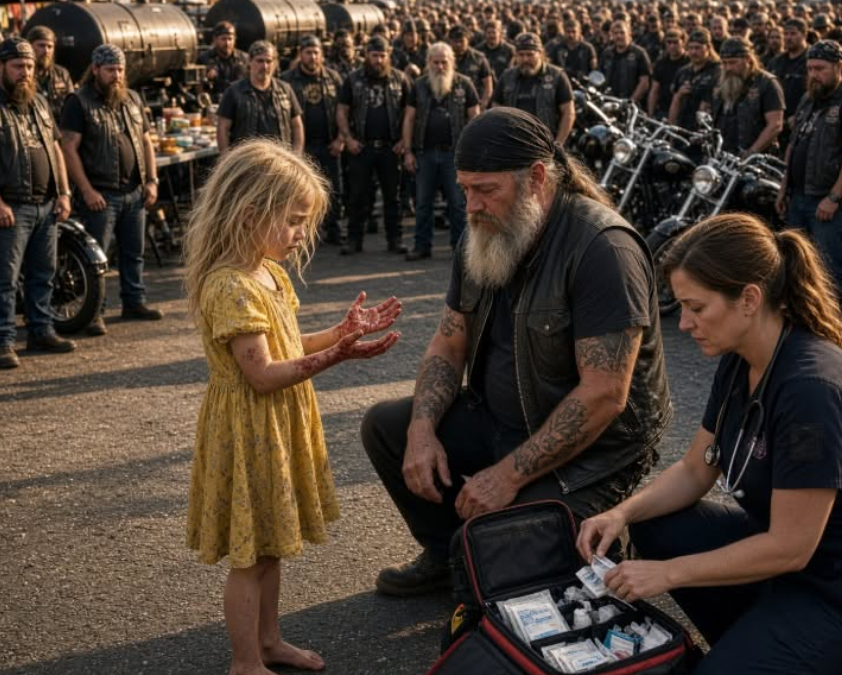
Wade crouched down, careful not to loom.
“Hey there.”
The girl looked at him.
Not afraid.
Not curious.
Just measuring.
Her eyes moved to the patches on his leather vest, then to the tattoos on his forearms, then back to his face.
“You here with somebody?” he asked.
“No.”
Quiet.
Steady.
Not the voice of a child telling a secret.
The voice of a child reporting a fact.
“What’s your name?”
“Nora.”
“Nora,” Wade repeated softly. “That’s a real pretty name.”
She blinked once.
No reaction.
“Are you hungry?”
At that, something in her face changed.
Not excitement.
Not eagerness.
Calculation.
Like she was trying to decide how dangerous honesty might be.
“We’ve got a whole lot of food over there,” Wade said. “Pulled pork, beans, cornbread, lemonade. You can have a plate.”
She looked past him toward the food tables.
The smell of barbecue drifted between them.
Her throat moved.
She nodded once.
Small.
Careful.
Wade extended one hand.
“Come on. Let’s get you something to eat.”
Nora looked at his hand.
Then she looked at her own.
She did not take it.
Wade watched the attempt before he understood what he was seeing.
Her fingers twitched.
The muscles in her forearm tightened.
Her hand lifted half an inch.
Then stopped.
The fingers remained curled slightly open, stiff and swollen, unable to close around his.
Wade’s smile faded.
“Nora.”
Her eyes dropped.
He lowered his hand.
“Can I see yours?”
Something like shame crossed her face.
That hurt him before he knew why.
She pulled both hands closer to her stomach.
“They’re okay.”
“I didn’t say they weren’t.”
“They still work.”
The sentence entered Wade’s chest and stayed there.
They still work.
Not they don’t hurt.
Not they’re fine.
They still work.
Shane stepped up behind him and stopped moving.
Wade did not look back.
“Nora,” he said gently, “I was a medic. A long time ago. I know hurt hands when I see them.”
She studied him.
Maybe she heard something in his voice.
Maybe she was just too tired to keep hiding.
Slowly, she held them out.
Wade Thornton had seen men split open by shrapnel.
He had held pressure on gunshot wounds while helicopters chopped the air above him.
He had seen burns, crushed fingers, road rash, broken bones, skin peeled away by accidents nobody should ever have survived.
But when a six-year-old girl held out her hands in the autumn sunlight, his breath stopped.
Her palms were destroyed.
Deep cracks ran from the base of her fingers toward her wrists. Blisters covered every finger. Her knuckles were swollen nearly twice their proper size, the joints so stiff her fingers could not close. The pads of her thumbs were rubbed smooth and raw. Small circular burns marked the heel of her right palm.
These were not the hands of a child.
They were working hands.
Ruined working hands.
Hands that had been in hot water.
Bleach.
Friction.
Heat.
Weight.
Repetition.
Over and over and over.
Wade looked up at her face.
She watched him with quiet patience, not crying, not flinching, just waiting to see what adults would do now that another piece of her life had become visible.
His voice cracked when he said her name.
“Nora.”
She looked down.
“Who did this to you?”
She shook her head.
“Nobody.”
Wade stayed still.
“Nobody?”
“I did.”
Behind him, Shane sucked in a breath.
Wade’s jaw tightened.
“What do you mean you did?”
Nora pulled her hands back against her dress.
“I had to.”
“Had to what?”
“The cleaning.”
Her voice remained matter-of-fact.
“The washing. The cooking.”
Wade heard the band behind him strike a wrong chord, then stop.
He heard laughter near the lemonade table fade.
He heard his own pulse.
“How old are you?”
“Six.”
“Where’s your mama?”
“She left.”
“When?”
Nora shrugged.
“A long time.”
“Where’s your daddy?”
“Home.”
“Why isn’t he with you?”
“He can’t get up.”
The words landed with the force of a physical blow.
Wade shifted his weight, still crouching.
“Your daddy can’t get up?”
She shook her head.
“He got hurt.”
“How?”
“A building fell.”
“Construction accident?”
“I think.”
“You live with him?”
“Yes.”
“Who takes care of you?”
Nora looked at him like he had asked a strange question.
“I take care of Daddy.”
Shane made a sound behind Wade.
Not a word.
Just grief trying to become one.
Wade stared at the little girl’s damaged hands.
“How long have you been doing that?”
She thought about it carefully.
Counting by survival instead of dates.
“Since the lady stopped coming.”
“What lady?”
“The nurse lady.”
“Why did she stop?”
“Daddy couldn’t pay. Or the papers stopped. He called people. They said wait.”
Her brow furrowed slightly, as if the bureaucratic explanation remained beyond her but the consequences had been clear enough.
“Then nobody came.”
Wade looked toward the trees beyond the fence.
They had turned deep orange and red.
“What season was it when she stopped coming?”
Nora followed his gaze.
“The leaves were still green.”
Two months.
Maybe three.
Maybe more.
A six-year-old had been caring for a bedridden man for months.
“What cleaning?” Wade asked, though part of him did not want the answer.
Nora listed the tasks the way another child might list toys.
“The kitchen floor because bugs come. Dishes because there’s only four plates. Laundry in the bathtub because the machine is broken. Sheets because Daddy sweats. The bathroom. The sores.”
Wade closed his eyes.
“The sores?”
“On Daddy’s back. And his legs.”
Her voice grew a little softer.
“They don’t get better.”
Behind Wade, Shane whispered, “Jesus Christ.”
Nora looked at him quickly.
As if she had done something wrong.
Wade raised a hand at Shane without turning.
“Shane.”
Shane stepped back.
Wade returned his focus to Nora.
“What do you do for the sores?”
“I clean them with the special water.”
“Peroxide?”
“I don’t know. The brown bottle.”
“Then?”
“Dry them. Put cream. I have to turn him but he’s heavy.”
She glanced at her hands.
“Sometimes I use the sheet.”
Wade could see it.
A child standing beside a hospital bed, pulling at sheets with both hands, trying to roll a grown man whose body no longer obeyed him.
“Does he hurt when you do that?”
Nora’s mouth trembled for the first time.
“Daddy tries not to make noise.”
Wade swallowed hard.
“And the burns?”
She looked at her right palm.
“The stove.”
“You cook?”
“Yes.”
“What do you cook?”
“Soup. Eggs if we have them. Macaroni. Toast.”
“How do you reach?”
“Chair.”
“Sometimes you slip?”
She nodded.
Donna Pruitt arrived before Wade called for her.
That was the kind of woman Donna was.
Forty-seven years old, short dark hair, sturdy as an old oak table, paramedic for twenty-two years, Iron Wolves for thirteen.
She knelt beside Wade with her medical kit already open.
One look at Nora’s hands, and the muscles in her jaw tightened.
“Hey, sweetheart,” Donna said, her voice impossibly gentle. “I’m Donna.”
Nora glanced at Wade.
Permission.
Wade nodded.
“She helps people too.”
Donna held up a sterile saline bottle.
“I’m going to clean your hands a little. It may sting some, but then I’ll put medicine and soft wraps on them, okay?”
“Can I still carry food?”
Donna paused.
Wade looked away.
“We’ll carry the food,” Donna said.
“I can carry it.”
“I know you can.”
Donna’s eyes filled.
“But today you don’t have to.”
Nora studied her.
That idea seemed unfamiliar enough to require examination.
Then she nodded.
Donna began cleaning the wounds with care so delicate her fingers barely seemed to touch the skin.
Nora did not cry.
That was almost worse.
She sat on the asphalt inside a circle of rough men, barbecue smoke, motorcycles, families, and October sunlight, letting a stranger tend to her ruined hands with the calm stillness of someone who had learned pain was simply another chore.
“How did you get here?” Wade asked softly.
“I walked.”
“From where?”
“Shelby Avenue.”
Wade turned toward Shane.
Shane already had his phone out.
“Other side of the river,” Shane said under his breath. “At least four miles.”
Wade looked back at Nora’s shoes.
They were worn thin at the soles.
“You walked four miles?”
“Yes.”
“With hands like this?”
Nora looked confused.
“My feet work.”
Wade’s chest hurt.
“Why did you come here?”
She looked toward the tables.
“The man at the store said there was free food here today.”
“Which store?”
“Corner one.”
“Did you ask him for food?”
She shook her head quickly.
“No.”
“Why not?”
“We don’t have money.”
“How long since you had food at home?”
“The last can was yesterday.”
“What was it?”
“Chicken soup.”
“Who ate it?”
“Daddy.”
“What did you eat?”
She hesitated.
“Crackers.”
“How many?”
“Two.”
Wade stood because if he stayed crouched, he was not sure he could keep from breaking in front of her.
For nineteen years, Wade Thornton had not cried where anyone could see.
Not at Emma’s funeral.
Not when his marriage ended under the weight of grief neither he nor his wife knew how to carry together.
Not when he packed Emma’s toys into boxes.
Not when the hospital called five years later asking if he wanted to donate the remaining medical equipment stored in his garage.
Not through another man’s funeral.
Not through surgery.
Not through nightmares.
But standing over a six-year-old girl whose hands could not close because she had been washing sheets in a bathtub and feeding her paralyzed father soup she did not eat herself, Wade felt something crack straight down the middle of him.
He turned to Shane.
“Church.”
Shane’s face changed.
In the Iron Wolves, church did not mean religion.
It meant the president needed the club right now, and whatever had been happening before no longer mattered.
Shane walked to the stage and took the microphone from the band’s lead singer.
“All Iron Wolves patched members, church by the south fence. Now.”
The music stopped.
Across the fairgrounds, men put down plates.
Laughter faded.
Leather cuts moved through the crowd with purpose.
Wade waited until Donna had wrapped Nora’s hands loosely in white gauze.
Then he crouched again.
“Nora.”
“Yes?”
“I need some of my brothers to understand what’s happening so we can help your daddy.”
Her eyes widened.
“Will they take him?”
“No.”
“You don’t know.”
She said it quietly.
Not challenging.
Correcting him.
Wade stopped.
Because she was right.
Adults had probably told her “I promise” before.
And things had happened anyway.
“You’re right,” he said.
Nora blinked.
“I don’t know everything that will happen. But I do know this. Your daddy needs medical help. You need food. Your hands need rest. And today, none of that is something you have to solve alone.”
She stared at him.
“Can you stand with me?”
She nodded.
He did not take her hand.
She could not hold his.
Instead, he walked beside her, slow enough for her short steps, all the way to the south fence where sixty-two patched Iron Wolves stood in a semicircle waiting.
Some were mechanics.
Some welders.
Some roofers.
Some truck drivers.
Some veterans.
Some grandfathers.
All of them had hands marked by work.
Burn scars.
Missing fingernails.
Calluses.
Arthritis.
Old cuts.
Crushed knuckles.
Hands that had built, repaired, fought, lifted, hauled, gripped handlebars through freezing rain, held newborn babies, lowered caskets, signed divorce papers, and wiped away tears in secret.
Wade entered the center of the circle with Nora beside him.
For the first time that day, she looked afraid.
Not of them.
Of being seen.
Wade knelt beside her.
“I’m not going to make you talk.”
She looked at him.
“I need them to see.”
She swallowed.
Then nodded.
Wade looked at his brothers.
“This is Nora Whitfield.”
Silence.
“She’s six years old.”
A few men shifted.
“She walked four miles today from Shelby Avenue because her father is paralyzed, the home-health nurse stopped coming, their food ran out, and his wound cream is empty.”
Nobody spoke.
“She’s been taking care of him alone.”
A sound moved through the men.
Not quite a gasp.
More like the entire group had been hit in the ribs.
Wade looked at Nora.
“Show them.”
Slowly, Nora lifted both bandaged hands.
Donna stepped beside her, tears already running down her face.
“I cleaned them enough to wrap, but they need real treatment,” Donna said, her voice shaking but professional. “Chemical irritation consistent with bleach or harsh cleaning agents. Friction wounds. Burns from cooking. Joint swelling from overuse. Cracks deep enough to risk infection.”
She looked across the semicircle.
“These hands are in worse condition than industrial injuries I’ve treated in grown men.”
Her voice broke.
“She’s six.”
No one moved.
The silence that fell over those men was not shock alone.
It was recognition.
Every one of them knew working hands.
Every one of them knew what repeated labor did to skin.
And every one of them understood, at the exact same time, that they were looking at a child whose hands had been sacrificed to work no child should know existed.
Roy Suttles was the first to sit down.
He did not mean to.
His knees simply went.
Roy was fifty-eight, a welder with forearms like bridge cables and a permanent burn scar across his neck from a job gone wrong in 1998. He had been patched for thirty-one years, married forty, father of four, grandfather of nine, and nobody in the club had ever seen him cry.
He sat on the ground, covered his face with both hands, and wept.
He was not the last.
Nora watched the men break down in confusion.
“Did I do something bad?”
Wade turned to her so fast his knees protested.
“No.”
“But they’re crying.”
“Because what happened to you should not have happened.”
Her face tightened.
“It wasn’t Daddy’s fault.”
Wade heard the steel beneath her small voice.
There it was.
The protective wall.
Not for herself.
For him.
“I believe you.”
“No, you don’t.”
“Yes, I do.”
“He got hurt.”
“I believe you.”
“He used to work.”
“I believe you.”
“He tries.”
Wade’s voice softened.
“Nora, I believe you.”
Her chin trembled.
“He says sorry every day.”
A man near the back turned away.
Shane wiped his eyes with the heel of his hand.
Wade nodded.
“Then let’s help him too.”
That changed her expression.
Just a little.
Not hope yet.
Hope would have been too expensive.
But something loosened.
Wade stood.
His president’s voice returned.
“Shane, you stay here. Keep the cookout running. Feed everyone. No rumors, no reporters, no crowd following.”
Shane nodded.
“Donna, you drive Nora.”
“Done.”
“Roy, you’re with me.”
Roy stood immediately, wiping his face without shame.
“Need construction?”
“Probably. We’re going to find out.”
Wade looked around.
“I want twelve men. Not the angriest. The steadiest.”
Hands went up.
More than twelve.
Almost all.
Wade chose carefully.
People who would not make a frightened child’s day worse.
A plumber.
An electrician.
Two construction foremen.
Roy.
Marcus Vale, who ran a towing company and could move anything with wheels.
Leonard, a retired nurse.
A club brother whose wife worked in disability services.
Two men strong enough to lift furniture and smart enough not to speak first.
When Wade turned back to Nora, she was watching him.
“Can we take food?”
“We’re taking food.”
“And cream?”
“We’re taking your daddy to someone with better cream than we can buy at a store.”
Her eyes widened.
“Hospital?”
“Maybe.”
“He doesn’t like hospitals.”
“Most people don’t.”
“They might keep him.”
“They might need to.”
Her face tightened again.
Wade crouched.
“Nora, listen to me. A hospital is not a punishment.”
She looked unconvinced.
“Sometimes people have to go there so they can come home safer.”
She whispered, “Can I go with him?”
“We’ll work it out.”
That phrase almost killed the fragile trust.
She pulled back.
“Grown-ups say that when they don’t know.”
Wade nodded.
“You’re right.”
She stared.
He continued.
“I don’t know yet if you can ride in the ambulance, or what doctors will say, or what the social worker will need. But I know you will not be ignored today. And I know your daddy will not be ignored today.”
Nora looked at him for a long time.
Then she nodded.
“Okay.”
Donna drove Nora in her pickup because an ambulance had not been called yet, and Wade did not want flashing lights arriving at the house before they understood what waited there.
Nora sat in the passenger seat with both bandaged hands resting on her knees, staring through the windshield while Nashville slid by outside.
She did not ask where they were going.
She already knew.
She was going home.
For the first time in months, she was not going alone.
The house on Shelby Avenue sat near the end of a dead-end street where yards had gone half wild and chain-link fences leaned under years of weather.
It was a small single-story bungalow with peeling paint, a sagging porch, and a mailbox so full of envelopes that several had spilled into the weeds.
A blue tarp covered part of the roof.
The front steps leaned left.
The grass had given up.
The house looked tired in the way houses look when the person responsible for caring for them has run out of money, strength, and witnesses.
Twelve motorcycles rolled to a stop along the curb.
Donna parked behind them.
Nora climbed out before anyone could help her.
Wade saw the way she looked at the bikes, then at the house.
Embarrassment crossed her face.
That made him angrier than the broken steps.
She was ashamed of the poverty.
Not the suffering.
The poverty.
“Nora.”
She looked up.
“We’re not here to judge the house.”
She lowered her eyes.
“It smells bad.”
“Then we’ll handle the smell.”
“The floor is clean.”
“I believe you.”
“I mopped yesterday.”
“Nora.”
She looked at him.
“You don’t have to prove you worked hard.”
Her face changed.
As if that sentence made no sense at all.
Then she turned and walked to the front door.
It was not locked.
“The lock broke.”
She said it like she was adding another chore to a list.
Wade stepped inside first only because Nora allowed him to.
The smell met him in the hallway.
Illness.
Unwashed bedding.
Antiseptic cream.
Stale air.
And under it, the sour metallic edge of infected wounds.
Donna’s expression sharpened.
Wade had to force his face to remain calm.
Nora walked down the hallway with the certainty of someone following a path traveled a thousand times.
“Daddy?”
A weak voice answered from the back bedroom.
“Nora?”
“I’m back.”
The relief in those two words broke something in every adult within earshot.
“I brought people.”
Silence.
“What people?”
“Motorcycle people.”
Roy whispered behind Wade, “That’s an introduction.”
Wade did not smile.
Carl Whitfield lay in a hospital bed that looked secondhand but functional.
He was thirty-four years old and looked fifty.
His face was gaunt.
Dark hair stuck to his forehead.
His beard had grown unevenly.
Beneath the thin blanket, his legs lay motionless, too still to belong to a young man. One arm worked. The other moved only partially. A plastic cup sat on a tray just out of easy reach.
His eyes found Nora first.
Then the bandages.
His face collapsed.
“Nora.”
“It’s okay.”
“What happened to your hands?”
“They put medicine.”
“What happened?”
Wade stepped forward before the child could lie to protect him.
“Mr. Whitfield, my name is Wade Thornton.”
Carl looked at him, fear replacing confusion.
“I don’t have trouble with you.”
“You don’t have trouble with me.”
“Then why are you in my house?”
“Your daughter walked four miles to our cookout today.”
Carl closed his eyes.
“No.”
“She came because you were out of food and wound cream.”
A tear slid from the corner of Carl’s eye into his hair.
“I told her not to leave the neighborhood.”
“She was hungry.”
Carl flinched.
“And you need medical care.”
“No hospital.”
Donna stepped beside Wade.
“Mr. Whitfield, I’m a paramedic.”
“No hospital.”
“Your wounds need evaluation.”
“They’ll take her.”
His voice cracked wide open.
“They’ll take my baby.”
Nora ran to the bed.
She tried to take his hand.
Couldn’t close her fingers.
So she laid both bandaged hands on top of his.
“I’m here.”
Carl stared at her hands and sobbed once.
A raw, helpless sound.
“I told you to call someone.”
“You said they might take me.”
“I was scared.”
“I know.”
“I didn’t mean for you to—”
“I could do it.”
“No.”
Carl’s face twisted.
“No, baby, you couldn’t. You did. But you couldn’t.”
Wade looked away.
There are moments when truth is so painful even strangers feel ashamed to hear it.
Donna put on gloves.
“Carl, I need to look.”
He shook his head.
Donna’s tone did not change.
“You have a fever.”
“I’m fine.”
Nora said very softly, “Daddy, you smell sick.”
Carl stopped resisting.
Wade saw the exact second surrender moved through him.
Not to them.
To his daughter’s honesty.
Donna examined him while Wade stepped into the hall.
A moment later, Donna called his name.
He returned.
Her eyes told him before she spoke.
“Hospital. Now.”
Carl shut his eyes.
“No.”
Donna’s voice stayed steady.
“These pressure wounds are advanced. I’m concerned about infection, possibly sepsis. He needs transport.”
Nora turned pale.
“Will he die?”
Carl made a sound.
Wade crouched immediately.
“Nobody said that.”
“But can he?”
Wade hated the answer.
“Yes.”
Her small body went still.
“But getting him to the hospital makes that less likely.”
Nora looked at Carl.
“You have to go.”
Carl started crying again.
“I don’t want to leave you.”
She repeated his own words back to him with devastating gentleness.
“I’ll be here.”
Donna called an ambulance.
Wade walked through the rest of the house.
The kitchen was immaculate.
Not casually clean.
Scrubbed.
The counters shone. The floor was damp from recent mopping. Four plates were stacked neatly beside the sink. Two spoons. One fork. A chipped mug. Everything in its place.
The refrigerator was empty.
Not nearly empty.
Empty.
One packet of ketchup lay in the door.
The cabinets were the same.
In the bathroom, the evidence of Nora’s labor waited in plain sight.
Clothes soaking in the tub.
A nearly empty bleach bottle.
A scrub brush worn flat.
Hydrogen peroxide.
A tube of wound cream squeezed until it had folded in on itself.
A wooden chair beside the stove in the kitchen explained the burns.
A laundry basket half full of damp sheets explained the raw fingers.
An overdue utility notice on the counter explained the darkness in the hallway.
Wade stood in the bathroom and placed one hand against the wall.
Emma returned to him all at once.
Not the hospital Emma.
The healthy Emma.
Standing on a kitchen chair, helping him stir pancake batter, flour on her nose, insisting she was “a big helper.”
He had laughed.
Told her she was making a mess.
Kissed the top of her head.
A child helping should have meant flour on the floor.
Not bleach burns.
Not infected wounds.
Not empty cabinets.
Wade took out his phone.
Shane answered on the first ring.
“What do you need?”
Wade looked down the hallway.
Nora sat beside her father’s bed, bandaged hands in her lap, telling him about the cookout like she had visited another country.
Pulled pork.
Cornbread.
Lemonade.
So much food.
Food everywhere, Daddy.
Wade’s throat closed.
“Everybody.”
Shane went quiet.
“Everybody?”
“Every brother who isn’t nailed down. Visiting clubs too if they’ll come.”
“What are we doing?”
Wade turned toward the bathroom mirror.
He barely recognized the man looking back.
“We’re doing what should’ve been done months ago.”
By the time the ambulance arrived, the first wave of motorcycles had already pulled onto Shelby Avenue.
Twenty at first.
Then forty.
Neighbors stepped onto porches.
Curtains moved.
A patrol car rolled in, and Shane spoke to the officer calmly enough that it stayed to block traffic instead of escalating the scene.
Carl refused to let paramedics load him until he knew where Nora would be.
“I’m not leaving her.”
Wade stood beside the stretcher.
“She won’t be alone.”
“Don’t say that like you control it.”
Wade nodded.
“You’re right.”
Carl looked surprised.
“I don’t control the hospital. I don’t control child services. But I control whether we disappear after today.”
Carl stared at him.
“We won’t.”
Nora stood at the foot of the bed, empty-handed because her hands could not hold anything.
Her eyes moved from one adult to another.
Searching for the trick.
The cost.
The moment help turned into punishment.
The social worker arrived before the ambulance left.
Patricia Rock.
Fifty-six, practical shoes, tired eyes, navy blazer, silver hair clipped at the back.
She looked at the motorcycles.
Then at Wade.
“You’re Mr. Thornton?”
“Yes.”
“I’m told there’s a child welfare concern.”
“There’s a family welfare emergency.”
She paused.
That distinction mattered.
He saw that she noticed.
“I need to speak with the child.”
“You will.”
“And the father.”
“He’s febrile and needs transport.”
“I understand.”
Wade lowered his voice.
“Before anyone starts using the word neglect like a hammer, you need to understand something. Home health stopped coming months ago. Supplies stopped. Food ran out. A six-year-old filled the gap your systems left behind.”
Patricia’s face tightened.
Not offended.
Struck.
“I’ll look into it.”
“Do more than look.”
She held his gaze.
“I will.”
That was enough for now.
When paramedics wheeled Carl through the living room, Nora finally broke.
Not loudly.
Not dramatically.
She simply folded at the knees beside the stretcher and started crying with both bandaged hands held uselessly in front of her.
“I tried,” she kept saying.
Carl sobbed.
“I know.”
“I cleaned them.”
“I know.”
“I made soup.”
“I know.”
“I did everything.”
The room went silent.
Carl reached as far as his arm allowed.
Wade lifted Nora gently and brought her close enough that Carl could touch her hair.
“You did too much.”
Carl’s voice was ruined.
“You hear me? Too much. That’s not your job.”
Nora cried harder.
“But you needed me.”
“I needed help.”
His thumb shook against her cheek.
“And I made you think help had to be you.”
The paramedics looked away.
Donna cried openly.
Wade stared at the floor.
No child should have to hear an apology like that.
But maybe some children need to.
Carl was taken to Vanderbilt University Medical Center.
Nora did not ride in the ambulance.
That decision nearly broke her.
Patricia explained gently that Donna would drive her behind them, and Wade would follow.
Nora listened with wet cheeks and suspicious eyes.
“You’ll lose it.”
“Lose what?” Wade asked.
“The ambulance.”
“I ride a motorcycle for a living.”
“That doesn’t mean anything.”
Despite everything, Donna smiled.
Wade nodded seriously.
“You’re right. How about this? Donna follows the ambulance. I follow Donna. Roy follows me. Shane follows Roy. If any of us lose the others, every man behind us will make fun of us until Christmas.”
Nora looked at the street.
There were now nearly a hundred bikers outside.
“That’s a lot of people.”
“More coming.”
“Why?”
“Because you came to us.”
“I only needed food.”
Wade crouched.
“No, sweetheart.”
Her eyes met his.
“You needed witnesses.”
By sundown, Shelby Avenue had changed.
Four hundred bikers did not storm the house.
They organized.
Shane ran the operation like a military build.
Construction crew.
Food crew.
Cleaning crew.
Medical support.
Childcare.
Traffic.
Supply runs.
Donation management.
No reporters.
No spectacle.
No one entered the house without a task.
No one touched Nora’s room until Wade asked her permission.
The porch was first.
Six men tore out rotted supports and replaced them with pressure-treated lumber. The steps were rebuilt. A proper wheelchair ramp took shape before dark, measured to code by men who argued intensely about slope while Shane threatened to fire all of them even though none of them worked for him.
A plumber fixed the bathroom sink.
An electrician replaced exposed wiring.
A locksmith installed a working front-door lock.
A crew from the Road Saints brought a new washing machine.
Someone stocked the refrigerator.
Then the pantry.
Then a second shelf because the first was not enough.
Donna stayed at the hospital with Carl until doctors admitted him for infected pressure injuries, a urinary tract infection, dehydration, and severe deconditioning.
Nora returned home with Wade and Patricia because she insisted she wanted to see the house.
When she walked into the kitchen and saw food on every shelf, she stopped.
“Whose is this?”
“Yours,” Wade said.
“All of it?”
“Yes.”
Her eyes narrowed.
“For how long?”
It was not childish greed.
It was survival math.
Wade sat at the kitchen table so he did not tower over her.
“As long as you need food, people will help make sure food is here.”
“That’s not an answer.”
He almost smiled.
“No. It’s the best true answer I have.”
She stared at the refrigerator.
“What if people forget?”
Wade thought carefully.
“Then we build a system that makes forgetting harder.”
Nora did not understand.
But Patricia did.
Her face changed.
The bedroom broke everyone.
Nora’s room was at the end of the hall.
It should have been a child’s room.
It was not.
A bare mattress on the floor.
A thin blanket.
No toys.
No books.
No lamp.
No dresser.
A single pair of socks folded carefully beside the mattress.
Peggy Suttles, Roy’s wife, stood in the doorway and covered her mouth.
“Oh, honey.”
Nora stiffened.
“It’s clean.”
Peggy dropped her hand immediately.
“Yes. It is.”
“I sweep.”
“I can tell.”
Peggy did not pity the room.
That saved the moment.
She turned to Wade.
“Can we?”
Wade looked at Nora.
“This is your room. They want to make it more comfortable. You can say no.”
Nora looked confused.
“Why would I say no?”
“Because it’s yours.”
She looked into the room as if the idea of owning even that bare space was new.
“Can I keep the socks?”
Peggy’s face nearly crumpled.
“Of course.”
“What else?”
“Everything you want.”
“There’s not anything else.”
Peggy took a breath.
“Then we’ll add things.”
“What things?”
“A bed frame. Sheets. A pillow. Maybe books. A lamp.”
Nora listened like someone being offered a menu in a language she half understood.
“Can it have flowers?”
Peggy smiled through tears.
“Yes.”
“Yellow?”
“Absolutely yellow.”
“Not bright.”
“Soft yellow.”
Nora nodded.
“Okay.”
By eight that night, the room had become almost unrecognizable.
A real bed.
New mattress.
Sheets with tiny yellow flowers.
Two pillows.
A quilt Peggy took from her own guest room.
A crescent-moon lamp donated by someone’s teenage daughter.
A shelf of secondhand books.
A small dresser.
And a stuffed bear named Captain.
The bear came from Roy’s granddaughter, who solemnly announced through a video call that Captain was brave, experienced, and “good at night.”
When Nora saw the room, she stopped at the doorway.
She did not speak.
She walked to the bed.
Touched the quilt with the least injured edge of one bandaged finger.
Then she picked up Captain using both arms because her hands could not grip him.
“Is this mine?”
Peggy nodded.
“It’s all yours, sweetheart.”
Nora sat down.
Held the bear against her chest.
And cried.
Not loudly.
Not the way children cry when they fall.
This was a quiet, shuddering collapse.
The sound of a small body finally being given permission to stop holding itself upright.
In the hallway, six grown men leaned against the wall and cried with her.
Wade stood farther back.
He thought about Emma’s purple blanket.
About hospital sheets.
About all the beds children should feel safe inside.
That night, Donna stayed at the house with Nora.
Wade stayed too, in the recliner Carl had used before the accident.
Patricia Rock completed the emergency plan at the kitchen table past midnight.
Temporary safety monitoring.
Medical updates.
School contact.
Restored home-health services.
Food support.
Investigation into benefit interruption.
No immediate removal from the home as long as safe adult supervision was maintained and Carl received care.
Nora fell asleep in her new bed with Captain under one arm.
At 2:13 a.m., she woke screaming.
Wade was in the hall before Donna.
Nora was sitting upright, both bandaged hands lifted in panic.
“I forgot the laundry.”
Wade’s heart clenched.
Donna sat on the edge of the bed.
“No laundry tonight.”
“But the sheets—”
“Clean.”
“The dishes—”
“Done.”
“Daddy—”
“At the hospital.”
Nora’s breathing sped.
“I’m supposed to—”
Wade crouched in the doorway.
“No.”
She looked at him.
“You are supposed to sleep.”
Tears ran down her face.
“What if I don’t wake up early?”
“Then you sleep late.”
“What about breakfast?”
“I’ll make it.”
“You can cook?”
Donna snorted softly.
Wade gave her a look.
“I can cook.”
Donna said, “He can burn things confidently.”
Nora blinked.
Then, unexpectedly, laughed once through tears.
It was tiny.
Almost accidental.
But it changed the air in the room.
Wade put one hand over his heart.
“Wounded.”
Donna smiled.
Nora lay back down.
“Can the light stay on?”
“Yes.”
“The door open?”
“Yes.”
“Will you be there?”
Wade thought of Emma.
Daddy, don’t leave.
His throat tightened.
“Yes.”
Nora studied him.
“Grown-ups say that.”
“I know.”
“And then things happen.”
“I know.”
He settled on the hallway floor with his back against the wall.
“Then I’ll sit here until morning and let morning prove it.”
She watched him for a long moment.
Then turned onto her side.
At dawn, Wade was still there.
Nora woke, saw him, and said nothing.
But her eyes changed.
A little.
Carl stayed at Vanderbilt for eleven days.
The doctors treated his pressure injuries, cleaned infected tissue, adjusted pain medication, started antibiotics, addressed a urinary infection, and began rebuilding a body that had been deteriorating under the impossible care of a child.
The first time Carl saw Wade at the hospital, he cried before speaking.
“How is she?”
“Sleeping.”
“Did she eat?”
“Yes.”
“How much?”
“More than yesterday.”
Carl closed his eyes.
“Good.”
Wade sat beside him.
For a while neither spoke.
Then Carl said, “I was a good father before.”
Wade looked at him.
“I believe you.”
“I worked.”
“I know.”
“I packed her lunches. Took her to kindergarten. She had pink shoes. She liked the zoo.”
His voice broke.
“I wasn’t always this.”
Wade let the silence hold that.
Carl wiped his eyes.
“After the accident, people came. Nurses. Physical therapy. Church folks. My sister for a week. Then everybody got busy. Insurance said paperwork. Medicaid said wait. The agency said they couldn’t send the aide without authorization.”
He swallowed.
“I called.”
“I believe you.”
“I called so many times.”
“I believe you.”
“But after a while, I stopped.”
There it was.
The place where explanation became responsibility.
Wade did not rescue him from it.
Carl looked out the window.
“I got tired of telling strangers I couldn’t wipe my own body.”
His voice became rough.
“I got tired of begging.”
Wade nodded.
“That shame almost killed you both.”
Carl flinched.
“Yes.”
“Don’t waste it.”
Carl looked at him.
“What?”
“You get to feel ashamed. You don’t get to stop there.”
Carl stared.
Wade leaned forward.
“That little girl loves you so much she destroyed her hands trying to keep you alive.”
Carl’s face crumpled.
“I know.”
“So use the shame. Let it burn long enough to keep you honest.”
Carl cried silently.
“I don’t know how to forgive myself.”
Wade looked at the two dates tattooed on his wrist.
Emma’s birth.
Emma’s death.
“Start by not asking Nora to do it for you.”
That sentence became the first brick in Carl’s rebuilding.
Nora visited on the fourth day.
Donna drove her.
Wade met them in the lobby.
Nora wore clean jeans, a soft sweater, and bandages wrapped like tiny white mittens.
She looked smaller in the hospital.
Children often do.
Carl began crying the moment he saw her.
Nora rushed to the bed.
Then stopped because she remembered her hands.
Carl held his arm out.
She climbed carefully onto the side of the bed.
“I ate eggs.”
Carl laughed through tears.
“You hate eggs.”
“Wade made them.”
Carl looked at Wade.
“Were they edible?”
Nora answered seriously.
“Mostly.”
Wade crossed his arms.
“This family is ungrateful.”
Nora smiled.
Carl saw it.
A real smile.
It nearly undid him.
“I’m sorry,” Carl whispered.
Nora looked at him.
“You said already.”
“I’ll probably say it again.”
She frowned.
“Okay.”
Carl touched her hair.
“But I need you to hear something else.”
“What?”
“You are not my nurse.”
Her face tightened.
“You needed—”
“I needed a nurse.”
He breathed through the pain.
“I needed help. I needed grown-ups. I needed to call more people. I needed to tell the truth.”
Nora looked confused.
Carl continued.
“I did not need my six-year-old daughter to become my nurse.”
“But I helped.”
“Yes.”
His eyes filled.
“And I am alive because you helped.”
Her chin lifted slightly.
“But it was too much.”
She looked down.
Carl gently touched her bandages.
“These are not proof you loved me enough.”
Nora’s eyes filled.
“They’re proof adults left too much in your hands.”
Wade turned toward the window.
Donna cried openly.
Nora did not answer.
She leaned against her father’s chest.
Carl held her with one working arm.
It was the beginning of a new kind of truth between them.
Not one that erased love.
One that finally stopped confusing love with labor.
The investigation took weeks.
The home-health interruption turned out to be a chain of clerical failures and human assumptions.
Authorization paperwork lost during a system change.
A follow-up call marked complete when it had not reached Carl.
A nurse reassigned.
A case manager on leave.
A mail notice sent to an old address.
A charity supply program discontinued without transition.
Each piece sounded small when explained separately.
Together, they became a six-year-old with ruined hands.
Patricia Rock brought the findings to Wade in a folder.
He read the first page.
Then the second.
Then closed it.
“Everybody made one little mistake.”
Patricia sighed.
“Some mistakes weren’t little.”
“But nobody meant for this to happen.”
“No.”
Wade stared across the clubhouse office.
“That almost makes it worse.”
“I know.”
“If a villain did this, we could point.”
“I know.”
“But this was people not checking. Not calling back. Not asking the next question.”
Patricia nodded.
“Systems fail quietly.”
Wade looked toward the main room where Nora sat at a table with Peggy, coloring carefully with a thick crayon taped for easier grip.
“She almost disappeared quietly too.”
“Not anymore.”
Wade looked back.
Patricia met his eyes.
“I’ve been doing this job twenty-two years. I’ve seen communities show up once for a crisis.”
“So?”
“So they usually leave when the story stops feeling urgent.”
Wade understood the warning.
“We’re not leaving.”
“People say that.”
“She said the same thing.”
Patricia smiled faintly.
“She’s smart.”
“She’s six.”
“Both can be true.”
The Iron Wolves formalized everything by the end of the month.
Not because Wade loved structure.
He hated it.
But Nora had taught him that good intentions without structure could vanish when people got busy.
They created a rotating schedule.
Donna and Peggy handled Nora’s bandage changes and meals.
Roy and two others took yard work.
Shane managed house renovation.
Leonard coordinated medical appointments.
A retired teacher helped get Nora back into school gently, without turning her into a spectacle.
Pastor Gene Hollis, who had known Carl before the accident and cried when he learned what had happened three miles from his church, agreed to administer a trust fund for Nora’s education.
A GoFundMe raised forty-seven thousand dollars in seventy-two hours after Wade allowed a carefully worded post that did not show Nora’s face or exploit her injuries.
“Tell the need,” he told Shane. “Not her pain.”
The house became accessible.
New plumbing.
Safe electrical.
A bathroom Carl could use.
A kitchen with lowered counter sections.
A working washer and dryer.
A hospital bed with proper turning equipment.
A power wheelchair.
A ramp.
Real locks.
Smoke detectors.
A full pantry.
But the most important work was less visible.
Saturday.
Every Saturday.
After Carl came home, riders kept showing up.
At first, Nora expected tasks.
Laundry.
Dishes.
Trash.
Sheets.
Medication.
Food.
But slowly, Saturdays changed.
Roy sat with Carl on the porch and talked about football.
Shane repaired a cabinet door and then stayed three hours arguing about barbecue sauce.
Donna checked Nora’s hands and then painted her nails a pale yellow that matched her sheets.
Wade brought breakfast and burned toast so badly Nora took over supervision from a stool.
“Nobody asked you to be Gordon Ramsay,” he grumbled.
“Who is that?”
“Never mind.”
“You can’t cook alone.”
“I cooked before you were born.”
“That was a long time ago.”
Carl laughed so hard he had to wipe his eyes.
Those ordinary Saturdays did something emergency rescue could not.
They taught Nora that help was not always dramatic.
Help could smell like coffee.
Sound like men arguing about the Titans.
Look like Peggy folding towels while humming off-key.
Feel like Donna gently stretching Nora’s fingers one by one.
Be Wade sitting at the kitchen table doing nothing except staying long enough that Nora stopped watching the door.
Her hands healed slowly.
The first week, the swelling remained severe.
The cracks stung.
The burns tightened.
Dr. Alan Merrick, a hand specialist Donna knew, agreed to see Nora at no charge.
He examined her carefully.
“The damage is significant,” he told Wade afterward.
Wade stood outside the exam room like a man awaiting sentencing.
“But?”
“But children heal astonishingly well when the source of injury stops.”
Wade closed his eyes briefly.
“So permanent?”
“I don’t think so. The joints are inflamed, not structurally destroyed. No tendon rupture. No deep infection. Burns will scar lightly but should fade.”
“How long?”
“Months. Therapy. Rest. Protection. She cannot return to the work that caused this.”
Wade looked through the window.
Nora sat beside Donna, choosing a sticker.
“She won’t.”
Dr. Merrick studied him.
“Are you family?”
Wade thought of Emma.
Then of Nora’s bandaged hand hovering near his because she still could not close it.
“No.”
A pause.
“Not by paperwork.”
By December, Nora could close her right hand into a loose fist.
She showed Wade in the kitchen.
He reacted too loudly.
She immediately opened it again.
“What?”
“Nothing.”
“You made a face.”
“I did not.”
“You did.”
“Do it again.”
She narrowed her eyes.
“Why?”
“Because I missed it.”
She curled her fingers again.
Not fully.
Not easily.
But enough.
Wade looked at that small fist like it was a sunrise.
In January, she held a pencil properly for almost two minutes.
In February, she buttoned her own coat.
She marched into the living room afterward and announced it like a military victory.
Carl saluted from his wheelchair.
Donna cheered.
Wade pretended to inspect the button work and declared it acceptable.
Nora rolled her eyes.
At school, things were harder.
Children asked questions.
Some kind.
Some careless.
Why do you have scars?
Why did bikers fix your house?
Is your daddy dead?
Are you poor?
Nora fought once.
A boy said her hands looked gross.
She hit him with her lunchbox.
Patricia got the call.
Then Wade.
Then Carl.
By the time Wade arrived at school, Nora sat in the office looking furious and ashamed.
Her principal, Mrs. Gaines, looked exhausted.
“She struck another student.”
Wade sat beside Nora.
“Did he deserve it?”
Mrs. Gaines blinked.
“Mr. Thornton.”
“I’m asking for context.”
Nora muttered, “He said my hands looked gross.”
Wade’s jaw tightened.
Mrs. Gaines softened.
“We addressed his comment too.”
“But hitting isn’t allowed,” Wade said.
Nora glared at him.
“What?”
He looked at her.
“You don’t get to hit everyone who says something stupid.”
“Why not?”
“Because your arms will get tired.”
Mrs. Gaines pressed her lips together, trying not to smile.
Nora’s anger faltered.
“But also,” Wade added, “because you’re not responsible for teaching every cruel person manners with a lunchbox.”
Nora looked down.
“He laughed.”
“I know.”
“I wanted him to stop.”
“I know.”
“It worked.”
Wade sighed.
“That’s the problem with hitting. Sometimes it works fast and wrong.”
Nora considered that.
“What works slow and right?”
Mrs. Gaines leaned forward.
“Using your voice. Getting an adult. Walking away. Telling the truth.”
Nora looked skeptical.
“Adults don’t always do stuff.”
Wade nodded.
“True.”
Mrs. Gaines accepted the hit.
“Then adults need to get better.”
Nora looked at her.
Something shifted.
Not trust.
Not yet.
But attention.
She was learning which adults could hear hard truth without punishing her for it.
By March, five months after she first appeared at the cookout, Nora walked into the Iron Wolves clubhouse for the monthly family dinner wearing a soft blue sweater and jeans with embroidered flowers at the pockets.
Her hands still carried faint white lines.
The scars would take longer.
But she could close them now.
Wade sat at the long table, arguing with Shane about a transmission problem neither of them agreed on.
Carl sat in his wheelchair near the end of the table, healthier, stronger, face fuller, beard trimmed.
Nora approached from behind Wade.
Nobody warned him.
She reached out.
And took his hand.
Her fingers closed around his completely.
Small.
Warm.
Whole.
Wade stopped mid-sentence.
He looked down.
Nora squeezed.
Not hard.
Enough.
“I can close my hands,” she said.
The clubhouse went silent.
Wade stared at her fingers wrapped around his.
The last time she had tried to take his hand, she could not.
She had stood inside the gate, hungry and exhausted, ashamed of the hands that had been forced to do too much.
Now those same hands held his.
Still scarred.
Still marked.
But hers again.
For pencils.
Forks.
Books.
Captain the bear.
Her father’s hand.
Maybe one day a bike throttle, though Wade had already decided he would pretend not to allow it.
His vision blurred.
“Oh no,” Nora said.
“What?”
“You’re doing it.”
“Doing what?”
“The crying face.”
Laughter broke through the room.
Wade scooped her up carefully.
She squealed, half delighted and half indignant.
“I’m too big!”
“No, you’re not.”
“I’m six and a half!”
“Ancient.”
He held her against his chest and finally let himself cry.
Not quietly.
Not hidden in a hallway.
Not swallowed behind his teeth.
He cried for Nora.
For Carl.
For Emma.
For nineteen years of believing strength meant keeping every broken thing inside his own chest.
For the terrible beauty of a child’s hand healing.
For all the times the world failed people quietly and then acted surprised when children carried what adults abandoned.
Nora wrapped her arms around his neck.
Her hands closed in the leather of his vest.
That made him cry harder.
“Wade,” she whispered.
“What, sweetheart?”
“You’re squeezing too much.”
The whole table laughed again.
He loosened his hold immediately.
“Sorry.”
“It’s okay.”
She leaned back and looked at him.
“Your hands still work?”
Wade looked at his own hands.
Big.
Scarred.
A little stiff now.
Hands that had carried weapons.
Hands that had packed wounds.
Hands that had signed hospital papers.
Hands that had lowered a tiny purple blanket into a memory box.
Hands that had almost forgotten how to hold anything gently.
He looked at Nora.
“They still work.”
She nodded solemnly, as if approving the answer.
“Good.”
Years later, people in Nashville still told the story.
Most told it wrong.
They focused on the dramatic parts.
The cookout.
The four-mile walk.
The four hundred bikers.
The empty refrigerator.
The ruined hands.
The motorcycles lining Shelby Avenue until neighbors stood on porches staring like thunder had parked outside a broken little house.
Those details sounded good.
They traveled well.
But Wade remembered the quieter things.
Nora looking at his offered hand and realizing she could not take it.
Carl whispering, “I needed help,” like confession and prayer at the same time.
Donna cleaning wounds with tears on her face.
Peggy saying, “Yes. It is,” when Nora insisted her empty room was clean.
Patricia Rock changing the word neglect into emergency.
Shane building a system because one rescued afternoon was not enough.
A child waking at 2:13 in the morning because she thought laundry still belonged to her.
A tiny laugh when Donna accused Wade of burning breakfast.
A small fist closing for the first time.
A hand finally finding his.
After that March dinner, the Iron Wolves started something bigger than an annual cookout.
They called it Emma’s Table at first, because Wade refused to put Nora’s name on anything without asking her, and because the old grief in him needed somewhere useful to go.
Emma’s Table became a quiet fund for families who were drowning before anyone noticed.
Home-health gaps.
Medical equipment.
Food.
Ramps.
Utility bills.
Childcare.
Emergency respite care for caregivers who had reached the end of their own strength.
No news cameras.
No sad photographs.
No children displayed for donations.
Wade’s rule was simple.
“Tell the need. Not the wound.”
Nora grew.
So did her hands.
The scars faded, but not completely.
Thin pale lines crossed her palms long after the pain left.
She did not hide them.
Not exactly.
But sometimes, when someone stared too long, she tucked her hands into her sleeves.
Wade noticed every time.
He never called attention to it.
He simply gave her something to hold.
A fork.
A crayon.
A wrench too big for her.
A paper plate.
Captain the bear.
A mug of hot chocolate.
Anything that reminded her hands they belonged to childhood again.
Carl learned too.
Not perfectly.
There were bad days.
Days when shame made him quiet.
Days when pain made him sharp.
Days when Nora tried to do too much because habit is a hard ghost to evict.
But the difference was this:
Someone always interrupted the old pattern.
Donna would say, “That’s a nurse job.”
Peggy would say, “That’s a grown-up problem.”
Wade would say, “Hands off, kid.”
And Carl, after a while, learned to say it himself.
One Saturday morning, Nora tried to drag a laundry basket toward the hall.
Carl caught her from his wheelchair.
“Nora.”
She froze.
“What?”
He pointed.
“That is not yours.”
“It’s just towels.”
“It is still not yours.”
“I can help.”
“You can help me pick a movie.”
“That’s not helping.”
“It is if you stop choosing cartoons with singing animals.”
She narrowed her eyes.
“You love those.”
“I do not.”
“You cried at the duck one.”
“That duck had emotional depth.”
Nora stared at him.
Then laughed.
And for Carl, that laugh was better than any medicine Vanderbilt had given him.
The years did what years do.
They changed people slowly, then all at once.
Nora turned seven.
Then eight.
Then ten.
She learned to ride a bike in the church parking lot while Wade jogged behind her, yelling instructions she ignored.
She learned multiplication at the clubhouse because Shane, to everyone’s surprise, was excellent at math and terrible at patience.
She learned how to change a tire from Roy.
She learned how to throw a punch properly from Donna, though Donna made her promise never to use it unless running was impossible.
She learned barbecue secrets from Wade, who insisted burnt toast did not reflect his true culinary range.
She learned that adults could fail.
But she also learned some adults came back to repair what failure broke.
At twelve, she asked Wade about Emma.
They were sitting outside the clubhouse while rain tapped the tin awning.
Wade had never told her the whole story.
Not because it was secret.
Because some grief remains folded for years, and opening it requires the right hands.
Nora looked at the tattoo on his wrist.
“Was she little?”
Wade knew who she meant.
“Yes.”
“How little?”
“Four.”
Nora was quiet.
“Did she have a bear?”
“A rabbit.”
“What was its name?”
“Bunny.”
“That’s not very creative.”
“No. She was four.”
Nora smiled softly.
Then she asked, “Is that why you helped me?”
Wade looked at the rain.
Part of him wanted to say yes.
A clean answer.
A meaningful one.
But Nora deserved the truth.
“At first, maybe that made me move faster.”
She listened.
“But no. I helped you because you needed help.”
Nora looked at him.
“You always say that.”
“Because it keeps being true.”
She turned her hands over in her lap.
The scars were nearly invisible now unless you knew where to look.
“I used to think I had to do something big for people to help.”
Wade’s throat tightened.
“I know.”
“Like I had to earn it.”
“You didn’t.”
“I know now.”
The rain continued.
After a while, she leaned her shoulder against his arm.
“I’m glad Emma had you.”
Wade closed his eyes.
For nineteen years, he had carried the belief that he failed his daughter because he could not keep her alive.
Nora did not erase that.
No one could.
But sitting beside him under the awning, alive and warm and no longer holding the whole world in her damaged hands, she gave his grief somewhere gentler to rest.
“I’m glad I had her,” he said.
Nora nodded.
Then, after a long silence, she slipped her hand into his.
Her fingers closed easily now.
Wade held on.
Not too tight.
Never too tight.
When Nora was sixteen, the Iron Wolves held the charity cookout at the same old fairgrounds.
By then, Wade’s beard had gone white at the edges.
Shane wore reading glasses he pretended were for “inventory purposes.”
Donna threatened to retire every six months and never did.
Carl rolled through the crowd in a power wheelchair, laughing with Roy, healthy enough to complain loudly about sauce choices and weather.
Nora stood at the gate in jeans, boots, and a pale yellow shirt.
She was taller now.
Strong.
Still watchful in certain moments.
But not invisible.
A little girl came in alone near noon.
Eight years old, maybe.
Dirty pink backpack.
Shoes too small.
Eyes too careful.
Nora saw her before anyone else did.
Wade saw Nora see her.
He did not move.
Not yet.
This was hers.
Nora crossed the fairgrounds slowly so she would not startle the child.
She crouched down.
Wade could not hear the first words.
But he saw the child look at the food tables.
Saw the hesitation.
Saw the survival math.
Then Nora held out both hands, palms up.
Not to grab.
Not to force.
To show.
The little girl stared at the faint scars.
Nora said something.
The child nodded.
And together, they walked toward the food.
Wade watched from beside the barbecue pits.
Shane stepped up next to him.
“You’re doing the face.”
Wade cleared his throat.
“What face?”
“The proud old man face.”
“I don’t have a proud old man face.”
“You absolutely do.”
Across the fairgrounds, Nora handed the girl a plate.
Then she looked back at Wade.
For a second, the years folded.
He saw her at six, standing near the gate in a faded yellow dress, hands ruined, eyes exhausted, body too small for the burden she carried.
Then he saw her as she was now.
Scarred.
Whole.
Not rescued once, but held long enough to heal.
Nora smiled at him.
Then lifted one hand and closed it into a fist.
Strong.
Easy.
Hers.
Wade pressed his palm against his chest.
Not over his heart exactly.
Over the ache that had lived there since Emma.
It was still there.
It always would be.
But now other things lived there too.
Nora’s first laugh.
Carl’s apology.
Captain the bear.
Yellow sheets.
Burnt toast.
A hallway floor at dawn.
A small hand closing around his.
Four hundred bikers had seen what silence had done to a child’s hands.
But what mattered most was what they did after.
They did not only cry.
They did not only fix a porch.
They did not only fill a refrigerator.
They stayed.
Because the truth Wade learned from Nora Whitfield was simple enough to shame the whole world.
A child should never have to become extraordinary to deserve rescue.
A father should never have to collapse completely before help arrives.
A family should never disappear because everyone assumed someone else was checking.
And hands that small were never meant to carry the weight of survival alone.
Years after that first cookout, Nora would still visit the Iron Wolves clubhouse on Saturdays.
Sometimes to help with Emma’s Table.
Sometimes to argue with Shane.
Sometimes to sit beside Wade while he pretended he did not need company.
On the wall near the main door, beneath a framed photograph of the old fairgrounds, hung a small brass plaque.
Most visitors read the top line first.
THE DAY A CHILD’S HANDS TAUGHT GROWN MEN HOW TO HOLD ON.
But Nora always touched the smaller words underneath.
THE WORK WAS NEVER HERS TO CARRY.
Then she would flex her fingers once.
Just once.
Not because they hurt.
Because they could.
And somewhere across the room, Wade Thornton would see it.
Every time.
He would remember the little girl at the gate who could not close her hands.
He would remember offering his own and watching shame cross her face.
He would remember all the broken systems, all the missed calls, all the quiet failures that had left a six-year-old scrubbing floors until her skin split.
Then he would look at Nora now.
Laughing.
Arguing.
Holding a plate.
Holding a pencil.
Holding Captain for some younger child who needed comfort.
Holding her father’s hand.
Holding his.
And Wade would understand, again and again, that healing was not the moment pain ended.
Healing was the long, stubborn proof that someone came back the next day.
And the next.
And the next.
Until the hand that once could not close around help finally learned it was safe to hold on.








