A 6-Year-Old Girl Climbed Onto a Chair in a Biker Bar and Screamed Her Dead Father’s Name—300 Riders Went Silent When They Realized Who She Was
A 6-Year-Old Girl Climbed Onto a Chair in a Biker Bar and Screamed Her Dead Father’s Name—300 Riders Went Silent When They Realized Who She Was
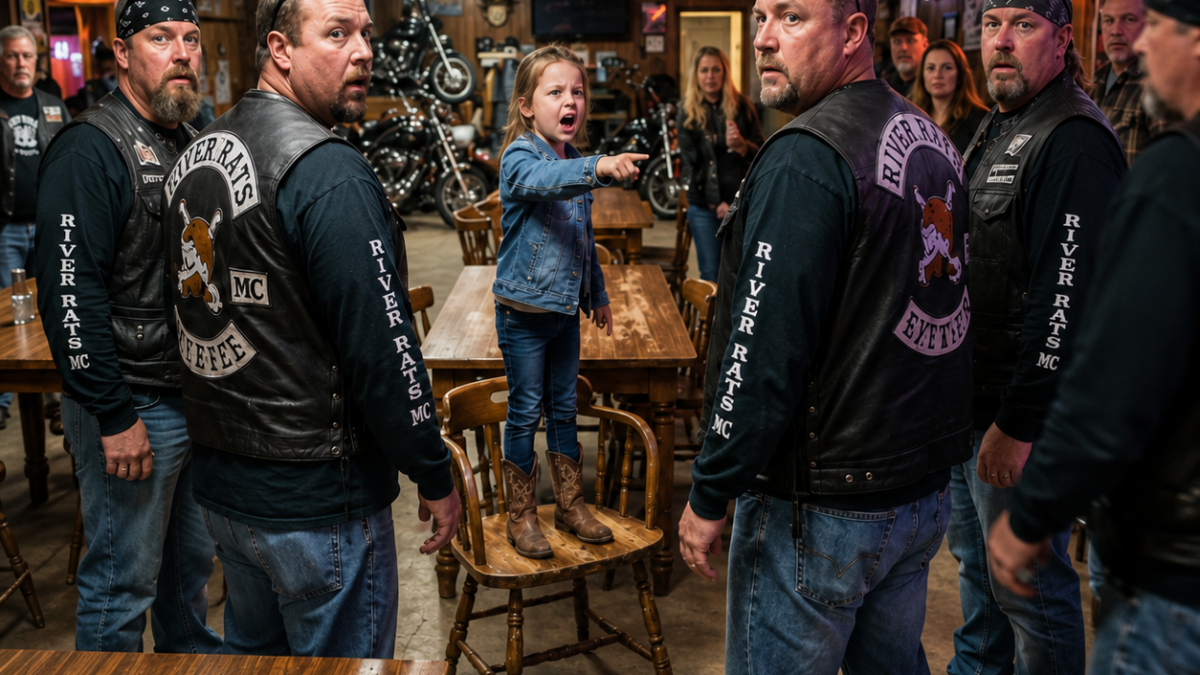
Three hundred bikers were laughing inside my Tulsa clubhouse when a six-year-old girl in an oversized denim jacket climbed onto a chair and screamed the name of a man we had buried two years earlier.
I recognized the jacket before I recognized the child, and when she said, “Kyle Sinclair was my daddy,” every man in the room understood that a promise we had made beside his grave had somehow failed.
Then she looked at me with tears running down her face and said her mother was still outside in a car, wouldn’t wake up, and had been trying to find us before her body finally gave out.
My name is Dawson Mercer.
I was fifty-six years old when Emory Sinclair walked into the Iron Saints clubhouse and reminded three hundred grown men what “nobody gets left behind” was actually supposed to mean.
Her father, Kyle, had been one of us.
We called him Anchor.
Not because he was slow.
Because when things went wrong, Kyle stayed.
Bike broke down at two in the morning?
Kyle stayed.
Brother sitting alone after his marriage collapsed?
Kyle stayed.
Two riders missing after a storm split the group?
Kyle turned around.
His rule was simple.
Nobody gets left behind.
We repeated it so often that eventually it became something printed on shirts instead of something we actively lived.
Then Kyle died.
Two years passed.
We still called his widow, Sarah, and his daughter family.
At least, that’s what we told ourselves.
But calls became less frequent.
Then holidays passed.
Then birthdays.
Then months.
We confused caring with showing up.
Kyle would have hated that.
That Saturday night, nearly three hundred riders had packed our old Route 66 clubhouse.
Pool balls cracking.
Music playing.
Men arguing about football and carburetors.
Maggie behind the bar yelling at anyone who put boots on her chairs.
I was drinking iced tea at the far end.
I hadn’t touched alcohol in nineteen years.
Grief had taught me what happens when a man tries to drown memories that deserve to stay alive.
Then the front door opened.
Nobody noticed at first.
A child stepped inside.
Tiny.
Brown hair tangled around her face.
Sneakers untied.
Oversized denim jacket hanging almost to her knees.
She looked completely wrong in that room.
Then I saw the patch sewn onto the back of the jacket.
A small Iron Saints emblem.
And beneath it, faded stitching.
ANCHOR.
My hand tightened around the glass.
The girl moved farther inside.
Nobody stopped her because nobody understood yet.
She looked from face to face.
Three hundred strangers in leather.
Then she grabbed the back of a chair.
Climbed onto it.
Her knees were shaking.
She drew one enormous breath.
And screamed:
“KYLE SINCLAIR!”
The clubhouse died.
Not quieted.
Died.
No music seemed loud enough anymore.
No laughter.
No pool balls.
Nothing.
I started walking toward her.
“Sweetheart?”
She looked at me.
Her face crumpled.
“Do you know him?”
My throat closed.
“Yes.”
“He was my daddy.”
Someone behind me whispered, “Jesus Christ.”
I looked again at the jacket.
Kyle’s jacket.
Modified clumsily to fit a child.
“What’s your name?”
“Emory.”
I knew that name.
We all did.
Kyle had talked about his little girl constantly.
She had been four when we buried him.
Now she was six.
And standing alone in a biker clubhouse at nine o’clock at night.
I crouched in front of her.
“Where’s your mom?”
PART2:
That was when Emory started crying.
Not loudly.
The exhausted kind.
Like she had been saving it until she found someone safe enough to hear it.
“In the car.”
“What car?”
“Outside somewhere.”
“Is she waiting for you?”
Emory shook her head.
“She won’t wake up.”
Every man near us went still.
My stomach dropped.
“How long has she been asleep?”
“I don’t know.”
“Did she drive you here?”
Another shake of the head.
“She was trying.”
“Trying to what?”
“Find Daddy’s friends.”
I looked around the room.
Three hundred men who had promised Kyle Sinclair his family would never be alone.
And his six-year-old daughter had somehow reached us by herself.
I took Emory gently by the shoulders.
“Baby, where is the car?”
She lifted one trembling hand toward the door.
Then she said the sentence that sent every Iron Saint in that clubhouse running into the parking lot at once.
“I think Mommy stopped breathing.”








