A 5-Year-Old Girl Was Mocked for Her Torn Pink Shoes—Then a Retired Navy SEAL and His K9 Learned Why She Refused to Take Them Off
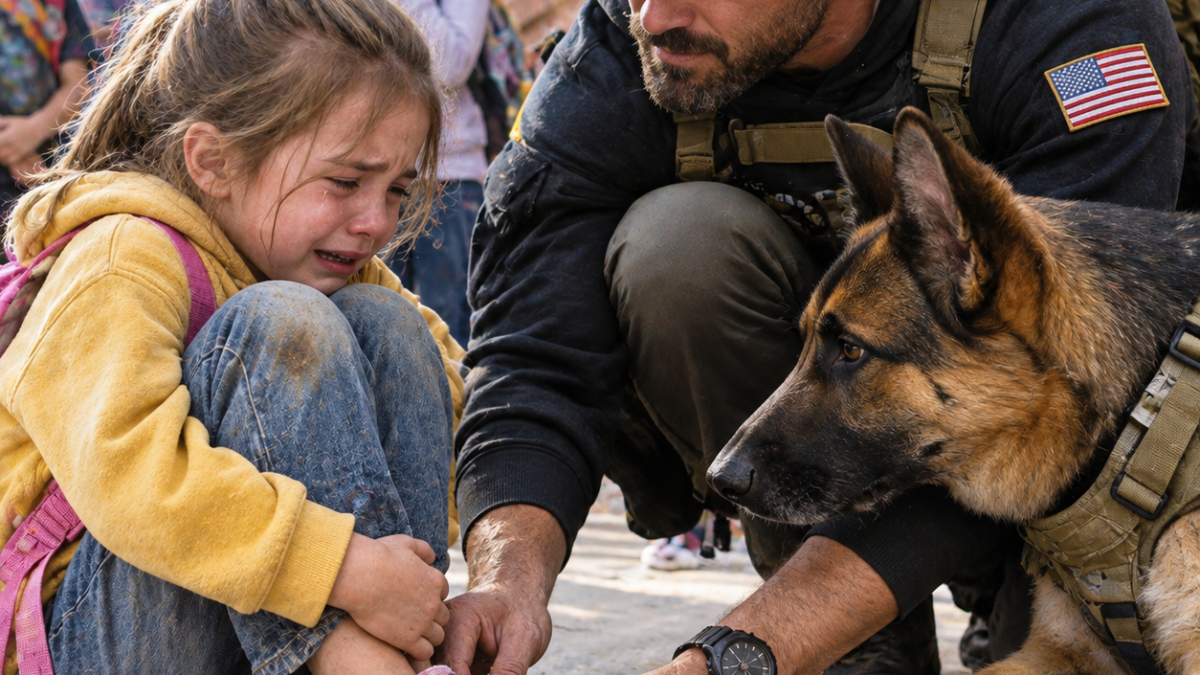
PART3:
Atlas’s ears moved with every sound without his body shifting.
Then Logan heard something underneath the noise.
Slap.
Slap.
Slap.
Soft.
Regular.
He stopped walking.
Mr. Reyes took two more steps before noticing.
“What?”
Logan looked toward the playground.
A little girl in a yellow hoodie was running toward the swings.
Brown ponytail.
Red ribbon.
Small, quick legs.
Her shoes were pink.
Or they had been pink once.
The fabric had faded pale at the toes.
The rubber was dark from use.
The left sole had separated nearly halfway across the front.
Every step opened it.
Slap.
Closed.
Slap.
Opened.
Slap.
Like a little mouth trying to say something.
A boy near the slide noticed.
He pointed.
“Flip-flap!”
The girl slowed.
Another child laughed.
“Flip-flap shoes!”
Then three voices picked it up.
“Flip-flap!”
“Flip-flap!”
“Flip-flap!”
Children do not always understand cruelty when they discover it.
Sometimes they find a sound that makes other children laugh and follow the laughter before they understand what the joke costs.
Logan knew that.
It didn’t make it hurt less.
The girl stopped in the middle of the blacktop.
She did not turn around.
Did not yell.
Did not cry.
She simply became still.
Completely still.
Logan recognized that too.
The trick of making your body smaller when you cannot make yourself disappear.
A whistle cut sharply across the playground.
The chant died.
A silver-haired teacher crossed the blacktop.
She did not hurry.
She did not need to.
“That is enough.”
Her voice was quiet.
Every child heard it.
The boy who had started the chant stared at his sneakers.
“We do not do that here. Not ever.”
No lecture.
No public humiliation.
No demand for an apology performed for adults.
She simply ended it.
The girl in the yellow hoodie walked toward the building without looking at anybody.
Mr. Reyes sighed.
“Mrs. Harland.”
“She always like that?”
“Sixty-three years old. Kindergarten teacher. She could probably stop a riot by raising one eyebrow.”
Logan watched the girl disappear through the door.
“What’s her name?”
Mr. Reyes looked at him.
Not suspicious.
Careful.
“Lily.”
That was all he gave.
Logan understood.
They continued toward the gym.
Ten minutes later, the bell had rung.
The school transformed.
The playground emptied.
Doors closed.
The hallway filled briefly with little shoes, backpacks, voices, then became strangely quiet.
Logan and Mr. Reyes were passing a row of low cubbies when Logan heard crying.
Barely.
Not the free crying of a hurt child.
This was controlled.
Breath catching.
Stopping.
Starting.
The crying of someone trying not to be heard.
He stopped again.
Mr. Reyes followed his gaze.
Mrs. Harland appeared around the corner at almost the same moment.
She heard it too.
She looked at Logan.
Then toward the cubbies.
“Stay there.”
He nodded.
She walked ahead.
Lily sat beneath the coat hooks with her back against the wall.
Her left shoe was in her lap.
She held a brown rubber band between both hands.
A plain office band.
She stretched it around the separated toe.
It snapped loose.
Hit her thumb.
She flinched.
Picked it up.
Tried again.
Mrs. Harland crouched.
“Lily, honey.”
Lily wiped her face with one sleeve.
“I’m okay.”
“Are you hurt?”
“No.”
“You sure?”
“Yes.”
She kept fighting the rubber band.
Logan stood in the doorway.
And suddenly he was six years old.
Not remembering six.
Being six.
Yellow kitchen light.
His mother standing at the sink.
Silver duct tape.
One pair of sneakers.
His fingers smoothing tape around a loose sole.
Around.
Around.
Around.
The tape had wrinkled if you pulled too quickly.
He had learned to make it neat.
That was the worst part.
He had become skilled at being poor.
He remembered checking the repair from three angles before school.
Not because it needed to function.
Because maybe if the tape looked intentional, nobody would laugh.
They laughed anyway.
“Tape Shoes.”
That name lasted almost a year.
Logan came back to the hallway.
Mrs. Harland glanced over her shoulder.
Their eyes met.
Something passed between them.
Not permission exactly.
Recognition of intention.
She gave him one small nod.
Logan crouched near the doorway.
Several feet away.
Hands visible on his knees.
He did not approach Lily.
“That’s smart.”
Lily looked up.
Her eyes were red.
Suspicious.
Logan nodded toward the rubber band.
“Holds better than you’d think.”
She studied his face.
Waiting for the joke.
He offered none.
“I used duct tape.”
Her eyebrows moved slightly.
“On shoes?”
“Silver.”
Lily stared.
“That’s ugly.”
“Extremely.”
A tiny sound escaped Mrs. Harland.
Almost a laugh.
Lily looked back at the shoe.
Atlas had been sitting beside Logan.
No command was given.
The dog stood.
Walked slowly toward Lily.
Stopped beside her.
Turned.
Sat with his back pressed against her shins.
Not facing her.
Not demanding touch.
Just there.
A warm wall.
Lily froze.
Her hand hovered above his coat.
Atlas stayed still.
Slowly, she placed one palm against his shoulder.
Her breathing changed.
Mrs. Harland took the rubber band.
“May I?”
Lily nodded.
The teacher doubled it.
Worked it around the toe.
The sole pulled temporarily into place.
“There.”
Lily hugged the shoe against her chest.
Her eyes moved toward the empty hallway.
Checked both directions.
Then she whispered:
“Please don’t tell my mom.”
Mrs. Harland’s face softened.
“Tell her what?”
“That it ripped again.”
“Why?”
“She’ll throw them away.”
The answer came too quickly.
Prepared.
Lily’s arms tightened around the shoe.
“She already bought me new ones.”
Logan said nothing.
Mrs. Harland did not say anything either.
Lily looked at both adults.
“I don’t want new ones.”
Then she put the torn sneaker back on.
Rubber band around the toe.
Stood.
Atlas stood with her.
Mrs. Harland held out her hand.
“Ready?”
Lily nodded.
The three of them walked toward class.
Logan stayed where he was.
His promised twenty-two minutes had already disappeared.
His presentation lasted nine.
Atlas demonstrated how he retrieved dropped objects.
How he ignored distractions.
How he positioned himself behind someone who needed physical space.
A little girl asked:
“Can service dogs be scared?”
Logan answered:
“Everybody gets to be scared.”
The children considered this.
A boy asked:
“Even Navy SEALs?”
“Yes.”
“Even Atlas?”
“Yes.”
Atlas sneezed.
The class laughed.
Logan should have left afterward.
He had five dogs at the ranch.
Two training sessions scheduled.
Paperwork.
Feed delivery.
A life.
Mrs. Harland stopped him near the gym.
“Lunch is at eleven forty.”
He waited.
“There’s an empty chair at my table.”
“That sounds strategic.”
She smiled.
“I teach kindergarten. Everything is strategic.”
“I’m not trying to interfere.”
“I know.”
“Her family situation is not my business.”
“I know.”
“I don’t want her thinking I feel sorry for her.”
Mrs. Harland’s expression changed.
“Good.”
Logan looked at her.
“Good?”
“Children can smell pity faster than dogs smell bacon.”
He glanced at Atlas.
“Debatable.”
Mrs. Harland smiled.
“Eleven forty.”
Logan stayed.
The cafeteria smelled like tater tots, disinfectant, warm milk, and the particular chaos of several hundred children eating simultaneously.
Lily sat two seats from Mrs. Harland.
Peanut-butter sandwich.
Apple slices.
Small carton of milk.
Her feet were hidden under the bench.
Logan sat across from the teacher.
Atlas lay under the table.
For several minutes, nobody mentioned shoes.
Good.
Then Logan said:
“When I was about your age, I had boots two sizes too big.”
Lily looked up.
“I stuffed newspaper in the toes.”
“Why?”
“So they wouldn’t fall off.”
“Did it work?”
“Mostly.”
“Mostly?”
“One day I walked in front of the class and half the sports section fell out.”
Lily stopped chewing.
Logan shook his head.
“The Broncos had lost that Sunday, so I considered it responsible recycling.”
Lily giggled.
Fast.
Unexpected.
Then covered her mouth.
Her eyes shot toward the next table.
Logan noticed.
So did Mrs. Harland.
Neither reacted.
After a moment Lily lowered her hand.
Logan continued eating.
“A lot of schools have clothing closets.”
Mrs. Harland nodded.
“We do.”
Lily immediately said:
“I have new shoes.”
Logan looked at her.
“Okay.”
“I don’t need any.”
“Okay.”
She seemed surprised.
Most adults would have pushed.
But why?
You’d look so nice.
Your old ones are broken.
Let us help you.
Sometimes help becomes another way of announcing that somebody has less than you.
Logan knew that.
He ate another fry.
Lily relaxed.
After lunch, he found Mr. Reyes.
“I know you can’t tell me about her family.”
“Correct.”
“I’m not asking.”
Logan took out a business card.
“Only give this to her mother if you think it’s appropriate.”
Mr. Reyes accepted it but did not promise anything.
“Why?”
“If she wants to call, she can.”
“About?”
Logan looked down the hallway.
“I don’t know yet.”
“That’s an unusual answer.”
“It’s the honest one.”
Mr. Reyes put the card into a folder.
On the way out, Logan passed Lily’s cubby.
Mrs. Harland happened to be nearby.
The small wooden door swung open wider than intended.
Inside, pushed neatly to the back, was a brand-new pair of white sneakers.
Tags attached.
Clean.
Correct size.
Logan stopped.
Mrs. Harland looked at them too.
Then closed the door.
No words.
That changed everything.
This wasn’t a child whose mother ignored worn-out shoes.
Her mother had bought replacements.
Probably replacements she could not easily afford.
Lily was choosing the torn pair.
Why?
That question followed Logan all the way home.
That night he sat on the ranch porch polishing boots that did not need polishing.
Atlas lay across the step.
At 8:15, the phone rang.
Unknown number.
Logan answered.
“Pierce.”
A woman’s voice.
Exhausted.
Guarded.
“This is Emily Mitchell.”
Logan sat straighter.
“Lily’s mother?”
“Yes.”
A pause.
Then:
“Why is a stranger asking about my daughter?”
Good question.
The next morning, Logan returned to Juniper Ridge.
Twenty minutes early.
He sat in his truck staring at the school.
Atlas waited quietly in back.
Logan had slept badly.
At midnight, he had polished his boots.
Again.
Men develop strange methods for controlling thoughts they cannot control.
Some drink.
Some run.
Logan polished leather.
Mr. Reyes brought him to a small office.
Atlas settled near the chair.
Emily Mitchell arrived at seven.
Straight from work.
Thirty years old.
Dark hair tied back.
Gray jacket.
White bakery apron underneath.
Flour at the hem.
She smelled faintly of bread, vanilla, and exhaustion.
She did not offer her hand.
Logan respected that.
“I looked you up.”
He almost winced.
“Okay.”
“Logan Pierce. Retired Navy SEAL.”
“Yes.”
“You train service dogs.”
“Yes.”
“There were articles about you.”
“Unfortunately.”
Emily sat forward.
“So I’m going to ask once.”
“Fair.”
“Why my daughter?”
Logan could have built an explanation.
Instead:
“Because I heard her crying.”
Emily did not move.
“Because she was trying to repair that shoe by herself.”
Still nothing.
“And because when I was her age, I was the kid with the shoes.”
Emily’s expression shifted.
Barely.
“Who knows about her?”
“No one.”
“Your employees?”
“No.”
“Friends?”
“No.”
“Press?”
“No.”
“You told people at your ranch?”
“No.”
“Why should I believe that?”
“You shouldn’t because I say so.”
She watched him.
“You decide based on what I do.”
That seemed to matter.
Emily looked down at her hands.
Dried glue along two fingertips.
Logan noticed.
She caught him looking.
“Last Thursday.”
“What?”
“The glue.”
She rubbed her fingers together.
“I fixed the sole last Thursday.”
A knock.
Mrs. Harland entered with Lily.
Yellow hoodie.
Pink shoes.
The rubber band gone now.
A shiny ridge of glue visible around the left toe.
Lily looked at her mother.
Then Logan.
Then the floor.
Emily opened both arms.
Lily walked into them.
“Remember our rule?”
“Yes, Mama.”
“We talk to grown-ups we don’t know only when Mrs. Harland or I are there.”
“I know.”
“Good.”
Atlas rose.
Crossed the room.
Sat behind Lily.
Pressed his back to her legs.
Lily’s hand came down to his fur.
Emily watched.
Something in her posture softened.
Then she said:
“Her daddy bought those shoes.”
Logan remained silent.
“Daniel.”
She swallowed.
“Army. Fort Carson.”
“How long has he been gone?”
“Long enough.”
Then:
“Seven weeks left if they keep the schedule.”
Lily looked toward her mother.
Emily continued.
“He bought those shoes the weekend before he left.”
“They were too big then.”
“Yes.”
She almost smiled.
“He told her there was room to grow.”
Lily whispered:
“Pink runs fastest.”
Emily looked at her.
“That’s what you told him.”
Lily nodded.
Then Emily reached toward the left shoe.
“Inside the tongue, he wrote something.”
Lily immediately pulled her foot back.
“Mom.”
“I’m not taking it.”
Emily looked at Logan.
“He calls her Little Bird.”
Her voice thinned.
“He wrote, ‘Run to me, little bird.’”
Logan felt his chest tighten.
Everything made sense.
The new white sneakers.
The secrecy.
The rubber band.
The panic.
Those shoes were not footwear to Lily.
They were a promise.
She had been waiting through deployment with one clear picture in her head.
Airport.
Father.
Running.
In those shoes.
Emily continued quietly.
“She won’t wear the new ones.”
“I saw them.”
“I bought them three weeks ago.”
“Do the pink ones hurt?”
Emily hesitated.
“I think so.”
Lily stared at Atlas.
“She won’t tell me.”
Emily looked at her daughter.
“Because she thinks I have too much already.”
Lily’s face reddened.
Emily’s voice became rough.
“She hides when things break.”
Nobody said anything.
“She sees me coming home from the bakery. She sees bills. She hears me talking about overtime.”
“Mama—”
“I know, Bug.”
Emily put a hand against Lily’s cheek.
“You are not something I carry.”
Lily’s eyes filled.
“You understand?”
A nod.
“You’re not a bill.”
Another nod.
“You’re my girl.”
Lily leaned into her.
Logan looked away.
He had learned years earlier that there are moments in families when a stranger’s greatest contribution is pretending he is not there.
After Lily returned to class, Emily gave Logan rules.
Clear ones.
“You don’t come to our house.”
“Okay.”
“No gifts.”
“Okay.”
“No shoes.”
“Okay.”
“No pictures.”
“Yes.”
“No reporters.”
“Yes.”
“No posting anything online.”
“Yes.”
“If you see Lily, it is at school with Mrs. Harland present.”
“Yes.”
Emily narrowed her eyes.
“You agree very easily.”
“A mother setting boundaries around her five-year-old is not a negotiation.”
She studied him.
Then nodded.
At the door she stopped.
“That glue won’t hold.”
Logan knew cobbling well enough to agree.
“Not on a flex point.”
“I’ll learn something better.”
“It needs stitching.”
Emily looked at him.
“Then I’ll learn to stitch.”
She left.
That sentence followed Logan for days.
Because there was someone in Colorado Springs who knew exactly how to stitch shoes.
Walter Pierce.
Logan’s father.
Pierce Shoe Repair stood on West Colorado Avenue between a laundromat and a taco shop.
Faded gold lettering.
Same front window Logan remembered from childhood.
Same hanging lamp over the workbench.
Logan drove past every evening.
Slowed.
Never stopped.
Eleven years.
That was how long he and his father had lived inside a silence neither seemed willing to break.
The silence began much earlier.
When Logan was eight, Career Day came to his elementary school.
Children stood and announced their parents’ jobs.
Doctor.
Mechanic.
Bank teller.
Police officer.
When Logan’s turn came, he said:
“My dad is just a shoe fixer.”
The class laughed.
Logan laughed too.
He was eight.
His own shoes were wrapped in duct tape.
The shame inside him needed somewhere to go.
Years later, after becoming a SEAL, Logan gave a magazine interview.
The reporter asked about poverty.
About motivation.
About why he wanted a life larger than the neighborhood where he grew up.
Logan talked carelessly.
Said he had watched his father repair shoes all his childhood and promised himself he would never live “that small.”
The line was printed.
Someone brought the magazine into Walter’s shop.
Left it open on the counter.
His father never confronted him.
That was worse.
Calls became shorter.
Visits rarer.
Then Logan stopped going entirely.
His mother died.
They stood together at the funeral.
Spoke politely.
Then eleven more years passed.
Now every evening Logan drove past the shop with Lily’s shoes in his mind.
He still did not stop.
Mrs. Harland called on Thursday.
“Come back.”
“For what?”
“My class has forty questions about Atlas.”
“Forty?”
“I counted.”
“Why?”
“Because one child asked whether he dreams.”
“He does.”
“Another asked whether he has a birthday.”
“He does.”
“One asked if he can read.”
“He cannot.”
“Are you sure?”
Logan looked at Atlas.
“Mostly.”
Mrs. Harland laughed.
“Twenty minutes.”
“Emily?”
“Approved. Same conditions.”
Logan returned Friday.
The classroom rug showed a map of the United States.
Lily sat near the back with her feet tucked under her.
The pink shoes were still there.
Logan began from prepared notes.
Terrible decision.
The children were dying.
One boy became deeply interested in his elbow.
Logan closed the folder.
“Okay.”
Everyone looked up.
“My notes are boring.”
A few giggles.
“I wrote them and even I don’t want to hear them.”
Mrs. Harland hid a smile.
Logan took a tiny plastic chair and sat on it.
His knees were almost at his shoulders.
The class laughed harder.
“Instead, I’ll tell you about a boy.”
Lily looked up.
“He had one pair of shoes.”
The room quieted.
“They broke.”
Logan did not look at Lily.
“His family didn’t have money for another pair right away.”
He described the duct tape.
Kitchen table.
His mother pretending not to notice.
The careful wrapping.
The bus.
The nickname.
Tape Shoes.
A boy laughed once at the name.
Then stopped when Logan continued.
“He learned something.”
“What?” a child asked.
“If you laugh first, sometimes people think it doesn’t hurt.”
The children stared.
“Did it work?” a girl asked.
“No.”
“What did he do?”
“He cried in the bathroom at home.”
The room became completely still.
“Why not tell his mom?”
“Because he thought she already had enough problems.”
At the back of the room, Lily’s hands unclenched.
Atlas crossed the rug.
Sat behind her.
Leaned against her legs.
Logan looked at the children.
“That boy was me.”
Nobody laughed.
Cody, the little boy in the dinosaur shirt who had started the playground chant, stared at Logan.
Then at Lily.
Then stood.
Mrs. Harland said nothing.
Cody carried his carpet square across the rug.
Put it beside Lily.
Sat down.
Did not apologize.
Not yet.
Did not look at her.
He just stopped making her sit alone.
Mrs. Harland said quietly:
“Thank you, Cody.”
Then the class asked Atlas questions.
Forty might have been an underestimate.
Did he like pizza?
No.
Had he jumped from airplanes?
Logan changed the subject.
Could he find lost keys?
Yes.
Did he snore?
Offensively.
Lily laughed.
That sound mattered.
Afterward, Logan signed out.
Then the gym door banged open.
Mrs. Harland appeared holding Lily’s hand.
Lily wore one pink shoe.
One gray sock.
In her free hand, she carried the entire sole of the other sneaker.
Not loose.
Off.
Completely.
“They were running laps,” Mrs. Harland said.
Lily stared at the sole.
“She kept running three steps after it came off.”
Logan stayed against the wall.
Emily arrived twenty minutes later.
Hair loose.
Sweatpants.
Jacket over sleep clothes.
She had been asleep after a twelve-hour night shift.
She saw Logan.
Gave one brief nod.
Then knelt in front of Lily.
“Hey, Bug.”
Lily held out the sole.
Her chin shook.
Emily took it.
“It’s okay.”
“No.”
“We’ll figure it out.”
“No!”
The word burst from Lily.
Everybody in the office went still.
“Daddy said these shoes would run to him!”
Emily’s face broke.
Lily sobbed.
“He said run to me. He said run to me and now they can’t run!”
Emily pulled her close.
“They can’t run to him!”
“I know.”
“They can’t!”
“I know, baby.”
Lily cried into her mother’s shoulder.
Everything she had held back on the playground, in the hallway, at lunch, at home, came out.
The office aide found tissues.
Nobody offered solutions.
That was the right thing.
Mrs. Harland brought the white sneakers from Lily’s cubby.
Emily set them on the floor.
“Only to get home.”
Lily shook her head.
“Only home.”
A long pause.
Then Lily let her mother put them on.
The broken pink pair went into a brown paper grocery bag.
Lily carried the bag against her chest.
That evening Emily called Mrs. Harland.
The teacher told her about Logan’s classroom story.
Tape Shoes.
The bathroom crying.
Cody moving his carpet square.
Atlas.
After the call, Emily sat at her kitchen table.
The brown bag in front of her.
She opened it.
Folded back the tongue.
Run to me, little bird.
She sat there a long time.
Then got her keys.
At Logan’s ranch, sunset was turning the pines copper when headlights approached.
Atlas barked once.
Logan stood from the porch.
Emily crossed the yard carrying the bag.
“You don’t make shoes.”
“No.”
“Your father does.”
Logan stopped.
Emily held out the bag.
“Will you take them to him?”
Logan stared at it.
Eleven years.
All compressed into brown paper.
“I need to tell you something.”
“What?”
“I haven’t spoken properly to my father in eleven years.”
Emily’s hand stayed extended.
“That shop is the hardest door I know how to open.”
Emily looked at him.
Then at the bag.
“I’m not asking you to fix your family.”
“I know.”
“I’m asking if you know someone who might fix these.”
“I do.”
“Then the rest is yours.”
Logan took the bag.
The next evening he stood outside Pierce Shoe Repair.
5:55.
Five minutes until closing.
Atlas beside him.
The brass bell above the door was visible through the glass.
Logan could leave.
He almost did.
Then he thought about Lily pressing a rubber band around a shoe because she did not want to burden her mother.
He opened the door.
The bell rang.
Same sound.
High.
Thin.
The smell hit next.
Leather.
Polish.
Wax.
Machine oil.
Old wood.
Nothing had changed.
Everything had changed.
Walter Pierce sat beneath the work lamp.
Seventy-one.
White hair.
Narrower shoulders.
Canvas apron.
Bent over a cowboy boot.
He did not look up.
“We close at six.”
“I know.”
The needle stopped.
Walter’s head lifted slowly.
Eleven years passed across his face.
Then disappeared.
“You here to get something fixed?”
Logan put the bag on the counter.
“Yes.”
“Yours?”
“No.”
Walter looked at Atlas.
Then Logan.
Then the bag.
He opened it.
Lifted the tiny sneaker.
Turned it over.
Examined glue.
Rubber-band marks.
Worn canvas.
Then folded back the tongue.
Run to me, little bird.
He read it twice.
“Her father?”
“Army.”
“Deployed?”
“Yes.”
“When home?”
“About six weeks.”
Walter looked at the shoe.
“She plans to wear these?”
“She plans to run to him.”
The old man’s expression changed.
“Then we’d better make them run.”
He chose curved needle.
Waxed thread.
Aligned the sole.
Then whispered:
“Lord, steady these old hands and let this hold.”
He pressed the needle.
His hand shook.
The needle slipped.
Walter tried again.
Another tremor.
He sat back.
For almost a minute he looked at his hands.
Hands that had repaired thousands of shoes.
Then he slid the needle toward Logan.
“My hands don’t do this anymore.”
Logan stared.
“Dad.”
“Yours will have to.”
“I don’t know how.”
“You used to say it was simple work.”
The words landed.
Not cruelly.
That made them hurt more.
Logan lowered his eyes.
Walter said:
“Sit.”
Logan sat on the same old stool from childhood.
Walter pulled out scrap leather.
“First lesson.”
“What?”
“Stop trying to win against the material.”
“I’m not.”
“You’re holding that needle like you’re interrogating it.”
Logan loosened his grip.
“Better.”
It took hours.
Logan broke two needles.
Punctured a thumb.
Pulled stitches too tight.
Made one seam curve so badly Walter cut it out without comment.
Atlas slept under the bench.
At eleven, Walter said:
“Come back tomorrow.”
Logan did.
Then again.
And again.
The real pink shoe sat under the lamp untouched while Logan practiced.
Walter would not let him work on it until the stitches were right.
“Why gold?” Logan asked one night.
Walter held up the thread.
Bright waxed gold.
“Children’s shoes.”
“That doesn’t answer me.”
“A child shouldn’t hide a repair.”
Walter ran the thread between his fingers.
“A visible stitch means somebody stayed long enough to mend it.”
Logan looked away.
The sentence was not only about shoes.
Saturday morning, Emily brought Lily to the shop.
She stayed every minute.
Her rule.
Lily stood beside the bench.
Walter looked down at her.
“You good at holding things?”
“Pretty good.”
He handed her beeswax.
“When he needs wax, you hold this.”
Lily took the job seriously.
Every time Logan raised thread, she presented the wax.
Walter nodded as if she were assisting in surgery.
The shop changed.
Saturday by Saturday.
Emily sat near the window drinking coffee.
Atlas leaned against whoever was trying hardest not to show emotion.
Sometimes Lily.
Sometimes Emily.
Sometimes Walter.
Logan’s stitches improved.
Shorter.
Straighter.
Gold seams.
One evening Logan finally said:
“When I was eight, Career Day.”
Walter kept sweeping.
Logan continued.
“I told my class my father was just a shoe fixer.”
The broom stopped.
“I know.”
Logan looked up.
“What?”
Walter leaned on the handle.
“I heard you.”
Logan stared.
“How?”
“Your mother forgot your lunch.”
Walter looked toward the old register.
“She asked me to take it.”
He spoke without anger.
“I arrived while your class was talking.”
“You were outside?”
“Yes.”
“And heard them laugh?”
“Yes.”
“Why didn’t you tell me?”
Walter’s face softened.
“You were eight.”
“So?”
“You were hurting.”
He set the broom aside.
“A father does not take his hurt and hand it back to his child because he wants an apology.”
Logan’s eyes burned.
“And the magazine?”
Walter looked at him.
“That one was harder.”
“I know.”
“No. You don’t.”
Logan swallowed.
“I said I would never live a life that small.”
“Yes.”
“I’m sorry.”
Walter walked toward the register.
Taped beside it was a yellowed card.
Logan had seen it his entire childhood.
Never read it.
Walter tapped it.
“Read.”
CHILDREN’S SHOES — NO CHARGE
SINCE 1984
Logan stared.
Walter sat.
“This town lives off Fort Carson.”
He looked around the shop.
“Families come and go.”
“Night workers.”
“Enlisted families.”
“Single mothers.”
“Men laying pipe in January.”
“Women baking bread at three in the morning.”
Logan thought of Emily.
Walter continued.
“Children came in with broken shoes.”
“Parents counting coins.”
“Trying not to look ashamed.”
He rubbed his thumb over one trembling finger.
“I could repair a child’s shoe in twenty minutes.”
“I couldn’t repair the shame.”
“So I charged nothing.”
Logan read the card again.
“My shoes?”
Walter’s expression tightened.
“Couldn’t fix them.”
“Why?”
“They were gone.”
“The uppers were thin.”
“The sole was finished.”
“A new pair cost fourteen dollars.”
Walter paused.
“Some months I gave fourteen dollars away before I got home.”
Logan looked at him.
“To other children?”
“Yes.”
“While mine were taped?”
“Yes.”
Walter did not defend himself.
“I have wondered for forty years whether that was right.”
The honesty hurt.
“I wanted to help everybody.”
He looked down.
“Sometimes helping everybody meant my own boy thought his father did not see him.”
Logan’s throat closed.
“It wasn’t because I didn’t love you.”
“I know.”
“No.”
Walter looked directly at him.
“You know now.”
That broke something open.
Logan covered his eyes.
“I was wrong about you.”
Walter said nothing.
“I told an entire magazine I was ashamed of what you did.”
“You told them you wanted something different.”
“I made you small.”
Walter reached across the bench.
Put his hand over Logan’s.
“You were a boy with sore feet.”
“Then a young man with something to prove.”
His hand stayed there.
“Boys grow.”
A pause.
“Men come back.”
Atlas rose.
Pressed against Logan’s leg.
Logan laughed once through tears.
“Traitor.”
Walter almost smiled.
They continued sewing.
Not everything needed a speech afterward.
Some repair happened through repetition.
Come back.
Sit down.
Thread needle.
Pull.
Try again.
Weeks passed.
The gold seam grew around the shoe.
Then Emily called.
Daniel’s unit was coming home early.
Four days.
Friday.
“We’ll be ready,” Logan promised.
He returned to the shop.
One stitch remained.
Walter held the shoe toward him.
“Bring it home.”
Logan threaded.
Set the needle.
Pulled.
A dry tearing sound.
The pink canvas split beside the seam.
Long rip.
Toward the heel.
Logan froze.
“No.”
Walter took the shoe.
Examined it under the lamp.
Logan stood.
“I pulled too tight.”
“No.”
“I ruined it.”
“No.”
Walter flexed the toe.
Then pushed one thumb inside.
“You see?”
The canvas was almost transparent.
Tiny toe impressions.
“She outgrew them.”
Logan sat.
“What?”
“At least a month ago.”
Walter looked at him.
“Probably longer.”
Logan thought of Lily running despite pain.
Hiding her feet.
Refusing new shoes.
“We can reinforce them.”
Walter shook his head.
“No.”
“Why?”
“Because then she runs to her father in a shoe that hurts.”
“But the promise—”
“The promise was that she would run.”
Walter set the torn sneaker down.
“Not that the same rubber had to survive forever.”
Logan looked at the shoe.
“What do we do?”
Walter reached beneath the counter.
Pink suede.
New rubber.
Gold thread.
“We build her a pair.”
Logan stared.
“Then they’re not the shoes.”
Walter folded back the old tongue.
The writing remained.
Run to me, little bird.
“We carry the old ones into the new.”
He explained.
Remove the tongues.
Stitch Daniel’s writing inside.
Use sound pieces of the old canvas to line the insoles.
Build the new shoes in Lily’s actual size.
Gold seam around the sole.
“Nothing she loves gets thrown away.”
Walter touched the worn pink fabric.
“It gets carried.”
Logan almost agreed.
Then stopped.
“No.”
Walter frowned.
“What?”
“We don’t decide.”
“Son—”
“They belong to Lily.”
Walter looked irritated.
Then Logan continued.
“And Emily trusted me.”
That changed his father’s face.
“If we cut these apart without asking, we’re doing exactly what every well-meaning adult has done.”
“Deciding for them.”
Walter lowered his eyes.
Then nodded.
“Call her.”
Emily brought Lily the next afternoon.
The torn shoes were laid openly on the bench.
Nothing hidden.
Logan showed the tear.
The worn toe.
The size difference.
He explained the plan.
New pink suede.
Old tongue.
Old canvas.
Gold thread.
Emily listened.
Then she knelt in front of Lily.
“The shoes are tired.”
Lily’s lip trembled.
“They’re broken?”
“They did their job too long.”
“Can they run?”
“Not without hurting you.”
Lily looked at Logan.
He did not soften the truth.
“No.”
Tears filled her eyes.
Then he touched the new suede.
“But we can build these.”
She stared.
“New shoes?”
“Yes.”
She shook her head.
He folded back the old tongue.
“Your dad’s words go inside.”
Lily stopped.
“And pieces of these go inside the bottom.”
“Inside?”
“Every step.”
Her breathing slowed.
Atlas walked over.
Sat against her legs.
Lily touched the suede.
“So the old shoes run inside the new ones?”
“Yes.”
“Every step?”
“Every one.”
She considered it.
Then nodded.
“All right.”
Emily smiled.
“Your decision?”
“My decision.”
“Sure?”
“Yes.”
Then Lily pointed at the gold thread.
“That too.”
Walter looked offended.
“Of course that.”
They traced Lily’s feet on brown paper.
She giggled when the pencil touched her heel.
Walter allowed room to grow.
Not enough to slip.
Enough to breathe.
Tuesday night.
Wednesday.
Thursday.
Walter cut.
Logan stitched.
Emily brought Lily Saturday before the final assembly and Lily held beeswax.
The old tongues were sewn inside the new shoes.
Daniel’s handwriting preserved.
The best fabric from the original pink shoes became lining.
Nothing thrown away that still carried meaning.
By Thursday night, the pair was finished.
Pink suede.
Gold stitching.
Soft interior.
Strong sole.
Actual room for Lily’s toes.
Walter placed them under the lamp.
Logan waited for praise.
His father said nothing.
Instead he opened the lowest workbench drawer.
A drawer Logan had never been allowed to touch as a child.
Walter removed his cobbler’s hammer.
Nearly fifty years old.
Dark wooden handle polished by one man’s hand.
He placed it in Logan’s palm.
Closed Logan’s fingers around it.
His own trembling hand remained over his son’s.
Nothing needed to be said.
The next morning, Lily came to the shop.
Yellow hoodie.
White shirt.
Red ribbon perfect in her ponytail.
Emily wore a blue dress.
Walter lifted the box.
Logan opened it.
Lily stared.
Then reached slowly.
She picked up the left shoe.
Gold seam shining.
Pressed the toe.
Room.
Then folded back the tongue.
Run to me, little bird.
Her lips moved as she read.
She looked at Emily.
“They’re still mine?”
Emily answered:
“Every stitch.”
The shoes went on.
Lily stood.
Moved her toes.
No pinch.
No pain.
Her entire face changed.
She took one step.
Then another.
Then ran.
Full speed through Pierce Shoe Repair.
Past boots.
Past shelves.
Around the bench.
Laughing.
Atlas followed at a dignified trot.
Walter laughed.
A rusty sound Logan had not heard in years.
Lily ran another lap.
Gold stitching flashing.
Then Logan said:
“I won’t be at the airport.”
Lily stopped.
Emily looked at him.
“That moment belongs to you.”
Emily shook her head.
“No.”
“Emily.”
“Lily asked for you.”
He looked at Lily.
She had already crossed the shop.
She took two of Logan’s fingers.
Held them.
Emily said:
“She asked for both of you.”
Walter lowered his eyes.
“She says the men who fixed her running have to see her run.”
Logan looked at his father.
Walter nodded.
“All right.”
Colorado Springs Airport was packed.
Military families.
Flags.
Handmade signs.
Children.
Grandparents.
Babies.
Coffee.
Announcements.
The particular electricity of people waiting for somebody they had imagined returning every day for months.
Emily gave Logan instructions.
“Tall white pillar.”
“We’ll stay there.”
“Don’t move.”
“We won’t.”
“When she runs, I want her to know where you are.”
Walter stood beside Logan.
Good jacket.
Clean shirt.
Hands trembling.
Atlas pressed against his leg.
Walter put one hand on the dog.
“I’ve repaired shoes for men going out for fifty years.”
He stared toward arrivals.
“Never watched one come back.”
“You nervous?”
“I am too old for nerves.”
His hand shook.
Atlas leaned harder.
Walter smiled.
“I am nervous anyway.”
At the rope line, Lily stood holding Emily’s hand.
Pink shoes visible beneath her jeans.
She bent twice to check laces that did not need checking.
Once she lifted the tongue.
Read the words.
Then straightened.
The flight landed.
The crowd changed.
You could feel it.
People stood taller.
Children stopped fidgeting.
Signs lifted.
Doors opened.
Soldiers came through.
Every few seconds somebody screamed a name.
Families broke from lines.
Hugs.
Tears.
Laughter.
Lily stood on her toes.
Not him.
Next soldier.
Not him.
Next.
Emily bent toward her.
Lily shook her head.
Not yet.
Walter whispered:
“Lord, bring him home.”
The doors opened again.
Daniel Mitchell came through.
Uniform.
Duffel bag.
Thinner than the photograph Emily kept at home.
His eyes searched.
Then found them.
Emily made a sound.
Not a word.
Lily released her hand.
Ran.
Pink shoes hitting polished floor.
Quick.
Even.
Gold thread flashing.
Daniel stopped.
Dropped the duffel.
Lily ran faster.
Halfway there, she stopped.
Everyone watching seemed confused.
Daniel remained on his knees now.
Arms open.
“Little Bird?”
Lily turned.
Looked back.
Searched.
Found the white pillar.
Found Logan.
Walter.
Atlas.
Then lifted one foot.
High.
Showed them the pink shoe.
Gold seam.
And waved with her whole arm.
Logan lifted his hand.
Walter lifted his.
His hand trembled.
He did not hide it.
Lily grinned.
Then turned.
Ran.
Daniel opened his arms.
She hit him hard enough to nearly knock him backward.
He wrapped both arms around her.
Buried his face in her hair.
His shoulders shook.
Nobody laughed at a soldier crying.
Emily reached them.
Kneeling.
Holding both.
For several minutes the rest of the airport moved around one small family.
Logan stayed near the pillar.
Exactly where he had promised.
Walter’s hand came to rest against his forearm.
“Good shoes.”
Logan laughed.
“Yeah.”
“Pretty good stitches too.”
Logan turned.
“That a compliment?”
“Don’t get used to it.”
Twenty minutes later Lily came toward them riding on Daniel’s hip.
She was talking so fast he could barely follow.
“Daddy, Daddy, look.”
She kicked off one shoe.
Held it toward him.
Folded the tongue.
Daniel read his own handwriting.
Run to me, little bird.
He stopped breathing for a moment.
Then looked at Logan.
Walter.
The gold thread.
Emily explained quietly.
Original shoes.
Broken beyond use.
Parts preserved.
New pair built around them.
Daniel rubbed one thumb over the gold seam.
Then took Walter’s hand.
“Thank you, sir.”
Walter looked uncomfortable.
“Girl did the running.”
Then Daniel faced Logan.
“She told me you made them.”
“My father taught me.”
Daniel shook his hand.
“Thank you for getting my girl to me in shoes that could run.”
Logan could not answer immediately.
Finally:
“Worth learning.”
Emily stepped closer.
“I want to say something.”
Logan waited.
“When I first met you, I gave you rules.”
“Yes.”
“Hard ones.”
“Reasonable ones.”
“You never argued.”
“No.”
“You asked before changing those shoes.”
Logan nodded.
Emily looked toward Lily.
“A mother remembers who respects the boundaries around her child.”
That meant more than the thanks.
Daniel crouched beside Atlas.
Scratched his neck.
Atlas leaned his entire seventy-pound body into the soldier.
Daniel nearly lost balance.
Lily laughed.
Not the careful giggle from the cafeteria.
Not the sound she covered with her hand.
A full laugh.
Open.
Free.
A month later, the first snow dusted Old Colorado City.
The bell over Pierce Shoe Repair rang.
Cody entered holding his mother’s hand.
The boy from the playground.
Dinosaur shirt replaced by a winter coat.
In his free hand:
One sneaker.
Heel split open.
He placed it on the counter.
Walter looked over his glasses.
Cody stared down.
“Can it be fixed?”
Walter picked up the shoe.
“Most things can.”
Cody looked at the yellowed card beside the register.
CHILDREN’S SHOES — NO CHARGE.
“My mom can pay.”
“I didn’t ask.”
Cody swallowed.
Then Logan appeared from the back.
He worked Saturdays now.
Not because Walter needed him every Saturday.
Because Logan wanted to be there.
He took Cody’s shoe.
Examined the split.
“Easy enough.”
Cody looked at the gold thread.
“Can mine have that?”
Logan smiled.
“Absolutely.”
Cody watched.
After several stitches he asked:
“Mr. Pierce?”
“Yeah?”
“Do you know Lily?”
“Yes.”
“I was mean to her.”
Logan continued sewing.
“I know.”
“I said Flip-Flap.”
“I know.”
Cody looked terrified.
Logan did not rescue him from the discomfort.
Finally Cody said:
“I told her sorry.”
“What did she say?”
“She said okay.”
“That was kind of her.”
“Am I bad?”
Logan stopped sewing.
Looked at him.
“No.”
Cody’s eyes filled.
“You did something mean.”
“Yeah.”
“Those aren’t the same thing.”
The boy nodded.
Logan returned to the shoe.
“What matters now?”
Cody thought.
“Don’t do it again?”
“Good start.”
The gold seam closed the heel.
When Logan handed it back, Cody stared at the repair.
“That looks cool.”
“A visible stitch means somebody stayed.”
“What?”
“Something my dad says.”
Walter pretended not to hear.
A few weeks later, a letter appeared in the Colorado Springs Gazette.
Small.
Reader-opinion page.
No photograph.
Logan had refused interviews about Lily.
When the reporter who once profiled him called asking about rumors of the repaired shoes, he told her:
“She is a child. Her story belongs to her family.”
The reporter respected it.
But Logan submitted one short letter of his own.
It read:
My father did not live a small life.
For nearly fifty years, Walter Pierce repaired the shoes of families who did not always have money to pay him. I once mistook quiet work for unimportant work. I was wrong.
He kept more people on their feet than I will ever know.
I am sorry it took me this long to understand the size of that.
Walter read it at his bench.
Twice.
Folded it.
Placed it beneath the lamp.
Then picked up another shoe.
No speech.
Logan sat beside him.
Started threading a needle.
The silence between them was different now.
Not punishment.
Not avoidance.
Comfort.
That became Saturdays.
Coffee before opening.
Radio low.
Walter teaching.
Logan sewing.
Atlas asleep under the bench.
Sometimes they talked about Logan’s mother.
Sometimes about deployments.
Sometimes about nothing.
They did not try to recover eleven missing years.
That would have been impossible.
They simply stopped losing new ones.
Emily occasionally brought Lily.
Daniel came too when duty allowed.
Lily’s pink shoes became ordinary shoes.
That was the best thing that could have happened to them.
Mud.
Scuffs.
Playground dust.
One scraped toe.
Gold stitching still visible.
She ran in them until she outgrew them.
This time she told her mother when they became tight.
Emily nearly cried when Lily said:
“Mom, I think I need bigger shoes.”
Such a normal sentence.
Such a victory.
They did not throw the pink pair away.
Lily kept them.
Years later, Daniel’s handwriting inside the tongue faded slightly.
The four words remained readable.
Run to me, little bird.
Walter kept what remained of the original torn shoes hanging by their laces behind the shop counter.
Not displayed dramatically.
Just there.
A paper tag attached.
One word.
MENDED.
Logan once asked why.
“They weren’t mended.”
Walter looked at him.
“No?”
“The shoes died.”
Walter nodded toward the bench.
Then toward Logan.
Then toward the street outside.
“You still think the tag is about the shoes?”
Logan laughed.
“Fair.”
Winter settled over Colorado Springs.
Snow along West Colorado Avenue.
Pikes Peak white.
One Saturday near closing, Walter fell asleep in his chair.
Apron still on.
Cobbler’s hammer resting loose in one hand.
Atlas lay at his feet.
The old man’s shoe touched the dog’s side.
At the bench, Logan worked on a small brown child’s shoe somebody had left that morning.
No name.
Only a note.
Please fix if possible. I can pay next Friday.
Logan had crossed out the second sentence.
He threaded gold waxed cord.
Set the needle.
Pulled.
One stitch.
Then another.
Slow.
Straight.
Visible.
Outside, snow moved through streetlight.
The shop bell was quiet.
Walter breathed softly.
Atlas breathed with him.
Logan glanced at the yellowed card beside the register.
CHILDREN’S SHOES — NO CHARGE.
He finally understood why his father had never replaced it with something newer.
Some rules did not need updating.
He finished the seam.
Turned the shoe in his hand.
Strong.
Ready.
Then heard the bell ring.
A mother entered with two children.
One boy wore a coat too thin for the weather.
The younger girl kept one foot slightly behind the other.
Logan noticed.
Not because he was looking for poverty.
Because he remembered hiding.
The mother approached the counter.
“I’m sorry. Are you closing?”
Logan looked at the clock.
Then at Walter.
His father had awakened.
Walter’s eyes met his.
No words.
Logan turned back.
“We’ve got time.”
The woman placed a small boot on the counter.
The sole had separated.
“I don’t get paid until Thursday.”
Logan touched the yellow card.
“Children’s shoes are free.”
Her expression changed.
Embarrassment first.
Then disbelief.
“I can pay eventually.”
“I know.”
“I don’t want charity.”
“It isn’t.”
She looked at him.
“What is it?”
Logan considered the question.
Then smiled.
“Shop policy.”
The woman laughed once.
Relief disguised as humor.
Her daughter moved closer.
Logan took out the gold thread.
“Do you want the repair to show?”
The little girl looked uncertain.
“Why?”
“Because this is the good thread.”
She touched it.
“Gold?”
“Gold.”
“Will people know my shoe broke?”
Logan thought of Lily on the blacktop.
Tape Shoes.
Flip-Flap.
His mother’s kitchen.
His father’s bench.
He answered carefully.
“They’ll know somebody fixed it.”
The girl thought.
Then nodded.
“Gold.”
Walter smiled from his chair.
Logan threaded the needle.
Atlas shifted closer to the children.
And the work began.
Years later, people who knew Logan from the military sometimes asked why he spent Saturdays repairing children’s shoes when he already ran a successful service-dog program.
He usually gave the simple answer.
“My dad needed help.”
That was not entirely true.
Walter had needed help eventually.
Hands worsened.
Eyes tired.
But by then Logan could have hired someone.
Could have paid for anything the shop needed.
He kept going because Saturday mornings had taught him something the SEAL teams never had.
Some forms of service are intentionally invisible.
No medals.
No photographs.
No ceremonies.
One child walks into school without being ashamed.
One mother keeps twelve dollars in her grocery budget.
One father comes home and watches his daughter run.
One old man learns his son finally understands him.
Nobody writes history books about those things.
That doesn’t make them small.
Lily grew.
At ten, she still remembered Atlas before she remembered Logan.
At twelve, she brought the pink shoes to school for a project about family objects.
She did not tell the class she had once been mocked.
She did not need to.
She talked about Daniel’s deployment.
Her mother working nights.
A cobbler.
A retired SEAL who could not sew.
Gold thread.
Her teacher asked what the shoes represented.
Lily answered:
“That something can change and still be the same thing you love.”
Emily heard that later and cried in the car.
Daniel pretended he did not.
Logan definitely did when Emily texted him the sentence.
He showed Walter.
The old man read it.
Nodded.
“Smart kid.”
“That’s all?”
“What else?”
“You’re impossible.”
“So I’ve heard.”
Walter died at eighty-one.
Peacefully.
Not at the bench.
At home.
Logan was there.
So was Atlas, older now, muzzle mostly gray.
Walter’s hands had stopped repairing shoes several years earlier.
But the shop remained open.
Logan kept it.
On the morning after the funeral, he unlocked the front door before sunrise.
The bell rang.
The shop smelled like leather.
Beeswax.
Old wood.
His father.
Logan sat at the bench.
Placed Walter’s cobbler hammer in front of him.
For a long time, he did nothing.
Then he noticed an envelope beneath the lamp.
His name.
Walter’s handwriting.
Logan opened it.
Inside was one sheet.
Son,
If you are reading this, I suppose you finally get to complain that I left you with work.
Good.
Work keeps the hands busy while the heart catches up.
Do not make this shop into a monument.
That would embarrass me.
Fix shoes.
Charge the people who can pay.
Do not charge the children.
Teach somebody else.
And when you make a mistake, pull the stitch and do it again.
You came back.
That was enough.
Dad
Logan read the last line until he couldn’t see it.
Atlas, too old to stand easily now, lifted himself from the floor.
Walked over.
Pressed his side against Logan’s leg.
Same old wall.
Logan rested one hand in his fur.
“I know, buddy.”
They stayed that way.
Then the bell rang.
A father entered with a boy.
Broken sneaker.
Logan wiped his face.
Stood.
“Morning.”
“Are you open?”
He looked at Walter’s letter.
Then at the shoe.
“Yes.”
He was.
Years after Atlas died, Logan kept a photograph of him beside the register.
Not military.
Not working.
Atlas lying beneath Walter’s bench with Lily’s original pink shoe visible in the background.
That was how Logan remembered him best.
Not as a war dog.
As a dog who understood that sometimes the strongest thing you can do for somebody is sit close without demanding an explanation.
The service-dog ranch continued.
Pierce Shoe Repair continued.
On Saturdays, veterans occasionally came into town with Logan.
Some learned leatherwork.
One man with severe anxiety discovered he could stitch for hours without his hands shaking.
Another veteran who rarely spoke became brilliant at replacing heels.
A woman who had lost part of her left hand developed a method for clamping children’s shoes that Walter would have admired.
The shop changed.
The rule did not.
CHILDREN’S SHOES — NO CHARGE.
A second card eventually appeared beneath it.
Logan wrote this one.
A VISIBLE STITCH MEANS SOMEBODY STAYED.
Emily saw it first.
She stood at the counter with sixteen-year-old Lily beside her.
Lily was taller than her mother now.
She had come to show Logan her driver’s permit.
“You’re driving?”
“I will be.”
“No.”
“I’m sixteen.”
“Still no.”
Emily laughed.
Lily looked toward the wall where the remains of the original pink sneakers still hung.
“Mended.”
She smiled.
“Can I take those home?”
Logan looked at her.
“They’re yours.”
“I know.”
“I always figured you’d ask.”
“Why now?”
Lily looked at the old shoes.
“Dad’s retiring next month.”
“Really?”
She nodded.
“We’re moving after.”
“Where?”
“Georgia.”
“That’s too far.”
“Mom says Colorado winters are trying to kill her.”
“Reasonable.”
Lily took the old shoes from the nail.
Held them.
The rubber had hardened.
Canvas faded.
One still open at the toe.
The handwriting removed long ago and placed into the new pair, but the shape remained.
She turned them over.
“You know what I remember?”
“What?”
“Not the boys.”
Logan waited.
“I remember Atlas sitting against me.”
She looked up.
“I remember Mom letting me keep them.”
“I remember Mr. Walter telling me gold catches light.”
Her eyes filled.
“And I remember running.”
Logan nodded.
“That’s enough.”
“No.”
She smiled.
“It’s more than enough.”
Daniel’s retirement ceremony was at Fort Carson.
Lily wore ordinary shoes.
Black.
Formal.
No gold thread.
The pink pair stayed at home.
That mattered too.
The promise had done its job.
When Daniel walked toward his family after the ceremony, Lily did not run.
She was sixteen.
Too cool for that.
She waited until he reached them.
Then threw her arms around him anyway.
Emily cried.
Daniel cried.
Nobody pretended otherwise.
Logan stood farther back.
No Atlas now.
No Walter.
He felt both absences sharply.
Lily saw him.
Waved.
He waved back.
For one second, the airport returned.
Little yellow hoodie.
Red ribbon.
Pink shoes.
A father on his knees.
Then the present came back.
A young woman.
A retired soldier.
A family that had made it through.
That evening, Lily gave Logan a small box.
“What’s this?”
“Open it.”
Inside was a spool of gold thread.
Logan laughed.
“I have approximately six hundred yards at the shop.”
“This one is different.”
“How?”
She had attached a paper tag.
In handwriting that looked uncannily like Daniel’s:
FOR THE NEXT LITTLE BIRD.
Logan stopped smiling.
Lily hugged him.
He held her.
“You were never poor, you know.”
She pulled back.
“What?”
“That’s how people told the story at first.”
“The poor girl with torn shoes.”
Lily made a face.
“We didn’t have much money.”
“I know.”
“Mom was broke.”
“Your mother was exhausted.”
“Same thing sometimes.”
Logan smiled.
“But you were never what those kids thought.”
Lily looked toward her parents.
“No.”
“What were you?”
She thought about it.
Then held up the spool.
“Waiting.”
That was better.
Much better.
The pink shoes had never really been a story about poverty.
Not to Logan.
Poverty was part of it.
Of course it was.
Emily’s night shifts.
Glue at two in the morning.
A child learning not to ask for more.
Logan’s duct-taped shoes.
Walter counting dollars.
Those things were real.
But broken shoes alone were not what connected them.
The deeper thing was what people attach to objects when people themselves are far away.
A father’s handwriting.
A mother’s glue.
A child’s promise.
An old man’s gold thread.
A son’s apology.
None of those could be purchased new.
That was why handing Lily another pair of white sneakers had never solved anything.
The problem was not that she needed shoes.
The problem was that everybody kept seeing shoes.
Mrs. Harland was the first adult besides Emily who understood that distinction.
Logan learned it.
Walter already knew.
You do not mend what matters by replacing it before asking what it means.
Sometimes you preserve the tongue.
Use the old canvas.
Build room around what somebody loves.
Then let them choose.
Logan thought about that often at the bench.
Especially with veterans.
Especially with families.
People came to him wanting their old lives back.
Before injury.
Before deployment.
Before divorce.
Before the night everything changed.
He could not give them that.
Neither could service dogs.
Neither could therapy.
Neither could a shoe shop.
But Walter’s method applied.
You kept what was still sound.
You admitted what had worn beyond use.
You stopped calling pain a gift.
You made room for growth.
And you stitched the old into something capable of carrying the person forward.
Not replacement.
Mending.
There was dignity in the difference.
One winter morning, years after Lily left Colorado, Logan opened the shop early.
Snow outside.
Street empty.
He made coffee.
Turned on Walter’s lamp.
The old yellow card remained beside the register.
CHILDREN’S SHOES — NO CHARGE.
Below it:
A VISIBLE STITCH MEANS SOMEBODY STAYED.
And beside both, Lily’s spool.
FOR THE NEXT LITTLE BIRD.
At eight fifteen, the bell rang.
A mother came in.
Two children.
The younger girl kept one shoe behind the other.
Logan recognized it immediately.
Not the shoe.
The posture.
He came around the counter.
Crouched.
“Morning.”
The girl said nothing.
Her mother looked embarrassed.
“Her sole came off on the bus.”
Logan nodded.
“May I see?”
The girl hesitated.
Then showed him.
The rubber separated at the toe.
Small problem.
Twenty minutes.
Maybe less.
“What’s your name?”
“Grace.”
“Well, Grace, this is serious.”
Her eyes widened.
Her mother looked worried.
Logan lowered his voice.
“I need you to make a major decision.”
“What?”
He held up two spools.
Brown.
Gold.
“Do we hide the repair?”
Grace looked between them.
“Or make it awesome?”
She pointed.
“Gold.”
“Correct answer.”
Her mother laughed.
Logan brought a stool over.
“Want to help?”
Grace nodded.
He handed her beeswax.
“Hold this.”
She held it exactly the way Lily once had.
Level.
Solemn.
Logan drew the gold thread across.
Twice.
“Perfect.”
The little girl smiled.
Outside, snow fell across West Colorado Avenue.
Inside, the needle passed through leather.
Then rubber.
Then back.
A straight gold line appeared.
Visible.
Unashamed.
At the other end of the room, the old cobbler’s hammer rested beneath Walter’s lamp.
Atlas’s photograph stood beside the register.
The shop smelled of beeswax and coffee.
Logan pulled the stitch snug.
Not too tight.
Guide it.
Don’t drag it.
The thread wants to go home.
He could still hear his father.
Grace watched every movement.
“Will it hold?”
Logan looked at the gold seam.
“Yes.”
“How long?”
He smiled.
“Long enough to get you where you’re going.”
And in the end, that was all any good mending had ever promised.








