A 5-Week-Old Kitten Was Found Superglued to a Sidewalk Before Dawn—Then a Jogger Heard One Tiny Cry at 5:15 A.M. and Stopped.
PART3:
The kind of sound that goes straight into your bones and stays there.
I held my hands above him, useless.
I was afraid to touch him.
Afraid to leave him.
Afraid he would tear himself open if he kept fighting.
Afraid he would stop fighting if I did nothing.
“Okay,” I said, though nothing was okay. “Okay, I’m here. I’m here.”
He cried harder.
I called 911 because I could not think of who else to call.
When the dispatcher answered, I heard myself speak too fast.
“There’s a kitten glued to the sidewalk.”
The words sounded insane.
The dispatcher paused.
“A kitten is what, ma’am?”
“Glued. Someone glued him to the sidewalk. He can’t move. He’s alive. Please send someone.”
She asked for the address.
I gave the street name, then looked around frantically for a house number. My phone light caught a mailbox across the street.
“Brook Hollow Drive. Near 1842. Please hurry. He’s hurting himself.”
The dispatcher told me animal control was being sent.
“Do not pull him,” she said.
“I won’t.”
“Keep him calm if you can.”
Keep him calm.
As if calm was something I could place over him like a blanket.
As if he had not spent hours alone on cold concrete while the rest of the neighborhood slept behind locked doors.
I took off my running jacket and folded it beside him, not on him, afraid the fabric would stick to the glue. I poured water from my bottle around his paws, not because I thought water would dissolve the glue, but because his skin looked dry and stretched and I was terrified it would tear.
The water ran across the sidewalk and caught the light.
The kitten shook.
“Stay with me,” I whispered. “Please stay with me.”
I do not know how long he had been there before I found him.
The vet would later say six to eight hours.
That meant sometime in the night, while people were brushing their teeth, turning off televisions, locking their doors, and going to bed, someone had carried a five-week-old kitten to a public sidewalk and fixed his body to the concrete.
Someone had either spread adhesive on the ground and pressed him into it, or covered parts of him and forced him down.
I try not to picture it.
Sometimes my mind does anyway.
Did he cry while they did it?
Did he try to crawl away?
Did they look back?
Did they hear him after they walked off?
Or was that the point?
I have asked myself those questions more times than I should.
None of the answers help.
A porch light came on across the street.
A man opened his front door.
“Everything okay?”
“No,” I called back. “Please stay there. Animal control is coming.”
He stepped closer anyway, then stopped when he saw my face.
“What happened?”
I could barely say it.
“Someone glued a kitten to the sidewalk.”
The man stared at me.
Then he looked down.
His hand went to his mouth.
“Oh my God.”
He disappeared back inside and returned with towels, but we could not use them. His wife came out too, wrapped in a robe, crying before she even reached us.
The kitten’s cries became weaker for a minute.
That scared me more than the screaming.
“No, no, no,” I whispered. “Don’t quit. You made it this far. Don’t quit now.”
His eyes were wet and half closed. His ears were flattened against his head. He was so small that my two hands could have covered him.
I kept talking.
I told him nonsense.
I told him he was brave.
I told him help was coming.
I told him the sun would be up soon.
I told him he was not alone anymore.
Maybe he understood none of it.
Maybe all he heard was a voice staying near him.
Sometimes that has to be enough.
The animal control truck arrived about twenty minutes after I called.
It felt like two hours.
Two officers stepped out. One was a woman named Ramirez. I remember her name because she said it twice, calmly, like she wanted both me and the kitten to hear something steady.
“I’m Officer Ramirez,” she said. “We’re going to help him.”
The other officer knelt beside the kitten and swore under his breath.
Not loudly.
Not unprofessionally.
Just like a person whose heart had reacted before his training could stop it.
They had seen bad things.
You could tell.
But this still hurt them.
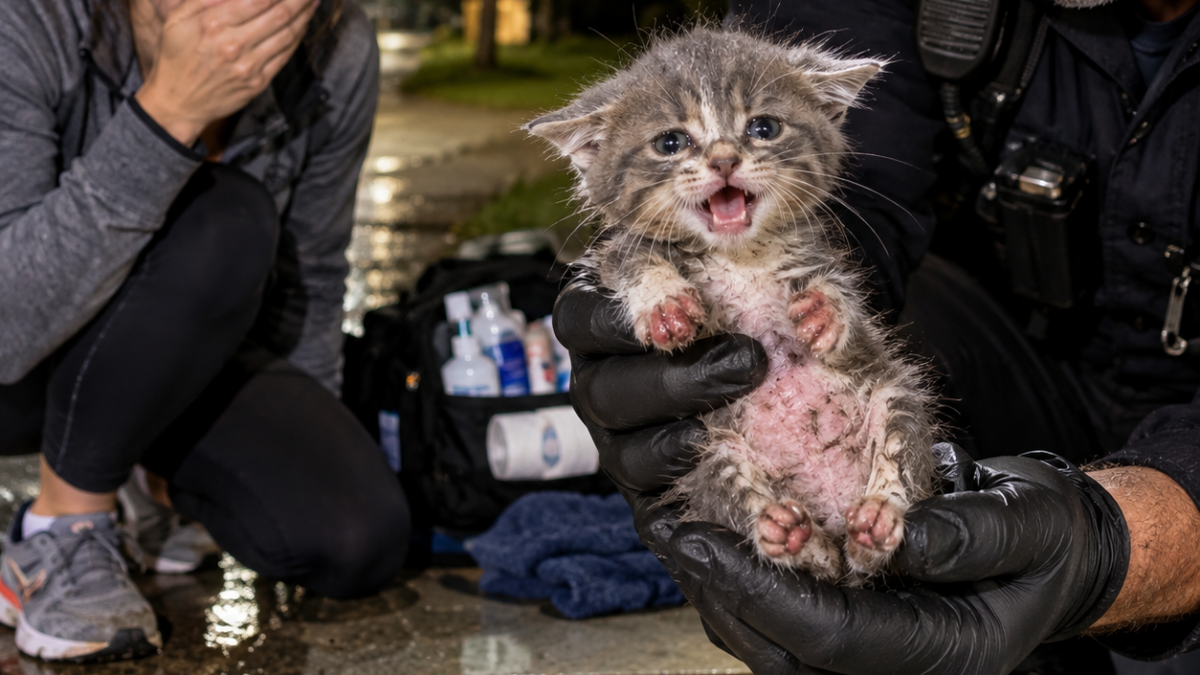
Ramirez put on gloves and opened a medical kit.
“We have to dissolve the adhesive slowly,” she said. “Do not try to lift him until we know what’s free.”
I nodded, even though I was not the one doing anything.
She used a solution on a cotton pad and started with the front left paw.
The kitten screamed the moment she touched the area.
I flinched.
Ramirez did not.
Her face tightened, but her hands stayed gentle.
“I know, sweetheart,” she murmured. “I know. I’m sorry.”
The other officer held a small light over the pavement.
The woman from across the street turned away and cried into her sleeve.
I stayed.
I do not say that proudly.
I wanted to turn away too.
But I had been the first person he saw after the dark, and some irrational part of me believed that if I looked away, he would think he had been left again.
So I stayed on my knees beside him while they worked.
One paw at a time.
Softening.
Waiting.
Lifting a millimeter.
Stopping when he cried too hard.
Starting again.
The adhesive had hardened around his pads. In some places, fur was fused into the glue. In others, the skin looked red and raw beneath it.
When his first paw came free, the officer wrapped it immediately.
Then the next.
Then the back paws.
Then his belly.
The belly took the longest.
The fur there was stuck in a wide patch, and every movement pulled at his skin. Ramirez worked so slowly I could see the strain in her shoulders.
The kitten cried through most of it.
Then, near the end, he became quiet.
Too quiet.
“Is he okay?” I asked.
“He’s exhausted,” Ramirez said. “We’re almost there.”
The final section released at 6:07.
I remember that too.
The sun had started to lighten the sky.
When Ramirez lifted him, he weighed almost nothing.
A little gray life in one gloved hand.
That was when we saw what remained on the sidewalk.
Fur.
Tiny gray pieces of him were still trapped in the dried glue.
The shape of his body remained faintly printed on the concrete.
Four little paws.
A belly.
A small outline where he had been forced to stay.
The woman across the street made a sound and turned fully away.
The man whispered, “Who would do that?”
Nobody answered.
Because there is no answer that makes sense.
Ramirez wrapped the kitten in a towel from the emergency kit, keeping his bandaged paws loose. He looked toward me once. His mouth opened, but no sound came out.
That broke me worse than the screaming.
“What happens now?” I asked.
“Emergency vet,” Ramirez said. “Right now.”
“Can I come?”
She looked at me for one second.
Maybe she was about to say no.
Then she looked down at the kitten.
“You can follow.”
I followed.
I do not remember driving there.
I remember gripping the steering wheel.
I remember my running shoes squeaking on the clinic floor.
I remember the receptionist’s face changing when Ramirez carried him in.
The vet took him immediately.
I stood in the waiting room with dried concrete dust on my knees and glue water on my hands. My phone kept buzzing because by then the neighbors had started texting one another. Someone had posted in the community group. Someone else asked if it was a joke.
I wanted it to be a joke.
I wanted to wake up and be angry at a cruel lie instead of standing in an emergency vet clinic waiting to learn if a baby animal would keep his feet.
After forty minutes, a veterinarian came out.
She had tired eyes and a kind voice.
“He’s alive,” she said first.
I covered my mouth.
“He’s dehydrated and hypothermic. His paw pads have partial chemical burns and abrasions where the skin was pulled. The skin on his belly is raw, but it appears intact. No fractures that we can feel. No signs of internal injury right now.”
“Will he live?”
“We’re hopeful.”
Hopeful.
That word became a place to stand.
Not safe ground.
But ground.
“He’ll need wound care, pain medication, fluids, and monitoring,” she continued. “He is very young, and he’s been through a significant trauma.”
“How long was he there?”
She hesitated.
“Based on his dehydration, body temperature, and skin condition, likely several hours. Possibly six to eight.”
I thought of the dark sidewalk.
The cold concrete.
The houses sleeping around him.
Six to eight hours.
An entire night for a life that had only existed five or six weeks.
“What will happen to him after treatment?”
“Animal control will document the case. Then, if he stabilizes, he’ll go into foster care.”
“Can I know where?”
The vet’s expression softened.
“Leave your information.”
I did.
Name.
Phone number.
Address.
Email.
Everything.
When I walked back outside, the sun had fully risen.
The world had started its day as if nothing had happened.
Cars moved through intersections.
A man in a suit bought coffee from the drive-through next door.
A woman laughed into her phone while walking a small white dog.
The normalness of it made me angry.
I wanted the whole city to stop.
I wanted someone to announce over every radio station that a kitten had spent the night glued to a sidewalk and that we were not allowed to continue pretending the world was fine.
But the world never stops just because your heart does.
I went back to the sidewalk later that morning.
I do not know why.
Maybe I needed to prove to myself it had happened.
Maybe I needed to see what was left.
The neighbors were outside then. People stood in small groups, arms crossed, faces pale. Someone had placed a cardboard box over the spot so nobody would step on it.
The glue was still there.
Dried.
Cloudy.
Hard.
And caught inside it were pieces of gray fur.
A tiny silhouette remained on the concrete.
The shape of where he had suffered.
I stood over it and cried in broad daylight while people walked around me quietly.
Nobody had seen anything.
No doorbell camera covered that part of the sidewalk.
No car had been caught passing at the right time.
No one remembered hearing a person.
Only the kitten.
Only that cry.
For the next few days, I called the clinic more than any normal person should.
The first update was cautious.
He had survived the first night.
He was eating a little.
His paws were bandaged.
He cried when handled, but less.
The second update was better.
He was standing briefly.
Wobbly.
Painful.
But standing.
The third update made me pull over while driving.
“He purred today,” the vet tech said.
I had to ask her to repeat it.
“He purred?”
“Only for a second. But yes.”
I sat in my car in a grocery store parking lot and cried again.
I seemed to cry everywhere that week.
On sidewalks.
In clinics.
In my car.
At my kitchen sink.
It embarrassed me at first.
Then it didn’t.
Some things deserve tears.
The foster family named him Oliver.
I would not have chosen that name, but somehow it fit him.
A serious little name for a kitten who had survived something no baby animal should ever know.
The first photo they sent showed him wrapped in a soft towel with four tiny bandaged paws stretched in front of him. His ears were still too big for his head. His eyes looked sleepy but clear. The fur on his belly had been shaved and treated. He looked impossibly small.
Alive.
That was the only word that mattered.
Alive.
His foster mother, Dana, told me he ate like a creature determined to make up for every hour he had lost. Wet food. Formula. Tiny bits of softened kitten food from a spoon. He slept under a heating pad made safe beneath blankets. He hated having his bandages changed and made his opinion known with a furious little squeak.
Good, I thought.
Let him be furious.
Let him know his body belongs to him.
Let him complain loudly every time someone touches a paw.
A few weeks later, Dana invited me to visit.
I almost said no.
I was afraid he would remember me only as part of the worst morning of his life.
But Dana said, “I think you should come. He’s doing well.”
Her house was warm and smelled faintly of laundry soap and cat food. She had a spare room set up with blankets, low bowls, toys, and a little bed shaped like a cave.
Oliver was smaller than I expected, even after seeing photos.
He sat in the middle of the room with bandages still on two paws and watched me like a judge.
“Hi,” I whispered.
His ears tilted.
I sat on the floor.
I did not reach for him.
I had learned something from that sidewalk.
Help should not always begin with hands.
Sometimes help begins by giving a frightened creature space to decide.
Dana smiled from the doorway.
“He’s cautious with new people.”
“He has reason to be.”
“Yes.”
Oliver took one step toward me.
Then stopped.
I stayed still.
He sniffed the air.
Took another step.
Then another.
When he was close enough, he reached out one bandaged paw and touched my shoelace.
Not me.
My shoelace.
Apparently, that was safer.
“Fair enough,” I whispered.
He looked up at my voice.
For one second, I saw him the way I first found him.
Mouth open.
Eyes wet.
Body pinned to concrete.
Then he blinked and batted clumsily at my shoelace again.
Living animals pull you back into the present.
That is one of their gifts.
Oliver healed slowly.
His paw pads stayed tender.
The vet said he might always have some sensitivity there. He might walk carefully on certain surfaces. He might dislike cold floors. The hair on his belly would grow back unevenly for a while.
But he would live.
He would run.
He would climb.
He would have a chance to become annoying in all the normal kitten ways.
That felt like a miracle.
The case never went anywhere.
Animal control documented everything.
Neighbors talked.
The community group exploded with anger.
People demanded cameras.
People blamed teenagers.
People blamed “sick people.”
People blamed society, parenting, the internet, the police, and each other.
But no one knew.
No one came forward.
No camera caught the person.
No witness remembered anything.
Someone had gone out in the dark with adhesive and a kitten.
Someone had done the unthinkable.
Then gone home.
Maybe they slept.
Maybe they ate breakfast.
Maybe they went to work and acted normal.
That is one of the things that haunts me most.
Cruelty does not always look monstrous in daylight.
Sometimes it has a mailbox, a job, clean shoes, and a polite voice at the grocery store.
Sometimes it passes you on the street.
Sometimes it smiles.
I still run early.
People ask how I can.
I do not run the same route every day anymore.
Not always.
But I still go before sunrise.
And I still do not wear headphones.
Now that choice feels heavier.
Before, it was preference.
Now, it feels like responsibility.
The world is always making sounds we can choose not to hear.
A cry under a bush.
A dog barking too long behind a fence.
A neighbor arguing through thin walls.
A child too quiet.
An old person who stops opening the curtains.
A tiny life on a sidewalk before dawn.
We tell ourselves we are busy.
We tell ourselves someone else will notice.
We tell ourselves it is probably nothing.
Sometimes it is nothing.
Sometimes it is everything.
Oliver was adopted three months after the rescue.
Dana called me before she approved the family.
“I wanted you to know,” she said.
My throat tightened.
“Are they good?”
“They’re wonderful.”
A retired couple.
No small children.
Warm house.
Soft rugs.
A sunroom.
They had recently lost an elderly cat and were not looking for a kitten, but Oliver’s story found them the way certain stories find the people meant to carry them.
“They understand his paws may need extra care,” Dana said. “They already bought little fleece mats for the kitchen.”
That made me cry.
Of course it did.
By then, crying over Oliver had become almost ordinary.
On the day he went home, Dana sent me a photo.
Oliver sat inside a carrier lined with a blue blanket. His eyes were wide, but not terrified. One paw rested on the blanket edge. His new owner’s hand was nearby, not touching him, just waiting.
Under the photo, Dana wrote:
He’s going home.
I stared at those words for a long time.
Home.
Not sidewalk.
Not concrete.
Not cold.
Not glue.
Home.
A few days later, I went back to Brook Hollow Drive.
I had not planned to.
My feet took me there.
The glue was mostly gone by then. Rain had worn it down. Someone had scrubbed part of it. But if you knew where to look, you could still see a faint mark in the concrete.
A small gray memory.
I stood there at 5:15 in the morning.
The same time.
Same darkness.
Same broken streetlamp.
Only now, the sidewalk was empty.
I listened.
There were birds beginning somewhere in the trees.
A car in the distance.
My own breathing.
No cry.
Thank God.
I thought about how thin the line had been.
If I had slept ten minutes longer.
If I had chosen another street.
If I had worn headphones.
If the wind had been louder.
If Oliver had been too weak to cry.
A life can hang from such small things.
A route.
A sound.
A stranger’s attention.
A choice made before you even know it matters.
People later called me a hero.
I never liked that.
Heroes know what they are walking toward.
I was just a woman running in the dark who heard something wrong and stopped.
That is all.
Maybe that is enough.
Maybe the world does not need everyone to be brave in grand ways.
Maybe it needs more people willing to stop for one small sound when it would be easier to keep moving.
Oliver is bigger now.
His new family sends updates sometimes.
He has grown into his ears.
His belly fur came back soft but slightly uneven.
His paws healed, though he still prefers rugs to tile.
He sleeps in the sunroom.
He steals socks.
He growls at the vacuum.
He has learned that hands can bring food, warmth, toys, and gentle scratches behind the ears.
He has learned that footsteps approaching do not always mean pain.
He has learned, slowly, that the world can hold more than the worst thing that ever happened to him.
I am still learning that too.
Because whenever I think of him, I think of two versions of the same sidewalk.
One in the dark, with a kitten trapped against the cold concrete.
One after sunrise, empty except for a faint outline of fur where suffering had been.
And then I think of the photo Dana sent me months later.
Oliver asleep on a windowsill, one healed paw stretched into the light.
That is the image I try to keep.
Not the glue.
Not the crying.
Not the cruelty.
The light.
The paw.
The small body safe enough to sleep.
Still, I will never forget that first sound.
One cry.
Thin enough to miss.
Strong enough to save him.
At 5:15 in the morning, in a quiet neighborhood where almost every house was asleep, a kitten cried from the sidewalk.
I heard him because I had chosen not to block out the world.
And sometimes, I think that is the whole lesson.
Pay attention.
The world is full of small cries.
Some are easy to ignore.
Some are inconvenient.
Some will break your heart if you stop long enough to hear them.
Stop anyway.
Because sometimes the distance between life and death is not a miracle.
Sometimes it is not a rescue team, a perfect plan, or a grand act of courage.
Sometimes it is only this:
One woman running before dawn.
One phone light cutting through the dark.
One pair of headphones left at home.
And one tiny gray kitten who lived because someone heard him.








