A 4-Year-Old With Leukemia Screamed at Every Needle for 9 Days—Then a 270-Pound Biker Rolled Up His Sleeve and Said, “I’m Still Here.”
A 4-Year-Old With Leukemia Screamed at Every Needle for 9 Days—Then a 270-Pound Biker Rolled Up His Sleeve and Said, “I’m Still Here.”
My four-year-old daughter had screamed through every needle for nine straight days, bitten a nursing assistant until she bled, and stopped trusting my hand because she had learned that whenever Mommy held it tight, pain was coming.
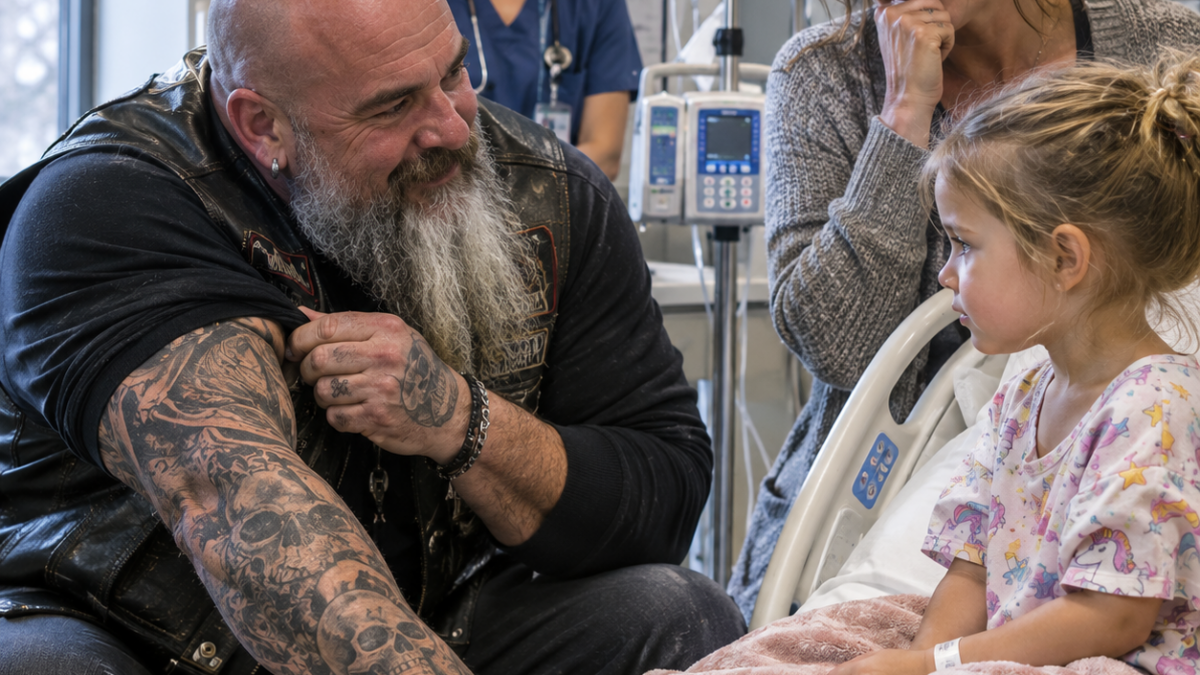
Then a six-foot-three, 270-pound biker called Mr. Ghost crouched beside her hospital bed, rolled up a sleeve covered in black skulls and tattoos, and told her, “Each one of these was a needle, kid—and I’m still here.”
Three months later, over a paper cup of terrible hospital coffee, I learned those tattoos had been hiding a twenty-three-year secret involving addiction, HIV, more than eight thousand needles, and five private words he had never told another human being until my daughter accidentally borrowed them to survive.
My name is Erica Volpe.
I am thirty-four years old.
I live off Oneida Street in Utica, New York.
I am a single mother.
My daughter’s name is Lily.
She is six years old now.
Before I tell you anything else, I need to tell you that part first.
Lily is alive.
She is doing well.
She is in maintenance therapy.
Her most recent bone marrow biopsy showed no detectable disease.
Her oncologist uses words like excellent prognosis.
We have started using words like kindergarten.
Summer camp.
Dance class.
Second grade.
Words that once seemed so far away I was afraid to say them out loud.
There was a time when I stopped buying clothes more than one size ahead because I was terrified of tempting the universe.
There was a time when I could not look at the little plastic table in the pediatric oncology playroom without wondering how many children who had colored pictures there never got to go home.
There was a time when I slept in a vinyl hospital chair with one hand touching my daughter’s ankle because I needed physical confirmation that she was still there.
But Lily is six now.
She leaves crayons uncapped.
She refuses crusts.
She watches Bluey in hedgehog pajamas.
She is obsessed with strawberry yogurt but will not eat an actual strawberry because apparently children are insane.
She has enough hair again to complain when I brush it.
She argues with me.
She laughs too loudly.
She is okay.
I need you to know that before I take you back to October of 2024.
Because there are parts of this story where it will not feel like she is going to be okay.
It did not feel that way to me either.
Lily was four when she was diagnosed with acute lymphoblastic leukemia.
Late September.
We had gone to the pediatrician because she looked pale.
That sounds so small now.
Pale.
She had been tired for maybe two weeks.
Bruises on her legs.
A low fever that came and went.
She stopped finishing breakfast.
PART2:
Then she started asking me to carry her from the living room to bed.
Lily had never been a child who wanted to be carried.
She had been independent since the moment she figured out that “No, I do it” could be used as a complete philosophy of life.
One morning she was sitting at the kitchen table in purple pajamas.
She had cereal in front of her.
She looked at me and said, “Mama, my legs feel sleepy.”
Something in my body knew before my mind did.
Mothers will tell you that sometimes.
Doctors may call it pattern recognition.
Maybe it is.
Maybe we simply know our children’s ordinary rhythms so intimately that a wrong note sounds louder to us.
I called the pediatrician.
Bloodwork.
CBC.
Then a phone call.
The nurse’s voice was too careful.
“Erica, the doctor wants you to take Lily to the emergency department.”
“What’s wrong?”
PART3:
“The doctor would rather discuss that after additional testing.”
You never forget sentences designed not to scare you.
Because they scare you worse than honest ones.
At the hospital, they drew more blood.
Lily screamed because she did not like the needle.
I held her hand.
She cried afterward for maybe three minutes.
Then she asked for a popsicle.
That was who she was before the fear took over.
She hated needles.
Then she moved on.
That night an oncologist sat beside me.
I remember his shoes.
Brown.
Polished.
I remember thinking that was strange.
How could someone polish shoes on a day when my daughter might have cancer?
His name was Dr. Samuel Feldman.
He was kind.
He used the word leukemia.
Then acute lymphoblastic leukemia.
Then prognosis.
Treatment protocol.
Induction.
Remission.
Chemotherapy.
Port placement.
Lumbar puncture.
Bone marrow aspiration.
He spoke slowly.
I heard about twenty percent.
Lily was in the bed watching cartoons.
She did not understand why Mommy had stopped breathing.
I asked:
“Is she going to die?”
There are questions you never imagine yourself asking until they are already out of your mouth.
Dr. Feldman did not look away.
“We treat this with the intention to cure her.”
“That wasn’t my question.”
“I know.”
I hated him for being careful.
Then I loved him for it.
He leaned forward.
“Lily’s type of leukemia is highly treatable. We need more information about her specific risk category and response to therapy, but many children with this diagnosis do very well.”
Many.
Not all.
I learned to hate percentages after that.
Ninety sounded beautiful until you imagined being in the ten.
Ninety-five sounded wonderful until your child was one of twenty.
Statistics stop comforting you when the individual is sleeping six feet away.
The first week came at us like weather.
Port surgery.
Blood draws.
Medication.
Steroids.
Chemotherapy.
Nurses.
Doctors.
Child life.
Dietitian.
Social worker.
Insurance calls.
Forms.
Names.
Schedules.
Side effects.
Lily cried.
But she cooperated.
She was brave in the way adults like children to be brave.
She cried while someone hurt her and then apologized for crying.
That became unbearable to me.
One nurse told her:
“You don’t have to say sorry, sweetheart.”
Lily sniffed.
“But I yelled.”
“You’re allowed.”
That nurse’s name was Monique.
I remember because I wrote it down later.
You remember the people who tell your frightened child she is allowed to be frightened.
By the second week, Lily knew what every cart meant.
A tray of syringes.
Access kit.
Dressing change.
Blood tubes.
She could distinguish alcohol prep pads from adhesive-removal wipes by smell.
She knew nurses by shoes.
That is not knowledge a four-year-old should have.
Then something changed.
It happened after a difficult port access.
The needle did not seat correctly the first time.
They had to try again.
Then another procedure later that day.
Then bloodwork the next morning.
By the third week, Lily decided she was finished.
Not medically.
Emotionally.
Her body remained in treatment.
Her trust left.
The first full screaming episode lasted almost twenty minutes.
The nurse entered with the access kit.
Lily saw it.
“No.”
“Sweetheart—”
“No!”
She backed against the headboard.
I reached for her.
She screamed at me.
“NO, MOMMY!”
I froze.
She had never called me Mommy like that.
Not as comfort.
As warning.
“Baby, we need—”
“DON’T TOUCH ME!”
She kicked.
The nurse stopped.
We waited.
Child life came.
Bubbles.
Tablet.
Counting.
Choices.
Would she like to sit up or lie down?
Which arm?
Which Band-Aid?
Nothing.
She screamed through all of it.
Eventually four adults had to help keep her body safe long enough to complete the access.
Afterward she would not look at me.
That hurt more than the screaming.
I sat beside her.
“Lily?”
She turned toward the wall.
“I’m sorry.”
Nothing.
“I love you.”
Still nothing.
Finally she said:
“You helped them.”
I had no defense.
Because I had.
I knew they needed to do it.
She knew I had participated in something that hurt.
Both things were true.
The next day it happened again.
Then again.
She began anticipating pain hours before anything happened.
If a nurse walked into the room wearing gloves, Lily started crying.
If I said, “Hold Mommy’s hand,” she jerked hers away.
I had trained her.
Without meaning to.
My hand meant pain was coming.
I will carry that knowledge forever.
On one access attempt she kicked a tray.
On another she screamed so hard she vomited.
Then she bit a nursing assistant.
Hard.
Forearm.
Broke skin.
The assistant’s name was Jenna.
Jenna did not yell.
Did not pull away angrily.
She stepped back, cleaned the wound and said:
“Lily, I know you’re scared.”
That made me cry.
I apologized over and over.
Jenna said:
“Erica, stop.”
“But she hurt you.”
“She is four and has cancer.”
“She still can’t bite people.”
“No.”
Jenna looked toward the bed.
“But today we’re going to deal with terrified first and manners later.”
That hospital was full of people like that.
People who understood priority.
By day nine of the screaming, I was exhausted.
Not tired.
Exhausted.
There is a difference.
Tired means sleep would help.
Exhausted means something deeper is empty.
I started dreading nurses entering.
Then feeling guilty for dreading the people saving my child.
I started getting nauseous before procedures.
I was becoming part of Lily’s fear loop.
She watched me.
Children always watch.
I would tense.
She would tense.
I would say everything was okay in a voice that told her absolutely nothing was okay.
By day eleven, Dr. Feldman spoke with me outside the room.
“We need to address the procedure anxiety.”
“What do we do?”
“We can use medication for major procedures.”
“What about everything else?”
He sighed.
“That’s harder.”
“How many more needles?”
He did not answer quickly enough.
I already knew.
A lot.
Treatment for childhood leukemia is not one dramatic battle.
It is repetition.
Again.
Again.
Again.
Blood tests.
Port access.
Medications.
Procedures.
Month after month.
Somebody once told me children are resilient.
I hate that phrase now.
Children can be resilient.
They can also be traumatized.
Those things can exist in the same child.
On day twelve, Lily’s child life specialist found me in the hallway.
Her name was Cassidy.
Twenty-eight maybe.
Curly hair.
Colorful sneakers.
She had the supernatural ability to carry a bag containing puppets, markers, bubbles, medical dolls, card games and somehow exactly the object a child needed at the right moment.
“Erica.”
I looked up.
“I have an idea.”
“Please tell me it doesn’t involve another sticker chart.”
She smiled sympathetically.
“No.”
“Good, because she threw the last one at me.”
“I heard.”
“Of course you did.”
Cassidy leaned against the wall.
“There is a volunteer.”
I waited.
“The kids call him Mr. Ghost.”
That sounded ridiculous.
“Mr. Ghost?”
“His name is Caleb Whitaker.”
“Okay.”
“He has been volunteering with pediatric patients for years.”
“How does that help?”
Cassidy hesitated.
“You need to see him.”
That is not an answer you want in a hospital.
“Why?”
“He’s…”
She searched.
“Visually specific.”
“What does that mean?”
“Six-three.”
“Okay.”
“About two-seventy.”
“Okay.”
“Shaved head.”
“Fine.”
“Long gray beard.”
“Cassidy.”
“Full tattoo sleeves.”
I stared.
“Skulls on both hands.”
I blinked.
“The kids love him.”
“What about parents?”
She smiled.
“The parents take a minute.”
I was too tired to be cautious.
“Bring him.”
“Are you sure?”
“My daughter bit an employee yesterday. Bring Satan if he has pediatric references.”
Cassidy laughed.
Then stopped because I was not entirely joking.
Friday, October 18th, 2024.
9:47 a.m.
I know the exact time because I was staring at the clock waiting for Lily’s port access.
The door opened.
Cassidy entered first.
Then Mr. Ghost.
She had not exaggerated.
He filled the doorway.
Six-foot-three.
Two hundred seventy pounds.
Black thermal shirt.
Jeans.
Work boots.
Shaved head.
Iron-gray beard reaching nearly to his sternum.
Hands the size of dinner plates.
Skull tattoo on each.
Dense black-and-gray ink disappeared beneath both sleeves.
My first thought was:
This man looks like he could pick up the hospital bed.
My second:
Please let this work.
He did not walk toward Lily.
That was the first smart thing he did.
He stopped just inside.
Looked at me.
“Mrs. Volpe?”
“Erica.”
He nodded.
“Erica. I’m Caleb Whitaker.”
His voice surprised me.
Deep.
Gentle.
“The kids around here call me Mr. Ghost.”
I looked at the skulls.
“Why?”
“Long story.”
“Of course.”
He smiled.
“I’m a hospital volunteer. May I come in?”
That mattered.
He asked.
Not Cassidy.
Not me only.
The room.
Our space.
“Yes.”
He entered.
Lily was turned toward the wall watching her tablet.
She heard his voice.
Turned.
Saw him.
I braced for fear.
Nothing.
She stared.
He did not approach.
He crouched on the floor about six feet from the bed.
That made him smaller.
Not small.
Nothing could make him small.
But less looming.
“Hi, kiddo.”
Lily stared.
“I heard you’ve been having a rough week.”
She nodded.
That alone shocked me.
Nine days of screaming.
Now a nod.
“I also heard you don’t like needles.”
Another nod.
Mr. Ghost looked at me.
Then back to Lily.
“Kid, I’m not here to tell you needles don’t hurt.”
Lily’s eyes stayed on him.
“They hurt.”
She whispered:
“Yes.”
“I don’t like them either.”
That got her.
Adults had spent days telling her:
Tiny poke.
Quick pinch.
Just a second.
Be brave.
Caleb Whitaker said:
They hurt.
Truth.
Lily sat up slightly.
“You don’t?”
“Nope.”
“But you’re big.”
He looked down at himself.
“That’s mostly cheeseburgers.”
Lily almost smiled.
Then he said:
“I want to show you something. Is that okay?”
Tiny voice.
The first calm voice I had heard from my daughter during a procedure conversation in nine days.
“Okay.”
He rolled his right sleeve upward.
Slow.
No dramatic reveal.
Just fabric moving.
Ink appeared.
Wrist.
Forearm.
Elbow.
Bicep.
Dense black-and-gray artwork.
Skulls.
Roses.
Chains.
Birds.
Letters.
Shapes I could not identify.
Lily stared.
“Whoa.”
He smiled.
“Yeah.”
“Did you draw those?”
“No, ma’am.”
“Who?”
“Tattoo artists.”
“What’s that?”
“People who make pictures on skin.”
She leaned forward.
“How?”
Caleb paused.
Then:
“Needles.”
Lily recoiled slightly.
He did not rush.
“Yep.”
He tapped one section.
“Every line.”
Another.
“Every shadow.”
Another.
“Every little piece.”
He looked at her.
“Needle.”
Lily stared at the sleeve.
“How many?”
“A lot.”
“How many?”
“More than a thousand pokes.”
Her mouth opened.
“No.”
“Yep.”
“You cried?”
That question almost made me laugh.
Caleb considered it seriously.
“Sometimes.”
“You did?”
“Kid, I have cried over less.”
“What?”
“Parking tickets.”
She smiled.
Then he became quiet.
“Lily.”
She looked at him.
“Each one was a needle.”
He held out his arm.
“And I am still here.”
Silence.
Not magical silence.
Not cinematic.
Just a hospital room.
Pump humming.
Cart in hallway.
TV playing quietly.
My child looking at a stranger’s tattooed arm.
Then Lily asked:
“Mister?”
“Yeah?”
“Will you stay?”
Caleb answered immediately.
“Yes, ma’am.”
The nurse entered ten minutes later.
Lily’s body changed the instant she saw the access kit.
Shoulders up.
Breathing fast.
“No.”
Caleb remained in the chair.
Did not touch her.
He said:
“Want me to show you the skull?”
Lily looked at his hand.
“Yes.”
He held it up.
“Ugly little guy, right?”
“No.”
“No?”
“He’s funny.”
“He thinks he’s tough.”
The nurse prepared everything.
I stood near the bed.
I did not offer my hand.
That was hard.
Caleb saw me hesitate.
He nodded slightly.
Wait.
Lily watched the skull.
The nurse said:
“Okay, Lily. We’re ready.”
Tears filled her eyes.
“No.”
Caleb said:
“It’s okay to say no.”
I looked at him.
So did the nurse.
Then he continued:
“But sometimes we have to do something even while we’re saying no.”
Lily started crying.
Not screaming.
Crying.
Big difference.
Caleb held out his tattooed hand.
“Want to squeeze a skull?”
She nodded.
He approached only after she agreed.
She took two of his enormous fingers.
Her hand disappeared around them.
The nurse cleaned the port area.
Lily whimpered.
Caleb said:
“Look at me.”
She did.
“I’m still here.”
The needle went in.
Lily screamed once.
Short.
Sharp.
Then stopped.
Caleb said:
“You’re still here.”
The nurse secured everything.
Done.
Lily stared at him.
Tears on her cheeks.
She whispered:
“I’m still here.”
Caleb smiled.
“Yes, ma’am.”
I went into the bathroom and cried where nobody could see me.
Not because everything was fixed.
It wasn’t.
The next procedure was still hard.
The one after that too.
Healing is rarely one dramatic breakthrough.
It is practice.
Caleb came back the next day.
And the next.
Then every day he was scheduled during induction.
Thirty-six days.
Sometimes twenty minutes.
Sometimes two hours.
He never made a show of it.
He read books.
Played cards.
Let Lily color sections of photocopied tattoo designs.
Brought her ridiculous temporary tattoos.
Once she put a glitter unicorn on the back of his skull-covered hand.
He wore it for a week.
A nurse asked why.
“Gang initiation.”
Lily laughed so hard she hiccupped.
He gave procedures a language she could understand.
Not “be brave.”
He hated that phrase.
He said:
“You can be scared and do it anyway.”
When Lily cried:
“Good. Cry.”
When she shook:
“Shake.”
When she said:
“I don’t want it.”
He said:
“I know.”
Then:
“Still here?”
She would nod.
“Still here.”
Over time, she needed his hand less.
That pleased him.
He never looked disappointed.
That is another thing I learned about good helpers.
They want you to need them less.
Bad helpers need to stay necessary.
By week three, Lily could sit through routine port access while watching a video.
Still afraid.
But present.
No restraints.
No kicking.
No biting.
By the end of induction, she would hold out her arm for bloodwork.
Eyes squeezed shut.
Mouth tight.
Sometimes tears.
But she did it.
One afternoon I heard her muttering.
“What did you say?”
“Nothing.”
“Lily.”
She looked embarrassed.
“I said I’m still here.”
I sat very still.
“Why?”
She shrugged.
“Mister Ghost says it.”
“He says that to you.”
“No.”
She shook her head.
“He says it.”
“What do you mean?”
“He says, ‘I’m still here.’”
Then she said:
“So I can say it too.”
I did not understand the weight of that yet.
Not fully.
At first, Mr. Ghost was simply the biker who had gotten my daughter through needles.
I did not ask much about him.
I knew he worked construction maintenance.
I knew he rode with a local motorcycle club.
I knew he had been a hospital volunteer a long time.
I knew children adored him.
I knew nurses trusted him.
That was enough.
There were moments when I became curious.
Once Lily asked about the skull on his right hand.
He said:
“That’s my first.”
“First skull?”
“First tattoo.”
“Why skull?”
Caleb smiled.
“Private joke.”
“With who?”
“Me.”
Lily accepted that.
Four-year-olds are good at respecting strange answers.
Adults are not.
I wondered.
Then forgot because oncology gives you too many immediate things to think about.
Three months passed.
January 2025.
Induction finished.
Lily had responded well.
The words remission and maintenance began appearing.
Not finished.
Not safe forever.
But better.
One Tuesday afternoon, we were at the hospital for a clinic visit.
Caleb came to see her.
He read her a book.
Some story about a dog who wanted to be an astronaut.
Lily corrected his voices.
He gave her a plastic bead bracelet she had made at craft time but forgotten.
Then he stood.
“Coffee.”
Lily looked up.
“Chocolate.”
He frowned.
“What?”
“Bring me chocolate.”
“You can’t order me around.”
“Yes.”
He looked at me.
“She gets this from you.”
“Absolutely.”
He and I walked toward the family lounge.
Hospital coffee machines produce a beverage legally classified as coffee only because nobody wants the paperwork required to invent another category.
We each got a cup.
Sat at a round table.
For three months, I had never asked Caleb anything deeply personal.
That day, I decided to.
“Can I ask you something?”
“Sure.”
“You don’t have to answer.”
He took a drink.
“Okay.”
“The first morning.”
He looked at me.
“With Lily.”
“Yeah.”
“You told her you had been poked more than a thousand times.”
He glanced at his arm.
“Yes.”
“You said it was the tattoos.”
“That’s the story.”
My stomach tightened.
“The story.”
He looked down at his coffee.
I had found the crack.
“You meant something else.”
Long silence.
Then:
“Yeah.”
I waited.
He rubbed his thumb over the skull tattoo on his right hand.
“Erica.”
“Yeah?”
“I don’t tell kids.”
“Okay.”
“Or parents.”
“Okay.”
“I’m telling you because…”
He stopped.
“Because your girl is doing good.”
I said nothing.
He inhaled slowly.
“2002.”
He began there.
Caleb Whitaker was thirty years old.
Working construction in Albany.
He had been drifting through life for about a decade after his mother died.
Construction.
Roofing.
Trucking.
Alcohol.
Drugs.
He did not romanticize it.
“Bad years.”
That was what he called them.
“How bad?”
“Shared-needle bad.”
I understood immediately.
He had been admitted with a fever.
Could barely stand.
The diagnosis was bacterial endocarditis.
Infection of the heart valve.
Two and a half months hospitalized.
IV antibiotics.
ICU.
Mitral valve replacement.
Then blood testing brought another diagnosis.
HIV-positive.
Caleb stared at his coffee.
“I thought I was dead.”
It was 2002.
Treatment had changed dramatically by then.
But Caleb did not know that.
He remembered the terror attached to the letters.
HIV.
He had grown up in the era when those letters were associated with funerals.
Wasting.
Fear.
Stigma.
He was thirty.
Newly sober because hospitalization had removed access to almost everything he had been using.
An infectious disease physician sat beside his hospital bed.
Dr. Anwar Patel.
Caleb remembers the name more than two decades later.
“Doc,” Caleb told him, “am I gonna die?”
Dr. Patel did not promise immortality.
He told Caleb treatment had changed.
Medication could suppress the virus.
Stay sober.
Take the medication.
Attend appointments.
Eat.
Sleep.
Live.
Caleb said:
“What do I do?”
Dr. Patel told him what treatment would require.
Medication.
Monitoring.
Needles.
Again.
Again.
Again.
Not dramatic.
Routine.
That may be harder.
One morning at a time.
Caleb looked at me across the family lounge.
“Erica, do you know how many needles I’ve had?”
I shook my head.
“More than eight thousand.”
I stared.
He smiled slightly.
“Probably significantly more if we’re counting every hospital draw.”
Eight thousand.
The number did not fit in my head.
“You told Lily a thousand.”
“She was four.”
“Why not tell her the truth?”
“Because four-year-olds don’t need eight thousand.”
Fair.
Then he said something that made everything shift.
“The tattoos came later.”
I frowned.
“What?”
“I wasn’t talking about tattoos.”
“The first day?”
“No.”
I stared at his sleeves.
“You told her each tattoo was a needle.”
“Yeah.”
“You meant—”
“I needed a story she could use.”
He rolled one sleeve slightly.
“The ink was the cover.”
I did not understand.
He explained.
After his diagnosis, after getting sober, Caleb had started volunteering in pediatric settings.
His AA sponsor had mentioned a program.
Caleb signed up.
He discovered something.
Children undergoing cancer treatment and chronic illness were terrified of needles.
Of course they were.
He knew the fear.
Different reasons.
Same object.
One day, a child asked about a small tattoo.
Caleb told him tattoos were made with needles.
The child became fascinated.
Something clicked.
A tattoo could turn the needle from an invisible hospital weapon into something visible.
Permanent.
Survivable.
Caleb began adding more ink.
Dense sleeves.
Black and gray.
Hundreds of hours.
Not only because of the children.
He liked tattoos.
But the story became useful.
Every line was made by a needle.
I’m still here.
The tattoo sleeves gave him a way to say something true without explaining why it was true.
I looked at his right hand.
The skull.
“What’s that one?”
Caleb smiled.
“That’s the first.”
“When?”
“2003.”
“Why skull?”
He turned his hand over.
“Death lost.”
I stared.
“What?”
“My viral load became undetectable.”
He tapped the skull.
“Death lost.”
He grinned.
“I won.”
Suddenly the tattoo looked completely different.
A skull people probably crossed the street to avoid.
Not threat.
Scoreboard.
I looked at the left hand.
“Second one?”
“Five-year mark.”
He showed me another hidden skull on his arm.
“Ten.”
Another.
“Fifteen.”
His body was a timeline.
Not of violence.
Survival.
I felt embarrassed by every assumption I had made the first morning he walked through Lily’s door.
He seemed to know.
“Parents take a minute.”
I laughed.
“Cassidy warned me.”
“Good woman.”
Then I asked:
“What about the thousand needles?”
His face changed.
That question mattered.
He leaned back.
“There’s something I say.”
“To the kids?”
“No.”
“To who?”
“Me.”
I waited.
He stared toward the window.
Snow outside.
Hospital roof below.
“Every morning.”
“What do you say?”
Long pause.
I thought he might refuse.
Then he looked at me.
“I am still here, Caleb.”
Five words.
That was all.
I am still here, Caleb.
He said them quietly.
Almost embarrassed.
“How long?”
“Twenty-three years.”
“Every morning?”
“Pretty much.”
He described the kitchen.
Small one-bedroom apartment.
Old wooden counter.
Bad lighting.
Medical lamp near the cutting board.
Coffee machine.
Sharps container.
Medication.
For years his treatment had required repeated injections along with changing drug regimens.
The details changed over time.
The ritual remained.
Clean.
Prepare.
Breathe.
Needle.
Push.
Remove.
Bandage.
Dispose.
Coffee.
Work.
And before the needle:
“I am still here, Caleb.”
Every morning.
Not inspirational.
Not public.
No tattoo quote.
No social-media post.
Five words nobody heard.
A man reminding himself that survival was already happening.
He looked at me.
“When I said that line to Lily…”
He stopped.
“What?”
“I heard myself.”
His eyes were wet.
“I’ve said the tattoo thing to hundreds of kids.”
“You have?”
“For years.”
“And Lily was different?”
He nodded.
“I said, ‘I’ve had a thousand needles. I’m still here.’”
He stared down.
“And for the first time I realized I was giving her my morning sentence.”
I felt my throat tighten.
“You didn’t mean to.”
“No.”
He laughed quietly.
“I thought I was doing my volunteer bit.”
“Your bit.”
“Yeah.”
“The scary tattoo guy teaches the kid that needles don’t kill you.”
He took another sip.
“Except with her, I heard it.”
I reached across the table.
Put my hand over his.
Huge hand.
Skull tattoo.
Warm.
“Thank you.”
He looked uncomfortable immediately.
“Don’t make it big.”
“I won’t.”
“Seriously.”
“I promise.”
“I don’t tell people this.”
“I know.”
“The hospital knows my medical status. People who need to know know.”
I nodded.
“Lily doesn’t.”
“No.”
“She won’t.”
“Not until she’s older.”
He looked at me.
“If you ever tell her.”
That surprised me.
“You want me to?”
“Someday.”
“When?”
“You’ll know.”
I sat back.
“What am I supposed to tell her?”
He thought.
“That some sentences belong to people before they belong to you.”
I did not understand until later.
We returned to Lily’s room.
He brought her a chocolate Snapple.
She said:
“Mister Ghost, read another.”
He sighed dramatically.
“I have a life.”
“No.”
“No?”
“You live here.”
He looked at me.
“You see how she treats me?”
“Your fault.”
He sat.
Read.
I watched.
That was the strangest part.
Nothing looked different.
Same man.
Same beard.
Same skulls.
Same voice.
But now I knew.
Every tattoo concealed another needle.
Every joke sat on top of twenty-three years of survival.
Every time he told a child “I’m still here,” he was opening a door into a private room without showing what was inside.
I kept my promise.
I told nobody.
Then Lily started doing something.
At first I thought it happened once.
Before an access, she closed her eyes.
The nurse prepared.
Lily whispered:
“I am still here.”
I looked at her.
Needle in.
She squeezed the bedrail.
“I am still here.”
Done.
Next procedure:
“I am still here.”
Blood draw:
“I am still here.”
She was not saying it for Caleb.
She said it to herself.
Like instructions.
One night after the nurse left, I sat beside her.
“Lily?”
“Yeah?”
“Where did you learn that?”
“What?”
“The thing you say.”
She shrugged.
“Mister Ghost.”
“Did he tell you to say it?”
She thought.
“No.”
“What happened?”
“He said it.”
“So you say it?”
“Yes.”
“Why?”
Four-year-olds occasionally explain the universe while picking at Band-Aid adhesive.
“So I can be still here too.”
Then she rolled over.
Fell asleep.
I sat beside her and cried.
Quietly.
Because suddenly I understood what Caleb meant.
Some sentences belong to people before they belong to you.
Lily had borrowed his.
Without permission.
Without knowing the cost.
And somehow made it hers.
I wanted to tell Caleb immediately.
He missed our next clinic visit.
That frightened me.
I asked Cassidy.
“Where’s Caleb?”
“He’s taking a couple weeks off.”
“Why?”
“Medical.”
My body tightened.
“What happened?”
“Nothing you need to panic about.”
That is another sentence designed to cause panic.
“Is he okay?”
“Yes.”
I texted him.
YOU OKAY?
He replied six hours later.
STILL HERE.
I stared at the screen.
Of course.
Two weeks later he returned.
Long sleeves.
Beard.
Skulls.
Coffee.
Same Mr. Ghost.
I found him in the family lounge.
“Sit down.”
He looked concerned.
“What happened?”
“Lily’s fine.”
“Then why do you look like that?”
“I need to tell you something.”
He sat.
I told him.
Every detail.
How she closed her eyes.
How she said:
“I am still here.”
How she had been doing it for weeks.
How I asked whether he taught her.
How she said:
“He didn’t teach it. He said it. So I said it. So I can be still here too.”
Caleb did not react immediately.
Then he put down his coffee.
Covered his face.
Both hands.
Two skulls pressed against his forehead.
His shoulders moved.
I realized he was crying.
I waited.
No fixing.
No hand on shoulder.
No “don’t cry.”
Let people have their feelings.
It took him a while.
Ten minutes maybe.
He wiped his face.
His beard was wet.
“Erica.”
“Yeah?”
“I’ve said that to myself for twenty-three years.”
“I know.”
“Never told anyone.”
“I know.”
“And a four-year-old stole it.”
I laughed through tears.
“She did.”
He looked toward the door.
“That’s…”
He stopped.
“What?”
“I don’t know.”
He rubbed his eyes.
Then said something I will remember as long as I live.
“I think she loaned me back my own sentence.”
I stared.
“What do you mean?”
“I was having a rough couple weeks.”
He looked down.
“Medical stuff.”
I didn’t ask.
He continued.
“I’ve been saying it because I’ve always said it.”
Pause.
“Not sure I believed it as much.”
My chest hurt.
“Then you tell me she says it.”
He smiled.
“A little four-year-old.”
“Four and a half.”
“Sorry.”
He laughed.
“She took something I used to survive.”
He looked at me.
“Then gave it back when I needed it.”
I put my hand over his again.
“Maybe that’s why you gave it away.”
He nodded.
“Maybe.”
Then he said:
“When she’s older.”
“I know.”
“Tell her.”
“I will.”
“Tell her it was mine.”
“I will.”
“Then hers.”
“Yes.”
“Then mine again.”
“Yes.”
He looked down at the skull on his right hand.
“And tell her she gave it back at the right time.”
“I promise.”
That is a promise I intend to keep.
Lily is six now.
She does not know Caleb’s full story.
She knows Mr. Ghost has “medicine stuff.”
She knows he sometimes has appointments.
She knows adults can get sick too.
She does not know about 2002.
Shared needles.
Endocarditis.
The hospital bed.
HIV.
The fear attached to that diagnosis.
Twenty-three years of treatment.
Eight thousand needles.
A kitchen counter at 6:47 a.m.
She does not need that yet.
Someday.
Sixteen maybe.
Twenty.
Whenever she can understand the difference between someone having HIV and being defined by HIV.
Whenever she can understand addiction without turning a man into the worst thing he did.
Whenever she can understand that survival is not purity.
That people can make terrible mistakes and still spend decades making something useful from being alive.
Then I will tell her.
I will say:
Remember Mr. Ghost?
She will probably roll her eyes.
Because he has every intention of still being around.
I will tell her about Dr. Patel.
The construction site.
The hospital.
The first skull.
Death lost.
I won.
I will tell her the tattoos she once stared at were never exactly what he told her.
They were true.
But not the entire truth.
The real needles were smaller.
More ordinary.
More relentless.
Medical needles.
Treatment needles.
Blood draws.
IVs.
Injections.
Needles attached to survival rather than decoration.
I will tell her that when he rolled up his sleeve at 9:47 a.m. on October 18th, 2024, he was giving her a version of himself small enough for a four-year-old to hold.
And she held it.
That matters.
People think children need the whole truth.
Sometimes they need the right-sized truth.
“You are not alone.”
“Pain ends.”
“Fear is allowed.”
“You are still here.”
That was enough.
Months after we had the family lounge conversation, I asked Caleb about the skull again.
We were waiting after one of Lily’s procedures.
She was sleeping.
His right hand rested on the table.
I pointed.
“May 2003?”
He nodded.
“Exact date?”
“May 14th.”
“You remember?”
He looked offended.
“Of course.”
“What happened?”
“Labs.”
Dr. Patel had told him his viral load was undetectable.
Caleb walked out of the clinic.
Drove to a tattoo shop.
Asked for a skull on the back of his right hand.
The same hand where hospital IVs had so often been placed.
The artist apparently asked:
“You sure?”
Caleb said:
“Very.”
I asked:
“Why a skull if the news was good?”
He smiled.
“That’s the joke.”
“Explain.”
“Everybody thinks skull means death.”
He held up his hand.
“To me, it means death showed up.”
Pause.
“And left without me.”
That was Mr. Ghost.
He had turned the symbol around.
People saw skulls and imagined danger.
He saw survival.
The second skull came at five years undetectable.
Another at ten.
Another at fifteen.
He had already chosen space for twenty-five.
“If I’m still here.”
I hated that phrase.
“When.”
He looked at me.
“What?”
“When you’re still here.”
He smiled.
“Bossy.”
“I have a child. It’s required.”
“I’ve been planning that tattoo for twelve years.”
“I’ll go.”
“What?”
“When you get it.”
He stared.
“You don’t have to.”
“I know.”
“Tattoo shops aren’t exactly your scene.”
“How do you know?”
He looked at me.
“Erica.”
“Fine.”
He laughed.
Then:
“I’d like that.”
Caleb still volunteers every Tuesday and Friday when his health and work schedule allow.
Kids still call him Mr. Ghost.
New parents still take a minute.
I watch it happen.
Door opens.
Big man.
Shaved head.
Iron beard.
Skulls.
The parent’s eyes widen.
Then their child laughs.
And the parent recalculates.
He still uses the sleeve.
“I’ve been poked more than a thousand times.”
Still technically true.
Wild understatement.
He still says:
“I’m still here.”
But now he sometimes adds something.
“And so are you.”
Then:
“We’re doing this together.”
He says Lily changed the speech.
She disagrees.
They argue.
One afternoon Lily told him:
“You copied me.”
Caleb put a hand on his chest.
“I copied you?”
“Yes.”
“I am fifty-something years old.”
“You copied.”
“I was saying it before you were born.”
“Prove it.”
He looked at me.
“Help.”
I said:
“You’re on your own.”
Lily smiled like she had won a court case.
She wears a bracelet now.
Black rubber.
White letters.
One word.
STILL.
Caleb gave it to her.
She refuses to remove it.
Bath.
Sleep.
Clinic.
School.
Everywhere.
A nurse once asked what it meant.
Lily said:
“I’m still here.”
Simple.
That is the thing about powerful words.
Adults explain them.
Children use them.
Her needle fear did not vanish overnight.
I don’t want to rewrite trauma into magic.
There were bad days.
There still are.
A difficult procedure can make her cry.
Sometimes she asks whether a needle will hurt.
We tell the truth.
“Yes.”
Then:
“It will end.”
Some days she grips my hand.
Trust returned.
Slowly.
That may be one of the greatest gifts Caleb gave us.
He did not just help her tolerate needles.
He helped return my hand to me.
For weeks, Lily associated my touch with betrayal.
Now, before a procedure, she reaches for me.
Not because she expects me to stop the pain.
Because she trusts I will stay while it happens.
I learned that from Caleb too.
Parents want to rescue.
Often we cannot.
We can stay.
That is harder than it sounds.
When the needle goes in, every cell in me wants to trade places.
I cannot.
So I sit.
She squeezes.
I breathe.
She says:
“I am still here.”
I answer:
“Yes.”
Sometimes:
“So am I.”
We do not know what the future holds.
No cancer family does.
Even when prognosis is good.
Even in remission.
Even when the doctor smiles.
You never entirely return to the person you were before diagnosis.
A fever becomes a question.
A bruise becomes a memory.
Fatigue becomes panic for half a second.
Then you breathe.
You wait.
You learn.
You live.
Maybe that is why Caleb understood Lily.
His illness is different.
His life is different.
His fear was different.
But he understands the strange experience of having your survival attached to routines you resent.
Medicine.
Appointments.
Blood.
Needles.
Numbers.
He knows what it means to wake up and remember that staying alive has maintenance.
He also knows you can become more than the maintenance.
He works.
Rides motorcycles.
Volunteers.
Complains about coffee.
Makes terrible jokes.
Has opinions about everything.
Once Lily asked him:
“Are you sick?”
He answered:
“Sometimes.”
“Are you dying?”
He did not flinch.
“Eventually.”
I nearly fell out of my chair.
Lily laughed.
“You’re silly.”
He said:
“So are you.”
Then he added:
“Today I’m living.”
I wrote that down afterward.
Not because it was poetic.
Because it was practical.
Today.
Living.
Maybe survival has to stay that small sometimes.
Lily starts kindergarten soon.
I am terrified.
Not of leukemia exactly.
Of normal motherhood.
Lunchbox.
Teachers.
Other children.
Germs.
Birthday invitations.
Being away from me.
It feels absurd after cancer that a school bus can scare me.
Caleb says that is healthy.
“You’re supposed to worry about regular mom stuff.”
Easy for him to say.
He does not have to pack snacks.
Lily wants Mr. Ghost to visit school for career day.
I told her he is not a career.
She said:
“He rides motorcycles.”
I said:
“Still not a career.”
Caleb said:
“Depends how good you are at taxes.”
He is encouraging her.
I told him he is banned.
He came back the next Tuesday.
The hospital knows him too well to respect my bans.
Sometimes I think about the first morning.
9:47.
I remember every detail.
The door.
Cassidy.
Boots.
Beard.
Skulls.
His enormous body lowering carefully to the floor so my frightened child would not feel towered over.
That physical choice told me more about him than the tattoos ever could.
He knew what his size did to a room.
So he reduced himself.
Good people do that.
They understand their power and choose how to carry it.
He asked permission.
Told the truth.
Did not promise painlessness.
Did not demand courage.
Did not say:
Don’t cry.
He said:
I’m still here.
Maybe that is why Lily believed him.
He was not selling bravery.
He was demonstrating endurance.
That is different.
Bravery sounds like you should not be scared.
Endurance says:
Be scared.
Stay anyway.
I used to believe strong people were the ones who did not break.
Cancer cured me of that idea.
Strong people break constantly.
Then keep participating.
Cassidy cries in supply rooms.
Nurses sit in cars after shifts.
Parents collapse in elevators.
Children scream.
Bikers with skull tattoos cover their faces in family lounges.
Then everybody goes back upstairs.
Still here.
That phrase changed meaning for me.
At first it meant survival.
Heartbeat.
Breathing.
Not dead.
Now I think it means presence.
Caleb is still here because he chose to remain in his own life after 2002.
Not perfectly.
Not without fear.
But here.
Lily is still here because medicine works, because nurses care for her, because doctors know what to do, because her body responded, because luck and science and timing and a thousand other things came together.
And she is still here emotionally because people kept meeting her fear without demanding she become someone else.
I am still here too.
That matters.
Parents disappear inside illness.
Everyone asks:
How is Lily?
Correctly.
But I became medication organizer.
Insurance caller.
Symptom tracker.
Meal negotiator.
Hospital sleeper.
Mother.
Nurse.
Driver.
Advocate.
I stopped being Erica.
Caleb was one of the first people to ask:
“How are you?”
I answered:
“Fine.”
He said:
“Liar.”
I laughed.
Then cried.
He handed me terrible coffee.
That was enough.
I once asked him why he kept volunteering.
After two decades.
Why continue walking into rooms filled with children experiencing pain?
He said:
“Because I almost wasted my life.”
I waited.
He continued:
“I got another one.”
“Another what?”
“Life.”
He shrugged.
“Not literally.”
He looked toward the oncology floor.
“But that’s what it felt like.”
Then:
“You do something with the extra.”
I told him:
“You don’t owe the world because you survived.”
He smiled.
“Funny.”
“What?”
“That’s what I tell parents.”
We both laughed.
Then he said:
“Maybe it isn’t debt.”
“What is it?”
“Interest.”
I stared.
“That’s terrible.”
“I’ve been working on it.”
“Stop.”
He laughed.
I think the real reason is simpler.
Hospital volunteering transformed what needles meant.
For years, needles represented consequences.
Addiction.
Illness.
Treatment.
Then he used the image of needles to help children.
He did not erase the past.
He repurposed it.
Like the skull.
Death symbol turned scoreboard.
Like tattoos.
Scary turned comforting.
Like his nickname.
Ghost.
He is the least ghostlike person I have ever met.
Too big.
Too loud.
Too present.
Maybe that is the joke too.
A man who once thought he was going to disappear made an entire life out of showing up.
I have never asked.
Some things belong to him.
A few weeks ago, Lily had bloodwork.
Routine.
We sat in clinic.
She wore a yellow shirt.
Hair in two uneven ponytails because I am still terrible at making them symmetrical.
The nurse brought the tray.
Lily looked.
Breath caught.
I saw fear arrive.
It still does.
She held out her hand.
I took it.
She closed her eyes.
Whispered:
“I am still here.”
The needle went in.
She squeezed.
Done.
She opened her eyes.
Mr. Ghost was standing in the doorway.
He had arrived without us noticing.
Lily smiled.
“Mister Ghost.”
He smiled.
“Kid.”
“You’re late.”
“I have a job.”
“No.”
He looked at me.
“She still thinks I live here.”
He came inside.
Lily pointed at his sleeve.
“I don’t need that anymore.”
He looked offended.
“You don’t like my tattoos?”
“I like them.”
“But?”
“I know needles.”
Caleb went quiet.
Lily looked proud.
“I can do them.”
He nodded.
“Yes, ma’am.”
Then she said:
“But you can stay.”
Caleb’s face changed.
Just slightly.
“Okay.”
He sat.
That may be the entire story.
At four, she needed his sleeve.
At six, she does not.
But she still wants him in the room.
That is what a good helper hopes for.
Not dependency.
Relationship.
He stayed while the nurse finished.
Then read Lily a book.
She corrected his voices.
Same as always.
Later, in the hallway, he stopped me.
“Erica.”
“Yeah?”
“She’s good.”
“She is.”
“I mean…”
He looked toward the room.
“She doesn’t need the trick.”
“No.”
He smiled.
“Good.”
He looked relieved.
Not sad.
Good.
I thought about all the people who want to be heroes in children’s stories.
The best ones work themselves out of the heroic role.
Caleb never wanted Lily to need Mr. Ghost forever.
He wanted Lily to become Lily again.
And she has.
Mostly.
She is still a child who knows words like oncology.
Still has scars.
Still has clinic days.
Still wears STILL on her wrist.
But leukemia is no longer the first thing she says about herself.
Ask Lily who she is.
She will tell you:
“I’m six.”
“I like hedgehogs.”
“I hate peas.”
“I can whistle.”
She cannot whistle.
But she insists.
If you ask about the bracelet, maybe she tells you.
Maybe not.
The sentence belongs to her now.
That is what Caleb wanted.
One day, years from now, I will tell her everything.
I will tell her Mr. Ghost’s real name is Caleb Whitaker.
I will tell her about Rome, New York.
His mother.
Her death.
The lost years.
The construction site.
The fever.
The heart infection.
The shared needle.
The hospital room.
Dr. Patel.
The diagnosis.
The question:
“Am I gonna die?”
The answer:
“Probably not from this.”
I will tell her what modern treatment gave him.
Time.
Then what he did with it.
I will tell her about eight thousand needles.
The kitchen counter.
6:47 a.m.
His coffee.
His private sentence.
I will tell her the skull on his right hand was never meant to frighten anybody.
It meant:
Death tried.
Death lost.
I am still here.
Then I will tell her the part that will probably make her cry.
That after saying those words privately for twenty-three years, he accidentally gave them to a frightened four-year-old.
And she returned them.
He had carried the sentence for decades.
Then one hard season, he needed to hear it from somebody else.
She happened to be four.
That is how meaning travels.
Not always from old to young.
Not always teacher to student.
Sometimes children hand adults back the things adults gave them.
Changed.
Simpler.
Cleaner.
Believed.
I will tell Lily:
You thought Mr. Ghost made you brave.
But there was a day when you made him brave too.
She will probably say:
“No I didn’t.”
I will say:
“Yes.”
She will argue.
She is my child.
Then maybe I will take her to the tattoo shop in 2028.
If Caleb lets us.
Twenty-five years.
Another skull.
He has been planning it for more than a decade.
I told him I would be there.
I intend to keep that promise.
Maybe Lily will be nine then.
Still too young for the entire story.
But old enough to watch Mr. Ghost get another little skull.
She can ask:
“Does it hurt?”
He will say:
“Yes.”
She will ask:
“Are you scared?”
He will probably say:
“A little.”
Then she will look at him and say the line.
I know she will.
“I’m still here.”
And he will probably answer:
“So am I.”
Maybe that is enough.
Maybe every life needs one sentence that is small enough to carry through terrible days.
Not:
Everything will be okay.
Because sometimes you do not know.
Not:
Be brave.
Because sometimes you cannot.
Not:
Don’t be afraid.
Because fear is not voluntary.
Just:
I am still here.
Present tense.
No promise about tomorrow.
No argument with yesterday.
Here.
Now.
Breathing.
Trying.
That was Caleb Whitaker’s sentence.
Then it became my daughter’s.
Then she loaned it back.
Now, I suppose, it belongs partly to me too.
When scans are coming.
When I see an unfamiliar number from oncology.
When Lily gets a fever.
When I wake at 3:00 a.m. and the old terror sits on my chest.
I put my feet on the floor.
I breathe.
I do not say everything will be fine.
I learned not to demand certainty from life.
I say:
I am still here, Erica.
Yes.
I stole it too.
Caleb does not know that.
Maybe he suspects.
Survival sentences are contagious.
I think he would approve.
There is one photograph I keep on my phone.
Not a dramatic one.
Not Lily in treatment.
Not Caleb showing tattoos.
It was taken last summer.
Hospital courtyard.
Lily in a yellow dress.
Hair growing back.
Caleb sitting on a bench.
He is wearing a black thermal despite the heat because he often keeps the sleeves down around families who do not know him.
Lily is standing beside him.
One hand on his shoulder.
He is looking at her.
She is laughing.
His skull tattoos are hidden.
You would never know the story.
I like that.
Not every scar needs to announce itself.
Not every survivor needs to explain.
Not every act of kindness needs a plaque.
Sometimes a man walks into a hospital twice a week.
Rolls up a sleeve.
Tells a frightened kid:
Needles hurt.
I’ve had a lot.
I’m still here.
The child listens.
Maybe that is all anybody needs to know.
But I know more.
I know that when Caleb says “still,” he means twenty-three years.
He means a thirty-year-old man in a hospital bed believing his life was ending.
He means sobriety.
Medication.
Appointments.
Side effects.
Blood tests.
Morning light over an old kitchen counter.
Coffee cooling while he prepares a syringe.
A tiny Band-Aid.
A sharps container.
Work boots.
Showing up.
He means every morning the world gave him one more day and he decided to use it.
And now my daughter says the same words before a needle enters her arm.
Not because she understands him.
Because she understands herself.
That may be better.
She does not need his fear.
She only needed his proof.
Mr. Ghost is still here.
Lily is still here.
And when I look at the two of them together, I understand something I could not have understood in those first terrible weeks after diagnosis.
Sometimes courage does not enter a hospital room looking gentle.
Sometimes it is six-foot-three.
Two hundred seventy pounds.
Shaved head.
Iron-gray beard.
Black skulls across both hands.
Sometimes it crouches six feet away from a terrified four-year-old so it will not frighten her.
Sometimes it tells the truth.
“Yes, kid. Needles hurt.”
Then rolls up a sleeve.
Sometimes it does not promise that pain will disappear.
It simply proves pain is survivable.
And sometimes the most powerful thing one human being can say to another is not:
You will be okay.
It is:
Look at me.
I hurt too.
I was scared too.
I have been pierced, tested, medicated, marked, and changed.
And I am still here.
Lily heard that at four.
She has carried it ever since.
Someday she will understand what it cost him to say it.
Until then, she wears a black bracelet around her little wrist.
White letters.
One word.
STILL.
She sleeps with it.
Goes to school with it.
Takes it to clinic.
When a nurse approaches with a needle, she closes her eyes.
Holds out her arm.
Breathes.
And quietly says the sentence a tattooed biker spent twenty-three years saying alone at 6:47 every morning.
“I am still here.”
Then she opens her eyes.
And she is.








