A 4-Pound Cat Dragged Herself Nearly 200 Yards Across a Frozen Highway With a Broken Spine—Then a Trucker Followed Her Gaze Toward a Drainage Pipe on the Other Side.
PART3:
Straps do not care whether the next exit is twenty-three miles away.
Something either holds or it fails, and failure on a highway turns into somebody else’s emergency faster than a man can apologize.
So I put on my hazard lights, slowed down, and eased onto the shoulder.
The truck rumbled to a stop.
Wind rocked the cab.
I sat for a second with both hands on the wheel, listening.
There is a certain silence after a diesel engine drops into idle on an empty road. Not real silence. The engine still grumbles. The heater still blows. The trailer still creaks. But compared to highway speed, it feels like the world has stepped back and given you a little room.
I took my gloves from the dash.
Pulled my coat tighter.
Opened the door.
Cold hit me hard enough to take the first breath out of my chest.
I climbed down and stepped onto the frozen shoulder.
Gravel crunched beneath my boots.
The wind cut under my collar.
I cursed out loud because there was no one around to be offended, then walked toward the trailer.
The strap was loose.
Not dangerously loose yet, but headed there.
I grabbed the ratchet handle, knocked the ice from it with the heel of my glove, and tightened it down.
The whole thing should have taken two minutes.
Two minutes.
I have thought about that number more than I like admitting.
If the strap had been tight, I would not have stopped.
If the flutter had started ten miles later, I would not have stopped there.
If I had waited until the next truck stop like lazy men sometimes do when they are tired and cold, I would not have seen her.
Sometimes a life changes because of some grand moral decision.
More often, I think, it changes because one strap makes the wrong sound at the right mile marker.
I had just finished tightening the ratchet when I saw something on the pavement.
At first, I thought it was road trash.
A torn piece of black plastic maybe.
A chunk of blown tire.
The kind of debris you see along interstates and forget before it passes out of view.
It was low to the ground and dark against the pale frozen asphalt.
The wind pushed at my coat.
A semi passed in the far lane, dragging a wall of air behind it.
The object moved.
Not rolled.
Not slid.
Moved.
I squinted.
It was on the outside lane, just beyond the shoulder line, heading across the road.
Slow.
Painfully slow.
A small dark shape pressed close to the asphalt.
For a second, my mind refused the truth because the truth did not make sense.
Then I saw the front paws.
A cat.
A little tortoiseshell female, though I did not know that word yet.
At the time, I only knew she was small, dark, and moving in a way no living creature should have to move.
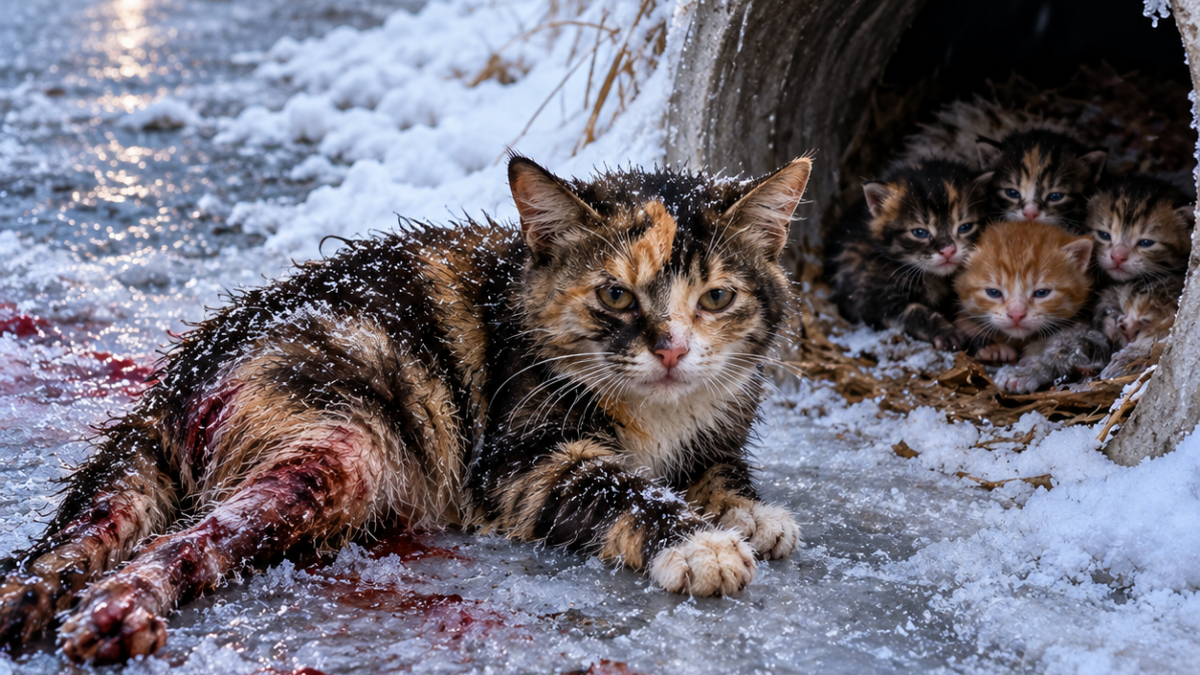
Her front legs pulled.
Her body followed.
Her back legs did not move.
They trailed behind her, loose and useless, scraping the frozen road.
A dark red line marked the pavement behind her.
Not drops.
A line.
Continuous.
Long enough that my stomach turned before my brain finished counting the distance.
She had been hit.
Hard.
Whoever hit her had not stopped.
I stepped off the shoulder without thinking.
Then stopped because another truck was coming.
The driver moved over half a lane, horn blasting at me like I was the idiot in this story.
Maybe I was.
The cat kept pulling herself forward.
She did not look at the truck.
Did not look at me.
Did not slow.
Her front claws hooked into the asphalt with a desperation I had never seen before. Later, the vet would show me where two of those claws had been torn out at the root. Later, I would understand that every movement must have been agony.
In that moment, all I saw was a creature too injured to survive trying to cross a highway that did not care.
I waited for a break in traffic and ran to her.
Not far.
Maybe twenty yards.
Long enough for the cold to burn my lungs.
Long enough for the wind to shove tears out of my eyes.
I knelt in front of her.
“Hey,” I said, which is a stupid thing to say to a dying cat on a frozen interstate, but people say stupid things when they have no script.
She pulled herself toward me.
Not away.
Toward.
Her mouth hung open.
Her breath came in quick little clouds.
Her eyes were wide, not glassy, not fading.
Fixed.
Determined.
That was the first thing that frightened me.
I had seen injured animals before.
Deer on the shoulder.
Dogs after collisions.
Birds with broken wings.
Pain makes most creatures turn inward. They curl around it. They hide. They bite. They freeze.
This cat was not doing any of that.
She was going somewhere.
I took off one glove and reached toward her carefully.
She did not hiss.
Did not swat.
Did not collapse.
She tried to pull past me.
I moved into her path.
“Easy,” I whispered. “Easy, sweetheart.”
Sweetheart.
I had not called anything sweetheart in years.
She tried to go around my hand.
Her front legs shook violently.
Her elbows—if that is what you call them on a cat—were raw and stripped nearly clean. Fur gone. Skin gone in places. Blood and road grit frozen into the wounds.
Her back half lay twisted behind her in a way that made my stomach tighten.
I reached under her chest.
She weighed almost nothing.
I had handled heavier lunch bags.
When I lifted her, I felt what the road had done.
Not in detail.
I am not a veterinarian.
But you know when a body is wrong.
You can feel the broken architecture of it.
The back end hung limp.
No resistance.
No strength.
No connection.
She did not cry when I picked her up.
That should have made it easier.
It did not.
Pain loud enough to silence an animal feels worse than pain that screams.
I held her against my coat.
She twisted.
Hard.
Stronger than anything that small and broken should have been.
Her front paws clawed at my sleeve.
Not at me.
Past me.
Toward the other side of the road.
Toward the ditch.
Toward something I had not yet seen.
“Stop,” I told her gently. “You’re hurt.”
She did not care.
She pushed with her front legs and nearly tore herself from my hands.
That was when I looked where she was looking.
Across the highway.
Past the opposite shoulder.
Beyond a narrow strip of gravel.
Half buried in the frozen grass at the base of the embankment was a concrete drainage pipe.
Nothing special.
You see a thousand of them if you drive enough miles.
Eighteen inches across maybe.
Dark mouth.
Dead grass caught around the rim.
Mud frozen in a lip along the bottom.
A piece of road infrastructure nobody would ever notice unless something inside it called.
At first, I heard nothing.
Only wind.
The idle of my truck.
The fading growl of another vehicle disappearing west.
Then the cat twisted again, and from across the road came a sound so thin I almost missed it.
A cry.
High.
Weak.
Then another.
Then several.
I went still.
The cat pushed harder.
“Oh,” I said.
The word left me with fog from my breath.
“Oh no.”
I tucked her inside my coat as best I could and waited for traffic.
There was not much, but there did not need to be much. One pickup at the wrong moment would be enough.
When the road cleared, I crossed fast, boots slipping once on black ice near the center line.
The cat fought me the whole way, front claws clutching fabric, head lifted despite everything.
At the mouth of the pipe, I set her down.
I did not know if that was the right thing to do.
Everything in me wanted to keep her still.
But she had crawled—God knows how far—toward that pipe, and I understood by then that I was not the one in charge of whatever this was.
The moment her front paws touched the frozen mud, she dragged herself forward.
Her body disappeared halfway into the pipe.
Then all the way.
I dropped to my stomach on the gravel, pulled my phone from my pocket, turned on the flashlight, and shined it inside.
The beam caught two eyes.
Then four.
Then a knot of tiny bodies pressed together in the dark.
Four kittens.
So small they barely seemed finished.
Their eyes were only partly open.
Their ears were still rounded close to their heads.
They lay in a shallow hollow scraped into frozen mud, piled on top of a torn piece of insulation—the kind of gray padding you find wrapped around guardrail posts or construction material.
She had dragged that in there too.
Of course she had.
Because apparently breaking her body once was not enough work for her.
All four kittens were alive.
They moved.
They cried.
They pressed against her as she curled her front half around them.
Her back legs lay useless behind her, partly outside the hollow, but she adjusted anyway. She dragged with her shoulders, shifted her chest, tucked her chin over them as if the force of her will could replace the half of her body the road had taken.
I lay there with my cheek against frozen gravel and forgot how to breathe properly.
I had no children.
That had been one of the arguments during my marriage, though not the biggest one.
My ex-wife wanted a full house.
I wanted to be on the road.
Or at least that was what I told both of us.
The truth was uglier.
I was afraid of needing people and being needed back.
Freight never asked you to love it.
Routes never cried for you.
A trailer never looked at you like you had failed it.
But in that pipe, on the side of a frozen highway, I watched a creature under four pounds do what I had spent most of my adult life avoiding.
She had been hurt beyond repair.
She had every reason to give up.
She had no reason to believe she could make it.
But four tiny lives were on the other side of the road.
So she went.
I do not know how long I lay there before I moved.
Maybe ten seconds.
Maybe a minute.
Cold has a way of stretching time.
Then a gust of wind hit my back and brought me to my senses.
The kittens were alive.
The mother was alive.
But none of them would stay that way long if I stood there being moved by it.
“Okay,” I said.
My voice shook.
“Okay. We’re doing this.”
Truckers carry strange supplies.
Cardboard boxes.
Old towels.
Bungee cords.
Gloves.
Flashlights.
Emergency blankets.
Hand warmers.
Half a roll of duct tape that could fix anything except your life.
I ran back across the highway, grabbed my coat from the passenger seat, then stopped because I was already wearing it and too rattled to think straight.
I took the spare insulated jacket from behind the seat.
Found a cardboard produce box I had kept for tools.
Cleared it out.
Found an old fleece blanket.
Three hand warmers.
A thermal emergency pack.
I carried everything back across the road while traffic shouted past in both directions.
The mother did not want me touching the kittens.
That became clear immediately.
When I reached inside, she lifted her head and made a sound so low and hoarse I would not have believed it came from that tiny body.
“Easy,” I told her. “I’m not taking them from you.”
Which was a lie.
I was going to have to take them.
I just did not know how to explain temporary rescue to a paralyzed cat who had just crossed a highway to return to her babies.
I put the box beside the pipe.
Opened the fleece blanket inside.
Activated two hand warmers and wrapped them under cloth so they would not burn the kittens.
Then I reached in.
She tried to cover them with her front legs.
I touched the top of her head with one finger.
“I know,” I whispered. “I know.”
I did not know.
Not really.
But my voice was all I had.
I lifted the first kitten.
Smaller than my palm.
Cold but moving.
Mouth open.
Angry at being removed from the only warmth it knew.
I placed it in the box.
Then the second.
Third.
Fourth.
All alive.
All squirming.
All impossibly fragile.
The mother dragged herself after them before I could reach for her.
She pulled to the edge of the pipe and tried to climb into the box.
She could not lift her back half.
I slid one hand under her chest and the other beneath her belly as gently as I knew how.
She stiffened.
I set her beside the kittens.
She immediately gathered them with her front paws.
Not gracefully.
Not easily.
But deliberately.
One under her chin.
Two between her front legs.
One against her chest.
She arranged them as if she had a picture in her mind and nothing, not broken bone or blood loss or hypothermia, would stop her from making reality match it.
Then she put her head down over them.
I wrapped the blanket around all five and carried them to the truck.
The cab had never felt so warm.
I cranked the heat higher.
Set the box on the passenger seat and buckled it in because I could not think of anything else to do.
The mother’s eyes stayed open.
She watched me.
Not trusting.
Not relaxing.
Just watching.
“You and me both,” I said.
I pulled onto the highway.
The nearest town was twenty-three kilometers away.
Fourteen miles.
Maybe a little more.
It felt like crossing a continent.
I drove one-handed for part of it, the other hand hovering near the box whenever the truck hit a rough patch.
The kittens cried twice.
Each time, the mother lifted her head.
Each time, she shifted toward them even though every movement cost her.
I talked the whole way.
I am not proud of the contents.
A lot of it was nonsense.
“Stay with me.”
“Almost there.”
“Don’t you dare quit after all that.”
“I don’t know anything about cats.”
“You hear me? Nothing. So this is on you too.”
“Just stay.”
I found the clinic by accident and desperation.
The town had one main street, a diner, a closed hardware store, a grain elevator, and a veterinary clinic with the lights off.
The sign on the door said closed.
There was an emergency number taped beneath it.
I called.
A man answered on the fourth ring.
He sounded half asleep and fully irritated.
“West Plains Veterinary.”
“I have an injured cat.”
“We open at eight.”
“She’s been hit. Back legs don’t work. Four kittens. They’re cold.”
Silence.
Then the voice changed.
“How far are you?”
“I’m outside your door.”
“I’ll be there in seven minutes.”
He made it in five.
Dr. Martin Bellamy looked like he had dressed in the dark, because he probably had. Gray sweatshirt under a winter coat, hair smashed on one side, boots unlaced.
He unlocked the door.
I carried the box inside.
The clinic smelled like antiseptic, old coffee, and something animal underneath both.
He took one look at the mother and moved faster.
“Exam room one.”
I put the box on the stainless table.
The kittens cried.
The mother tried to drag herself over them again.
Dr. Bellamy’s face tightened.
“How long ago?”
“I don’t know. I found her on the highway.”
“Back legs moving at all?”
“No.”
“Any urination?”
“I don’t know.”
“Did she respond to pain?”
“I didn’t test her.”
“Good.”
He touched her spine.
Then her back feet.
Then pinched carefully in a way that made me look away even before I knew what he was checking.
No response.
The mother watched him with exhausted hatred.
He took her temperature.
His mouth tightened further.
“Severe hypothermia.”
He checked her gums.
“Blood loss.”
Then the kittens.
“Cold. But decent. Bellies not empty.”
He looked at me.
“She fed them recently.”
I nodded like that meant anything I could handle.
“She dragged herself back to them,” I said.
The vet’s hands paused.
“What?”
I explained.
Badly at first.
Then again with more detail.
The highway.
The blood trail.
The pipe.
The kittens.
The distance.
Dr. Bellamy stood there for a moment, one hand resting lightly on the table near the mother’s head.
He had probably seen more suffering in animals than I could imagine.
But his face changed anyway.
“Good Lord,” he said softly.
Then he went to work.
The next hour became a blur of controlled urgency.
IV fluids.
Warm blankets.
Heated pads.
Pain medication.
Tiny bottles.
Tiny syringes.
A technician arrived, a woman named Lila who wore sweatpants under her scrub top and never once complained about being called in.
She cleaned the kittens.
Weighed them.
Checked their temperatures.
Marked them with little colored threads because they looked nearly identical to my untrained eye.
The mother—who still had no name then—lay beneath a warming blanket with her front paws stretched toward the box where the kittens had been placed.
Every time they made noise, she tried to move.
Every time, Dr. Bellamy or Lila guided her gently back.
“She’s going to hurt herself more,” Lila said.
Dr. Bellamy looked grim.
“She already has.”
Cleaning her wounds took more than an hour.
I stayed in the doorway until I could not stomach it, then stepped into the hall, ashamed of myself.
From there, I could hear the soft clink of metal tools.
Water running.
Lila murmuring.
The mother made almost no sound.
That was worse than screaming.
Once, I heard Dr. Bellamy say, “Asphalt’s frozen into the tissue.”
I walked outside after that and threw up beside the building.
The cold air felt deserved.
I stood there with one hand against the brick wall, breathing hard, and thought about turning around, getting in my truck, and leaving.
Not because I did not care.
Because I cared too much and did not know where to put it.
I had deliveries to make.
A schedule.
A dispatcher.
A life designed specifically to avoid scenes like this.
No one expected me to stay.
I had done my part.
Found them.
Brought them in.
Anything after that belonged to professionals.
That was the kind of logic I had used most of my adult life.
Do the necessary thing.
Stop before it becomes personal.
Keep moving.
Then I looked through the window.
Inside, under the harsh clinic lights, the mother lifted her head at the faint cry of one kitten.
Not far.
Not strong.
Just enough to try.
With a broken spine.
With skin torn from her elbows.
With blood loss and cold and pain medication pulling at her.
She still tried.
I wiped my mouth with the back of my hand.
“Fine,” I told the dark parking lot.
“You win.”
I went back inside.
By morning, Dr. Bellamy had an X-ray.
He showed it to me like I understood.
I did not.
He pointed anyway.
“L4.”
The break was clean in one sense and devastating in every other.
Complete fracture in the lumbar spine.
Permanent paralysis of both rear legs.
No surgical option.
No meaningful chance she would regain function.
Her back half was gone to her.
Not physically.
Worse.
Present but unreachable.
I looked through the window into the recovery room.
She lay on her side with the kittens beside her in a heated nest.
“She’ll never walk?”
“Not on her back legs.”
“Pain?”
“Manageable after stabilization. Long-term depends on care.”
“What kind of care?”
He leaned back against the counter.
“Bladder management, likely. Skin protection. Mobility assistance. Special litter setup. Monitoring for sores. Infection risk. She’ll need someone experienced.”
I almost laughed.
There it was.
The sentence that should have released me.
Someone experienced.
I had never owned a cat.
I barely kept houseplants alive.
“What happens if no one takes her?”
Dr. Bellamy did not answer fast enough.
That was answer enough.
“She came that far,” I said.
He looked tired.
“Yes.”
“For them.”
“Yes.”
The kittens made a sound in the next room.
Tiny.
Hungry.
The mother lifted her head.
Dr. Bellamy watched her.
“We’ll supplement them,” he said. “She’s too weak to nurse fully. She may not accept them for long. Trauma changes behavior.”
It was the first time I saw him be wrong.
Eighteen hours after she arrived, after fluids and pain medicine and wound cleaning and X-rays and warming and more suffering than most creatures could stand, the mother dragged herself toward the kittens.
Lila had set them in a small heated box beside the recovery bed.
The mother heard them cry.
Her front legs moved.
At first, Lila tried to stop her.
“She’s going to open the wounds.”
But Dr. Bellamy held up one hand.
“Wait.”
The cat pulled herself across the towel.
Inches.
That was all.
But it took everything.
Her rear legs trailed behind her.
Her elbows were bandaged.
Her body trembled.
She reached the first kitten, hooked it gently with one front paw, and pulled it beneath her chin.
Then the second.
Third.
Fourth.
She arranged them exactly the way she had in the drainage pipe.
Under her chin.
Between her front legs.
Against the only half of her body that still answered her.
Then she began to nurse.
Lila turned away.
Dr. Bellamy removed his glasses and wiped them though they were not dirty.
I stood in the doorway and felt something open in me that I had worked years to keep closed.
“She shouldn’t be able to do that,” I said.
Dr. Bellamy put his glasses back on.
“No,” he said. “She shouldn’t.”
But she did.
That became the story of her.
She should not have crossed the road.
She did.
She should not have survived the night.
She did.
She should not have nursed four kittens while her own body was burning calories it could not spare.
She did.
She should not have tolerated handling, medicine, bandage changes, assisted feeding, and the indignities of paralysis.
She did.
She should not have trusted anyone after what the road and people had done to her.
Eventually, she did.
Not quickly.
Not cheaply.
Trust is expensive when your body has already paid too much.
For the first three days, I slept in my truck outside the clinic.
My dispatcher threatened me twice.
Then yelled.
Then softened when I finally told him enough of the truth.
“You found what?”
“A cat.”
“You shut down a delivery over a cat?”
“And four kittens.”
Silence.
Then:
“You’re losing your mind, Hollis.”
“Maybe.”
Another silence.
“I’ll reroute the load.”
“Thank you.”
“You owe me.”
“I know.”
“I want pictures.”
That surprised me.
“What?”
“Pictures, Ray. My wife loves cats.”
By the end of the week, half the dispatch office was asking about her.
She did not have a name yet.
On the chart, Lila wrote:
Tortoiseshell female, highway rescue.
Then shortened it to:
Highway.
That stuck before any of us decided it had.
“How’s Highway this morning?” Dr. Bellamy would ask.
“Highway ate half a tablespoon.”
“Highway needs fresh bandages.”
“Highway hissed at me.”
“Highway bit the thermometer.”
The name fit.
Not because a highway had almost killed her.
Because she had beaten one.
The kittens grew.
That is a simple sentence for something that felt miraculous every day.
One gained weight faster than the others and became Round One in my head, though Lila called him Blue because of his thread color.
One had a loud voice and complained constantly.
One slept on Highway’s front paw whenever possible.
One climbed everything as soon as its legs figured out what legs were.
All four survived.
All four.
They opened their eyes fully.
They stumbled over one another.
They kneaded their mother’s bandaged chest with paws no bigger than bottle caps.
They learned to hiss at Lila, which she took personally and with pride.
Highway nursed them for five weeks.
Five weeks.
She lost weight doing it.
Too much.
Dr. Bellamy supplemented her with syringe feeding and calorie paste and high-protein food warmed just enough to smell irresistible.
She accepted it.
Barely.
With the expression of a queen tolerating bad servants.
But if a kitten cried from more than a few feet away, she abandoned food and dragged herself toward the sound.
Every time.
It became almost impossible to watch and impossible to ignore.
I started helping at the clinic between calls.
At first, I told myself it was because I had already missed work and might as well be useful.
Then because Dr. Bellamy’s staff was short.
Then because Highway seemed calmer when I sat near her.
The truth was simpler.
I did not want to leave.
There was a chair in the corner of the recovery room.
Hard plastic.
Awful.
I sat there for hours.
Read trucking magazines.
Answered dispatch texts.
Drank terrible clinic coffee.
Watched a paralyzed cat build a wall around her babies with the half of her body she had left.
I learned things.
Cats prefer routine until they don’t.
Kittens can create more chaos than livestock.
A mother cat will let you know exactly how stupid you are with one look.
Bandages never stay clean.
Weight gain in grams can make grown adults celebrate.
Tiny lives make large demands.
And sometimes caring for something does not feel like a burden.
Sometimes it feels like being drafted into usefulness after years of drifting around your own life.
Dr. Bellamy warned me often.
“You know she won’t be easy.”
“I know.”
“No, Ray. You don’t.”
“Then tell me.”
So he did.
He showed me how paralysis affected more than walking.
How sores formed.
How skin broke down.
How urine scald could happen if she could not position herself properly.
How infections started quietly.
How small changes mattered.
How dignity was not sentimental; it was practical care.
Clean bedding.
Low-entry litter.
Soft surfaces.
Mobility equipment.
Regular vet visits.
Attention.
Patience.
Money.
Time.
I listened to every word.
Somewhere during that month, without ceremony, the question changed.
Not:
Could I adopt her?
But:
What kind of home would she need, and how fast could I make mine into it?
My rented house was not ready for any living creature with standards.
I saw that clearly the first time Lila asked me to describe it.
“Stairs?”
“Two at the front.”
“Bedroom?”
“Small.”
“Flooring?”
“Old carpet.”
“Other pets?”
“No.”
“Safe space?”
“Define safe.”
She gave me a look.
Lila had many looks.
That one meant:
This man has survived fifty-one years by accident.
I bought a ramp.
Then a better ramp because the first one was garbage.
I replaced the litter box with a low-entry one before she ever came home, then modified it because even low was not low enough.
I moved furniture.
Rolled up rugs.
Scrubbed the floor.
Bought washable pads.
Bought cat food.
Bought the wrong cat food.
Bought the right cat food.
Bought toys.
Too many toys.
A scratching post.
A soft bed.
Then built a small ramp to my own bed after Dr. Bellamy said she might not be able to get up otherwise.
“You don’t even know if she’ll want to sleep with you,” he said.
“She crossed a highway. I’m not telling her where she can sleep.”
He smiled at that.
He did not smile much.
When Highway’s wheelchair arrived, I cried.
That is embarrassing but true.
A small company that made mobility carts for animals offered it after Dr. Bellamy posted her X-rays and story on a professional forum.
Not public.
Not viral fame.
Just veterinarians talking to people who could help.
The cart was tiny.
Two small wheels.
A lightweight frame.
A little harness to support her rear legs.
It looked both ridiculous and magnificent.
Highway hated it for approximately eighteen minutes.
She froze.
Flattened her ears.
Glared at all of us.
Then one kitten waddled away from the group and squeaked.
Highway moved.
One front paw.
Then the other.
The wheels rolled.
She stopped, surprised.
Tried again.
Three days later, she was using the cart like she had been born with it.
Not gracefully.
Not at first.
She bumped into doorframes.
Backed herself into corners.
Tipped once into a pile of towels and looked so offended that Lila had to leave the room to laugh.
But she learned.
Because that is what she did.
Something in her body failed.
She adjusted.
The kittens were adopted before they were eight weeks old.
I thought that would break her.
Maybe it did in some way I could not see.
The first one left with a young couple who had lost their senior cat that spring.
The loud one went to a family with two children who had been properly interrogated by Lila until they promised to respect claws.
The climber went to a veterinary technician’s sister.
The last one—the one who slept on Highway’s paw—stayed until the final day.
Highway watched him leave from her heated bed.
I sat beside her.
She did not cry.
Did not panic.
Did not drag herself toward the door.
Maybe she knew.
Maybe animals understand departures differently.
Maybe she was simply exhausted.
After the family left, she looked at the empty blanket where her kittens had been.
Then at me.
Then she pulled herself into her cart and rolled three uneven feet until her head bumped my boot.
That was the moment I knew for sure.
“You’re coming home with me,” I told her.
She blinked.
“I don’t know what I’m doing.”
Another blink.
“But that hasn’t stopped either of us so far.”
The first week home was a disaster.
I had imagined gratitude.
This was foolish.
Highway did not care that I had rearranged my life.
She cared that the house smelled wrong.
The sounds were wrong.
The heater clicked too loudly.
The refrigerator hum offended her.
My boots were apparently unacceptable where I left them.
She hid under the kitchen table for six hours.
When I tried to coax her out with food, she stared at me like I had suggested fraud.
At midnight, she cried.
I panicked.
Checked her bedding.
Her food.
Her water.
The litter.
Her cart.
Her temperature, badly.
I called Dr. Bellamy’s emergency number.
“She’s crying,” I said.
There was a long silence.
“Ray.”
“What?”
“Is she eating?”
“Yes.”
“Breathing normally?”
“Yes.”
“Any bleeding?”
“No.”
“Is she stuck?”
“No.”
“Then maybe she is a cat in a new house.”
“I thought she was in pain.”
“She might be uncomfortable. She might also be mad.”
“Mad?”
“She has opinions.”
I looked at Highway.
She stared back from under the table and cried again.
It did sound like an opinion.
By the end of the week, she had taken possession of the recliner.
By the end of the month, she had trained me to warm her food, clean her wheels before she came inside, and keep a towel folded in the exact patch of sun by the east window.
By spring, my house was no longer quiet.
It had routines.
Medication.
Laundry.
Floor cleaning.
Food schedules.
Vet visits.
Wheel adjustments.
Small victories.
Small messes.
And Highway.
Always Highway.
Her elbows healed, but the scars remained.
Two thick hairless patches where the road had taken her skin.
Two claws never grew back.
Her back legs never worked again.
They never would.
Dr. Bellamy was clear about that.
Paralysis is not a motivational montage.
Not every injury becomes a comeback story in the way people want.
Highway did not regain what was gone.
She built a life around what remained.
That was harder.
And better.
She gained weight slowly.
From under four pounds to five.
Then almost six.
The first time the scale read 2.7 kilograms, Dr. Bellamy smiled like she had won a court case.
“Highest since rescue.”
I celebrated by buying Highway a toy shaped like a fish.
She ignored it for three days and then slept on it.
I stopped long-haul driving that year.
People think that was noble.
It was not entirely.
I was tired.
My back hurt.
The money had never been as good as people imagined.
But yes, Highway changed the decision.
Long-haul routes meant I could be gone for days.
Sometimes a week.
Regional routes meant I could be home almost every night.
At worst, gone one day.
I told the dispatcher I needed local work.
He complained.
Then made it happen.
His wife, who had been following Highway’s updates since the first photo, sent me a heated cat bed.
The note said:
For the boss.
That was accurate.
I became known at three warehouses as the driver with the wheelchair cat.
This annoyed me less than expected.
Men who had never asked me anything personal in years suddenly asked how she was.
“Cat still rolling?”
“Highway doing okay?”
“She bite you yet?”
Once, a forklift operator with tattoos up both arms handed me a small bag of knitted cat sweaters his grandmother had made after hearing the story.
“They’re ugly,” he said. “But she’s old and enthusiastic.”
Highway wore one for twelve seconds.
I sent a picture anyway.
His grandmother wrote back through him:
She looks noble.
Highway did not look noble.
She looked furious.
But I appreciated the kindness.
Kindness began showing up in places I had stopped expecting it.
A mechanic offered to weld a better ramp bracket.
A neighbor I had barely spoken to brought over old towels.
The kid next door asked if Highway was part robot.
I said yes.
He thought that was amazing.
For years, I had kept people at a polite distance.
Highway made that harder.
She required explanations.
She required help sometimes.
She required me to answer the door when someone brought supplies.
She required me to become visible in ways I had avoided.
I did not become a different man overnight.
People love that version.
Man rescues animal and learns to love again.
Clean.
Simple.
False.
I remained impatient.
Private.
Bad at accepting concern.
But my house changed first.
Then my schedule.
Then my habits.
Then, slowly, the shape of my days.
Highway slept on my bed using the ramp I had built too steeply at first, then rebuilt after she refused it.
She had opinions about blankets.
She preferred old flannel shirts to store-bought beds.
She hated thunderstorms, which made sense in a way I never told myself out loud.
The first big storm after she came home, thunder cracked over the house and Highway dragged herself under the bed without her cart.
I got down on the floor.
My knees protested.
I had no plan.
“Hey,” I said.
She stayed hidden.
“Fair.”
Rain hit the windows.
The house creaked.
I lay there on my stomach beside the bed like a fool for twenty minutes.
Finally, Highway pushed her head out.
Just her head.
Then one front paw.
I did not reach for her.
I had learned something by then.
Not every frightened thing needs to be grabbed.
Sometimes you sit where it can see you and let it choose.
She came out slowly.
Dragged herself onto the flannel shirt I had placed beside me.
Thunder rolled again.
She pressed her head against my arm.
We stayed there until the storm passed.
That was the night I realized she had rescued me too.
I hate that sentence.
It sounds like something embroidered on a pillow.
But it is true.
Not in the dramatic sense.
She did not pull me from a burning building.
She did not heal my loneliness through magic.
What she did was simpler and more relentless.
She needed me every day.
Not in a way that flattered me.
In a practical way.
Food.
Water.
Clean bedding.
Medication.
Cart adjustments.
Ramps.
Routine.
Presence.
A man who is needed every day has fewer places to hide from his own life.
Before Highway, I could disappear into miles.
After Highway, I had to come home.
That matters.
Coming home to someone who expects you—even if that someone is a six-pound tortoiseshell with wheels and a judgmental face—can rearrange the inside of a man.
The vet asked me once why I kept doing it.
Not judgmentally.
Curiously.
We were at a follow-up appointment.
Highway had just tried to bite the blood pressure cuff.
“She’s expensive,” Dr. Bellamy said.
“Yes.”
“She’s stubborn.”
“Yes.”
“She has trained you badly.”
“Also yes.”
He smiled.
“Most people would have admired her and let someone else handle the long-term part.”
I looked at Highway.
She sat in her cart on the exam table, glaring at both of us as if she understood tone.
I thought about the highway.
The blood line.
The pipe.
The kittens.
Her body moving across frozen asphalt one front paw at a time.
“I watched something smaller than a loaf of bread cross a highway with a broken spine because her babies were on the other side,” I said. “I have never seen anything that brave. Not in a person. Not anywhere.”
Dr. Bellamy said nothing.
“So no,” I continued. “I don’t know cats. I don’t know paralysis. I don’t know half of what I’m doing. But I know this much: she spent everything she had getting back to what needed her.”
Highway blinked slowly.
“I can spend some of what I have making sure she never has to do that again.”
That answer became the one people repeated.
I wish I had said it more elegantly.
But truth usually comes out in work clothes.
Years passed.
Not many.
Enough.
Highway is about five now.
That number is not exact.
No one knows her birthday.
We mark it on the date I found her, though found is not really the right word.
I did not find Highway.
She was on her way somewhere.
I interrupted.
She still uses her cart every day.
Not constantly.
Inside the house, she often prefers dragging herself over soft surfaces because she is stubborn and the floors are adapted for it. Outside, on the ramp and packed dirt path I built along the side yard, she uses the wheels.
She is fast when she wants to be.
Alarmingly fast.
The first time she chased a grasshopper across the yard, I nearly pulled a muscle trying to catch up.
She did not catch the grasshopper.
That did not reduce her confidence.
Her elbows are scarred.
Always will be.
The hair never grew back right.
Sometimes I touch those patches gently when she sleeps, and my throat tightens before I can stop it.
The road left its signature.
So did survival.
She weighs almost six pounds now.
Still small.
But solid.
Her coat shines.
Her eyes remain fierce.
She has a low-entry litter setup that took three attempts and one weekend of cursing to build properly.
She has a ramp to the bed.
A ramp to the couch.
A ramp to the window shelf.
I tell people I built the house around accessibility because that sounds responsible.
The truth is I built it around Highway’s preferences, and she has many.
The kittens send updates.
That is how ridiculous my life has become.
The loud one, now named Cricket, lives with the family whose children promised Lila they would use gentle hands. He apparently yells at closed doors.
The climber, now Juniper, has broken two lamps and developed a taste for stealing socks.
The sleepy one, named Milo, lives with the vet tech’s sister and still sleeps with one paw over his face.
The biggest, Blue, lives with the young couple and has become enormous enough that I question whether Highway was honest about the father.
I keep their pictures on the refrigerator.
Highway ignores them completely.
Or pretends to.
Once, I held up Cricket’s Christmas photo.
“That’s your son.”
She licked her paw.
“Rude,” I said.
She looked at me.
I put the photo on the fridge anyway.
Every November, I drive past the stretch of highway where I found her.
Not always on the exact day.
Close enough.
The first time, I stopped.
That was a mistake and not a mistake.
The pipe was still there.
Of course it was.
Concrete does not care what it has witnessed.
Dead grass had grown back around it.
Traffic moved as usual.
Fast.
Indifferent.
I stood on the shoulder with my hands in my jacket pockets and looked across the lanes.
It seemed impossible.
Too far.
Too cold.
Too loud.
Too much.
How had she crossed that?
How had anything living crossed that after being broken?
A pickup passed close enough to shake my coat.
I stepped back.
For a moment, I could almost see her again.
Low to the asphalt.
Front claws pulling.
Eyes fixed on the other side.
Not dying.
Going somewhere.
I left a small marker near the pipe that first year.
Not a memorial.
She was alive, asleep in her heated bed at home, probably shedding on my flannel.
I left it for myself, I think.
A flat stone with one word written in permanent marker.
HOME.
The next spring, the marker was gone.
Snowplow maybe.
Wind.
Someone cleaning the shoulder.
It was fine.
The important things rarely stay where you put them anyway.
They move inside you.
Highway changed how I see the road.
That is not poetry.
It is practical.
I notice animals more.
I slow sooner.
I carry a rescue box now.
Blankets.
Gloves.
Small carrier.
Heating packs.
Bottled water.
Towels.
A scanner app with emergency vet numbers saved by region.
Other drivers tease me.
Then call when they find something.
A hawk with a broken wing near Rawlins.
A half-frozen dog under a loading dock in Rock Springs.
Three kittens behind a pallet stack in Laramie.
I cannot save everything.
That was another lesson.
Trying will break you.
But I can stop more often than I used to.
I can look instead of assuming someone else will.
I can be inconvenienced.
That word— inconvenience—has started to feel important to me.
A lot of cruelty happens because people refuse inconvenience.
Someone hit Highway and kept driving.
Maybe they did not know.
I have tried to give them that.
Maybe it happened fast.
Maybe they thought she was already gone.
But someone did not stop.
Stopping is inconvenient.
Cold.
Messy.
Late delivery.
Dirty coat.
Emergency vet.
Money.
Pain.
Responsibility.
The kittens lived because one small broken mother refused to measure love by inconvenience.
I live differently now because she made that excuse impossible for me.
There is a photograph Dr. Bellamy keeps in the clinic.
Not the worst one.
He would never put that up.
It shows Highway three months after rescue, sitting in her little wheelchair beside the four kittens just before the last adoption.
She looks too small to belong to the story people tell about her.
The kittens are fat and clean and chaotic.
Highway looks tired.
Proud, if cats can look proud.
Which they can.
Under the photo, Lila wrote:
HIGHWAY AND CREW.
People ask about it.
Dr. Bellamy tells the short version.
Hit by car.
Crawled back to kittens.
Survived.
Adopted.
That version takes less than a minute.
It is true.
It is also not enough.
Stories shrink when they travel.
People like the dramatic parts.
Broken spine.
Frozen highway.
Four kittens.
Custom wheelchair.
Truck driver adopts cat.
Those are the bones.
The life is in the smaller things.
Highway refusing to eat unless the bowl is slightly elevated.
Highway dragging herself across clinic tile because one kitten squeaked.
Lila crying behind the laundry shelves.
Dr. Bellamy pretending he had allergies.
Me learning to cut pills into quarters.
The dispatcher asking for photos.
The first time Highway used the ramp to my bed and looked personally offended that I was already in it.
The way she sometimes dreams and her front paws move like she is still crawling toward something.
The way I wake when that happens, even now.
The way I put one hand near her—not on her, not unless she leans—and wait.
She always wakes.
She always looks around.
She always remembers where she is.
Warm room.
Soft blanket.
No highway.
No pipe.
No cold.
Then she settles again.
That is what rescue means long after the dramatic part ends.
Not one heroic moment.
A thousand ordinary reassurances.
You are here.
You are safe.
Food comes.
Pain is treated.
Your body matters.
Your fear is allowed.
Nothing needs you across the road tonight.
Sometimes I wonder what Highway remembers.
People like to imagine animals forget pain faster than we do.
Maybe some do.
Maybe that is something we tell ourselves because the alternative asks too much from us.
Highway remembers certain things.
I know that.
She hates the sound of rumble strips.
If I play a dashcam video too loud and that buzzing shoulder sound comes through, her ears flatten.
She dislikes the smell of diesel on my gloves unless I let her approach first.
She loves cardboard boxes but freezes at the echo inside concrete drainage tunnels when we pass road work on foot.
Memory lives in the body even when no one explains it.
Mine too.
I still hear the back door of the trailer sometimes in the middle of the night and think it is the cry from the pipe.
I still check my straps more often than necessary.
I still slow near that mile marker even when Highway is home and safe.
Some people might call that trauma.
Maybe.
I call it remembering properly.
To remember properly is not to stay trapped in the worst moment.
It is to let the worst moment teach you what not to ignore.
Highway taught me that.
She did not teach me to be fearless.
She was not fearless.
I need to be clear about that.
People use the word brave wrong.
They think bravery means absence of fear.
That cat was terrified.
Every part of her body must have been screaming.
She had been struck by a vehicle, dragged herself through freezing wind, crossed lanes that could have killed her a second time, and returned to a dark pipe where four helpless lives depended on her warmth.
She was afraid.
She went anyway.
That is bravery.
Not clean.
Not pretty.
Not decorated.
Just one front paw forward because stopping was not an option she could accept.
I have thought about that during my own smaller troubles.
Bad medical news.
Lonely evenings.
Bills.
A winter when regional routes dried up and money got tight.
The day my ex-wife called to say her new husband had died and we talked for two hours like people who had once loved each other and did not know how to name what remained.
The night Highway developed a urinary infection and I drove ninety miles through snow to the emergency clinic with one hand on her carrier and the other white-knuckled on the wheel.
Life keeps presenting highways.
Most are not literal.
Something needed on the other side.
Someone.
Some responsibility.
Some apology.
Some decision you would rather avoid.
I am still not as brave as a five-pound cat.
But I am better than I was.
That counts.
Once, a reporter contacted Dr. Bellamy.
Someone had heard the story from someone who heard it from someone else.
They wanted video.
Photos.
Interview.
“Hero cat mother.”
“Truck driver who changed his life.”
All the usual phrases.
Dr. Bellamy asked me.
I said no.
Then maybe.
Then no again.
It was Lila who said:
“Ray, people might care. That isn’t always bad.”
I understood her point.
Stories can bring help.
Donations.
Awareness.
Wheelchairs for animals.
Emergency care funds.
Adoptions.
But stories can also flatten living things into symbols.
Highway was not a symbol to me.
She was the creature currently refusing to take medicine unless I hid it in food warmed exactly twelve seconds.
I did not want strangers turning her pain into comments.
Still, Dr. Bellamy eventually shared a careful version in a professional newsletter about emergency response and disabled-animal care.
No gore.
No spectacle.
Just facts and what long-term care required.
Donations came in anyway.
Enough to create a small fund at West Plains Veterinary for injured strays and mobility equipment.
They named it the Highway Fund.
I objected.
Highway did not, probably because nobody asked her.
The first animal helped by it was a dachshund with a spinal injury.
Then a barn cat missing a front leg.
Then an old dog whose owner could not afford a cart.
Highway never knew.
Or maybe she did.
Animals understand less language than we pretend and more truth than we expect.
I brought her to the clinic the day the dachshund tried his new wheels.
She sat in her cart watching him wobble across the floor.
He bumped into a chair.
Recovered.
Tried again.
Highway blinked slowly.
Approval, I decided.
Or judgment.
With her, the two often looked the same.
I have learned many technical things since adopting her.
How to express a bladder when needed.
How to recognize early skin irritation.
How to pad a harness properly.
How to clean wheels.
How to adjust straps so they support but do not rub.
How to lift without twisting the spine.
How to prevent pressure sores.
How to make a home safer for an animal who cannot feel half her body.
But the hardest things were not technical.
The hardest thing was letting her try.
That may sound strange.
After everything she survived, I wanted to protect her from every possible risk.
I wanted to carry her everywhere.
Stop every fall.
Prevent every frustration.
Make the world soft enough that nothing ever challenged her again.
Dr. Bellamy corrected me.
Often.
“Careful, Ray.”
“I am being careful.”
“No. You are being fearful.”
That annoyed me.
Mostly because he was right.
“She needs mobility,” he said. “Not just safety.”
“She could hurt herself.”
“She could also stop living.”
That sentence sat with me.
So I let her try.
Small ramp.
Low platform.
Supervised yard time.
Cart practice.
Window shelf.
Soft obstacle course Lila called physical therapy and I called Highway’s royal annoyance.
She fell sometimes.
Not far.
Not badly.
She got angry.
Adjusted.
Tried again.
The first time she climbed the little ramp to the bed by herself, I almost helped her three times.
Each time, I stopped.
She reached the top, pulled herself onto the blanket, turned around, and looked at me like she had known all along I was the slow one.
Maybe she had.
Love, I learned, is not removing every hard thing.
Sometimes love is standing close enough to help, far enough not to steal the attempt.
Highway had crossed a highway because something needed her.
Afterward, she still needed a life that belonged to her.
Not just survival under my management.
A life.
That distinction matters.
It matters for animals.
For people too.
I think about that when strangers call her poor thing.
They mean well.
I used to say things like that too.
Poor thing.
Look what happened to her.
How sad.
Highway does not live like a poor thing.
She lives like a queen with inconvenient rear legs.
She patrols the house.
Supervises my coffee.
Inspects groceries.
Attacks shoelaces.
Sits in sun.
Complains about late meals.
Allows limited affection.
Demands routine.
She is not an injury with fur.
She is a whole creature who experienced injury.
That difference changed how I talk about suffering.
Some people survive terrible things and then spend the rest of their lives being introduced by the terrible thing.
Highway taught me not to do that.
Yes, her spine broke.
Yes, she crawled.
Yes, she saved her kittens.
But she also hates salmon treats, loves turkey, prefers the blue blanket over the green one, and once knocked my tax documents into her water bowl because I had ignored her dinner by eight minutes.
A survivor deserves more than the story of what hurt them.
They deserve the story of what they like.
What annoys them.
How they sleep.
Who they boss around.
Where they are going next.
Highway is still going somewhere.
That is the thing.
Even now.
Even with wheels.
Even with scars.
She moves with purpose.
Across the kitchen.
Down the ramp.
Into the yard.
Toward sunlight.
Toward food.
Toward me when thunder comes.
Toward whatever small life waits on the other side of her fear.
I hope I do the same.
There is one memory I do not tell often.
It happened the morning after the kittens were all adopted.
I arrived at the clinic expecting Highway to be distressed.
Instead, I found Dr. Bellamy sitting on the floor beside her recovery cage.
Not kneeling.
Sitting.
Legs stretched out like a tired man who had given up pretending he was only checking vitals.
Highway was asleep with her head against his knee.
He looked embarrassed when I walked in.
“She crawled over,” he said.
“As patients do.”
He cleared his throat.
“I was not petting her.”
“Of course not.”
“She required monitoring.”
“Obviously.”
Highway opened one eye, saw me, then closed it again.
Dr. Bellamy said softly, “You know, I have seen animals do astonishing things.”
I nodded.
“But this one…”
He did not finish.
He did not need to.
Some lives refuse to fit inside professional language.
That was Highway.
Complete L4 fracture.
Permanent hind-limb paralysis.
Deep abrasions.
Hypothermia.
Blood loss.
Dehydration.
Those were accurate.
They mattered.
But none of them explained her.
Medical records can describe what is broken.
They cannot measure why something keeps moving.
That part remains mystery.
People ask whether I believe animals love the way people do.
I have no idea.
I am a truck driver, not a philosopher.
But I know Highway returned.
I know her kittens were alive because she did.
I know she fed them before leaving for food.
I know she dragged insulation into a frozen pipe.
I know she nursed them while her own body was failing.
I know she panicked when they cried.
You can call that instinct if you want.
Maybe it is.
But I have seen plenty of humans ignore instincts that should have made them kinder.
If instinct can do something that holy, maybe we should respect it more.
Highway is sleeping beside me as I write this.
Actually, she is pretending to sleep.
Her ears move every time I shift.
Her cart rests near the door.
One wheel has mud on it from this morning because she insisted on inspecting the yard after rain.
The ramp to my bed creaks now.
I need to fix it.
She will supervise.
Poorly.
Probably by sitting on the screws.
Outside, trucks pass on the county road beyond my rental house.
Not many.
Enough.
Sometimes their sound makes her lift her head.
Sometimes it does not.
Healing is not a straight road.
Neither is trust.
But she is here.
Warm.
Fed.
Safe.
The kittens are grown.
The pipe is empty.
The highway has no claim on her anymore.
When people ask why I changed my routes, changed my house, changed my schedule, changed so much for one injured cat, I think they expect a sentimental answer.
I have one, I suppose.
I love her.
That is true.
But love is a word people overuse until it becomes soft around the edges.
The harder answer is responsibility.
I saw what she did with hers.
She weighed less than two kilos.
Her spine was broken.
Her rear legs were gone to her.
Her claws were torn.
Her skin was stripped.
The temperature was below freezing.
Traffic was moving.
Her babies were on the other side.
She did not calculate whether she could make it.
She did not wait for rescue.
She did not decide the road was too wide or her body too damaged or the distance too far.
She simply went.
Because something needed her.
I was not the brave one that day.
I was the man who happened to stop.
She was already on the way.
All I did was join the story after the hardest part had begun.
But sometimes joining is enough.
Sometimes stopping is enough.
Sometimes carrying the box, making the call, opening your home, changing the route, cleaning the wheels, building the ramp, and coming back every day is what courage looks like after the emergency lights are gone.
Highway taught me that too.
Great bravery may begin in one impossible act.
But it survives in repetition.
Daily care.
Ordinary devotion.
The meal served.
The bedding changed.
The wound checked.
The ramp repaired.
The frightened creature not rushed.
The damaged body treated as worthy.
The life after rescue made large enough to actually live in.
That is the promise I made her, though I never said it well.
You will not have to cross the road again.
Not for food.
Not for warmth.
Not for safety.
Not for love.
You crossed it once.
That was enough.
Now I cross what needs crossing.
For both of us.
And every morning, when Highway rolls down the little ramp from my bed, bumps her cart against the doorframe, glares at me like breakfast is already late, and heads toward the kitchen with her front paws steady beneath her, I hear something I first heard on that frozen shoulder.
Not a cry.
Not pain.
Purpose.
A small life moving forward because forward is where life still is.
That sound changed me.
I hope I never stop hearing it.








