A 280-Pound 1%er Biker Stopped in Walmart to Fix His 4-Year-Old Daughter’s Pink Bow—Then One Photo of His “DEATH” Knuckles Went Viral
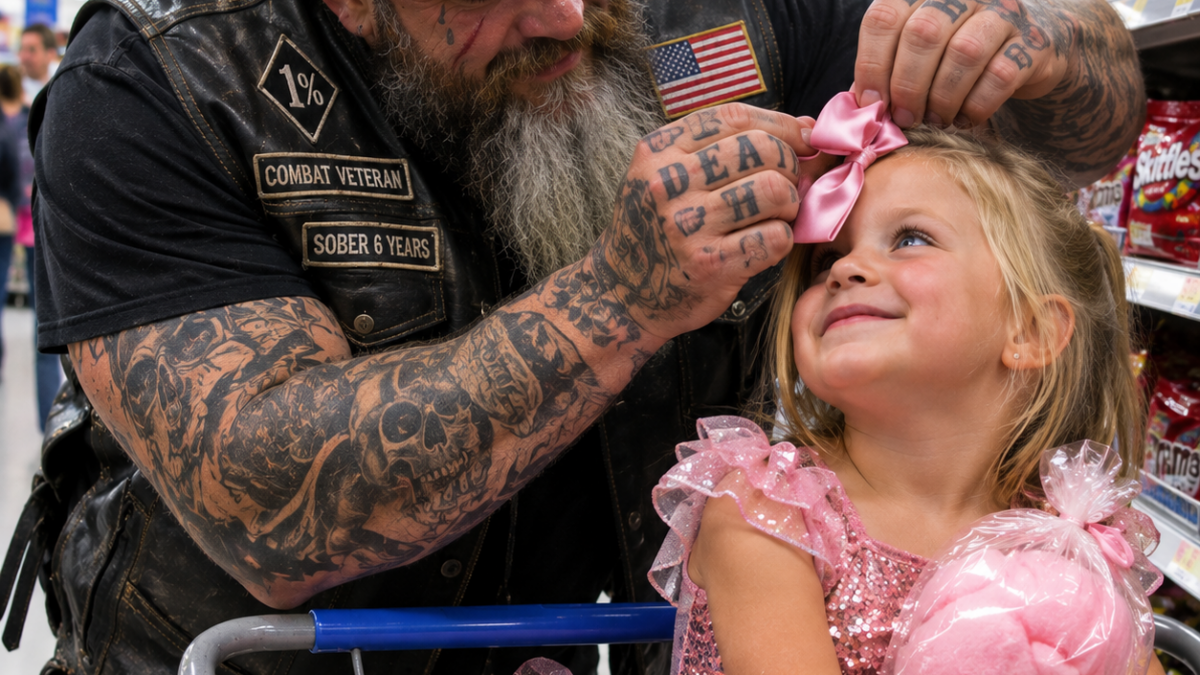
A 280-Pound 1%er Biker Stopped in Walmart to Fix His 4-Year-Old Daughter’s Pink Bow—Then One Photo of His “DEATH” Knuckles Went Viral.
Five million people saw a photograph of a 6-foot-5 biker with DEATH tattooed across his knuckles carefully fixing his four-year-old daughter’s pink bow, but almost none of them knew those same hands had once carried two dead soldiers out of a burning vehicle and later put another man in the hospital.
The internet laughed at the contrast between the feared 1%er and the tiny girl ordering him around in a glittery tutu, while his motorcycle club turned the picture into a joke that followed their sergeant-at-arms all the way back to the clubhouse.
Then I learned why Marcus Holloway had started taking Brooklyn to Walmart every Saturday morning in the first place—and why the toughest men in his club stopped laughing when they heard what had happened in his house at 4:47 one Sunday morning two years earlier.
My name is Patricia Lassiter.
I am forty-nine years old.
I teach eleventh-grade English at a public high school in Maumelle, Arkansas.
I have spent most of my adult life teaching teenagers that you cannot understand a character from one scene.
Context matters.
History matters.
The thing a person does in chapter nineteen may make no sense until you discover what happened to them in chapter three.
I believed that academically for twenty-six years.
Then, on a Saturday morning at Walmart, a man named Marcus Holloway taught it to me in real life.
I first saw him on May 18th.
9:47 in the morning.
Aisle nine.
Candy.
I was standing beside my half-filled shopping cart trying to decide whether buying three bags of chocolate for my students during final-exam week was kindness or enabling when I heard a little girl say:
“Daddy. Stop.”
The voice was serious.
Not upset.
Commanding.
I looked over.
She was sitting in the child seat of a Walmart cart.
Four years old, maybe.
Blonde.
Round cheeks.
White leggings.
Small pink Velcro sneakers.
A glittery pink tutu.
A white cotton shirt.
And an enormous hand-tied pink satin bow clipped to the right side of her head.
The bow had slipped.
That was the emergency.
Her father stopped the shopping cart instantly.
I noticed him because everybody noticed him.
Six-foot-five.
Two hundred eighty pounds, I later learned.
Completely shaved head.
A thick salt-and-pepper beard reaching halfway down his chest.
Black leather motorcycle cut.
Dense tattoo sleeves.
A scar running diagonally across his right cheekbone.
Two faded blue teardrops beneath his left eye.
PART2:
And across the knuckles of his right hand, in old prison-style blue ink:
D E A T H.
People moved around him differently.
You could see it.
A woman approaching from the opposite direction redirected her cart before reaching him.
A man with two children glanced at the patch on the biker’s vest, then pulled his children slightly closer.
Nobody said anything.
They did not need to.
Humans make decisions about strangers fast.
Threat.
Safe.
Normal.
Not normal.
Move.
Stay.
Marcus Holloway had the kind of face people decided things about.
The little girl did not care.
“My bow.”
He leaned over the front of the cart.
His enormous forearms folded against the handle.
He brought his face down until he was level with hers.
“What happened to it?”
“It’s crooked.”
He examined the bow with the seriousness of a trauma surgeon.
She pointed.
“That side.”
“Yes, ma’am.”
He lifted his right hand.
DEATH across the knuckles.
PART3:
Then, with two fingers, he carefully repositioned the pink satin bow.
Not rushed.
Not clumsy.
He adjusted one loop.
Smoothed the ribbon.
Then used his other hand to settle a few strands of blonde hair back into place.
“Better, princess?”
She tilted her head.
Examined his work in the reflection of the freezer door beside them.
Then nodded once.
“Better.”
“Good.”
He straightened.
She immediately said:
“Cotton candy.”
He looked toward the shelves.
“We already discussed this.”
“Pink.”
“You had pink last week.”
“Pink.”
He sighed.
I heard him mumble:
“I negotiate with grown men easier than this.”
The girl pointed again.
“Pink.”
He picked up one bag.
Placed it in her lap.
Her whole face brightened.
Then she slapped one tiny hand against his chest in a celebratory high-five.
His mouth twitched beneath his beard.
Not a full smile.
Almost.
That was the scene.
Maybe forty seconds.
I had no idea I was watching the beginning of something millions of people would eventually see.
I also had no idea why, months later, I would still be thinking about it at one o’clock in the morning.
At that moment, I was simply a teacher watching an unexpected pair in Walmart.
The little girl looked like somebody had dressed a cupcake.
Her father looked like he had recently conquered a neighboring kingdom.
They continued down the aisle.
I followed because I needed coffee creamer two aisles over.
Not because I was spying.
At least that is what I told myself.
By checkout, I had ended up three registers away.
That was when another woman, whom I would later learn was named Jennifer Reyes, saw them.
Jennifer was thirty-one.
Two children.
She was behind Marcus in line.
Brooklyn—the little girl—had turned sideways in the cart seat.
The cotton-candy bag sat in her lap.
Her bow had gone crooked again.
Marcus had one hand around the cart handle.
The DEATH tattoo was completely visible.
Brooklyn reached up.
He leaned toward her.
She high-fived his chest.
Jennifer took one photograph.
From behind.
No faces.
Just contrast.
The enormous man.
The tiny hand.
The bow.
The knuckles.
The cotton candy.
A picture that told one story if you knew nothing.
And another if you looked longer.
Jennifer went home.
At 4:47 that afternoon, she posted it on Facebook.
The caption was five words.
Toughest man at Walmart today.
She expected her sister to laugh.
Maybe fifteen friends.
Instead, within hours, strangers started sharing it.
By midnight:
Thousands.
By Sunday:
Tens of thousands.
By Monday morning:
Hundreds of thousands.
Eventually more than five million shares.
People wrote captions of their own.
THE REAL BOSS OF THE MC.
WHEN YOUR DAUGHTER OUTRANKS YOUR PATCH.
DEATH ON THE KNUCKLES, PRINCESS DUTY IN THE HEART.
Some comments were kind.
Some stupid.
Some stereotypical.
Some assumed Marcus was dangerous.
Others turned him instantly into a saint.
Both groups made the same mistake.
They thought one photograph explained him.
Marcus himself knew none of this.
He did not use Facebook.
No Instagram.
No TikTok.
According to him, he had once created a Facebook account in 2017, received three messages from women he did not remember from high school and one political argument from an uncle, then deleted it forever.
He learned about the photograph Tuesday morning.
6:47 a.m.
He walked into Buckhorn Diesel & Truck Repair in Mayflower, where he was the lead mechanic.
Four men from his motorcycle chapter were standing near the coffee station.
Waiting.
That alone should have warned him.
His closest brother, a man everyone called Diesel, held up a phone.
“Brother.”
Marcus stopped.
“What?”
“We need to discuss Saturday.”
Marcus stared.
“Which part?”
Diesel turned the screen.
Marcus saw the picture.
His shaved head.
His vest.
His knuckles.
Brooklyn’s bow.
Pink cotton candy.
Tiny hand.
He read the caption.
Then the number underneath.
Millions.
He stood silent.
One of the younger men began laughing.
Marcus looked at Diesel.
“Brother.”
Diesel’s face remained perfectly serious.
“Yeah?”
“I’m going to get absolutely destroyed over this, aren’t I?”
Diesel finally broke.
Laughed.
Hard.
Another patched brother nearly spilled his coffee.
“Brother, you have already been destroyed.”
Someone held up another phone.
The photograph had become the chapter lock screen.
Their amateur graphic designer, a fifty-one-year-old biker named Hank, had added words over it:
MARCUS “WRAITH” HOLLOWAY
CHAPTER SERGEANT-AT-ARMS
ALSO KNOWN AS:
THE DRIVER
Marcus stared at it for maybe a minute.
Then said:
“Show me yours.”
Diesel showed his own screen.
Same picture.
Marcus rubbed both hands over his face.
“What did I do to deserve you people?”
Diesel answered:
“You wore a pink bow out of Walmart.”
“That was my daughter.”
“History won’t care.”
Marcus poured coffee.
Another man said:
“Wraith, club meeting Thursday. We’re voting on whether Brooklyn gets your sergeant-at-arms patch.”
Marcus turned.
“I got one thing to say.”
Everybody quieted.
“At the clubhouse, I can be scary.”
He pointed toward the phone.
“At Walmart? I drive the cart.”
Nobody spoke.
Marcus continued:
“And if any of y’all got an issue, my four-year-old is the one who’ll discuss it with you.”
Fifteen seconds of silence.
Then every man in the room lost it.
That sentence became the joke.
Then the joke became a T-shirt.
But none of them knew what the Saturday routine actually meant.
Neither did I.
That would come later.
I met Marcus properly about a month after the photograph.
By then local media had figured out who he was.
Jennifer’s cropped photograph had protected the faces, but Maumelle is not Los Angeles.
People knew the vest.
The bike.
The Walmart.
Eventually somebody recognized him.
Marcus agreed to exactly one local interview.
His condition:
Brooklyn’s face stayed off camera.
The reporter asked:
“What did you think when you found out millions of people had seen the photo?”
Marcus answered:
“That the internet needs hobbies.”
“What was your daughter doing?”
“Running my Saturday.”
“Does she always dress like that?”
“Saturday, yes.”
“Pink tutu?”
“Yes.”
“Cotton candy?”
“Yes.”
“What about you?”
“What about me?”
The reporter laughed.
“The contrast.”
Marcus looked confused.
“What contrast?”
The reporter pointed at his hands.
Marcus looked down at DEATH tattooed across his knuckles.
Then toward Brooklyn, who was somewhere off camera.
He shrugged.
“She’s my kid.”
As if that explained everything.
At the time, I thought maybe it did.
I wanted to write about what I had witnessed.
Not publish it.
I teach students observational writing.
I had considered using the moment anonymously in a classroom exercise about assumptions.
But it felt wrong without permission.
So I found him.
This is easier to do in a town the size of ours than I am proud to admit.
Iron Diamond Brotherhood had a public clubhouse number for charity events.
I called.
A man answered:
“Iron Diamond.”
I said:
“My name is Patricia Lassiter.”
Silence.
“Okay.”
“I’m trying to contact Marcus Holloway.”
Longer silence.
“Why?”
“I saw him in Walmart.”
The man started laughing.
I closed my eyes.
“I assume you’re Diesel.”
He stopped.
“How do you know?”
“Local news.”
“Oh.”
I explained.
Teacher.
Witness.
Wanted permission to use a version of the scene in an essay about first impressions.
Diesel took my number.
Marcus called two days later.
“Ms. Lassiter?”
“Patricia.”
“Marcus Holloway.”
His voice was different on the phone.
Still deep.
Less intimidating when not attached to 280 pounds of tattoos.
I explained again.
He said:
“Why?”
“Why what?”
“Why write about it?”
“Because everybody who saw the photograph decided what it meant.”
“And?”
“I think they were probably wrong.”
Silence.
Then:
“Come Saturday.”
“Where?”
“House.”
I hesitated.
He laughed.
“You’re the one who called the biker club asking where I live.”
Fair point.
Saturday afternoon, I drove to the Holloway house.
Small.
Brick.
Well-kept.
Dogwood tree in the backyard.
Plastic tricycle near the porch.
Black Harley in the garage.
Nothing cinematic.
Marcus’s wife, Hannah, opened the door.
She was slight.
Freckled.
Hazel eyes.
Soft voice.
The opposite of her husband physically.
Not emotionally.
I would discover that later.
Brooklyn was on the floor arranging plastic horses in what appeared to be a highly regulated social hierarchy.
Marcus sat at the kitchen table.
No leather vest.
Gray T-shirt.
Tattoo sleeves fully visible.
Still intimidating.
Brooklyn looked up.
“You Walmart lady?”
Marcus closed his eyes.
“Brooklyn.”
“What?”
“Don’t call guests Walmart lady.”
I laughed.
“It’s accurate.”
She accepted this.
Then pointed toward me.
“Daddy fixes my bow.”
“I saw.”
“He does it good.”
Marcus said:
“Thank you for the performance review.”
We eventually moved to the back porch.
Coffee.
Hannah joined us.
Brooklyn came and went.
I asked about the motorcycle club.
Army.
Prison.
Sobriety.
I did not expect Marcus to answer everything.
He did.
Not proudly.
Not dramatically.
Factually.
Marcus Holloway grew up in North Little Rock.
Father gone when he was six.
Mother worked two jobs.
By twelve, Marcus described himself as “mostly self-raised.”
He joined the Army in 2007.
Four years.
Iraq.
Afghanistan.
October 2010, Kandahar.
IED.
Marcus was inside the vehicle.
Two men in his infantry company died beside him.
Specialist Ramirez.
Sergeant Wheeler.
Marcus survived.
The diagonal scar across his cheek came from shrapnel.
The teardrops beneath his eye represented the two men.
He carried both of them from the vehicle.
“Were they alive?”
I asked.
“No.”
“Then why carry them?”
Marcus looked at me like I had asked why gravity existed.
“We don’t leave people.”
That was it.
He came home in 2011.
He did not adjust well.
That phrase, “did not adjust well,” is how society packages years of trauma into something polite.
Marcus drank.
Fought.
Isolated.
Worked.
Quit jobs.
Started others.
Drank more.
In 2014, at a bar in North Little Rock, another man said something Marcus no longer remembers.
Marcus started a fight.
Not self-defense.
Not misunderstanding.
He wanted me to understand that.
“I hit him first.”
The man was badly injured.
Marcus was arrested.
Aggravated assault.
Plea.
Prison.
Tucker Maximum Security Unit.
Eighteen months.
In May 2015, another inmate tattooed DEATH across his knuckles.
I asked:
“Why death?”
Marcus looked at his hand.
“Because that was where I was headed.”
“Did you want to die?”
“Some days.”
He rubbed the old blue ink.
“It wasn’t a tough-guy tattoo.”
“What was it?”
“Reminder.”
“Of?”
“Who was driving.”
I didn’t understand.
He tapped the knuckles.
“That guy.”
“The violent one.”
“Yeah.”
“I wanted him where I could see him.”
The tattoo had not been a celebration.
It was a warning to himself.
This is who you become when rage drives.
The prison sentence was terrible.
Marcus does not romanticize incarceration.
He does not call it what saved him.
He says prison nearly finished something alcohol had started.
But somewhere in that eighteen months, he stopped drinking.
He walked out in November 2016.
Thirty-five days sober.
He remained sober.
Joined the Iron Diamond Brotherhood in 2017.
Earned his patch in 2018.
Sergeant-at-arms by 2021.
The club had men with prison records.
Combat histories.
Construction jobs.
Divorces.
Addictions.
Bad backs.
Good hearts.
Bad tempers.
Not saints.
Not devils.
People.
That was how Marcus described them.
In October 2018, he met Hannah.
AA meeting.
Church basement.
Hannah had her own recovery story.
She had been sober six months longer than Marcus.
Their first date was breakfast.
Why breakfast?
Hannah answered:
“Because neither of us trusted ourselves with nighttime dating yet.”
Marcus smiled.
“We were deeply romantic.”
They married in October 2019.
Brooklyn arrived March 12th, 2021.
3:14 a.m.
Marcus remembers the time.
He remembers the first time he held her.
3:47.
He told me:
“I didn’t think I was the kind of man who got a daughter.”
I asked:
“What does that mean?”
He looked toward the yard where Brooklyn was playing.
“I knew what I’d done.”
“Prison?”
“Everything.”
He flexed his tattooed fingers.
“Didn’t feel like life should hand me something that clean.”
Hannah said quietly:
“Life isn’t a courtroom.”
Marcus looked at her.
She had clearly said that before.
I asked what changed when Brooklyn was born.
Marcus thought.
Then:
“I got scared of myself.”
Hannah reached over.
Touched his arm.
He continued.
“Not that I thought I’d hurt her.”
“I didn’t.”
“But?”
“I knew what anger had done to my life.”
He looked at his knuckles.
“I decided it ends with me.”
That sentence returned later.
At the time, I wrote it down.
Hannah read my notebook.
“Teacher.”
“Sorry.”
“No, it’s fine.”
Then Marcus said something strange.
“I made one private rule.”
“What?”
He looked toward his daughter.
“I can be hard with the world.”
Pause.
“Not with her.”
He shrugged.
“Ever.”
I asked:
“Even discipline?”
“Discipline isn’t hardness.”
“What’s the difference?”
“Discipline teaches.”
He looked toward his hands.
“Hardness just hurts.”
That line made me stop writing.
The man with DEATH tattooed across his knuckles had apparently spent years thinking more seriously about gentleness than most people I knew.
Still, the real reason for Walmart Saturdays had not come out.
That happened during my third visit.
Hannah told me.
We were on the porch again.
Marcus had taken Brooklyn to get ice cream.
I mentioned the Saturday routine.
“How long has he been doing that?”
Hannah looked toward the driveway.
“Since she was one.”
“Every Saturday?”
“Almost.”
“Why?”
Hannah became quiet.
I knew immediately I had stepped into something.
“You don’t have to answer.”
“No.”
She took a breath.
“You should know.”
March 2022.
Brooklyn had just turned one.
Hannah was twelve weeks pregnant.
Second child.
They had already heard a heartbeat.
They had names written on paper.
Not decided.
Discussing.
Marcus wanted another girl.
Hannah insisted he only said that because Brooklyn already controlled him.
Then one Sunday morning.
4:47 a.m.
Marcus was working an overnight long-haul brake-repair job two hours south near Pine Bluff.
Hannah woke with cramps.
Then bleeding.
She knew before she reached the bathroom.
She miscarried alone on the bathroom floor.
She called Marcus.
Then called her mother.
Then drove herself to the emergency room because she could not reach anyone quickly enough to take her.
When Marcus told me this later, he still sounded angry about that.
Not at Hannah.
At time.
Distance.
Two hours.
He drove back.
Too fast.
Far too fast.
He arrived at 7:14.
Hannah was already in a hospital bed.
Empty.
There are words medical people use.
Pregnancy loss.
Spontaneous abortion.
Products of conception.
None capture what it feels like when you had started imagining a person and then that imagined future disappears.
They had a private burial.
Small carved wooden box.
Under a dogwood tree in the backyard.
I had been drinking coffee twenty feet from that tree without knowing.
Hannah looked toward it.
“For six weeks, I was bad.”
“Bad how?”
“Depression.”
She did not soften the word.
“The first week, I couldn’t get out of bed.”
Marcus took time off.
His mother-in-law helped.
Brooklyn needed feeding.
Diapers.
Bath.
Play.
A one-year-old does not understand grief.
That can be mercy and cruelty at the same time.
By week two, Hannah could shower.
By week three, she could feed Brooklyn lunch.
But Saturdays were difficult.
Why Saturday?
That had been the day they did family things.
Markets.
Breakfast.
Park.
With another baby coming, Saturdays had been full of plans.
After the miscarriage, empty time became loud.
Marcus noticed.
He did not give Hannah a speech.
Did not tell her to move on.
Did not force activity.
He simply began taking Brooklyn out every Saturday morning at nine.
At first:
Park.
Then farmers market.
Breakfast diner.
Eventually Walmart.
Three hours.
Sometimes four.
Hannah stayed home.
Alone.
Sometimes slept.
Sometimes cried.
Sometimes sat under the dogwood tree.
Sometimes held the carved wooden box before they buried it.
Sometimes did nothing.
Marcus never asked for a report.
That was his gift.
Privacy.
Hannah said:
“He didn’t make me perform recovery for him.”
That sentence was devastating.
“He’d come home with Brooklyn.”
“She’d be sticky.”
“Always.”
“Marcus would ask, ‘You good?’”
“If I said no, he would say okay.”
“If I said yes, he’d say okay.”
“No fixing.”
“No timeline.”
By summer, Hannah was better.
By fall, better again.
December 2022, she returned to teaching yoga Saturday mornings at nine.
By then, Daddy and Brooklyn morning had become permanent.
The original purpose was gone.
The ritual remained.
Brooklyn had no memory of its origin.
To her, Saturdays had always meant:
Daddy.
Cart.
Walmart.
Pink.
Cotton candy.
The thing millions of people found cute had been built in grief.
Not Brooklyn’s grief.
Her mother’s.
Marcus did not take Brooklyn out because he was trying to prove he was a good father.
He took her because his wife needed a silent house.
That changed the photograph for me.
The bow was not the story.
The cotton candy was not the story.
The gigantic biker obeying a four-year-old was not even the story.
The story was time.
Four hours every Saturday.
For years.
Love measured not by declarations but by calendars.
I asked Hannah:
“Does Brooklyn know?”
“No.”
“Will you tell her?”
“One day.”
“When?”
“When she needs to know that something happy can grow out of something sad without disrespecting the sad thing.”
English teachers spend careers hoping to produce a sentence that good.
Hannah said it without thinking.
When Marcus returned with Brooklyn, I told him Hannah had explained.
He became quiet.
“You okay with me knowing?”
He looked at his wife.
She nodded.
Marcus sat.
For a while nobody spoke.
Then I asked:
“Why Walmart?”
He looked confused.
“What?”
“Of all places.”
He laughed.
“Sis, I don’t need anything from Walmart most Saturdays.”
“Then why?”
He pointed toward Brooklyn.
“She likes it.”
“That’s it?”
“She likes pushing the buttons on the toy aisle.”
“She likes the pink candy.”
“The cashiers know her.”
He shrugged.
“It gives Hannah another ninety minutes.”
That simple.
The ritual outlived the emergency.
That is what good rituals do.
They begin as medicine.
Then become family.
The photograph kept spreading.
Marcus hated the attention.
The club loved the opportunity to torment him.
At a June chapter meeting, somebody proposed T-shirts.
Marcus opposed.
He was outvoted unanimously.
Five hundred black shirts.
Small Iron Diamond Brotherhood emblem over the heart.
One line across the back:
AT THE CLUBHOUSE, A 1%er.
AT WALMART, A DRIVER.
Marcus stared at the sample.
“You people are children.”
Diesel said:
“Brooklyn outranks you.”
Marcus responded:
“She does.”
That was when the joke changed.
They decided to sell the shirts.
Not for club money.
Not bar tabs.
Not repairs.
The proceeds went to pediatric oncology in Pulaski County.
Why oncology?
Diesel’s nephew had been treated there.
Another member had lost a daughter to leukemia years before.
No public speech.
They voted.
Sold five hundred shirts in eleven days.
Raised just under fifteen thousand dollars.
Marcus did not wear his shirt to the clubhouse.
He wore it to Walmart.
Saturday.
Brooklyn got her own.
Pink.
Same basic design.
Except her back said:
THE BOSS.
Hannah made it.
Of course.
The next time I saw them at Walmart, Brooklyn was wearing it over the tutu.
Marcus pushed the cart.
Someone recognized him.
A woman approached.
“Are you the Walmart biker?”
Marcus visibly regretted being alive.
“Yes, ma’am.”
The woman asked for a photograph.
Marcus said:
“With me, fine.”
Then immediately:
“Not my daughter’s face.”
The woman nodded.
They took it.
That became his rule.
Interviews.
Photos.
Media.
Brooklyn’s face stays private.
A reporter once pushed.
“People love the father-daughter story.”
Marcus answered:
“Then they can love it without owning her face.”
That ended the discussion.
I respected that.
Internet fame makes people think access is affection.
It isn’t.
Brooklyn did not choose five million strangers.
Marcus understood.
The club’s teasing never stopped.
If Marcus entered a meeting late:
“Driver’s here.”
If somebody needed groceries:
“Wraith will handle the cart.”
When Brooklyn visited the clubhouse for a charity picnic, thirty grown men called her “ma’am.”
She accepted this without irony.
Once I watched Diesel ask:
“Miss Brooklyn, may I have a cupcake?”
She stared at him.
“Pink one?”
“Yes.”
“No.”
Diesel nodded solemnly.
“Understood.”
Marcus nearly choked.
The patches and the tattoos were their own story.
The two teardrops.
Ramirez.
Wheeler.
Two dead men.
Marcus once showed me old Army photographs.
Young.
Clean-shaven.
Thin.
He barely looked like the same person.
There were five men around a vehicle.
Marcus pointed.
“Ramirez.”
Then:
“Wheeler.”
Both gone.
He did not tell war stories.
Most veterans I have known who experienced real violence do not tell them the way movies do.
He told fragments.
Dust.
Heat.
Sound.
Then silence.
The IED hit.
Metal.
Blood.
Marcus injured.
Cheek cut open.
Hearing gone temporarily in one ear.
He crawled out.
Went back.
Dragged Ramirez.
Went back again.
Wheeler.
Someone later asked why.
Same answer he gave me.
“We don’t leave anybody.”
Prison did something different to him.
The Army had taught him controlled violence.
Trauma and alcohol turned that inward and outward.
The bar fight in 2014 became the ugliest line in his story because he could not blame war entirely.
Marcus said:
“People like giving veterans excuses.”
I did not know how to respond.
He continued:
“PTSD explains some things.”
He tapped the table.
“Doesn’t make the other guy’s hospital bill disappear.”
He had written the injured man a letter after prison.
No excuse.
No request for forgiveness.
He sent money toward the man’s medical debt for years.
The man never replied.
Marcus said:
“That’s his right.”
Redemption, I learned from Marcus, is not getting everybody to forgive you.
Sometimes it is accepting that they will not.
Then living differently anyway.
The DEATH tattoo remained.
He could have covered it.
Lasered it.
He didn’t.
I asked why.
“Wouldn’t you rather Brooklyn not see it?”
“She sees it.”
“What does she think it means?”
Marcus smiled.
“She thinks it says Dad.”
I stared.
“What?”
“She learned letters.”
He held up his hand.
“D-E-A…”
He laughed.
“She decided it’s Daddy writing.”
“You corrected her?”
“Nope.”
“Why?”
“Got enough time for the real story later.”
He became serious.
“I want her to know who I was.”
“When?”
“When she can understand people change without thinking people are safe just because they say they changed.”
Again.
That precision.
Marcus did not want a myth.
He wanted truth with timing.
One afternoon Brooklyn crawled onto his lap while we talked.
She traced the scar across his cheek.
“Daddy ouchie.”
“Old ouchie.”
“Kiss?”
She kissed it.
Marcus closed his eyes.
One second.
That enormous man.
Scar.
Prison ink.
Combat tattoos.
Pink tutu in his lap.
I understood why photographs like Jennifer’s go viral.
Contrast attracts us.
But the contrast was false.
We act as though toughness and tenderness are opposites.
Marcus did not.
He had come to believe they were tools.
Use the right one.
That was his philosophy.
Months after meeting him, I asked:
“What do you want Brooklyn to think a strong man is?”
He answered immediately.
“Safe.”
Not feared.
Not dominant.
Not undefeated.
Safe.
He explained.
“A man can be dangerous.”
He looked at his hands.
“I know that.”
“But if his wife and kid aren’t safer because he’s there, what’s the point?”
I wrote that down too.
He rolled his eyes.
“Teacher.”
“Sorry.”
“No you’re not.”
He was right.
The chapter eventually started quarterly shirt fundraisers.
Different brother.
Different sentence.
Money still to pediatric oncology.
One shirt read:
MY OLD LADY KNITS.
MY KIDS READ.
MY DAD STILL CALLS ME SON.
THAT’S MY HARDCORE.
Diesel chose it.
Sold out.
The joke had become something else.
Men who had spent years performing hardness started publicly naming the ordinary things they loved.
Gardening.
Daughters.
Grandchildren.
Recovery.
Books.
Dogs.
One member’s shirt said:
TWENTY YEARS CLEAN.
STILL CRY AT DOG MOVIES.
FIGHT ME.
That one sold out in hours.
Marcus blamed Brooklyn.
Brooklyn accepted responsibility.
Time moved.
She turned five.
Kindergarten.
Still pink tutu on Saturdays.
Still bow.
Still cotton candy.
Still correction duty.
“Daddy, patch crooked.”
He stops.
Every time.
She straightens the vest.
He waits.
This has become my favorite part.
Not that he fixes her.
She fixes him too.
Literally.
Symbolically, if you are an English teacher and therefore incapable of leaving symbolism alone.
One Saturday, fourteen months after the original photograph, I drove past Walmart around 9:47.
I did not plan to stop.
Then I saw his Harley.
Black.
Chrome.
Visitor side.
I parked.
I went inside.
Aisle nine.
There they were.
Marcus wore the infamous shirt.
AT THE CLUBHOUSE, A 1%er.
AT WALMART, A DRIVER.
Brooklyn sat in the child seat.
Five now.
Pink tutu.
Bow.
Cotton candy.
She was talking.
Marcus listened.
Not pretending.
Actually listening.
I stayed back.
I had learned something about observing people.
Not every moment needs your participation.
Brooklyn reached upward.
“Daddy.”
He stopped.
“What?”
“Patch.”
He bent.
She adjusted the shoulder of his cut.
Tiny fingers against black leather.
“Crooked.”
“Better?”
She nodded.
“Better.”
He straightened.
Then she said:
“Go.”
The 280-pound sergeant-at-arms pushed the cart.
No argument.
I smiled.
A woman near me noticed.
“Cute, right?”
I nodded.
“You know them?”
“A little.”
She looked at Marcus.
“He scares me.”
I understood.
“He scares a lot of people.”
“Is he nice?”
The question was innocent.
I thought about it.
“Sometimes.”
She looked surprised.
I smiled.
“He’s human.”
That was the answer.
Marcus has anger.
He has bad days.
He has slammed a garage door too hard.
He has argued with Hannah.
He has apologized.
He has walked outside when he knew he was getting too angry.
Once, during a conversation on the porch, Brooklyn spilled juice across his paperwork.
Marcus stood abruptly.
I saw irritation hit him.
His jaw tightened.
Brooklyn froze.
Old instincts live in bodies.
Marcus looked at her.
Looked at the juice.
Then deliberately lowered his voice.
“Accident?”
She nodded.
“Okay.”
He got a towel.
Later I asked:
“Was that hard?”
He knew exactly what I meant.
“Yes.”
“What did you do?”
“Counted.”
“To what?”
“Five.”
“That simple?”
“No.”
He looked toward Brooklyn.
“Simple ain’t easy.”
That may be the sentence I use most with my students now.
Simple is not easy.
Do not drink.
Simple.
Stay sober six years.
Not easy.
Do not hit.
Simple.
Interrupt the anger inside your own body after violence has become familiar.
Not easy.
Be gentle with your daughter.
Simple.
Learn gentleness when nobody taught it to you.
Not easy.
Take your child to Walmart.
Simple.
Do it every Saturday for years because your wife once needed three quiet hours to grieve.
Not easy.
Love is frequently uncomplicated and difficult at the same time.
That is Marcus Holloway.
His life is full of things that look contradictory until you understand them.
Combat veteran who hates glorifying violence.
One-percenter who obeys a four-year-old at the candy aisle.
Prison tattoo that functions as a warning against prison.
Sergeant-at-arms who talks constantly about de-escalation.
Huge man who lowers himself to a child’s eye level before fixing a bow.
A father who looks frightening because he has spent years trying to make sure the person who matters most never has reason to fear him.
I asked Hannah once whether she was ever frightened of Marcus.
She answered carefully.
“Of him?”
“Yes.”
“No.”
“Never?”
“I have been frightened for him.”
Different.
She continued:
“When he gets quiet, I know something is happening.”
“What do you do?”
“Ask.”
“And if he doesn’t answer?”
“Ask later.”
“Does he ever yell?”
“Sure.”
“Does he scare Brooklyn?”
Hannah became firm.
“No.”
Then she explained.
“If he raises his voice, he apologizes.”
“He tells her Daddy was loud.”
“He doesn’t tell her she made him loud.”
That distinction matters.
Children who grow up around anger often get taught that adult emotions are their responsibility.
Marcus refused.
“That’s his biggest rule,” Hannah said.
“What?”
“She is never responsible for keeping him calm.”
I thought about his childhood.
Father gone.
Mother exhausted.
Boy raising himself.
Then Army.
War.
Drinking.
Prison.
Every stage teaching him emotion was something dangerous.
Now he was teaching his daughter something else.
Adults regulate themselves.
Children get to be children.
That may be the true story behind the bow.
Brooklyn is allowed to care about whether satin sits correctly on her head.
Do you understand how extraordinary that is?
Four-year-olds should get to have four-year-old emergencies.
Crooked bows.
Wrong-color cups.
Broken crayons.
Lost stuffed animals.
The world will introduce real grief soon enough.
Marcus knew that better than most.
So when Brooklyn says:
“My bow.”
He stops.
Because in her world, it matters.
And he wants her world to stay that small for as long as it can.
When the photograph went viral, some commenters mocked him.
“Whipped.”
“Soft.”
“Princess dad.”
Marcus saw those eventually.
Diesel insisted.
I asked whether they bothered him.
“No.”
“None?”
“People used to call me worse in prison.”
“Does ‘soft’ bother you?”
Marcus looked genuinely confused.
“Why?”
“Some men would take it as an insult.”
He laughed.
“Sis.”
He pointed toward the scar.
“I’ve been hard.”
Pause.
“Hard almost killed me.”
Then:
“Soft bought me a house.”
He pointed toward Hannah inside.
“Got me her.”
Then toward Brooklyn.
“Got me that kid.”
He leaned back.
“I know which one pays better.”
One reporter later asked him what he wanted fathers to take from the photograph.
Marcus had refused broader life advice in earlier interviews.
But that day he answered.
“I’m only as hard as I need to be.”
Then:
“I’m as soft as my daughter needs me to be.”
He shrugged.
“Both.”
“Every day.”
“Ain’t complicated.”
That quote spread almost as widely as the photograph.
I think people liked it because many men have never been given permission to understand strength that way.
The photograph let them laugh first.
The sentence let them think.
I teach seventeen-year-old boys.
I know how early they start learning performance.
Don’t cry.
Don’t care too much.
Don’t look weak.
Don’t like pink things.
Don’t let girls boss you.
Don’t say you’re scared.
Don’t apologize too quickly.
Marcus Holloway had spent his first thirty years believing some version of that.
Then life beat it out of him.
War did not make him soft.
Prison did not.
Sobriety began it.
Hannah expanded it.
Brooklyn finished the job.
A tiny blonde girl in a tutu looked at DEATH tattooed across four knuckles and saw the hand that fixed her bow.
She did not know enough to fear the symbolism.
That gave Marcus a chance to become something else before she learned what it meant.
There is a photograph in the Holloway house that nobody online has seen.
I saw it once.
Brooklyn is maybe eighteen months old.
Sleeping on Marcus’s chest.
He is asleep too.
Recliner.
No shirt.
Tattoo sleeves.
Her head tucked beneath his beard.
His enormous palm across her back.
On the wall behind them is a framed Army photograph.
Young Marcus beside Ramirez and Wheeler.
Hannah told me she took the picture because it looked like two versions of Marcus were in the same room.
The man who survived.
The father who came later.
Marcus hates the photograph because he says his stomach looks bad.
That too is human.
The dogwood tree is still in their yard.
I asked Hannah if the Saturday routine still serves its original purpose.
She looked at the tree.
“Some Saturdays.”
Grief does not vanish when another child is alive.
That is something people are cruel about without realizing.
“You have Brooklyn.”
“You can try again.”
“At least it was early.”
Every sentence meant to comfort can become a blade.
Hannah loves Brooklyn completely.
That did not make the lost child less real.
Marcus understood.
He never used Brooklyn as medicine for Hannah.
He simply gave Hannah room.
That may be why the routine survived.
It was never built on pretending.
Sometimes Saturdays are joy.
Sometimes grief.
Usually both.
Brooklyn only knows Daddy day.
That is enough.
When she is older, Hannah will tell her.
They have decided.
Not yet.
Maybe ten.
Maybe twelve.
One day she will ask why Saturdays started.
They will tell her about the baby under the dogwood.
They will explain grief.
Marcus will probably cry.
Hannah definitely will.
Brooklyn may not know what to say.
Children often do not.
Then, eventually, she will understand something.
Her happiest ritual began because her father loved her mother enough to make space around pain.
There are worse family inheritances.
Jennifer, the woman who took the photograph, became their friend.
She apologized first.
“I should have asked.”
Marcus said:
“Probably.”
Jennifer looked embarrassed.
He added:
“You protected the faces.”
“Yes.”
“Good.”
Then:
“Don’t do it again.”
She laughed nervously.
He was serious.
They became friends anyway.
Jennifer’s oldest daughter and Brooklyn decided they were best friends after exactly one birthday party.
Nobody consulted the parents.
Apparently the decision is permanent.
Lacey, one of the Walmart cashiers, recognizes them every Saturday.
Keeps a small pink candy behind the counter for Brooklyn.
Marcus complains.
“She gets enough sugar.”
Lacey ignores him.
Brooklyn says:
“Daddy, Lacey said yes.”
Marcus pays.
This is the feared sergeant-at-arms.
Constantly defeated by women under five-foot-five.
The club has memorialized this thoroughly.
At one charity cookout, they put a sign on his chair:
WRAITH
SERGEANT-AT-ARMS
CART OPERATIONS DIRECTOR
Marcus tore it off.
Brooklyn retrieved it.
Put it back.
He left it.
That might be my favorite detail.
One evening on the Holloway porch, I finally asked Marcus:
“What do the brothers think about all this?”
“What?”
“You changing.”
He frowned.
“They knew me before.”
“Do they respect the softer version?”
Marcus smiled.
“Most of them are softer than they look too.”
He told me about Diesel knitting.
I thought he was joking.
He was not.
Diesel’s wife taught him after hand surgery.
Now he makes terrible scarves.
Howard, another club member, reads romance novels.
Claims they belong to his wife.
Nobody believes him.
Hank volunteers at an animal shelter.
A man nicknamed Grinder has three rescue cats.
Marcus said:
“People look at the cut and fill in the blanks.”
Exactly.
That was my whole reason for writing.
People fill blanks.
We do it constantly.
The photograph showed one blank.
The internet filled it:
Scary biker secretly adorable.
Cute.
Incomplete.
The fuller truth was much harder.
Scary biker had once genuinely been scary.
He had hurt people.
Had been hurt.
Had gone to prison.
Had gotten sober.
Had learned control.
Had built a family.
Had lost a child.
Had protected his wife’s grief.
Had raised another child inside a deliberate boundary of gentleness.
That is not a meme.
It is a life.
Redemption stories can become dishonest when we erase what required redemption.
Marcus does not want that.
He hates when people call him “proof people change” without mentioning the injured man from the bar fight.
“His life changed too,” Marcus told me.
That is responsibility.
Growth does not erase damage.
It adds behavior after it.
Year after year.
Decision after decision.
Saturday after Saturday.
That is the only proof Marcus trusts.
Not a viral photo.
A calendar.
November 2016 to today.
Sober.
March 2022 to today.
Saturday mornings.
Every time anger rose and he did not let it drive.
Every time Brooklyn said:
“Daddy.”
And he answered.
A person is not transformed by one big moment.
They are transformed by repetition.
I teach that in literature now.
Characters reveal themselves through patterns.
So do people.
A violent man can be gentle once.
That means little.
A gentle man can lose his temper once.
That does not define everything.
Look at the pattern.
Marcus’s pattern changed.
That is the point.
One day last fall, I saw something that convinced me more than the photograph ever could.
Brooklyn was tired.
Long day.
Too much sugar.
She had a meltdown.
Not cute.
Real.
Screaming.
Shoes kicked off.
Crying because her pink cup was at home.
Marcus looked exhausted.
His shoulders tightened.
I watched old anger flicker.
He closed his eyes.
Breathed.
Then sat on the Walmart floor.
Right there.
Aisle near housewares.
Huge tattooed man.
Leather vest.
He sat.
Brooklyn cried.
He did not tell her to stop.
Did not threaten.
Did not bribe.
He said:
“You done?”
“No!”
“Okay.”
She cried more.
People stared.
Marcus stayed.
Eventually she crawled into his lap.
He held her.
She hiccupped.
“I want Mommy.”
“I know.”
“You’re not Mommy.”
“Nope.”
“Mommy better.”
“Usually.”
She looked at him.
“Carry me.”
He stood with her.
One arm.
Picked up both tiny shoes with the other.
Pushed the cart awkwardly toward checkout.
That scene never went viral.
No photo.
No caption.
It told me more.
Anyone can perform tenderness when a child is cute.
The real test comes when they are difficult.
Marcus stayed gentle.
Not perfect.
Gentle.
Months later I mentioned it.
He looked embarrassed.
“She was acting crazy.”
“She was four.”
“Same thing.”
Then he became serious.
“My old man would’ve hit me.”
I waited.
“That’s why I sat down.”
There it was.
He had recognized a fork in the road.
He chose.
That is how generational violence ends.
Not with a speech.
A man sitting on a Walmart floor while a child screams about a cup.
The Internet will never share that five million times.
Maybe it should.
Brooklyn is five now.
She started kindergarten.
Marcus cried after dropping her off.
He denies it.
Hannah has photographs.
Case closed.
She still wears pink.
Still commands her father.
Still believes DEATH means something related to Daddy.
She will learn eventually.
The world will tell her who her father was.
Maybe Google will.
Maybe another child.
Maybe she will see the old court record.
Marcus knows.
He is preparing.
“I don’t want her hearing a cleaned-up version.”
“What will you tell her?”
“That I hurt somebody.”
“That I went to prison.”
“That alcohol was part of it.”
“That trauma isn’t an excuse.”
“That sobriety doesn’t make the past disappear.”
“What if she looks at you differently?”
He became quiet.
“She should.”
That answer surprised me.
“Why?”
“Because that’s new information.”
He smiled sadly.
“I just hope she keeps looking after.”
That may be all any redeemed person can ask.
Not that others ignore the past.
That they keep looking after learning it.
I will.
I have.
Fourteen months.
Coffee.
Porch.
Walmart.
Club charity events.
I have watched Marcus long enough to understand one thing.
The internet did not discover a secretly gentle man.
Brooklyn did.
Years earlier.
And once she discovered him, Marcus decided that was the man he wanted to keep becoming.
The shirts raised money.
The photograph faded from daily feeds.
Another viral story replaced it.
Then another.
That is how the internet works.
Five million shares become old news.
But every Saturday at nine, Marcus still leaves the house with Brooklyn.
Hannah goes to yoga.
Sometimes sits quietly afterward.
Marcus loads the cart.
Brooklyn picks candy.
No audience required.
That is important.
The behavior continued after attention disappeared.
That is how you know it was real.
The last time I saw them, I did not interrupt.
October morning.
Cool.
Sunlight through Walmart windows.
Marcus in the black shirt.
AT THE CLUBHOUSE, A 1%er.
AT WALMART, A DRIVER.
Leather cut over it.
One hand on the cart.
DEATH knuckles visible.
Brooklyn in pink.
Cotton candy.
Bow slightly crooked.
She reached up.
“Daddy.”
He stopped immediately.
“What?”
“Come here.”
He bent.
She fixed his chapter patch.
Pressed it flat.
Then patted his shoulder.
“Better.”
Marcus smiled.
“Better?”
“Yes.”
He stood.
She pointed down the aisle.
“Go.”
“Yes, ma’am.”
He pushed.
I watched them disappear around the corner.
Then I thought about that first photograph.
About the assumptions.
About the five million people.
About men laughing at contradiction.
There really was no contradiction.
The tattoos were real.
The prison time was real.
The assault was real.
The IED was real.
The dead brothers were real.
The sobriety was real.
The miscarriage was real.
The grief under the dogwood was real.
The tutu was real.
The cotton candy was real.
The bow was real.
People contain all of it.
We prefer simple categories because they demand less from us.
Dangerous.
Good.
Bad.
Tough.
Soft.
Marcus would probably laugh at this many words.
He once told me:
“Teacher, you people can turn buying milk into a metaphor.”
Fair.
But I am an English teacher.
Occupational hazard.
So I will say it plainly.
The hand with DEATH tattooed across the knuckles is the same hand that fixes the bow.
Not despite its history.
Because the man attached to that hand knows what it can do.
He knows how much strength can destroy when nobody controls it.
So he controls it.
He chooses precision.
Softness.
Restraint.
He makes his hand safe.
Again.
Again.
Again.
That is the part the photograph cannot show.
Marcus once carried two dead soldiers from a wreck because his unit did not leave people.
Years later, he left another man bleeding on a bar floor because rage had taken control.
Then he sat in a prison cell with DEATH tattooed across his fingers and decided he had become somebody he did not want driving his life.
He got sober.
He stayed sober.
He came home.
He met Hannah.
He became a father.
They lost a child.
He could not repair that.
So he did something smaller.
Every Saturday morning, he gave his wife silence.
Then the silence became routine.
The routine became childhood.
The childhood became a photograph.
The photograph became a joke.
The joke became five hundred shirts.
The shirts became nearly fifteen thousand dollars for sick children.
One pink bow became a thousand consequences.
Life works like that sometimes.
Small things travel.
I asked Marcus once what he thought his fallen Army brothers would say if they saw the Walmart picture.
He stared at me.
Then laughed.
“Ramirez would never stop talking.”
“What about Wheeler?”
“Probably ask why I didn’t buy the kid two bags.”
“Would they be surprised?”
His smile faded.
“No.”
“Why?”
Marcus looked toward Brooklyn.
“They knew me before I got lost.”
That sentence has stayed with me.
They knew me before I got lost.
Maybe redemption is partly returning to something that existed before the damage.
Not innocence.
You cannot become innocent again.
But maybe capacity.
The ability to care.
To protect.
To be soft.
Marcus thinks prison created his worst tattoo.
Maybe Brooklyn gave it a different meaning.
DEATH used to be the man he feared becoming.
Now those letters grip a shopping cart.
That does not erase the old meaning.
It layers another over it.
One Saturday, Brooklyn will be too big for the cart.
That bothers me more than it should.
She will walk beside him.
Then someday she will be embarrassed by the tutu.
Then the bow.
Then maybe by her father.
Teenagers are cruel in ordinary ways.
Marcus says:
“She better not be.”
Hannah says:
“She will.”
He looks horrified.
I tell him:
“Normal developmental stage.”
He says:
“Don’t speak teacher at me.”
But eventually, Brooklyn will understand what those Saturdays were.
She will learn about the baby under the dogwood.
She will learn her mother needed silence.
She will learn her father had been building a protected space for Hannah while pretending he was just buying cotton candy.
She will learn why a chapter full of hard men printed a joke on shirts and gave the money away.
She will learn what the teardrops mean.
Ramirez.
Wheeler.
She will learn the scar.
The prison.
The bar fight.
The DEATH tattoo.
She may cry.
She may get angry.
She may ask questions Marcus fears.
He says he will answer all of them.
Then maybe she will look at the old photograph.
The one Jennifer took.
Her pink bow.
His knuckles.
Her hand against his chest.
And perhaps she will understand something the internet never did.
Her father was not gentle because he had never been violent.
He was gentle because he had.
He knew the difference.
He chose.
Every Saturday.
At the clubhouse, he could be Wraith.
Sergeant-at-arms.
Combat veteran.
Convicted felon.
1%er.
The man people moved away from in grocery aisles.
But to Brooklyn?
He drives the cart.
That is the deal.
Fourteen months after the picture, I asked him one final question.
We were on the porch.
Brooklyn was asleep inside.
Hannah cleaning up after dinner.
“What do you think the toughest thing you’ve ever done is?”
He immediately started to answer:
“Afghanistan.”
Then stopped.
I could see him reconsider.
“Prison?”
I asked.
“No.”
“Sobriety?”
He shook his head.
Then looked through the glass door toward his daughter.
“Staying.”
I waited.
He continued.
“Anybody can do one hard thing.”
He rubbed the old blue tattoo across his knuckles.
“Staying is every day.”
“With Brooklyn?”
“With all of it.”
“Hannah.”
“Sober.”
“Work.”
“Club.”
“Kid.”
“Apologies.”
He shrugged.
“Staying.”
That was his answer.
Not fighting.
Not surviving the IED.
Not prison.
Staying.
I thought about the Saturday routine.
One morning would have been cute.
Fourteen months became character.
Years became love.
Maybe that is the measure.
Not what a person can do once when everybody is watching.
What they keep doing when nobody is.
Last Saturday, I drove past Highway 49 at 9:47.
I saw the Harley.
I went inside.
I know.
At this point I sound like a stalker.
Teacher curiosity.
Aisle nine.
Marcus.
Brooklyn.
Same routine.
She had cotton candy.
He wore the shirt.
She said something I couldn’t hear.
He stopped.
Bent.
She reached toward his face.
For a second I thought she was fixing his beard.
Then I saw.
Her bow had slipped.
She had removed it.
She placed it into his massive tattooed hand.
Marcus looked at it.
Then at her.
“You want it back?”
“Yes.”
“Where?”
“Right side.”
“Like always?”
“Like always.”
He clipped it into her hair.
Adjusted one loop.
Smoothed the ribbon.
Checked both sides.
“Better, princess?”
Brooklyn tilted her head.
Serious.
Evaluating.
Then nodded.
“Better.”
Marcus straightened.
His DEATH knuckles returned to the shopping-cart handle.
Brooklyn pointed toward the next aisle.
“Go.”
He pushed.
No hesitation.
And I thought:
There he is.
Not the photograph.
Not the legend.
Not the inmate.
Not the soldier.
Not the 1%er.
Not the viral dad.
Just Marcus Holloway.
A man with a complicated past.
Driving a shopping cart.
Carrying less violence than he used to.
Carrying more love than he expected.
Trying, one Saturday at a time, to make sure the hardest parts of his story stop with him.
Some people see the teardrops.
Some see DEATH.
Some see the 1%er patch.
Some see the scar.
Some see the tutu.
Some see the bow.
I see the stopping.
That is the part I think matters.
His daughter says:
“Daddy.”
He stops.
His wife needs silence.
He makes space.
His anger rises.
He stops.
The bottle calls.
He stops.
The old version of Marcus reaches for the wheel.
He stops him too.
Maybe redemption is not becoming somebody completely different.
Maybe it is learning which parts of yourself no longer get to drive.
Marcus still has the hands.
The memories.
The scars.
The tattoos.
The history.
He simply chooses what those hands do now.
Fix a bow.
Push a cart.
Hold his wife.
Carry his daughter.
Raise money for sick children.
Turn wrenches.
Make coffee.
Stay.
There is a small carved wooden box beneath a dogwood tree behind his house.
There are two dead soldiers inside his memories.
There is another man somewhere in Arkansas who carries the consequences of one terrible bar fight.
There is a prison record that will never vanish.
There are five million people who laughed at a photograph.
And there is one little girl who knows none of that yet.
She knows only this:
Daddy comes every Saturday.
Daddy buys the pink kind.
Daddy drives the cart.
Daddy fixes the bow.
Daddy stays.
For now, that is enough.
Maybe it is more than enough.
Because when I think about Marcus Holloway now, I do not measure him by the scar across his face.
I do not measure him by two prison-blue teardrops.
I do not measure him by the letters across his knuckles.
I do not even measure him by the patch on his back.
I measure him the way Brooklyn does.
By whether he stops when she says “Daddy.”
By whether he bends low enough to meet her eyes.
By whether those enormous hands are gentle when they reach for pink satin.
By whether he is still there next Saturday.
And the Saturday after that.
And the Saturday after that.
Some men, you do not measure by their tattoos.
You measure them by who feels safe sitting in their cart.








