A 280-Pound 1%er Biker Stopped in Walmart Because His 4-Year-Old Said, “Daddy, Fix My Bow”—Then One Stranger Took a Photo
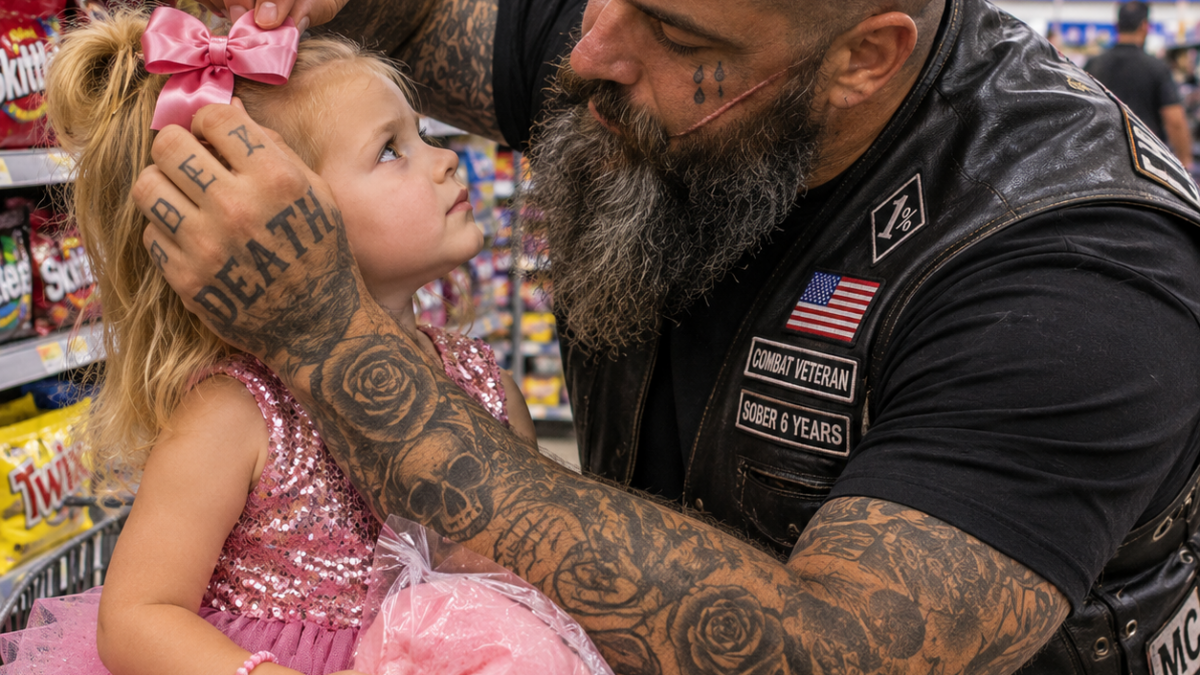
A 280-Pound 1%er Biker Stopped in Walmart Because His 4-Year-Old Said, “Daddy, Fix My Bow”—Then One Stranger Took a Photo
A four-year-old girl in a glittery pink tutu ordered the most intimidating man in a Maumelle Walmart to stop pushing her shopping cart because her satin bow was crooked, and the 280-pound tattooed biker obeyed so quickly that half the candy aisle stopped to watch.
Twelve minutes later, a stranger quietly photographed the faded blue word DEATH across his knuckles beside his daughter’s tiny raised hand, never knowing the man in the leather 1%er cut had survived war, prison, addiction, and a private family loss that had created those Saturday Walmart trips in the first place.
By the time that photograph reached five million shares, Marcus “Wraith” Holloway’s entire motorcycle chapter had discovered it—but the reason five hundred bikers eventually put one sentence about that pink-bowed little girl across their backs began years earlier, with a promise Marcus had never spoken aloud to anyone.
At 9:47 on a Saturday morning in May, Brooklyn Holloway decided her father had made a mistake.
Not a large mistake.
Not the kind that required an apology, money or adult intervention.
A bow mistake.
The pink satin bow Hannah Holloway had tied into the right side of her daughter’s blonde hair at exactly 8:45 that morning had shifted.
Only slightly.
Maybe half an inch.
To a normal person, it was still a bow.
To Brooklyn, who had turned four two months earlier and approached fashion with the seriousness of a federal inspector, it represented unacceptable deterioration in standards.
She sat in the child seat of a Walmart shopping cart wearing a glittery pink tutu over white leggings, a plain white cotton shirt and little pink Velcro sneakers.
A bright pink bag of cotton candy rested in her lap.
Her father was pushing the cart.
Brooklyn looked up at him.
“Daddy.”
Marcus kept walking.
“Hm?”
“Stop.”
The cart stopped immediately.
Brooklyn pointed at the side of her head.
“My bow.”
Marcus looked.
“What about it?”
“It’s wrong.”
He leaned closer.
“Looks like a bow.”
PART2:
Brooklyn gave him the stare four-year-old girls reserve for fathers who are deliberately pretending not to understand something obvious.
“Fix it.”
I was fourteen feet away.
A box of cereal was in my cart.
A package of paper towels sat underneath.
I had gone to Walmart that morning intending to buy groceries, shampoo and dry-erase markers for my classroom.
Instead, I stood at the top of aisle nine watching one of the most intimidating men I had ever seen receive instructions from a child in a tutu.
His name, though I did not know it yet, was Marcus Holloway.
Most people called him Wraith.
He was thirty-seven.
Six-foot-five.
Around two hundred eighty pounds.
His head was completely shaved.
A thick salt-and-pepper beard reached halfway down his chest.
A long pink scar cut diagonally across his right cheekbone.
Two faded blue teardrops sat below the outer corner of his left eye.
His arms were covered in dense black-and-gray tattoos.
Skulls.
Old roses.
Military imagery.
Names.
Dates.
Across the four knuckles of his right hand, in faded prison-blue block letters, was one word.
DEATH.
He wore a black T-shirt beneath a weathered black leather motorcycle cut.
Iron Diamond Brotherhood MC.
Little Rock Charter.
Combat Veteran.
American flag.
PART3:
A small diamond-shaped 1%er patch.
And on the front of the cut, almost lost between all the harder-looking patches, a small embroidered rectangle.
SOBER 6 YEARS.
He looked like the kind of man strangers tried not to inconvenience.
Brooklyn had no such concern.
“Daddy.”
“I’m looking.”
“It’s crooked.”
“All right.”
Marcus stepped around the cart.
Then this enormous man bent.
First at the waist.
Then lower.
He rested both tattooed forearms across the cart’s front edge until his face was level with his daughter’s.
Brooklyn pointed.
“Here.”
“I see it.”
“Mommy puts it here.”
“I know where Mommy puts it.”
“No, you don’t.”
I nearly laughed.
Marcus did not.
He treated the accusation seriously.
“All right. Show me.”
Brooklyn touched a spot above her right ear.
Marcus raised his right hand.
The one that said DEATH.
With the tips of two enormous fingers, he loosened the pink bow from where it had slipped.
He adjusted it.
He used his left hand to smooth the little satin loops.
Then he tilted his head.
“Better, princess?”
Brooklyn examined the result.
Not in a mirror.
Apparently her father’s face served as adequate reflection of workmanship.
She tilted her head one direction.
Then the other.
Marcus waited.
Finally:
“Better.”
“Thank God.”
“You did it wrong before.”
“It was the wind.”
“You were holding the cart.”
“Wind doesn’t care who holds the cart.”
Brooklyn considered this.
Then lifted one tiny hand.
Marcus gave her a high five.
Her palm disappeared against his.
I remember that sound.
A little smack in the middle of Walmart.
Then she grabbed the pink cotton candy again.
Marcus returned to the cart handle.
And they moved on as if nothing unusual had happened.
That was my first sight of Marcus Holloway.
It was not the photograph.
It was not the tattoos.
It was how quickly he stopped.
He could have said:
It’s fine.
We’re busy.
Later.
Sit still.
Instead, the moment his daughter told him something mattered to her, he treated it as though it mattered to him.
That detail stayed with me.
My name is Patricia Lassiter.
I was forty-nine that morning.
I teach English at Maumelle Central High School.
For twenty-seven years, I have watched teenagers pretend they do not care about things that matter deeply to them.
I notice gestures.
Tone.
Contradictions.
Occupational hazard.
Something about Marcus and Brooklyn felt like a contradiction written in twelve-point bold.
Violence everywhere on the surface.
Tenderness in the hands.
I was not the only person watching.
A woman behind them near the candy display had two children of her own.
Jennifer Reyes.
Thirty-one.
I learned her name weeks later.
She watched Marcus fix the bow.
At checkout, Jennifer ended up three feet behind the Holloways.
Brooklyn had moved the cotton candy from her lap to the cart basket.
Marcus was placing groceries on the conveyor belt one-handed while preventing Brooklyn from attempting to climb backward out of the child seat.
“Sit.”
“I am sitting.”
“You are facing backward.”
“Still sitting.”
Marcus looked at the cashier.
The cashier laughed.
Her name was Lacey.
Twenty-four.
Nose ring.
Kind smile.
Apparently she already knew Brooklyn.
“Morning, Miss B.”
Brooklyn waved.
“Hi, Lacey.”
“Pink today?”
Brooklyn looked offended.
“Always pink.”
“Of course.”
Marcus put a gallon of milk on the belt.
Lacey scanned it.
“You keeping him in line?”
Brooklyn nodded.
“He did my bow wrong.”
Marcus stopped unloading groceries.
“I fixed the bow.”
“You did it wrong first.”
“I did not put the bow on first.”
“Mommy did.”
“Exactly.”
“You were driving.”
“The cart.”
“You made wind.”
Jennifer told me later that was when she lifted her phone.
Not because she wanted to photograph a scary biker.
Because she had children.
She understood what she was seeing.
A father losing an argument he had no intention of winning.
Brooklyn raised her hand again.
“High five.”
Marcus leaned toward her.
Her palm struck the center of his enormous tattooed chest.
Jennifer took one photograph.
From behind.
Marcus’s face was mostly turned away.
Brooklyn’s full face was not visible.
You could see the back of Marcus’s shaved head.
The leather cut.
His right hand wrapped around the cart handle.
DEATH across the knuckles.
Brooklyn’s pink bow.
Her tiny arm raised against him.
Cotton candy in her lap.
That was it.
One picture.
Jennifer did not say anything.
She did not approach them.
Did not ask their names.
Did not know Marcus was called Wraith.
Did not know he had been incarcerated.
Did not know he was sober.
Did not know Brooklyn’s Saturday routine existed for a reason that had nothing to do with Walmart.
At 4:47 that afternoon, Jennifer posted the photograph to Facebook.
Her original caption contained four words.
Toughest man at Walmart today.
She intended to make a few friends smile.
By midnight, the photograph had more than four thousand shares.
By Sunday, tens of thousands.
By Monday morning, hundreds of thousands.
People added their own captions.
This is fatherhood.
Real men fix bows.
The safest little girl in Arkansas.
Don’t judge a book by its cover.
Some were sweet.
Some were stupid.
Some made jokes about the tattoos.
Others speculated wildly about Marcus’s life.
Former gangster.
Prison enforcer.
Hitman.
Military sniper.
Drug dealer turned dad.
People invented entire biographies based on one photograph.
Ironically, Marcus’s actual biography was more complicated than most of them.
He simply did not know the photograph existed.
Marcus did not have Facebook.
Or Instagram.
Or TikTok.
Or any personal social media.
He owned a smartphone primarily because Hannah required him to and because his job occasionally sent diagnostic photographs through text.
His online footprint was essentially:
weather,
motorcycle parts,
diesel diagrams,
and photographs Hannah sent him of Brooklyn.
So while millions of strangers were zooming in on his knuckles, Marcus spent Sunday changing the starter on a 2018 Peterbilt and making pancakes shaped badly enough that Brooklyn refused to identify the animal he claimed they represented.
He found out Tuesday morning.
6:47.
Buckhorn Diesel & Truck Repair on Highway 365 in Mayflower.
Marcus walked through the shop door carrying a travel mug.
His chapter road captain, Diesel, stood by the coffee machine.
Diesel was forty-three.
Six-foot-one.
Heavy beard.
Another Iron Diamond cut.
Beside him were three other patched brothers.
Hank.
Rook.
Mouse, who despite the nickname was approximately 240 pounds.
None of them appeared to be working.
Marcus noticed immediately.
“What?”
Diesel held up a phone.
“Brother.”
Marcus stopped.
“We need to talk about your Saturday morning.”
Marcus’s expression tightened.
“What happened?”
Diesel turned the screen.
Marcus stared.
The photograph.
His own back.
His own hand.
Brooklyn’s bow.
Cotton candy.
High five.
Caption.
He looked at the number.
4.7 million shares.
Marcus blinked.
“Is that million?”
Hank said:
“Yes.”
“Why?”
Nobody answered.
Marcus leaned closer.
“Who took this?”
Diesel said:
“Some lady at Walmart.”
“Why?”
Rook shrugged.
“Because apparently you’re adorable.”
Marcus slowly looked at him.
Rook took one step backward.
“Respectfully.”
Marcus read the caption again.
Toughest man at Walmart today.
His ears turned red beneath the edge of his shaved scalp.
Then he noticed Diesel’s lock screen.
Same photograph.
Except Hank had added text.
MARCUS HOLLOWAY.
CHAPTER SERGEANT-AT-ARMS.
IRON DIAMOND BROTHERHOOD MC.
ALSO KNOWN AS:
THE DRIVER.
Marcus stared.
“Diesel.”
“Yeah?”
“Show me your phone.”
“You’re looking at it.”
“Full screen.”
Diesel unlocked it.
Same picture.
Marcus looked at the other three men.
“You too?”
Hank showed his.
Same.
Rook.
Same.
Mouse had added pink hearts.
Marcus stared at him.
Mouse said:
“My old lady did it.”
“Your old lady put hearts on your lock screen?”
“Yes.”
“And you kept them?”
“She’ll know if I change it.”
Marcus considered that.
“Fair.”
Then he rubbed one hand down his beard.
“Brother.”
Diesel waited.
Marcus pointed at the photograph.
“I am gonna get razzed for this for the rest of my life, ain’t I?”
Diesel’s face broke.
“The entire chapter has been laughing for two days.”
“You knew before me?”
“You don’t have Facebook.”
“Because Facebook is stupid.”
“Apparently Facebook thinks you fix bows beautifully.”
Marcus closed his eyes.
Hank said:
“We’re thinking calendar.”
Marcus opened them.
“No.”
“Wraith’s Guide to Parenting.”
“No.”
“Twelve Months of Tenderness.”
“Hank.”
“February could be tea party.”
Marcus looked at Diesel.
“Control your people.”
Diesel laughed.
Marcus poured coffee.
He stood there silently for several seconds.
Then looked at the photograph one more time.
“Here’s the deal.”
The laughter slowed.
Marcus’s voice stayed low.
“At the clubhouse?”
He tapped his own cut.
“I can be scary.”
Nobody interrupted.
“At Walmart?”
He pointed toward the cart in the photograph.
“I drive the cart.”
Diesel smiled.
“That so?”
“That’s the deal.”
Marcus took a sip of coffee.
“And if any of y’all got a problem with that, my four-year-old daughter is the one gonna come talk to you.”
He paused.
“Not me.”
Nobody spoke for fifteen seconds.
Then Diesel started laughing.
Hard.
The others followed.
Marcus finally did too.
That should have been nothing more than a funny photograph.
It was not.
I learned the rest because I could not stop thinking about them.
For three Saturdays after seeing Marcus and Brooklyn, I happened to see them again.
Same Walmart.
Almost same time.
Pink outfit.
Cart.
Marcus.
Cotton candy.
The fourth Saturday, curiosity defeated normal social restraint.
I introduced myself.
Not dramatically.
They were near the cereal.
I said:
“Excuse me.”
Marcus turned.
His body changed immediately.
Not aggression.
Awareness.
The kind of awareness veterans and bikers sometimes carry so deeply it looks automatic.
I held both hands where he could see them.
“My name is Patricia.”
He nodded.
“Ma’am.”
“I was in the candy aisle the day your daughter made you fix her bow.”
Brooklyn looked up.
“I make Daddy fix lots of things.”
Marcus glanced at her.
“Apparently.”
“I just wanted to say it was a lovely thing to see.”
Marcus looked uncomfortable.
“Thank you.”
Brooklyn said:
“He does it wrong sometimes.”
“I’ve heard.”
That made her smile.
Then I asked something I usually would never ask a stranger.
“Why every Saturday?”
Marcus looked at me.
The air changed.
I immediately regretted it.
“That was rude.”
He said nothing.
“I’m sorry.”
Brooklyn held out the cotton candy.
“Want some?”
Marcus looked at her.
“You don’t share cotton candy with me.”
“You have a beard.”
“What does that mean?”
“It gets stuck.”
She offered the bag to me again.
I took one tiny piece.
“Thank you.”
Marcus studied me for another second.
Then:
“My wife teaches Saturday mornings.”
That was all.
I nodded.
We parted.
A week later, I saw Hannah with them.
She knew who I was because Marcus had apparently described me as:
“The teacher lady Brooklyn gave sugar to.”
Hannah laughed when I introduced myself.
She was small beside Marcus.
Freckled.
Hazel eyes.
Soft Arkansas voice.
Something calm about her.
We talked ten minutes.
Then twenty.
Eventually, months later, they invited me for coffee.
That was how I learned why Saturdays existed.
And to understand that, you have to understand Marcus before Brooklyn.
Marcus Holloway grew up in North Little Rock.
Second of three boys.
His father left when Marcus was six.
Not died.
Left.
That distinction mattered to Marcus.
His mother worked two jobs.
Tyson processing plant.
Then nights at Waffle House.
She loved her boys.
She was exhausted.
Both can be true.
By twelve, Marcus knew how to cook eggs, wash uniforms and tell bill collectors his mother was not home.
By sixteen, he had been arrested once for fighting.
By eighteen, he joined the Army.
Not because of patriotism alone.
Not because of college money alone.
Because, in his own words:
“I needed somewhere the rules stayed the same long enough for me to learn them.”
He served from 2007 to 2011.
Iraq.
Afghanistan.
He was good at soldiering.
That fact frightened him later.
In October 2010, outside Kandahar, an IED hit his vehicle.
Marcus was seated two positions behind Specialist Daniel Ramirez and Sergeant Cole Wheeler.
The explosion tore metal through the side of the vehicle.
Marcus woke disoriented.
Blood in his mouth.
Right side of his face open from shrapnel.
Smoke.
Noise.
He remembered screaming.
Then he remembered realizing the screaming was his.
Ramirez was already dead.
Wheeler too.
Marcus dragged both men from the vehicle anyway.
When I asked why, he stared at me as if the question itself was strange.
“We don’t leave anybody.”
“But you knew?”
“Yeah.”
“They were gone?”
“Yeah.”
“Then why risk yourself?”
He looked toward his backyard.
Brooklyn was chasing bubbles.
“We don’t leave anybody.”
That was the only answer.
The two teardrops under his left eye came years later.
One for Ramirez.
One for Wheeler.
People who saw them assumed prison kills.
Marcus let them assume.
Correcting strangers required conversation.
He disliked conversation.
The scar came from the blast.
The drinking came afterward.
Not immediately.
That would have been easier to understand.
He came home in 2011 and held himself together for nearly three years.
Worked.
Fixed engines.
Rode motorcycles.
Drank more than he should.
Slept less than he needed.
Avoided fireworks.
Avoided talking about Afghanistan.
Avoided anybody who suggested the two might be connected.
Then in 2014, at a bar in North Little Rock, another man said something Marcus barely remembered.
Words.
Shoulder contact.
Alcohol.
Rage.
The fight lasted less than two minutes.
A man went to the hospital.
Marcus went to jail.
Aggravated assault.
He pled out.
Tucker Maximum Security Unit.
Eighteen months.
The DEATH tattoo came there.
Not because Marcus thought it looked hard.
He already looked hard.
He got it because one night in his cell he realized almost everything he touched while angry became worse.
His cellmate worked homemade ink into the four knuckles.
D.
E.
A.
T.
H.
One letter per knuckle grouping across the hand.
Marcus watched the word form.
He told me:
“I needed to remember where that guy was headed.”
“What guy?”
“Me.”
He entered sobriety before release.
Thirty-five days sober when he walked out in November 2016.
He joined Iron Diamond Brotherhood the following year.
The club gave him structure.
Men who understood war.
Men who understood prison.
Some understood addiction.
Not saints.
Marcus never described them that way.
They were complicated men who expected loyalty.
He became sergeant-at-arms in 2021.
The title suited the man outsiders believed Marcus was.
Then he met Hannah.
October 2018.
AA meeting.
Methodist church basement.
Hannah was twenty-seven.
Yoga instructor.
Recovering from her own addiction history.
Six months more sober than Marcus.
Marcus noticed her because she laughed at something during the meeting.
Hannah noticed him because everybody else avoided the chair beside him.
She sat there.
Afterward, Marcus said:
“You didn’t have to sit by me.”
Hannah said:
“I wanted the chair.”
Their first date was breakfast.
Eleven days later.
Marcus ordered eggs, bacon, black coffee.
Hannah ordered oatmeal.
He told her oatmeal was not breakfast.
She told him prison had apparently ruined his culinary judgment.
He asked for a second date.
They married in October 2019.
Brooklyn was born March 12, 2021.
3:14 a.m.
Marcus remembers the minute.
Of course he does.
He first held her at 3:47.
He remembers that too.
Hannah told me he had been terrified.
Marcus denied this.
Hannah said:
“He refused to sit.”
Marcus replied:
“She was tiny.”
“You were afraid you’d drop her.”
“I was not.”
“You asked the nurse three times where to put your hands.”
“That’s responsible.”
Hannah smiled at me.
“He was terrified.”
Marcus ignored her.
Brooklyn weighed seven pounds, three ounces.
Marcus held her against his chest.
Her entire head fit beneath his beard.
He looked down at her.
Then cried.
No sound.
Just tears.
Hannah pretended not to see because she knew him well enough already.
Later Marcus told me:
“I didn’t think I got that.”
“Got what?”
He looked embarrassed.
“A daughter.”
“Why not?”
“Because I knew who I’d been.”
That sentence contains almost everything important about Marcus Holloway.
He thought goodness was something awarded to people with clean histories.
Then a little girl arrived and loved him before she knew what history was.
He had no defense against that.
He became obsessed with gentleness.
Not publicly.
He still rode.
Still wore the cut.
Still handled chapter conflicts.
Still worked with diesel engines.
Still looked capable of bending a crowbar.
But with Brooklyn?
Different world.
He learned diapers.
Ponytails badly.
Bath temperature.
Favorite cups.
The correct way to cut grapes.
Which stuffed rabbit was “sleep rabbit” and which identical rabbit was offensively wrong.
He let her color the flowers tattooed on his arms with washable markers.
At three, she painted his fingernails pink.
He attended a chapter meeting with two nails still painted because acetone had not removed everything.
Nobody mentioned it.
Not because they were afraid.
Because several of them had daughters.
Marcus believed the private and public versions of himself could coexist.
Then came March 2022.
Hannah was pregnant again.
Twelve weeks.
They had not told many people.
Marcus knew.
Her sister.
Two close friends.
They had begun privately talking about another bedroom.
Names.
A boy?
A girl?
Brooklyn was twelve months old.
At 4:47 on a Sunday morning, Hannah woke with cramping.
Marcus was not home.
He had taken an emergency overnight repair job in Pine Bluff.
Long-haul truck with brake issues.
Hannah went into the bathroom.
Blood.
She knew.
Women sometimes know before anybody tells them.
She called Marcus.
He answered on the second ring.
“Hannah?”
“I think something’s wrong.”
“What?”
She could not finish.
Marcus heard her crying.
He said:
“I’m coming.”
She told him not to drive recklessly.
He did anyway.
Hannah drove herself to the emergency room because she did not want an ambulance waking Brooklyn.
A neighbor came over.
Marcus reached the hospital at 7:14.
The baby was gone.
There was no villain.
No medical negligence.
No dramatic reason.
Sometimes pregnancy ends.
Sometimes biology does something cruel without intention.
That was almost harder for Marcus.
Anger needs an address.
There was none.
Hannah went home.
They grieved differently.
Marcus became useful.
That is what men like Marcus do when emotions exceed language.
Laundry.
Food.
Trash.
Brooklyn.
He repaired a backyard gate that did not need repairing.
Changed oil in Hannah’s car two thousand miles early.
Cleaned the garage.
Hannah stayed in bed.
The first week, she barely moved.
By the second week, she showered.
By the third, she could feed Brooklyn lunch without crying afterward.
She stopped teaching yoga.
Stopped answering messages.
Stopped wanting people around.
Marcus did not try to cheer her up.
This is important.
He did not say:
We can try again.
Everything happens for a reason.
At least it was early.
You already have Brooklyn.
Those sentences destroy grieving people.
Marcus said almost nothing.
He sat nearby.
He brought water.
He handled Brooklyn.
And one Saturday morning, without discussing it, he dressed their daughter and left the house.
Hannah asked:
“Where are you going?”
“Out.”
“With her?”
“Yes.”
“How long?”
“Few hours.”
“Why?”
Marcus shrugged.
“Daddy day.”
Brooklyn was twelve months old.
Daddy day involved a park.
Coffee.
Stroller.
Marcus returned three hours later.
Hannah had slept.
The following Saturday, same.
Then farmer’s market.
Then park.
Then breakfast.
Eventually Walmart.
Every Saturday, Marcus took Brooklyn away for three or four hours.
He never told Hannah why.
She knew.
The house became hers for a morning.
Silence.
Grief.
Sleep.
Sometimes she sat beneath the dogwood tree in the backyard where they had privately buried a small carved wooden box.
I will not romanticize that part.
Hannah told me some Saturdays she simply stayed in bed.
Others she cried.
One she watched three hours of terrible television and ate cereal.
Healing does not have to look meaningful.
It just has to keep happening.
By December, Hannah returned to teaching Saturday yoga at 9 a.m.
Marcus could have stopped Daddy Day.
He did not.
Because by then Brooklyn knew.
Saturday meant Dad.
At eighteen months, she recognized Walmart.
At two, she began choosing snacks.
At three, the pink cotton candy started.
Marcus bought one bag every Saturday.
Even when they had three bags unopened at home.
Hannah asked:
“Why?”
Marcus said:
“She expects it.”
“She eats four bites.”
“Not relevant.”
At four, Brooklyn began choosing her own Saturday clothes.
Tutu.
White shirt.
Leggings.
Pink shoes.
Pink bow.
Every week.
The bow was tied by Hannah.
Adjusted repeatedly by Marcus.
That was the history behind the photograph.
Jennifer Reyes saw twelve seconds.
The internet saw one image.
Neither could see the miscarriage.
The dogwood tree.
The Army vehicle.
Tucker.
AA.
The first Saturday stroller ride.
All of it lived inside the hand fixing that bow.
That is why I have stopped believing small moments are actually small.
Sometimes they are only the visible end of a very long story.
The Iron Diamond chapter learned part of that story too.
Not all.
Marcus did not discuss Hannah’s miscarriage widely.
But his brothers knew Saturday belonged to Brooklyn.
After the photograph went viral, jokes lasted weeks.
Then something changed.
At a June chapter meeting, Hank proposed shirts.
Diesel expected Marcus to refuse.
Instead, Marcus said:
“What kind?”
“Black.”
“Obviously.”
“Small club mark front.”
“What back?”
Hank showed him a mockup.
AT THE CLUBHOUSE, A 1%er.
AT WALMART, A DRIVER.
Marcus stared.
Diesel watched him carefully.
Then Marcus laughed.
Not a small laugh.
A real one.
“Brooklyn approve it?”
Hank said:
“She designed it.”
“What?”
Hannah had sent Hank a photograph of Brooklyn pointing at the words on a printout.
Marcus looked betrayed.
“My own house.”
Diesel said:
“Democracy.”
“This club is not a democracy.”
“Too late.”
They voted anyway.
Unanimous.
Five hundred shirts.
Marcus added one condition.
“If we’re selling ’em, money goes somewhere useful.”
They discussed veterans.
Addiction recovery.
Children.
Marcus chose pediatric oncology.
Hannah asked why.
He said:
“Parents shouldn’t have to worry about hotel money while their kid’s sick.”
The chapter donated every dollar of profit.
$14,847.50.
In Brooklyn’s name.
That detail mattered to Marcus.
Not Wraith.
Not the club.
Brooklyn.
The shirts sold in eleven days.
Marcus refused to wear his.
For approximately two weeks.
Then Brooklyn asked:
“Where’s your driver shirt?”
Marcus said:
“I don’t wear it.”
“Why?”
“It’s embarrassing.”
“What’s embarrass?”
Hannah said:
“When Daddy is scared people will laugh.”
Brooklyn looked at him.
“Are you scared?”
Marcus stared at Hannah.
Hannah drank coffee.
Brooklyn repeated:
“Are you?”
Marcus wore the shirt the next Saturday.
To Walmart.
Brooklyn got her own version.
Pink.
On the back:
THE BOSS.
Hannah sewed adjustments herself.
Same machine she had used to sew Marcus’s sobriety patch.
That detail made me unexpectedly emotional when she told me.
The Sober 6 Years patch on Marcus’s vest had been sewn using black thread from a spool he had owned since 2016.
Hannah kept using the same spool for repairs.
Marcus’s cut.
Brooklyn’s shirt.
A little line of thread tying different versions of a life together.
Maybe English teachers look too hard for symbolism.
Maybe.
I still like it.
The photograph reached national pages.
Reporters found Marcus.
He refused most interviews initially.
Then agreed on conditions.
Brooklyn’s face never shown.
No school.
No address.
No identifying details beyond what the family approved.
He cared less about his own privacy.
Hers was non-negotiable.
The first reporter asked:
“What does it feel like to become a symbol of gentle fatherhood?”
Marcus looked physically pained.
“I fixed a bow.”
The reporter laughed.
Marcus did not.
“No, seriously.”
“I am.”
The reporter tried again.
“You have a very intimidating appearance.”
“So I’ve heard.”
“But your daughter seems completely comfortable.”
“She’s my daughter.”
“Do people misunderstand men like you?”
Marcus leaned back.
“Some do.”
“What would you want them to understand?”
He thought.
Then:
“Tattoos don’t raise kids.”
That was all.
The reporter waited.
Marcus added:
“People do.”
Another interview asked about the DEATH tattoo.
He almost ended the interview.
Then answered.
“It’s there because I needed to remember where anger takes me.”
“Do you regret it?”
Marcus looked at his hand.
“No.”
“Why?”
“Brooklyn sees letters.”
“She doesn’t see what I was.”
“What will you tell her when she’s older?”
“The truth.”
That answer impressed me.
No mythology.
No hiding.
No claiming prison had been unfair.
Marcus committed the assault.
He admitted it.
He served the sentence.
Sobriety did not erase it.
Fatherhood did not erase it.
Softness did not turn the past false.
He simply refused to let the past dictate every future action.
Hannah described it better.
“He doesn’t believe redemption means pretending the old person never existed.”
She looked toward Marcus playing with Brooklyn in the yard.
“He believes you keep that person where you can see him.”
I thought about DEATH on his hand.
A reminder visible every time he ties a shoe.
Holds a cup.
Fixes a bow.
Maybe especially then.
Fourteen months after the photograph, I knew the family well enough that Brooklyn stopped treating me like a stranger.
She called me Miss Trish.
I hated it and loved it.
I attended her fifth birthday.
Jennifer Reyes came too.
Her oldest daughter and Brooklyn decided they were best friends within fourteen minutes.
Diesel arrived carrying a present wrapped badly enough that everyone knew he had done it himself.
Brooklyn opened it.
A child-sized mechanic toolbox.
Pink.
Marcus said:
“She’s not touching my tools.”
Diesel said:
“Those are hers.”
“She’ll lose them.”
Brooklyn shouted:
“No!”
Marcus looked at Diesel.
“You created this.”
Diesel looked pleased.
The club’s charity shirts continued.
Every quarter, a different member chose a sentence.
One said:
I RIDE LOUD SO MY KIDS KNOW I MADE IT HOME.
Another:
SOBER ENOUGH TO REMEMBER BEDTIME STORIES.
Diesel’s eventually said:
MY OLD LADY KNITS.
MY KIDS READ.
MY DAD STILL CALLS ME SON.
THAT’S MY HARDCORE.
It sold out in four days.
The pediatric oncology unit kept receiving checks.
Marcus never became comfortable with any of it.
He tolerated it because the money helped children.
And because Brooklyn thought Daddy being on shirts was funny.
The photograph changed how strangers treated him too.
Occasionally someone recognized the beard and tattoos.
“Walmart guy?”
Marcus sighed.
“Yes.”
One woman asked him to fix her daughter’s bow for a photograph.
Marcus refused.
Politely.
“That’s my kid’s thing.”
I respected that.
A moment going viral does not make the person public property.
He kept boundaries.
Brooklyn’s life stayed mostly normal.
Kindergarten.
Crayons.
Tantrums.
Pink.
Horses became an obsession for a while.
Then dinosaurs.
Still pink dinosaurs.
Saturday remained.
Even after Hannah no longer needed the silence for grief.
Even after she returned fully to work.
Even after the Walmart photograph became old internet history.
Saturday belonged to Marcus and Brooklyn.
Why?
Because rituals can begin as rescue and remain as love.
Hannah once told me:
“At first he took her because I couldn’t function.”
“Then I got better.”
“I thought maybe Saturdays would stop.”
“Did you want them to?”
“No.”
She smiled.
“I liked watching them leave.”
“That sounds terrible.”
“I know.”
“But I knew they had something.”
She paused.
“And I had something too.”
“What?”
“The sound of the door closing and knowing everybody I loved was okay.”
That is grief too.
Not only crying.
Relief without guilt.
Quiet without abandonment.
By the time Brooklyn was five and a half, she understood Saturday only as tradition.
She did not know it had been born after a baby she never met.
Marcus and Hannah had not yet decided how to tell her.
They would.
Eventually.
Age appropriate.
Truth without burden.
Marcus believed children deserved truth when they were old enough to carry it.
That applied to the miscarriage.
War.
Prison.
Addiction.
All of it.
He once said:
“I’m not gonna make her think I was born Dad.”
I asked what he meant.
“She needs to know people can become different.”
That may be the most important thing he ever told me.
People can become different.
Not magically.
Not because someone loves them.
Not because becoming a parent automatically repairs character.
Marcus changed because he spent years doing boring things repeatedly.
Not drinking.
Meetings.
Work.
Apologies.
Boundaries.
Therapy eventually.
Responsibility.
Then diapers.
Saturday mornings.
Bow fixing.
The viral photograph caught the visible result.
The work was off camera.
Most important work is.
The two teardrops remained.
The scar remained.
DEATH remained.
His record remained.
The 1%er diamond remained.
So did the pink bow.
That contradiction bothered people who wanted one clean version.
Dangerous or gentle?
Criminal or father?
Biker or family man?
Hard or soft?
Marcus rejected the question.
In his most recent interview, a parenting blogger asked:
“What do you hope men learn from the photo?”
Marcus said:
“Brother, I’m only as hard as I need to be.”
The interviewer waited.
Marcus looked toward Brooklyn, who was outside camera range.
“I’m as soft as my daughter needs me to be.”
He shrugged.
“Both.”
“Every day.”
“It ain’t complicated.”
People quoted that everywhere.
Marcus hated that too.
Diesel printed it and taped it inside the clubhouse bathroom.
Marcus removed it.
Diesel printed another.
This happened four times.
The fifth time Marcus left it.
That is friendship among bikers apparently.
I saw Marcus in Walmart again last Saturday.
9:47.
Almost exactly the same time.
I had driven by for groceries.
The Harley was outside.
Black.
Chrome bright in the October sun.
Inside, aisle nine.
There they were.
Brooklyn sat in the child seat.
Five now.
Longer legs.
Pink tutu.
Pink bow.
Cotton candy.
Marcus wore the driver shirt under his cut.
He pushed.
She talked.
He listened.
I did not interrupt.
I stayed far enough away that they did not notice me.
Brooklyn reached toward Marcus’s shoulder.
“Daddy.”
He stopped immediately.
“What?”
“Your patch.”
“What about it?”
“Crooked.”
Marcus looked down.
“Looks fine.”
“No.”
She climbed slightly forward.
“Hold still.”
Marcus bent.
The same way he had fourteen months earlier.
Enormous forearms resting on the front of the cart.
He lowered his shoulder so she could reach.
Brooklyn used both little hands to straighten one of the patches on his cut.
Careful.
Serious.
Marcus waited.
She sat back.
“Better.”
Marcus nodded.
“Thank you, ma’am.”
She held up a hand.
High five.
The DEATH knuckles rose.
Tiny palm met enormous hand.
Same sound.
Small smack.
Then they kept moving.
No stranger lifted a phone that time.
At least none I saw.
No viral post.
No headlines.
No interviews.
Just Saturday.
I stood beside a shelf of candy and thought about every thing the original photograph could not show.
A six-year-old boy whose father left.
A tired mother working two jobs.
A nineteen-year-old soldier.
Iraq.
Afghanistan.
Ramirez.
Wheeler.
The blast.
The scar.
The drinking.
A North Little Rock bar.
Tucker.
A homemade tattoo.
Thirty-five sober days.
An AA basement.
Hannah.
Breakfast.
Marriage.
3:47 a.m. on March 12, 2021.
A newborn girl against a tattooed chest.
A lost pregnancy.
A dogwood tree.
A woman too depressed to leave bed.
A father quietly saying:
I’ll take Brooklyn.
Saturday.
Saturday.
Saturday.
The farmer’s market.
The park.
Walmart.
Pink cotton candy.
One bow.
A stranger.
A photograph.
Five million shares.
Five hundred shirts.
Thousands of dollars for sick children.
And a grown man discovering that the world’s idea of toughness mattered less than a four-year-old girl’s opinion about whether her bow was straight.
People love transformation stories.
We want one dramatic moment.
The criminal becomes good.
The addict becomes sober.
The hard man becomes gentle.
Life almost never works that way.
Marcus did not transform in Walmart.
The photograph did not change him.
It exposed something already there.
A man can carry evidence of every terrible place he has been and still choose what his hands do next.
That is the part I keep returning to.
His hands.
The right hand had dragged two dead soldiers from a destroyed vehicle.
The right hand had been clenched during the bar fight that sent him to prison.
The right hand had been tattooed with DEATH inside a maximum-security cell.
The right hand had held his newborn daughter.
Buckled car seats.
Cut strawberries.
Fixed toys.
Held Hannah during the year she thought grief might swallow her.
Pushed a Walmart cart.
Straightened a pink satin bow.
The hand did not become innocent.
It became useful.
That seems more honest than redemption stories where the past disappears.
Marcus’s past is written directly onto his skin.
Brooklyn does not care.
To her, DEATH is simply the blue word on Daddy’s hand.
The teardrops are marks near Daddy’s eye.
The scar is something she once traced with one finger and asked:
“Did it hurt?”
Marcus said:
“Yes.”
She kissed it.
Then asked for crackers.
Children are efficient with history.
They accept information and return to snacks.
One afternoon on the Holloways’ back porch, I asked Marcus whether he worried Brooklyn would someday be embarrassed by the photograph.
He thought.
“No.”
“Why?”
“She’ll be embarrassed by me for something.”
“That’s guaranteed.”
“Exactly.”
He took a drink of coffee.
“If it ain’t the bow, it’ll be my music.”
“What music?”
“Hank Williams.”
“That is embarrassing.”
He pointed at me.
“See?”
Then his expression softened.
“I hope when she’s older she understands.”
“What?”
He stared toward the backyard.
Brooklyn was lying in the grass beside Hannah.
“That I liked being her dad.”
I waited.
He rubbed his thumb over the DEATH letters without realizing it.
“I don’t want her thinking I did stuff because I had to.”
“What stuff?”
“Cart.”
“Bow.”
“Tea party.”
“School.”
“Whatever comes.”
He shrugged.
“I want her to know I liked it.”
That sentence is the reason I am writing this now.
Not because Marcus Holloway is extraordinary.
He would hate that description.
Because so much of parenting happens in tiny acts children may never remember.
Brooklyn does not remember the first Saturday.
She does not remember why Marcus took her out of the house.
She does not remember her mother unable to get out of bed after losing a pregnancy.
She does not remember being the little person whose presence gave both parents a reason to keep moving.
She remembers cotton candy.
Walmart.
Daddy driving the cart.
That is enough.
Sometimes a child receives the benefit of love without ever needing to know the pain that created the ritual.
That may be one of the kindest things parents can do.
Carry the origin.
Give the child only the safety.
Hannah carries March 2022.
Marcus carries it.
Brooklyn carries Saturday.
I think that is beautiful.
Marcus once told me the Daddy and Brooklyn routine had started as an act for Hannah.
I said:
“So the viral photo is really a love story about your wife.”
He looked horrified.
“Do not tell the internet that.”
“Why?”
“Then they’ll make more shirts.”
He was probably right.
But he smiled.
Hannah knew.
She always knew.
The first time the photograph appeared on television, Hannah watched it silently.
The anchor talked about the scary-looking biker with the tiny daughter.
Hannah laughed.
Then cried.
Marcus noticed.
“You okay?”
She nodded.
“Why are you crying?”
“Because nobody knows.”
“Knows what?”
“Why you were there.”
Marcus understood.
He sat beside her.
“We know.”
Hannah nodded.
That was enough.
Maybe that is another lesson.
Not everything meaningful needs public recognition.
Five million people saw the result.
Two people knew the origin.
Three, if you count Brooklyn in the way children know love without knowing why.
Now four, because they told me.
And whoever reads this.
But the meaning existed before witnesses.
That matters.
The shirt fundraiser continues.
The club still jokes.
Brooklyn still bosses grown men.
At the clubhouse family barbecue, she once ordered Diesel to move because he was blocking her sidewalk chalk.
Diesel moved.
Immediately.
Marcus watched.
“Why you listen to her?”
Diesel said:
“I’ve seen what she does to you.”
Fair.
The Iron Diamond men have become part of Brooklyn’s world.
Not all are fathers.
Some are grandfathers.
Some have complicated relationships with their own children.
One told me the photograph made him call a daughter he had not spoken to in eleven months.
I asked what happened.
“She answered.”
That was all he wanted to say.
Another bought one of the shirts for his adult son.
Another stopped calling pink things “girl stuff” after Brooklyn told him colors do not have jobs.
Small changes.
Nobody became saintly.
The clubhouse remained loud.
Motorcycles remained motorcycles.
The men remained who they were.
But softness gained permission.
That is different.
Marcus’s photograph accidentally gave several hard-looking men a joke they could hide sincerity inside.
That is how some men survive vulnerability.
They make shirts.
They laugh.
Then donate fourteen thousand dollars to children with cancer.
No speech necessary.
Hannah understands that too.
At the first fundraiser, someone asked whether she was proud of Marcus.
She said:
“I was proud before Walmart.”
That should probably be printed somewhere.
Viral attention did not validate him.
The photograph did not make him a good father.
Brooklyn’s life already knew.
Hannah already knew.
The people closest to him already knew.
The internet arrived late.
It usually does.
I think about Jennifer Reyes too.
She worried afterward that she had violated their privacy.
When we eventually introduced her to the Holloways, she apologized.
Marcus said:
“Did you show my kid’s face?”
“No.”
“Did you make money?”
“No.”
“Did you say anything bad?”
“No.”
He shrugged.
“Then we’re good.”
Jennifer cried.
Marcus looked alarmed.
“Why are you crying?”
She laughed.
“I don’t know.”
Brooklyn solved the problem by asking Jennifer’s children whether they liked cotton candy.
That was the beginning of their friendship.
One random photo rearranged several lives.
Jennifer became family-adjacent.
The chapter created charity fundraisers.
The hospital received money.
I gained friends I never expected.
Marcus gained eternal harassment from bikers.
Brooklyn gained nothing.
Which is exactly how Marcus wanted it.
She is still a child.
Not content.
Not a brand.
Not “the Walmart biker girl.”
Brooklyn.
Kindergarten.
Tutu.
Cotton candy.
Boss.
Marcus has rejected offers involving family reality shows, sponsorships and branded merchandise.
One company offered a significant amount for a father-daughter clothing campaign.
He said no.
Hannah asked if he knew how much money they offered.
“Yes.”
“And?”
“No.”
“Why?”
“Because then Saturday becomes work.”
That ended the discussion.
Saturday was sacred.
It had begun as shelter for grief.
Marcus would not turn it into performance.
The photograph happened because nobody knew they were being watched.
He wanted to preserve that.
I admire him for it.
There is something fragile about genuine moments once people expect them.
A father can fix a bow naturally.
A father fixing a bow for a camera becomes something else.
Marcus wanted the first thing.
So no sponsored Saturdays.
No photographers.
No interviews with Brooklyn.
Only groceries.
Candy.
Whatever ridiculous thing she talks him into buying.
Last month it was glitter glue.
Hannah banned glitter glue.
Marcus bought it anyway.
The house suffered.
He admitted fault.
Growth is not perfection.
A year from now, Brooklyn may stop wearing tutus.
One day she will stop sitting in the cart.
One day she will walk beside Marcus.
Then ahead.
One day she may be too old for cotton candy every Saturday.
Or too busy.
Friends.
Sports.
Teenage life.
Marcus knows.
He does not like talking about it.
I asked once:
“What happens when she doesn’t want Daddy Day?”
He stared.
“We’re not discussing that.”
“She’ll be seventeen someday.”
“No.”
“That’s generally how aging works.”
“Not in my house.”
Hannah laughed from the kitchen.
“He thinks he can intimidate time.”
Marcus said:
“Working on it.”
But his face changed.
He knows.
That is why he stops the cart now.
The bow matters now.
Because childhood is temporary even when ritual makes it feel permanent.
Maybe Jennifer’s photograph became valuable for a reason none of them expected.
It froze one ordinary Saturday.
Someday Brooklyn will see it differently.
At four, she saw:
Daddy.
At fifteen, perhaps embarrassment.
At twenty-five, maybe history.
At forty, perhaps she will see the tired mother who tied the bow.
The father who stopped.
The ritual created out of grief.
The hand.
I hope someone tells her everything.
Not all at once.
When she is ready.
That the Saturday tradition existed because her mother once needed quiet.
That her father understood without making her ask.
That he turned grief into three hours of groceries and playgrounds.
That later those hours became joy.
That millions of strangers thought the important contrast was tattoos versus pink bows.
But the true contrast was something else.
A man who once lost control of himself built a life around responding when a small person said:
Stop.
Think about that.
The bar fight came from Marcus not stopping.
Alcohol.
Rage.
Momentum.
Prison.
Years later, Brooklyn said:
“Daddy. Stop.”
He stopped immediately.
Not because she controlled him.
Because he had learned the value of stopping.
Then she asked him to use the same hand marked DEATH to fix something delicate.
He did.
Maybe symbolism is unavoidable there.
Maybe life occasionally writes better sentences than English teachers.
Fourteen months ago, I watched a frightening-looking stranger bend over a Walmart cart because his daughter’s bow was crooked.
Today I know what I was actually watching.
A man practicing the life he had built after almost destroying the first one.
A combat veteran carrying grief without letting grief choose every action.
A former inmate refusing to pretend prison never happened.
A sober alcoholic doing one more ordinary Saturday without drinking.
A husband continuing a ritual that began because his wife once could not get out of bed.
A father who had privately decided violence would stop at the edge of his daughter’s world whenever he had the power to stop it.
A man being soft on purpose.
That last part matters.
Softness is not the absence of strength.
For Marcus, it requires more strength than aggression ever did.
Anger had always been easy.
Tenderness required attention.
Patience.
Sitting still while a child chooses between two nearly identical bags of candy.
Fixing the bow again.
And again.
And again.
Driving the cart.
When I drove past that Walmart last Saturday, I almost kept going.
Then I saw the Harley.
I parked.
I did not enter immediately.
Through the front windows, I could make out the candy aisle.
Marcus.
Brooklyn.
Same composition almost.
Except she was taller.
His beard had more gray.
Time had moved.
Brooklyn stood in the cart basket briefly while Marcus told her to sit.
She sat.
Then pointed at his shoulder.
His patch was crooked.
He bent.
She fixed it.
That reversed image almost broke me.
For years he had been straightening the things that mattered to her.
Now, in one tiny way, she was straightening him.
Not changing who he was.
Just putting one piece back where it belonged.
When they finished, Marcus pushed the cart.
Brooklyn held cotton candy.
They disappeared around the end of the aisle.
I stayed outside.
They did not need another witness.
I drove home.
At one in the morning, I began writing.
Because there are men you see once and think you understand.
The shaved head.
Prison ink.
Club patch.
Scar.
DEATH.
We are pattern-making creatures.
We decide quickly.
Dangerous.
Criminal.
Hard.
Bad.
Sometimes those descriptions contain pieces of truth.
Marcus has been dangerous.
He has committed a serious crime.
He has hurt people.
He has lived inside violence.
Pretending otherwise would make the story cheaper.
But a person is not required to remain only the worst true thing you can say about him.
That is the part I wish more people understood.
Marcus cannot erase 2014.
He cannot bring Ramirez or Wheeler back.
He cannot undo Tucker.
He cannot recover the baby Hannah lost.
He cannot go backward and become a different young man.
He can decide what the hand does today.
That is all any of us have.
Today.
On Saturdays, Marcus Holloway puts that hand on a Walmart shopping cart.
His daughter sits in front of him.
She points.
Commands.
Laughs.
Complains.
Chooses pink cotton candy.
Sometimes her bow slips.
When it does, she calls the man half the store is trying not to stare at.
“Daddy.”
And Marcus stops.
Every time.
Some men, you don’t measure by their tattoos.
Some men, you measure by who is sitting in their cart.








