A 28-Pound Shelter Cat Was Ignored for Five Months—Then One Volunteer Wrote the Brutally Honest Adoption Post That Made Thousands of People Fall in Love With Him
PART3:
“He fits.”
“He does not fit.”
“He’s a cat.”
“He is several cats.”
I crouched and opened the crate door.
“Come here, big guy.”
Unit stepped forward.
His front paws emerged.
Then his head.
Then his shoulders.
Then more body.
Then still more body.
I remember thinking, Surely this is the end of the cat.
It was not.
He flowed out slowly, like orange dough with bones.
Marisol whispered, “Oh my God.”
Unit took three steps, sat on my shoe, and began purring.
The floor vibrated.
Not metaphorically.
Actually.
His purr had an engine note.
A diesel engine.
Denise covered her mouth.
“He’s sweet.”
“He’s enormous,” I said.
Both things were true.
We tried the kennel anyway.
Unit walked inside, turned halfway, got stuck, reversed with great dignity, then sat in the doorway with his rear end outside and his front half inside, as if compromise had been reached.
“Okay,” Denise said. “Dog kennel.”
So Unit became the only cat in the cat room housed in a small-dog kennel.
Even then, he filled it.
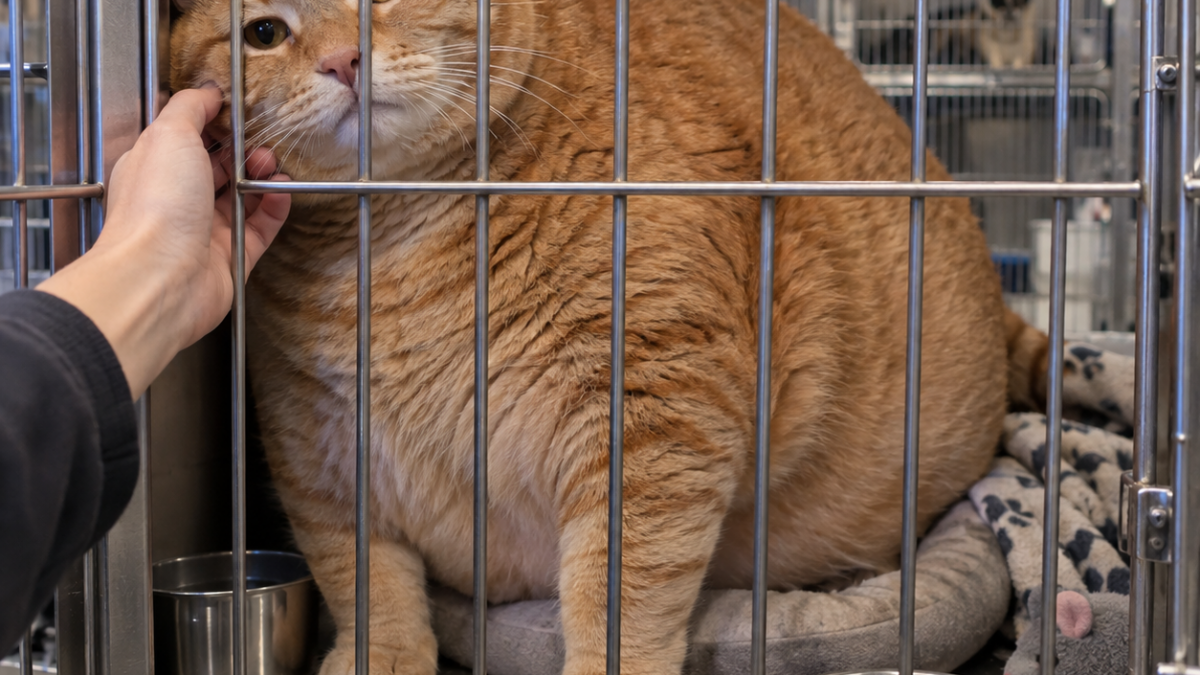
When he lay down, there was barely any kennel left. If he stretched, one paw touched the water dish and the other touched the wall. His belly rested on the floor like it had a lease. His face, broad and orange and solemn, pressed against the bars whenever anyone passed.
He was not miserable.
That made it funnier and sadder.
Unit accepted shelter life as if we had all been waiting for his supervision. He greeted everyone. He tolerated nail trims. He loved chin scratches. He purred loudly enough to confuse new volunteers who thought something mechanical had switched on.
But he did not get adopted.
The first week, people laughed when they saw him.
“That cat is huge!”
“Oh my gosh, look at him!”
“Is he part bobcat?”
“Can I take a picture?”
They took pictures.
They did not take Unit.
The second week, we posted him online.
Our first listing was normal.
Unit is a sweet four-year-old orange tabby looking for a loving forever home. He is a gentle giant who enjoys attention, chin scratches, and cozy naps. Unit would benefit from a home committed to helping him continue a healthy weight-loss journey with veterinary guidance.
It was accurate.
It was responsible.
It got twelve likes, two comments, and one message from a woman asking if he was free because she “needed a barn cat.”
Unit, who took five minutes to lower himself into a nap and screamed when his water bowl was too far from his face, would have lasted approximately seventeen seconds as a barn cat.
We said no.
Weeks passed.
People kept walking past him.
They did not ignore him exactly. Unit was impossible to ignore. They smiled. They laughed. They pointed. They took videos. But when it came time to choose a cat, they chose smaller ones.
Kittens.
Sleek black cats.
Tiny calicos.
A three-legged gray cat named Muffin who bit everyone but looked photogenic.
Unit stayed.
Month one became month two.
We changed his photo.
New caption.
New angle.
New wording.
Still no adoption.
Month three, we featured him in an “Adult Cats Need Love Too” post.
Nothing.
Month four, we tried “Big Love in a Big Package.”
Nothing.
By then, Unit had broken two cat beds.
Not through violence.
Through existence.
The first bed had a plastic frame and a plush cushion. We placed it in his kennel on a Monday. By Tuesday, one side had caved in like a roof after heavy snow. Unit lay on top of the wreckage looking peaceful.
The second was a round donut bed labeled “jumbo.”
False advertising.
Unit lowered himself into it, overflowed on all sides, and by morning the seam had split open. Stuffing puffed around him like surrender.
“Maybe no more beds,” Marisol said.
Unit yawned.
I began calling him “Your Majesty” when no one was listening.
Then one September evening, after another family walked past Unit and adopted a kitten named Sprinkles, something in me snapped.
Not angrily.
Not dramatically.
I was tired.
Tired of pretending.
Tired of polishing rough edges until they disappeared.
Tired of trying to make every animal sound like the same perfect little package when the very things that made them difficult, ridiculous, inconvenient, or strange were often the things that made them unforgettable.
I stood in front of Unit’s kennel at 6:45 p.m.
He sat with one paw in his water bowl, staring at me.
“You know what the problem is?” I asked him.
Unit blinked.
“We keep trying to make you sound adoptable.”
He licked one paw.
“You are adoptable. That’s not the issue. But ‘gentle giant’ is weak.”
He stared.
“It’s not enough.”
His tail thumped once.
I chose to interpret that as agreement.
I went to the office, opened the shelter Facebook page, deleted the adoption draft I had been working on, and wrote the truth.
UNIT. Four years old. Twenty-eight pounds. Orange. Immense.
He is not fluffy. He is not big-boned. He is just enormous.
I stopped, laughed at myself, then kept typing.
Unit has been at our shelter for five months because people keep walking past him and choosing cats that do not require their own zip code.
Let us be clear: Unit is the cat equivalent of a beanbag chair that learned to purr.
He takes up an entire kennel by himself. When he lies down, the kennel is over. There is no more kennel. Only Unit.
He has already broken two cat beds simply by existing on them.
He does not fit into a standard cat carrier. Please do not arrive with one unless you enjoy failure.
We had to borrow a small-dog crate for him, and even that crate has been questioning its life choices.
His belly nearly touches the floor when he walks.
His face is approximately the size of a dinner plate.
And somehow, despite being built like a Thanksgiving ham with whiskers, Unit is the sweetest, gentlest cat in this building. He purrs like a diesel engine. He wants to sit in your lap, but your lap is not big enough. That is not his problem. That is between you and your furniture.
Unit needs a home that can help him lose weight safely, under veterinary guidance, without body-shaming him because he already knows he is shaped like a throw pillow full of soup.
He does well with respectful people, enjoys attention, and believes all chairs should be evaluated for structural integrity before use.
Someone please come get this absolute unit of a cat.
He is not in the kennel.
He IS the kennel.
I read it back.
Then I stared at the screen.
Then I walked to Denise’s office.
“Can I post something risky?”
She looked up from paperwork with the expression of a woman who had heard those words before and regretted it every time.
“How risky?”
“Honest.”
“That’s not an answer.”
I turned the laptop toward her.
She read silently.
At “beanbag chair that learned to purr,” her mouth twitched.
At “Thanksgiving ham with whiskers,” she made a sound.
At “He IS the kennel,” she laughed so hard she had to take off her glasses.
“Post it,” she said.
“Really?”
“Before I become responsible and change my mind.”
So I posted it at 7:03 p.m. on a Wednesday.
I attached three photos.
One showed Unit filling nearly the entire kennel, giant orange face pressed against the door, eyes calm and mildly disappointed.
The second showed him from the side, walking across the visiting room with his belly low and his tail high, giving everyone an honest understanding of the situation.
The third showed Marisol trying to hold him.
She was a grown woman.
Unit appeared to be approximately the size of her entire torso.
I hit publish.
Then I went home.
At 8:15, the post had two hundred shares.
I texted Denise.
That’s weird.
At 9:00, it had one thousand.
At 10:30, five thousand.
By midnight, fourteen thousand.
I was in bed, wide awake, phone lighting up like a slot machine.
Comments poured in.
I would die for Unit.
He is not a cat, he is a sectional sofa.
I have never loved anyone more.
Please tell Unit I respect him.
Does he come with a forklift?
My husband says no but my heart says Unit.
Unit for president.
At 12:42 a.m., the shelter website crashed.
At 1:10, Denise texted:
WHAT DID YOU DO
I wrote back:
Told the truth?
She replied:
THE TRUTH BROKE THE INTERNET
By Thursday morning, the phones stopped working.
Not metaphorically.
Literally.
The shelter phone system jammed from incoming calls. Voicemails filled before 9 a.m. Emails flooded in. Messages arrived from Tennessee, Georgia, Alabama, Ohio, Texas, Oregon, Alaska. A woman from London asked whether international adoption was possible and whether Unit “would tolerate a transatlantic lifestyle.” Someone from Alaska offered to charter a flight. A family in Texas said they had a custom-built oversized carrier and could leave within the hour.
A man in Florida sent a photo of his couch and wrote, I believe this furniture is Unit-ready.
It was chaos.
Beautiful, stupid, overwhelming chaos.
Reporters called.
Local news asked to film him.
A national morning show emailed.
One pet food company offered to send “a year of food,” which we politely declined because Unit’s entire medical plan involved him eating less, not becoming the face of unlimited kibble.
Meanwhile, Unit remained Unit.
He slept through his fame.
At noon, I entered the cat room to find two staff members standing in front of his kennel.
“Do you think he knows?” one asked.
Unit snored.
“No,” I said. “And we must never tell him. His ego is already load-bearing.”
The problem with sudden attention is that it feels like rescue, but it creates new responsibility.
Everyone wanted Unit.
Not everyone was right for Unit.
He did not need someone adopting him as a joke. He did not need someone who would overfeed him because “chonk” was cute. He did not need stairs he could not handle, children who might climb on him, dogs who would chase him, or people who thought viral fame and long-term care were the same thing.
He needed a home.
A real one.
With patience, money for veterinary follow-ups, furniture capable of sacrifice, and people who would love him after the internet moved on.
Denise closed public inquiries after twenty-four hours.
“We need a lottery,” Marisol said.
“Not exactly,” Denise replied. “We need screening first. Then maybe a lottery among approved homes.”
We spent two days reviewing applications.
There were hundreds.
Some were sweet but unsuitable.
Some were hilarious.
One applicant wrote, I am physically prepared to be sat on by this cat.
Another wrote, My husband is a structural engineer and has assessed our home for Unit compatibility.
One person simply wrote, I have a king-sized bed and no self-respect. Please consider me.
Tempting, but not enough.
Then we found Aaron and Beth Miller from Nashville.
They were in their forties, married, no kids at home, both working from home. They had two large, calm dogs and a single-story house with wide rooms, no stairs Unit would need to navigate, and a veterinarian who had already helped one of their dogs lose weight safely after thyroid issues. Beth wrote that her childhood cat had been obese when adopted and lived nine more healthy years after a slow plan. Aaron attached a photo of a giant memory-foam dog bed and wrote, We bought this for our Great Dane mix. He refuses to use it. Perhaps it has been waiting for Unit.
Denise read the application twice.
“This might be them.”
I tried not to get excited.
Shelter workers learn not to trust hope too early.
We called.
Beth answered and immediately started crying.
Not sobbing dramatically. Just overwhelmed.
“I know everyone wants him,” she said. “I just… I keep thinking about him being passed over because he’s too much. Our old cat was too much for people too. Too heavy, too shy, too old. She was the best animal we ever had.”
Aaron got on the phone and asked practical questions.
Diet.
Mobility.
Carrier size.
Medical records.
Stress level with dogs.
Litter box needs.
His first question was not, “Is he really that big?”
It was, “How do we make the transition easiest for him?”
That was when I knew.
On Saturday, the Millers arrived with a dog crate, a memory-foam pad, and the energy of people arriving to meet royalty and furniture at the same time.
Unit was in the visiting room.
We had brushed him.
He had tolerated it.
Mostly.
When Beth saw him, she stopped.
“Oh,” she whispered.
Aaron stood beside her.
He stared.
Then said quietly, “He’s bigger in person.”
I laughed.
Beth knelt.
“Hi, Unit.”
Unit looked at her.
Beth held out one hand.
He sniffed.
Then pressed his dinner-plate face into her palm and purred so loudly Aaron looked toward the ceiling.
“Is something vibrating?”
“That’s him,” I said.
Aaron’s eyes widened.
“I love him.”
Beth sat on the floor.
Unit approached her lap.
We all held our breath.
He placed one paw on her thigh.
Then the other.
Then paused, as if calculating load-bearing capacity.
Beth braced herself.
Unit attempted to climb fully into her lap.
The result was less “cat cuddling” and more “small landslide.”
Beth laughed while crying.
“I’ve got you,” she told him.
She did not.
None of us had Unit.
Unit had us.
The adoption paperwork took thirty minutes. Getting Unit into the crate took four adults, two treats, one towel, and a level of negotiation usually reserved for international diplomacy.
He walked inside eventually.
And filled the entire thing.
Aaron looked through the crate door.
“Well,” he said, “there is no crate left.”
Beth wiped her eyes.
“That’s okay. We have a house.”
Before they left, I crouched by the crate.
Unit blinked at me.
“Be good,” I said.
He did not promise.
“Eat your prescribed portions.”
He looked away.
“Don’t break their furniture too fast.”
Beth laughed.
“We accept the risk.”
Then Unit left the shelter.
Five months after he arrived in a dog crate, he left in a dog crate with a memory-foam pad, two approved adopters, medical records, a diet plan, and half the internet emotionally invested in his future.
I went into the back room afterward and cried beside the mop bucket.
That is where shelter workers cry.
Not in front of adopters if we can help it. Not on camera. Not during the happy photo unless it catches us by surprise. We cry in storage closets, laundry rooms, parked cars, exam rooms, and beside mop buckets because joy and grief share space in shelters, and sometimes the body does not know which one it is releasing.
Denise found me.
“You okay?”
“Yes.”
“You’re crying next to bleach.”
“I’m happy.”
“Shelter happy or normal happy?”
“Shelter happy.”
She nodded.
Shelter happy is different.
It means something good happened, but you are tired enough to feel every animal it has not happened for yet.
Three days later, the update arrived.
Beth sent a photo.
Unit was stretched across the bottom of a king-sized bed, taking up nearly the entire lower third. He looked comfortable, regal, and unbothered by gravity.
On the floor sat the Millers’ two large dogs, staring up at him with expressions of deep betrayal.
The caption read:
Update: Unit has claimed the bed. The dogs sleep on the floor now. We do not make the rules. He does.
Denise screamed from her office.
Not fear.
Joy.
The shelter posted the update.
The internet lost its mind again.
THE DOGS HAVE BEEN EVICTED.
LONG LIVE KING UNIT.
This is the most Tennessee thing I’ve ever seen.
That bed belongs to him legally now.
Someone draw him like a Renaissance monarch.
Within hours, someone did.
Unit wearing a crown.
Unit on a throne.
Unit as a loaf of bread.
Unit as a planet with tiny moons labeled Dogs.
A local bakery sent cookies shaped like orange cats. A mattress store commented, We stand ready if Unit requires an upgrade. A gym offered him a free membership, which felt rude but made us laugh anyway.
The attention faded eventually, as attention always does.
The internet moved on to a raccoon stealing tacos, a toddler arguing with Alexa, and a goat standing on a police car.
But Unit stayed adopted.
That mattered more.
Beth sent updates every few weeks.
Unit walking slowly on a harness in their hallway.
Unit sitting beside one dog, who had accepted his demotion.
Unit on the memory-foam bed, finally letting the dogs share the king.
Unit weighing twenty-seven pounds after six weeks.
Then twenty-six.
Then twenty-four.
Safely.
Slowly.
Under veterinary care.
His face stayed dinner-plate-sized.
His purr stayed industrial.
His right to furniture remained absolute.
After Unit, something changed at the shelter.
Not because every animal could become viral. They could not. Not because funny bios fixed the deeper problems of animal homelessness, poverty, landlord restrictions, overbreeding, underfunding, and people failing animals in ways both cruel and complicated.
A clever post cannot solve all that.
But it can open a door.
And behind one open door, sometimes people notice five more.
The week after Unit left, I rewrote Myrtle’s bio.
Myrtle was a twelve-year-old tortoiseshell cat with arthritis, no patience, and the face of a retired librarian who had seen too much.
The old bio said:
Senior cat seeking quiet home. Myrtle enjoys gentle affection and would do best as the only pet.
Nobody cared.
The new one said:
Myrtle is twelve, opinionated, and done with everyone’s nonsense. She does not want your dog. She does not want your toddler. She does not want to hear about your busy household. Myrtle wants one sunny window, one soft bed, and a human who understands that love sometimes looks like sitting near each other without making it weird.
She was adopted in two days by a widow named Frances who said, “I also want to sit near someone without making it weird.”
Then came Pickle, a black cat who screamed whenever doors closed.
Old bio:
Vocal young cat with lots of personality.
New bio:
Pickle has one volume: court testimony. If you want a quiet cat, keep walking. If you want a tiny black goblin who announces every meal, door, dust particle, and emotional shift in the household, Pickle is your man.
Adopted in four days by a college music professor who said his apartment was “too quiet anyway.”
Then Toast, a nervous beige cat who looked permanently surprised.
New bio:
Toast appears to have recently learned he is a cat and remains uncertain about the responsibilities. He is shy, gentle, and built like a nervous dinner roll.
Adopted in three days.
Then Captain Janet, a one-eyed calico who hated being picked up but loved feet.
New bio:
Captain Janet has one eye, strong boundaries, and a foot interest we are choosing not to analyze.
Adopted.
Then Beans, who was not smart.
I say that with love.
Beans once got trapped behind an open door because he did not understand how turning around worked.
New bio:
Beans is orange, affectionate, and currently operating on airplane mode. He may not know where he is, but he is thrilled to be included.
Adopted within twenty-four hours.
People started checking our page daily.
Not because every post was funny.
Some were not.
Some animals had stories too painful to joke about.
But even then, I wrote more honestly.
If a dog was scared, I said scared, not “a little timid.”
If a cat needed medication, I explained it plainly.
If an animal had boundaries, I described them as boundaries, not flaws.
If a pet was weird, I let them be weird.
Because people can love weird.
People often prefer real.
What they cannot connect with is a paragraph so polished the animal disappears beneath adjectives.
The shelter director, Martin, called me into his office a month after Unit’s adoption.
Martin had worked animal welfare for thirty years and carried the emotional posture of a man who had seen every version of heartbreak but still showed up with coffee. He tapped a printed spreadsheet on his desk.
“Do you know what this is?”
“Evidence?”
He looked over his glasses.
“Adoptions.”
“Oh.”
“Since Unit’s post, cat adoptions are up thirty-eight percent.”
I sat down.
“Really?”
“Really.”
“That’s good.”
“It’s very good.”
He leaned back.
“What changed?”
I shrugged.
“We stopped making them sound perfect.”
He nodded slowly.
“That’s what I thought.”
For a moment, neither of us spoke.
Through the office wall, a dog barked.
Then another.
Then the beagle in kennel twelve began singing his tragic opera.
Martin sighed.
“Write the truth, Cassie. Just make sure the truth helps them.”
That became my rule.
Not brutal truth.
Not humiliating truth.
Not turning animals into jokes at their expense.
Loving truth.
Specific truth.
Truth that says: this is who they are, and who they are is worth meeting.
Unit became a legend.
Not just online.
In our building.
When a new animal came in with some unusual trait, staff would say, “Find the Unit angle.”
A giant rabbit named Deborah?
Unit angle: She looks soft but has the emotional authority of a landlord.
A parrot with trust issues?
Unit angle: He knows three phrases, and unfortunately one of them is “you did this.”
A chihuahua mix who trembled constantly but demanded snacks?
Unit angle: Small haunted Victorian child in dog form.
We were careful.
We laughed because we loved them, not because they were disposable.
That distinction matters.
One afternoon, about six months after Unit left, Beth and Aaron brought him back for a visit.
Not to return him.
I nearly fainted when I saw them enter with the crate.
“Don’t panic,” Beth said quickly. “He has a checkup nearby. We thought we’d stop in.”
The crate door faced the lobby.
Inside sat Unit.
Smaller.
Still huge, but less dangerously so. His coat shone. His eyes were bright. His face remained approximately the size of a plate, though perhaps a salad plate now.
He looked around the lobby.
Then at me.
Then he meowed.
Deep.
Offended.
Familiar.
I opened the crate door.
He stepped out slowly, looked around like a visiting dignitary inspecting former holdings, then walked directly to the front desk and sat on my foot.
I crouched.
“Your Majesty.”
He head-butted my hand.
I cried instantly.
Beth smiled.
“He does that when he likes people.”
“He sat on my foot the day he came in.”
“Then he liked you from the beginning.”
I scratched under his chin.
His purr started.
The desk vibrated.
Staff members came from every direction.
“Unit!”
“Look at him!”
“He’s lost weight!”
“He’s still enormous!”
Aaron held up a hand.
“We are very proud of his progress, but please know he remains committed to being a large presence.”
Unit accepted admiration for eight minutes, then tried to enter the cat room, presumably to reclaim kennel space.
We did not allow it.
Before they left, Beth handed me a framed photo.
It showed Unit lying on the king bed with both dogs squeezed beside him. One dog’s head rested on his belly. Unit looked deeply inconvenienced and secretly pleased.
On the back, Beth had written:
Thank you for telling the truth about him.
I keep that photo on my desk.
Not because Unit was famous.
Because he reminded me what I had forgotten in the exhaustion of shelter work.
Animals do not need us to make them perfect.
They need us to see them clearly and still fight for them.
The shy ones.
The loud ones.
The old ones.
The fat ones.
The scarred ones.
The ones who bite because fear got there first.
The ones who hide so well visitors forget they exist.
The ones who take up too much space.
The ones who have been waiting so long that staff start speaking about them in careful voices.
They do not need a fairy tale.
They need the right person to recognize them.
And sometimes recognition begins with a sentence nobody else was willing to write.
He is not fluffy.
He is not big-boned.
He is just enormous.
And he is wonderful.
A year after Unit’s adoption, we held a small fundraiser called Real Pets, Real Homes.
The poster featured Unit’s face in full orange glory with the slogan:
PERFECT IS OVERRATED. ADOPT REAL.
People came wearing T-shirts with his picture. Someone made buttons that said HE IS THE KENNEL. Beth and Aaron brought Unit in a stroller made for elderly dogs because he enjoyed outings but did not believe in unnecessary walking.
He sat in the stroller like a parade float.
Children lined up to meet him.
We did not let everyone touch him because fame does not cancel consent, not even for cats. But Unit accepted a few gentle chin scratches and one tiny boy who whispered, “You are very big,” with religious awe.
The event raised enough money to renovate the cat room.
Wider kennels.
Better perches.
Stronger beds.
Very strong beds.
A plaque near the entrance read:
In honor of Unit, who reminded us every animal deserves enough room to be themselves.
Denise cried at the unveiling.
I pretended not to.
Martin did not pretend.
He wiped his eyes and said, “Dusty in here.”
“It’s a new room,” I said.
“Construction dust.”
“Sure.”
Unit yawned.
Fame had not changed him.
Only his furniture.
I still write adoption bios.
Some are funny.
Some are tender.
Some are blunt.
Some are almost love letters.
Every time I sit down to write one, I look at the animal first. Not the intake notes. Not the medical summary. Not the old template. The animal.
Who are you?
What would make someone stop?
What truth, told kindly, might open the right door?
There is always a truth.
Myrtle wanted quiet companionship.
Pickle wanted an audience.
Toast wanted safety.
Captain Janet wanted respect.
Beans wanted someone who did not mind explaining furniture to him.
Unit wanted space, a diet plan, reinforced bedding, and someone whose lap was willing to fail bravely.
The world is full of people who think love begins with perfection.
Shelters prove otherwise every day.
Love begins when someone sees the inconvenient truth and stays.
The barking.
The medical bills.
The special food.
The fear.
The weight.
The age.
The missing eye.
The loud meow.
The broken bed.
The enormous orange body occupying the entire lower third of a king-sized mattress while two dogs reconsider their life choices from the floor.
That is where love becomes real.
Unit is still alive as I write this.
Twenty-two pounds now, which is still a lot of cat but much healthier. Beth says he has more energy. Aaron says he has developed a hobby of supervising laundry. The dogs have negotiated partial bed rights. Unit allows this, generously, between 2 p.m. and 4 p.m., unless he changes his mind.
His latest update came last week.
A photo of him sitting beside a window, sunlight across his orange fur, looking slimmer but still magnificent.
The caption said:
Unit update: Down six pounds, up one attitude. Still enormous. Still perfect.
I stared at that picture for a long time.
Then I walked into the cat room.
A black-and-white cat named Barbara was hiding under a blanket because visitors made her nervous. She had been with us seven weeks and had no applications. Her current bio said she was “sweet but shy.”
Accurate.
Forgettable.
I sat on the floor outside her kennel.
“Barbara,” I said, “we need to tell the truth.”
She peeked one eye out from under the blanket.
By evening, her new listing was live.
Barbara is not unfriendly. She is simply an introvert with excellent judgment. She does not believe strangers deserve immediate access to her personality, and frankly, she may be right. If you are patient, quiet, and willing to earn the approval of a cat who treats trust like a retirement account, Barbara might be your girl.
She was adopted four days later by a librarian.
Of course she was.
That night, after everyone left, I stood alone in the cat room.
The kennels hummed softly.
A kitten batted a toy mouse.
An old tabby snored.
Somewhere, a water bowl clinked.
There were still too many animals.
Still not enough homes.
Still heartbreaking days ahead.
But one kennel was empty because Barbara had gone home.
Another because Beans had gone home.
Another because Myrtle had gone home.
And long before them, one very large orange cat had gone home because we stopped trying to hide what made him different.
I thought about the first time Unit sat in his kennel, face pressed against the door, body filling every inch, waiting for someone to understand that too much cat was not a warning.
It was an invitation.
The right family did.
They saw him clearly.
All twenty-eight pounds of him.
And they came with a dog crate, a memory-foam pad, and room in their life for a cat who was not fluffy, not big-boned, not small enough to ignore.
Just enormous.
Just gentle.
Just real.
And finally, finally, chosen.








