A 250-Pound Farmer Collapsed in the Frozen Mud Calling His Dead Granddaughter’s Name—Then My Feral Stray Cat Did What No Human Had Been Able to Do for Five Years
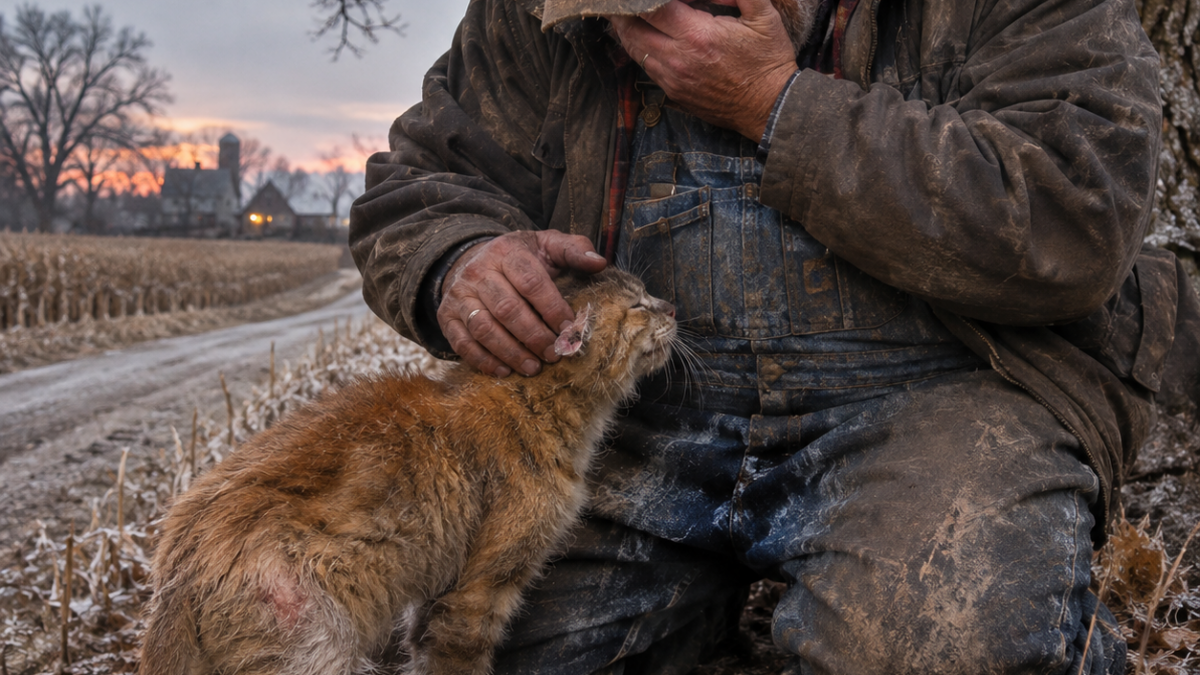
A 250-Pound Farmer Collapsed in the Frozen Mud Calling His Dead Granddaughter’s Name—Then My Feral Stray Cat Did What No Human Had Been Able to Do for Five Years
For five years, Hank Whitmore had blamed himself for the birthday drive that ended with his five-year-old granddaughter dying in a drunk-driving crash, and every November he disappeared alone to the edge of his Indiana farm because he could not bear to let anyone see him break.
My scarred orange stray Rusty trusted no one—not me, not the neighbors, not even the hand that fed him every night—yet when he heard that enormous farmer crying into the frozen mud, he crossed the road, climbed into Hank’s lap, and began to purr.
What neither of us understood that evening was that Rusty’s tiny act of trust would reopen the grief Hank had buried, expose the truth his estranged daughter had never been able to say aloud, and give a shattered family one final chance to forgive the man who had spent years punishing himself for something that was never his fault.
The first thing I remember is the sound.
Not the cold.
Not the darkness gathering over the Indiana fields.
Not even the sight of Hank Whitmore kneeling in the frozen mud beneath the old oak tree.
The sound.
It was not ordinary crying.
It was the kind of sound that makes you stop moving because your body recognizes pain before your mind understands what you are hearing.
A deep, broken cry came across the field.
Then a name.
“Sadie.”
A pause.
“Oh God, Sadie.”
I stopped in the middle of Whitmore County Road 17 with one boot on gravel and the other in dead grass.
My breath turned white in front of me.
The temperature had dropped quickly after sunset, and the November wind moved through the harvested cornfields with a dry, whispering sound.
I almost turned around.
Not because I was afraid of Hank.
Everyone in our part of southern Indiana knew Hank Whitmore.
Or thought they did.
He owned just over four hundred acres bordering the small rental property where I lived.
Soybeans.
Corn.
Cattle.
A machine shed big enough to hold three tractors.
Two grain bins.
One white farmhouse that had probably been standing since before my grandparents were born.
Hank was sixty-two then.
About six-foot-four.
Maybe two hundred fifty pounds.
PART2:
Broad through the shoulders, heavy through the hands, built like the farm machinery he repaired.
His face looked permanently weathered by sun and wind.
Deep lines.
Gray beard.
Faded feed-store baseball cap.
Canvas overalls.
Mud on everything.
If you had asked anyone in town to describe him, they probably would have said the same things.
Quiet.
Dependable.
Hard.
Not cruel.
Hard.
A man who could rebuild a hydraulic pump in sleet without saying a word.
A man who once pulled a neighbor’s truck out of a ditch during an ice storm and left before anyone could thank him.
A man who went to funerals, stood in the back, shook hands, and went home.
I had seen him laugh exactly twice.
Both times at the hardware store.
I had never seen him cry.
That evening he was on his knees.
His enormous body folded forward.
His hands covered his face.
PART3:
And something inside him had completely collapsed.
I knew immediately that I had walked into a moment that did not belong to me.
So I stepped backward.
Slowly.
Quietly.
I thought I could disappear before he noticed.
Then I realized Rusty was not following me.
Rusty had been living under my porch for three weeks.
Living might be too generous a word.
He existed there.
A scarred orange tomcat with half his left ear missing, a ragged notch through the right, and a coat that looked as though he had spent most of his life fighting weather, dogs, other cats, and possibly farm equipment.
The first time I saw him, he was eating from my garbage can.
I opened the back door.
He hissed so violently I nearly apologized to him.
Then he disappeared.
The next evening, he returned.
I left kibble.
He waited until I went inside.
Then ate.
For the next week, that was our arrangement.
I provided food.
Rusty provided contempt.
I tried sitting on the porch.
He stayed under the steps.
I moved the bowl closer.
He moved farther away.
I offered canned food.
He accepted the food and rejected the relationship.
That seemed fair.
Then, sometime during the second week, he started following me on my evening walks.
Not close.
Never close.
Six feet behind.
Sometimes eight.
If I stopped, he stopped.
If I turned toward him, he pretended he had another reason for being there.
He followed me down the county road, past the creek culvert, along the edge of Hank’s fields, then back home.
Every evening.
Same distance.
Same suspicion.
Until that night.
Hank cried beneath the oak tree.
Rusty moved toward him.
At first I thought he had seen a mouse.
“Rusty.”
The cat ignored me.
“Rusty.”
Sharper.
Nothing.
He walked off the gravel.
Across brittle grass silvered with frost.
Straight toward Hank.
My stomach tightened.
A frightened stray cat was unpredictable.
So was a man in grief.
“Rusty, come here.”
The ridiculous part was that Rusty had never once come when called.
Why would he start now?
He reached Hank’s boots.
Hank did not notice.
His face remained buried in both hands.
“Sadie.”
Rusty sniffed one muddy boot.
Then the other.
I held my breath.
He stepped between Hank’s knees.
Pressed his battered orange forehead against the man’s trembling wrist.
And meowed.
Hank gasped.
His hands fell away from his face.
I had never seen eyes like that.
Red.
Swollen.
Tears moving through the deep lines along his cheeks.
He stared down.
Rusty looked up.
For one second, neither moved.
Then Rusty did something he had never done with me.
He climbed onto Hank.
One paw on the man’s thigh.
Then another.
He turned around once on the heavy denim.
Curled into Hank’s lap.
And started purring.
Loud.
Not a faint vibration.
A full, deep rumble.
In the stillness of the field, I could hear it ten feet away.
Hank’s right hand hovered over the cat.
Huge hand.
Scarred knuckles.
Oil beneath the nails.
He looked almost frightened to touch him.
Then, slowly, he lowered his palm.
Rusty’s body did not tense.
Hank stroked once.
From head to tail.
Rusty closed his eyes.
Hank broke again.
But differently.
The violent sobbing stopped.
His shoulders still shook.
Tears still came.
Yet the sound softened.
He leaned over that little orange cat as though afraid the cold wind might take him too.
I should have left.
Instead, I walked off the road.
Sat in the frozen grass about ten feet away.
I said nothing.
Hank said nothing.
Rusty purred.
That was when I noticed the marker.
A flat stone partly hidden beneath dead weeds near the oak.
Not a grave marker.
Too small.
More like something someone had placed there intentionally.
On top sat a wooden bluebird.
Hand-carved.
Painted pale blue.
Tiny black eyes.
Detailed wings.
It looked delicate and strangely beautiful against frozen mud.
We sat there perhaps twenty minutes.
Maybe thirty.
Time becomes difficult around grief.
Eventually Hank wiped his face with the sleeve of his flannel shirt.
His left hand remained on Rusty’s back.
The cat had fallen asleep.
Hank looked at the little wooden bird.
“Her name was Sadie.”
His voice sounded scraped empty.
I swallowed.
“I heard.”
He nodded.
“Today would’ve been her birthday.”
I waited.
“Ten.”
Wind moved through the corn stubble.
I looked at the bluebird.
“Your granddaughter?”
Hank nodded.
“Only one.”
“I’m sorry.”
He reached for the carving.
Lifted it carefully.
The contrast was almost painful.
Massive farmer.
Tiny wooden bird.
“She loved these.”
“Bluebirds?”
“All birds.”
A faint smile appeared.
“She couldn’t say cardinal when she was little.”
“What did she call them?”
“Red chickens.”
I laughed softly before I could stop myself.
Hank did too.
One short sound.
Then his face crumpled.
“God.”
He rubbed his thumb across the carving.
“She followed me everywhere.”
He looked toward the farmhouse in the distance.
“When she was three, she decided she was a farmer.”
“She had pink rubber boots.”
“Wouldn’t wear anything else.”
“Summer.”
“Winter.”
“Church once.”
“Her mother nearly killed me because I told her the boots were fine.”
His smile returned briefly.
“She’d come down to the barn and ask me what every tool was.”
“Then ask again the next day.”
“She couldn’t remember half of it.”
“But she remembered every cow.”
“Named them.”
“Most had terrible names.”
“Princess.”
“Cookie.”
“One she called Truck because apparently cow wasn’t good enough.”
I listened.
This did not feel like a stranger telling me a story.
It felt like somebody opening a door that had been nailed shut from the inside.
Hank looked at Rusty.
“She liked orange cats.”
My throat tightened.
“Did she have one?”
“No.”
“My daughter was allergic.”
He gave a small, broken laugh.
“Sadie still asked every birthday.”
Then silence.
The bluebird remained in his hand.
I knew the question I should not ask.
I asked it anyway.
“What happened?”
Hank’s jaw tightened.
For a moment, I thought I had gone too far.
Then he spoke.
“Five years ago.”
His thumb stopped moving across the wooden bird.
“Her fifth birthday.”
He looked toward the road.
“I promised I’d take her to the diner.”
“Harper’s?”
He nodded.
Harper’s Diner sat seven miles away on Main Street.
Old chrome stools.
Red booths.
Cherry pie served under glass.
“My wife used to take our daughter there.”
“After my wife died, I kept doing it.”
“Then Sadie came along.”
“She loved the pie.”
“She’d eat the filling and leave half the crust.”
“Terrible waste.”
Another small smile.
“I told her all week we’d go.”
“Just me and her.”
“But the night before…”
He stopped.
Rusty shifted.
Hank automatically stroked him.
“The equipment shed door broke.”
“Wind caught it.”
“Bent one hinge.”
“I needed to fix it before weather came.”
“It got dark.”
“So I pulled my truck around.”
“Headlights facing the shed.”
“I worked until almost midnight.”
“Went inside.”
“I was tired.”
He closed his eyes.
“Forgot the lights.”
I knew before he said it.
“Battery.”
“Dead.”
He nodded.
“Completely.”
“The next afternoon, Sadie was dressed and waiting.”
“Birthday dress.”
“Pink boots.”
“Her mother was with her.”
I recognized something in the way he said her mother.
Not my daughter.
Her mother.
Distance.
Pain.
“What was your daughter’s name?”
“Laura.”
He took a long breath.
“I got in the truck.”
“Turned the key.”
“Click.”
“Nothing.”
“I was furious.”
“At myself.”
“At the truck.”
“At everything.”
“I told Laura to take her car.”
“I said I’d jump the truck and meet them.”
“I remember Sadie standing beside the passenger door.”
“She yelled, ‘Don’t eat my pie, Grandpa.’”
Hank’s hand tightened around the bluebird.
“She was laughing.”
I felt my chest constrict.
“They made it three miles.”
His voice flattened.
“Intersection at County 12.”
“Pickup came through the red light.”
“Sixty-one miles an hour according to the crash report.”
“Driver’s blood alcohol was more than twice the legal limit.”
“Hit the passenger side.”
I looked away.
The frozen field blurred.
“Sadie was on that side.”
“Yes.”
“Laura?”
“Broken ribs.”
“Pelvis.”
“Concussion.”
“Collapsed lung.”
“Lived.”
“And Sadie?”
Hank shook his head.
I knew.
Still, hearing nothing felt worse than words.
“Trooper said she probably didn’t know what happened.”
He stared at the dirt.
“People tell you things like that.”
“Probably didn’t feel it.”
“Probably didn’t know.”
“Probably.”
His voice sharpened.
“Hell of a word.”
I didn’t answer.
“I was five minutes behind.”
He continued.
“I got the truck running.”
“Drove toward town.”
“Saw lights.”
“Fire truck.”
“Ambulance.”
“State police.”
“I remember thinking somebody had hit a deer.”
He looked at me.
“I saw Laura’s car.”
His face folded.
“I knew.”
Rusty lifted his head.
Hank’s hand stopped.
The cat stretched one paw against his jacket.
Hank resumed petting him.
“If I’d turned off the damn headlights…”
“No.”
The word escaped me.
Hank looked up.
I stopped myself.
He continued.
“If my truck had started…”
“You don’t know that.”
“We would’ve left five minutes earlier.”
“Or later.”
“I would’ve been driving.”
“Maybe I would’ve seen him.”
“Maybe I would’ve stopped.”
“Maybe I would’ve taken another road.”
“Maybe—”
“Hank.”
He stared at me.
“Maybe nothing.”
He laughed bitterly.
“You don’t understand.”
“I understand enough.”
“No.”
His voice became louder.
“You don’t.”
“I made the mistake.”
“A stupid switch.”
“One stupid switch.”
“And she’s dead.”
The words hung between us.
I wanted to tell him what everyone tells grieving people.
It wasn’t your fault.
But I could feel how useless those words would sound after five years of him building his entire grief around one forgotten headlight switch.
So I said something else.
“The drunk driver made a choice.”
Hank’s face hardened.
“So did I.”
“Forgetting isn’t the same as choosing.”
“You think that matters?”
“Yes.”
“To me?”
“Maybe not yet.”
He stared.
Then looked away.
“People have told me that.”
“I figured.”
“Judge.”
“Pastor.”
“Laura’s counselor.”
“Everybody.”
“And?”
“And Sadie’s still dead.”
There was nothing to say.
So I stayed quiet.
Maybe that was what Rusty understood better than people.
He did not explain.
He did not fix.
He stayed.
Hank eventually said:
“The driver went to prison.”
“How long?”
“Eighteen years.”
“Plea deal.”
“Aggravated vehicular homicide.”
“Laura went to sentencing.”
“I couldn’t.”
“Why?”
He looked toward the farmhouse.
“Because I wanted to kill him.”
Not dramatic.
Matter-of-fact.
“I knew if I saw him, I’d do something that put me in prison too.”
“So I stayed home.”
“Laura never forgave that either.”
“You know that?”
“No.”
He rubbed his face.
“She never said.”
Then came the sentence that seemed to hurt him more than the crash.
“She left.”
I already knew from the original story lines. Need expand.
“When?”
“Two months after funeral.”
“Where?”
“Indianapolis first.”
“Then Chicago.”
“Now somewhere near Milwaukee.”
“You talk?”
Hank looked down.
“Christmas.”
“Sometimes.”
“Text.”
“Birthday.”
“Not Sadie’s.”
“She never calls on Sadie’s.”
“Why?”
“I don’t know.”
“Because she blames you?”
Hank’s jaw tightened.
“Yes.”
“Did she say that?”
“No.”
“Then how do you know?”
“She can’t look at me.”
I thought about that.
“Maybe she can’t look at this place.”
“Same thing.”
“No.”
“It is.”
“Hank.”
He looked at me.
“This farm is full of Sadie.”
His expression changed.
I continued.
“The porch.”
“The barn.”
“The fence.”
“The diner road.”
“The tree.”
“If Laura left, maybe she was running from memories.”
“Not from you.”
He swallowed.
“That’s what people say.”
“You keep saying that.”
“Because people keep trying to make it easier.”
“What if they’re not?”
He looked annoyed.
“What if they’re right?”
He almost responded.
Then stopped.
Rusty stood.
Turned around.
Resettled.
His tail curled against Hank’s arm.
Hank looked at him.
“Where’d you get this cat?”
“I didn’t.”
“What?”
“He got me.”
That made Hank smile.
“He lives under my porch.”
“You feed him.”
“Yes.”
“Then he’s yours.”
“Tell him that.”
Hank scratched Rusty’s scarred ear.
“What happened to him?”
“No idea.”
“Coyotes?”
“Maybe.”
“Fight?”
“Probably several.”
“Somebody owned him?”
“I don’t know.”
“Does he let you touch him?”
“No.”
Hank looked at me.
Then at the cat sleeping in his lap.
“Well.”
“Exactly.”
For the first time that evening, Hank laughed.
Not much.
But enough.
Darkness deepened.
I eventually stood.
My legs had gone numb.
Hank carefully lifted Rusty.
The cat stretched but did not resist.
Hank placed him on the grass.
Then stood.
He looked enormous again.
Same man.
Same shoulders.
Yet something about him seemed less closed.
He slipped the wooden bluebird inside his jacket.
Near his heart.
“Thank you.”
“I didn’t do anything.”
“You stayed.”
The words landed harder than I expected.
Hank looked at Rusty rubbing against his boots.
“He did too.”
Then he walked toward the farm.
After perhaps twenty yards, he turned.
“You walk this road tomorrow?”
“Usually.”
“Same time?”
“About.”
Hank nodded.
“Bring him.”
I looked at Rusty.
“Apparently I’m his transportation manager now.”
Hank almost smiled.
“It gets lonely.”
Then he disappeared into the dusk.
Rusty and I walked home.
For the first time since meeting him, he stayed beside my boots.
Not six feet behind.
Beside me.
That should have been the end of the story.
It wasn’t.
The next evening, Hank was waiting beneath the oak.
Standing.
Coffee in hand.
No crying.
Rusty saw him.
Ran.
Actually ran.
Hank crouched.
Rusty went straight into his hands.
I stopped walking.
“So that’s how it is?”
Rusty ignored me.
Hank laughed.
“He knows quality.”
“Traitor.”
That became a routine.
Not daily.
Then almost daily.
Hank would finish work around five.
I walked around five-thirty.
Rusty came.
Sometimes we talked.
Sometimes not.
Hank built a bench near the tree after two weeks.
“Ground’s too cold.”
He said.
The bench was ugly.
Overbuilt.
Could probably survive a tornado.
Rusty approved.
We drank coffee.
Talked weather.
Crops.
Football.
Fuel prices.
Sometimes Sadie.
Not always.
Grief is easier to live beside when it is not required to perform every time.
Rusty changed too.
He began spending evenings at Hank’s barn.
Then mornings.
Then nights.
I pretended not to notice.
One Saturday, Hank appeared on my porch carrying a bag of expensive cat food.
“Your cat’s getting thin.”
“My cat?”
“He sleeps at my barn.”
“Then he’s your cat.”
Hank considered.
“Joint custody.”
That was how it began.
By January, Rusty allowed me to pet him.
By February, Hank had built him a heated box inside the barn.
By March, Rusty preferred the farmhouse.
I was offended.
But not very.
Hank needed him more.
Then something happened in April.
Laura called.
I was at Hank’s kitchen table when the phone rang.
I knew it was unusual because Hank stared at the screen without answering.
“Who?”
He showed me.
LAURA
“Answer.”
“I will.”
He didn’t.
“Hank.”
“I know.”
Rusty sat beneath the table.
Hank finally accepted.
“Hello.”
I stood.
He waved me down.
“Dad?”
A woman’s voice faintly came through.
“Yeah.”
Silence.
Then:
“Are you busy?”
Hank looked toward the window.
“No.”
That was a lie.
He was rebuilding a planter box.
But nothing was more important.
Laura asked about a legal envelope.
The county prosecutor’s office had contacted her.
The man who killed Sadie, Martin Cole, was becoming eligible for a parole-review hearing.
Not release.
Review.
The state wanted victim-family statements.
Hank’s face changed.
“When?”
“June.”
“You going?”
“I don’t know.”
Another silence.
Then Laura asked:
“Are you?”
Hank looked at me.
“No.”
Her voice sharpened.
“Of course.”
Hank flinched.
The call ended badly.
Not screaming.
Worse.
Cold.
When he hung up, he stared at the wall.
“She does blame me.”
I was quiet.
“She said ‘of course.’”
“That could mean ten things.”
“It means one.”
“Hank.”
He stood.
“I should’ve gone to sentencing.”
“You told me why you didn’t.”
“She needed me.”
“Maybe.”
“I wasn’t there.”
“That part you can own.”
He looked at me.
“But not the crash.”
He turned away.
We did not speak for several minutes.
Rusty jumped onto the chair beside him.
Hank stroked him automatically.
Two days later, Hank received the parole packet.
He left it unopened.
For a week.
Then another.
Finally I said:
“If you don’t want to speak, don’t.”
“I don’t.”
“Then write.”
“No.”
“Why?”
“What would I say?”
“The truth.”
He laughed bitterly.
“What truth?”
“That you hate him.”
“That you hate yourself.”
“That you miss Sadie.”
“That you’re scared Laura hates you.”
“That you carved a bird five years ago and still carry it every November.”
Hank stared.
“You make therapy sound unpleasant.”
“Probably why I don’t do it professionally.”
He opened the packet.
The victim-impact form had boxes.
Spaces.
Legal language.
Hank hated paperwork.
He wrote three sentences.
Then tore it up.
Another page.
Tore it up.
Finally he wrote:
My granddaughter Sadie was five years old when Martin Cole killed her. I have spent five years thinking that because my truck would not start, I somehow helped cause her death. I know now that his decision to drive drunk belongs to him, even if I am still learning how to believe that. I do not want revenge. I want the court to understand that one selfish decision did not end one life—it changed every life around hers.
He stopped.
I stared.
Hank looked embarrassed.
“Too much?”
“No.”
“Sounds weak.”
“No.”
He added:
I also failed my daughter after the crash because I disappeared into my own guilt when she needed her father. That failure is mine. I intend to repair what I can while I still have time.
That line mattered more than the first.
He mailed it.
Then he called Laura.
No answer.
He left a voicemail.
“I’m going to the hearing.”
Pause.
“If you want me there.”
Another pause.
“If you don’t, I’ll stay outside.”
“I won’t make it harder.”
“I just wanted you to know.”
He hung up.
Laura called three days later.
“You can come.”
Hank sat down.
“Okay.”
“But don’t talk to me about the truck.”
His face tightened.
“Okay.”
“I mean it.”
“I won’t.”
“I can’t do that again.”
“Okay.”
They attended together.
I did not go.
It wasn’t my place.
Rusty stayed with me that day.
Hank returned after dark.
He parked outside my house.
Sat in the truck.
Rusty jumped onto the hood.
I walked out.
“How’d it go?”
Hank remained behind the steering wheel.
“Parole denied.”
“How do you feel?”
He thought.
“Nothing.”
Fair.
“Laura?”
His eyes filled.
“She hugged me.”
That was everything.
He got out.
Rusty moved to his lap the moment he sat on my porch.
Hank laughed through tears.
“She hugged me.”
Then repeated:
“She hugged me.”
The relationship did not repair overnight.
That would have been dishonest.
Laura still lived far away.
Still avoided the farm for months.
Still had anger.
Still had trauma.
Hank still blamed himself reflexively.
Still said:
If I’d remembered the lights.
But less often.
Then, in August, Laura came home.
Not alone.
She brought her husband, Michael, whom Hank had met only twice.
And her seven-year-old son.
Eli.
Sadie had died before Eli was born.
That fact carried its own complicated grief.
Hank stood on the porch as their car came up the drive.
He looked terrified.
“You’ve faced bulls.”
I told him.
“Shut up.”
“Tractor fires.”
“Not helping.”
“Tax audits.”
“Go home.”
Rusty sat beside his boot.
The car stopped.
Laura stepped out.
For one moment, father and daughter looked at each other across fifteen feet of gravel.
Laura had Hank’s eyes.
I had not expected that.
She walked forward.
Hank did not move.
Then she said:
“Hi, Dad.”
His chin trembled.
“Hi, sweetheart.”
That word almost broke both of them.
Eli emerged.
“Is that Rusty?”
Hank blinked.
“You know Rusty?”
“Mom showed me pictures.”
Laura looked away.
That detail mattered.
She had been looking at Hank’s pictures.
Keeping track.
Rusty walked toward Eli.
Sniffed him.
Allowed a cautious touch.
Hank seemed offended.
“Took me weeks.”
Eli grinned.
“I’m better.”
Lunch was awkward.
Then less awkward.
No one mentioned the crash until evening.
Eli was playing outside.
Michael had gone with him.
Laura and Hank sat at the kitchen table.
I was leaving.
Laura stopped me.
“You can stay.”
I did not know whether I should.
Hank looked at me.
Stay.
So I did.
Laura stared at her coffee.
“I never blamed you for the truck.”
Hank froze.
The room became completely silent.
He looked at her.
“What?”
“I never blamed you.”
His face changed.
“Laura.”
“I blamed you for disappearing.”
He swallowed.
“I was there.”
“No.”
She shook her head.
“You were physically there.”
“You worked sixteen-hour days.”
“You stopped eating dinner with me.”
“You wouldn’t say Sadie’s name.”
“You wouldn’t go into her room.”
“You didn’t go to sentencing.”
“I thought—”
“You thought you were protecting me?”
“No.”
He looked down.
“I thought I was poison.”
Laura began crying.
Hank looked up.
She continued.
“Do you know why I left?”
“Because this place…”
“Yes.”
“The farm hurt.”
“Everywhere.”
“She was everywhere.”
“But you were too.”
Hank’s eyes filled.
“I couldn’t grieve with you because you had decided your grief was a punishment.”
He said nothing.
Laura wiped her face.
“You kept saying the battery.”
“The lights.”
“The truck.”
“Dad, I lost my daughter.”
“And then I lost my father to guilt.”
Hank covered his mouth.
Rusty jumped onto the table.
Of course.
Cats do not respect emotional timing.
He walked between them.
Laura laughed through tears.
“What is this?”
“Rusty.”
“I know.”
“He’s not supposed to be on the table.”
“He doesn’t care.”
Rusty sat directly in front of Hank.
Laura reached out.
Rusty sniffed her hand.
Then walked toward her.
Hank whispered:
“Traitor.”
Laura smiled.
That was the first moment father and daughter laughed together in my presence.
Then Hank said:
“I’m sorry.”
Laura looked at him.
“No explanation.”
“No excuse.”
“I left you alone while standing right beside you.”
“I’m sorry.”
Laura cried harder.
Hank stood.
Walked around the table.
Stopped.
He did not touch her until she moved first.
She stood.
Hugged him.
The sound Hank made reminded me of the first evening under the oak.
But this time he was not alone.
Rusty watched from the table.
I looked away.
Some moments deserve privacy even if you’re in the room.
Later, Laura asked about the bluebird.
Hank went still.
“You still have it?”
“Every year.”
“Can I see it?”
He brought it down from his bedroom.
She held it.
The paint had faded slightly.
One wing showed wear from years of handling.
Laura traced the carving.
“She would have loved this.”
“I know.”
“You carved it for her?”
“The night before.”
She looked at him.
“Why didn’t you give it to me?”
Hank was confused.
“What?”
“After.”
“I thought…”
“What?”
He shook his head.
“I don’t know.”
Laura looked at the bird.
“Can I keep it?”
Pain crossed his face.
Then acceptance.
“Yes.”
She held it against her chest.
“Thank you.”
For the first time in five years, the wooden bluebird left Hank’s possession.
He cried after they drove away.
Not because he regretted giving it.
Because he had finally allowed a memory of Sadie to belong to somebody besides his guilt.
Weeks later, Laura mailed a package.
Inside was a photograph.
Sadie at four.
Pink cowboy boots.
Standing beside Hank’s tractor.
A bluebird perched on the fence behind her.
On the back Laura wrote:
For the bench.
Hank framed it.
Placed it near the oak only when weather was good.
He still brought it inside at night.
Some habits are love.
Not fear.
The parole hearing returned every few years.
Martin Cole was eventually released after serving most of his sentence.
That news frightened everyone.
Not because Hank planned revenge.
Because release made the man real again.
Laura called.
“Are you okay?”
Hank said:
“No.”
She replied:
“Me neither.”
That was progress.
They spoke.
Neither pretended.
A month later, a letter came.
From Martin.
Hank recognized the return address.
He left it unopened for three days.
Then brought it to the bench.
Rusty climbed into his lap.
I sat beside him.
“You want me to open it?”
“No.”
“You want me to leave?”
“No.”
He opened it.
Martin’s letter was not dramatic.
No excuses.
He said he had been twenty-nine.
Drinking after losing his job.
Angry.
Drove anyway.
He remembered entering the intersection.
Then impact.
Then prison hospital.
He had spent years knowing a child died because of him.
He did not ask forgiveness.
He wrote:
I know there is no sentence I can serve that brings Sadie back. I know saying I am sorry does not repair what I destroyed. I will carry what I did for the rest of my life. I am not asking you to answer.
Hank read it twice.
Then folded it.
“What do you think?”
I asked.
“I hate him.”
“Okay.”
“I believe him.”
“Both can happen.”
He nodded.
“I’m not forgiving him.”
“You don’t have to.”
Hank stared at Rusty.
“I spent years thinking somebody needed to forgive me.”
“Laura.”
“God.”
“Sadie.”
“Me.”
He looked toward the field.
“Maybe I was asking the wrong question.”
“What question?”
“Maybe you don’t wait until guilt disappears.”
“Maybe you just stop making a home for it.”
I had no better answer.
Hank never wrote Martin back.
Laura did.
Months later.
She did not forgive him either.
She simply wrote:
I received your apology. I hope you live the rest of your life in a way that proves you understand what you took from us.
That was enough.
Time moved.
Rusty became less rusty.
Not in color.
In condition.
Good food thickened his coat.
Vet care cleared infections.
The half ear remained.
Scar remained.
He became pleasantly overweight.
Hank denied this.
Dr. Patel? This isn’t same story. New local vet Dr. Collins called him fat.
Hank was offended for a week.
“He’s winter-ready.”
“He is shaped like a pumpkin.”
Rusty moved permanently into Hank’s farmhouse during year two.
I retained visitation rights.
He still joined my walks.
Mostly when he felt like it.
Every Friday at 5:30, we met beneath the oak.
Not every day anymore.
Friday became intentional.
Hank said routine helped.
Coffee.
Bench.
Rusty.
Sometimes Laura joined by video.
Sometimes she came in person.
Eli came during summers.
He added another small carving beside the stone marker.
A red chicken.
For cardinal.
Laura laughed until she cried.
The marker changed too.
Originally plain.
Eventually Hank had Sadie’s name engraved.
SADIE WHITMORE
2014–2019
SHE LOVED BIRDS, PINK BOOTS, AND CHERRY PIE
He asked Laura before doing it.
She said yes.
On what would have been Sadie’s fifteenth birthday, the family did something new.
They went to Harper’s Diner.
Hank had not entered since the crash.
Ten years.
The owner remembered him.
“Coffee?”
Hank nodded.
Then Laura said:
“And cherry pie.”
The waitress brought one large slice.
Four forks.
Hank stared.
Eli immediately ate the filling and left crust.
Everyone went silent.
Then Laura laughed.
“Oh my God.”
Hank covered his face.
“What?”
“She did that.”
“I know.”
Eli looked confused.
“Who?”
“Your sister.”
He smiled.
“Then it’s genetic.”
That was the first birthday anniversary where laughter lasted longer than crying.
Not because grief ended.
Because grief had finally made room.
Years passed.
Hank slowed.
The farm did not.
But he did.
He leased more acreage to another farmer.
Kept cattle.
Fixed fewer things himself.
Eli grew tall.
Laura visited more.
She and Hank never became the family they might have been without the crash.
That family was gone.
What they built instead was different.
More careful.
More honest.
They stopped saying:
I’m fine.
They started saying:
Today is bad.
Or:
I miss her.
Or:
I need you.
Rusty helped with that somehow.
Maybe because animals make silence less threatening.
You can sit beside a person with a cat between you and not feel pressured to fill every second.
Rusty grew old too.
His muzzle lightened.
Jumping became climbing.
Hank built steps beside the bench.
Then steps to the bed.
Then steps to the tractor seat.
I asked:
“Why does a cat need to be on the tractor?”
Hank looked genuinely confused.
“He supervises.”
“Of course.”
At fifteen, Rusty developed kidney disease.
We did not know his true age.
Vet estimated maybe three or four when I found him.
So fifteen was approximate.
Hank took every medication schedule more seriously than planting season.
Fluids.
Renal food.
Checkups.
He kept a notebook.
I joked that Rusty had better medical records than Hank.
True.
One November evening, almost eleven years after the first night under the oak, Rusty did not follow us outside.
He remained curled near the wood stove.
Hank knew.
I knew.
He carried Rusty to the bench anyway.
Wrapped in a blanket.
The sky was clear.
Cold.
Exactly like that first evening.
Hank sat.
Rusty in his lap.
I beside them.
Laura arrived unexpectedly.
She had driven three hours.
Eli with her.
Now a teenager.
Nobody needed to explain.
Rusty barely opened his eyes.
Hank stroked the scarred ear.
“You remember this place?”
The cat purred.
Faint.
Still there.
Hank smiled.
“He always did that.”
Laura sat on the other side.
“What?”
“First night.”
“He just walked over.”
“I’ve heard the story a thousand times.”
“You haven’t heard it correctly.”
“Oh?”
Hank looked at me.
“She was trying to sneak away.”
I protested.
“I was respecting your privacy.”
“You were running.”
“I was retreating tactically.”
Eli laughed.
Rusty purred again.
Hank’s eyes filled.
“When I think about that night…”
He looked toward the stone marker.
“I don’t remember the crying first anymore.”
That surprised me.
“What do you remember?”
“This idiot.”
He scratched Rusty’s head.
“Climbing into my lap.”
Rusty died two days later.
At home.
Hank held him.
I was there.
Laura was there.
No emergency.
No suffering prolonged beyond what was fair.
When the veterinarian left, Hank remained sitting in his chair with Rusty’s collar in his hand.
Tiny handmade leather collar.
Hank had made it years earlier.
Stamped inside:
RUSTY WHITMORE-BENNETT
Joint custody preserved forever.
We buried Rusty beneath the oak.
Near Sadie’s marker.
Not beside it as though animal and child were equivalent.
They were not.
But near enough to tell the truth.
Rusty had become part of the place where Hank learned to grieve differently.
Hank carved the marker himself.
Small.
Orange-stained cedar.
RUSTY
HE STAYED
That was all.
Laura cried when she saw it.
So did I.
Hank did not.
Not then.
The next Friday at 5:30, I almost did not go.
What was the point?
No Rusty.
Cold weather.
Hank might want privacy.
Then I remembered the first night.
You stayed.
So I went.
Hank was already on the bench.
Two thermoses.
He handed me one.
We sat.
Empty space between us.
After several minutes, Hank said:
“Feels wrong.”
“Yes.”
“I keep waiting for him to jump up.”
“Me too.”
Wind moved through the field.
Then he laughed.
“He would’ve hated this cold.”
“He lived outside for years.”
“Still hated it.”
We drank coffee.
The empty space remained.
But we stayed.
Every Friday after that.
Sometimes Laura joined.
Sometimes Eli.
Sometimes just us.
Fourteen years after Sadie’s death, Hank turned seventy-one.
He sold most of the farm to a neighboring family under an agreement protecting the oak and memorial area.
Laura worried he would resist leaving the farmhouse.
He did.
Then a hip replacement changed his opinion.
He moved into a smaller place near town.
Not assisted living.
He would like that distinction noted.
The bench remained.
We still visited.
One spring afternoon, Hank handed me a box.
Inside was the first bluebird carving.
I stared.
“Laura gave it back?”
“No.”
“She had this made.”
I turned it over.
The original carving remained with Laura.
This was a replica made by Eli in high-school shop class.
At the bottom he had burned two dates.
Sadie’s birthday.
And the date Rusty first climbed into Hank’s lap.
I looked at him.
“Hank.”
“Put it somewhere.”
“Why me?”
“Because you saw it.”
“Saw what?”
“The night things changed.”
I thought about correcting him.
The night did not erase guilt.
It did not repair Laura.
Did not change the crash.
Did not resurrect Sadie.
But maybe change does not need to be total to be real.
“I’ll keep it.”
“Good.”
Hank looked toward the oak.
“You know, I used to think if I stopped blaming myself, it’d mean I loved her less.”
That sentence stayed with me.
He continued.
“Like guilt was the last thing I could still do for her.”
I swallowed.
“What changed?”
He smiled.
“Rusty.”
“A cat taught you philosophy?”
“No.”
“Cat taught me sitting still.”
“Laura taught me the rest.”
He looked toward Sadie’s marker.
“She never needed me to suffer.”
“I needed to remember her.”
“Different thing.”
We sat quietly.
Then Hank said:
“I finally believe it.”
“What?”
“That it wasn’t my fault.”
I looked at him.
For years, I had wanted to hear that.
By then, I knew better than to celebrate too loudly.
I only said:
“Good.”
He nodded.
“Still wish I turned off those lights.”
“Of course.”
“Still wish my truck started.”
“Of course.”
“Still imagine ten versions where she’s alive.”
“I know.”
“But I don’t live in them anymore.”
That was healing.
Not forgetting.
Not forgiveness of every person.
Not pretending tragedy had a purpose.
Simply no longer living inside the alternate version of one afternoon.
Hank died at seventy-six.
Heart.
Quick.
At home.
Laura found him after he failed to answer the phone.
On his nightstand:
A photograph of Sadie.
A photograph of Rusty.
The small red-chicken carving Eli had made.
His funeral filled the church.
Farmers.
Mechanics.
People from town.
Men who had known Hank forty years and admitted they had never seen him cry.
Laura spoke.
She told the story.
Not of the crash.
Of the oak tree.
Of Rusty.
Of Hank learning to say Sadie’s name again.
She stood behind the pulpit and said:
“My father spent years believing strength meant suffering quietly.”
“He was wrong.”
The church became still.
“He learned, very late, that grief shared is not grief weakened.”
“That lesson gave me my father back.”
Then she looked toward me.
“And apparently it took one half-eared orange cat to teach him.”
People laughed through tears.
After the funeral, we went to the oak.
Laura.
Eli.
Me.
A few close friends.
We poured black coffee into paper cups.
Left one cup on the bench for Hank.
Probably environmentally irresponsible.
He would have approved.
Eli placed a new carving near the marker.
A tiny tractor.
Laura said:
“He would’ve complained the tires were wrong.”
Eli smiled.
“They are.”
We stayed until sunset.
That has been years now.
The farm belongs to another family.
The oak remains.
The bench has been replaced once.
Sadie’s marker remains.
Rusty’s cedar marker has weathered almost silver.
I still have the bluebird replica.
It sits on a shelf near my front door.
People ask about it occasionally.
I tell them:
A farmer carved one for his granddaughter.
A cat sat in his lap.
That’s the short version.
The long version is harder.
The long version is about how guilt can imitate love so convincingly that a person begins to believe suffering is loyalty.
It is about a father who watched his daughter disappear because both were grieving the same child in opposite directions.
It is about a drunk driver whose decision destroyed a family and a legal system that could punish him but could not repair them.
It is about a daughter who spent years unable to return to the place where her child had once laughed.
It is about a massive farmer who could repair engines, fences, tractors, roofs, and broken machinery but had no idea how to repair himself.
And yes, it is about an orange stray cat.
A cat who had every reason to distrust people.
Half an ear.
Scarred face.
Dirty coat.
No obvious history of kindness.
Yet when he saw a man collapsed in frozen mud, Rusty did the exact thing no human around Hank had known how to do.
He walked closer.
Not with advice.
Not explanations.
Not forgiveness.
Not demands.
He simply put his body against somebody in pain.
Then stayed.
Sometimes I wonder why.
Did Rusty hear something in Hank’s voice?
Did he smell grief?
Did he simply want warmth?
Was he drawn to the stillness?
Nobody knows.
I stopped needing to know.
Human beings are obsessed with reasons.
Animals are often better at moments.
Hank was hurting.
Rusty approached.
That is enough.
The first evening I ever saw them together, I believed I was witnessing one act of comfort.
I had no idea it would last years.
Every Friday.
5:30.
Rain.
Snow.
Summer heat.
Two men, later an old man and an older friend, sitting beneath an oak.
Black coffee.
Sometimes silence.
Sometimes Sadie.
And an orange cat curled into Hank’s lap as though that was where he had always belonged.
For years, people in town thought Rusty was Hank’s cat.
They were wrong.
Then they thought he was mine.
Also wrong.
Rusty belonged to the road between us.
To the porch where he first learned food could appear without a trap.
To the barn where he learned hands could scratch without hurting.
To the oak where he learned a huge crying man could be safe.
To the farmhouse where he grew fat.
To the bench where he spent countless evenings sleeping through conversations he accidentally made possible.
Maybe that’s what family is sometimes.
Not ownership.
Not blood.
Not even intention.
Just repeated presence.
You stayed yesterday.
So I trust you today.
Hank once told me the worst part of losing Sadie was not the funeral.
Not the hospital.
Not the courtroom.
It was waking up weeks later and realizing the world had continued.
Sunrise.
Cows needed feeding.
Mail arrived.
People bought groceries.
Football games happened.
The diner still served cherry pie.
He hated the world for continuing.
Years later, he told me something different.
“Turns out that’s the mercy too.”
I asked what he meant.
He said:
“World keeps going long enough for you to catch up.”
I think about that often.
The world did not stop when Sadie died.
It did not stop when Laura left.
It did not stop when Rusty appeared beneath my porch.
It did not stop when Hank fell apart beneath the oak.
It kept moving.
And eventually, very slowly, Hank moved too.
Not away from Sadie.
Forward with her.
There is a difference.
On what would have been Sadie’s twenty-fifth birthday, Laura returned to the farm.
By then Hank was gone.
Rusty too.
Eli was an adult.
They brought cherry pie.
Laura placed a piece on the bench.
Then laughed.
“Dad would say that’s a waste.”
Eli answered:
“Rusty would’ve eaten it.”
I sat beside them.
We talked about Sadie.
Not the crash.
Sadie.
The girl.
Pink boots.
Red chickens.
Bad cow names.
Cherry filling without crust.
The distinction mattered.
For years, her death had swallowed her life.
By then, her life had become larger again.
That might be the kindest thing memory can eventually do.
The sun went down.
Wind moved through the fields.
For one irrational second, I expected an orange shape to appear along the gravel.
Six feet behind.
Keeping distance.
Watching.
Nothing came.
I smiled anyway.
Because the empty road no longer felt empty in the same way.
Some presences survive as habits.
I still glance toward Hank’s old barn.
Still check the porch when I hear a cat outside.
Still stop when somebody says Sadie’s name.
Still remember the sound of Rusty’s purr beneath that oak.
Deep.
Steady.
Almost absurdly loud.
I remember Hank’s hand suspended above him.
A man terrified to touch something gentle.
Then lowering.
One stroke.
Then another.
His shoulders relaxing.
His breathing slowing.
That was the exact moment the future changed.
Not dramatically.
Nobody knew.
No music.
No revelation.
Just one broken man discovering he could be touched without being asked to explain himself.
If Rusty had turned back that evening, perhaps Hank and Laura still would have found one another.
Maybe.
I do not build my life around alternate versions anymore either.
I learned that from Hank.
What happened is enough.
Rusty walked forward.
Hank let him stay.
I sat down.
Years followed.
That is the story.
A farmer lost a granddaughter.
A father lost a daughter.
A daughter lost a child.
A stray cat found two homes.
And somewhere beneath an old Indiana oak tree, a man who had spent five years believing pain was the only thing he still owed the dead finally learned something much harder.
The people we lose do not need us to remain broken in order to prove that they mattered.
Sadie mattered when Hank cried.
She mattered when he laughed.
She mattered when Laura came home.
She mattered when they ate cherry pie.
She mattered when Hank stopped blaming himself.
Maybe especially then.
And Rusty?
Rusty never knew any of that.
He was just a cat.
He wanted warmth.
Food.
A lap.
Perhaps that is why he succeeded where the rest of us struggled.
He never tried to convince Hank to move on.
He simply showed him that even in the middle of unbearable grief, something living could still choose to come close.
Sometimes that is where healing begins.
Not with the right words.
Not with answers.
Not with forgetting.
With someone—or something—seeing you at your worst and deciding not to walk away.








