A 19-Year-Old Walmart Worker Found a Cat Dragging Two Broken Legs Toward the Store Lights—Then He Saw How Far She Had Crawled
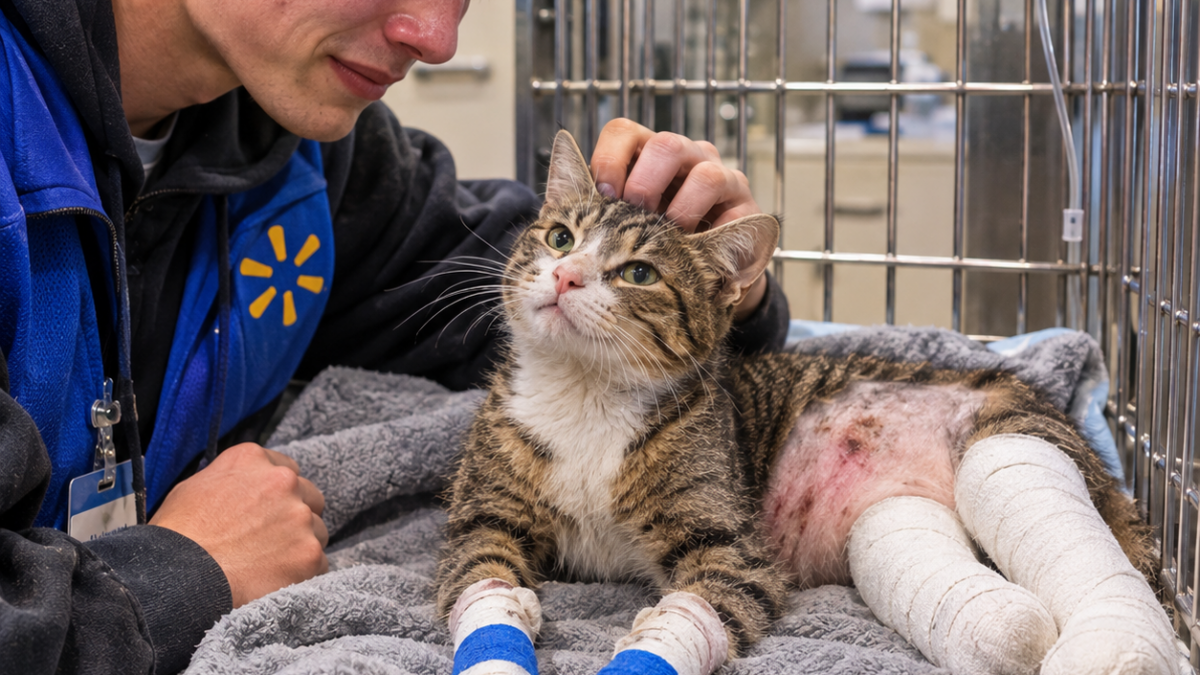
A 19-Year-Old Walmart Worker Found a Cat Dragging Two Broken Legs Toward the Store Lights—Then He Saw How Far She Had Crawled.
At 11:50 p.m., nineteen-year-old Ethan Cole thought the tiny shape dragging itself across a Walmart parking lot was a plastic bag caught in the wind—until it lifted its head and pulled two useless back legs another inch toward the store lights.
Behind the little tabby, a thin smear of blood stretched back toward the road, and when Ethan realized she had crossed nearly forty feet of rough asphalt using only her front paws, he understood she had not been crawling away from the place where she was hit—she had been crawling toward people.
But when the store doors were about to close, his manager told him the injured animal could not come inside, and Ethan had only seconds to decide how much he was willing to risk for a cat who had already risked everything just to reach him.
The parking lot was almost empty by the time Ethan Cole started his final cart run.
It was 11:47 on a Wednesday night in late September, and the Walmart on the south side of Tulsa had entered that strange final stage before closing when everything felt both busy and abandoned.
Inside, registers were being counted.
The overnight crew had started pulling pallets toward the aisles.
The pharmacy gate was already down.
A tired mother hurried toward her minivan with two children and a cart full of groceries.
A man in work boots loaded cases of bottled water into the bed of a pickup.
Somewhere near the garden center, an employee was dragging a stack of empty propane cages into position for the night.
Ethan knew those sounds.
He had worked there almost eleven months.
Cart wheels rattling over cracked pavement.
Automatic doors opening and closing.
Shopping carts banging together.
A distant announcement reminding customers the store would close in ten minutes.
The low mechanical hum of parking-lot lights.
It was not a glamorous job.
Ethan made $12.50 an hour.
Most nights, his uniform consisted of a reflective vest over whatever clean polo he had managed to find, worn sneakers, and jeans that always seemed to smell faintly of hot asphalt no matter how many times his mother washed them.
He was nineteen.
He had finished high school the year before.
Community college had lasted one semester.
Not because he had failed.
Because his mother’s hours at the medical billing office had been cut, rent had gone up, and somebody needed to cover the electric bill while they figured out what came next.
So Ethan took more shifts.
He told people it was temporary.
Almost a year later, he was still pushing carts.
That did not bother him as much as people assumed.
He liked knowing what needed to be done.
Find carts.
Bring them back.
Help somebody lift a television into a truck.
Jump-start a customer’s dead battery.
Take trash to the compactor.
Simple problems.
Visible solutions.
Life outside the parking lot rarely worked that way.
Ethan’s father had left when he was twelve.
Not dramatically.
No police.
No final argument.
He simply moved to Texas for “work” and gradually became a birthday text, then a Christmas text, then occasionally a Facebook reaction from a man Ethan barely recognized.
His mother, Rachel, never spoke badly about him.
That somehow made Ethan angrier.
PART2:
At nineteen, Ethan had developed a quiet suspicion of people who said they would come back.
He believed actions more than promises.
That night he was mostly thinking about going home.
His shift ended at midnight.
His mother had texted him at ten:
CHILI IN FRIDGE. DON’T EAT THE CHEESE I BOUGHT FOR LUNCH.
He had replied:
NO PROMISES.
She had sent a thumbs-down emoji.
He smiled when he thought about it.
Then he pushed another row of carts toward the entrance.
He was halfway across the far end of the lot when he saw something move.
Low to the ground.
Near the painted line separating the main parking area from the access road.
Ethan stopped.
At first he assumed it was trash.
Plastic bags skittered across that lot constantly.
Sometimes flattened cardboard boxes moved strangely in the wind.
But there was almost no wind.
PART3:
The object moved again.
Not sideways.
Forward.
Slowly.
Ethan squinted.
“Hey?”
Nothing.
He left the carts.
Walked closer.
The thing moved another few inches.
That was when Ethan saw ears.
Small.
Triangular.
A head.
He ran.
“Oh, God.”
It was a cat.
A small brown-and-gray tabby.
Maybe seven pounds.
Maybe less.
She was lying flat against the asphalt.
Her front paws stretched forward.
Her claws caught the rough surface.
Then she pulled.
Her shoulders moved.
Her chest slid.
Her entire body advanced perhaps two inches.
The back half of her did not move on its own.
Both hind legs trailed behind her.
Wrong.
Loose.
One turned at an angle Ethan knew legs were not supposed to turn.
The cat stopped.
Panted.
Then reached forward again.
Claws scraped.
Pull.
Slide.
Stop.
Ethan’s stomach turned.
“Hey, hey, hey.”
He approached carefully.
The cat looked toward him.
Her eyes were enormous.
Gold-green.
Her mouth open.
Breathing fast.
She did not hiss.
Did not try to run.
Could not.
Ethan crouched a few feet away.
“Easy.”
She tried pulling herself again.
Toward him.
No.
Not exactly toward him.
Toward the building.
Toward the entrance lights behind him.
Ethan looked back.
At nearly midnight, the automatic doors were the brightest thing in the parking lot.
White light spilling across the sidewalk.
People.
Movement.
Safety, perhaps.
He turned toward the road.
Then noticed something dark on the pavement.
A mark.
He stood.
Walked backward along the cat’s path.
Three feet.
Five.
Ten.
The mark became clearer.
Blood.
Not much.
A small reddish smear near the access lane.
A few spots.
Then faint scrape marks across the asphalt.
Ethan looked back at the cat.
She had moved again.
Another inch.
He began counting his steps.
One.
Two.
Three.
By the time he reached the first blood spot, he was almost forty feet away.
He stared.
“No.”
He turned toward the cat.
There was no way.
She had been struck near the road.
Then dragged herself all the way toward the store.
Using her front legs.
Her back legs trailing.
Across asphalt.
Ethan ran back.
This time he knelt beside her.
“Okay.”
The cat’s front paws were bloody.
At first he thought the blood came from the accident.
Then he saw the claws.
Several were worn almost to the quick.
One nail was split.
The pads were scraped.
She had clawed herself forward until her own feet bled.
Something inside Ethan snapped into focus.
No more hesitation.
He slipped off his reflective vest.
Then his work jacket beneath it.
He folded the jacket.
“I’m going to pick you up.”
The cat stared.
He had no idea whether speaking helped.
It helped him.
“Don’t bite me.”
No reaction.
“Actually, bite me if you need to. Just don’t move.”
He slid one hand beneath her chest.
The other beneath her hips.
The moment he touched her lower body, she stiffened.
A tiny sound escaped.
Not a full meow.
More like air catching in her throat.
Ethan froze.
“Sorry.”
He adjusted.
Supported everything.
Then lifted.
The cat weighed almost nothing.
Her hind legs hung.
Ethan felt sick.
She panted against his arm.
For one second, she looked at his face.
Then something happened he would later repeat every time anybody asked why he had cared so much about a cat he had known less than a minute.
She put her head against his forearm.
That was it.
She stopped trying to move.
Forty feet of crawling.
Claws worn bloody.
Body dragging over asphalt.
Then a stranger picked her up.
And she stopped.
Ethan stood there in the Walmart parking lot at 11:52 p.m. holding an injured cat against his chest.
“She knew,” he later told his mother.
Rachel would ask, “Knew what?”
And Ethan would never have a perfect answer.
That she had been found.
Maybe.
That somebody else would carry her now.
He walked quickly toward the entrance.
One of his coworkers, Jamal Reed, was pushing a cart train toward him.
Jamal was twenty-three, broad-shouldered, permanently cheerful, and somehow capable of making a ten-hour retail shift sound like a comedy routine.
He saw Ethan.
Stopped.
“What happened?”
“Cat got hit.”
Jamal’s expression changed instantly.
“Is she alive?”
“Yes.”
He looked at the legs.
“Oh, man.”
“Call somebody inside.”
“Animal control?”
“It’s midnight.”
“Emergency vet?”
“I don’t know. Just call Maria.”
Maria Alvarez was the closing front-end supervisor.
Jamal grabbed his radio.
Ethan kept walking.
The automatic doors opened.
Warm fluorescent light spilled around him.
The cat’s ears twitched.
Then Maria appeared.
She saw what Ethan was carrying.
“Ethan.”
“I found her outside.”
“You can’t bring an animal into the store.”
The sentence came automatically.
Policy before context.
Ethan stared at her.
“She got hit.”
“I understand, but—”
“Both legs are broken.”
Maria stepped closer.
Then saw them.
Her face changed.
“Oh.”
“She crawled from the road.”
“What?”
“Almost forty feet.”
The cat shifted slightly.
Ethan tightened his hold.
“She needs somewhere safe while I figure out where to take her.”
Maria looked toward the entrance.
Then toward the service desk.
“We can put her in a box in the vestibule.”
“No.”
“Ethan.”
“It’s cold out there.”
“It’s not cold.”
“She’s hurt.”
“I know.”
“Then I’m taking her to the break room.”
“We can’t have an animal in the food-prep area.”
“Then office.”
“Ethan, I need you to understand—”
He did something very unlike himself.
He interrupted his supervisor.
“Then fire me.”
Silence.
Jamal’s eyebrows rose.
Maria stared at him.
Ethan’s heart was pounding.
He needed this job.
His mother needed him to have this job.
Rent did not care about cats.
Electricity did not care about principles.
But the cat in his arms had dragged two broken legs forty feet toward the only humans she could see.
Ethan looked at Maria.
“Fire me tomorrow.”
Maria’s face tightened.
“Stop being dramatic.”
“I’m serious.”
“So am I.”
She pointed toward the small office behind customer service.
“Go.”
Ethan blinked.
“What?”
“Office.”
She turned toward Jamal.
“Get towels from maintenance.”
Jamal grinned.
“Yes, ma’am.”
Maria looked at Ethan again.
“And you are not fired.”
“Okay.”
“Yet.”
She walked away.
Ethan smiled despite himself.
Inside the office, he lowered the cat onto his jacket.
She collapsed immediately.
One technician from the pharmacy who was still clocked in came over and looked at her.
“Don’t give her food.”
Ethan nodded.
“Water?”
“Small amount if she wants it.”
The cat barely lifted her head.
Jamal found a shallow plastic lid.
They put water in it.
Ethan dipped one finger.
Touched it near her mouth.
She licked once.
Then stopped.
Maria returned carrying a cardboard box.
“I called Tulsa Emergency Veterinary.”
Ethan looked up.
“They’re open?”
“Twenty-four hours.”
“How far?”
“Fifteen minutes.”
“Can they take her?”
“They said bring her.”
He checked the clock.
11:58.
“My shift ends in two minutes.”
Maria folded her arms.
“You still have carts outside.”
Jamal immediately said, “I got them.”
Maria looked at him.
“You have returns.”
“Carlos got them.”
Carlos, who had just entered the office, said, “Apparently I do.”
Maria sighed.
“Go.”
Ethan hesitated.
“My car—”
“Go.”
He lifted the cat carefully.
Maria stopped him.
“Take the box.”
He lined it with his jacket.
The cat’s eyes followed him as he positioned her inside.
Maria crouched.
For the first time, she touched the cat.
One finger against the side of her head.
“You better live,” she whispered.
Ethan looked at her.
Maria straightened immediately.
“Drive.”
He drove with one hand on the steering wheel and the other resting inside the box.
Every bump felt enormous.
He apologized at every pothole.
“Sorry.”
The cat barely moved.
“Stay with me.”
Red light.
“Come on.”
He had never spoken to an animal like that before.
They had owned a dog when he was a child.
Maggie.
A black mutt with white paws.
She died when Ethan was fourteen.
His father had already left by then.
Ethan remembered sitting beside Maggie on the kitchen floor during her final morning while his mother cried in the bathroom because she thought he could not hear.
After that, Rachel said no more pets.
Not because she disliked animals.
Because losing them hurt too much.
Ethan understood.
Then the light changed.
He drove faster.
Tulsa Emergency Veterinary had glass doors, white walls, and the smell of disinfectant mixed with coffee.
Two technicians were waiting with a stretcher.
“Hit by car?”
“I think so.”
“How long ago?”
“I don’t know.”
“Any loss of consciousness?”
“I found her outside.”
“Owner?”
“No.”
One technician looked at Ethan.
“Are you taking financial responsibility?”
The question hit him.
Money.
Of course.
He had seventy-eight dollars in his checking account until Friday.
“What does that mean?”
“We need authorization for diagnostics and stabilization.”
“How much?”
“Exam, X-rays, pain control, initial stabilization could be several hundred.”
Ethan stared.
The cat lay on the stretcher.
Her eyes were still open.
“How much do you need right now?”
The receptionist said, “We can start with the emergency exam and minimum stabilization deposit.”
“How much?”
“Three hundred.”
He almost laughed.
Three hundred dollars.
That was nearly three full shifts before taxes.
“I have seventy-eight.”
The receptionist looked apologetic.
“We may have payment options.”
Ethan pulled out his phone.
Called his mother.
She answered after four rings.
“Ethan?”
Her voice was thick with sleep.
“Hey.”
“What happened?”
“Nothing to me.”
That woke her completely.
“What does that mean?”
“I found a cat.”
Silence.
“Okay.”
“She got hit by a car.”
“Ethan.”
“I brought her to an emergency vet.”
Another silence.
“How bad?”
“Both back legs.”
Rachel exhaled.
“What do you need?”
Ethan closed his eyes.
“Three hundred dollars.”
His mother made $18.75 an hour and had spent the previous week arguing with the electric company about a payment extension.
He hated asking.
“I can pay you Friday.”
“Stop.”
“Mom—”
“Give them my card.”
“You don’t have—”
“Ethan.”
That tone ended arguments.
She read him the number.
The emergency team took the cat through double doors.
Ethan remained in the waiting room.
His jacket was gone with her.
He sat in a Walmart polo shirt while the air conditioning blasted overhead.
At 12:43 a.m., he called Maria.
“She’s being seen.”
“How bad?”
“Don’t know.”
“Keep me updated.”
Jamal texted:
CAT UPDATE???
Ethan replied:
WAITING.
Then Carlos:
BRO IF YOU GET FIRED I’LL STEAL YOU A VEST AS A SOUVENIR.
Ethan smiled.
At 1:16, a veterinarian came into the waiting room.
Dr. Priya Shah.
Mid-forties.
Dark blue scrubs.
Tired but direct.
“You brought the tabby?”
“Yes.”
“She’s stable.”
Ethan’s shoulders dropped.
“But?”
Dr. Shah sat.
That was when he knew there was a but.
“Both hind legs are fractured.”
He looked down.
“Both?”
“Yes. One femur, one tibia. Her pelvis also has a fracture, but that appears stable enough that it may heal without surgery.”
Ethan rubbed his face.
“Can she walk again?”
“Possibly.”
“Possibly?”
“We need more imaging and an orthopedic consult.”
“What else?”
“She has significant abrasions across her lower abdomen and the dorsal surfaces of both hind legs.”
“From the car?”
“Some could be. Most appear consistent with dragging across pavement.”
Ethan pictured her.
Pull.
Slide.
Pull.
Slide.
“The front paws?”
Dr. Shah nodded.
“That’s another issue.”
“What?”
“Several claws are worn down into the quick. Pads are abraded. She used those front feet hard.”
“How long?”
The veterinarian tilted her head.
“What do you mean?”
“She crawled almost forty feet.”
Dr. Shah stared.
“Forty?”
“I measured afterward. About that.”
She was quiet.
“How far is that for a cat like her?”
“Far.”
“Could she do it in a minute?”
“Not with those injuries.”
“How long?”
“No way to know precisely.”
“Guess.”
Dr. Shah hesitated.
“With both hind limbs nonfunctional, shock, pain, and the pattern on the nails?”
She looked toward the treatment room.
“Twenty minutes. Maybe thirty. Possibly longer if she stopped frequently.”
Ethan stopped breathing for a second.
Twenty minutes.
He had assumed she had been hit moments before he found her.
Twenty minutes dragging herself across parking-lot asphalt.
“Why?”
Dr. Shah looked at him.
“What?”
“Why keep going?”
“Animals try to reach safety.”
“She was going toward the building.”
“That makes sense.”
“Not toward bushes.”
“No.”
“Not away from the road.”
“No.”
“Toward the lights.”
Dr. Shah’s expression softened.
“Then perhaps she associated the building with people.”
Ethan stared at the floor.
“She was looking for help.”
“I can’t tell you what she was thinking.”
“I know.”
But he did not need a veterinarian to translate everything.
The cat had crawled toward the only place with people.
That was enough.
“What happens now?”
“Pain medication. Fluids. Wound management. We’ll keep her overnight. Orthopedic surgeon will review imaging in the morning.”
“And cost?”
Dr. Shah hesitated.
Ethan’s stomach tightened again.
“If both legs need surgical stabilization, potentially two thousand to twenty-five hundred dollars.”
He laughed once.
Not because anything was funny.
“I make twelve-fifty an hour.”
Dr. Shah nodded.
“We work with several rescues.”
“Will they take her?”
“We can contact them in the morning.”
“If nobody does?”
“We’ll discuss options.”
“What options?”
She did not answer immediately.
Ethan hated that pause.
He understood.
“I’m not putting her down because I’m poor.”
“No one said that.”
“I’m saying it.”
Dr. Shah leaned forward.
“Ethan, she is painful, but her injuries appear treatable. We are not at a euthanasia conversation right now.”
He exhaled.
“Okay.”
“But treatment has to be funded somehow.”
“I’ll figure it out.”
Dr. Shah smiled slightly.
“Get some sleep first.”
“I’m staying.”
“You don’t need to.”
“I know.”
He stayed anyway.
At 3:10 in the morning, a veterinary technician let him see her.
The cat was in a recovery kennel.
IV line.
Pain medication.
Both front paws wrapped.
Her lower body rested on thick padding.
She looked smaller than before.
Ethan sat outside the cage.
“Hey.”
Her eyes opened.
“You made it.”
She blinked.
“They say you broke basically everything.”
One ear moved.
“Bit dramatic.”
He sat there.
“I don’t know your name.”
The cat watched him.
“Parking Lot is terrible.”
Blink.
“Walmart might get me sued.”
Nothing.
“Forty?”
Her ears shifted.
Ethan looked at her.
“Forty feet.”
He thought about it.
“That’s kind of weird.”
The cat closed her eyes.
“Yeah. We’ll work on it.”
By six, Ethan had slept perhaps twenty minutes.
He drove home.
Rachel was awake.
Still wearing pajama pants.
Coffee in hand.
She took one look at him.
“Where’s your jacket?”
“With the cat.”
“Of course.”
He sat at the kitchen table.
His mother placed coffee in front of him.
“How bad?”
He explained.
Broken legs.
Pelvis.
Abrasions.
Surgery.
Money.
When he reached the estimate, Rachel went silent.
“Two thousand two hundred?”
“Maybe more.”
“We don’t have that.”
“I know.”
“Ethan.”
“I know.”
He expected her to say something practical.
You did enough.
You cannot save everything.
There are rescues.
You have bills.
Instead Rachel asked, “What’s the cat’s name?”
He looked up.
“I think Forty.”
“Forty?”
“She crawled forty feet.”
His mother stared at him.
Then put one hand over her mouth.
“Oh, honey.”
That was when Ethan finally cried.
Not much.
Just enough.
“I picked her up and she stopped.”
Rachel came around the table.
Put both arms around him.
“She stopped because somebody had her.”
Ethan looked at his mother.
“That’s what I thought.”
That morning, after sleeping three hours, Ethan returned to Walmart.
He was not scheduled until afternoon.
Maria saw him near the service desk.
“Well?”
“Both legs broken.”
Her face dropped.
“Pelvis too.”
“God.”
“Surgery is twenty-two hundred.”
Maria stared.
“How old are you again?”
“Nineteen.”
“Just checking whether you became independently wealthy overnight.”
“No.”
Jamal arrived.
“What are we doing?”
Ethan looked at him.
“What?”
“For money.”
That was how the fundraiser began.
Not online.
Not at first.
A piece of printer paper taped inside the employee break room.
CAT FROM PARKING LOT — SURGERY FUND.
Underneath:
$2,200 NEEDED.
Then a photo Ethan had taken through the kennel door.
Forty lying under a blanket.
Front paws bandaged.
Eyes open.
Jamal contributed twenty dollars.
Maria put in one hundred.
Ethan stared when she handed him the bills.
“You don’t have to.”
“I know.”
“You have kids.”
“They have shoes.”
“That is not a budgeting system.”
“Take it.”
Carlos gave thirty.
A woman from electronics gave ten.
A maintenance worker named George gave five and apologized because he could not give more.
A cashier named Diane, who had been the loudest person saying Ethan could not bring an animal into the store, gave fifty.
He looked at her.
“What?”
Diane frowned.
“Don’t make this emotional.”
“You gave fifty dollars.”
“I like cats.”
“You told me to take her outside.”
“I was working.”
“So was I.”
“Do you want the fifty or not?”
“Yes, ma’am.”
“Then leave.”
By the end of the first day, they had $612.
Someone told the overnight crew.
Then deli.
Then automotive.
An assistant manager posted it in the employee group chat.
The next morning, they had $970.
The store manager, Mr. Hanley, called Ethan into his office.
Ethan assumed he had finally gotten in trouble.
Mr. Hanley was fifty-something, bald, extremely organized, and possessed the unsettling ability to know which employee had abandoned a pallet in the wrong aisle without anyone telling him.
He closed the door.
“I heard you brought an injured cat into the building.”
“Yes.”
“After being told not to.”
“Yes.”
“You told Maria to fire you.”
Ethan looked at the floor.
“Apparently.”
Mr. Hanley leaned back.
“Do you normally threaten management?”
“No.”
“Good.”
Silence.
Then Mr. Hanley opened a drawer.
Pulled out an envelope.
Placed it on the desk.
“What’s that?”
“Store associates collected $1,340.”
Ethan stared.
“I thought it was nine-seventy.”
“Somebody from overnight passed another hat.”
Ethan opened the envelope.
Cash.
Checks.
A handwritten list of names and amounts.
Mr. Hanley said, “There’s also a local rescue willing to cover the remaining orthopedic bill if you transfer medical responsibility to them.”
Ethan looked up.
“What rescue?”
“Paws & Second Chances.”
“They’ll take her?”
“Technically.”
“Technically?”
“They said if you want to foster-to-adopt after recovery, they’ll consider it.”
Ethan stared.
Mr. Hanley’s mouth moved slightly.
Almost a smile.
“You look surprised.”
“I live with my mom.”
“Ask your mom.”
“She’ll say no.”
His phone buzzed.
A text from Rachel.
HOW IS FORTY?
Then:
IF RESCUE NEEDS A FOSTER ADDRESS USE OURS.
Ethan showed the phone to Mr. Hanley.
The manager nodded.
“Seems resolved.”
“She said no more animals when our dog died.”
“People change.”
Ethan looked at the envelope again.
“How much did you give?”
Mr. Hanley frowned.
“Not relevant.”
“You gave something.”
“I said not relevant.”
“Twenty?”
“Get out of my office.”
Ethan laughed.
The surgery happened Friday morning.
Both hind limbs were stabilized with pins.
Her pelvic fracture did not require surgery.
The damaged skin on her stomach and legs was cleaned and dressed.
Her front paws were wrapped to protect the worn claws and pads.
The rescue covered the gap after the employee fundraiser reached $1,412.
Ethan sat in the waiting room while Forty was in surgery.
He had worked only a few hours that morning.
Maria rearranged his schedule.
“Don’t get used to this.”
“I won’t.”
He knew everyone was bending rules for him.
He also knew something strange was happening.
Forty had become everybody’s cat.
Jamal asked for updates every hour.
Diane told customers about her at register six.
George from maintenance built a small donation box out of scrap plywood even though the surgical amount had already been met.
“Recovery costs money,” he said.
Mr. Hanley pretended not to know about the box.
He definitely knew.
At 1:40 p.m., Dr. Shah came out.
Ethan stood.
“She’s okay.”
He closed his eyes.
“Surgery went well.”
“Both?”
“Both.”
“Will she walk?”
“We expect so.”
The sentence almost knocked him down.
“Expect?”
“She has good deep-pain response, no evidence of spinal cord injury, and the repairs are stable.”
“When?”
“That’s the harder part.”
“Days?”
“No.”
“Weeks?”
“Yes.”
“How many?”
“Eight weeks of very strict confinement. Possibly longer before normal activity.”
Ethan nodded.
“Fine.”
“Fine?”
“She crawled forty feet.”
Dr. Shah smiled.
“I have a feeling you’re going to repeat that a lot.”
“Probably.”
The morning after surgery, Ethan took the photograph everyone would remember.
Forty lay inside a recovery cage.
Little tabby body on blankets.
Both hind legs wrapped in bright white casts and bandaging.
Front paws bandaged too.
Fur shaved across her lower belly.
Raw abrasions visible between dressings.
Two enormous eyes looking straight toward the phone.
Everything about the picture should have looked tragic.
Instead, Ethan saw one thing.
Alive.
He sent it to his mother.
Rachel replied:
OH MY GOD SHE LOOKS TINY.
Then:
SHE’S COMING HOME AFTER THIS RIGHT?
He smiled.
YOU SAID NO MORE PETS.
Rachel:
I SAID THAT FIVE YEARS AGO.
Ethan:
THAT SOUNDS LIKE A YES.
Rachel:
DON’T PUSH IT.
It was a yes.
Forty remained at the clinic longer than Ethan expected.
Pain management.
Monitoring.
Bandage changes.
The first week was hard.
She barely ate.
Then began taking small bites.
She hated oral medication.
Loved chicken.
Despised one particular technician for no identifiable reason.
She tolerated Ethan.
Then something changed.
He visited during meal breaks.
Sometimes before work.
Sometimes after closing.
He sat beside the recovery kennel and talked.
Not about anything important.
Customers.
His manager.
His mother.
Jamal’s terrible dating life.
How expensive gasoline was.
What community-college classes he might take in spring.
Forty listened.
Or slept.
He did not care which.
On the fifth visit, she crawled toward the front of the kennel when she heard his voice.
Ethan stopped.
“Did you just do that?”
Forty stared.
A technician behind him smiled.
“She does that when you come in.”
“No.”
“Yes.”
“She can’t know my schedule.”
“She knows your voice.”
Ethan crouched.
“Hey, Forty.”
She pushed her face against the kennel door.
He touched one finger between the bars.
She rubbed against it.
His throat tightened.
The technician pretended to check paperwork.
Two weeks after surgery, Forty was cleared for foster recovery.
Strict cage rest.
Very strict.
No jumping.
No climbing.
No walking around the house.
Rachel transformed a corner of the living room into what she called “Forty’s apartment.”
Large recovery pen.
Low litter tray.
Food.
Water.
Blankets.
A heating pad placed safely beneath half the bedding.
Medication chart taped to the wall.
Ethan stared.
“You really hated the idea of another pet.”
Rachel adjusted a blanket.
“I hate irresponsible pet ownership.”
“You told me no pets.”
“Because you were fourteen and said you would walk a dog every morning.”
“That is unrelated.”
“You walked Maggie three mornings.”
“I was grieving.”
“She was alive for four more years.”
Ethan smiled.
Forty arrived that afternoon.
She was still bandaged.
Still thin.
Still unable to use her hind legs normally.
But she was alert.
Ethan carried her inside in the clinic crate.
Rachel crouched.
Forty looked at her.
Rachel looked back.
“Well.”
Ethan waited.
“This is the cat who cost two thousand dollars?”
“Technically more.”
Rachel glared.
Forty meowed.
Rachel immediately softened.
“Oh, don’t start.”
Forty meowed again.
Five minutes later Rachel was feeding her chicken from a spoon.
Ethan took a photo.
“If you send that to anyone, you can sleep outside.”
Recovery was not inspirational every day.
That surprised Ethan.
He had unconsciously expected progress to behave like a movie.
One difficult beginning.
Music.
Small victory.
Bigger victory.
Happy ending.
Instead there were days when Forty seemed better.
Then worse.
One bandage slipped.
Another had to be changed early.
She developed mild irritation around a pin site.
She stopped eating for half a day and sent Ethan into a panic.
At three in the morning, he once woke because he thought he heard her cry.
He ran into the living room.
Forty was asleep.
Rachel stood in the hallway.
“You okay?”
“I heard something.”
“That was the refrigerator.”
“I knew that.”
“You absolutely did not.”
He sat beside Forty’s pen anyway.
She opened her eyes.
“Sorry.”
Rachel leaned against the wall.
“You know she’s going to heal whether you watch her breathe or not.”
“I know.”
“Do you?”
“No.”
Rachel sat beside him.
For a while they watched the cat sleep.
Then she said, “You were like this with Maggie.”
Ethan looked at her.
“Was I?”
“Every time she got sick.”
“I don’t remember.”
“You’d sleep beside her bed.”
He looked toward Forty.
“Dad said I was dramatic.”
Rachel’s face changed slightly.
“He said a lot of things.”
Ethan almost laughed.
His mother rarely came close to criticizing his father.
“You were the one who took Maggie to the vet at the end.”
Rachel nodded.
“I couldn’t.”
“I know.”
“You were fourteen.”
“I know.”
“You shouldn’t have had to do that.”
“It was okay.”
“No.”
She looked at him.
“It wasn’t.”
Ethan said nothing.
Rachel touched his shoulder.
“You’ve always been the one who stays when something is hurt.”
The sentence embarrassed him.
He shrugged.
“It was a cat in a parking lot.”
“No.”
She smiled sadly.
“It never is with you.”
Three weeks into recovery, Forty began moving one hind foot.
Very slightly.
Ethan almost missed it.
He was changing her bedding.
Her right rear toes flexed.
He froze.
“Mom.”
Rachel was cooking.
“Mom.”
“What?”
“Come here.”
“What happened?”
“Just come here.”
She hurried over.
“What?”
“Watch.”
Nothing.
Forty stared at them.
Ethan touched the pad of her hind foot gently.
The toes moved.
Rachel gasped.
“That counts.”
“It counts.”
They sent the video to Dr. Shah.
She replied:
VERY GOOD. DO NOT LET HER WALK YET.
Ethan showed Forty.
“You heard the doctor.”
Forty tried to stand.
“No.”
She glared.
“Your personality is becoming a problem.”
By week four, she wanted out.
The cat who had once dragged herself toward the store lights now objected loudly to confinement.
She rattled the pen.
Clawed at the door.
Meowed at Rachel whenever Rachel passed.
“This is your fault,” Rachel told Ethan.
“My fault?”
“You rescued a criminal.”
“She’s bored.”
“She’s manipulative.”
Forty meowed.
Rachel opened a can of food.
Ethan laughed.
“Very resistant.”
“Be quiet.”
The Walmart employees continued asking about her.
A photograph was taped inside the break room.
FORTY — WEEK FOUR.
Underneath, Jamal had written:
EMPLOYEE OF THE MONTH.
Someone added:
SHE DOESN’T EVEN WORK HERE.
Then:
SHE WORKED HARDER THAN YOU.
Mr. Hanley removed that line.
Probably because it was true.
At week six, Forty returned for X-rays.
The bones were healing.
Dr. Shah showed Ethan the images.
“See this?”
“No.”
“This.”
“Still no.”
She laughed.
“The callus formation.”
“Is that good?”
“Yes.”
“When can she walk?”
“Not yet.”
“You enjoy saying that.”
“I enjoy not repairing the same leg twice.”
Fair.
Two more weeks.
Then controlled movement.
The day the recovery pen opened for the first supervised steps, Ethan was more nervous than he had been on surgery day.
Forty stood.
Her back legs shook.
Muscles had weakened.
Her balance was poor.
She took one step.
Then sat.
Ethan crouched a few feet away.
“Come here.”
Rachel stood behind him with her phone.
Forty looked at Ethan.
Took another step.
The right leg moved awkwardly.
Left followed.
She wobbled.
Stopped.
Then continued.
Three steps.
Four.
Five.
Ethan’s eyes filled.
“Come on.”
Forty reached him.
Then, rather than performing some grand act of gratitude, tried to climb directly into his lap.
He laughed.
“Okay.”
He lifted her gently.
Rachel lowered the phone because she was crying too hard to film properly.
The next day Forty walked six feet.
Then ten.
Within a week, she was moving around the living room under supervision.
At first she looked mechanical.
Careful.
Then increasingly like a cat.
One afternoon, she spotted a toy mouse.
Her body lowered instinctively.
Her hind legs hesitated.
Then she pounced.
Badly.
Missed.
Rolled sideways.
Ethan panicked.
Forty stood up and attacked the mouse again.
Rachel laughed.
“She’s fine.”
“She fell.”
“She’s a cat.”
“She has hardware in both legs.”
“And apparently ambition.”
The strangest part of Forty’s recovery was her relationship with doors.
The front door especially.
Whenever it opened, she watched.
Not fearfully.
Interested.
If Ethan came home from work, she often walked toward him.
Slowly at first.
Then faster.
By the third month, she was waiting near the hallway when she heard his key.
Rachel noticed.
“She knows your car.”
“No, she doesn’t.”
“She absolutely does.”
“Cars sound the same.”
“Yours sounds like it’s dying.”
“That’s fair.”
Ethan started taking community-college classes again in January.
Two courses.
Biology and English composition.
He had no grand career plan.
Not yet.
But something about the emergency clinic had stayed with him.
Not becoming a veterinarian.
That required more school than he was willing to imagine.
Maybe vet technician.
Maybe animal control.
Maybe rescue work.
He did not tell many people.
Jamal found out.
“You’re leaving us?”
“I’m taking two classes.”
“Traitor.”
“I’ll still push carts.”
“Good. Forty needs a stable income.”
Forty technically became Ethan’s cat three months after surgery.
The rescue required an adoption application even though everybody involved already knew what would happen.
Home check.
Veterinary reference.
Agreement.
Fee.
Rachel insisted on paying the fee.
Ethan objected.
“She’s my cat.”
“She lives in my house.”
“I pay rent.”
“You contribute to rent.”
“Semantics.”
Rachel signed the family section.
When the rescue volunteer asked whether everyone in the household wanted the adoption, Rachel looked offended.
“I bought her a Christmas stocking.”
The volunteer laughed.
Approval granted.
Ethan’s first official photograph with Forty was taken in the Walmart parking lot.
That had been Jamal’s idea.
“Full circle.”
“That sounds like something from Instagram.”
“Exactly.”
They went during daylight.
Forty wore a harness.
Ethan carried her.
He did not put her on the asphalt.
Not even for the photograph.
He stood near the place where he had found her.
Jamal took the picture.
Ethan looked toward the road.
The blood was long gone.
Rain.
Traffic.
Time.
No trace.
He counted the distance again.
Approximately forty feet.
He knew the measurement almost by memory now.
Twelve meters.
Forty feet.
A short distance if you were walking.
Nothing in a car.
A few seconds for a healthy person.
An impossible distance if both your back legs were broken and every inch required dragging bone, skin, and fur over pavement.
Ethan looked at the store entrance.
Forty looked too.
“You remember?”
She probably did not.
At least not in the human way.
Ethan did not need her to.
Then somebody called from behind them.
“Is that the cat?”
Diane from register six was walking toward work.
Ethan smiled.
“The criminal herself.”
Diane approached.
Forty sniffed her hand.
“This cost me fifty dollars.”
“She says thank you.”
“She better.”
Forty rubbed against Diane’s fingers.
Diane’s face softened instantly.
“Okay, that’s worth fifty.”
Word spread that Forty was visiting.
Within fifteen minutes, Ethan regretted everything.
Employees came outside.
Jamal.
Carlos.
George.
Maria.
Even Mr. Hanley.
They formed a loose circle.
Forty remained in Ethan’s arms.
Maria touched her ear.
“You caused a lot of paperwork.”
Forty blinked.
“Remember when you told me she couldn’t come inside?” Ethan asked.
Maria pointed at him.
“Do not rewrite history.”
“You literally said—”
“I then gave you the office.”
“After I threatened to get fired.”
“You were nineteen and dramatic.”
“I’m still nineteen.”
“Exactly.”
Mr. Hanley looked at Forty.
Then at Ethan.
“Good work.”
Ethan smiled.
“With what?”
The manager shrugged.
“Staying.”
One word.
That one stayed with him.
A local reporter eventually heard about Forty.
Somebody from the store had mentioned the fundraiser.
The story appeared in a short community segment.
Nineteen-year-old Walmart employee rescues injured cat.
The reporter wanted Ethan to describe himself as a hero.
He refused.
“I picked her up.”
“You also raised money.”
“Everybody did.”
“You took her to the emergency vet.”
“Because she was injured.”
“You threatened your job.”
Ethan looked embarrassed.
“That part doesn’t need to be included.”
It absolutely was.
The clip aired anyway.
Rachel recorded it.
Then made him watch.
“Turn it off.”
“You’re famous.”
“I hate you.”
Forty sat beside Rachel.
“You hear how he talks to me?” Rachel asked the cat.
Forty purred.
The attention brought donations to Paws & Second Chances.
Enough to fund treatment for two other injured animals.
Ethan liked that part.
He disliked almost everything else.
Strangers messaged him.
Some asked to meet Forty.
One woman offered to buy her.
He blocked her immediately.
Others shared their own rescue stories.
A dog found beneath a bridge.
A kitten inside an engine compartment.
A senior cat abandoned after an eviction.
Those messages changed how Ethan understood what had happened.
Forty’s story felt extraordinary because he had witnessed every brutal inch of it.
But animals survived unnoticed every day.
Some reached people.
Some did not.
That thought bothered him.
It also motivated him.
He began volunteering two Saturdays a month with the rescue that had helped pay Forty’s surgical bill.
Kennel cleaning.
Transport.
Photos.
Nothing glamorous.
One Saturday he was asked to help catch a terrified shepherd mix abandoned near a warehouse.
The dog would not approach.
Ethan spent three hours sitting thirty feet away throwing chicken.
One volunteer asked, “You sure you want to waste the whole afternoon?”
Ethan looked at the dog.
“She spent eight days out here.”
The volunteer smiled.
“Fair.”
They caught her after dark.
Ethan arrived home exhausted.
Forty was waiting near the door.
He picked her up.
“You’re a bad influence.”
She purred.
Rachel called from the kitchen.
“Wash your hands before touching anything. You smell like dog.”
Life moved.
Forty’s legs became stronger.
The fur over her shaved belly grew back.
The raw abrasions faded.
Her front claws regrew unevenly.
Two remained slightly damaged.
One hind leg always turned outward a little when she ran.
Dr. Shah said that might never change.
Forty did not care.
She ran anyway.
The first time she sprinted down the hallway, Ethan nearly had a heart attack.
“Mom!”
Rachel appeared.
“What?”
“She’s running.”
“So?”
“She shouldn’t—”
Forty came tearing back the other direction.
Rachel stepped aside.
“I think nobody told her.”
Within six months, the cat who had once moved two inches at a time could leap onto the couch.
Within nine, she climbed onto Ethan’s bed.
A year after the accident, she reached the top of the refrigerator.
Ethan stared up at her.
“You have two surgically repaired legs.”
Forty looked down.
“This is irresponsible.”
She began washing one paw.
“I spent two thousand dollars on those.”
Rachel called from the living room.
“You spent seventy-eight.”
“Emotionally, I spent all of it.”
Forty stayed on the refrigerator.
The anniversary arrived almost without Ethan noticing.
September.
Same Walmart.
Same night shift.
He was still working there, though fewer hours because of school.
At 11:50 p.m., he happened to be outside.
Not collecting carts anymore.
He had been moved to online pickup.
Better pay.
Less walking.
Jamal had joked Forty got him promoted.
Ethan looked toward the far end of the parking lot.
The lights.
The access road.
The exact stretch of asphalt.
For a moment he could see it again.
Tiny shape.
Pull.
Slide.
Stop.
Pull.
He walked out there.
No blood.
No scrape marks.
Just pavement.
Cars.
Painted lines.
A receipt moving in the wind.
Forty had covered the distance in twenty or thirty minutes.
Ethan walked it in eight seconds.
He turned.
Forty feet.
That was all.
That was everything.
He thought about what Dr. Shah had said that first night.
Animals try to reach safety.
He still wondered what Forty had understood.
Probably very little in the way humans meant understanding.
She did not know “Walmart.”
Did not know “emergency veterinary hospital.”
Did not understand traffic laws.
Could not know surgery existed.
But she had been hit.
Pain exploded through her body.
Her hind legs stopped working.
Darkness surrounded her.
And in the distance there was light.
Movement.
Humans.
So she went toward them.
Not quickly.
Not gracefully.
Not because success was guaranteed.
Because there was nowhere else that looked like help.
That was the part Ethan could never forget.
She had no reason to know anyone would stop.
Cars had passed.
People might have walked by.
Maybe whoever hit her never even noticed.
Maybe they noticed and left.
Ethan would never know.
Yet Forty kept moving.
Claws catching asphalt.
Front shoulders carrying everything.
Her body leaving small pieces of itself behind.
Twenty minutes.
Maybe thirty.
Toward light.
Toward strangers.
Toward a nineteen-year-old kid making $12.50 an hour who had no money, no medical knowledge, and no plan.
Somehow, that had been enough.
Ethan’s second year of community college changed his path.
He switched from general studies into a veterinary technology track.
Rachel was not surprised.
“You knew?”
“You spent an entire semester pretending you were ‘just interested.’”
“I was figuring it out.”
“You watched surgical videos while eating cereal.”
“Educational.”
“Disgusting.”
He applied for part-time work at the emergency clinic.
Dr. Shah remembered him.
“Forty-foot cat.”
“That is apparently my legal name now.”
“Does she walk?”
“She climbs cabinets.”
“Good.”
They hired him as a veterinary assistant.
His final Walmart shift happened two years after the rescue.
Maria was still there.
Jamal too.
Diane had transferred to another store.
George retired.
Mr. Hanley shook Ethan’s hand.
“Going to miss carts?”
“No.”
“That was too fast.”
“I’ve had two years to prepare.”
Jamal handed him a gift bag.
Inside was a reflective Walmart vest.
Signed by everyone.
Across the back, somebody had written:
THEN FIRE ME.
Ethan laughed until he had to sit down.
Maria pointed at Jamal.
“That was him.”
“You said it.”
“I did not expect it to become company folklore.”
Rachel framed the vest.
Ethan objected.
She ignored him.
Forty remained part of every version of his future.
First apartment away from home.
She moved with him.
First serious relationship.
His girlfriend, Maya, had to pass what Rachel called “the Forty test.”
Forty climbed into Maya’s lap on their second date.
Rachel said, “Good enough.”
Maya later became an elementary school teacher.
She adored Forty.
Possibly more than Ethan.
“I rescued her,” he would say.
Forty slept on Maya’s pillow.
“Clearly she remembers.”
Years later, when Ethan finished his veterinary technician program, Rachel brought Forty to the small family celebration at her house.
The cat was older.
Still mobile.
Still slightly crooked in one hind leg.
Ethan sat on the floor.
Forty climbed into his lap.
Rachel took a picture.
Then pulled out another photograph.
The recovery cage.
Two white casts.
Bandaged front paws.
Shaved belly.
Those huge eyes.
She held both photographs side by side.
“You kept this?”
“Of course.”
Ethan looked at them.
Same cat.
Two completely different bodies.
In one, survival looked impossible.
In the other, Forty was fat enough that Dr. Shah would probably have given him a lecture.
Rachel said, “Do you ever think about if you hadn’t gone out for that last cart run?”
“Yes.”
He answered too quickly.
His mother lowered the photographs.
“A lot?”
“Sometimes.”
“What do you do with that?”
Ethan looked at Forty.
“You don’t.”
Rachel waited.
“You can’t.”
He stroked the cat’s back.
“If I think about every five-minute difference, it makes me crazy.”
Because there were too many.
If Ethan had finished his cart run early.
If somebody else had gotten the far row.
If Forty had crawled toward bushes instead of lights.
If the store had closed ten minutes sooner.
If Ethan had assumed she was trash.
If he had obeyed policy before looking at the injury.
If Maria had refused.
If the clinic had been farther.
If Rachel had said no to the deposit.
If the rescue had not answered.
If employees had not donated.
Survival depended on terrifyingly ordinary decisions.
That could make a person feel powerful.
Or helpless.
Ethan chose neither.
He chose responsible.
When he later trained new assistants at the emergency clinic, he told them:
“Don’t build your identity around saving things.”
One trainee frowned.
“What does that mean?”
“You’ll lose some.”
The room became quiet.
“You do everything right and some animals still die.”
He had learned that.
A puppy with parvovirus.
A cat with heart failure.
A dog brought in too late after heatstroke.
There were nights he went home and sat on the floor because standing felt unnecessarily ambitious.
Forty would walk over.
Older now.
Slower.
She would press against his knee.
He would remember.
Forty survived.
Others would not.
Neither outcome made him a hero or a failure.
His job was to show up.
Carry what needed carrying.
Do what could be done.
Then accept what could not.
That was harder than pushing carts.
Forty lived a long time.
Long enough for her first gray hairs to appear around the muzzle.
Long enough that strangers seeing her walk would never guess both hind legs had once been shattered.
The slight outward swing of her left leg remained.
Ethan loved it.
It made her gait recognizable from the end of a hallway.
When she was ten, arthritis developed around one repaired joint.
Dr. Shah, now grayer herself, looked at the X-rays.
“Not unexpected.”
Ethan frowned.
“I know.”
“Medication.”
“I know.”
“Weight management.”
He looked at Forty.
Forty looked offended.
“She’s not fat.”
Dr. Shah stared at him.
“You’re a veterinary technician.”
“Conflict of interest.”
Maya laughed.
Forty went on a diet.
She never forgave anyone.
Years later, after Ethan and Maya married, Forty moved into their first house.
Rachel came over on moving day.
She carried one small cardboard box.
“What’s that?”
“Forty’s stuff.”
“She has more than one box.”
“This is important stuff.”
Inside:
The first harness.
A faded Walmart employee fundraiser sign.
The photograph after surgery.
A copy of the local news clipping.
And Ethan’s old reflective vest.
“Why did you save all this?”
Rachel looked at him.
“Because you don’t.”
“What?”
“You save everyone else’s history and throw away your own.”
He laughed.
“That is deeply dramatic.”
“Your father did enough disappearing. I keep records.”
The sentence caught him off guard.
Rachel softened.
“Sorry.”
“No.”
He looked at the vest.
“Keep it.”
She smiled.
“I planned to.”
When Forty was twelve, Ethan brought her back to the Walmart parking lot one final time.
Not because she remembered.
Because he did.
The store had changed.
New pickup lanes.
Different signs.
Some lights replaced.
Jamal had become an assistant manager.
Maria had transferred to another location.
The place near the road where Forty had been struck was now partly covered by a painted pedestrian zone.
Ethan carried her.
Always carried her there.
He never placed her on that asphalt.
Jamal met them outside.
“That cat is ancient.”
Forty glared.
“She heard you.”
“She still expensive?”
“More every year.”
“Good.”
They stood near the old path.
Jamal looked toward the entrance.
“I remember you coming through those doors.”
Ethan smiled.
“You looked terrified.”
“I was.”
“You told Maria to fire you.”
“That story has been exaggerated.”
“I was standing there.”
“Unreliable witness.”
Jamal laughed.
Then became serious.
“You know what I remember?”
“What?”
“She stopped moving.”
Ethan looked at him.
“When you had her.”
Jamal shoved his hands into his pockets.
“I was halfway across the lot. Before you picked her up, she kept trying to crawl.”
Ethan had not known Jamal had seen that far back.
“And afterward?”
“Nothing.”
Jamal looked at Forty.
“She just put her head down.”
Ethan swallowed.
“Yeah.”
“Like she knew the walking part was somebody else’s job now.”
For years Ethan had described the moment almost exactly that way without knowing whether anybody else had witnessed it.
He looked down.
Forty rested in his arms.
She was heavier than she had been that night.
Warm.
Safe.
Annoyed.
Alive.
“Forty feet,” Jamal said.
Ethan nodded.
“Forty feet.”
People later tried to make the distance symbolic.
Ethan understood why.
Stories need numbers.
Before and after.
A measurable thing.
Forty feet made it easy to imagine.
But the real distance was larger.
From asphalt to a recovery cage.
From two shattered legs to running down a hallway.
From a nineteen-year-old cart attendant with no plan to a veterinary technician teaching other people how to care for injured animals.
From Rachel saying no more pets to keeping a photograph in her wallet.
From a manager worrying about store policy to employees emptying their pockets.
A lot of things traveled farther than forty feet that night.
Compassion did too.
Forty’s final years were quieter.
That pleased Ethan.
Animals should not have to remain inspirational forever.
She became an ordinary old cat.
Demanded food.
Slept in sun.
Complained about closed doors.
Stole Maya’s side of the bed.
Needed arthritis medicine.
Developed kidney disease late in life.
Ethan hated the irony.
After spending his career helping families understand aging animals, he became irrational when it was his own.
Dr. Shah finally told him, “You know too much.”
“I know.”
“And none of it helps.”
“No.”
“You’re watching numbers instead of her.”
Ethan looked at Forty.
Older.
Thinner.
Still looking back.
“What do I do?”
Dr. Shah smiled sadly.
“The same thing you did the first night.”
“What?”
“Pay attention to where she’s trying to go.”
He did.
For months, Forty still went toward food.
Toward Maya.
Toward sunlight.
Toward Ethan’s lap.
Those were good days.
Eventually, she stopped.
The morning Ethan knew, Forty was lying on a blanket near the bedroom window.
Sunlight touched her paws.
She had not eaten.
Barely drank.
He sat beside her.
She lifted her head.
Then, slowly, placed it on his forearm.
Exactly as she had in the parking lot.
Ethan stopped breathing.
He was nineteen again.
Reflective vest.
Midnight.
Broken legs.
A tiny body giving up the work of moving because somebody else had finally taken over.
Maya saw his face.
“Oh.”
Ethan nodded.
Forty rested.
He called Dr. Shah.
They chose home.
Rachel came.
Older now.
White-haired.
She sat on the floor despite complaining about her knees.
Jamal came too.
“That cat still owes me twenty bucks,” he said.
Ethan laughed through tears.
Forty slept.
No dramatic speeches.
No need.
When the veterinarian arrived, Ethan held her.
Not tightly.
Just enough.
Her head against the same arm.
Maya touched her back.
Rachel stroked one ear.
Ethan whispered, “I’ve got you.”
The same thing he had said through the carrier door at red lights.
The medication worked gently.
Forty relaxed.
For the first time since Ethan had known her, there was no next distance to cross.
No parking lot.
No clinic.
No recovery.
No painful step.
She did not need to keep going simply because she had always been good at it.
Ethan carried her to the end.
Afterward, Rachel found him sitting alone on the porch.
She lowered herself beside him.
For several minutes, neither spoke.
Then Rachel said, “She made it.”
Ethan looked down.
He had spent years hearing people say that.
Forty made it.
She survived.
She walked.
She lived.
Now the phrase sounded different.
“Yeah.”
His mother leaned against him.
“She really did.”
Not because she lived forever.
Nothing does.
She made it because the forty feet were not the whole story.
The pain was not the whole story.
The casts were not the whole story.
The photograph in the cage was not the whole story.
After that came years.
Windows.
Warm beds.
Chicken.
Hallways.
Vet visits.
Arguments about weight.
Moving boxes.
A wedding.
A house.
Sunlight.
Ordinary mornings.
That was what survival had purchased.
Not immortality.
Time.
Weeks later, Ethan returned to the old Walmart alone.
Jamal knew he was coming.
They walked toward the far end of the parking lot after dark.
11:50 p.m.
The same time.
Different year.
The building glowed behind them.
Ethan stood near the road.
Then turned toward the entrance.
Forty feet.
He started walking.
Not quickly.
One step at a time.
He imagined what it had taken.
Front claws.
Broken body.
Darkness.
Pain.
No guarantee anybody would care.
He reached the entrance.
Eight seconds.
He stopped beneath the lights.
Years earlier, a cat had taken perhaps half an hour to cross the same distance.
Ethan looked back toward the road.
Jamal stood beside him.
“You okay?”
“No.”
“Fair.”
After a while, Ethan said, “You know what bothers me?”
“What?”
“People always say she refused to give up.”
“She did.”
“I know.”
Ethan shoved his hands into his jacket.
“But I don’t want that to be the whole lesson.”
Jamal waited.
“She shouldn’t have needed to be that strong.”
That was the truth underneath all the inspirational versions.
Forty’s courage was beautiful.
What happened to her was not.
Pain does not become good because somebody survives it.
Suffering does not become necessary because it produces an inspiring ending.
Forty should never have been lying beside that road.
She should never have needed bloody front claws.
She should never have had to crawl toward strangers hoping one of them would stop.
The beautiful part began when someone did.
A nineteen-year-old employee stopped.
A supervisor bent a rule.
A mother gave money she did not have.
Coworkers passed a donation envelope.
A rescue paid the difference.
Veterinarians repaired bone.
People kept showing up.
Forty had crossed the first forty feet alone.
She did not cross the rest alone.
That was the story Ethan carried into every emergency room for the rest of his career.
When frightened owners arrived apologizing because they could not afford everything, he remembered his seventy-eight-dollar checking account.
When somebody said, “I don’t know if I can do this,” he remembered his mother reading out her credit-card number at one in the morning.
When junior employees froze because an animal looked too broken to help, he remembered two useless hind legs dragging beneath parking-lot lights.
He never promised miracles.
He knew better.
He promised attention.
“We’ll look.”
“We’ll see what can be done.”
“One step first.”
Sometimes that was enough.
Years afterward, a new veterinary assistant asked why Ethan kept an old Walmart name badge inside his locker.
Beside it was a photograph.
A tiny tabby inside a recovery cage.
Two white casts.
Two bandaged front paws.
Shaved belly.
Bright eyes.
The assistant pointed.
“Your cat?”
Ethan smiled.
“Yeah.”
“What happened?”
He considered the short version.
Car accident.
Surgery.
Recovery.
Then looked at the photograph.
“She came looking for us.”
“What do you mean?”
Ethan leaned against the locker.
“She got hit in a parking lot around midnight.”
The young assistant waited.
“Both back legs were broken.”
“Jesus.”
“She couldn’t walk.”
“So how did somebody find her?”
Ethan looked at the old picture.
“She crawled.”
“How far?”
“About forty feet.”
“With broken legs?”
“Only used the front ones.”
The assistant stared.
“Why?”
Ethan smiled slightly.
“The store was lit.”
“That’s it?”
“There were people there.”
The assistant looked again at the photograph.
“She knew?”
Ethan shook his head.
“I don’t know what she knew.”
He closed the locker.
“But she went toward the light.”
That was enough.
Forty had been a cat.
Not a symbol.
Not a saint.
Not proof the universe rewarded perseverance.
Just a hurt little animal who found herself alone in the dark and moved toward the only place that looked like help.
And Ethan had been a nineteen-year-old Walmart employee.
Not a hero.
Not rich.
Not trained.
Not ready.
Just the person standing at the end of those forty feet when she arrived.
Maybe that was the part people misunderstood most.
You do not have to be extraordinary to become somebody’s rescue.
Sometimes you only have to notice.
Sometimes you have to bend down.
Sometimes you have to say:
I see you.
You don’t have to crawl anymore.
I’ll carry you from here.








